
PRODUCTION PLANNING AND CONTROL DAIRY PLANT
CP
Published · 22 slides · 0 views

1 / 1
Description
PRODUCTION PLANNING AND CONTROL DAIRY PLANT MANAGEMENT (DTT-421 A K JHA Production Production is the process by which goods or services are created. It is a means of converting raw materials into finished product by performing a set of
Related Topics
Share
Embed code
Download this presentation From Below
"PRODUCTION PLANNING AND CONTROL DAIRY PLANT" is the property of its rightful owner. Permission is granted to download and print the materials on this website for personal, non-commercial use only, and to display it on your personal computer provided you do not modify the materials and that you retain all copyright notices contained in the materials. By downloading content from our website, you accept the terms of this agreement.
Presentation Transcript
01
PRODUCTION PLANNING AND CONTROL DAIRY PLANT MANAGEMENT (DTT-421
A K JHA<br>
A K JHA<br>
02
Production Production is the process by which goods or services are created.
It is a means of converting raw materials into finished product by performing a set of manufacturing operations in a predetermined sequences that transforms material from a given to desired form.<br>
It is a means of converting raw materials into finished product by performing a set of manufacturing operations in a predetermined sequences that transforms material from a given to desired form.<br>
03
Planning Planning means preparing the scheme in advance before the actual work is started.
It is predetermination of future course of action to meet the desired objectives.
Before starting the production it is necessary to decide in advance what to produce, how to produce, how much to produce and where to sell.<br>
It is predetermination of future course of action to meet the desired objectives.
Before starting the production it is necessary to decide in advance what to produce, how to produce, how much to produce and where to sell.<br>
04
Production Planning Production planning is the predetermination of future achievement in type of products, volume of production, quality time, manufacturing cost and the resources required.
It analyses all the problems that may arise and decides in advance how to address them.<br>
It analyses all the problems that may arise and decides in advance how to address them.<br>
05
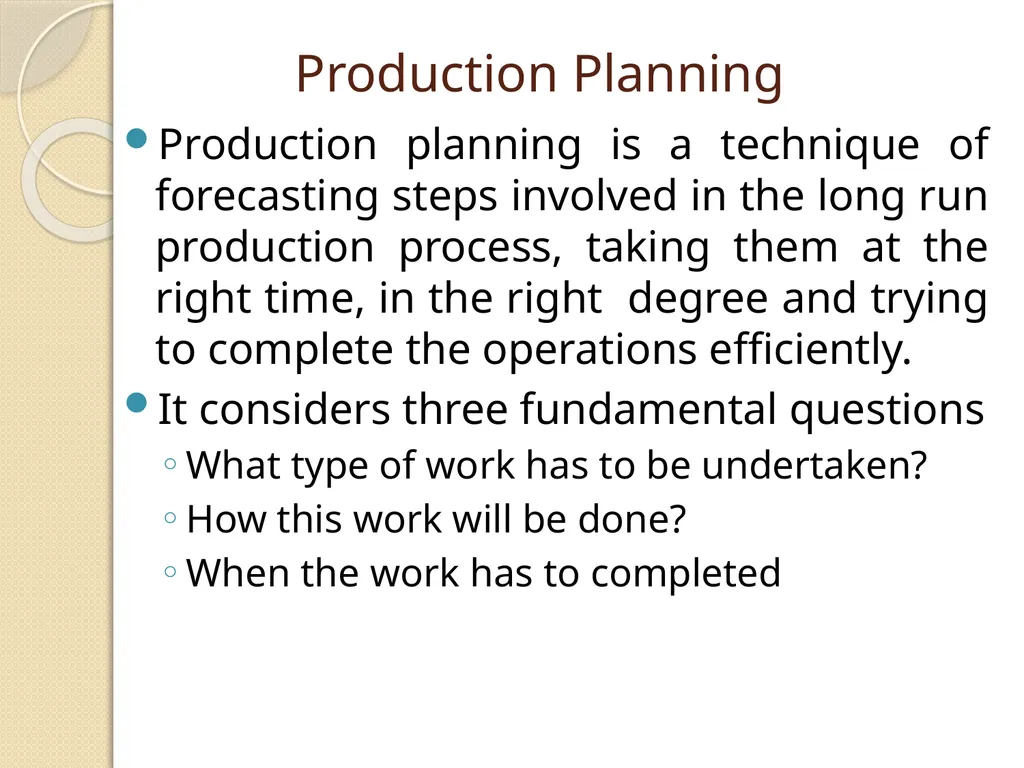
Production Planning Production planning is a technique of forecasting steps involved in the long run production process, taking them at the right time, in the right degree and trying to complete the operations efficiently.
It considers three fundamental questions
What type of work has to be undertaken?
How this work will be done?
When the work has to completed<br>
It considers three fundamental questions
What type of work has to be undertaken?
How this work will be done?
When the work has to completed<br>
06
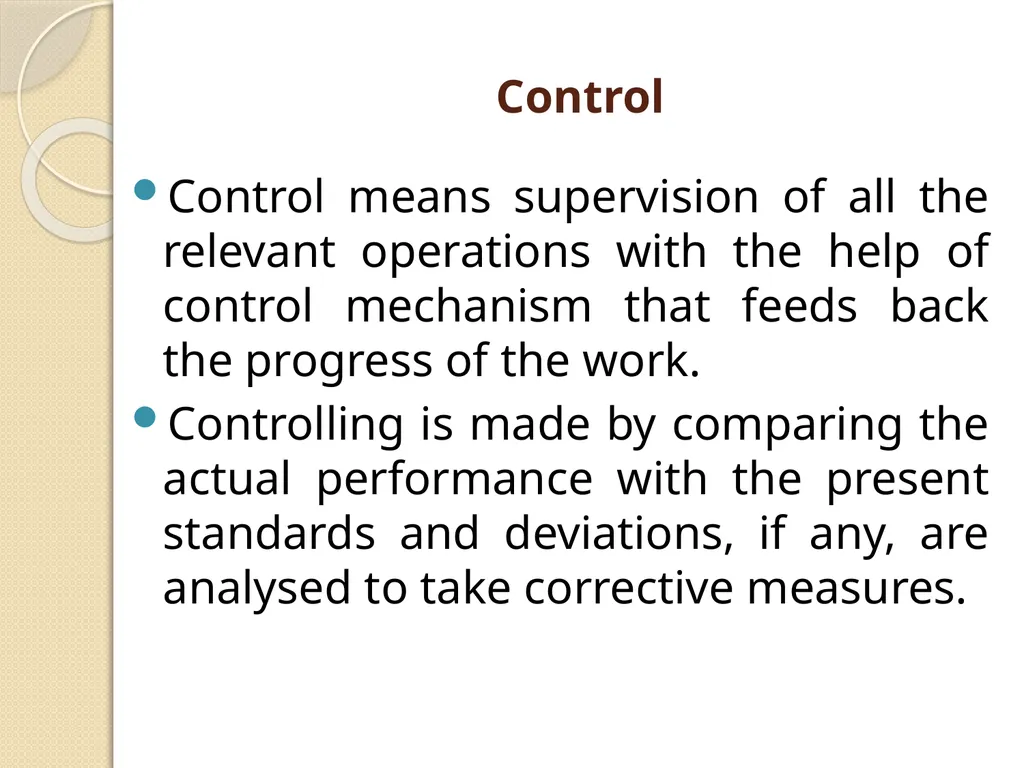
Control Control means supervision of all the relevant operations with the help of control mechanism that feeds back the progress of the work.
Controlling is made by comparing the actual performance with the present standards and deviations, if any, are analysed to take corrective measures.<br>
Controlling is made by comparing the actual performance with the present standards and deviations, if any, are analysed to take corrective measures.<br>
07
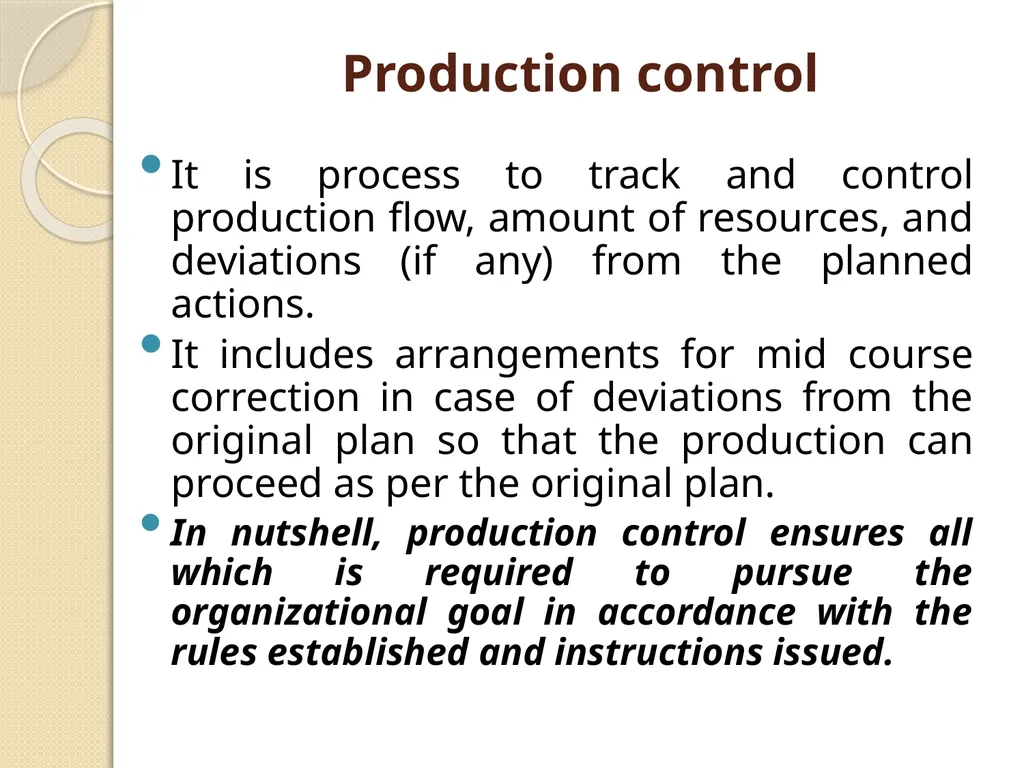
Production control It is process to track and control production flow, amount of resources, and deviations (if any) from the planned actions.
It includes arrangements for mid course correction in case of deviations from the original plan so that the production can proceed as per the original plan.
In nutshell, production control ensures all which is required to pursue the organizational goal in accordance with the rules established and instructions issued.<br>
It includes arrangements for mid course correction in case of deviations from the original plan so that the production can proceed as per the original plan.
In nutshell, production control ensures all which is required to pursue the organizational goal in accordance with the rules established and instructions issued.<br>
08
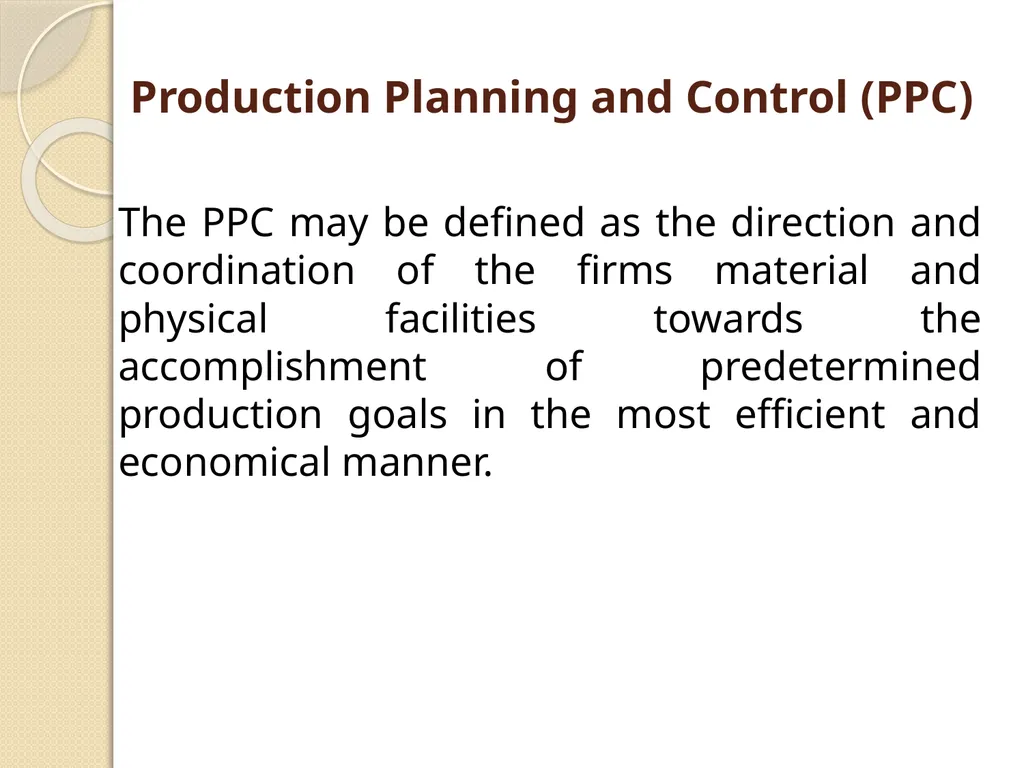
Production Planning and Control (PPC) The PPC may be defined as the direction and coordination of the firms material and physical facilities towards the accomplishment of predetermined production goals in the most efficient and economical manner.<br>
09
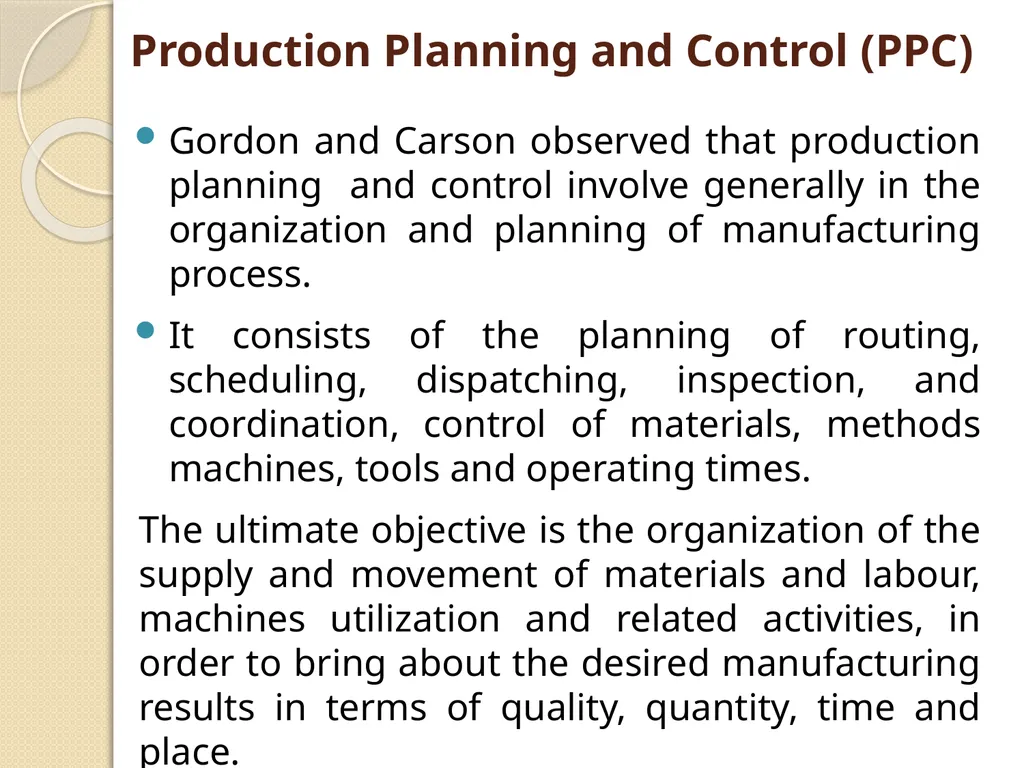
Production Planning and Control (PPC) Gordon and Carson observed that production planning and control involve generally in the organization and planning of manufacturing process.
It consists of the planning of routing, scheduling, dispatching, inspection, and coordination, control of materials, methods machines, tools and operating times.
The ultimate objective is the organization of the supply and movement of materials and labour, machines utilization and related activities, in order to bring about the desired manufacturing results in terms of quality, quantity, time and place.<br>
It consists of the planning of routing, scheduling, dispatching, inspection, and coordination, control of materials, methods machines, tools and operating times.
The ultimate objective is the organization of the supply and movement of materials and labour, machines utilization and related activities, in order to bring about the desired manufacturing results in terms of quality, quantity, time and place.<br>
10
PPC Contd.. Planning initiates action while control is an adjusting process, providing corrective measures for planned development.
Production control regulates and stimulates the manufacturing process from the beginning to the end.<br>
Production control regulates and stimulates the manufacturing process from the beginning to the end.<br>
11
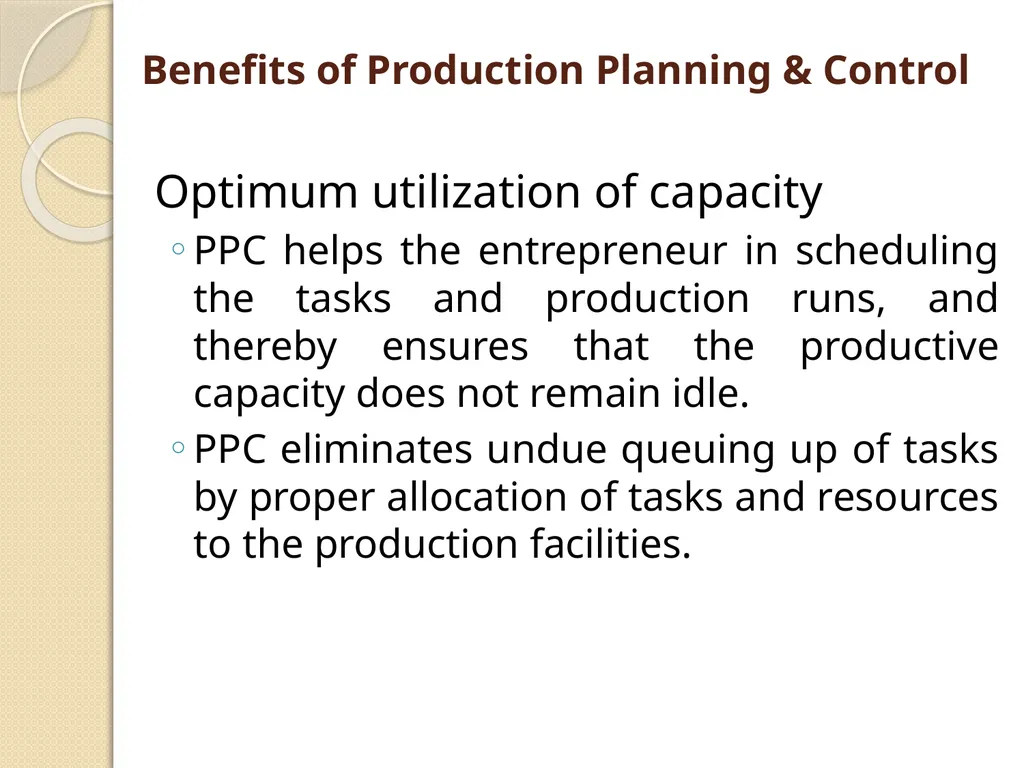
Benefits of Production Planning & Control Optimum utilization of capacity
PPC helps the entrepreneur in scheduling the tasks and production runs, and thereby ensures that the productive capacity does not remain idle.
PPC eliminates undue queuing up of tasks by proper allocation of tasks and resources to the production facilities.<br>
PPC helps the entrepreneur in scheduling the tasks and production runs, and thereby ensures that the productive capacity does not remain idle.
PPC eliminates undue queuing up of tasks by proper allocation of tasks and resources to the production facilities.<br>
12
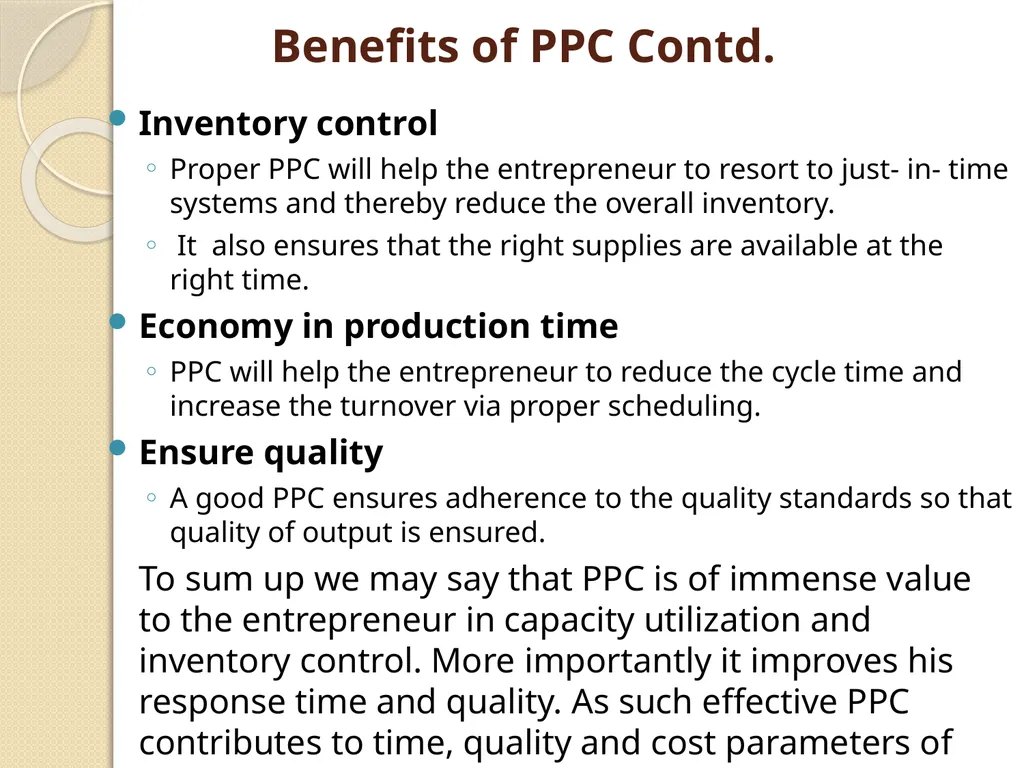
Benefits of PPC Contd. Inventory control
Proper PPC will help the entrepreneur to resort to just- in- time systems and thereby reduce the overall inventory.
It also ensures that the right supplies are available at the right time.
Economy in production time
PPC will help the entrepreneur to reduce the cycle time and increase the turnover via proper scheduling.
Ensure quality
A good PPC ensures adherence to the quality standards so that quality of output is ensured.
To sum up we may say that PPC is of immense value to the entrepreneur in capacity utilization and inventory control. More importantly it improves his response time and quality. As such effective PPC contributes to time, quality and cost parameters of entrepreneurial success.<br>
Proper PPC will help the entrepreneur to resort to just- in- time systems and thereby reduce the overall inventory.
It also ensures that the right supplies are available at the right time.
Economy in production time
PPC will help the entrepreneur to reduce the cycle time and increase the turnover via proper scheduling.
Ensure quality
A good PPC ensures adherence to the quality standards so that quality of output is ensured.
To sum up we may say that PPC is of immense value to the entrepreneur in capacity utilization and inventory control. More importantly it improves his response time and quality. As such effective PPC contributes to time, quality and cost parameters of entrepreneurial success.<br>
13
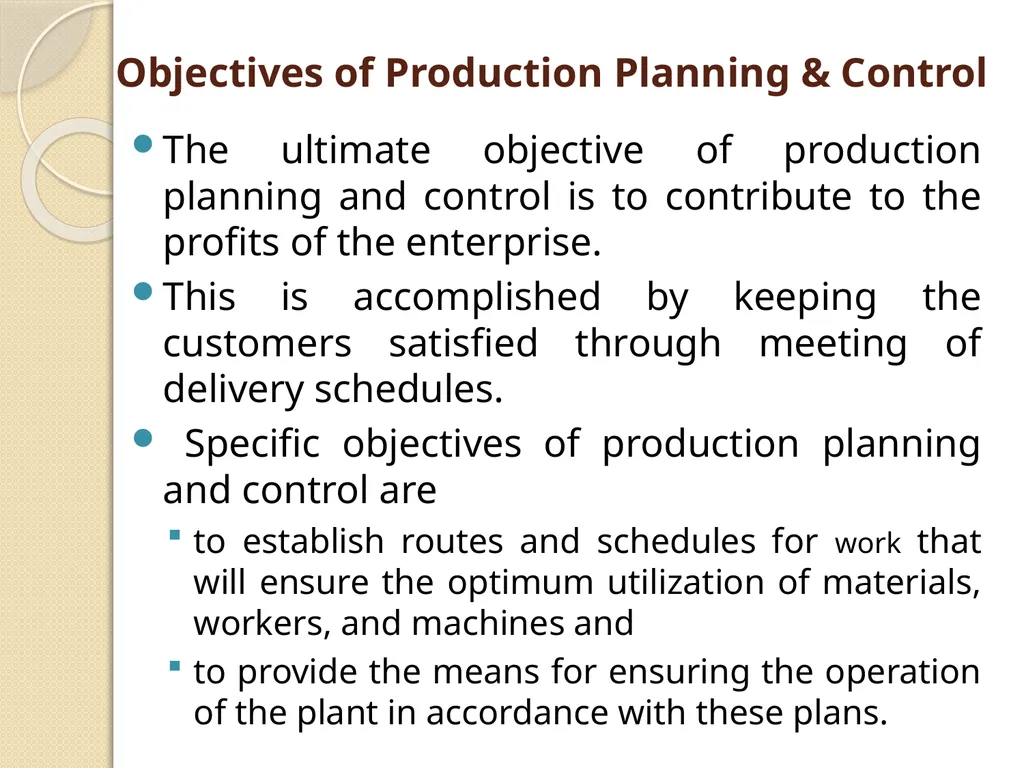
Objectives of Production Planning & Control The ultimate objective of production planning and control is to contribute to the profits of the enterprise.
This is accomplished by keeping the customers satisfied through meeting of delivery schedules.
Specific objectives of production planning and control are
to establish routes and schedules for work that will ensure the optimum utilization of materials, workers, and machines and
to provide the means for ensuring the operation of the plant in accordance with these plans.<br>
This is accomplished by keeping the customers satisfied through meeting of delivery schedules.
Specific objectives of production planning and control are
to establish routes and schedules for work that will ensure the optimum utilization of materials, workers, and machines and
to provide the means for ensuring the operation of the plant in accordance with these plans.<br>
14
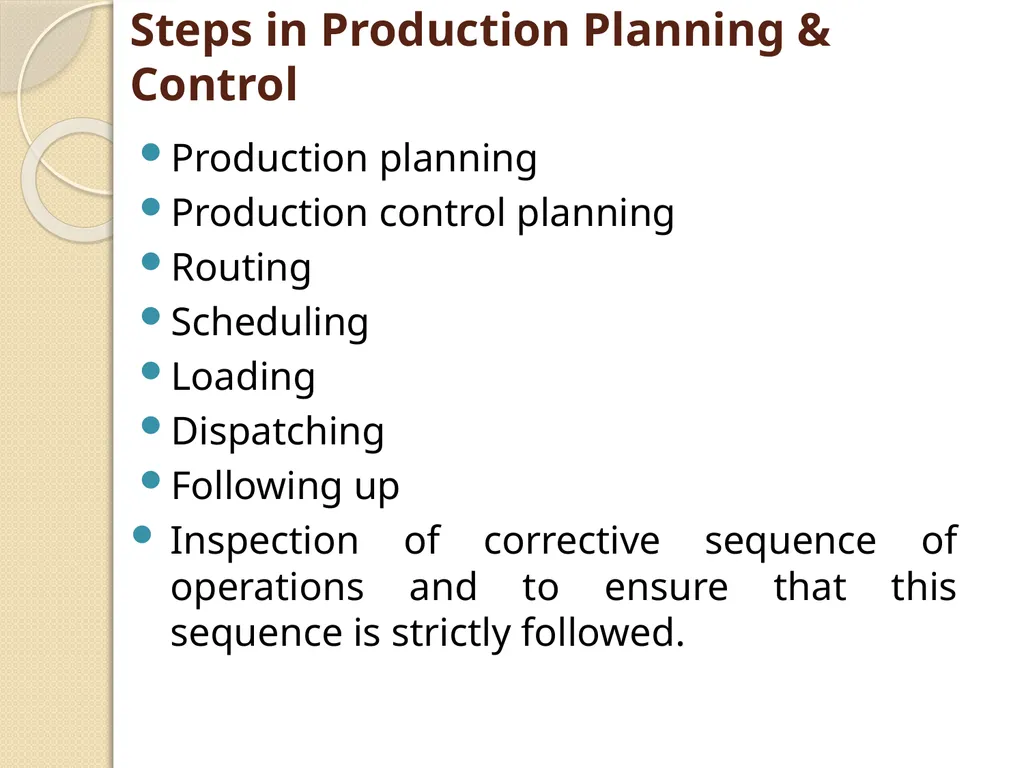
Steps in Production Planning & Control Production planning
Production control planning
Routing
Scheduling
Loading
Dispatching
Following up
Inspection of corrective sequence of operations and to ensure that this sequence is strictly followed.<br>
Production control planning
Routing
Scheduling
Loading
Dispatching
Following up
Inspection of corrective sequence of operations and to ensure that this sequence is strictly followed.<br>
15
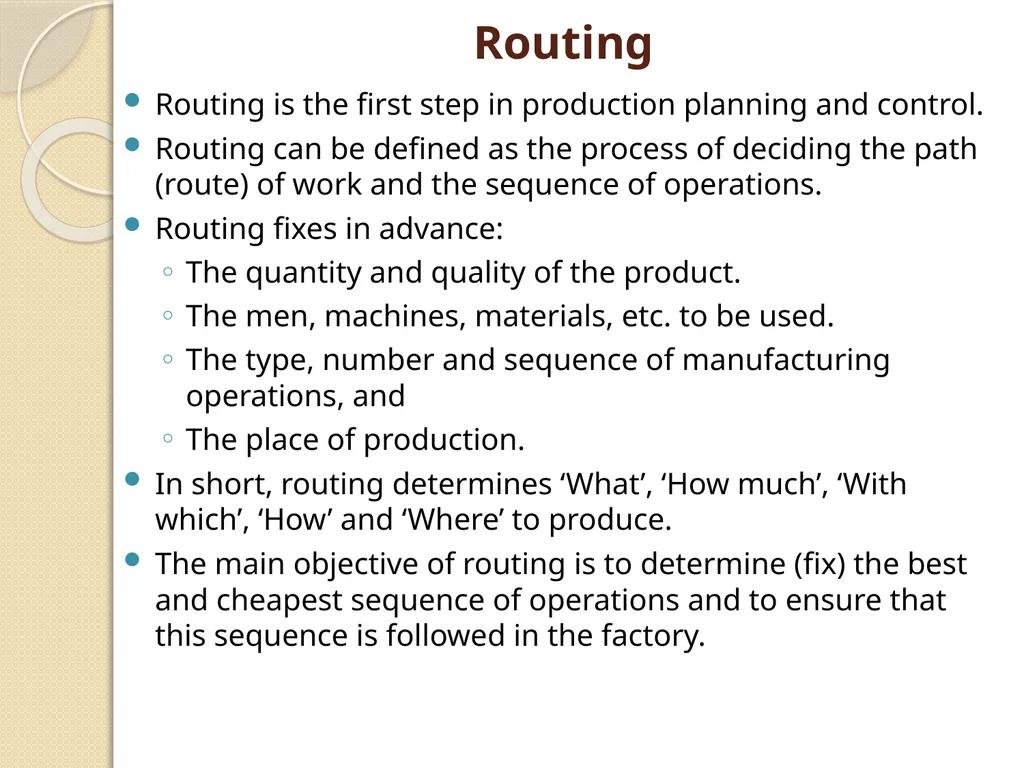
Routing Routing is the first step in production planning and control.
Routing can be defined as the process of deciding the path (route) of work and the sequence of operations.
Routing fixes in advance:
The quantity and quality of the product.
The men, machines, materials, etc. to be used.
The type, number and sequence of manufacturing operations, and
The place of production.
In short, routing determines ‘What’, ‘How much’, ‘With which’, ‘How’ and ‘Where’ to produce.
The main objective of routing is to determine (fix) the best and cheapest sequence of operations and to ensure that this sequence is followed in the factory.<br>
Routing can be defined as the process of deciding the path (route) of work and the sequence of operations.
Routing fixes in advance:
The quantity and quality of the product.
The men, machines, materials, etc. to be used.
The type, number and sequence of manufacturing operations, and
The place of production.
In short, routing determines ‘What’, ‘How much’, ‘With which’, ‘How’ and ‘Where’ to produce.
The main objective of routing is to determine (fix) the best and cheapest sequence of operations and to ensure that this sequence is followed in the factory.<br>
16
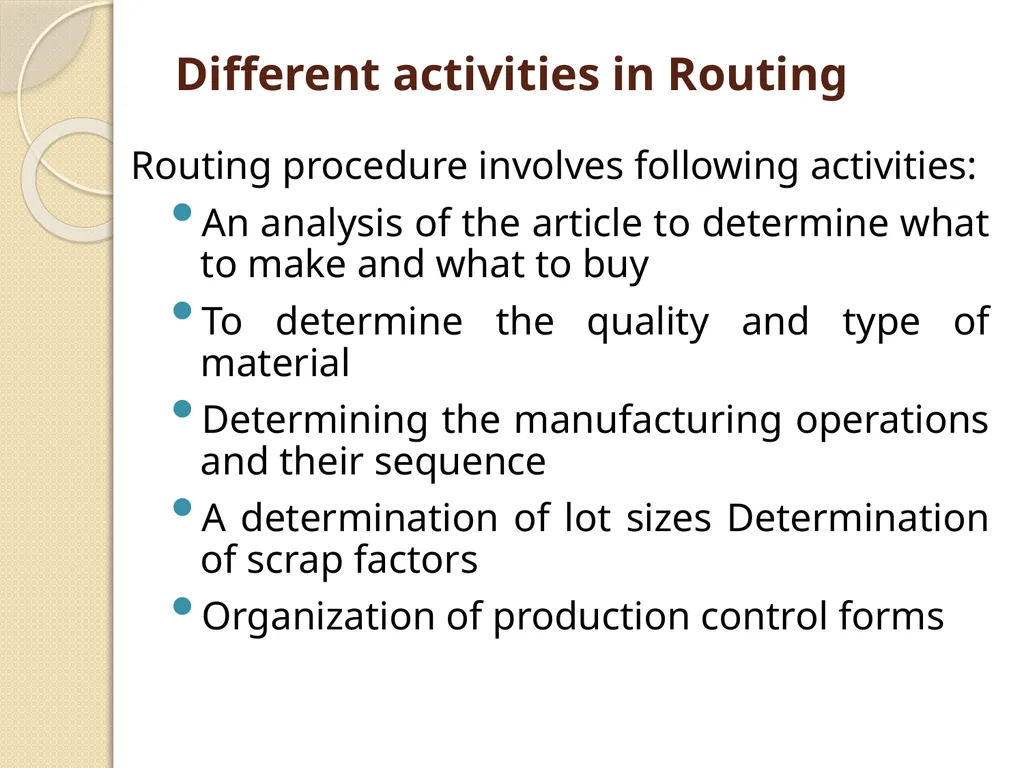
Different activities in Routing Routing procedure involves following activities:
An analysis of the article to determine what to make and what to buy
To determine the quality and type of material
Determining the manufacturing operations and their sequence
A determination of lot sizes Determination of scrap factors
Organization of production control forms<br>
An analysis of the article to determine what to make and what to buy
To determine the quality and type of material
Determining the manufacturing operations and their sequence
A determination of lot sizes Determination of scrap factors
Organization of production control forms<br>
17
Loading The next step is the execution of the schedule plan as per the route chalked out which includes the assignment of the work to the operators at their machines or work places.
Gantt Charts are most commonly used in small industries in order to determine the existing load and also to foresee how fast a job can be done.
It is a type of bar chart that illustrates project schedule.
The charts explain the start and finish dates of terminal elements and summary elements of a project.<br>
Gantt Charts are most commonly used in small industries in order to determine the existing load and also to foresee how fast a job can be done.
It is a type of bar chart that illustrates project schedule.
The charts explain the start and finish dates of terminal elements and summary elements of a project.<br>
18
Scheduling Scheduling is the last of the planning functions.
It determines when an operation is to be performed, or when work is to be completed; the difference lies in the detail of the scheduling procedure.
In a centralized control situation - where all process planning, loading, and scheduling for the plant are done in a central office- the details of the schedule may specify the starting and finishing time for an operation.
On the other hand, the central schedule may simply give a completion time for the work in a given department.<br>
It determines when an operation is to be performed, or when work is to be completed; the difference lies in the detail of the scheduling procedure.
In a centralized control situation - where all process planning, loading, and scheduling for the plant are done in a central office- the details of the schedule may specify the starting and finishing time for an operation.
On the other hand, the central schedule may simply give a completion time for the work in a given department.<br>
19
Production control Production control is the process of planning production in advance of operations, establishing the exact route of each individual item part
or assembly, setting, starting and finishing for each important item
or the finishing production and releasing the necessary orders as well as initiating the necessary follow-up to have the smooth function of the enterprise<br>
or assembly, setting, starting and finishing for each important item
or the finishing production and releasing the necessary orders as well as initiating the necessary follow-up to have the smooth function of the enterprise<br>
20
Dispatching Dispatching is release of orders and instructions for starting of the production of an item as per the route sheet and schedule chart.
Movement of materials to different workstations
Movement of tools and fixtures necessary for each operation
Beginning of work on each operation
Recording of time and cost involved in each operation
Movement of work from one operation to another in accordance with the route sheet
Inspecting or supervision of work
Dispatching is an important step as it translates production plans into production.<br>
Movement of materials to different workstations
Movement of tools and fixtures necessary for each operation
Beginning of work on each operation
Recording of time and cost involved in each operation
Movement of work from one operation to another in accordance with the route sheet
Inspecting or supervision of work
Dispatching is an important step as it translates production plans into production.<br>
21
Follow Up Every production programme involves determination of the progress of work, removing bottlenecks in the flow of work and ensuring that the productive operations are taking place in accordance with the plans.
Follow up delays or deviations from the production plans.
It helps to reveal defects in routing and scheduling, misunderstanding of orders and instructions, under loading or overloading of work etc.<br>
Follow up delays or deviations from the production plans.
It helps to reveal defects in routing and scheduling, misunderstanding of orders and instructions, under loading or overloading of work etc.<br>
22
Inspection
This is mainly to ensure the quality of goods. It can be required as effective agency of production control.
Corrective measures
Corrective action may involve any of those activities of adjusting the route, rescheduling of work, changing the workloads, repairs and maintenance of machinery or equipment, control over inventories of the cause of deviation is the poor performance of the employees. Certain personnel decisions like training, transfer, demotion etc. may have to be taken.
Re-planning
Re-planning is not a corrective action. Re-planning revises routes, loads, and schedules; a new plan is developed. In manufacturing this is often required. Changes in market conditions, manufacturing methods, or many other factors affecting the plant will often call for re-planning.<br>
This is mainly to ensure the quality of goods. It can be required as effective agency of production control.
Corrective measures
Corrective action may involve any of those activities of adjusting the route, rescheduling of work, changing the workloads, repairs and maintenance of machinery or equipment, control over inventories of the cause of deviation is the poor performance of the employees. Certain personnel decisions like training, transfer, demotion etc. may have to be taken.
Re-planning
Re-planning is not a corrective action. Re-planning revises routes, loads, and schedules; a new plan is developed. In manufacturing this is often required. Changes in market conditions, manufacturing methods, or many other factors affecting the plant will often call for re-planning.<br>