
Professional Learning series: New Jersey Tiered
PM
Published · 26 slides · 0 views

1 / 1

Description
Professional Learning series: New Jersey Tiered System of Supports (NJTSS) Data-Based Decision Making Office of Student Support Services Division of Educational Services Quote Every student can learn, just not on the same day, or the same
Related Topics
Share
Embed code
Download this presentation From Below
"Professional Learning series: New Jersey Tiered" is the property of its rightful owner. Permission is granted to download and print the materials on this website for personal, non-commercial use only, and to display it on your personal computer provided you do not modify the materials and that you retain all copyright notices contained in the materials. By downloading content from our website, you accept the terms of this agreement.
Presentation Transcript
01
Professional Learning series:
New Jersey Tiered System of Supports (NJTSS) Data-Based Decision Making Office of Student Support Services
Division of Educational Services<br>
Division of Educational Services<br>
02
Quote “Every student can learn, just not on the same day, or the same way.” George Evans 2<br>
03
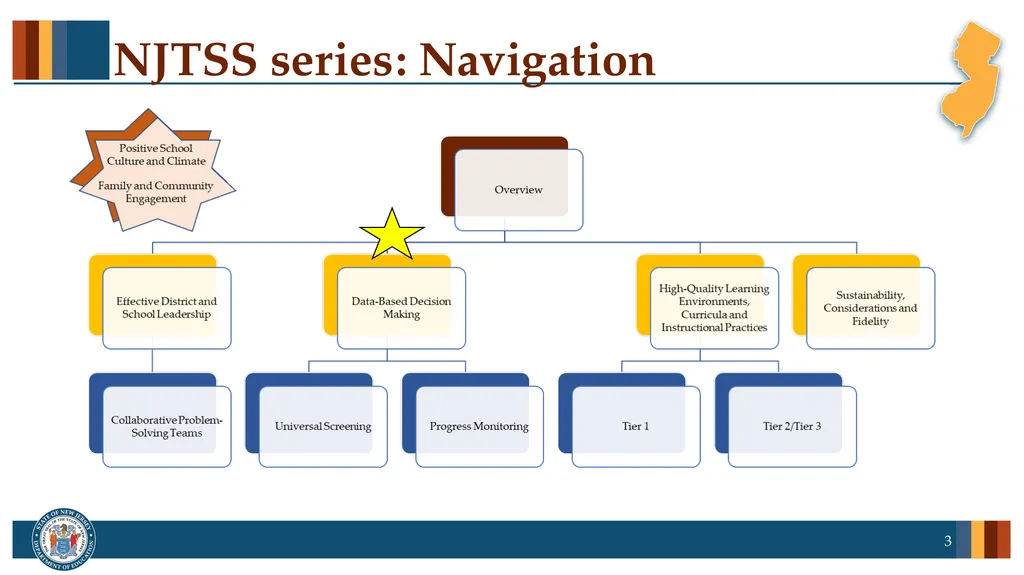
NJTSS series: Navigation 3<br>
04
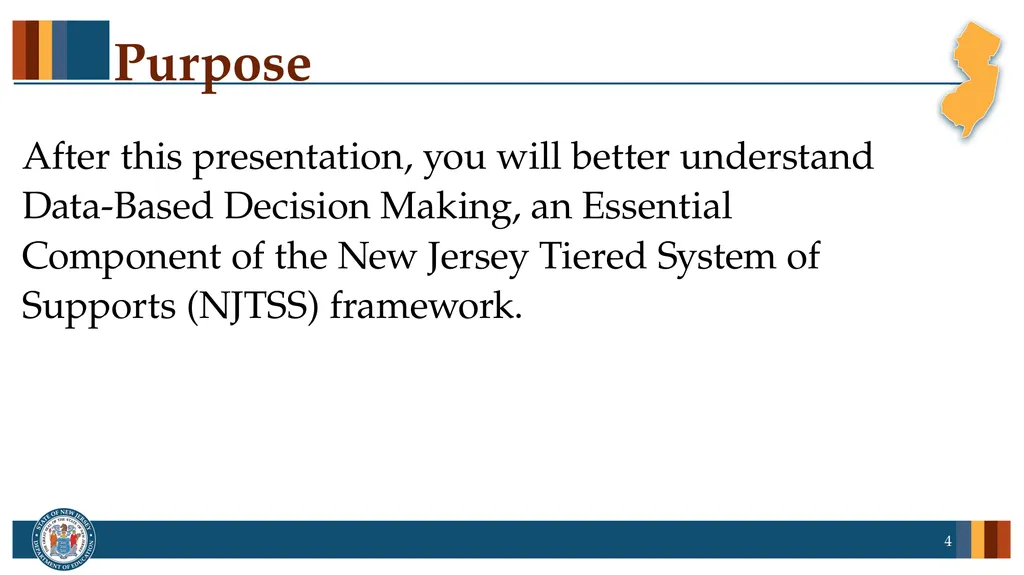
Purpose After this presentation, you will better understand Data-Based Decision Making, an Essential Component of the New Jersey Tiered System of Supports (NJTSS) framework. 4<br>
05
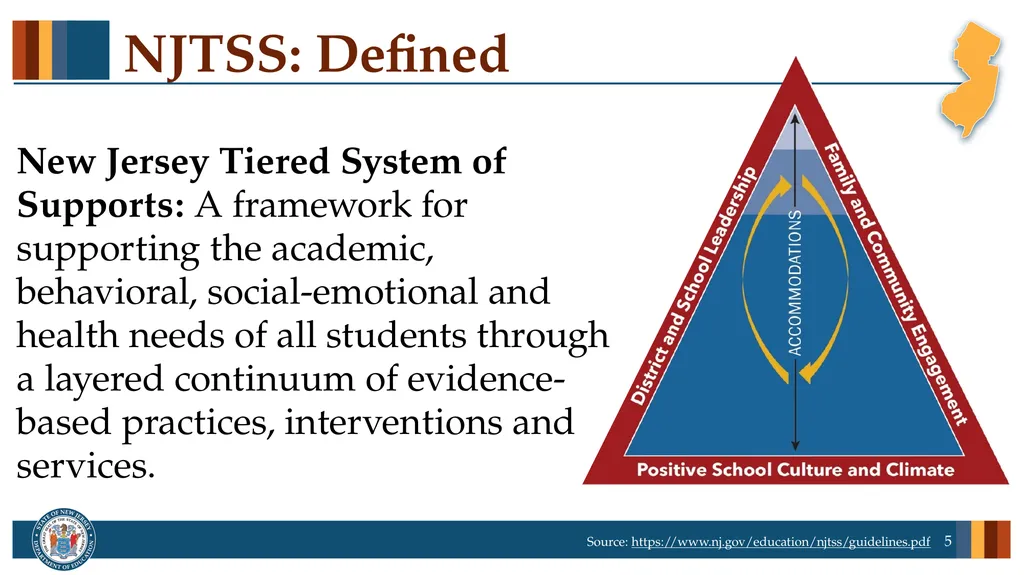
NJTSS: Defined New Jersey Tiered System of Supports: A framework for supporting the academic, behavioral, social-emotional and health needs of all students through a layered continuum of evidence-based practices, interventions and services. Source: https://www.nj.gov/education/njtss/guidelines.pdf 5<br>
06
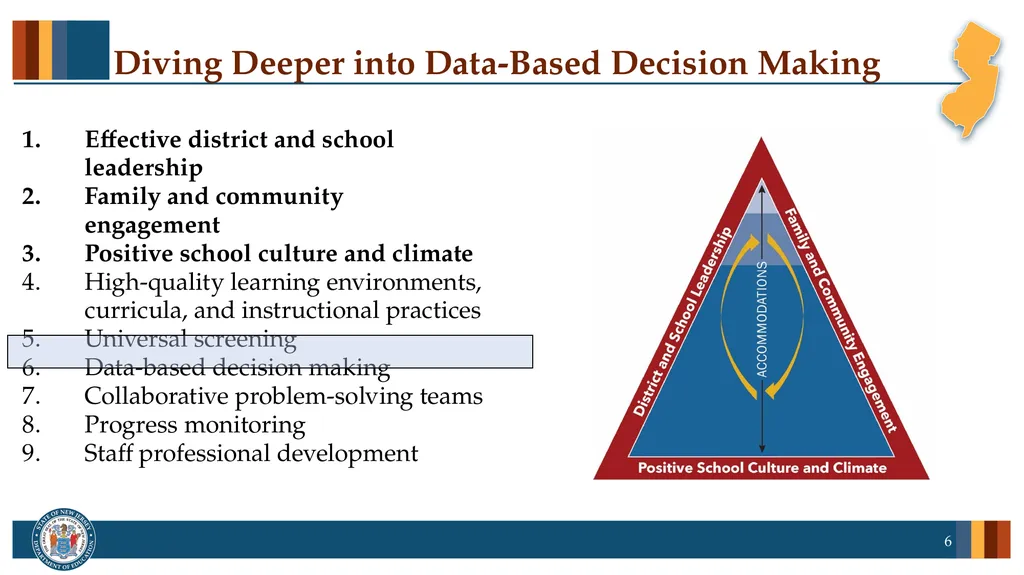
Diving Deeper into Data-Based Decision Making Effective district and school leadership
Family and community engagement
Positive school culture and climate
High-quality learning environments, curricula, and instructional practices
Universal screening
Data-based decision making
Collaborative problem-solving teams
Progress monitoring
Staff professional development 6<br>
Family and community engagement
Positive school culture and climate
High-quality learning environments, curricula, and instructional practices
Universal screening
Data-based decision making
Collaborative problem-solving teams
Progress monitoring
Staff professional development 6<br>
07
Data-Based Decision Making (1 of 2) Definition
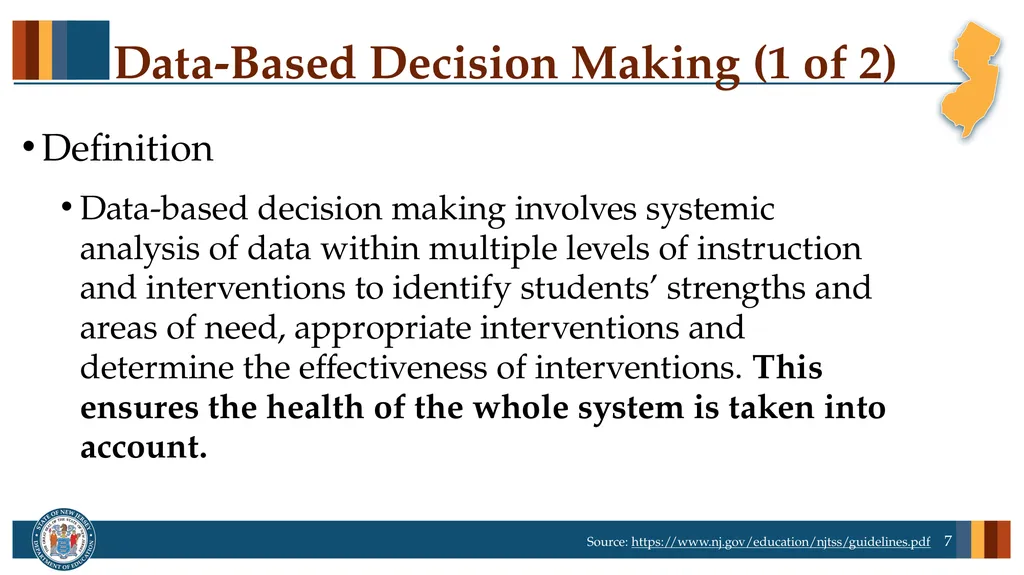
Data-based decision making involves systemic analysis of data within multiple levels of instruction and interventions to identify students’ strengths and areas of need, appropriate interventions and determine the effectiveness of interventions. This ensures the health of the whole system is taken into account. Source: https://www.nj.gov/education/njtss/guidelines.pdf 7<br>
Data-based decision making involves systemic analysis of data within multiple levels of instruction and interventions to identify students’ strengths and areas of need, appropriate interventions and determine the effectiveness of interventions. This ensures the health of the whole system is taken into account. Source: https://www.nj.gov/education/njtss/guidelines.pdf 7<br>
08
Data-Based Decision Making (2 of 2) An ongoing, outcomes driven approach.
Analyze screening and progress monitoring data to determine how to best address system and students’ skill needs.
Clearly-specified, data-based decision rules are used to guide intervention selection and modification.
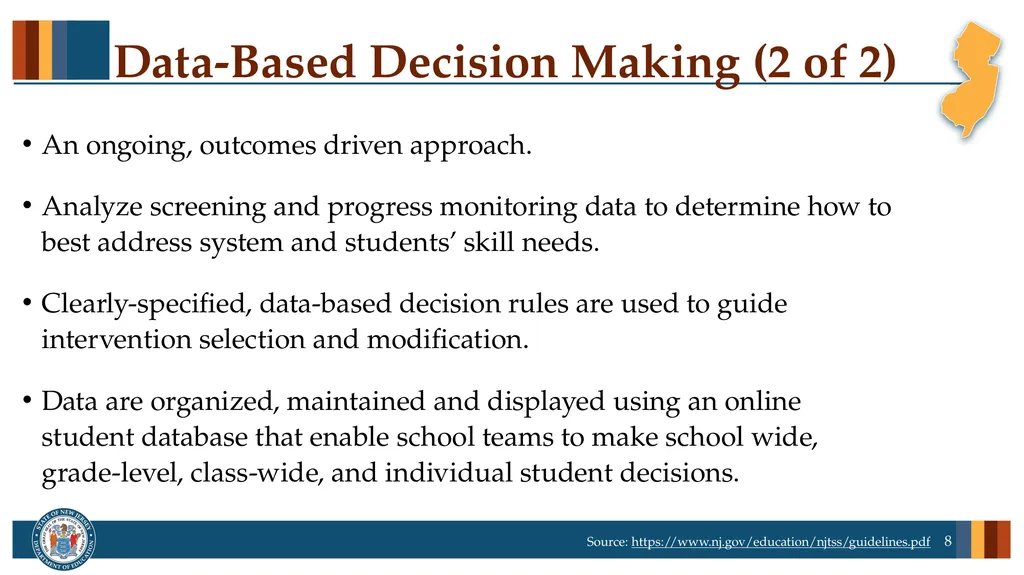
Data are organized, maintained and displayed using an online student database that enable school teams to make school wide, grade-level, class-wide, and individual student decisions. Source: https://www.nj.gov/education/njtss/guidelines.pdf 8<br>
Analyze screening and progress monitoring data to determine how to best address system and students’ skill needs.
Clearly-specified, data-based decision rules are used to guide intervention selection and modification.
Data are organized, maintained and displayed using an online student database that enable school teams to make school wide, grade-level, class-wide, and individual student decisions. Source: https://www.nj.gov/education/njtss/guidelines.pdf 8<br>
09
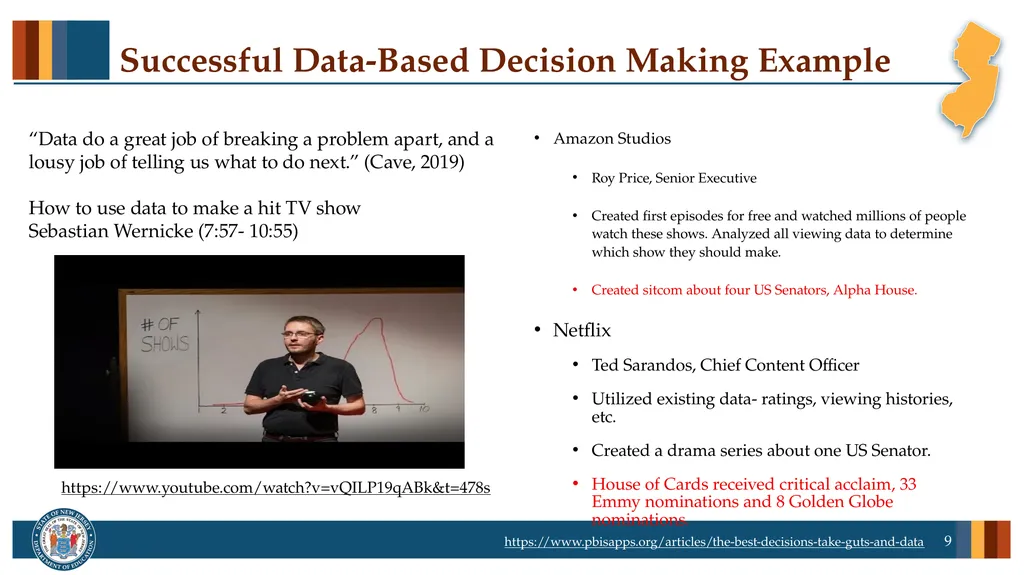
Successful Data-Based Decision Making Example “Data do a great job of breaking a problem apart, and a lousy job of telling us what to do next.” (Cave, 2019)
How to use data to make a hit TV show
Sebastian Wernicke (7:57- 10:55) https://www.youtube.com/watch?v=vQILP19qABk&t=478s Amazon Studios
Roy Price, Senior Executive
Created first episodes for free and watched millions of people watch these shows. Analyzed all viewing data to determine which show they should make.
Created sitcom about four US Senators, Alpha House. Netflix
Ted Sarandos, Chief Content Officer
Utilized existing data- ratings, viewing histories, etc.
Created a drama series about one US Senator.
House of Cards received critical acclaim, 33 Emmy nominations and 8 Golden Globe nominations. https://www.pbisapps.org/articles/the-best-decisions-take-guts-and-data 9<br>
How to use data to make a hit TV show
Sebastian Wernicke (7:57- 10:55) https://www.youtube.com/watch?v=vQILP19qABk&t=478s Amazon Studios
Roy Price, Senior Executive
Created first episodes for free and watched millions of people watch these shows. Analyzed all viewing data to determine which show they should make.
Created sitcom about four US Senators, Alpha House. Netflix
Ted Sarandos, Chief Content Officer
Utilized existing data- ratings, viewing histories, etc.
Created a drama series about one US Senator.
House of Cards received critical acclaim, 33 Emmy nominations and 8 Golden Globe nominations. https://www.pbisapps.org/articles/the-best-decisions-take-guts-and-data 9<br>
10
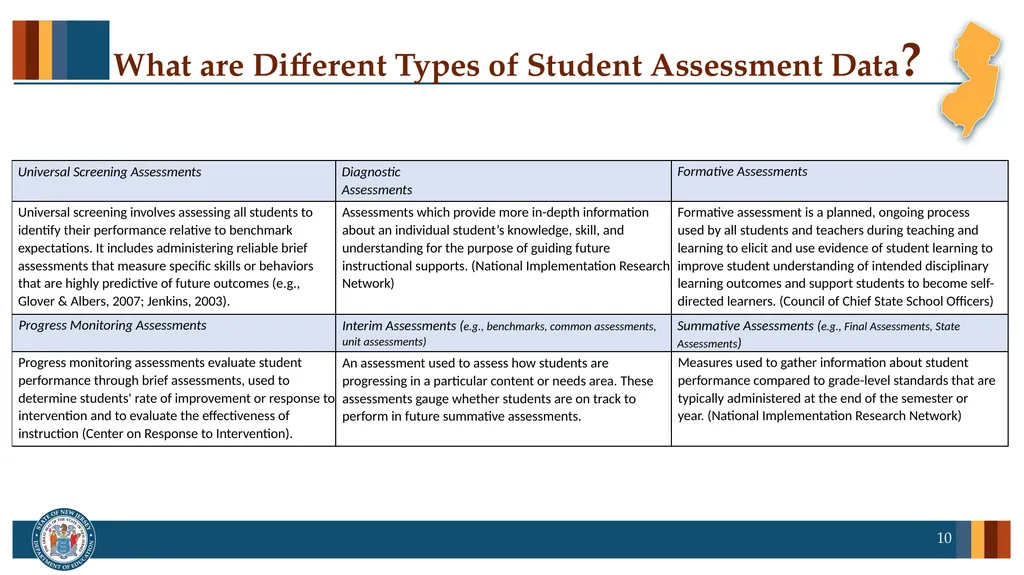
What are Different Types of Student Assessment Data? Universal Screening Assessments Universal screening involves assessing all students to identify their performance relative to benchmark expectations. It includes administering reliable brief assessments that measure specific skills or behaviors that are highly predictive of future outcomes (e.g., Glover & Albers, 2007; Jenkins, 2003). Diagnostic Assessments Assessments which provide more in-depth information about an individual student’s knowledge, skill, and understanding for the purpose of guiding future instructional supports. (National Implementation Research Network) Formative Assessments Formative assessment is a planned, ongoing process used by all students and teachers during teaching and learning to elicit and use evidence of student learning to improve student understanding of intended disciplinary learning outcomes and support students to become self-directed learners. (Council of Chief State School Officers) Progress Monitoring Assessments Progress monitoring assessments evaluate student performance through brief assessments, used to determine students' rate of improvement or response to intervention and to evaluate the effectiveness of instruction (Center on Response to Intervention). Interim Assessments (e.g., benchmarks, common assessments, unit assessments) An assessment used to assess how students are progressing in a particular content or needs area. These assessments gauge whether students are on track to perform in future summative assessments. Summative Assessments (e.g., Final Assessments, State Assessments) Measures used to gather information about student performance compared to grade-level standards that are typically administered at the end of the semester or year. (National Implementation Research Network) 10<br>
11
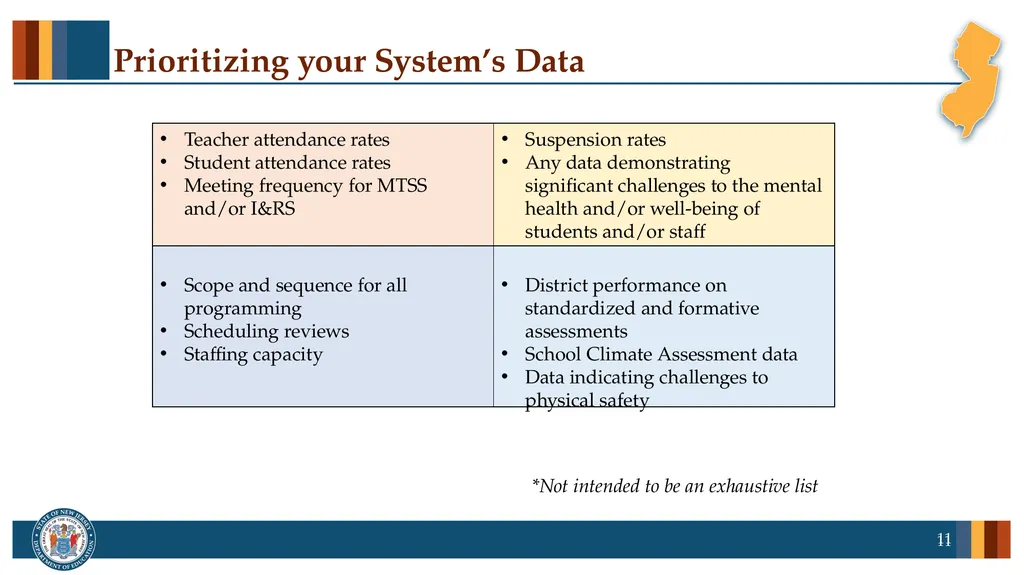
Prioritizing your System’s Data Teacher attendance rates
Student attendance rates
Meeting frequency for MTSS and/or I&RS Suspension rates
Any data demonstrating significant challenges to the mental health and/or well-being of students and/or staff Scope and sequence for all programming
Scheduling reviews
Staffing capacity District performance on standardized and formative assessments
School Climate Assessment data
Data indicating challenges to physical safety *Not intended to be an exhaustive list 11<br>
Student attendance rates
Meeting frequency for MTSS and/or I&RS Suspension rates
Any data demonstrating significant challenges to the mental health and/or well-being of students and/or staff Scope and sequence for all programming
Scheduling reviews
Staffing capacity District performance on standardized and formative assessments
School Climate Assessment data
Data indicating challenges to physical safety *Not intended to be an exhaustive list 11<br>
12
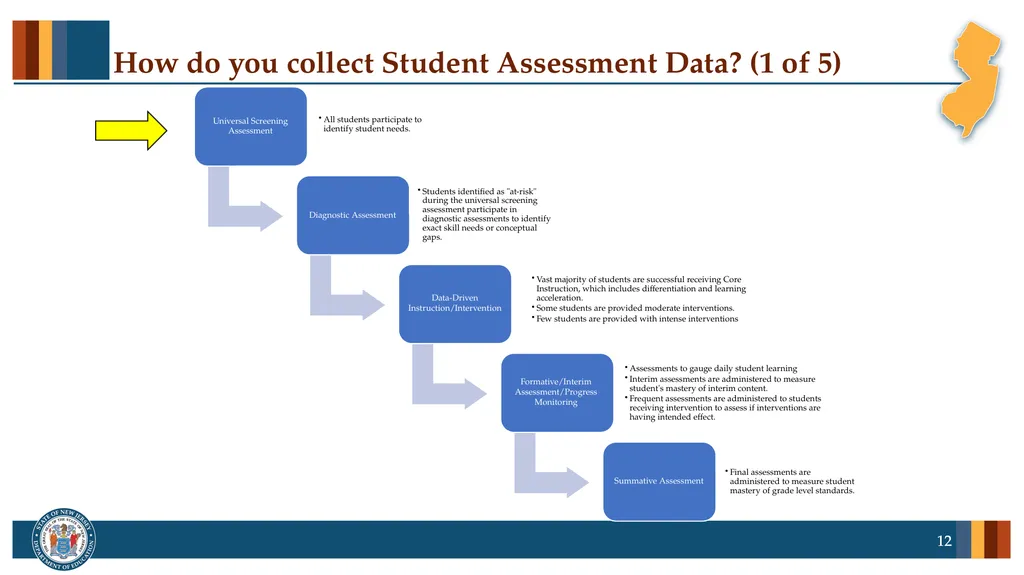
How do you collect Student Assessment Data? (1 of 5) Universal Screening Assessment All students participate to identify student needs. Diagnostic Assessment Students identified as "at-risk" during the universal screening assessment participate in diagnostic assessments to identify exact skill needs or conceptual gaps. Data-Driven Instruction/Intervention Vast majority of students are successful receiving Core Instruction, which includes differentiation and learning acceleration.
Some students are provided moderate interventions.
Few students are provided with intense interventions Formative/Interim Assessment/Progress Monitoring Assessments to gauge daily student learning
Interim assessments are administered to measure student's mastery of interim content.
Frequent assessments are administered to students receiving intervention to assess if interventions are having intended effect. Summative Assessment Final assessments are administered to measure student mastery of grade level standards. 12<br>
Some students are provided moderate interventions.
Few students are provided with intense interventions Formative/Interim Assessment/Progress Monitoring Assessments to gauge daily student learning
Interim assessments are administered to measure student's mastery of interim content.
Frequent assessments are administered to students receiving intervention to assess if interventions are having intended effect. Summative Assessment Final assessments are administered to measure student mastery of grade level standards. 12<br>
13
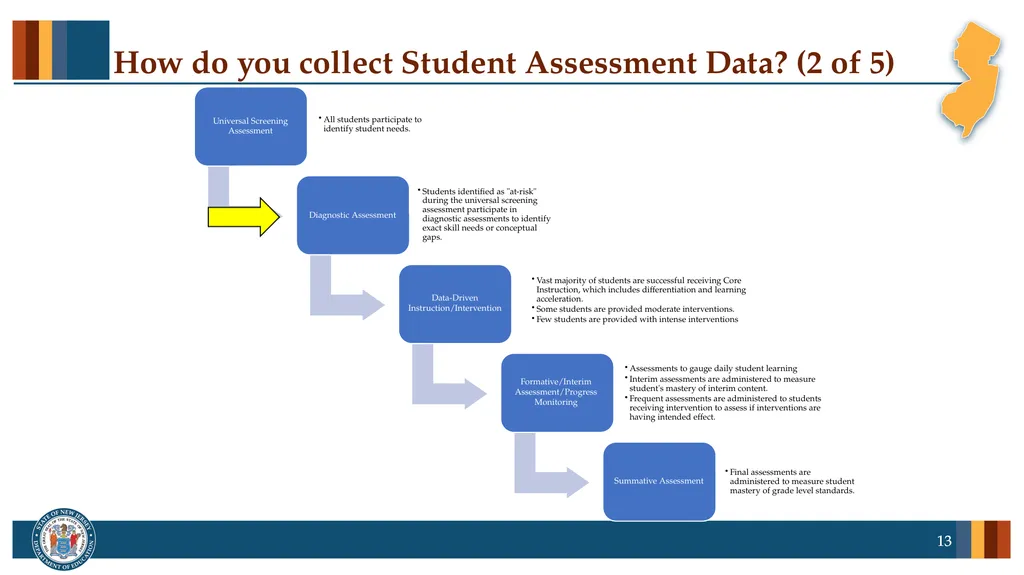
How do you collect Student Assessment Data? (2 of 5) Universal Screening Assessment All students participate to identify student needs. Diagnostic Assessment Students identified as "at-risk" during the universal screening assessment participate in diagnostic assessments to identify exact skill needs or conceptual gaps. Data-Driven Instruction/Intervention Vast majority of students are successful receiving Core Instruction, which includes differentiation and learning acceleration.
Some students are provided moderate interventions.
Few students are provided with intense interventions Formative/Interim Assessment/Progress Monitoring Assessments to gauge daily student learning
Interim assessments are administered to measure student's mastery of interim content.
Frequent assessments are administered to students receiving intervention to assess if interventions are having intended effect. Summative Assessment Final assessments are administered to measure student mastery of grade level standards. 13<br>
Some students are provided moderate interventions.
Few students are provided with intense interventions Formative/Interim Assessment/Progress Monitoring Assessments to gauge daily student learning
Interim assessments are administered to measure student's mastery of interim content.
Frequent assessments are administered to students receiving intervention to assess if interventions are having intended effect. Summative Assessment Final assessments are administered to measure student mastery of grade level standards. 13<br>
14
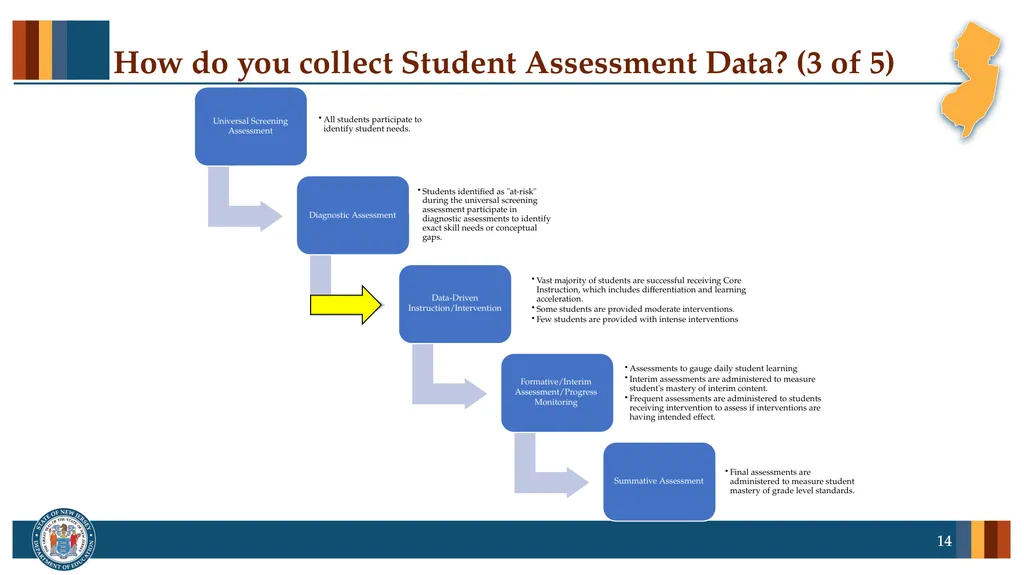
How do you collect Student Assessment Data? (3 of 5) Universal Screening Assessment All students participate to identify student needs. Diagnostic Assessment Students identified as "at-risk" during the universal screening assessment participate in diagnostic assessments to identify exact skill needs or conceptual gaps. Data-Driven Instruction/Intervention Vast majority of students are successful receiving Core Instruction, which includes differentiation and learning acceleration.
Some students are provided moderate interventions.
Few students are provided with intense interventions Formative/Interim Assessment/Progress Monitoring Assessments to gauge daily student learning
Interim assessments are administered to measure student's mastery of interim content.
Frequent assessments are administered to students receiving intervention to assess if interventions are having intended effect. Summative Assessment Final assessments are administered to measure student mastery of grade level standards. 14<br>
Some students are provided moderate interventions.
Few students are provided with intense interventions Formative/Interim Assessment/Progress Monitoring Assessments to gauge daily student learning
Interim assessments are administered to measure student's mastery of interim content.
Frequent assessments are administered to students receiving intervention to assess if interventions are having intended effect. Summative Assessment Final assessments are administered to measure student mastery of grade level standards. 14<br>
15
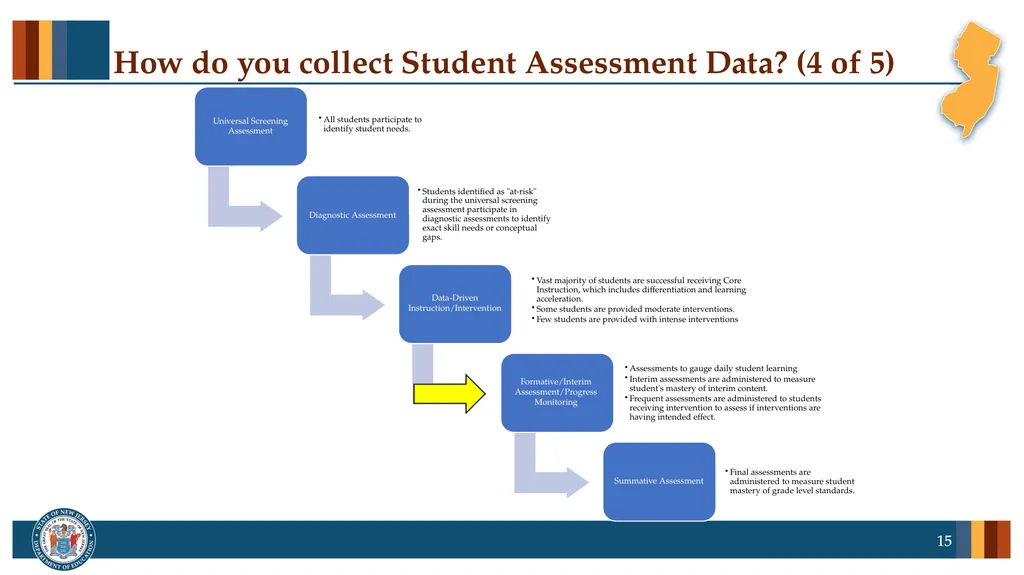
How do you collect Student Assessment Data? (4 of 5) Universal Screening Assessment All students participate to identify student needs. Diagnostic Assessment Students identified as "at-risk" during the universal screening assessment participate in diagnostic assessments to identify exact skill needs or conceptual gaps. Data-Driven Instruction/Intervention Vast majority of students are successful receiving Core Instruction, which includes differentiation and learning acceleration.
Some students are provided moderate interventions.
Few students are provided with intense interventions Formative/Interim Assessment/Progress Monitoring Assessments to gauge daily student learning
Interim assessments are administered to measure student's mastery of interim content.
Frequent assessments are administered to students receiving intervention to assess if interventions are having intended effect. Summative Assessment Final assessments are administered to measure student mastery of grade level standards. 15<br>
Some students are provided moderate interventions.
Few students are provided with intense interventions Formative/Interim Assessment/Progress Monitoring Assessments to gauge daily student learning
Interim assessments are administered to measure student's mastery of interim content.
Frequent assessments are administered to students receiving intervention to assess if interventions are having intended effect. Summative Assessment Final assessments are administered to measure student mastery of grade level standards. 15<br>
16
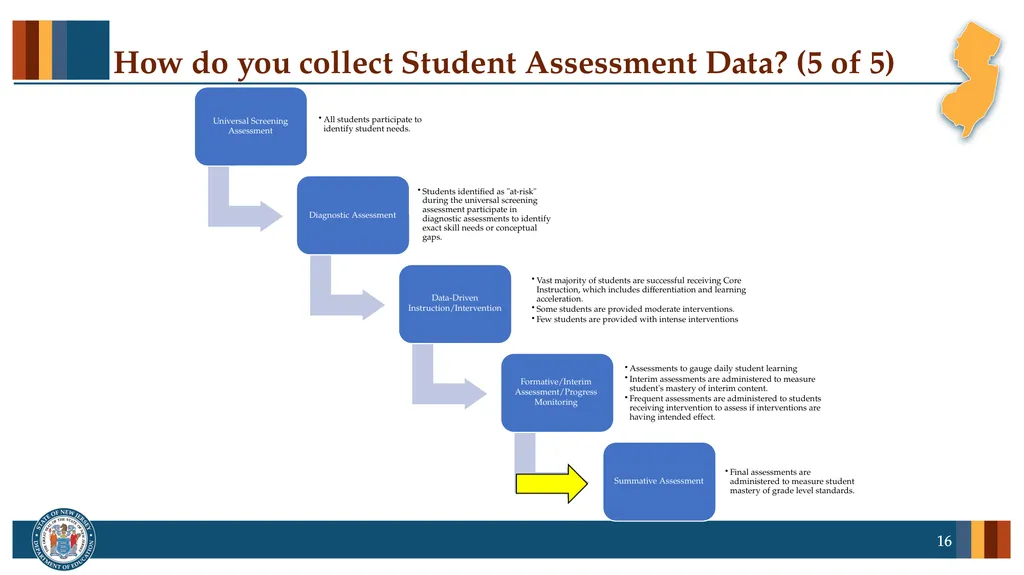
How do you collect Student Assessment Data? (5 of 5) Universal Screening Assessment All students participate to identify student needs. Diagnostic Assessment Students identified as "at-risk" during the universal screening assessment participate in diagnostic assessments to identify exact skill needs or conceptual gaps. Data-Driven Instruction/Intervention Vast majority of students are successful receiving Core Instruction, which includes differentiation and learning acceleration.
Some students are provided moderate interventions.
Few students are provided with intense interventions Formative/Interim Assessment/Progress Monitoring Assessments to gauge daily student learning
Interim assessments are administered to measure student's mastery of interim content.
Frequent assessments are administered to students receiving intervention to assess if interventions are having intended effect. Summative Assessment Final assessments are administered to measure student mastery of grade level standards. 16<br>
Some students are provided moderate interventions.
Few students are provided with intense interventions Formative/Interim Assessment/Progress Monitoring Assessments to gauge daily student learning
Interim assessments are administered to measure student's mastery of interim content.
Frequent assessments are administered to students receiving intervention to assess if interventions are having intended effect. Summative Assessment Final assessments are administered to measure student mastery of grade level standards. 16<br>
17
New Jersey Annual School Planning Process What do you do with Data?
Identify needs for instructional system improvements
Identify needs for students Source: https://www.state.nj.us/education/ESSA/asp/ 17<br>
Identify needs for instructional system improvements
Identify needs for students Source: https://www.state.nj.us/education/ESSA/asp/ 17<br>
18
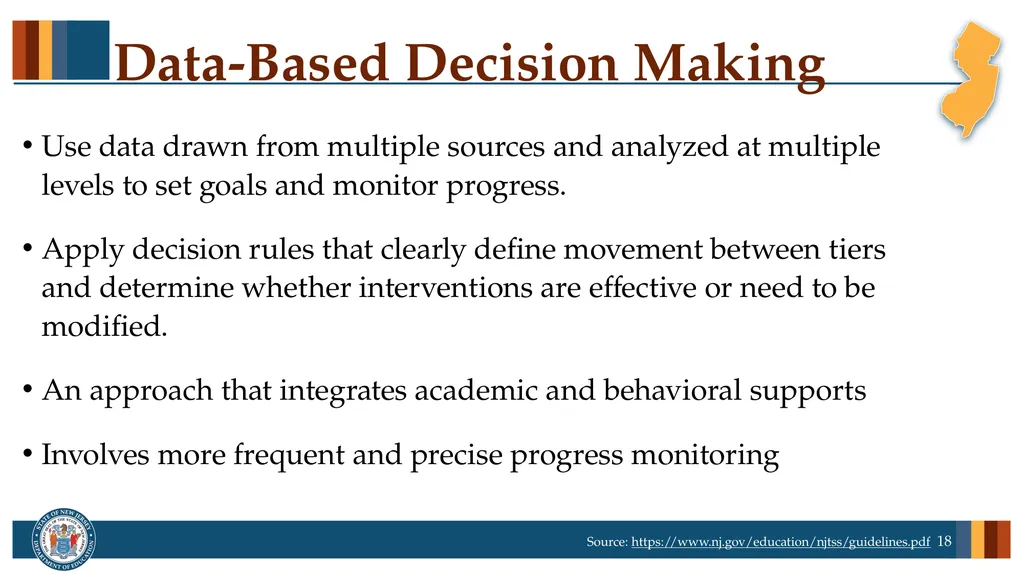
Data-Based Decision Making Use data drawn from multiple sources and analyzed at multiple levels to set goals and monitor progress.
Apply decision rules that clearly define movement between tiers and determine whether interventions are effective or need to be modified.
An approach that integrates academic and behavioral supports
Involves more frequent and precise progress monitoring Source: https://www.nj.gov/education/njtss/guidelines.pdf 18<br>
Apply decision rules that clearly define movement between tiers and determine whether interventions are effective or need to be modified.
An approach that integrates academic and behavioral supports
Involves more frequent and precise progress monitoring Source: https://www.nj.gov/education/njtss/guidelines.pdf 18<br>
19
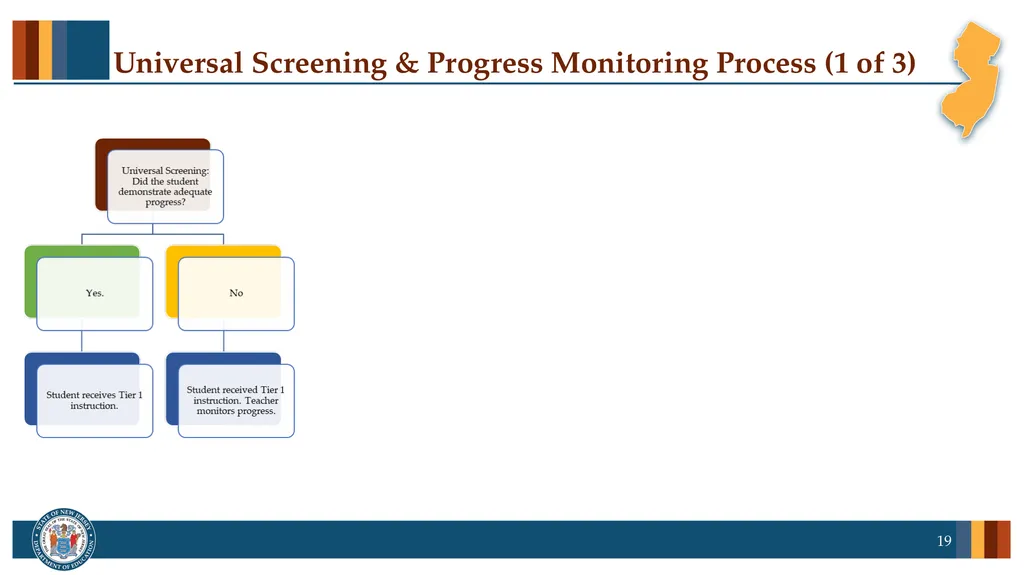
Universal Screening & Progress Monitoring Process (1 of 3) 19<br>
20
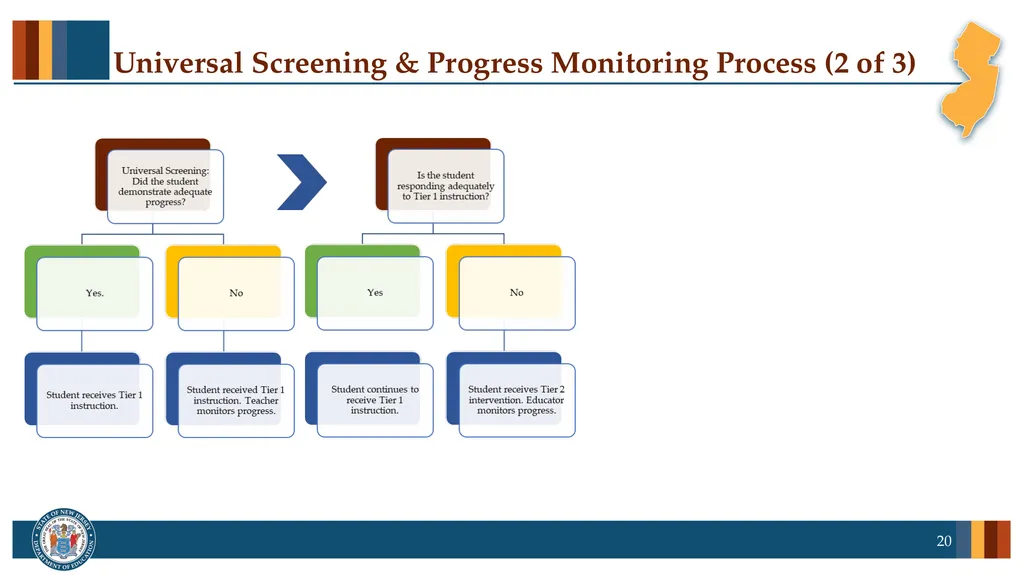
Universal Screening & Progress Monitoring Process (2 of 3) 20<br>
21
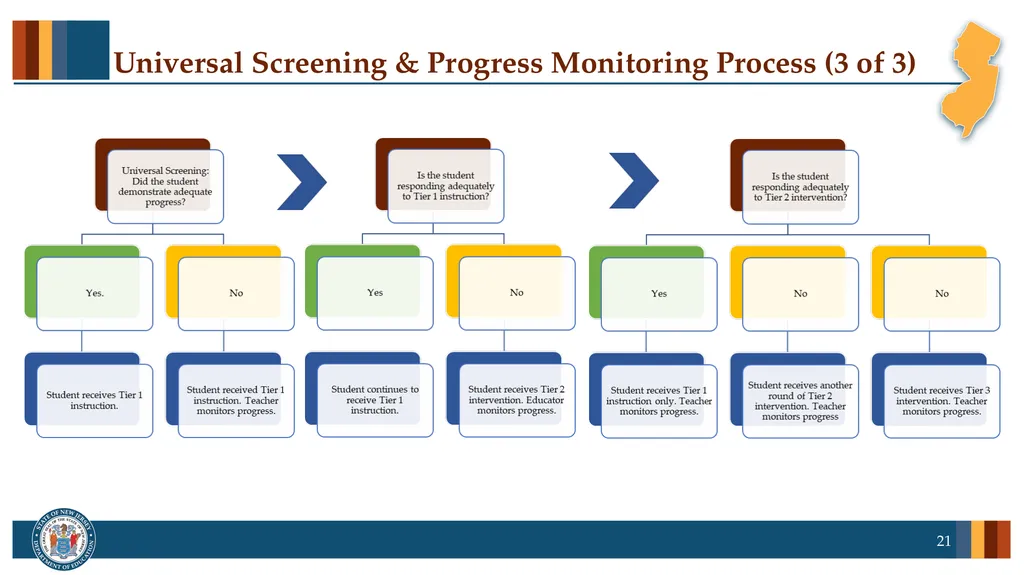
Universal Screening & Progress Monitoring Process (3 of 3) 21<br>
22
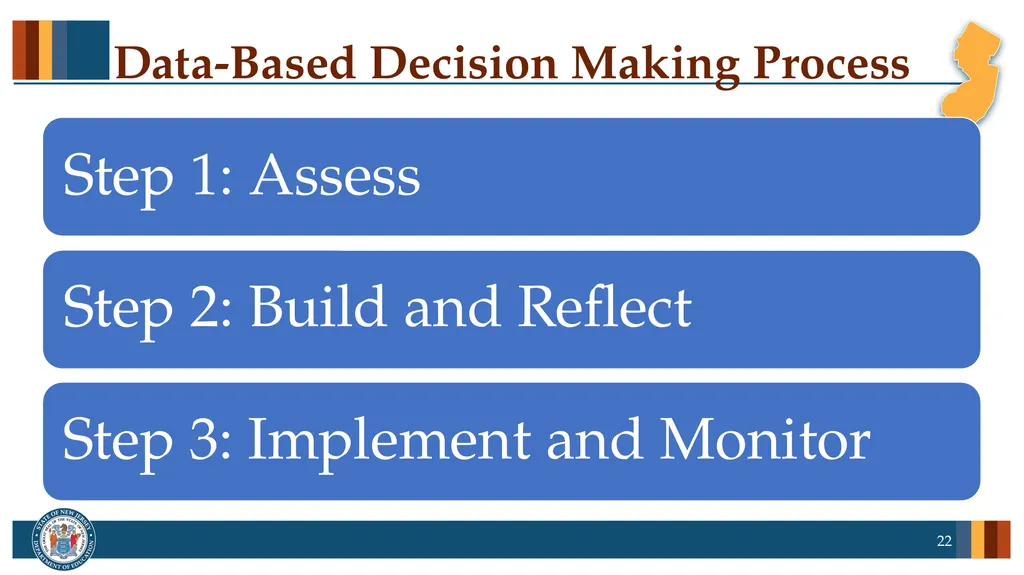
Data-Based Decision Making Process Step 1: Assess Step 2: Build and Reflect Step 3: Implement and Monitor 22<br>
23
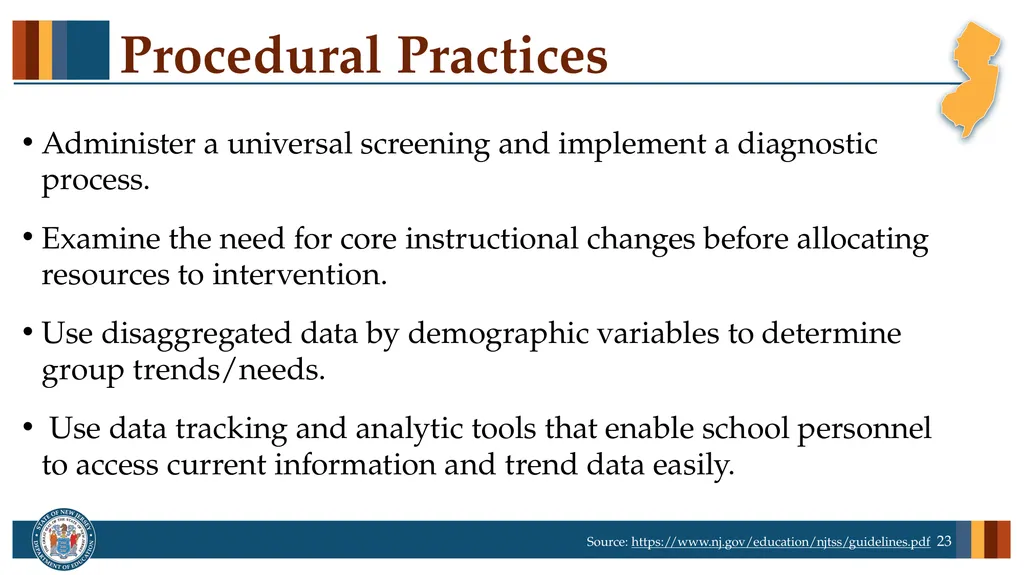
Procedural Practices Administer a universal screening and implement a diagnostic process.
Examine the need for core instructional changes before allocating resources to intervention.
Use disaggregated data by demographic variables to determine group trends/needs.
Use data tracking and analytic tools that enable school personnel to access current information and trend data easily. Source: https://www.nj.gov/education/njtss/guidelines.pdf 23<br>
Examine the need for core instructional changes before allocating resources to intervention.
Use disaggregated data by demographic variables to determine group trends/needs.
Use data tracking and analytic tools that enable school personnel to access current information and trend data easily. Source: https://www.nj.gov/education/njtss/guidelines.pdf 23<br>
24
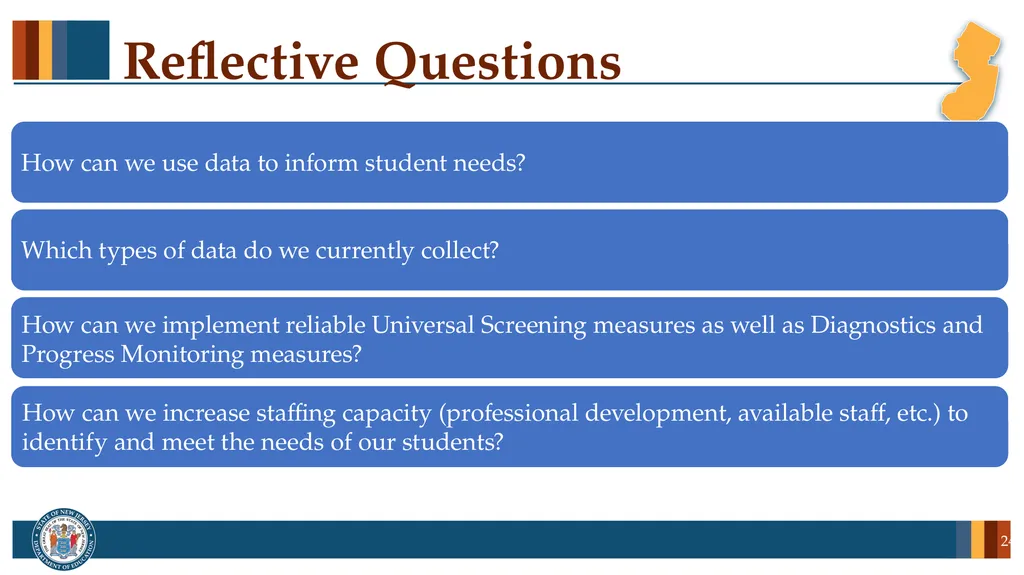
Reflective Questions How can we use data to inform student needs? Which types of data do we currently collect? How can we implement reliable Universal Screening measures as well as Diagnostics and Progress Monitoring measures? How can we increase staffing capacity (professional development, available staff, etc.) to identify and meet the needs of our students? 24<br>
25
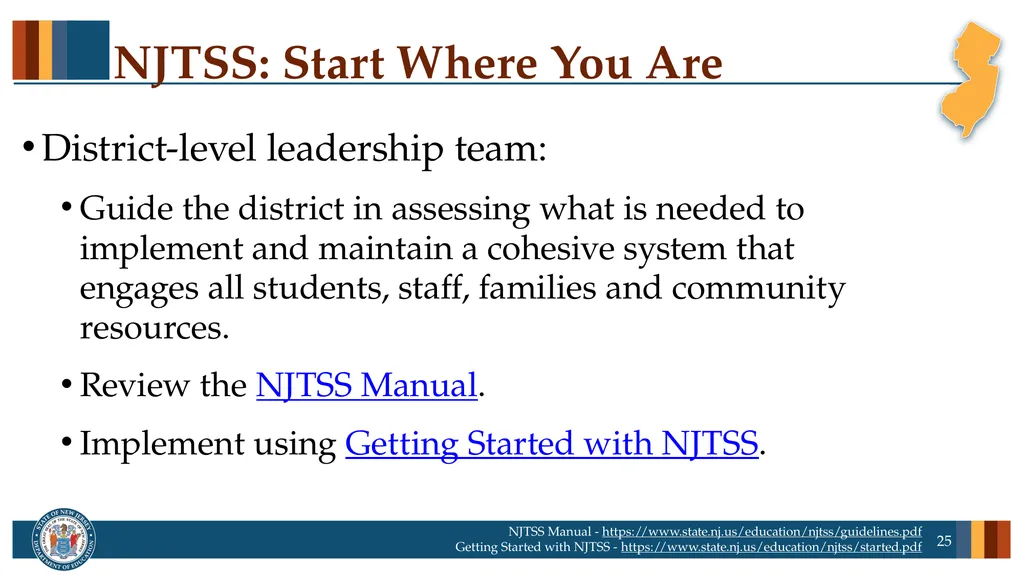
NJTSS: Start Where You Are District-level leadership team:
Guide the district in assessing what is needed to implement and maintain a cohesive system that engages all students, staff, families and community resources.
Review the NJTSS Manual.
Implement using Getting Started with NJTSS. NJTSS Manual - https://www.state.nj.us/education/njtss/guidelines.pdf
Getting Started with NJTSS - https://www.state.nj.us/education/njtss/started.pdf 25<br>
Guide the district in assessing what is needed to implement and maintain a cohesive system that engages all students, staff, families and community resources.
Review the NJTSS Manual.
Implement using Getting Started with NJTSS. NJTSS Manual - https://www.state.nj.us/education/njtss/guidelines.pdf
Getting Started with NJTSS - https://www.state.nj.us/education/njtss/started.pdf 25<br>
26
Thank You @NewJerseyDOE @newjerseydoe New Jersey Department of Education Thank You! New Jersey Department of Education New Jersey Department of Education @newjerseydoe 26<br>