Programming by Example using Least General Generalizations Mohammad Raza, Sumit Gulwani Natasa Milic-Frayling Microsoft Research Introduction Programming by Example (PBE) has made significant advances recently, e.g. Excel Flash Fill
"Programming by Example using Least General" is the property of its rightful owner. Permission is granted to
download and print the materials on this website for personal, non-commercial use only, and to display it
on your personal computer provided you do not modify the materials and that you retain all copyright
notices contained in the materials. By downloading content from our website, you accept the terms of this
agreement.
Presentation Transcript
01
Programming by Example using Least General Generalizations Mohammad Raza, Sumit Gulwani & Natasa Milic-Frayling
Microsoft Research<br>
02
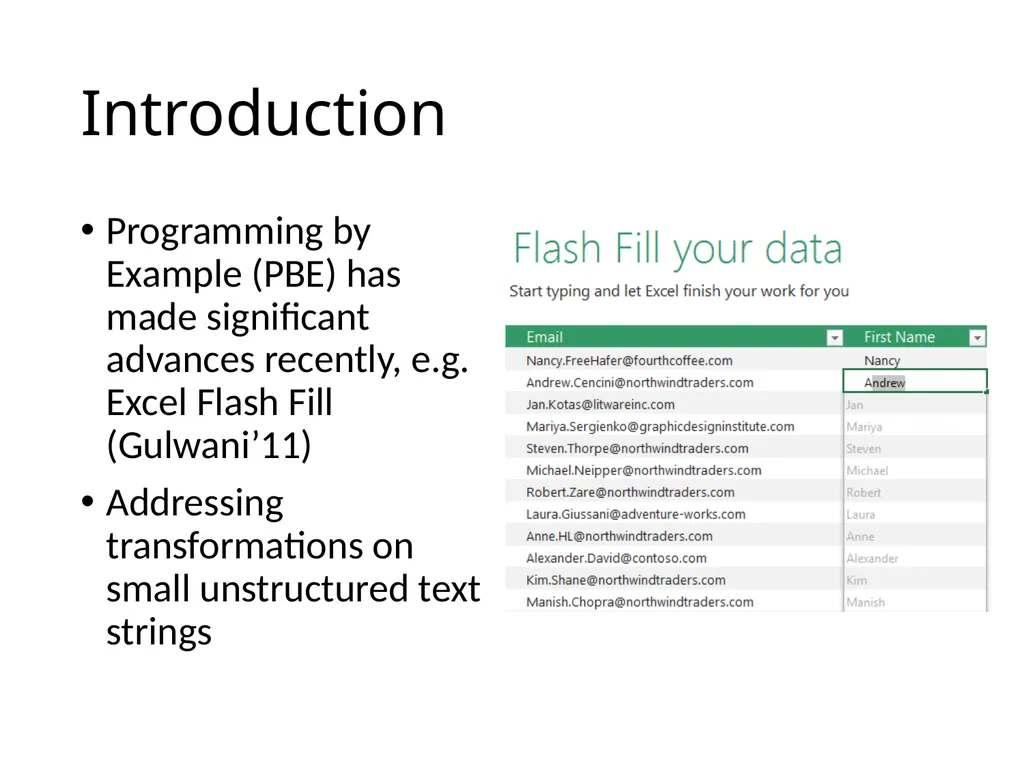
Introduction Programming by Example (PBE) has made significant advances recently, e.g. Excel Flash Fill (Gulwani’11)
Addressing transformations on small unstructured text strings<br>
03
Introduction Existing approaches do not scale to more complex editing scenarios e.g. richly formatted document editing
PBE paradigm is well-suited to rich formatting scenarios:
Styles, templates are restrictive and require premature commitment from the user
Macro programming languages are expressive but too advanced for most users
Discoverability of specialised features is difficult in complex UIs<br>
04
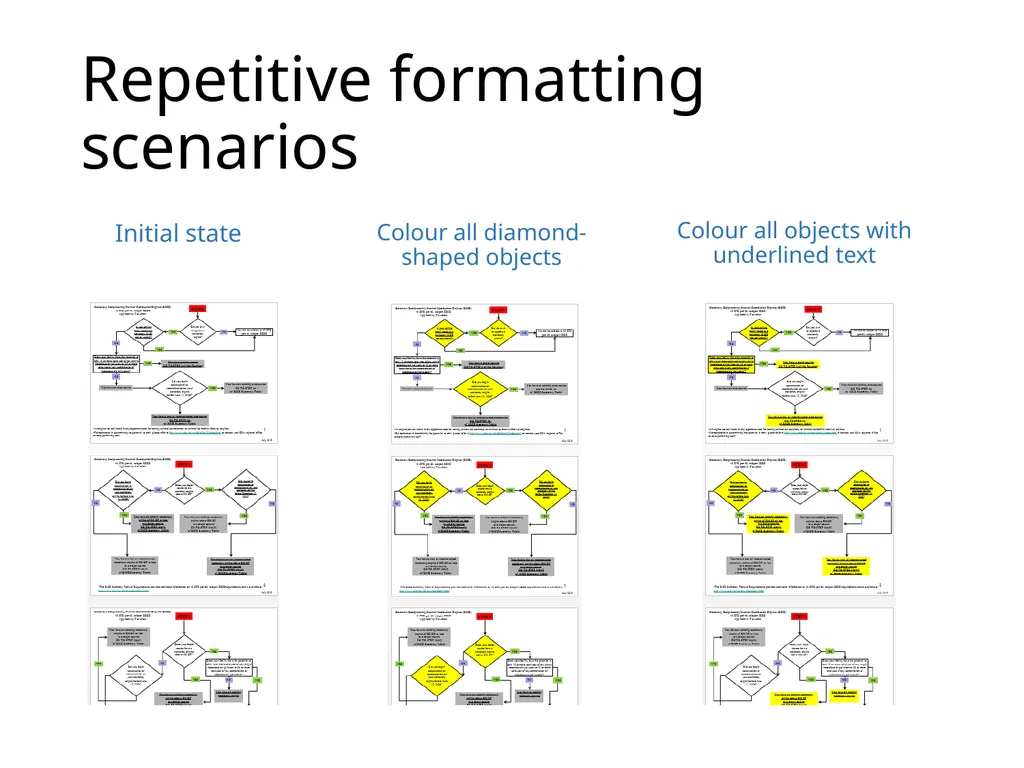
Repetitive formatting scenarios Initial state Colour all diamond-shaped objects Colour all objects with underlined text<br>
05
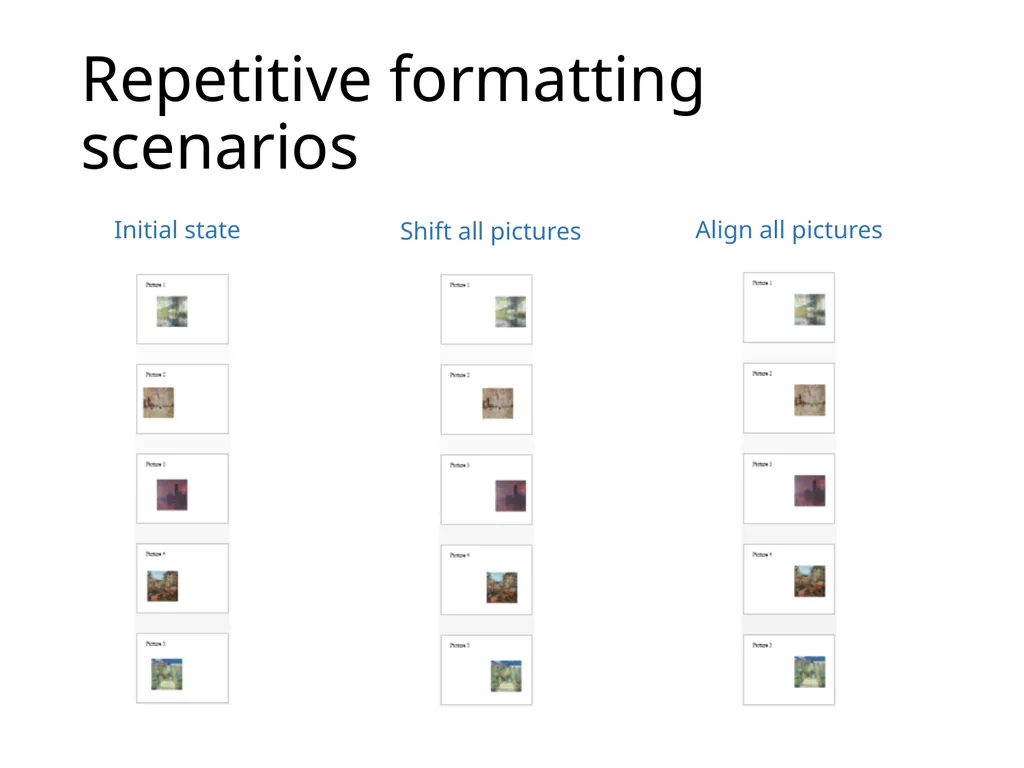
Repetitive formatting scenarios Initial state Shift all pictures Align all pictures<br>
06
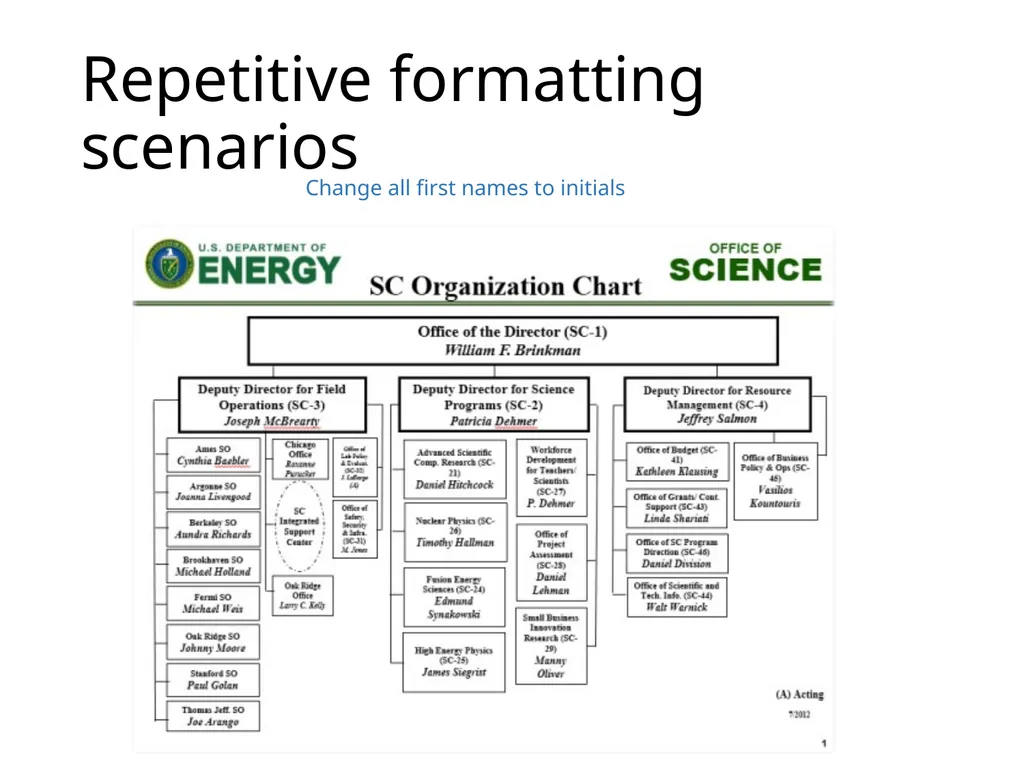
Repetitive formatting scenarios Change all first names to initials<br>
07
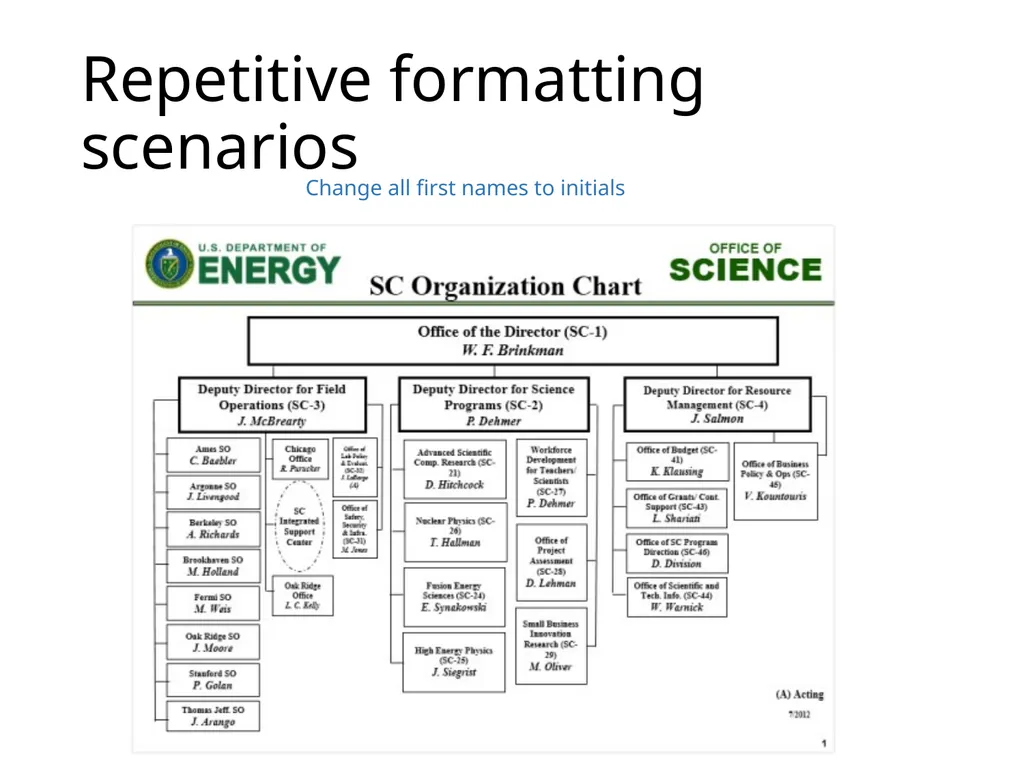
Repetitive formatting scenarios Change all first names to initials<br>
08
Challenges & existing approaches General PBE ingredients:
Domain specific language (DSL) - space of possible programs
Synthesis algorithm - given input-output examples, infer a satisfying program in the DSL
Trade offs between expressivity of DSL, efficiency and accuracy of synthesis algorithm
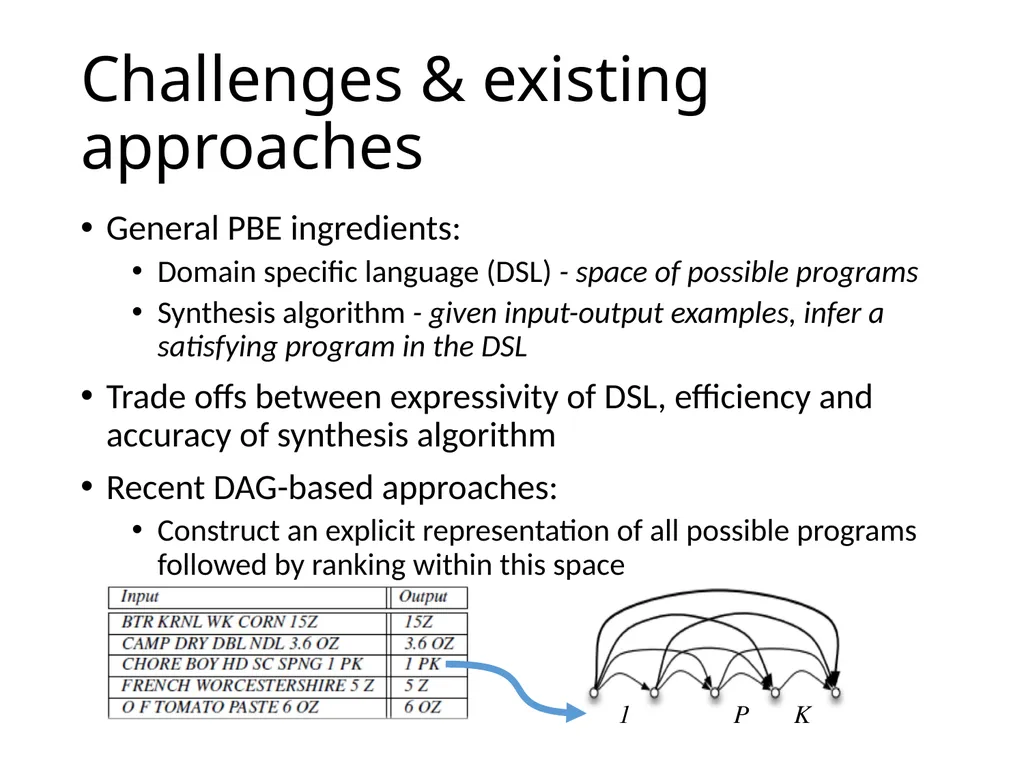
Recent DAG-based approaches:
Construct an explicit representation of all possible programs followed by ranking within this space 1 P K<br>
09
A different approach to PBE Since goal is to find a single program, can we incorporate the ranking strategy implicitly into the synthesis algorithm?
Adopting the notion of least general generalization from inductive inference (Plotkin’70):
Design a DSL equipped with a natural subsumption ordering on programs
Design an algorithm that efficiently generates programs that are minimal with respect to the subsumption ordering
Avoid exhaustive enumeration of the search space<br>
10
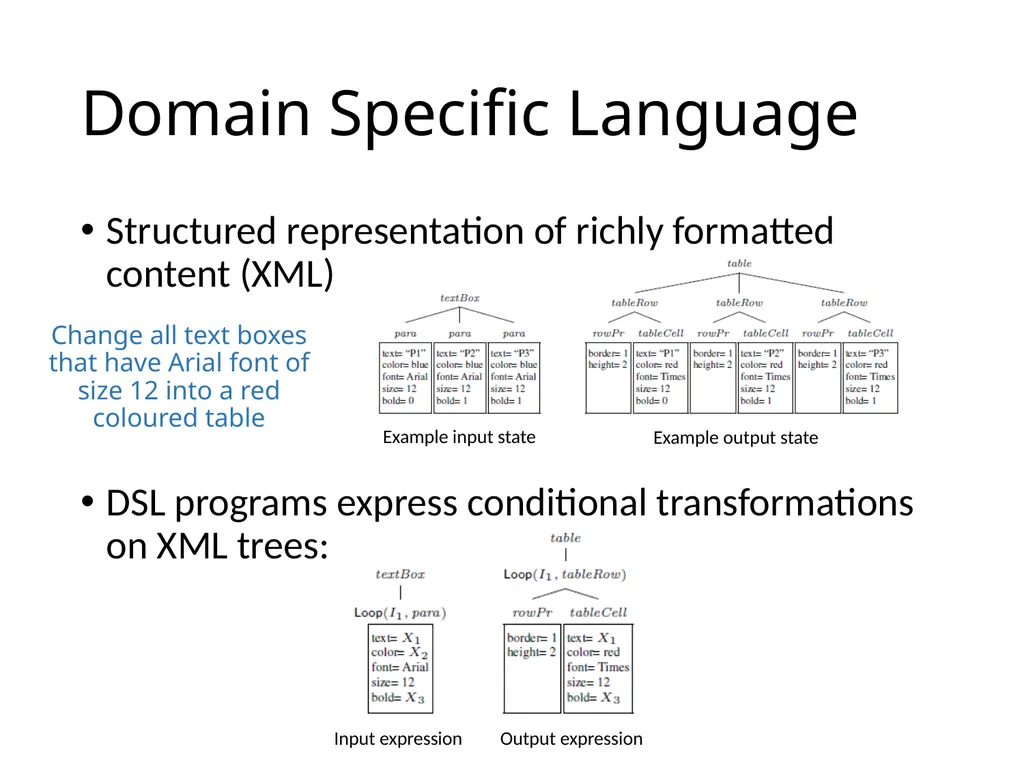
Domain Specific Language Example input state Example output state Output expression Input expression Structured representation of richly formatted content (XML)
DSL programs express conditional transformations on XML trees: Change all text boxes that have Arial font of size 12 into a red coloured table<br>
11
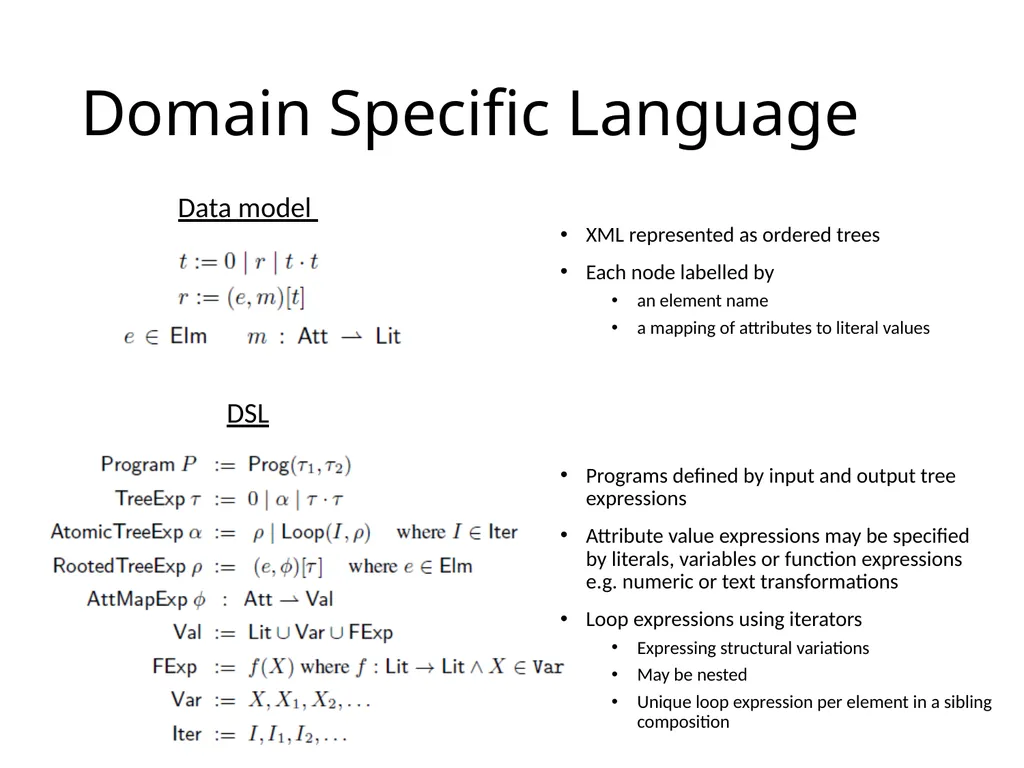
Domain Specific Language Data model DSL XML represented as ordered trees
Each node labelled by
an element name
a mapping of attributes to literal values
Programs defined by input and output tree expressions
Attribute value expressions may be specified by literals, variables or function expressions e.g. numeric or text transformations
Loop expressions using iterators
Expressing structural variations
May be nested
Unique loop expression per element in a sibling composition<br>
12
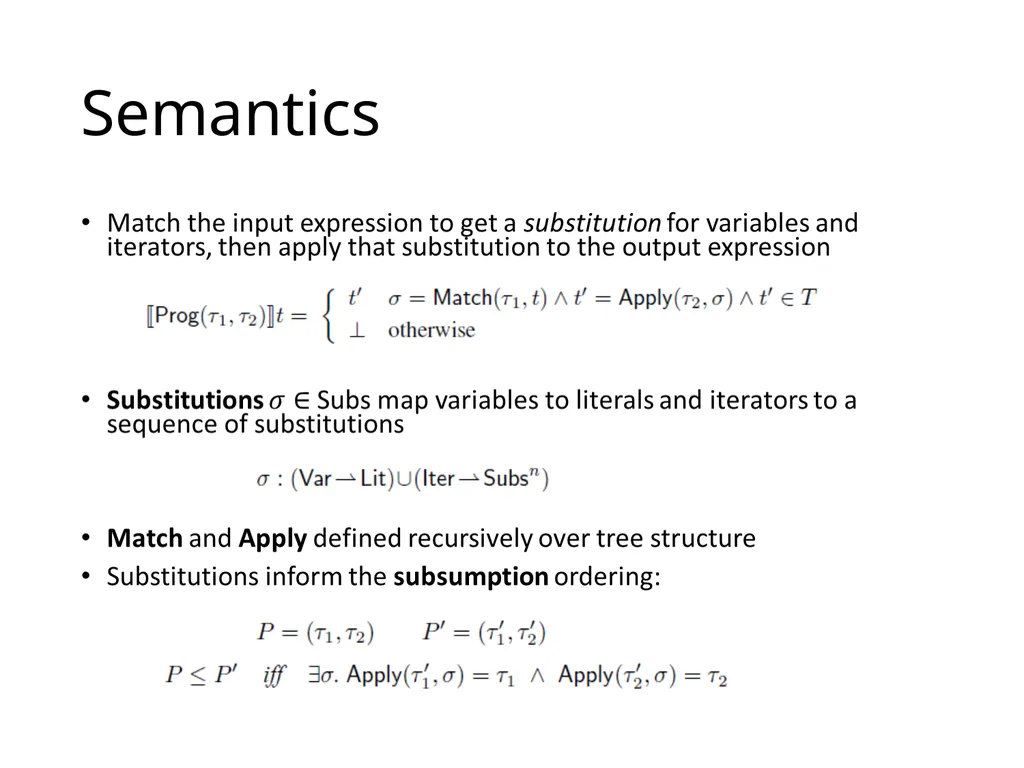
Semantics<br>
13
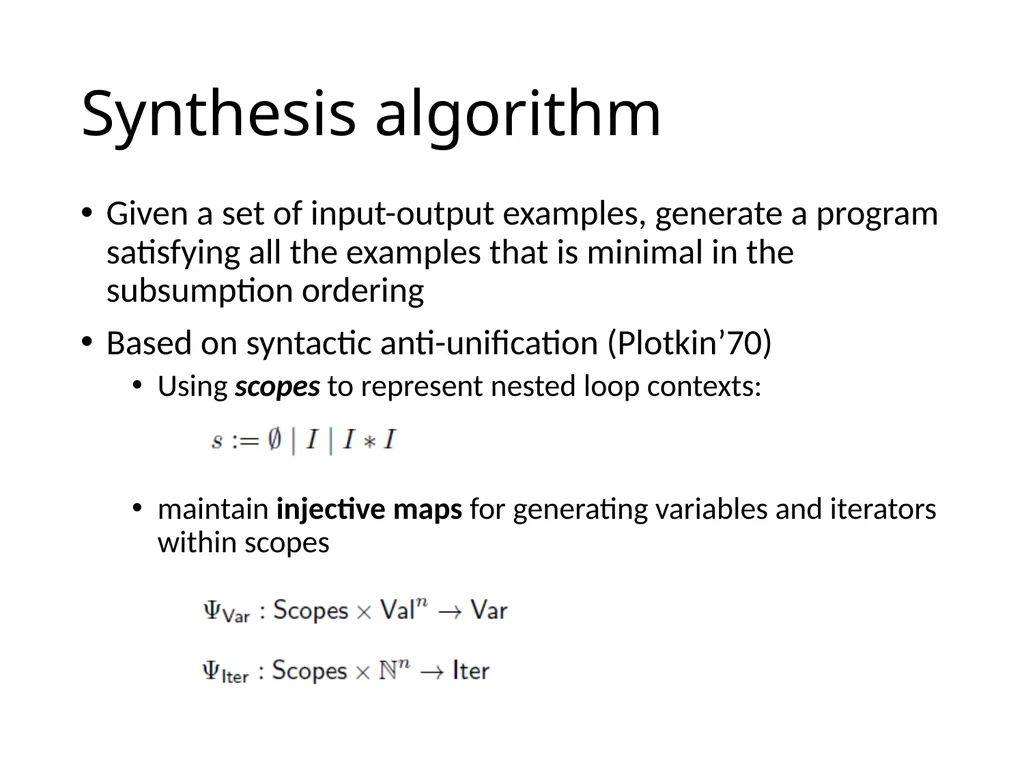
Synthesis algorithm Given a set of input-output examples, generate a program satisfying all the examples that is minimal in the subsumption ordering
Based on syntactic anti-unification (Plotkin’70)
Using scopes to represent nested loop contexts:
maintain injective maps for generating variables and iterators within scopes<br>
14
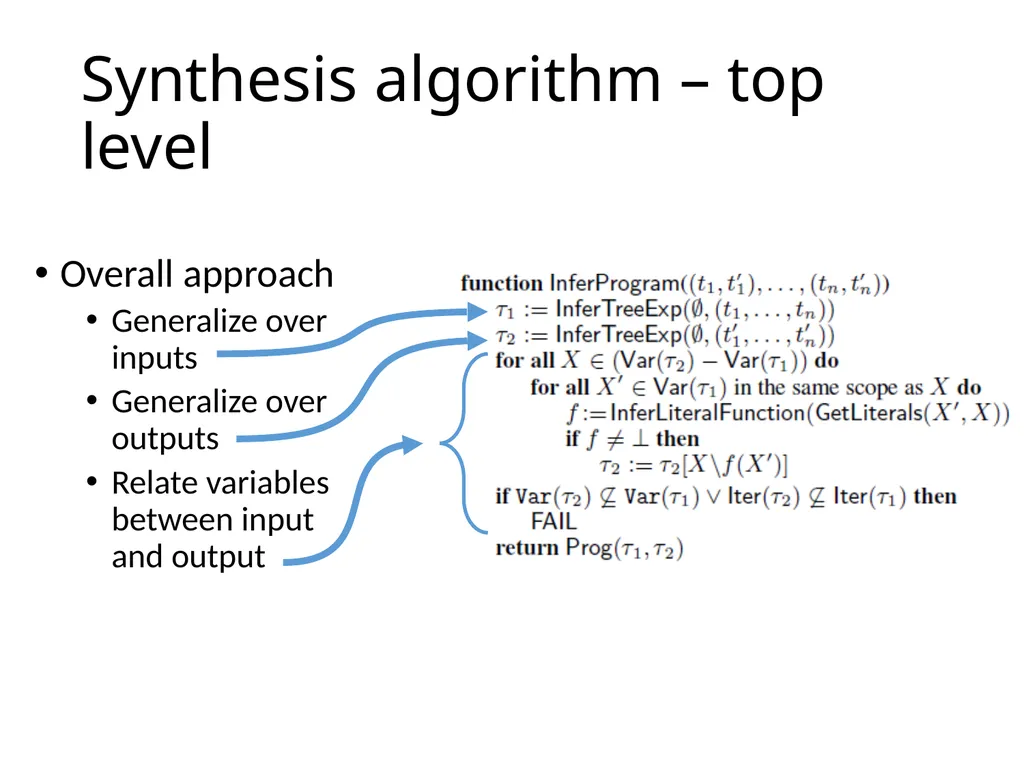
Synthesis algorithm – top level Overall approach
Generalize over inputs
Generalize over outputs
Relate variables between input and output<br>
15
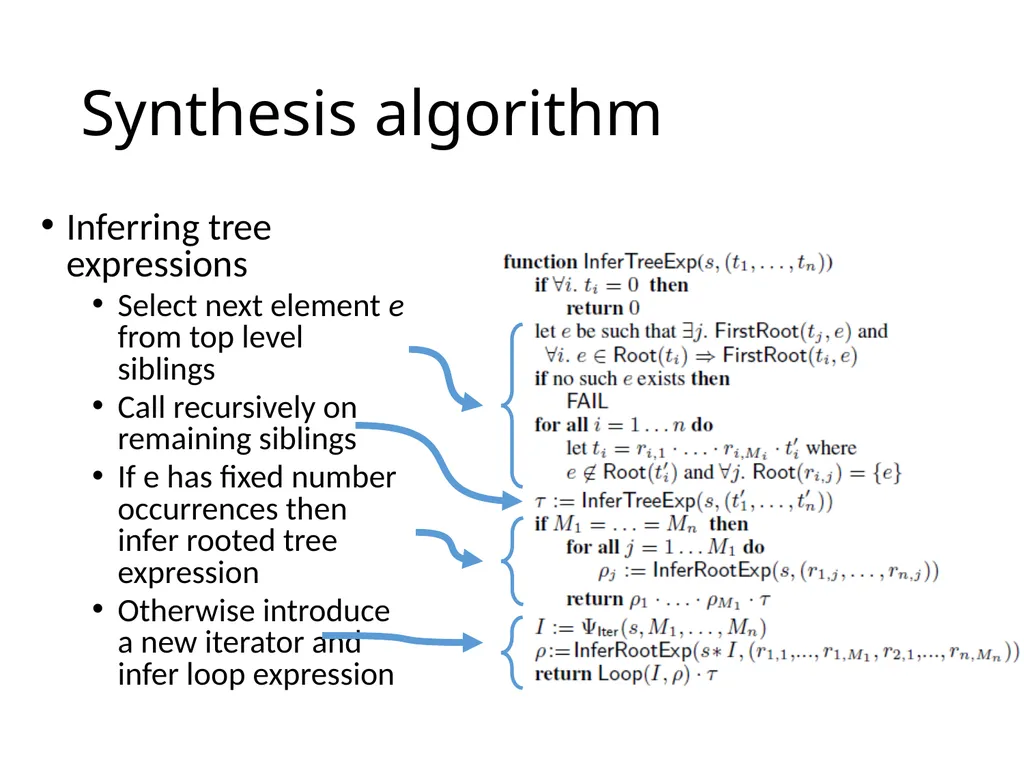
Synthesis algorithm Inferring tree expressions
Select next element e from top level siblings
Call recursively on remaining siblings
If e has fixed number occurrences then infer rooted tree expression
Otherwise introduce a new iterator and infer loop expression<br>
16
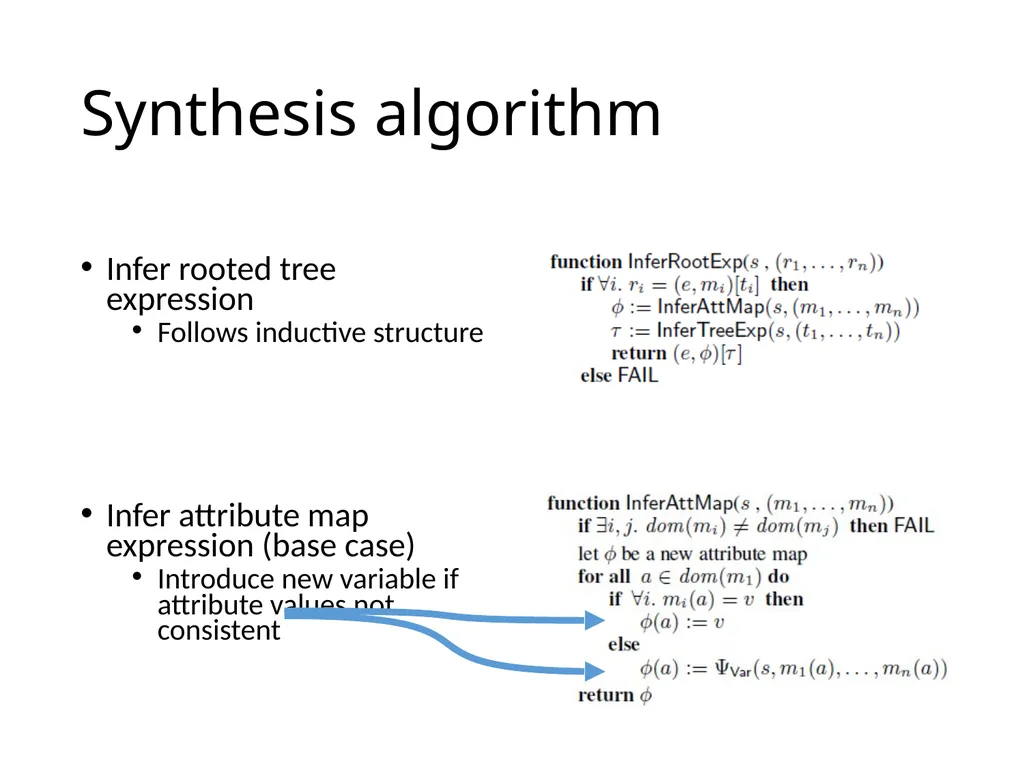
Synthesis algorithm Infer rooted tree expression
Follows inductive structure
Infer attribute map expression (base case)
Introduce new variable if attribute values not consistent<br>
17
Evaluation Implemented an add-in for Microsoft PowerPoint, based on OOXML file format
Evaluated with questions from online help forums
Questions covered wide range of PowerPoint features
e.g. shapes, images, charts, tables, bullets, margins, fonts, borders, size, positioning, scaling, colors, styles, indents…
“indent any text of a certain font if it appears inside a table”
“change only red coloured circular shapes”
“change only text of a certain font and size”
“borders around all pictures”
“change paragraphs to table rows”
Some tasks involving ranges not expressible
Average of 4.2 examples required for task completion<br>
18
Conclusion Extended applicability of PBE to domain of rich formatting transformations
LGG provides a different approach to PBE where
DSL is designed with respect to a target subsumption relation
ranking bias is implicit in the synthesis algorithm
Next steps:
Targeting more expressive domains (e.g. ranges in conditionals, loop conditions)
Faster convergence (customizing XML formats)
Natural interaction techniques, e.g. NL input from user to target more expressive domains with fewer examples<br>