
Progress on the Implementation of the revised


Description: Progress on the Implementation of the revised White Paper on Arts, Culture and Heritage Presented by: Director-General Date: 03 December 2021 TABLE OF CONTENTS Purpose; Background and discussion; Linkages to the Legislation; Discussion of
Related Topics
Download Presentation
"Progress on the Implementation of the revised" is the property of its rightful owner. Permission is granted to download and print the materials on this website for personal, non-commercial use only, and to display it on your personal computer provided you do not modify the materials and that you retain all copyright notices contained in the materials. By downloading content from our website, you accept the terms of this agreement.
Presentation Transcript
slide1. Progress on the
Implementation of the revised White Paper on Arts, Culture and Heritage Presented by: Director-General
Date: 03 December 2021<br>
slide2. TABLE OF CONTENTS Purpose;
Background and discussion;
Linkages to the Legislation;
Discussion of some of the proposals;
Risks and Communications implications;
Timelines;
Way forward;
Update on Arts, Culture and Development Interventions;
Update on Heritage Preservation and Promotion Interventions. 2<br>
slide3. PURPOSE The purpose of this presentation is update the Portfolio Committee on the Implementation of the revised White Paper on Arts, Culture and Heritage.
This has elements applicable to both the ACPD branch and the Heritage Promotion and Preservation (HPP) branch since the main focus of the White Paper was on Arts, Culture and Heritage has a direct impact on the work of the two branches. 3<br>
slide4. BACKGROUND AND DISCUSSION The Revised White Paper on Arts, Culture and Heritage was approved by Cabinet in October 2018.
The White Paper was thereafter presented to Parliament on several occasions and was finally endorsed by Parliament in November 2019.
It is therefore against this background that an exercise has been carried out to identify what needs to be done in order to roll-out or implement the Revised White Paper. 4 LINKAGES TO THE LEGISLATION The actions plans for the implementation of the revised White Paper will among others, include the enactment, amendment and or repeal of some of the legislation currently administered by the Department.
It is worth mentioning that some of our legislation pre-dates the current democratic dispensation and would therefore have to be aligned with democratic values, social justice and fundamental human rights as enshrined in the Constitution of the Republic of South Africa.
Furthermore, new legislation would also have to take into account the various provisions of the Public Finance Management Act, 1999 as amended, current Court judgments on a variety of legal issues including limitations on the exercise of discretionary powers by various functionaries including the Executive.<br>
slide5. SOME OF THE PROPOSALS There are numerous proposals and for purposes of this presentation same have been grouped as follows:
Formulation of policies and strategies;
Establishment of institutions;
Proposed affiliation;
Proposed legislation; and
Miscellaneous proposals. 5<br>
slide6. DISCUSSION OF SOME OF THE PROPOSALS Formulation of policies and strategies
Establish a dance policy;
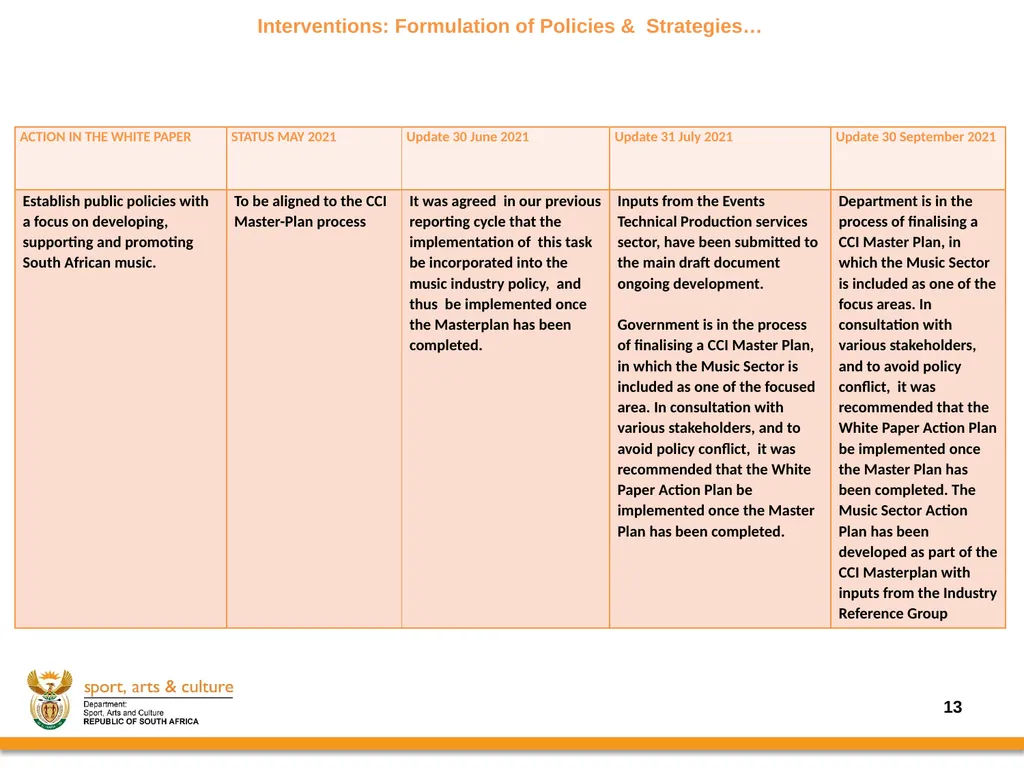
Establish public policies with a focus on developing, supporting and promoting South African music;
Develop an implementation and management strategy for the new Artistic and Reproduction Rights (ARR) for the visual arts introduced in the Intellectual Property Amendment Bill;
Review the 1996 policy that sought to correct and reconstruct the heritage dispensation in accordance with the provisions of the Constitution;
(e) Establish an integrated National Heritage Policy Framework in order to address the fragmentation and duplications in the current overlapping heritage architecture in order to eliminate duplication and overlaps for greater integration, consolidation, coherence, optimal functioning and effective delivery and ensure a coherent arts, culture and heritage intergovernmental policy across national, provincial and local sphere of governance;
(f) Have an integrated National Policy on Museums to address the incoherent and fragmented dispensation of the past policy;
(g) Review the position of discipline-specific training within the FET college system and Finalise discussions relevant stakeholders regarding the proposed new SETA landscape; 6<br>
slide7. DISCUSSION OF SOME OF THE PROPOSALS… 2. Establishment of institutions
Establishment of African Arts, Culture and Heritage Centres at Tertiary Institutions / Establishment of departments, divisions and entities at Tertiary Institutions focused on arts, culture and heritage policy, management and administration;
Establish the viability of establishing a National Research and Development Institute for African Art, Culture and Heritage / A portion of national, provincial and local funding must be set aside for research and teaching and learning in the fields of management training and internships;
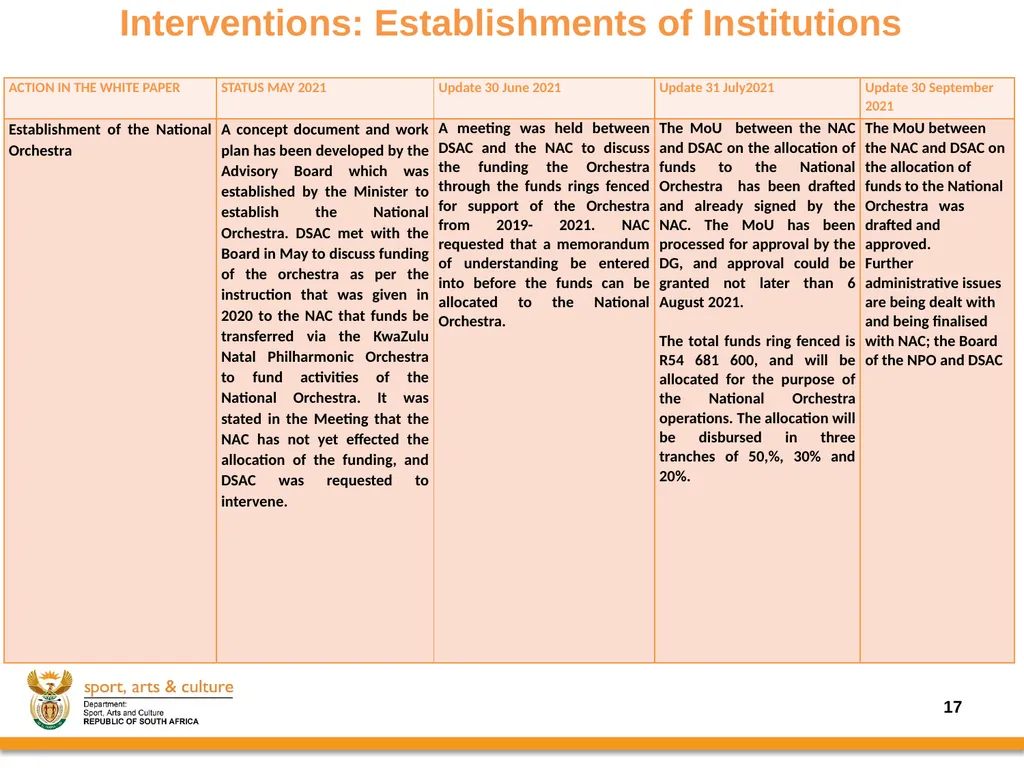
Establish National Theatre, Dance, Orchestral companies;
As per the findings of a feasibility study, establish an independent body to facilitate Artistic Reproduction Rights (ARR) management;
Establish a National Monuments, Heritage Sites and Resources Commission (National Heritage Resources Commission);
Establish a National Geographical Place Names Commission. This appears to be a proposed name change in relation to the South African Geographical Names Council (SAGNC);
Heraldry and National Symbols Commission. This appears to be a proposed name change in relation to the Bureau of Heraldry;
Proposes a numerous kinds of libraries – consider the need to have a one stop library with sections for differently abled users;
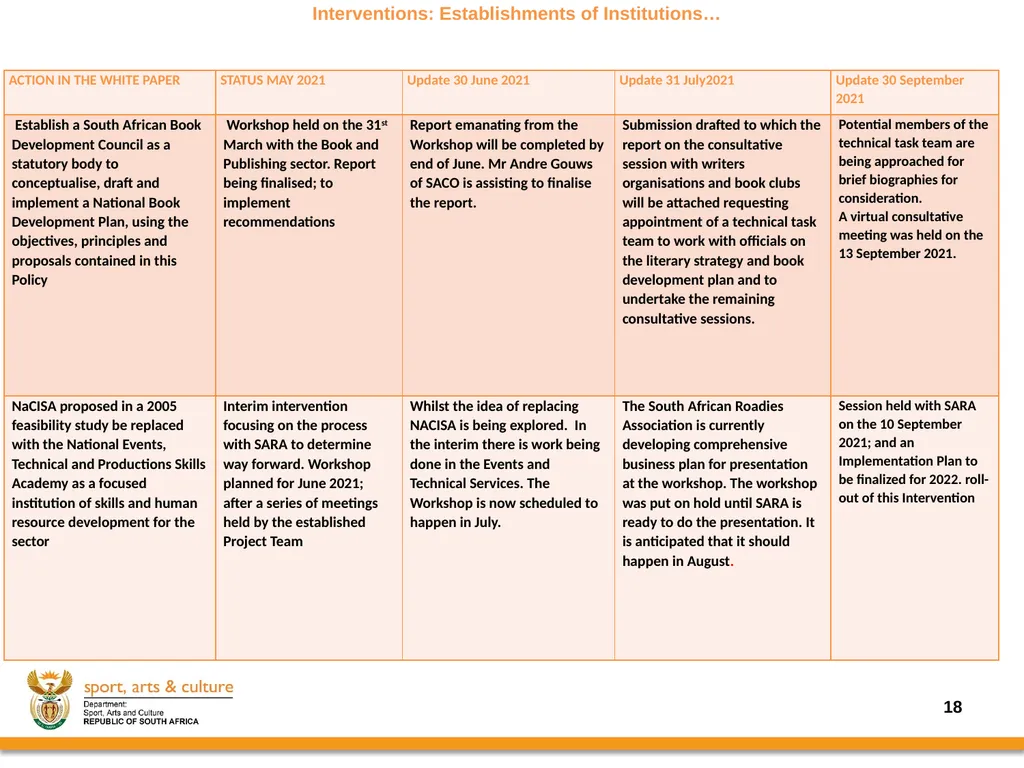
Establish a South African Book Development Council as a statutory body; 7<br>
slide8. DISCUSSION OF SOME OF THE PROPOSALS... (j) Establish the National Events, Technical and Productions Skills Academy (replacing NaCISA that proposed in a 2005 feasibility study);
(k) Have a National Skills Academy, Sourcing enterprise, cultural precincts in all provinces etc. – review the MGE strategy;
(l) Explore the possibility of establishing a fully-fledged Benevolent Fund as outlined by the research commissioned by DAC several years ago;
Proposed affiliation
Arts, Culture and Heritage be represented in the National Indigenous Knowledge Systems Office (NIKSO);
Establish a bi-annual South African Performing Arts Market;
4. Proposed legislation
Draft legislation for National Museums or amend the Cultural Institutions Act to clarify the role of National Museums;
It must be noted that where new institutions will be established or names of current ones be changed, this will invariably require either enactment of new legislation, amendment and or repeal of existing legislation;
Lastly, there is a need to review almost 90% of DSAC legislation so that it is in line with the latest Court judgments, new legislation for an example, the Public Finance Management Act, 1999 as amended, the current democratic dispensation and the democratic values, social justice and fundamental human rights as enshrined in the Constitution of the Republic of South Africa. 8<br>
slide9. DISCUSSION OF SOME OF THE PROPOSALS… 5. Miscellaneous proposals
Stimulate artistic innovation through support for artists and cultural practitioners;
Conduct audits of municipal theatres across the country and develop an implementation strategy for the effective administration and management of these theatres;
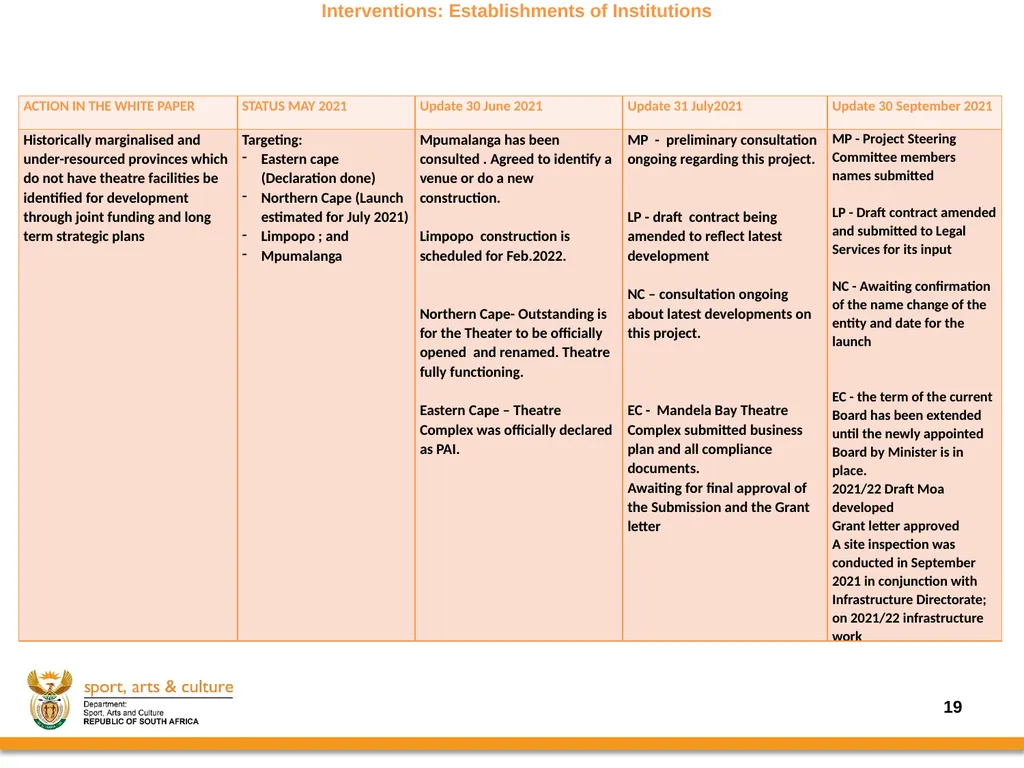
Develop historically marginalised and under-resourced provinces which do not have theatre facilities through joint funding and long term strategic plans;
Have an Incubator scheme for subsidized Theatres;
Funding of Performing Arts companies which have developed reputable education and training programmes as well as accreditation of their courses through the national qualification frameworks;
Implement incentive schemes proposed in the unpublished Independent Development Corporation (IDC) music industry study (2013);
Provide support of professional income and sustainability, transformation of the sector financially and contribution to creative industry development for visual artists;
Strengthening of existing visual arts infrastructure for greater sector development, transformation through African knowledge development and critical skills growth in a key sector;
Have a new vision for state run National, Provincial and Local Art Galleries and Art Museums;
The “Film and Video” sector be renamed “Audio-Visual Media” sector; 9<br>
slide10. DISCUSSION ON SOME OF THE PROPOSALS… (k) Each sub-sector of the cultural and creative industries sector should be defined according to the United Nations Educational, Scientific and Cultural Organization (UNESCO) Framework for Statistics;
(l) Explore ways in which banks and financial institutions could play key roles in fostering technological innovation and supporting investment in township cultural businesses; venture capital initiatives;
(m) Dept. will enter into a series of discussions with the Department of Labour to enable artists to retain their self-employed status for taxation purposes etc.;
(n) Have more systematic and formalised engagement between the Ministry of Arts and Culture and the Ministries of Education;
(o) Form partnerships with the Ministry of Basic Education and the Ministry of Arts, Culture and Heritage regarding the provision of arts, culture and heritage education for learners at basic education level; 10<br>
slide11. RISKS AND COMMUNICATIONS IMPLICATIONS Possible duplication of mandates and responsibilities in institutions to be established;
Determine the need, feasibility and sustainability of such proposed new institutions – consider current financial constraints;
Potential increase in the number of entities of the DSAC – increase administrative burden and operational and administrations costs including payments to Council or Board members;
Consider the need for renaming institutions including the financial costs thereof;
Consult the institutions first before making pronouncements on changes that are likely to take place. 11<br>
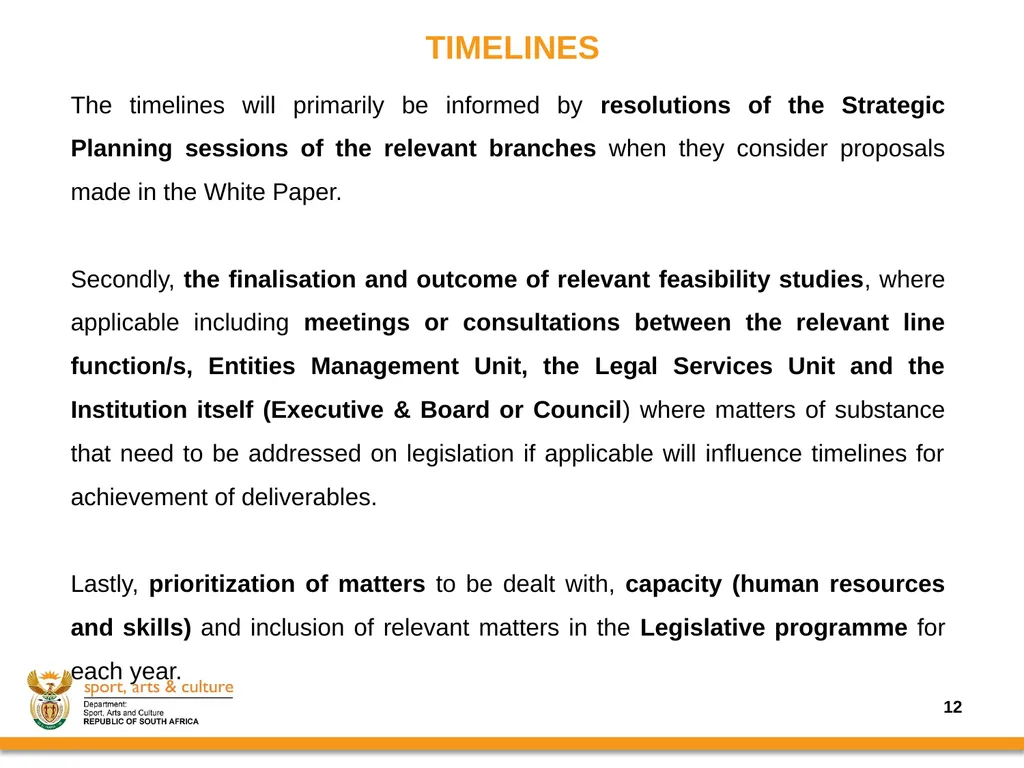
slide12. TIMELINES The timelines will primarily be informed by resolutions of the Strategic Planning sessions of the relevant branches when they consider proposals made in the White Paper.
Secondly, the finalisation and outcome of relevant feasibility studies, where applicable including meetings or consultations between the relevant line function/s, Entities Management Unit, the Legal Services Unit and the Institution itself (Executive & Board or Council) where matters of substance that need to be addressed on legislation if applicable will influence timelines for achievement of deliverables.
Lastly, prioritization of matters to be dealt with, capacity (human resources and skills) and inclusion of relevant matters in the Legislative programme for each year. 12<br>
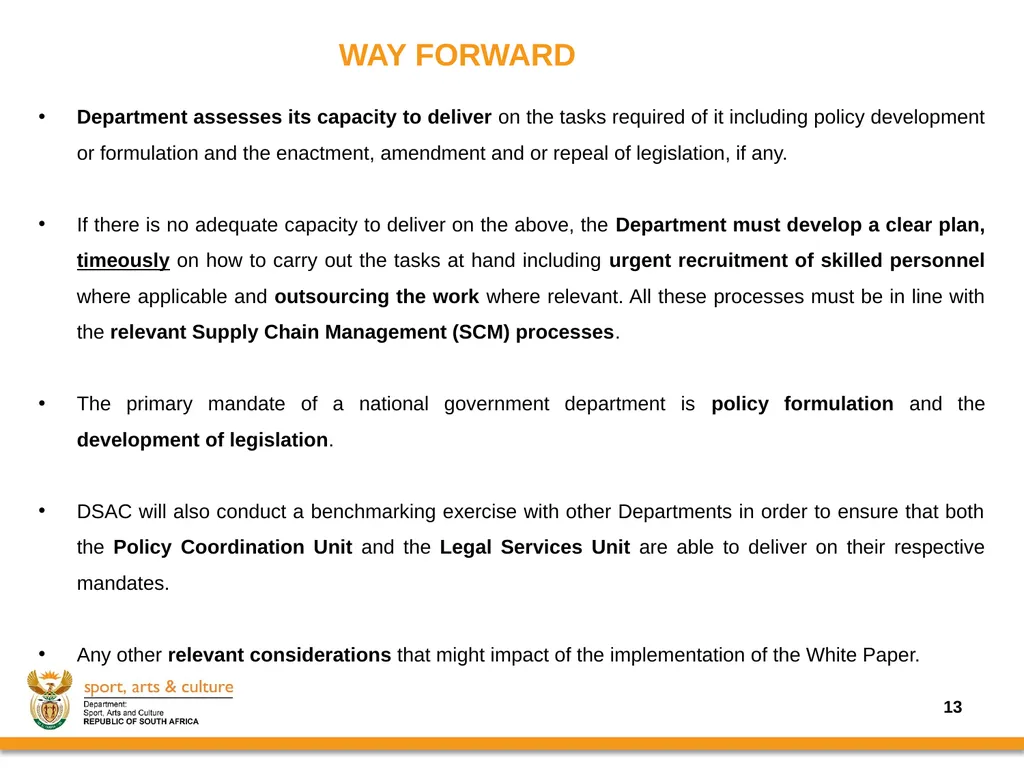
slide13. WAY FORWARD Department assesses its capacity to deliver on the tasks required of it including policy development or formulation and the enactment, amendment and or repeal of legislation, if any.
If there is no adequate capacity to deliver on the above, the Department must develop a clear plan, timeously on how to carry out the tasks at hand including urgent recruitment of skilled personnel where applicable and outsourcing the work where relevant. All these processes must be in line with the relevant Supply Chain Management (SCM) processes.
The primary mandate of a national government department is policy formulation and the development of legislation.
DSAC will also conduct a benchmarking exercise with other Departments in order to ensure that both the Policy Coordination Unit and the Legal Services Unit are able to deliver on their respective mandates.
Any other relevant considerations that might impact of the implementation of the White Paper. 13<br>
slide14. UPDATE ON ARTS CULTURE AND DEVELOPMENT INTERVENTIONS<br>
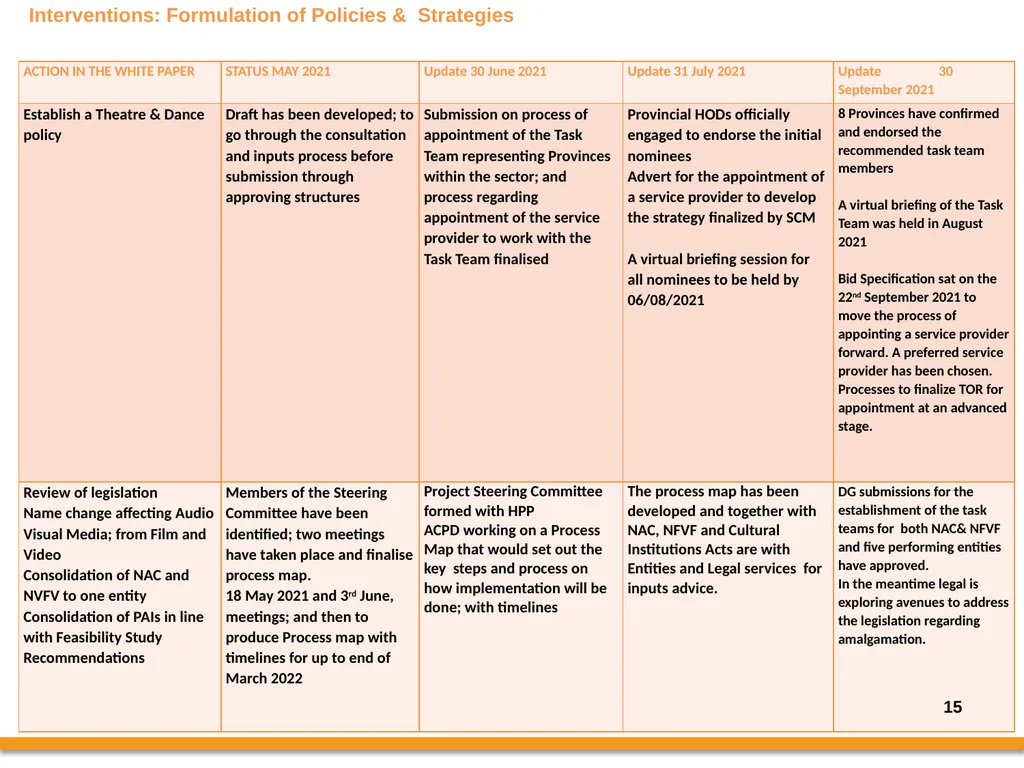
slide15. Interventions: Formulation of Policies & Strategies 15<br>
slide16. Interventions: Formulation of Policies & Strategies… 13<br>
slide17. Interventions: Establishments of Institutions 17<br>
slide18. Interventions: Establishments of Institutions… 18<br>
slide19. Interventions: Establishments of Institutions 19<br>
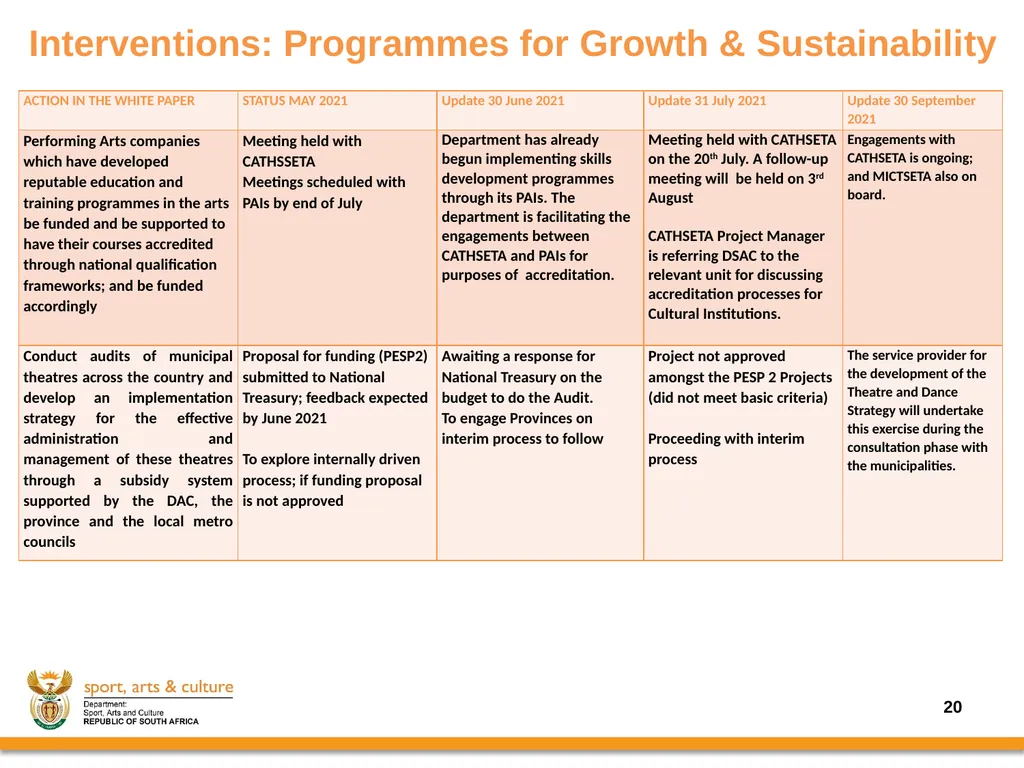
slide20. Interventions: Programmes for Growth & Sustainability 20<br>
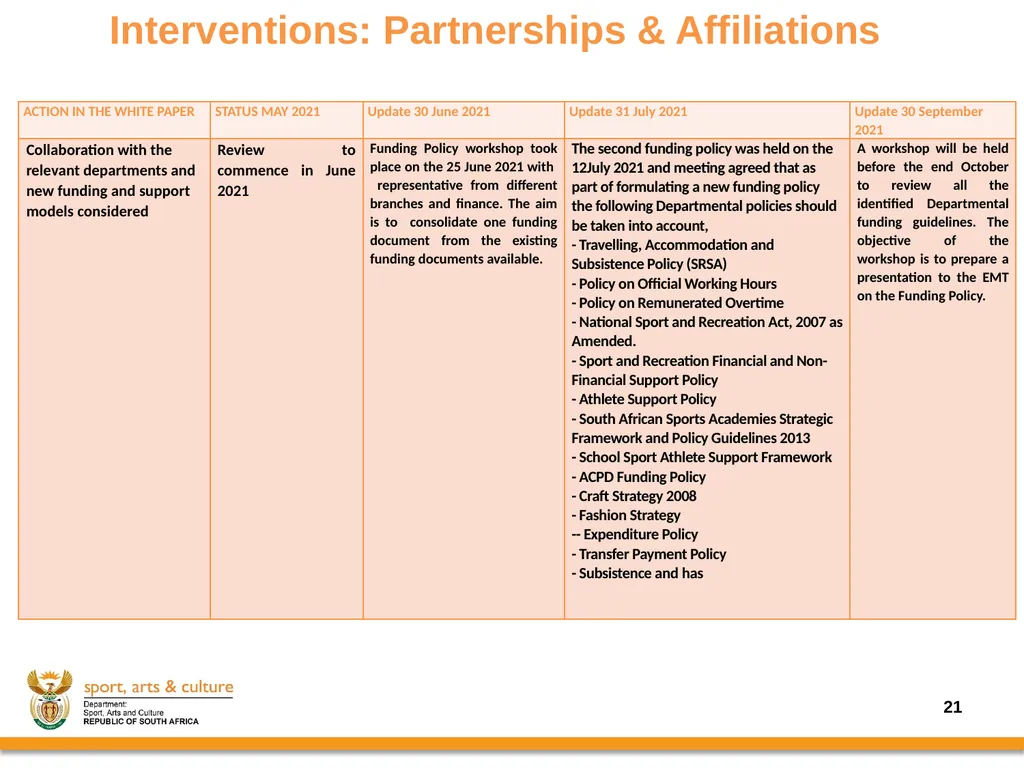
slide21. Interventions: Partnerships & Affiliations 21<br>
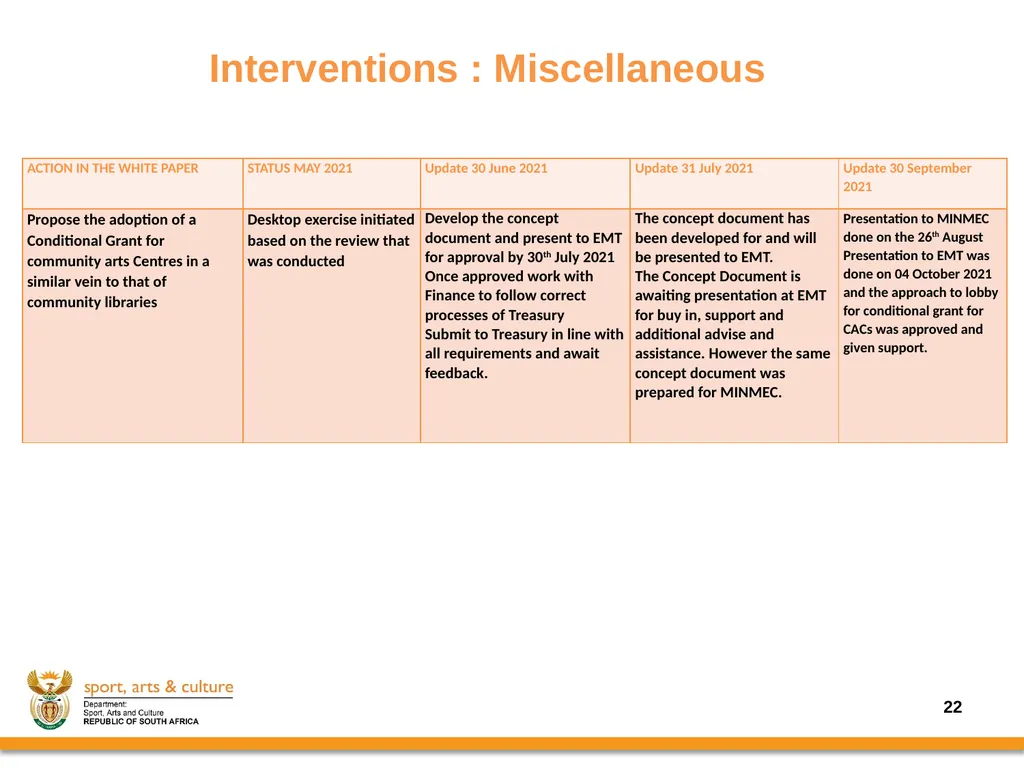
slide22. Interventions : Miscellaneous 22<br>
slide23. UPDATE ON HERITAGE PROMOTION AND PRESERVATION INTERVENTIONS<br>
slide24. Heritage Policies and Research 24<br>
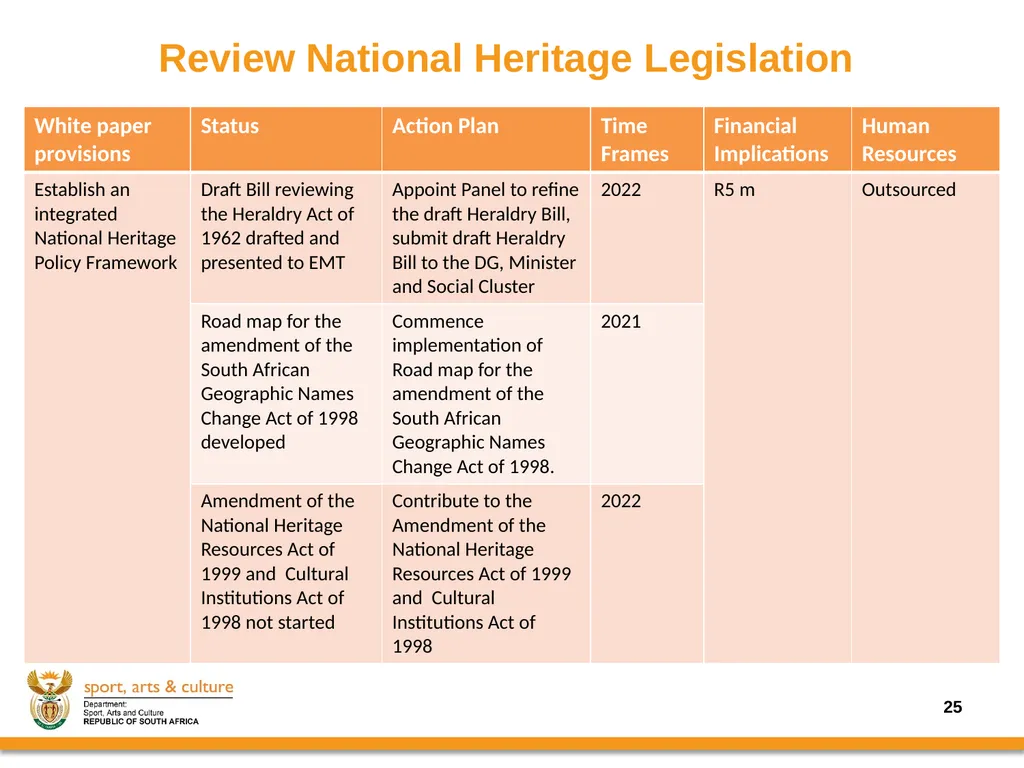
slide25. Review National Heritage Legislation 25<br>
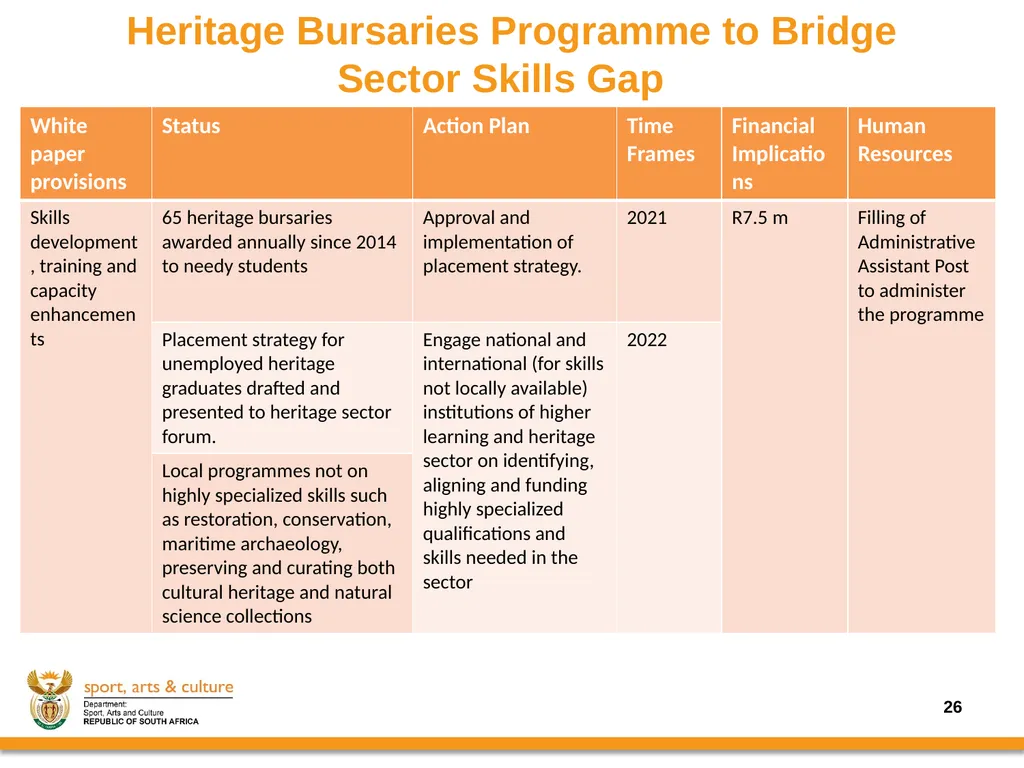
slide26. Heritage Bursaries Programme to Bridge Sector Skills Gap 26<br>
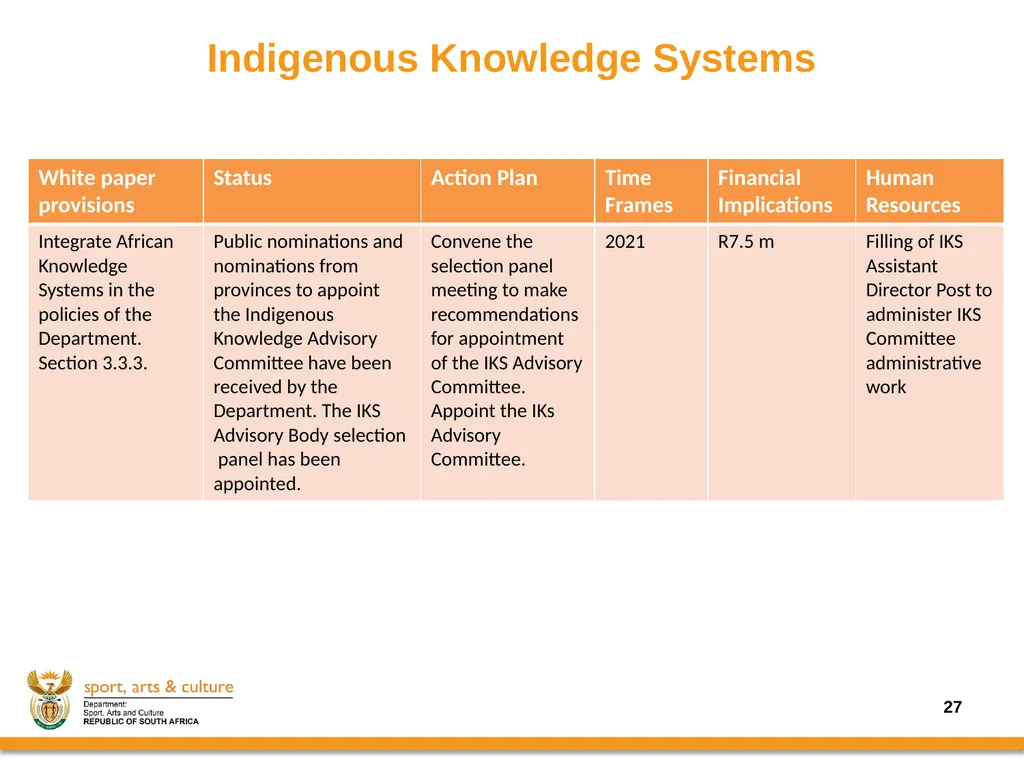
slide27. Indigenous Knowledge Systems 27<br>
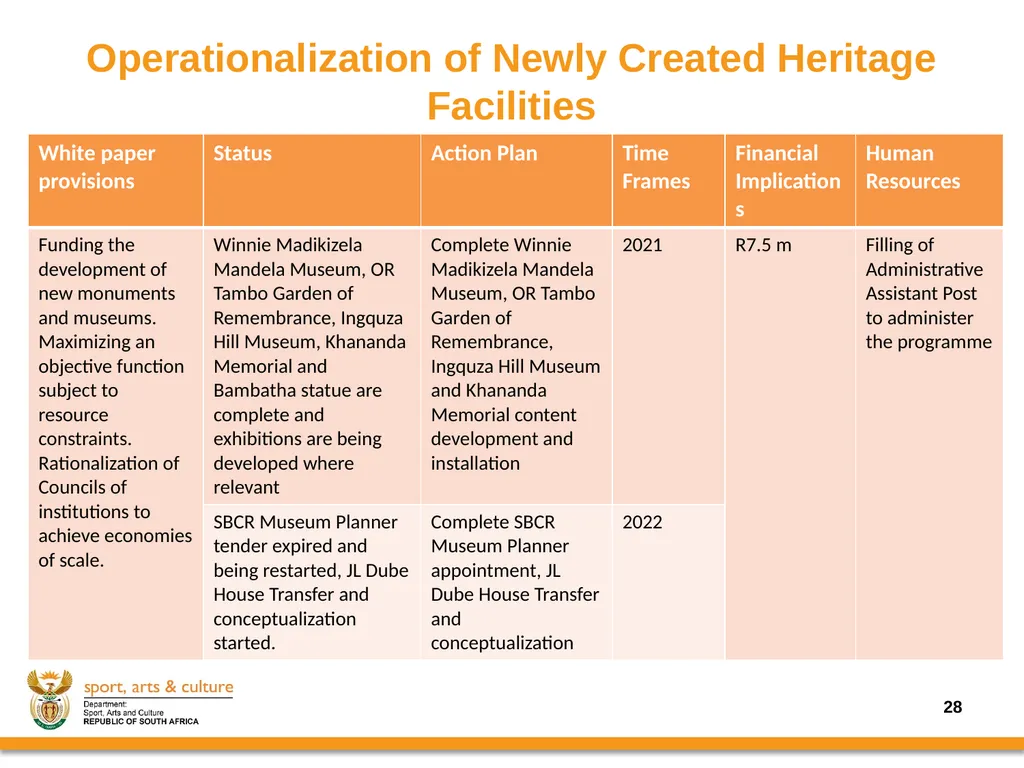
slide28. Operationalization of Newly Created Heritage Facilities 28<br>
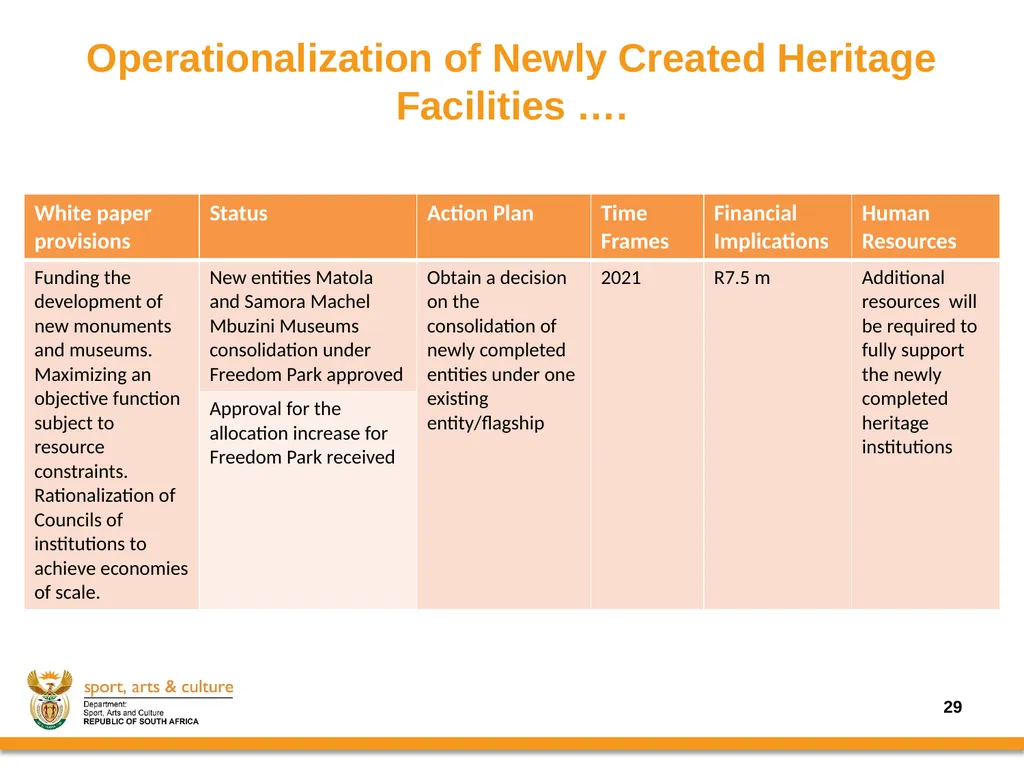
slide29. Operationalization of Newly Created Heritage Facilities …. 29<br>
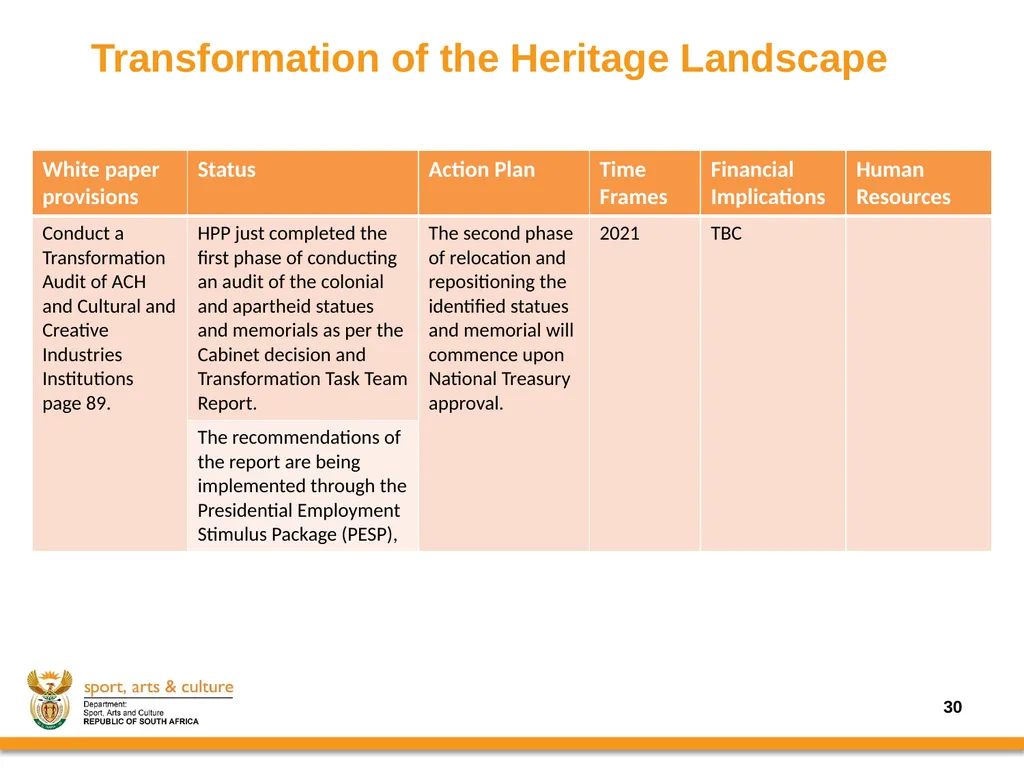
slide30. Transformation of the Heritage Landscape 30<br>
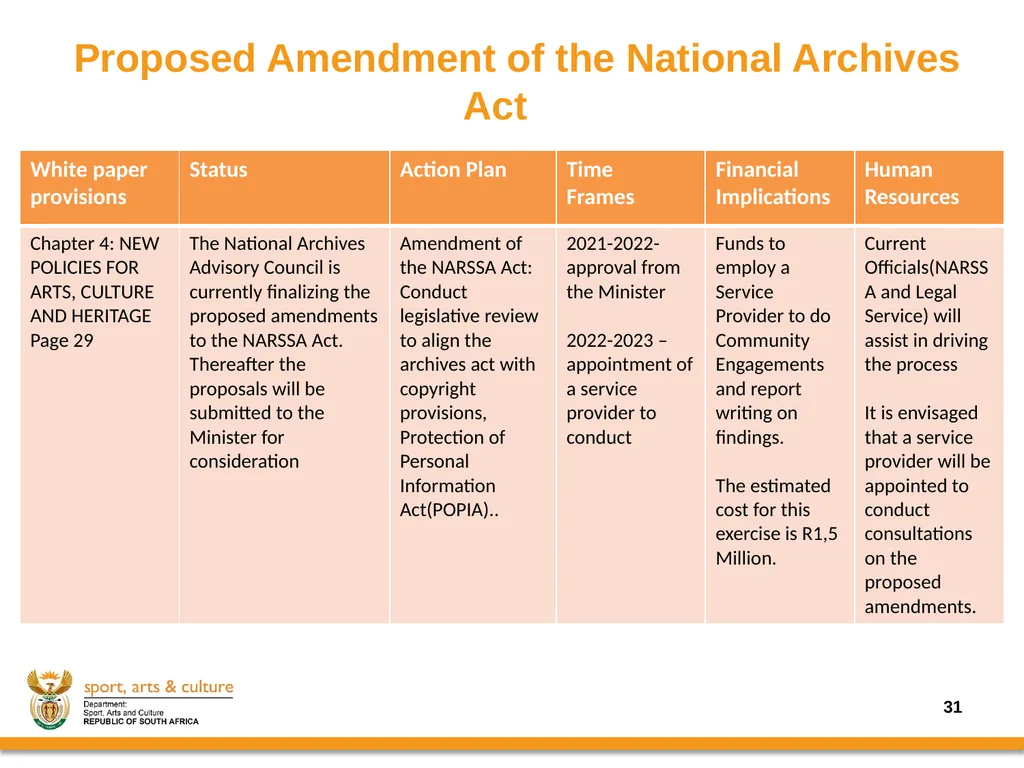
slide31. Proposed Amendment of the National Archives Act 31<br>
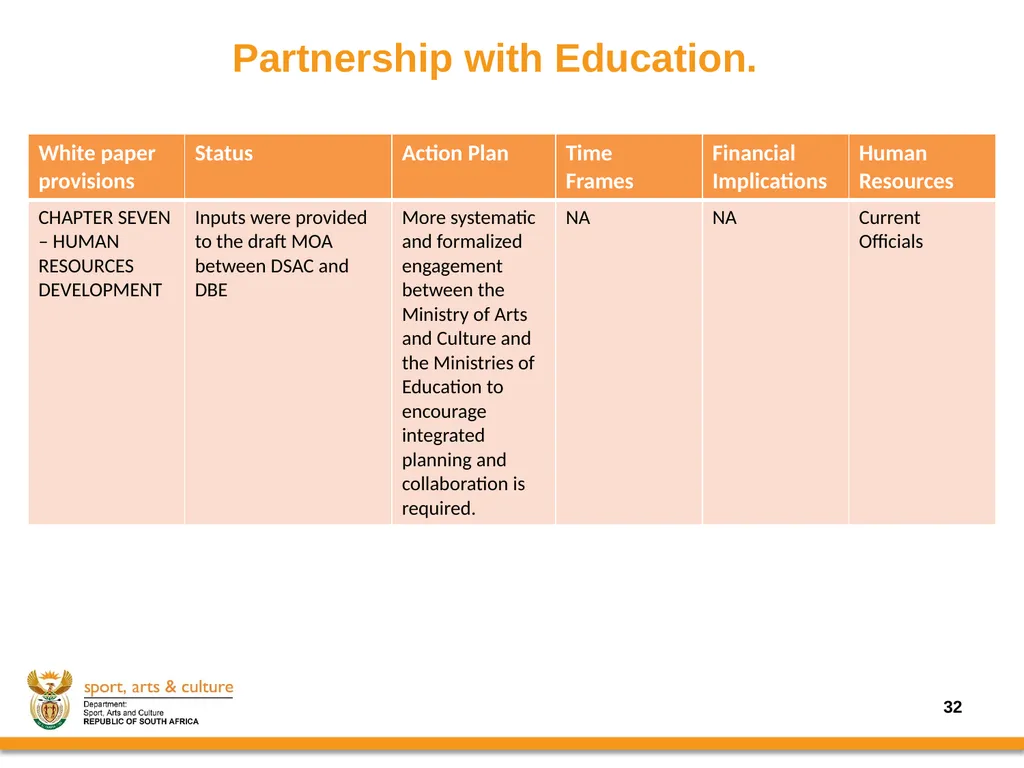
slide32. Partnership with Education. 32<br>
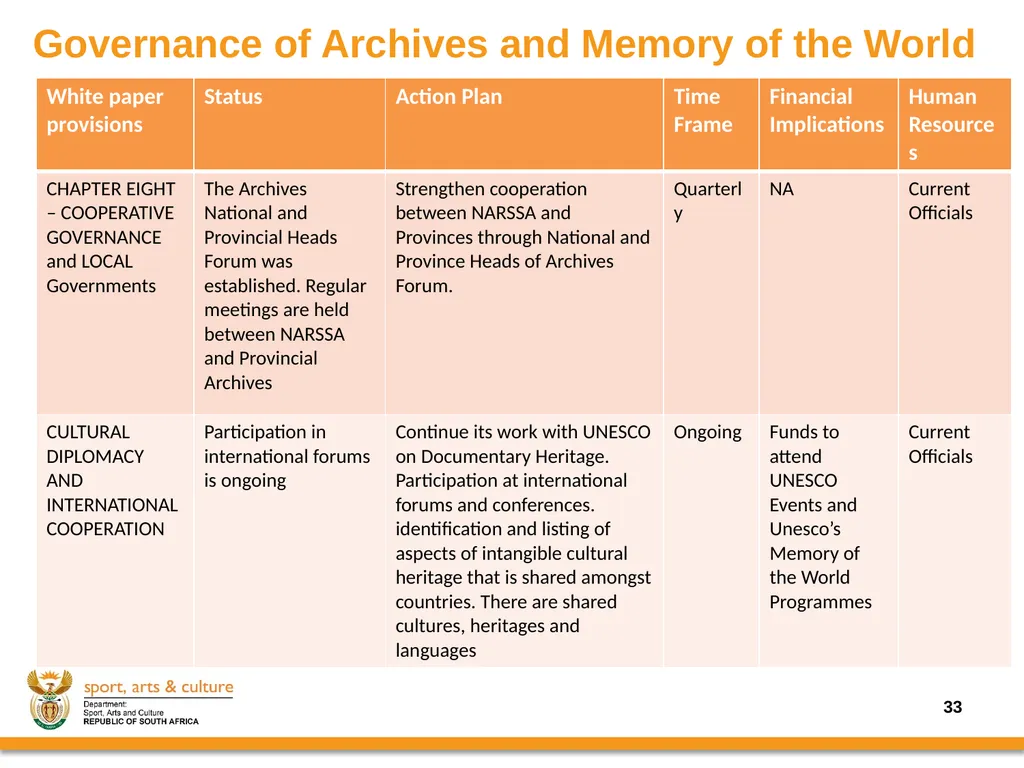
slide33. Governance of Archives and Memory of the World 33<br>
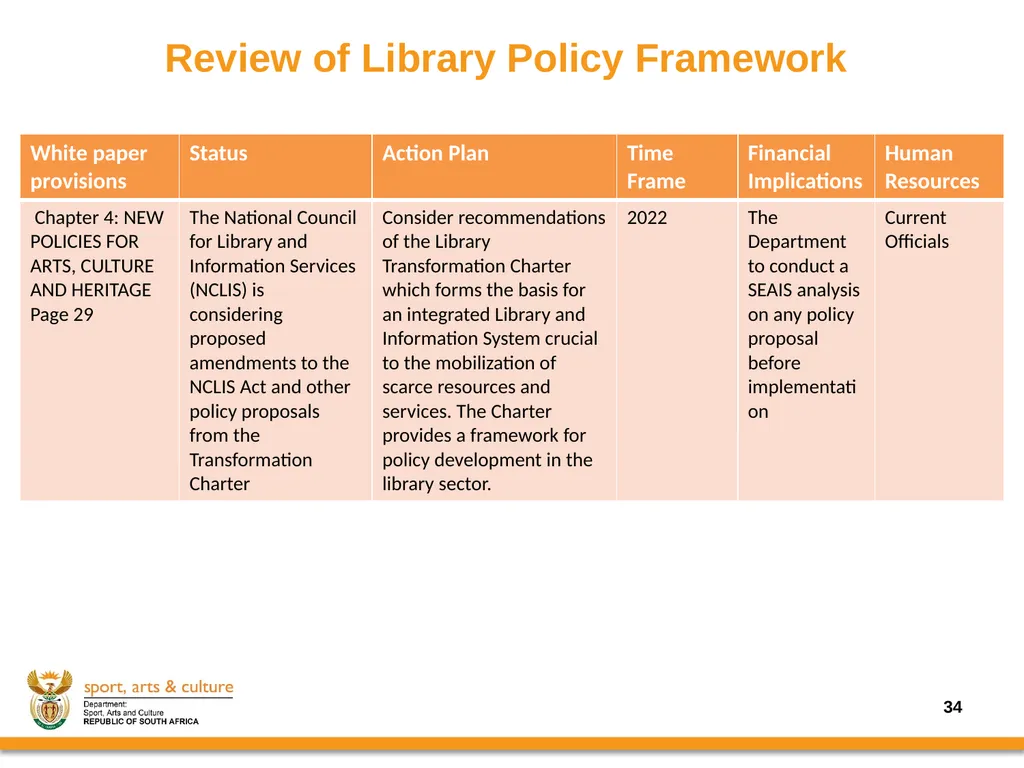
slide34. Review of Library Policy Framework 34<br>
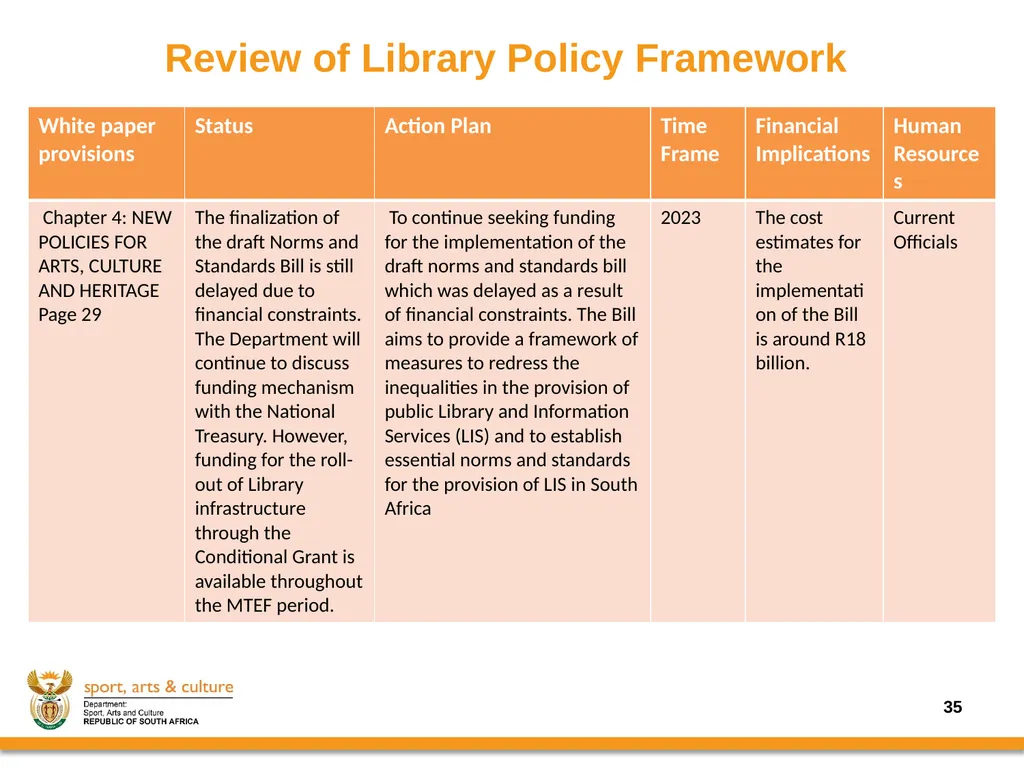
slide35. Review of Library Policy Framework 35<br>
slide36. THANK YOU<br>
Date: 03 December 2021<br>
slide2. TABLE OF CONTENTS Purpose;
Background and discussion;
Linkages to the Legislation;
Discussion of some of the proposals;
Risks and Communications implications;
Timelines;
Way forward;
Update on Arts, Culture and Development Interventions;
Update on Heritage Preservation and Promotion Interventions. 2<br>
slide3. PURPOSE The purpose of this presentation is update the Portfolio Committee on the Implementation of the revised White Paper on Arts, Culture and Heritage.
This has elements applicable to both the ACPD branch and the Heritage Promotion and Preservation (HPP) branch since the main focus of the White Paper was on Arts, Culture and Heritage has a direct impact on the work of the two branches. 3<br>
slide4. BACKGROUND AND DISCUSSION The Revised White Paper on Arts, Culture and Heritage was approved by Cabinet in October 2018.
The White Paper was thereafter presented to Parliament on several occasions and was finally endorsed by Parliament in November 2019.
It is therefore against this background that an exercise has been carried out to identify what needs to be done in order to roll-out or implement the Revised White Paper. 4 LINKAGES TO THE LEGISLATION The actions plans for the implementation of the revised White Paper will among others, include the enactment, amendment and or repeal of some of the legislation currently administered by the Department.
It is worth mentioning that some of our legislation pre-dates the current democratic dispensation and would therefore have to be aligned with democratic values, social justice and fundamental human rights as enshrined in the Constitution of the Republic of South Africa.
Furthermore, new legislation would also have to take into account the various provisions of the Public Finance Management Act, 1999 as amended, current Court judgments on a variety of legal issues including limitations on the exercise of discretionary powers by various functionaries including the Executive.<br>
slide5. SOME OF THE PROPOSALS There are numerous proposals and for purposes of this presentation same have been grouped as follows:
Formulation of policies and strategies;
Establishment of institutions;
Proposed affiliation;
Proposed legislation; and
Miscellaneous proposals. 5<br>
slide6. DISCUSSION OF SOME OF THE PROPOSALS Formulation of policies and strategies
Establish a dance policy;
Establish public policies with a focus on developing, supporting and promoting South African music;
Develop an implementation and management strategy for the new Artistic and Reproduction Rights (ARR) for the visual arts introduced in the Intellectual Property Amendment Bill;
Review the 1996 policy that sought to correct and reconstruct the heritage dispensation in accordance with the provisions of the Constitution;
(e) Establish an integrated National Heritage Policy Framework in order to address the fragmentation and duplications in the current overlapping heritage architecture in order to eliminate duplication and overlaps for greater integration, consolidation, coherence, optimal functioning and effective delivery and ensure a coherent arts, culture and heritage intergovernmental policy across national, provincial and local sphere of governance;
(f) Have an integrated National Policy on Museums to address the incoherent and fragmented dispensation of the past policy;
(g) Review the position of discipline-specific training within the FET college system and Finalise discussions relevant stakeholders regarding the proposed new SETA landscape; 6<br>
slide7. DISCUSSION OF SOME OF THE PROPOSALS… 2. Establishment of institutions
Establishment of African Arts, Culture and Heritage Centres at Tertiary Institutions / Establishment of departments, divisions and entities at Tertiary Institutions focused on arts, culture and heritage policy, management and administration;
Establish the viability of establishing a National Research and Development Institute for African Art, Culture and Heritage / A portion of national, provincial and local funding must be set aside for research and teaching and learning in the fields of management training and internships;
Establish National Theatre, Dance, Orchestral companies;
As per the findings of a feasibility study, establish an independent body to facilitate Artistic Reproduction Rights (ARR) management;
Establish a National Monuments, Heritage Sites and Resources Commission (National Heritage Resources Commission);
Establish a National Geographical Place Names Commission. This appears to be a proposed name change in relation to the South African Geographical Names Council (SAGNC);
Heraldry and National Symbols Commission. This appears to be a proposed name change in relation to the Bureau of Heraldry;
Proposes a numerous kinds of libraries – consider the need to have a one stop library with sections for differently abled users;
Establish a South African Book Development Council as a statutory body; 7<br>
slide8. DISCUSSION OF SOME OF THE PROPOSALS... (j) Establish the National Events, Technical and Productions Skills Academy (replacing NaCISA that proposed in a 2005 feasibility study);
(k) Have a National Skills Academy, Sourcing enterprise, cultural precincts in all provinces etc. – review the MGE strategy;
(l) Explore the possibility of establishing a fully-fledged Benevolent Fund as outlined by the research commissioned by DAC several years ago;
Proposed affiliation
Arts, Culture and Heritage be represented in the National Indigenous Knowledge Systems Office (NIKSO);
Establish a bi-annual South African Performing Arts Market;
4. Proposed legislation
Draft legislation for National Museums or amend the Cultural Institutions Act to clarify the role of National Museums;
It must be noted that where new institutions will be established or names of current ones be changed, this will invariably require either enactment of new legislation, amendment and or repeal of existing legislation;
Lastly, there is a need to review almost 90% of DSAC legislation so that it is in line with the latest Court judgments, new legislation for an example, the Public Finance Management Act, 1999 as amended, the current democratic dispensation and the democratic values, social justice and fundamental human rights as enshrined in the Constitution of the Republic of South Africa. 8<br>
slide9. DISCUSSION OF SOME OF THE PROPOSALS… 5. Miscellaneous proposals
Stimulate artistic innovation through support for artists and cultural practitioners;
Conduct audits of municipal theatres across the country and develop an implementation strategy for the effective administration and management of these theatres;
Develop historically marginalised and under-resourced provinces which do not have theatre facilities through joint funding and long term strategic plans;
Have an Incubator scheme for subsidized Theatres;
Funding of Performing Arts companies which have developed reputable education and training programmes as well as accreditation of their courses through the national qualification frameworks;
Implement incentive schemes proposed in the unpublished Independent Development Corporation (IDC) music industry study (2013);
Provide support of professional income and sustainability, transformation of the sector financially and contribution to creative industry development for visual artists;
Strengthening of existing visual arts infrastructure for greater sector development, transformation through African knowledge development and critical skills growth in a key sector;
Have a new vision for state run National, Provincial and Local Art Galleries and Art Museums;
The “Film and Video” sector be renamed “Audio-Visual Media” sector; 9<br>
slide10. DISCUSSION ON SOME OF THE PROPOSALS… (k) Each sub-sector of the cultural and creative industries sector should be defined according to the United Nations Educational, Scientific and Cultural Organization (UNESCO) Framework for Statistics;
(l) Explore ways in which banks and financial institutions could play key roles in fostering technological innovation and supporting investment in township cultural businesses; venture capital initiatives;
(m) Dept. will enter into a series of discussions with the Department of Labour to enable artists to retain their self-employed status for taxation purposes etc.;
(n) Have more systematic and formalised engagement between the Ministry of Arts and Culture and the Ministries of Education;
(o) Form partnerships with the Ministry of Basic Education and the Ministry of Arts, Culture and Heritage regarding the provision of arts, culture and heritage education for learners at basic education level; 10<br>
slide11. RISKS AND COMMUNICATIONS IMPLICATIONS Possible duplication of mandates and responsibilities in institutions to be established;
Determine the need, feasibility and sustainability of such proposed new institutions – consider current financial constraints;
Potential increase in the number of entities of the DSAC – increase administrative burden and operational and administrations costs including payments to Council or Board members;
Consider the need for renaming institutions including the financial costs thereof;
Consult the institutions first before making pronouncements on changes that are likely to take place. 11<br>
slide12. TIMELINES The timelines will primarily be informed by resolutions of the Strategic Planning sessions of the relevant branches when they consider proposals made in the White Paper.
Secondly, the finalisation and outcome of relevant feasibility studies, where applicable including meetings or consultations between the relevant line function/s, Entities Management Unit, the Legal Services Unit and the Institution itself (Executive & Board or Council) where matters of substance that need to be addressed on legislation if applicable will influence timelines for achievement of deliverables.
Lastly, prioritization of matters to be dealt with, capacity (human resources and skills) and inclusion of relevant matters in the Legislative programme for each year. 12<br>
slide13. WAY FORWARD Department assesses its capacity to deliver on the tasks required of it including policy development or formulation and the enactment, amendment and or repeal of legislation, if any.
If there is no adequate capacity to deliver on the above, the Department must develop a clear plan, timeously on how to carry out the tasks at hand including urgent recruitment of skilled personnel where applicable and outsourcing the work where relevant. All these processes must be in line with the relevant Supply Chain Management (SCM) processes.
The primary mandate of a national government department is policy formulation and the development of legislation.
DSAC will also conduct a benchmarking exercise with other Departments in order to ensure that both the Policy Coordination Unit and the Legal Services Unit are able to deliver on their respective mandates.
Any other relevant considerations that might impact of the implementation of the White Paper. 13<br>
slide14. UPDATE ON ARTS CULTURE AND DEVELOPMENT INTERVENTIONS<br>
slide15. Interventions: Formulation of Policies & Strategies 15<br>
slide16. Interventions: Formulation of Policies & Strategies… 13<br>
slide17. Interventions: Establishments of Institutions 17<br>
slide18. Interventions: Establishments of Institutions… 18<br>
slide19. Interventions: Establishments of Institutions 19<br>
slide20. Interventions: Programmes for Growth & Sustainability 20<br>
slide21. Interventions: Partnerships & Affiliations 21<br>
slide22. Interventions : Miscellaneous 22<br>
slide23. UPDATE ON HERITAGE PROMOTION AND PRESERVATION INTERVENTIONS<br>
slide24. Heritage Policies and Research 24<br>
slide25. Review National Heritage Legislation 25<br>
slide26. Heritage Bursaries Programme to Bridge Sector Skills Gap 26<br>
slide27. Indigenous Knowledge Systems 27<br>
slide28. Operationalization of Newly Created Heritage Facilities 28<br>
slide29. Operationalization of Newly Created Heritage Facilities …. 29<br>
slide30. Transformation of the Heritage Landscape 30<br>
slide31. Proposed Amendment of the National Archives Act 31<br>
slide32. Partnership with Education. 32<br>
slide33. Governance of Archives and Memory of the World 33<br>
slide34. Review of Library Policy Framework 34<br>
slide35. Review of Library Policy Framework 35<br>
slide36. THANK YOU<br>