
PROGRESS REPORT ON THE IMPLEMENTATION OF HISTORY
MS
Published · 29 slides · 0 views

1 / 1

Description
PROGRESS REPORT ON THE IMPLEMENTATION OF HISTORY AS A COMPULSORY SUBJECT (GR 4-12) 19 November 2024 Presentation Outline Purpose Preamble Problem Statement Background Members of the Ministerial Task Team (MTT) Terms of Reference for the MTT
Related Topics
Share
Embed code
Download this presentation From Below
"PROGRESS REPORT ON THE IMPLEMENTATION OF HISTORY" is the property of its rightful owner. Permission is granted to download and print the materials on this website for personal, non-commercial use only, and to display it on your personal computer provided you do not modify the materials and that you retain all copyright notices contained in the materials. By downloading content from our website, you accept the terms of this agreement.
Presentation Transcript
01
PROGRESS REPORT ON THE IMPLEMENTATION OF HISTORY AS A COMPULSORY SUBJECT
(GR 4-12) 19 November 2024<br>
02
Presentation Outline Purpose
Preamble
Problem Statement
Background
Members of the Ministerial Task Team (MTT)
Terms of Reference for the MTT
Progress Report on the work of the MTT
Implications for Teacher Development
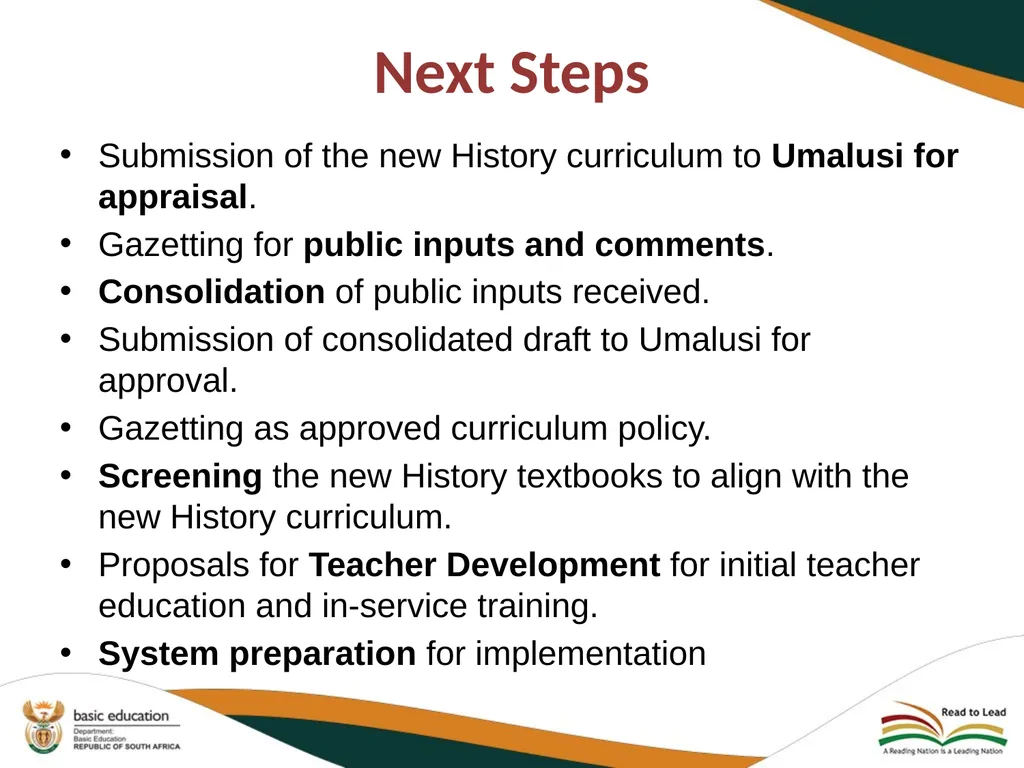
Next Steps
Conclusion<br>
Preamble
Problem Statement
Background
Members of the Ministerial Task Team (MTT)
Terms of Reference for the MTT
Progress Report on the work of the MTT
Implications for Teacher Development
Next Steps
Conclusion<br>
03
Purpose To present to the Portfolio Committee for discussion, a progress report on the implementation of History as a compulsory subject.<br>
04
Preamble The National Development Plan (NDP) stipulates that “History, heritage and culture are important for understanding the past, analysing the present and planning for the future. They foster social understanding and cohesion, which is important for social and economic stability and growth.” (NDP p304, 2030).<br>
05
Problem Statement The uptake of History as a preferred subject among learners and parents was waning in some provinces, leading to the decline in the number of learners choosing to study the subject. The number of schools declined from 6023 (2008) to 5404 in 2015.
The continuing decline of the subject meant that:
young people would know very little of their country and the society in which they live;
the youth would lose a sense of nationalism, patriotism and national unity derived through the study of History;
the youth would be unable to appreciate the historical struggles of many South Africans who contributed towards the establishment of a Democratic South Africa.<br>
The continuing decline of the subject meant that:
young people would know very little of their country and the society in which they live;
the youth would lose a sense of nationalism, patriotism and national unity derived through the study of History;
the youth would be unable to appreciate the historical struggles of many South Africans who contributed towards the establishment of a Democratic South Africa.<br>
06
Background The History Ministerial Task Team (MTT) was appointed on 04 June 2015 to advise the former Minister of Basic Education, the Honourable Mrs Angelina Motshekga, on the possibility of offering History as a compulsory subject in Further Education and Training (FET) Band.
The team started their work in March 2016 and completed it in December 2017.
The MTT report was presented to the public on 31 May 2018.<br>
The team started their work in March 2016 and completed it in December 2017.
The MTT report was presented to the public on 31 May 2018.<br>
07
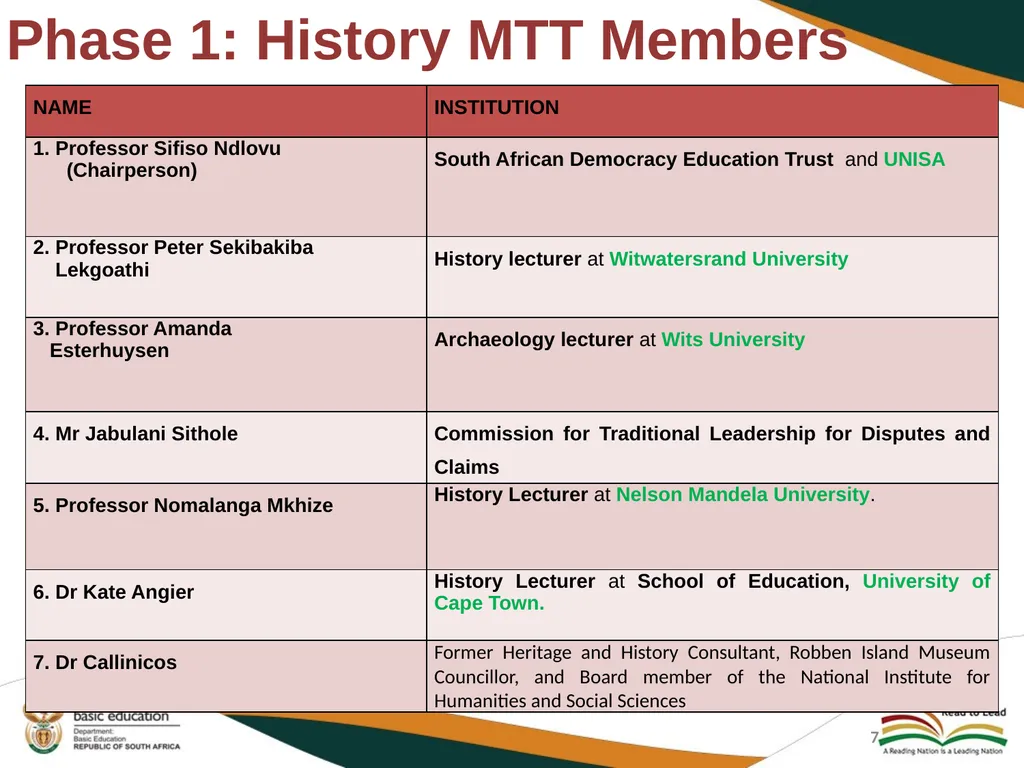
Phase 1: History MTT Members 7<br>
08
Background: Terms of Reference conduct a comparative international study on best practices regarding the offering of History in FET schools,
Advise on possible modalities for the compulsory introduction of History, including the consideration of it as part of citizenship located within Life Orientation;
Review the content of History in the FET and the General Education and Training (GET) band.<br>
Advise on possible modalities for the compulsory introduction of History, including the consideration of it as part of citizenship located within Life Orientation;
Review the content of History in the FET and the General Education and Training (GET) band.<br>
09
Background: Terms of Reference Audit the number of teachers or human resources available against the number of teachers that will be required in affected schools if such a decision was made;
Audit the number of History trainee teachers in higher education institutions for demand and supply;
Propose Teacher Development Programmes in the area of Initial Professional Education and Training (IPET) and Continuous Professional Teacher Development (CPTD);<br>
Audit the number of History trainee teachers in higher education institutions for demand and supply;
Propose Teacher Development Programmes in the area of Initial Professional Education and Training (IPET) and Continuous Professional Teacher Development (CPTD);<br>
10
Background: Comparative Study Themes investigated for the comparative study:
Whether History is compulsory in a given country and if so, up to which grade?
Whether History is a stand-alone subject or integrated and at what level?
Composition of the Content framework.
Level of control or autonomy – national/local level.
What skills are being developed?
Why the countries chose the particular approach they took?
What kind of identity is being promoted in the curriculum?<br>
Whether History is compulsory in a given country and if so, up to which grade?
Whether History is a stand-alone subject or integrated and at what level?
Composition of the Content framework.
Level of control or autonomy – national/local level.
What skills are being developed?
Why the countries chose the particular approach they took?
What kind of identity is being promoted in the curriculum?<br>
11
Background: Comparative Study Findings of the comparative study:
History has an important place in the school curricula across most parts of the world.
There are variations about whether History is separate or integrated.
In many countries History is offered as a compulsory subject (either as a distinct or integrated subject) up to Junior secondary level (Grade 9/age 14).
In some countries History is compulsory up to Upper secondary school, but in most countries it is offered as an elective or option at the upper level, as in South Africa.
History is a tremendously political subject, e.g. Brazil legislated the teaching of African History because 53% of the population are Afro-Brazilian; in Rwanda the Tutsi perspective is the history of Rwanda; the teaching and implementation of patriotic history in Zimbabwe.<br>
History has an important place in the school curricula across most parts of the world.
There are variations about whether History is separate or integrated.
In many countries History is offered as a compulsory subject (either as a distinct or integrated subject) up to Junior secondary level (Grade 9/age 14).
In some countries History is compulsory up to Upper secondary school, but in most countries it is offered as an elective or option at the upper level, as in South Africa.
History is a tremendously political subject, e.g. Brazil legislated the teaching of African History because 53% of the population are Afro-Brazilian; in Rwanda the Tutsi perspective is the history of Rwanda; the teaching and implementation of patriotic history in Zimbabwe.<br>
12
Key Recommendations: MTT Some History should be made compulsory at FET band and should replace Life Orientation (LO) as the 4th fundamental subject;
LO to remain compulsory at the GET band until Grade 9, and the content should be strengthened;
GET Social Sciences: History should be separated from Geography and be made a stand-alone subject;
CAPS curriculum has serious limitations and a complete overhaul of CAPS is required;
The CAPS syllabus and content is very Eurocentric and it is not about building the character of an African learner;
Africa-centredness should become a principle in revisiting the content;
Ancient history and pre-colonial African history should be brought into the FET Band.<br>
LO to remain compulsory at the GET band until Grade 9, and the content should be strengthened;
GET Social Sciences: History should be separated from Geography and be made a stand-alone subject;
CAPS curriculum has serious limitations and a complete overhaul of CAPS is required;
The CAPS syllabus and content is very Eurocentric and it is not about building the character of an African learner;
Africa-centredness should become a principle in revisiting the content;
Ancient history and pre-colonial African history should be brought into the FET Band.<br>
13
Phase 2 :Background On 15 October 2018, the former Minister of Basic Education, the Honourable Mrs Angelina Motshekga approved the reappointment of the MTT to revise the History curriculum.
The MTT started the process of revising the curriculum in 2019 and conducted several sessions between February and October of the same year.
During 2020, their work was interrupted by COVID-19 pandemic and the lockdown conditions prevalent in the country at the time.<br>
The MTT started the process of revising the curriculum in 2019 and conducted several sessions between February and October of the same year.
During 2020, their work was interrupted by COVID-19 pandemic and the lockdown conditions prevalent in the country at the time.<br>
14
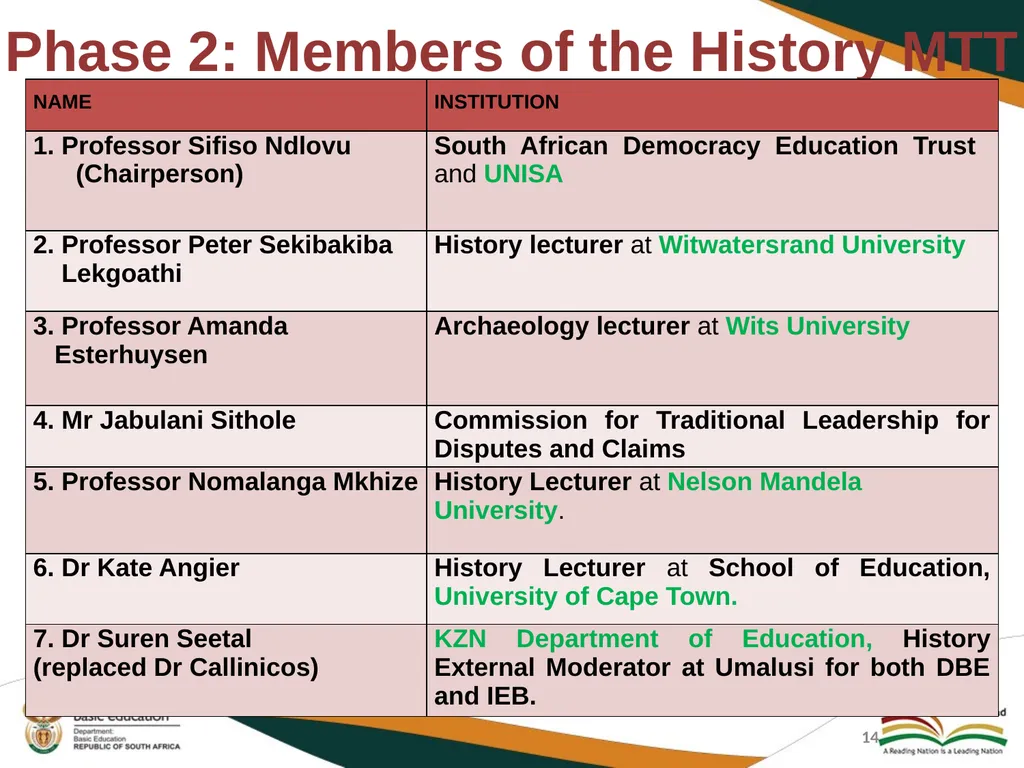
Phase 2: Members of the History MTT 14<br>
15
Background (Conti…) The MTT resumed with their work from August 2020, using a virtual platform as the country was still under lockdown.
The MTT contract expired on 31 April 2023 and a request for extension until 31 April 2025 was made, approved by the former Minister.<br>
The MTT contract expired on 31 April 2023 and a request for extension until 31 April 2025 was made, approved by the former Minister.<br>
16
Terms of Reference To develop a new History curriculum from Grades 4-12;
To conduct provincial consultations in the education sector to obtain inputs into the new History Curriculum;
To receive public inputs and comments for consideration, on the new History curriculum;
To screen new textbooks to ensure alignment with the new curriculum; and
To propose History Teacher development programmes for both Initial Teacher Education (ITE) and In-Service Teacher Education (re-skilling and up-skilling).<br>
To conduct provincial consultations in the education sector to obtain inputs into the new History Curriculum;
To receive public inputs and comments for consideration, on the new History curriculum;
To screen new textbooks to ensure alignment with the new curriculum; and
To propose History Teacher development programmes for both Initial Teacher Education (ITE) and In-Service Teacher Education (re-skilling and up-skilling).<br>
17
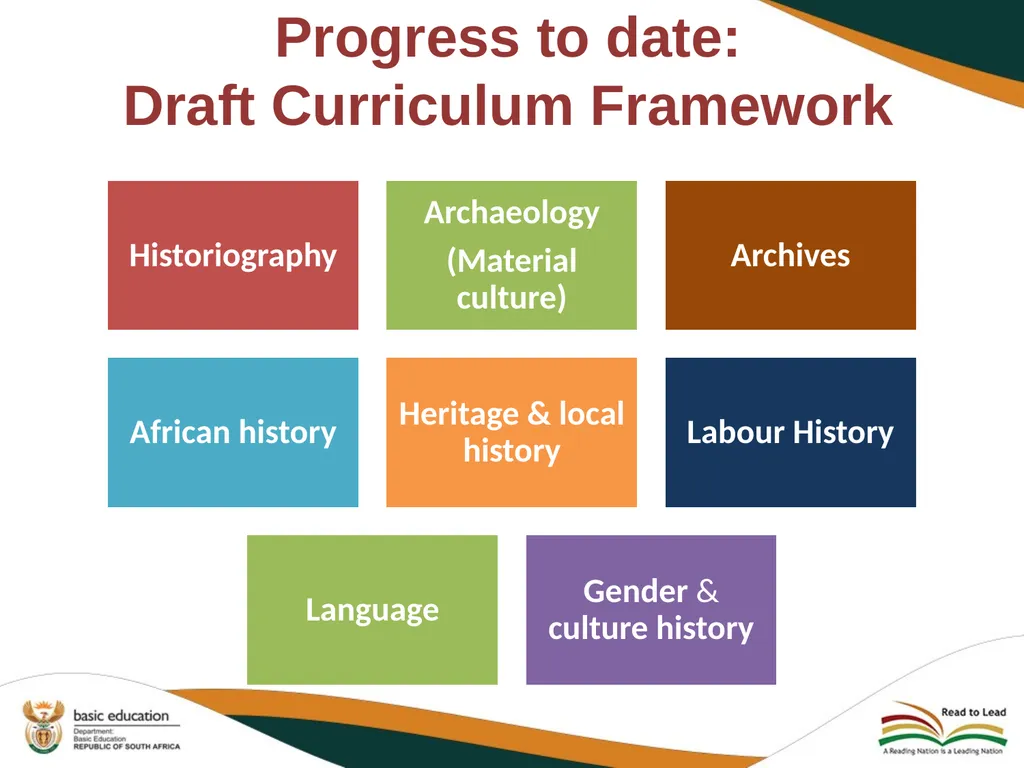
Progress to date:
Draft Curriculum Framework<br>
18
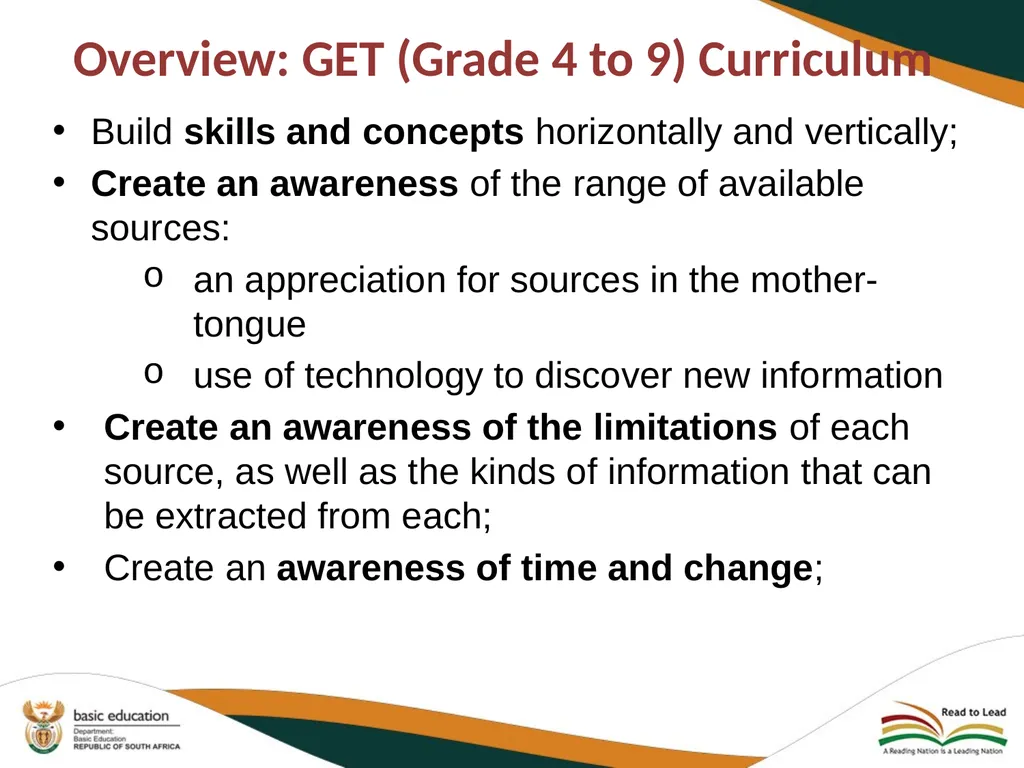
Overview: GET (Grade 4 to 9) Curriculum Build skills and concepts horizontally and vertically;
Create an awareness of the range of available sources:
an appreciation for sources in the mother-tongue
use of technology to discover new information
Create an awareness of the limitations of each source, as well as the kinds of information that can be extracted from each;
Create an awareness of time and change;<br>
Create an awareness of the range of available sources:
an appreciation for sources in the mother-tongue
use of technology to discover new information
Create an awareness of the limitations of each source, as well as the kinds of information that can be extracted from each;
Create an awareness of time and change;<br>
19
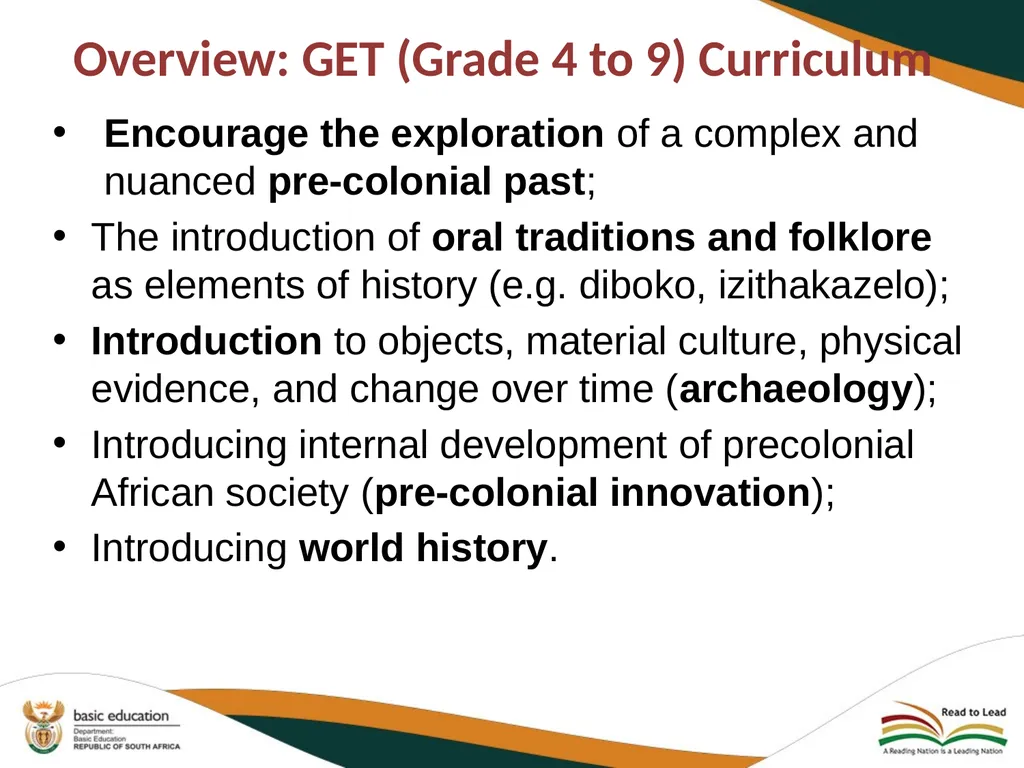
Overview: GET (Grade 4 to 9) Curriculum Encourage the exploration of a complex and nuanced pre-colonial past;
The introduction of oral traditions and folklore as elements of history (e.g. diboko, izithakazelo);
Introduction to objects, material culture, physical evidence, and change over time (archaeology);
Introducing internal development of precolonial African society (pre-colonial innovation);
Introducing world history.<br>
The introduction of oral traditions and folklore as elements of history (e.g. diboko, izithakazelo);
Introduction to objects, material culture, physical evidence, and change over time (archaeology);
Introducing internal development of precolonial African society (pre-colonial innovation);
Introducing world history.<br>
20
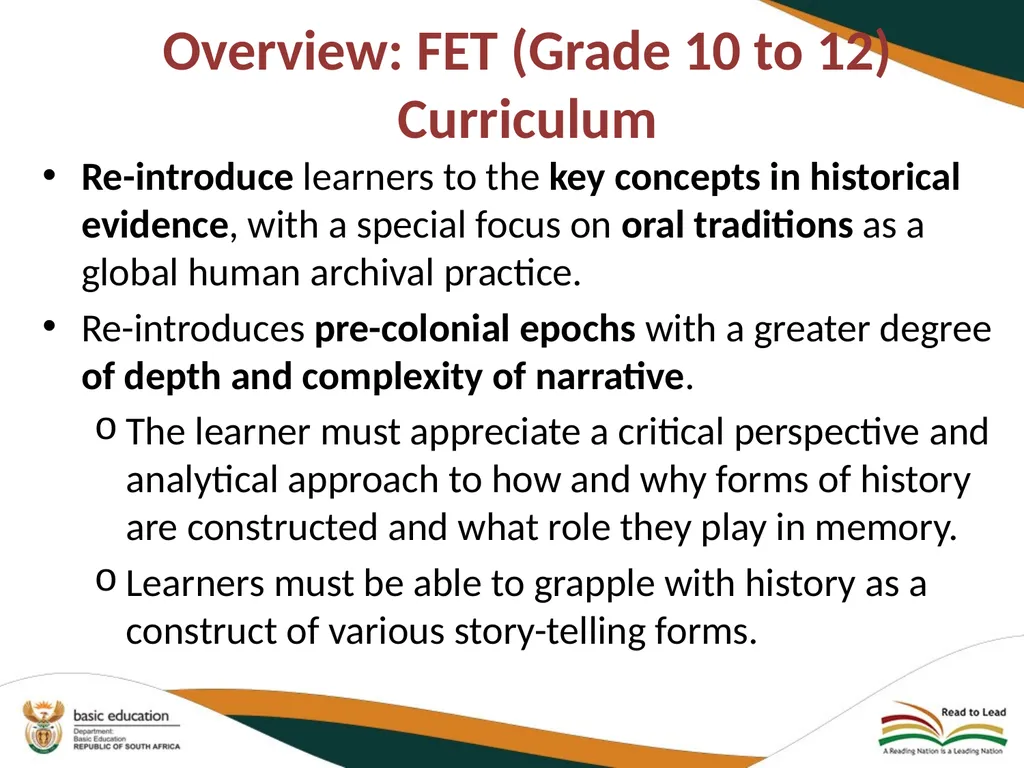
Overview: FET (Grade 10 to 12) Curriculum Re-introduce learners to the key concepts in historical evidence, with a special focus on oral traditions as a global human archival practice.
Re-introduces pre-colonial epochs with a greater degree of depth and complexity of narrative.
The learner must appreciate a critical perspective and analytical approach to how and why forms of history are constructed and what role they play in memory.
Learners must be able to grapple with history as a construct of various story-telling forms.<br>
Re-introduces pre-colonial epochs with a greater degree of depth and complexity of narrative.
The learner must appreciate a critical perspective and analytical approach to how and why forms of history are constructed and what role they play in memory.
Learners must be able to grapple with history as a construct of various story-telling forms.<br>
21
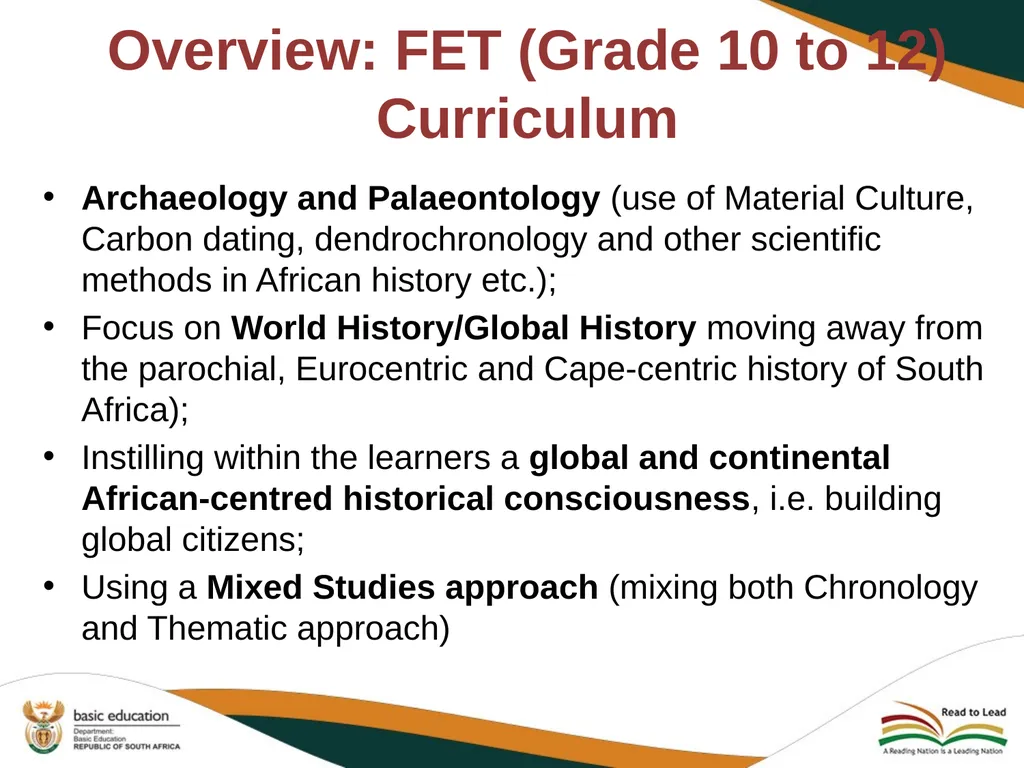
Overview: FET (Grade 10 to 12) Curriculum Archaeology and Palaeontology (use of Material Culture, Carbon dating, dendrochronology and other scientific methods in African history etc.);
Focus on World History/Global History moving away from the parochial, Eurocentric and Cape-centric history of South Africa);
Instilling within the learners a global and continental African-centred historical consciousness, i.e. building global citizens;
Using a Mixed Studies approach (mixing both Chronology and Thematic approach)<br>
Focus on World History/Global History moving away from the parochial, Eurocentric and Cape-centric history of South Africa);
Instilling within the learners a global and continental African-centred historical consciousness, i.e. building global citizens;
Using a Mixed Studies approach (mixing both Chronology and Thematic approach)<br>
22
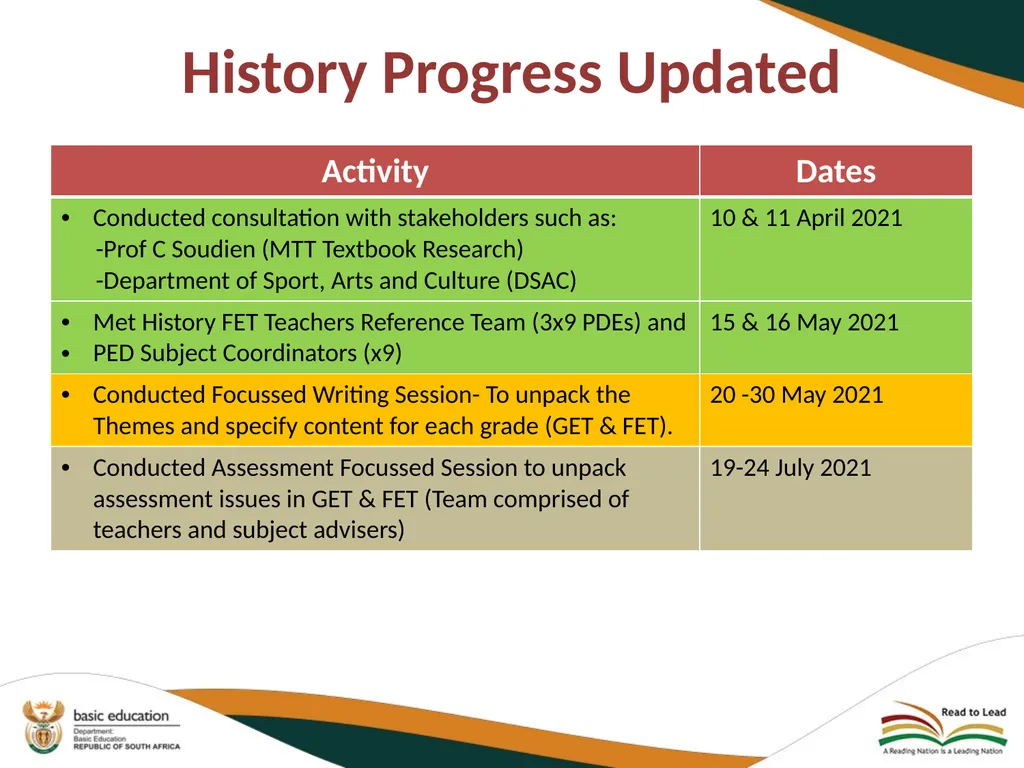
History Progress Updated<br>
23
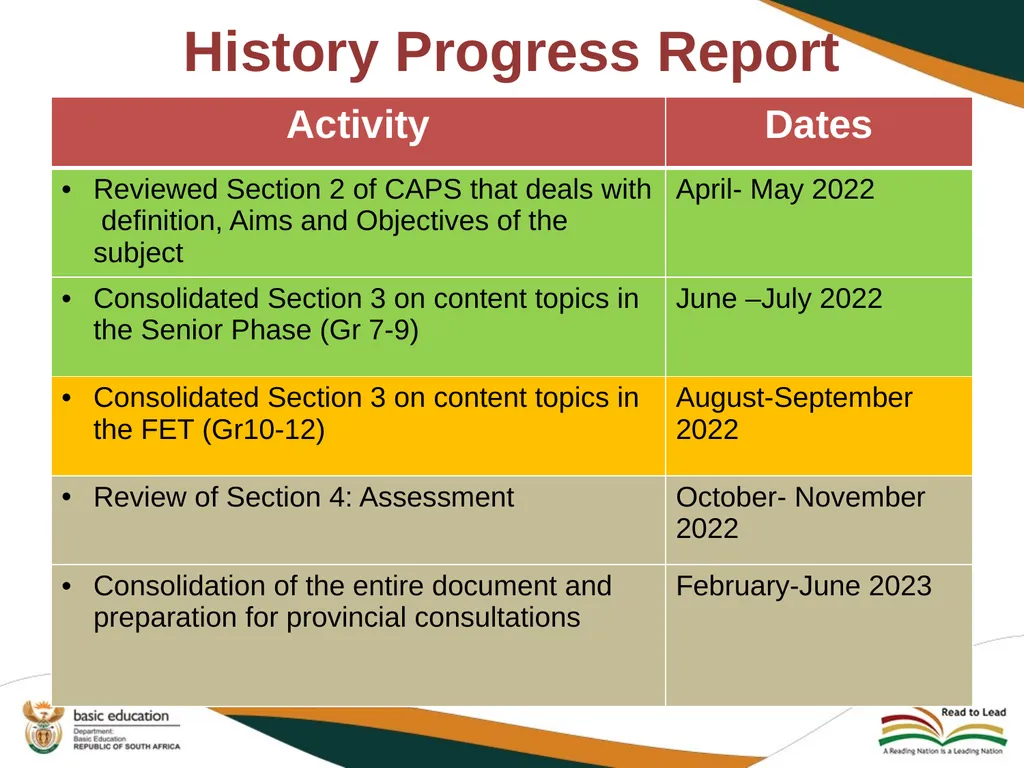
History Progress Report<br>
24
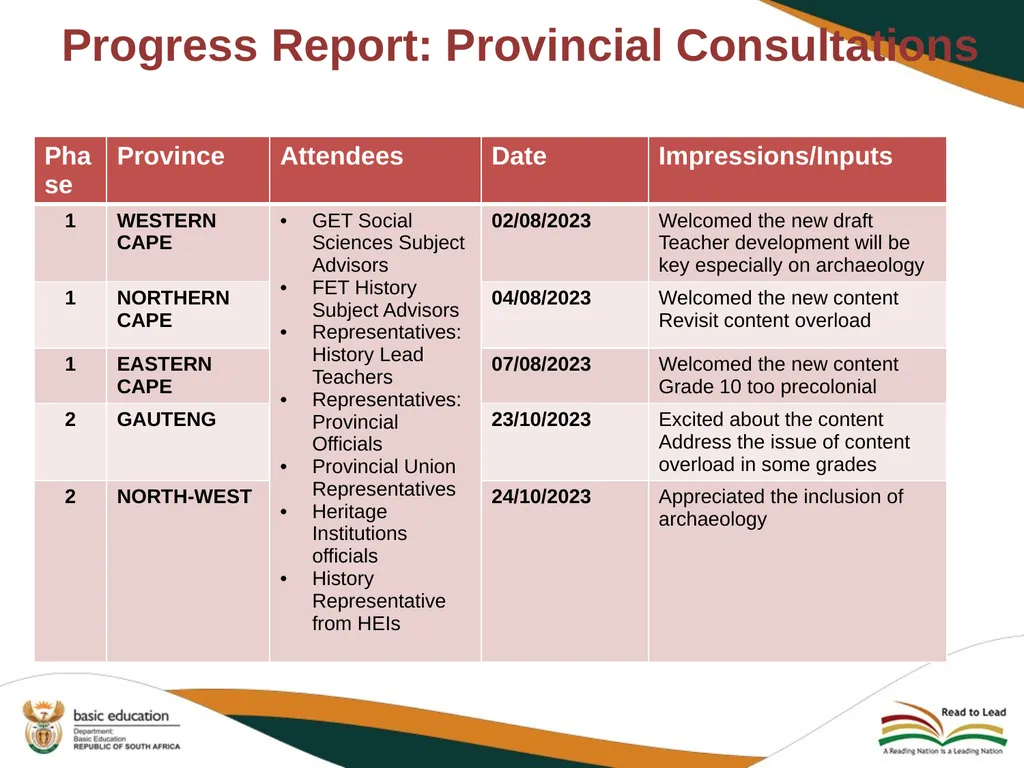
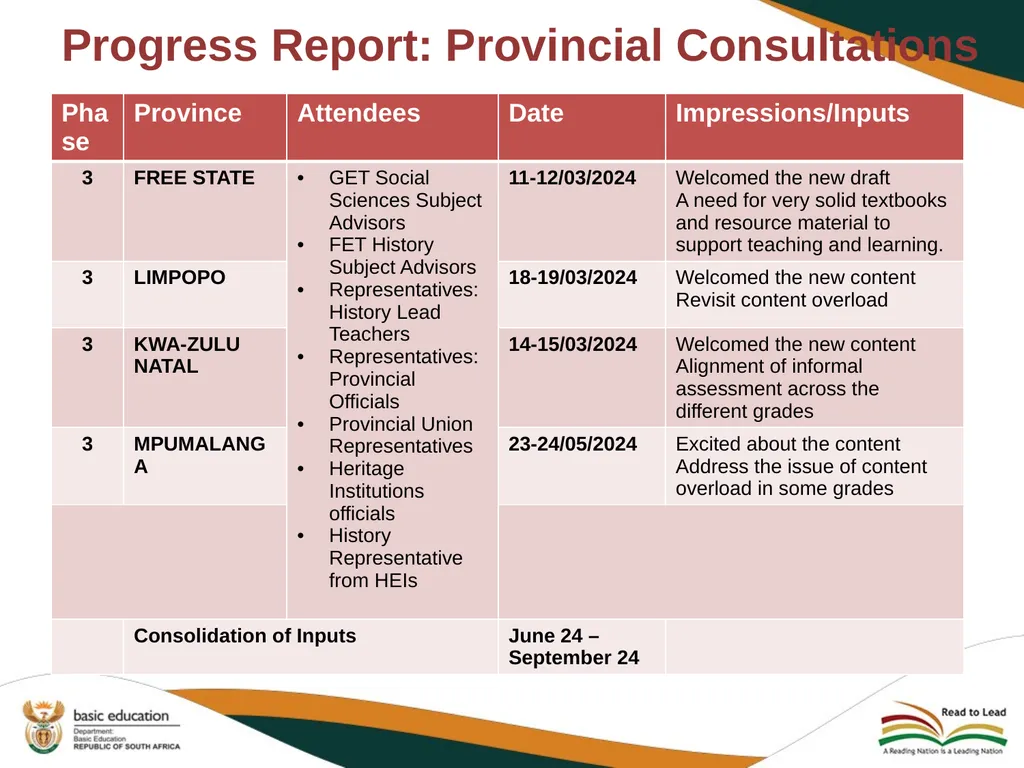
Progress Report: Provincial Consultations<br>
25
Progress Report: Provincial Consultations<br>
26
Implications for Teacher Development The new History curriculum is NOT a superficial tinkering of CAPS but is a radical overhaul.
It will require professional development of existing history teachers in content knowledge (historiography), pedagogical knowledge, language and archaeology.
Initial Teacher Education (BEd and PGCE) will require re-curriculation to incorporate the new “knowledges” to teach the new history curriculum.
Departments of History, History Education, Archaeology and Languages to collaborate.<br>
It will require professional development of existing history teachers in content knowledge (historiography), pedagogical knowledge, language and archaeology.
Initial Teacher Education (BEd and PGCE) will require re-curriculation to incorporate the new “knowledges” to teach the new history curriculum.
Departments of History, History Education, Archaeology and Languages to collaborate.<br>
27
Next Steps Submission of the new History curriculum to Umalusi for appraisal.
Gazetting for public inputs and comments.
Consolidation of public inputs received.
Submission of consolidated draft to Umalusi for approval.
Gazetting as approved curriculum policy.
Screening the new History textbooks to align with the new History curriculum.
Proposals for Teacher Development for initial teacher education and in-service training.
System preparation for implementation<br>
Gazetting for public inputs and comments.
Consolidation of public inputs received.
Submission of consolidated draft to Umalusi for approval.
Gazetting as approved curriculum policy.
Screening the new History textbooks to align with the new History curriculum.
Proposals for Teacher Development for initial teacher education and in-service training.
System preparation for implementation<br>
28
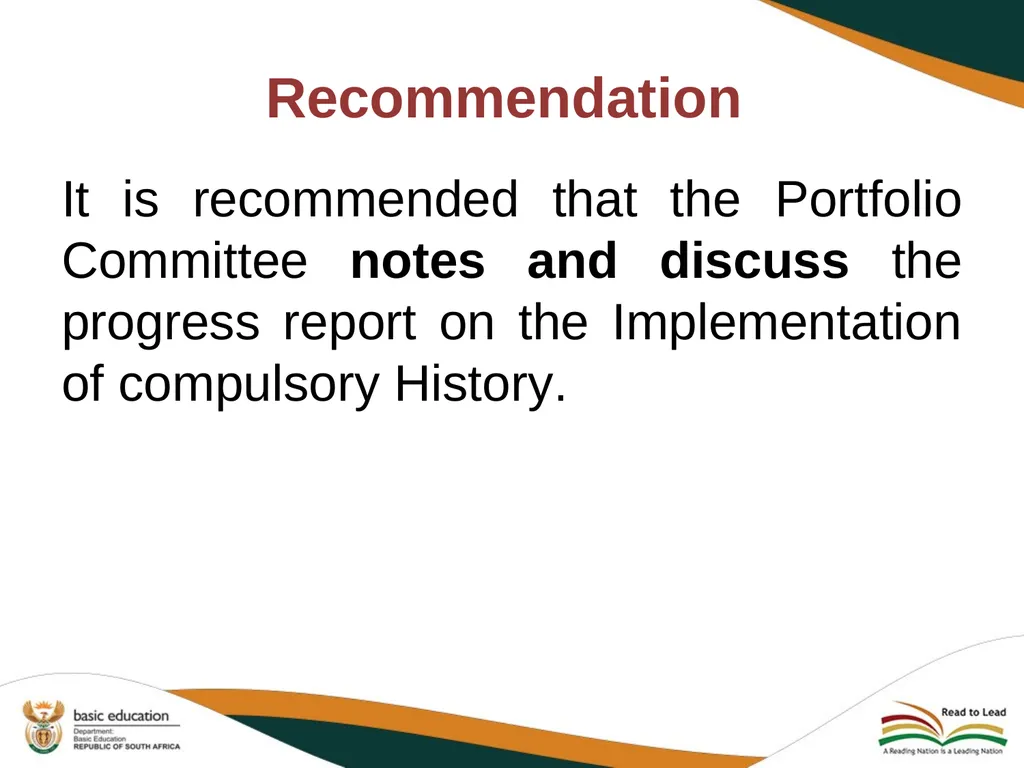
Recommendation It is recommended that the Portfolio Committee notes and discuss the progress report on the Implementation of compulsory History.<br>