Project Management 1 1. Project Selection 2. Conceptual Development 3. Initiating a Project 2 2 Learning Objectives After completing this chapter, students will be able to: Explain criteria for a useful project selectionscreening model
"Project Management 1 1. Project Selection 2." is the property of its rightful owner. Permission is granted to
download and print the materials on this website for personal, non-commercial use only, and to display it
on your personal computer provided you do not modify the materials and that you retain all copyright
notices contained in the materials. By downloading content from our website, you accept the terms of this
agreement.
Presentation Transcript
01
Project Management 1<br>
02
1. Project Selection 2. Conceptual Development 3. Initiating a Project 2 2<br>
03
Learning Objectives After completing this chapter, students will be able to:
Explain criteria for a useful project selection/screening model
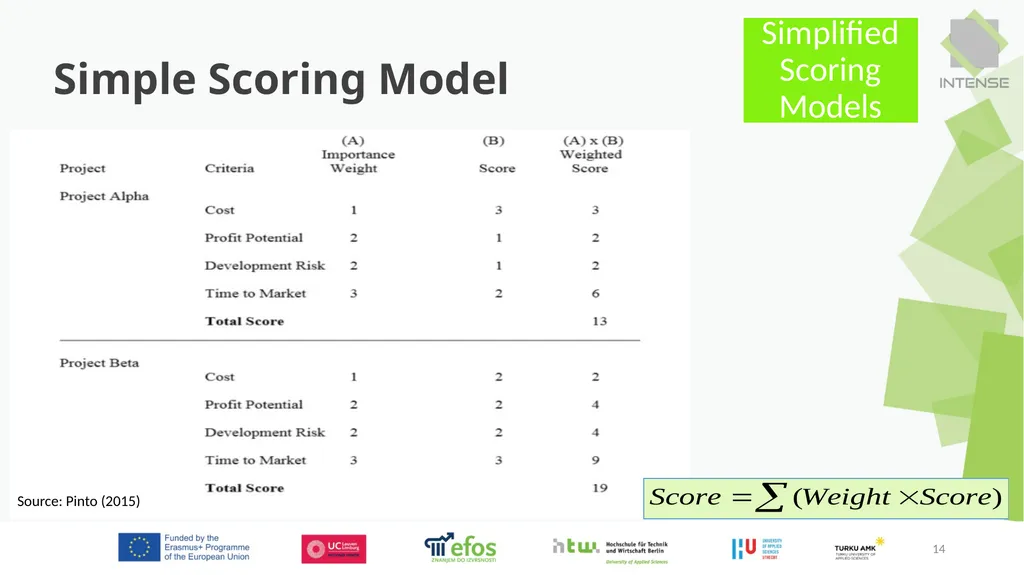
Understand how to employ scoring models to select projects
Recognise the challenges that arise in maintaining an optimal project portfolio for an organisation
Understand the three keys to successful project portfolio management 3<br>
04
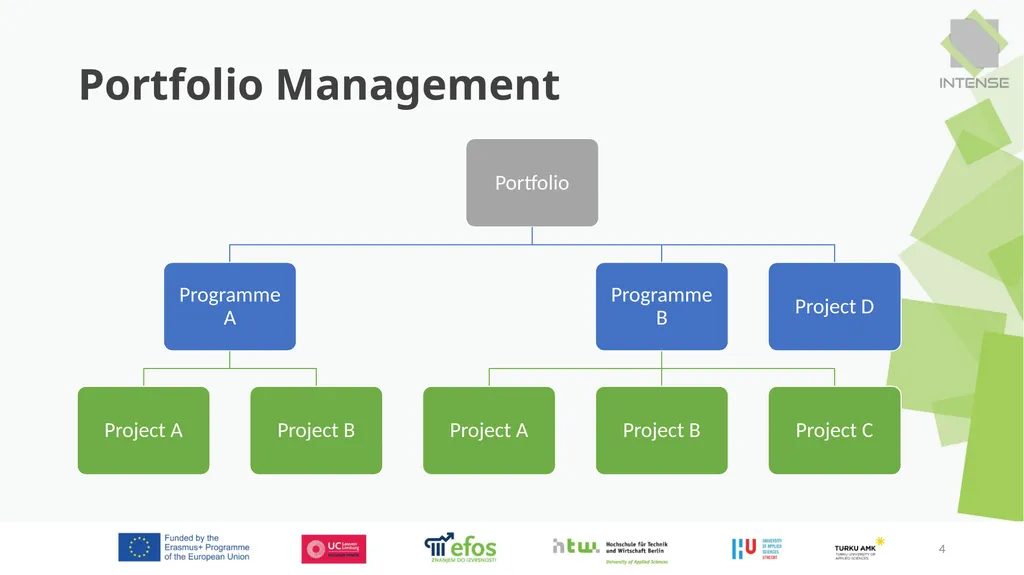
Portfolio Management 4<br>
05
Project Group Work for This Course During this course you are to develop and plan a project of your choice
Today:
Choose a team of 4 – 5 Students
Needs to be able to be in working mode in 2 weeks
Develop different project ideas with your team
Can be real or fictitious
Choose a project idea that your team will follow for the rest of this course Summer Term 2017 5<br>
06
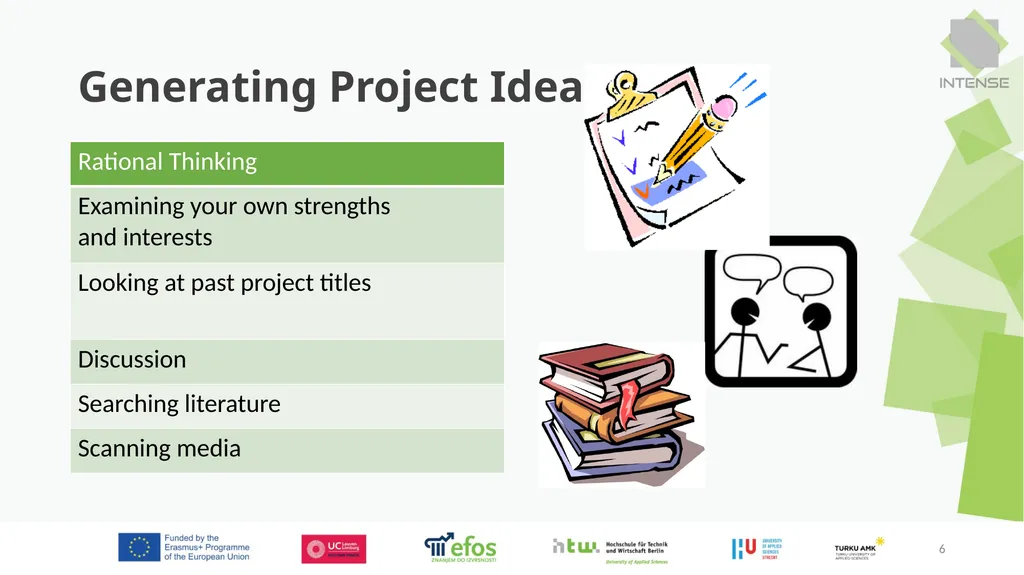
Generating Project Ideas 6<br>
07
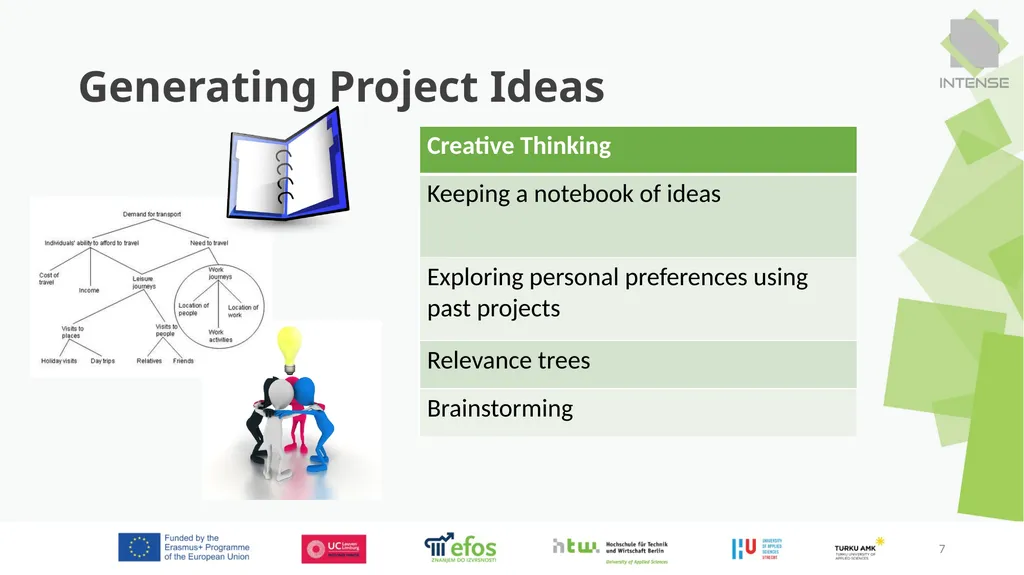
Generating Project Ideas 7<br>
08
Step 1: Silent brainstorm (5 minutes)
Write down your thoughts and/or ideas on post-its/cards. If you want, you can visualise your ideas with little drawings; use one post-it/card per idea.
Step 2: Sharing (10 minutes)
Present your ideas to the other group members and put your post-its/cards on the table or a flip-chart
Other group members can add ideas spontaneously
Step 3: Voting (5 minutes)
Use the two stickers to vote for the two project ideas that you like most
Choose the two project ideas with the most votes
Step 4: Specifying your project ideas (10 minutes)
Specify the two remaining project ideas within your team: what could your project look like?
Collect your ideas on post-its/cards 8 Generating Project Ideas - Approach<br>
09
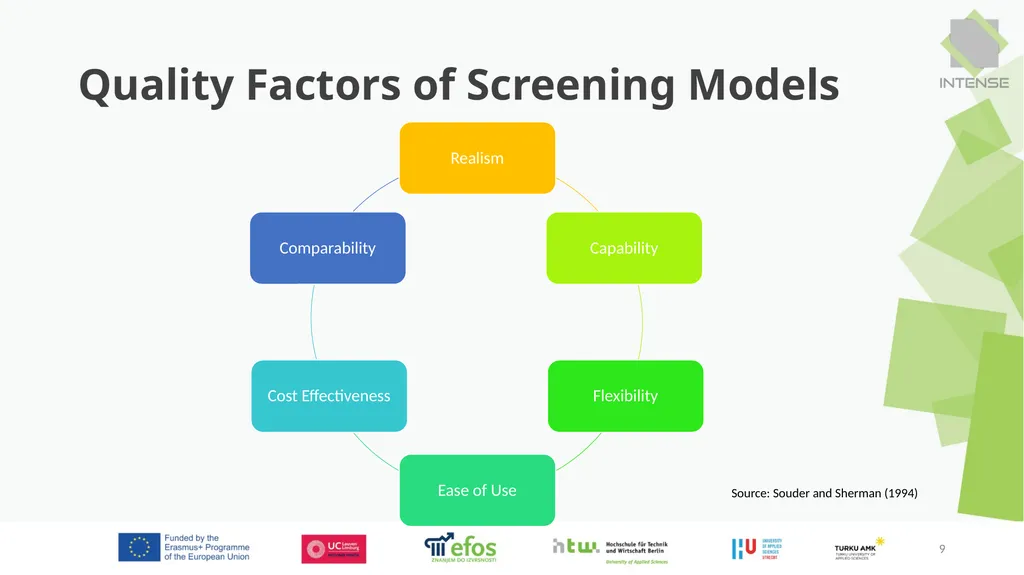
Quality Factors of Screening Models 9 9 Source: Souder and Sherman (1994)<br>
10
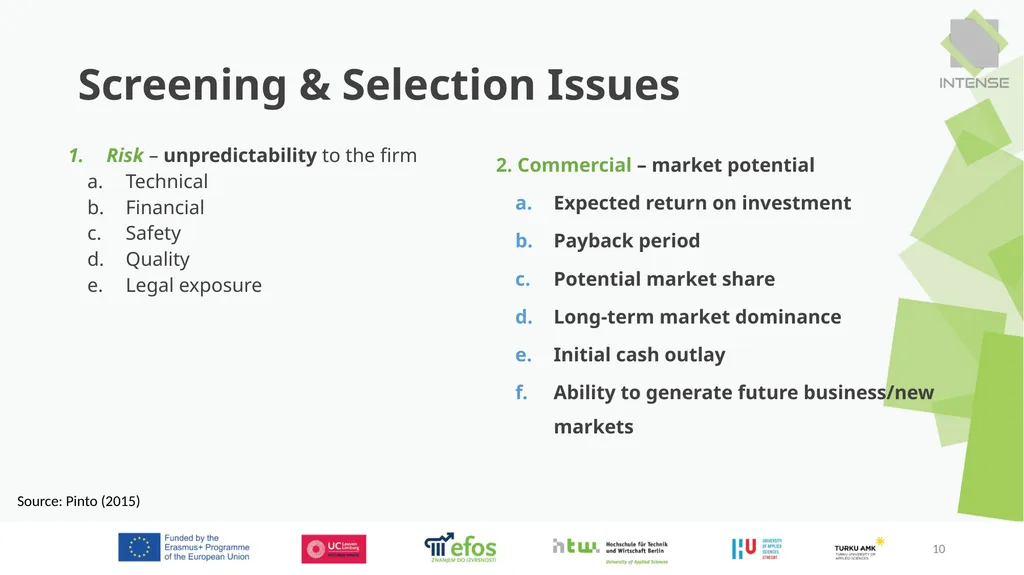
Screening & Selection Issues Risk – unpredictability to the firm
Technical
Financial
Safety
Quality
Legal exposure 2. Commercial – market potential
Expected return on investment
Payback period
Potential market share
Long-term market dominance
Initial cash outlay
Ability to generate future business/new markets 10 10 Source: Pinto (2015)<br>
11
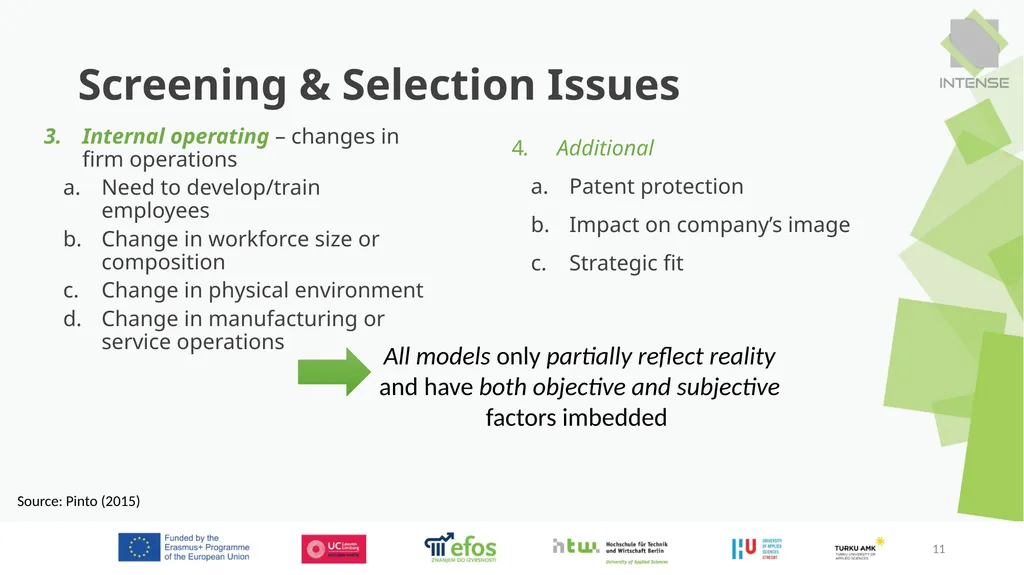
Screening & Selection Issues Internal operating – changes in firm operations
Need to develop/train employees
Change in workforce size or composition
Change in physical environment
Change in manufacturing or service operations 4. Additional
Patent protection
Impact on company’s image
Strategic fit All models only partially reflect reality and have both objective and subjective factors imbedded 11 11 Source: Pinto (2015)<br>
12
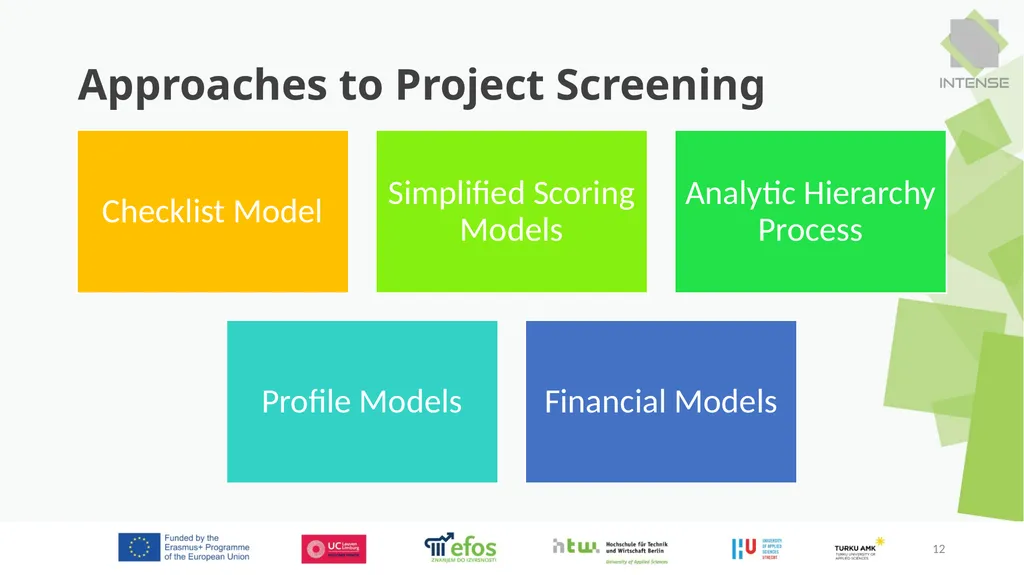
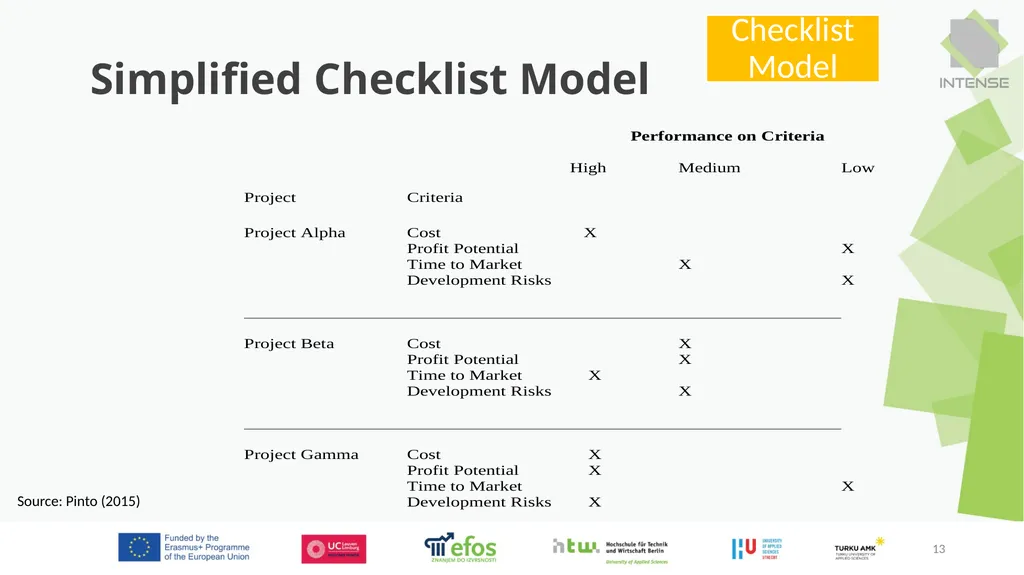
Approaches to Project Screening 12 12<br>
13
Simplified Checklist Model 13 13 Source: Pinto (2015)<br>
14
Simple Scoring Model 14 14 Source: Pinto (2015)<br>
15
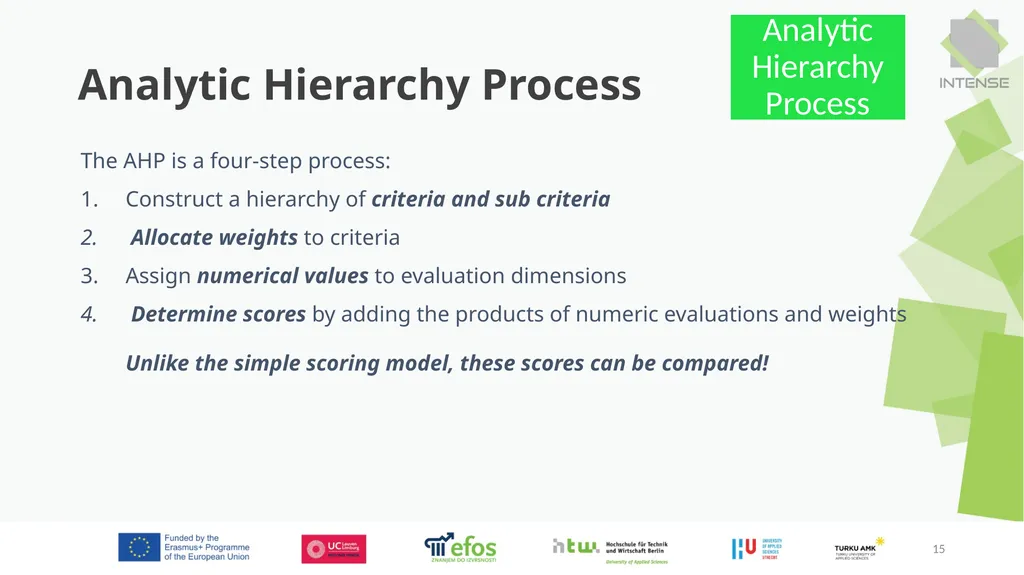
Analytic Hierarchy Process The AHP is a four-step process:
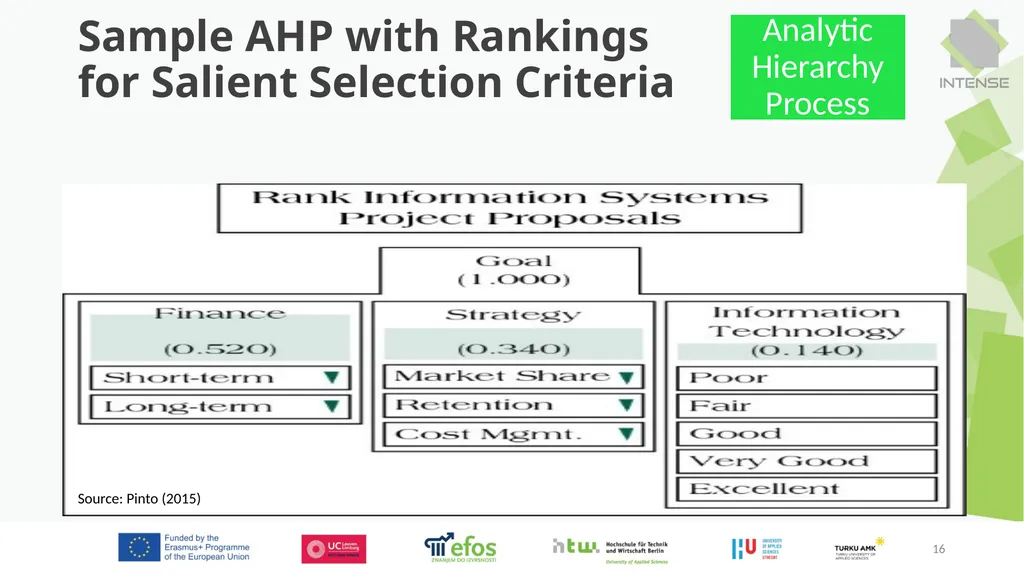
Construct a hierarchy of criteria and sub criteria
Allocate weights to criteria
Assign numerical values to evaluation dimensions
Determine scores by adding the products of numeric evaluations and weights
Unlike the simple scoring model, these scores can be compared! 15 15<br>
16
Sample AHP with Rankings for Salient Selection Criteria 16 Source: Pinto (2015)<br>
17
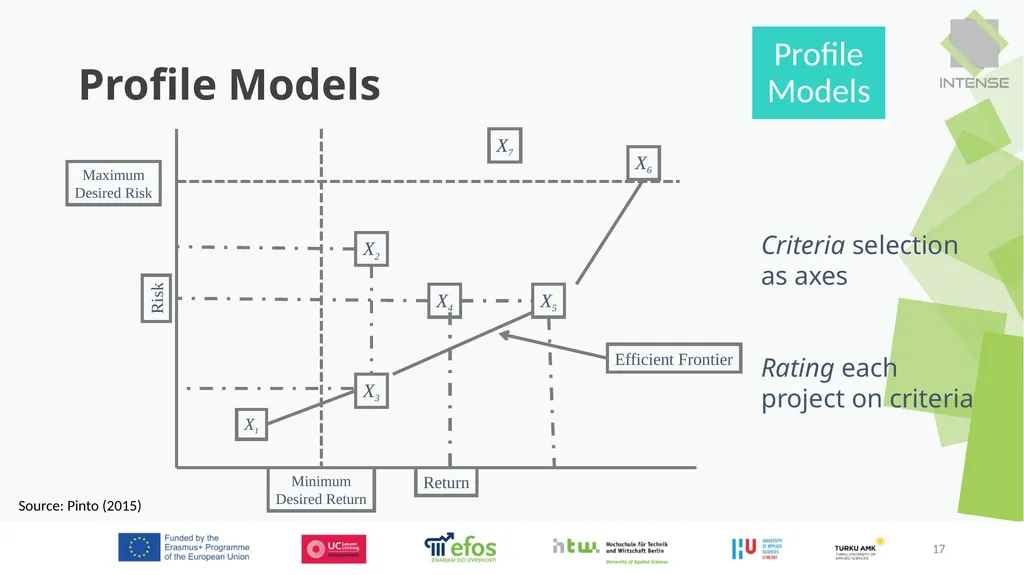
Profile Models Criteria selection as axes
Rating each project on criteria Source: Pinto (2015) 17<br>
18
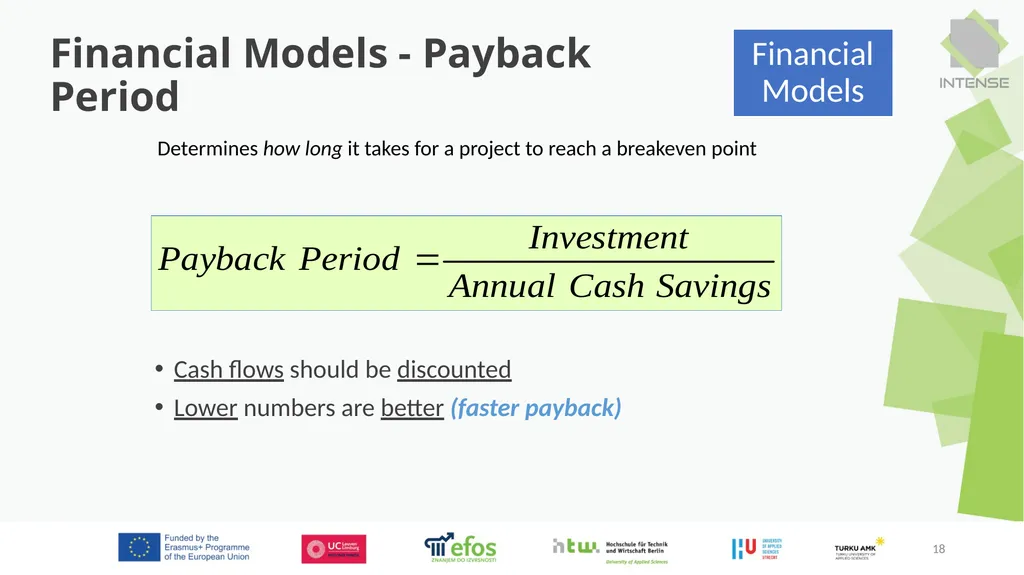
Financial Models - Payback Period Cash flows should be discounted
Lower numbers are better (faster payback) Determines how long it takes for a project to reach a breakeven point 18 18<br>
19
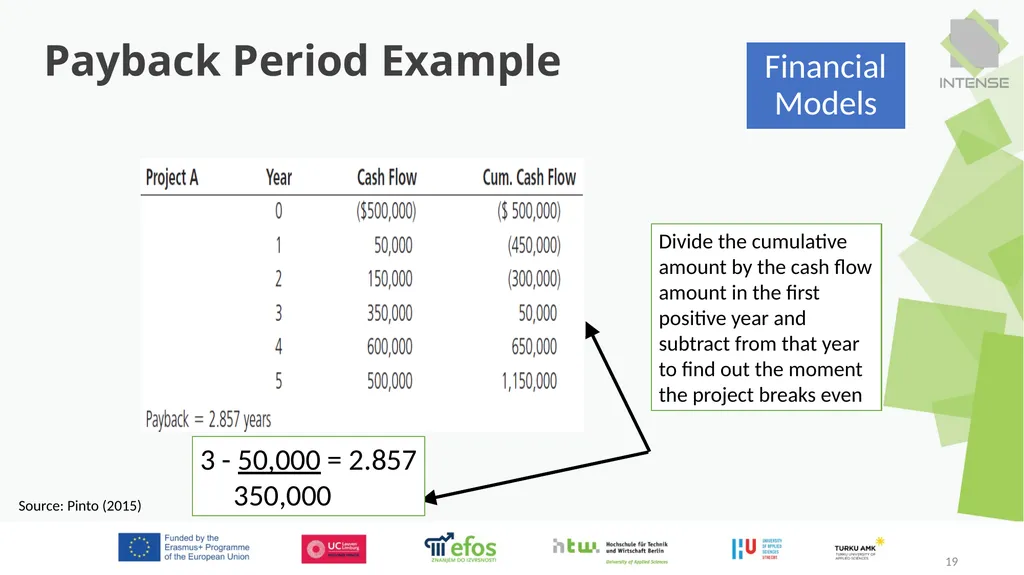
Payback Period Example Divide the cumulative amount by the cash flow amount in the first positive year and subtract from that year to find out the moment the project breaks even 3 - 50,000 = 2.857
350,000 19 Source: Pinto (2015)<br>
20
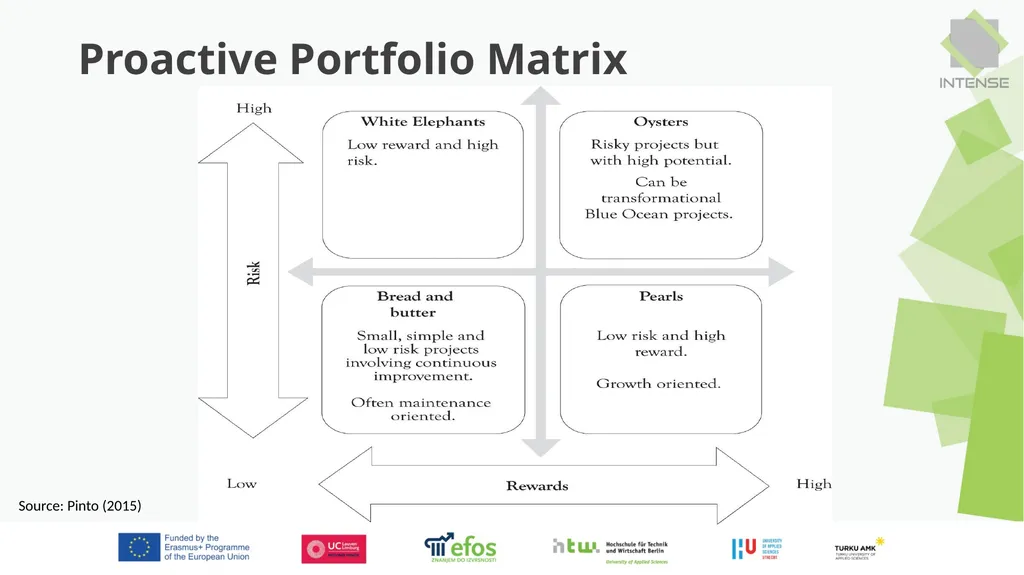
Proactive Portfolio Matrix Source: Pinto (2015) "Dieses Foto" von Unbekannter Autor ist lizenziert gemäß CC BY-SA-NC<br>
21
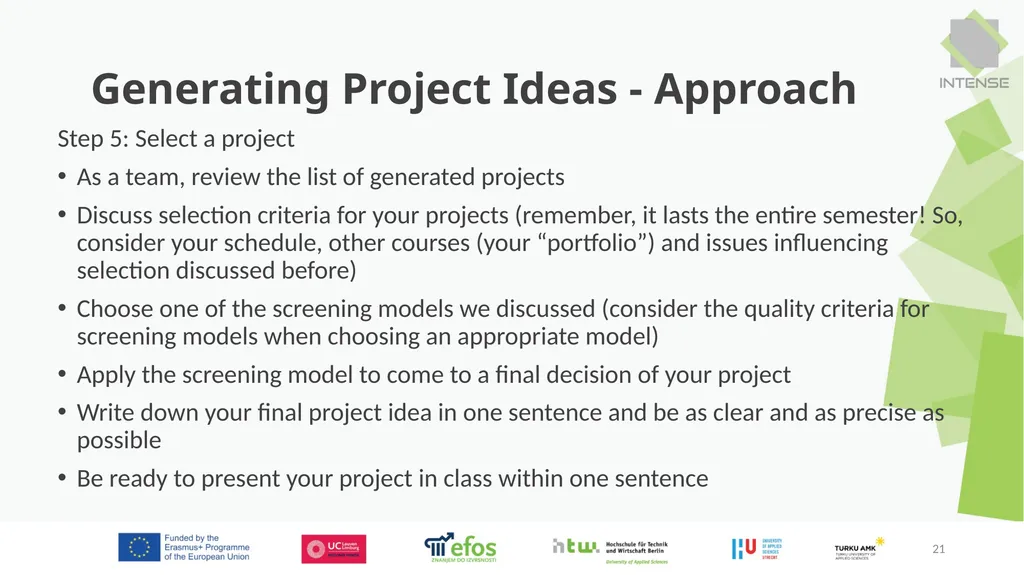
Step 5: Select a project
As a team, review the list of generated projects
Discuss selection criteria for your projects (remember, it lasts the entire semester! So, consider your schedule, other courses (your “portfolio”) and issues influencing selection discussed before)
Choose one of the screening models we discussed (consider the quality criteria for screening models when choosing an appropriate model)
Apply the screening model to come to a final decision of your project
Write down your final project idea in one sentence and be as clear and as precise as possible
Be ready to present your project in class within one sentence 21 Generating Project Ideas - Approach<br>
22
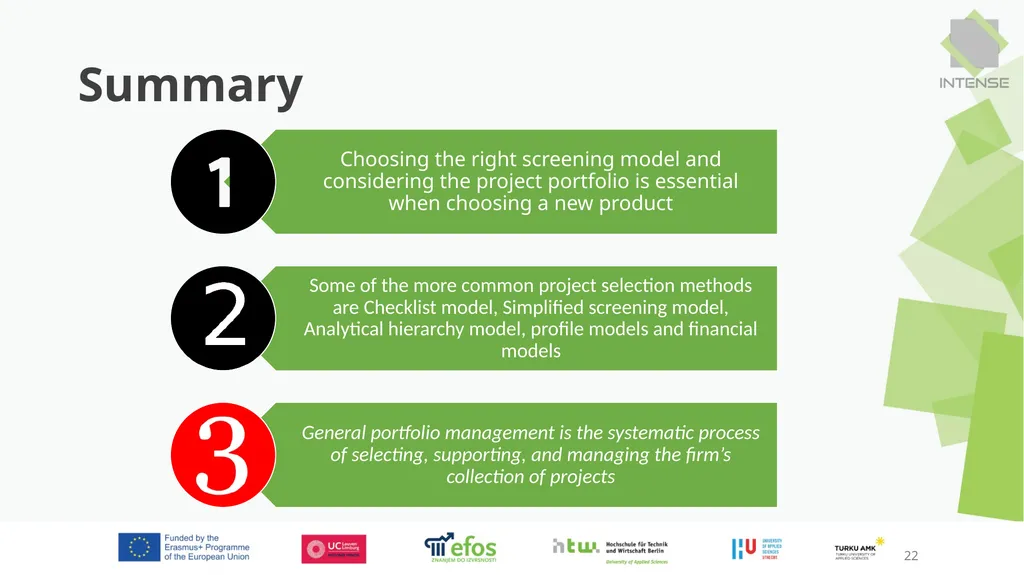
Summary 22 22<br>
23
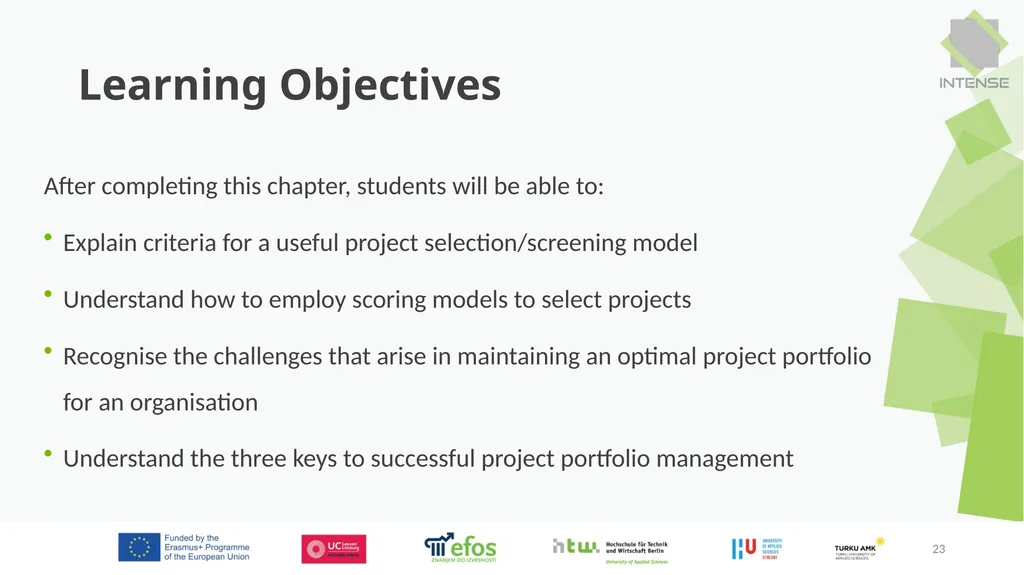
Learning Objectives After completing this chapter, students will be able to:
Explain criteria for a useful project selection/screening model
Understand how to employ scoring models to select projects
Recognise the challenges that arise in maintaining an optimal project portfolio for an organisation
Understand the three keys to successful project portfolio management 23<br>
24
References Horine, Greg (2013): Absolute Beginner’s Guide to Project Management, Que Sams/Pearson Education, 3rd ed.
Pinto, J. K. (2015): Project management. Achieving competitive advantage, Pearson Education, Harlow, Essex, 4th ed.
Project Management Institute (2013): A Guide to the Project Management Body of Knowledge: PMBOK(R) Guide, Project Management Institute; 5th ed.
Souder, W. E., & Sherman, J. D. (1994). Managing new technology development. Columbia University Press. 24<br>