Proposal Preparation 101 Office of Sponsored Programs and Research (OSPR) (updated July 2023) Office of Sponsored Programs and Research (OSPR) OSPR at Clark University is responsible for the review and submission of external funding
"Proposal Preparation 101 Office of Sponsored" is the property of its rightful owner. Permission is granted to
download and print the materials on this website for personal, non-commercial use only, and to display it
on your personal computer provided you do not modify the materials and that you retain all copyright
notices contained in the materials. By downloading content from our website, you accept the terms of this
agreement.
Presentation Transcript
01
Proposal Preparation 101 Office of Sponsored Programs
and Research (OSPR)
(updated July 2023)<br>
02
Office of Sponsored Programs and Research (OSPR) OSPR at Clark University is responsible for the review and submission of external funding requests and the acceptance of external funding for all university-based research, educational, training and other projects for which the sponsors require conditions in return for their financial support.
These include grant, subgrant, contract, subcontract, and cooperative agreement applications and proposals, federal or non-federal, including continuations, extensions, renewals, supplements, and transfer applications for all departments.
This review and processing constitutes "institutional approval." OSPR works with a range of university offices to ensure the post award management of all sponsored projects.<br>
03
Corporate and Foundation Relations (CFR) CFR is responsible for approving external funding requests to private sponsors, i.e. corporations, foundations and non-government organizations.
These requests to private sources are for sponsored programs and require review from CFR prior to the same review process by OSPR as funding requests made to public sponsors.<br>
04
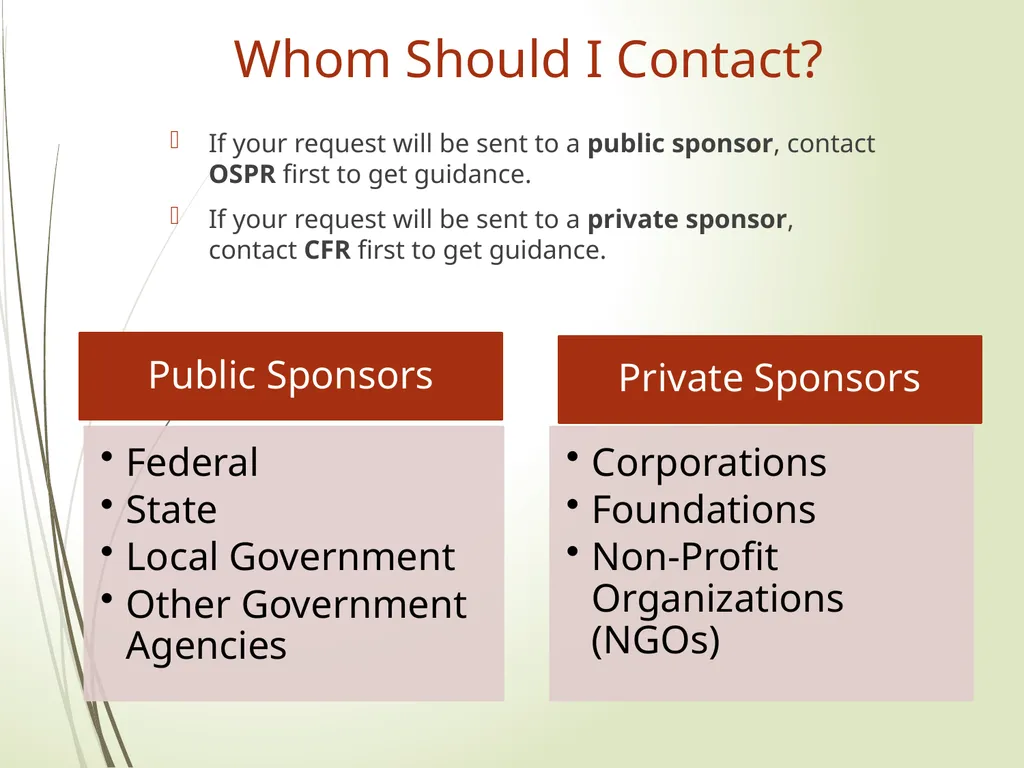
Whom Should I Contact? If your request will be sent to a public sponsor, contact OSPR first to get guidance.
If your request will be sent to a private sponsor, contact CFR first to get guidance.<br>
05
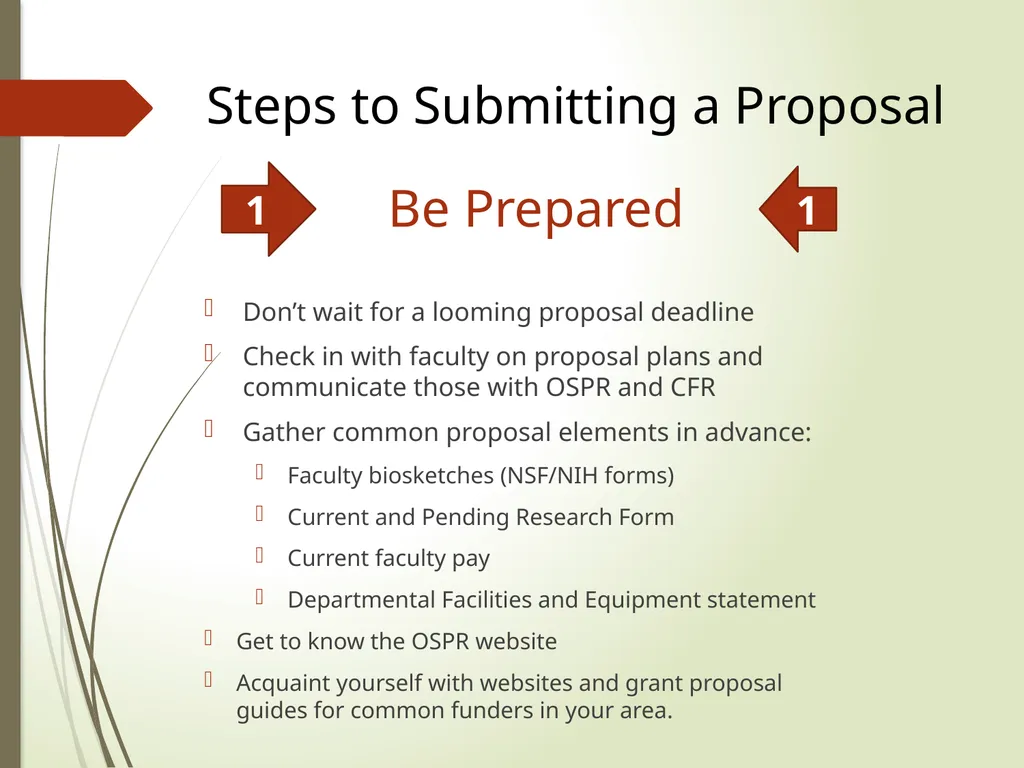
Be Prepared Don’t wait for a looming proposal deadline
Check in with faculty on proposal plans and communicate those with OSPR and CFR
Gather common proposal elements in advance:
Faculty biosketches (NSF/NIH forms)
Current and Pending Research Form
Current faculty pay
Departmental Facilities and Equipment statement
Get to know the OSPR website
Acquaint yourself with websites and grant proposal guides for common funders in your area. 1 1 Steps to Submitting a Proposal<br>
06
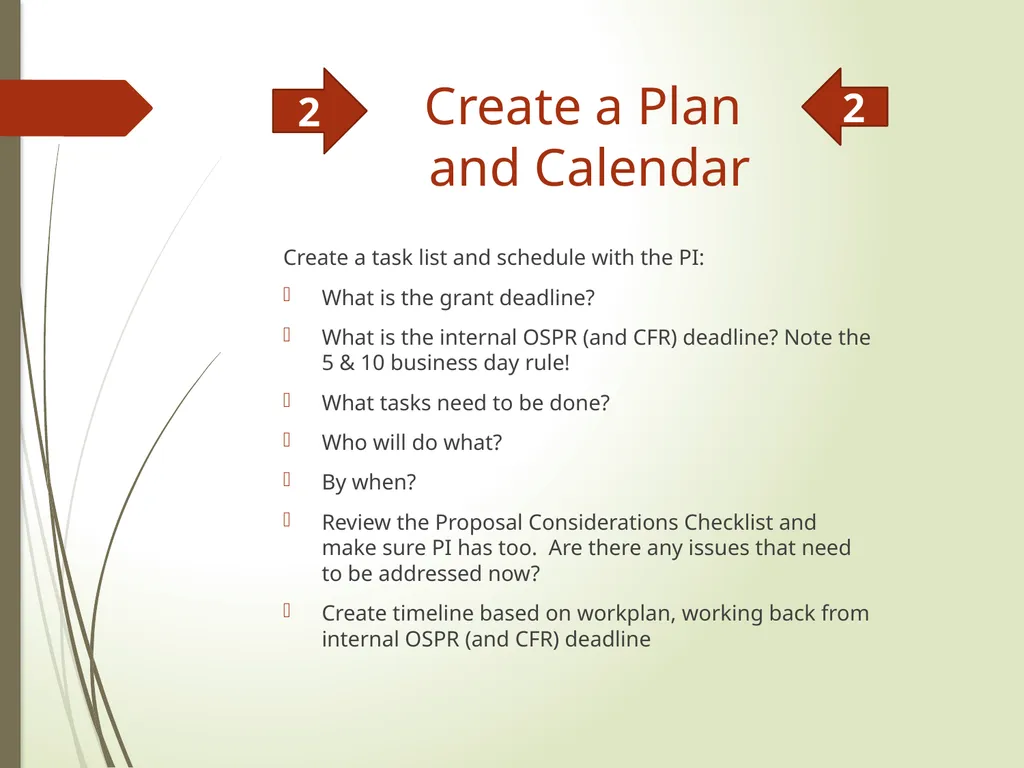
Create a Plan and Calendar Create a task list and schedule with the PI:
What is the grant deadline?
What is the internal OSPR (and CFR) deadline? Note the 5 & 10 business day rule!
What tasks need to be done?
Who will do what?
By when?
Review the Proposal Considerations Checklist and make sure PI has too. Are there any issues that need to be addressed now?
Create timeline based on workplan, working back from internal OSPR (and CFR) deadline 2 2<br>
07
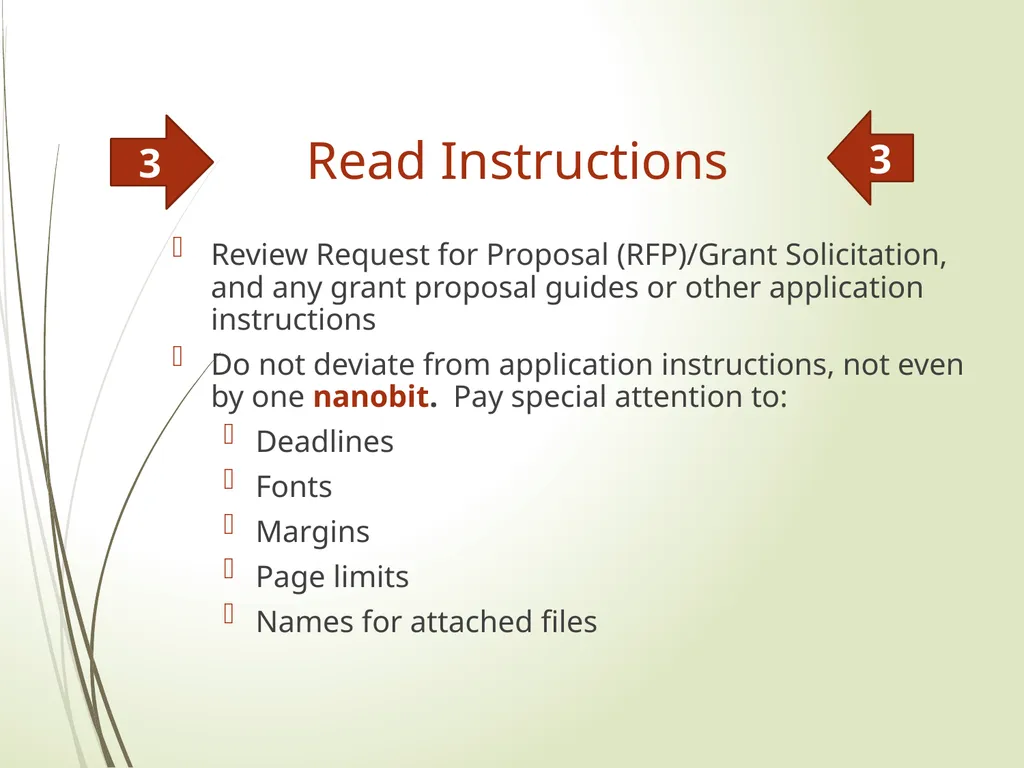
Read Instructions Review Request for Proposal (RFP)/Grant Solicitation, and any grant proposal guides or other application instructions
Do not deviate from application instructions, not even by one nanobit. Pay special attention to:
Deadlines
Fonts
Margins
Page limits
Names for attached files 3 3<br>
08
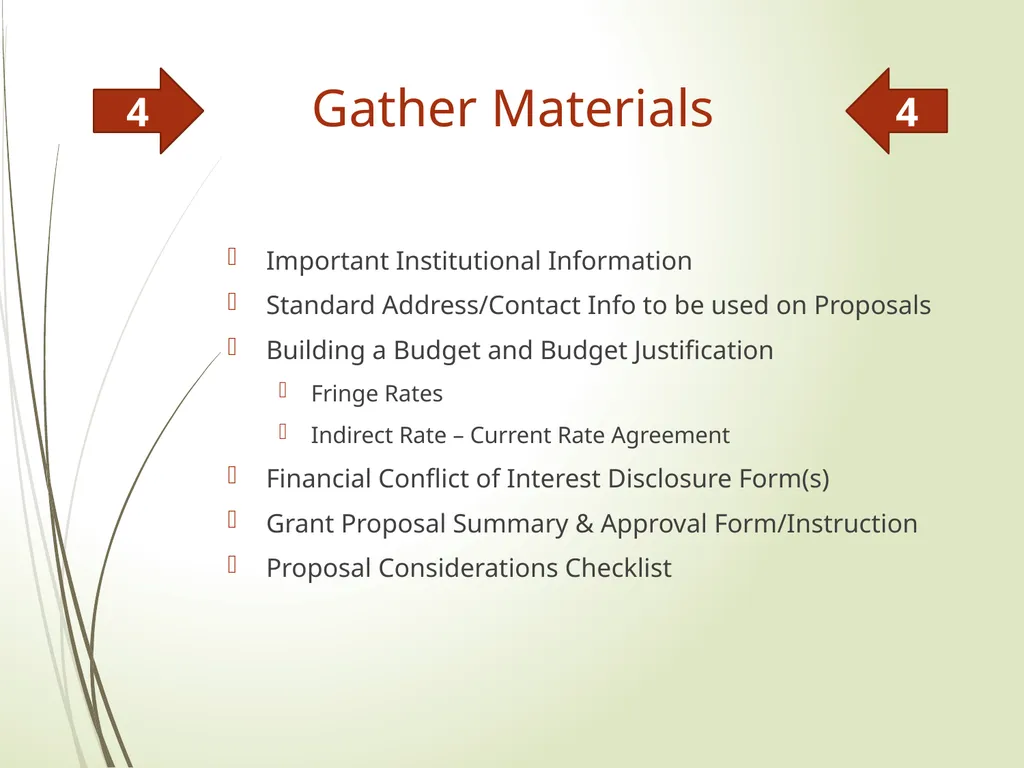
Gather Materials Important Institutional Information
Standard Address/Contact Info to be used on Proposals
Building a Budget and Budget Justification
Fringe Rates
Indirect Rate – Current Rate Agreement
Financial Conflict of Interest Disclosure Form(s)
Grant Proposal Summary & Approval Form/Instruction
Proposal Considerations Checklist 4 4<br>
09
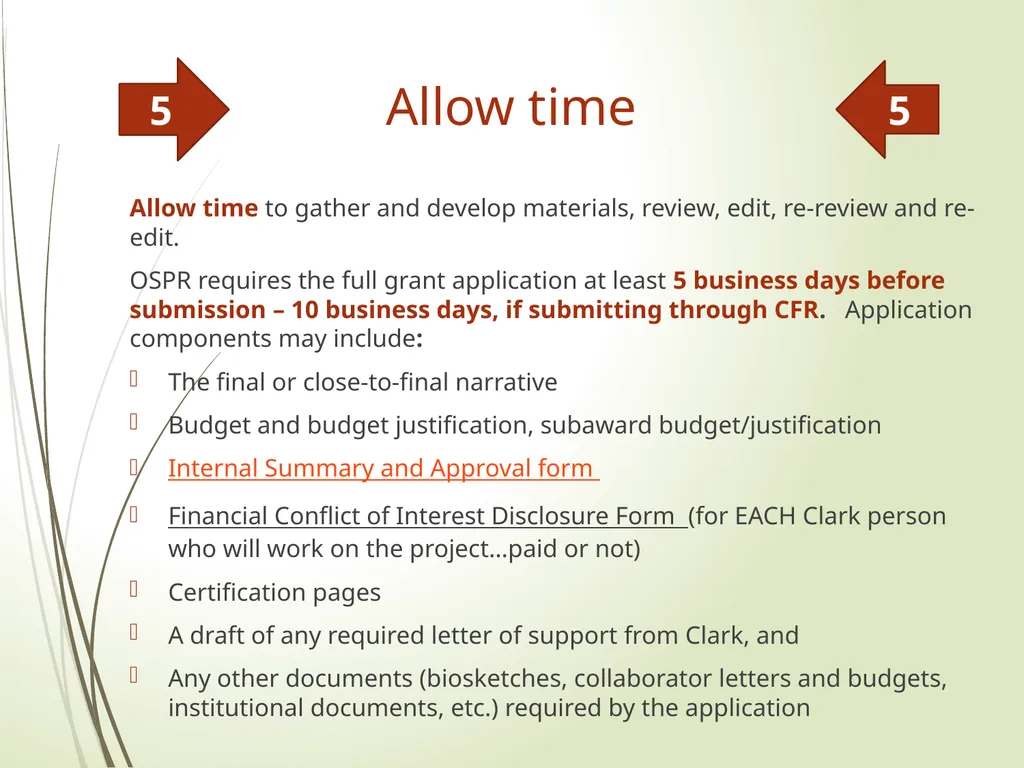
Allow time Allow time to gather and develop materials, review, edit, re-review and re-edit.
OSPR requires the full grant application at least 5 business days before submission – 10 business days, if submitting through CFR. Application components may include:
The final or close-to-final narrative
Budget and budget justification, subaward budget/justification
Internal Summary and Approval form
Financial Conflict of Interest Disclosure Form (for EACH Clark person who will work on the project…paid or not)
Certification pages
A draft of any required letter of support from Clark, and
Any other documents (biosketches, collaborator letters and budgets, institutional documents, etc.) required by the application 5 5<br>
10
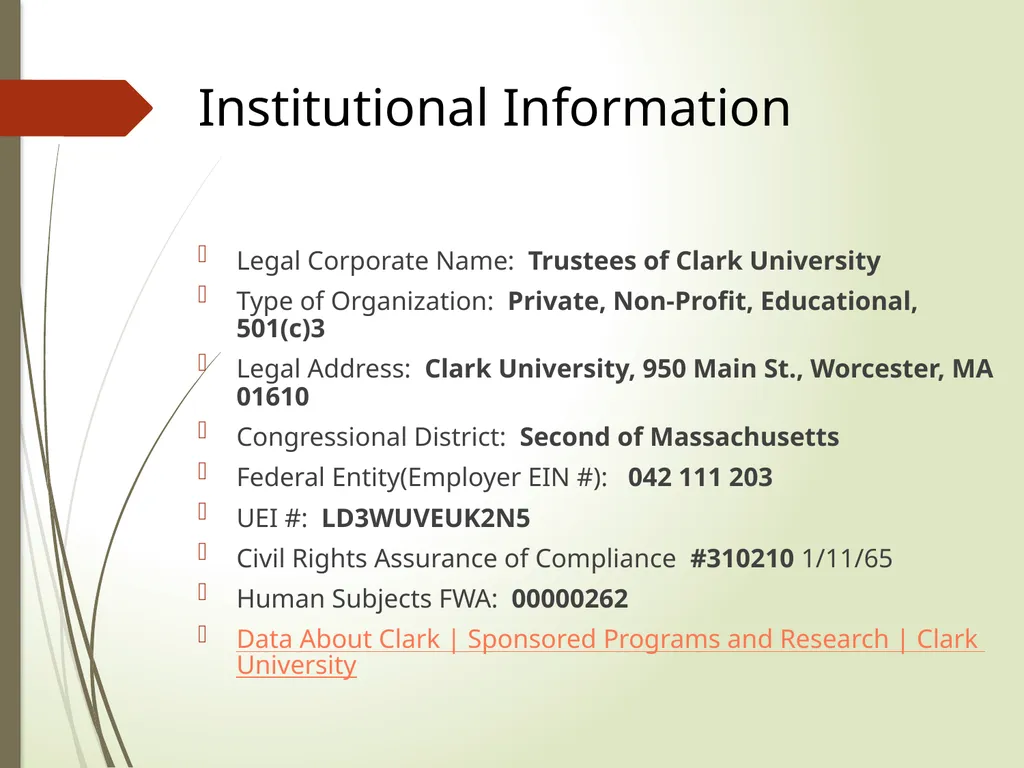
Institutional Information Legal Corporate Name: Trustees of Clark University
Type of Organization: Private, Non-Profit, Educational, 501(c)3
Legal Address: Clark University, 950 Main St., Worcester, MA 01610
Congressional District: Second of Massachusetts
Federal Entity(Employer EIN #): 042 111 203
UEI #: LD3WUVEUK2N5
Civil Rights Assurance of Compliance #310210 1/11/65
Human Subjects FWA: 00000262
Data About Clark | Sponsored Programs and Research | Clark University<br>
11
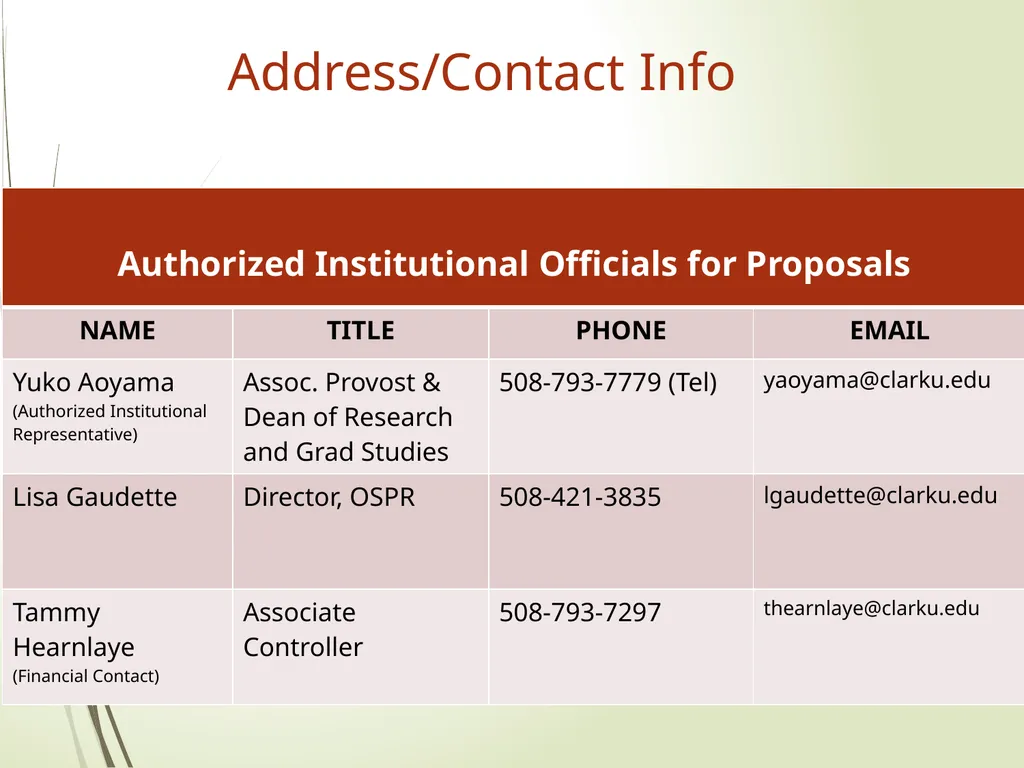
Address/Contact Info<br>
12
Building a Budget A budget is generally divided into two classifications:
Direct Costs
Indirect Costs, also known as Facilities and Administrative Costs (F&A Costs) and Overhead Costs<br>
13
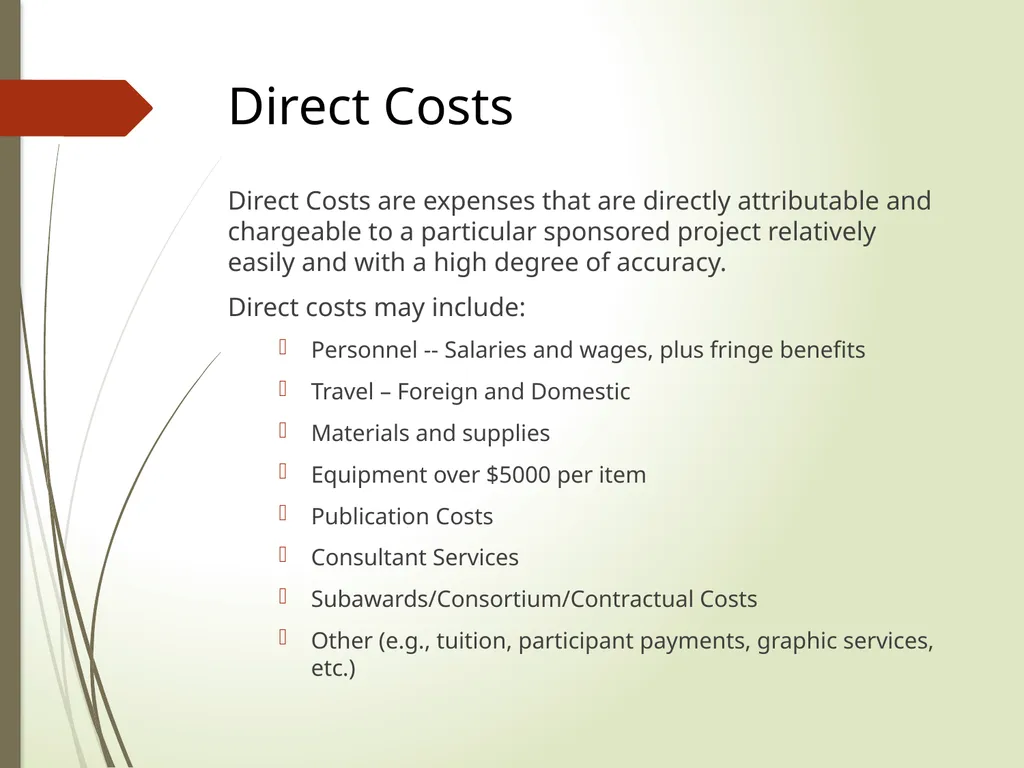
Direct Costs Direct Costs are expenses that are directly attributable and chargeable to a particular sponsored project relatively easily and with a high degree of accuracy.
Direct costs may include:
Personnel -- Salaries and wages, plus fringe benefits
Travel – Foreign and Domestic
Materials and supplies
Equipment over $5000 per item
Publication Costs
Consultant Services
Subawards/Consortium/Contractual Costs
Other (e.g., tuition, participant payments, graphic services, etc.)<br>
14
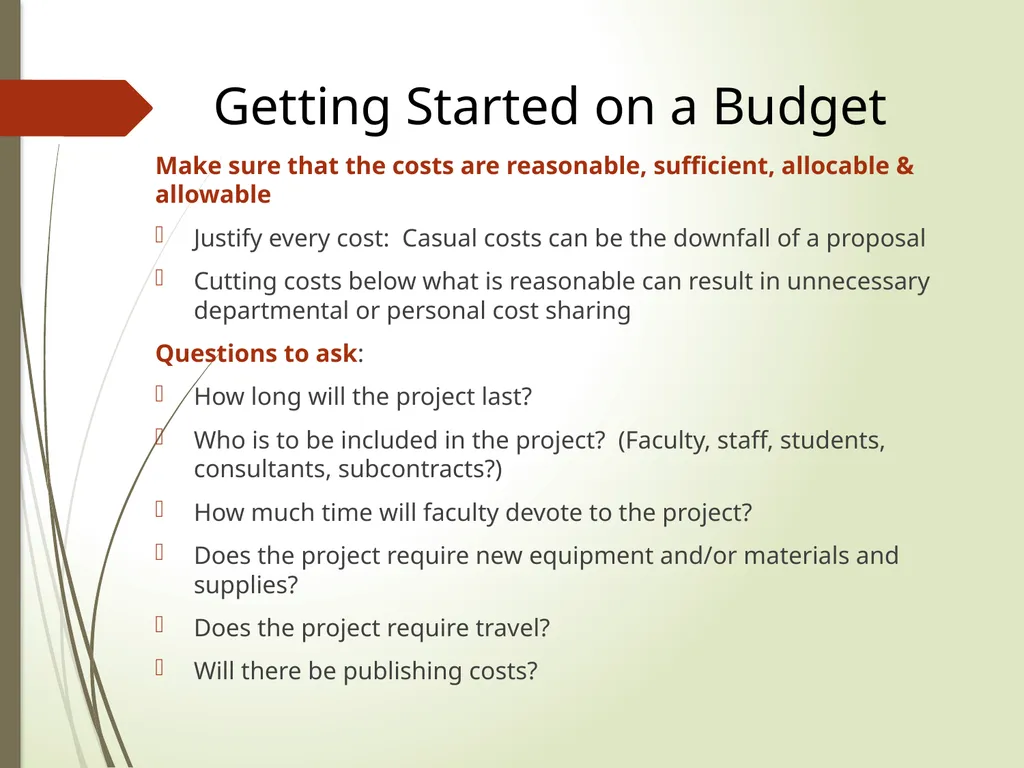
Getting Started on a Budget Make sure that the costs are reasonable, sufficient, allocable & allowable
Justify every cost: Casual costs can be the downfall of a proposal
Cutting costs below what is reasonable can result in unnecessary departmental or personal cost sharing
Questions to ask:
How long will the project last?
Who is to be included in the project? (Faculty, staff, students, consultants, subcontracts?)
How much time will faculty devote to the project?
Does the project require new equipment and/or materials and supplies?
Does the project require travel?
Will there be publishing costs?<br>
15
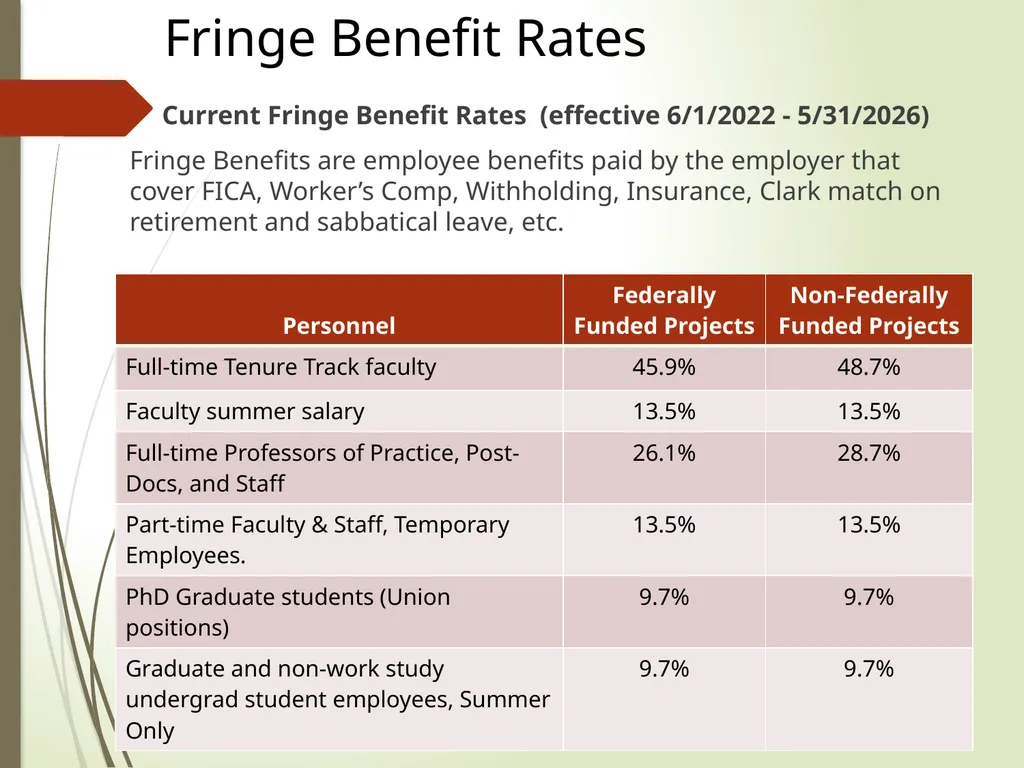
Fringe Benefit Rates Current Fringe Benefit Rates (effective 6/1/2022 - 5/31/2026)
Fringe Benefits are employee benefits paid by the employer that cover FICA, Worker’s Comp, Withholding, Insurance, Clark match on retirement and sabbatical leave, etc.<br>
16
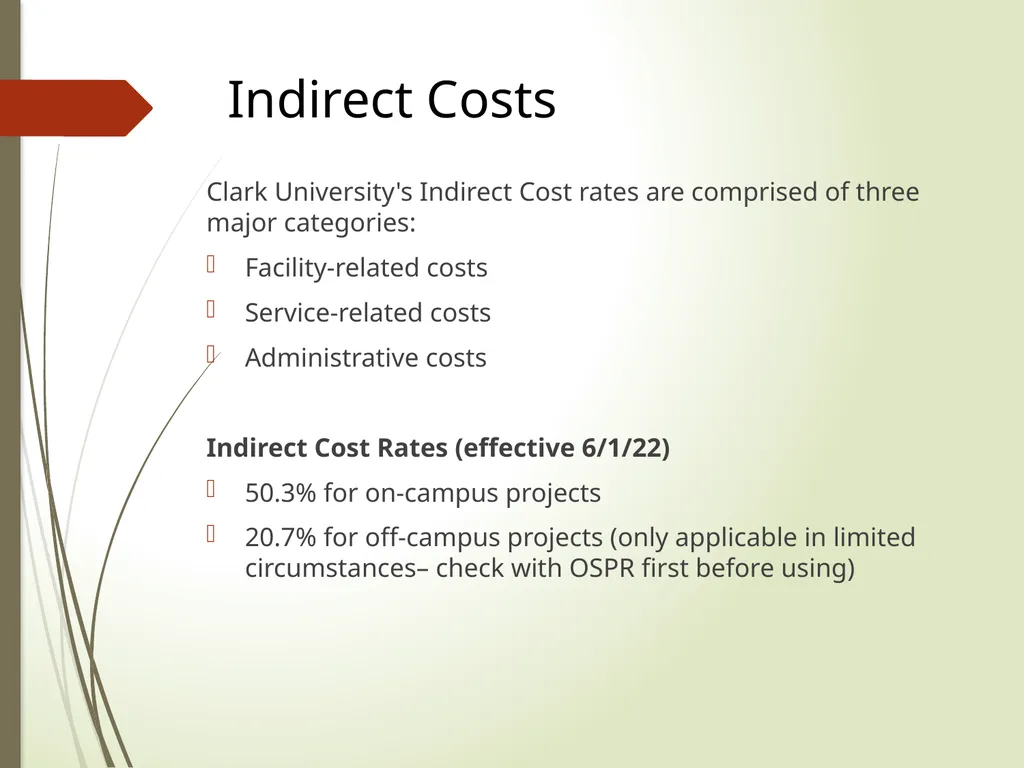
Indirect Costs Clark University's Indirect Cost rates are comprised of three major categories:
Facility-related costs
Service-related costs
Administrative costs
Indirect Cost Rates (effective 6/1/22)
50.3% for on-campus projects
20.7% for off-campus projects (only applicable in limited circumstances– check with OSPR first before using)<br>
17
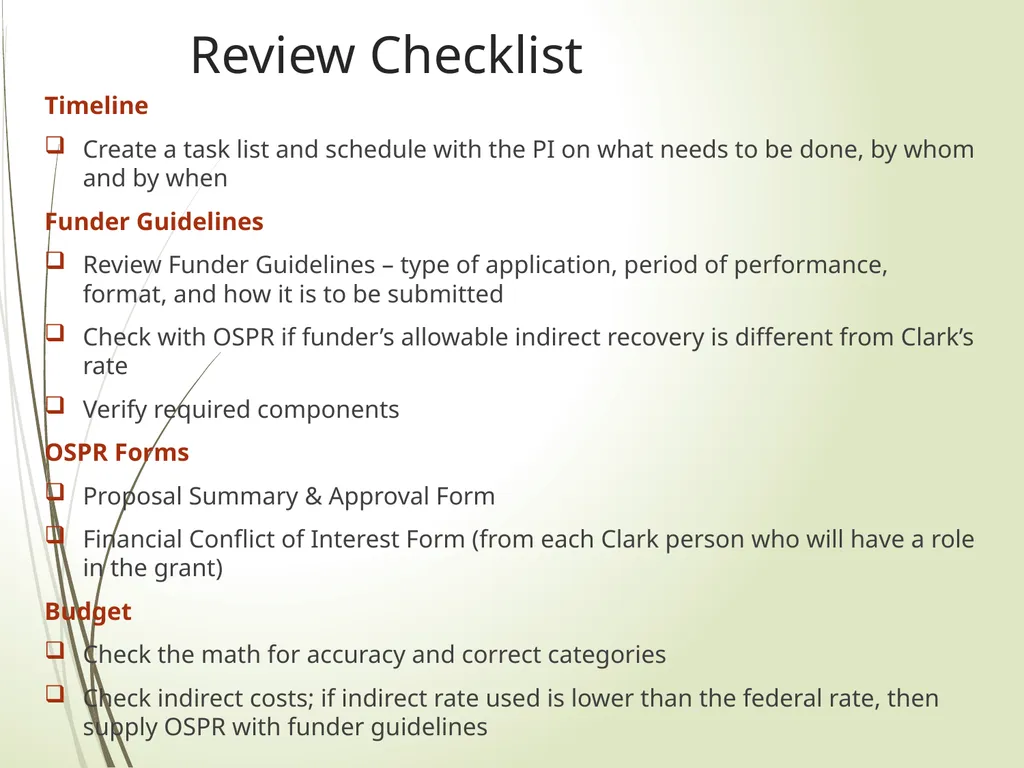
Review Checklist Timeline
Create a task list and schedule with the PI on what needs to be done, by whom and by when
Funder Guidelines
Review Funder Guidelines – type of application, period of performance, format, and how it is to be submitted
Check with OSPR if funder’s allowable indirect recovery is different from Clark’s rate
Verify required components
OSPR Forms
Proposal Summary & Approval Form
Financial Conflict of Interest Form (from each Clark person who will have a role in the grant)
Budget
Check the math for accuracy and correct categories
Check indirect costs; if indirect rate used is lower than the federal rate, then supply OSPR with funder guidelines<br>
18
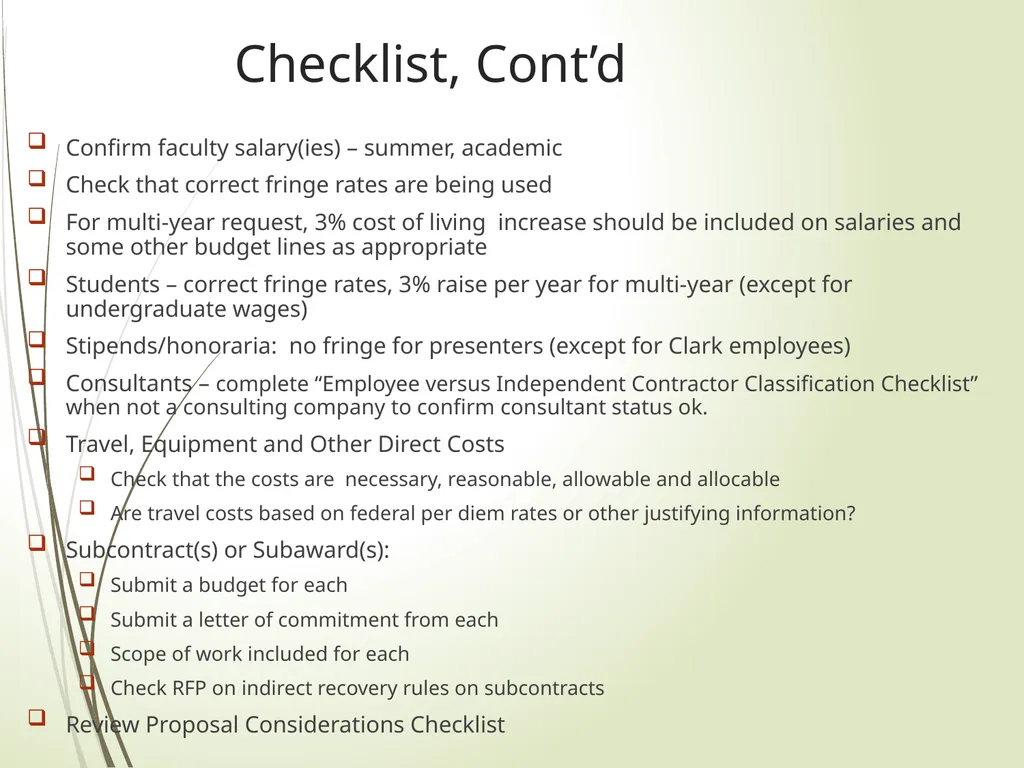
Checklist, Cont’d Confirm faculty salary(ies) – summer, academic
Check that correct fringe rates are being used
For multi-year request, 3% cost of living increase should be included on salaries and some other budget lines as appropriate
Students – correct fringe rates, 3% raise per year for multi-year (except for undergraduate wages)
Stipends/honoraria: no fringe for presenters (except for Clark employees)
Consultants – complete “Employee versus Independent Contractor Classification Checklist” when not a consulting company to confirm consultant status ok.
Travel, Equipment and Other Direct Costs
Check that the costs are necessary, reasonable, allowable and allocable
Are travel costs based on federal per diem rates or other justifying information?
Subcontract(s) or Subaward(s):
Submit a budget for each
Submit a letter of commitment from each
Scope of work included for each
Check RFP on indirect recovery rules on subcontracts
Review Proposal Considerations Checklist<br>
19
Contact Information For additional information please contact:
Lisa Gaudette, Director, OSPR
lgaudette@clarku.edu
508-421-3835
Mira Ormsby, Assistant Director, OSPR
mormsby@clarku.edu
508-793-7765<br>