
Proposing a conceptual model of discriminatory
JO
Published · 67 slides · 0 views

1 / 1

Description
Proposing a conceptual model of discriminatory intention of the Iranian physicians toward people living with HIV using fuzzy approach Dr. Zahra Alipour Darvishi Assistant professor of Management Islamic Azad University Tehran North
Related Topics
Share
Embed code
Download this presentation From Below
"Proposing a conceptual model of discriminatory" is the property of its rightful owner. Permission is granted to download and print the materials on this website for personal, non-commercial use only, and to display it on your personal computer provided you do not modify the materials and that you retain all copyright notices contained in the materials. By downloading content from our website, you accept the terms of this agreement.
Presentation Transcript
01
Proposing a conceptual model of discriminatory intention of the
Iranian physicians toward people living with HIV using fuzzy approach ِDr. Zahra Alipour Darvishi
Assistant professor of Management Islamic Azad University – Tehran North Branch, Iran<br>
02
Proposing a conceptual model of discriminatory intention of the Iranian physicians toward people living with HIV using fuzzy approach Dr. Zahra Alipour Darvishi
Assistant professor of Management department
Islamic Azad University – Tehran North Branch, Iran<br>
03
Why we have to study the discrimination’s intention of Health care providers in Iran? 1. In Iran the pattern of HIV transmission is changed and it is spread up through a hidden processes
2. Public awakening about Aids through social medias is relatively prohibited and limited
3. traumatic experience for health care providers<br>
2. Public awakening about Aids through social medias is relatively prohibited and limited
3. traumatic experience for health care providers<br>
04
In Iran the pattern of HIV transmission is changed and it is spread up through a hidden processes 1. The number of people living with HIV (PLWH) has increased in Iran, although formal registered statistics are about 25000 HIV-positive people but the estimated are about 80,000 – 1000000 HIV-positive people that differentials are unknown and uncontrolled (Mohraz, 2011)
2. The infection pattern was being converted from drug user’s injection to risky sexual activity from 2010 (Mohraz 2012)
In many Iranian prisons the injection needles have been distributed free of charge for addicts<br>
2. The infection pattern was being converted from drug user’s injection to risky sexual activity from 2010 (Mohraz 2012)
In many Iranian prisons the injection needles have been distributed free of charge for addicts<br>
05
In Iran the pattern of HIV transmission is changed and it is spread up through a hidden processes 3. High-risk sexual practices observed among young people recently (National AIDS committee secretariat 2012) resulted in increasing of uncontrolled sex behavior among injecting drug users and the statistics of HIV-positive people goes up exponentially (Mohraz 2009)<br>
06
Public awakening about Aids through social medias is relatively prohibited and limited In Iran, due to the specific characteristics of the country's cultural / political limitations, scattering the information of HIV and Aids in the public level is limited (Mohammad et al. 2007) Mohammad et al. 2007<br>
07
traumatic experience for health care providers Discovering that one has HIV illness can be a traumatic experience and can be made more difficult by social constructs and negative reactions to the infection (Mohammadpour et al. 2009)<br>
08
Unofficial whispers 1. A nurse who was accidently infected with needles in Imam Khomeini Hospital did not tell her secret even her parents and her family (quote from her peer)
2. Medical students who are HIV-positive should not have the right to complete their degree
3. A HIV positive woman who was pregnant hospitalized for giving birth in a public hospital but health care providers refused to help her and she took pain Persistently for more than 24 hours when she was waiting for a doctor or a nurse<br>
2. Medical students who are HIV-positive should not have the right to complete their degree
3. A HIV positive woman who was pregnant hospitalized for giving birth in a public hospital but health care providers refused to help her and she took pain Persistently for more than 24 hours when she was waiting for a doctor or a nurse<br>
09
There are wide range-awakening and training of health care providers but it is not enough for attitudinal change<br>
10
Have you ever though about why wide range training of health care personnel could not have enough effectiveness on discrimination behavior toward PLWH? There are wide range-awakening and training of health care providers but it is not enough for attitudinal change<br>
11
In order to achieve zero discrimination If we don’t prepare the health care providers’ attitude for non discriminating toward PLWH, they don’t welcome effectively and so the hidden process of spreading up HIV transmission will be extended uncontrollably<br>
12
Subject Attitudes are the most important predictor of a behavior intention ( Ryu et al. 2003) and finally a behavior such as discriminatory behavior, it is essential to study the mechanism of discriminatory attitude towards PLWH<br>
13
Research aims This research’s aim is to provide a conceptual model of the casual relations of factors affecting discrimination intention of health care professionals toward PLWH<br>
14
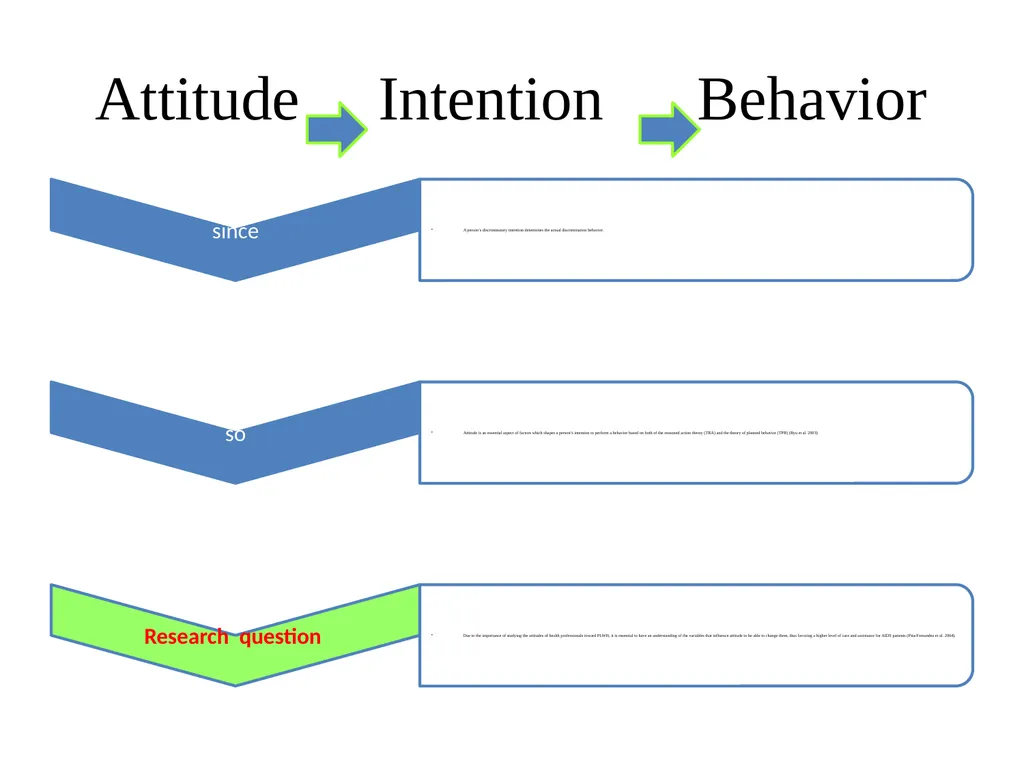
Attitude Intention Behavior<br>
15
What are the attitudinal factors affecting the discriminatory intention toward PLWH?<br>
16
Stigma and discrimination “The concept ‘discrimination’ (an action) is often equated with stigma (an attitude)” (Bellal Hossain and Kippax, 2010).”
Discrimination conceptualized as an instrument of stigmatization by Major & O’Brien (2005) and it is an outcome of stigmatization by Bond et al. (2002).<br>
Discrimination conceptualized as an instrument of stigmatization by Major & O’Brien (2005) and it is an outcome of stigmatization by Bond et al. (2002).<br>
17
Prejudice prejudice is defined as negative or biased feelings toward particular social groups (Goldman et al. 2006)<br>
18
Stigma and Prejudice Stigma research has traditionally emphasized studying people with ‘‘unusual’’ conditions such as facial disfigurement, HIV/AIDS, short stature and mental illness. By contrast, researchers focused on prejudice and discrimination tend to focus on the far more ordinary, but clearly powerful implications of gender, age, race and class divisions.<br>
19
The prejudice tradition grew from concerns with social processes driven by exploitation and domination, such as racism, while work in the stigma tradition has been more concerned with processes driven by enforcement of social norms and disease avoidance (Phelan et al. 2008) Stigma and Prejudice<br>
20
Embodied in both works is similarity in the experiences of stigma and prejudice includes: exposure to negative attitudes, structural and interpersonal experiences of discrimination or unfair treatment, and violence perpetrated against persons who belong to disadvantaged social groups (Goldman et al. 2006) Stigma and Prejudice<br>
21
Participants in the study of Surlis and Hyde 2001 gave very rich descriptions of experiencing stigmatizing attitudes from nurses, some of which they believed to be rooted in existing prejudices associated with the lifestyle or risk behaviors of those who are HIV positive Stigma and Prejudice<br>
22
Alonzo and Reynolds 1995 stated people with HIV are stigmatized because their illness is associated with deviant behavior, perceived as the responsibility of the individual, viewed as contagious and a threat to the community (Surlis and Hyde 2001 ). It seems in Iran as a religious society there are some prejudice attitudes against theses deviant behavior which accompanied with cultural dominance lead to stigmatize PLWH. Stigma and Prejudice<br>
23
Perceived risk fear produces discrimination towards PLWH. Irrational fear about transmission of HIV strongly correlated with discriminatory attitudes (Ahsan Ullah 2011 and Herek et al 1999)<br>
24
Perceived risk Breault and Polifroni (1992) studied nurses’ attitudes and feelings in caring for HIV/AIDS patients and found that all respondents reported some degree of fear and risk associated with caring for HIV/AIDS patients.<br>
25
Perceived risk The spouses of the physicians and nurses in charge of the HIV-positive individuals put pressure to stop serving the patients or even quitting the job (Ahsan Ullah 2011 and Herek et al 1999)
There are evidences that they were evicted from home by their families and rejected by their friends and colleagues.<br>
There are evidences that they were evicted from home by their families and rejected by their friends and colleagues.<br>
26
Perceived risk Fear is associated with the positioning of HIV-positive people as ‘others’: homosexuals, sex workers, injecting drug-users, all of whom are already stigmatized in the society.
It looks the fear of transmission of HIV with stigma produce a special kind of risk perception among health care workers be called social risk perception<br>
It looks the fear of transmission of HIV with stigma produce a special kind of risk perception among health care workers be called social risk perception<br>
27
Belief in a just world
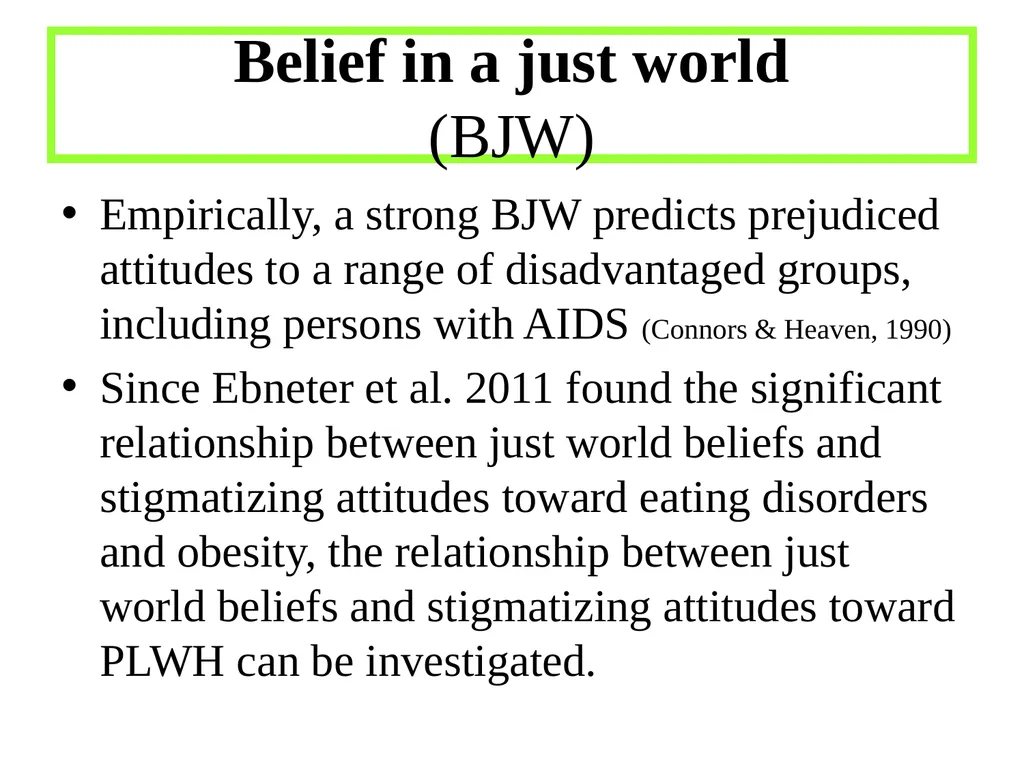
(BJW) There are some researches that frame people who believe in a just world (BJW) have some beliefs including: good things come to those who deserve them and bad things come to those who do not as blame homosexuals for acquiring AIDS and so minimize the injustices they observe happening to others (Furnham 2003, Mudrack 2005)<br>
28
Belief in a just world
(BJW) Empirically, a strong BJW predicts prejudiced attitudes to a range of disadvantaged groups, including persons with AIDS (Connors & Heaven, 1990)
Since Ebneter et al. 2011 found the significant relationship between just world beliefs and stigmatizing attitudes toward eating disorders and obesity, the relationship between just world beliefs and stigmatizing attitudes toward PLWH can be investigated.<br>
Since Ebneter et al. 2011 found the significant relationship between just world beliefs and stigmatizing attitudes toward eating disorders and obesity, the relationship between just world beliefs and stigmatizing attitudes toward PLWH can be investigated.<br>
29
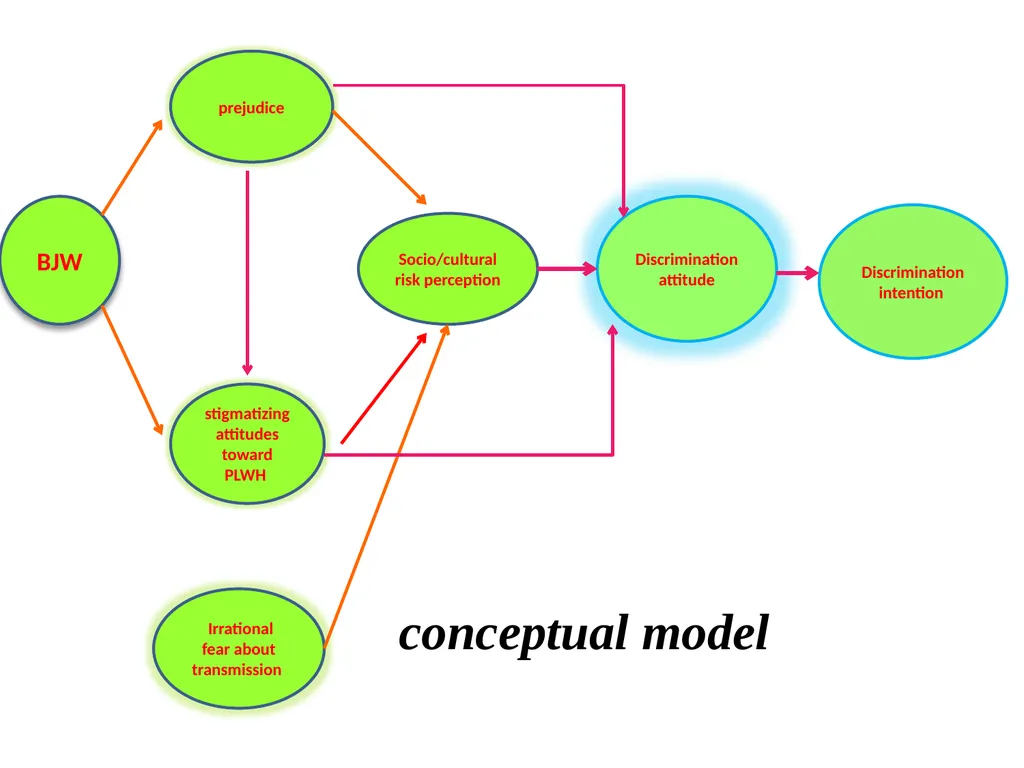
conceptual model BJW Irrational fear about transmission stigmatizing attitudes toward
PLWH prejudice Discrimination attitude Discrimination
intention Socio/cultural risk perception<br>
PLWH prejudice Discrimination attitude Discrimination
intention Socio/cultural risk perception<br>
30
Complexity of discriminatory attitude toward PLWH and Fuzzy Analysis Parker 2003<br>
31
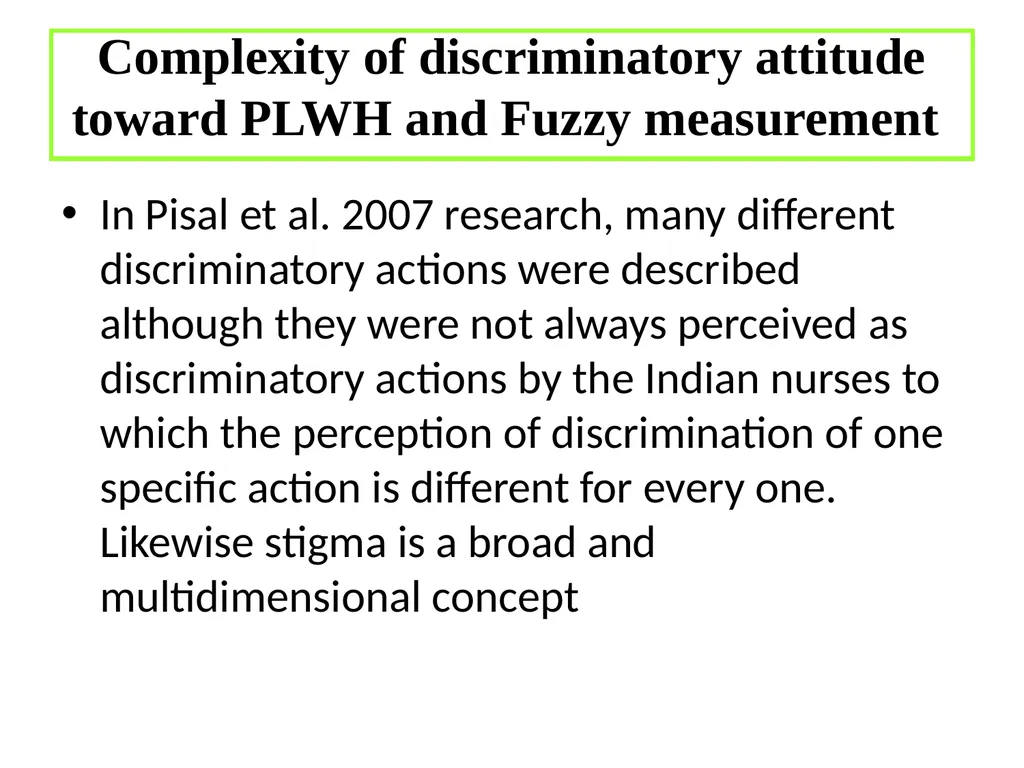
Complexity of discriminatory attitude toward PLWH and Fuzzy measurement In Pisal et al. 2007 research, many different discriminatory actions were described although they were not always perceived as discriminatory actions by the Indian nurses to which the perception of discrimination of one specific action is different for every one. Likewise stigma is a broad and multidimensional concept<br>
32
Complexity and ambiguity of discriminatory attitude toward PLWH and Fuzzy analysis When an attitude toward a behavior is forming, a judgmental process takes place too. Therefore the issues related to discriminatory intention of a health care provider can be associated to his/her behavioral memories involved in his/her judgmental process in order to elicit the judgment categories and prototypes they use in judgment formulation
(Sanchez and De La Torre 1996, Putnam 1975) Sanchez and De La Torre 1996, Putnam 1975<br>
(Sanchez and De La Torre 1996, Putnam 1975) Sanchez and De La Torre 1996, Putnam 1975<br>
33
Complexity and ambiguity of discriminatory attitude toward PLWH and Fuzzy measurement The effectiveness of intervention programs depends on the high power of measurement of this phenomena by considering this complexity, illuminating this ambiguity and articulating this judgmental process<br>
34
Developing a fuzzy measurement There is a lack of considerations about complexity of this judgmental process in existing studies and for compensating these deficiencies, the development of a new method of measuring discriminatory attitude is required.
I developed a fuzzy measurement to evaluate the employee justice perception for my PhD thesis 2009. This applied fuzzy method can also be used for measuring the health care workers discriminatory attitude toward PLWH<br>
I developed a fuzzy measurement to evaluate the employee justice perception for my PhD thesis 2009. This applied fuzzy method can also be used for measuring the health care workers discriminatory attitude toward PLWH<br>
35
Fuzzy method Fuzzy logic, based on the Fuzzy set theory, developed by Zadeh (1965), allows approaching the complex world of the cognitional judgments with the rigor of logical mathematical instruments without loosing the richness of verbal judgment(Yager, 1991& Zimmermann, 1987)<br>
36
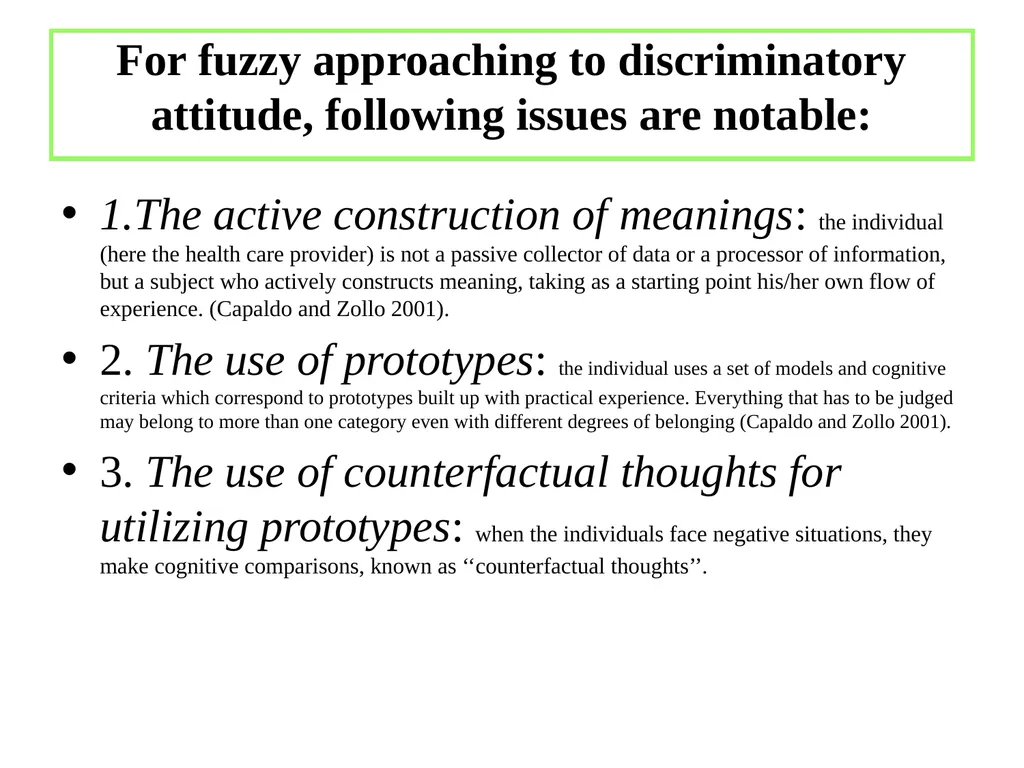
For fuzzy approaching to discriminatory attitude, following issues are notable: 1.The active construction of meanings: the individual (here the health care provider) is not a passive collector of data or a processor of information, but a subject who actively constructs meaning, taking as a starting point his/her own flow of experience. (Capaldo and Zollo 2001).
2. The use of prototypes: the individual uses a set of models and cognitive criteria which correspond to prototypes built up with practical experience. Everything that has to be judged may belong to more than one category even with different degrees of belonging (Capaldo and Zollo 2001).
3. The use of counterfactual thoughts for utilizing prototypes: when the individuals face negative situations, they make cognitive comparisons, known as ‘‘counterfactual thoughts’’.<br>
2. The use of prototypes: the individual uses a set of models and cognitive criteria which correspond to prototypes built up with practical experience. Everything that has to be judged may belong to more than one category even with different degrees of belonging (Capaldo and Zollo 2001).
3. The use of counterfactual thoughts for utilizing prototypes: when the individuals face negative situations, they make cognitive comparisons, known as ‘‘counterfactual thoughts’’.<br>
37
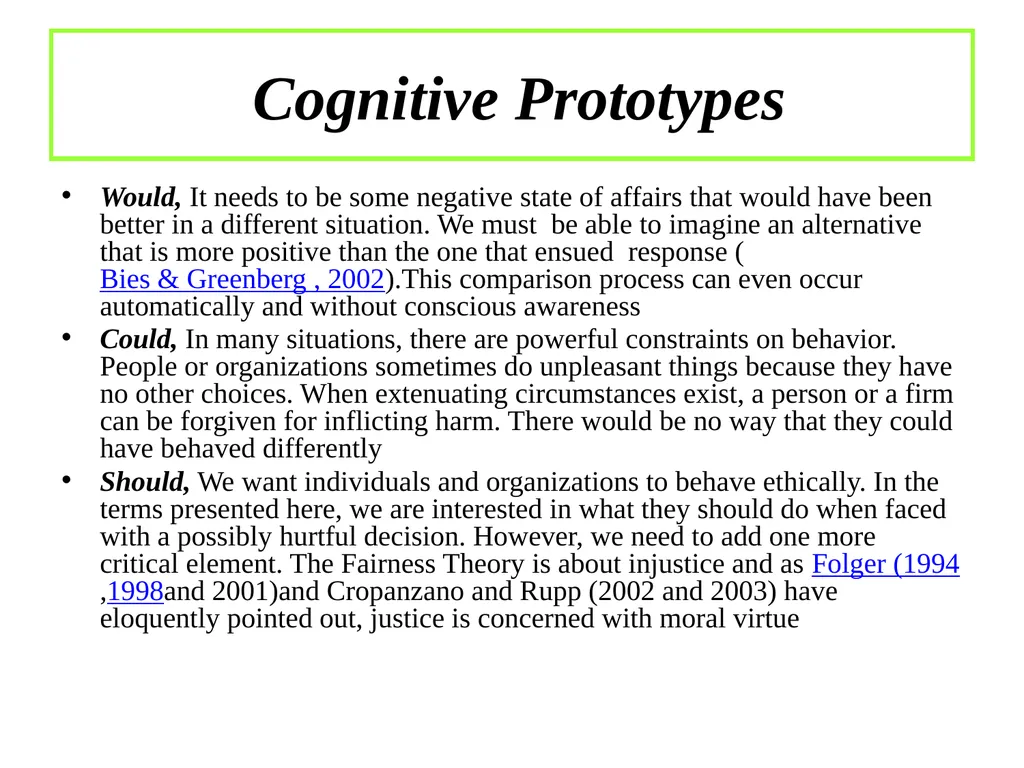
Cognitive Prototypes Would, It needs to be some negative state of affairs that would have been better in a different situation. We must be able to imagine an alternative that is more positive than the one that ensued response (Bies & Greenberg , 2002).This comparison process can even occur automatically and without conscious awareness
Could, In many situations, there are powerful constraints on behavior. People or organizations sometimes do unpleasant things because they have no other choices. When extenuating circumstances exist, a person or a firm can be forgiven for inflicting harm. There would be no way that they could have behaved differently
Should, We want individuals and organizations to behave ethically. In the terms presented here, we are interested in what they should do when faced with a possibly hurtful decision. However, we need to add one more critical element. The Fairness Theory is about injustice and as Folger (1994 ,1998and 2001)and Cropanzano and Rupp (2002 and 2003) have eloquently pointed out, justice is concerned with moral virtue<br>
Could, In many situations, there are powerful constraints on behavior. People or organizations sometimes do unpleasant things because they have no other choices. When extenuating circumstances exist, a person or a firm can be forgiven for inflicting harm. There would be no way that they could have behaved differently
Should, We want individuals and organizations to behave ethically. In the terms presented here, we are interested in what they should do when faced with a possibly hurtful decision. However, we need to add one more critical element. The Fairness Theory is about injustice and as Folger (1994 ,1998and 2001)and Cropanzano and Rupp (2002 and 2003) have eloquently pointed out, justice is concerned with moral virtue<br>
38
In order to explain empirically
this judgmental process I made a pilot experiment<br>
39
I invited 15 physicians for answer my questions that 6 physicians’ answers was useful for my research so I analyzed their answers<br>
40
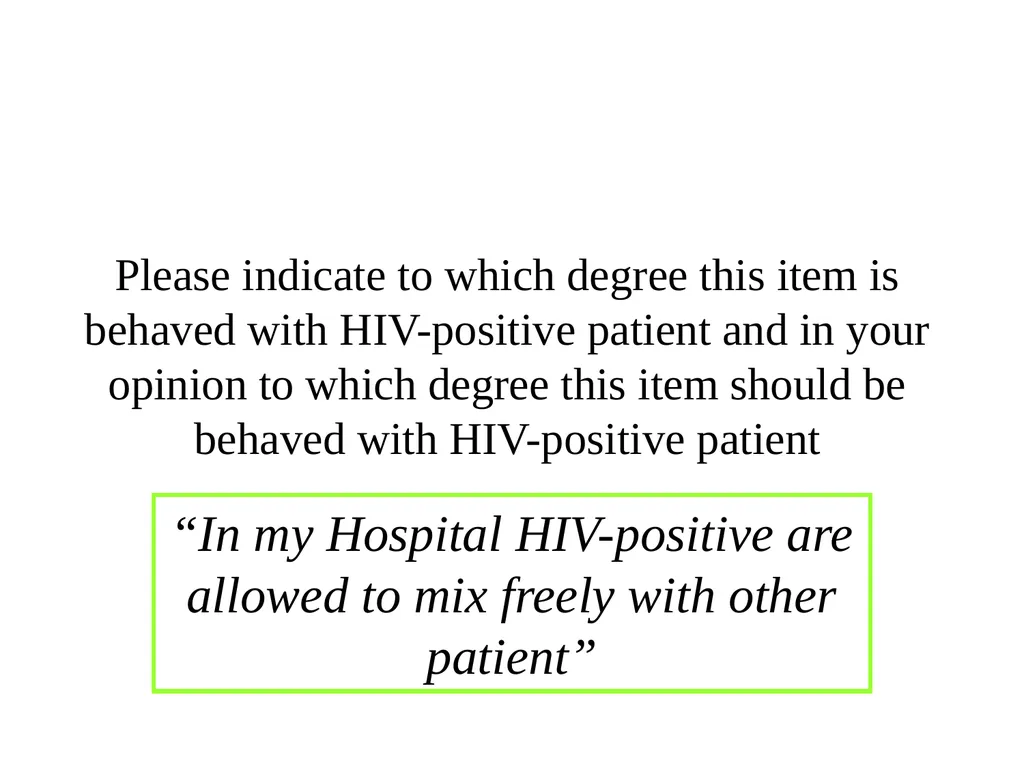
Please indicate to which degree this item is behaved with HIV-positive patient and in your opinion to which degree this item should be behaved with HIV-positive patient “In my Hospital HIV-positive are allowed to mix freely with other patient”<br>
41
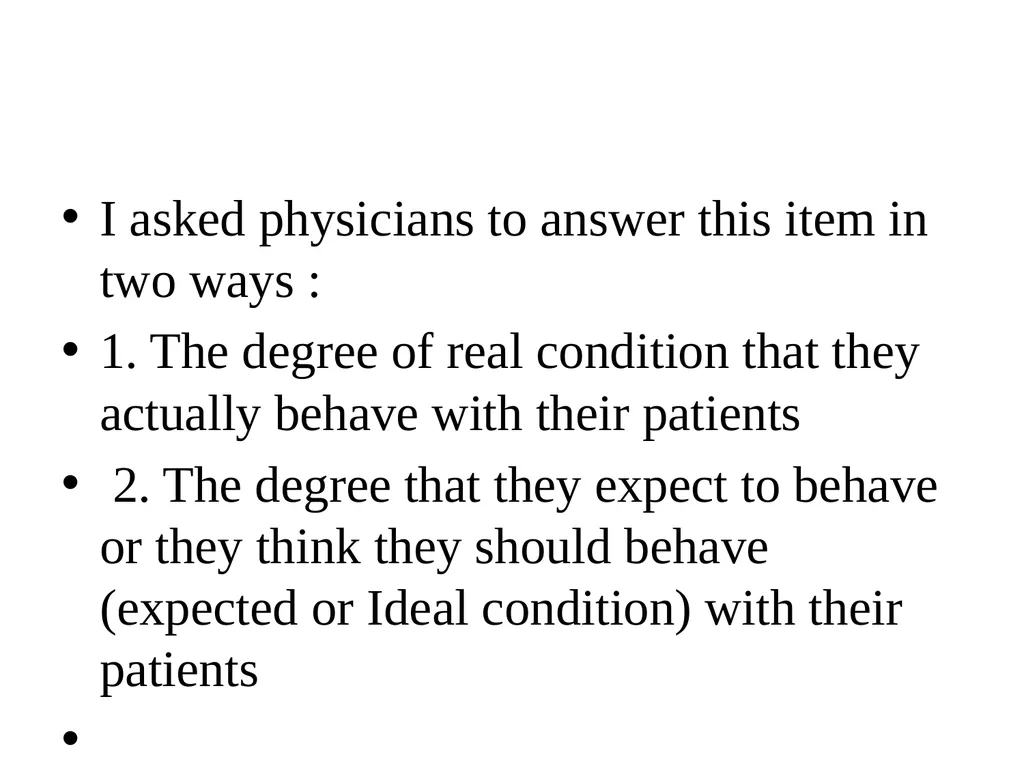
I asked physicians to answer this item in two ways :
1. The degree of real condition that they actually behave with their patients
2. The degree that they expect to behave or they think they should behave (expected or Ideal condition) with their patients<br>
1. The degree of real condition that they actually behave with their patients
2. The degree that they expect to behave or they think they should behave (expected or Ideal condition) with their patients<br>
42
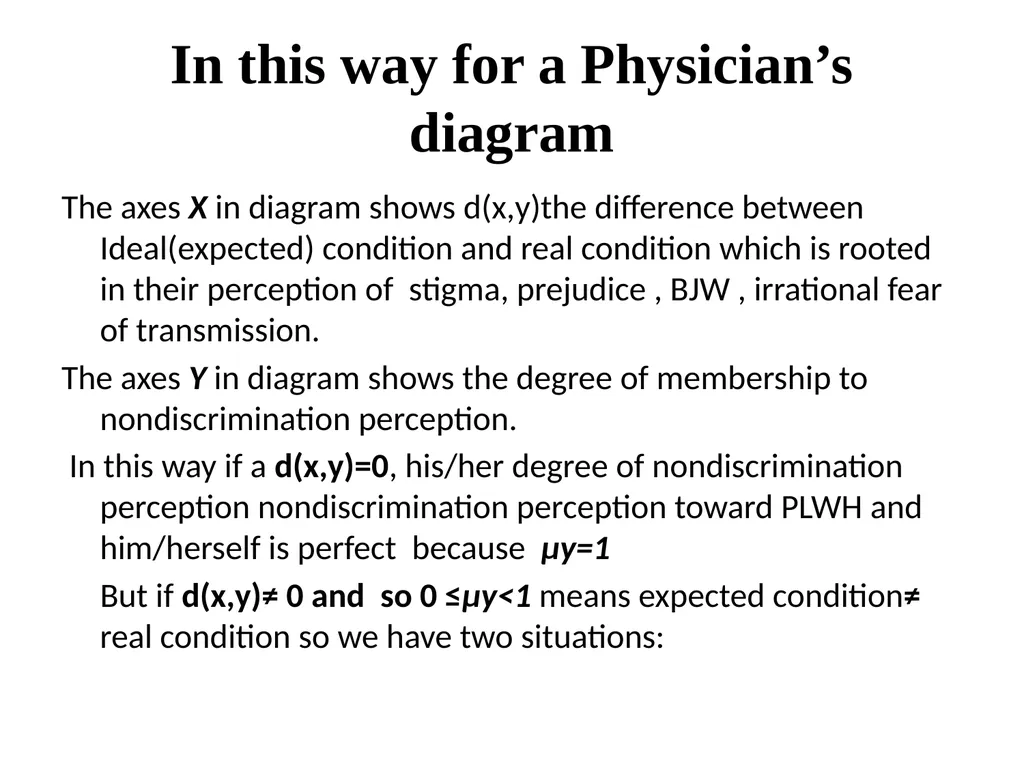
In this way for a Physician’s diagram The axes X in diagram shows d(x,y)the difference between Ideal(expected) condition and real condition which is rooted in their perception of stigma, prejudice , BJW , irrational fear of transmission.
The axes Y in diagram shows the degree of membership to nondiscrimination perception.
In this way if a d(x,y)=0, his/her degree of nondiscrimination perception nondiscrimination perception toward PLWH and him/herself is perfect because µy=1
But if d(x,y)≠ 0 and so 0 ≤µy<1 means expected condition≠ real condition so we have two situations:<br>
The axes Y in diagram shows the degree of membership to nondiscrimination perception.
In this way if a d(x,y)=0, his/her degree of nondiscrimination perception nondiscrimination perception toward PLWH and him/herself is perfect because µy=1
But if d(x,y)≠ 0 and so 0 ≤µy<1 means expected condition≠ real condition so we have two situations:<br>
43
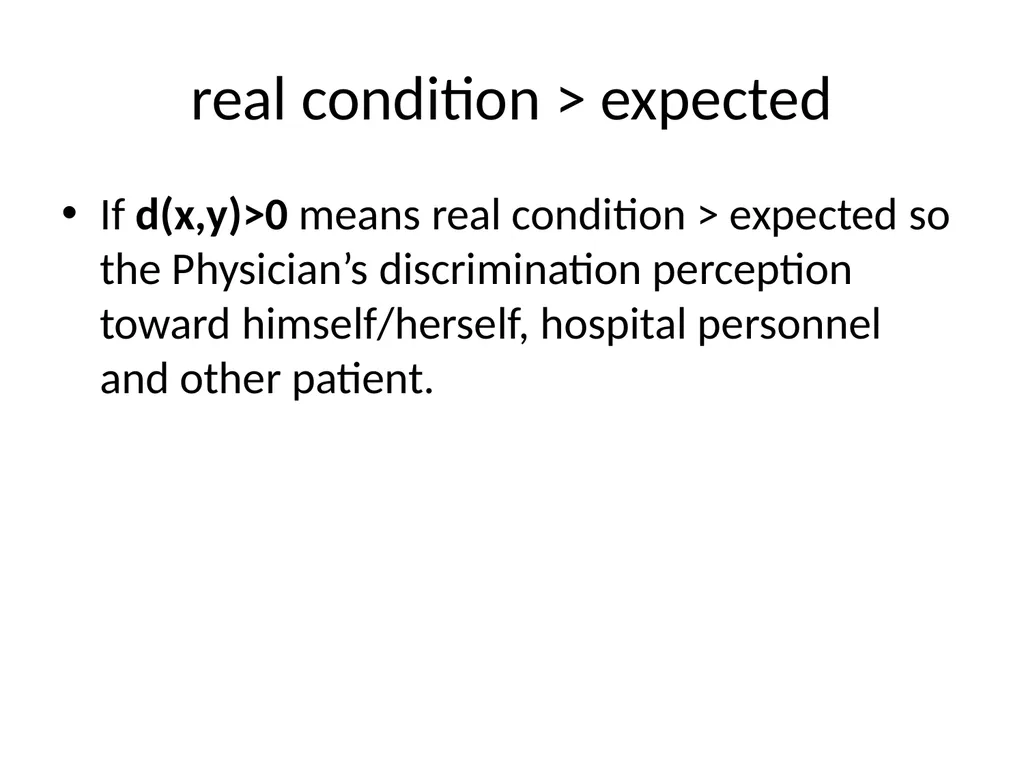
real condition > expected If d(x,y)>0 means real condition > expected so the Physician’s discrimination perception toward himself/herself, hospital personnel and other patient.<br>
44
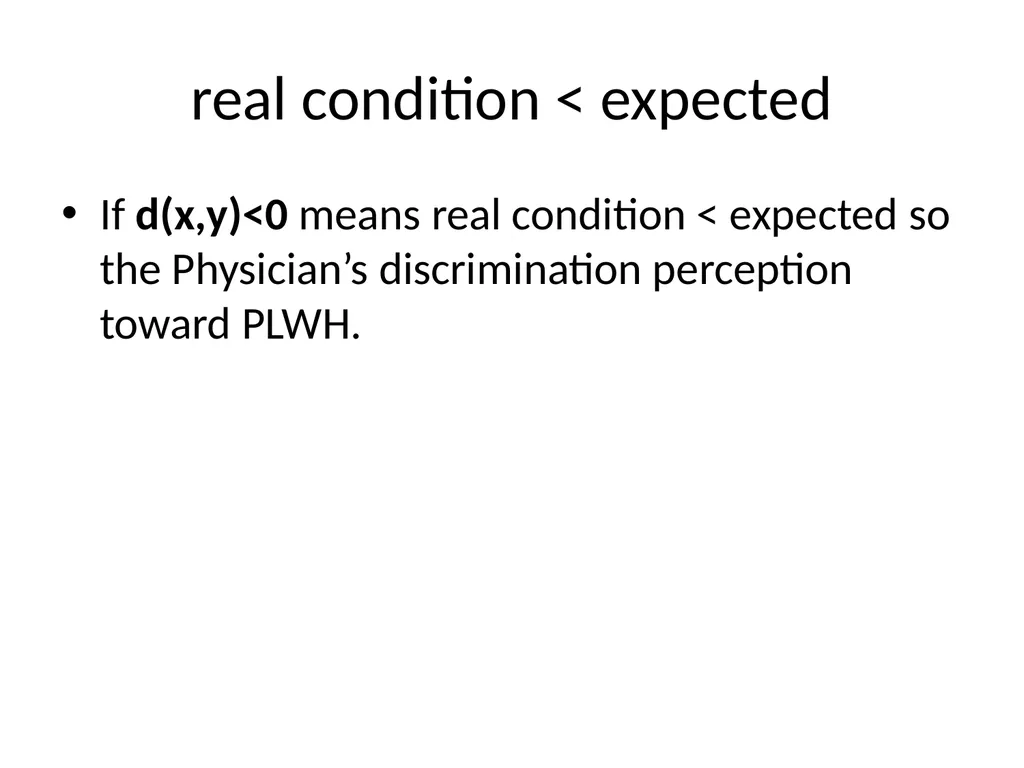
real condition < expected If d(x,y)<0 means real condition < expected so the Physician’s discrimination perception toward PLWH.<br>
45
Axes X is d(x,y)
Axes y is µy<br>
46
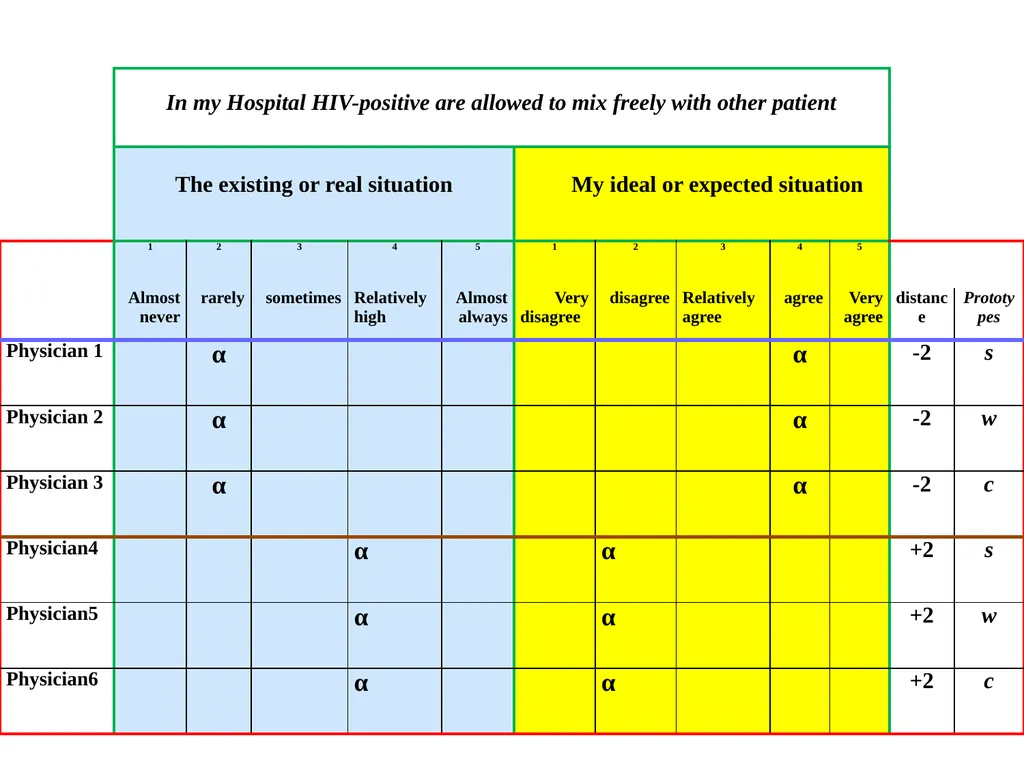
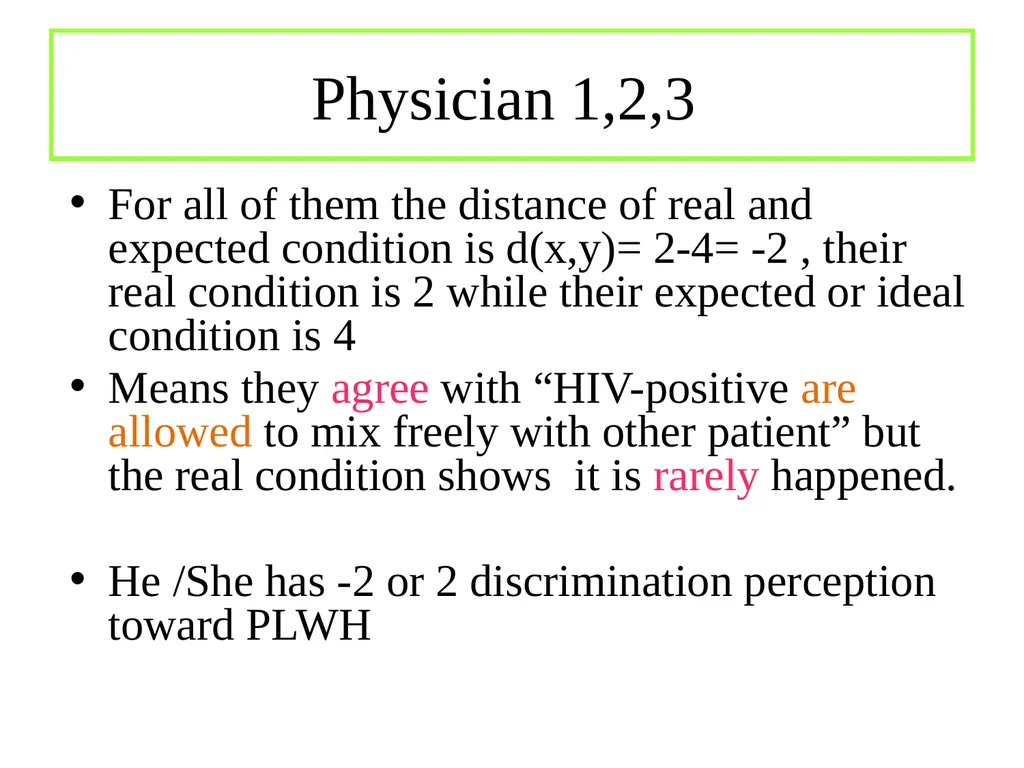
Physician 1,2,3 For all of them the distance of real and expected condition is d(x,y)= 2-4= -2 , their real condition is 2 while their expected or ideal condition is 4
Means they agree with “HIV-positive are allowed to mix freely with other patient” but the real condition shows it is rarely happened.
He /She has -2 or 2 discrimination perception toward PLWH<br>
Means they agree with “HIV-positive are allowed to mix freely with other patient” but the real condition shows it is rarely happened.
He /She has -2 or 2 discrimination perception toward PLWH<br>
47
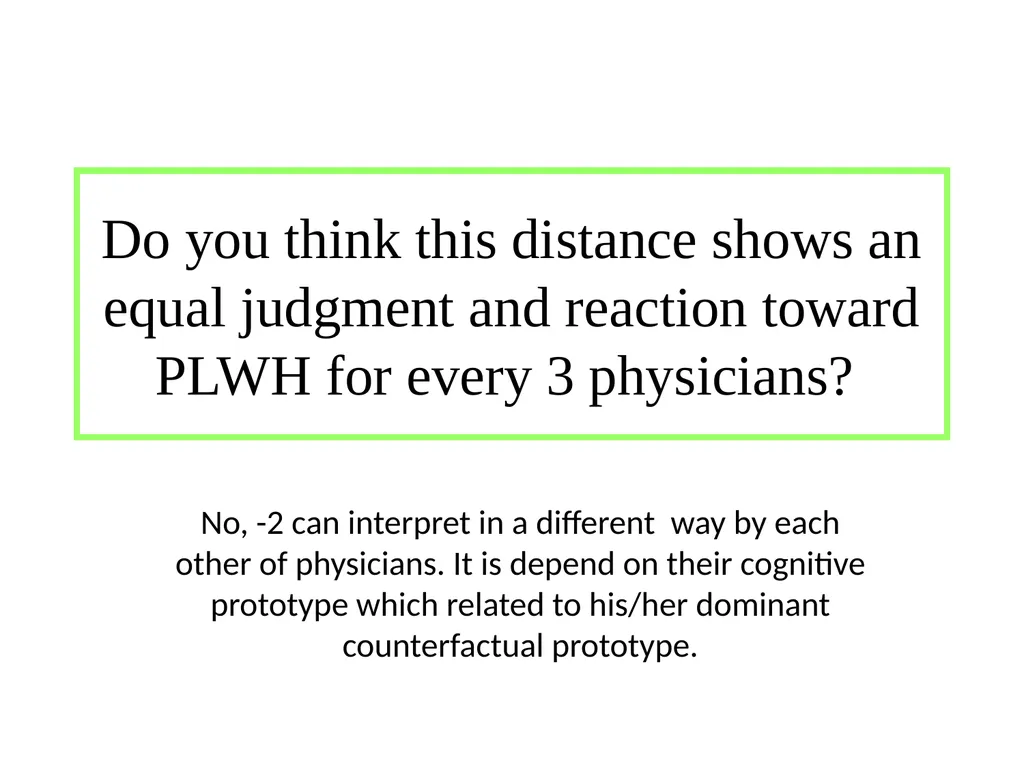
Do you think this distance shows an equal judgment and reaction toward PLWH for every 3 physicians? No, -2 can interpret in a different way by each other of physicians. It is depend on their cognitive prototype which related to his/her dominant counterfactual prototype.<br>
48
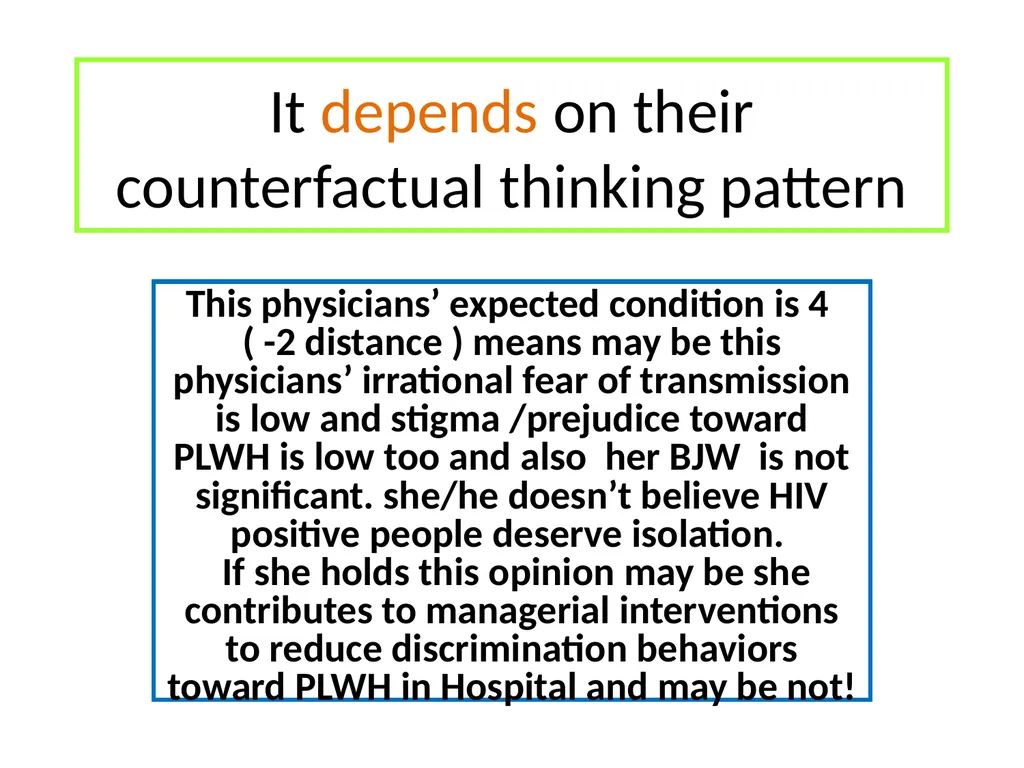
It depends on their counterfactual thinking pattern This physicians’ expected condition is 4
( -2 distance ) means may be this physicians’ irrational fear of transmission is low and stigma /prejudice toward PLWH is low too and also her BJW is not significant. she/he doesn’t believe HIV positive people deserve isolation.
If she holds this opinion may be she contributes to managerial interventions to reduce discrimination behaviors toward PLWH in Hospital and may be not!<br>
( -2 distance ) means may be this physicians’ irrational fear of transmission is low and stigma /prejudice toward PLWH is low too and also her BJW is not significant. she/he doesn’t believe HIV positive people deserve isolation.
If she holds this opinion may be she contributes to managerial interventions to reduce discrimination behaviors toward PLWH in Hospital and may be not!<br>
49
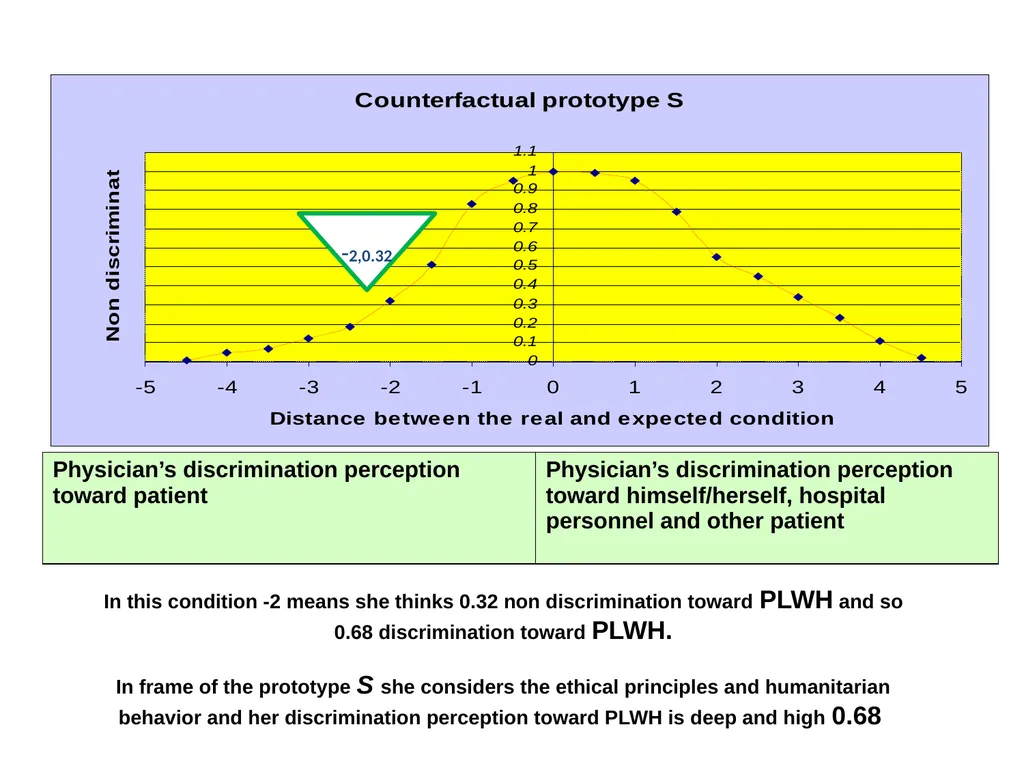
In this condition -2 means she thinks 0.32 non discrimination toward PLWH and so 0.68 discrimination toward PLWH.
In frame of the prototype S she considers the ethical principles and humanitarian behavior and her discrimination perception toward PLWH is deep and high 0.68 -2,0.32<br>
In frame of the prototype S she considers the ethical principles and humanitarian behavior and her discrimination perception toward PLWH is deep and high 0.68 -2,0.32<br>
50
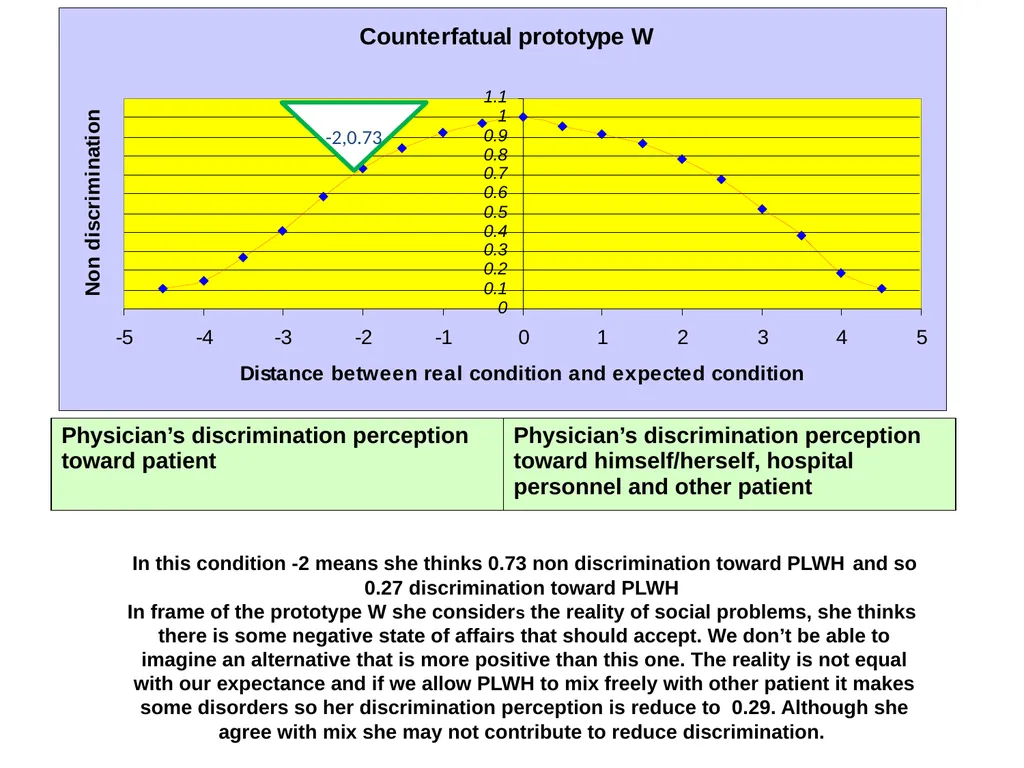
In this condition -2 means she thinks 0.73 non discrimination toward PLWH and so 0.27 discrimination toward PLWH
In frame of the prototype W she considers the reality of social problems, she thinks there is some negative state of affairs that should accept. We don’t be able to imagine an alternative that is more positive than this one. The reality is not equal with our expectance and if we allow PLWH to mix freely with other patient it makes some disorders so her discrimination perception is reduce to 0.29. Although she agree with mix she may not contribute to reduce discrimination. -2,0.73<br>
In frame of the prototype W she considers the reality of social problems, she thinks there is some negative state of affairs that should accept. We don’t be able to imagine an alternative that is more positive than this one. The reality is not equal with our expectance and if we allow PLWH to mix freely with other patient it makes some disorders so her discrimination perception is reduce to 0.29. Although she agree with mix she may not contribute to reduce discrimination. -2,0.73<br>
51
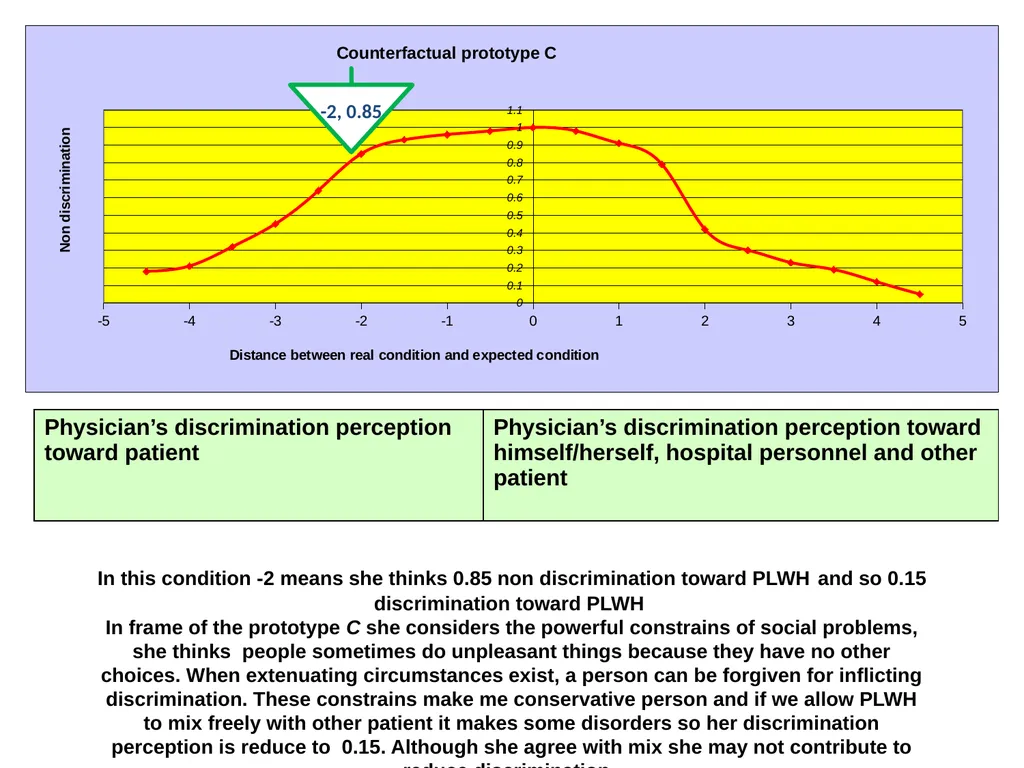
In this condition -2 means she thinks 0.85 non discrimination toward PLWH and so 0.15 discrimination toward PLWH
In frame of the prototype C she considers the powerful constrains of social problems, she thinks people sometimes do unpleasant things because they have no other choices. When extenuating circumstances exist, a person can be forgiven for inflicting discrimination. These constrains make me conservative person and if we allow PLWH to mix freely with other patient it makes some disorders so her discrimination perception is reduce to 0.15. Although she agree with mix she may not contribute to reduce discrimination. -2, 0.85<br>
In frame of the prototype C she considers the powerful constrains of social problems, she thinks people sometimes do unpleasant things because they have no other choices. When extenuating circumstances exist, a person can be forgiven for inflicting discrimination. These constrains make me conservative person and if we allow PLWH to mix freely with other patient it makes some disorders so her discrimination perception is reduce to 0.15. Although she agree with mix she may not contribute to reduce discrimination. -2, 0.85<br>
52
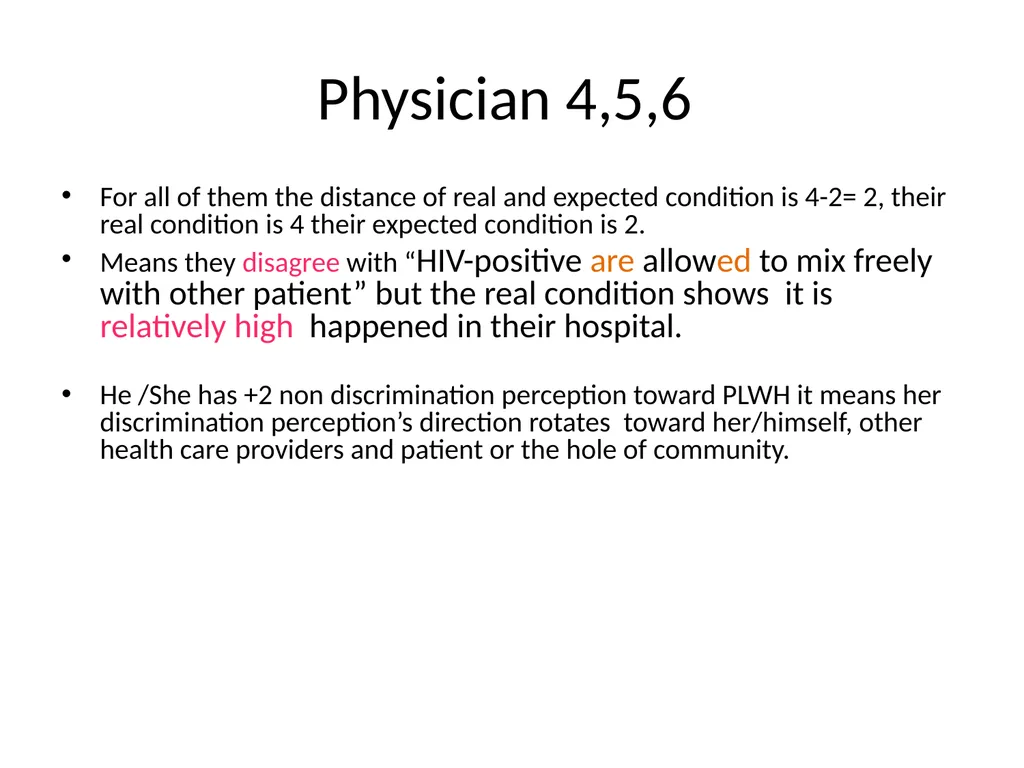
Physician 4,5,6 For all of them the distance of real and expected condition is 4-2= 2, their real condition is 4 their expected condition is 2.
Means they disagree with “HIV-positive are allowed to mix freely with other patient” but the real condition shows it is relatively high happened in their hospital.
He /She has +2 non discrimination perception toward PLWH it means her discrimination perception’s direction rotates toward her/himself, other health care providers and patient or the hole of community.<br>
Means they disagree with “HIV-positive are allowed to mix freely with other patient” but the real condition shows it is relatively high happened in their hospital.
He /She has +2 non discrimination perception toward PLWH it means her discrimination perception’s direction rotates toward her/himself, other health care providers and patient or the hole of community.<br>
53
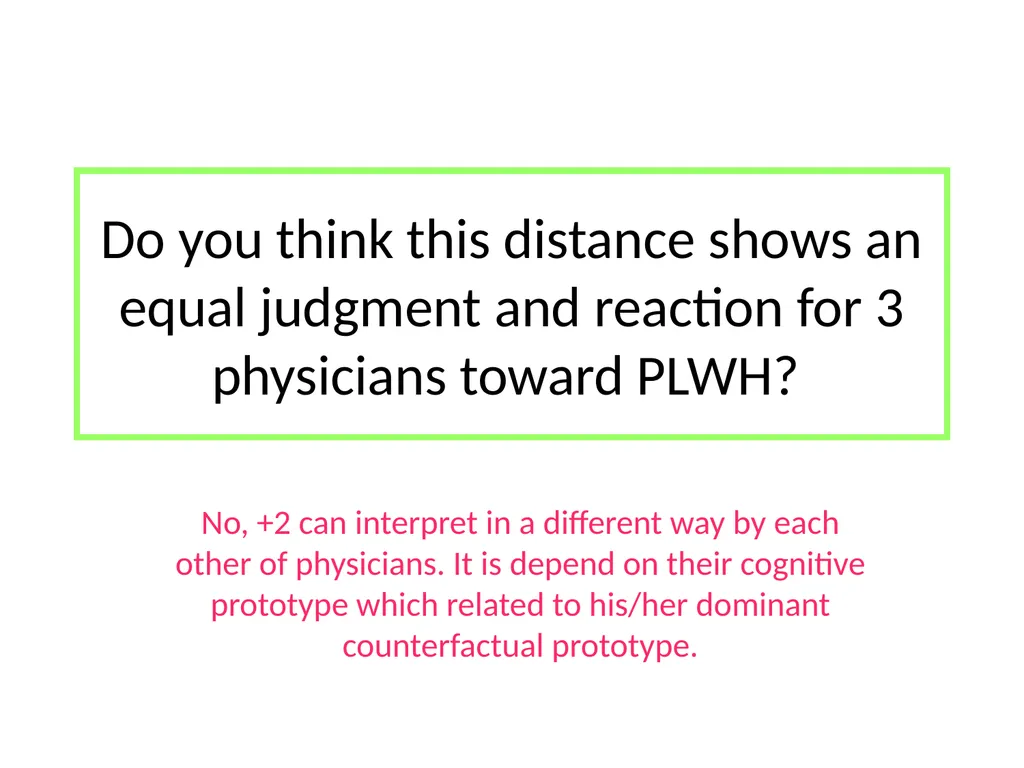
Do you think this distance shows an equal judgment and reaction for 3 physicians toward PLWH? No, +2 can interpret in a different way by each other of physicians. It is depend on their cognitive prototype which related to his/her dominant counterfactual prototype.<br>
54
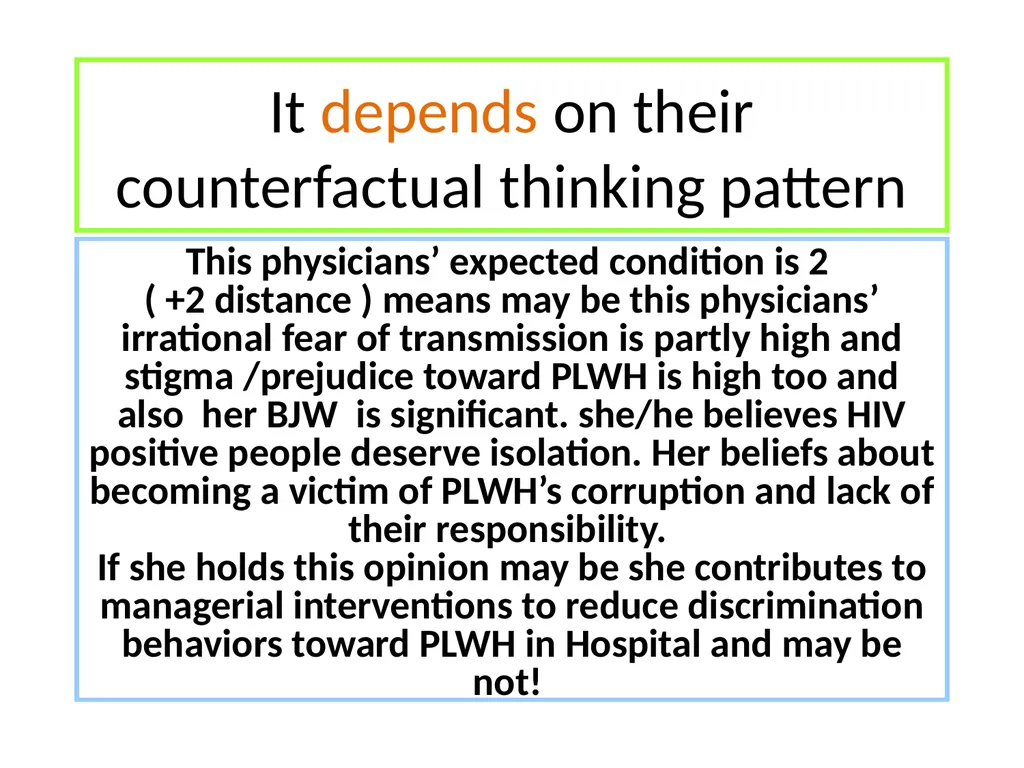
It depends on their counterfactual thinking pattern This physicians’ expected condition is 2
( +2 distance ) means may be this physicians’ irrational fear of transmission is partly high and stigma /prejudice toward PLWH is high too and also her BJW is significant. she/he believes HIV positive people deserve isolation. Her beliefs about becoming a victim of PLWH’s corruption and lack of their responsibility.
If she holds this opinion may be she contributes to managerial interventions to reduce discrimination behaviors toward PLWH in Hospital and may be not!<br>
( +2 distance ) means may be this physicians’ irrational fear of transmission is partly high and stigma /prejudice toward PLWH is high too and also her BJW is significant. she/he believes HIV positive people deserve isolation. Her beliefs about becoming a victim of PLWH’s corruption and lack of their responsibility.
If she holds this opinion may be she contributes to managerial interventions to reduce discrimination behaviors toward PLWH in Hospital and may be not!<br>
55
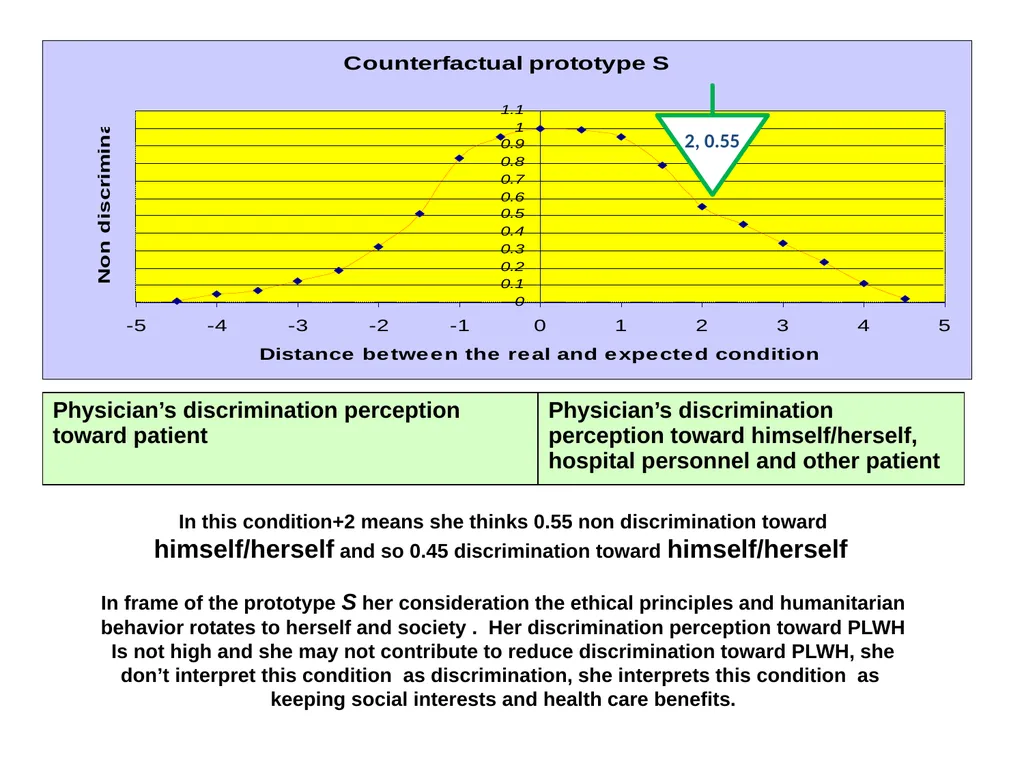
In this condition+2 means she thinks 0.55 non discrimination toward himself/herself and so 0.45 discrimination toward himself/herself
In frame of the prototype S her consideration the ethical principles and humanitarian behavior rotates to herself and society . Her discrimination perception toward PLWH
Is not high and she may not contribute to reduce discrimination toward PLWH, she don’t interpret this condition as discrimination, she interprets this condition as keeping social interests and health care benefits. 2, 0.55<br>
In frame of the prototype S her consideration the ethical principles and humanitarian behavior rotates to herself and society . Her discrimination perception toward PLWH
Is not high and she may not contribute to reduce discrimination toward PLWH, she don’t interpret this condition as discrimination, she interprets this condition as keeping social interests and health care benefits. 2, 0.55<br>
56
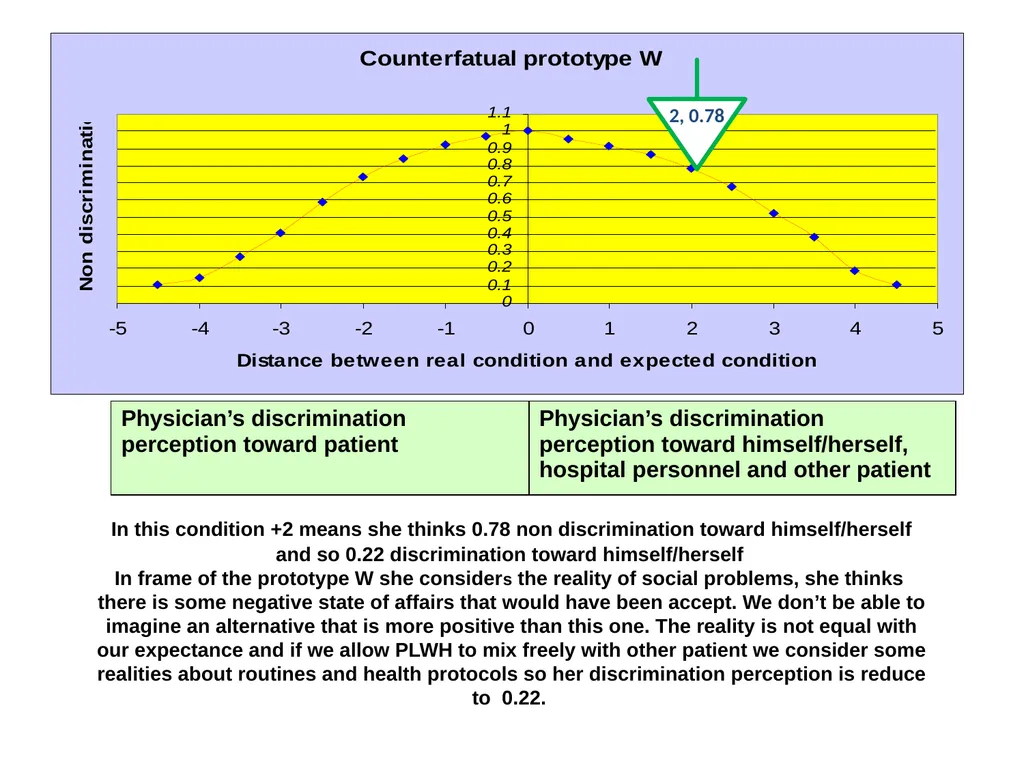
In this condition +2 means she thinks 0.78 non discrimination toward himself/herself and so 0.22 discrimination toward himself/herself
In frame of the prototype W she considers the reality of social problems, she thinks there is some negative state of affairs that would have been accept. We don’t be able to imagine an alternative that is more positive than this one. The reality is not equal with our expectance and if we allow PLWH to mix freely with other patient we consider some realities about routines and health protocols so her discrimination perception is reduce to 0.22. 2, 0.78<br>
In frame of the prototype W she considers the reality of social problems, she thinks there is some negative state of affairs that would have been accept. We don’t be able to imagine an alternative that is more positive than this one. The reality is not equal with our expectance and if we allow PLWH to mix freely with other patient we consider some realities about routines and health protocols so her discrimination perception is reduce to 0.22. 2, 0.78<br>
57
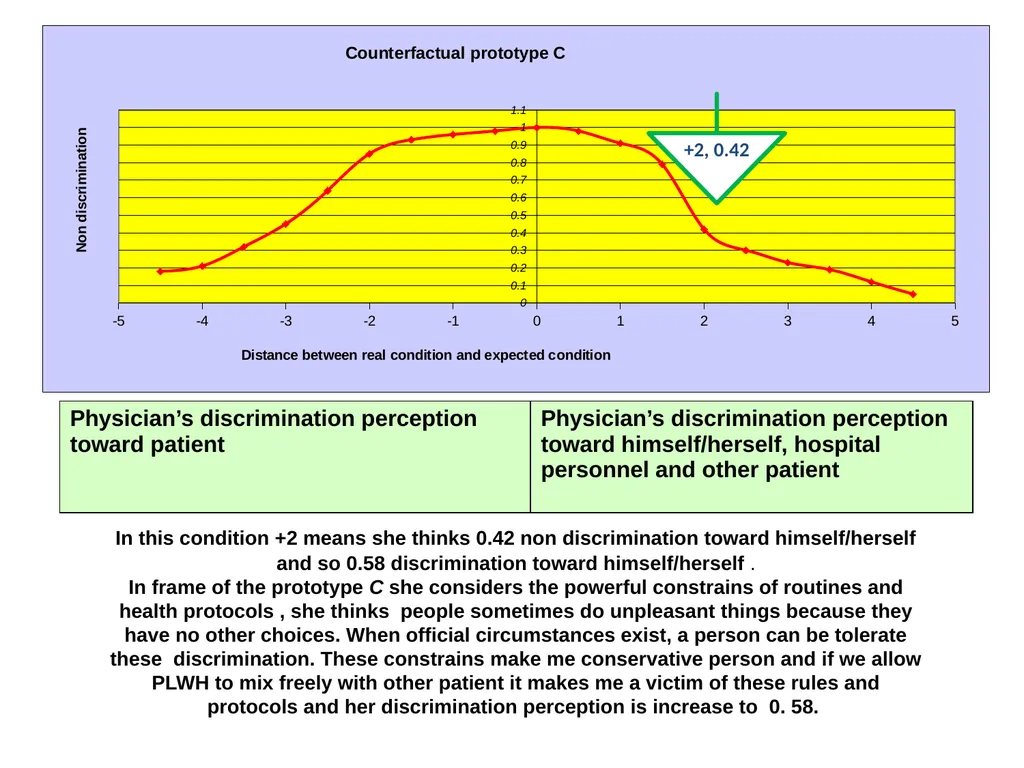
In this condition +2 means she thinks 0.42 non discrimination toward himself/herself and so 0.58 discrimination toward himself/herself .
In frame of the prototype C she considers the powerful constrains of routines and health protocols , she thinks people sometimes do unpleasant things because they have no other choices. When official circumstances exist, a person can be tolerate these discrimination. These constrains make me conservative person and if we allow PLWH to mix freely with other patient it makes me a victim of these rules and protocols and her discrimination perception is increase to 0. 58. +2, 0.42<br>
In frame of the prototype C she considers the powerful constrains of routines and health protocols , she thinks people sometimes do unpleasant things because they have no other choices. When official circumstances exist, a person can be tolerate these discrimination. These constrains make me conservative person and if we allow PLWH to mix freely with other patient it makes me a victim of these rules and protocols and her discrimination perception is increase to 0. 58. +2, 0.42<br>
58
Conclusion For better explanation and more accurate forecasting of the discrimination behavior of health care providers we need not only the model of factors affecting their discrimination intention but also we need their dominant counterfactual prototype. Fuzzy membership functions help us to modify the factors affecting the discrimination intention in order to achieve powerful managerial intervention and to contribute for changing the attitude toward PLWH.<br>
59
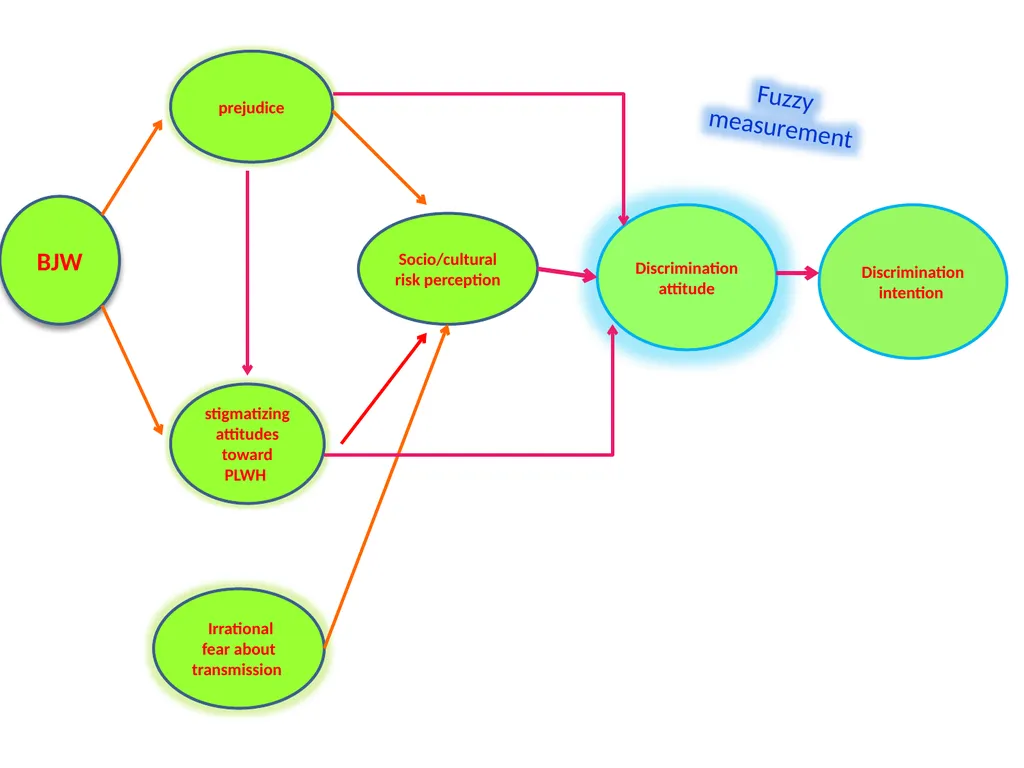
BJW Irrational fear about transmission stigmatizing attitudes toward
PLWH prejudice Discrimination attitude Discrimination
intention Socio/cultural risk perception Fuzzy measurement<br>
PLWH prejudice Discrimination attitude Discrimination
intention Socio/cultural risk perception Fuzzy measurement<br>
60
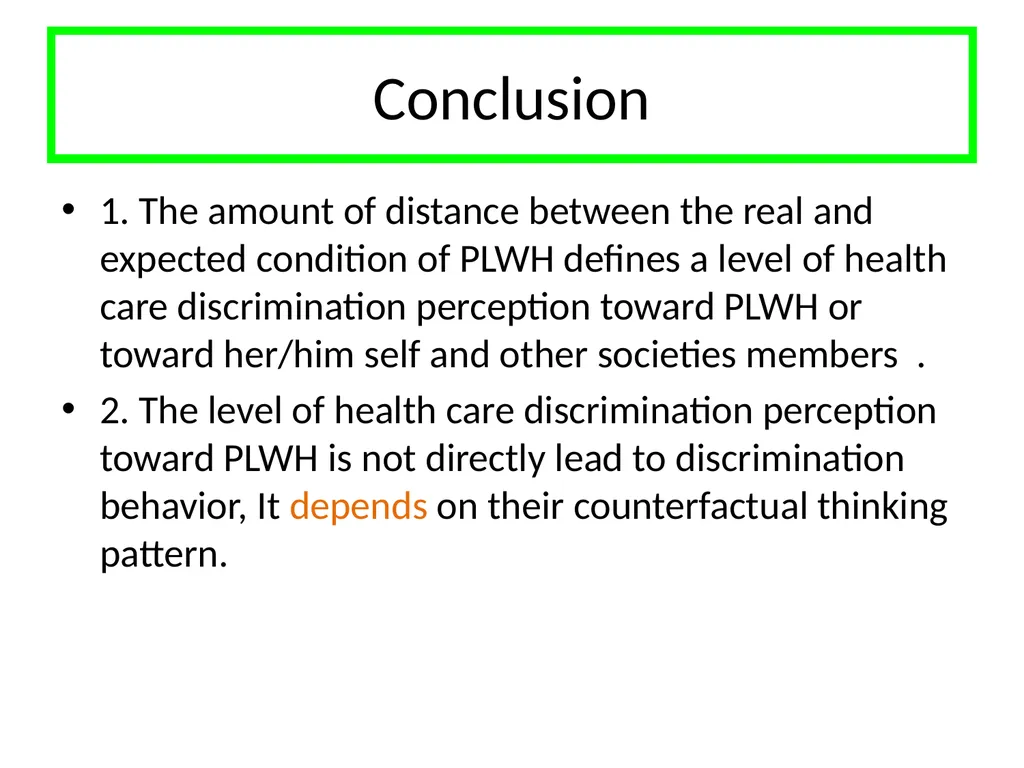
Conclusion 1. The amount of distance between the real and expected condition of PLWH defines a level of health care discrimination perception toward PLWH or toward her/him self and other societies members .
2. The level of health care discrimination perception toward PLWH is not directly lead to discrimination behavior, It depends on their counterfactual thinking pattern.<br>
2. The level of health care discrimination perception toward PLWH is not directly lead to discrimination behavior, It depends on their counterfactual thinking pattern.<br>
61
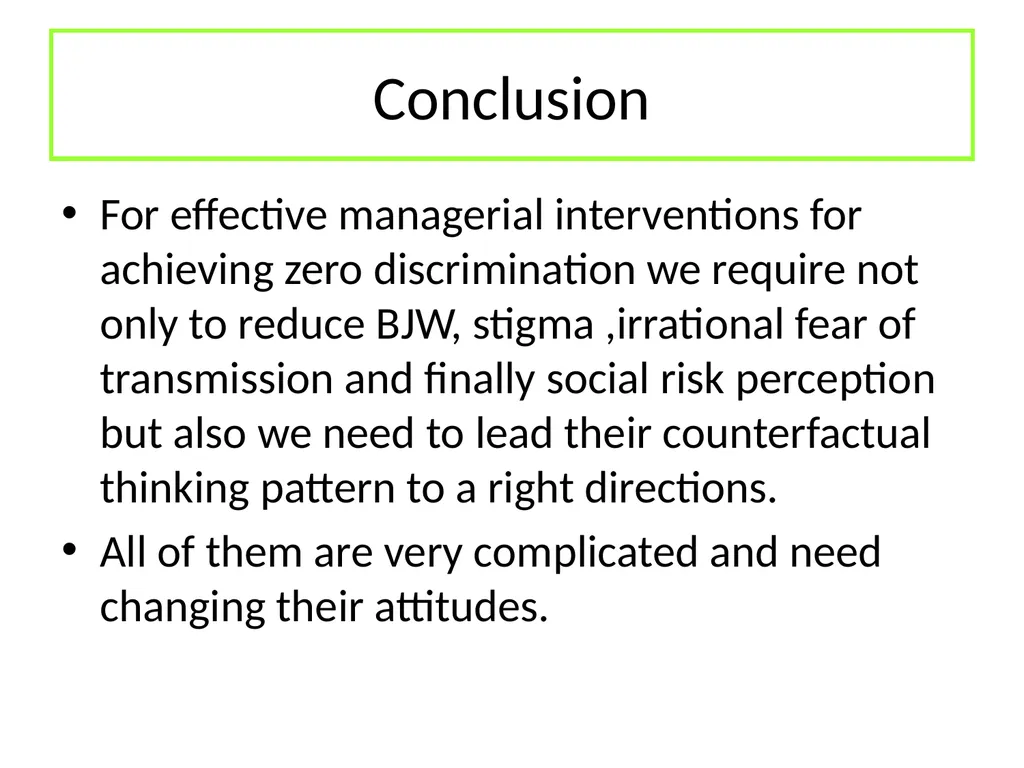
Conclusion For effective managerial interventions for achieving zero discrimination we require not only to reduce BJW, stigma ,irrational fear of transmission and finally social risk perception but also we need to lead their counterfactual thinking pattern to a right directions.
All of them are very complicated and need changing their attitudes.<br>
All of them are very complicated and need changing their attitudes.<br>
62
Finally I have An important request!????? For implementing this research proposal
I need your kind help and ????support<br>
I need your kind help and ????support<br>
63
Thank you for your kind attention<br>