
Protecting and Securing PLM and Supply Chain Data
LO
Published · 36 slides · 0 views
1 / 1
Description
Protecting and Securing PLM and Supply Chain Data Rohit Ranchal PI: Bharat Bhargava CERIAS Computer Sciences PLM Center of Excellence Purdue University Outline Background Problem Statement Related Work Managed Information Object Active
Related Topics
Share
Embed code
Download this presentation From Below
"Protecting and Securing PLM and Supply Chain Data" is the property of its rightful owner. Permission is granted to download and print the materials on this website for personal, non-commercial use only, and to display it on your personal computer provided you do not modify the materials and that you retain all copyright notices contained in the materials. By downloading content from our website, you accept the terms of this agreement.
Presentation Transcript
01
Protecting and Securing PLM and Supply Chain Data Rohit Ranchal
PI: Bharat Bhargava
CERIAS
Computer Sciences
PLM Center of Excellence Purdue University<br>
PI: Bharat Bhargava
CERIAS
Computer Sciences
PLM Center of Excellence Purdue University<br>
02
Outline Background
Problem Statement
Related Work
Managed Information Object
Active Bundle Scheme
Extending Active Bundle Scheme
Possible Projects 2<br>
Problem Statement
Related Work
Managed Information Object
Active Bundle Scheme
Extending Active Bundle Scheme
Possible Projects 2<br>
03
Background: Modern Enterprises Globally distributed operations e.g. Boeing, Cummins, Dow Agro Sciences
Focus on core competencies and outsource auxiliary tasks to partner organizations
Rely on Supply Chain to collaborate with partners in transforming raw materials into products
Use PLM Information Systems to manage the information flow that facilitates the movement of physical product related entities in the supply chain
PLM systems continuously receive, process and share dynamic supply chain information (sensitive data)
Commercial information shared with advisors and lawyers
Personally identifiable information about customers and employees
Intellectual property shared with partners 3<br>
Focus on core competencies and outsource auxiliary tasks to partner organizations
Rely on Supply Chain to collaborate with partners in transforming raw materials into products
Use PLM Information Systems to manage the information flow that facilitates the movement of physical product related entities in the supply chain
PLM systems continuously receive, process and share dynamic supply chain information (sensitive data)
Commercial information shared with advisors and lawyers
Personally identifiable information about customers and employees
Intellectual property shared with partners 3<br>
04
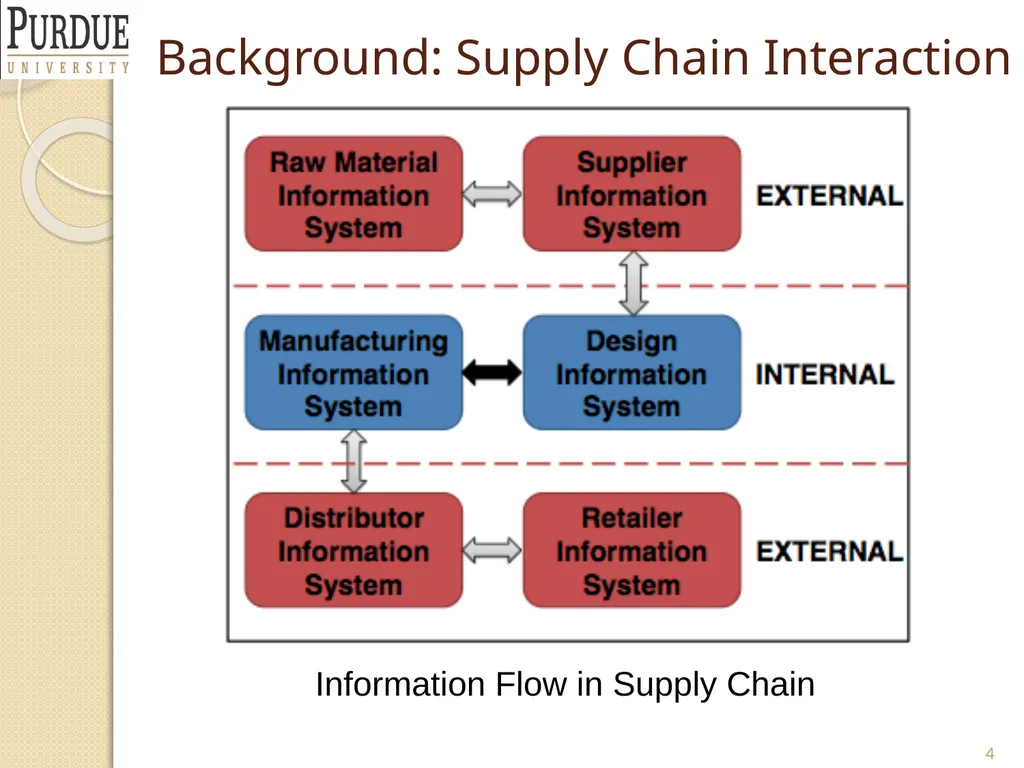
Background: Supply Chain Interaction 4 Information Flow in Supply Chain<br>
05
Information Flow in Supply Chain Globally distributed supply chain processes
Information not confined to a single domain but distributed among and controlled by multiple partners
Outsourcing of shared information by partner organizations
No way to track the information access and usage in external domain (organization has no control over the processes in external domain)
Intermediate steps of information flow might expose information to hostile threats
Unauthorized disclosure and data leakage of information shared among partners across multiple domains
Violations and malicious activities in a trusted domain remain undetected 5<br>
Information not confined to a single domain but distributed among and controlled by multiple partners
Outsourcing of shared information by partner organizations
No way to track the information access and usage in external domain (organization has no control over the processes in external domain)
Intermediate steps of information flow might expose information to hostile threats
Unauthorized disclosure and data leakage of information shared among partners across multiple domains
Violations and malicious activities in a trusted domain remain undetected 5<br>
06
Impact of Security Threats Leakage of sensitive information - list of customers, product secrets etc to competitors, malicious entities, government institutions or attackers
High financial losses
Damage to the reputation of organization and its partners
Criminal activities
Affect on National Security 6<br>
High financial losses
Damage to the reputation of organization and its partners
Criminal activities
Affect on National Security 6<br>
07
Challenges for Supply Chain Security Lack of mechanisms to communicate information owner’s policies to the protection frameworks of the partners
Lack of information sharing standards for protecting data in distributed supply chains
Custom security requirements and controls applied by partners
Incompatibility and reduced ability to ensure policy enforcement leaves security gaps
Disparate, evolving and changing Information security standards to satisfy changing business models, regulatory and geographical law requirements 7<br>
Lack of information sharing standards for protecting data in distributed supply chains
Custom security requirements and controls applied by partners
Incompatibility and reduced ability to ensure policy enforcement leaves security gaps
Disparate, evolving and changing Information security standards to satisfy changing business models, regulatory and geographical law requirements 7<br>
08
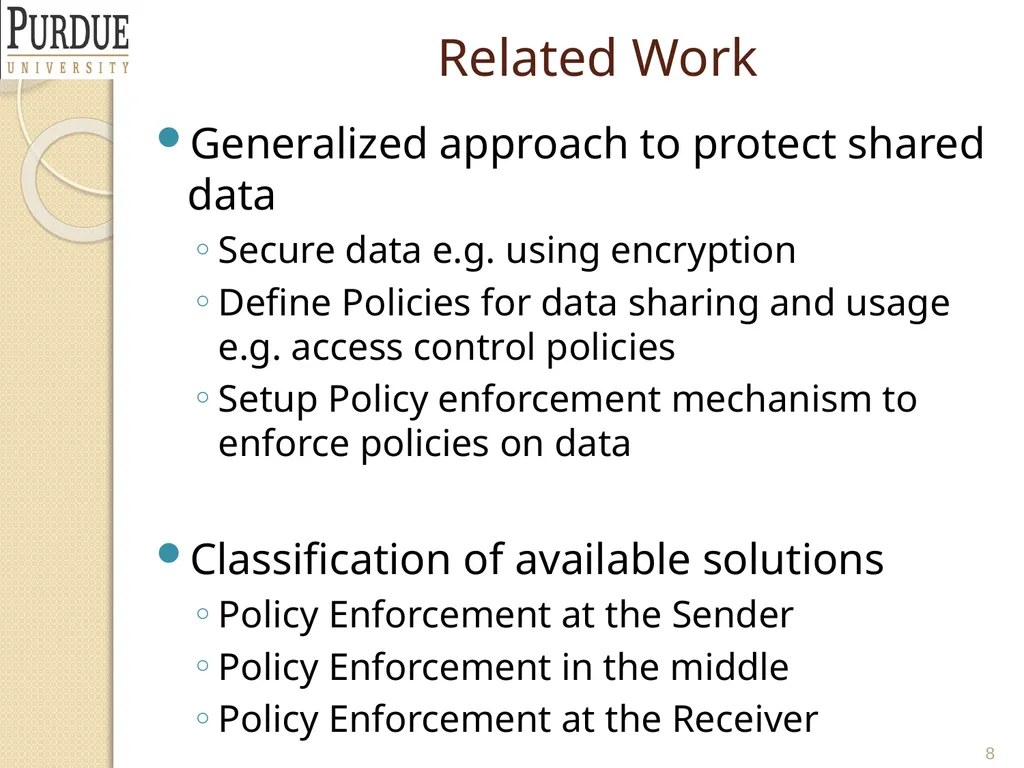
Related Work Generalized approach to protect shared data
Secure data e.g. using encryption
Define Policies for data sharing and usage e.g. access control policies
Setup Policy enforcement mechanism to enforce policies on data
Classification of available solutions
Policy Enforcement at the Sender
Policy Enforcement in the middle
Policy Enforcement at the Receiver 8<br>
Secure data e.g. using encryption
Define Policies for data sharing and usage e.g. access control policies
Setup Policy enforcement mechanism to enforce policies on data
Classification of available solutions
Policy Enforcement at the Sender
Policy Enforcement in the middle
Policy Enforcement at the Receiver 8<br>
09
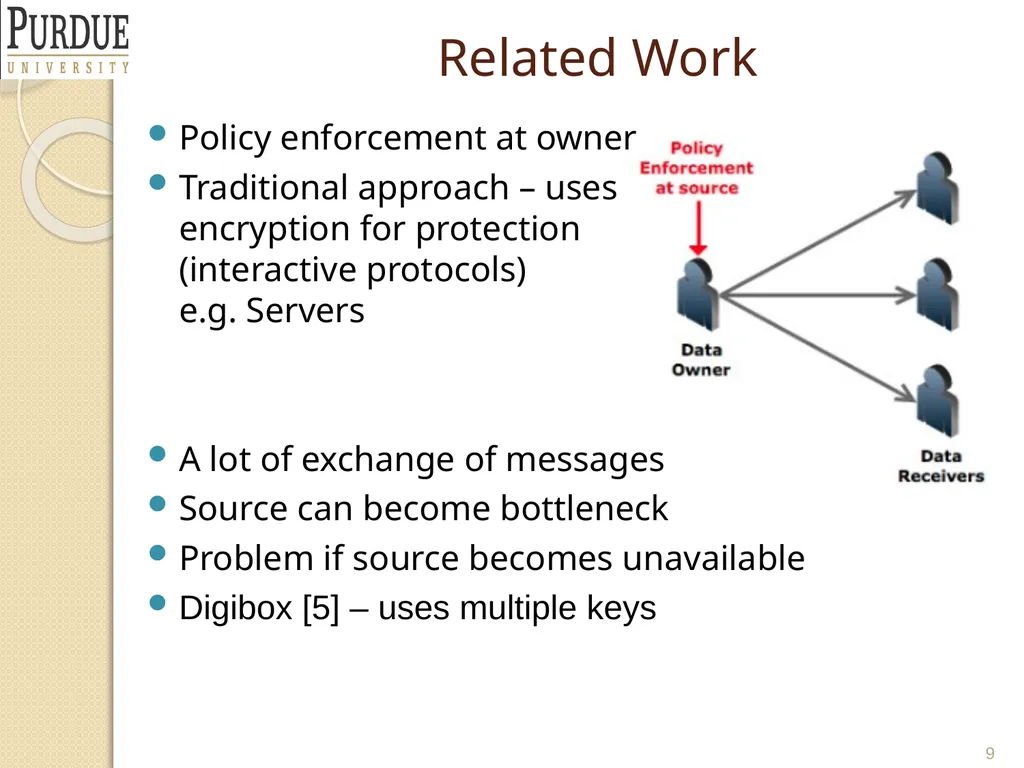
Related Work Policy enforcement at owner
Traditional approach – uses encryption for protection (interactive protocols) e.g. Servers
A lot of exchange of messages
Source can become bottleneck
Problem if source becomes unavailable
Digibox [5] – uses multiple keys 9<br>
Traditional approach – uses encryption for protection (interactive protocols) e.g. Servers
A lot of exchange of messages
Source can become bottleneck
Problem if source becomes unavailable
Digibox [5] – uses multiple keys 9<br>
10
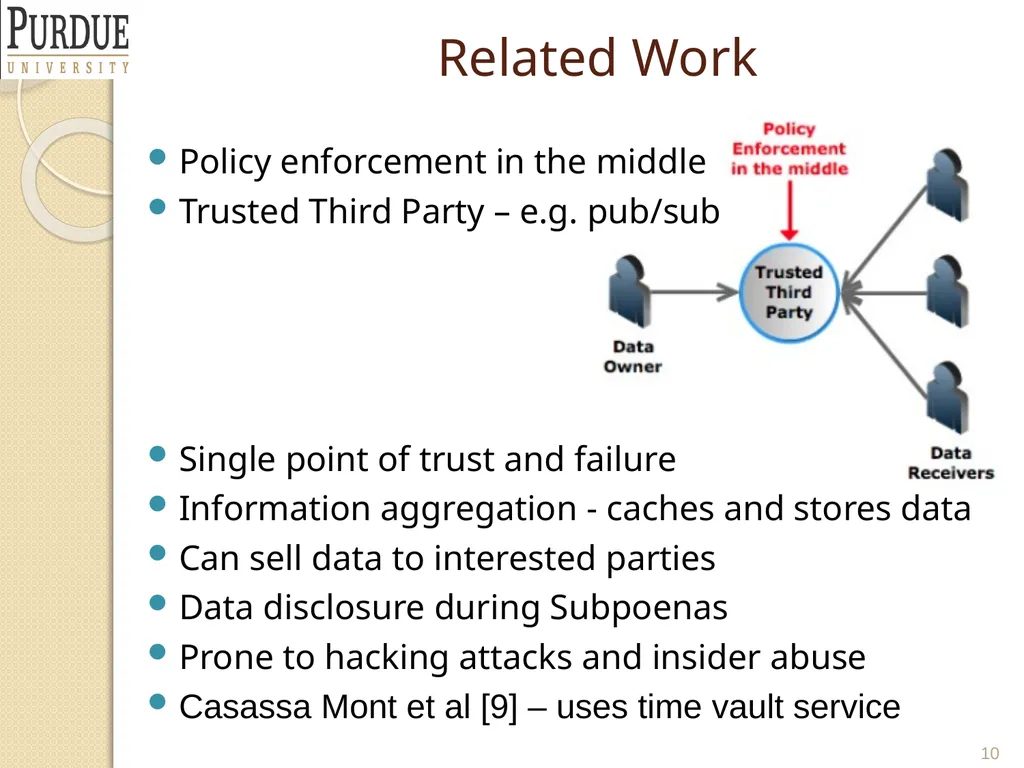
Related Work Policy enforcement in the middle
Trusted Third Party – e.g. pub/sub
Single point of trust and failure
Information aggregation - caches and stores data
Can sell data to interested parties
Data disclosure during Subpoenas
Prone to hacking attacks and insider abuse
Casassa Mont et al [9] – uses time vault service 10<br>
Trusted Third Party – e.g. pub/sub
Single point of trust and failure
Information aggregation - caches and stores data
Can sell data to interested parties
Data disclosure during Subpoenas
Prone to hacking attacks and insider abuse
Casassa Mont et al [9] – uses time vault service 10<br>
11
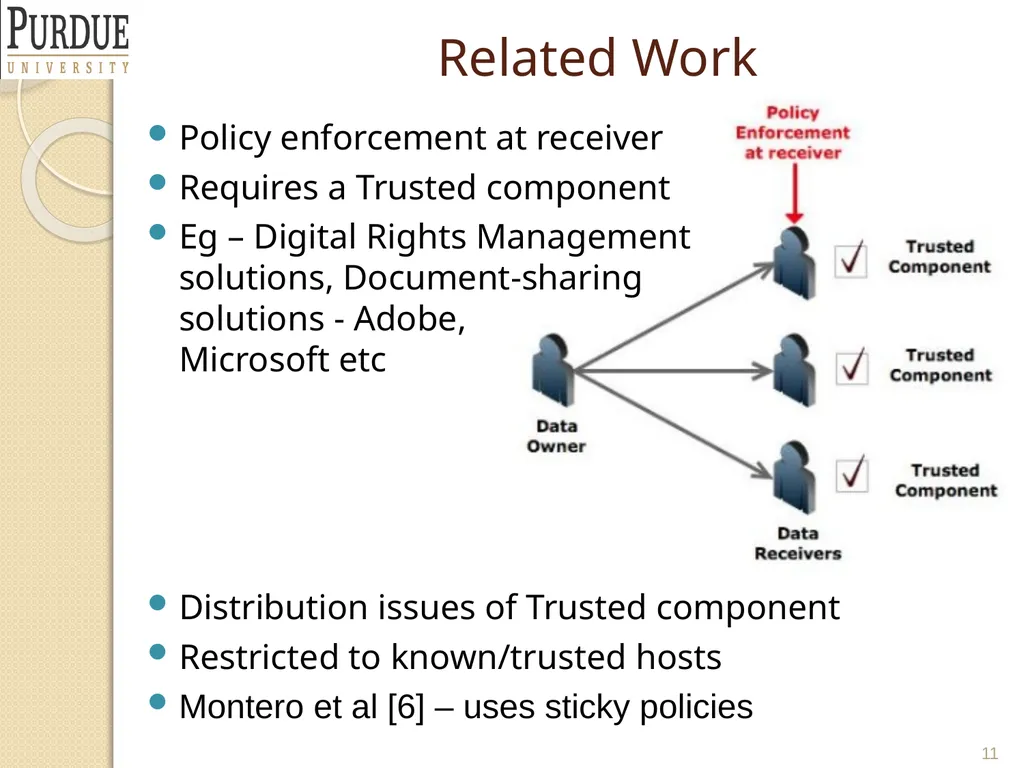
Related Work Policy enforcement at receiver
Requires a Trusted component
Eg – Digital Rights Management solutions, Document-sharing solutions - Adobe, Microsoft etc
Distribution issues of Trusted component
Restricted to known/trusted hosts
Montero et al [6] – uses sticky policies 11<br>
Requires a Trusted component
Eg – Digital Rights Management solutions, Document-sharing solutions - Adobe, Microsoft etc
Distribution issues of Trusted component
Restricted to known/trusted hosts
Montero et al [6] – uses sticky policies 11<br>
12
Proposed Approach Existing approaches that rely on the use of standards, service level agreements, and legal contracts are insufficient
Propose an end-to-end approach for protecting shared data in digital supply chains
Self-protecting data centric approach for policy based controlled data dissemination
Security auditing of business processes that compose supply chains
Enables tracking the information flows of shared data
Detecting malicious interactions and compromised business processes of partners
Tracks the data flow and actions upon them and enables auditing, detecting and reporting policy violations 12<br>
Propose an end-to-end approach for protecting shared data in digital supply chains
Self-protecting data centric approach for policy based controlled data dissemination
Security auditing of business processes that compose supply chains
Enables tracking the information flows of shared data
Detecting malicious interactions and compromised business processes of partners
Tracks the data flow and actions upon them and enables auditing, detecting and reporting policy violations 12<br>
13
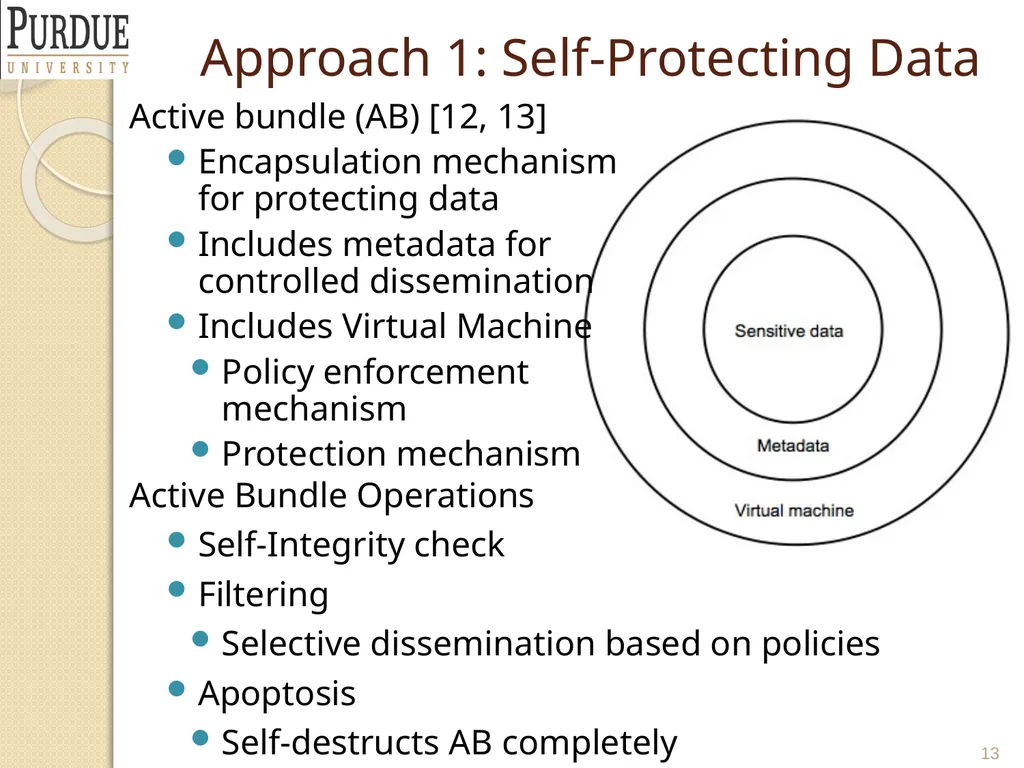
Approach 1: Self-Protecting Data Active bundle (AB) [12, 13]
Encapsulation mechanism for protecting data
Includes metadata for controlled dissemination
Includes Virtual Machine
Policy enforcement mechanism
Protection mechanism
Active Bundle Operations
Self-Integrity check
Filtering
Selective dissemination based on policies
Apoptosis
Self-destructs AB completely 13<br>
Encapsulation mechanism for protecting data
Includes metadata for controlled dissemination
Includes Virtual Machine
Policy enforcement mechanism
Protection mechanism
Active Bundle Operations
Self-Integrity check
Filtering
Selective dissemination based on policies
Apoptosis
Self-destructs AB completely 13<br>
14
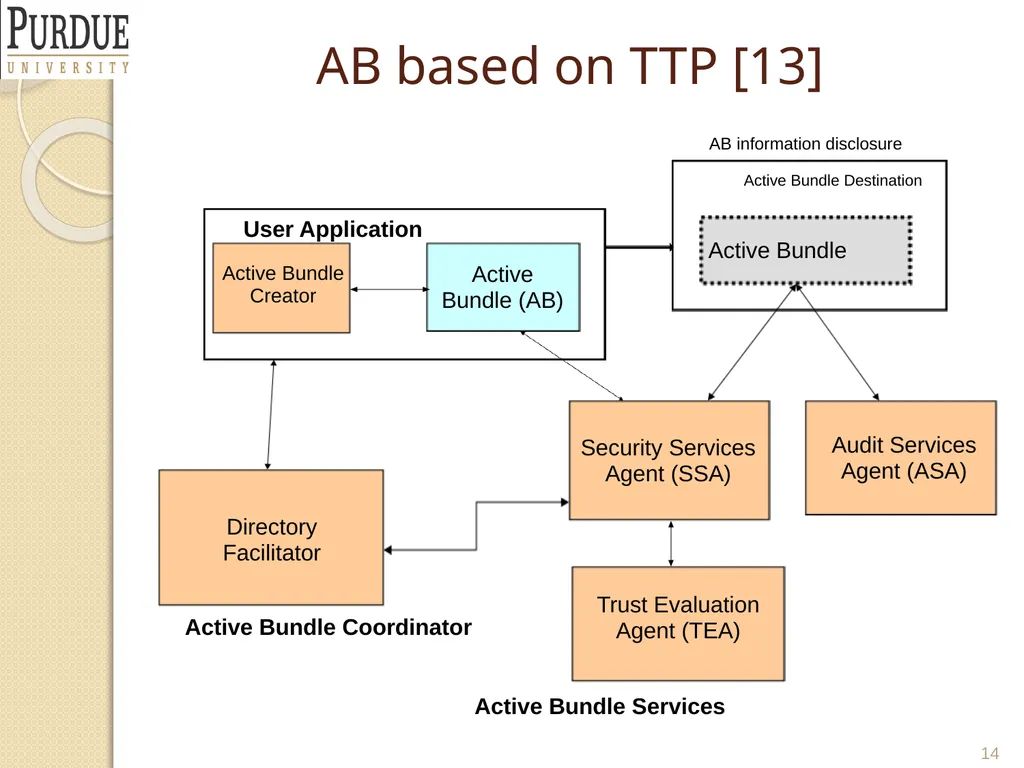
AB based on TTP [13] Active
Bundle (AB) Security Services
Agent (SSA) Active Bundle Services User Application Active Bundle Coordinator Active Bundle Creator Directory
Facilitator Active Bundle Destination Trust Evaluation
Agent (TEA) Audit Services
Agent (ASA) Active Bundle AB information disclosure 14<br>
Bundle (AB) Security Services
Agent (SSA) Active Bundle Services User Application Active Bundle Coordinator Active Bundle Creator Directory
Facilitator Active Bundle Destination Trust Evaluation
Agent (TEA) Audit Services
Agent (ASA) Active Bundle AB information disclosure 14<br>
15
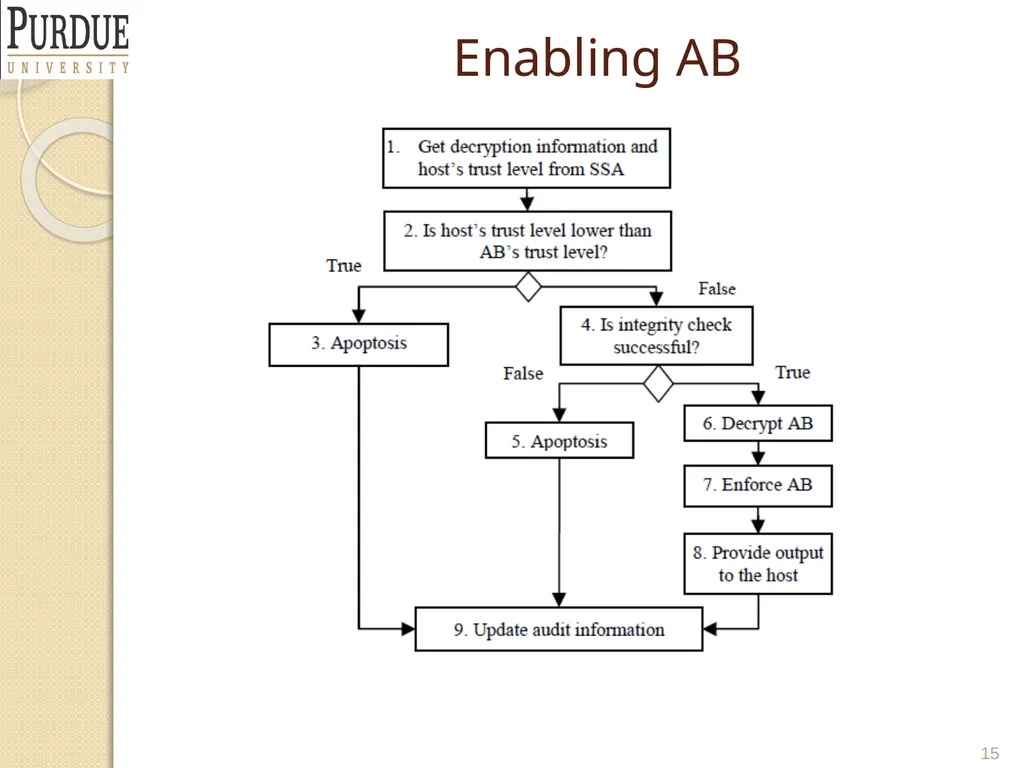
Enabling AB 15<br>
16
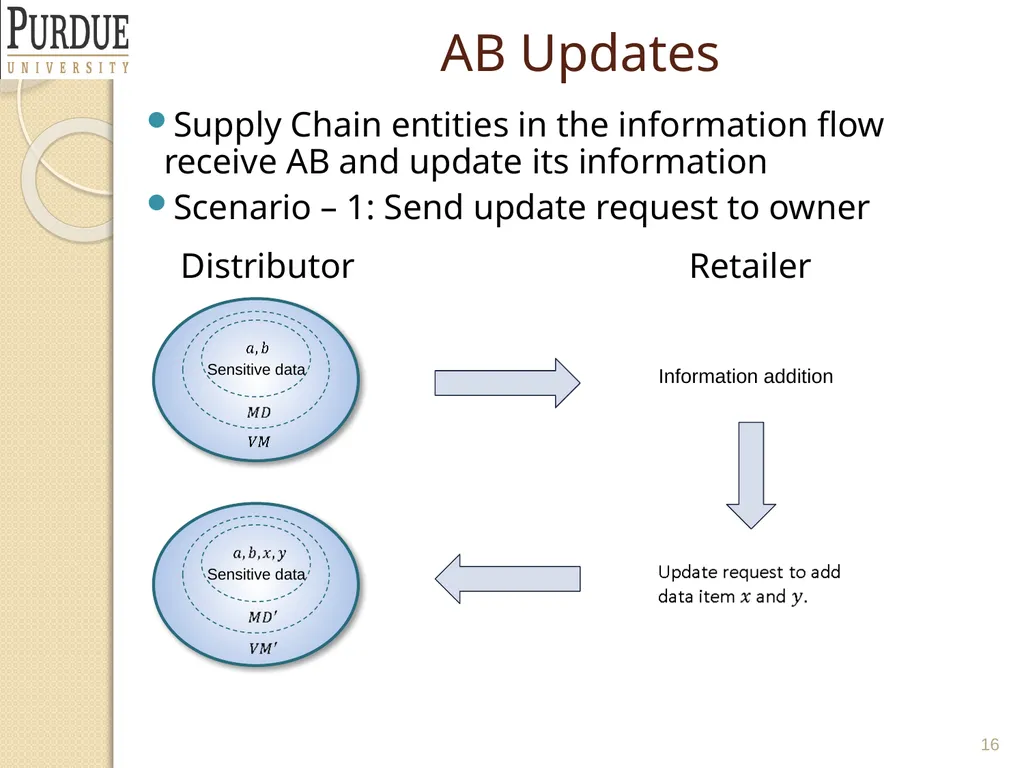
AB Updates 16 Supply Chain entities in the information flow receive AB and update its information
Scenario – 1: Send update request to owner Distributor Retailer Sensitive data Sensitive data Information addition<br>
Scenario – 1: Send update request to owner Distributor Retailer Sensitive data Sensitive data Information addition<br>
17
Problems with updating an AB 17 Advantage
Simple
The owner can control every update
Disadvantage
The update request may be rejected or partially rejected by the owner
The new privacy policy for the updated AB is created by the owner which may conflict with the updater’s policy
The updater may not want the original owner to know the appended data
The owner may get a lot of requests for updates<br>
Simple
The owner can control every update
Disadvantage
The update request may be rejected or partially rejected by the owner
The new privacy policy for the updated AB is created by the owner which may conflict with the updater’s policy
The updater may not want the original owner to know the appended data
The owner may get a lot of requests for updates<br>
18
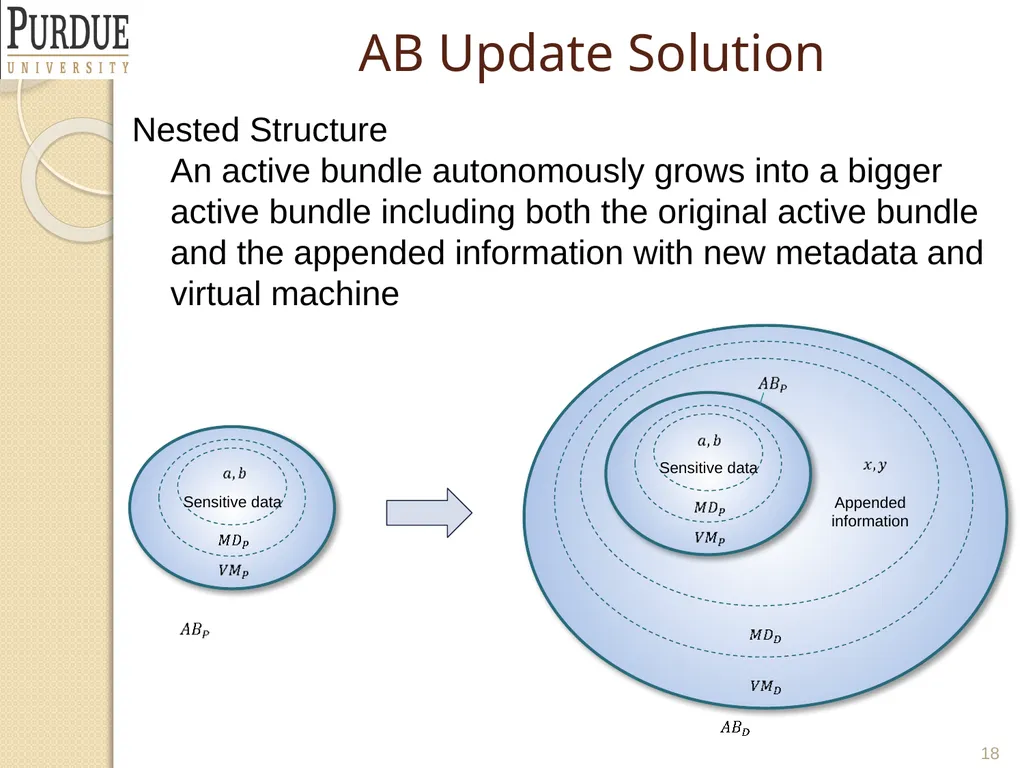
AB Update Solution 18 Nested Structure
An active bundle autonomously grows into a bigger active bundle including both the original active bundle and the appended information with new metadata and virtual machine<br>
19
AB Update Solution 19 Advantage
Any entity with the permission to append information can append and specify the new privacy policy for the appended information
Existing policies are still effective on the existing data and new policies are only enforced on the appended data and the existing data
The nested structure of an active bundle naturally represents the history of updates
Disadvantage
AB’s size grows linearly with every update
The new policies may be more restrictive than the original policies which may restrict access to the original data
Possible Solution: VMs of Nested ABs are redundant. A single common VM can serve all Nested ABs<br>
Any entity with the permission to append information can append and specify the new privacy policy for the appended information
Existing policies are still effective on the existing data and new policies are only enforced on the appended data and the existing data
The nested structure of an active bundle naturally represents the history of updates
Disadvantage
AB’s size grows linearly with every update
The new policies may be more restrictive than the original policies which may restrict access to the original data
Possible Solution: VMs of Nested ABs are redundant. A single common VM can serve all Nested ABs<br>
20
Improving the AB Implementation Improve the AB implementation by making it less dependent on TTP
Provide a mechanism for policy based selective dissemination
Use a policy language to define policies
Providing resilience against malicious hosts
Application specific development and experimentation 20<br>
Provide a mechanism for policy based selective dissemination
Use a policy language to define policies
Providing resilience against malicious hosts
Application specific development and experimentation 20<br>
21
Improving AB Implementation Provide selective dissemination
Organize data in AB into separate items
Encrypt each item with a different key
Decrease dependence on TTP
Use Shamir’s threshold secret sharing technique [16] to split each of the decryption keys into N shares
Set a threshold t such that t shares are required for key reconstruction
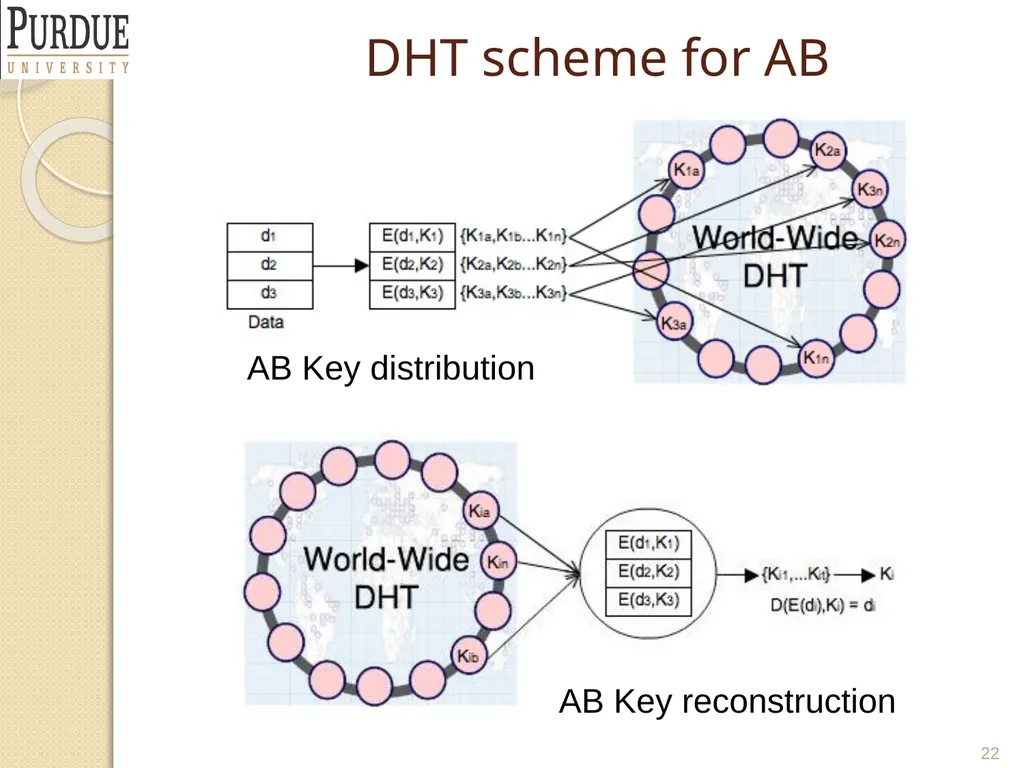
Store the key shares in a distributed hash table (DHT) built on top of P2P system (Vuze) [26]
Each share is stored at a random node 21<br>
Organize data in AB into separate items
Encrypt each item with a different key
Decrease dependence on TTP
Use Shamir’s threshold secret sharing technique [16] to split each of the decryption keys into N shares
Set a threshold t such that t shares are required for key reconstruction
Store the key shares in a distributed hash table (DHT) built on top of P2P system (Vuze) [26]
Each share is stored at a random node 21<br>
22
DHT scheme for AB 22 AB Key distribution AB Key reconstruction<br>
23
Advantages of using DHT Huge scale - millions of geographically distributed nodes
Decentralized – individually owned nodes with no single point of trust
Load reduction and Asynchronous communication – no synchronization issues
Hard to deduce all the shares (atleast t)
Hard to compromise all the nodes that store the shares
Use periodic splitting to protect against dynamic adversaries 23<br>
Decentralized – individually owned nodes with no single point of trust
Load reduction and Asynchronous communication – no synchronization issues
Hard to deduce all the shares (atleast t)
Hard to compromise all the nodes that store the shares
Use periodic splitting to protect against dynamic adversaries 23<br>
24
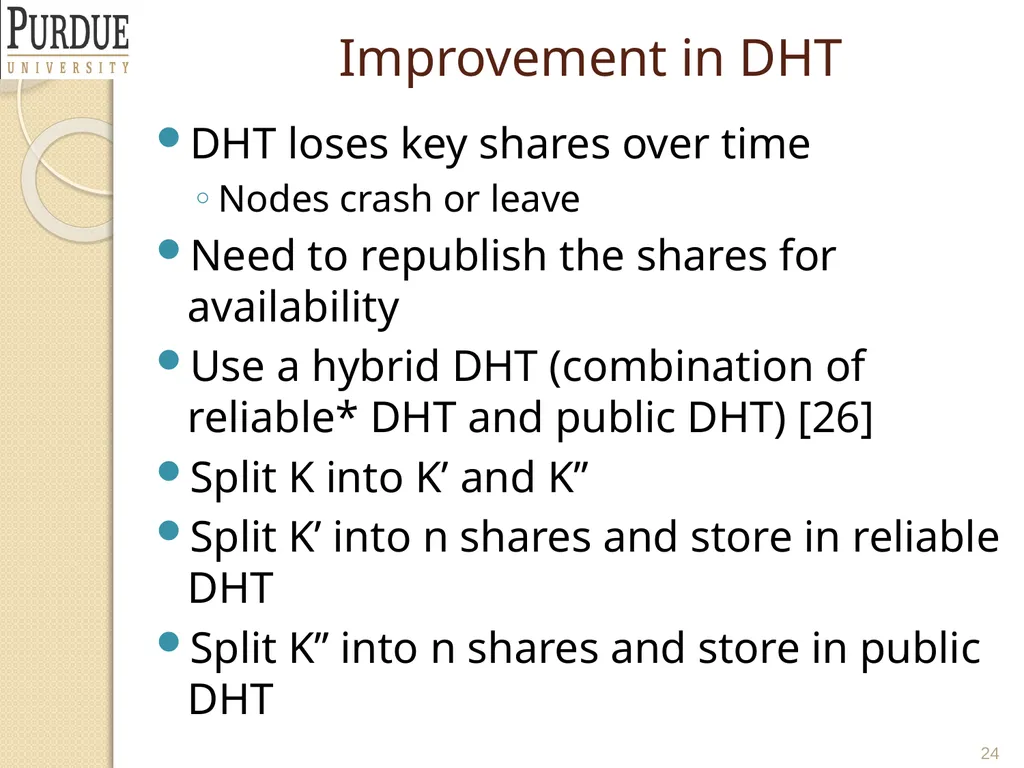
Improvement in DHT DHT loses key shares over time
Nodes crash or leave
Need to republish the shares for availability
Use a hybrid DHT (combination of reliable* DHT and public DHT) [26]
Split K into K’ and K’’
Split K’ into n shares and store in reliable DHT
Split K’’ into n shares and store in public DHT 24<br>
Nodes crash or leave
Need to republish the shares for availability
Use a hybrid DHT (combination of reliable* DHT and public DHT) [26]
Split K into K’ and K’’
Split K’ into n shares and store in reliable DHT
Split K’’ into n shares and store in public DHT 24<br>
25
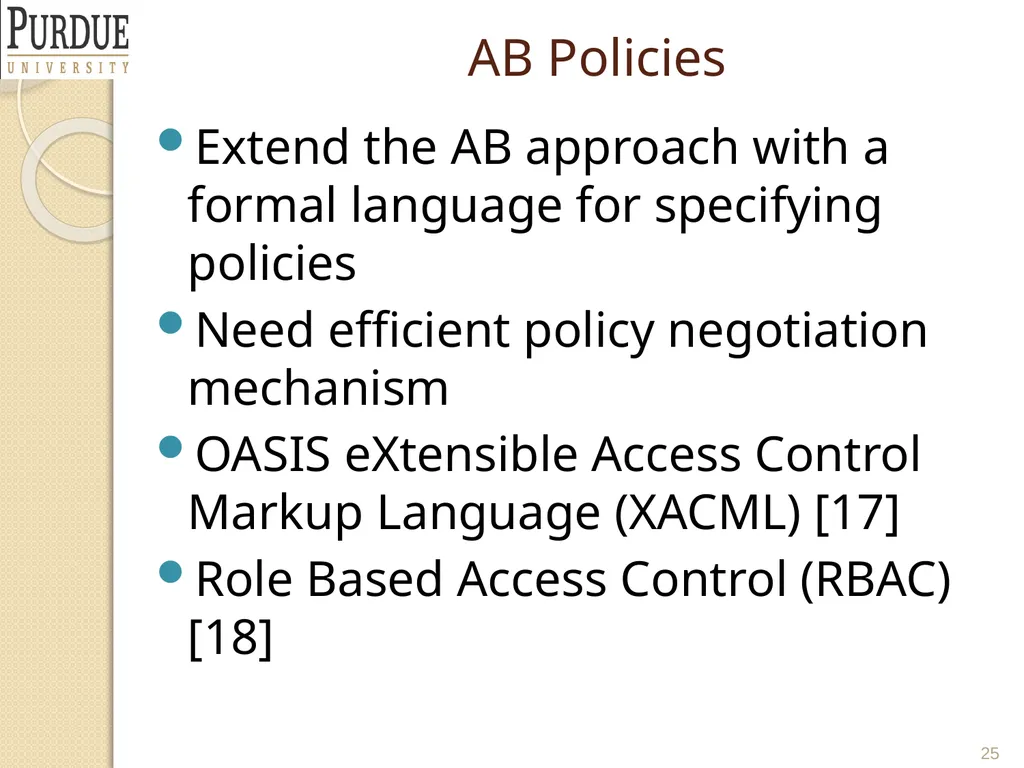
AB Policies Extend the AB approach with a formal language for specifying policies
Need efficient policy negotiation mechanism
OASIS eXtensible Access Control Markup Language (XACML) [17]
Role Based Access Control (RBAC) [18] 25<br>
Need efficient policy negotiation mechanism
OASIS eXtensible Access Control Markup Language (XACML) [17]
Role Based Access Control (RBAC) [18] 25<br>
26
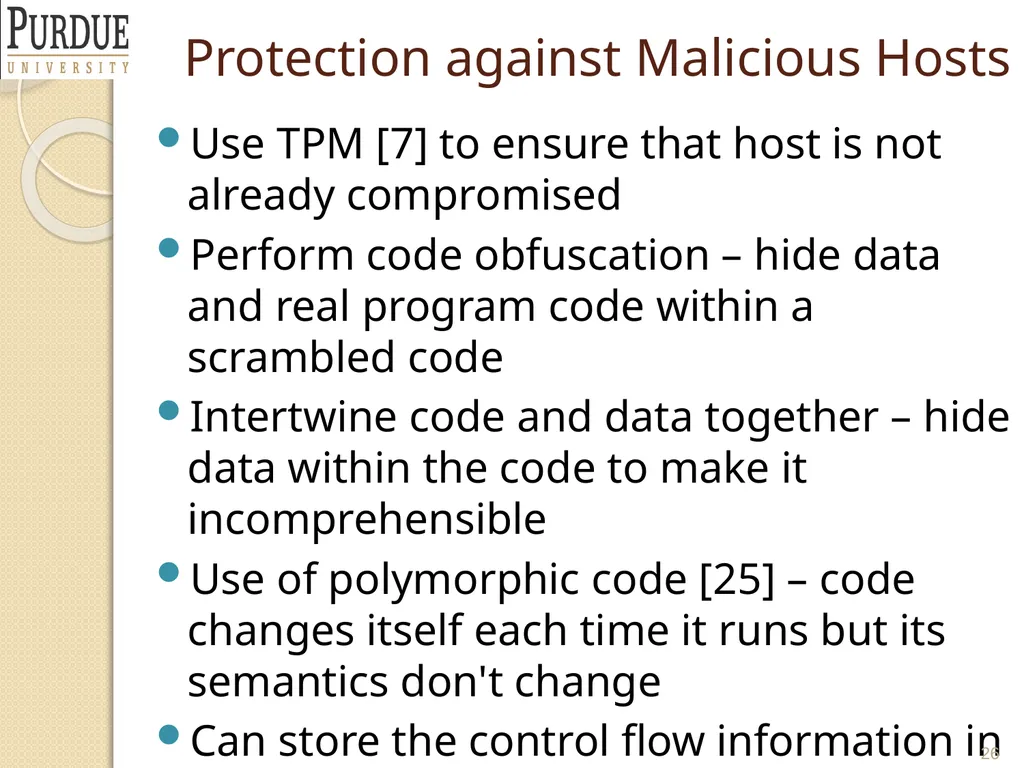
Protection against Malicious Hosts Use TPM [7] to ensure that host is not already compromised
Perform code obfuscation – hide data and real program code within a scrambled code
Intertwine code and data together – hide data within the code to make it incomprehensible
Use of polymorphic code [25] – code changes itself each time it runs but its semantics don't change
Can store the control flow information in random DHT nodes 26<br>
Perform code obfuscation – hide data and real program code within a scrambled code
Intertwine code and data together – hide data within the code to make it incomprehensible
Use of polymorphic code [25] – code changes itself each time it runs but its semantics don't change
Can store the control flow information in random DHT nodes 26<br>
27
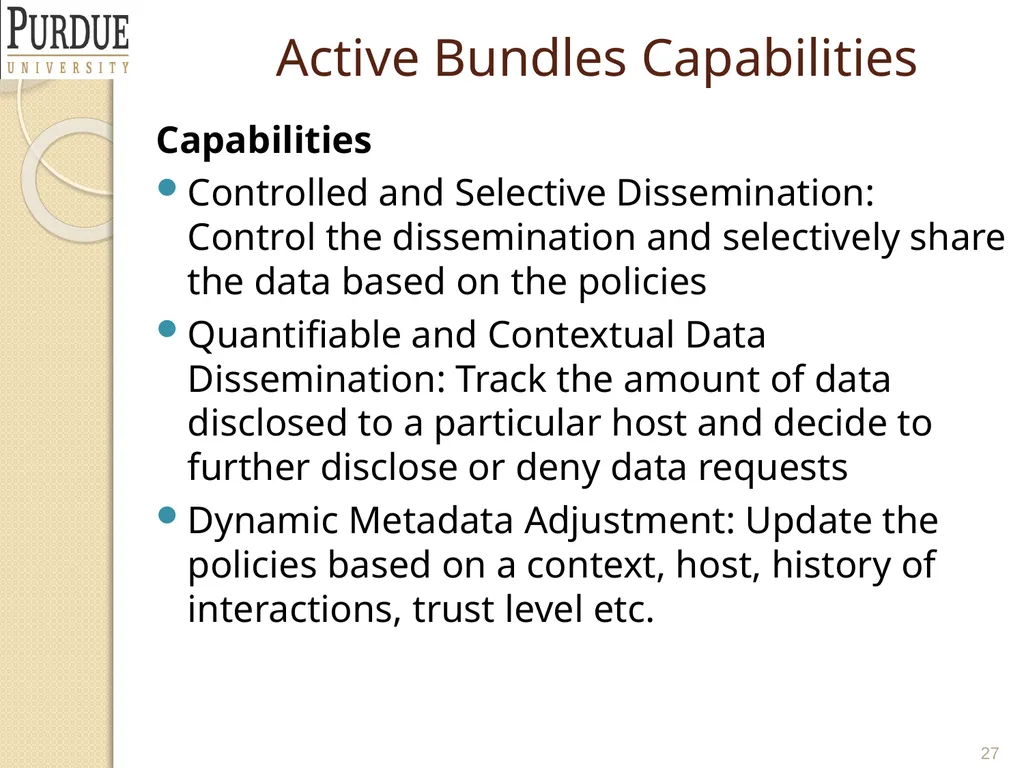
Active Bundles Capabilities Capabilities
Controlled and Selective Dissemination: Control the dissemination and selectively share the data based on the policies
Quantifiable and Contextual Data Dissemination: Track the amount of data disclosed to a particular host and decide to further disclose or deny data requests
Dynamic Metadata Adjustment: Update the policies based on a context, host, history of interactions, trust level etc. 27<br>
Controlled and Selective Dissemination: Control the dissemination and selectively share the data based on the policies
Quantifiable and Contextual Data Dissemination: Track the amount of data disclosed to a particular host and decide to further disclose or deny data requests
Dynamic Metadata Adjustment: Update the policies based on a context, host, history of interactions, trust level etc. 27<br>
28
Active Bundles Advantages Do not require hosts to have a policy enforcement engine or a trusted component
Doesn’t rely on a dedicated TTP
No trusted destination host assumption – works on unknown hosts
Decentralized Distributed Asynchronous communication 28<br>
Doesn’t rely on a dedicated TTP
No trusted destination host assumption – works on unknown hosts
Decentralized Distributed Asynchronous communication 28<br>
29
Approach 2: End to End Auditing Trust Broker
Trusted third party responsible for maintaining end-to-end auditing in information flow chain
Maintains a list of certified business processes that use the Taint Analysis Module and ensure their compliance with the required security controls
Manages end-to-end client/process-invocation session
Taint Analysis
Low level layer that monitors the interactions of business processes (at runtime)
Inspects the data exchanges (information flow) and reports policy violations 29<br>
Trusted third party responsible for maintaining end-to-end auditing in information flow chain
Maintains a list of certified business processes that use the Taint Analysis Module and ensure their compliance with the required security controls
Manages end-to-end client/process-invocation session
Taint Analysis
Low level layer that monitors the interactions of business processes (at runtime)
Inspects the data exchanges (information flow) and reports policy violations 29<br>
30
Trust Broker Certifies business processes upon certification by an external trusted authority
Certification assures that the business process allows tracking of information flow and ensures secure messaging
Maintains an end-to-end session of business processes’ interactions
Collects and audits the activities of the business processes of the collaborating partners
Logs warnings of illegal interactions and informs the client process about the detected violation 30<br>
Certification assures that the business process allows tracking of information flow and ensures secure messaging
Maintains an end-to-end session of business processes’ interactions
Collects and audits the activities of the business processes of the collaborating partners
Logs warnings of illegal interactions and informs the client process about the detected violation 30<br>
31
Taint Analysis Independent of processes
No need to change the processes or access the source code of processes
Interception of process execution (Process remains transparent)
Uses program instrumentation to gain control upon the occurrence of certain events
Two possible deployment options
Only in Trusted Domains
Detection of insider attacks
Detection of compromised processes
Detection of outbound interactions
In Public Domains
Enforcing service composition policies 31<br>
No need to change the processes or access the source code of processes
Interception of process execution (Process remains transparent)
Uses program instrumentation to gain control upon the occurrence of certain events
Two possible deployment options
Only in Trusted Domains
Detection of insider attacks
Detection of compromised processes
Detection of outbound interactions
In Public Domains
Enforcing service composition policies 31<br>
32
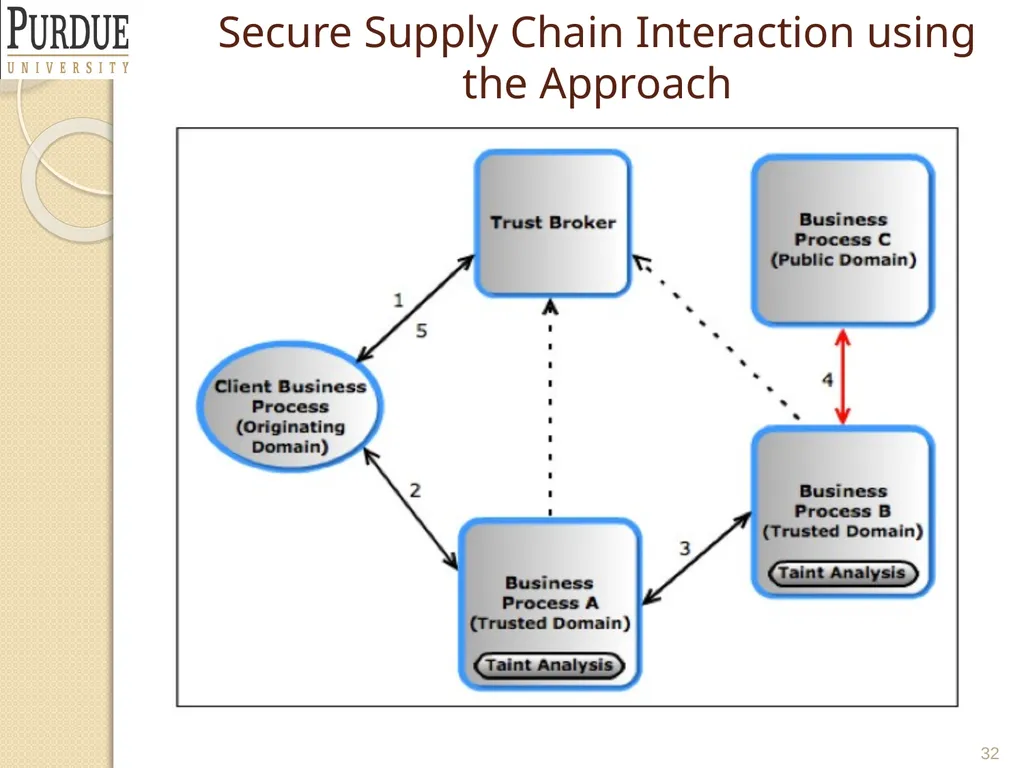
Secure Supply Chain Interaction using the Approach 32<br>
33
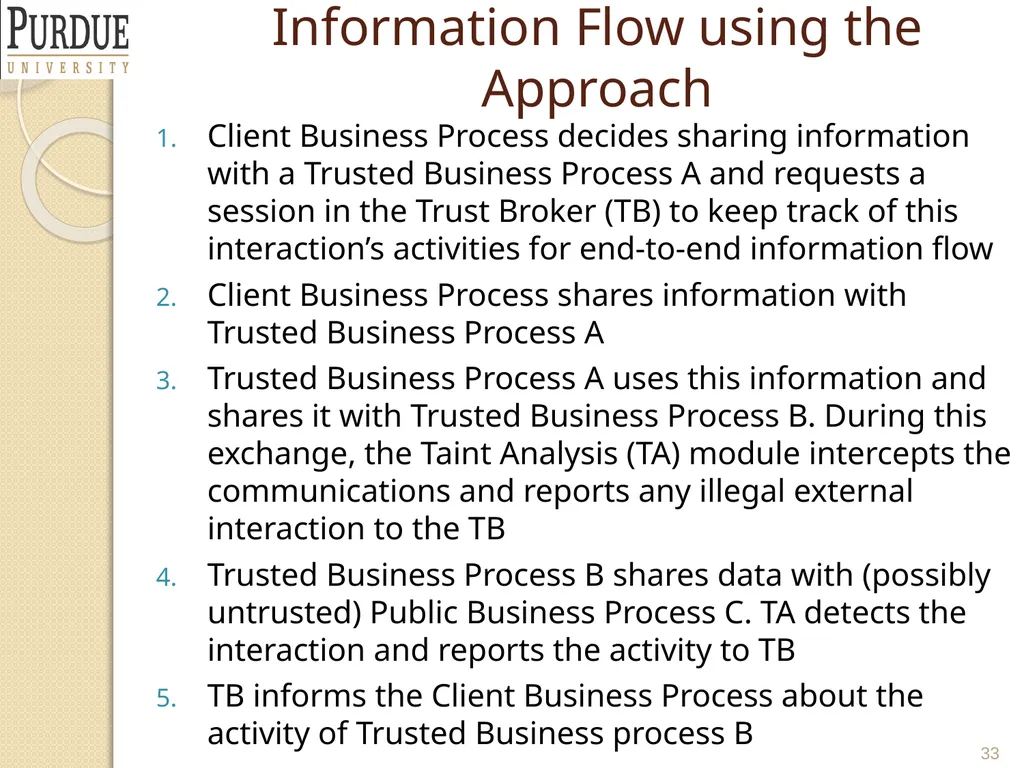
Information Flow using the Approach Client Business Process decides sharing information with a Trusted Business Process A and requests a session in the Trust Broker (TB) to keep track of this interaction’s activities for end-to-end information flow
Client Business Process shares information with Trusted Business Process A
Trusted Business Process A uses this information and shares it with Trusted Business Process B. During this exchange, the Taint Analysis (TA) module intercepts the communications and reports any illegal external interaction to the TB
Trusted Business Process B shares data with (possibly untrusted) Public Business Process C. TA detects the interaction and reports the activity to TB
TB informs the Client Business Process about the activity of Trusted Business process B 33<br>
Client Business Process shares information with Trusted Business Process A
Trusted Business Process A uses this information and shares it with Trusted Business Process B. During this exchange, the Taint Analysis (TA) module intercepts the communications and reports any illegal external interaction to the TB
Trusted Business Process B shares data with (possibly untrusted) Public Business Process C. TA detects the interaction and reports the activity to TB
TB informs the Client Business Process about the activity of Trusted Business process B 33<br>
34
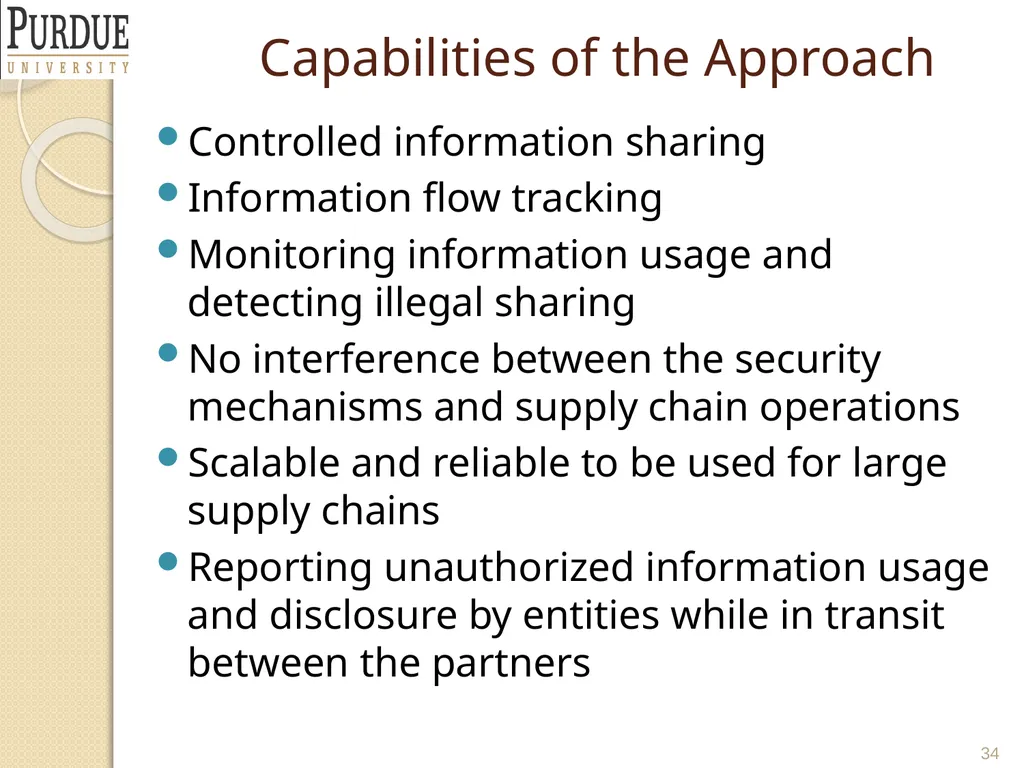
Capabilities of the Approach Controlled information sharing
Information flow tracking
Monitoring information usage and detecting illegal sharing
No interference between the security mechanisms and supply chain operations
Scalable and reliable to be used for large supply chains
Reporting unauthorized information usage and disclosure by entities while in transit between the partners 34<br>
Information flow tracking
Monitoring information usage and detecting illegal sharing
No interference between the security mechanisms and supply chain operations
Scalable and reliable to be used for large supply chains
Reporting unauthorized information usage and disclosure by entities while in transit between the partners 34<br>
35
References R. Shirey, “Internet Security Glossary, Version 2,” The Internet Engineering Task Force (IETF), RFC4949, August 2007. Online at http://tools.ietf.org/html/rfc4949
“iPad Mini Heist: $1.5 Million Stash Of Apple Devices Reportedly Stolen From JFK Airport,” Nov. 2012, online at: http://www.huffingtonpost.com/2012/11/15/ipad-mini-heist-million- stolen-jfk-airport_n_2137799.html
“Hackers attack Foxconn for the laughs,” Feb. 2012, online at: http://www.macworld.com/article/1165298/foxconn_reportedly_hacked _by_group_critical_of_working_conditions.html
H. Livingston, T. Telesco, L. Gardner, R. Loeslein, E. Zelinski, and W. Pumford, “Counterfeit Parts Safeguards and Reporting – U.S. Government and Industry Collaboration to Combat the Threat,” Defense Standardization Journal, pp.9-16, Jan/Mar 2010.
“Verizon 2012 Data Breach Investigations Report,” http://www.verizonbusiness.com/resources/reports/rp_data-breach- investigations-report-2012_en_xg.pdf?CMP=DMC- SMB_Z_ZZ_ZZ_Z_TV_N_Z037
World Economic Forum, “New Models for Addressing Supply Chain and Transport Risk,” 2011.
Insider Threat Center at Cert, “Examining Insider Threat Risk at the US Citizenship and Immigration Services,” Dec. 2010, online at: http://www.dhs.gov/xoig/assets/mgmtrpts/OIG_11-33_Jan11.pdf
N. Browne, M. de Crespigny, J. Reavis, K. Roemer, and R. Samani, “Business Assurance for the 21st Century: Navigating the Information Assurance landscape,” white paper, Information Security Forum, 2011. 35<br>
“iPad Mini Heist: $1.5 Million Stash Of Apple Devices Reportedly Stolen From JFK Airport,” Nov. 2012, online at: http://www.huffingtonpost.com/2012/11/15/ipad-mini-heist-million- stolen-jfk-airport_n_2137799.html
“Hackers attack Foxconn for the laughs,” Feb. 2012, online at: http://www.macworld.com/article/1165298/foxconn_reportedly_hacked _by_group_critical_of_working_conditions.html
H. Livingston, T. Telesco, L. Gardner, R. Loeslein, E. Zelinski, and W. Pumford, “Counterfeit Parts Safeguards and Reporting – U.S. Government and Industry Collaboration to Combat the Threat,” Defense Standardization Journal, pp.9-16, Jan/Mar 2010.
“Verizon 2012 Data Breach Investigations Report,” http://www.verizonbusiness.com/resources/reports/rp_data-breach- investigations-report-2012_en_xg.pdf?CMP=DMC- SMB_Z_ZZ_ZZ_Z_TV_N_Z037
World Economic Forum, “New Models for Addressing Supply Chain and Transport Risk,” 2011.
Insider Threat Center at Cert, “Examining Insider Threat Risk at the US Citizenship and Immigration Services,” Dec. 2010, online at: http://www.dhs.gov/xoig/assets/mgmtrpts/OIG_11-33_Jan11.pdf
N. Browne, M. de Crespigny, J. Reavis, K. Roemer, and R. Samani, “Business Assurance for the 21st Century: Navigating the Information Assurance landscape,” white paper, Information Security Forum, 2011. 35<br>
36
References B. Fabian, and O. Günther, “Security Challenges of the EPCglobal Network,” Communications of the ACM, v.52 n.7, July 2009.
M. Swanson, N. Bartol, and R. Moorthy, “Piloting Supply Chain Risk Management Practices for Federal Information Systems,” Draft NISTIR 7622. NIST, 2010.
M. Atallah, H. Elmongui, V. Deshpande, and L. Schwarz, "Secure supply-chain protocols," in IEEE International Conference on E- Commerce, pp. 293-302, 2003.
R. Ranchal, and B. Bhargava, “Protecting PLM data throughout their lifecycle,” in 9th International Conference on Heterogeneous Networking for Quality, Reliability, Security and Robustness (Qshine), 2013.
M. Azarmi, B. Bhargava, P. Angin, R. Ranchal, N. Ahmed, A. Sinclair, M. Linderman, and L. ben Othmane, “An End-to-End Security Auditing Approach for Service Oriented Architecture,” In 31st IEEE Symposium on Reliable Distributed Systems (SRDS), 2012.
G. Kiczales, J. Lamping, A. Mendhekar, C. Maeda, C. Lopes, J. Loingtier, and J. Irwin, “Aspect-oriented programming,” European Conference on Object-Oriented Programming (ECOOP’97), pp. 220– 242, 1997.
L. Othmane, and L. Lilien, “Protecting Privacy in Sensitive Data Dissemination with Active Bundles,” In The 7th Annual Conference on Privacy, Security and Trust, Saint John, NB, Canada, 2009.
L. ben Othmane, “Active bundles for protecting confidentiality of sensitive data throughout their lifecycle,” Theses, Western Michigan University Kalamazoo, MI, USA, December 2010. 36<br>
M. Swanson, N. Bartol, and R. Moorthy, “Piloting Supply Chain Risk Management Practices for Federal Information Systems,” Draft NISTIR 7622. NIST, 2010.
M. Atallah, H. Elmongui, V. Deshpande, and L. Schwarz, "Secure supply-chain protocols," in IEEE International Conference on E- Commerce, pp. 293-302, 2003.
R. Ranchal, and B. Bhargava, “Protecting PLM data throughout their lifecycle,” in 9th International Conference on Heterogeneous Networking for Quality, Reliability, Security and Robustness (Qshine), 2013.
M. Azarmi, B. Bhargava, P. Angin, R. Ranchal, N. Ahmed, A. Sinclair, M. Linderman, and L. ben Othmane, “An End-to-End Security Auditing Approach for Service Oriented Architecture,” In 31st IEEE Symposium on Reliable Distributed Systems (SRDS), 2012.
G. Kiczales, J. Lamping, A. Mendhekar, C. Maeda, C. Lopes, J. Loingtier, and J. Irwin, “Aspect-oriented programming,” European Conference on Object-Oriented Programming (ECOOP’97), pp. 220– 242, 1997.
L. Othmane, and L. Lilien, “Protecting Privacy in Sensitive Data Dissemination with Active Bundles,” In The 7th Annual Conference on Privacy, Security and Trust, Saint John, NB, Canada, 2009.
L. ben Othmane, “Active bundles for protecting confidentiality of sensitive data throughout their lifecycle,” Theses, Western Michigan University Kalamazoo, MI, USA, December 2010. 36<br>