
Prudence in Germline Gene Editing The Urgent Need
YM
Published · 20 slides · 0 views

1 / 1




Description
Prudence in Germline Gene Editing The Urgent Need for Collaborative Partnerships in Africa Dr Gerald Michael Ssebunnya AFRICA INSTITUTE FOR HUMAN DIGNITY gmshumandignityafrica.com GFBR Meeting 2019, Singapore 12th 13th November, 2019
Related Topics
Share
Embed code
Download this presentation From Below
"Prudence in Germline Gene Editing The Urgent Need" is the property of its rightful owner. Permission is granted to download and print the materials on this website for personal, non-commercial use only, and to display it on your personal computer provided you do not modify the materials and that you retain all copyright notices contained in the materials. By downloading content from our website, you accept the terms of this agreement.
Presentation Transcript
01
Prudence in Germline Gene Editing
The Urgent Need for Collaborative Partnerships in Africa Dr Gerald Michael Ssebunnya
AFRICA INSTITUTE FOR HUMAN DIGNITY
gms@humandignityafrica.com
GFBR Meeting 2019, Singapore
12th – 13th November, 2019<br>
AFRICA INSTITUTE FOR HUMAN DIGNITY
gms@humandignityafrica.com
GFBR Meeting 2019, Singapore
12th – 13th November, 2019<br>
02
Outline Acknowledgements
About germline (heritable) gene editing (GGE)
A call to prudence in GGE
Africa and the GGE debate
Urgent need for collaborative partnerships in Africa
Africa Institute for Human Dignity
Summary 1 Africa Institute for Human Dignity www.humandignityafrica.com<br>
About germline (heritable) gene editing (GGE)
A call to prudence in GGE
Africa and the GGE debate
Urgent need for collaborative partnerships in Africa
Africa Institute for Human Dignity
Summary 1 Africa Institute for Human Dignity www.humandignityafrica.com<br>
03
Acknowledgements I wish to express my sincere gratitude to GFBR and the sponsors for inviting me and sponsoring my participation at the GBFR Meeting 2019.
I also wish to thank Dr Voo Teck Chuan for his insightful review of my write-up and presentation.
I am also grateful to Miss Paula Ssebunnya for her assistance in preparing these slides.
Disclaimer: the views expressed in this presentation are those of the author and Africa Institute for Human Dignity (AIHD), and not necessarily those of the University of Botswana or the Republic of Botswana. 2 Africa Institute for Human Dignity www.humandignityafrica.com<br>
04
About germline gene editing The advent of the CRISPR (Clustered Regularly Interspaced Short Palindromic Repeats)-Cas9 system in human gene editing is a monumental milestone in the current biotechnology revolution.
Its use for germline gene editing (GGE), however, is beset with serious ethical concerns, mainly because of issues of trans-generational heritability.
Its use in somatic cell gene editing is less controversial and has been widely endorsed for treatment of diseases caused by genetic mutation. 3 Africa Institute for Human Dignity www.humandignityafrica.com<br>
05
A call to prudence in GGE Understandably, various Western and other expert organisations have called for due prudence in the pursuit of heritable gene editing, particularly in the wake of its widely condemned use/ misuse by He Jiankui in 2018.
Prudence (prudentia/phronesis) is the architectonic cardinal virtue concerned with practical wisdom about things to be done
Aquinas 1948: ST I-II: 57, 4 4 Africa Institute for Human Dignity www.humandignityafrica.com<br>
Prudence (prudentia/phronesis) is the architectonic cardinal virtue concerned with practical wisdom about things to be done
Aquinas 1948: ST I-II: 57, 4 4 Africa Institute for Human Dignity www.humandignityafrica.com<br>
06
A call to prudence in GGE (cont.) Prudence is “a positive virtue, which seeks through practical wisdom, based on mature experience, to steer a middle course between rashness and timidity, and to determine the right means to the best ends … [It] requires a willingness to take calculated risks – but only when our calculations are based on a disinterested attempt to judge what is truly good or evil not only for ourselves, but also for others in the larger scheme of things as far as we can understand it”.
Boyd 2003: 101 5 Africa Institute for Human Dignity www.humandignityafrica.com<br>
Boyd 2003: 101 5 Africa Institute for Human Dignity www.humandignityafrica.com<br>
07
A call to prudence in GGE (cont.) Prudence in GGE is a global imperative and demands creative recourse to the precautionary principle.
“The precautionary principle states that, in cases of serious or irreversible threats to the health of humans or ecosystems, acknowledged scientific uncertainty should not be used as a reason to postpone preventive measures.”
Martuzzi & Tickner 2004: 7
The precautionary principle enshrines the principal cardinal virtue of prudence and the fundamental ethical principle of nonmaleficence (‘first, do no harm’). 6 Africa Institute for Human Dignity www.humandignityafrica.com<br>
08
Africa and the GGE debate Conspicuously, despite its significant burden of genetic diseases, Africa appears to have no articulated position yet on GGE.
Although Africa is not a homogeneous entity, its common strands (particularly its postcolonial sociocultural and geopolitical realities; and disease burden), warrant a unified outlook on GGE. Examples include:
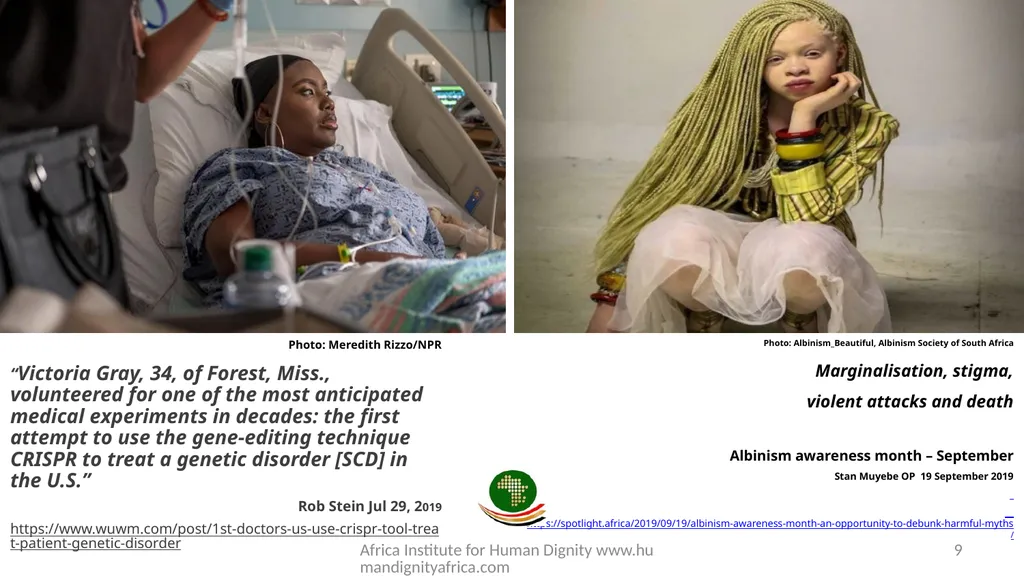
Sickle cell disease [single autosomal recessive gene]
Autosomal recessive oculocutaneous albinism [specific genes] 7 Africa Institute for Human Dignity www.humandignityafrica.com<br>
09
Photo: Meredith Rizzo/NPR
“Victoria Gray, 34, of Forest, Miss., volunteered for one of the most anticipated medical experiments in decades: the first attempt to use the gene-editing technique CRISPR to treat a genetic disorder [SCD] in the U.S.”
Rob Stein Jul 29, 2019
https://www.wuwm.com/post/1st-doctors-us-use-crispr-tool-treat-patient-genetic-disorder Photo: Albinism_Beautiful, Albinism Society of South Africa
Marginalisation, stigma,
violent attacks and death
Albinism awareness month – September
Stan Muyebe OP 19 September 2019
https://spotlight.africa/2019/09/19/albinism-awareness-month-an-opportunity-to-debunk-harmful-myths/ Africa Institute for Human Dignity www.humandignityafrica.com 8<br>
10
Africa and the GGE debate (cont.) Evidently, GGE heralds potential exponential benefits to many in Africa, and Africa presents a unique opportunity for the research and therapeutic application of GGE.
It is imperative, therefore, that Africa proactively engages in the current debate on the ethics of GGE.
The animated debate on GGE is notable for its lack of consensus on the key foundational concepts that inform human values and human flourishing, namely, the concepts of human personhood, human nature, human dignity, human rights and the human good, among others. 9 Africa Institute for Human Dignity www.humandignityafrica.com<br>
11
Africa and the GGE debate (cont.) The traditional African worldview on human dignity, human values and human flourishing is characteristically cosmological, consisting in:
The metaphysical ‘vital force’ of being
A harmonious human-to-environment relationship
The invaluableness of human life (the living, the ‘living dead’, and the ‘future living’)
Communitarian relationality:
“I am because we are and, since we are, therefore I am.”
Mbiti 1970: 141
“Motho ke motho ka batho.” (Setswana proverb) 10 Africa Institute for Human Dignity www.humandignityafrica.com<br>
12
Africa and the GGE debate (cont.) There is significant heterogeneous acculturation in Africa mainly due to colonial, postcolonial and religious interactions.
There is a need to articulate contemporary African thought on the fundamental concepts of human dignity, human values and human flourishing.
Any acceptable GGE intervention in Africa would have to authentically engage with the delicate harmonious African communitarian values such as ‘humaneness’ (ubuntu/ botho/ obuntubulamu/ utu/ …) and reverence for human life.
For instance, the possibility of deliberate embryo destruction and abortion in cases of off-target mutations in GGE raises highly contentious ethical concerns. 11 Africa Institute for Human Dignity www.humandignityafrica.com<br>
13
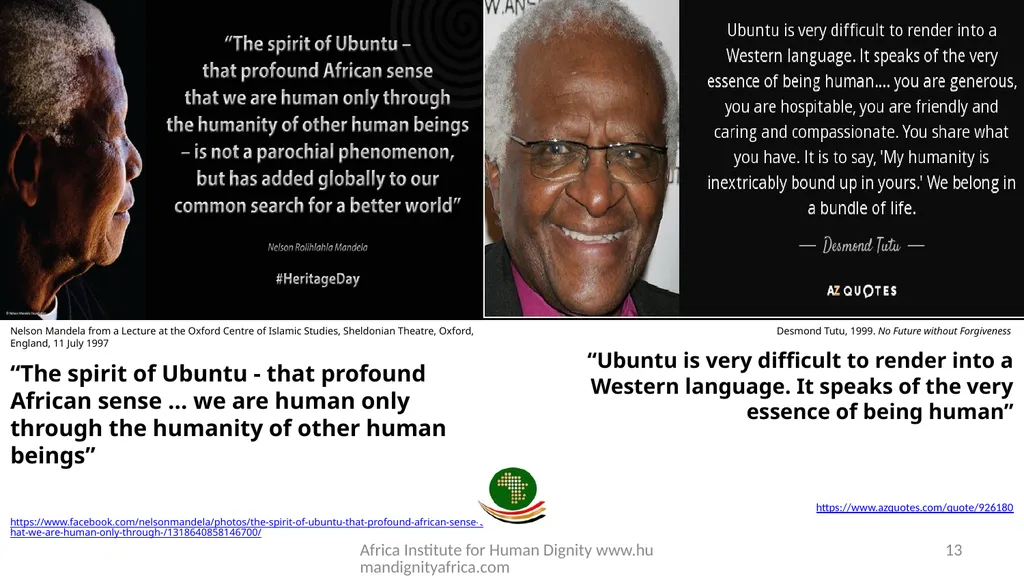
Nelson Mandela from a Lecture at the Oxford Centre of Islamic Studies, Sheldonian Theatre, Oxford, England, 11 July 1997
“The spirit of Ubuntu - that profound African sense … we are human only through the humanity of other human beings”
https://www.facebook.com/nelsonmandela/photos/the-spirit-of-ubuntu-that-profound-african-sense-that-we-are-human-only-through-/1318640858146700/ Africa Institute for Human Dignity www.humandignityafrica.com 12 Desmond Tutu, 1999. No Future without Forgiveness
“Ubuntu is very difficult to render into a Western language. It speaks of the very essence of being human”
https://www.azquotes.com/quote/926180<br>
14
The Urgent Need for CPs in Africa Africa’s contemporary realities certainly demand effective collaborative partnerships (CPs) within Africa, and between Africa and expert organisations outside Africa, to foster Africa’s authentic engagement in the critical debate on the ethics of GGE.
Such collaborative partnerships would need to focus on, among others, prudent research-based advocacy, public education and sensitisation, to ensure truly informed policy decision-making in Africa. 13 Africa Institute for Human Dignity www.humandignityafrica.com<br>
Such collaborative partnerships would need to focus on, among others, prudent research-based advocacy, public education and sensitisation, to ensure truly informed policy decision-making in Africa. 13 Africa Institute for Human Dignity www.humandignityafrica.com<br>
15
The Urgent Need for CPs in Africa (cont.) “Making truly informed decisions about complex scientific matters requires people to understand science ... [and] for people to make truly informed decision on ethical matters, ethical education is required.”
Gyngell et al 2019: 1
It is vital, therefore, that Africa prioritises the relevant science and ethics education with regard to GGE, through its collaborative partnerships.
Effective collaborative partnerships require willing and committed partners; relevant collaboration, with clear objectives and shared responsibilities; and mutual respect with regard to value systems.
Emanuel et al 2008: 125 14 Africa Institute for Human Dignity www.humandignityafrica.com<br>
16
Africa Institute for Human Dignity Africa Institute for Human Dignity (AIHD) is a pan-African Trust domiciled in Gaborone, Botswana.
It “is a merit-based not-for-profit non-governmental organisation, which does not discriminate on basis of race, colour, nationality, gender, age, social status, religion or political affiliation.”
Ssebunnya et al 2019: 11
AIHD aims to articulate contemporary African thought on the dignity of the human person, human values and human flourishing, through a synergistic network of committed scholars and researchers.
AIHD is committed to effective collaborative partnerships. 15 Africa Institute for Human Dignity www.humandignityafrica.com<br>
17
Africa Institute for Human Dignity (cont.) One of AIHD’s main objectives is to effectively:
“advise and influence policy and practice in academic and research institutions; governments; non-governmental organisations; business organisations; indigenous leadership settings; youth organisations; communities; and individuals on contemporary African thought on the dignity of the human person, human values and human flourishing.”
Ssebunnya et al 2019
Through collaborative partnerships, AIHD can effectively develop and deliver (throughout Africa) appropriate workshops, meetings and short courses on the vital ethics of GGE. 16 Africa Institute for Human Dignity www.humandignityafrica.com<br>
18
Summary GGE heralds potential exponential benefits in Africa and worldwide.
Africa presents a unique opportunity (in terms of disease burden) for the research and therapeutic application of GGE.
Prudence in GGE is a global imperative and demands creative recourse to the precautionary principle.
There is an urgent need for authentic African engagement in the GGE debate through effective collaborative partnerships.
AIHD is committed to establishing effective collaborative partnerships to articulate contemporary African thought on the issue of GGE. 17 Africa Institute for Human Dignity www.humandignityafrica.com<br>
19
References Aquinas T. Summa Theologica. Trans. Fathers of the English Dominican Province. St. Thomas Aquinas Summa Theologica: Complete English Edition in Five Volumes. 1948. New York: Benziger Bros.
Boyd KM. The Two-Edged Sword: Biotechnology and Mythology. In Klotzko AJ (ed) The Cloning Sourcebook. 2003. New York: Oxford University Press, 94-103.
Emanuel EJ, Wendler D & Grady C. An Ethical Framework for Biomedical Research. In Emanuel EJ, Grady C, Crouch RA, Lie RK, Miller FG & Wendler D (eds), The Oxford Textbook of Clinical Research Ethics. 2008. New York: Oxford University Press, 123-135.
Gyngell C, Bowman-Smart H & Savulescu J. Moral reasons to edit the human genome: picking up from the Nuffield report. Journal of Medical Ethics. 2019, 0: 1-10, DOI: 10.1136/medethics-2018-105084.
Gyngell C, Douglas T & Savulescu J. The Ethics of Germline Gene Editing. Journal of Applied Philosophy. 2017, 34(4): 498-513.
Kasenene P. African Ethical Theory and the Four Principles. In Veatch RM (ed.), Cross-Cultural Perspectives in Medical Ethics. 2000 Sudbury, MA: Jones and Bartlett Publishers, 347-357. Makumba MM. Introduction to African Philosophy. 2007. Nairobi: Paulines Publications Africa.
Martuzzi M & Tickner J. Introduction – the precautionary principle: protecting public health, the environment and the future of our children. In Martuzzi M & Tickner J. (eds) The precautionary principle: protecting public health, the environment and the future of our children. 2004. Available at: http://www.euro.who.int/__data/assets/pdf_file/0003/91173/E83079.pdf [accessed 19 September 2019].
Mbiti J. African Religions and Philosophies. 1970. New York: Doubleday and Company.
Rakatsoane FCL & van Niekerk AA. Human invaluableness: An emerging African bioethical Principle. South African Journal of Philosophy. 2017, 36 (2): 252-262, DOI: 10.1080/02580136.2016.1223983.
Ssebunnya GM, Kiggundu J, Lukoma JB, Ssegawa-Kaggwa J & Mafela L. The AIHD Concept: Articulating Contemporary African Thought. 2019. Gaborone: AIHD Office.
Tempels P. Bantu Philosophy. 1959. Paris: Presence Africaine. Africa Institute for Human Dignity www.humandignityafrica.com 18<br>
20
Thank you all for your kind attention! Ke a leboga! Terima kasih!
Gracias! りがとうございます!
Asante sana!
Mwebale nnyo! 谢谢!
Obrigado! Merci beaucoup! Africa Institute for Human Dignity www.humandignityafrica.com 19<br>
Gracias! りがとうございます!
Asante sana!
Mwebale nnyo! 谢谢!
Obrigado! Merci beaucoup! Africa Institute for Human Dignity www.humandignityafrica.com 19<br>