PSD BOOK CLUB Hosted by the Idea Exchange Committee Do Safety Differently by Sidney Dekker and Todd Conklin Last updated 812024 Idea Exchange Committee Members Nicole Loontjens - nbloontjensamsty.com Laura Ankrom -
"PSD BOOK CLUB Hosted by the Idea Exchange" is the property of its rightful owner. Permission is granted to
download and print the materials on this website for personal, non-commercial use only, and to display it
on your personal computer provided you do not modify the materials and that you retain all copyright
notices contained in the materials. By downloading content from our website, you accept the terms of this
agreement.
Presentation Transcript
01
PSD BOOK CLUB Hosted by the Idea Exchange Committee Do Safety Differently by Sidney Dekker and Todd Conklin
Last updated 8/1/2024<br>
02
Idea Exchange Committee Members Nicole Loontjens - nbloontjens@amsty.com
Laura Ankrom - laura.ankrom@pscoreconsulting.com
Hope Luebeck - hope.luebeck@chemours.com
Katherine Prem - katherine.prem@lyondellbasell.com
Adam Hirsch - ahirsch@amsty.com
Meg Reese - meg_reese@oxy.com
Gregg Kiihne - gregg.kiihne@basf.com Meg_Reese@oxy.com> Meg_Reese@oxy.com> Meg_Reese@oxy.com> New members are always welcome!
Feel free to email any of us with questions or to join the committee.<br>
03
Book Club Purpose The Process Safety Division Book Club is open to all PSD members!
The intent of this book club is to provide a forum to discuss books that are being talked about in the process safety world and/or are beneficial for professional development…
and continue to build this excellent PS community!<br>
04
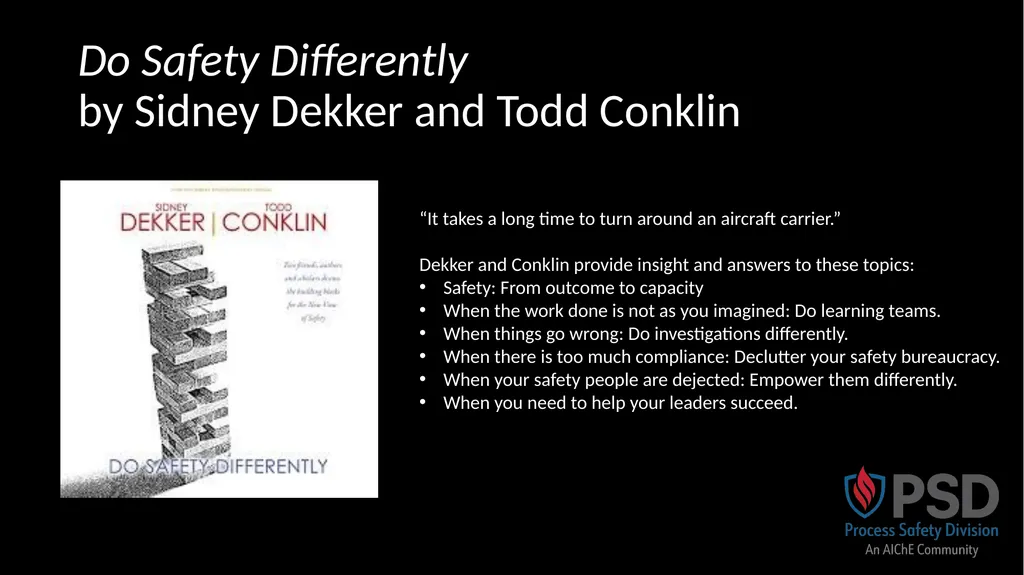
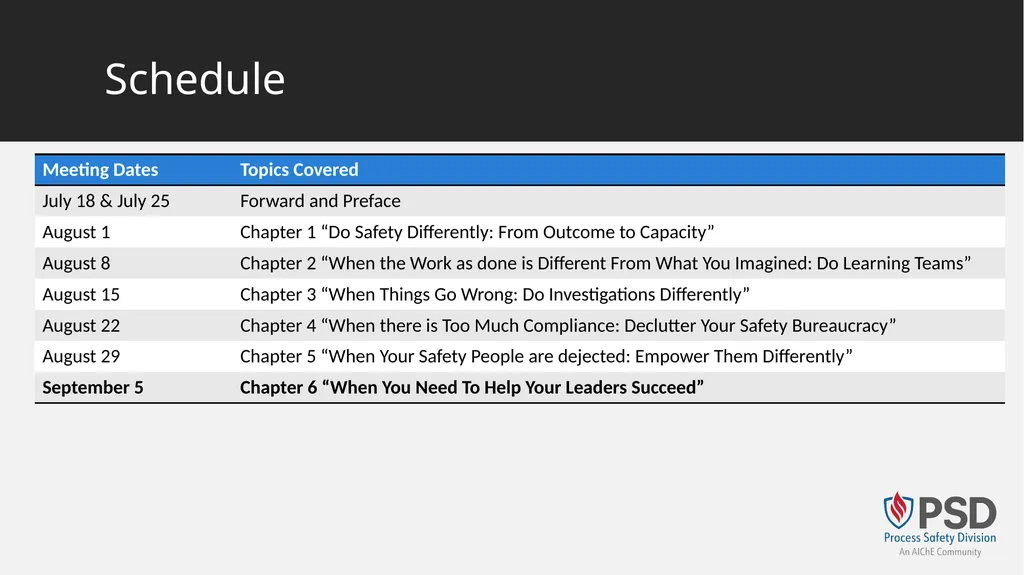
Do Safety Differently by Sidney Dekker and Todd Conklin “It takes a long time to turn around an aircraft carrier.”
Dekker and Conklin provide insight and answers to these topics:
Safety: From outcome to capacity
When the work done is not as you imagined: Do learning teams.
When things go wrong: Do investigations differently.
When there is too much compliance: Declutter your safety bureaucracy.
When your safety people are dejected: Empower them differently.
When you need to help your leaders succeed.<br>
05
Schedule<br>
06
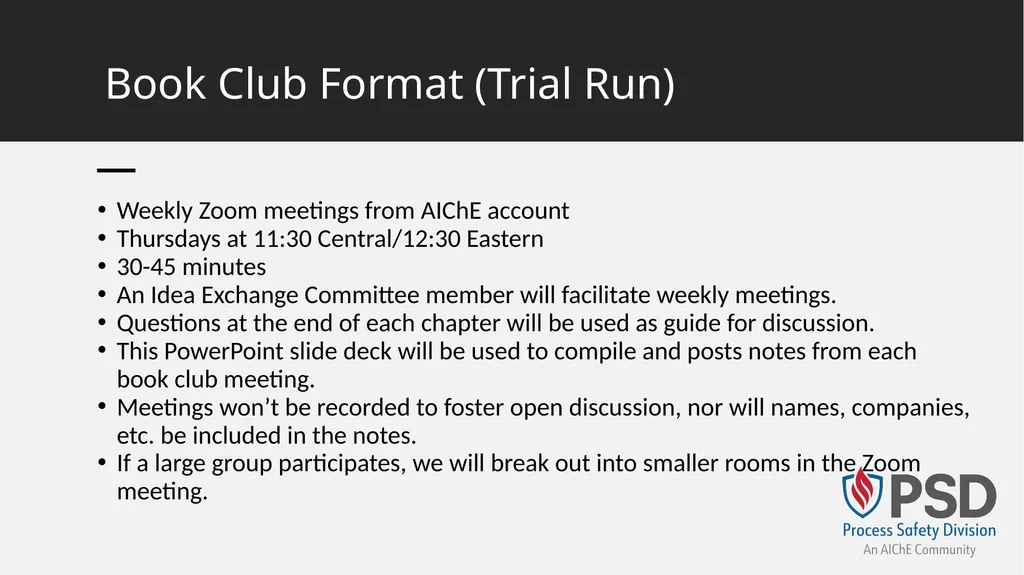
Book Club Format (Trial Run) Weekly Zoom meetings from AIChE account
Thursdays at 11:30 Central/12:30 Eastern
30-45 minutes
An Idea Exchange Committee member will facilitate weekly meetings.
Questions at the end of each chapter will be used as guide for discussion.
This PowerPoint slide deck will be used to compile and posts notes from each book club meeting.
Meetings won’t be recorded to foster open discussion, nor will names, companies, etc. be included in the notes.
If a large group participates, we will break out into smaller rooms in the Zoom meeting.<br>
07
Disclaimer Legal disclaimer drafted for review by AIChE. Will be included in slide deck for all meetings.<br>
08
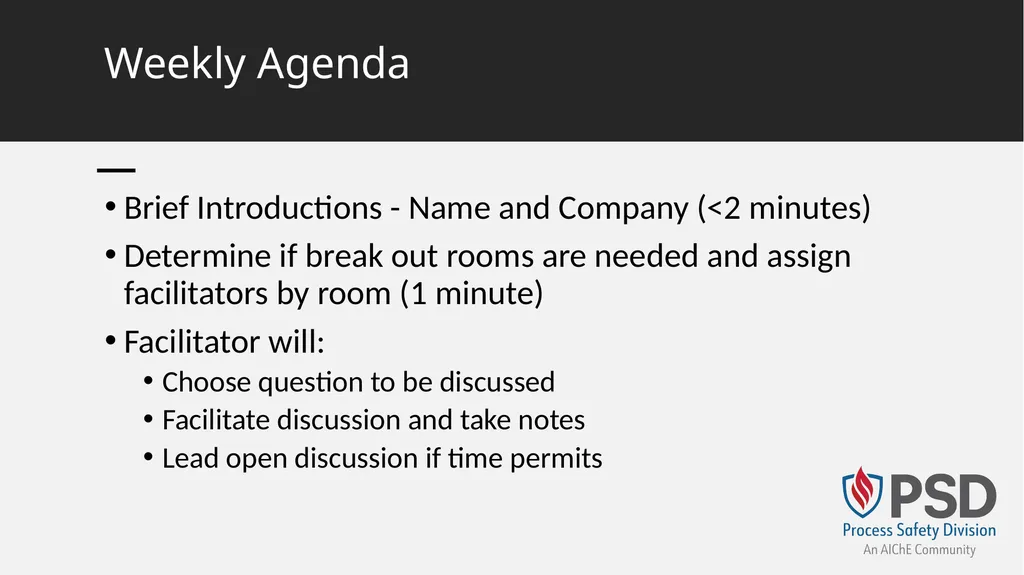
Weekly Agenda Brief Introductions - Name and Company (<2 minutes)
Determine if break out rooms are needed and assign facilitators by room (1 minute)
Facilitator will:
Choose question to be discussed
Facilitate discussion and take notes
Lead open discussion if time permits<br>
09
Ground Rules Raise hands to interject, ask a question, etc.
Use chat function to add ideas, thoughts, questions, helpful links, etc.
Be courteous.
Facilitator/Scribe will monitor the chat and hands as well as ask for a topic to be ‘tabled’ if straying too far off.<br>
10
Forward and Preface Open Discussion with attendees<br>
11
Chapter 1 “Do Safety Differently: From Outcome to Capacity” Question 1
Consider the list of capacities that make things go well in the example from this chapter (e.g., diversity of opinion, ability to say “stop”).
Is there any capacity you are seeing in your own organization?
Is there a capacity you would like to see be developed in your own organization? Why?<br>
12
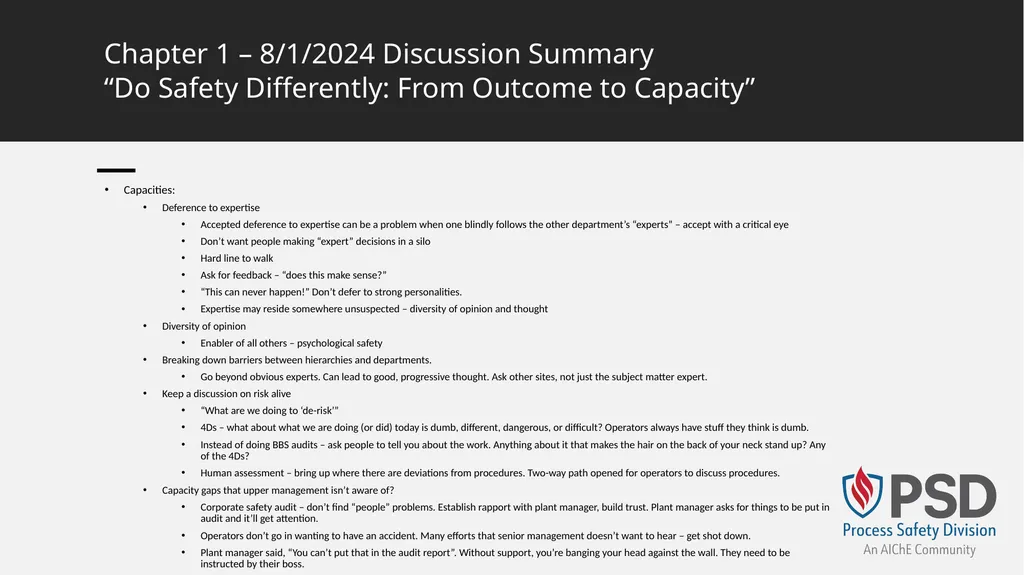
Chapter 1 – 8/1/2024 Discussion Summary “Do Safety Differently: From Outcome to Capacity” Capacities:
Deference to expertise
Accepted deference to expertise can be a problem when one blindly follows the other department’s “experts” – accept with a critical eye
Don’t want people making “expert” decisions in a silo
Hard line to walk
Ask for feedback – “does this make sense?”
“This can never happen!” Don’t defer to strong personalities.
Expertise may reside somewhere unsuspected – diversity of opinion and thought
Diversity of opinion
Enabler of all others – psychological safety
Breaking down barriers between hierarchies and departments.
Go beyond obvious experts. Can lead to good, progressive thought. Ask other sites, not just the subject matter expert.
Keep a discussion on risk alive
“What are we doing to ‘de-risk’”
4Ds – what about what we are doing (or did) today is dumb, different, dangerous, or difficult? Operators always have stuff they think is dumb.
Instead of doing BBS audits – ask people to tell you about the work. Anything about it that makes the hair on the back of your neck stand up? Any of the 4Ds?
Human assessment – bring up where there are deviations from procedures. Two-way path opened for operators to discuss procedures.
Capacity gaps that upper management isn’t aware of?
Corporate safety audit – don’t find “people” problems. Establish rapport with plant manager, build trust. Plant manager asks for things to be put in audit and it’ll get attention.
Operators don’t go in wanting to have an accident. Many efforts that senior management doesn’t want to hear – get shot down.
Plant manager said, “You can’t put that in the audit report”. Without support, you’re banging your head against the wall. They need to be instructed by their boss.<br>
13
Chapter 1 “Do Safety Differently: From Outcome to Capacity” Question 2
The safer your organization or industry becomes, the more inverse the correlation between injuries and accidents tends to become.
Why do you think this is true?
Is this a good or a bad outcome?<br>
14
Chapter 1 “Do Safety Differently: From Outcome to Capacity” Question 3
Does your organization believe that Heinrich was right?
And, if so, about what?
Should you try to change that?<br>
15
Chapter 1 “Do Safety Differently: From Outcome to Capacity” Question 4
Safety metrics can amount to a ‘Looking Good Index’ (or LGI). Who in your organization is trying to (make whom) look good, and for which stakeholders or what purposes?
Does your organization measure or otherwise track the presence of capacities that make things go well?
If not, what are the obstacles to them doing so?<br>
16
Chapter 1 “Do Safety Differently: From Outcome to Capacity” Question 5
Does your organization have a “Zero Harm” policy or goal?
Is it aware of the increased fatality risks associated with such a policy or goal?
What might you do about that?<br>
17
Chapter 1 “Do Safety Differently: From Outcome to Capacity” Notes<br>