
Psychiatric Emergencies CHAPTER 29 Introduction
PC
Published · 84 slides · 0 views
1 / 1


Description
Psychiatric Emergencies CHAPTER 29 Introduction The mind and body are inseparable. Illness affects a persons behavior. Changes in mental state affect physical health. Definition of Behavioral Emergency (1 of 3) Most experts define behavior
Related Topics
Share
Embed code
Download this presentation From Below
"Psychiatric Emergencies CHAPTER 29 Introduction" is the property of its rightful owner. Permission is granted to download and print the materials on this website for personal, non-commercial use only, and to display it on your personal computer provided you do not modify the materials and that you retain all copyright notices contained in the materials. By downloading content from our website, you accept the terms of this agreement.
Presentation Transcript
01
Psychiatric Emergencies CHAPTER 29<br>
02
Introduction The mind and body are inseparable.
Illness affects a person’s behavior.
Changes in mental state affect physical health.<br>
Illness affects a person’s behavior.
Changes in mental state affect physical health.<br>
03
Definition of Behavioral Emergency (1 of 3) Most experts define behavior as the way people act or perform.
Overt behavior is open and generally understood by those around the person.
Covert behavior has hidden meanings or intentions.<br>
Overt behavior is open and generally understood by those around the person.
Covert behavior has hidden meanings or intentions.<br>
04
Definition of Behavioral Emergency (2 of 3) Behavioral emergency
A disorder of mood, thought, or behavior that interferes with activities of daily living (ADLs) Psychiatric emergency
Behavior that threatens a person’s health or safety or the health and safety of another person<br>
A disorder of mood, thought, or behavior that interferes with activities of daily living (ADLs) Psychiatric emergency
Behavior that threatens a person’s health or safety or the health and safety of another person<br>
05
Definition of Behavioral Emergency (3 of 3) A behavioral or psychiatric emergency is defined by the person who dials 9-1-1.
It can be difficult to understand the patient’s confused and frayed feelings.<br>
It can be difficult to understand the patient’s confused and frayed feelings.<br>
06
Medicolegal Considerations When behavior, speech, and thoughts are erratic, it can be difficult to communicate.
Spend time with the patient.
Obtain consent when possible.
Be clear in your explanations.
Take extra time to record the call.<br>
Spend time with the patient.
Obtain consent when possible.
Be clear in your explanations.
Take extra time to record the call.<br>
07
Causes of Abnormal Behavior (1 of 6) Four broad categories of causes:
Biologic or organic
Environmental
Acute injury or illness
Substance related<br>
Biologic or organic
Environmental
Acute injury or illness
Substance related<br>
08
Causes of Abnormal Behavior (2 of 6) Biologic or organic
Previously described as organic brain syndrome
Examples: hypoxia, seizure, traumatic brain injury (TBI), chronic alcohol and substance use disorder, brain tumors
Conditions alter the functioning of the brain<br>
Previously described as organic brain syndrome
Examples: hypoxia, seizure, traumatic brain injury (TBI), chronic alcohol and substance use disorder, brain tumors
Conditions alter the functioning of the brain<br>
09
Causes of Abnormal Behavior (3 of 6) Environmental
Psychosocial and sociocultural influences
Consistent exposure to stressful events
Sociocultural factors affect biology, behavior, and responses to the stress of emergencies.
Injury and illness
Medical conditions
Traumatic events
Posttraumatic stress disorder (PTSD)<br>
Psychosocial and sociocultural influences
Consistent exposure to stressful events
Sociocultural factors affect biology, behavior, and responses to the stress of emergencies.
Injury and illness
Medical conditions
Traumatic events
Posttraumatic stress disorder (PTSD)<br>
10
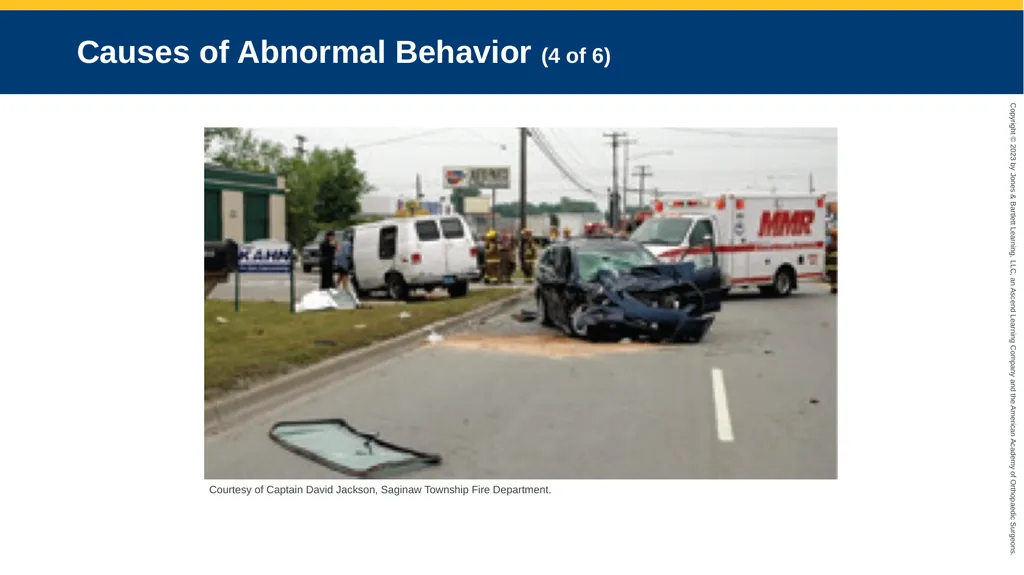
Causes of Abnormal Behavior (4 of 6) Courtesy of Captain David Jackson, Saginaw Township Fire Department.<br>
11
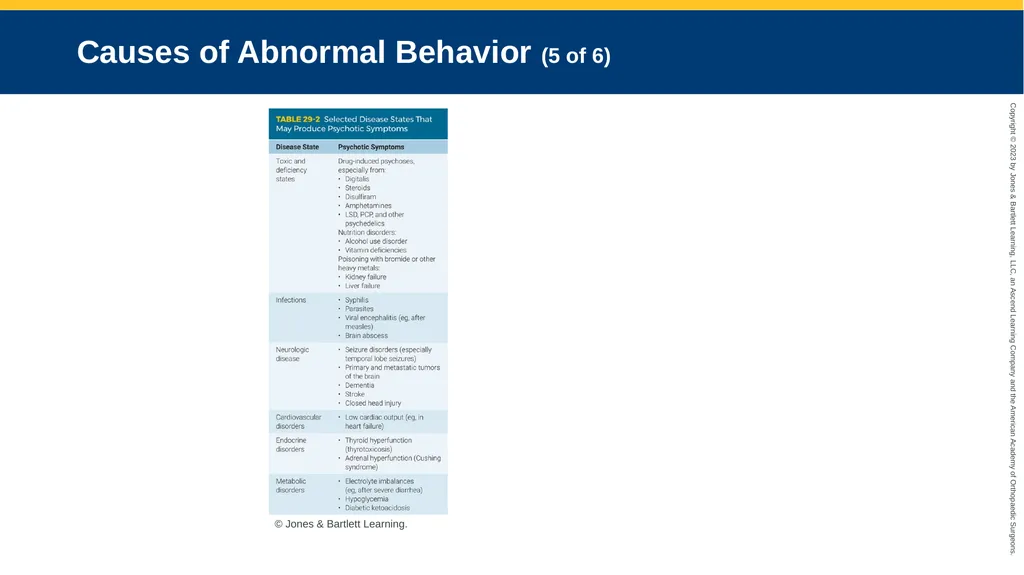
Causes of Abnormal Behavior (5 of 6) © Jones & Bartlett Learning.<br>
12
Causes of Abnormal Behavior (6 of 6) Substance-related disorders include use of:
Alcohol
Cigarettes
Illicit drugs
Other substances
Now recognized to be a complex biologic and psychological problem rather than moral weakness<br>
Alcohol
Cigarettes
Illicit drugs
Other substances
Now recognized to be a complex biologic and psychological problem rather than moral weakness<br>
13
Psychiatric Signs and Symptoms (1 of 2) When mental health is challenged, mechanisms or behaviors work to return homeostasis.
Present as psychiatric signs, symptoms, or behaviors<br>
Present as psychiatric signs, symptoms, or behaviors<br>
14
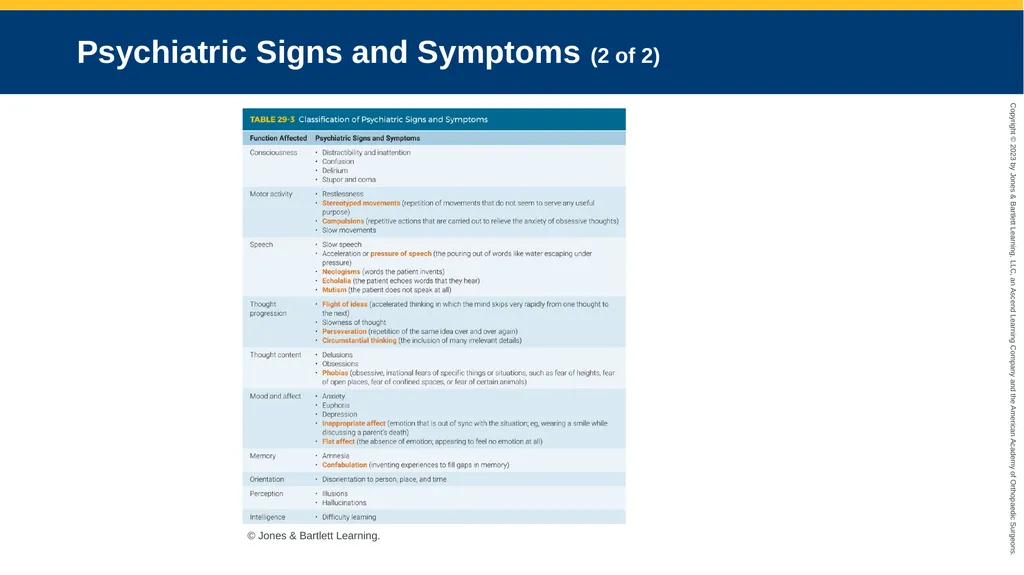
Psychiatric Signs and Symptoms (2 of 2) © Jones & Bartlett Learning.<br>
15
Patient Assessment Assessment of the patient with a psychiatric emergency differs from other methods.
You are the diagnostic instrument.
The assessment is part of the treatment.<br>
You are the diagnostic instrument.
The assessment is part of the treatment.<br>
16
Scene Size-Up (1 of 2) Ensure your safety at the scene.
Assess the environment for clues to the patient’s condition or the cause of the emergency.
Consider the mechanism of injury and/or nature of illness.<br>
Assess the environment for clues to the patient’s condition or the cause of the emergency.
Consider the mechanism of injury and/or nature of illness.<br>
17
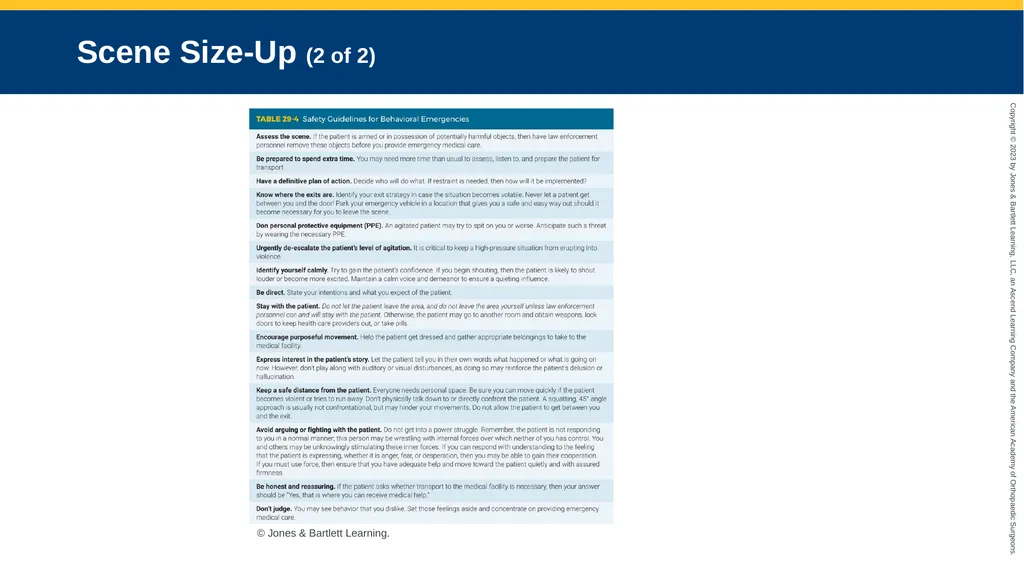
Scene Size-Up (2 of 2) © Jones & Bartlett Learning.<br>
18
Primary Survey Clearly identify yourself
Form a general impression
Assess pupils
Airway and breathing
Circulation
Transport decision<br>
Form a general impression
Assess pupils
Airway and breathing
Circulation
Transport decision<br>
19
History Taking Mental status examination
Key part of the assessment
Check each system in order using COASTMAP.<br>
Key part of the assessment
Check each system in order using COASTMAP.<br>
20
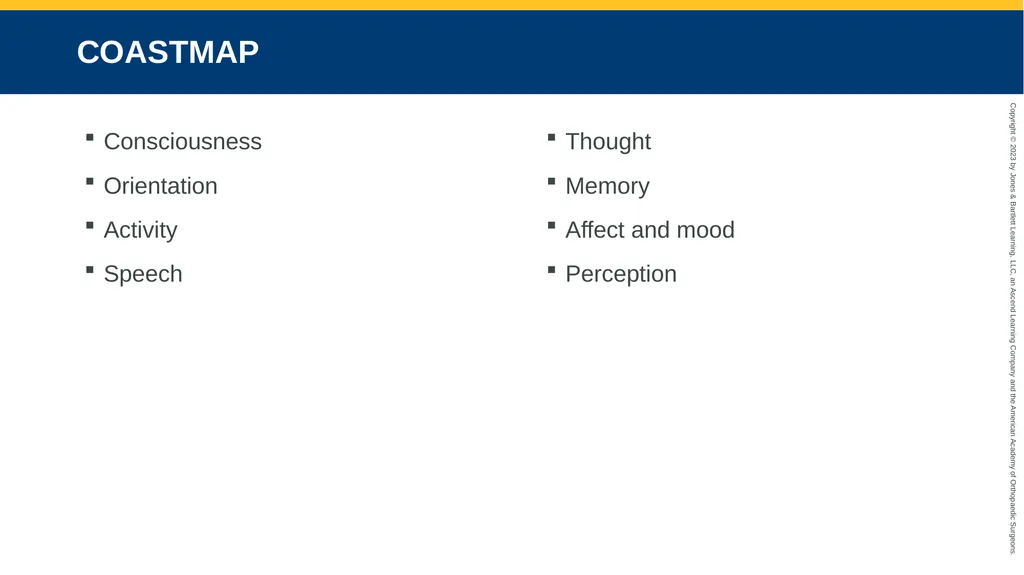
COASTMAP Consciousness
Orientation
Activity
Speech Thought
Memory
Affect and mood
Perception<br>
Orientation
Activity
Speech Thought
Memory
Affect and mood
Perception<br>
21
Secondary Assessment Obtain vital signs.
Examine skin temperature and moisture.
Inspect the head and pupils.
Note unusual odors on the breath.
Examine extremities.<br>
Examine skin temperature and moisture.
Inspect the head and pupils.
Note unusual odors on the breath.
Examine extremities.<br>
22
Reassessment Routinely performed during transport
Monitor the patient for sudden changes in thought or behavior.
Discuss with the medical facility the need for restraints or medications.
If the patient is aggressive or violent, provide advance notice to the emergency department.<br>
Monitor the patient for sudden changes in thought or behavior.
Discuss with the medical facility the need for restraints or medications.
If the patient is aggressive or violent, provide advance notice to the emergency department.<br>
23
Emergency Medical Care Rule out and treat medical causes.
Oxygen therapy
Testing blood glucose level
Administration of dextrose
General interventions for hypothermia or shock<br>
Oxygen therapy
Testing blood glucose level
Administration of dextrose
General interventions for hypothermia or shock<br>
24
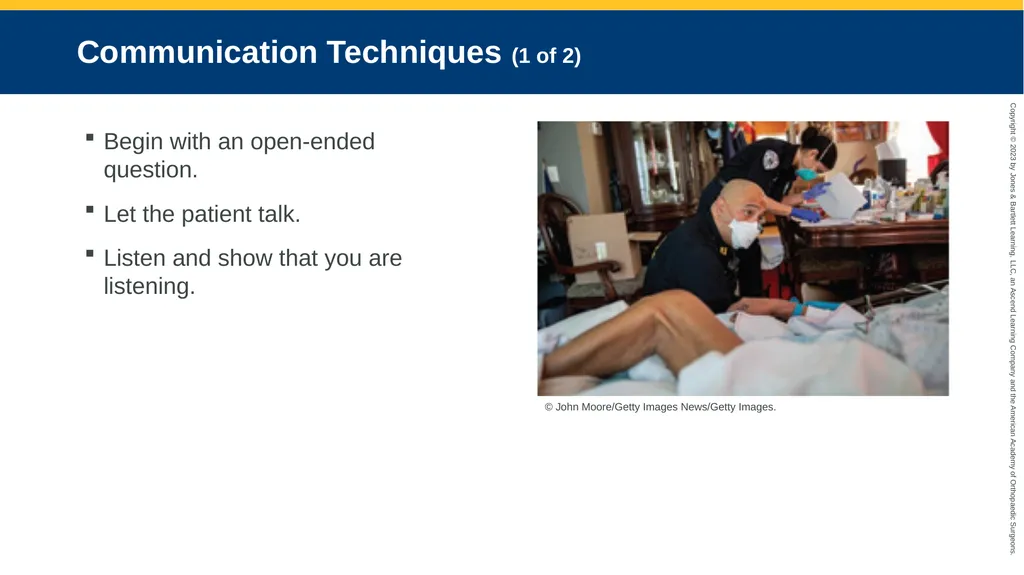
Communication Techniques (1 of 2) Begin with an open-ended question.
Let the patient talk.
Listen and show that you are listening. © John Moore/Getty Images News/Getty Images.<br>
Let the patient talk.
Listen and show that you are listening. © John Moore/Getty Images News/Getty Images.<br>
25
Communication Techniques (2 of 2) Don’t be afraid of silences.
Acknowledge and label feelings.
Don’t argue.
Facilitate communication. Direct the patient’s attention.
Ask questions.
Adjust your approach as needed.<br>
Acknowledge and label feelings.
Don’t argue.
Facilitate communication. Direct the patient’s attention.
Ask questions.
Adjust your approach as needed.<br>
26
Crisis Intervention Skills (1 of 2) Be as calm and direct as possible.
Exclude disruptive people.
Sit down.
Maintain a nonjudgmental attitude. © Jones & Bartlett Learning.<br>
Exclude disruptive people.
Sit down.
Maintain a nonjudgmental attitude. © Jones & Bartlett Learning.<br>
27
Crisis Intervention Skills (2 of 2) Provide honest reassurance.
Develop a plan of action.
Encourage some motor activity.
Stay with the patient at all times.
Bring all medications to the medical facility.
Never assume that it is impossible to talk with any patient until you have tried.<br>
Develop a plan of action.
Encourage some motor activity.
Stay with the patient at all times.
Bring all medications to the medical facility.
Never assume that it is impossible to talk with any patient until you have tried.<br>
28
Physical Restraint (1 of 4) Improvised or commercially made devices
Be familiar with restraints used by your agency.
Make sure you have sufficient personnel.
Discuss the plan of action before you begin.
If the show of force doesn't calm the patient, move quickly.
The best position for securing the patient is supine.<br>
Be familiar with restraints used by your agency.
Make sure you have sufficient personnel.
Discuss the plan of action before you begin.
If the show of force doesn't calm the patient, move quickly.
The best position for securing the patient is supine.<br>
29
Physical Restraint (2 of 4) Never:
Tie ankles and wrists together
Hobble tie
Place patient facedown Once in place:
Don’t remove restraints.
Don’t negotiate or make deals.<br>
Tie ankles and wrists together
Hobble tie
Place patient facedown Once in place:
Don’t remove restraints.
Don’t negotiate or make deals.<br>
30
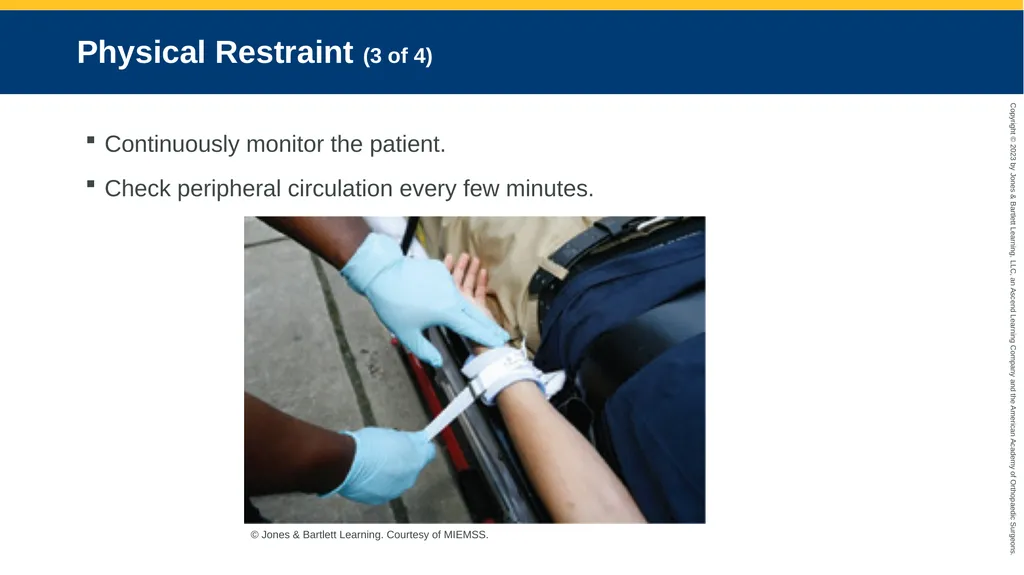
Physical Restraint (3 of 4) Continuously monitor the patient.
Check peripheral circulation every few minutes. © Jones & Bartlett Learning. Courtesy of MIEMSS.<br>
Check peripheral circulation every few minutes. © Jones & Bartlett Learning. Courtesy of MIEMSS.<br>
31
Physical Restraint (4 of 4) Be careful if a combative patient suddenly becomes calm.
Document everything in the patient’s chart.
You may defend yourself against an attack.<br>
Document everything in the patient’s chart.
You may defend yourself against an attack.<br>
32
Chemical Restraint (1 of 8) Use of medication to subdue a patient
Only use with approval from medical control.
Follow local protocols and guidelines.
Not always easier than physical restraint and has its own hazards<br>
Only use with approval from medical control.
Follow local protocols and guidelines.
Not always easier than physical restraint and has its own hazards<br>
33
Chemical Restraint (2 of 8) Medications most often used:
Benzodiazepines
Antipsychotic medications
Antihistamines<br>
Benzodiazepines
Antipsychotic medications
Antihistamines<br>
34
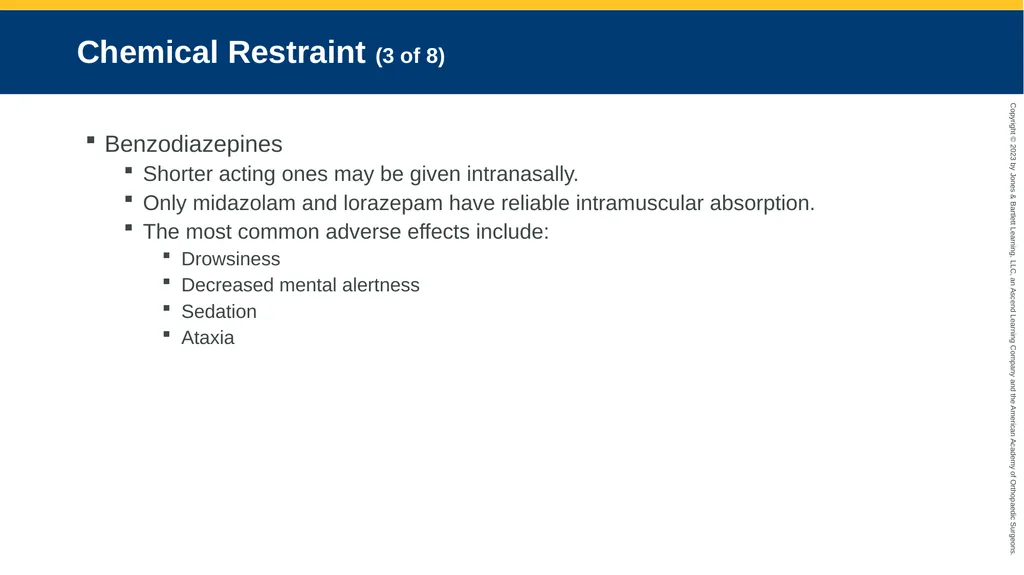
Chemical Restraint (3 of 8) Benzodiazepines
Shorter acting ones may be given intranasally.
Only midazolam and lorazepam have reliable intramuscular absorption.
The most common adverse effects include:
Drowsiness
Decreased mental alertness
Sedation
Ataxia<br>
Shorter acting ones may be given intranasally.
Only midazolam and lorazepam have reliable intramuscular absorption.
The most common adverse effects include:
Drowsiness
Decreased mental alertness
Sedation
Ataxia<br>
35
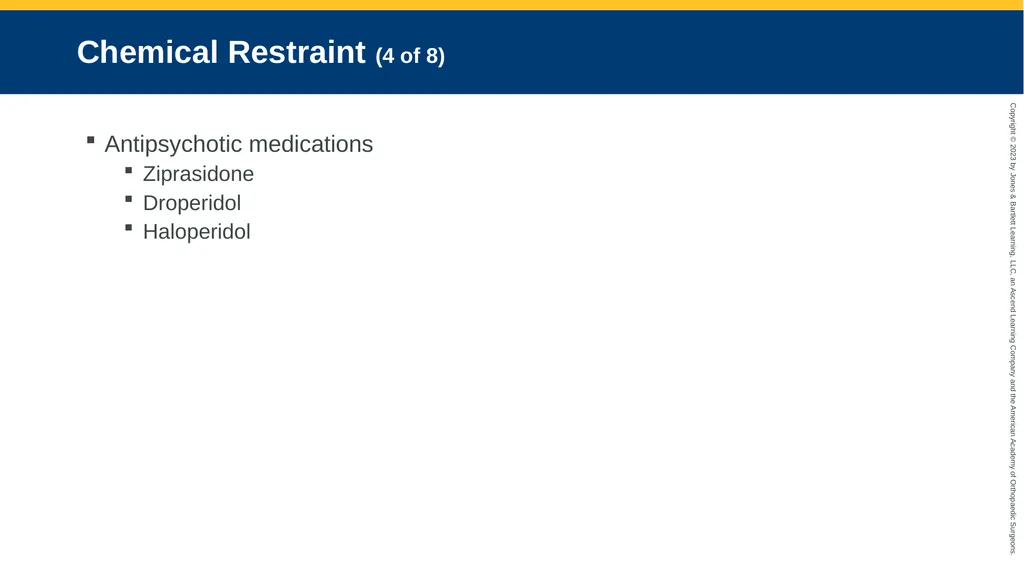
Chemical Restraint (4 of 8) Antipsychotic medications
Ziprasidone
Droperidol
Haloperidol<br>
Ziprasidone
Droperidol
Haloperidol<br>
36
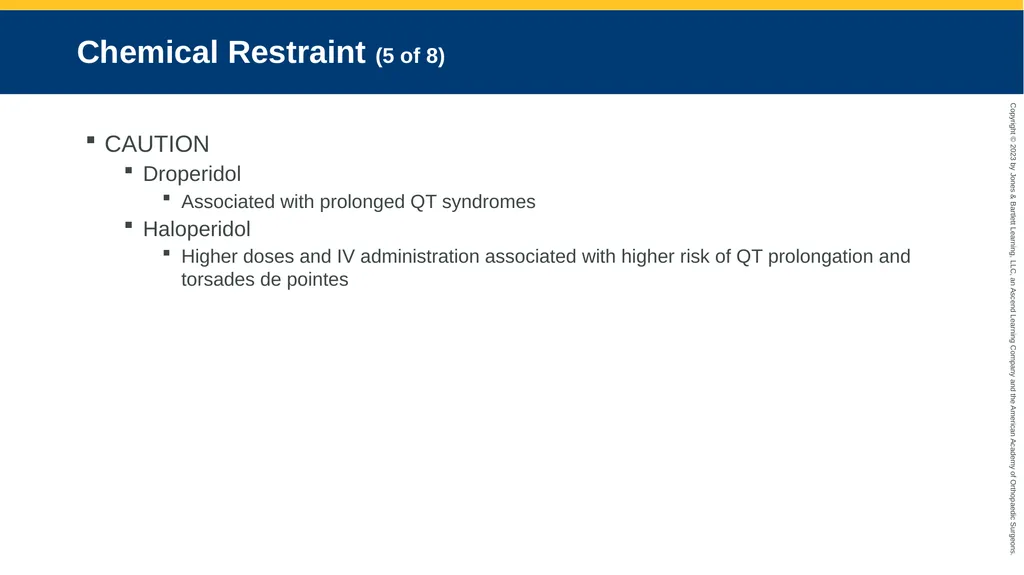
Chemical Restraint (5 of 8) CAUTION
Droperidol
Associated with prolonged QT syndromes
Haloperidol
Higher doses and IV administration associated with higher risk of QT prolongation and torsades de pointes<br>
Droperidol
Associated with prolonged QT syndromes
Haloperidol
Higher doses and IV administration associated with higher risk of QT prolongation and torsades de pointes<br>
37
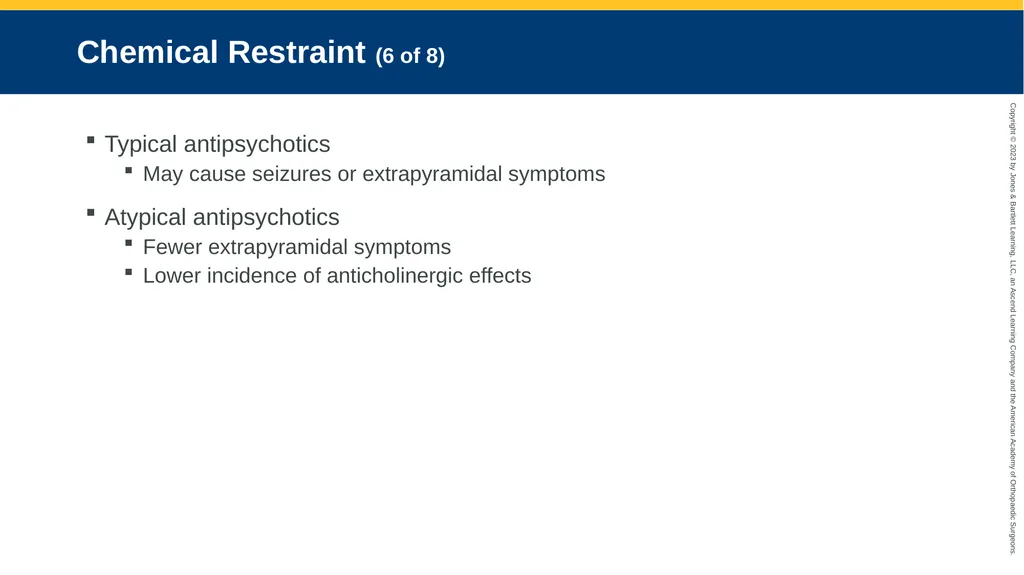
Chemical Restraint (6 of 8) Typical antipsychotics
May cause seizures or extrapyramidal symptoms
Atypical antipsychotics
Fewer extrapyramidal symptoms
Lower incidence of anticholinergic effects<br>
May cause seizures or extrapyramidal symptoms
Atypical antipsychotics
Fewer extrapyramidal symptoms
Lower incidence of anticholinergic effects<br>
38
Chemical Restraint (7 of 8) Closely monitor the patient for:
Hypotension
Bradycardia
Glucose levels<br>
Hypotension
Bradycardia
Glucose levels<br>
39
Chemical Restraint (8 of 8) Antihistamines
Used for many years in the treatment of psychiatric patients
Best known for sedative properties
Produces anticholinergic effect
Used for both adult and pediatric patients<br>
Used for many years in the treatment of psychiatric patients
Best known for sedative properties
Produces anticholinergic effect
Used for both adult and pediatric patients<br>
40
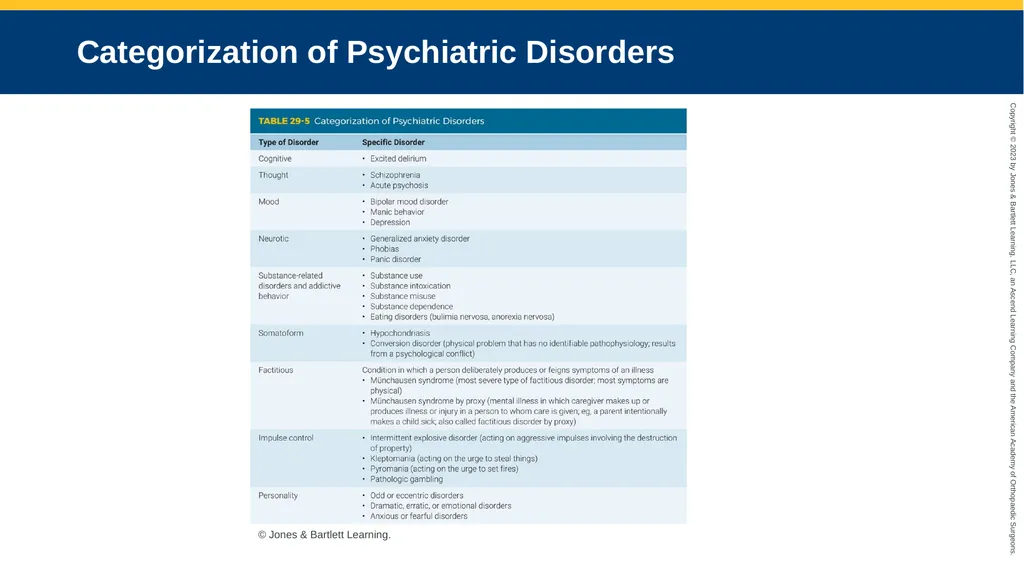
Categorization of Psychiatric Disorders © Jones & Bartlett Learning.<br>
41
Acute Psychosis (1 of 3) Pathophysiology
Person is out of touch with reality.
Psychoses or episodes occur for many reasons.
Episodes can be brief or last a lifetime.
Assessment
Characteristic: profound thought disorder
A thorough examination is rarely possible.
Transport the patient without trauma.
Use COASTMAP.<br>
Person is out of touch with reality.
Psychoses or episodes occur for many reasons.
Episodes can be brief or last a lifetime.
Assessment
Characteristic: profound thought disorder
A thorough examination is rarely possible.
Transport the patient without trauma.
Use COASTMAP.<br>
42
Acute Psychosis (2 of 3) Consciousness
Orientation
Activity
Speech Thought
Memory
Affect and mood
Perception<br>
Orientation
Activity
Speech Thought
Memory
Affect and mood
Perception<br>
43
Acute Psychosis (3 of 3) Management
Reasoning does not always work.
Explain what is being done.
Directions should be simple and consistent.
Keep orienting the patient.
When nonpharmacologic methods fail, it may be appropriate to:
Safely restrain the patient
Administer a medication to treat the behavior<br>
Reasoning does not always work.
Explain what is being done.
Directions should be simple and consistent.
Keep orienting the patient.
When nonpharmacologic methods fail, it may be appropriate to:
Safely restrain the patient
Administer a medication to treat the behavior<br>
44
Delirium (1 of 2) Pathophysiology
Delirium: acute onset of cognitive impairment
Dementia: more chronic process
Patients may become agitated and violent.
Exited delirium: potentially fatal state of extreme agitation
Agitated delirium: same premortem characteristics as excited delirium, with the former used in cases that involved fatalities<br>
Delirium: acute onset of cognitive impairment
Dementia: more chronic process
Patients may become agitated and violent.
Exited delirium: potentially fatal state of extreme agitation
Agitated delirium: same premortem characteristics as excited delirium, with the former used in cases that involved fatalities<br>
45
Delirium (2 of 2) Assessment
First try to reorient patients to surroundings and circumstances.
Use interviewing techniques.
Assess thoroughly.
Management
Law enforcement are often necessary.
Identify the stressor or metabolic condition.<br>
First try to reorient patients to surroundings and circumstances.
Use interviewing techniques.
Assess thoroughly.
Management
Law enforcement are often necessary.
Identify the stressor or metabolic condition.<br>
46
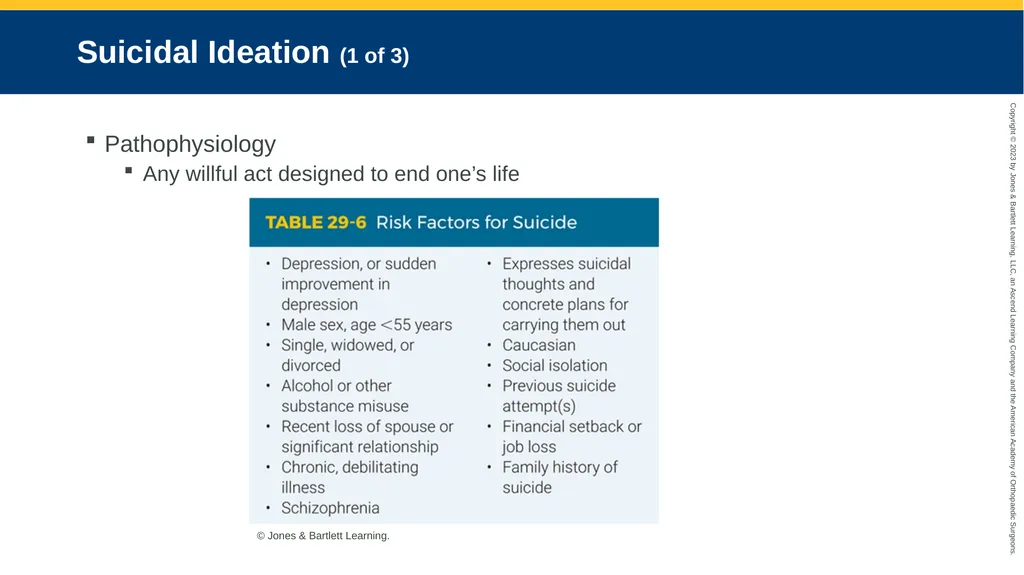
Suicidal Ideation (1 of 3) Pathophysiology
Any willful act designed to end one’s life © Jones & Bartlett Learning.<br>
Any willful act designed to end one’s life © Jones & Bartlett Learning.<br>
47
Suicidal Ideation (2 of 3) Assessment
Every patient with depression must be evaluated for suicide risk.
Most patients are relieved when the topic is brought up.
Broach the subject using a stepwise approach.
Identify patients at a higher risk.<br>
Every patient with depression must be evaluated for suicide risk.
Most patients are relieved when the topic is brought up.
Broach the subject using a stepwise approach.
Identify patients at a higher risk.<br>
48
Suicidal Ideation (3 of 3) Management
Don’t leave the patient alone.
Collect implements of self-destruction.
Acknowledge the patient’s feelings.
Encourage transport.<br>
Don’t leave the patient alone.
Collect implements of self-destruction.
Acknowledge the patient’s feelings.
Encourage transport.<br>
49
Patterns of Violence, Abuse, and Neglect (1 of 6) Abuse and neglect
Assess the following:
The patient
The environment
Other persons involved
Document your findings and report your concerns according to local protocols.<br>
Assess the following:
The patient
The environment
Other persons involved
Document your findings and report your concerns according to local protocols.<br>
50
Patterns of Violence, Abuse, and Neglect (2 of 6) Violence
Most angry patients can be calmed by a trained person who conveys confidence.
Encourage the patient to talk
Be prepared to deal with hostile or violent behavior.<br>
Most angry patients can be calmed by a trained person who conveys confidence.
Encourage the patient to talk
Be prepared to deal with hostile or violent behavior.<br>
51
Patterns of Violence, Abuse, and Neglect (3 of 6) Identify situations with the potential for violence.
Be psychologically prepared for a possible violent encounter.
Do not rely completely on dispatcher’s information.
Develop situational awareness.<br>
Be psychologically prepared for a possible violent encounter.
Do not rely completely on dispatcher’s information.
Develop situational awareness.<br>
52
Patterns of Violence, Abuse, and Neglect (4 of 6) Risk factors
Scenarios including:
Alcohol or drug consumption
Incidents involving crowds
Violence that has already occurred
People who are:
Intoxicated
Experiencing psychosis
Experiencing withdrawal or delirium<br>
Scenarios including:
Alcohol or drug consumption
Incidents involving crowds
Violence that has already occurred
People who are:
Intoxicated
Experiencing psychosis
Experiencing withdrawal or delirium<br>
53
Patterns of Violence, Abuse, and Neglect (5 of 6) Warning signs include:
Posture: sitting tensely
Speech: loud, critical, threatening
Motor activity: unable to sit still, easily startled
Clenched fists, avoidance of eye contact
Your own feelings<br>
Posture: sitting tensely
Speech: loud, critical, threatening
Motor activity: unable to sit still, easily startled
Clenched fists, avoidance of eye contact
Your own feelings<br>
54
Patterns of Violence, Abuse, and Neglect (6 of 6) Management of the violent patient
Assess the entire situation.
Observe your surroundings.
Maintain a safe distance.
Try verbal interventions first.<br>
Assess the entire situation.
Observe your surroundings.
Maintain a safe distance.
Try verbal interventions first.<br>
55
Mood Disorders (1 of 3) Unipolar mood disorder: mood remains at one pole of the depression-mania continuum
Bipolar mood disorder: mood alternates between mania and depression<br>
Bipolar mood disorder: mood alternates between mania and depression<br>
56
Mood Disorders (2 of 3) Manic behavior
Patients typically have exaggerated perception of happiness with hyperactivity and insomnia.
Characteristics include talkativeness, flight of ideas, delusions of grandeur, tangential thinking, elated effect.
Depression
Can occur in episodes with sudden onset and limited duration
Onset can also be subtle and chronic in nature.<br>
Patients typically have exaggerated perception of happiness with hyperactivity and insomnia.
Characteristics include talkativeness, flight of ideas, delusions of grandeur, tangential thinking, elated effect.
Depression
Can occur in episodes with sudden onset and limited duration
Onset can also be subtle and chronic in nature.<br>
57
Mood Disorders (3 of 3) Depression (cont’d)
Diagnostic features (GAS PIPES)
Guilt
Appetite
Sleep disturbance
Paying attention
Interest
Psychomotor abnormalities
Energy
Suicidal thoughts<br>
Diagnostic features (GAS PIPES)
Guilt
Appetite
Sleep disturbance
Paying attention
Interest
Psychomotor abnormalities
Energy
Suicidal thoughts<br>
58
Schizophrenia Typical onset occurs during early adulthood.
The patient may experience:
Delusions
Hallucinations
Apathy
Mutism
A flat affect
Lack of interest in pleasure
Erratic speech
Overly emotional responses
Lack of/extreme motor behavior<br>
The patient may experience:
Delusions
Hallucinations
Apathy
Mutism
A flat affect
Lack of interest in pleasure
Erratic speech
Overly emotional responses
Lack of/extreme motor behavior<br>
59
Neurotic Disorders (1 of 6) Collection of psychiatric disorders without psychotic symptoms
Generalized anxiety disorder (GAD)
Phobias
Panic disorder<br>
Generalized anxiety disorder (GAD)
Phobias
Panic disorder<br>
60
Neurotic Disorders (2 of 6) Generalized anxiety disorder (GAD)
Patient worries for no particular reason or worrying prevents decision-making abilities.
Worry must be difficult to turn off or control.
When caring for a patient with GAD:
Identify yourself in a calm, confident manner.
Listen attentively.
Talk with the person about their feelings.<br>
Patient worries for no particular reason or worrying prevents decision-making abilities.
Worry must be difficult to turn off or control.
When caring for a patient with GAD:
Identify yourself in a calm, confident manner.
Listen attentively.
Talk with the person about their feelings.<br>
61
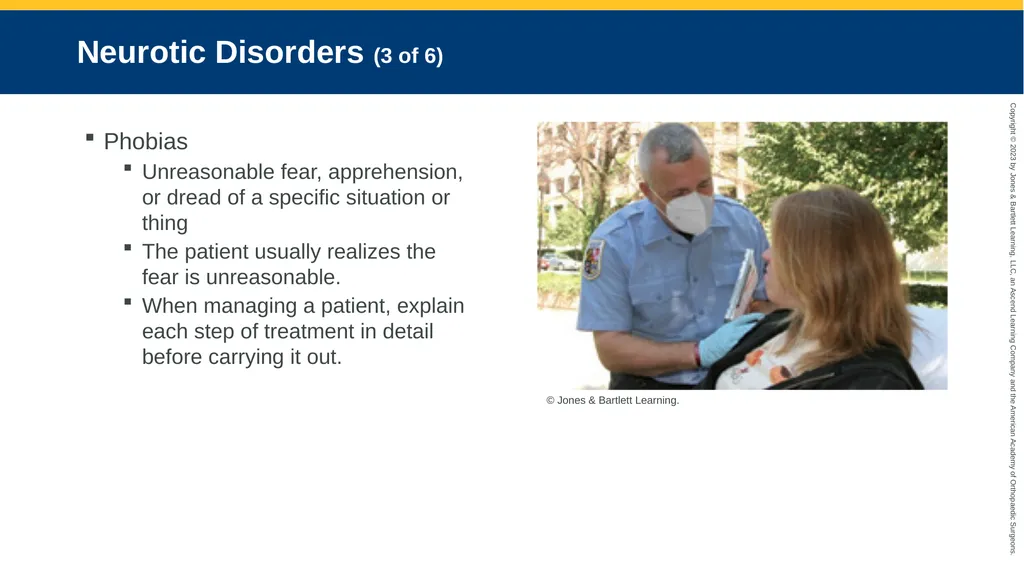
Neurotic Disorders (3 of 6) Phobias
Unreasonable fear, apprehension, or dread of a specific situation or thing
The patient usually realizes the fear is unreasonable.
When managing a patient, explain each step of treatment in detail before carrying it out. © Jones & Bartlett Learning.<br>
Unreasonable fear, apprehension, or dread of a specific situation or thing
The patient usually realizes the fear is unreasonable.
When managing a patient, explain each step of treatment in detail before carrying it out. © Jones & Bartlett Learning.<br>
62
Neurotic Disorders (4 of 6) Panic disorder
Sudden, unexpected, and overwhelming feelings of fear and dread
If allowed to continue, panic attacks can cause severe lifestyle restrictions.
Signs and symptoms usually peak in 10 minutes and last about an hour.
Can mimic several medical conditions<br>
Sudden, unexpected, and overwhelming feelings of fear and dread
If allowed to continue, panic attacks can cause severe lifestyle restrictions.
Signs and symptoms usually peak in 10 minutes and last about an hour.
Can mimic several medical conditions<br>
63
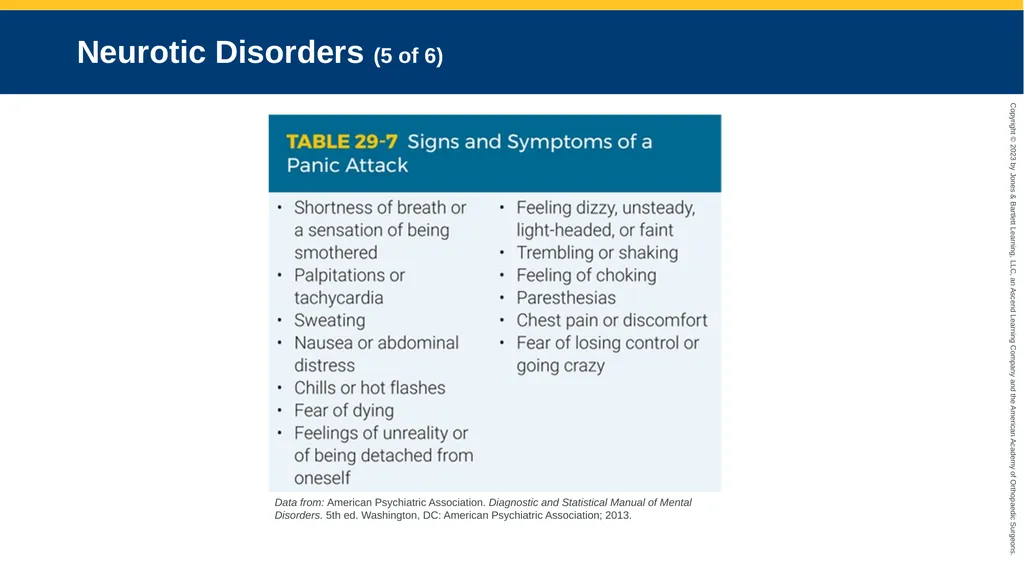
Neurotic Disorders (5 of 6) Data from: American Psychiatric Association. Diagnostic and Statistical Manual of Mental Disorders. 5th ed. Washington, DC: American Psychiatric Association; 2013.<br>
64
Neurotic Disorders (6 of 6) Panic disorder (cont’d)
Separate from panicky bystanders.
Create a calm environment.
Tolerate the patient’s disability.
Reassure the patient.
Give the symptoms a name.
Help the patient regain control.<br>
Separate from panicky bystanders.
Create a calm environment.
Tolerate the patient’s disability.
Reassure the patient.
Give the symptoms a name.
Help the patient regain control.<br>
65
Substance-Related Disorders Regarded on four levels:
Substance use
Substance intoxication
Substance use disorder
Substance dependence
Determining the most effective treatment requires an integrative approach.<br>
Substance use
Substance intoxication
Substance use disorder
Substance dependence
Determining the most effective treatment requires an integrative approach.<br>
66
Eating Disorders (1 of 2) There are two major types: bulimia nervosa and anorexia nervosa.
Persons may experience severe electrolyte imbalances.
Anxiety, depression, and substance use disorders are often present in those diagnosed.<br>
Persons may experience severe electrolyte imbalances.
Anxiety, depression, and substance use disorders are often present in those diagnosed.<br>
67
Eating Disorders (2 of 2) Bulimia nervosa
Consumption of large amounts of food
Compensated by purging techniques
Anorexia nervosa
Weight loss jeopardizes health and lives
Patients lose weight by exerting extraordinary control over food consumption.<br>
Consumption of large amounts of food
Compensated by purging techniques
Anorexia nervosa
Weight loss jeopardizes health and lives
Patients lose weight by exerting extraordinary control over food consumption.<br>
68
Somatoform Disorders Preoccupation with physical health and appearance
Hypochondriasis: Anxiety or fear that the person may have a serious disease
Conversion disorder: A physical condition results from faking a physical disorder<br>
Hypochondriasis: Anxiety or fear that the person may have a serious disease
Conversion disorder: A physical condition results from faking a physical disorder<br>
69
Factitious Disorders Also called Münchausen syndrome
Patient produces or feigns physical or psychological signs or symptoms.
Factitious disorder by proxy (Müchausen syndrome by proxy)
A parent or caregiver makes a child sick for attention and pity.<br>
Patient produces or feigns physical or psychological signs or symptoms.
Factitious disorder by proxy (Müchausen syndrome by proxy)
A parent or caregiver makes a child sick for attention and pity.<br>
70
Impulse Control Disorders Lack of ability to resist a temptation
Examples include:
Intermittent explosive disorder
Kleptomania
Pyromania
Pathologic gambling
This group of disorders is rare.<br>
Examples include:
Intermittent explosive disorder
Kleptomania
Pyromania
Pathologic gambling
This group of disorders is rare.<br>
71
Personality Disorders The ways of relating to others become dysfunctional or cause distress to other people.
Another psychiatric illness is likely to be present at the same time.
Patients tend to do poorly during treatment.
Remain calm and professional.<br>
Another psychiatric illness is likely to be present at the same time.
Patients tend to do poorly during treatment.
Remain calm and professional.<br>
72
Medications for Psychiatric Disorders and Behavioral Emergencies Drugs that affect mood, thought, or behavior
Patients may use several types of psychotropic drugs.
During your assessment, identify:
Which medications have been prescribed
Whether they are being taken<br>
Patients may use several types of psychotropic drugs.
During your assessment, identify:
Which medications have been prescribed
Whether they are being taken<br>
73
Psychiatric Medication Types (1 of 6) Antidepressants
Combat the symptoms of depressive illness
Alter levels of neurotransmitters in the autonomic nervous system<br>
Combat the symptoms of depressive illness
Alter levels of neurotransmitters in the autonomic nervous system<br>
74
Psychiatric Medication Types (2 of 6) Benzodiazepines
May be prescribed for severe emotional distress
Short-term therapy may help the patient experiencing crisis or acute panic reactions.<br>
May be prescribed for severe emotional distress
Short-term therapy may help the patient experiencing crisis or acute panic reactions.<br>
75
Psychiatric Medication Types (3 of 6) Antipsychotics
Newer medications have less risk of adverse effects and are more effective.
Known as atypical antipsychotic (AAP) drugs
Relieve delusions and hallucinations
Improve symptoms of anxiety and depression<br>
Newer medications have less risk of adverse effects and are more effective.
Known as atypical antipsychotic (AAP) drugs
Relieve delusions and hallucinations
Improve symptoms of anxiety and depression<br>
76
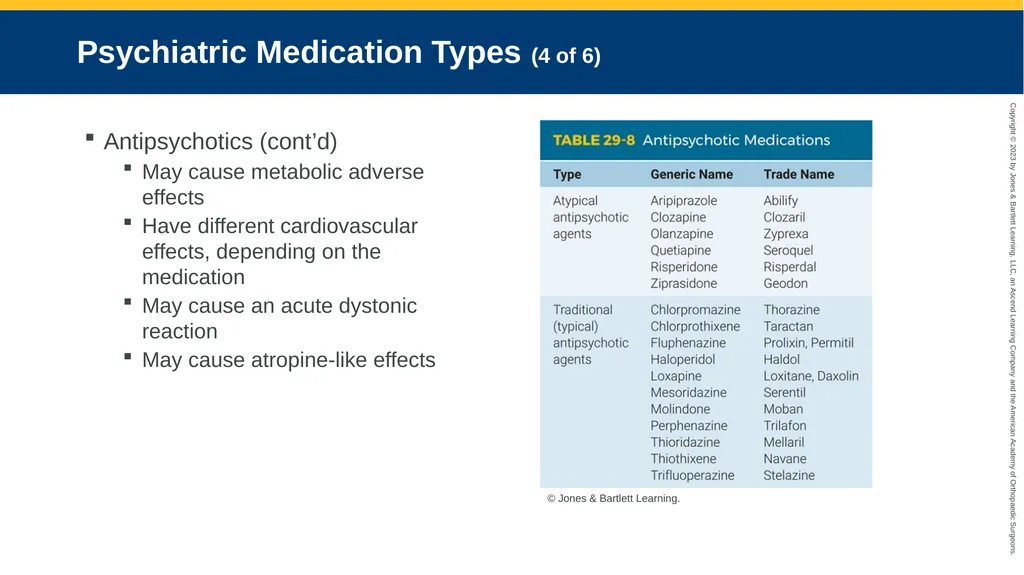
Psychiatric Medication Types (4 of 6) Antipsychotics (cont’d)
May cause metabolic adverse effects
Have different cardiovascular effects, depending on the medication
May cause an acute dystonic reaction
May cause atropine-like effects © Jones & Bartlett Learning.<br>
May cause metabolic adverse effects
Have different cardiovascular effects, depending on the medication
May cause an acute dystonic reaction
May cause atropine-like effects © Jones & Bartlett Learning.<br>
77
Psychiatric Medication Types (5 of 6) Amphetamines
CNS and PNS stimulants
Help with attention-deficit disorder with hyperactivity and narcolepsy
Raise systolic and diastolic blood pressure<br>
CNS and PNS stimulants
Help with attention-deficit disorder with hyperactivity and narcolepsy
Raise systolic and diastolic blood pressure<br>
78
Psychiatric Medication Types (6 of 6) Amphetamines
Psychological effects depend on:
Dose
Mental state
Personality Results include:
Alertness
Reduced fatigue
Elevated mood
Increased concentration
Euphoria
Increased motor and speech activities<br>
Psychological effects depend on:
Dose
Mental state
Personality Results include:
Alertness
Reduced fatigue
Elevated mood
Increased concentration
Euphoria
Increased motor and speech activities<br>
79
Problems Associated with Medication Noncompliance Increases the likelihood that a person with mental illness will commit a violent act
When obtaining medication history, include:
Previously prescribed medications
Missed doses<br>
When obtaining medication history, include:
Previously prescribed medications
Missed doses<br>
80
Emergency Use of Medications Emergency use of medications may be indicated in an escalating behavioral crisis.
The potential danger is too great not to intervene.
Before administering chemical restraint, complete your assessment with:
A thorough understanding of the chief complaint
Attention to allergies
Medical and medication history
Weigh the risks against the benefits<br>
The potential danger is too great not to intervene.
Before administering chemical restraint, complete your assessment with:
A thorough understanding of the chief complaint
Attention to allergies
Medical and medication history
Weigh the risks against the benefits<br>
81
The Psychological Effect of War (1 of 4) Traumatic stressful events can lead to psychological trauma.
Military personnel who have experienced combat have a high incidence of PTSD.
Four categories of PTSD symptoms:
Intrusive thoughts
Avoiding reminders
Negative thoughts and feelings
Arousal and reactive symptoms<br>
Military personnel who have experienced combat have a high incidence of PTSD.
Four categories of PTSD symptoms:
Intrusive thoughts
Avoiding reminders
Negative thoughts and feelings
Arousal and reactive symptoms<br>
82
The Psychological Effect of War (2 of 4) Acute stress disorder
People experiencing intense stress often develop symptoms within days of the event.
Symptoms differ from PTSD in that they are dissociative.
Considered a precursor to PTSD<br>
People experiencing intense stress often develop symptoms within days of the event.
Symptoms differ from PTSD in that they are dissociative.
Considered a precursor to PTSD<br>
83
The Psychological Effect of War (3 of 4) Military cultural competency
A specific skill that assists in identifying sometimes subtle indicators of discharged military personnel<br>
A specific skill that assists in identifying sometimes subtle indicators of discharged military personnel<br>
84
The Psychological Effect of War (4 of 4) When you encounter military service members experiencing medical or behavioral problems, use:
Compassion
Understanding
Protocols
Cognizance of their cultural background<br>
Compassion
Understanding
Protocols
Cognizance of their cultural background<br>