
Public Administration N5 www.futuremanagers.com
TA
Published · 36 slides · 0 views
1 / 1
Description
Public Administration N5 www.futuremanagers.com INTRODUCTION The SA Constitution states that government authorities and officials must ensure that all citizens, especially the poor, and other vulnerable groups, have equal access to basic
Related Topics
Download this presentation From Below
"Public Administration N5 www.futuremanagers.com" is the property of its rightful owner. Permission is granted to download and print the materials on this website for personal, non-commercial use only, and to display it on your personal computer provided you do not modify the materials and that you retain all copyright notices contained in the materials. By downloading content from our website, you accept the terms of this agreement.
Share
Embed code
Presentation Transcript
01
Public Administration
N5<br>
N5<br>
02
www.futuremanagers.com INTRODUCTION
The SA Constitution states that government authorities and officials must ensure that all citizens, especially the poor, and other vulnerable groups, have equal access to basic services. Public policy is therefore necessary to determine which services communities need and what kinds of development are needed. Module 1 - Policy and Policy-Making<br>
The SA Constitution states that government authorities and officials must ensure that all citizens, especially the poor, and other vulnerable groups, have equal access to basic services. Public policy is therefore necessary to determine which services communities need and what kinds of development are needed. Module 1 - Policy and Policy-Making<br>
03
www.futuremanagers.com Module 1 - Policy and Policy-Making (continued) THE NATURE OF PUBLIC POLICY
A set of common rules and guidelines have emerged over time, which has enabled communities to deliver basic services and to manage any differences which exist among individuals and groups effectively.<br>
A set of common rules and guidelines have emerged over time, which has enabled communities to deliver basic services and to manage any differences which exist among individuals and groups effectively.<br>
04
www.futuremanagers.com Module 1 - Policy and Policy-Making (continued) PLANNING, DETERMINING OBJECTIVES, DECISION-MAKING AND POLICY-MAKING
Planning is a thought activity that involves the individual and/or group’s imagination, logic and vision. Objectives define and state the purpose of an institution. Policy-making is the process in which actions and interactions are taken by all spheres and levels of government in the interest of all citizens.<br>
Planning is a thought activity that involves the individual and/or group’s imagination, logic and vision. Objectives define and state the purpose of an institution. Policy-making is the process in which actions and interactions are taken by all spheres and levels of government in the interest of all citizens.<br>
05
www.futuremanagers.com Module 1 - Policy and Policy-Making (continued) FACTORS THAT INFLUENCE POLICY-MAKING Internal factors include:
Conditions of establishment;
Political assignment;
Legality according to the state and administrative law;
Financial means;
Personnel abilities; and
Physical facilities. External factors include:
Circumstances;
Needs and expectations of the population;
Policies of political parties;
Activities and representations of interest groups;
Personal views of political executive office-bearers; and
Research, investigations and views of experienced public officials.<br>
Conditions of establishment;
Political assignment;
Legality according to the state and administrative law;
Financial means;
Personnel abilities; and
Physical facilities. External factors include:
Circumstances;
Needs and expectations of the population;
Policies of political parties;
Activities and representations of interest groups;
Personal views of political executive office-bearers; and
Research, investigations and views of experienced public officials.<br>
06
www.futuremanagers.com Module 1 - Policy and Policy-Making (continued) POLICY-MAKING PROCEDURE
The policy-making process can be divided into three groups, namely:
The policy-making processes;
The policy-implementation processes; and
Policy analysis and evaluation processes.<br>
The policy-making process can be divided into three groups, namely:
The policy-making processes;
The policy-implementation processes; and
Policy analysis and evaluation processes.<br>
07
www.futuremanagers.com Module 1 - Policy and Policy-Making (continued) INSTITUTIONS INVOLVE IN POLICY-MAKING
The following institutions are involved in determining a policy:
Legislative institutions;
Executive councils and committees;
Commissions and committees of enquiry;
Select, standing and joint committee of parliament;
Cabinet committees; and
Internal auxiliary services and staff units.<br>
The following institutions are involved in determining a policy:
Legislative institutions;
Executive councils and committees;
Commissions and committees of enquiry;
Select, standing and joint committee of parliament;
Cabinet committees; and
Internal auxiliary services and staff units.<br>
08
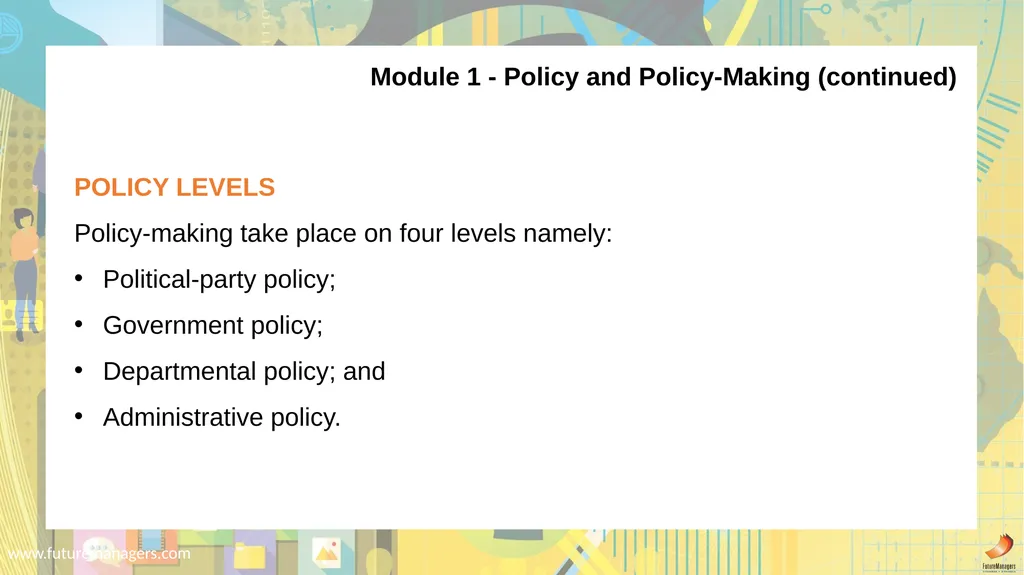
www.futuremanagers.com Module 1 - Policy and Policy-Making (continued) POLICY LEVELS
Policy-making take place on four levels namely:
Political-party policy;
Government policy;
Departmental policy; and
Administrative policy.<br>
Policy-making take place on four levels namely:
Political-party policy;
Government policy;
Departmental policy; and
Administrative policy.<br>
09
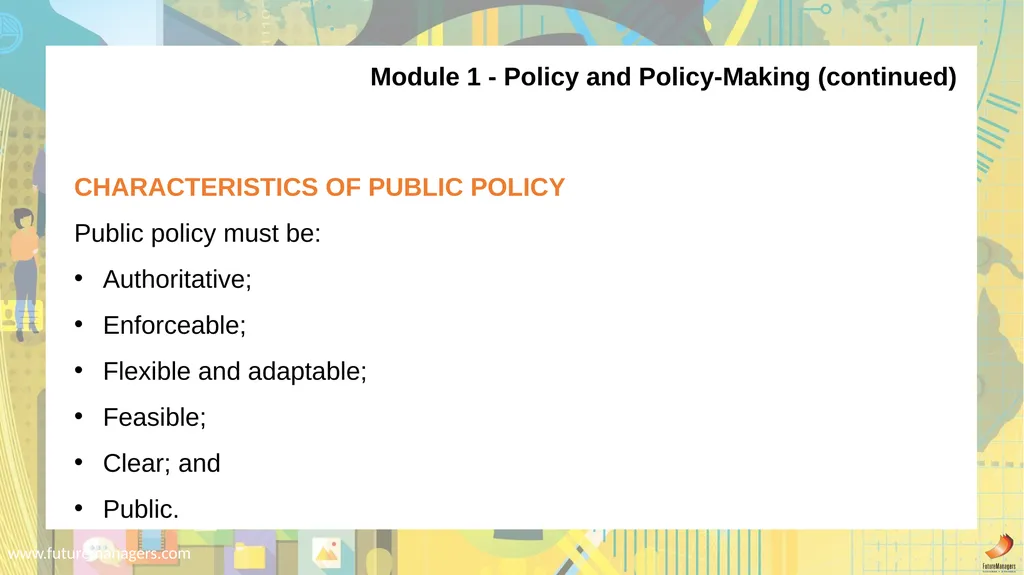
www.futuremanagers.com Module 1 - Policy and Policy-Making (continued) CHARACTERISTICS OF PUBLIC POLICY
Public policy must be:
Authoritative;
Enforceable;
Flexible and adaptable;
Feasible;
Clear; and
Public.<br>
Public policy must be:
Authoritative;
Enforceable;
Flexible and adaptable;
Feasible;
Clear; and
Public.<br>
10
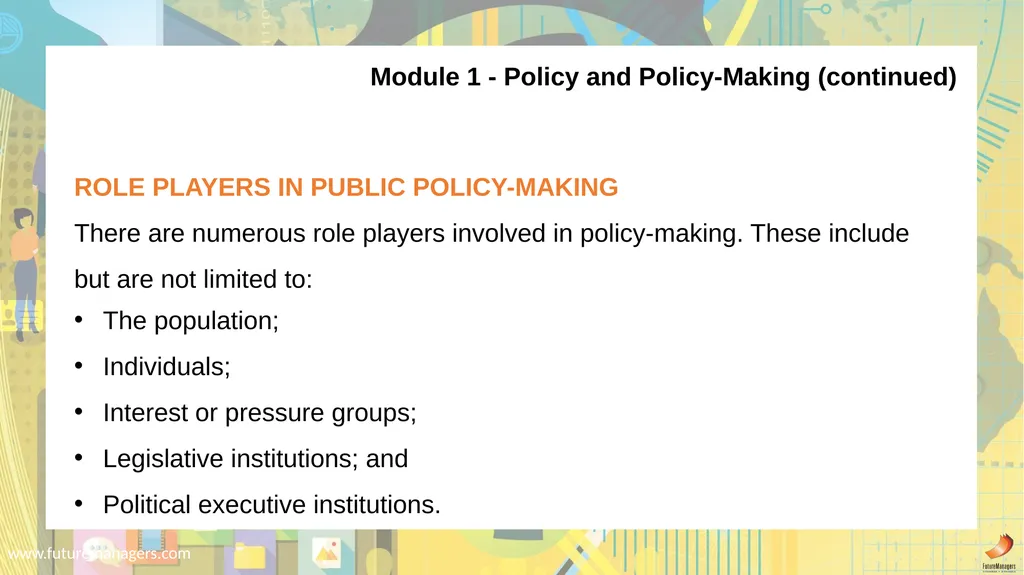
www.futuremanagers.com Module 1 - Policy and Policy-Making (continued) ROLE PLAYERS IN PUBLIC POLICY-MAKING
There are numerous role players involved in policy-making. These include but are not limited to: The population;
Individuals;
Interest or pressure groups;
Legislative institutions; and
Political executive institutions.<br>
There are numerous role players involved in policy-making. These include but are not limited to: The population;
Individuals;
Interest or pressure groups;
Legislative institutions; and
Political executive institutions.<br>
11
www.futuremanagers.com Module 1 - Policy and Policy-Making (continued) CONCLUSION
It is important for policy-makers to have the necessary capacity and opportunity to continuously adapt public policy to the changing circumstances of the people.<br>
It is important for policy-makers to have the necessary capacity and opportunity to continuously adapt public policy to the changing circumstances of the people.<br>
12
www.futuremanagers.com INTRODUCTION
An organisational unit or an institution within the public sector consists of people who have to co-operate with each other to achieve political objectives. Module 2 - Organising<br>
An organisational unit or an institution within the public sector consists of people who have to co-operate with each other to achieve political objectives. Module 2 - Organising<br>
13
www.futuremanagers.com Module 2 - Organising (continued) WHAT IS ORGANISING?
Organising takes place when all tasks and responsibilities and functions are grouped together to achieve the goals of the organisation. Positions must be arranged in such a way that the personnel are willing to co-operate with each other to achieve an objective.<br>
Organising takes place when all tasks and responsibilities and functions are grouped together to achieve the goals of the organisation. Positions must be arranged in such a way that the personnel are willing to co-operate with each other to achieve an objective.<br>
14
www.futuremanagers.com Module 2 - Organising (continued) POLITICAL FACILITATION
The country is strongly managed by political parties. These functions include:
Legislative;
Executive; and
judicial functions.<br>
The country is strongly managed by political parties. These functions include:
Legislative;
Executive; and
judicial functions.<br>
15
www.futuremanagers.com Module 2 - Organising (continued) ORGANISATIONAL THEORIES
There is the:
Classical classification theory which states that the main purpose of an organisation unit is to carry out duties directed by political office-bearers (public sector approach); and the
Modern/contemporary classification theory which states that the main purpose is to make a profit (private sector approach).<br>
There is the:
Classical classification theory which states that the main purpose of an organisation unit is to carry out duties directed by political office-bearers (public sector approach); and the
Modern/contemporary classification theory which states that the main purpose is to make a profit (private sector approach).<br>
16
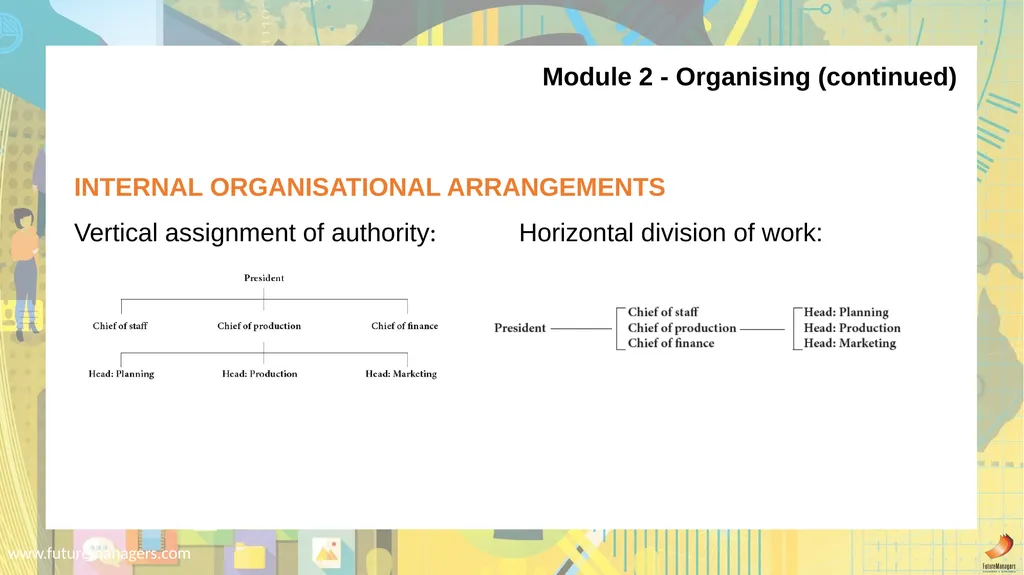
www.futuremanagers.com Module 2 - Organising (continued) INTERNAL ORGANISATIONAL ARRANGEMENTS Horizontal division of work: Vertical assignment of authority:<br>
17
www.futuremanagers.com Module 2 - Organising (continued) AIDS IN ORGANISING
The organising process has to be done in writing;
Organisational charts, manuals and procedure codes can be used to communicate important information to staff members; and
All the functions performed by public officials must be accounted for.<br>
The organising process has to be done in writing;
Organisational charts, manuals and procedure codes can be used to communicate important information to staff members; and
All the functions performed by public officials must be accounted for.<br>
18
www.futuremanagers.com Module 2 - Organising (continued) ORGANISATIONAL SYSTEMS
There are three types of systems which can be used in an organisation:
The line system;
The functional system; and
The line and staff organisation.<br>
There are three types of systems which can be used in an organisation:
The line system;
The functional system; and
The line and staff organisation.<br>
19
www.futuremanagers.com Module 2 - Organising (continued) CONCLUSION
Every organisation needs a structure in order to operate efficiently. Hierarchical structures can be used by an organisation if the structure fits into the nature of the workload. Delegation is also important as one of the core concepts of management and leadership.<br>
Every organisation needs a structure in order to operate efficiently. Hierarchical structures can be used by an organisation if the structure fits into the nature of the workload. Delegation is also important as one of the core concepts of management and leadership.<br>
20
www.futuremanagers.com INTRODUCTION
The government’s financial status works exactly like any individual person’s
account; it can only spend what was received during the previous financial year. The budget is important to consider as it outlines new policies which should be to improve the general welfare of all South Africans. Module 3 - Financing<br>
The government’s financial status works exactly like any individual person’s
account; it can only spend what was received during the previous financial year. The budget is important to consider as it outlines new policies which should be to improve the general welfare of all South Africans. Module 3 - Financing<br>
21
www.futuremanagers.com Module 3 – Financing (continued) NATURE OF STATE FINANCES
The state does not have its own money; it is the money belonging to the public. The state has a strict budget, with which activities have to be organised. Each financial year, the state budget starts at R0,00 and is estimated over a period of 12 months.<br>
The state does not have its own money; it is the money belonging to the public. The state has a strict budget, with which activities have to be organised. Each financial year, the state budget starts at R0,00 and is estimated over a period of 12 months.<br>
22
www.futuremanagers.com Module 3 – Financing (continued) GENERAL FINANCIAL THEORIES
Specific theoretical frameworks have been developed for government finance. These frameworks explore:
Government funds (which are public funds);
State departments;
State budget; and
The financial year as a fixed period.<br>
Specific theoretical frameworks have been developed for government finance. These frameworks explore:
Government funds (which are public funds);
State departments;
State budget; and
The financial year as a fixed period.<br>
23
www.futuremanagers.com Module 3 – Financing (continued) PHASES OF STATE FINANCES
The budget can be divided into four phases, namely:
The preparation phase;
The approval phase;
The execution/implementation phase; and
The control phase.<br>
The budget can be divided into four phases, namely:
The preparation phase;
The approval phase;
The execution/implementation phase; and
The control phase.<br>
24
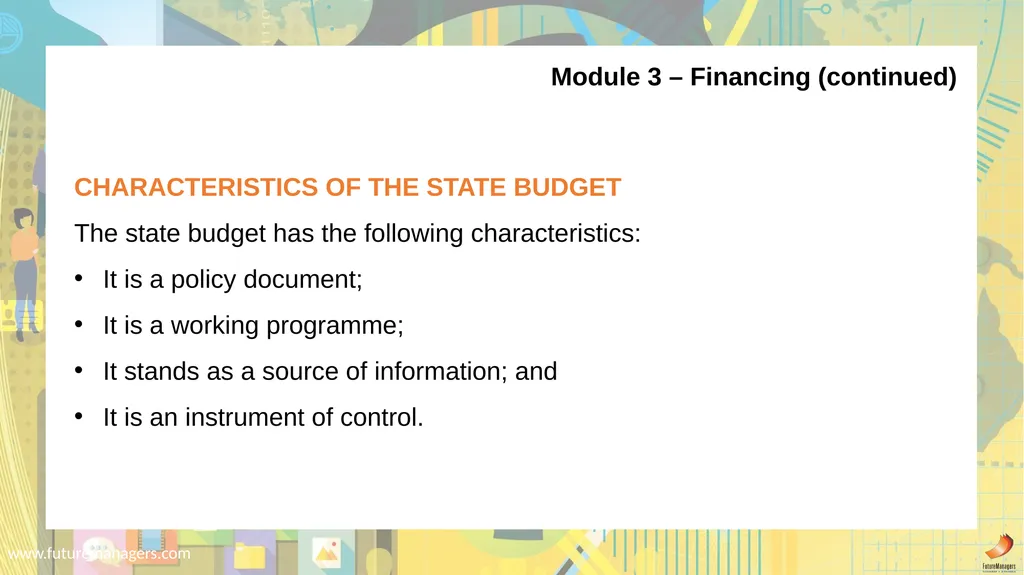
www.futuremanagers.com Module 3 – Financing (continued) CHARACTERISTICS OF THE STATE BUDGET
The state budget has the following characteristics:
It is a policy document;
It is a working programme;
It stands as a source of information; and
It is an instrument of control.<br>
The state budget has the following characteristics:
It is a policy document;
It is a working programme;
It stands as a source of information; and
It is an instrument of control.<br>
25
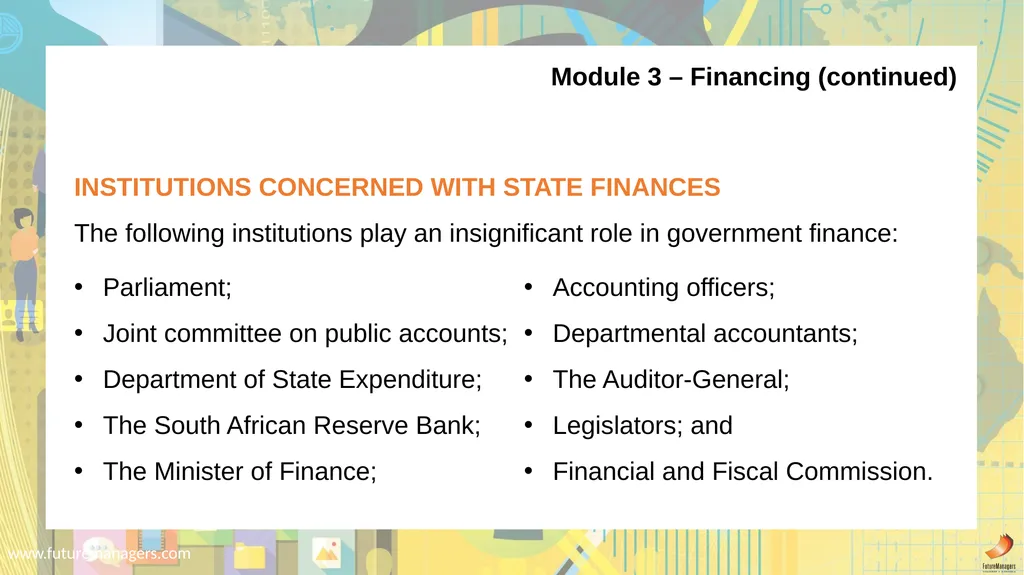
www.futuremanagers.com Module 3 – Financing (continued) INSTITUTIONS CONCERNED WITH STATE FINANCES
The following institutions play an insignificant role in government finance: Parliament;
Joint committee on public accounts;
Department of State Expenditure;
The South African Reserve Bank;
The Minister of Finance; Accounting officers;
Departmental accountants;
The Auditor-General;
Legislators; and
Financial and Fiscal Commission.<br>
The following institutions play an insignificant role in government finance: Parliament;
Joint committee on public accounts;
Department of State Expenditure;
The South African Reserve Bank;
The Minister of Finance; Accounting officers;
Departmental accountants;
The Auditor-General;
Legislators; and
Financial and Fiscal Commission.<br>
26
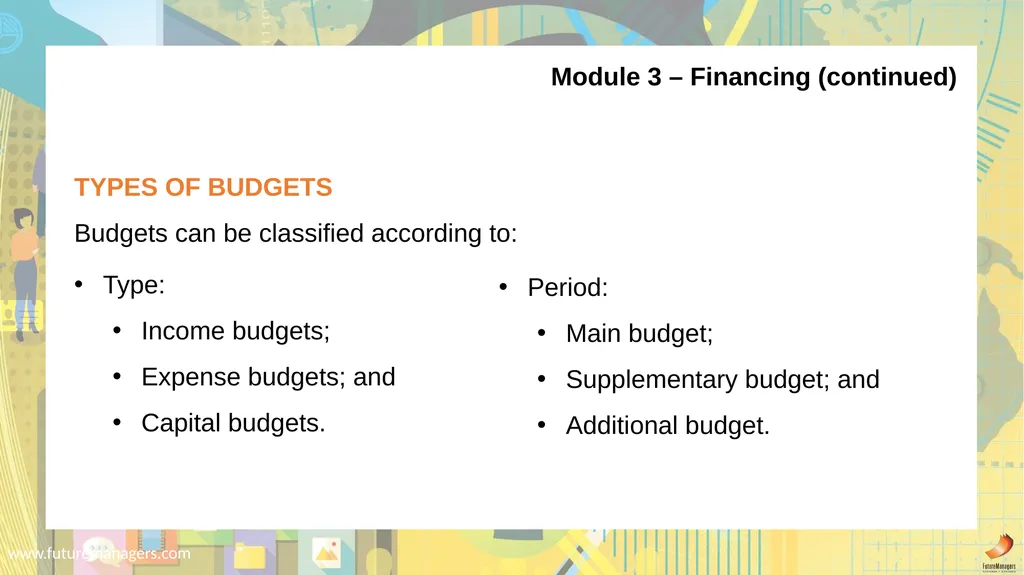
www.futuremanagers.com Module 3 – Financing (continued) TYPES OF BUDGETS
Budgets can be classified according to: Type:
Income budgets;
Expense budgets; and
Capital budgets. Period:
Main budget;
Supplementary budget; and
Additional budget.<br>
Budgets can be classified according to: Type:
Income budgets;
Expense budgets; and
Capital budgets. Period:
Main budget;
Supplementary budget; and
Additional budget.<br>
27
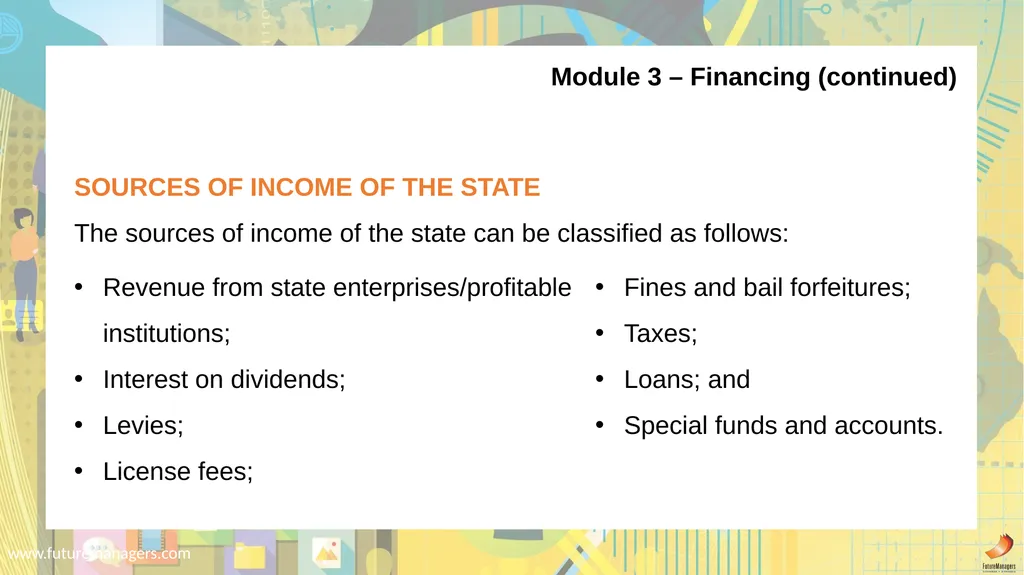
www.futuremanagers.com Module 3 – Financing (continued) SOURCES OF INCOME OF THE STATE
The sources of income of the state can be classified as follows: Revenue from state enterprises/profitable institutions;
Interest on dividends;
Levies;
License fees; Fines and bail forfeitures;
Taxes;
Loans; and
Special funds and accounts.<br>
The sources of income of the state can be classified as follows: Revenue from state enterprises/profitable institutions;
Interest on dividends;
Levies;
License fees; Fines and bail forfeitures;
Taxes;
Loans; and
Special funds and accounts.<br>
28
www.futuremanagers.com Module 3 – Financing (continued) FINANCIAL CONTROL
Managing government finances is critical important to ensure that quality services are provided to the people.<br>
Managing government finances is critical important to ensure that quality services are provided to the people.<br>
29
www.futuremanagers.com Module 3 – Financing (continued) CONCLUSION
Governmental finances are connected to all the activities of the government. Adequate service delivery should be based on adequate funding and proper budgeting and planning. Political executive institutions have a responsibility to manage their budgets effectively so that they become accountable, responsible and transparent within the legal framework.<br>
Governmental finances are connected to all the activities of the government. Adequate service delivery should be based on adequate funding and proper budgeting and planning. Political executive institutions have a responsibility to manage their budgets effectively so that they become accountable, responsible and transparent within the legal framework.<br>
30
www.futuremanagers.com INTRODUCTION
The staffing of public institutions involves all generic activities which constitute the functions of personnel officials. These functions include:
Personnel policy and procedures;
Personnel financing;
Personnel organisation;
Personnel control; and
Personnel management. Module 4 - Personnel Administration<br>
The staffing of public institutions involves all generic activities which constitute the functions of personnel officials. These functions include:
Personnel policy and procedures;
Personnel financing;
Personnel organisation;
Personnel control; and
Personnel management. Module 4 - Personnel Administration<br>
31
www.futuremanagers.com Module 4 – Personnel Administration (continued) PERSONNEL HUMAN RESOURCE SYSTEMS
The following systems have developed over the years and have been in force in many countries:
Aristocratic system;
Democratic system;
Spoils system; and
Merit system.<br>
The following systems have developed over the years and have been in force in many countries:
Aristocratic system;
Democratic system;
Spoils system; and
Merit system.<br>
32
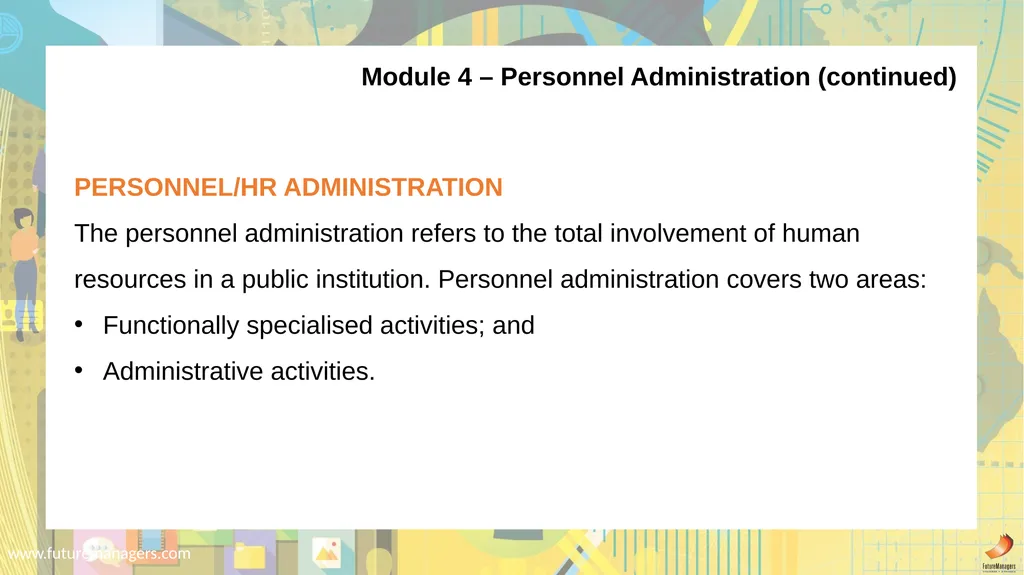
www.futuremanagers.com Module 4 – Personnel Administration (continued) PERSONNEL/HR ADMINISTRATION
The personnel administration refers to the total involvement of human resources in a public institution. Personnel administration covers two areas:
Functionally specialised activities; and
Administrative activities.<br>
The personnel administration refers to the total involvement of human resources in a public institution. Personnel administration covers two areas:
Functionally specialised activities; and
Administrative activities.<br>
33
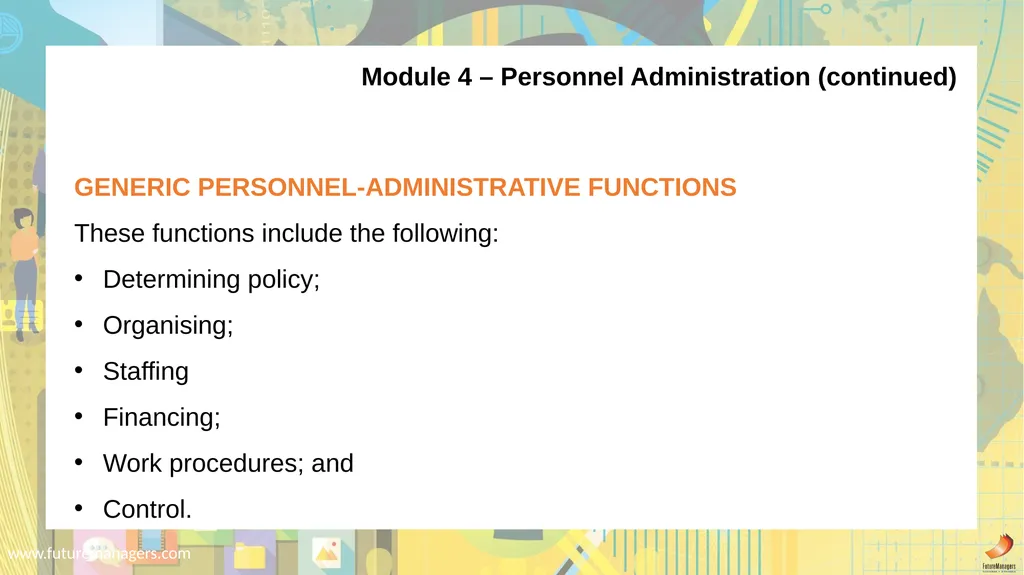
www.futuremanagers.com Module 4 – Personnel Administration (continued) GENERIC PERSONNEL-ADMINISTRATIVE FUNCTIONS
These functions include the following:
Determining policy;
Organising;
Staffing
Financing;
Work procedures; and
Control.<br>
These functions include the following:
Determining policy;
Organising;
Staffing
Financing;
Work procedures; and
Control.<br>
34
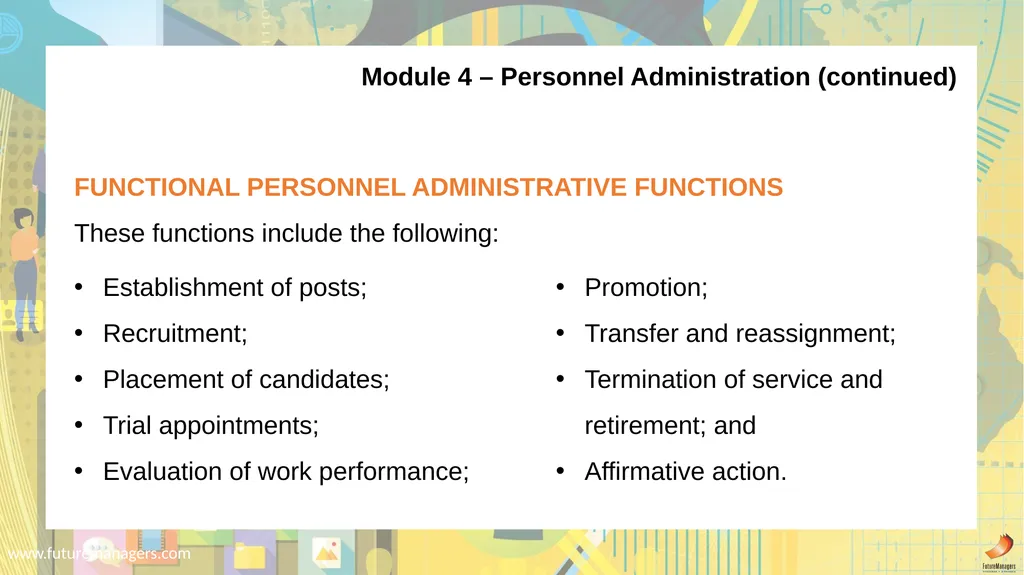
www.futuremanagers.com Module 4 – Personnel Administration (continued) FUNCTIONAL PERSONNEL ADMINISTRATIVE FUNCTIONS
These functions include the following: Establishment of posts;
Recruitment;
Placement of candidates;
Trial appointments;
Evaluation of work performance; Promotion;
Transfer and reassignment;
Termination of service and retirement; and
Affirmative action.<br>
These functions include the following: Establishment of posts;
Recruitment;
Placement of candidates;
Trial appointments;
Evaluation of work performance; Promotion;
Transfer and reassignment;
Termination of service and retirement; and
Affirmative action.<br>
35
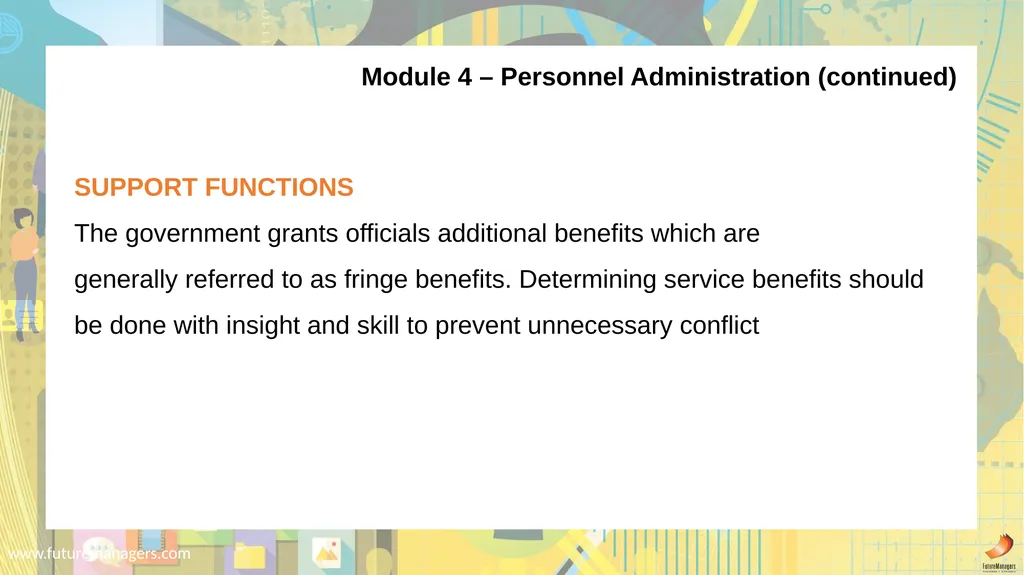
www.futuremanagers.com Module 4 – Personnel Administration (continued) SUPPORT FUNCTIONS
The government grants officials additional benefits which are
generally referred to as fringe benefits. Determining service benefits should be done with insight and skill to prevent unnecessary conflict<br>
The government grants officials additional benefits which are
generally referred to as fringe benefits. Determining service benefits should be done with insight and skill to prevent unnecessary conflict<br>
36
www.futuremanagers.com Module 4 – Personnel Administration (continued) CONLUSION
A personnel policy can be beneficial to both an organisation and the employees. Service benefits should be provided to employees in order to create a sense of loyalty to the employer and indicate the employer cares for their wellbeing.<br>
A personnel policy can be beneficial to both an organisation and the employees. Service benefits should be provided to employees in order to create a sense of loyalty to the employer and indicate the employer cares for their wellbeing.<br>