Public Law Working Group President of the Family
Description: Public Law Working Group President of the Family Divisions Public Law Working Group (PLWG) Final Report (March 2021) Briefing on the PLWG best practice guidance on support for, and work with, families prior to court proceedings for use in
Related Topics
Download Presentation
"Public Law Working Group President of the Family" is the property of its rightful owner. Permission is granted to download and print the materials on this website for personal, non-commercial use only, and to display it on your personal computer provided you do not modify the materials and that you retain all copyright notices contained in the materials. By downloading content from our website, you accept the terms of this agreement.
Presentation Transcript
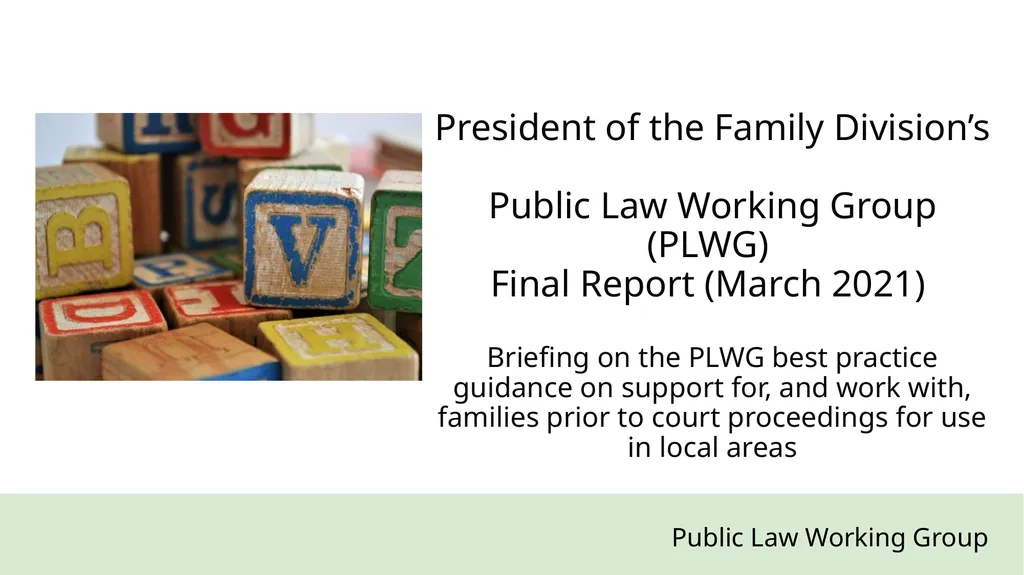
slide1. Public Law Working Group President of the Family Division’s Public Law Working Group (PLWG) Final Report (March 2021)
Briefing on the PLWG best practice guidance on support for, and work with, families prior to court proceedings for use in local areas<br>
slide2. Public Law Working Group Background to the report and practice guidance The PFD launched a review of family (public and private) law at the end of 2018.
The public law aims were twofold: understand whether children and young people can be safely diverted from becoming the subject of public law proceedings; and, that decisions about their lives are made swiftly and fairly once they are subject to proceedings.
As well as identifying practical, cultural and legislative challenges and making some longer term recommendations for change, the PLWG’s final report includes a suite of resources for practitioners e.g. best practice guidance and advice from children and young people.
Differences in LA decision making and in the use of and/or approaches to the PLO and pre-proceedings process were identified as an area for focus and attention. Particularly in light of the significant regional variations in the use of urgent applications to the courts.<br>
slide3. Public Law Working Group Rationale for this work Over time, there is a growing sense of an increase in risk-averse practice in all parts of the family justice system. The drivers include high-profile cases, criticism of professionals, particularly social workers, and societal shifts in tolerance of risk.
For professionals, encouraging safe management of risk while building on family strengths and energising wider family support, is critical. The use of the PLO and pre proceedings should be an opportunity for families to embrace positive change. It should be a point of hope.
The main aim of the best practice guidance on pre-court work with children and families is to share learning and practical tools to support practitioners in local authorities to confidently make consistent, timely and balanced decisions around the initiation of pre-proceedings. The guidance seeks to encourage confident practice.
The guidance underlines the fact that the legal threshold being met does not always mean it is right, or proportionate, to escalate to pre-proceedings or instigate care proceedings.<br>
slide4. Public Law Working Group First and foremost, the child’s welfare is paramount.
The child’s views must be heard.
Managing and mitigating risks whilst working with the child and their family is key.
Work with the child and their family requires a collaborative approach to co-producing plans and to positively support change.
A partnership approach employing the existing skills, knowledge and resources of all partners and agencies involved with the family is vital.
Accurate and timely recording is vital as are clear communications with the family.
Court proceedings must be necessary and proportionate, an option of last resort, be clear why this application, why now.
Timeliness and minimising delay are important.
If in doubt all practitioners working in the system should always refer back to these principles. Work with children and families: the underpinning principles in the guidance<br>
slide5. Public Law Working Group Deciding to initiate pre-proceedings (1) The guidance underlines the fact it is not always right or proportionate, to arrange a legal gateway/planning meeting just because necessary threshold is met.
Where one is needed, the meeting should be held in a timely way to consider the available information and decide the best course of action to protect the child’s welfare e.g. move to pre-proceedings to issue immediate care proceedings.
It should be chaired by a suitably senior manager and participants must agree on the specific issues, risks and mitigating factors of relevance.
Factors to be considered:
What is the lived experience of the child and impact on their wellbeing?
How long have children’s social care been involved with the family?
What support has been offered to the family and how have they engaged with this offer?
What assessments have been completed?
Have changes already been made by parents to mitigate the identified risk factors?<br>
slide6. Public Law Working Group Deciding to initiate pre-proceedings (2) If the legal threshold is met and attendees agree to initiate pre-proceedings then a tailored plan of action should be agreed, including:
Any continuing support or any additional direct work with the child during this period?
Any further support or direct work which could be offered the family to mitigate identified risks?
How risks and/or positive changes in this period will be tracked?
What expert assessments that are required, including who is being assessed, why, plus duration?
Wider family members to be consulted to offer support or be assessed as alternative carers?
Once the decision to enter pre-proceedings has been taken, the guidance notes that families can step out of the PLO process if it becomes clear that this level of intervention is no longer in the child’s best interests.
However, to prevent further instability (for both the child and their family) there must be a degree of confidence that the changes sought are achievable and sustainable.<br>
slide7. Public Law Working Group Pre-proceedings and the PLO (1) The PLO brings together a series of steps that ensure the professionals working with children and their families explore all of the realistic opportunities to achieve the best outcome for the relevant children.
It’s important practitioners both view and approach this phase not simply as a procedural step to court: pre-proceedings are an intervention in themselves and act as the final chance to manage risk by supporting change.
Every effort should be made to improve outcomes for the child as safely as possible. It also serves to ‘narrow the issues’ if entry to court is required.
Pre-proceedings may not always secure the required changes and the PLWG report recognises this fact. Courts are encouraged to do the same, noting that where timely, intensive work is underway, criticism of the local authority is unwarranted. Where all other options have been explored and issuing is the only safe option, the courts will benefit from the work that has been undertaken during pre-proceedings.
Again, the report recognises the complex and difficult work social workers undertake and their skill and expertise in supporting children and families and the management of risk in the community.<br>
slide8. Public Law Working Group Pre-proceedings and the PLO (2) Clear communication with the family about identified concerns and the expectation of all of those who are involved in the process, including clear timescales to prevent drift is vital.
It is crucial that the parents clearly understand this process, what is expected of them, how the LA will work with their family and agree plans. It is important to consider any support parents might need to understand the nature of the LAs concerns e.g. advocacy or interpretation services. Older children will also need support to understand this process.
The pre-proceedings phase should be no longer than 16 weeks but this is dependent on myriad factors, from the child’s needs to the number of professionals involved.
It is important social workers keep a clear, accurate record of the agreed plan and the status of assessments in progress and/or outcomes to inform future decision-making processes. A template developed and used successfully in one DFJ area is included in the guidance.
Outcomes should be clearly recorded at the end of the PLO process - escalation to court, an extension to continue working with the family or ‘stepping out’ of the process if sufficient progress has been evidenced. The deciding factor must always be the immediacy of harm.<br>
slide9. Public Law Working Group Pre-proceedings and the PLO with newborns Pre-proceedings can be initiated for an unborn child and should be held as early as possible, with timescales monitored closely.
If there is already involvement with the expectant parents, this work must begin as early as possible; the identification of needs, and the provision of support, must happen as soon as possible.
Some assessments or interventions may not be able to start or finish before birth and specialist medical advice may be required about some of the timings.
However, the agreement may be completed and agreed prior to the birth.
If a decision to issue proceedings on birth is made then draft documents should be ready to send to lawyers prior to birth and parents should be provided with copies at the earliest opportunity.
Placement options should be considered early on and discussed with parents e.g. parent-and-baby foster placements, so that early permanence is achieved for babies, as appropriate.<br>
slide10. Public Law Working Group Additional reading and resources for practitioners The PLWG report includes a series of resources for practitioners who work with children and families during public proceedings:
A pre-proceeding proforma to keep a clear record of this important work*
A set of principles for the letter before proceedings plus a parent’s commentary on the standard template for this letter
Top tips for professionals from children and young people with experience of public law proceedings
Best practice guides on the use of Section 20/76, on case management and special guardianship orders (SGOs)
A revamped social work evidence template (SWET) plus new user guidance
A new abridged version of the SWET for use in urgent hearings
A PLO toolkit developed by Essex County Council.<br>
slide11. Public Law Working Group Pre-proceedings proforma and recording An example of a pre-proceedings proforma in use in several local authority areas is included in the guidance. It fulfils a number of functions and is based on a simple, medical record. It has received positive feedback from social workers, families and the courts and has contributed to a reduction of public proceedings:
It is a record and reminder of the issues of concern and the work that is being undertaken. When necessary, this can be referred to in discussions with parents.
Its simple layout and format allows the family an opportunity to become involved and invested in the support and assessment.
It puts into sharp focus the necessary elements that must be reviewed at each review. This is particularly important when considering the progress.
It is a living document which records the changes that have been identified and it ensures the evidence that is gathered is relevant and fresh if proceedings are contemplated.
It is important evidence of the work that has been undertake if proceedings are issued. This should be filed with the application to the court.
If proceedings are issued, it avoids duplication of work particularly (expert) assessments that have already been undertaken.<br>
slide12. Public Law Working Group S 20 / s 76 accommodation<br>
slide13. Public Law Working Group Issues A significant decline in the use of s 20/76 following In the matter of N (Children) (Adoption: Jurisdiction) [2015] EWCA Civ 1112, [2016] 2 WLR 713 (discussed in more detail later)
Lack of clarity among social workers as to the appropriate use of s 20/76 and fear of criticism by managers or judiciary (findings in the joint work by the MOJ and DfE)
Backed up by national data demonstrating a fall in the number of children looked after under s 20/76 by 10% in 2017/18 compared to 2016/17 and an increase of 9% in children who are looked after under care orders
The proportion of all children looked after under under a care order increased from 58% in 2013/14 to 73% in 2017/18 while the proportion of children accommodated by agreement (s 20/76) fell from 27% 2013/14 to 19% in 2017/18
Inconsistency in the approach, use of s 20/76 and the interpretation of guidance from the courts
Children and families missing out on this important provision or it being misused where otherwise it may lead to more favourable outcomes for children and their families<br>
slide14. Public Law Working Group Statute and Case-law This part will summarise:
a. The English statute
b. The Welsh statute
c. The general provisions
d. Summary of some key case-law<br>
slide15. Public Law Working Group The Children Act (1989) Section 20 (Part III) Part III concerns support for children and their families. It places two classes of duty on local authorities: mandatory and discretionary. Mandatory To provide accommodation for a child where:
There are no persons with PR
Child is lost or abandoned
Person caring for the child is prevented from providing suitable accommodation for the child
Child within the LA area is at least 16 years old and whose welfare is “likely to be seriously prejudiced if they do not provide” the child with accommodation Discretionary A discretion to provide accommodation for a child where:
Considered to safeguard and promote the child’s welfare even where a person with PR can accommodate the child
A person who is 16 years old but under 21 years old may be accommodated in a community home which takes children who have reached the age of 16 if to do so will safeguard and promote the child’s welfare<br>
slide16. Public Law Working Group Section 20 (contd.) The LA cannot accommodate a child if a person with PR who is willing and able to provide/arrange accommodation for the child objects
A person with PR may at any time remove the child from LA accommodation that is provided pursuant to this section. There is no requirement to give notice. This is subject to the following exceptions:
a person with a child arrangement ‘lives with’ order, a special guardian or a person who cares for the child pursuant to the High Court’s inherent jurisdiction consents to the accommodation;
a child who is 16 or older consents to accommodation.
There are no statutory time limits but the subject of LA duties under s22 of the Act (and Care Planning and Case review (England) Regulations 20201, SI 2010/959)<br>
slide17. Public Law Working Group Social Service and well-being (Wales) Act (2014) The relevant provisions are set out in Part 6, section 76 that, in summary, provide: In addition to its “principal” duties, there is a general duty upon LAs to secure “sufficient accommodation” for a looked-after child and to meet the needs of the children within its area so far as it is reasonably practicable
It places a mandatory duty on the LAs to provide accommodation for children within its area who are:
Lost;
Abandoned;
A person looking after the child is prevented from providing the child with suitable accommodation;
This duty extends to a child who is 16 years old and whose wellbeing is likely to be seriously prejudiced if not accommodated<br>
slide18. Public Law Working Group Section 76 (contd.) A LA may not provide such accommodation if a person with PR who is willing and able to provide accommodation for the child objects
A person with PR who is willing may at any time remove the child from LA accommodation save where a person with a child arrangement order, a special guardian or a person who cares for the child pursuant to the High Court’s inherent jurisdiction consents to the accommodation<br>
slide19. Public Law Working Group Statutory Provision General Note
A LA cannot prevent a person with PR (as set out earlier) from removing the relevant child from LA accommodation. To do so will require a court order such as:
EPO;
ICO
An agreement to s 20/76 accommodation by a person who holds PR for the relevant child is an agreement to delegate the day-to-day exercise of PR to the LA<br>
slide20. Public Law Working Group Case Study R (G) v Nottingham City Council [2008] EWHC 152 (Admin); [2008] 1 FLR 166 and [2008] EWHC 400; [2008] 1 FLR 1668, “The law is perfectly clear but perhaps requires re-emphasis. Whatever the impression a casual reader might gain… no local authority and no social worker has any power to a remove a child from its parent or, without the agreement of the parent, to take a child into care, unless they have first obtained an order from a family court authorising that step…” (para 15, per Munby J). [NB. There are two qualifications to this, which are not relevant for present purposes]
Coventry City Council v C, B, CA and CH [2012] EWHC 2190 (Fam); [2013] 2 FLR 987. Made clear: (i) the use of s 20 must not be “compulsion in disguise”; (ii) “the parent must have the requisite capacity to make that agreement”; and (iii) “it is essential that any consent so obtained is properly informed and, at least where is results in detriment to the giver’s personal interest, is fairly obtained” (paras 27 – 28 and 46, per Hedley J)<br>
slide21. Public Law Working Group Case Study (contd.) In the matter of N (Children) (Adoption: Jurisdiction) [2015] EWCA Civ 1112; [2017] AC 167. “A local authority cannot use its powers under section 20 if a parent ‘objects’… So where, as here, the child’s parent is known and in contact with the local authority, the local authority requires the consent of the parent” (para 163) and “A local authority which fails to permit a parent to remove a child in circumstances within section 20(8) acts unlawfully, exposes itself to proceedings at the suit of the parent and may even be guilty of a criminal offence” (para 169)
Williams and another v London Borough of Hackney [2018] UKSC 37; [2019] AC 421. An authoritative summary of the advent of section 20, the existing case-law and good practice (paras 1 – 52)<br>
slide22. Public Law Working Group Good Practice The issues that have been identified earlier are detailed in the main report. To address these issues the Public Law Working Group has produced the following:
A guide to good practice;
An explanatory note for older children;
A template s 20/76 agreement<br>
slide23. Public Law Working Group A Guide to Good Practice S 20/76 are versatile, agile and essential provisions that allow LAs to provide appropriate support for children and their families. With this in mind:
LAs should promote and support their front line social workers to comply with this guide
Within each LA the use of s 20/76 should be monitored by a senior manager
Each family must be assessed on that family’s individual needs and circumstances
Working in partnership with the family is an essential part of s 20/76
In each case take the steps that are set out in the guide to good practice<br>
slide24. Public Law Working Group The Family and S 20/ 76 Engage and follow the core principles:
Identify the context and purpose why s 20/76 is being considered. Is it a short-term issue (assessment or respite) or to address longer-term issues such as education?
Have particular regard to the child’s age. You may consider them in the following groups:
Newborn and very young babies;
Toddlers up to five years old;
Five/six years to pre teens;
Teens to sixteen;
Sixteen +
Ensure that the voice of the child is clearly identified, considered and noted
Please note that separation of a newborn from a parent under these provisions is scarcely appropriate<br>
slide25. Public Law Working Group Immigration This can be a very important consideration in some cases: see the guidance on this issue at paragraphs 154-157 of the main report
Be sure to address this issue as early as possible. This may impact on the type of assessments or even the question of an assessment being undertaken
Remember that children may have a different immigration status to their parents and within the family different members may have different statuses
Immigration and cultural issues are different considerations but sometimes connected. Check with the family before you alert the consulate of the relevant country. In some cases this may pose additional risks to the family or the extended family who continue to live in the country of birth<br>
slide26. Public Law Working Group Consent and Consultation Identify who holds PR, locate and consult
Satisfy yourself that the person giving or withholding consent has capacity to do so [ss 1-3 Mental Capacity Act (2005)]. If there are doubts about capacity take no further steps until this issue has been addressed
If a person has capacity but has additional needs, ensure that those needs are met and supported. This may be by referrals to adult services, independent advocacy or intermediary services
Timing is crucial. Plan ahead and give the family as much time as possible to consider this. With expectant parents, this may begin before the birth of the child. However, consent to accommodate cannot be given until the child is born
Take special care with expectant mothers or those who have recently given birth. They may require additional support
Make sure that those consulted have been given all of the relevant information in an accessible and understandable format and language<br>
slide27. Public Law Working Group Consent and Consultation (cont.) Make sure that the relevant PR holder understands the consequences of giving consent and that they can withdraw consent at any time
Consent must not be given under duress or in the face of a threat (disguised or otherwise) to issue court proceedings
Consent is a positive act. Do not treat silence, lack of objection or acquiescence as consent
Consent must be given prior to or at time of accommodation. It cannot be given retrospectively
Where possible, those holding PR should have access to legal advice
Agree the purpose and duration of the accommodation in advance. In case of an emergency, agree this as soon as possible. This may be amended during regular reviews
Record the agreement in writing. The template for this agreement (https://www.judiciary.uk/publications/message-from-the-president-of-the-family-division-publication-of-the-presidents-public-law-working-group-report/) is designed to maximise compliance with this practice guide. It may prove to be important evidence<br>
slide28. Public Law Working Group Reviews The purpose and duration of accommodation must be regularly reviewed
Agree the frequency in advance. This may change at each review with the changing needs of the family
The accommodation must be reviewed as soon as practicable following a material change in the circumstances of the child or the family
Be clear that those who are agreeing to accommodation may ask for a review at any time
The reviews should be chaired by an IRO
During the period of accommodation, the needs of the child (including but not limited to educational, psychological and therapeutic) must be regularly reviewed and provided for<br>
slide29. Public Law Working Group PR and s 20/76 Those with PR retain their PR during the period of accommodation
The person with PR who consents to accommodation delegates the exercise of his/her PR for the day-to-day tasks but must be kept informed about his/her child
The LA cannot interfere with the PR holders’ exercise of PR even if in the circumstances it deems that PR is unreasonably exercised
If consent is withdrawn, the child must be returned immediately<br>
slide30. Public Law Working Group Some Examples of Appropriate Uses of S 20/76 Respite for the carers where:
The child suffers with a medical condition and/or disability;
Child presents with challenging behaviour;
Unexpected family or domestic crisis
Carers require a short period to:
Undertake an assessment (e.g. PLO);
Participate in intensive therapy;
Undergo detoxification
Carers require a short time to improve the home conditions
Carers or dependants of the carers require a period of medical treatment and recovery
Provision of education such as residential schools
Unaccompanied minors<br>
slide31. Public Law Working Group Explanatory Note for Older Children This note is available here, https://www.judiciary.uk/publications/message-from-the-president-of-the-family-division-publication-of-the-presidents-public-law-working-group-report/
It is intended to assist older children to gain a better understanding of what it means to be accommodated under s 20/76 and to raise appropriate questions
It aims to explain what it means to be looked after
The final appendix (Appendix I) to the main report also contains some very helpful documents that have been developed by the FJYP and will be of enormous assistance to all practitioners<br>
slide32. Public Law Working Group Template Agreement Annexed to the guide to good practice is a suggested template agreement (https://www.judiciary.uk/publications/message-from-the-president-of-the-family-division-publication-of-the-presidents-public-law-working-group-report/)
It is recognised that many LAs already have such a document and others may wish to adopt a variation of this document
The document is divided into sections so as to maximise clarity and ease understanding of what is being agreed to, by whom and other important details
The template agreement may be amended at each review
It provides an important reference point for families and PR holders alike
It may also serve to be an important piece of evidence (stand alone or as part of the PLO documentation) should the matter go to court
The use of this template is strongly recommended<br>
slide33. Public Law Working Group Applications and Case Management<br>
slide34. Public Law Working Group What’s new? Advance notification to Cafcass of the issue of proceedings
New C110A – the online form (or use of the ‘urgent information sheet’ where the online form is not in operation)
Pleading the grounds – concise numbered paragraphs
The revised SWET and a new short-form SWET for urgent applications<br>
slide35. Public Law Working Group What’s new? cont. The child’s birth certificate/proof of birth as core documentation
Increased focus on the appropriate timing of urgent and non-urgent hearings to maximise participation and optimise the effectiveness of the hearing
ICO checklist to assist good practice and appropriate early case management
Increased focus on effective Advocates' Meetings (a) with the use of template documents and (b) filing the minutes before the CMH<br>
slide36. Public Law Working Group Advance notification of Cafcass of the issue of proceedings (F1, para 2) 1. At the time the decision is taken to issue<br>
slide37. Public Law Working Group The application form (F1, para 1) 2. Completion of the revised/online C110A (the Public Law Platform)
Highlighting the changes
Completion of the existing C110A (if still in use) and the ‘urgent application information sheet’ in appropriate cases (F3)
Urgent applications – crucial information for the court<br>
slide38. Public Law Working Group The grounds for the application
(F1, para 1(i)) 3. Numbered paragraphs
Focused and concise
Threshold findings/other grounds relied upon<br>
slide39. Public Law Working Group The statement in support of the application 4. The revised SWET –
o The new form
The short form SWET for urgent applications
o The relevant information for urgent hearings
What makes a good statement?<br>
slide40. Public Law Working Group Core documentation, to include (F1, para 3) 5. The child’s birth certificate, or
Identity documentation/biometric page of the child’s passport for foreign national children without a birth certificate<br>
slide41. Public Law Working Group Listing urgent applications (F1, para 4) 6. Notice to respondents/sufficient time to arrange representation
Listing on shorter notice than requested in exceptional circumstances only<br>
slide42. Public Law Working Group Good practice at interim care hearings 7. Use of the ICO checklist (F7)<br>
slide43. Public Law Working Group Case Management at urgent care hearings 8. Progressing the case at an early stage
Suggested case management directions for ICO hearings (in ICO checklist)<br>
slide44. Public Law Working Group Listing the first CMH in non-urgent cases (F1, para 5) 9. Within the CMH window
Giving enough time for effective preparation
Not necessarily the first available date<br>
slide45. Public Law Working Group Effective Advocates' Meetings (F1, paras 6-8) 10. Use of Advocates' Meeting templates (F4 – F6)
Minute of the meeting to be filed in advance of the CMH
Use of template case summary/position statements<br>
slide46. Public Law Working Group Wellbeing (F1, para 10) 11. National focus
Local arrangements (each DFJ area)<br>
slide47. Public Law Working Group Case Management Best Practice Guidance<br>
slide48. Public Law Working Group What’s new? Short form orders after completion of full CMO at first hearing
Case summaries & position statements to be filed and served 4pm the day before the hearing
Focus on navigating judge/justices through the bundle and provide a short reading list set out in CS or PS, rather than editing/filleting the bundle
New born babies – strict case management and time limits<br>
slide49. Public Law Working Group What’s new? cont. Greater use of extensions to the 26 week time limit in appropriate cases
More intense focus on (a) whether expert NECESSARY and (b) whether another FCMH or directions hearing is NECESSARY
For CMH or FCMH PS on behalf of CG is sufficient rather than a detailed case analysis
Limit the number of issues (ie no more than 6) to be determined at a FFH<br>
slide50. Public Law Working Group What’s new? cont. Routinely release CGs from attending the whole of a FFH
Do NOT list a FH before an effective IRH
More intense focus on IRHs being effective to conclude the proceedings or limit the issues in dispute
No COs with children remaining at or returning home, unless exceptional reasons for making a CO<br>
slide51. Public Law Working Group Short form orders (paras 11-15) 1. CMO completed ONLY for first CMH
Thereafter short form order containing only the information, recitals and orders relevant to or made at this hearing
To be submitted to court within 24 hours of the hearing unless the judge directs otherwise<br>
slide52. Public Law Working Group Case Summary, Position Statements and CG’s Position Statement to be in template format (Appendix H1-H3) (paras 16-17) 2. To be filed and served on or before 4pm the day before the hearing
After the first CMH, Case Summaries should not repeat the whole of the background information<br>
slide53. Public Law Working Group Newborn babies (paras 18-20) 3. Prepare application and supporting documents in advance of birth where application intended to be made for removal of baby into care
Strict case management directions and time limits<br>
slide54. Public Law Working Group 26-week limit (para 21) 4. Where way forward is clear (eg child not to return to parent(s)) but further time is required to determine plan or placement which in best interests of child, consider extending the 26 week limit<br>
slide55. Public Law Working Group Experts (paras 22-24) 5. ONLY where NECESSARY for just and fair determination of the proceedings
Judges MUST scrutinise all applications for experts with rigour<br>
slide56. Public Law Working Group Hearings & FFHs (25-29) 6. Is a further hearing in the case really NECESSARY?
If so, why and for what purpose?
For purposes of stand CMHs or FCMHs, position statement from CG will suffice rather than detailed case analysis
Limit the issues to be determined at FFH – no more than 6
Focus on identifying the father, DNA testing (if necessary), DBS checks, disclosure of documents to those subject of viability assessments & early identification of realistic kinship carers
Importance of judicial continuity<br>
slide57. Public Law Working Group Do NOT list FH before effective IRH (paras 30-33) 7. List IRH for realistic period of time
Advocates’ meeting at least 2 days before IRH
Steps & information required for an effective IRH<br>
slide58. Public Law Working Group Care Orders at home (33-37) 8. Requires exceptional reasons to make a final CO with child/children remaining/living at home
Must NOT be used as a vehicle for provision of support & services
Rare in extreme that risks merit a CO but risks can be managed with child/children living at home
CO represents a serious intrusion by the state into family life<br>
slide59. Special GuardianshipBest Practice Guidance John Simmonds
Director of Policy, Research and Development
CoramBAAF<br>
slide60. The Evolution of Special Guardainship Originally identified as a further permanency option to adoption as a part of a major review in the late 1990’s and early 2000’s
Suggested applicability
Older Children
Unaccompanied asylum-seeking children
Children whose cultural/religious communities did not accept adoption as an acceptable solution<br>
slide61. The Evolution of Special Guardianship Developed towards the placement of children under 5 with family members as a resolution of care proceedings.
Th extent to which those family members had a relationship with the child or had substantial caring experience of the child varied enormously.
The processes available to local authorities and the courts was not well aligned with other routes to permanence – particularly adoption or long-term foster care.
In adoption and foster care, the suitability of carers and the match with the child is dealt with by the local authority. The court’s responsibility is to authorise the most appropriate legal order for the child.
Special Guardianship enables/requires both processes to be addressed by the court.
Have The courts have become a family placement agency when this was never identified in the original objectives for Special Guardianship?<br>
slide62. https://explore-education-statistics.service.gov.uk/find-statistics/children-looked-after-in-england-including-adoptions/2020<br>
slide63. Review of Special Guardianship The Department for Education undertook a review resulting from widespread concern about the robustness of due process – particularly the assessment of suitability as set out by regulation
The findings of the review reinforced the positive option of Special Guardianship. Amendments were made to the regulatory framework to require due consideration to be given to any significant harm that the child had suffered and the parenting capacity of the prospective special guardians to address those issues in their care of the child.
The amendment was then placed in primary legislation as Section 8 of the Children and Social Work Act 2017 and applied to any child subject to a Section 31A plan.<br>
slide64. Re P-S (Children) 18.6.2018 The specific resolution of the matters subject to appeal were expanded to the identification of a range of issues that were commonly reported across both the courts and local authorities in relation to Special Guardianship.
The urgency of resolving these issues was summed up in the judgment:
There is a real need for authoritative guidance to sit alongside the statutory materials. I therefore propose to invite the Family Justice Council to undertake this task (prepare authoritative guidance) and to make available to it all the research and other relevant materials which were put before us. (para 70 and 71)<br>
slide65. Authoritative Guidance Rapid Evidence review commissioned by the Nuffield Family Justice Observatory – undertaken By Judith Harwin and John Simmonds
Incorporated into the review of the Public Law Working Group.
Publication of the PLWG chapter on special guardianship including Best Practice Guidance on Special Guardianship was published in<br>
slide66. Best Practice Guidance - Basics The Placement of a Child/ren where they have met the threshold of significant harm must be evidence and experienced informed.
Placement and the legal order that enables this is a life changing and life enhancing that will impact on the child for 80-90 years.
The placement of the child and the making of the order is only the beginning. There are likely to be multiple issues that evolve over time, within the family – as there are in every family. The challenges are likely to be more prominent where children have experienced abuse and/or neglect.<br>
slide67. Stage 1 The escalation of child protection concerns and the child protection plan to the decision by the local authority to issue care proceedings
The challenge in engaging the wider family –
What they know and what they don’t know about the local authority’s involvement.
How they think and feel about what they come to discover?
How this impacts on family relationships – shock, dis-belief, anger, blame, anxiety, fear.
Responding to the immediate issues of the need to care for the child within the family – who, when and how?
Engaging with the local authority in a constructive and meaningful way to identify answers/solutions in the emerging crisis of care proceedings<br>
slide68. The plan to place the child Where an agreement is reached to place the child/ren –
The carers need to be fully informed of the detail of the child being placed with them –
The legal framework that enables the placement.
What is known about the child’s health, development, and needs from 24/7 routines to longer term issues and more specific issues such as treatment for addictions, low birth weight, responses to trauma, identified disabilities or blood born viruses.
The concerns/questions of the family members as carers and the sufficiency of their approach to parenting.
Access to health, legal, education and social work advice and support.<br>
slide69. Access to resources Practical issues such as clothing, hygiene, beds and bedding, feeding, toys
Relational issue such as ‘family time’ with parents and other priority people
Parenting support including the provision of specific programmes to develop specific skills
Financial and housing resources including safety in the home, employment, pets<br>
slide70. The Timeline Integrating the local authority’s engagement with the family members who agree and are identified as being suitable for care for the child in the immediate and short term with the long-term care plan for the child is extremely challenging and variable.
For some, the prospective carers they may know the child well and have cared for the child through family arrangements and agreements. For others, none of this may be directly experienced based.
The key issue is that in every case, the special guardians will need a specific evidence-based plan that takes into account the needs of the child and those of the carers. The plan will need to evolve on the basis of actual experience – what works well and what needs further exploration and resolution.<br>
slide71. Issues for the Court The courts duties and responsibilities to resolve the matters set out in the application will be a combination of the evidence in relation to the:
The ‘welfare checklist’ and related matters,
The threshold for significant harm,
The local authority’s care a plan for the child.
Where Special Guardianship is the identified legal order for the resolution of those proceedings, the court is faced with a major challenge.
Resolving not only the question of what the plan for the child should be (as is the case of adoption) but whether the plan for the child is working based o robust evidence, drawn from substantial experience.<br>
slide72. Best Practice Guidance Recognises the serious challenge and responsibilities faced by the court, the local authority, the carers and the child – amplified by the legal responsibility to complete proceedings within 26 weeks – unless a lawful extension is granted
Identifies the fundamental importance of evidence, experience and the child’s development over time as the child settles into placement with the prospective special guardians.
Does this Return us to the legal requirement in the Act which describes the Order as a private law application requiring one year of caring for the child before an application can be made?<br>
slide73. Best Practice Guidance Recognises that the plan for the child and the making of the order needs to addressed on an individual case by case basis.
In some cases, the evidence may be sufficient to make an order where the child has been in placement for 3 months. In other cases, the child may need to be in placement for 12 months.
Whatever timescale is appropriate, the welfare, needs and development of the child by the prospective special guardians must be the primary focus as set out in law.
Nothing else will do!<br>
Briefing on the PLWG best practice guidance on support for, and work with, families prior to court proceedings for use in local areas<br>
slide2. Public Law Working Group Background to the report and practice guidance The PFD launched a review of family (public and private) law at the end of 2018.
The public law aims were twofold: understand whether children and young people can be safely diverted from becoming the subject of public law proceedings; and, that decisions about their lives are made swiftly and fairly once they are subject to proceedings.
As well as identifying practical, cultural and legislative challenges and making some longer term recommendations for change, the PLWG’s final report includes a suite of resources for practitioners e.g. best practice guidance and advice from children and young people.
Differences in LA decision making and in the use of and/or approaches to the PLO and pre-proceedings process were identified as an area for focus and attention. Particularly in light of the significant regional variations in the use of urgent applications to the courts.<br>
slide3. Public Law Working Group Rationale for this work Over time, there is a growing sense of an increase in risk-averse practice in all parts of the family justice system. The drivers include high-profile cases, criticism of professionals, particularly social workers, and societal shifts in tolerance of risk.
For professionals, encouraging safe management of risk while building on family strengths and energising wider family support, is critical. The use of the PLO and pre proceedings should be an opportunity for families to embrace positive change. It should be a point of hope.
The main aim of the best practice guidance on pre-court work with children and families is to share learning and practical tools to support practitioners in local authorities to confidently make consistent, timely and balanced decisions around the initiation of pre-proceedings. The guidance seeks to encourage confident practice.
The guidance underlines the fact that the legal threshold being met does not always mean it is right, or proportionate, to escalate to pre-proceedings or instigate care proceedings.<br>
slide4. Public Law Working Group First and foremost, the child’s welfare is paramount.
The child’s views must be heard.
Managing and mitigating risks whilst working with the child and their family is key.
Work with the child and their family requires a collaborative approach to co-producing plans and to positively support change.
A partnership approach employing the existing skills, knowledge and resources of all partners and agencies involved with the family is vital.
Accurate and timely recording is vital as are clear communications with the family.
Court proceedings must be necessary and proportionate, an option of last resort, be clear why this application, why now.
Timeliness and minimising delay are important.
If in doubt all practitioners working in the system should always refer back to these principles. Work with children and families: the underpinning principles in the guidance<br>
slide5. Public Law Working Group Deciding to initiate pre-proceedings (1) The guidance underlines the fact it is not always right or proportionate, to arrange a legal gateway/planning meeting just because necessary threshold is met.
Where one is needed, the meeting should be held in a timely way to consider the available information and decide the best course of action to protect the child’s welfare e.g. move to pre-proceedings to issue immediate care proceedings.
It should be chaired by a suitably senior manager and participants must agree on the specific issues, risks and mitigating factors of relevance.
Factors to be considered:
What is the lived experience of the child and impact on their wellbeing?
How long have children’s social care been involved with the family?
What support has been offered to the family and how have they engaged with this offer?
What assessments have been completed?
Have changes already been made by parents to mitigate the identified risk factors?<br>
slide6. Public Law Working Group Deciding to initiate pre-proceedings (2) If the legal threshold is met and attendees agree to initiate pre-proceedings then a tailored plan of action should be agreed, including:
Any continuing support or any additional direct work with the child during this period?
Any further support or direct work which could be offered the family to mitigate identified risks?
How risks and/or positive changes in this period will be tracked?
What expert assessments that are required, including who is being assessed, why, plus duration?
Wider family members to be consulted to offer support or be assessed as alternative carers?
Once the decision to enter pre-proceedings has been taken, the guidance notes that families can step out of the PLO process if it becomes clear that this level of intervention is no longer in the child’s best interests.
However, to prevent further instability (for both the child and their family) there must be a degree of confidence that the changes sought are achievable and sustainable.<br>
slide7. Public Law Working Group Pre-proceedings and the PLO (1) The PLO brings together a series of steps that ensure the professionals working with children and their families explore all of the realistic opportunities to achieve the best outcome for the relevant children.
It’s important practitioners both view and approach this phase not simply as a procedural step to court: pre-proceedings are an intervention in themselves and act as the final chance to manage risk by supporting change.
Every effort should be made to improve outcomes for the child as safely as possible. It also serves to ‘narrow the issues’ if entry to court is required.
Pre-proceedings may not always secure the required changes and the PLWG report recognises this fact. Courts are encouraged to do the same, noting that where timely, intensive work is underway, criticism of the local authority is unwarranted. Where all other options have been explored and issuing is the only safe option, the courts will benefit from the work that has been undertaken during pre-proceedings.
Again, the report recognises the complex and difficult work social workers undertake and their skill and expertise in supporting children and families and the management of risk in the community.<br>
slide8. Public Law Working Group Pre-proceedings and the PLO (2) Clear communication with the family about identified concerns and the expectation of all of those who are involved in the process, including clear timescales to prevent drift is vital.
It is crucial that the parents clearly understand this process, what is expected of them, how the LA will work with their family and agree plans. It is important to consider any support parents might need to understand the nature of the LAs concerns e.g. advocacy or interpretation services. Older children will also need support to understand this process.
The pre-proceedings phase should be no longer than 16 weeks but this is dependent on myriad factors, from the child’s needs to the number of professionals involved.
It is important social workers keep a clear, accurate record of the agreed plan and the status of assessments in progress and/or outcomes to inform future decision-making processes. A template developed and used successfully in one DFJ area is included in the guidance.
Outcomes should be clearly recorded at the end of the PLO process - escalation to court, an extension to continue working with the family or ‘stepping out’ of the process if sufficient progress has been evidenced. The deciding factor must always be the immediacy of harm.<br>
slide9. Public Law Working Group Pre-proceedings and the PLO with newborns Pre-proceedings can be initiated for an unborn child and should be held as early as possible, with timescales monitored closely.
If there is already involvement with the expectant parents, this work must begin as early as possible; the identification of needs, and the provision of support, must happen as soon as possible.
Some assessments or interventions may not be able to start or finish before birth and specialist medical advice may be required about some of the timings.
However, the agreement may be completed and agreed prior to the birth.
If a decision to issue proceedings on birth is made then draft documents should be ready to send to lawyers prior to birth and parents should be provided with copies at the earliest opportunity.
Placement options should be considered early on and discussed with parents e.g. parent-and-baby foster placements, so that early permanence is achieved for babies, as appropriate.<br>
slide10. Public Law Working Group Additional reading and resources for practitioners The PLWG report includes a series of resources for practitioners who work with children and families during public proceedings:
A pre-proceeding proforma to keep a clear record of this important work*
A set of principles for the letter before proceedings plus a parent’s commentary on the standard template for this letter
Top tips for professionals from children and young people with experience of public law proceedings
Best practice guides on the use of Section 20/76, on case management and special guardianship orders (SGOs)
A revamped social work evidence template (SWET) plus new user guidance
A new abridged version of the SWET for use in urgent hearings
A PLO toolkit developed by Essex County Council.<br>
slide11. Public Law Working Group Pre-proceedings proforma and recording An example of a pre-proceedings proforma in use in several local authority areas is included in the guidance. It fulfils a number of functions and is based on a simple, medical record. It has received positive feedback from social workers, families and the courts and has contributed to a reduction of public proceedings:
It is a record and reminder of the issues of concern and the work that is being undertaken. When necessary, this can be referred to in discussions with parents.
Its simple layout and format allows the family an opportunity to become involved and invested in the support and assessment.
It puts into sharp focus the necessary elements that must be reviewed at each review. This is particularly important when considering the progress.
It is a living document which records the changes that have been identified and it ensures the evidence that is gathered is relevant and fresh if proceedings are contemplated.
It is important evidence of the work that has been undertake if proceedings are issued. This should be filed with the application to the court.
If proceedings are issued, it avoids duplication of work particularly (expert) assessments that have already been undertaken.<br>
slide12. Public Law Working Group S 20 / s 76 accommodation<br>
slide13. Public Law Working Group Issues A significant decline in the use of s 20/76 following In the matter of N (Children) (Adoption: Jurisdiction) [2015] EWCA Civ 1112, [2016] 2 WLR 713 (discussed in more detail later)
Lack of clarity among social workers as to the appropriate use of s 20/76 and fear of criticism by managers or judiciary (findings in the joint work by the MOJ and DfE)
Backed up by national data demonstrating a fall in the number of children looked after under s 20/76 by 10% in 2017/18 compared to 2016/17 and an increase of 9% in children who are looked after under care orders
The proportion of all children looked after under under a care order increased from 58% in 2013/14 to 73% in 2017/18 while the proportion of children accommodated by agreement (s 20/76) fell from 27% 2013/14 to 19% in 2017/18
Inconsistency in the approach, use of s 20/76 and the interpretation of guidance from the courts
Children and families missing out on this important provision or it being misused where otherwise it may lead to more favourable outcomes for children and their families<br>
slide14. Public Law Working Group Statute and Case-law This part will summarise:
a. The English statute
b. The Welsh statute
c. The general provisions
d. Summary of some key case-law<br>
slide15. Public Law Working Group The Children Act (1989) Section 20 (Part III) Part III concerns support for children and their families. It places two classes of duty on local authorities: mandatory and discretionary. Mandatory To provide accommodation for a child where:
There are no persons with PR
Child is lost or abandoned
Person caring for the child is prevented from providing suitable accommodation for the child
Child within the LA area is at least 16 years old and whose welfare is “likely to be seriously prejudiced if they do not provide” the child with accommodation Discretionary A discretion to provide accommodation for a child where:
Considered to safeguard and promote the child’s welfare even where a person with PR can accommodate the child
A person who is 16 years old but under 21 years old may be accommodated in a community home which takes children who have reached the age of 16 if to do so will safeguard and promote the child’s welfare<br>
slide16. Public Law Working Group Section 20 (contd.) The LA cannot accommodate a child if a person with PR who is willing and able to provide/arrange accommodation for the child objects
A person with PR may at any time remove the child from LA accommodation that is provided pursuant to this section. There is no requirement to give notice. This is subject to the following exceptions:
a person with a child arrangement ‘lives with’ order, a special guardian or a person who cares for the child pursuant to the High Court’s inherent jurisdiction consents to the accommodation;
a child who is 16 or older consents to accommodation.
There are no statutory time limits but the subject of LA duties under s22 of the Act (and Care Planning and Case review (England) Regulations 20201, SI 2010/959)<br>
slide17. Public Law Working Group Social Service and well-being (Wales) Act (2014) The relevant provisions are set out in Part 6, section 76 that, in summary, provide: In addition to its “principal” duties, there is a general duty upon LAs to secure “sufficient accommodation” for a looked-after child and to meet the needs of the children within its area so far as it is reasonably practicable
It places a mandatory duty on the LAs to provide accommodation for children within its area who are:
Lost;
Abandoned;
A person looking after the child is prevented from providing the child with suitable accommodation;
This duty extends to a child who is 16 years old and whose wellbeing is likely to be seriously prejudiced if not accommodated<br>
slide18. Public Law Working Group Section 76 (contd.) A LA may not provide such accommodation if a person with PR who is willing and able to provide accommodation for the child objects
A person with PR who is willing may at any time remove the child from LA accommodation save where a person with a child arrangement order, a special guardian or a person who cares for the child pursuant to the High Court’s inherent jurisdiction consents to the accommodation<br>
slide19. Public Law Working Group Statutory Provision General Note
A LA cannot prevent a person with PR (as set out earlier) from removing the relevant child from LA accommodation. To do so will require a court order such as:
EPO;
ICO
An agreement to s 20/76 accommodation by a person who holds PR for the relevant child is an agreement to delegate the day-to-day exercise of PR to the LA<br>
slide20. Public Law Working Group Case Study R (G) v Nottingham City Council [2008] EWHC 152 (Admin); [2008] 1 FLR 166 and [2008] EWHC 400; [2008] 1 FLR 1668, “The law is perfectly clear but perhaps requires re-emphasis. Whatever the impression a casual reader might gain… no local authority and no social worker has any power to a remove a child from its parent or, without the agreement of the parent, to take a child into care, unless they have first obtained an order from a family court authorising that step…” (para 15, per Munby J). [NB. There are two qualifications to this, which are not relevant for present purposes]
Coventry City Council v C, B, CA and CH [2012] EWHC 2190 (Fam); [2013] 2 FLR 987. Made clear: (i) the use of s 20 must not be “compulsion in disguise”; (ii) “the parent must have the requisite capacity to make that agreement”; and (iii) “it is essential that any consent so obtained is properly informed and, at least where is results in detriment to the giver’s personal interest, is fairly obtained” (paras 27 – 28 and 46, per Hedley J)<br>
slide21. Public Law Working Group Case Study (contd.) In the matter of N (Children) (Adoption: Jurisdiction) [2015] EWCA Civ 1112; [2017] AC 167. “A local authority cannot use its powers under section 20 if a parent ‘objects’… So where, as here, the child’s parent is known and in contact with the local authority, the local authority requires the consent of the parent” (para 163) and “A local authority which fails to permit a parent to remove a child in circumstances within section 20(8) acts unlawfully, exposes itself to proceedings at the suit of the parent and may even be guilty of a criminal offence” (para 169)
Williams and another v London Borough of Hackney [2018] UKSC 37; [2019] AC 421. An authoritative summary of the advent of section 20, the existing case-law and good practice (paras 1 – 52)<br>
slide22. Public Law Working Group Good Practice The issues that have been identified earlier are detailed in the main report. To address these issues the Public Law Working Group has produced the following:
A guide to good practice;
An explanatory note for older children;
A template s 20/76 agreement<br>
slide23. Public Law Working Group A Guide to Good Practice S 20/76 are versatile, agile and essential provisions that allow LAs to provide appropriate support for children and their families. With this in mind:
LAs should promote and support their front line social workers to comply with this guide
Within each LA the use of s 20/76 should be monitored by a senior manager
Each family must be assessed on that family’s individual needs and circumstances
Working in partnership with the family is an essential part of s 20/76
In each case take the steps that are set out in the guide to good practice<br>
slide24. Public Law Working Group The Family and S 20/ 76 Engage and follow the core principles:
Identify the context and purpose why s 20/76 is being considered. Is it a short-term issue (assessment or respite) or to address longer-term issues such as education?
Have particular regard to the child’s age. You may consider them in the following groups:
Newborn and very young babies;
Toddlers up to five years old;
Five/six years to pre teens;
Teens to sixteen;
Sixteen +
Ensure that the voice of the child is clearly identified, considered and noted
Please note that separation of a newborn from a parent under these provisions is scarcely appropriate<br>
slide25. Public Law Working Group Immigration This can be a very important consideration in some cases: see the guidance on this issue at paragraphs 154-157 of the main report
Be sure to address this issue as early as possible. This may impact on the type of assessments or even the question of an assessment being undertaken
Remember that children may have a different immigration status to their parents and within the family different members may have different statuses
Immigration and cultural issues are different considerations but sometimes connected. Check with the family before you alert the consulate of the relevant country. In some cases this may pose additional risks to the family or the extended family who continue to live in the country of birth<br>
slide26. Public Law Working Group Consent and Consultation Identify who holds PR, locate and consult
Satisfy yourself that the person giving or withholding consent has capacity to do so [ss 1-3 Mental Capacity Act (2005)]. If there are doubts about capacity take no further steps until this issue has been addressed
If a person has capacity but has additional needs, ensure that those needs are met and supported. This may be by referrals to adult services, independent advocacy or intermediary services
Timing is crucial. Plan ahead and give the family as much time as possible to consider this. With expectant parents, this may begin before the birth of the child. However, consent to accommodate cannot be given until the child is born
Take special care with expectant mothers or those who have recently given birth. They may require additional support
Make sure that those consulted have been given all of the relevant information in an accessible and understandable format and language<br>
slide27. Public Law Working Group Consent and Consultation (cont.) Make sure that the relevant PR holder understands the consequences of giving consent and that they can withdraw consent at any time
Consent must not be given under duress or in the face of a threat (disguised or otherwise) to issue court proceedings
Consent is a positive act. Do not treat silence, lack of objection or acquiescence as consent
Consent must be given prior to or at time of accommodation. It cannot be given retrospectively
Where possible, those holding PR should have access to legal advice
Agree the purpose and duration of the accommodation in advance. In case of an emergency, agree this as soon as possible. This may be amended during regular reviews
Record the agreement in writing. The template for this agreement (https://www.judiciary.uk/publications/message-from-the-president-of-the-family-division-publication-of-the-presidents-public-law-working-group-report/) is designed to maximise compliance with this practice guide. It may prove to be important evidence<br>
slide28. Public Law Working Group Reviews The purpose and duration of accommodation must be regularly reviewed
Agree the frequency in advance. This may change at each review with the changing needs of the family
The accommodation must be reviewed as soon as practicable following a material change in the circumstances of the child or the family
Be clear that those who are agreeing to accommodation may ask for a review at any time
The reviews should be chaired by an IRO
During the period of accommodation, the needs of the child (including but not limited to educational, psychological and therapeutic) must be regularly reviewed and provided for<br>
slide29. Public Law Working Group PR and s 20/76 Those with PR retain their PR during the period of accommodation
The person with PR who consents to accommodation delegates the exercise of his/her PR for the day-to-day tasks but must be kept informed about his/her child
The LA cannot interfere with the PR holders’ exercise of PR even if in the circumstances it deems that PR is unreasonably exercised
If consent is withdrawn, the child must be returned immediately<br>
slide30. Public Law Working Group Some Examples of Appropriate Uses of S 20/76 Respite for the carers where:
The child suffers with a medical condition and/or disability;
Child presents with challenging behaviour;
Unexpected family or domestic crisis
Carers require a short period to:
Undertake an assessment (e.g. PLO);
Participate in intensive therapy;
Undergo detoxification
Carers require a short time to improve the home conditions
Carers or dependants of the carers require a period of medical treatment and recovery
Provision of education such as residential schools
Unaccompanied minors<br>
slide31. Public Law Working Group Explanatory Note for Older Children This note is available here, https://www.judiciary.uk/publications/message-from-the-president-of-the-family-division-publication-of-the-presidents-public-law-working-group-report/
It is intended to assist older children to gain a better understanding of what it means to be accommodated under s 20/76 and to raise appropriate questions
It aims to explain what it means to be looked after
The final appendix (Appendix I) to the main report also contains some very helpful documents that have been developed by the FJYP and will be of enormous assistance to all practitioners<br>
slide32. Public Law Working Group Template Agreement Annexed to the guide to good practice is a suggested template agreement (https://www.judiciary.uk/publications/message-from-the-president-of-the-family-division-publication-of-the-presidents-public-law-working-group-report/)
It is recognised that many LAs already have such a document and others may wish to adopt a variation of this document
The document is divided into sections so as to maximise clarity and ease understanding of what is being agreed to, by whom and other important details
The template agreement may be amended at each review
It provides an important reference point for families and PR holders alike
It may also serve to be an important piece of evidence (stand alone or as part of the PLO documentation) should the matter go to court
The use of this template is strongly recommended<br>
slide33. Public Law Working Group Applications and Case Management<br>
slide34. Public Law Working Group What’s new? Advance notification to Cafcass of the issue of proceedings
New C110A – the online form (or use of the ‘urgent information sheet’ where the online form is not in operation)
Pleading the grounds – concise numbered paragraphs
The revised SWET and a new short-form SWET for urgent applications<br>
slide35. Public Law Working Group What’s new? cont. The child’s birth certificate/proof of birth as core documentation
Increased focus on the appropriate timing of urgent and non-urgent hearings to maximise participation and optimise the effectiveness of the hearing
ICO checklist to assist good practice and appropriate early case management
Increased focus on effective Advocates' Meetings (a) with the use of template documents and (b) filing the minutes before the CMH<br>
slide36. Public Law Working Group Advance notification of Cafcass of the issue of proceedings (F1, para 2) 1. At the time the decision is taken to issue<br>
slide37. Public Law Working Group The application form (F1, para 1) 2. Completion of the revised/online C110A (the Public Law Platform)
Highlighting the changes
Completion of the existing C110A (if still in use) and the ‘urgent application information sheet’ in appropriate cases (F3)
Urgent applications – crucial information for the court<br>
slide38. Public Law Working Group The grounds for the application
(F1, para 1(i)) 3. Numbered paragraphs
Focused and concise
Threshold findings/other grounds relied upon<br>
slide39. Public Law Working Group The statement in support of the application 4. The revised SWET –
o The new form
The short form SWET for urgent applications
o The relevant information for urgent hearings
What makes a good statement?<br>
slide40. Public Law Working Group Core documentation, to include (F1, para 3) 5. The child’s birth certificate, or
Identity documentation/biometric page of the child’s passport for foreign national children without a birth certificate<br>
slide41. Public Law Working Group Listing urgent applications (F1, para 4) 6. Notice to respondents/sufficient time to arrange representation
Listing on shorter notice than requested in exceptional circumstances only<br>
slide42. Public Law Working Group Good practice at interim care hearings 7. Use of the ICO checklist (F7)<br>
slide43. Public Law Working Group Case Management at urgent care hearings 8. Progressing the case at an early stage
Suggested case management directions for ICO hearings (in ICO checklist)<br>
slide44. Public Law Working Group Listing the first CMH in non-urgent cases (F1, para 5) 9. Within the CMH window
Giving enough time for effective preparation
Not necessarily the first available date<br>
slide45. Public Law Working Group Effective Advocates' Meetings (F1, paras 6-8) 10. Use of Advocates' Meeting templates (F4 – F6)
Minute of the meeting to be filed in advance of the CMH
Use of template case summary/position statements<br>
slide46. Public Law Working Group Wellbeing (F1, para 10) 11. National focus
Local arrangements (each DFJ area)<br>
slide47. Public Law Working Group Case Management Best Practice Guidance<br>
slide48. Public Law Working Group What’s new? Short form orders after completion of full CMO at first hearing
Case summaries & position statements to be filed and served 4pm the day before the hearing
Focus on navigating judge/justices through the bundle and provide a short reading list set out in CS or PS, rather than editing/filleting the bundle
New born babies – strict case management and time limits<br>
slide49. Public Law Working Group What’s new? cont. Greater use of extensions to the 26 week time limit in appropriate cases
More intense focus on (a) whether expert NECESSARY and (b) whether another FCMH or directions hearing is NECESSARY
For CMH or FCMH PS on behalf of CG is sufficient rather than a detailed case analysis
Limit the number of issues (ie no more than 6) to be determined at a FFH<br>
slide50. Public Law Working Group What’s new? cont. Routinely release CGs from attending the whole of a FFH
Do NOT list a FH before an effective IRH
More intense focus on IRHs being effective to conclude the proceedings or limit the issues in dispute
No COs with children remaining at or returning home, unless exceptional reasons for making a CO<br>
slide51. Public Law Working Group Short form orders (paras 11-15) 1. CMO completed ONLY for first CMH
Thereafter short form order containing only the information, recitals and orders relevant to or made at this hearing
To be submitted to court within 24 hours of the hearing unless the judge directs otherwise<br>
slide52. Public Law Working Group Case Summary, Position Statements and CG’s Position Statement to be in template format (Appendix H1-H3) (paras 16-17) 2. To be filed and served on or before 4pm the day before the hearing
After the first CMH, Case Summaries should not repeat the whole of the background information<br>
slide53. Public Law Working Group Newborn babies (paras 18-20) 3. Prepare application and supporting documents in advance of birth where application intended to be made for removal of baby into care
Strict case management directions and time limits<br>
slide54. Public Law Working Group 26-week limit (para 21) 4. Where way forward is clear (eg child not to return to parent(s)) but further time is required to determine plan or placement which in best interests of child, consider extending the 26 week limit<br>
slide55. Public Law Working Group Experts (paras 22-24) 5. ONLY where NECESSARY for just and fair determination of the proceedings
Judges MUST scrutinise all applications for experts with rigour<br>
slide56. Public Law Working Group Hearings & FFHs (25-29) 6. Is a further hearing in the case really NECESSARY?
If so, why and for what purpose?
For purposes of stand CMHs or FCMHs, position statement from CG will suffice rather than detailed case analysis
Limit the issues to be determined at FFH – no more than 6
Focus on identifying the father, DNA testing (if necessary), DBS checks, disclosure of documents to those subject of viability assessments & early identification of realistic kinship carers
Importance of judicial continuity<br>
slide57. Public Law Working Group Do NOT list FH before effective IRH (paras 30-33) 7. List IRH for realistic period of time
Advocates’ meeting at least 2 days before IRH
Steps & information required for an effective IRH<br>
slide58. Public Law Working Group Care Orders at home (33-37) 8. Requires exceptional reasons to make a final CO with child/children remaining/living at home
Must NOT be used as a vehicle for provision of support & services
Rare in extreme that risks merit a CO but risks can be managed with child/children living at home
CO represents a serious intrusion by the state into family life<br>
slide59. Special GuardianshipBest Practice Guidance John Simmonds
Director of Policy, Research and Development
CoramBAAF<br>
slide60. The Evolution of Special Guardainship Originally identified as a further permanency option to adoption as a part of a major review in the late 1990’s and early 2000’s
Suggested applicability
Older Children
Unaccompanied asylum-seeking children
Children whose cultural/religious communities did not accept adoption as an acceptable solution<br>
slide61. The Evolution of Special Guardianship Developed towards the placement of children under 5 with family members as a resolution of care proceedings.
Th extent to which those family members had a relationship with the child or had substantial caring experience of the child varied enormously.
The processes available to local authorities and the courts was not well aligned with other routes to permanence – particularly adoption or long-term foster care.
In adoption and foster care, the suitability of carers and the match with the child is dealt with by the local authority. The court’s responsibility is to authorise the most appropriate legal order for the child.
Special Guardianship enables/requires both processes to be addressed by the court.
Have The courts have become a family placement agency when this was never identified in the original objectives for Special Guardianship?<br>
slide62. https://explore-education-statistics.service.gov.uk/find-statistics/children-looked-after-in-england-including-adoptions/2020<br>
slide63. Review of Special Guardianship The Department for Education undertook a review resulting from widespread concern about the robustness of due process – particularly the assessment of suitability as set out by regulation
The findings of the review reinforced the positive option of Special Guardianship. Amendments were made to the regulatory framework to require due consideration to be given to any significant harm that the child had suffered and the parenting capacity of the prospective special guardians to address those issues in their care of the child.
The amendment was then placed in primary legislation as Section 8 of the Children and Social Work Act 2017 and applied to any child subject to a Section 31A plan.<br>
slide64. Re P-S (Children) 18.6.2018 The specific resolution of the matters subject to appeal were expanded to the identification of a range of issues that were commonly reported across both the courts and local authorities in relation to Special Guardianship.
The urgency of resolving these issues was summed up in the judgment:
There is a real need for authoritative guidance to sit alongside the statutory materials. I therefore propose to invite the Family Justice Council to undertake this task (prepare authoritative guidance) and to make available to it all the research and other relevant materials which were put before us. (para 70 and 71)<br>
slide65. Authoritative Guidance Rapid Evidence review commissioned by the Nuffield Family Justice Observatory – undertaken By Judith Harwin and John Simmonds
Incorporated into the review of the Public Law Working Group.
Publication of the PLWG chapter on special guardianship including Best Practice Guidance on Special Guardianship was published in<br>
slide66. Best Practice Guidance - Basics The Placement of a Child/ren where they have met the threshold of significant harm must be evidence and experienced informed.
Placement and the legal order that enables this is a life changing and life enhancing that will impact on the child for 80-90 years.
The placement of the child and the making of the order is only the beginning. There are likely to be multiple issues that evolve over time, within the family – as there are in every family. The challenges are likely to be more prominent where children have experienced abuse and/or neglect.<br>
slide67. Stage 1 The escalation of child protection concerns and the child protection plan to the decision by the local authority to issue care proceedings
The challenge in engaging the wider family –
What they know and what they don’t know about the local authority’s involvement.
How they think and feel about what they come to discover?
How this impacts on family relationships – shock, dis-belief, anger, blame, anxiety, fear.
Responding to the immediate issues of the need to care for the child within the family – who, when and how?
Engaging with the local authority in a constructive and meaningful way to identify answers/solutions in the emerging crisis of care proceedings<br>
slide68. The plan to place the child Where an agreement is reached to place the child/ren –
The carers need to be fully informed of the detail of the child being placed with them –
The legal framework that enables the placement.
What is known about the child’s health, development, and needs from 24/7 routines to longer term issues and more specific issues such as treatment for addictions, low birth weight, responses to trauma, identified disabilities or blood born viruses.
The concerns/questions of the family members as carers and the sufficiency of their approach to parenting.
Access to health, legal, education and social work advice and support.<br>
slide69. Access to resources Practical issues such as clothing, hygiene, beds and bedding, feeding, toys
Relational issue such as ‘family time’ with parents and other priority people
Parenting support including the provision of specific programmes to develop specific skills
Financial and housing resources including safety in the home, employment, pets<br>
slide70. The Timeline Integrating the local authority’s engagement with the family members who agree and are identified as being suitable for care for the child in the immediate and short term with the long-term care plan for the child is extremely challenging and variable.
For some, the prospective carers they may know the child well and have cared for the child through family arrangements and agreements. For others, none of this may be directly experienced based.
The key issue is that in every case, the special guardians will need a specific evidence-based plan that takes into account the needs of the child and those of the carers. The plan will need to evolve on the basis of actual experience – what works well and what needs further exploration and resolution.<br>
slide71. Issues for the Court The courts duties and responsibilities to resolve the matters set out in the application will be a combination of the evidence in relation to the:
The ‘welfare checklist’ and related matters,
The threshold for significant harm,
The local authority’s care a plan for the child.
Where Special Guardianship is the identified legal order for the resolution of those proceedings, the court is faced with a major challenge.
Resolving not only the question of what the plan for the child should be (as is the case of adoption) but whether the plan for the child is working based o robust evidence, drawn from substantial experience.<br>
slide72. Best Practice Guidance Recognises the serious challenge and responsibilities faced by the court, the local authority, the carers and the child – amplified by the legal responsibility to complete proceedings within 26 weeks – unless a lawful extension is granted
Identifies the fundamental importance of evidence, experience and the child’s development over time as the child settles into placement with the prospective special guardians.
Does this Return us to the legal requirement in the Act which describes the Order as a private law application requiring one year of caring for the child before an application can be made?<br>
slide73. Best Practice Guidance Recognises that the plan for the child and the making of the order needs to addressed on an individual case by case basis.
In some cases, the evidence may be sufficient to make an order where the child has been in placement for 3 months. In other cases, the child may need to be in placement for 12 months.
Whatever timescale is appropriate, the welfare, needs and development of the child by the prospective special guardians must be the primary focus as set out in law.
Nothing else will do!<br>