
Public Relations Execution Campaign Strategy











Description: Public Relations Execution Campaign Strategy Objectives What are your goals? Targeting Who are your best prospects? Timing When to market the productservice? Geography Where to concentrate your efforts? Positioning Whats your
Related Topics
Download Presentation
"Public Relations Execution Campaign Strategy" is the property of its rightful owner. Permission is granted to download and print the materials on this website for personal, non-commercial use only, and to display it on your personal computer provided you do not modify the materials and that you retain all copyright notices contained in the materials. By downloading content from our website, you accept the terms of this agreement.
Presentation Transcript
slide1. Public Relations Execution<br>
slide2. Campaign Strategy Objectives – What are your goals?
Targeting – Who are your best prospects?
Timing – When to market the product/service?
Geography – Where to concentrate your efforts?
Positioning – What’s your place relative to competition?
Brand personality – Human characteristics of your brand?
Competitive Advantage – What differentiate your brand?
and ++++++++
Then do the Creative Brief<br>
slide3. Public Relations Plan Review public opinion and press coverage
Statement of public relations strategy
What issues are important to your publics?
How will you manage opinion on these issues?
Media relations and placement strategy
Target vehicle selection - Who?, What?, How?
Product placement - Where? When? Why?
Discussion of public relations tactics
Publicity Programs, Staged Events, PR Ads
Discussion of promotional activities
Contests and Incentives<br>
slide4. Traditional PR Tools House Ads
In-House Publications
Public Service Announcements (PSAs)
Corporate Advertising
Speakers, Photographs, Films
Displays, Exhibits, Staged Events<br>
slide5. The Press Release Primary tool used to deliver messages to editors, producers, and reporters
Produced by company, used by press
Must be tailored to medium, written well, and, generally, tight and simple
Print news release, Video news release<br>
slide6. Print Press Release News Values
Conflict
Impact
Novelty
Distance
Eminence
Recency
CINDER - The spark but not the fire<br>
slide7. Role of the Reporter Reporter just needs to write the story
Have to think about how they will see you press release - what is the peg and hook
The Peg, this is what makes it news
The Hook, this is what makes it interesting
They may decide not to write about you, write something you don’t want, or write something tangential to your goals<br>
slide8. Press Release Format Double Spaced on 8.5” by 11”
Provide name, address, & phone number
Release date, typically no embargoes
Margins should be 1.5”
Length – short paragraphs
Slug lines – “more” / “###” at the bottom
Include a headline and cutlines
Timing – be sensitive to editorial deadlines<br>
slide9. Press Release Style Be fair and try to be objective
Use quotes
AP Style
Inverted pyramid
Do not misspell
Proofread<br>
slide11. Media/Press Kits Structures a successful press conference
Normally in folder form - easy access
Provides important background info
Given before or at press conference
News release
Backgrounder
Biography
Photographs
Fact Sheets
Q & A sheets<br>
slide12. Media Kits Make sure information is accurate and answers most fundamental questions
Sufficient background information to allow editor to select a story angle
Not too commercial. Balance and fair
Confine opinions to credible sources
Have visually arresting graphics<br>
slide13. Backgrounder Provide additional information to complement the shorter news release
Longer and more general
4-5 page backgrounder provides editors with more depth and details
Unlimited latitude for the writer
Subject matter dictates the form
News Release Style
Descriptive, narrative style<br>
slide14. Biography Biographical summary of key person/s
Can take many forms
Straight Biography
Narrative Biography<br>
slide15. Fact Sheet or Q&A Fact Sheet is a document that compactly profiles an organization
Company, product lines, top managers, location, sales, leading product, history
Q & A either substitutes for or complements a fact sheet
Lists the FAQs
May substitute for a personal interview<br>
slide16. Supporting Materials Photographs
In real environments, but eye-catching
Focus on product/issue
Have an underlying message<br>
slide17. Press Conference Convene media representatives to make a statement/answer questions
Risky PR activity - must be taken seriously
Will the press show up?
Will they ask the right questions?
Do you want to answer them?
Do you know how to answer?
How will you react if you are cornered or unable to field the question?<br>
slide18. Press Conference Nov 1 – 5:00 – 7:00 PM / Class Zoom Link
• Hilton Aspire will meet from 5:00 – 6:00 • Marriott Bonvoy will meet from 6:00 – 7:00
10 minutes to set up & process the breaking news story
Welcome journalists and confirm press kits; share if needed
Presentation should last 10 minutes with 10 minutes Q&A
Will discuss event just after departure of journalists.
Press release due at 1:00 p.m. on Thursday, October 27
Send to me and Abby so we can send to 335 Students
Full Electronic Press Kit due on Tuesday, November 1 before event
Include press release, fact sheet, pictures and graphics, printout of presentation deck (optional), and supporting materials (zipped into a single file)<br>
slide19. Press Conference Roles Account Directors
Host press conference; Presentation and Q&A
PR/Promotions Directors
Write Press Release; Prepare the press conference
Research Directors
Prepare the fact sheet; IM at the press conference
Creative Directors
Make press kit + visual elements of press kit,
Media Directors
Generate media contacts (about 20); 10 Tweets<br>
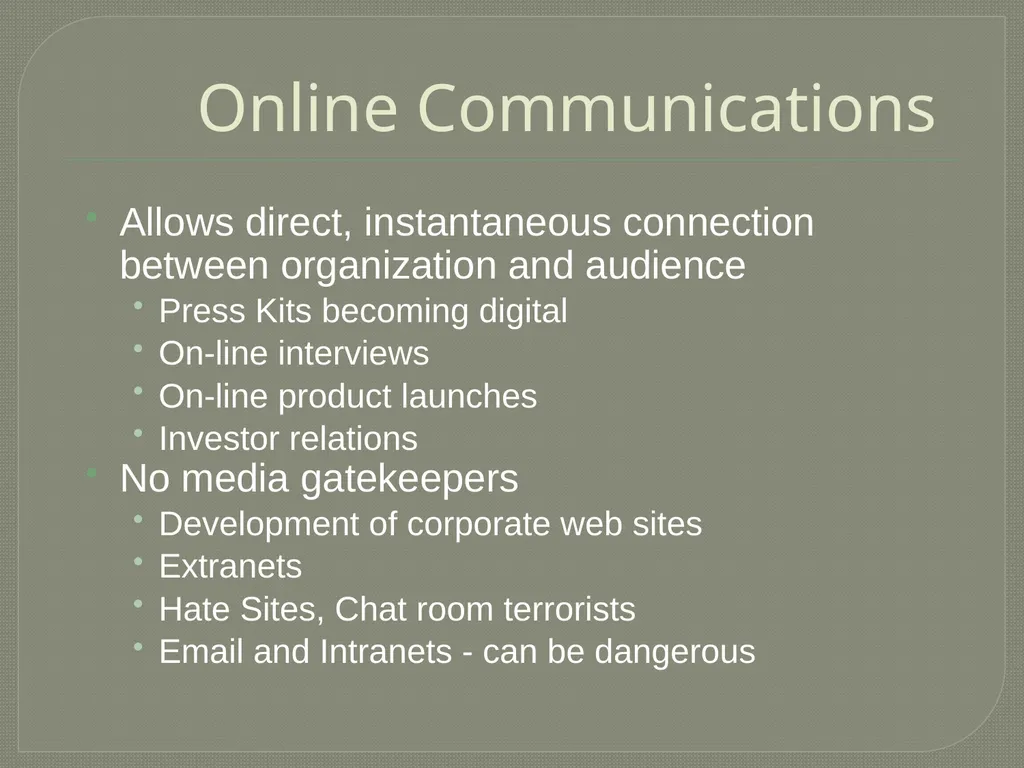
slide20. Online Communications Allows direct, instantaneous connection between organization and audience
Press Kits becoming digital
On-line interviews
On-line product launches
Investor relations
No media gatekeepers
Development of corporate web sites
Extranets
Hate Sites, Chat room terrorists
Email and Intranets - can be dangerous<br>
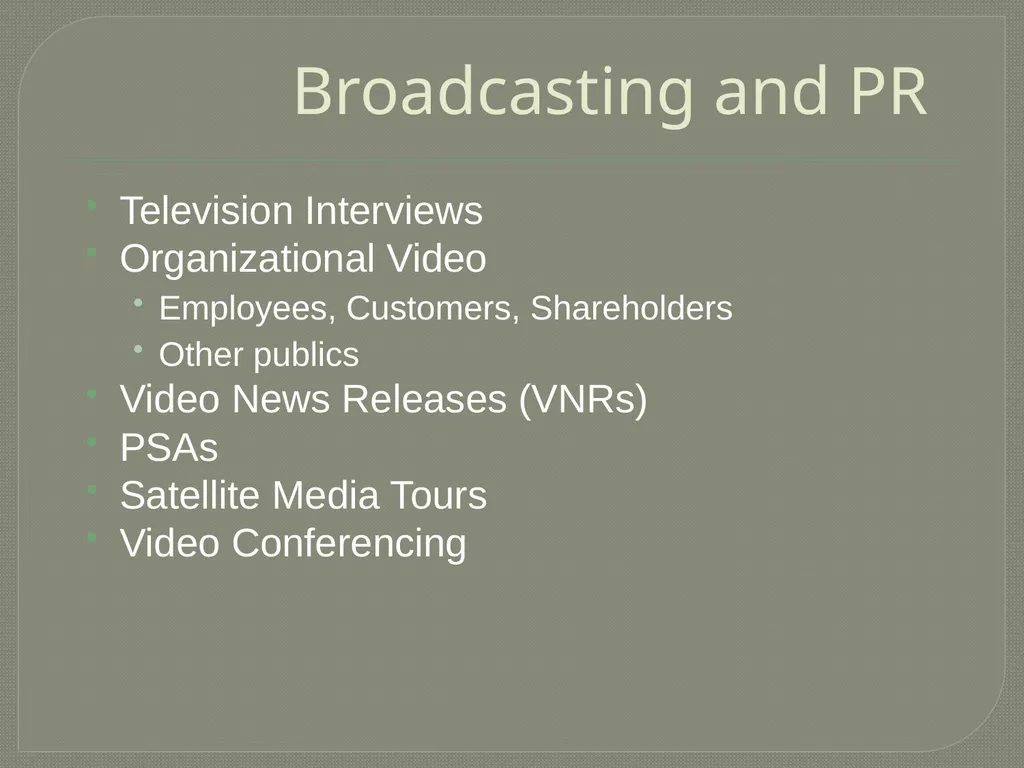
slide21. Broadcasting and PR Television Interviews
Organizational Video
Employees, Customers, Shareholders
Other publics
Video News Releases (VNRs)
PSAs
Satellite Media Tours
Video Conferencing<br>
slide22. Assessing Effectiveness Hard to track the effects of PR
Particularly for unpaid placements
Takes effort to find output of campaign
Process Evaluation - number of placements, number of articles, number of appearances
Outcome Evaluation - measure change in audience knowledge, attitudes, and behaviors
Try to tie change to PR efforts<br>
slide23. Content Analysis Frequency of coverage
Placement within paper
People reached
Messages conveyed
Editing of releases
Attitude conveyed<br>
slide2. Campaign Strategy Objectives – What are your goals?
Targeting – Who are your best prospects?
Timing – When to market the product/service?
Geography – Where to concentrate your efforts?
Positioning – What’s your place relative to competition?
Brand personality – Human characteristics of your brand?
Competitive Advantage – What differentiate your brand?
and ++++++++
Then do the Creative Brief<br>
slide3. Public Relations Plan Review public opinion and press coverage
Statement of public relations strategy
What issues are important to your publics?
How will you manage opinion on these issues?
Media relations and placement strategy
Target vehicle selection - Who?, What?, How?
Product placement - Where? When? Why?
Discussion of public relations tactics
Publicity Programs, Staged Events, PR Ads
Discussion of promotional activities
Contests and Incentives<br>
slide4. Traditional PR Tools House Ads
In-House Publications
Public Service Announcements (PSAs)
Corporate Advertising
Speakers, Photographs, Films
Displays, Exhibits, Staged Events<br>
slide5. The Press Release Primary tool used to deliver messages to editors, producers, and reporters
Produced by company, used by press
Must be tailored to medium, written well, and, generally, tight and simple
Print news release, Video news release<br>
slide6. Print Press Release News Values
Conflict
Impact
Novelty
Distance
Eminence
Recency
CINDER - The spark but not the fire<br>
slide7. Role of the Reporter Reporter just needs to write the story
Have to think about how they will see you press release - what is the peg and hook
The Peg, this is what makes it news
The Hook, this is what makes it interesting
They may decide not to write about you, write something you don’t want, or write something tangential to your goals<br>
slide8. Press Release Format Double Spaced on 8.5” by 11”
Provide name, address, & phone number
Release date, typically no embargoes
Margins should be 1.5”
Length – short paragraphs
Slug lines – “more” / “###” at the bottom
Include a headline and cutlines
Timing – be sensitive to editorial deadlines<br>
slide9. Press Release Style Be fair and try to be objective
Use quotes
AP Style
Inverted pyramid
Do not misspell
Proofread<br>
slide11. Media/Press Kits Structures a successful press conference
Normally in folder form - easy access
Provides important background info
Given before or at press conference
News release
Backgrounder
Biography
Photographs
Fact Sheets
Q & A sheets<br>
slide12. Media Kits Make sure information is accurate and answers most fundamental questions
Sufficient background information to allow editor to select a story angle
Not too commercial. Balance and fair
Confine opinions to credible sources
Have visually arresting graphics<br>
slide13. Backgrounder Provide additional information to complement the shorter news release
Longer and more general
4-5 page backgrounder provides editors with more depth and details
Unlimited latitude for the writer
Subject matter dictates the form
News Release Style
Descriptive, narrative style<br>
slide14. Biography Biographical summary of key person/s
Can take many forms
Straight Biography
Narrative Biography<br>
slide15. Fact Sheet or Q&A Fact Sheet is a document that compactly profiles an organization
Company, product lines, top managers, location, sales, leading product, history
Q & A either substitutes for or complements a fact sheet
Lists the FAQs
May substitute for a personal interview<br>
slide16. Supporting Materials Photographs
In real environments, but eye-catching
Focus on product/issue
Have an underlying message<br>
slide17. Press Conference Convene media representatives to make a statement/answer questions
Risky PR activity - must be taken seriously
Will the press show up?
Will they ask the right questions?
Do you want to answer them?
Do you know how to answer?
How will you react if you are cornered or unable to field the question?<br>
slide18. Press Conference Nov 1 – 5:00 – 7:00 PM / Class Zoom Link
• Hilton Aspire will meet from 5:00 – 6:00 • Marriott Bonvoy will meet from 6:00 – 7:00
10 minutes to set up & process the breaking news story
Welcome journalists and confirm press kits; share if needed
Presentation should last 10 minutes with 10 minutes Q&A
Will discuss event just after departure of journalists.
Press release due at 1:00 p.m. on Thursday, October 27
Send to me and Abby so we can send to 335 Students
Full Electronic Press Kit due on Tuesday, November 1 before event
Include press release, fact sheet, pictures and graphics, printout of presentation deck (optional), and supporting materials (zipped into a single file)<br>
slide19. Press Conference Roles Account Directors
Host press conference; Presentation and Q&A
PR/Promotions Directors
Write Press Release; Prepare the press conference
Research Directors
Prepare the fact sheet; IM at the press conference
Creative Directors
Make press kit + visual elements of press kit,
Media Directors
Generate media contacts (about 20); 10 Tweets<br>
slide20. Online Communications Allows direct, instantaneous connection between organization and audience
Press Kits becoming digital
On-line interviews
On-line product launches
Investor relations
No media gatekeepers
Development of corporate web sites
Extranets
Hate Sites, Chat room terrorists
Email and Intranets - can be dangerous<br>
slide21. Broadcasting and PR Television Interviews
Organizational Video
Employees, Customers, Shareholders
Other publics
Video News Releases (VNRs)
PSAs
Satellite Media Tours
Video Conferencing<br>
slide22. Assessing Effectiveness Hard to track the effects of PR
Particularly for unpaid placements
Takes effort to find output of campaign
Process Evaluation - number of placements, number of articles, number of appearances
Outcome Evaluation - measure change in audience knowledge, attitudes, and behaviors
Try to tie change to PR efforts<br>
slide23. Content Analysis Frequency of coverage
Placement within paper
People reached
Messages conveyed
Editing of releases
Attitude conveyed<br>