
Public Relations N5 www.futuremanagers.com NATURE
MY
Published · 50 slides · 0 views

1 / 1


Description
Public Relations N5 www.futuremanagers.com NATURE AND DEFINITION OF PUBLIC RELATIONS Organisational Public Relations is concerned with promoting and improving a companys image or reputation of an organisation through communicating the
Related Topics
Share
Embed code
Download this presentation From Below
"Public Relations N5 www.futuremanagers.com NATURE" is the property of its rightful owner. Permission is granted to download and print the materials on this website for personal, non-commercial use only, and to display it on your personal computer provided you do not modify the materials and that you retain all copyright notices contained in the materials. By downloading content from our website, you accept the terms of this agreement.
Presentation Transcript
01
Public Relations
N5<br>
N5<br>
02
www.futuremanagers.com NATURE AND DEFINITION OF PUBLIC RELATIONS
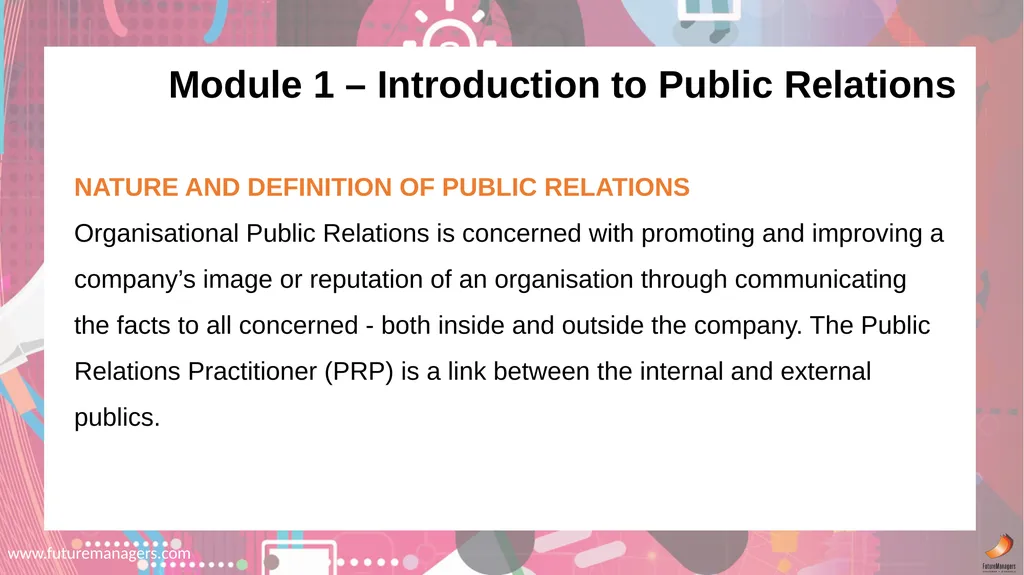
Organisational Public Relations is concerned with promoting and improving a company’s image or reputation of an organisation through communicating the facts to all concerned - both inside and outside the company. The Public Relations Practitioner (PRP) is a link between the internal and external publics. Module 1 – Introduction to Public Relations<br>
Organisational Public Relations is concerned with promoting and improving a company’s image or reputation of an organisation through communicating the facts to all concerned - both inside and outside the company. The Public Relations Practitioner (PRP) is a link between the internal and external publics. Module 1 – Introduction to Public Relations<br>
03
www.futuremanagers.com Module 1 – Introduction to Public Relations (continued) THE NEED FOR PUBLIC RELATIONS IN SOCIETY
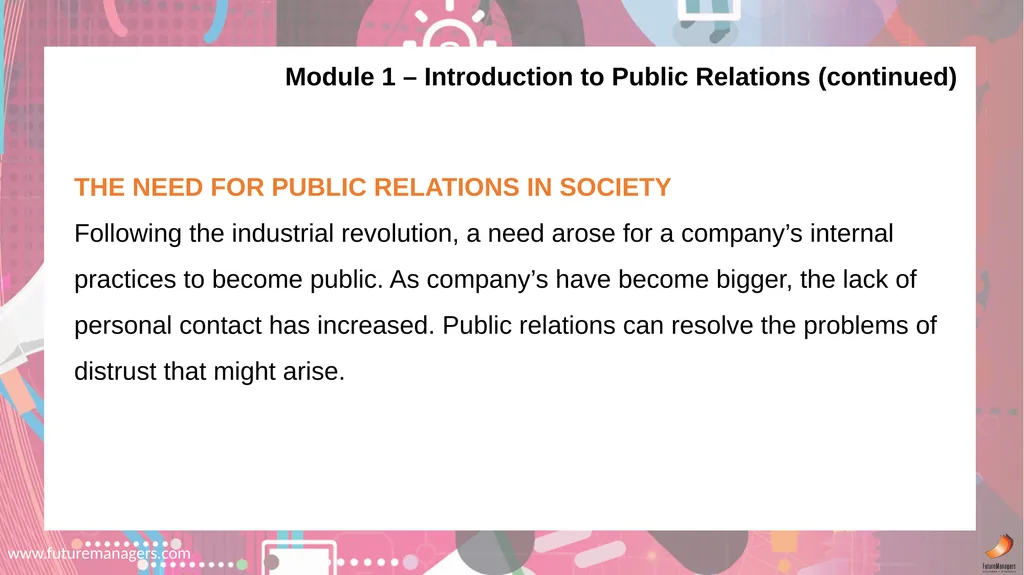
Following the industrial revolution, a need arose for a company’s internal practices to become public. As company’s have become bigger, the lack of personal contact has increased. Public relations can resolve the problems of distrust that might arise.<br>
Following the industrial revolution, a need arose for a company’s internal practices to become public. As company’s have become bigger, the lack of personal contact has increased. Public relations can resolve the problems of distrust that might arise.<br>
04
www.futuremanagers.com Module 1 – Introduction to Public Relations (continued) THE TWO-FOLD TASK OF THE PUBLIC RELATIONS PRACTITIONER
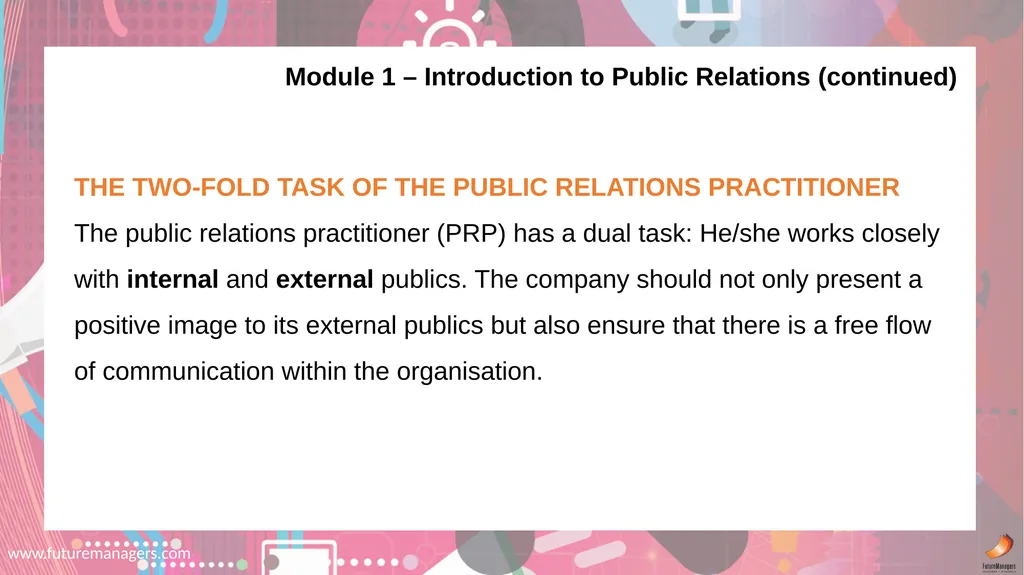
The public relations practitioner (PRP) has a dual task: He/she works closely with internal and external publics. The company should not only present a positive image to its external publics but also ensure that there is a free flow of communication within the organisation.<br>
The public relations practitioner (PRP) has a dual task: He/she works closely with internal and external publics. The company should not only present a positive image to its external publics but also ensure that there is a free flow of communication within the organisation.<br>
05
www.futuremanagers.com Module 1 – Introduction to Public Relations (continued) THE ORGANISATION OF PUBLIC RELATIONS
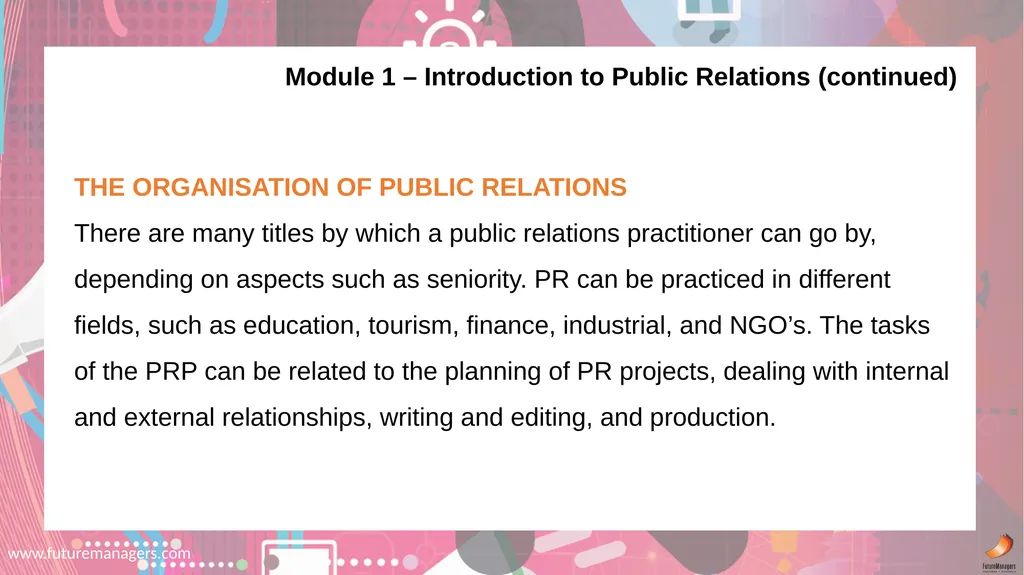
There are many titles by which a public relations practitioner can go by, depending on aspects such as seniority. PR can be practiced in different fields, such as education, tourism, finance, industrial, and NGO’s. The tasks of the PRP can be related to the planning of PR projects, dealing with internal and external relationships, writing and editing, and production.<br>
There are many titles by which a public relations practitioner can go by, depending on aspects such as seniority. PR can be practiced in different fields, such as education, tourism, finance, industrial, and NGO’s. The tasks of the PRP can be related to the planning of PR projects, dealing with internal and external relationships, writing and editing, and production.<br>
06
www.futuremanagers.com Module 1 – Introduction to Public Relations (continued) AREAS RELATED TO PUBLIC RELATIONS
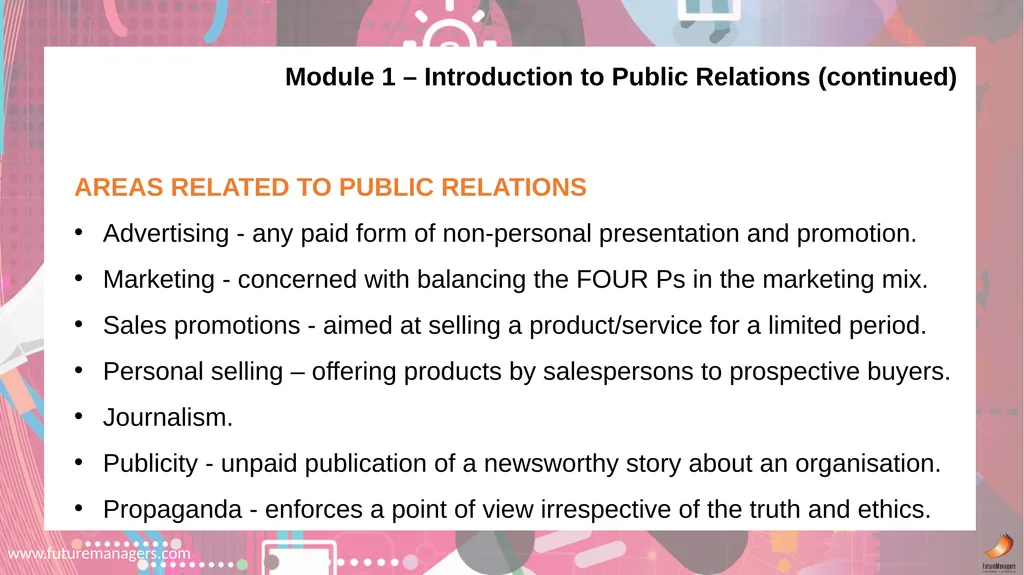
Advertising - any paid form of non-personal presentation and promotion.
Marketing - concerned with balancing the FOUR Ps in the marketing mix.
Sales promotions - aimed at selling a product/service for a limited period.
Personal selling – offering products by salespersons to prospective buyers.
Journalism.
Publicity - unpaid publication of a newsworthy story about an organisation.
Propaganda - enforces a point of view irrespective of the truth and ethics.<br>
Advertising - any paid form of non-personal presentation and promotion.
Marketing - concerned with balancing the FOUR Ps in the marketing mix.
Sales promotions - aimed at selling a product/service for a limited period.
Personal selling – offering products by salespersons to prospective buyers.
Journalism.
Publicity - unpaid publication of a newsworthy story about an organisation.
Propaganda - enforces a point of view irrespective of the truth and ethics.<br>
07
www.futuremanagers.com THE PUBLIC RELATIONS PRACTITIONER
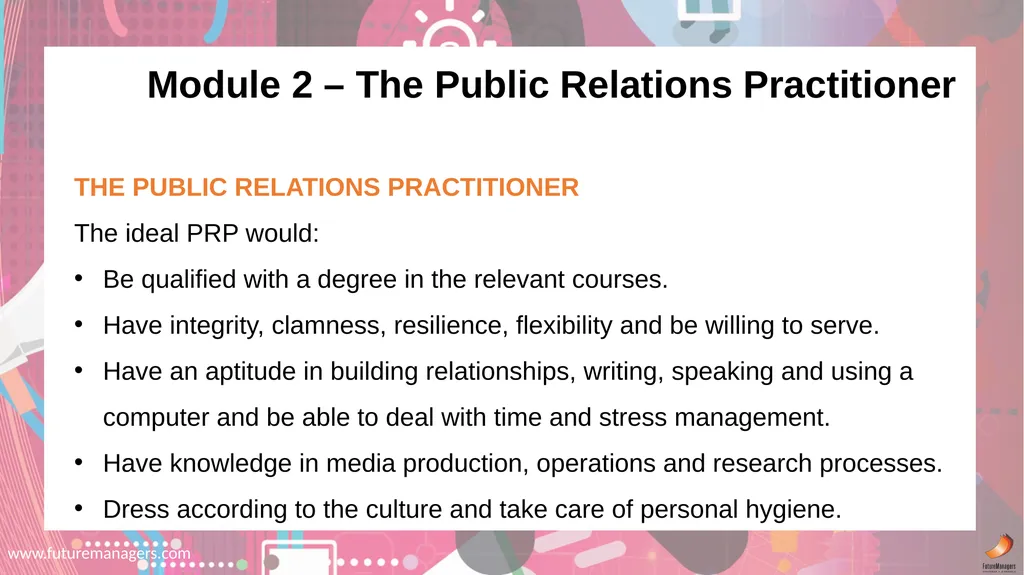
The ideal PRP would:
Be qualified with a degree in the relevant courses.
Have integrity, clamness, resilience, flexibility and be willing to serve.
Have an aptitude in building relationships, writing, speaking and using a computer and be able to deal with time and stress management.
Have knowledge in media production, operations and research processes.
Dress according to the culture and take care of personal hygiene. Module 2 – The Public Relations Practitioner<br>
The ideal PRP would:
Be qualified with a degree in the relevant courses.
Have integrity, clamness, resilience, flexibility and be willing to serve.
Have an aptitude in building relationships, writing, speaking and using a computer and be able to deal with time and stress management.
Have knowledge in media production, operations and research processes.
Dress according to the culture and take care of personal hygiene. Module 2 – The Public Relations Practitioner<br>
08
www.futuremanagers.com Module 2 – The Public Relations Practitioner (continued) THE ROLE OF PRISA IN PUBLIC RELATIONS
PRISA stands for The Public Relations Institute of Southern Africa. PRISA concerns itself guarding the field of Public Relations, ensuring that members are accredited and setting codes of conduct.<br>
PRISA stands for The Public Relations Institute of Southern Africa. PRISA concerns itself guarding the field of Public Relations, ensuring that members are accredited and setting codes of conduct.<br>
09
www.futuremanagers.com Module 2 – The Public Relations Practitioner (continued) NETWORKING
Networking is a system of developing professional contacts and networks in the business world. Successful networking is achieved by joining professional organisations and meeting other professionals in your field.<br>
Networking is a system of developing professional contacts and networks in the business world. Successful networking is achieved by joining professional organisations and meeting other professionals in your field.<br>
10
www.futuremanagers.com Module 2 – The Public Relations Practitioner (continued) FRONTLINE SKILLS
Knowledge in the following front-line areas is essential for the receptionist (the first person with whom the general public comes into contact) and the PRP:
Public – external and internal knowledge, such as staff names and titles;
The company’s history, vision, mission, and policies;
Products sold or services rendered; and
Social responsibility programmes offered.<br>
Knowledge in the following front-line areas is essential for the receptionist (the first person with whom the general public comes into contact) and the PRP:
Public – external and internal knowledge, such as staff names and titles;
The company’s history, vision, mission, and policies;
Products sold or services rendered; and
Social responsibility programmes offered.<br>
11
www.futuremanagers.com Module 2 – The Public Relations Practitioner (continued) CLIENT RELATIONS
Client relations refers to the customer service component in public relations. If a company shows bad customer service, it is unlikely that it will retain a high number of customers. With good, friendly service, a company will keep its customers while growing and gaining more.<br>
Client relations refers to the customer service component in public relations. If a company shows bad customer service, it is unlikely that it will retain a high number of customers. With good, friendly service, a company will keep its customers while growing and gaining more.<br>
12
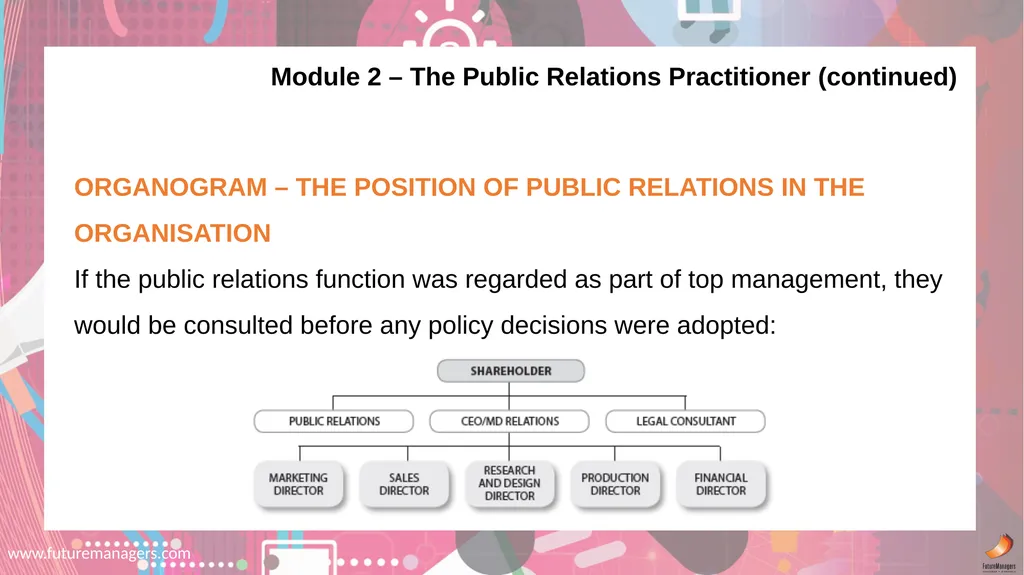
www.futuremanagers.com Module 2 – The Public Relations Practitioner (continued) ORGANOGRAM – THE POSITION OF PUBLIC RELATIONS IN THE ORGANISATION
If the public relations function was regarded as part of top management, they would be consulted before any policy decisions were adopted:<br>
If the public relations function was regarded as part of top management, they would be consulted before any policy decisions were adopted:<br>
13
www.futuremanagers.com INTRODUCTION: FORMULATING A PUBLIC RELATIONS PROGRAMME
Establishing a public relations programme has four main areas:
Research/listening - involves finding out the opinions of the public who are affected by the organisation.
Planning/decision making - using opinion to influence policies.
Communication/action -explaining the plan of action to all who are involved and getting their support.
Evaluation - evaluating the results of the programme. Module 3 – The Public Relations Process<br>
Establishing a public relations programme has four main areas:
Research/listening - involves finding out the opinions of the public who are affected by the organisation.
Planning/decision making - using opinion to influence policies.
Communication/action -explaining the plan of action to all who are involved and getting their support.
Evaluation - evaluating the results of the programme. Module 3 – The Public Relations Process<br>
14
www.futuremanagers.com THE AIM OF INTERNAL PUBLIC RELATIONS COMMUNICATION
To ensure that employees feel valued and indispensable members of a team;
To promote an understanding of management’s problems, needs, duties, obligations and practices and faith in the goodwill behind these.
To maintain an atmosphere and is conducive to genuine two-way communication.
To provide a direct channel to employees and a channel for feedback. Module 4 – Internal Communication<br>
To ensure that employees feel valued and indispensable members of a team;
To promote an understanding of management’s problems, needs, duties, obligations and practices and faith in the goodwill behind these.
To maintain an atmosphere and is conducive to genuine two-way communication.
To provide a direct channel to employees and a channel for feedback. Module 4 – Internal Communication<br>
15
www.futuremanagers.com Module 4 – Internal Communication (continued) THE PRINCIPLES OF EMPLOYEE COMMUNICATION
Some of the principles of employee communication include:
Using plain clear language;
Considering your target audience;
Choosing the appropriate communication ‘tool’;
Obtaining feedback; and
Being sensitive to cultural background.<br>
Some of the principles of employee communication include:
Using plain clear language;
Considering your target audience;
Choosing the appropriate communication ‘tool’;
Obtaining feedback; and
Being sensitive to cultural background.<br>
16
www.futuremanagers.com Module 4 – Internal Communication (continued) METHODS OF INTERNAL COMMUNICATION
These fall into three categories:
Direct – such as face-to-face meetings;
Electronic – such as a local area network or video conference; and
Printed – such as introduction booklets and information pamphlets.<br>
These fall into three categories:
Direct – such as face-to-face meetings;
Electronic – such as a local area network or video conference; and
Printed – such as introduction booklets and information pamphlets.<br>
17
www.futuremanagers.com Module 4 – Internal Communication (continued) COMMUNICATION AUDIT – A TOOL OF MEASUREMENT OF THE EFFECTIVENESS OF INTERNAL COMMUNICATION
A communication audit consists of carefully compiled questionnaires on the effectiveness of internal communication that are distributed to the staff in order to find solutions to issues or to improve aspects of the organisation.<br>
A communication audit consists of carefully compiled questionnaires on the effectiveness of internal communication that are distributed to the staff in order to find solutions to issues or to improve aspects of the organisation.<br>
18
www.futuremanagers.com BASIC PUBLIC RELATIONS ETIQUETTE - PUBLIC
PRISA’s code of professional conduct towards the public includes:
We shall respect the public interest and the dignity of the individual.
We shall not knowingly, intentionally or recklessly communicate false or misleading information.
We have a positive duty to maintain integrity and accuracy, as well as generally accepted standards of good taste. Module 5 – Social Skills and Protocol<br>
PRISA’s code of professional conduct towards the public includes:
We shall respect the public interest and the dignity of the individual.
We shall not knowingly, intentionally or recklessly communicate false or misleading information.
We have a positive duty to maintain integrity and accuracy, as well as generally accepted standards of good taste. Module 5 – Social Skills and Protocol<br>
19
www.futuremanagers.com BASIC PUBLIC RELATIONS ETIQUETTE – COLLEAGUES
PRISA’s code of conduct towards colleagues includes:
Members shall not purposefully harm the professional reputation or practice of another registered individual, professional person or accredited PR practitioner,
Members shall co-operate with colleagues to uphold and apply this code. Module 5 – Social Skills and Protocol<br>
PRISA’s code of conduct towards colleagues includes:
Members shall not purposefully harm the professional reputation or practice of another registered individual, professional person or accredited PR practitioner,
Members shall co-operate with colleagues to uphold and apply this code. Module 5 – Social Skills and Protocol<br>
20
www.futuremanagers.com Module 5 – Social Skills and Protocol (continued) COMMUNICATION AND PUBLIC RELATIONS
The PRP uses different communication styles on different occasions, such as:
The controlling style – communicator makes all of the decisions;
The egalitarian style – employee participation is key in problem solving;
The structural style – “by the book”;
The dynamic style – unfiltered and concise;
The relinquishing style – gives up communicator's opinion;
The withdrawal style – communicator takes a neutral stance.<br>
The PRP uses different communication styles on different occasions, such as:
The controlling style – communicator makes all of the decisions;
The egalitarian style – employee participation is key in problem solving;
The structural style – “by the book”;
The dynamic style – unfiltered and concise;
The relinquishing style – gives up communicator's opinion;
The withdrawal style – communicator takes a neutral stance.<br>
21
www.futuremanagers.com Module 5 – Social Skills and Protocol (continued) NON-VERBAL COMMUNICATION
Non-verbal communication refers to the way we stand, walk, move and look. Good interpersonal communication depends both on active listening and the participants’ ability to interpret non-verbal communication. It is often referred to as ‘body language.’<br>
Non-verbal communication refers to the way we stand, walk, move and look. Good interpersonal communication depends both on active listening and the participants’ ability to interpret non-verbal communication. It is often referred to as ‘body language.’<br>
22
www.futuremanagers.com Module 5 – Social Skills and Protocol (continued) THE USE OF THE TELEPHONE IN PUBLIC RELATIONS
The telephonist performs a vital function in the organisation. The words, attitude, tone and speed with which he/she answers the telephone is the first impression that the caller has of the organisation.<br>
The telephonist performs a vital function in the organisation. The words, attitude, tone and speed with which he/she answers the telephone is the first impression that the caller has of the organisation.<br>
23
www.futuremanagers.com Module 5 – Social Skills and Protocol (continued) BUSINESS PROTOCOL IN SOUTH AFRICA
The public relations practitioner is the specialist in protocol in the organisation. South Africa is a dynamic society and new forms of accepted behaviour are evolving all the time. For example, Madiba set a new fashion trend with his renowned shirts.<br>
The public relations practitioner is the specialist in protocol in the organisation. South Africa is a dynamic society and new forms of accepted behaviour are evolving all the time. For example, Madiba set a new fashion trend with his renowned shirts.<br>
24
www.futuremanagers.com Module 5 – Social Skills and Protocol (continued) INFORMATION SERVICES
Almost anything you need for your promotions/PR communication programme can be accessed through the Yellow Pages as well as: Photographers
Signs and displays
Translation services
Hiring services
Shop-fittings
Television production services
Tuxedo hire
Stage erecting and lighting
Video and sound equipment<br>
Almost anything you need for your promotions/PR communication programme can be accessed through the Yellow Pages as well as: Photographers
Signs and displays
Translation services
Hiring services
Shop-fittings
Television production services
Tuxedo hire
Stage erecting and lighting
Video and sound equipment<br>
25
www.futuremanagers.com Module 5 – Social Skills and Protocol (continued) BASIC NEGOTIATING SKILLS
Have qualities of:
Openness;
Active listening skills;
Integrity;
Being objective and unbiased; and
Patience.<br>
Have qualities of:
Openness;
Active listening skills;
Integrity;
Being objective and unbiased; and
Patience.<br>
26
www.futuremanagers.com NEWS AND NEWS CATEGORIES
News must be relevant to the readers and provide information about new, fresh information about events that have taken place.
News categories are:
Hard news;
Soft news; and
Researched news. Module 6 – Media<br>
News must be relevant to the readers and provide information about new, fresh information about events that have taken place.
News categories are:
Hard news;
Soft news; and
Researched news. Module 6 – Media<br>
27
www.futuremanagers.com Module 6 – Media (continued) THE PRINTED MEDIA
This can be categorized into:
Newspapers; and
Magazines.<br>
This can be categorized into:
Newspapers; and
Magazines.<br>
28
www.futuremanagers.com Module 6 – Media (continued) ELECTRONIC MEDIA
This can be categorized into:
The radio; and
Television.<br>
This can be categorized into:
The radio; and
Television.<br>
29
www.futuremanagers.com BASIC APPROACH AND MEDIA SELECTION
It is vital to conduct background research on the nature of the product or service, the cost of the medium, the target audience, the budget, the atmosphere and the technical requirements before making any decisions on the appropriate media. Module 7 – Media Relations<br>
It is vital to conduct background research on the nature of the product or service, the cost of the medium, the target audience, the budget, the atmosphere and the technical requirements before making any decisions on the appropriate media. Module 7 – Media Relations<br>
30
www.futuremanagers.com Module 7 – Media Relations (continued) THE MEDIA (NEWS) RELEASE
The contents of a media release will include:
The topic, which must be interesting and newsworthy;
A title for the story;
The date and a reference number;
The name, address and contact details of the company and representative.<br>
The contents of a media release will include:
The topic, which must be interesting and newsworthy;
A title for the story;
The date and a reference number;
The name, address and contact details of the company and representative.<br>
31
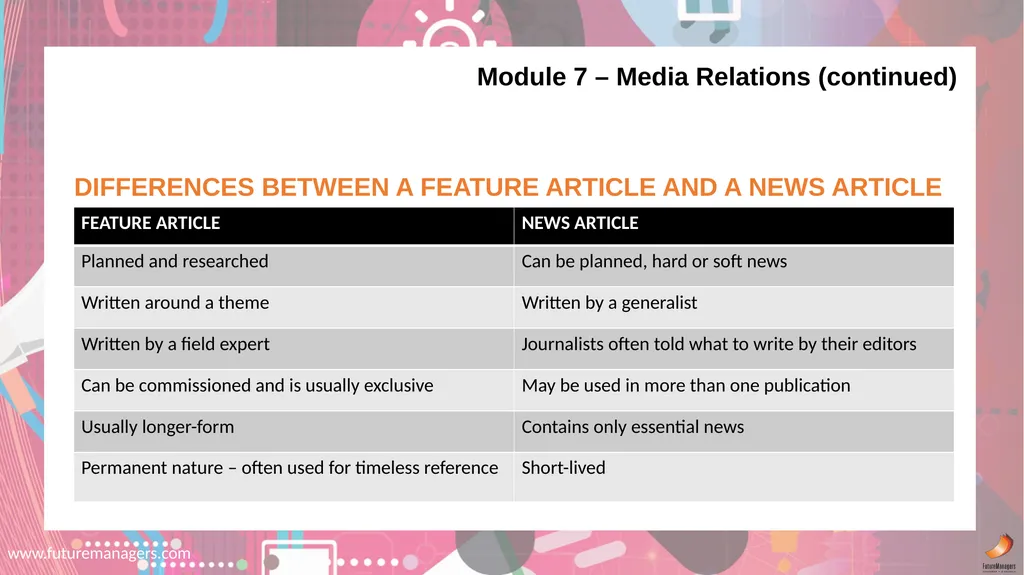
www.futuremanagers.com Module 7 – Media Relations (continued) DIFFERENCES BETWEEN A FEATURE ARTICLE AND A NEWS ARTICLE<br>
32
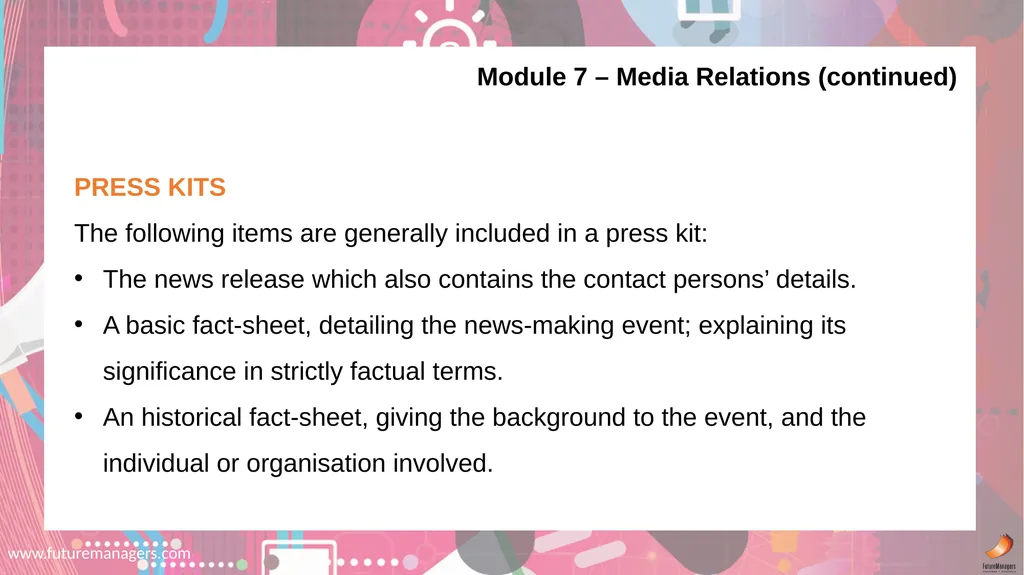
www.futuremanagers.com Module 7 – Media Relations (continued) PRESS KITS
The following items are generally included in a press kit:
The news release which also contains the contact persons’ details.
A basic fact-sheet, detailing the news-making event; explaining its significance in strictly factual terms.
An historical fact-sheet, giving the background to the event, and the individual or organisation involved.<br>
The following items are generally included in a press kit:
The news release which also contains the contact persons’ details.
A basic fact-sheet, detailing the news-making event; explaining its significance in strictly factual terms.
An historical fact-sheet, giving the background to the event, and the individual or organisation involved.<br>
33
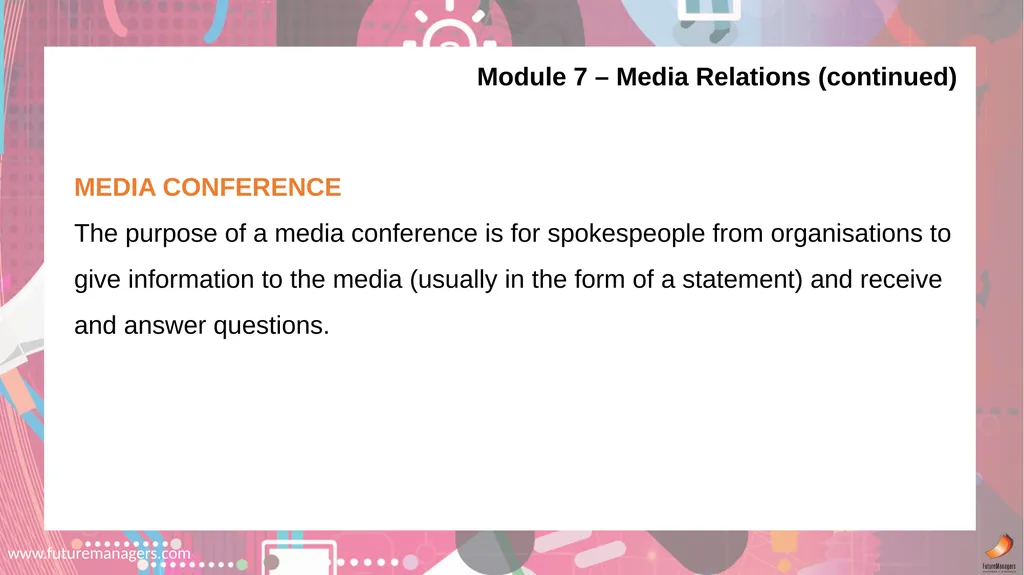
www.futuremanagers.com Module 7 – Media Relations (continued) MEDIA CONFERENCE
The purpose of a media conference is for spokespeople from organisations to give information to the media (usually in the form of a statement) and receive and answer questions.<br>
The purpose of a media conference is for spokespeople from organisations to give information to the media (usually in the form of a statement) and receive and answer questions.<br>
34
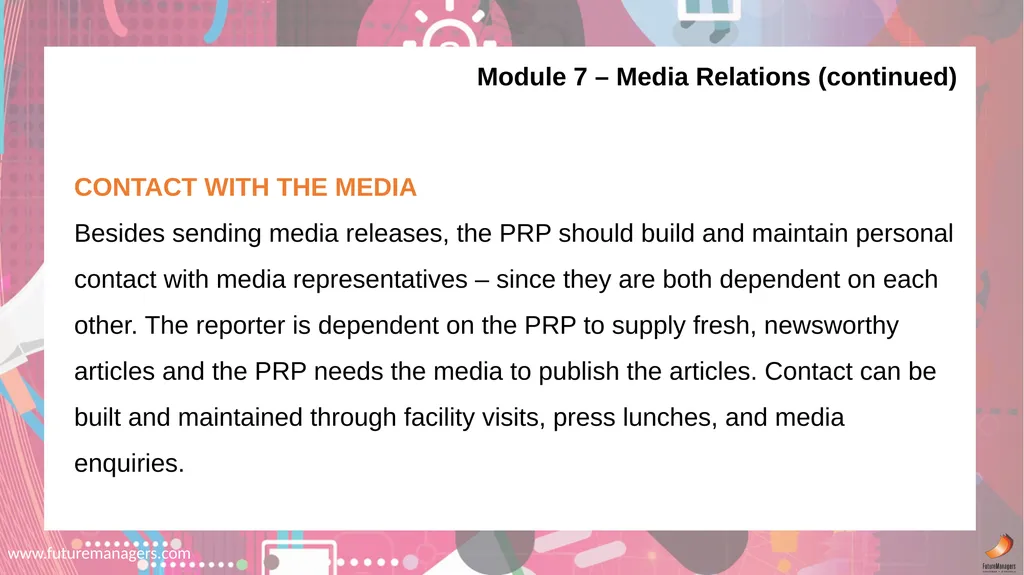
www.futuremanagers.com Module 7 – Media Relations (continued) CONTACT WITH THE MEDIA
Besides sending media releases, the PRP should build and maintain personal contact with media representatives – since they are both dependent on each other. The reporter is dependent on the PRP to supply fresh, newsworthy articles and the PRP needs the media to publish the articles. Contact can be built and maintained through facility visits, press lunches, and media enquiries.<br>
Besides sending media releases, the PRP should build and maintain personal contact with media representatives – since they are both dependent on each other. The reporter is dependent on the PRP to supply fresh, newsworthy articles and the PRP needs the media to publish the articles. Contact can be built and maintained through facility visits, press lunches, and media enquiries.<br>
35
www.futuremanagers.com Module 7 – Media Relations (continued) THE VALUE OF PHOTOGRAPHS IN PR
It provides proof of an event.
It adds interest and stimulates attention.
They impart an immediate message – quicker than text does.
It has direct appeal.
They lend aesthetic value to publications.
They make publications more user-friendly and potentially less boring.<br>
It provides proof of an event.
It adds interest and stimulates attention.
They impart an immediate message – quicker than text does.
It has direct appeal.
They lend aesthetic value to publications.
They make publications more user-friendly and potentially less boring.<br>
36
www.futuremanagers.com Module 7 – Media Relations (continued) PACKAGING, DESPATCH, HANDLING AND FILING OF PHOTOGRAPHS
Cover the photograph with a clean sheet of paper and enclose it in an envelope with two pieces of cardboard on either side.
Courier press releases and photographs or have them delivered locally by the company messenger.
Stored them in a dry cool room and enclosed in cardboard sleeves.<br>
Cover the photograph with a clean sheet of paper and enclose it in an envelope with two pieces of cardboard on either side.
Courier press releases and photographs or have them delivered locally by the company messenger.
Stored them in a dry cool room and enclosed in cardboard sleeves.<br>
37
www.futuremanagers.com CUSTOMERS/CLIENTS
Customers/clients are important to the company because they determine the long-term future of the company. Staff should be trained to be service-orientated and honest when meeting with customers or clients. Module 8 – Interpersonal Relationships in the Business World<br>
Customers/clients are important to the company because they determine the long-term future of the company. Staff should be trained to be service-orientated and honest when meeting with customers or clients. Module 8 – Interpersonal Relationships in the Business World<br>
38
www.futuremanagers.com Module 8 – Interpersonal Relationships in the Business World (continued) SUPPLIERS
Suppliers are important to a company because they supply products and services that an organisation needs. Suppliers should be paid timeously in order to maintain positive relations.<br>
Suppliers are important to a company because they supply products and services that an organisation needs. Suppliers should be paid timeously in order to maintain positive relations.<br>
39
www.futuremanagers.com Module 8 – Interpersonal Relationships in the Business World (continued) SPONSORS
A sponsorship is an exchange between an organisation and an entity. The company expects publicity in return for financial backing. A donation is money that is given to a cause with no expectation of a return.<br>
A sponsorship is an exchange between an organisation and an entity. The company expects publicity in return for financial backing. A donation is money that is given to a cause with no expectation of a return.<br>
40
www.futuremanagers.com Module 8 – Interpersonal Relationships in the Business World (continued) THE GOVERNMENT
The government is important to a business because they will pass laws that affect the company and a positive endorsement from a company might add to the organisational image. In order to maintain food relations with the government, companies should obey laws and regulations in place as well as liaise with government representatives to find out whether there are any changes in legislation in the pipeline.<br>
The government is important to a business because they will pass laws that affect the company and a positive endorsement from a company might add to the organisational image. In order to maintain food relations with the government, companies should obey laws and regulations in place as well as liaise with government representatives to find out whether there are any changes in legislation in the pipeline.<br>
41
www.futuremanagers.com Module 8 – Interpersonal Relationships in the Business World (continued) THE MEDIA
The media is important to a company because it is the gateway to other target audiences. In order to maintain good relations with the media, draw up a list of media connections and maintain contact when suitable an send media releases to the relevant editor.<br>
The media is important to a company because it is the gateway to other target audiences. In order to maintain good relations with the media, draw up a list of media connections and maintain contact when suitable an send media releases to the relevant editor.<br>
42
www.futuremanagers.com Module 8 – Interpersonal Relationships in the Business World (continued) SHAREHOLDERS
Shareholders are important to a company because they supply the company with the capital necessary to run the business. In order to maintain good relations with shareholders, a company should send questionnaires to see whether the shareholders are happy with the return. New shareholders should also be welcomed by the company.<br>
Shareholders are important to a company because they supply the company with the capital necessary to run the business. In order to maintain good relations with shareholders, a company should send questionnaires to see whether the shareholders are happy with the return. New shareholders should also be welcomed by the company.<br>
43
www.futuremanagers.com Module 8 – Interpersonal Relationships in the Business World (continued) FACTORS THAT INFLUENCE RELATIONSHIPS
Honesty and ethical practice.
Empathy – the ability to see how a situation affects the other party.
Courtesy at all times –particularly if the other party is tense.
Helpfulness – always go the second mile.<br>
Honesty and ethical practice.
Empathy – the ability to see how a situation affects the other party.
Courtesy at all times –particularly if the other party is tense.
Helpfulness – always go the second mile.<br>
44
www.futuremanagers.com CORPORATE CULTURE AND CORPORATE CLIMATE
Corporate culture or organisational culture is the behaviour that is taken for granted in that organisation. Conforming to the rules becomes the basis for reward and ability to rise in the organisation. Module 9 – Corporate Identity<br>
Corporate culture or organisational culture is the behaviour that is taken for granted in that organisation. Conforming to the rules becomes the basis for reward and ability to rise in the organisation. Module 9 – Corporate Identity<br>
45
www.futuremanagers.com Module 9 – Corporate Identity (continued) CORPORATE IDENTITY AND CORPORATE IMAGE
Corporate identity is the image the organisation wishes to portray – it is the visual identity of the company. Corporate image is the impression one has of a total organisation.<br>
Corporate identity is the image the organisation wishes to portray – it is the visual identity of the company. Corporate image is the impression one has of a total organisation.<br>
46
www.futuremanagers.com Module 9 – Corporate Identity (continued) THE ADVANTAGES OF A GOOD CORPORATE IMAGE
Consumers will buy products from organisations with a good reputation.
Consumers are likely to pay more and buy new products from a trusted company.
Shareholders will invest in a company with a good reputation.
Banks and suppliers will grant credit to a company with a good image.
Employees will gain job satisfaction – resulting in greater productivity, greater service orientation and ultimately greater profits.<br>
Consumers will buy products from organisations with a good reputation.
Consumers are likely to pay more and buy new products from a trusted company.
Shareholders will invest in a company with a good reputation.
Banks and suppliers will grant credit to a company with a good image.
Employees will gain job satisfaction – resulting in greater productivity, greater service orientation and ultimately greater profits.<br>
47
www.futuremanagers.com Module 9 – Corporate Identity (continued) PRINCIPLES OF BASIC DESIGN - LOGO
A logo is a symbol of an organisation. When designing or evaluating a logo it is necessary to check the following basic principles of design: Is the colour suitable for the content?
Is the design balanced?
Is the style up-to-date?
Is the logo suitable for the company?
Is it unique?
Is it memorable?<br>
A logo is a symbol of an organisation. When designing or evaluating a logo it is necessary to check the following basic principles of design: Is the colour suitable for the content?
Is the design balanced?
Is the style up-to-date?
Is the logo suitable for the company?
Is it unique?
Is it memorable?<br>
48
www.futuremanagers.com Module 9 – Corporate Identity (continued) IMPLEMENTING A CORPORATE IDENTITY PROGRAMME
The design process involved includes:
Briefing a designer;
Research;
Deciding on a design;
Compiling a manual; and
Implementation.<br>
The design process involved includes:
Briefing a designer;
Research;
Deciding on a design;
Compiling a manual; and
Implementation.<br>
49
www.futuremanagers.com Module 9 – Corporate Identity (continued) CORPORATE IDENTITY CHECKLIST
Stationery;
Literature;
Transportation;
Packaging materials;
Architecture
Signs;
Marketing and sales material;
Employee relations;
Operational materials;
Clothing; and
Gifts.<br>
Stationery;
Literature;
Transportation;
Packaging materials;
Architecture
Signs;
Marketing and sales material;
Employee relations;
Operational materials;
Clothing; and
Gifts.<br>
50
www.futuremanagers.com Module 9 – Corporate Identity (continued) FACTORS THAT AFFECT CORPORATE IMAGE
Factors influencing the corporate image are related to the four Ps:
Product;
Price;
Promotion; and
Place.<br>
Factors influencing the corporate image are related to the four Ps:
Product;
Price;
Promotion; and
Place.<br>