
Published Feb 2024 – Applies and Statutory from







Description: Published Feb 2024 Applies and Statutory from Sept 24 Working Together to Improve School Attendance. DfE Guidance Governor Updates 3rd July 2024 Alasdair Whitelaw Pupil Inclusion and Support Manager Aims To look at the statutory
Related Topics
Download Presentation
"Published Feb 2024 – Applies and Statutory from" is the property of its rightful owner. Permission is granted to download and print the materials on this website for personal, non-commercial use only, and to display it on your personal computer provided you do not modify the materials and that you retain all copyright notices contained in the materials. By downloading content from our website, you accept the terms of this agreement.
Presentation Transcript
slide1. Published Feb 2024 – Applies and Statutory from Sept ‘24 Working Together to Improve School Attendance. DfE Guidance Governor Updates – 3rd July 2024
Alasdair Whitelaw
Pupil Inclusion and Support Manager<br>
slide2. Aims To look at the statutory requirements relating to Attendance for all schools. To look at the Attendance governance role, and recommendations / best practice in terms of carrying it out.<br>
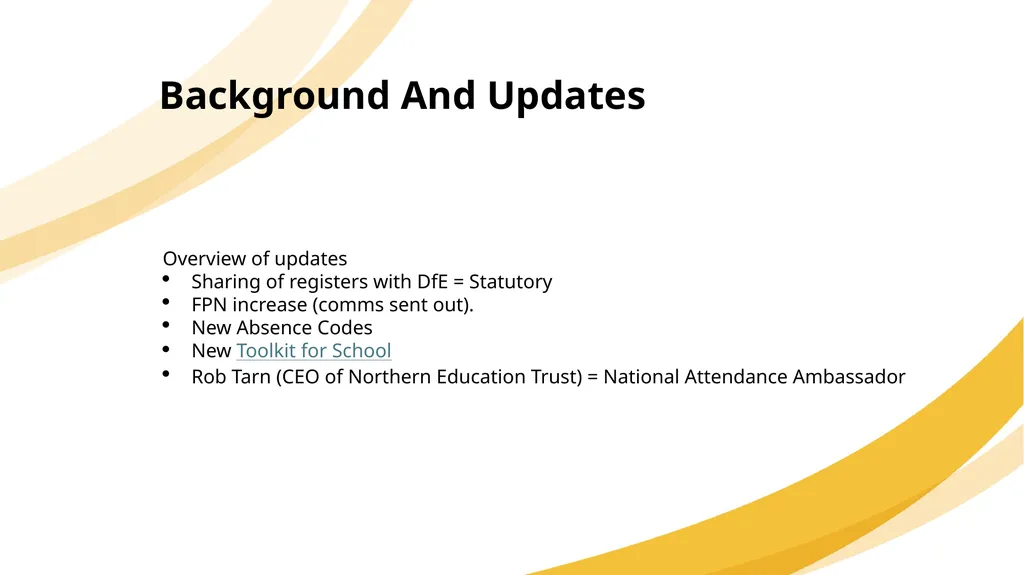
slide3. Overview of updates
Sharing of registers with DfE = Statutory
FPN increase (comms sent out).
New Absence Codes
New Toolkit for School
Rob Tarn (CEO of Northern Education Trust) = National Attendance Ambassador Background And Updates<br>
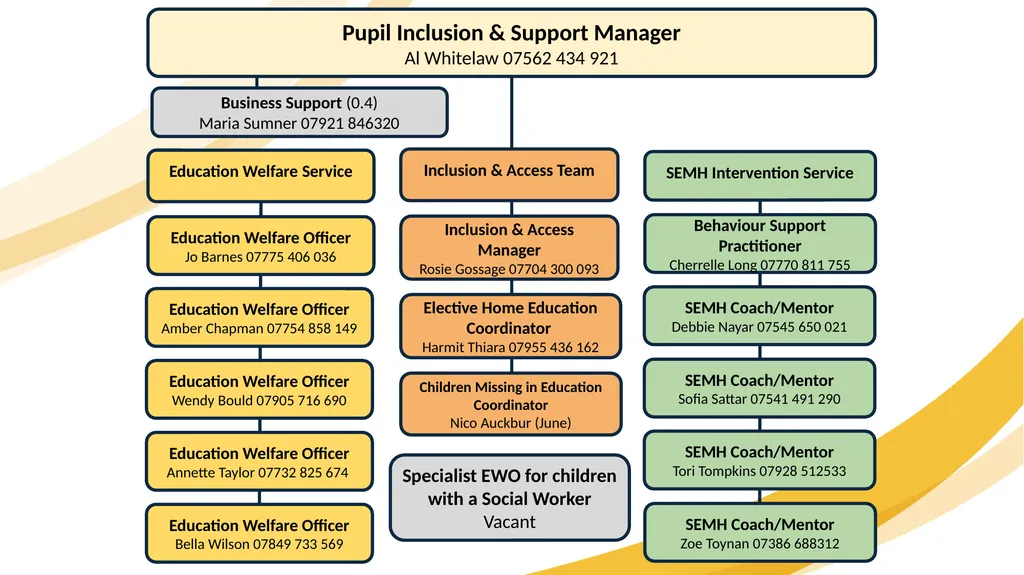
slide4. Pupil Inclusion & Support Manager
Al Whitelaw 07562 434 921 Education Welfare Service Inclusion & Access Team SEMH Intervention Service Behaviour Support Practitioner
Cherrelle Long 07770 811 755 Inclusion & Access Manager
Rosie Gossage 07704 300 093 Education Welfare Officer
Jo Barnes 07775 406 036 Education Welfare Officer
Amber Chapman 07754 858 149 Education Welfare Officer
Wendy Bould 07905 716 690 Elective Home Education Coordinator
Harmit Thiara 07955 436 162 Children Missing in Education Coordinator
Nico Auckbur (June) SEMH Coach/Mentor
Debbie Nayar 07545 650 021 SEMH Coach/Mentor
Tori Tompkins 07928 512533 Education Welfare Officer
Annette Taylor 07732 825 674 SEMH Coach/Mentor
Sofia Sattar 07541 491 290 Education Welfare Officer
Bella Wilson 07849 733 569 Business Support (0.4)
Maria Sumner 07921 846320 Specialist EWO for children with a Social Worker
Vacant SEMH Coach/Mentor
Zoe Toynan 07386 688312<br>
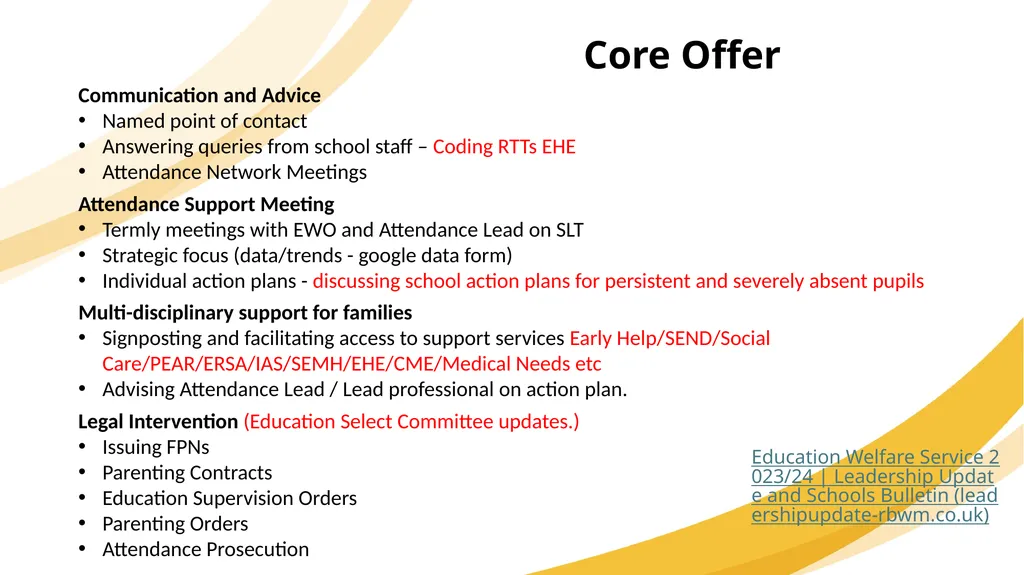
slide5. Core Offer Communication and Advice
Named point of contact
Answering queries from school staff – Coding RTTs EHE
Attendance Network Meetings
Attendance Support Meeting
Termly meetings with EWO and Attendance Lead on SLT
Strategic focus (data/trends - google data form)
Individual action plans - discussing school action plans for persistent and severely absent pupils
Multi-disciplinary support for families
Signposting and facilitating access to support services Early Help/SEND/Social Care/PEAR/ERSA/IAS/SEMH/EHE/CME/Medical Needs etc
Advising Attendance Lead / Lead professional on action plan.
Legal Intervention (Education Select Committee updates.)
Issuing FPNs
Parenting Contracts
Education Supervision Orders
Parenting Orders
Attendance Prosecution Education Welfare Service 2023/24 | Leadership Update and Schools Bulletin (leadershipupdate-rbwm.co.uk)<br>
slide6. Traded Offer
(37 schools) various Hours and prices. Runs academic year Case holding at Severe absence.
Contacting families and understanding the barriers to attendance.
Setting up and leading attendance meetings with families
Developing in school reasonable adjustments and initial attendance action plans
Completion of referrals to other services, including early help assessments
Building communication and Relationships between stakeholders.
Training
Processes
Policy and Audits Education Welfare Service 2023/24 | Leadership Update and Schools Bulletin (leadershipupdate-rbwm.co.uk)<br>
slide7. Main Responsibilities for Schools All Pupils
Have a clear school attendance policy on the school website which all staff, pupils and parents understand.
Develop and maintain a whole school culture that promotes the benefits of good attendance.
Accurately complete admission and attendance registers.
Have robust daily processes to follow up absence.
Regularly monitor data to identify patterns and trends and understand which pupils and pupil cohorts to focus on.
Have a dedicated senior leader with overall responsibility for championing and improving attendance. Attendance Lead on SLT;
Have overall responsibility for Attendance
Attend the Attendance Support Meeting whether traded or core offers.
Ensure comms on Attendance is effective.<br>
slide8. Pupils at risk of becoming persistently absent 100% - 90%
Proactively use data to identify pupils at risk of poor attendance.
Work with each pupil identified and their parents to understand and address the reasons for absence, including any in-school barriers to attendance.
Where out of school barriers are identified, signpost and support access to any required services in the first instance and act as lead practitioner if attendance is the only issue and/or the local threshold for formal early help is not met.
If the issue persists, take an active part in the multi-agency effort with the local authority and other partners. If a case meets the local threshold for formal early help/family support, this includes conducting the early help assessment and acting as the lead practitioner where all partners agree that the school is the best placed lead service. Where the lead practitioner is outside of the school, continue to work with the local authority and partners. Main Responsibilities for Schools<br>
slide9. Persistently absent pupils (90%)
Continued support as for pupils at risk of becoming persistently absent and:
Where absence becomes persistent, put additional targeted support in place to remove any barriers. Where necessary this includes working with partners, for example Early Help
Where there is a lack of engagement, hold more formal conversations with parents and be clear about the potential need for legal intervention in future.
Where support is not working, being engaged with or appropriate, work with the local authority on legal intervention.
Where there are safeguarding concerns, intensify support through statutory children’s social care.
Work with other schools in the local area, such as schools previously attended and the schools of any siblings. Main Responsibilities for Schools<br>
slide10. Severely absent pupils (50%)
Continued support as for persistently absent pupils and:
Agree a joint approach for all severely absent pupils with the local authority. Support for cohorts of pupils with lower attendance than their peers
Proactively use data to identify cohorts with, or at risk of, low attendance and develop strategies to support them. Agree a joint approach for all severely absent pupils with the local authority.
Work with other schools in the local area and the local authority to share effective practice where there are common barriers to attendance. Main Responsibilities for Schools<br>
slide11. Support for pupils with medical conditions or SEND with poor attendance
Maintain the same ambition for attendance and work with pupils and parents to maximise attendance.
Ensure join up with pastoral support and where required, put in place additional support and adjustments, such as an individual healthcare plan and if applicable, ensuring the provision outlined in the pupil’s EHCP is accessed.
Consider additional support from wider services and external partners, making timely referrals
Regularly monitor data for such groups, including at board and governing body meetings and with local authorities. Main Responsibilities for Schools<br>
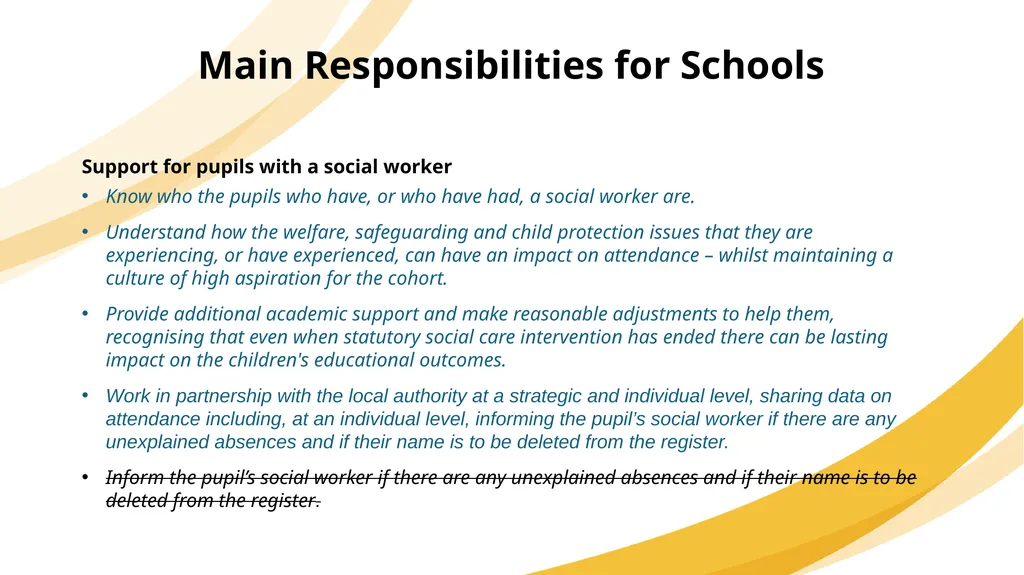
slide12. Support for pupils with a social worker
Know who the pupils who have, or who have had, a social worker are.
Understand how the welfare, safeguarding and child protection issues that they are experiencing, or have experienced, can have an impact on attendance – whilst maintaining a culture of high aspiration for the cohort.
Provide additional academic support and make reasonable adjustments to help them, recognising that even when statutory social care intervention has ended there can be lasting impact on the children's educational outcomes.
Work in partnership with the local authority at a strategic and individual level, sharing data on attendance including, at an individual level, informing the pupil’s social worker if there are any unexplained absences and if their name is to be deleted from the register.
Inform the pupil’s social worker if there are any unexplained absences and if their name is to be deleted from the register. Main Responsibilities for Schools<br>
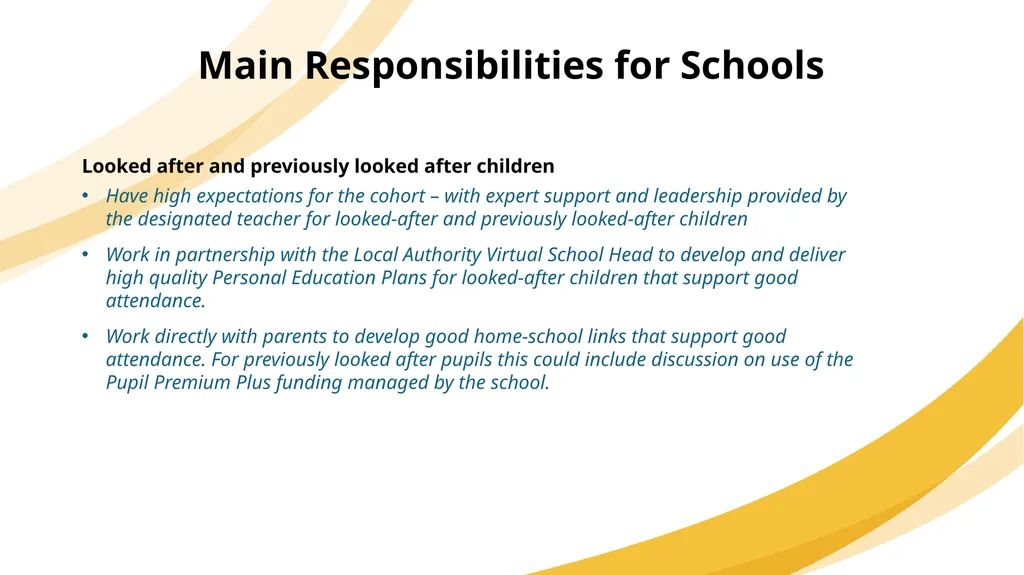
slide13. Main Responsibilities for Schools Looked after and previously looked after children
Have high expectations for the cohort – with expert support and leadership provided by the designated teacher for looked-after and previously looked-after children
Work in partnership with the Local Authority Virtual School Head to develop and deliver high quality Personal Education Plans for looked-after children that support good attendance.
Work directly with parents to develop good home-school links that support good attendance. For previously looked after pupils this could include discussion on use of the Pupil Premium Plus funding managed by the school.<br>
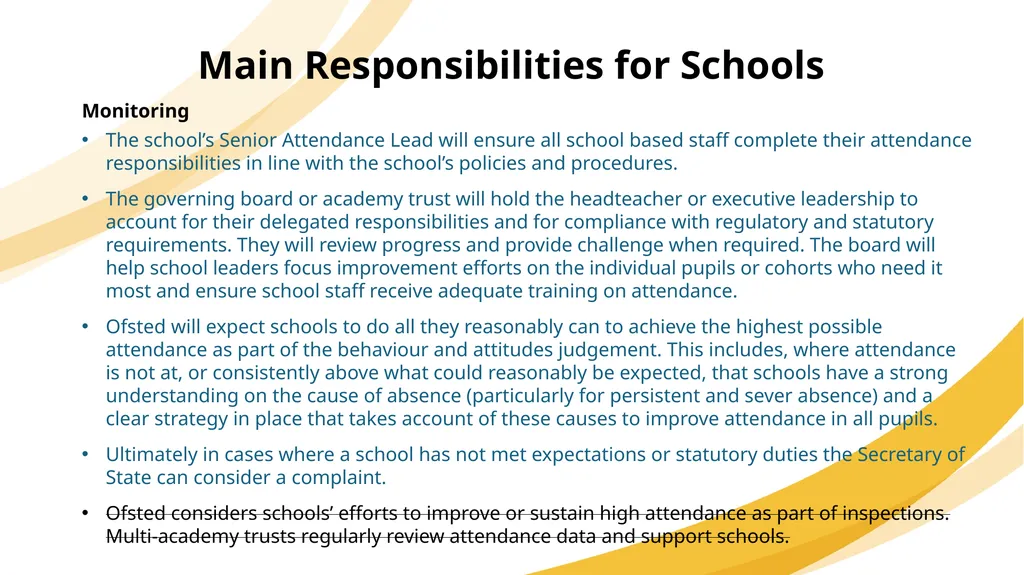
slide14. Monitoring
The school’s Senior Attendance Lead will ensure all school based staff complete their attendance responsibilities in line with the school’s policies and procedures.
The governing board or academy trust will hold the headteacher or executive leadership to account for their delegated responsibilities and for compliance with regulatory and statutory requirements. They will review progress and provide challenge when required. The board will help school leaders focus improvement efforts on the individual pupils or cohorts who need it most and ensure school staff receive adequate training on attendance.
Ofsted will expect schools to do all they reasonably can to achieve the highest possible attendance as part of the behaviour and attitudes judgement. This includes, where attendance is not at, or consistently above what could reasonably be expected, that schools have a strong understanding on the cause of absence (particularly for persistent and sever absence) and a clear strategy in place that takes account of these causes to improve attendance in all pupils.
Ultimately in cases where a school has not met expectations or statutory duties the Secretary of State can consider a complaint.
Ofsted considers schools’ efforts to improve or sustain high attendance as part of inspections. Multi-academy trusts regularly review attendance data and support schools. Main Responsibilities for Schools<br>
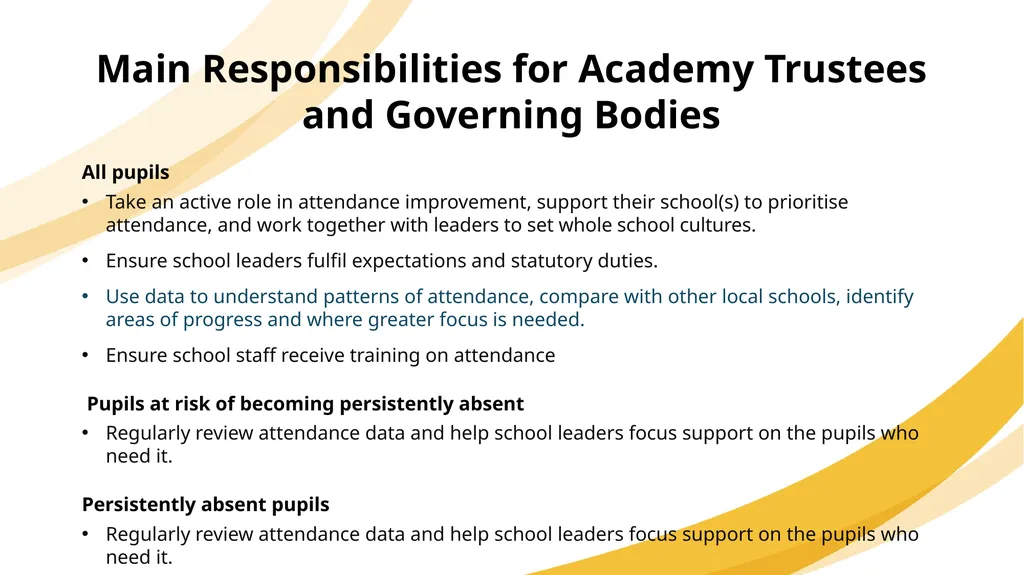
slide15. All pupils
Take an active role in attendance improvement, support their school(s) to prioritise attendance, and work together with leaders to set whole school cultures.
Ensure school leaders fulfil expectations and statutory duties.
Use data to understand patterns of attendance, compare with other local schools, identify areas of progress and where greater focus is needed.
Ensure school staff receive training on attendance
Pupils at risk of becoming persistently absent
Regularly review attendance data and help school leaders focus support on the pupils who need it.
Persistently absent pupils
Regularly review attendance data and help school leaders focus support on the pupils who need it. Main Responsibilities for Academy Trustees and Governing Bodies<br>
slide16. Severely absent pupils
Regularly review attendance data and help school leaders focus support on the pupils who need it.
Support for cohorts of pupils with lower attendance than their peers
Regularly review attendance data and help school leaders focus support on the pupils who need it.
Support for pupils with medical conditions or SEND with poor attendance
Regularly review attendance data and help school leaders focus support on the pupils who need it.
Support for pupils with a social worker
Regularly review attendance data and help school leaders focus support on the pupils who need it.
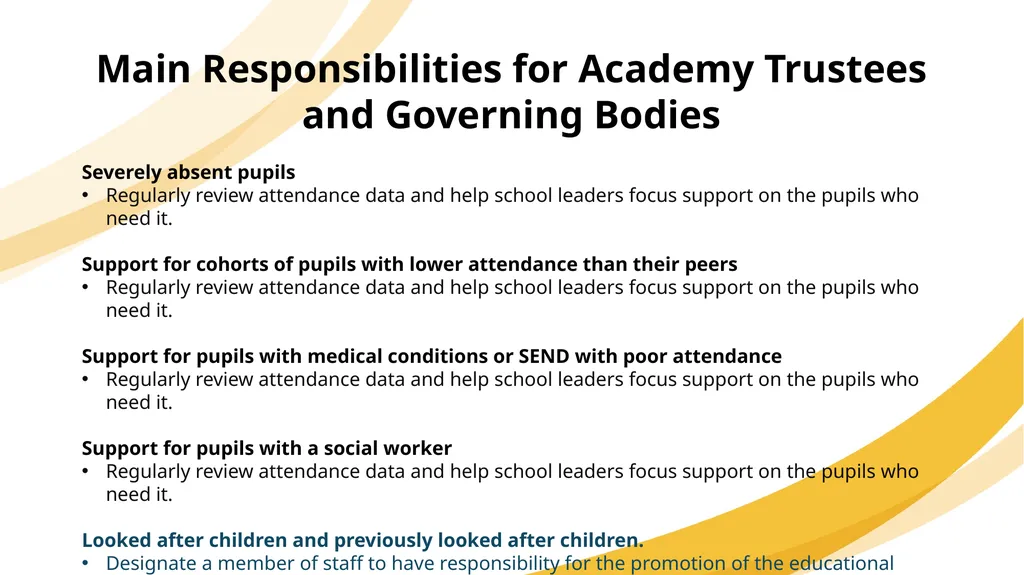
Looked after children and previously looked after children.
Designate a member of staff to have responsibility for the promotion of the educational achievement of looked after and previously looked after pupils.
Monitor and review attendance of the cohort and consider how school policies, including behaviour policies, are sensitive to their needs and support good attendance. Main Responsibilities for Academy Trustees and Governing Bodies<br>
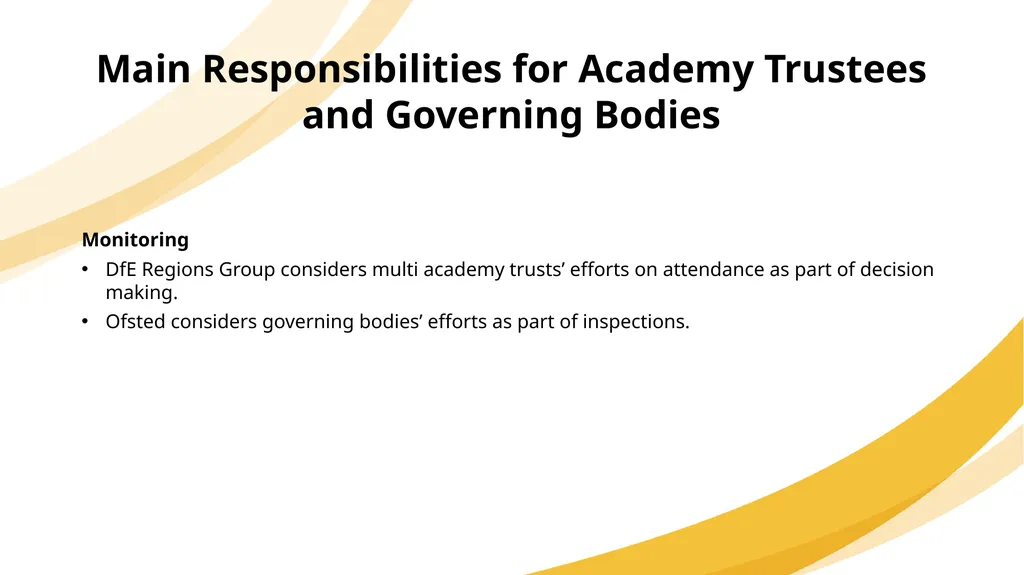
slide17. Main Responsibilities for Academy Trustees and Governing Bodies Monitoring
DfE Regions Group considers multi academy trusts’ efforts on attendance as part of decision making.
Ofsted considers governing bodies’ efforts as part of inspections.<br>
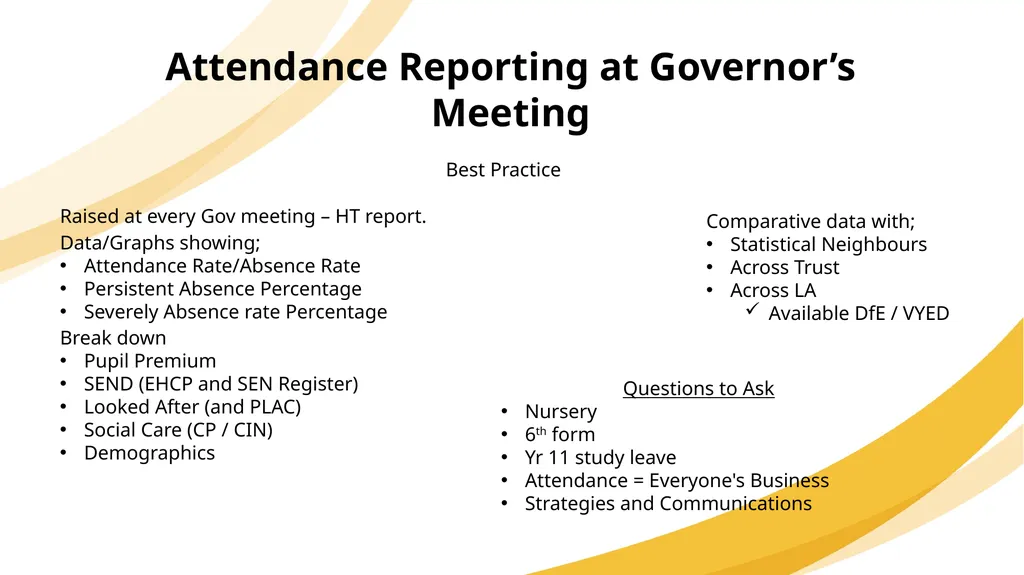
slide18. Attendance Reporting at Governor’s Meeting Best Practice Questions to Ask
Nursery
6th form
Yr 11 study leave
Attendance = Everyone's Business
Strategies and Communications Raised at every Gov meeting – HT report.
Data/Graphs showing;
Attendance Rate/Absence Rate
Persistent Absence Percentage
Severely Absence rate Percentage
Break down
Pupil Premium
SEND (EHCP and SEN Register)
Looked After (and PLAC)
Social Care (CP / CIN)
Demographics Comparative data with;
Statistical Neighbours
Across Trust
Across LA
Available DfE / VYED<br>
slide19. All pupils
Ensure their child attends every day the school is open except when a statutory reason applies.
Notify the school as soon as possible when their child has to be unexpectedly absent (e.g. sickness).
Only request leave of absence in exceptional circumstances and do so in advance.
Book any medical appointments around the school day where possible.
Pupils at risk of becoming persistently absent
Work with the school and local authority to help them understand their child’s barriers to attendance.
Proactively engage with the support offered to prevent the need for more formal support.
Persistently absent pupils
Work with the school and local authority to help them understand their child’s barriers to attendance.
Proactively engage with the formal support offered – including any parenting contract or voluntary early help plan to prevent the need for legal intervention. Main Responsibilities for Parents<br>
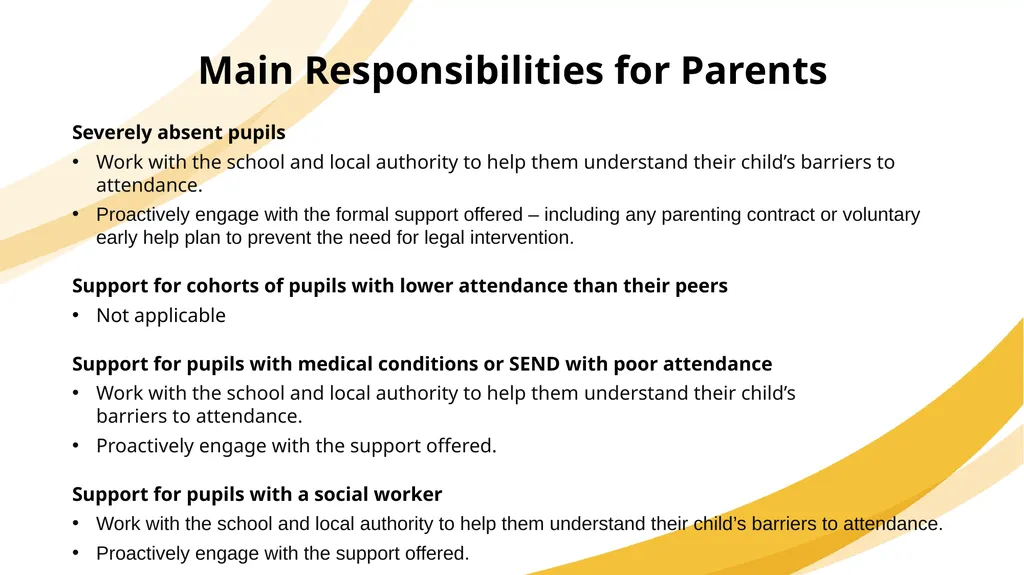
slide20. Severely absent pupils
Work with the school and local authority to help them understand their child’s barriers to attendance.
Proactively engage with the formal support offered – including any parenting contract or voluntary early help plan to prevent the need for legal intervention.
Support for cohorts of pupils with lower attendance than their peers
Not applicable
Support for pupils with medical conditions or SEND with poor attendance
Work with the school and local authority to help them understand their child’s barriers to attendance.
Proactively engage with the support offered.
Support for pupils with a social worker
Work with the school and local authority to help them understand their child’s barriers to attendance.
Proactively engage with the support offered. Main Responsibilities for Parents<br>
slide21. Looked after and previously looked after children
Work with the school and local authority to help them understand their child’s barriers to attendance – including the development of the Personal Education Plans.
Proactively engage with the support offered.
Monitoring
Schools regularly update parents on their child’s attendance.
(If parents feel the school and/or local authority have not delivered what they are expected to they should discuss the case with the school and/or local authorities attendance support team.) Main Responsibilities for Parents<br>
slide22. Main Responsibilities for Local Authority
School Attendance Support Team (Education Welfare Service) will be available free of charge to all schools (inc. independent, Special and Alternative provision) from September ’23. All Pupils
Have a strategic approach to improving attendance for the whole area and make it a key focus of all frontline council services.
Have a School Attendance Support Team that works with all schools in their area to remove area-wide barriers to attendance.
Provide each school with a named point of contact in the School Attendance Support Team who can support with queries and advice.
Offer opportunities for all schools in the area to share effective practice.<br>
slide23. Pupils at risk of becoming persistently absent
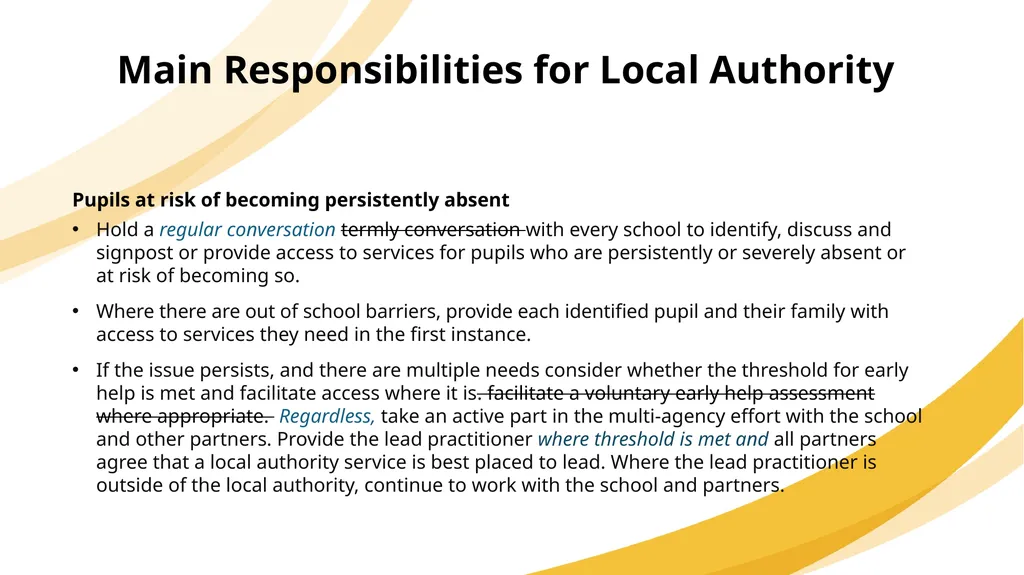
Hold a regular conversation termly conversation with every school to identify, discuss and signpost or provide access to services for pupils who are persistently or severely absent or at risk of becoming so.
Where there are out of school barriers, provide each identified pupil and their family with access to services they need in the first instance.
If the issue persists, and there are multiple needs consider whether the threshold for early help is met and facilitate access where it is. facilitate a voluntary early help assessment where appropriate. Regardless, take an active part in the multi-agency effort with the school and other partners. Provide the lead practitioner where threshold is met and all partners agree that a local authority service is best placed to lead. Where the lead practitioner is outside of the local authority, continue to work with the school and partners. Main Responsibilities for Local Authority<br>
slide24. Main Responsibilities for Local Authority Persistently absent pupils (90%)
Continue support as for pupils at risk of becoming persistently absent and:
Work jointly with the school to provide formal support options including parenting contracts and education supervision orders.
Where there are safeguarding concerns, ensure joint working between the school, children’s social care services and other statutory safeguarding partners.
Where support is not working, being engaged with or appropriate, enforce attendance through legal intervention (including prosecution as a last resort).<br>
slide25. Severely absent pupils (50%)
Continued support as for persistently absent pupils and:
All services should make this group the top priority for support. This may include a whole family plan, consideration for an education, health and care plan, or alternative form of educational provision.
Be especially conscious of any potential safeguarding issues, ensuring joint working between the school, children’s social care services and other statutory safeguarding partners. Where appropriate, this could include conducting a full children’s social care assessment and building attendance into children in need and child protection plans. Main Responsibilities for Local Authority<br>
slide26. Support for cohorts of pupils with lower attendance than their peers
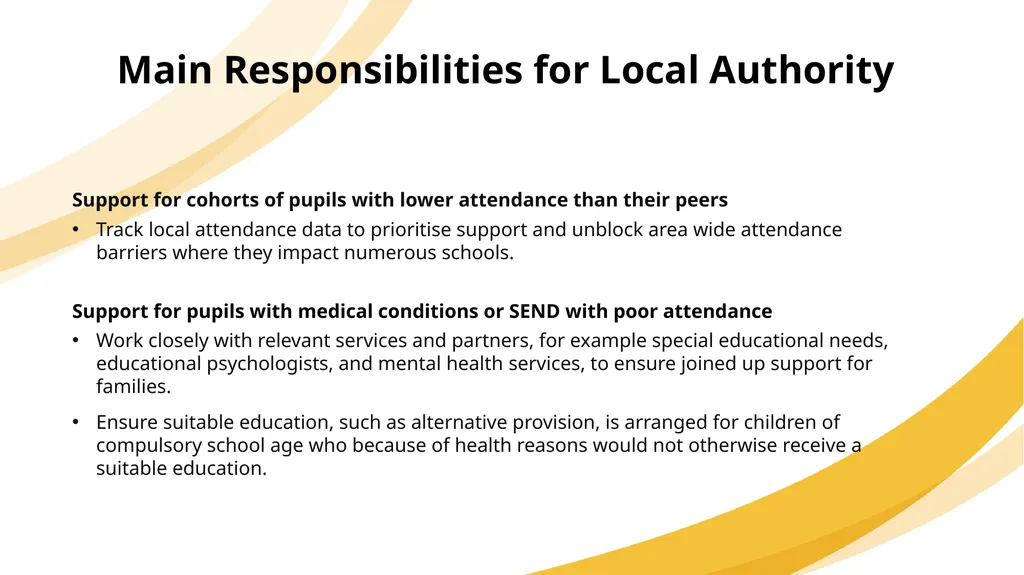
Track local attendance data to prioritise support and unblock area wide attendance barriers where they impact numerous schools.
Support for pupils with medical conditions or SEND with poor attendance
Work closely with relevant services and partners, for example special educational needs, educational psychologists, and mental health services, to ensure joined up support for families.
Ensure suitable education, such as alternative provision, is arranged for children of compulsory school age who because of health reasons would not otherwise receive a suitable education. Main Responsibilities for Local Authority<br>
slide27. Support for pupils with a social worker
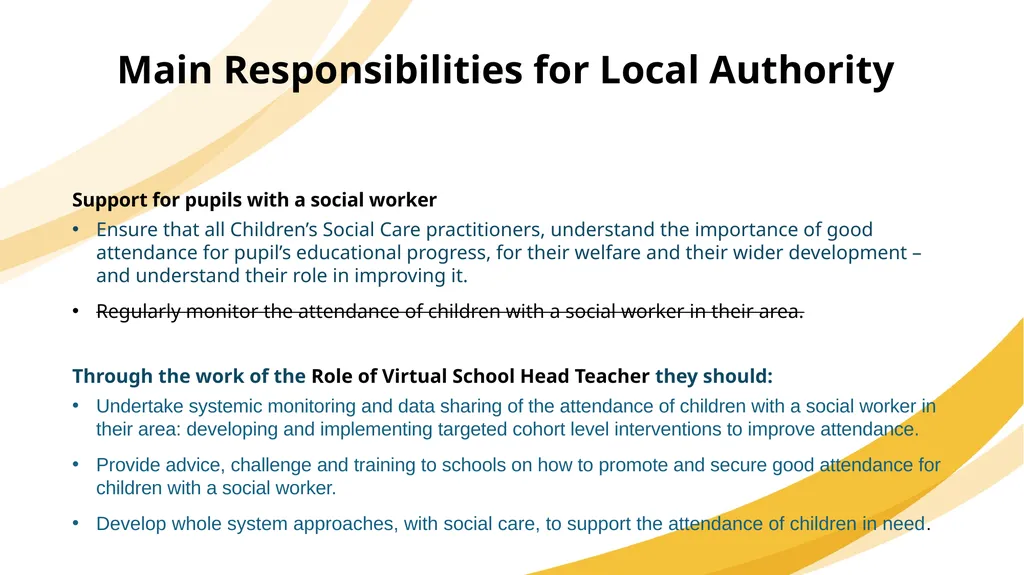
Ensure that all Children’s Social Care practitioners, understand the importance of good attendance for pupil’s educational progress, for their welfare and their wider development – and understand their role in improving it.
Regularly monitor the attendance of children with a social worker in their area.
Through the work of the Role of Virtual School Head Teacher they should:
Undertake systemic monitoring and data sharing of the attendance of children with a social worker in their area: developing and implementing targeted cohort level interventions to improve attendance.
Provide advice, challenge and training to schools on how to promote and secure good attendance for children with a social worker.
Develop whole system approaches, with social care, to support the attendance of children in need. Main Responsibilities for Local Authority<br>
slide28. Looked after and previously looked after children
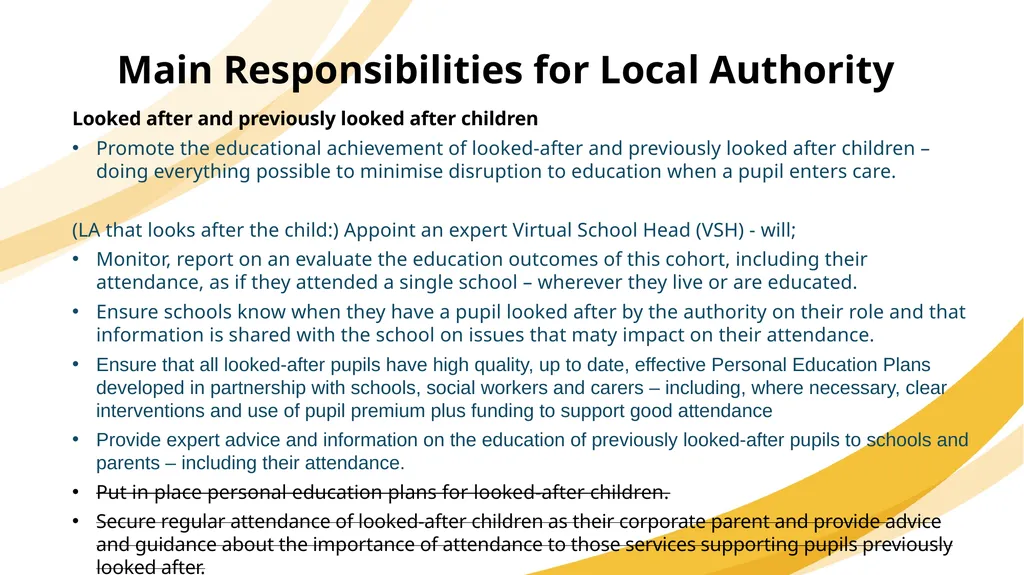
Promote the educational achievement of looked-after and previously looked after children – doing everything possible to minimise disruption to education when a pupil enters care.
(LA that looks after the child:) Appoint an expert Virtual School Head (VSH) - will;
Monitor, report on an evaluate the education outcomes of this cohort, including their attendance, as if they attended a single school – wherever they live or are educated.
Ensure schools know when they have a pupil looked after by the authority on their role and that information is shared with the school on issues that maty impact on their attendance.
Ensure that all looked-after pupils have high quality, up to date, effective Personal Education Plans developed in partnership with schools, social workers and carers – including, where necessary, clear interventions and use of pupil premium plus funding to support good attendance
Provide expert advice and information on the education of previously looked-after pupils to schools and parents – including their attendance.
Put in place personal education plans for looked-after children.
Secure regular attendance of looked-after children as their corporate parent and provide advice and guidance about the importance of attendance to those services supporting pupils previously looked after. Main Responsibilities for Local Authority<br>
slide29. Main Responsibilities for Local Authority Monitoring
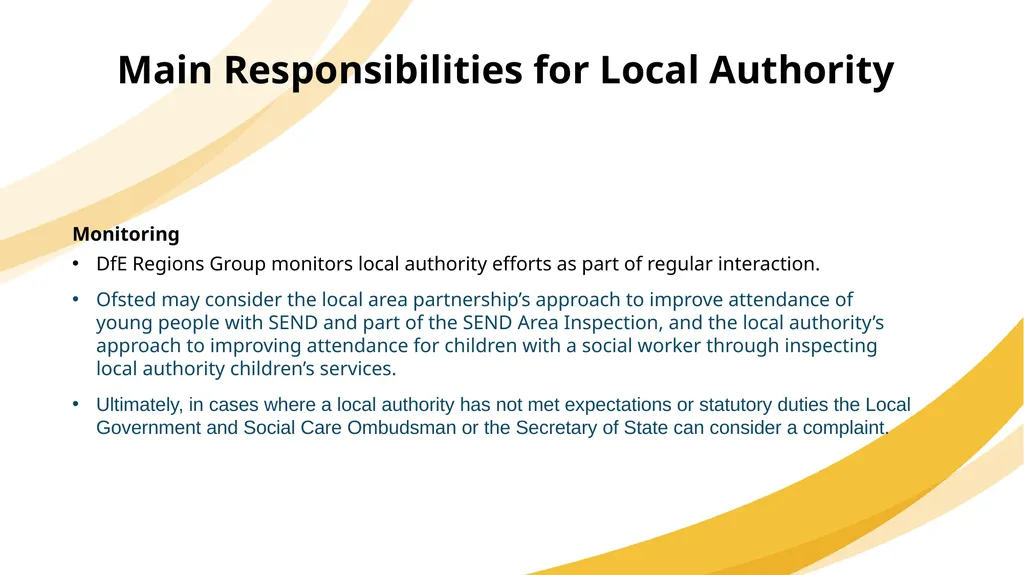
DfE Regions Group monitors local authority efforts as part of regular interaction.
Ofsted may consider the local area partnership’s approach to improve attendance of young people with SEND and part of the SEND Area Inspection, and the local authority’s approach to improving attendance for children with a social worker through inspecting local authority children’s services.
Ultimately, in cases where a local authority has not met expectations or statutory duties the Local Government and Social Care Ombudsman or the Secretary of State can consider a complaint.<br>
slide30. Questions<br>
Alasdair Whitelaw
Pupil Inclusion and Support Manager<br>
slide2. Aims To look at the statutory requirements relating to Attendance for all schools. To look at the Attendance governance role, and recommendations / best practice in terms of carrying it out.<br>
slide3. Overview of updates
Sharing of registers with DfE = Statutory
FPN increase (comms sent out).
New Absence Codes
New Toolkit for School
Rob Tarn (CEO of Northern Education Trust) = National Attendance Ambassador Background And Updates<br>
slide4. Pupil Inclusion & Support Manager
Al Whitelaw 07562 434 921 Education Welfare Service Inclusion & Access Team SEMH Intervention Service Behaviour Support Practitioner
Cherrelle Long 07770 811 755 Inclusion & Access Manager
Rosie Gossage 07704 300 093 Education Welfare Officer
Jo Barnes 07775 406 036 Education Welfare Officer
Amber Chapman 07754 858 149 Education Welfare Officer
Wendy Bould 07905 716 690 Elective Home Education Coordinator
Harmit Thiara 07955 436 162 Children Missing in Education Coordinator
Nico Auckbur (June) SEMH Coach/Mentor
Debbie Nayar 07545 650 021 SEMH Coach/Mentor
Tori Tompkins 07928 512533 Education Welfare Officer
Annette Taylor 07732 825 674 SEMH Coach/Mentor
Sofia Sattar 07541 491 290 Education Welfare Officer
Bella Wilson 07849 733 569 Business Support (0.4)
Maria Sumner 07921 846320 Specialist EWO for children with a Social Worker
Vacant SEMH Coach/Mentor
Zoe Toynan 07386 688312<br>
slide5. Core Offer Communication and Advice
Named point of contact
Answering queries from school staff – Coding RTTs EHE
Attendance Network Meetings
Attendance Support Meeting
Termly meetings with EWO and Attendance Lead on SLT
Strategic focus (data/trends - google data form)
Individual action plans - discussing school action plans for persistent and severely absent pupils
Multi-disciplinary support for families
Signposting and facilitating access to support services Early Help/SEND/Social Care/PEAR/ERSA/IAS/SEMH/EHE/CME/Medical Needs etc
Advising Attendance Lead / Lead professional on action plan.
Legal Intervention (Education Select Committee updates.)
Issuing FPNs
Parenting Contracts
Education Supervision Orders
Parenting Orders
Attendance Prosecution Education Welfare Service 2023/24 | Leadership Update and Schools Bulletin (leadershipupdate-rbwm.co.uk)<br>
slide6. Traded Offer
(37 schools) various Hours and prices. Runs academic year Case holding at Severe absence.
Contacting families and understanding the barriers to attendance.
Setting up and leading attendance meetings with families
Developing in school reasonable adjustments and initial attendance action plans
Completion of referrals to other services, including early help assessments
Building communication and Relationships between stakeholders.
Training
Processes
Policy and Audits Education Welfare Service 2023/24 | Leadership Update and Schools Bulletin (leadershipupdate-rbwm.co.uk)<br>
slide7. Main Responsibilities for Schools All Pupils
Have a clear school attendance policy on the school website which all staff, pupils and parents understand.
Develop and maintain a whole school culture that promotes the benefits of good attendance.
Accurately complete admission and attendance registers.
Have robust daily processes to follow up absence.
Regularly monitor data to identify patterns and trends and understand which pupils and pupil cohorts to focus on.
Have a dedicated senior leader with overall responsibility for championing and improving attendance. Attendance Lead on SLT;
Have overall responsibility for Attendance
Attend the Attendance Support Meeting whether traded or core offers.
Ensure comms on Attendance is effective.<br>
slide8. Pupils at risk of becoming persistently absent 100% - 90%
Proactively use data to identify pupils at risk of poor attendance.
Work with each pupil identified and their parents to understand and address the reasons for absence, including any in-school barriers to attendance.
Where out of school barriers are identified, signpost and support access to any required services in the first instance and act as lead practitioner if attendance is the only issue and/or the local threshold for formal early help is not met.
If the issue persists, take an active part in the multi-agency effort with the local authority and other partners. If a case meets the local threshold for formal early help/family support, this includes conducting the early help assessment and acting as the lead practitioner where all partners agree that the school is the best placed lead service. Where the lead practitioner is outside of the school, continue to work with the local authority and partners. Main Responsibilities for Schools<br>
slide9. Persistently absent pupils (90%)
Continued support as for pupils at risk of becoming persistently absent and:
Where absence becomes persistent, put additional targeted support in place to remove any barriers. Where necessary this includes working with partners, for example Early Help
Where there is a lack of engagement, hold more formal conversations with parents and be clear about the potential need for legal intervention in future.
Where support is not working, being engaged with or appropriate, work with the local authority on legal intervention.
Where there are safeguarding concerns, intensify support through statutory children’s social care.
Work with other schools in the local area, such as schools previously attended and the schools of any siblings. Main Responsibilities for Schools<br>
slide10. Severely absent pupils (50%)
Continued support as for persistently absent pupils and:
Agree a joint approach for all severely absent pupils with the local authority. Support for cohorts of pupils with lower attendance than their peers
Proactively use data to identify cohorts with, or at risk of, low attendance and develop strategies to support them. Agree a joint approach for all severely absent pupils with the local authority.
Work with other schools in the local area and the local authority to share effective practice where there are common barriers to attendance. Main Responsibilities for Schools<br>
slide11. Support for pupils with medical conditions or SEND with poor attendance
Maintain the same ambition for attendance and work with pupils and parents to maximise attendance.
Ensure join up with pastoral support and where required, put in place additional support and adjustments, such as an individual healthcare plan and if applicable, ensuring the provision outlined in the pupil’s EHCP is accessed.
Consider additional support from wider services and external partners, making timely referrals
Regularly monitor data for such groups, including at board and governing body meetings and with local authorities. Main Responsibilities for Schools<br>
slide12. Support for pupils with a social worker
Know who the pupils who have, or who have had, a social worker are.
Understand how the welfare, safeguarding and child protection issues that they are experiencing, or have experienced, can have an impact on attendance – whilst maintaining a culture of high aspiration for the cohort.
Provide additional academic support and make reasonable adjustments to help them, recognising that even when statutory social care intervention has ended there can be lasting impact on the children's educational outcomes.
Work in partnership with the local authority at a strategic and individual level, sharing data on attendance including, at an individual level, informing the pupil’s social worker if there are any unexplained absences and if their name is to be deleted from the register.
Inform the pupil’s social worker if there are any unexplained absences and if their name is to be deleted from the register. Main Responsibilities for Schools<br>
slide13. Main Responsibilities for Schools Looked after and previously looked after children
Have high expectations for the cohort – with expert support and leadership provided by the designated teacher for looked-after and previously looked-after children
Work in partnership with the Local Authority Virtual School Head to develop and deliver high quality Personal Education Plans for looked-after children that support good attendance.
Work directly with parents to develop good home-school links that support good attendance. For previously looked after pupils this could include discussion on use of the Pupil Premium Plus funding managed by the school.<br>
slide14. Monitoring
The school’s Senior Attendance Lead will ensure all school based staff complete their attendance responsibilities in line with the school’s policies and procedures.
The governing board or academy trust will hold the headteacher or executive leadership to account for their delegated responsibilities and for compliance with regulatory and statutory requirements. They will review progress and provide challenge when required. The board will help school leaders focus improvement efforts on the individual pupils or cohorts who need it most and ensure school staff receive adequate training on attendance.
Ofsted will expect schools to do all they reasonably can to achieve the highest possible attendance as part of the behaviour and attitudes judgement. This includes, where attendance is not at, or consistently above what could reasonably be expected, that schools have a strong understanding on the cause of absence (particularly for persistent and sever absence) and a clear strategy in place that takes account of these causes to improve attendance in all pupils.
Ultimately in cases where a school has not met expectations or statutory duties the Secretary of State can consider a complaint.
Ofsted considers schools’ efforts to improve or sustain high attendance as part of inspections. Multi-academy trusts regularly review attendance data and support schools. Main Responsibilities for Schools<br>
slide15. All pupils
Take an active role in attendance improvement, support their school(s) to prioritise attendance, and work together with leaders to set whole school cultures.
Ensure school leaders fulfil expectations and statutory duties.
Use data to understand patterns of attendance, compare with other local schools, identify areas of progress and where greater focus is needed.
Ensure school staff receive training on attendance
Pupils at risk of becoming persistently absent
Regularly review attendance data and help school leaders focus support on the pupils who need it.
Persistently absent pupils
Regularly review attendance data and help school leaders focus support on the pupils who need it. Main Responsibilities for Academy Trustees and Governing Bodies<br>
slide16. Severely absent pupils
Regularly review attendance data and help school leaders focus support on the pupils who need it.
Support for cohorts of pupils with lower attendance than their peers
Regularly review attendance data and help school leaders focus support on the pupils who need it.
Support for pupils with medical conditions or SEND with poor attendance
Regularly review attendance data and help school leaders focus support on the pupils who need it.
Support for pupils with a social worker
Regularly review attendance data and help school leaders focus support on the pupils who need it.
Looked after children and previously looked after children.
Designate a member of staff to have responsibility for the promotion of the educational achievement of looked after and previously looked after pupils.
Monitor and review attendance of the cohort and consider how school policies, including behaviour policies, are sensitive to their needs and support good attendance. Main Responsibilities for Academy Trustees and Governing Bodies<br>
slide17. Main Responsibilities for Academy Trustees and Governing Bodies Monitoring
DfE Regions Group considers multi academy trusts’ efforts on attendance as part of decision making.
Ofsted considers governing bodies’ efforts as part of inspections.<br>
slide18. Attendance Reporting at Governor’s Meeting Best Practice Questions to Ask
Nursery
6th form
Yr 11 study leave
Attendance = Everyone's Business
Strategies and Communications Raised at every Gov meeting – HT report.
Data/Graphs showing;
Attendance Rate/Absence Rate
Persistent Absence Percentage
Severely Absence rate Percentage
Break down
Pupil Premium
SEND (EHCP and SEN Register)
Looked After (and PLAC)
Social Care (CP / CIN)
Demographics Comparative data with;
Statistical Neighbours
Across Trust
Across LA
Available DfE / VYED<br>
slide19. All pupils
Ensure their child attends every day the school is open except when a statutory reason applies.
Notify the school as soon as possible when their child has to be unexpectedly absent (e.g. sickness).
Only request leave of absence in exceptional circumstances and do so in advance.
Book any medical appointments around the school day where possible.
Pupils at risk of becoming persistently absent
Work with the school and local authority to help them understand their child’s barriers to attendance.
Proactively engage with the support offered to prevent the need for more formal support.
Persistently absent pupils
Work with the school and local authority to help them understand their child’s barriers to attendance.
Proactively engage with the formal support offered – including any parenting contract or voluntary early help plan to prevent the need for legal intervention. Main Responsibilities for Parents<br>
slide20. Severely absent pupils
Work with the school and local authority to help them understand their child’s barriers to attendance.
Proactively engage with the formal support offered – including any parenting contract or voluntary early help plan to prevent the need for legal intervention.
Support for cohorts of pupils with lower attendance than their peers
Not applicable
Support for pupils with medical conditions or SEND with poor attendance
Work with the school and local authority to help them understand their child’s barriers to attendance.
Proactively engage with the support offered.
Support for pupils with a social worker
Work with the school and local authority to help them understand their child’s barriers to attendance.
Proactively engage with the support offered. Main Responsibilities for Parents<br>
slide21. Looked after and previously looked after children
Work with the school and local authority to help them understand their child’s barriers to attendance – including the development of the Personal Education Plans.
Proactively engage with the support offered.
Monitoring
Schools regularly update parents on their child’s attendance.
(If parents feel the school and/or local authority have not delivered what they are expected to they should discuss the case with the school and/or local authorities attendance support team.) Main Responsibilities for Parents<br>
slide22. Main Responsibilities for Local Authority
School Attendance Support Team (Education Welfare Service) will be available free of charge to all schools (inc. independent, Special and Alternative provision) from September ’23. All Pupils
Have a strategic approach to improving attendance for the whole area and make it a key focus of all frontline council services.
Have a School Attendance Support Team that works with all schools in their area to remove area-wide barriers to attendance.
Provide each school with a named point of contact in the School Attendance Support Team who can support with queries and advice.
Offer opportunities for all schools in the area to share effective practice.<br>
slide23. Pupils at risk of becoming persistently absent
Hold a regular conversation termly conversation with every school to identify, discuss and signpost or provide access to services for pupils who are persistently or severely absent or at risk of becoming so.
Where there are out of school barriers, provide each identified pupil and their family with access to services they need in the first instance.
If the issue persists, and there are multiple needs consider whether the threshold for early help is met and facilitate access where it is. facilitate a voluntary early help assessment where appropriate. Regardless, take an active part in the multi-agency effort with the school and other partners. Provide the lead practitioner where threshold is met and all partners agree that a local authority service is best placed to lead. Where the lead practitioner is outside of the local authority, continue to work with the school and partners. Main Responsibilities for Local Authority<br>
slide24. Main Responsibilities for Local Authority Persistently absent pupils (90%)
Continue support as for pupils at risk of becoming persistently absent and:
Work jointly with the school to provide formal support options including parenting contracts and education supervision orders.
Where there are safeguarding concerns, ensure joint working between the school, children’s social care services and other statutory safeguarding partners.
Where support is not working, being engaged with or appropriate, enforce attendance through legal intervention (including prosecution as a last resort).<br>
slide25. Severely absent pupils (50%)
Continued support as for persistently absent pupils and:
All services should make this group the top priority for support. This may include a whole family plan, consideration for an education, health and care plan, or alternative form of educational provision.
Be especially conscious of any potential safeguarding issues, ensuring joint working between the school, children’s social care services and other statutory safeguarding partners. Where appropriate, this could include conducting a full children’s social care assessment and building attendance into children in need and child protection plans. Main Responsibilities for Local Authority<br>
slide26. Support for cohorts of pupils with lower attendance than their peers
Track local attendance data to prioritise support and unblock area wide attendance barriers where they impact numerous schools.
Support for pupils with medical conditions or SEND with poor attendance
Work closely with relevant services and partners, for example special educational needs, educational psychologists, and mental health services, to ensure joined up support for families.
Ensure suitable education, such as alternative provision, is arranged for children of compulsory school age who because of health reasons would not otherwise receive a suitable education. Main Responsibilities for Local Authority<br>
slide27. Support for pupils with a social worker
Ensure that all Children’s Social Care practitioners, understand the importance of good attendance for pupil’s educational progress, for their welfare and their wider development – and understand their role in improving it.
Regularly monitor the attendance of children with a social worker in their area.
Through the work of the Role of Virtual School Head Teacher they should:
Undertake systemic monitoring and data sharing of the attendance of children with a social worker in their area: developing and implementing targeted cohort level interventions to improve attendance.
Provide advice, challenge and training to schools on how to promote and secure good attendance for children with a social worker.
Develop whole system approaches, with social care, to support the attendance of children in need. Main Responsibilities for Local Authority<br>
slide28. Looked after and previously looked after children
Promote the educational achievement of looked-after and previously looked after children – doing everything possible to minimise disruption to education when a pupil enters care.
(LA that looks after the child:) Appoint an expert Virtual School Head (VSH) - will;
Monitor, report on an evaluate the education outcomes of this cohort, including their attendance, as if they attended a single school – wherever they live or are educated.
Ensure schools know when they have a pupil looked after by the authority on their role and that information is shared with the school on issues that maty impact on their attendance.
Ensure that all looked-after pupils have high quality, up to date, effective Personal Education Plans developed in partnership with schools, social workers and carers – including, where necessary, clear interventions and use of pupil premium plus funding to support good attendance
Provide expert advice and information on the education of previously looked-after pupils to schools and parents – including their attendance.
Put in place personal education plans for looked-after children.
Secure regular attendance of looked-after children as their corporate parent and provide advice and guidance about the importance of attendance to those services supporting pupils previously looked after. Main Responsibilities for Local Authority<br>
slide29. Main Responsibilities for Local Authority Monitoring
DfE Regions Group monitors local authority efforts as part of regular interaction.
Ofsted may consider the local area partnership’s approach to improve attendance of young people with SEND and part of the SEND Area Inspection, and the local authority’s approach to improving attendance for children with a social worker through inspecting local authority children’s services.
Ultimately, in cases where a local authority has not met expectations or statutory duties the Local Government and Social Care Ombudsman or the Secretary of State can consider a complaint.<br>
slide30. Questions<br>