
Putting it on the agenda (again) Historical
CM
Published · 18 slides · 0 views

1 / 1

Description
Putting it on the agenda (again) Historical Dialogue in History Education in Israel, the Gaza Strip and the West Bank Aims of today Brief and dense tour of education systems and history education British Mandate Palestine Israel Gaza Strip
Related Topics
Share
Embed code
Download this presentation From Below
"Putting it on the agenda (again) Historical" is the property of its rightful owner. Permission is granted to download and print the materials on this website for personal, non-commercial use only, and to display it on your personal computer provided you do not modify the materials and that you retain all copyright notices contained in the materials. By downloading content from our website, you accept the terms of this agreement.
Presentation Transcript
01
Putting it on the agenda (again) Historical Dialogue in History Education in Israel, the Gaza Strip and the West Bank<br>
02
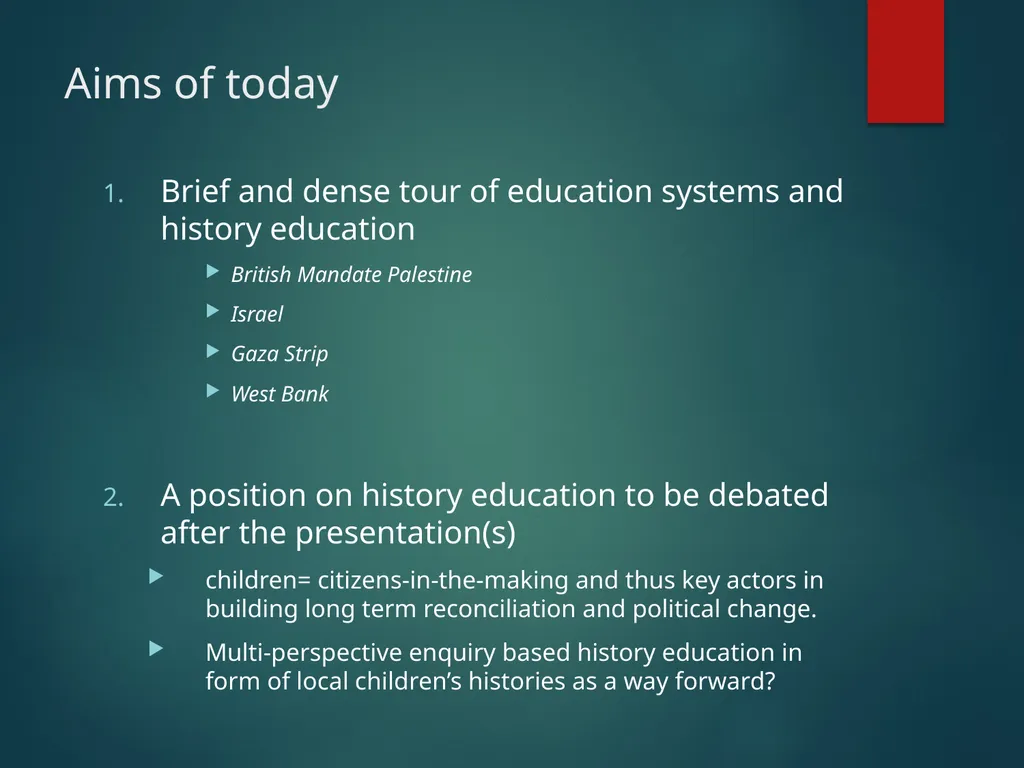
Aims of today Brief and dense tour of education systems and history education
British Mandate Palestine
Israel
Gaza Strip
West Bank
A position on history education to be debated after the presentation(s)
children= citizens-in-the-making and thus key actors in building long term reconciliation and political change.
Multi-perspective enquiry based history education in form of local children’s histories as a way forward?<br>
03
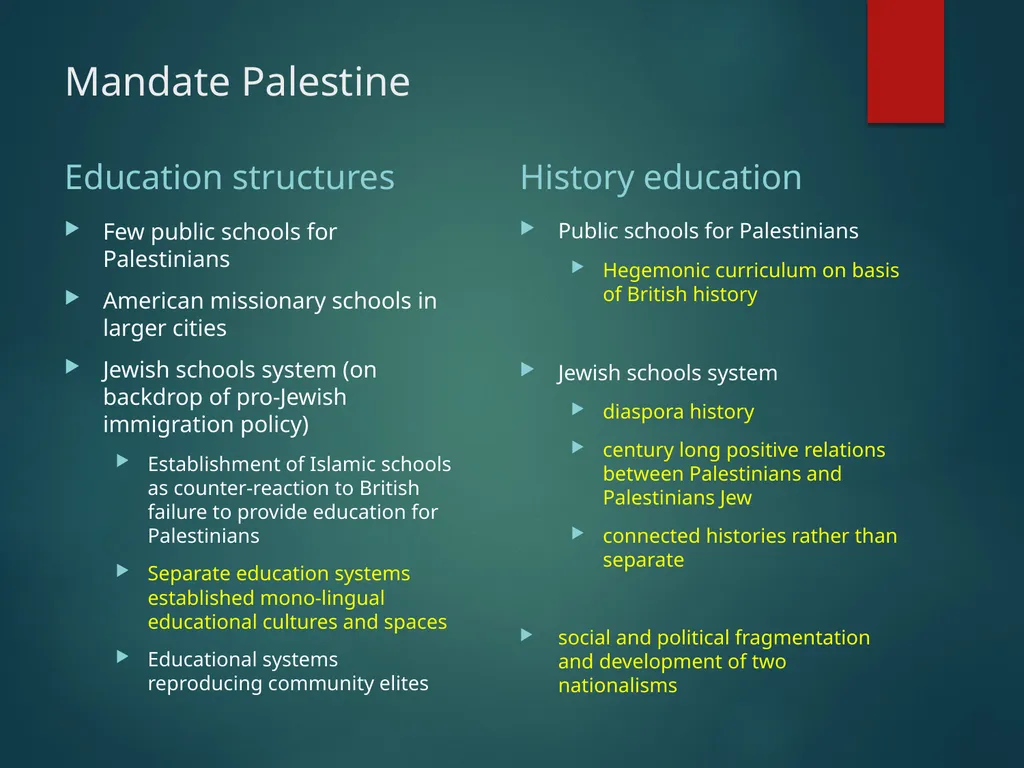
Mandate Palestine Education structures Few public schools for Palestinians
American missionary schools in larger cities
Jewish schools system (on backdrop of pro-Jewish immigration policy)
Establishment of Islamic schools as counter-reaction to British failure to provide education for Palestinians
Separate education systems established mono-lingual educational cultures and spaces
Educational systems reproducing community elites History education Public schools for Palestinians
Hegemonic curriculum on basis of British history
Jewish schools system
diaspora history
century long positive relations between Palestinians and Palestinians Jew
connected histories rather than separate
social and political fragmentation and development of two nationalisms<br>
04
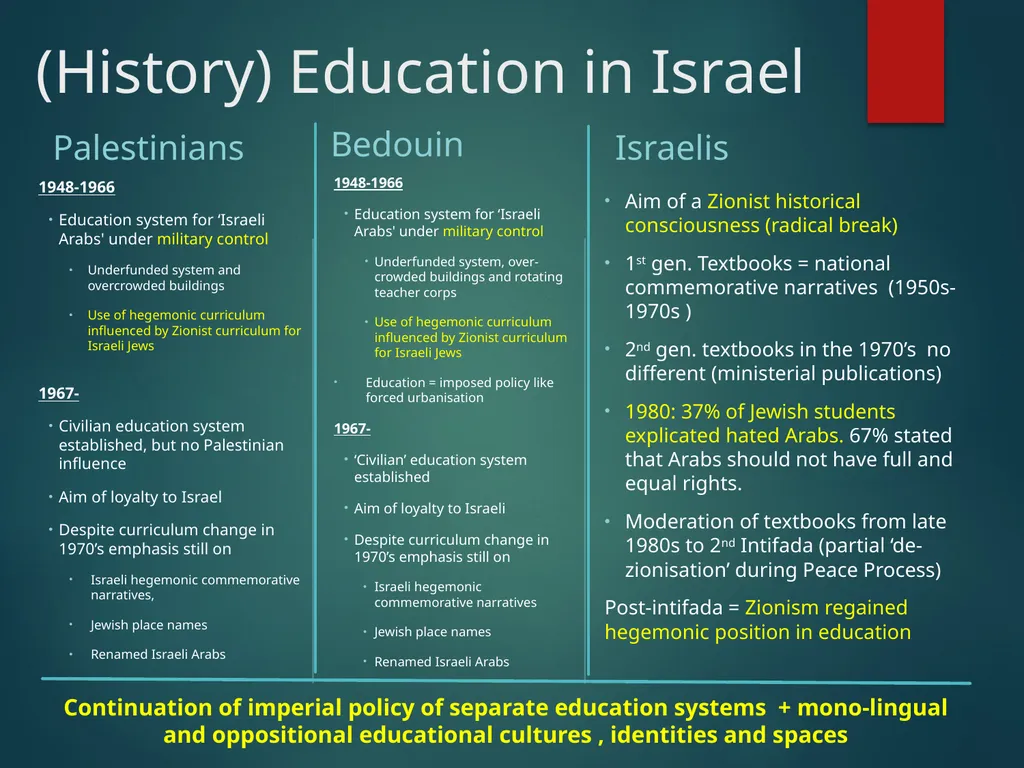
(History) Education in Israel Israelis Aim of a Zionist historical consciousness (radical break)
1st gen. Textbooks = national commemorative narratives (1950s-1970s )
2nd gen. textbooks in the 1970’s no different (ministerial publications)
1980: 37% of Jewish students explicated hated Arabs. 67% stated that Arabs should not have full and equal rights.
Moderation of textbooks from late 1980s to 2nd Intifada (partial ‘de-zionisation’ during Peace Process)
Post-intifada = Zionism regained hegemonic position in education Bedouin 1948-1966
Education system for ‘Israeli Arabs' under military control
Underfunded system, over-crowded buildings and rotating teacher corps
Use of hegemonic curriculum influenced by Zionist curriculum for Israeli Jews
Education = imposed policy like forced urbanisation
1967-
‘Civilian’ education system established
Aim of loyalty to Israeli
Despite curriculum change in 1970’s emphasis still on
Israeli hegemonic commemorative narratives
Jewish place names
Renamed Israeli Arabs Palestinians 1948-1966
Education system for ‘Israeli Arabs' under military control
Underfunded system and overcrowded buildings
Use of hegemonic curriculum influenced by Zionist curriculum for Israeli Jews
1967-
Civilian education system established, but no Palestinian influence
Aim of loyalty to Israel
Despite curriculum change in 1970’s emphasis still on
Israeli hegemonic commemorative narratives,
Jewish place names
Renamed Israeli Arabs Continuation of imperial policy of separate education systems + mono-lingual and oppositional educational cultures , identities and spaces<br>
05
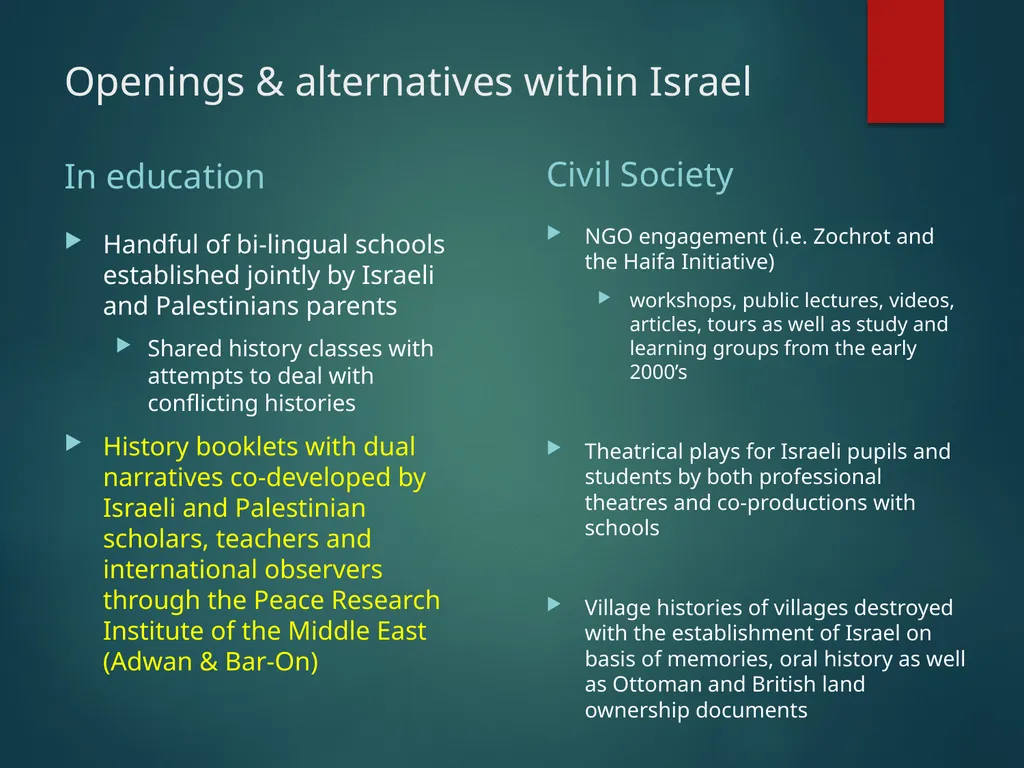
Openings & alternatives within Israel In education Handful of bi-lingual schools established jointly by Israeli and Palestinians parents
Shared history classes with attempts to deal with conflicting histories
History booklets with dual narratives co-developed by Israeli and Palestinian scholars, teachers and international observers through the Peace Research Institute of the Middle East (Adwan & Bar-On) Civil Society NGO engagement (i.e. Zochrot and the Haifa Initiative)
workshops, public lectures, videos, articles, tours as well as study and learning groups from the early 2000’s
Theatrical plays for Israeli pupils and students by both professional theatres and co-productions with schools
Village histories of villages destroyed with the establishment of Israel on basis of memories, oral history as well as Ottoman and British land ownership documents<br>
06
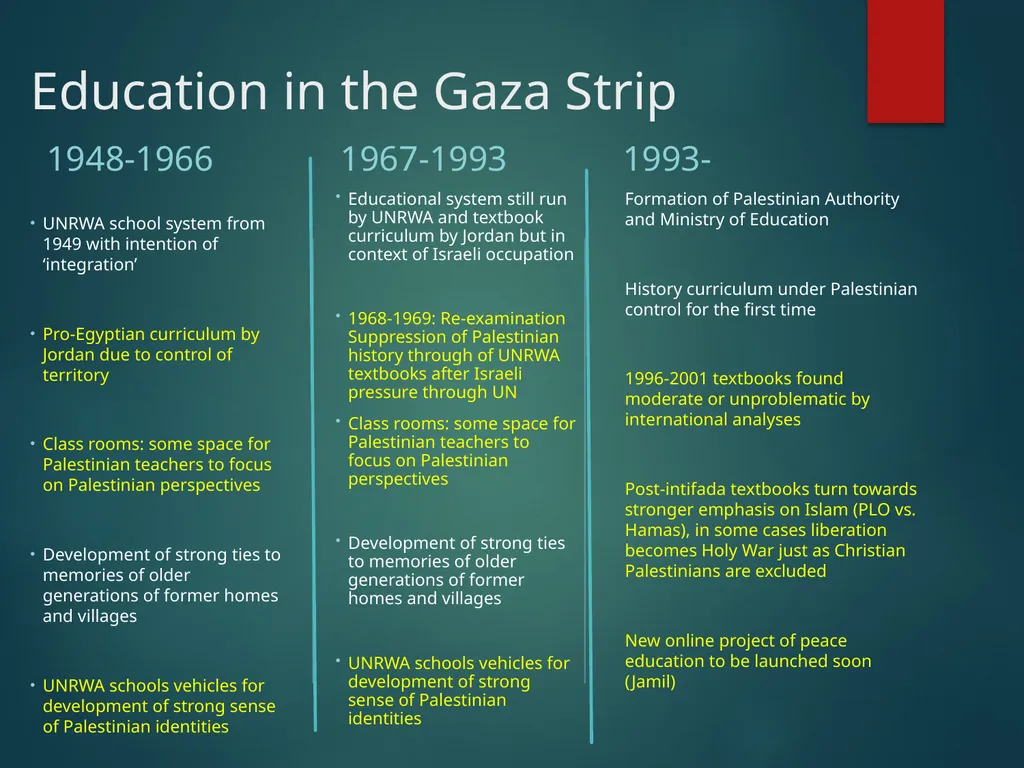
Education in the Gaza Strip 1948-1967
1948-1966 UNRWA school system from 1949 with intention of ‘integration’
Pro-Egyptian curriculum by Jordan due to control of territory
Class rooms: some space for Palestinian teachers to focus on Palestinian perspectives
Development of strong ties to memories of older generations of former homes and villages
UNRWA schools vehicles for development of strong sense of Palestinian identities 1967-1993 Educational system still run by UNRWA and textbook curriculum by Jordan but in context of Israeli occupation
1968-1969: Re-examination Suppression of Palestinian history through of UNRWA textbooks after Israeli pressure through UN
Class rooms: some space for Palestinian teachers to focus on Palestinian perspectives
Development of strong ties to memories of older generations of former homes and villages
UNRWA schools vehicles for development of strong sense of Palestinian identities 1993- Formation of Palestinian Authority and Ministry of Education
History curriculum under Palestinian control for the first time
1996-2001 textbooks found moderate or unproblematic by international analyses
Post-intifada textbooks turn towards stronger emphasis on Islam (PLO vs. Hamas), in some cases liberation becomes Holy War just as Christian Palestinians are excluded
New online project of peace education to be launched soon (Jamil)<br>
07
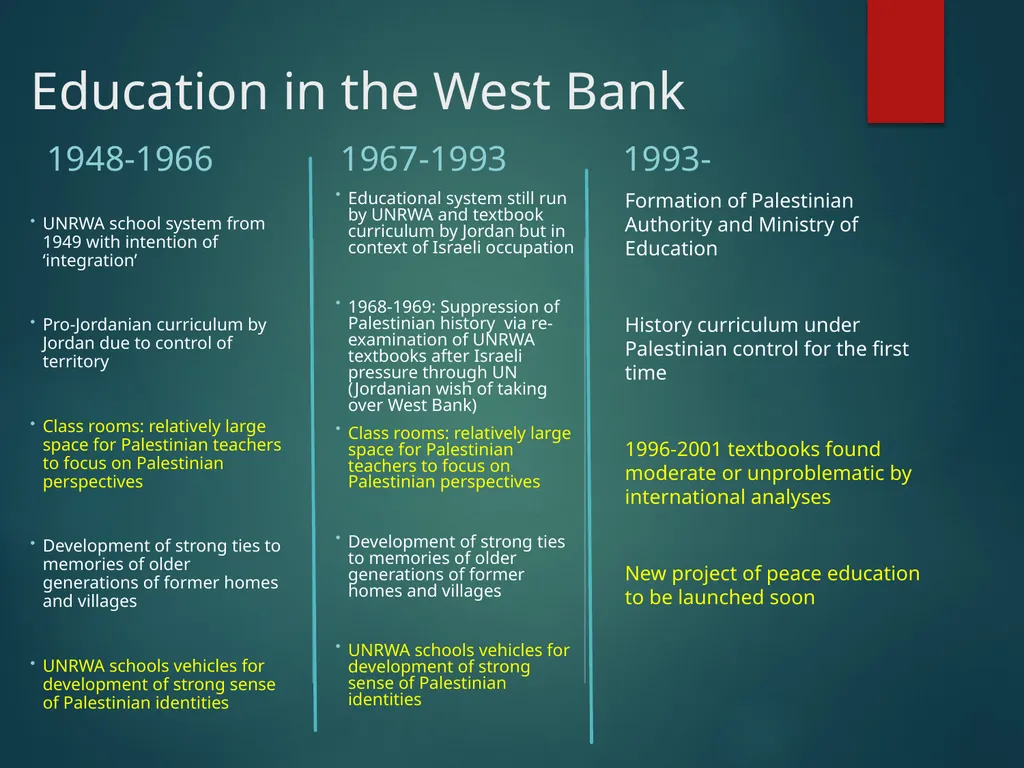
Education in the West Bank 1948-1967
1948-1966 UNRWA school system from 1949 with intention of ‘integration’
Pro-Jordanian curriculum by Jordan due to control of territory
Class rooms: relatively large space for Palestinian teachers to focus on Palestinian perspectives
Development of strong ties to memories of older generations of former homes and villages
UNRWA schools vehicles for development of strong sense of Palestinian identities 1967-1993 Educational system still run by UNRWA and textbook curriculum by Jordan but in context of Israeli occupation
1968-1969: Suppression of Palestinian history via re-examination of UNRWA textbooks after Israeli pressure through UN (Jordanian wish of taking over West Bank)
Class rooms: relatively large space for Palestinian teachers to focus on Palestinian perspectives
Development of strong ties to memories of older generations of former homes and villages
UNRWA schools vehicles for development of strong sense of Palestinian identities 1993- Formation of Palestinian Authority and Ministry of Education
History curriculum under Palestinian control for the first time
1996-2001 textbooks found moderate or unproblematic by international analyses
New project of peace education to be launched soon<br>
08
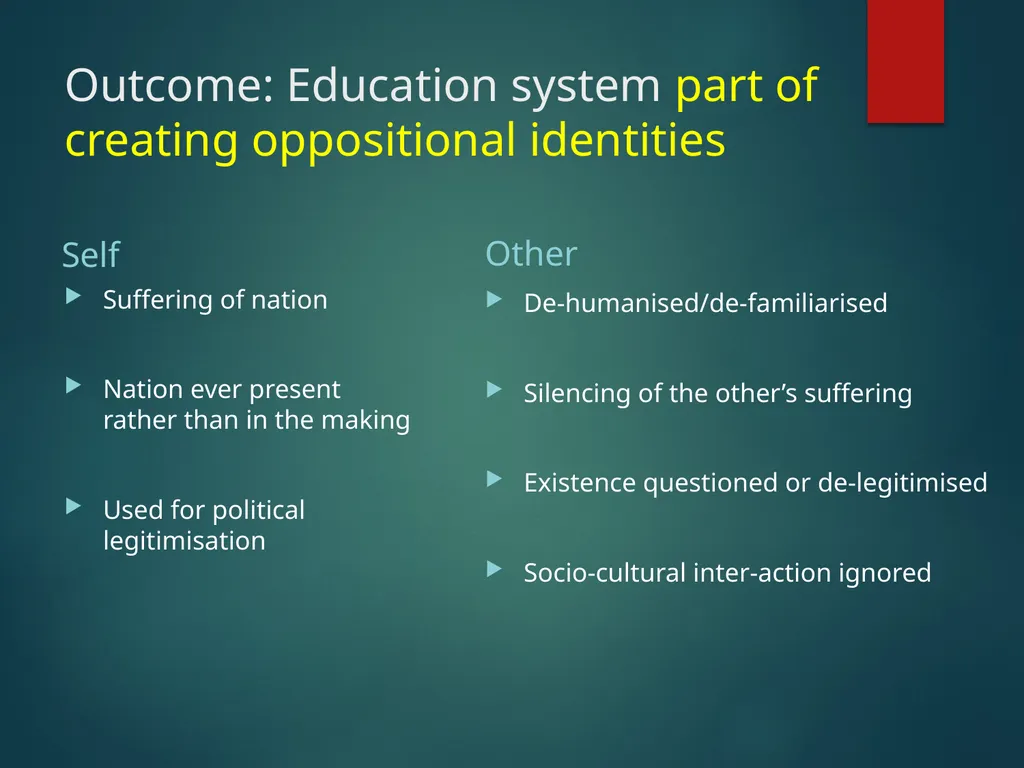
Outcome: Education system part of creating oppositional identities Self Suffering of nation
Nation ever present rather than in the making
Used for political legitimisation Other De-humanised/de-familiarised
Silencing of the other’s suffering
Existence questioned or de-legitimised
Socio-cultural inter-action ignored<br>
Nation ever present rather than in the making
Used for political legitimisation Other De-humanised/de-familiarised
Silencing of the other’s suffering
Existence questioned or de-legitimised
Socio-cultural inter-action ignored<br>
09
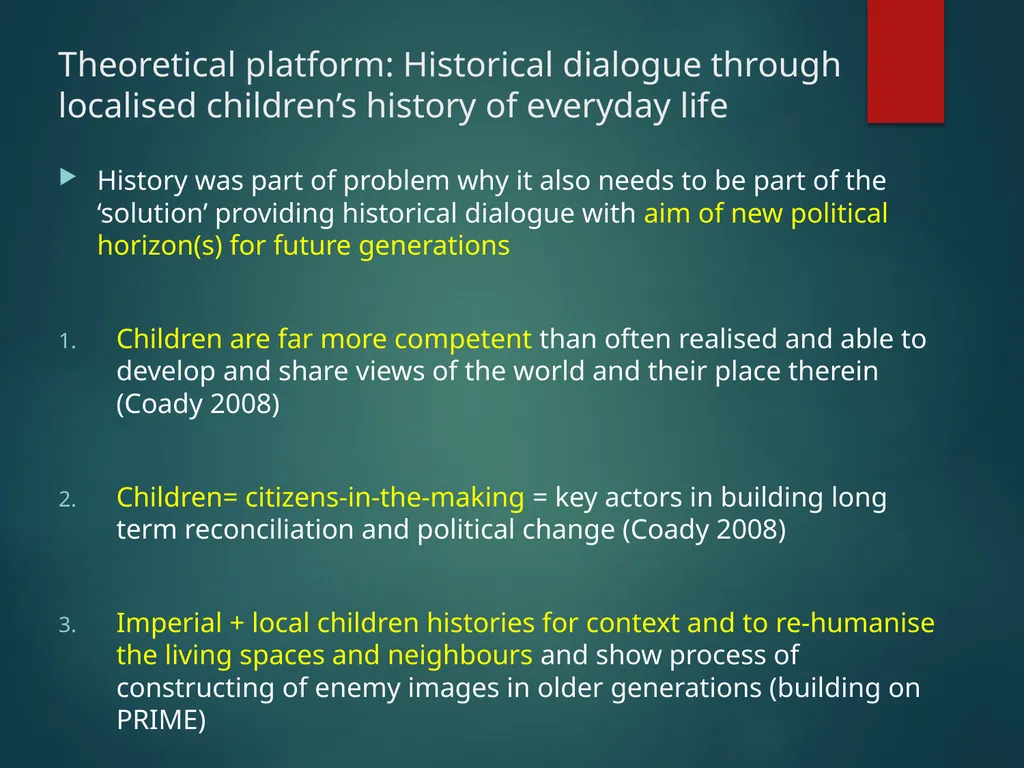
Theoretical platform: Historical dialogue through localised children’s history of everyday life History was part of problem why it also needs to be part of the ‘solution’ providing historical dialogue with aim of new political horizon(s) for future generations
Children are far more competent than often realised and able to develop and share views of the world and their place therein (Coady 2008)
Children= citizens-in-the-making = key actors in building long term reconciliation and political change (Coady 2008)
Imperial + local children histories for context and to re-humanise the living spaces and neighbours and show process of constructing of enemy images in older generations (building on PRIME)<br>
10
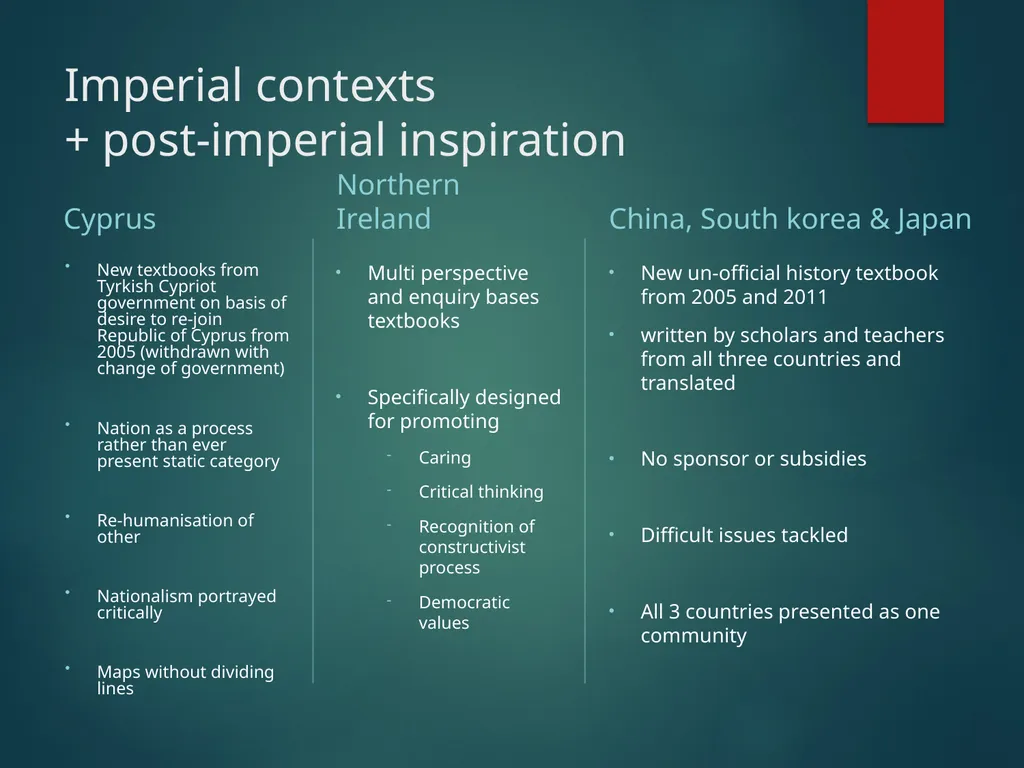
Imperial contexts
+ post-imperial inspiration Cyprus New textbooks from Tyrkish Cypriot government on basis of desire to re-join Republic of Cyprus from 2005 (withdrawn with change of government)
Nation as a process rather than ever present static category
Re-humanisation of other
Nationalism portrayed critically
Maps without dividing lines Northern Ireland Multi perspective and enquiry bases textbooks
Specifically designed for promoting
Caring
Critical thinking
Recognition of constructivist process
Democratic values China, South korea & Japan New un-official history textbook from 2005 and 2011
written by scholars and teachers from all three countries and translated
No sponsor or subsidies
Difficult issues tackled
All 3 countries presented as one community<br>
11
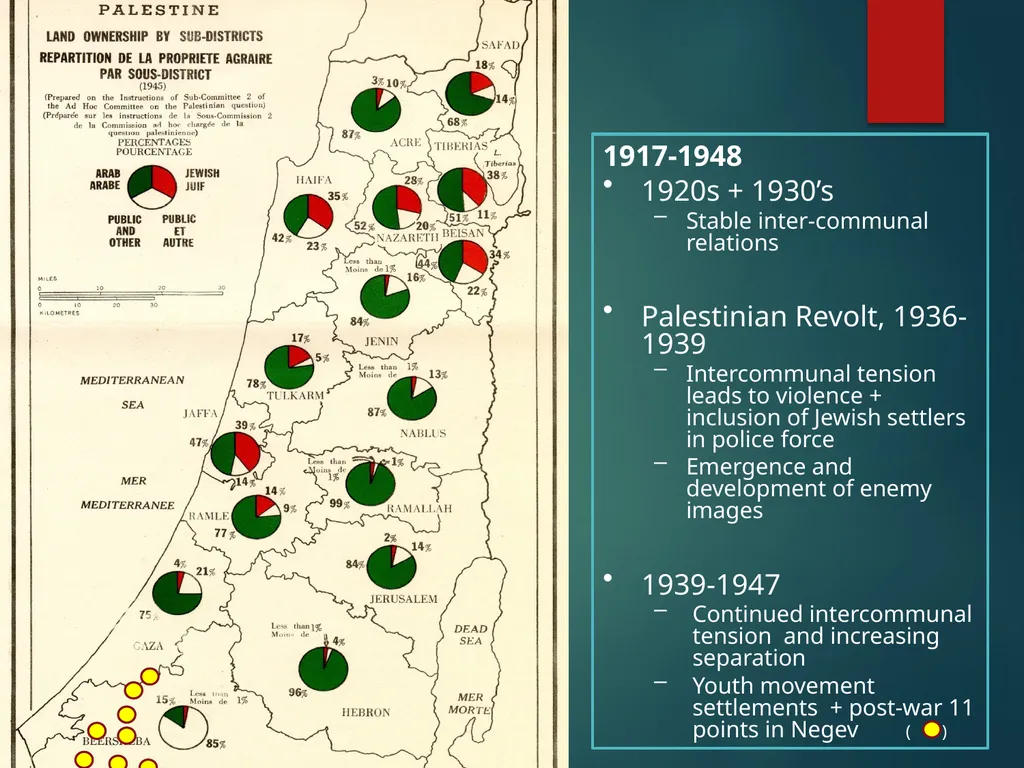
1917-1948
1920s + 1930’s
Stable inter-communal relations
Palestinian Revolt, 1936-1939
Intercommunal tension leads to violence + inclusion of Jewish settlers in police force
Emergence and development of enemy images
1939-1947
Continued intercommunal tension and increasing separation
Youth movement settlements + post-war 11 points in Negev ( )<br>
12
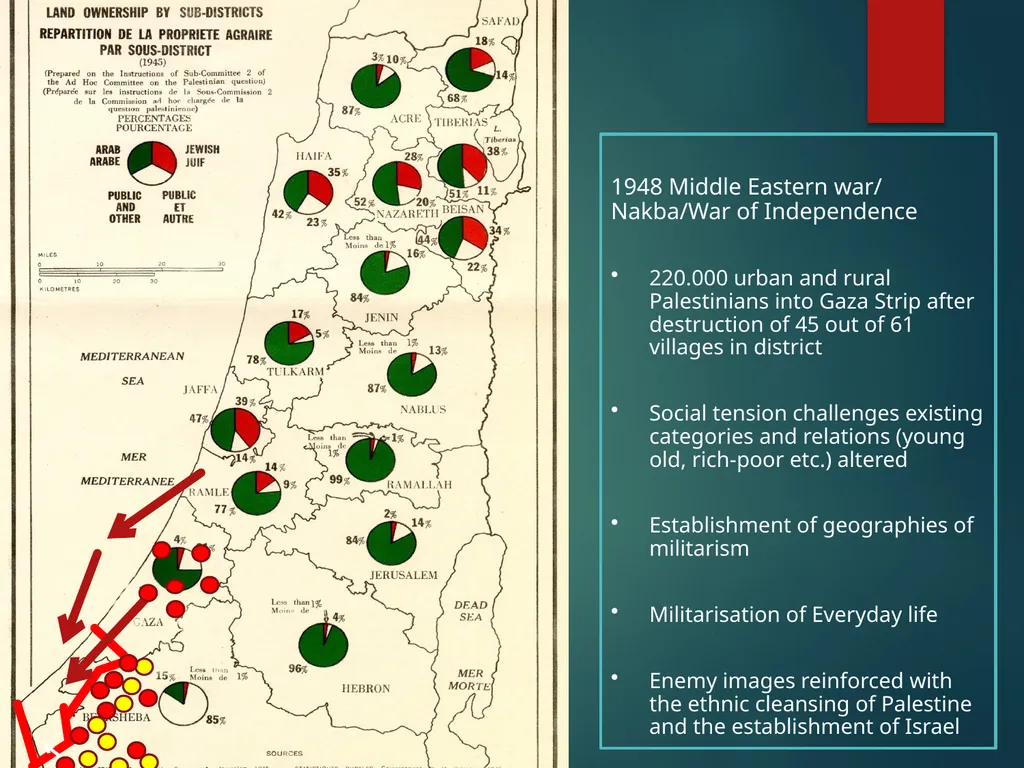
1948 Middle Eastern war/ Nakba/War of Independence
220.000 urban and rural Palestinians into Gaza Strip after destruction of 45 out of 61 villages in district
Social tension challenges existing categories and relations (young old, rich-poor etc.) altered
Establishment of geographies of militarism
Militarisation of Everyday life
Enemy images reinforced with the ethnic cleansing of Palestine and the establishment of Israel<br>
13
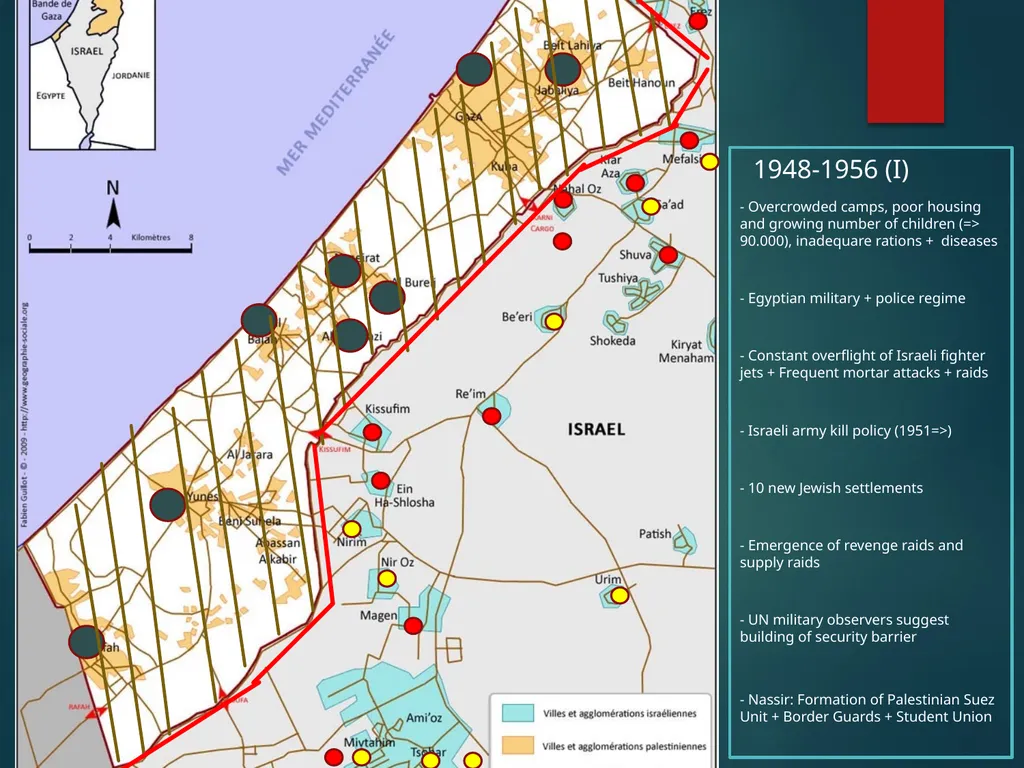
1948-1956 (I)
- Overcrowded camps, poor housing and growing number of children (=> 90.000), inadequare rations + diseases
- Egyptian military + police regime
- Constant overflight of Israeli fighter jets + Frequent mortar attacks + raids
- Israeli army kill policy (1951=>)
- 10 new Jewish settlements
- Emergence of revenge raids and supply raids
- UN military observers suggest building of security barrier
- Nassir: Formation of Palestinian Suez Unit + Border Guards + Student Union<br>
14
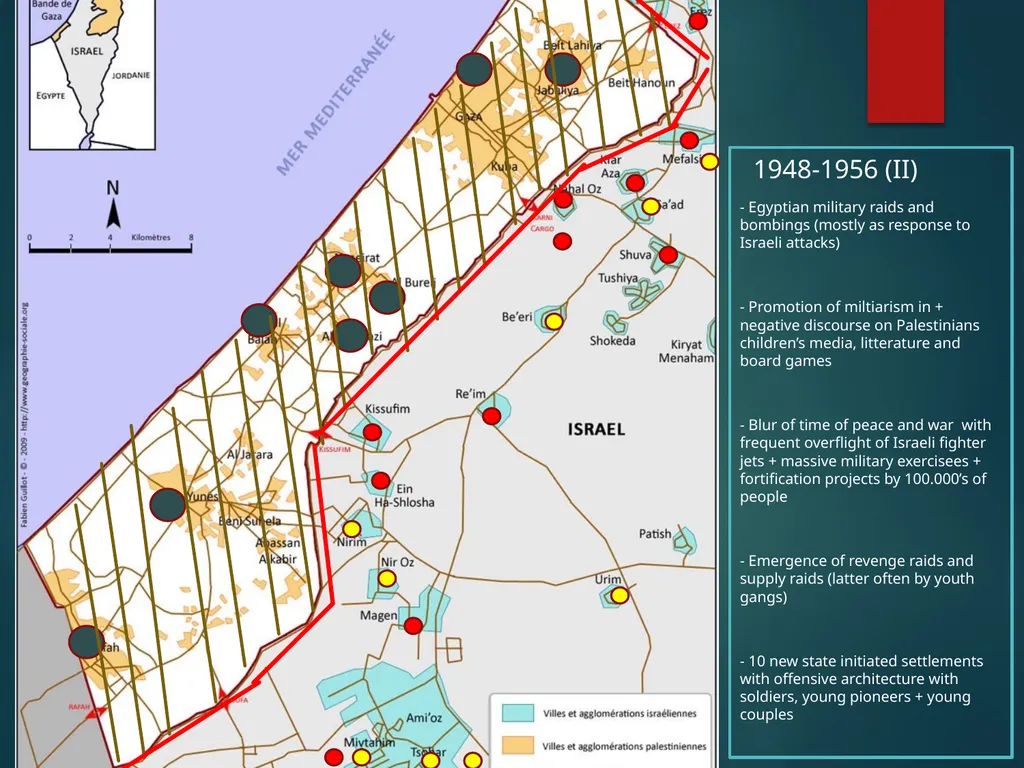
1948-1956 (II)
- Egyptian military raids and bombings (mostly as response to Israeli attacks)
- Promotion of miltiarism in + negative discourse on Palestinians children’s media, litterature and board games
- Blur of time of peace and war with frequent overflight of Israeli fighter jets + massive military exercisees + fortification projects by 100.000’s of people
- Emergence of revenge raids and supply raids (latter often by youth gangs)
- 10 new state initiated settlements with offensive architecture with soldiers, young pioneers + young couples<br>
15
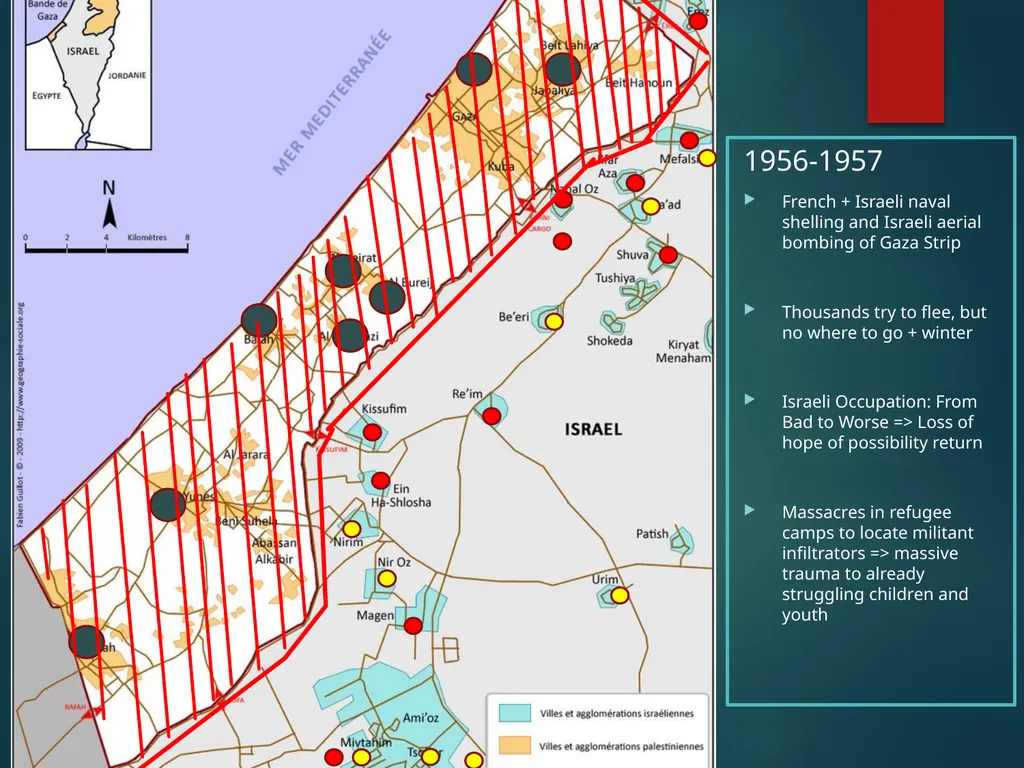
1956-1957
French + Israeli naval shelling and Israeli aerial bombing of Gaza Strip
Thousands try to flee, but no where to go + winter
Israeli Occupation: From Bad to Worse => Loss of hope of possibility return
Massacres in refugee camps to locate militant infiltrators => massive trauma to already struggling children and youth<br>
16
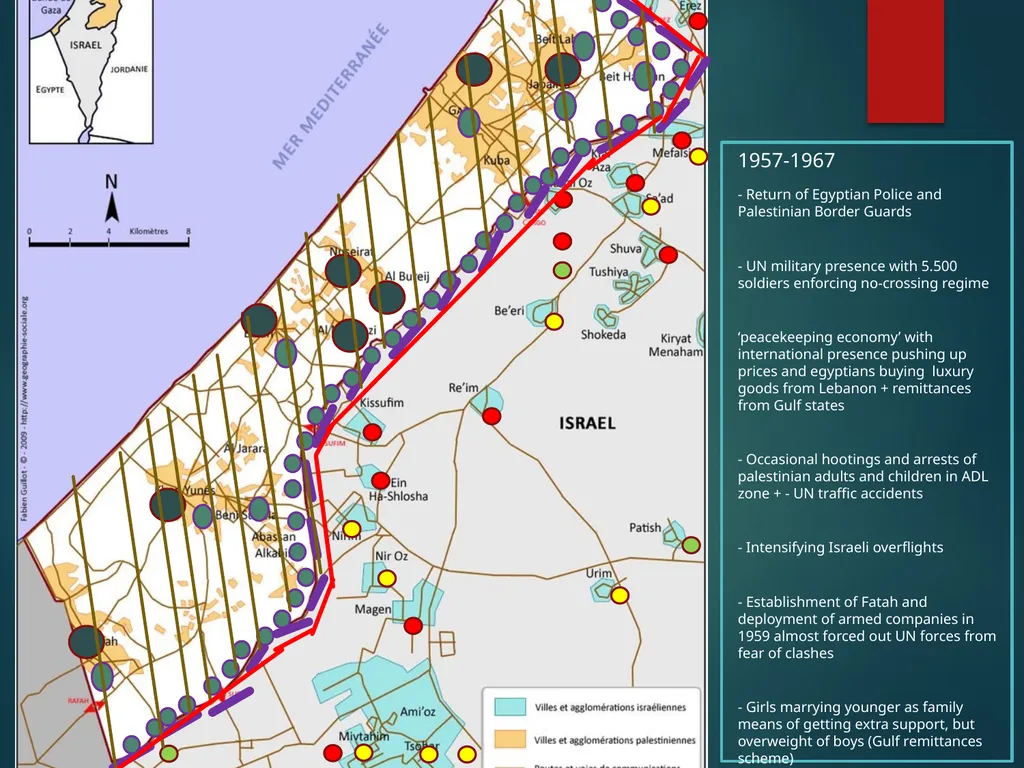
1957-1967
- Return of Egyptian Police and Palestinian Border Guards
- UN military presence with 5.500 soldiers enforcing no-crossing regime
‘peacekeeping economy’ with international presence pushing up prices and egyptians buying luxury goods from Lebanon + remittances from Gulf states
- Occasional hootings and arrests of palestinian adults and children in ADL zone + - UN traffic accidents
- Intensifying Israeli overflights
- Establishment of Fatah and deployment of armed companies in 1959 almost forced out UN forces from fear of clashes
- Girls marrying younger as family means of getting extra support, but overweight of boys (Gulf remittances scheme)<br>
17
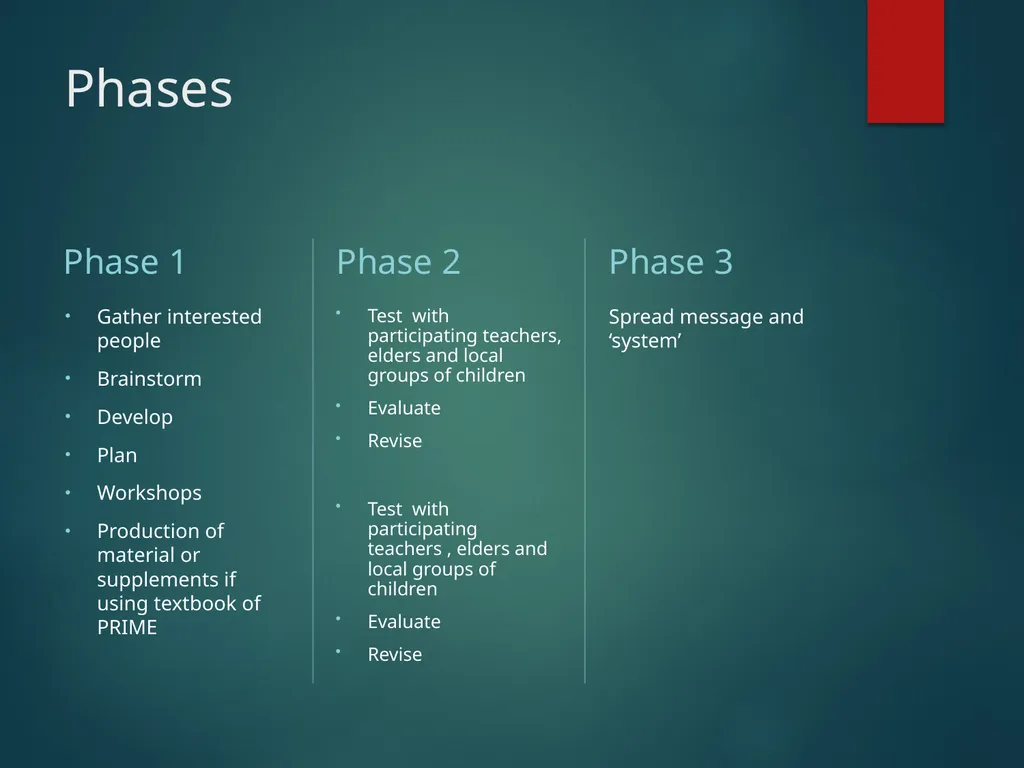
Phases Phase 1 Gather interested people
Brainstorm
Develop
Plan
Workshops
Production of material or supplements if using textbook of PRIME Phase 2 Test with participating teachers, elders and local groups of children
Evaluate
Revise
Test with participating teachers , elders and local groups of children
Evaluate
Revise Phase 3 Spread message and ‘system’<br>
18
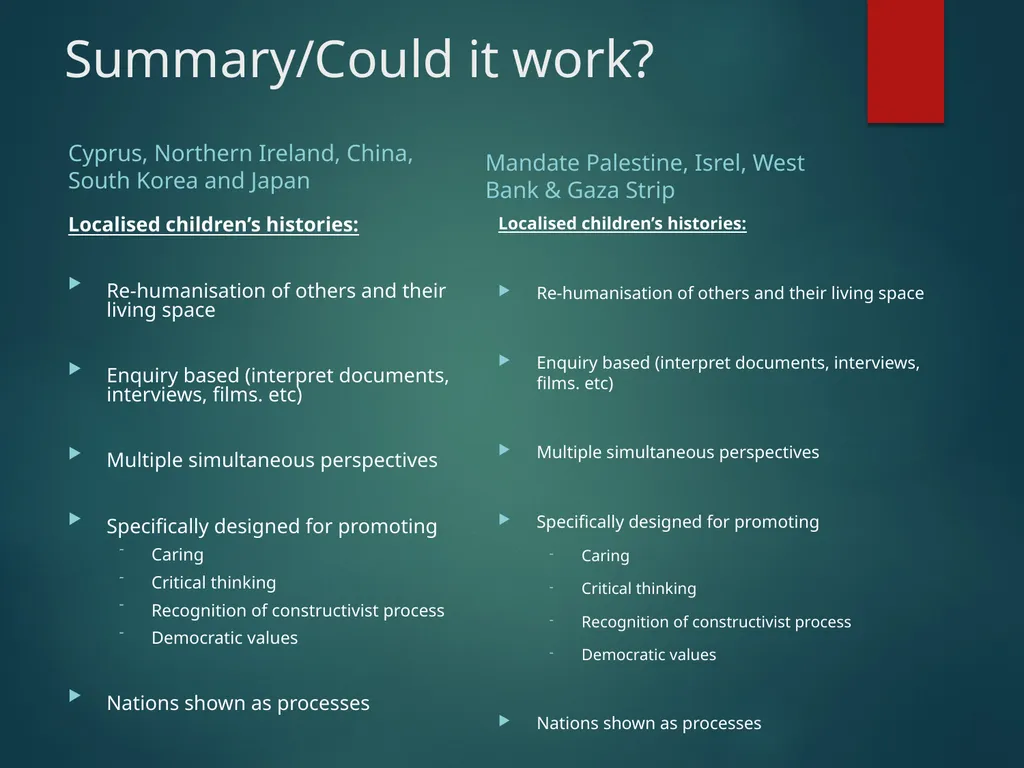
Summary/Could it work? Cyprus, Northern Ireland, China, South Korea and Japan Localised children’s histories:
Re-humanisation of others and their living space
Enquiry based (interpret documents, interviews, films. etc)
Multiple simultaneous perspectives
Specifically designed for promoting
Caring
Critical thinking
Recognition of constructivist process
Democratic values
Nations shown as processes Mandate Palestine, Isrel, West Bank & Gaza Strip Localised children’s histories:
Re-humanisation of others and their living space
Enquiry based (interpret documents, interviews, films. etc)
Multiple simultaneous perspectives
Specifically designed for promoting
Caring
Critical thinking
Recognition of constructivist process
Democratic values
Nations shown as processes<br>
Re-humanisation of others and their living space
Enquiry based (interpret documents, interviews, films. etc)
Multiple simultaneous perspectives
Specifically designed for promoting
Caring
Critical thinking
Recognition of constructivist process
Democratic values
Nations shown as processes Mandate Palestine, Isrel, West Bank & Gaza Strip Localised children’s histories:
Re-humanisation of others and their living space
Enquiry based (interpret documents, interviews, films. etc)
Multiple simultaneous perspectives
Specifically designed for promoting
Caring
Critical thinking
Recognition of constructivist process
Democratic values
Nations shown as processes<br>