QUANTIFIERS UNCOUNTABLE-NOUNS Little and a Little are used with non-count nouns, that is, such that we cant express in number but in quantity, as an amount. Form (a) little uncountable noun For example: I have little milk in the fridge.
"QUANTIFIERS UNCOUNTABLE-NOUNS Little and a Little" is the property of its rightful owner. Permission is granted to
download and print the materials on this website for personal, non-commercial use only, and to display it
on your personal computer provided you do not modify the materials and that you retain all copyright
notices contained in the materials. By downloading content from our website, you accept the terms of this
agreement.
Presentation Transcript
01
QUANTIFIERS<br>
02
UNCOUNTABLE-NOUNS Little and a Little are used with non-count nouns, that is, such that we can't express in number but in quantity, as an amount.
Form (a) little + uncountable noun
For example:
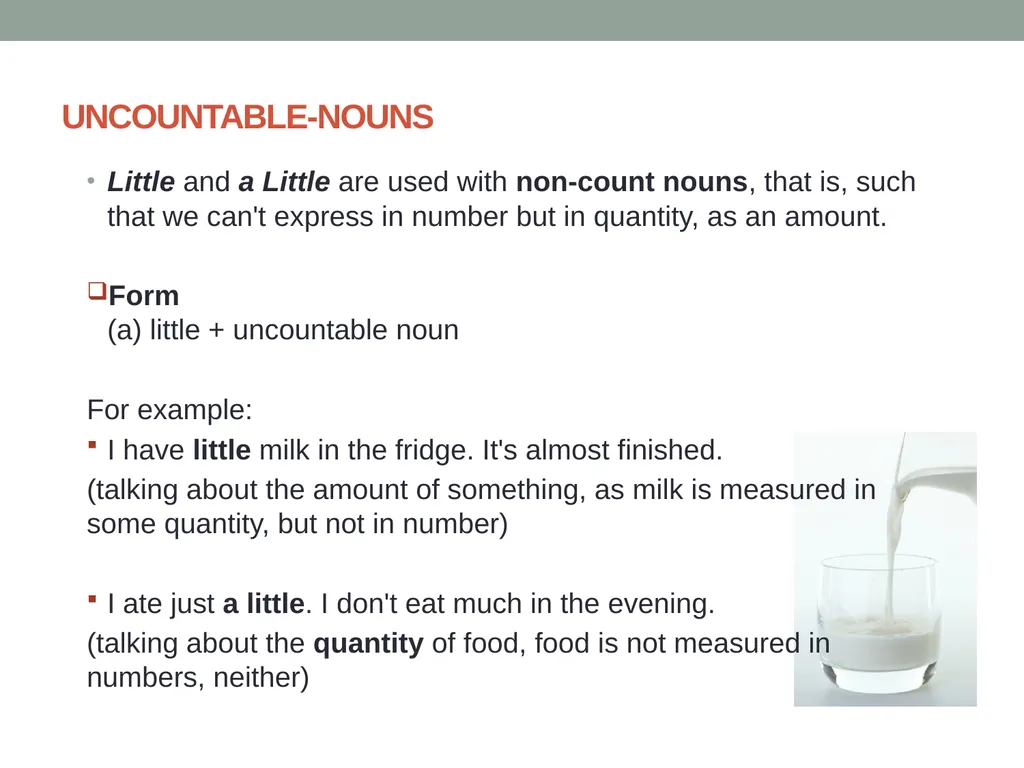
I have little milk in the fridge. It's almost finished.
(talking about the amount of something, as milk is measured in some quantity, but not in number)
I ate just a little. I don't eat much in the evening.
(talking about the quantity of food, food is not measured in numbers, neither)<br>
03
COUNTABLE-NOUNS Generally, Few and A Few are used with count nouns, therefore describing how big or small is the number of things.
Form
- (a) few + plural countable noun
For example:
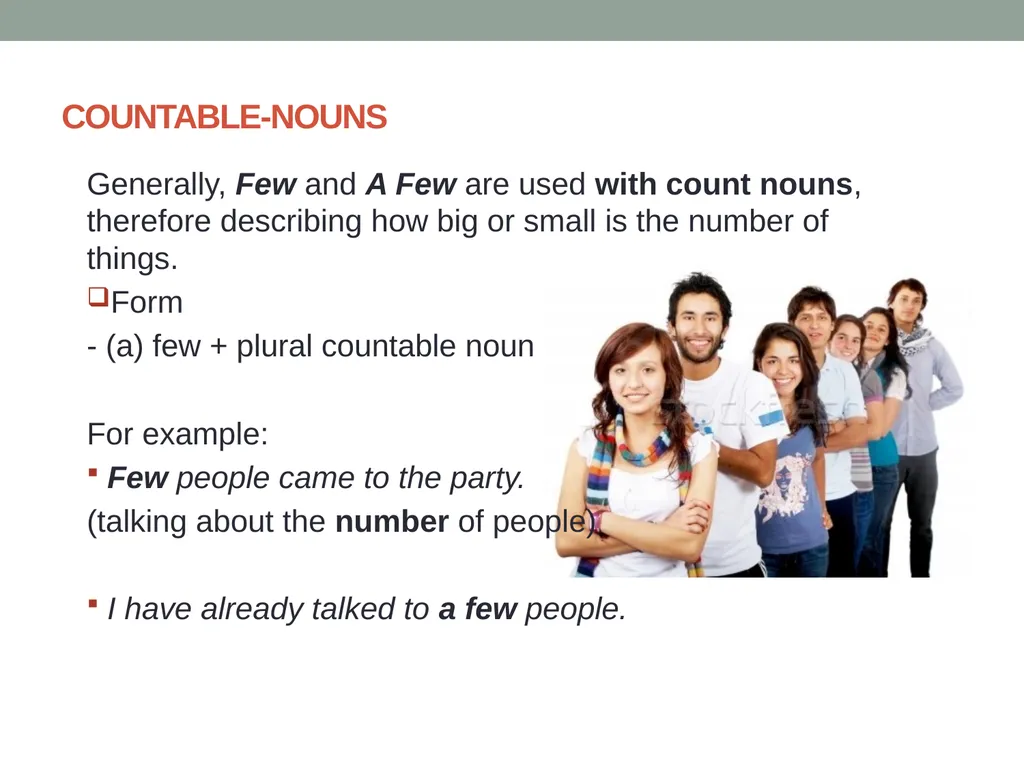
Few people came to the party.
(talking about the number of people)
I have already talked to a few people.<br>
04
Few – Little Are used to express a negative idea. We mean unsatisfactory number or amount of something, not enough Consider the examples: - I feel sorry for her. She has (very) few friends. (Negative idea: She does not have many friends; she has almost no friends.) - There was few biscuits. - I have (very) little money. I don't even have enough money to buy food for dinner. (Negative idea: I do not have much money; I have almost no money.) - There was little coffee. Note: the use of very (+few/little) makes the negative stronger, the number/amount smaller.<br>
05
A Few - A Little We have a positive idea. That is, we mean the number or amount of something is satisfactory. Maybe not so many or not so much, but enough. Consider these examples: - She has been here only two weeks, but she has already made a few friends. (Positive idea: She has made some friends already.) - There was a few biscuits. - I'm very pleased. I've been able to save a little money this month. (Positive idea: I have saved some money instead of spending all of it.) - There was a little coffee. A few/ a little give a positive idea; they indicate that something exists, is present, as in the examples above.<br>
06
Note: If we use a few or a little before a pronoun or determiner, we use of. Examples: - A few of them went to the cinema. - He only kept a little of his money with him.<br>
07
Making comparisons The comparative form of "few" is fewer, and the comparative form of "little" is less. Remember: use "fewer" for plural countable nouns, and "less" for uncountable nouns. For example, "There are fewer people here than last year" or "He drinks less coffee than I do". It is grammatically incorrect to say "There are less people here than last year", as "people" is a plural countable noun.<br>
08
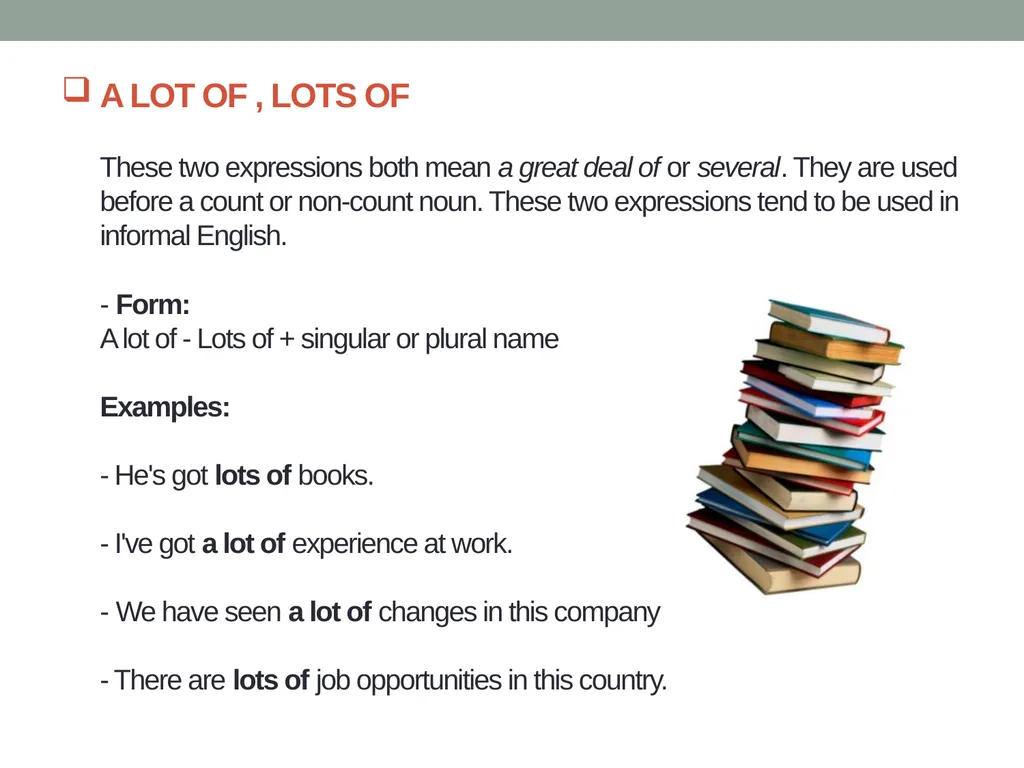
A LOT OF , LOTS OF These two expressions both mean a great deal of or several. They are used before a count or non-count noun. These two expressions tend to be used in informal English. - Form: A lot of - Lots of + singular or plural name Examples: - He's got lots of books. - I've got a lot of experience at work. - We have seen a lot of changes in this company - There are lots of job opportunities in this country.<br>
09
LOT OF Use a lot at the end of a sentence as an adverb. A lot is NOT followed by a noun. The meaning is the same as a great deal.
Examples:
I enjoy swimming a lot.
Mary seems to travel a lot.<br>
10
ENOUGH Form:
adjective or adverb + enough
enough + noun
enough + of + pronoun/determiner
Usage:
1. We use enough to mean sufficient.
Examples:
Your clothes are big enough to fit me.
You've done enough work. You can stop now.
Have you got enough money to buy me a drink?<br>
11
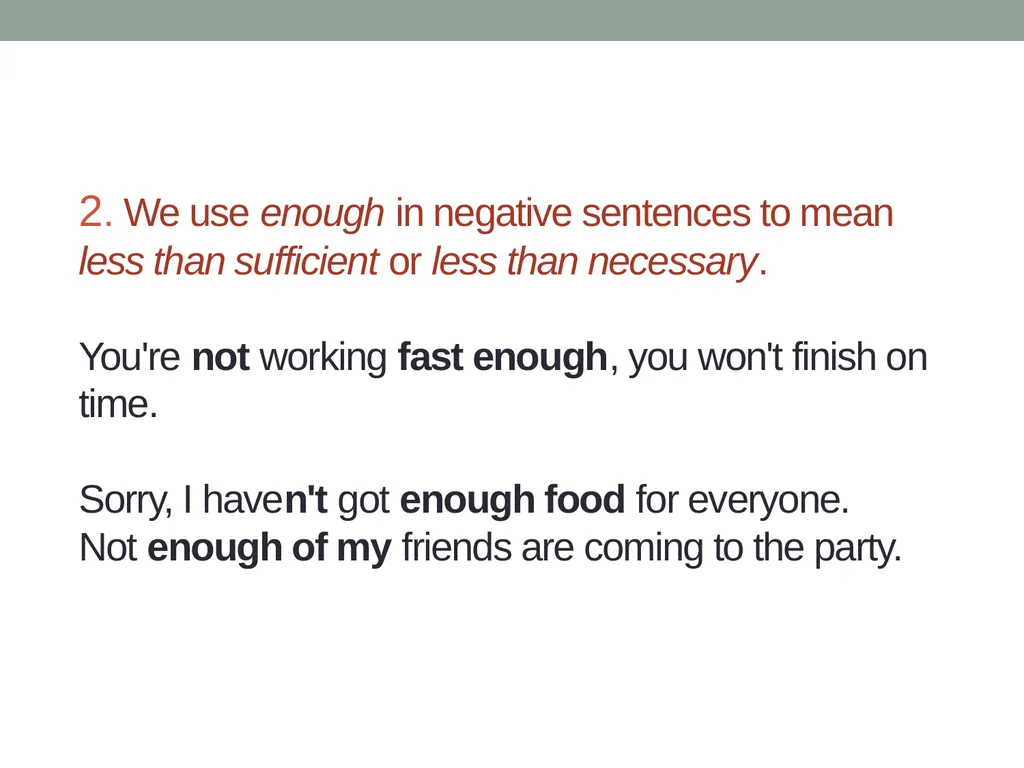
2. We use enough in negative sentences to mean less than sufficient or less than necessary. You're not working fast enough, you won't finish on time. Sorry, I haven't got enough food for everyone. Not enough of my friends are coming to the party.<br>
12
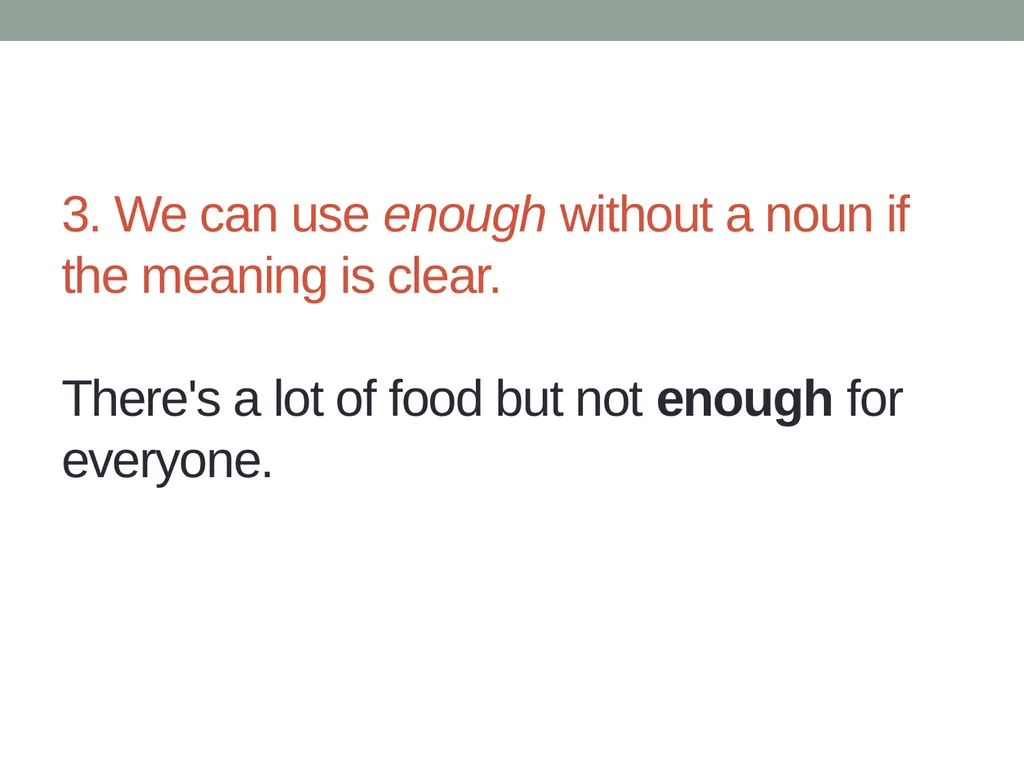
3. We can use enough without a noun if the meaning is clear. There's a lot of food but not enough for everyone.<br>