
Quarter 1 Report on Performance Information and

Description: Quarter 1 Report on Performance Information and Financial Information 30 August 2023 The report is front loaded with performance information on our core function under Programmes 2 4, to enable the Department to highlight key issues and
Related Topics
Download Presentation
"Quarter 1 Report on Performance Information and" is the property of its rightful owner. Permission is granted to download and print the materials on this website for personal, non-commercial use only, and to display it on your personal computer provided you do not modify the materials and that you retain all copyright notices contained in the materials. By downloading content from our website, you accept the terms of this agreement.
Presentation Transcript
slide1. Quarter 1 Report on
Performance Information and Financial Information
30 August 2023<br>
slide2. The report is front loaded with performance information on our core function under Programmes 2 – 4, to enable the Department to highlight key issues and achievements in the implementation of South Africa’s Foreign Policy;
The compliance issues under Programme 1 reflect at the end in order to showcase how the Department supports its core function;
The Department has achieved 100% (21 of 21 targets) set for Quarter 1. 2 Introduction<br>
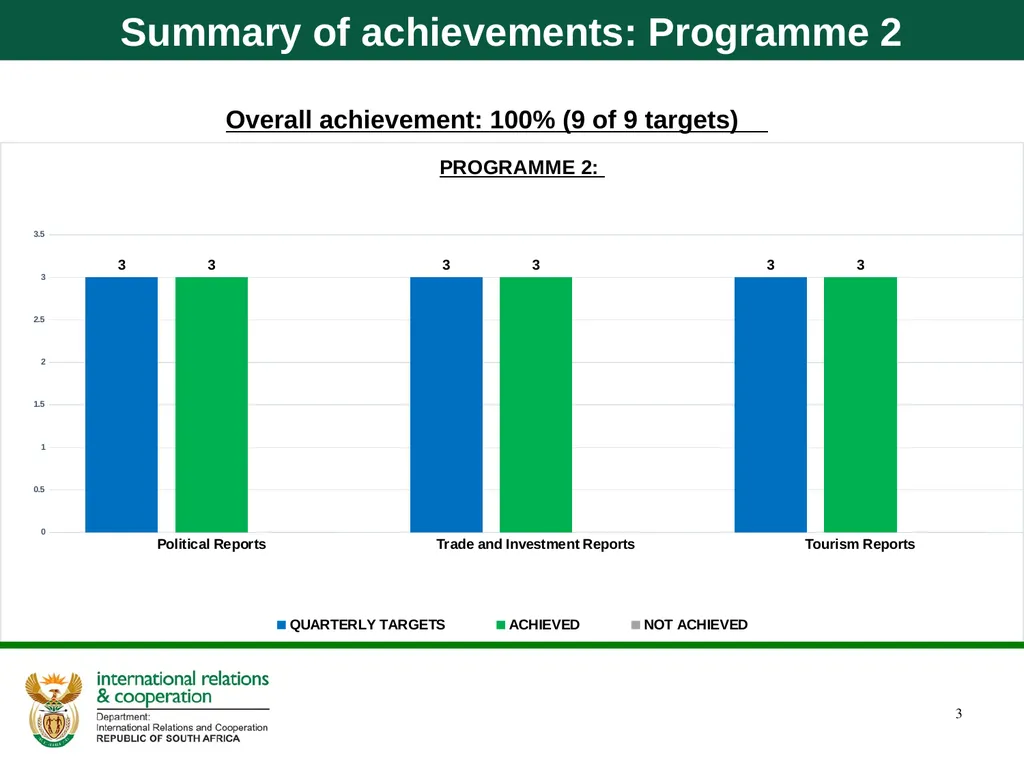
slide3. Summary of achievements: Programme 2 Overall achievement: 100% (9 of 9 targets) 3<br>
slide4. The three bilateral branches: Africa, Americas & Europe and Asia & Middle East reported as follows:
Regional political reports, including the outcomes of structured bilateral mechanisms (SBMs) and high-level visits (HLVs) aligned to achievement of the NDP and MTSF. The SBMs, HLVs and political engagements took place against the backdrop of political, economic developments and the security situation in the regions.
Quarterly progress reports on the regional trade and investments and investment initiatives undertaken in support of the one government investment approach. Head Office and Missions in the regions continued to explore investment opportunities for South Africa, in line with the objectives of the Economic Reconstruction and Recovery Plan (ERRP) which focuses on priority interventions aimed at restoring growth and creating jobs.
Quarterly progress reports on the regional tourism-promotion events to promote South Africa as a preferred tourist destination. Tourism is recognised for its immense potential and its significant contribution to the economy. Targeted tourism activities such as outreach programmes to tour operators and travel media through information dissemination, participation in Tourism Fairs and Expo’s into the foreign tourism market were undertaken. 4 Programme 2: International Relations<br>
slide5. POLITICAL
Africa
Structured Bilateral Mechanisms, high-level visits and political engagements with countries on the continent focussed on, among other:
Minister Pandor’s working visit to the Republic of Mauritius
A General Cooperation Agreement (GCA) was signed, establishing a Joint Commission at Senior Officials’ level to be co-chaired by the Directors General of both countries. The JC will serve as the mechanism through which the two countries would work together across various sectors.
Minister engaged the Mauritian business sector in order to further deepen South Africa-Mauritian trade and investment relations.
Minister Pandor’s Political and Diplomatic Consultations in Angola
Views were exchanged on regional, continental, and international issues of mutual interest as well as the security situation in the eastern Democratic Republic of Congo (DRC).
Acknowledged the Memorandum of Understanding (MoU) on the Tripartite Mechanism for Dialogue and Cooperation between South Africa, Angola and the DRC.
Minister provided a briefing on the African Peace Mission to the Russia and Ukraine Conflict, and the engagement by the six African Heads of State with the Presidents of Ukraine and Russia. 5 Programme 2: International Relations (cont…)<br>
slide6. POLITICAL
Africa (continued)
President Ramaphosa’s working visit to the Kingdom of Lesotho (supported by DM Botes)
The Sod-Turning Ceremony for Polihali Water Project was officiated.
The President highlighted a number of aspect during his opening remarks, including, (i) that the Lesotho Highlands Water Project (LHWP) is one of the biggest infrastructure investments by SA outside its border, (ii) the project is a good example of public-private collaboration, (iii) Phase II of the project, once completed will increase the current supply rate of 780 million cubic meters to more than 1270 million cubic meters per annum.
During DM Botes and the Foreign Minister of Lesotho’s engagement, the energy deficit in both countries was highlighted. In this regard, Lesotho’s Foreign Minister emphasised the potential that exist in Lesotho because of the availability of water and wind which can be harnessed for the benefit of both countries.
The Ministers responsible for Energy and Electricity agreed that they will begin to work on cooperation agreement regarding four potential projects that have passed the feasible stage.
The Ministers responsible for Water committed to continue to work together to resolve remaining challenges in the implementation of Phase II of the LHWP. 6 Programme 2: International Relations (cont…)<br>
slide7. POLITICAL
Africa (continued)
Mid-term review of the Third Session of the Bi-National Commission (BNC) between South Africa and the Republic of Mozambique
Implementation of decisions taken during the BNC, which was held in March 2023 in South Africa were monitored. The meeting, among other:
Noted that the Southern African Development Community (SADC) is relatively stable except for a few areas of instability, such as northern Mozambique, Eswatini and the Easter DRC.
Expressed concern about the armed conflict in the Republic of Sudan and called on the parties to engage in dialogue to bring about peace and avoid further deterioration of the already dire humanitarian situation.
Called for the strengthening of multilateralism and reiterated its support for the rule based international system and centrality of the UNSC in maintaining peace and security.
Reiterated the desire to resolve conflict through dialogue and to this effect welcomed the African Peace Initiative to the Russia-Ukraine conflict.
Noted with satisfaction the success of the joint operation that resulted in the seizure of substantial amounts of illicit drugs.
Noted with appreciation of various technical and operational engagements regarding the repatriation of recovered stolen motor vehicles. 7 Programme 2: International Relations (cont…)<br>
slide8. POLITICAL
Africa (continued)
Minister Pandor’s working visit to Cameroon
Bilateral relations discussions included:
Emphasis on the need to strengthen areas of cooperation and establish a mechanism for political consultations. Identified areas of cooperation are: agriculture, mining, infrastructure development, education, health, science and innovation and youth empowerment.
Emphasis on the need to strengthen the legal framework for bilateral cooperation and it from the Senior Officials’ Meeting (SOM) to a Joint Commission of Cooperation (JCC).
Significance of creating a conducive environment in both countries that will allow the business sector to thrive. Emphasis was placed on fair treatment of the business sector in both countries as it will enable the continent to adhere to a better South Africa, better Africa and better world.
Consensus that the two countries should work together in various multilateral for a such as the UN and the AU and have regular political consultations.
During a Round Table with businesses that have links to SA, it was highlighted that there is enormous potential for tourism, trade and investment that exist between SA and Cameroon. However, obstacles such as (i) access to SA visas, (ii) Cameroon fiscal policy and (iii) funding for SA companies prevent tourism and trade to flourish. 8 Programme 2: International Relations (cont…)<br>
slide9. POLITICAL
Africa (continued)
State visit to the Republic of South Africa by President Geingob of the Republic of Namibia
The state visit was preceded by bilateral meetings between sectoral ministries.
A Memorandum of Understanding (MoU) on Cooperation in Tourism was signed which will enable the two countries to exchange ideas on improving tourism and maximising its economic potential.
It was agreed that, on the economic front, the two countries would share national strategies with a view to develop their economies to improve the living conditions of the people and restore livelihoods following the devastation of the COVID-19 pandemic.
Ministers responsible for Trade and Industry agreed to have follow-up and deeper discussions regarding cooperation between the South African Industrial Development Corporation (IDC) funding of identified projects. This will augur well with leveraging of the opportunities brought about the implementation of the AfCFTA.
Emphasis was placed on the full implementation of the AfCFTA Framework to ensure food security and self-sufficiency in the wake of the Russia-Ukraine conflict.
President Geingob indicated that more oil and gas has been discovered in the Orange River and it is therefore important for SA to work closely with Namibia to leverage these opportunities, particularly in green hydrogen. 9 Programme 2: International Relations (cont…)<br>
slide10. POLITICAL
Americas and Europe
The SBMs, high-level and other political engagements, with countries in the region focused, amongst others on:
The 4th Annual Consultations between South Africa and Canada was held in Ottawa. Progress was made in areas of trade and investment, environment, science and technology, arts and culture, development cooperation and strengthening cooperation in health, education, and South Africa’s Just Energy Transition.
The 11th SA-Germany Bi-National Commission illustrated the substantive nature of South Africa’s relationship with Germany in areas covered by the working groups including arts and culture, science and innovation, higher education, development cooperation and vocational training.
High level consultations saw the status of bilateral, multilateral, cultural, political and economic relations reviewed including energy investment pledges and the strengthening of trade tries. Peace and security and multilateralism discussed.
A successful official visit by the Vice President of Colombia strengthened diplomatic and political relations and defined a roadmap for mutually beneficial cooperation in agriculture; arts and culture; energy; gender empowerment; higher education, science and innovation; sport; tourism; trade and investment and transport. 10 Programme 2: International Relations (cont…)<br>
slide11. POLITICAL
Americas and Europe (cont.)
The 17th Joint Consultative Mechanism with Cuba reviewed progress made since the 16th JCM in terms of active cooperation and ongoing efforts to elevate trade relations to mirror the level of political relations.
During a working visit to Lisbon, bilateral cooperation and the forthcoming state visit to South Africa was discussed.
During official visits to SA by a Netherlands and Danish, relationships in the areas of green hydrogen, renewable energy and just energy transition. During the visit, a Memorandum of Understanding in the Field of Green Hydrogen with the Netherlands was signed and the President and the Prime Ministers participated in a Denmark-Netherlands-South Africa Business Forum focusing on key areas in green energy and green hydrogen.
During the State Visit by the President of Portugal the Defence Cooperation Agreement was signed.
During the State Visit by Finland trade and investment relations was strengthened targeting various sectors of cooperation including ICT food hygiene and construction. 11 Programme 2: International Relations (cont…)<br>
slide12. POLITICAL
Asia and Middle East
Structured Bilateral Mechanisms, high-level visits and political engagements with countries in the region focussed on, among other:
Third Session of the SA-UAE Joint Committee on Cooperation
Both countries:
Agreed on the importance of concluding mutually agreed agreements and Memoranda of Understanding (MoUs).
Expressed their commitment to strengthening multilaterism while also advocating for the needs and interests of developing countries to be placed at the top of the international agenda.
Agreed to expand economic cooperation and explore the potential of increasing commercial engagements between the two countries.
Will encourage and facilitate increased trade flows and investment activities between their respective business communities.
To explore technical cooperation in Special Economic Zones (SEZs), through a MoU, to enhance investment and trade relations through collaboration between technical experts from both sides. 12 Programme 2: International Relations (cont…)<br>
slide13. POLITICAL
Asia and Middle East (continued)
12th South Africa-China Strategic Dialogue – Deputy Minister Mashego-Dlamini
The visit allowed the Deputy Minister (DM) to, among other, co-chair the 12th SA-China Strategic Dialogue with her counterpart, meet with the International Department (ID) of the Chinese Communist Party (CPC); hold a courtesy call meeting with her counterpart from MOFCOM in preparation for the upcoming Joint Working Group (JWG).
During the 12th SA-China Strategic Dialogue, views on China-Africa cooperation, the situation in Africa, and international and regional issues of mutual interest and concern were exchanged.
The DM, during her engagement with the CPC, requested the encouragement of m ore investment from China to South Africa. SA seeks China’s support in exploring a modernisation path that meets its national conditions.
During the DM’s meeting with the Vice Minister of Commerce of China, it was indicated that SA is strategically placed to serve as a gateway for exports into Africa and both countries can cooperate in this regard, while taking advantage of the AfCFTA.
During the meeting with Standard Bank, it was observed that the Standard Bank office in Beijing is a useful resource for South Africa’s economic engagements especially in relation to engagements with potential Chinese investors who seek more information on the SA economic landscape. 13 Programme 2: International Relations (cont…)<br>
slide14. POLITICAL
Asia and Middle East (continued)
7th Round of Political Consultations held in Astana
The meeting agreed, among other:
That the political and economic relations have witnessed an upwards trajectory, despite major shifts in the international political landscape.
To advance the bilateral and economic cooperation, a frequency of high-level visits across all sectors, in particular mutual visits at both Heads of State and Foreign Minister level should be prioritised.
That areas identified for an intensification of economic cooperation should include, mining (services, technology and equipment), pharmaceuticals (vaccines), agro-processing (fruit juices, canned fruit and vegetables, grapes, wines), geological exploration, the blue economy, defence and renewable energy.
That the expedition of the conclusion of internal processes related to the finalisation of (a) the Agreement on Trade and Economic Cooperation and (b) the Agreement on the Exemption of Visa requirements for holders of Diplomatic and Official passports and (c) the Memorandum of Cooperation between the DIRCO Diplomatic Academy and the Kazakhstan Academy of Public Administration, should be prioritised. 14 Programme 2: International Relations (cont…)<br>
slide15. POLITICAL
Asia and Middle East (continued)
Official visit of Prime Minister Lee Hsien Loong of Singapore
Two Memoranda of Understanding (MoUs) were signed during the Official Visit, namely the (a) the MoU between the Department of Communications and Digital Technologies of the Republic of South Africa and the Ministry of Communications and Information of the Republic of Singapore in the Field of Information and Communications Technology and, (b) The MoU between the Government of the Republic of South Africa and the Government of the Republic of Singapore on Skills Development.
The two countries agreed to further develop their economic partnership, as well as deepening and expanding cooperation in trade and investment, science and innovation, digitalisation, communications and technology, water and sanitation and skills development.
The potential for expanding ties with Singapore in the fields of Higher Education, Science and Innovation was highlighted.
Possible partnerships between Singapore Airlines and SAA were discussed.
South Africa and Singapore agreed to further develop the two countries’ economic partnership, as well as deepening and expanding cooperation in trade and investment, science and innovation, digitalisation, communications and technology, water and sanitation and skills development. 15 Programme 2: International Relations (cont…)<br>
slide16. TRADE & INVESTMENT
Africa
Initiatives by Missions on the continent included engagements that focused on, among other:
Negotiations with the Paramount Group (Aerospace and Defence) of Algeria as an opportunity for South Africa to build public-private partnership relations to establish sustainable mutual beneficial trade and investment relations.
Negotiations with Imperial STP Super Maritime and NAI (Sao Tome and Principe) that provided valuable insight with regards to logistics and shipping routes to São Tomé with the aim of increasing South African exports to São Tomé and Príncipe.
Taking stock of progress already made in terms of investments and to discuss new opportunities with a view to promoting win-win trade and investment cooperation.
Barriers/challenges that impede the pursuance and promotion of trade and investment initiatives.
Building public-private partnership relations to establish sustainable mutual beneficial trade and investment relations.
Signing of twinning agreements between the cities of Cape Town and Nairobi in order to collaborate on the management on informal housing and other affordable housing initiatives.
Agreement with Eritrea to pursue Sectoral Cooperation in the field of Marine Resources, with emphasis on fisheries, in accordance with the General Cooperation Agreement.
Promotion of cross border trade by AfCFTA as well as strengthening trade and investment links on bilateral levels and within the context of the AfCFTA. 16 Programme 2: International Relations (cont.)<br>
slide17. TRADE & INVESTMENT
Americas and Europe
Trade and investment initiatives on the continent included engagements that focused on, amongst others:
Bilateral cooperation and development through trade missions to SA as well as the participation at the EXPOMIN 2023 in Chile, led by a dtic business delegation.
Trade, investment and global leadership through various engagements with role players invested in the upcoming BRICS Summit.
Energy and Mineral resources through the identification of SA in the exportation of cobalt and discussions with CDIAL HALAL on the repurposing of chicken waste to energy.
Housing through a Canadian investment initiative focussed on an affordable housing scheme to commence in the Western Cape.
Science and Innovation through an SA Wine Promotion Event held in Ottawa focussing on the Global Innovation Clusters (GIC).
Water resources, Agriculture & Education. 17 Programme 2: International Relations (cont.)<br>
slide18. TRADE & INVESTMENT
Asia and Middle East
Trade and investment initiatives in the region included engagements that focused on, among other:
Further explore opportunities for investment for local production/assembly of vehicles and components in the Eastern Cape and to discuss collaboration particularly in research, technology and skills development.
Potential renewable energy investment projects in the Western Cape.
Identifying possible South African partners for infrastructural projects such as the construction of refineries or power plants.
Interest in assisting South Africa to overhaul and maintain its oil refineries, engage in mining projects, establishing the direct Mahan Airlines flights to South Africa as well as for South Africa to purchase Iranian petrochemical products.
Interest to contribute to the resolution of SA’s current energy challenges.
Matters of market access for South African products, trade and investment.
SA’s sustainability journey and experience in relation to climate change in terms of water management.
Promoting a favourable narrative regarding doing business in SA and promotion of SA goods and Services.
Possible collaboration with the South African government in terms of transitioning to low-carbon energy sources. 18 Programme 2: International Relations (cont.)<br>
slide19. TOURISM
Africa
Missions on the continent continued to engage relevant stakeholders on a variety of matters which includes:
There are opportunities for outbound tourism to South Africa that can be harnessed. Those related to Healthcare through the promotion of South Africa’s private healthcare system can make SA a destination of choice for many African citizens such as South Sudan. The spinoffs of such tourism for the hotel, accommodation and aviation sectors can be huge.
A Pre-Tourism Indaba event for Tour Operators of Ghana that would be sending 60 tour operators to Tourism Indaba with the aim further strengthening interaction between the tourism authorities as this approach is starting to produce desired results in tourism numbers.
Ghana signed an MoU on Transport Cooperation with SA recently. In a meeting with the airline African World Airlines (AWA – Ghana). Further cooperation and collaboration is sought in line with the signed MOU. AWA is advancing into South African economy through the training of pilots for 6 million SAC’s, Aircrafts servicing services worth R14 million and the spending of R20 million on average on flights and accommodation in SA.
Areas of improvement includes the expanding of existing cooperation, the Identification of new opportunities to explore as well as the identification of concrete barriers to tourism. 19 Programme 2: International Relations (cont.)<br>
slide20. TOURISM
Americas and Europe
Mission specific tourism activities within the region included:
A Wine Tasting Event in collaboration with Wines of South Africa (WOSA) in Washington.
Attendance of the Ottawa Travel and Vacation show.
Participation in the annual Passport DC: Around the World Embassy Tour and Flower Mart in Washington.
South Africa Week at the University of Catolica in Chile.
Attendance of the University Expomin in Chile and the 2023 Vienna Tourism Fair.
A mission Tourism Promotion event in Cyprus.
Engagements with Tourism Operators in Switzerland.
Exploration of future partnerships with Euro Tours operating throughout Europe and beyond.
Attendance of a South African tourism promotion presentation to membership of United Nations Women’s Guild (UNWG) in Vienna.
SANPARKS, SA Tourism and the Department of Tourism and identified Provinces in SA are strategising with the Russian Association of Parks in terms of Tourism Cooperation. 20 Programme 2: International Relations (cont.)<br>
slide21. TOURISM
Asia and Middle East
Missions in the region continued to engage relevant stakeholders on a variety of matters:
Utilising Freedom Day celebrations to promote South Africa as the preferred tourist destination.
Possibility of a travel company to generate travel and tourism packages for South Africa.
Opportunities for collaboration in terms of the entertainment industry.
Updating Tour Operators on new Tourism products in South Africa.
The discussion of Exchange Programmes between travel agencies to familiarise trips.
Participation in tourism roadshows and tourism fairs.
Promotion of South African tourism, food, wine and culture.
Possible future collaboration in the arts and film industry.
Explore developing cooperation programmes in the areas of wildlife tourism and wildlife management.
Visa challenges.
Barriers to tourism. 21 Programme 2: International Relations (cont.)<br>
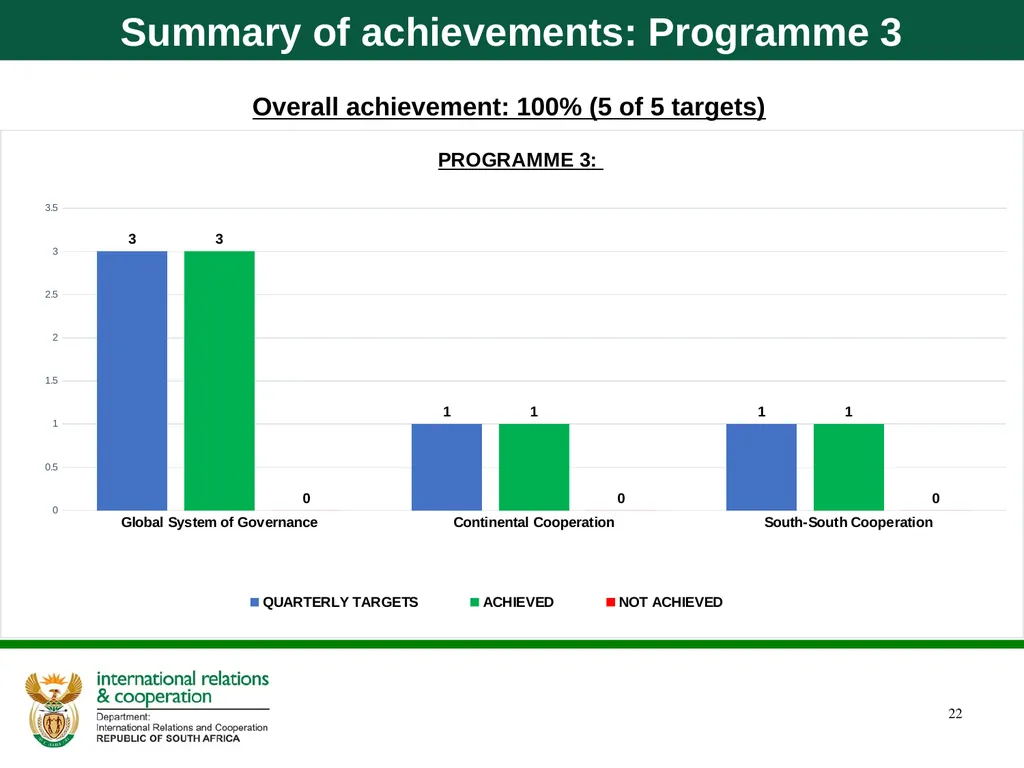
slide22. Overall achievement: 100% (5 of 5 targets) 22 Summary of achievements: Programme 3<br>
slide23. 23 Programme 3: International Cooperation (cont.) Sub Programme 3.1: System of Global Governance Three reports on the outcomes of multilateral and multistate organisations reflecting South Africa's participation and interests, including that of the African Agenda on:
Report on Peace and Security
African Initiative on Ukraine
President Ramaphosa participated in the African Peace Mission aimed at a peaceful resolution of the conflict between Ukraine and Russia. The two-day mission was hailed as a demonstration of collective African engagement on a global issue and was described as impactful.
Peace Building Commission (PBC)
The meetings were aimed at ensuring post conflict reconstruction and development in countries emerging from conflict.
Open meetings of the United Nations Security Council (UNSC)
The meetings of the UNSC were aimed at advancing international peace and security.<br>
slide24. 24 Programme 3: International Cooperation (cont.) Sub Programme 3.1: System of Global Governance (continued) 5th Session of the Ad Hoc Committee on Cyber Crime
The Session focused on the first reading of the preamble, the provisions on International Cooperation, Preventive Measures, Technical Assistance, and the Mechanism of Implementation and the Final Provisions of a Comprehensive International Convention on Countering the use of Information and Communications Technologies for Criminal Purposes.
Seminar: “The Role of Africa in Advancing Multilateralism at the United Nations and other Multilateral Fora”
The seminar focused on Africa’s role in promoting multilateralism at the UN and in other international fora. The objective of the seminar was to create a platform between DIRCO officials, academia and think-tanks to deliberate on Africa’s role in promoting multilateralism at the UN and in other international fora given current geopolitical challenges.
BRICS Counter Terrorism Working Group
Discussions focussed on the threats and challenges faced by each Member State, and what was being done at the national level to mitigate and counter the threat.<br>
slide25. 25 Programme 3: International Cooperation (cont.) Sub-programme 3.1: System of Global Governance (continued) 2. Report on Human Rights
Consultations in preparation for South Africa’s participation in the 53rd Session of the Human Rights Council
The consultations were very useful in successfully appraising participants about, among other, South Africa’s priorities in the Human Rights Council.
United Nations Permanent Forum on Indigenous Issues (UNPFII)
South Africa delivered three statements on the theme, human rights dialogue with the Special Rapporteur on the rights of Indigenous Peoples and the Expert Mechanism on the Rights of Indigenous Peoples (EMRIP) and The six mandated areas of the Forum.
Campaign for the successful re-election of Adv Patsy Tlakula to the Committee on the Elimination of Racial Discrimination (CERD)
Advocate P Tlakula was elected to serve on the 18 member UN Committee (CERD) responsible for the monitoring of States’ implementation of the Convention.<br>
slide26. 26 Programme 3: International Cooperation (cont.) Sub-programme 3.1: System of Global Governance (continued) Generation Equality Forum (GEF) Action Coalition on Economic Justice and Rights Expert Leaders Retreat
The Retreat made progress on determining priority workstreams for the EJR Action Coalition. It was agreed that there is still a need to further refine these, and that UN Women will present a recommendation for the Action Coalition’s short, medium, and long-term priorities. The collective agreed on a way forward for the blueprint on Action Area 4, that aims to “advance gender-transformative economies that work for women, people, and the planet”, with the short title of “Gender-transformative Economies.”
5th Capital-Level Focal Points Meeting
South Africa participated actively in the meeting, which identified the need for supporting legislation to facilitate the implementation of the WPS Agenda and to address identified challenges, which includes lack of budget provision in WPS National Action Plans, and that outcomes of monitoring and evaluation do not constitute strategic planning processes.<br>
slide27. 27 Programme 3: International Cooperation (cont.) Sub-programme 3.1: System of Global Governance (continued) 3. Report on Economic & Social Development:
76th Session of the World Health Assembly
The Session considered, among other:
The report of the Director-General (DG) on the work of the WHO in health emergencies, during which the Ukraine and Russia both presented resolutions related to the ongoing war.
The report of the DG of the WHO on the Health Conditions in the occupied Palestinian territory, including East Jerusalem and the Occupied Syrian Golan.
Meeting of the Health Ministers of the Foreign Policy & Global Health (FPGH) Initiative on the margins of the 76th World Health Assembly (WHA)
The meeting shared South Africa’s activities for the year which were well received by the Group, including the theme: “Back to Basics: Addressing Global Health Challenges in the Foreign Policy Space.”<br>
slide28. 28 Programme 3: International Cooperation (cont.) Sub-programme 3.1: System of Global Governance (continued) Negotiations of the Intergovernmental Negotiating Body (INB) on the pandemic treaty
Member states made some progress at the meeting when they concluded a first reading of and inputs into the Zero Draft of the instrument and agreed on the way forward.
56th Session of the UN Commission on Population and Development (CPD)
South Africa was able to promote and sustain agreed language on Comprehensive Sexual Education (CSE) and Sexual and Reproductive Health and Rights. Additionally, South Africa co-hosted two side events on (i) advancing the ICPD25 commitments in the context of sustainable development using a framework of sexual and reproductive health, rights, and Justice and (ii) comprehensive sexuality education for all - evidence and learnings from around the globe.
The United Nations Economic and Social Council (ECOSOC) operational activities for development segment
The meeting agreed, among other, that the UN RCs has strengthened their role in the UN reformed development system and are supporting countries in implementing the 2030 Agenda for sustainable development.<br>
slide29. 29 Programme 3: International Cooperation (cont.) Sub-programme 3.1: System of Global Governance (continued) One report on the implementation of South Africa’s international reporting obligations in terms of international agreements that South Africa is a party to.
South Africa has an international obligation to submit national reports in terms of international agreements it is party to. Line-function departments submit national reports, while DIRCO monitors the submission of the reports and provides feedback to Cabinet.
Maintained 60 positions on identified influential multilateral bodies where South Africa is represented.
Most of these positions are available on a rotational basis. South Africa is represented at identified multilateral bosies to promote its national interests and influence resolutions, decisions and outcomes.<br>
slide30. 30 Programme 3: International Cooperation (cont.) Sub-programme 3.2: Continental Cooperation<br>
slide31. One report on the outcomes of South-South engagements reflecting South Africa’s participation and interests, including that of the African Agenda. The report focuses on the following activities, which focusses on the following activities:
Brazil, Russia, India, China, South Africa (BRICS)
BRICS Deputy Ministers/Special Envoys on the Middle East and North Africa (MENA)
The meeting, amongst other, agreed that:
BRICS member states must come together to discuss these issues and identify potential solutions for the benefit of all.
BRICS must continue to prioritise regional and continental peace, stability, security and development as the main components towards contributing to a sustainable peaceful and just global order based on international law.
Third BRICS Sous-Sherpa meeting on Institutional Development
The meeting reflected on the following aspects:
Consolidation of BRICS Cooperation.
External Engagement with non-BRICS Countries.
BRICS Membership Expansion. 31 Programme 3: International Cooperation (cont.) Sub-programme 3.4: South-South Cooperation<br>
slide32. Brazil, Russia, India, China, South Africa (BRICS)
Second BRICS Sherpa and Sous-Sherpa meeting
The meeting took place in preparation for the Standalone meeting of the BRICS Ministers of Foreign Affairs and International Relations and focused on finalising the Joint Statement that was issued. Despite the increasing differences manifesting during negotiations, consensus was reached on the text for the Joint Statement
Standalone meeting of the BRICS Ministers of Foreign Affairs and International Relations
The meeting, among other:
Reaffirmed commitment to strengthening the framework of BRICS cooperation under the three pillars of political and security, economic and financial, and cultural and people-to-people cooperation upholding the BRICS spirit.
Reiterated commitment to strengthening multilateralism and upholding international law.
Friends of BRICS Foreign Ministers meeting
The meeting reflected on strengthening partnerships towards a multipolar world, sustainable and inclusive global recovery, bringing fairness to global financial systems and fostering dialogue as a pathway to peace and development. 32 Programme 3: International Cooperation (cont.) Sub-programme 3.4: South-South Cooperation (continued)<br>
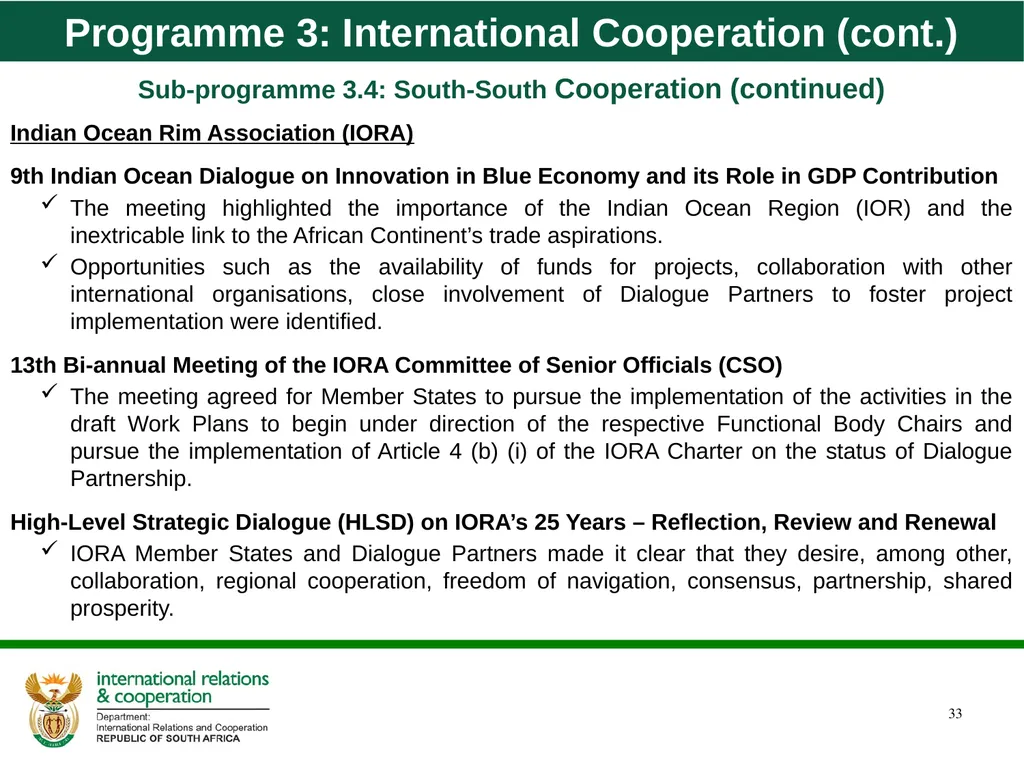
slide33. Indian Ocean Rim Association (IORA)
9th Indian Ocean Dialogue on Innovation in Blue Economy and its Role in GDP Contribution
The meeting highlighted the importance of the Indian Ocean Region (IOR) and the inextricable link to the African Continent’s trade aspirations.
Opportunities such as the availability of funds for projects, collaboration with other international organisations, close involvement of Dialogue Partners to foster project implementation were identified.
13th Bi-annual Meeting of the IORA Committee of Senior Officials (CSO)
The meeting agreed for Member States to pursue the implementation of the activities in the draft Work Plans to begin under direction of the respective Functional Body Chairs and pursue the implementation of Article 4 (b) (i) of the IORA Charter on the status of Dialogue Partnership.
High-Level Strategic Dialogue (HLSD) on IORA’s 25 Years – Reflection, Review and Renewal
IORA Member States and Dialogue Partners made it clear that they desire, among other, collaboration, regional cooperation, freedom of navigation, consensus, partnership, shared prosperity. 33 Programme 3: International Cooperation (cont.) Sub-programme 3.4: South-South Cooperation (continued)<br>
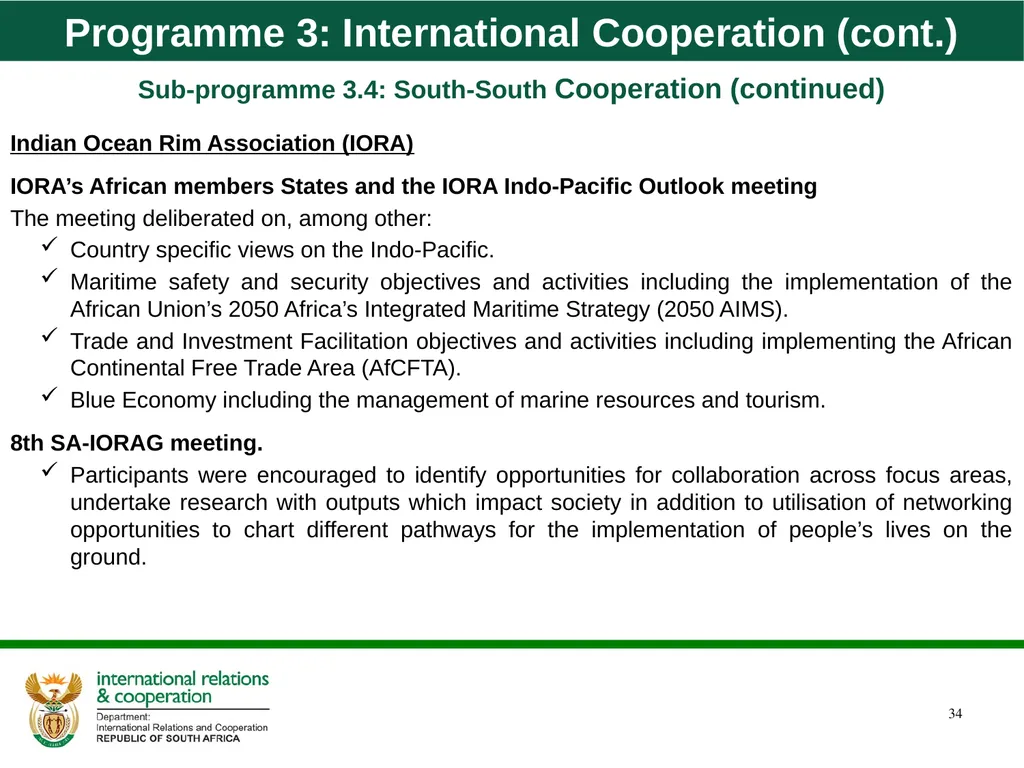
slide34. Indian Ocean Rim Association (IORA)
IORA’s African members States and the IORA Indo-Pacific Outlook meeting
The meeting deliberated on, among other:
Country specific views on the Indo-Pacific.
Maritime safety and security objectives and activities including the implementation of the African Union’s 2050 Africa’s Integrated Maritime Strategy (2050 AIMS).
Trade and Investment Facilitation objectives and activities including implementing the African Continental Free Trade Area (AfCFTA).
Blue Economy including the management of marine resources and tourism.
8th SA-IORAG meeting.
Participants were encouraged to identify opportunities for collaboration across focus areas, undertake research with outputs which impact society in addition to utilisation of networking opportunities to chart different pathways for the implementation of people’s lives on the ground. 34 Programme 3: International Cooperation (cont.) Sub-programme 3.4: South-South Cooperation (continued)<br>
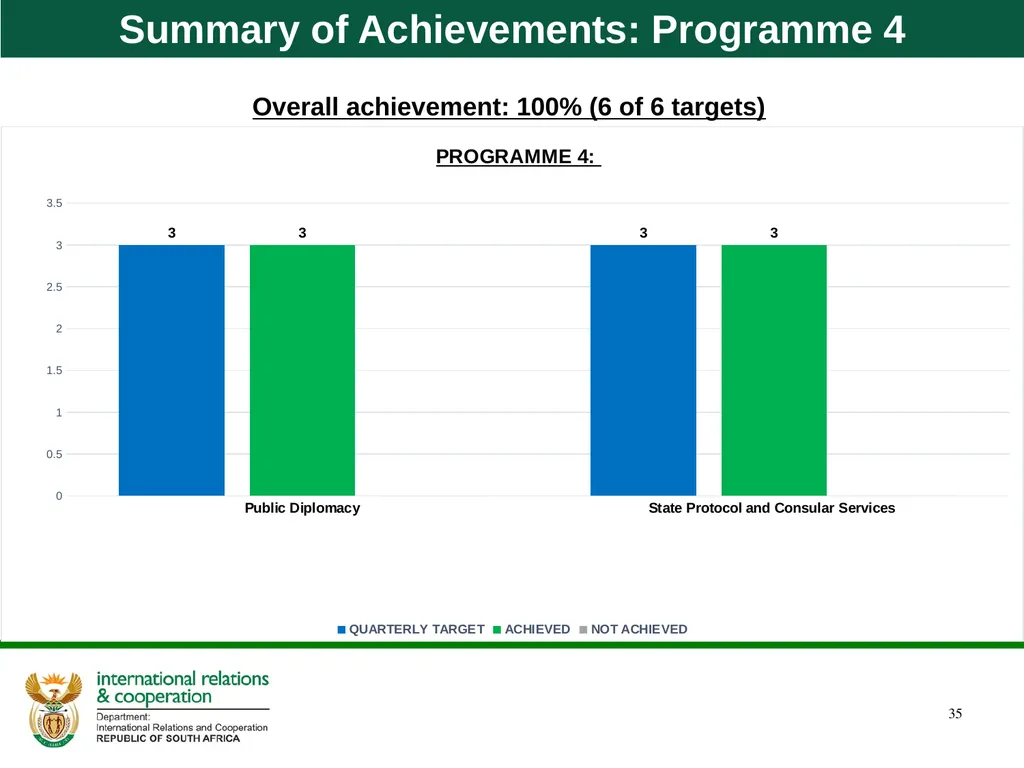
slide35. Overall achievement: 100% (6 of 6 targets) 35 Summary of Achievements: Programme 4<br>
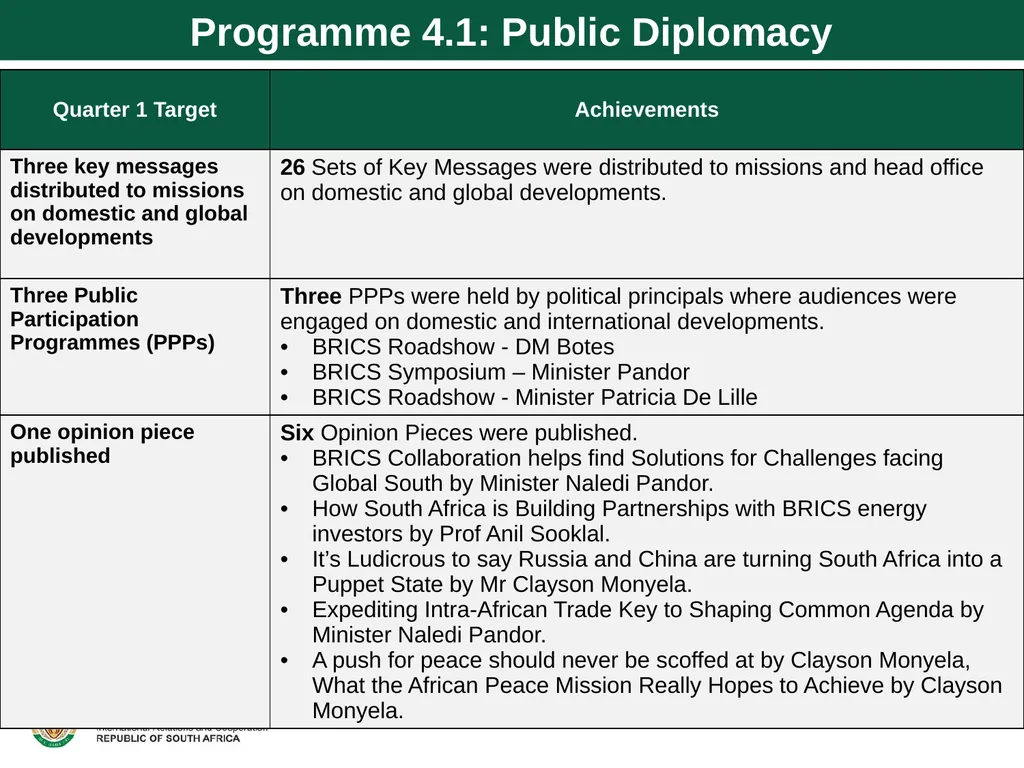
slide36. 36 Programme 4.1: Public Diplomacy<br>
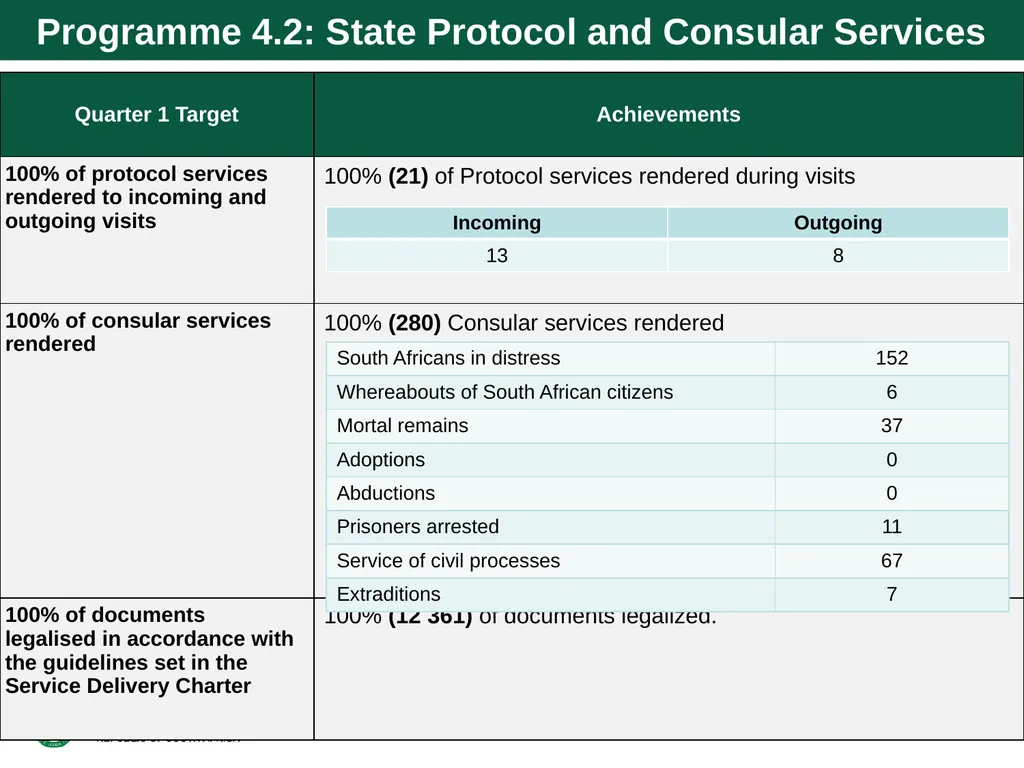
slide37. 37 Programme 4.2: State Protocol and Consular Services<br>
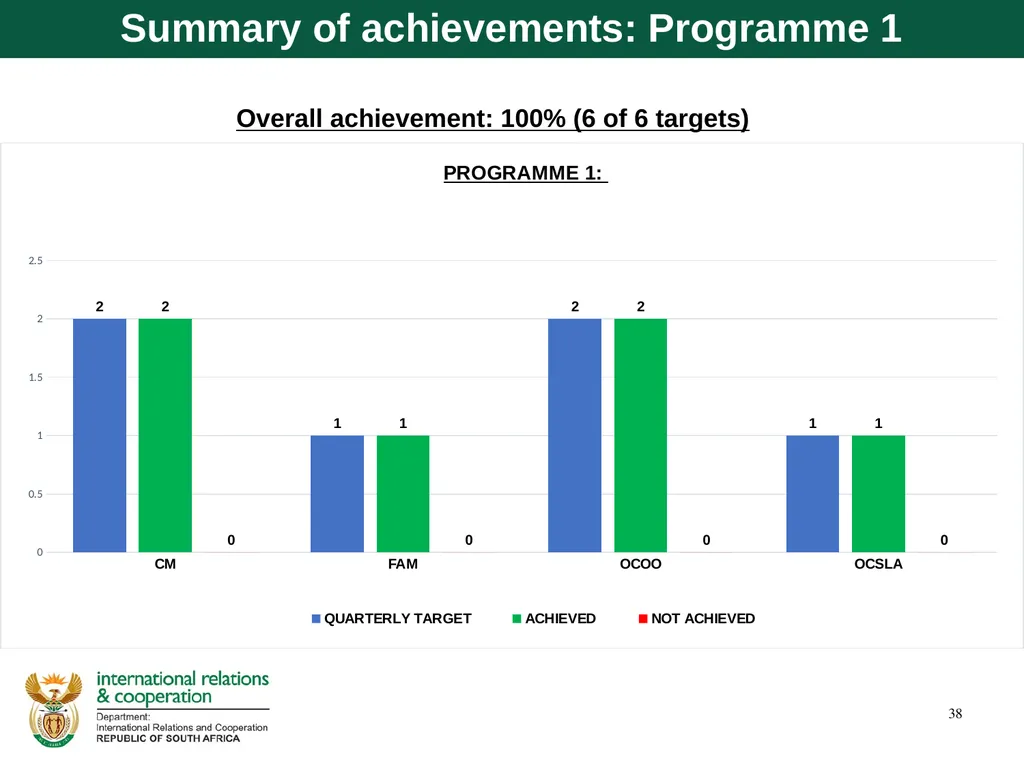
slide38. Overall achievement: 100% (6 of 6 targets) 38 Summary of achievements: Programme 1<br>
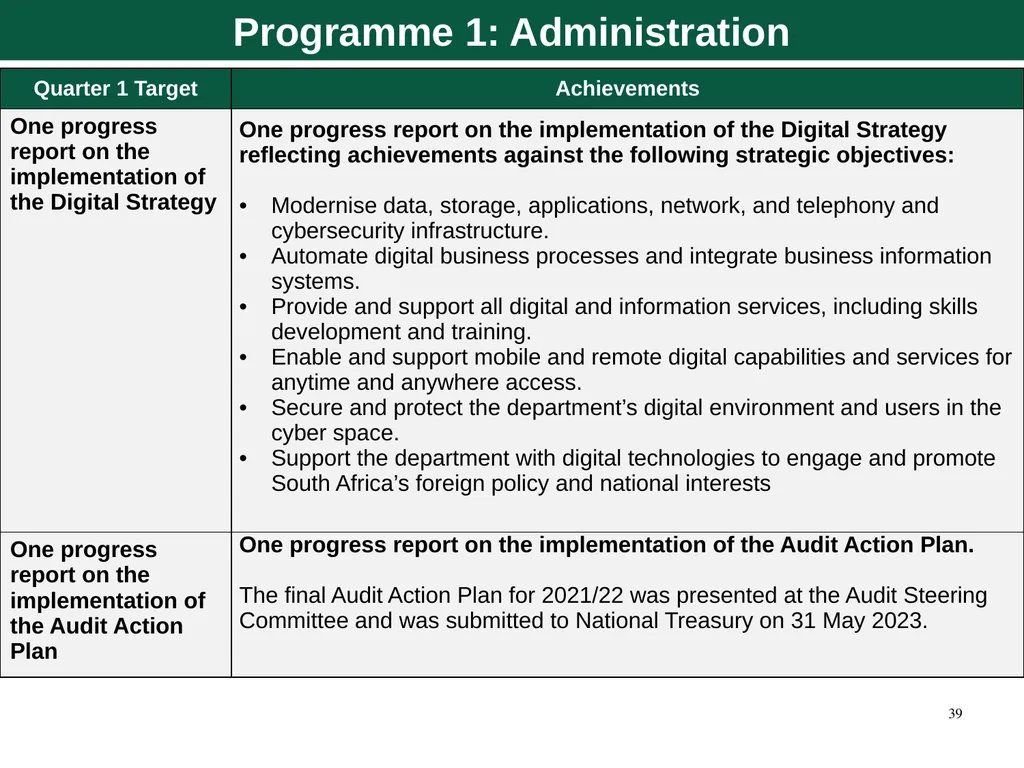
slide39. 39 Programme 1: Administration<br>
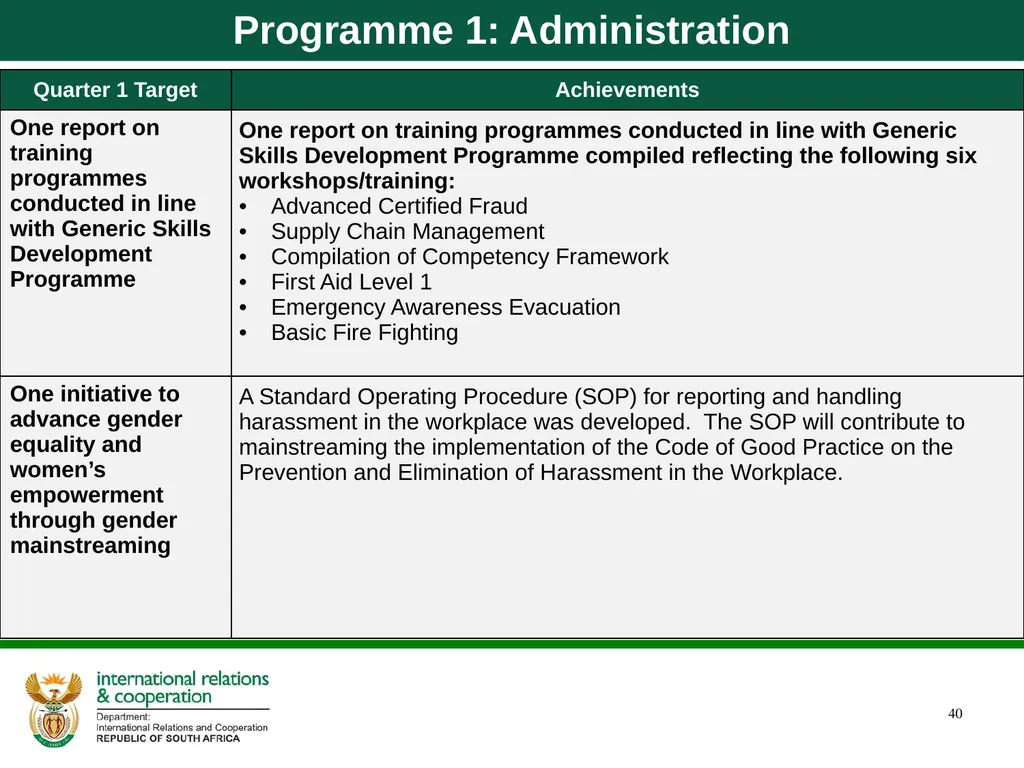
slide40. 40 Programme 3: International Cooperation (cont.) Programme 1: Administration<br>
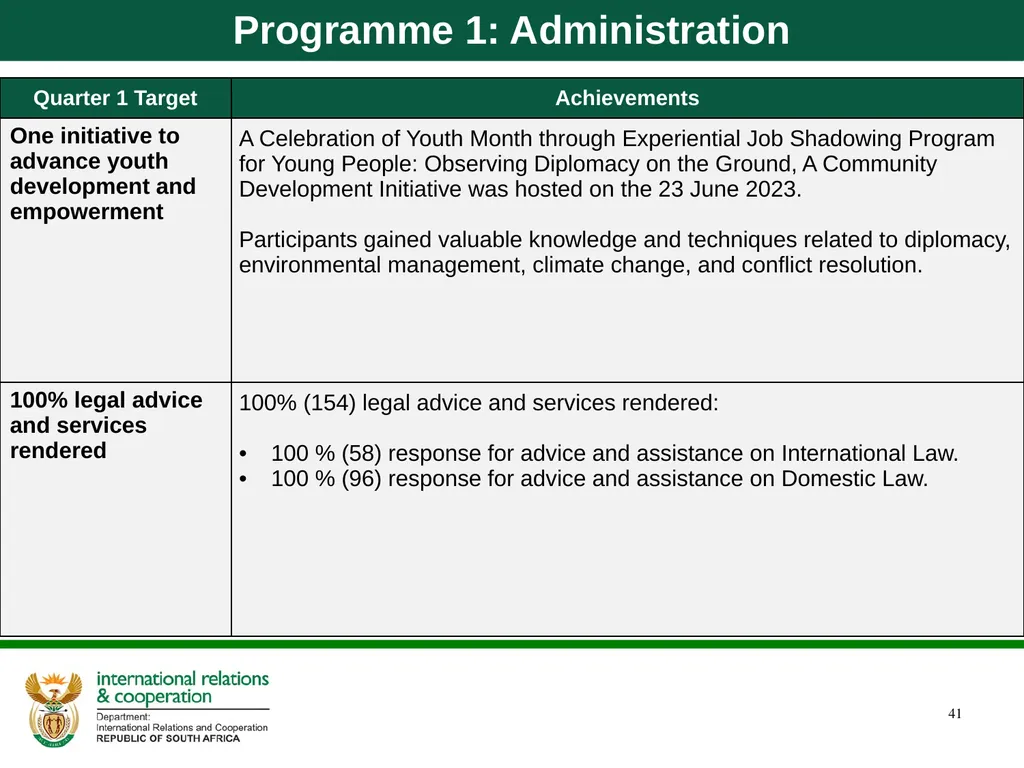
slide41. 41 Programme 3: International Cooperation (cont.) Programme 1: Administration<br>
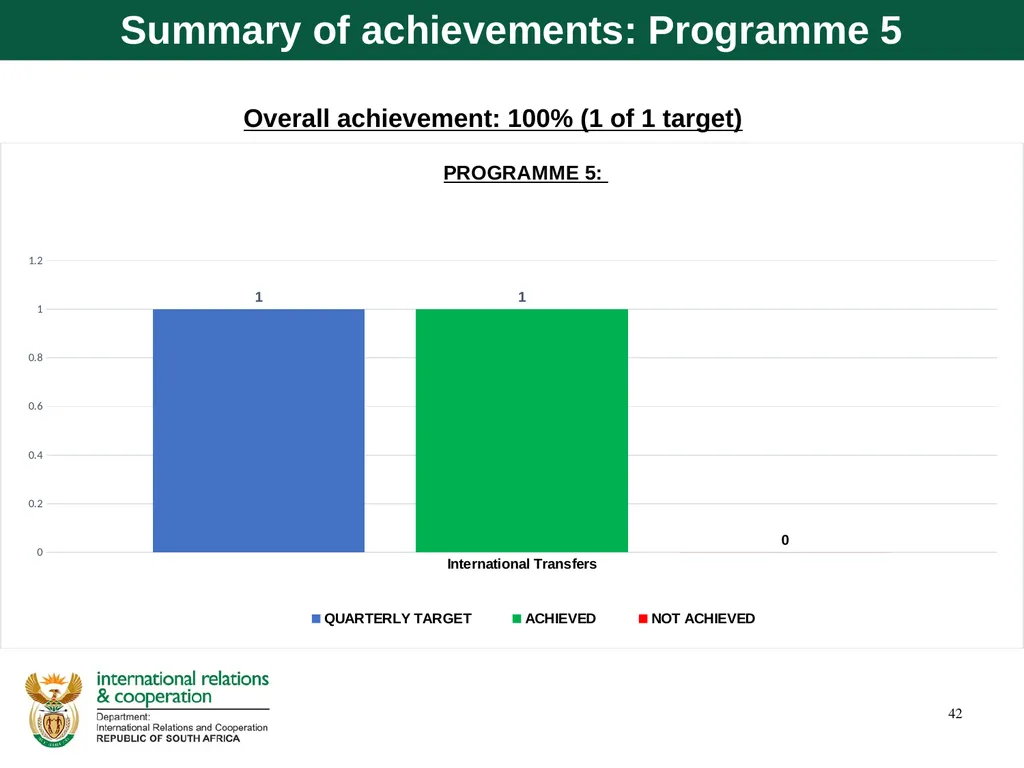
slide42. Overall achievement: 100% (1 of 1 target) 42 Summary of achievements: Programme 5<br>
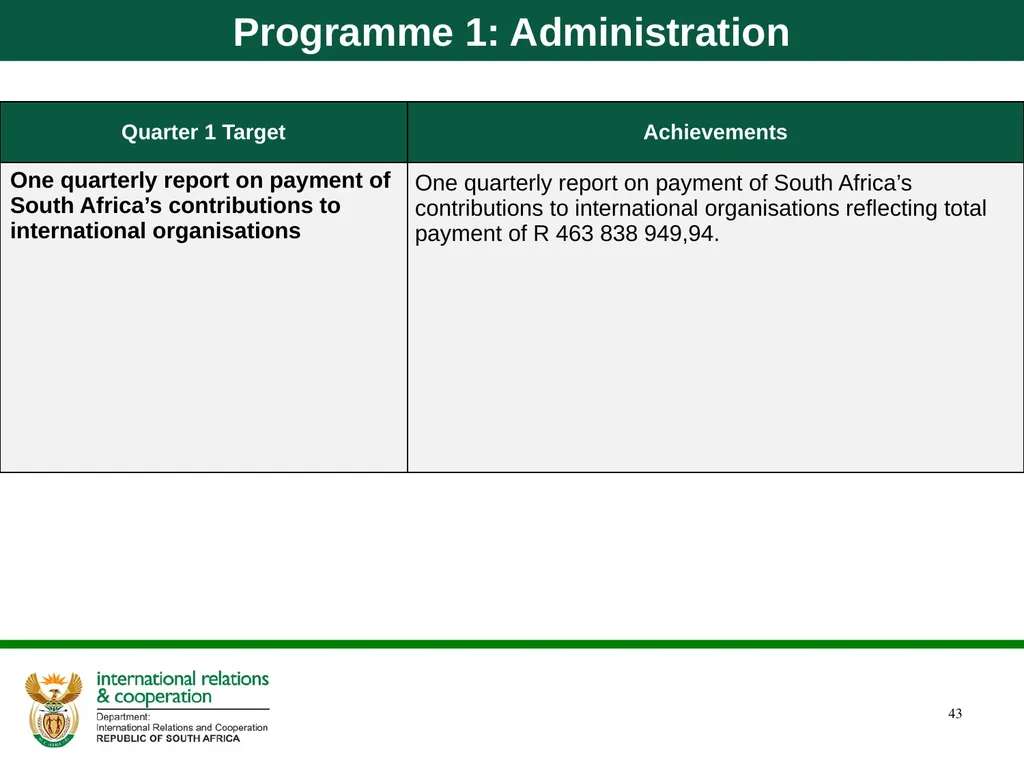
slide43. 43 Programme 3: International Cooperation (cont.) Programme 1: Administration<br>
slide44. Quarter 1 Financial Report<br>
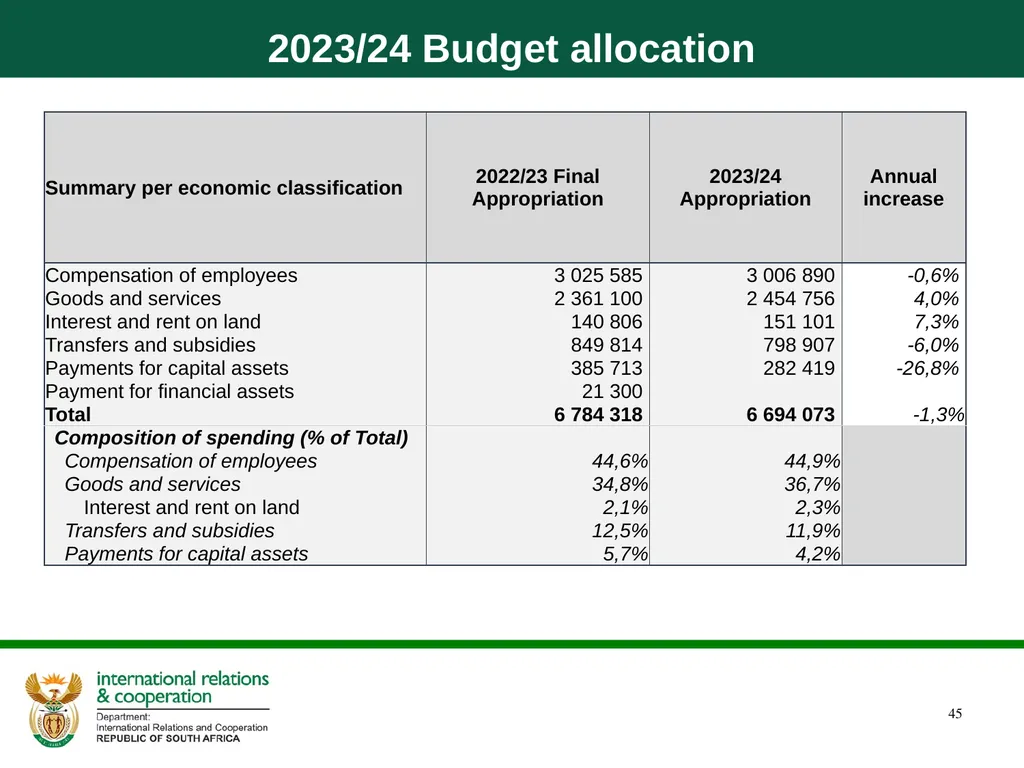
slide45. 45 Programme 3: International Cooperation (cont.) 2023/24 Budget allocation<br>
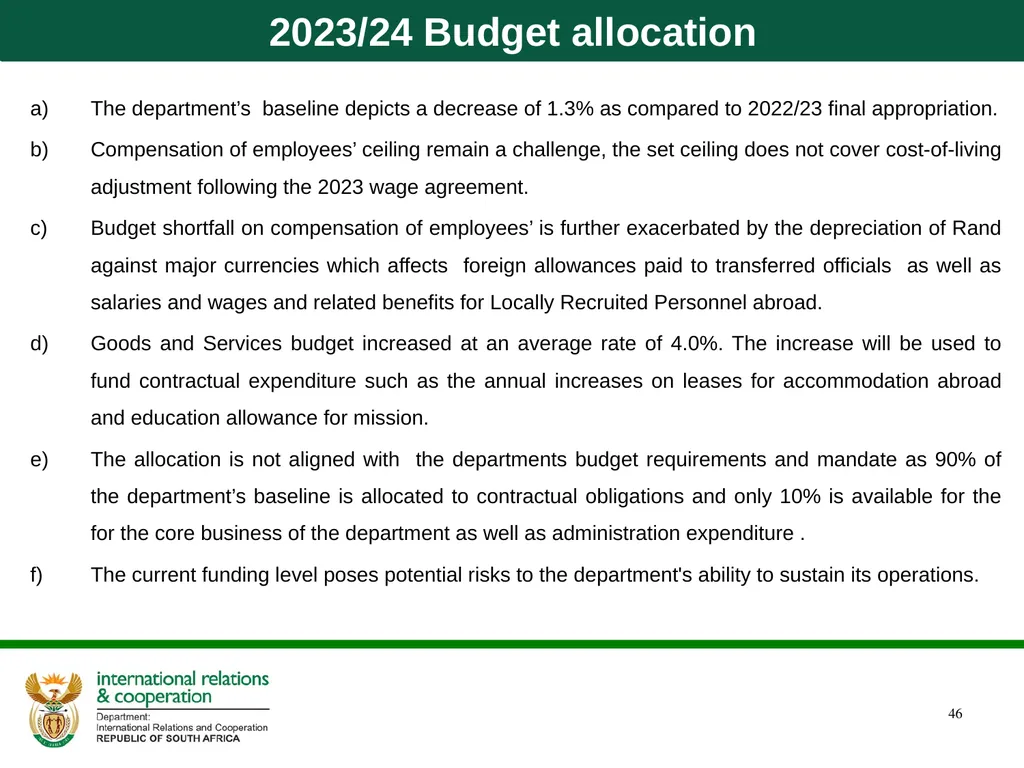
slide46. 46 Programme 3: International Cooperation (cont.) The department’s baseline depicts a decrease of 1.3% as compared to 2022/23 final appropriation.
Compensation of employees’ ceiling remain a challenge, the set ceiling does not cover cost-of-living adjustment following the 2023 wage agreement.
Budget shortfall on compensation of employees’ is further exacerbated by the depreciation of Rand against major currencies which affects foreign allowances paid to transferred officials as well as salaries and wages and related benefits for Locally Recruited Personnel abroad.
Goods and Services budget increased at an average rate of 4.0%. The increase will be used to fund contractual expenditure such as the annual increases on leases for accommodation abroad and education allowance for mission.
The allocation is not aligned with the departments budget requirements and mandate as 90% of the department’s baseline is allocated to contractual obligations and only 10% is available for the for the core business of the department as well as administration expenditure .
The current funding level poses potential risks to the department's ability to sustain its operations. 2023/24 Budget allocation<br>
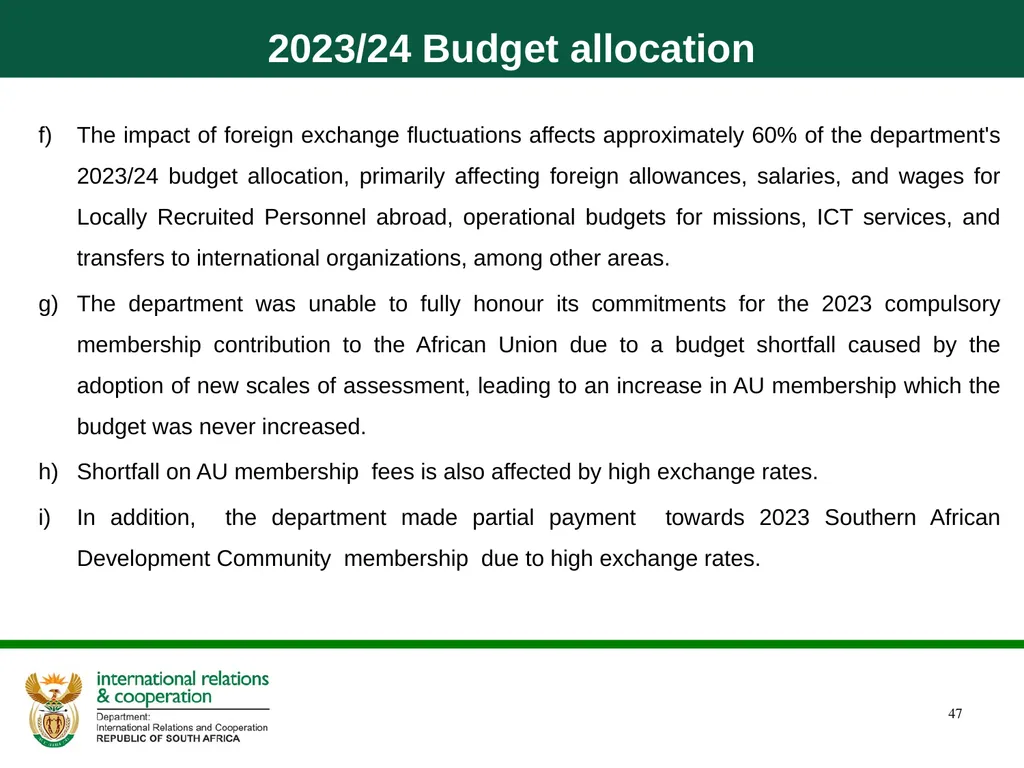
slide47. 47 Programme 3: International Cooperation (cont.) The impact of foreign exchange fluctuations affects approximately 60% of the department's 2023/24 budget allocation, primarily affecting foreign allowances, salaries, and wages for Locally Recruited Personnel abroad, operational budgets for missions, ICT services, and transfers to international organizations, among other areas.
The department was unable to fully honour its commitments for the 2023 compulsory membership contribution to the African Union due to a budget shortfall caused by the adoption of new scales of assessment, leading to an increase in AU membership which the budget was never increased.
Shortfall on AU membership fees is also affected by high exchange rates.
In addition, the department made partial payment towards 2023 Southern African Development Community membership due to high exchange rates. 2023/24 Budget allocation<br>
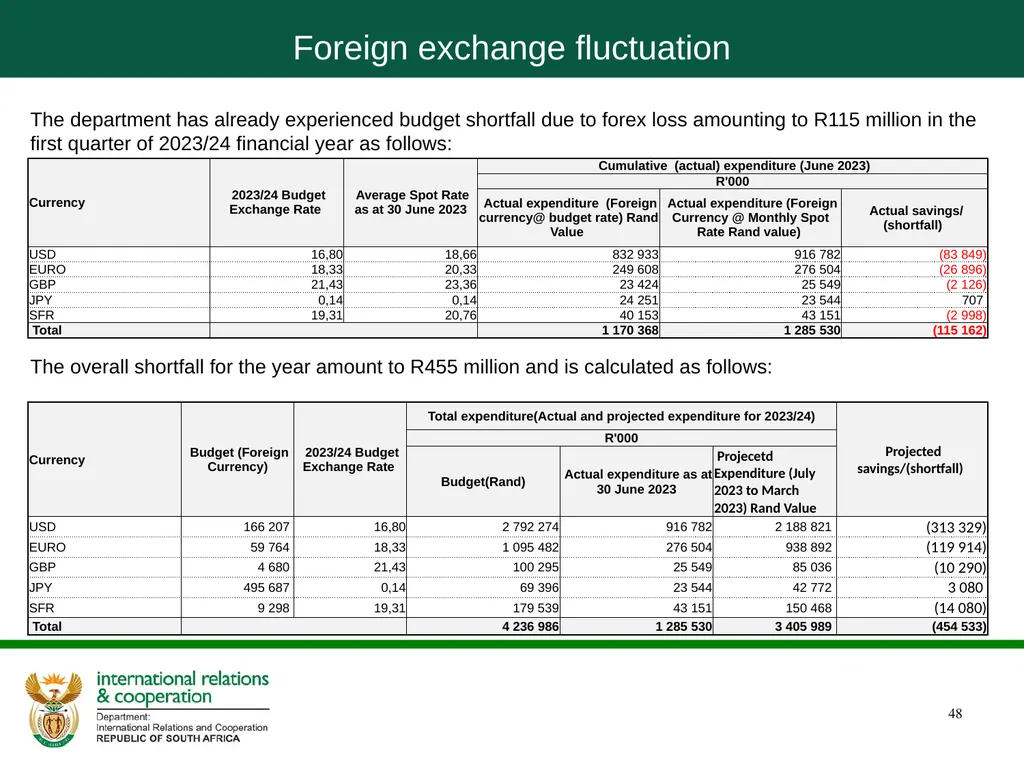
slide48. 48 Programme 3: International Cooperation (cont.) The department has already experienced budget shortfall due to forex loss amounting to R115 million in the first quarter of 2023/24 financial year as follows:
The overall shortfall for the year amount to R455 million and is calculated as follows: Foreign exchange fluctuation<br>
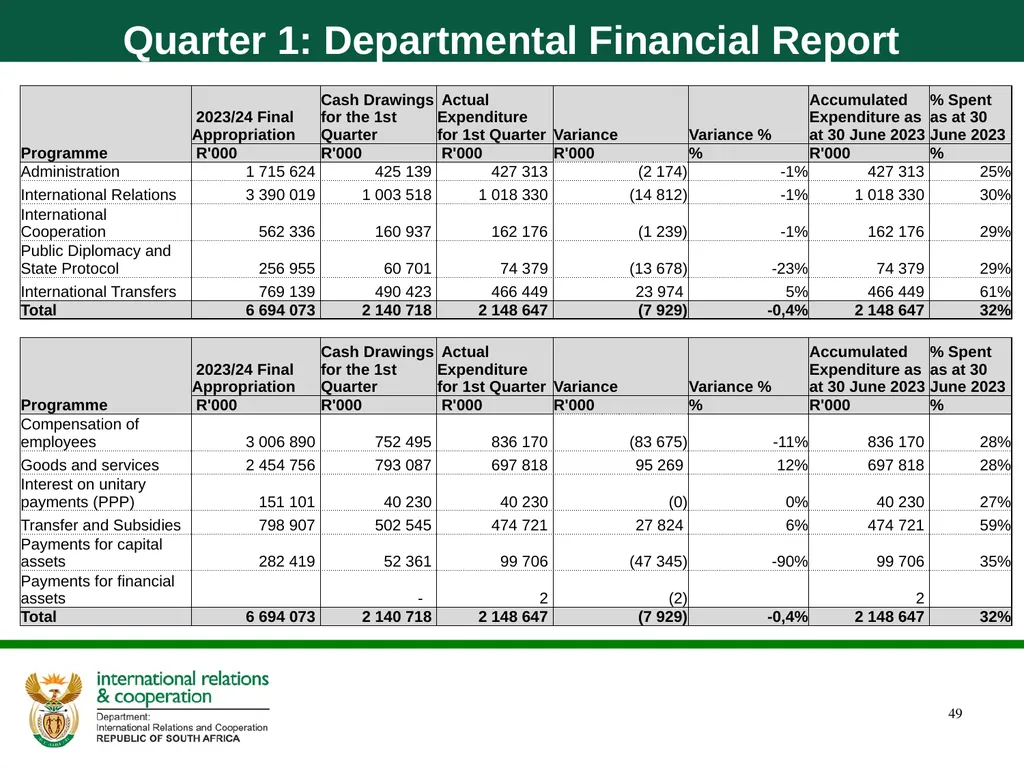
slide49. 49 Programme 3: International Cooperation (cont.) Quarter 1: Departmental Financial Report<br>
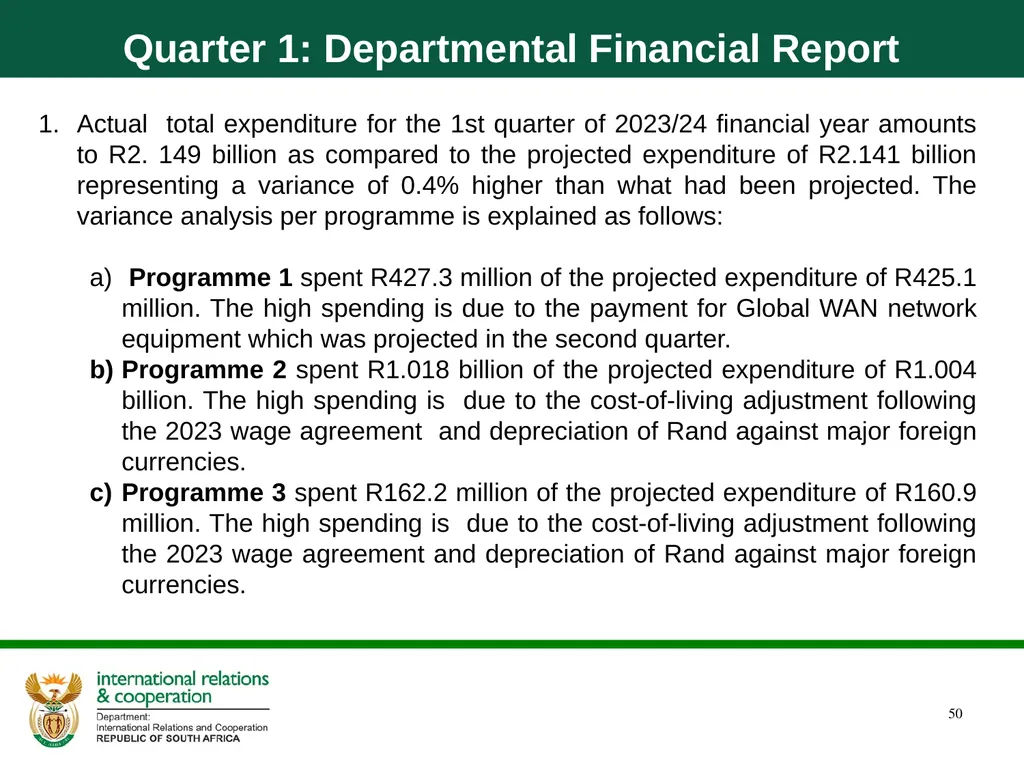
slide50. 50 Programme 3: International Cooperation (cont.) Actual total expenditure for the 1st quarter of 2023/24 financial year amounts to R2. 149 billion as compared to the projected expenditure of R2.141 billion representing a variance of 0.4% higher than what had been projected. The variance analysis per programme is explained as follows:
Programme 1 spent R427.3 million of the projected expenditure of R425.1 million. The high spending is due to the payment for Global WAN network equipment which was projected in the second quarter.
Programme 2 spent R1.018 billion of the projected expenditure of R1.004 billion. The high spending is due to the cost-of-living adjustment following the 2023 wage agreement and depreciation of Rand against major foreign currencies.
Programme 3 spent R162.2 million of the projected expenditure of R160.9 million. The high spending is due to the cost-of-living adjustment following the 2023 wage agreement and depreciation of Rand against major foreign currencies. Quarter 1: Departmental Financial Report<br>
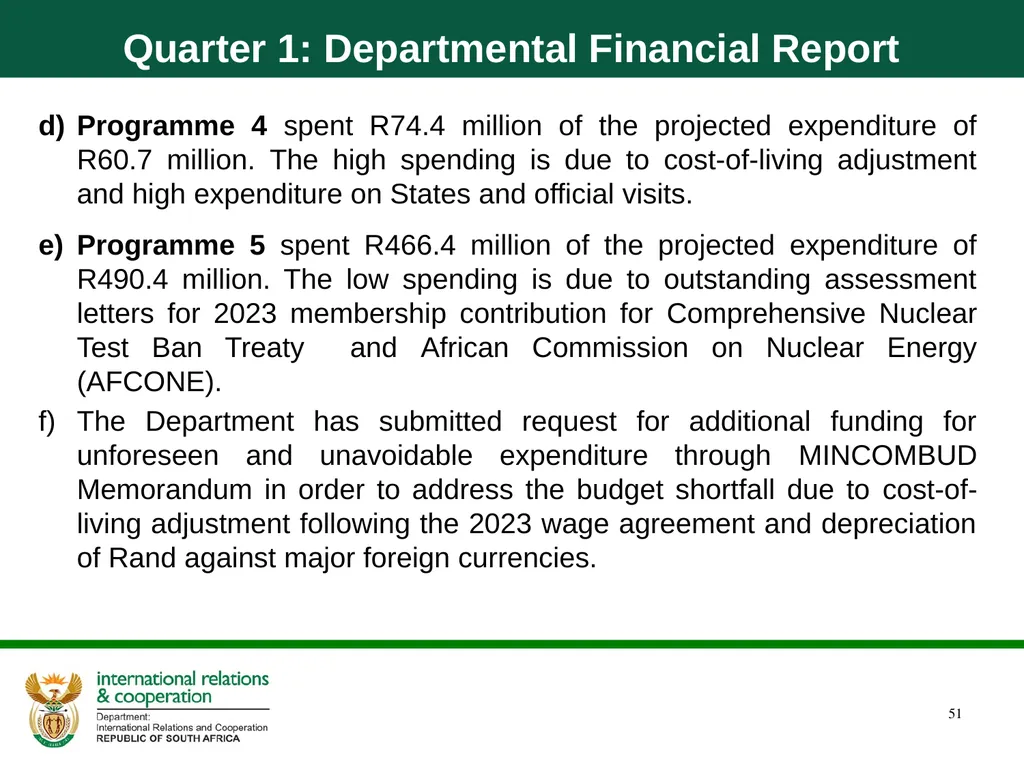
slide51. 51 Programme 3: International Cooperation (cont.) Programme 4 spent R74.4 million of the projected expenditure of R60.7 million. The high spending is due to cost-of-living adjustment and high expenditure on States and official visits.
Programme 5 spent R466.4 million of the projected expenditure of R490.4 million. The low spending is due to outstanding assessment letters for 2023 membership contribution for Comprehensive Nuclear Test Ban Treaty and African Commission on Nuclear Energy (AFCONE).
The Department has submitted request for additional funding for unforeseen and unavoidable expenditure through MINCOMBUD Memorandum in order to address the budget shortfall due to cost-of-living adjustment following the 2023 wage agreement and depreciation of Rand against major foreign currencies. Quarter 1: Departmental Financial Report<br>
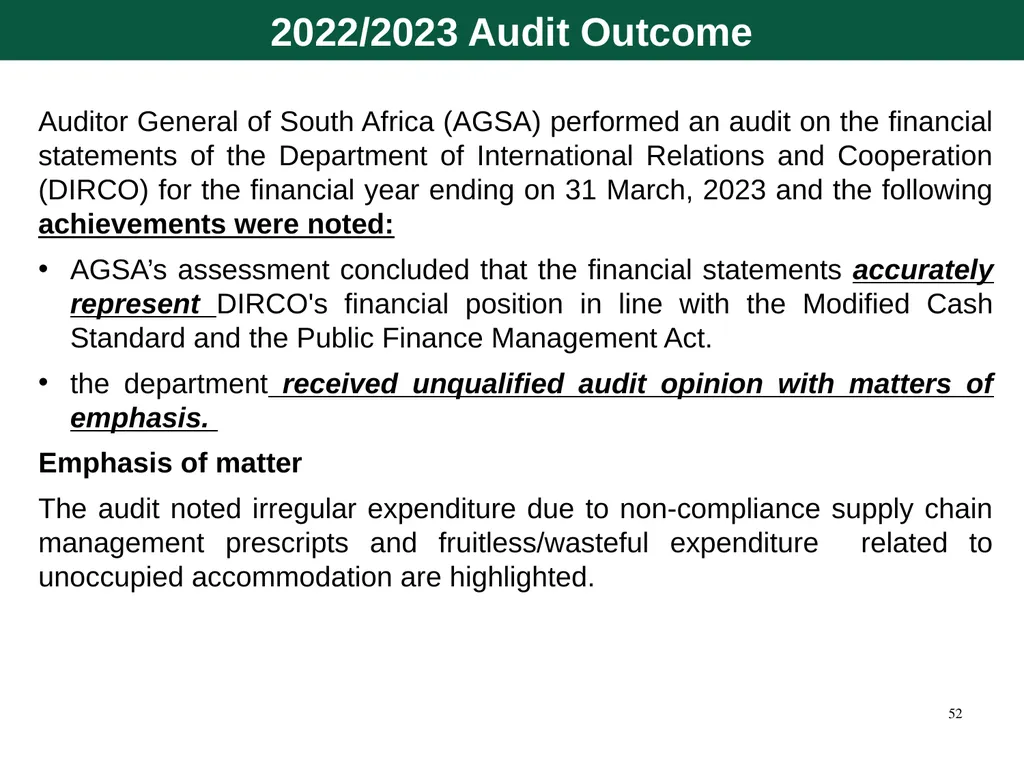
slide52. 52 2022/2023 Audit Outcome Auditor General of South Africa (AGSA) performed an audit on the financial statements of the Department of International Relations and Cooperation (DIRCO) for the financial year ending on 31 March, 2023 and the following achievements were noted:
AGSA’s assessment concluded that the financial statements accurately represent DIRCO's financial position in line with the Modified Cash Standard and the Public Finance Management Act.
the department received unqualified audit opinion with matters of emphasis.
Emphasis of matter
The audit noted irregular expenditure due to non-compliance supply chain management prescripts and fruitless/wasteful expenditure related to unoccupied accommodation are highlighted.<br>
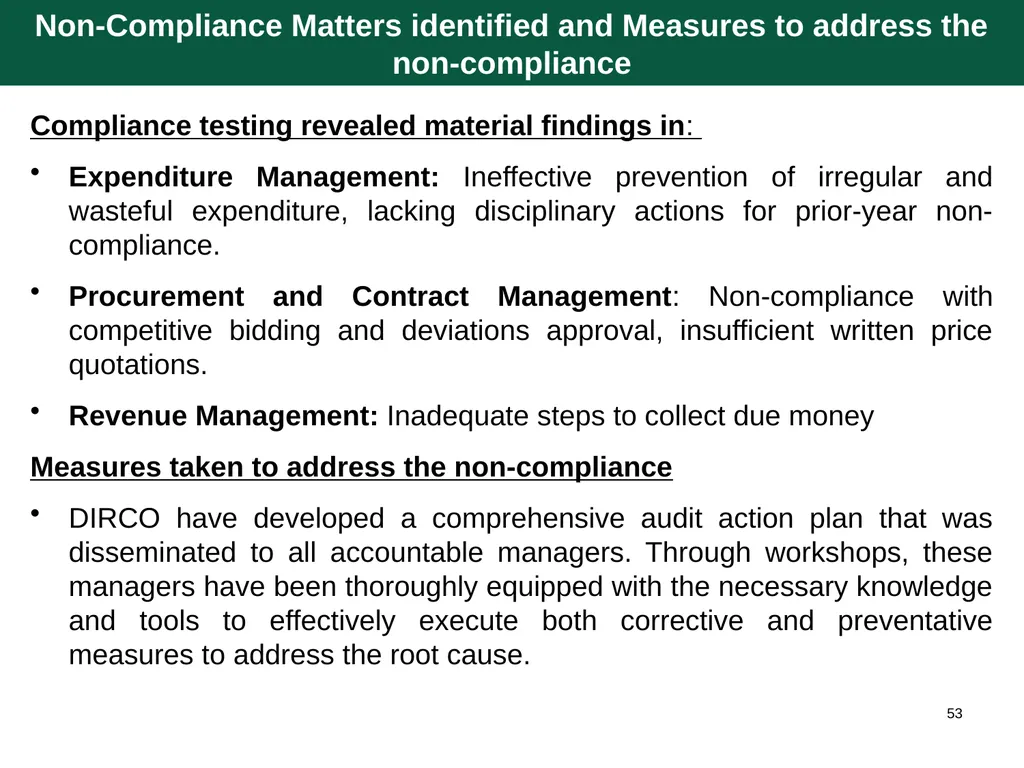
slide53. Compliance testing revealed material findings in:
Expenditure Management: Ineffective prevention of irregular and wasteful expenditure, lacking disciplinary actions for prior-year non-compliance.
Procurement and Contract Management: Non-compliance with competitive bidding and deviations approval, insufficient written price quotations.
Revenue Management: Inadequate steps to collect due money
Measures taken to address the non-compliance
DIRCO have developed a comprehensive audit action plan that was disseminated to all accountable managers. Through workshops, these managers have been thoroughly equipped with the necessary knowledge and tools to effectively execute both corrective and preventative measures to address the root cause. 53 Non-Compliance Matters identified and Measures to address the non-compliance<br>
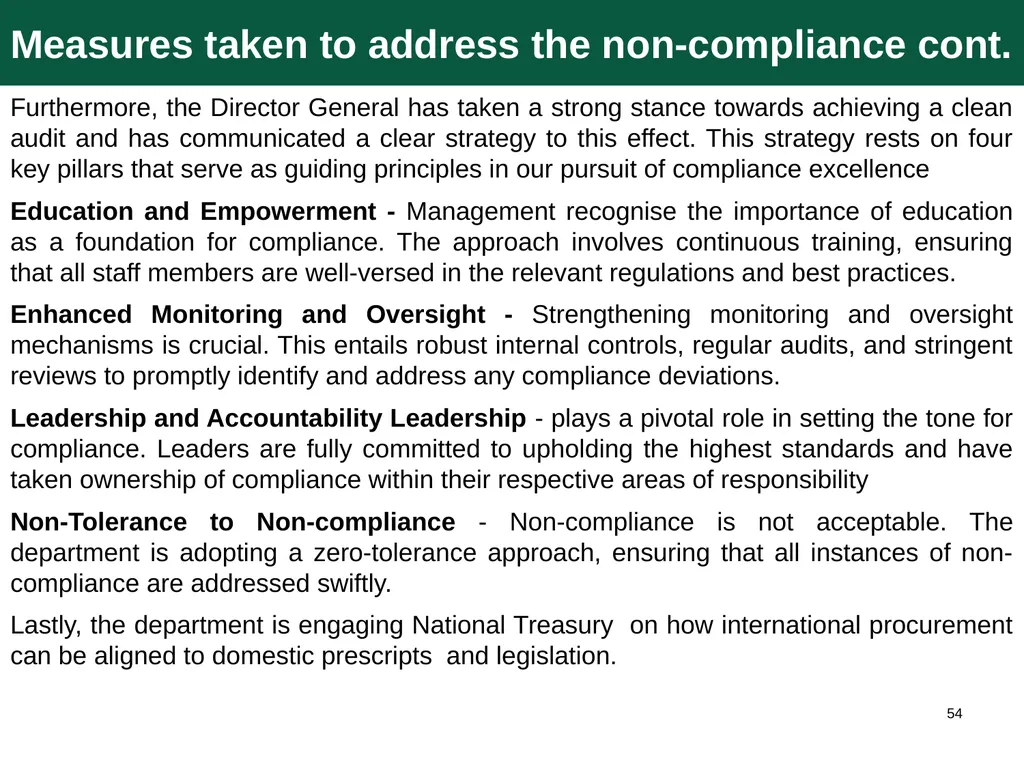
slide54. Furthermore, the Director General has taken a strong stance towards achieving a clean audit and has communicated a clear strategy to this effect. This strategy rests on four key pillars that serve as guiding principles in our pursuit of compliance excellence
Education and Empowerment - Management recognise the importance of education as a foundation for compliance. The approach involves continuous training, ensuring that all staff members are well-versed in the relevant regulations and best practices.
Enhanced Monitoring and Oversight - Strengthening monitoring and oversight mechanisms is crucial. This entails robust internal controls, regular audits, and stringent reviews to promptly identify and address any compliance deviations.
Leadership and Accountability Leadership - plays a pivotal role in setting the tone for compliance. Leaders are fully committed to upholding the highest standards and have taken ownership of compliance within their respective areas of responsibility
Non-Tolerance to Non-compliance - Non-compliance is not acceptable. The department is adopting a zero-tolerance approach, ensuring that all instances of non-compliance are addressed swiftly.
Lastly, the department is engaging National Treasury on how international procurement can be aligned to domestic prescripts and legislation. 54 Measures taken to address the non-compliance cont.<br>
slide55. Thank you<br>
Performance Information and Financial Information
30 August 2023<br>
slide2. The report is front loaded with performance information on our core function under Programmes 2 – 4, to enable the Department to highlight key issues and achievements in the implementation of South Africa’s Foreign Policy;
The compliance issues under Programme 1 reflect at the end in order to showcase how the Department supports its core function;
The Department has achieved 100% (21 of 21 targets) set for Quarter 1. 2 Introduction<br>
slide3. Summary of achievements: Programme 2 Overall achievement: 100% (9 of 9 targets) 3<br>
slide4. The three bilateral branches: Africa, Americas & Europe and Asia & Middle East reported as follows:
Regional political reports, including the outcomes of structured bilateral mechanisms (SBMs) and high-level visits (HLVs) aligned to achievement of the NDP and MTSF. The SBMs, HLVs and political engagements took place against the backdrop of political, economic developments and the security situation in the regions.
Quarterly progress reports on the regional trade and investments and investment initiatives undertaken in support of the one government investment approach. Head Office and Missions in the regions continued to explore investment opportunities for South Africa, in line with the objectives of the Economic Reconstruction and Recovery Plan (ERRP) which focuses on priority interventions aimed at restoring growth and creating jobs.
Quarterly progress reports on the regional tourism-promotion events to promote South Africa as a preferred tourist destination. Tourism is recognised for its immense potential and its significant contribution to the economy. Targeted tourism activities such as outreach programmes to tour operators and travel media through information dissemination, participation in Tourism Fairs and Expo’s into the foreign tourism market were undertaken. 4 Programme 2: International Relations<br>
slide5. POLITICAL
Africa
Structured Bilateral Mechanisms, high-level visits and political engagements with countries on the continent focussed on, among other:
Minister Pandor’s working visit to the Republic of Mauritius
A General Cooperation Agreement (GCA) was signed, establishing a Joint Commission at Senior Officials’ level to be co-chaired by the Directors General of both countries. The JC will serve as the mechanism through which the two countries would work together across various sectors.
Minister engaged the Mauritian business sector in order to further deepen South Africa-Mauritian trade and investment relations.
Minister Pandor’s Political and Diplomatic Consultations in Angola
Views were exchanged on regional, continental, and international issues of mutual interest as well as the security situation in the eastern Democratic Republic of Congo (DRC).
Acknowledged the Memorandum of Understanding (MoU) on the Tripartite Mechanism for Dialogue and Cooperation between South Africa, Angola and the DRC.
Minister provided a briefing on the African Peace Mission to the Russia and Ukraine Conflict, and the engagement by the six African Heads of State with the Presidents of Ukraine and Russia. 5 Programme 2: International Relations (cont…)<br>
slide6. POLITICAL
Africa (continued)
President Ramaphosa’s working visit to the Kingdom of Lesotho (supported by DM Botes)
The Sod-Turning Ceremony for Polihali Water Project was officiated.
The President highlighted a number of aspect during his opening remarks, including, (i) that the Lesotho Highlands Water Project (LHWP) is one of the biggest infrastructure investments by SA outside its border, (ii) the project is a good example of public-private collaboration, (iii) Phase II of the project, once completed will increase the current supply rate of 780 million cubic meters to more than 1270 million cubic meters per annum.
During DM Botes and the Foreign Minister of Lesotho’s engagement, the energy deficit in both countries was highlighted. In this regard, Lesotho’s Foreign Minister emphasised the potential that exist in Lesotho because of the availability of water and wind which can be harnessed for the benefit of both countries.
The Ministers responsible for Energy and Electricity agreed that they will begin to work on cooperation agreement regarding four potential projects that have passed the feasible stage.
The Ministers responsible for Water committed to continue to work together to resolve remaining challenges in the implementation of Phase II of the LHWP. 6 Programme 2: International Relations (cont…)<br>
slide7. POLITICAL
Africa (continued)
Mid-term review of the Third Session of the Bi-National Commission (BNC) between South Africa and the Republic of Mozambique
Implementation of decisions taken during the BNC, which was held in March 2023 in South Africa were monitored. The meeting, among other:
Noted that the Southern African Development Community (SADC) is relatively stable except for a few areas of instability, such as northern Mozambique, Eswatini and the Easter DRC.
Expressed concern about the armed conflict in the Republic of Sudan and called on the parties to engage in dialogue to bring about peace and avoid further deterioration of the already dire humanitarian situation.
Called for the strengthening of multilateralism and reiterated its support for the rule based international system and centrality of the UNSC in maintaining peace and security.
Reiterated the desire to resolve conflict through dialogue and to this effect welcomed the African Peace Initiative to the Russia-Ukraine conflict.
Noted with satisfaction the success of the joint operation that resulted in the seizure of substantial amounts of illicit drugs.
Noted with appreciation of various technical and operational engagements regarding the repatriation of recovered stolen motor vehicles. 7 Programme 2: International Relations (cont…)<br>
slide8. POLITICAL
Africa (continued)
Minister Pandor’s working visit to Cameroon
Bilateral relations discussions included:
Emphasis on the need to strengthen areas of cooperation and establish a mechanism for political consultations. Identified areas of cooperation are: agriculture, mining, infrastructure development, education, health, science and innovation and youth empowerment.
Emphasis on the need to strengthen the legal framework for bilateral cooperation and it from the Senior Officials’ Meeting (SOM) to a Joint Commission of Cooperation (JCC).
Significance of creating a conducive environment in both countries that will allow the business sector to thrive. Emphasis was placed on fair treatment of the business sector in both countries as it will enable the continent to adhere to a better South Africa, better Africa and better world.
Consensus that the two countries should work together in various multilateral for a such as the UN and the AU and have regular political consultations.
During a Round Table with businesses that have links to SA, it was highlighted that there is enormous potential for tourism, trade and investment that exist between SA and Cameroon. However, obstacles such as (i) access to SA visas, (ii) Cameroon fiscal policy and (iii) funding for SA companies prevent tourism and trade to flourish. 8 Programme 2: International Relations (cont…)<br>
slide9. POLITICAL
Africa (continued)
State visit to the Republic of South Africa by President Geingob of the Republic of Namibia
The state visit was preceded by bilateral meetings between sectoral ministries.
A Memorandum of Understanding (MoU) on Cooperation in Tourism was signed which will enable the two countries to exchange ideas on improving tourism and maximising its economic potential.
It was agreed that, on the economic front, the two countries would share national strategies with a view to develop their economies to improve the living conditions of the people and restore livelihoods following the devastation of the COVID-19 pandemic.
Ministers responsible for Trade and Industry agreed to have follow-up and deeper discussions regarding cooperation between the South African Industrial Development Corporation (IDC) funding of identified projects. This will augur well with leveraging of the opportunities brought about the implementation of the AfCFTA.
Emphasis was placed on the full implementation of the AfCFTA Framework to ensure food security and self-sufficiency in the wake of the Russia-Ukraine conflict.
President Geingob indicated that more oil and gas has been discovered in the Orange River and it is therefore important for SA to work closely with Namibia to leverage these opportunities, particularly in green hydrogen. 9 Programme 2: International Relations (cont…)<br>
slide10. POLITICAL
Americas and Europe
The SBMs, high-level and other political engagements, with countries in the region focused, amongst others on:
The 4th Annual Consultations between South Africa and Canada was held in Ottawa. Progress was made in areas of trade and investment, environment, science and technology, arts and culture, development cooperation and strengthening cooperation in health, education, and South Africa’s Just Energy Transition.
The 11th SA-Germany Bi-National Commission illustrated the substantive nature of South Africa’s relationship with Germany in areas covered by the working groups including arts and culture, science and innovation, higher education, development cooperation and vocational training.
High level consultations saw the status of bilateral, multilateral, cultural, political and economic relations reviewed including energy investment pledges and the strengthening of trade tries. Peace and security and multilateralism discussed.
A successful official visit by the Vice President of Colombia strengthened diplomatic and political relations and defined a roadmap for mutually beneficial cooperation in agriculture; arts and culture; energy; gender empowerment; higher education, science and innovation; sport; tourism; trade and investment and transport. 10 Programme 2: International Relations (cont…)<br>
slide11. POLITICAL
Americas and Europe (cont.)
The 17th Joint Consultative Mechanism with Cuba reviewed progress made since the 16th JCM in terms of active cooperation and ongoing efforts to elevate trade relations to mirror the level of political relations.
During a working visit to Lisbon, bilateral cooperation and the forthcoming state visit to South Africa was discussed.
During official visits to SA by a Netherlands and Danish, relationships in the areas of green hydrogen, renewable energy and just energy transition. During the visit, a Memorandum of Understanding in the Field of Green Hydrogen with the Netherlands was signed and the President and the Prime Ministers participated in a Denmark-Netherlands-South Africa Business Forum focusing on key areas in green energy and green hydrogen.
During the State Visit by the President of Portugal the Defence Cooperation Agreement was signed.
During the State Visit by Finland trade and investment relations was strengthened targeting various sectors of cooperation including ICT food hygiene and construction. 11 Programme 2: International Relations (cont…)<br>
slide12. POLITICAL
Asia and Middle East
Structured Bilateral Mechanisms, high-level visits and political engagements with countries in the region focussed on, among other:
Third Session of the SA-UAE Joint Committee on Cooperation
Both countries:
Agreed on the importance of concluding mutually agreed agreements and Memoranda of Understanding (MoUs).
Expressed their commitment to strengthening multilaterism while also advocating for the needs and interests of developing countries to be placed at the top of the international agenda.
Agreed to expand economic cooperation and explore the potential of increasing commercial engagements between the two countries.
Will encourage and facilitate increased trade flows and investment activities between their respective business communities.
To explore technical cooperation in Special Economic Zones (SEZs), through a MoU, to enhance investment and trade relations through collaboration between technical experts from both sides. 12 Programme 2: International Relations (cont…)<br>
slide13. POLITICAL
Asia and Middle East (continued)
12th South Africa-China Strategic Dialogue – Deputy Minister Mashego-Dlamini
The visit allowed the Deputy Minister (DM) to, among other, co-chair the 12th SA-China Strategic Dialogue with her counterpart, meet with the International Department (ID) of the Chinese Communist Party (CPC); hold a courtesy call meeting with her counterpart from MOFCOM in preparation for the upcoming Joint Working Group (JWG).
During the 12th SA-China Strategic Dialogue, views on China-Africa cooperation, the situation in Africa, and international and regional issues of mutual interest and concern were exchanged.
The DM, during her engagement with the CPC, requested the encouragement of m ore investment from China to South Africa. SA seeks China’s support in exploring a modernisation path that meets its national conditions.
During the DM’s meeting with the Vice Minister of Commerce of China, it was indicated that SA is strategically placed to serve as a gateway for exports into Africa and both countries can cooperate in this regard, while taking advantage of the AfCFTA.
During the meeting with Standard Bank, it was observed that the Standard Bank office in Beijing is a useful resource for South Africa’s economic engagements especially in relation to engagements with potential Chinese investors who seek more information on the SA economic landscape. 13 Programme 2: International Relations (cont…)<br>
slide14. POLITICAL
Asia and Middle East (continued)
7th Round of Political Consultations held in Astana
The meeting agreed, among other:
That the political and economic relations have witnessed an upwards trajectory, despite major shifts in the international political landscape.
To advance the bilateral and economic cooperation, a frequency of high-level visits across all sectors, in particular mutual visits at both Heads of State and Foreign Minister level should be prioritised.
That areas identified for an intensification of economic cooperation should include, mining (services, technology and equipment), pharmaceuticals (vaccines), agro-processing (fruit juices, canned fruit and vegetables, grapes, wines), geological exploration, the blue economy, defence and renewable energy.
That the expedition of the conclusion of internal processes related to the finalisation of (a) the Agreement on Trade and Economic Cooperation and (b) the Agreement on the Exemption of Visa requirements for holders of Diplomatic and Official passports and (c) the Memorandum of Cooperation between the DIRCO Diplomatic Academy and the Kazakhstan Academy of Public Administration, should be prioritised. 14 Programme 2: International Relations (cont…)<br>
slide15. POLITICAL
Asia and Middle East (continued)
Official visit of Prime Minister Lee Hsien Loong of Singapore
Two Memoranda of Understanding (MoUs) were signed during the Official Visit, namely the (a) the MoU between the Department of Communications and Digital Technologies of the Republic of South Africa and the Ministry of Communications and Information of the Republic of Singapore in the Field of Information and Communications Technology and, (b) The MoU between the Government of the Republic of South Africa and the Government of the Republic of Singapore on Skills Development.
The two countries agreed to further develop their economic partnership, as well as deepening and expanding cooperation in trade and investment, science and innovation, digitalisation, communications and technology, water and sanitation and skills development.
The potential for expanding ties with Singapore in the fields of Higher Education, Science and Innovation was highlighted.
Possible partnerships between Singapore Airlines and SAA were discussed.
South Africa and Singapore agreed to further develop the two countries’ economic partnership, as well as deepening and expanding cooperation in trade and investment, science and innovation, digitalisation, communications and technology, water and sanitation and skills development. 15 Programme 2: International Relations (cont…)<br>
slide16. TRADE & INVESTMENT
Africa
Initiatives by Missions on the continent included engagements that focused on, among other:
Negotiations with the Paramount Group (Aerospace and Defence) of Algeria as an opportunity for South Africa to build public-private partnership relations to establish sustainable mutual beneficial trade and investment relations.
Negotiations with Imperial STP Super Maritime and NAI (Sao Tome and Principe) that provided valuable insight with regards to logistics and shipping routes to São Tomé with the aim of increasing South African exports to São Tomé and Príncipe.
Taking stock of progress already made in terms of investments and to discuss new opportunities with a view to promoting win-win trade and investment cooperation.
Barriers/challenges that impede the pursuance and promotion of trade and investment initiatives.
Building public-private partnership relations to establish sustainable mutual beneficial trade and investment relations.
Signing of twinning agreements between the cities of Cape Town and Nairobi in order to collaborate on the management on informal housing and other affordable housing initiatives.
Agreement with Eritrea to pursue Sectoral Cooperation in the field of Marine Resources, with emphasis on fisheries, in accordance with the General Cooperation Agreement.
Promotion of cross border trade by AfCFTA as well as strengthening trade and investment links on bilateral levels and within the context of the AfCFTA. 16 Programme 2: International Relations (cont.)<br>
slide17. TRADE & INVESTMENT
Americas and Europe
Trade and investment initiatives on the continent included engagements that focused on, amongst others:
Bilateral cooperation and development through trade missions to SA as well as the participation at the EXPOMIN 2023 in Chile, led by a dtic business delegation.
Trade, investment and global leadership through various engagements with role players invested in the upcoming BRICS Summit.
Energy and Mineral resources through the identification of SA in the exportation of cobalt and discussions with CDIAL HALAL on the repurposing of chicken waste to energy.
Housing through a Canadian investment initiative focussed on an affordable housing scheme to commence in the Western Cape.
Science and Innovation through an SA Wine Promotion Event held in Ottawa focussing on the Global Innovation Clusters (GIC).
Water resources, Agriculture & Education. 17 Programme 2: International Relations (cont.)<br>
slide18. TRADE & INVESTMENT
Asia and Middle East
Trade and investment initiatives in the region included engagements that focused on, among other:
Further explore opportunities for investment for local production/assembly of vehicles and components in the Eastern Cape and to discuss collaboration particularly in research, technology and skills development.
Potential renewable energy investment projects in the Western Cape.
Identifying possible South African partners for infrastructural projects such as the construction of refineries or power plants.
Interest in assisting South Africa to overhaul and maintain its oil refineries, engage in mining projects, establishing the direct Mahan Airlines flights to South Africa as well as for South Africa to purchase Iranian petrochemical products.
Interest to contribute to the resolution of SA’s current energy challenges.
Matters of market access for South African products, trade and investment.
SA’s sustainability journey and experience in relation to climate change in terms of water management.
Promoting a favourable narrative regarding doing business in SA and promotion of SA goods and Services.
Possible collaboration with the South African government in terms of transitioning to low-carbon energy sources. 18 Programme 2: International Relations (cont.)<br>
slide19. TOURISM
Africa
Missions on the continent continued to engage relevant stakeholders on a variety of matters which includes:
There are opportunities for outbound tourism to South Africa that can be harnessed. Those related to Healthcare through the promotion of South Africa’s private healthcare system can make SA a destination of choice for many African citizens such as South Sudan. The spinoffs of such tourism for the hotel, accommodation and aviation sectors can be huge.
A Pre-Tourism Indaba event for Tour Operators of Ghana that would be sending 60 tour operators to Tourism Indaba with the aim further strengthening interaction between the tourism authorities as this approach is starting to produce desired results in tourism numbers.
Ghana signed an MoU on Transport Cooperation with SA recently. In a meeting with the airline African World Airlines (AWA – Ghana). Further cooperation and collaboration is sought in line with the signed MOU. AWA is advancing into South African economy through the training of pilots for 6 million SAC’s, Aircrafts servicing services worth R14 million and the spending of R20 million on average on flights and accommodation in SA.
Areas of improvement includes the expanding of existing cooperation, the Identification of new opportunities to explore as well as the identification of concrete barriers to tourism. 19 Programme 2: International Relations (cont.)<br>
slide20. TOURISM
Americas and Europe
Mission specific tourism activities within the region included:
A Wine Tasting Event in collaboration with Wines of South Africa (WOSA) in Washington.
Attendance of the Ottawa Travel and Vacation show.
Participation in the annual Passport DC: Around the World Embassy Tour and Flower Mart in Washington.
South Africa Week at the University of Catolica in Chile.
Attendance of the University Expomin in Chile and the 2023 Vienna Tourism Fair.
A mission Tourism Promotion event in Cyprus.
Engagements with Tourism Operators in Switzerland.
Exploration of future partnerships with Euro Tours operating throughout Europe and beyond.
Attendance of a South African tourism promotion presentation to membership of United Nations Women’s Guild (UNWG) in Vienna.
SANPARKS, SA Tourism and the Department of Tourism and identified Provinces in SA are strategising with the Russian Association of Parks in terms of Tourism Cooperation. 20 Programme 2: International Relations (cont.)<br>
slide21. TOURISM
Asia and Middle East
Missions in the region continued to engage relevant stakeholders on a variety of matters:
Utilising Freedom Day celebrations to promote South Africa as the preferred tourist destination.
Possibility of a travel company to generate travel and tourism packages for South Africa.
Opportunities for collaboration in terms of the entertainment industry.
Updating Tour Operators on new Tourism products in South Africa.
The discussion of Exchange Programmes between travel agencies to familiarise trips.
Participation in tourism roadshows and tourism fairs.
Promotion of South African tourism, food, wine and culture.
Possible future collaboration in the arts and film industry.
Explore developing cooperation programmes in the areas of wildlife tourism and wildlife management.
Visa challenges.
Barriers to tourism. 21 Programme 2: International Relations (cont.)<br>
slide22. Overall achievement: 100% (5 of 5 targets) 22 Summary of achievements: Programme 3<br>
slide23. 23 Programme 3: International Cooperation (cont.) Sub Programme 3.1: System of Global Governance Three reports on the outcomes of multilateral and multistate organisations reflecting South Africa's participation and interests, including that of the African Agenda on:
Report on Peace and Security
African Initiative on Ukraine
President Ramaphosa participated in the African Peace Mission aimed at a peaceful resolution of the conflict between Ukraine and Russia. The two-day mission was hailed as a demonstration of collective African engagement on a global issue and was described as impactful.
Peace Building Commission (PBC)
The meetings were aimed at ensuring post conflict reconstruction and development in countries emerging from conflict.
Open meetings of the United Nations Security Council (UNSC)
The meetings of the UNSC were aimed at advancing international peace and security.<br>
slide24. 24 Programme 3: International Cooperation (cont.) Sub Programme 3.1: System of Global Governance (continued) 5th Session of the Ad Hoc Committee on Cyber Crime
The Session focused on the first reading of the preamble, the provisions on International Cooperation, Preventive Measures, Technical Assistance, and the Mechanism of Implementation and the Final Provisions of a Comprehensive International Convention on Countering the use of Information and Communications Technologies for Criminal Purposes.
Seminar: “The Role of Africa in Advancing Multilateralism at the United Nations and other Multilateral Fora”
The seminar focused on Africa’s role in promoting multilateralism at the UN and in other international fora. The objective of the seminar was to create a platform between DIRCO officials, academia and think-tanks to deliberate on Africa’s role in promoting multilateralism at the UN and in other international fora given current geopolitical challenges.
BRICS Counter Terrorism Working Group
Discussions focussed on the threats and challenges faced by each Member State, and what was being done at the national level to mitigate and counter the threat.<br>
slide25. 25 Programme 3: International Cooperation (cont.) Sub-programme 3.1: System of Global Governance (continued) 2. Report on Human Rights
Consultations in preparation for South Africa’s participation in the 53rd Session of the Human Rights Council
The consultations were very useful in successfully appraising participants about, among other, South Africa’s priorities in the Human Rights Council.
United Nations Permanent Forum on Indigenous Issues (UNPFII)
South Africa delivered three statements on the theme, human rights dialogue with the Special Rapporteur on the rights of Indigenous Peoples and the Expert Mechanism on the Rights of Indigenous Peoples (EMRIP) and The six mandated areas of the Forum.
Campaign for the successful re-election of Adv Patsy Tlakula to the Committee on the Elimination of Racial Discrimination (CERD)
Advocate P Tlakula was elected to serve on the 18 member UN Committee (CERD) responsible for the monitoring of States’ implementation of the Convention.<br>
slide26. 26 Programme 3: International Cooperation (cont.) Sub-programme 3.1: System of Global Governance (continued) Generation Equality Forum (GEF) Action Coalition on Economic Justice and Rights Expert Leaders Retreat
The Retreat made progress on determining priority workstreams for the EJR Action Coalition. It was agreed that there is still a need to further refine these, and that UN Women will present a recommendation for the Action Coalition’s short, medium, and long-term priorities. The collective agreed on a way forward for the blueprint on Action Area 4, that aims to “advance gender-transformative economies that work for women, people, and the planet”, with the short title of “Gender-transformative Economies.”
5th Capital-Level Focal Points Meeting
South Africa participated actively in the meeting, which identified the need for supporting legislation to facilitate the implementation of the WPS Agenda and to address identified challenges, which includes lack of budget provision in WPS National Action Plans, and that outcomes of monitoring and evaluation do not constitute strategic planning processes.<br>
slide27. 27 Programme 3: International Cooperation (cont.) Sub-programme 3.1: System of Global Governance (continued) 3. Report on Economic & Social Development:
76th Session of the World Health Assembly
The Session considered, among other:
The report of the Director-General (DG) on the work of the WHO in health emergencies, during which the Ukraine and Russia both presented resolutions related to the ongoing war.
The report of the DG of the WHO on the Health Conditions in the occupied Palestinian territory, including East Jerusalem and the Occupied Syrian Golan.
Meeting of the Health Ministers of the Foreign Policy & Global Health (FPGH) Initiative on the margins of the 76th World Health Assembly (WHA)
The meeting shared South Africa’s activities for the year which were well received by the Group, including the theme: “Back to Basics: Addressing Global Health Challenges in the Foreign Policy Space.”<br>
slide28. 28 Programme 3: International Cooperation (cont.) Sub-programme 3.1: System of Global Governance (continued) Negotiations of the Intergovernmental Negotiating Body (INB) on the pandemic treaty
Member states made some progress at the meeting when they concluded a first reading of and inputs into the Zero Draft of the instrument and agreed on the way forward.
56th Session of the UN Commission on Population and Development (CPD)
South Africa was able to promote and sustain agreed language on Comprehensive Sexual Education (CSE) and Sexual and Reproductive Health and Rights. Additionally, South Africa co-hosted two side events on (i) advancing the ICPD25 commitments in the context of sustainable development using a framework of sexual and reproductive health, rights, and Justice and (ii) comprehensive sexuality education for all - evidence and learnings from around the globe.
The United Nations Economic and Social Council (ECOSOC) operational activities for development segment
The meeting agreed, among other, that the UN RCs has strengthened their role in the UN reformed development system and are supporting countries in implementing the 2030 Agenda for sustainable development.<br>
slide29. 29 Programme 3: International Cooperation (cont.) Sub-programme 3.1: System of Global Governance (continued) One report on the implementation of South Africa’s international reporting obligations in terms of international agreements that South Africa is a party to.
South Africa has an international obligation to submit national reports in terms of international agreements it is party to. Line-function departments submit national reports, while DIRCO monitors the submission of the reports and provides feedback to Cabinet.
Maintained 60 positions on identified influential multilateral bodies where South Africa is represented.
Most of these positions are available on a rotational basis. South Africa is represented at identified multilateral bosies to promote its national interests and influence resolutions, decisions and outcomes.<br>
slide30. 30 Programme 3: International Cooperation (cont.) Sub-programme 3.2: Continental Cooperation<br>
slide31. One report on the outcomes of South-South engagements reflecting South Africa’s participation and interests, including that of the African Agenda. The report focuses on the following activities, which focusses on the following activities:
Brazil, Russia, India, China, South Africa (BRICS)
BRICS Deputy Ministers/Special Envoys on the Middle East and North Africa (MENA)
The meeting, amongst other, agreed that:
BRICS member states must come together to discuss these issues and identify potential solutions for the benefit of all.
BRICS must continue to prioritise regional and continental peace, stability, security and development as the main components towards contributing to a sustainable peaceful and just global order based on international law.
Third BRICS Sous-Sherpa meeting on Institutional Development
The meeting reflected on the following aspects:
Consolidation of BRICS Cooperation.
External Engagement with non-BRICS Countries.
BRICS Membership Expansion. 31 Programme 3: International Cooperation (cont.) Sub-programme 3.4: South-South Cooperation<br>
slide32. Brazil, Russia, India, China, South Africa (BRICS)
Second BRICS Sherpa and Sous-Sherpa meeting
The meeting took place in preparation for the Standalone meeting of the BRICS Ministers of Foreign Affairs and International Relations and focused on finalising the Joint Statement that was issued. Despite the increasing differences manifesting during negotiations, consensus was reached on the text for the Joint Statement
Standalone meeting of the BRICS Ministers of Foreign Affairs and International Relations
The meeting, among other:
Reaffirmed commitment to strengthening the framework of BRICS cooperation under the three pillars of political and security, economic and financial, and cultural and people-to-people cooperation upholding the BRICS spirit.
Reiterated commitment to strengthening multilateralism and upholding international law.
Friends of BRICS Foreign Ministers meeting
The meeting reflected on strengthening partnerships towards a multipolar world, sustainable and inclusive global recovery, bringing fairness to global financial systems and fostering dialogue as a pathway to peace and development. 32 Programme 3: International Cooperation (cont.) Sub-programme 3.4: South-South Cooperation (continued)<br>
slide33. Indian Ocean Rim Association (IORA)
9th Indian Ocean Dialogue on Innovation in Blue Economy and its Role in GDP Contribution
The meeting highlighted the importance of the Indian Ocean Region (IOR) and the inextricable link to the African Continent’s trade aspirations.
Opportunities such as the availability of funds for projects, collaboration with other international organisations, close involvement of Dialogue Partners to foster project implementation were identified.
13th Bi-annual Meeting of the IORA Committee of Senior Officials (CSO)
The meeting agreed for Member States to pursue the implementation of the activities in the draft Work Plans to begin under direction of the respective Functional Body Chairs and pursue the implementation of Article 4 (b) (i) of the IORA Charter on the status of Dialogue Partnership.
High-Level Strategic Dialogue (HLSD) on IORA’s 25 Years – Reflection, Review and Renewal
IORA Member States and Dialogue Partners made it clear that they desire, among other, collaboration, regional cooperation, freedom of navigation, consensus, partnership, shared prosperity. 33 Programme 3: International Cooperation (cont.) Sub-programme 3.4: South-South Cooperation (continued)<br>
slide34. Indian Ocean Rim Association (IORA)
IORA’s African members States and the IORA Indo-Pacific Outlook meeting
The meeting deliberated on, among other:
Country specific views on the Indo-Pacific.
Maritime safety and security objectives and activities including the implementation of the African Union’s 2050 Africa’s Integrated Maritime Strategy (2050 AIMS).
Trade and Investment Facilitation objectives and activities including implementing the African Continental Free Trade Area (AfCFTA).
Blue Economy including the management of marine resources and tourism.
8th SA-IORAG meeting.
Participants were encouraged to identify opportunities for collaboration across focus areas, undertake research with outputs which impact society in addition to utilisation of networking opportunities to chart different pathways for the implementation of people’s lives on the ground. 34 Programme 3: International Cooperation (cont.) Sub-programme 3.4: South-South Cooperation (continued)<br>
slide35. Overall achievement: 100% (6 of 6 targets) 35 Summary of Achievements: Programme 4<br>
slide36. 36 Programme 4.1: Public Diplomacy<br>
slide37. 37 Programme 4.2: State Protocol and Consular Services<br>
slide38. Overall achievement: 100% (6 of 6 targets) 38 Summary of achievements: Programme 1<br>
slide39. 39 Programme 1: Administration<br>
slide40. 40 Programme 3: International Cooperation (cont.) Programme 1: Administration<br>
slide41. 41 Programme 3: International Cooperation (cont.) Programme 1: Administration<br>
slide42. Overall achievement: 100% (1 of 1 target) 42 Summary of achievements: Programme 5<br>
slide43. 43 Programme 3: International Cooperation (cont.) Programme 1: Administration<br>
slide44. Quarter 1 Financial Report<br>
slide45. 45 Programme 3: International Cooperation (cont.) 2023/24 Budget allocation<br>
slide46. 46 Programme 3: International Cooperation (cont.) The department’s baseline depicts a decrease of 1.3% as compared to 2022/23 final appropriation.
Compensation of employees’ ceiling remain a challenge, the set ceiling does not cover cost-of-living adjustment following the 2023 wage agreement.
Budget shortfall on compensation of employees’ is further exacerbated by the depreciation of Rand against major currencies which affects foreign allowances paid to transferred officials as well as salaries and wages and related benefits for Locally Recruited Personnel abroad.
Goods and Services budget increased at an average rate of 4.0%. The increase will be used to fund contractual expenditure such as the annual increases on leases for accommodation abroad and education allowance for mission.
The allocation is not aligned with the departments budget requirements and mandate as 90% of the department’s baseline is allocated to contractual obligations and only 10% is available for the for the core business of the department as well as administration expenditure .
The current funding level poses potential risks to the department's ability to sustain its operations. 2023/24 Budget allocation<br>
slide47. 47 Programme 3: International Cooperation (cont.) The impact of foreign exchange fluctuations affects approximately 60% of the department's 2023/24 budget allocation, primarily affecting foreign allowances, salaries, and wages for Locally Recruited Personnel abroad, operational budgets for missions, ICT services, and transfers to international organizations, among other areas.
The department was unable to fully honour its commitments for the 2023 compulsory membership contribution to the African Union due to a budget shortfall caused by the adoption of new scales of assessment, leading to an increase in AU membership which the budget was never increased.
Shortfall on AU membership fees is also affected by high exchange rates.
In addition, the department made partial payment towards 2023 Southern African Development Community membership due to high exchange rates. 2023/24 Budget allocation<br>
slide48. 48 Programme 3: International Cooperation (cont.) The department has already experienced budget shortfall due to forex loss amounting to R115 million in the first quarter of 2023/24 financial year as follows:
The overall shortfall for the year amount to R455 million and is calculated as follows: Foreign exchange fluctuation<br>
slide49. 49 Programme 3: International Cooperation (cont.) Quarter 1: Departmental Financial Report<br>
slide50. 50 Programme 3: International Cooperation (cont.) Actual total expenditure for the 1st quarter of 2023/24 financial year amounts to R2. 149 billion as compared to the projected expenditure of R2.141 billion representing a variance of 0.4% higher than what had been projected. The variance analysis per programme is explained as follows:
Programme 1 spent R427.3 million of the projected expenditure of R425.1 million. The high spending is due to the payment for Global WAN network equipment which was projected in the second quarter.
Programme 2 spent R1.018 billion of the projected expenditure of R1.004 billion. The high spending is due to the cost-of-living adjustment following the 2023 wage agreement and depreciation of Rand against major foreign currencies.
Programme 3 spent R162.2 million of the projected expenditure of R160.9 million. The high spending is due to the cost-of-living adjustment following the 2023 wage agreement and depreciation of Rand against major foreign currencies. Quarter 1: Departmental Financial Report<br>
slide51. 51 Programme 3: International Cooperation (cont.) Programme 4 spent R74.4 million of the projected expenditure of R60.7 million. The high spending is due to cost-of-living adjustment and high expenditure on States and official visits.
Programme 5 spent R466.4 million of the projected expenditure of R490.4 million. The low spending is due to outstanding assessment letters for 2023 membership contribution for Comprehensive Nuclear Test Ban Treaty and African Commission on Nuclear Energy (AFCONE).
The Department has submitted request for additional funding for unforeseen and unavoidable expenditure through MINCOMBUD Memorandum in order to address the budget shortfall due to cost-of-living adjustment following the 2023 wage agreement and depreciation of Rand against major foreign currencies. Quarter 1: Departmental Financial Report<br>
slide52. 52 2022/2023 Audit Outcome Auditor General of South Africa (AGSA) performed an audit on the financial statements of the Department of International Relations and Cooperation (DIRCO) for the financial year ending on 31 March, 2023 and the following achievements were noted:
AGSA’s assessment concluded that the financial statements accurately represent DIRCO's financial position in line with the Modified Cash Standard and the Public Finance Management Act.
the department received unqualified audit opinion with matters of emphasis.
Emphasis of matter
The audit noted irregular expenditure due to non-compliance supply chain management prescripts and fruitless/wasteful expenditure related to unoccupied accommodation are highlighted.<br>
slide53. Compliance testing revealed material findings in:
Expenditure Management: Ineffective prevention of irregular and wasteful expenditure, lacking disciplinary actions for prior-year non-compliance.
Procurement and Contract Management: Non-compliance with competitive bidding and deviations approval, insufficient written price quotations.
Revenue Management: Inadequate steps to collect due money
Measures taken to address the non-compliance
DIRCO have developed a comprehensive audit action plan that was disseminated to all accountable managers. Through workshops, these managers have been thoroughly equipped with the necessary knowledge and tools to effectively execute both corrective and preventative measures to address the root cause. 53 Non-Compliance Matters identified and Measures to address the non-compliance<br>
slide54. Furthermore, the Director General has taken a strong stance towards achieving a clean audit and has communicated a clear strategy to this effect. This strategy rests on four key pillars that serve as guiding principles in our pursuit of compliance excellence
Education and Empowerment - Management recognise the importance of education as a foundation for compliance. The approach involves continuous training, ensuring that all staff members are well-versed in the relevant regulations and best practices.
Enhanced Monitoring and Oversight - Strengthening monitoring and oversight mechanisms is crucial. This entails robust internal controls, regular audits, and stringent reviews to promptly identify and address any compliance deviations.
Leadership and Accountability Leadership - plays a pivotal role in setting the tone for compliance. Leaders are fully committed to upholding the highest standards and have taken ownership of compliance within their respective areas of responsibility
Non-Tolerance to Non-compliance - Non-compliance is not acceptable. The department is adopting a zero-tolerance approach, ensuring that all instances of non-compliance are addressed swiftly.
Lastly, the department is engaging National Treasury on how international procurement can be aligned to domestic prescripts and legislation. 54 Measures taken to address the non-compliance cont.<br>
slide55. Thank you<br>