
QUARTER ONE TO QUARTER THREE Performance PORTFOLIO
CP
Published · 95 slides · 0 views

1 / 1


Description
QUARTER ONE TO QUARTER THREE Performance PORTFOLIO COMMITTEE ON HEALTH 07 FEBRUARY 2017 PROGRESS REPORT ON ANNUAL PERFORMANCE PLAN 201617 Purpose Present an updated Quarter One, Two and Three Performance Report. The report is presented by
Related Topics
Share
Embed code
Download this presentation From Below
"QUARTER ONE TO QUARTER THREE Performance PORTFOLIO" is the property of its rightful owner. Permission is granted to download and print the materials on this website for personal, non-commercial use only, and to display it on your personal computer provided you do not modify the materials and that you retain all copyright notices contained in the materials. By downloading content from our website, you accept the terms of this agreement.
Presentation Transcript
01
QUARTER ONE TO QUARTER THREE
Performance PORTFOLIO COMMITTEE ON HEALTH 07 FEBRUARY 2017 PROGRESS REPORT ON ANNUAL PERFORMANCE PLAN 2016/17<br>
Performance PORTFOLIO COMMITTEE ON HEALTH 07 FEBRUARY 2017 PROGRESS REPORT ON ANNUAL PERFORMANCE PLAN 2016/17<br>
02
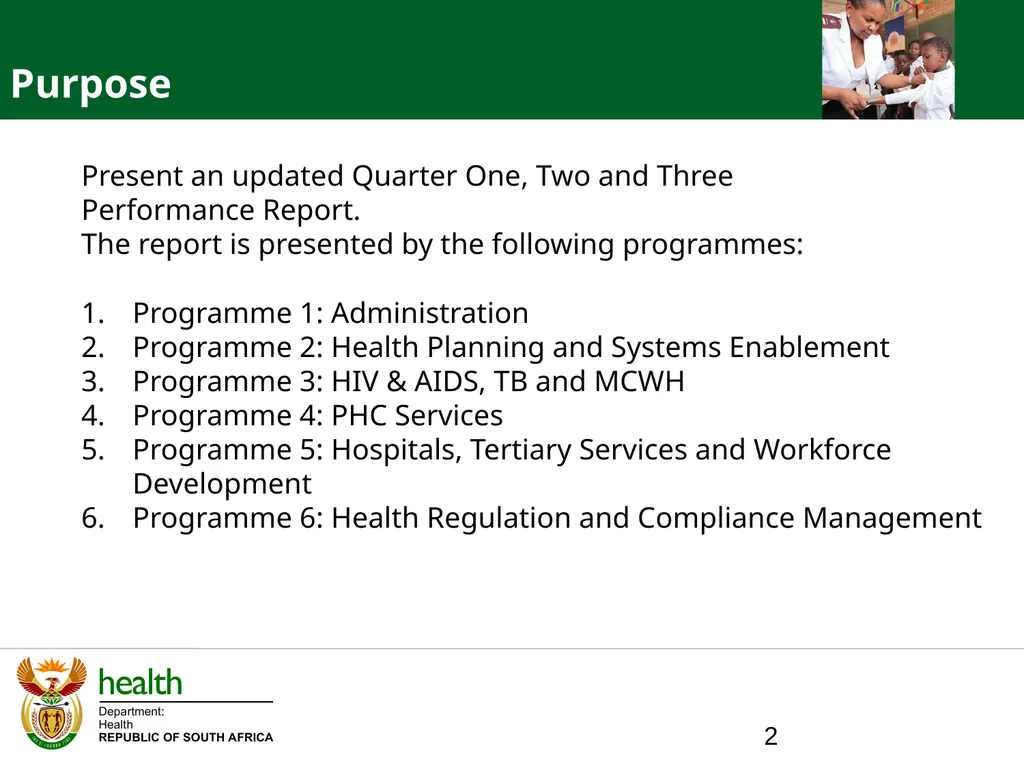
Purpose Present an updated Quarter One, Two and Three
Performance Report.
The report is presented by the following programmes:
Programme 1: Administration
Programme 2: Health Planning and Systems Enablement
Programme 3: HIV & AIDS, TB and MCWH
Programme 4: PHC Services
Programme 5: Hospitals, Tertiary Services and Workforce Development
Programme 6: Health Regulation and Compliance Management 2<br>
Performance Report.
The report is presented by the following programmes:
Programme 1: Administration
Programme 2: Health Planning and Systems Enablement
Programme 3: HIV & AIDS, TB and MCWH
Programme 4: PHC Services
Programme 5: Hospitals, Tertiary Services and Workforce Development
Programme 6: Health Regulation and Compliance Management 2<br>
03
3 Progress Report PROGRAMME 1 : ADMINISTRATION<br>
04
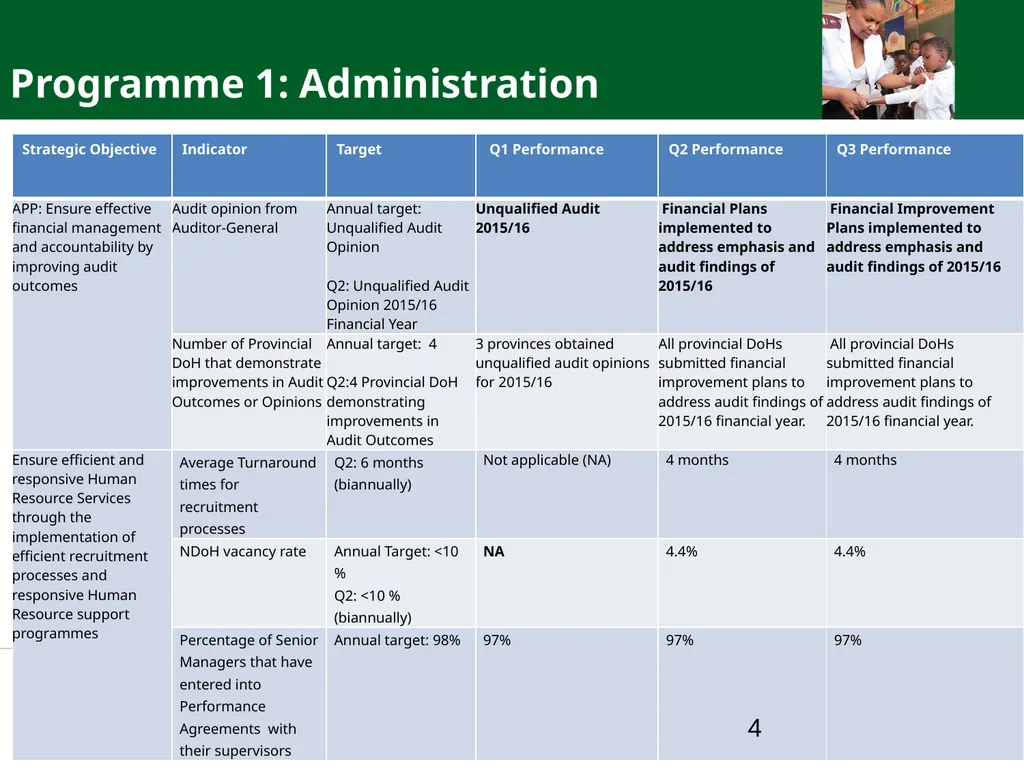
Programme 1: Administration 4<br>
05
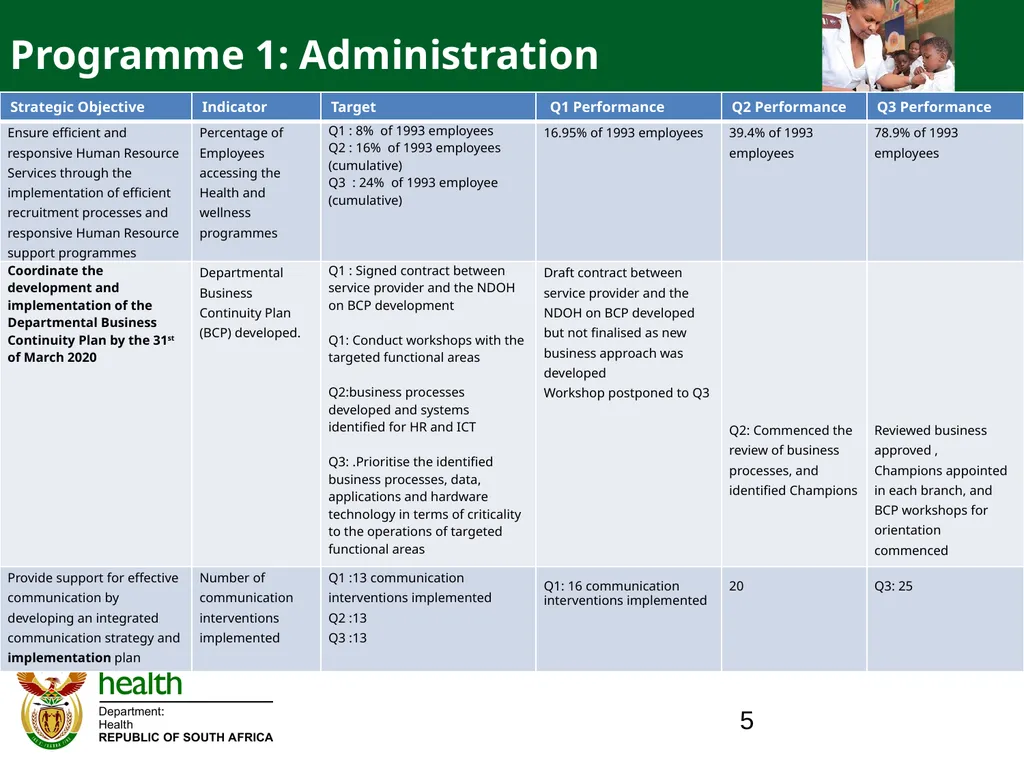
Programme 1: Administration 5<br>
06
Progress Report PROGRAMME 2 : HEALTH PLANNING AND SYSTEMS ENABLEMENT 6<br>
07
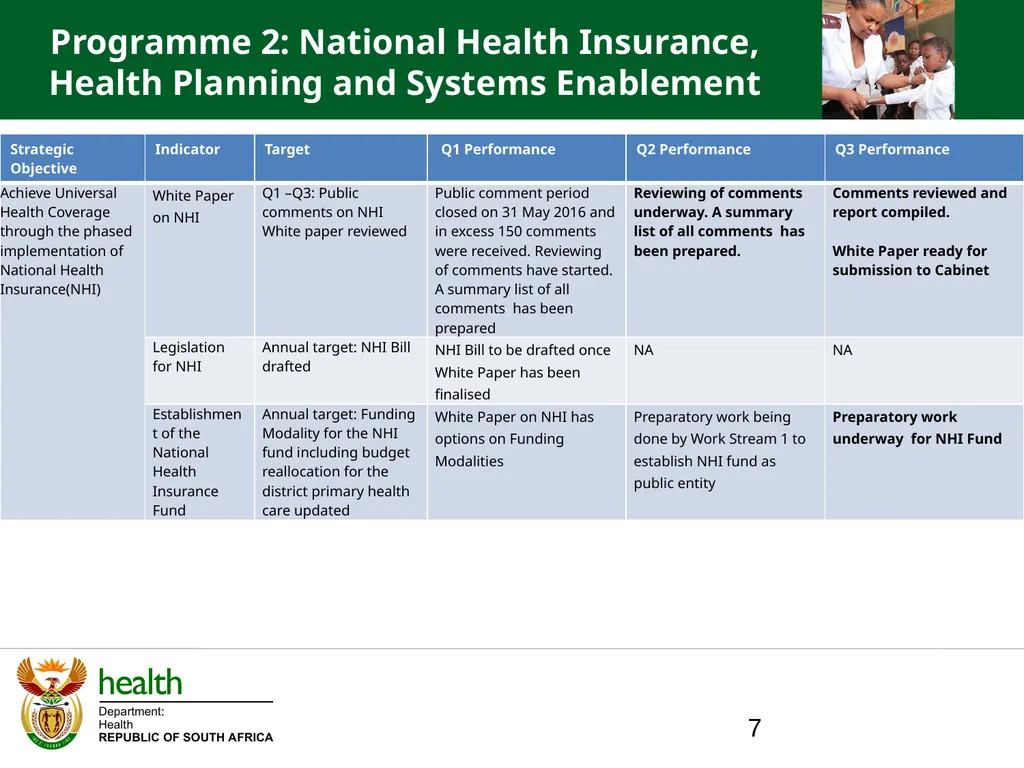
Programme 2: National Health Insurance, Health Planning and Systems Enablement 7<br>
08
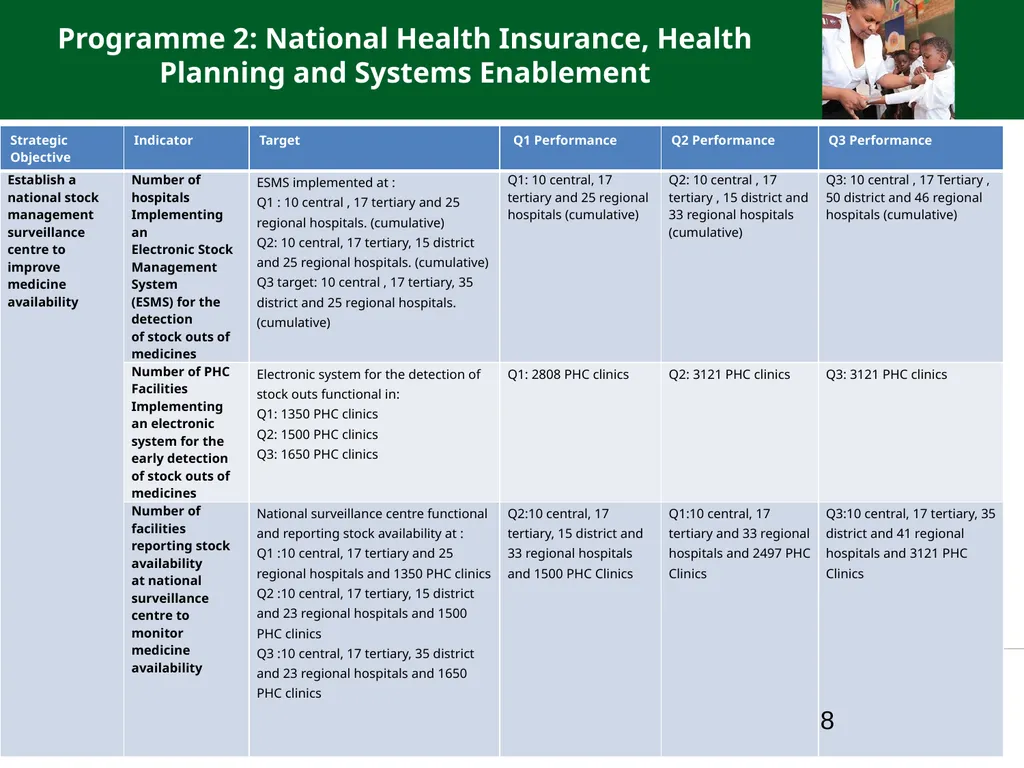
Programme 2: National Health Insurance, Health Planning and Systems Enablement 8<br>
09
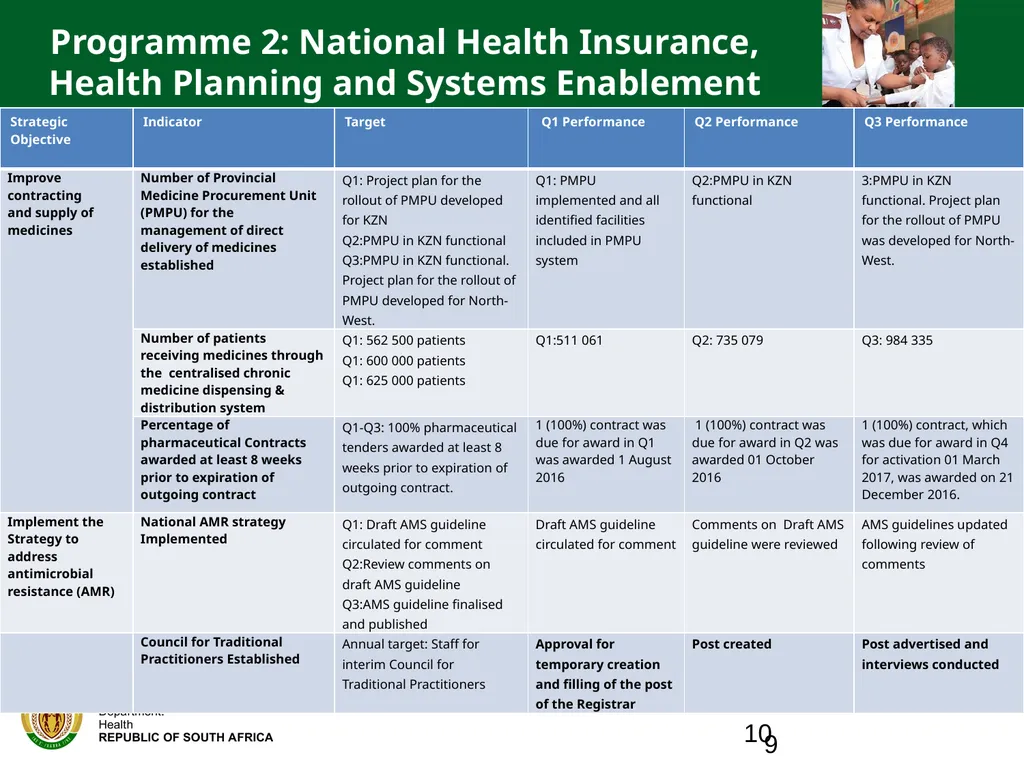
10 Programme 2: National Health Insurance, Health Planning and Systems Enablement 9<br>
10
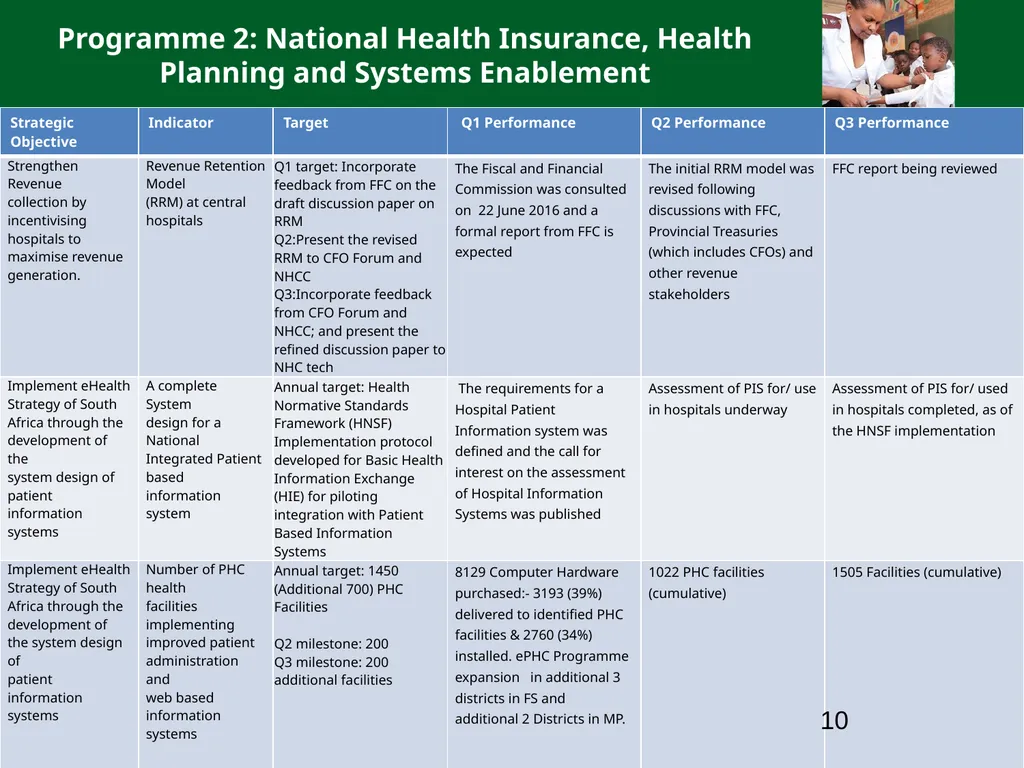
11 Programme 2: National Health Insurance, Health Planning and Systems Enablement 10<br>
11
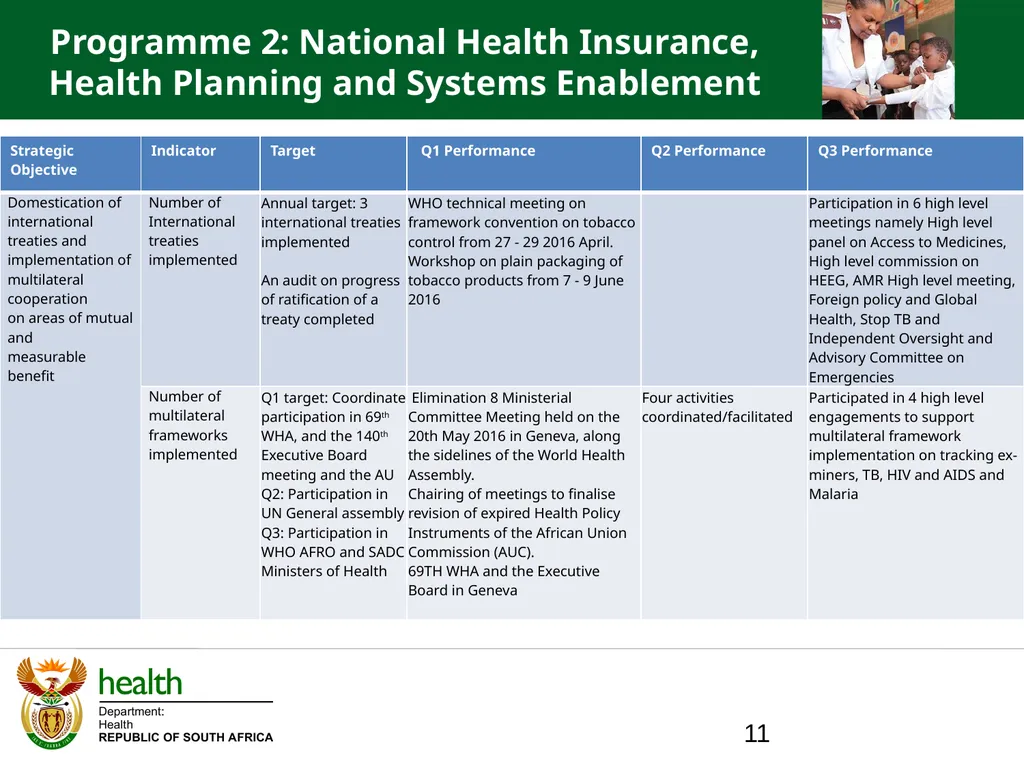
11 Programme 2: National Health Insurance, Health Planning and Systems Enablement<br>
12
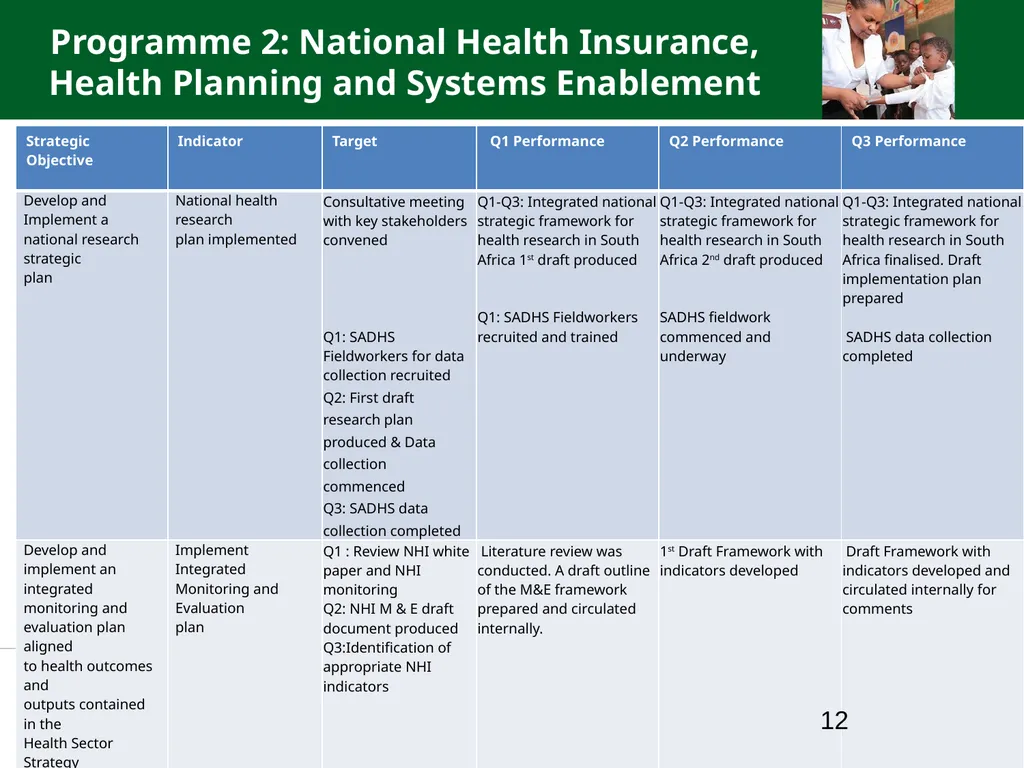
12 Programme 2: National Health Insurance, Health Planning and Systems Enablement 12<br>
13
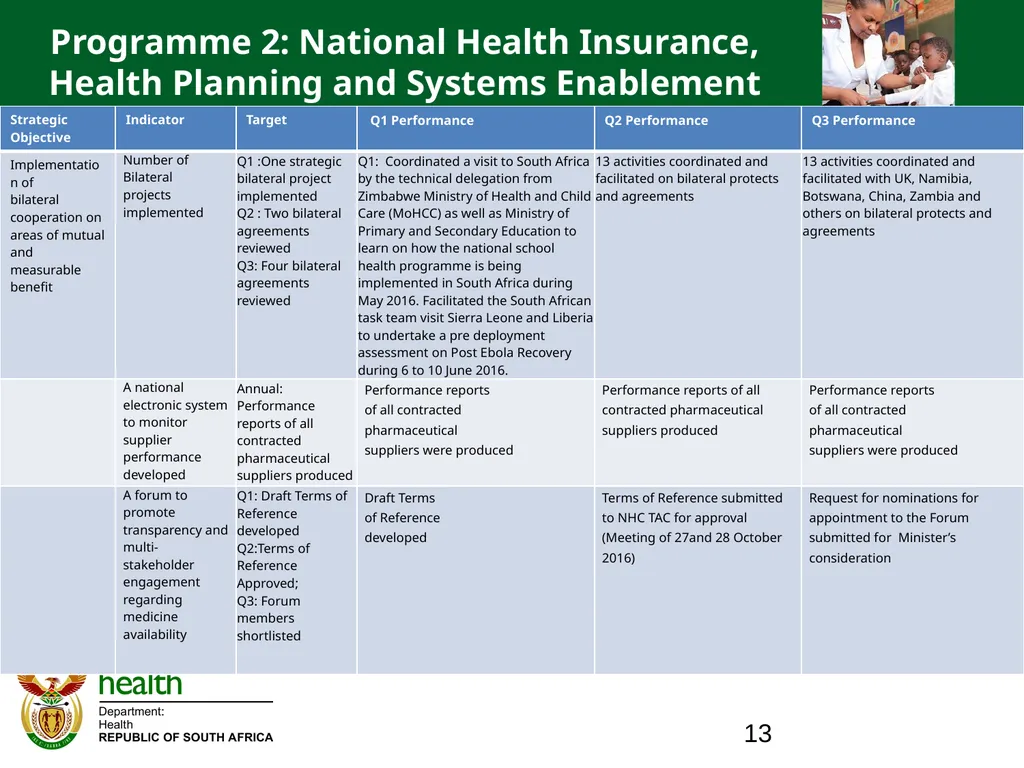
13 Programme 2: National Health Insurance, Health Planning and Systems Enablement<br>
14
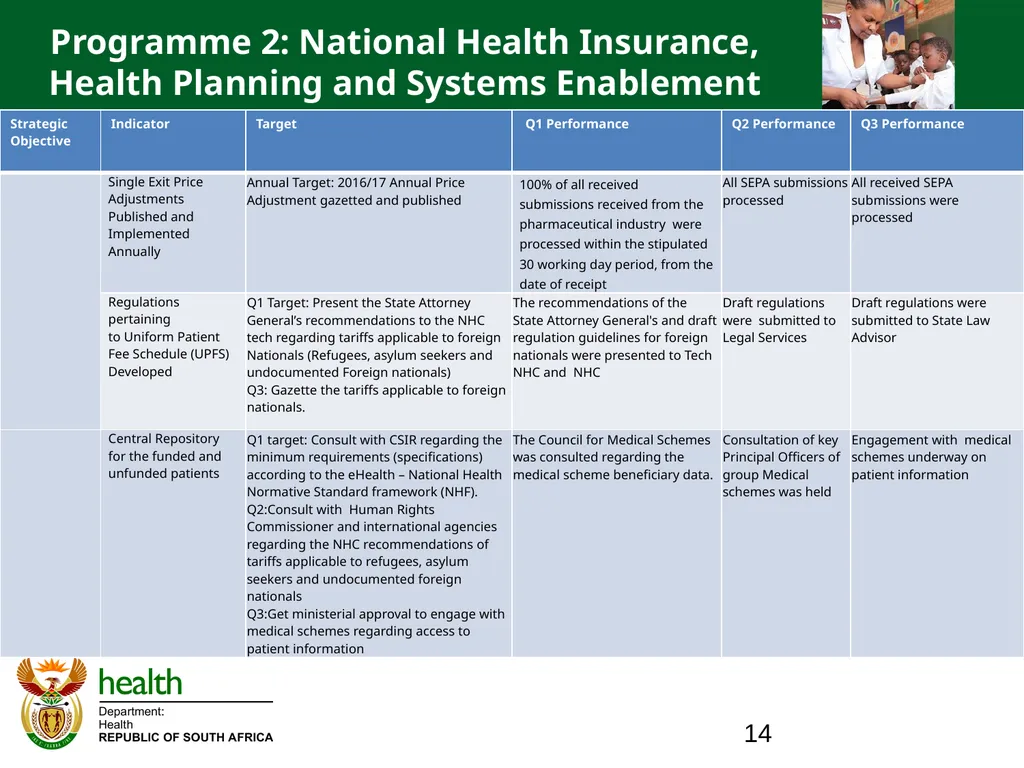
14 Programme 2: National Health Insurance, Health Planning and Systems Enablement<br>
15
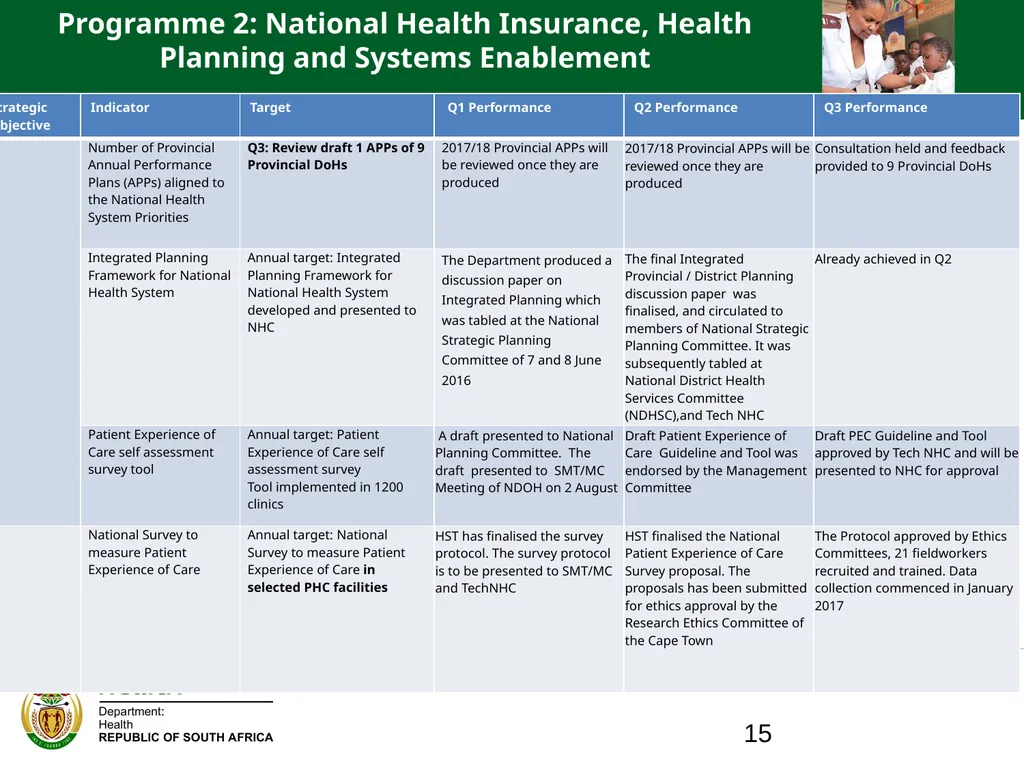
15 Programme 2: National Health Insurance, Health Planning and Systems Enablement<br>
16
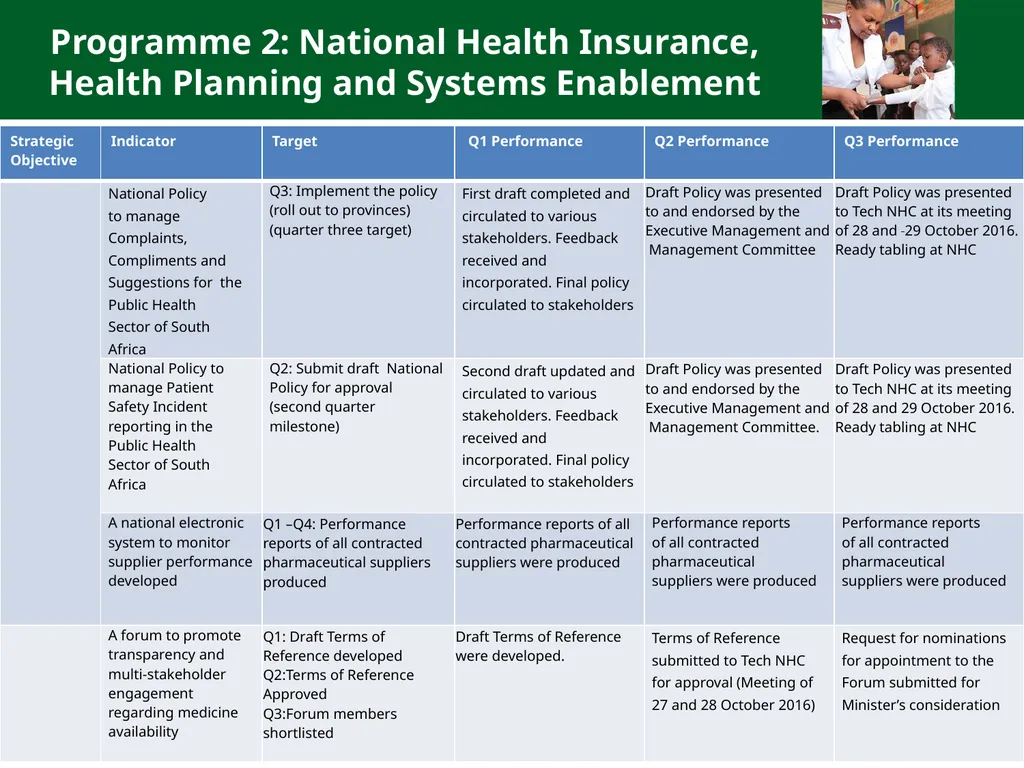
16 Programme 2: National Health Insurance, Health Planning and Systems Enablement<br>
17
17 Programme 2
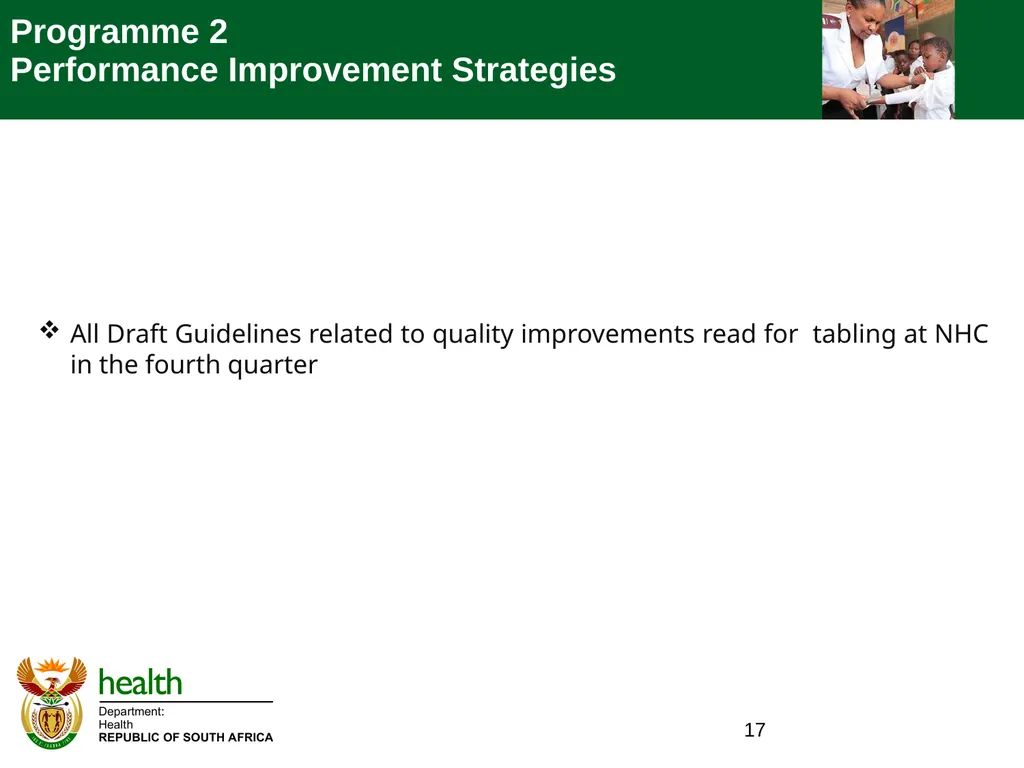
Performance Improvement Strategies All Draft Guidelines related to quality improvements read for tabling at NHC in the fourth quarter<br>
Performance Improvement Strategies All Draft Guidelines related to quality improvements read for tabling at NHC in the fourth quarter<br>
18
Progress Report PROGRAMME 3 :HIV/AIDS, TB AND MATERNAL AND CHILD HEALTH 18<br>
19
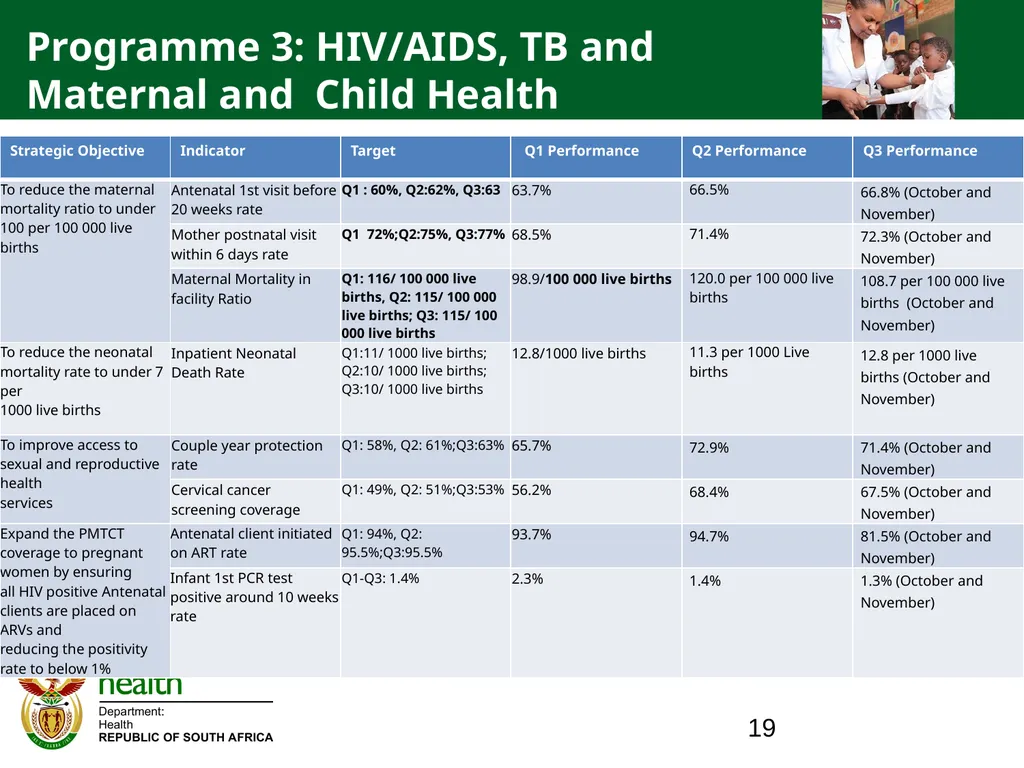
Programme 3: HIV/AIDS, TB and
Maternal and Child Health 19<br>
20
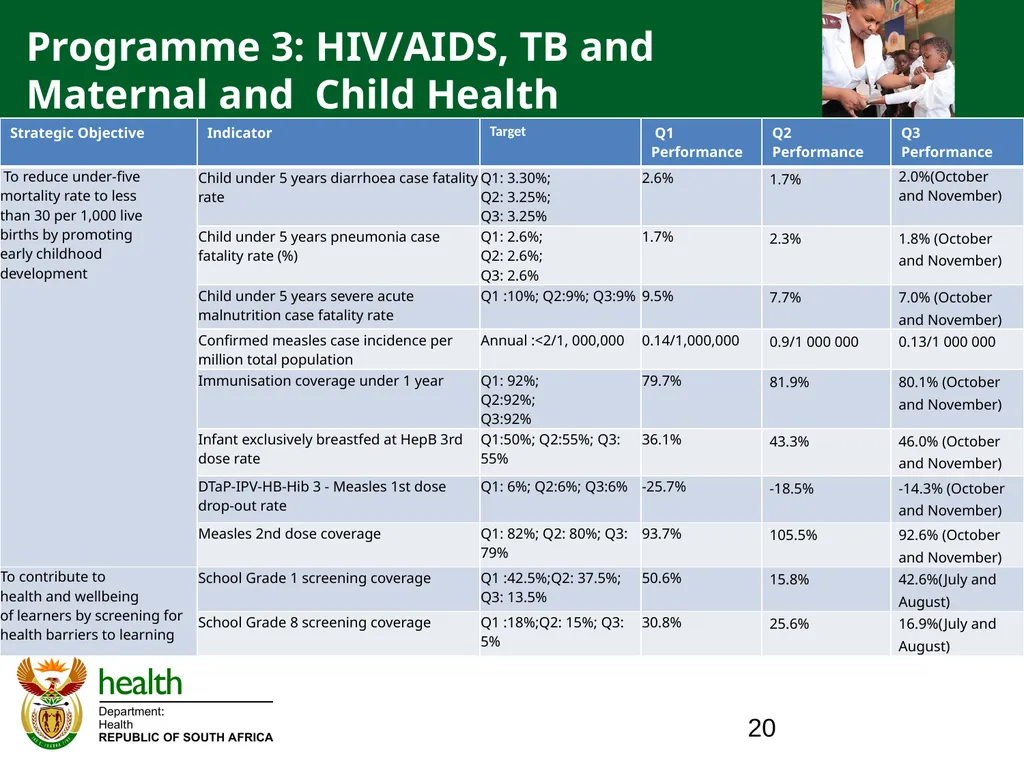
Programme 3: HIV/AIDS, TB and
Maternal and Child Health 20<br>
21
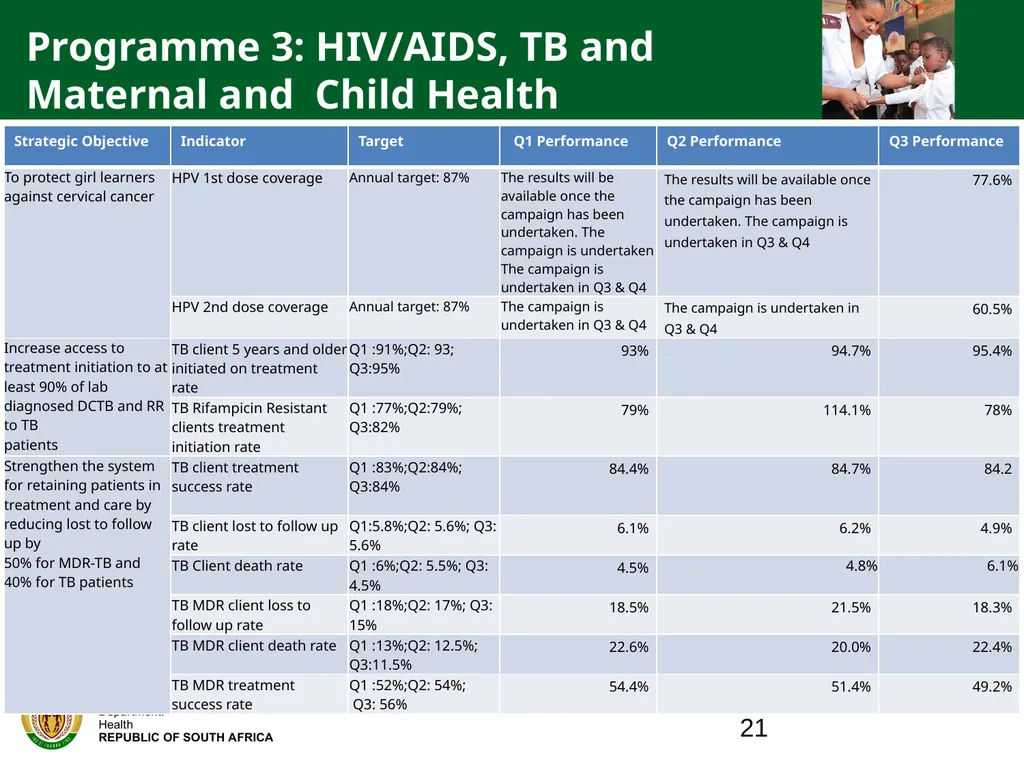
Programme 3: HIV/AIDS, TB and
Maternal and Child Health 21<br>
22
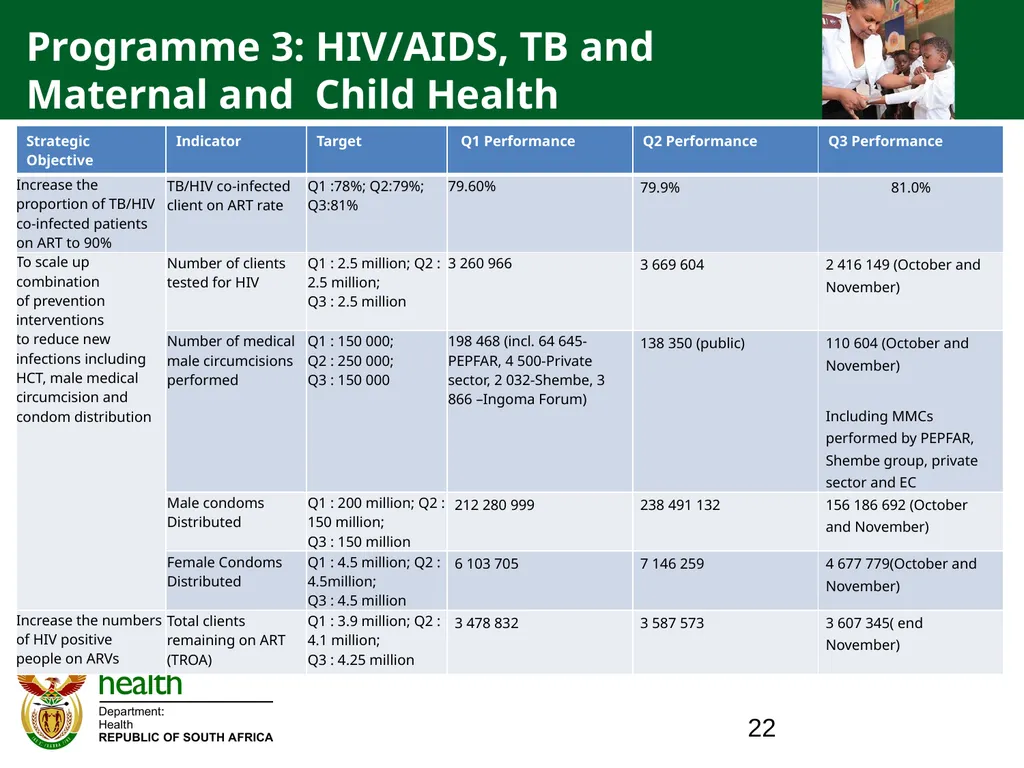
Programme 3: HIV/AIDS, TB and
Maternal and Child Health 22<br>
23
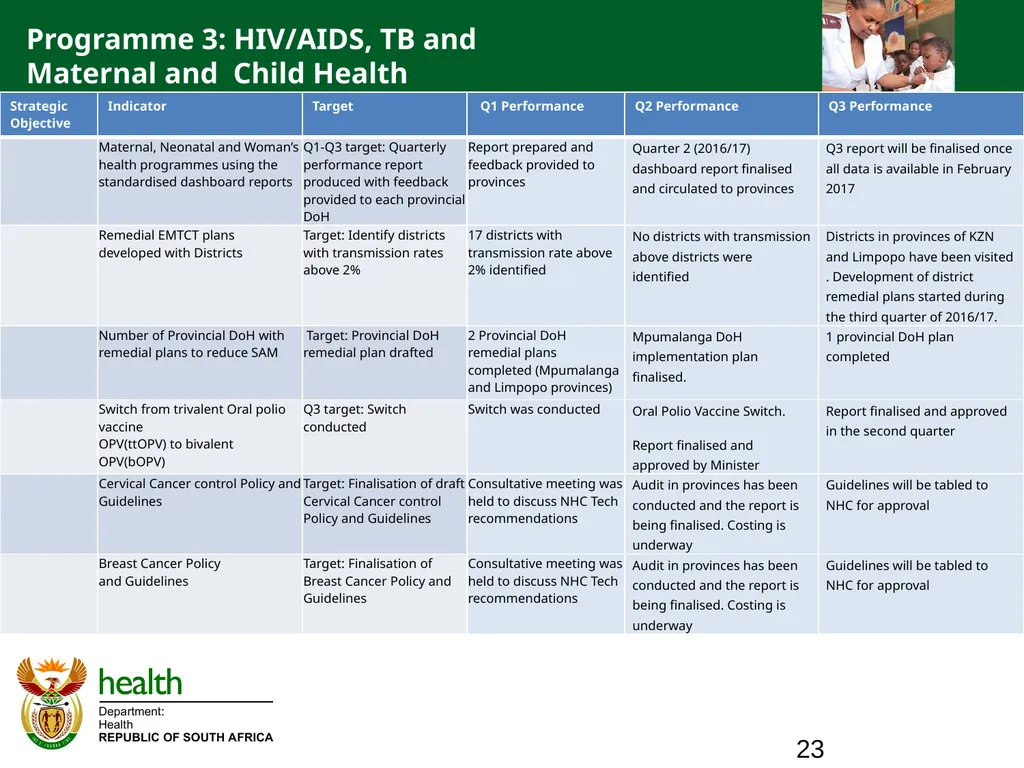
Programme 3: HIV/AIDS, TB and
Maternal and Child Health 23<br>
24
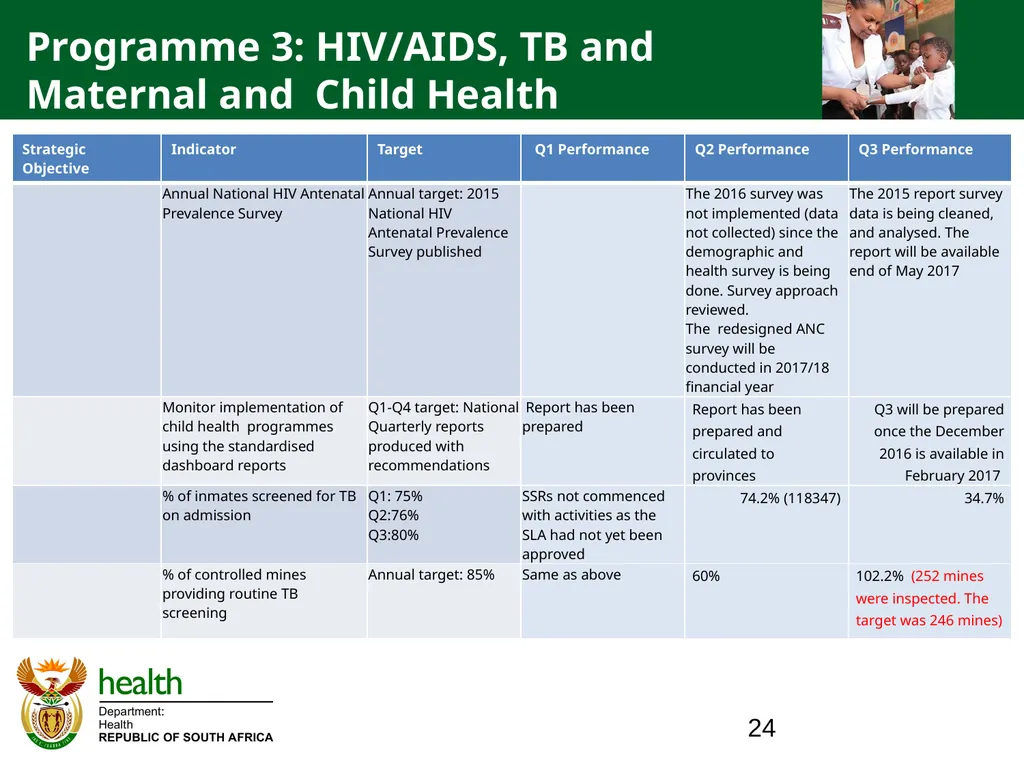
Programme 3: HIV/AIDS, TB and
Maternal and Child Health 24<br>
25
25 Programme 3
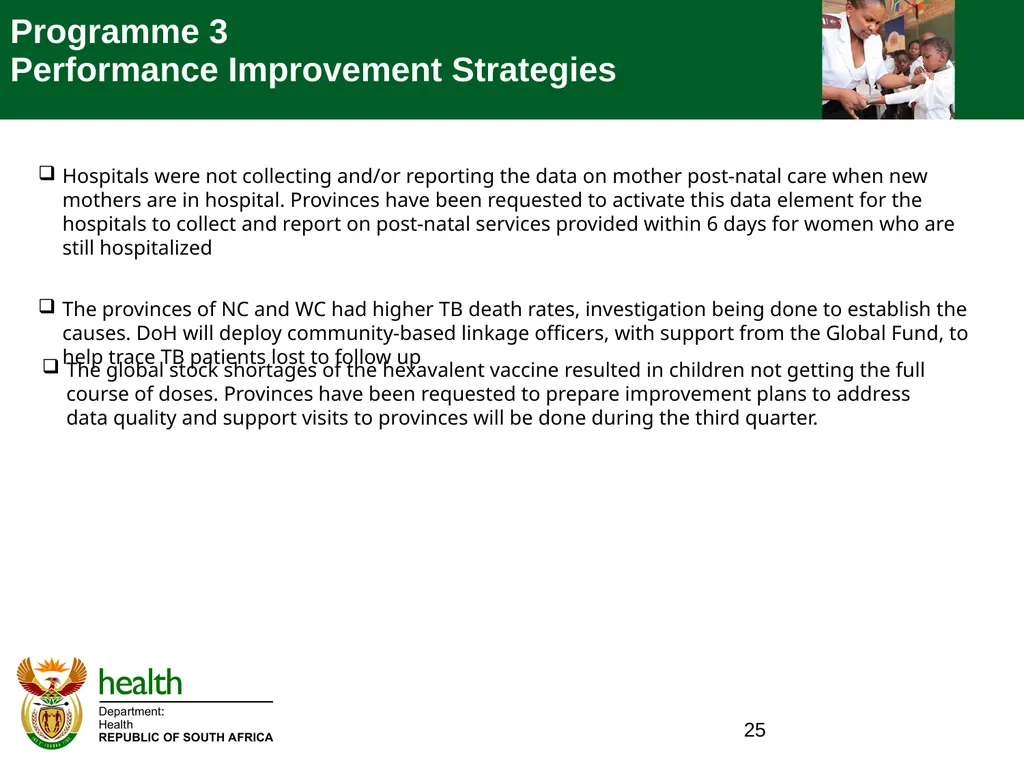
Performance Improvement Strategies Hospitals were not collecting and/or reporting the data on mother post-natal care when new mothers are in hospital. Provinces have been requested to activate this data element for the hospitals to collect and report on post-natal services provided within 6 days for women who are still hospitalized
The provinces of NC and WC had higher TB death rates, investigation being done to establish the causes. DoH will deploy community-based linkage officers, with support from the Global Fund, to help trace TB patients lost to follow up The global stock shortages of the hexavalent vaccine resulted in children not getting the full course of doses. Provinces have been requested to prepare improvement plans to address data quality and support visits to provinces will be done during the third quarter.<br>
Performance Improvement Strategies Hospitals were not collecting and/or reporting the data on mother post-natal care when new mothers are in hospital. Provinces have been requested to activate this data element for the hospitals to collect and report on post-natal services provided within 6 days for women who are still hospitalized
The provinces of NC and WC had higher TB death rates, investigation being done to establish the causes. DoH will deploy community-based linkage officers, with support from the Global Fund, to help trace TB patients lost to follow up The global stock shortages of the hexavalent vaccine resulted in children not getting the full course of doses. Provinces have been requested to prepare improvement plans to address data quality and support visits to provinces will be done during the third quarter.<br>
26
Progress Report PROGRAMME 4 : PRIMARY HEALTH CARE 26<br>
27
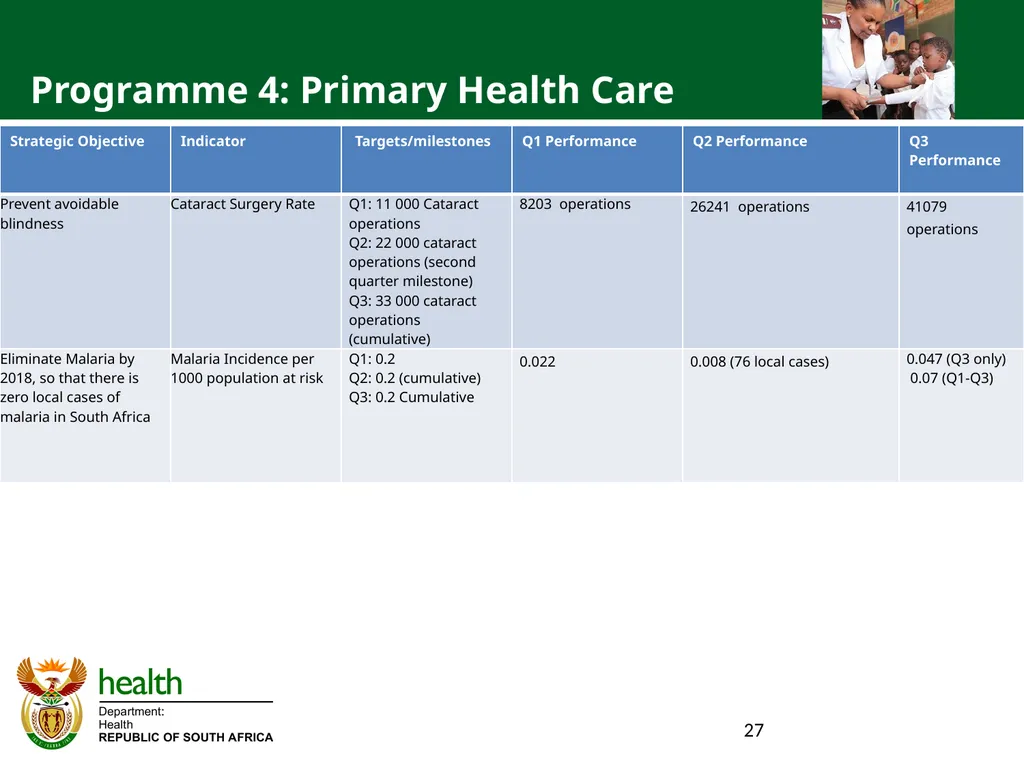
Programme 4: Primary Health Care 27<br>
28
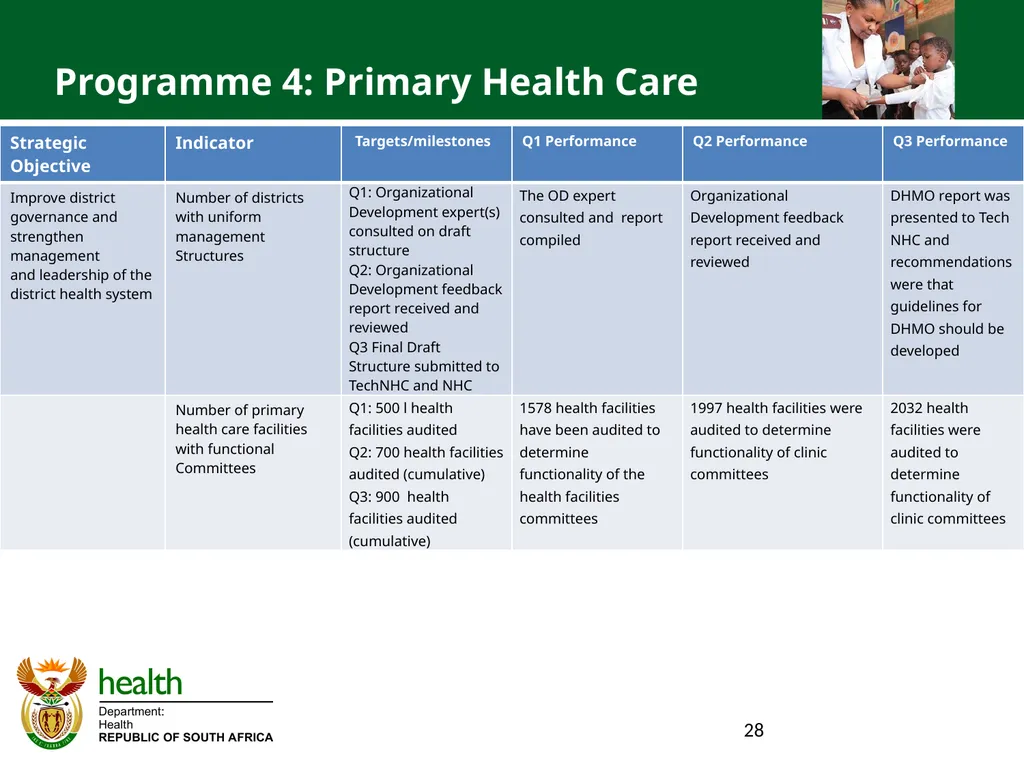
Programme 4: Primary Health Care 28<br>
29
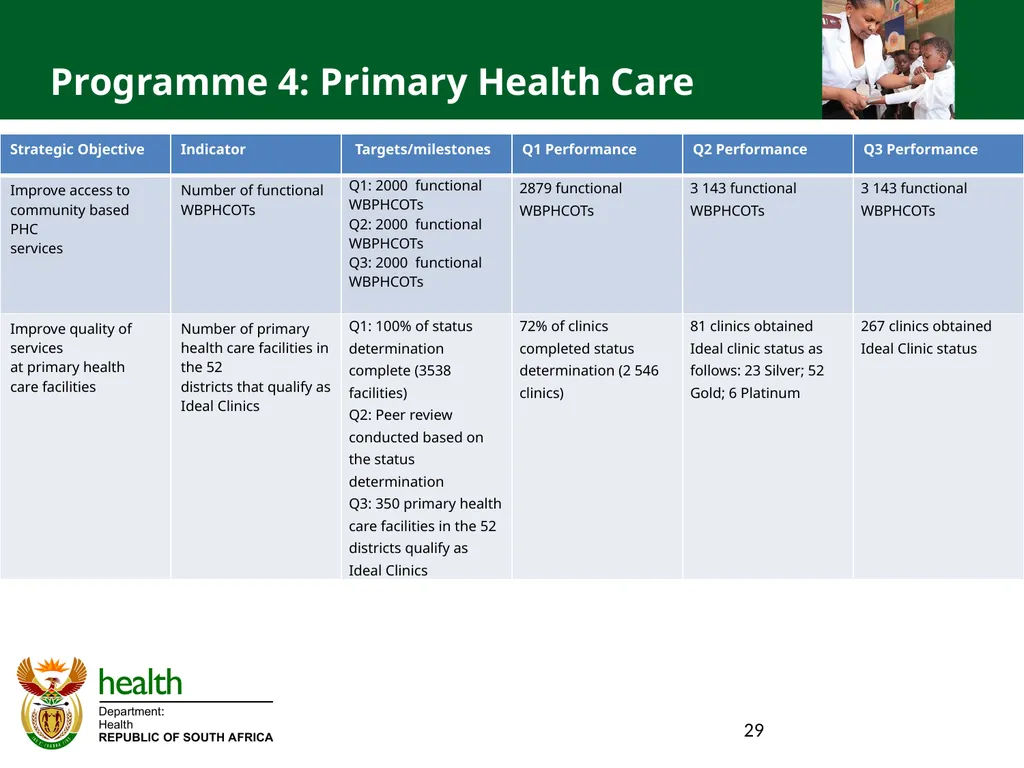
Programme 4: Primary Health Care 29<br>
30
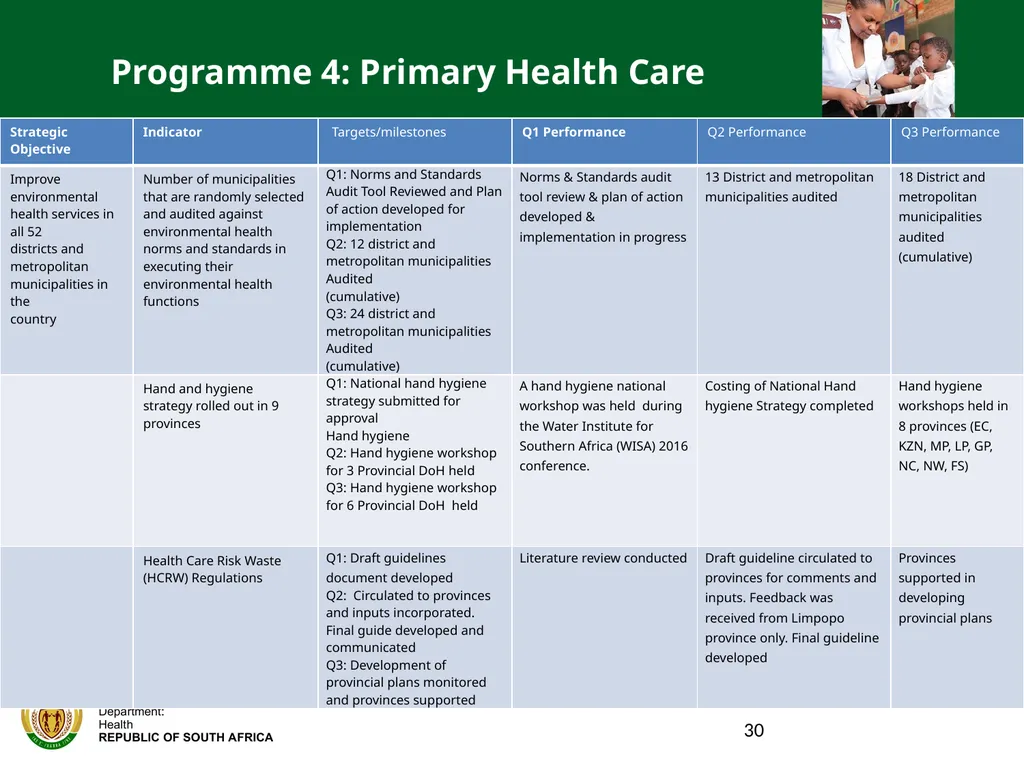
Programme 4: Primary Health Care 30<br>
31
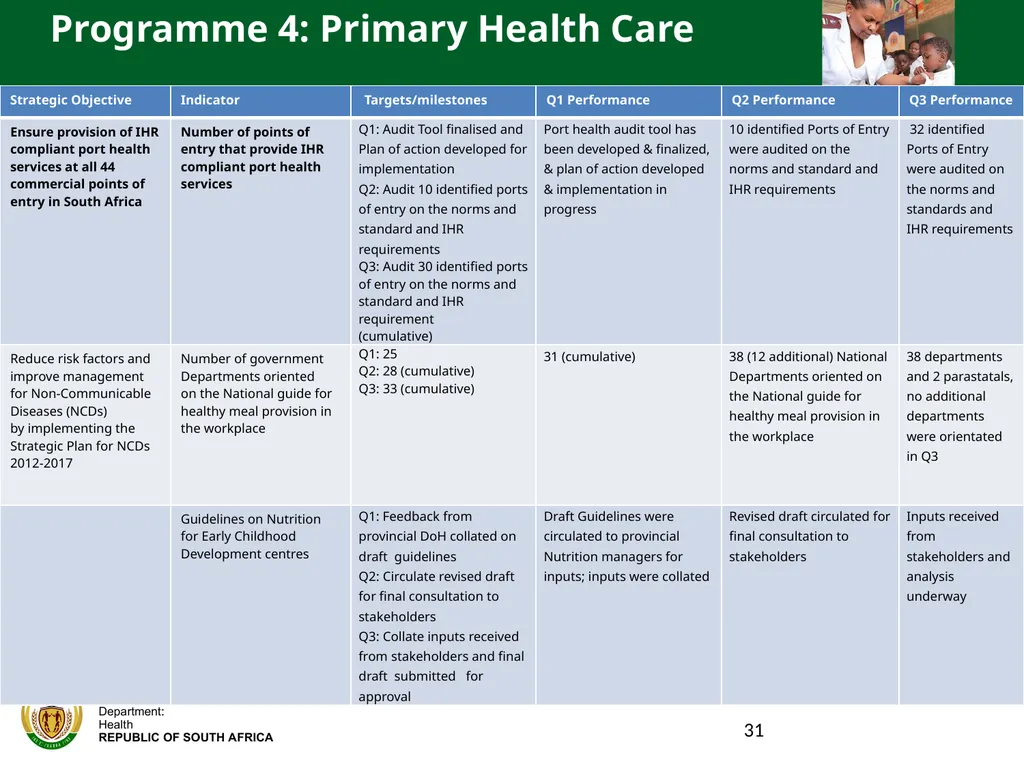
Programme 4: Primary Health Care 31<br>
32
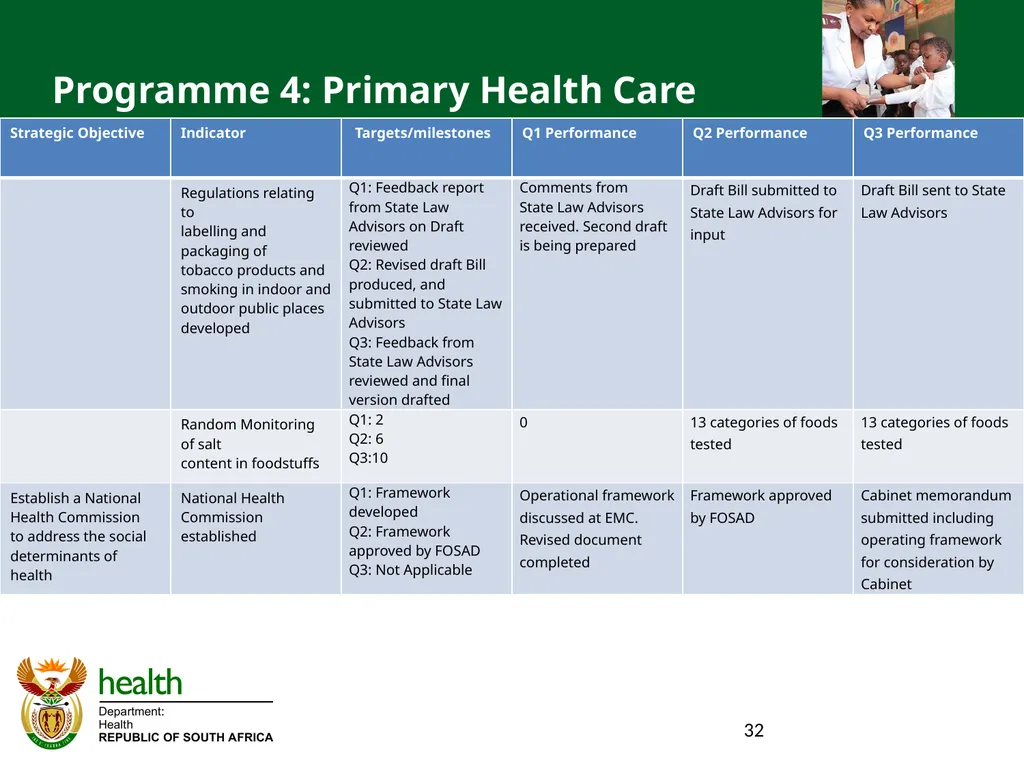
Programme 4: Primary Health Care 32<br>
33
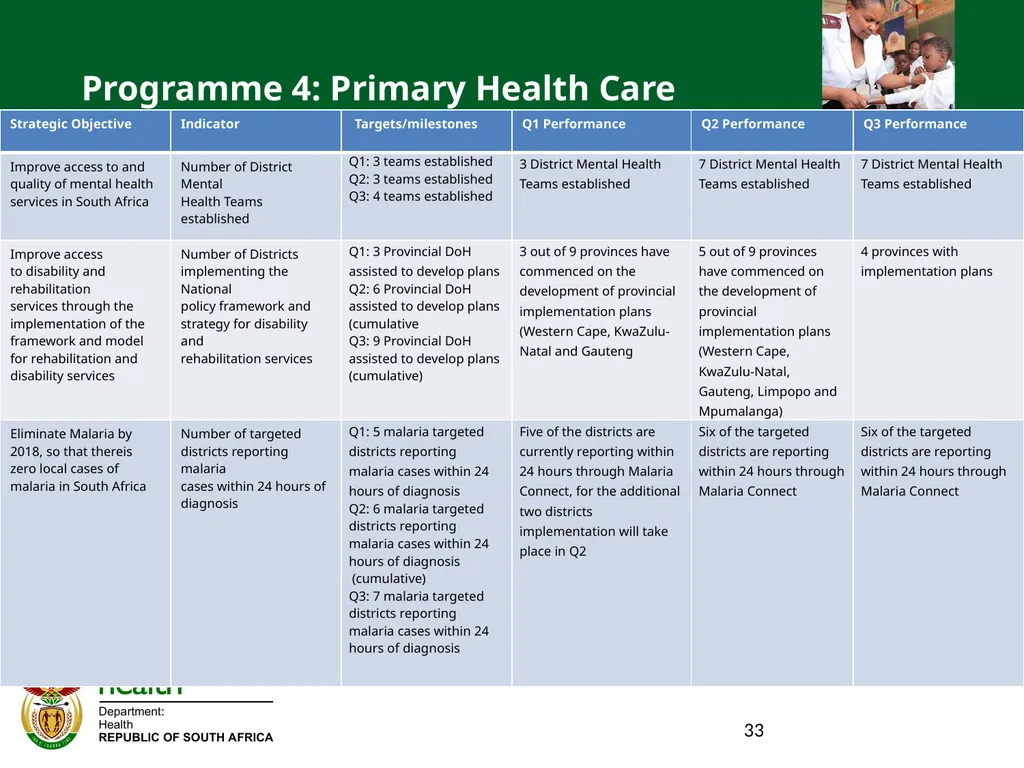
Programme 4: Primary Health Care 33<br>
34
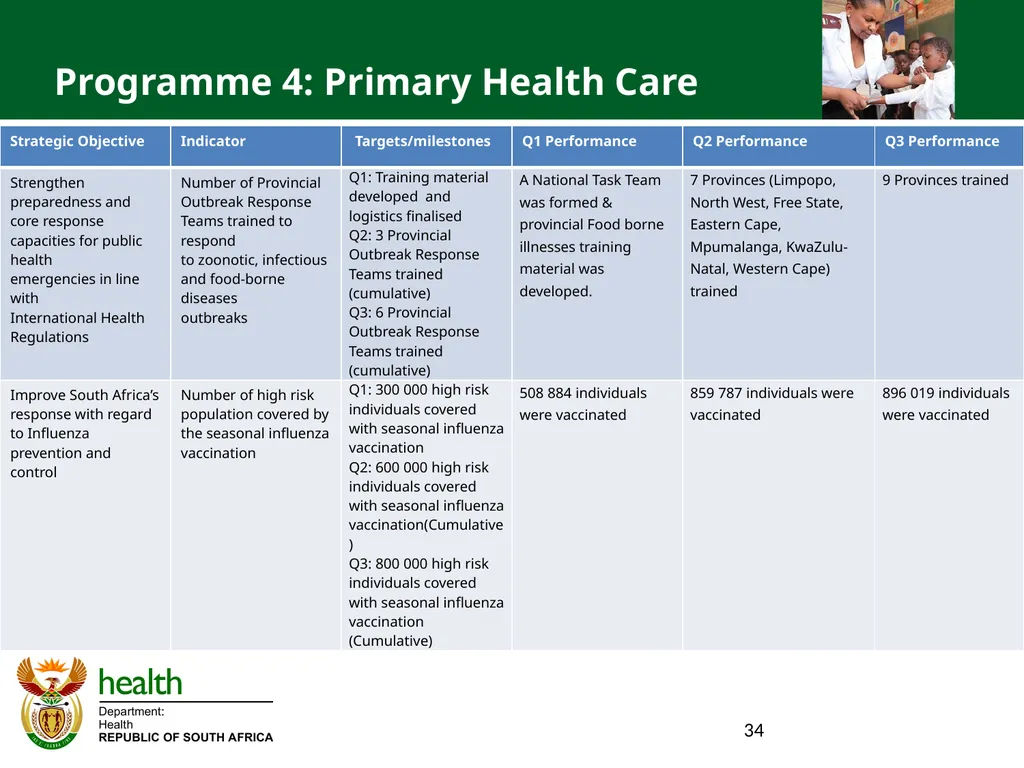
Programme 4: Primary Health Care 34<br>
35
35 Programme 4
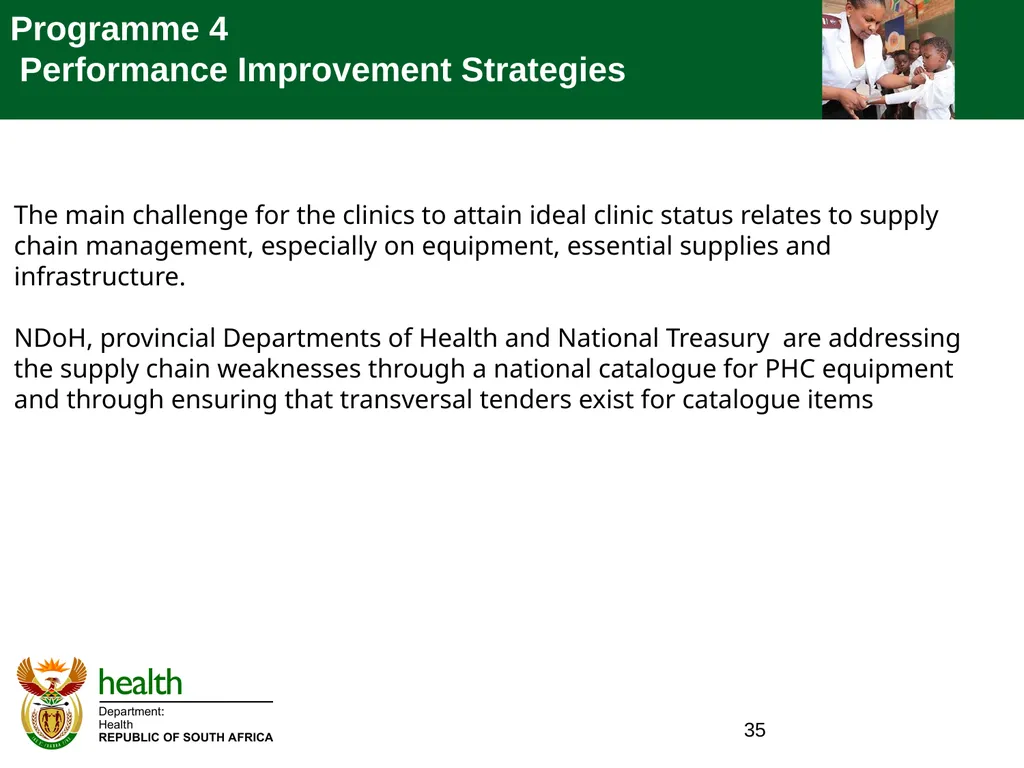
Performance Improvement Strategies The main challenge for the clinics to attain ideal clinic status relates to supply chain management, especially on equipment, essential supplies and infrastructure.
NDoH, provincial Departments of Health and National Treasury are addressing the supply chain weaknesses through a national catalogue for PHC equipment and through ensuring that transversal tenders exist for catalogue items<br>
Performance Improvement Strategies The main challenge for the clinics to attain ideal clinic status relates to supply chain management, especially on equipment, essential supplies and infrastructure.
NDoH, provincial Departments of Health and National Treasury are addressing the supply chain weaknesses through a national catalogue for PHC equipment and through ensuring that transversal tenders exist for catalogue items<br>
36
Progress Report PROGRAMME 5 : Hospitals, Tertiary Services and Workforce Development 36<br>
37
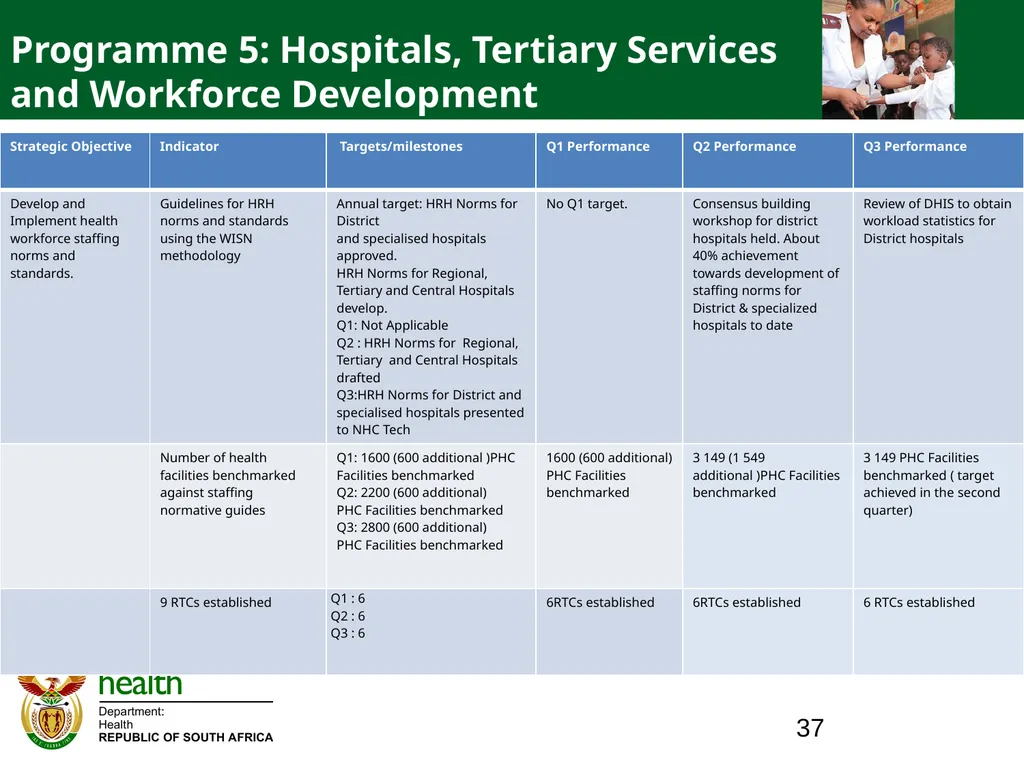
Programme 5: Hospitals, Tertiary Services and Workforce Development 37<br>
38
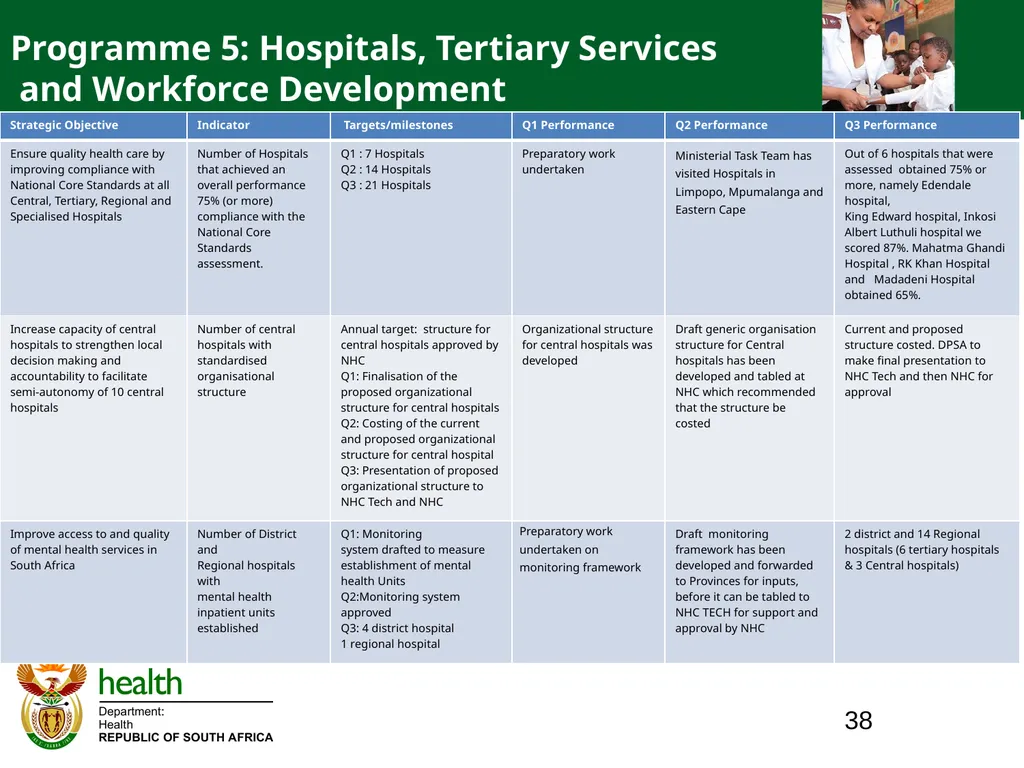
Programme 5: Hospitals, Tertiary Services
and Workforce Development 38<br>
39
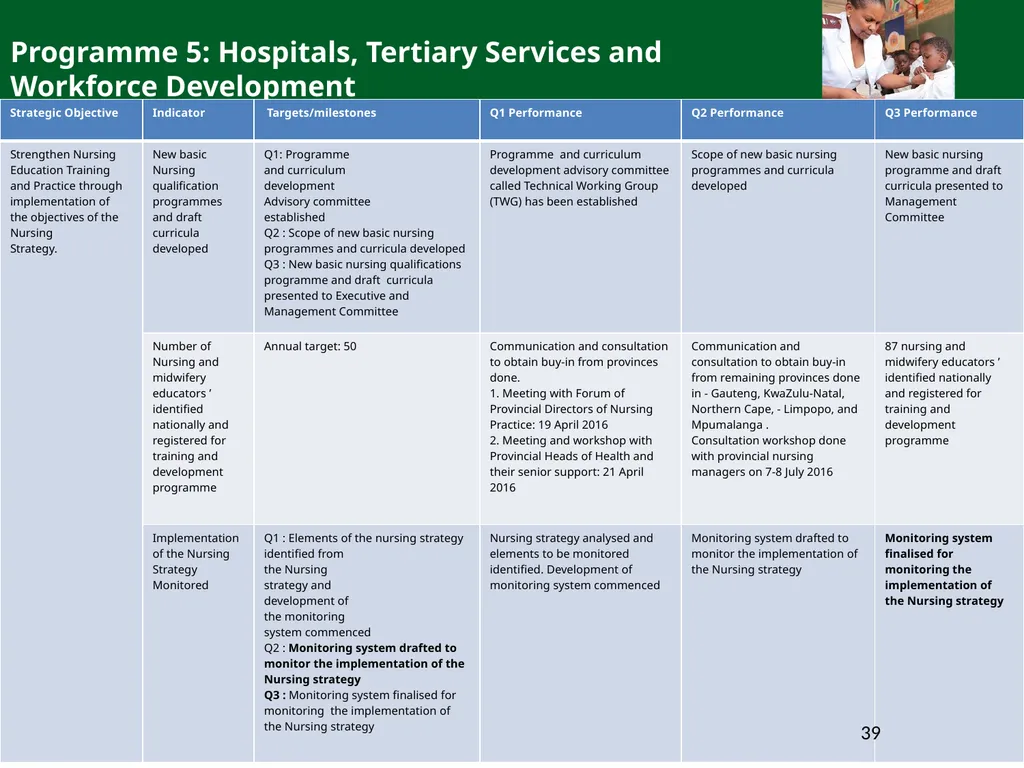
Programme 5: Hospitals, Tertiary Services and Workforce Development 39<br>
40
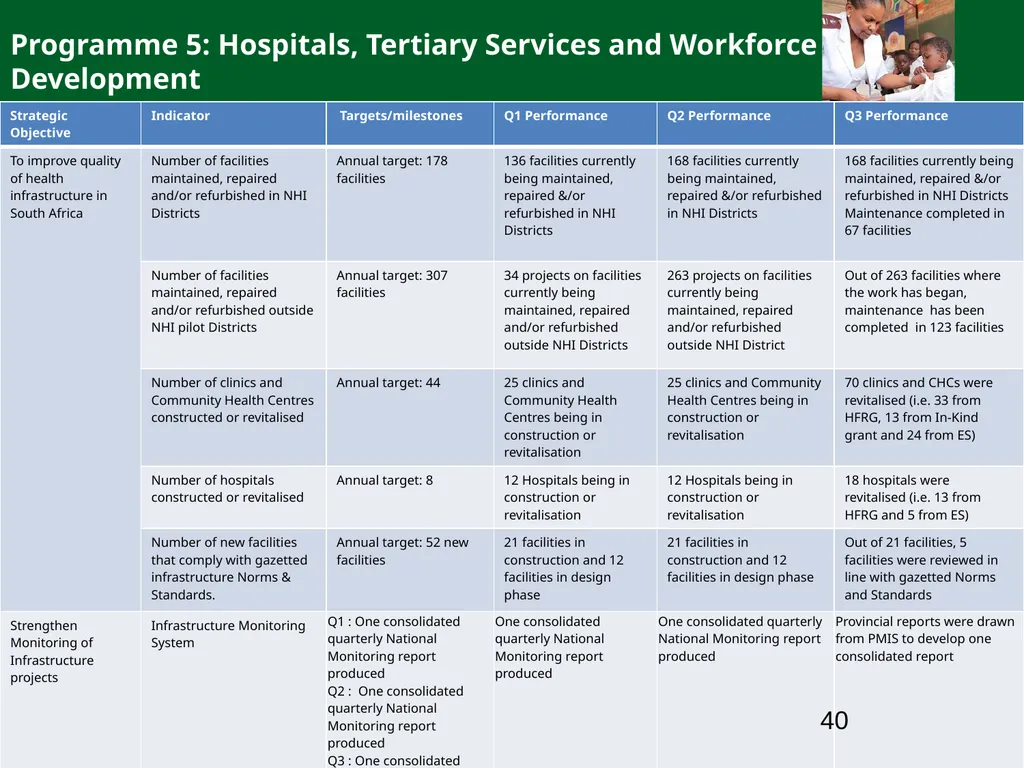
Programme 5: Hospitals, Tertiary Services and Workforce Development 40<br>
41
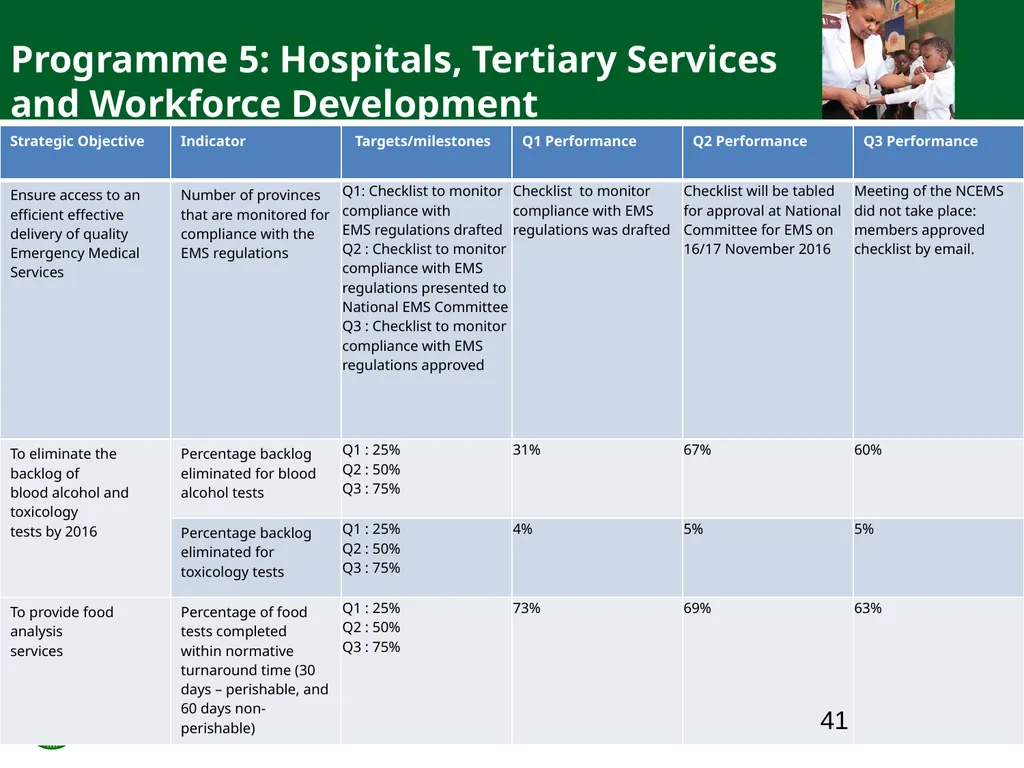
Programme 5: Hospitals, Tertiary Services and Workforce Development 41<br>
42
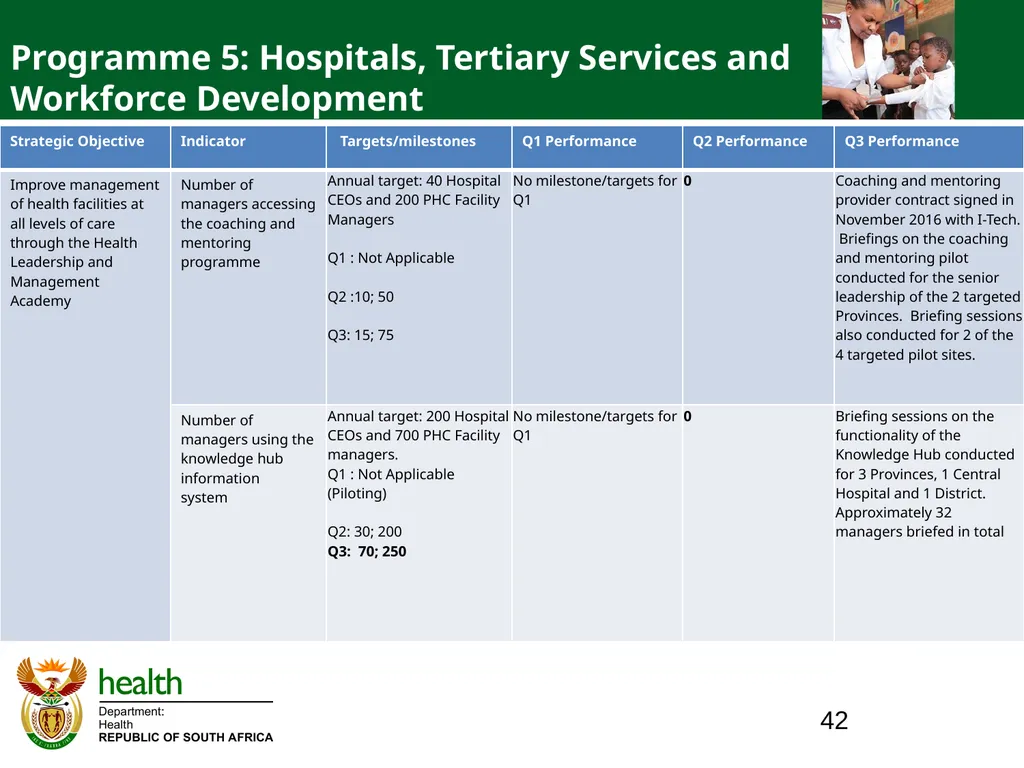
Programme 5: Hospitals, Tertiary Services and Workforce Development 42<br>
43
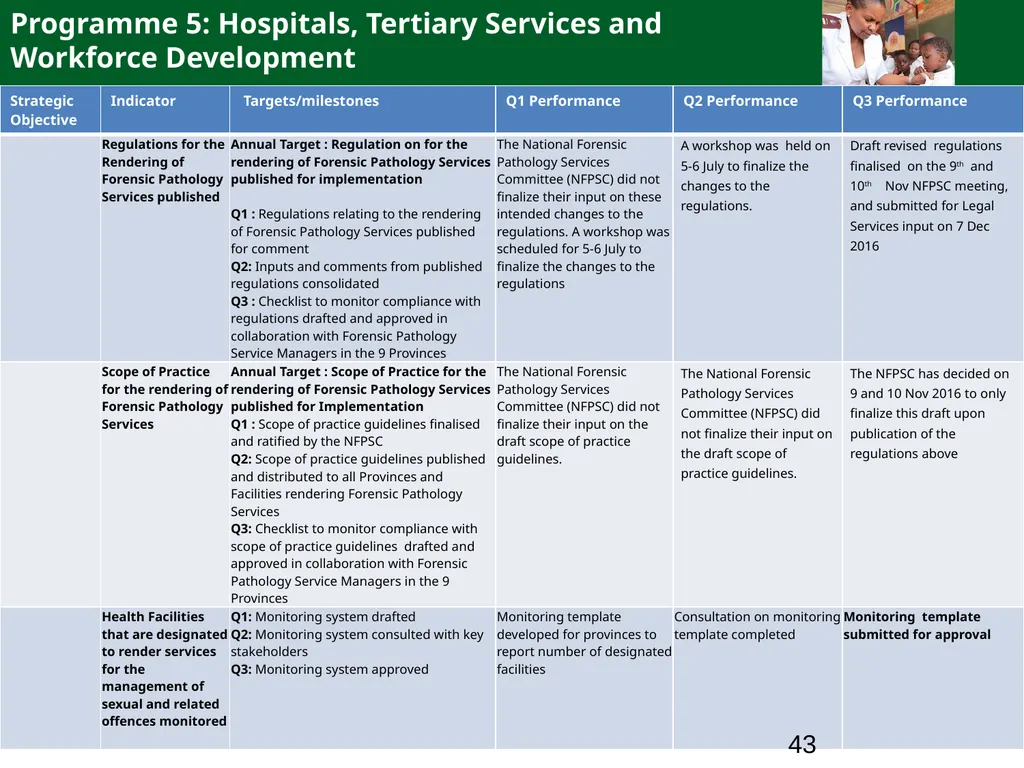
Programme 5: Hospitals, Tertiary Services and Workforce Development 43<br>
44
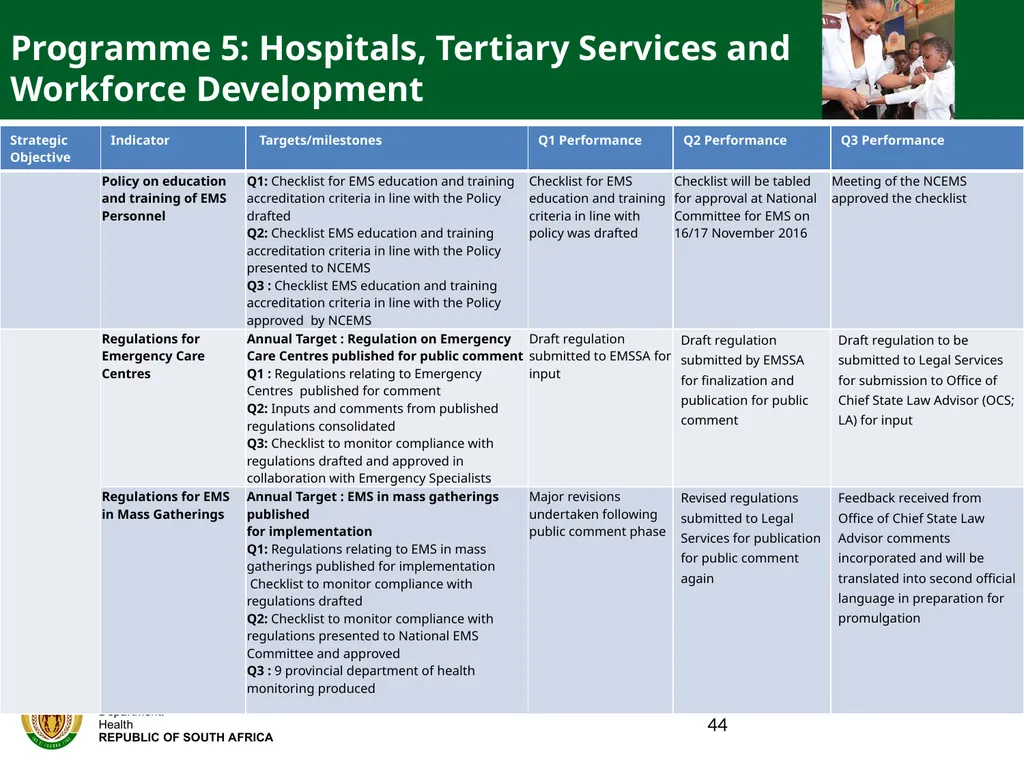
Programme 5: Hospitals, Tertiary Services and Workforce Development 44<br>
45
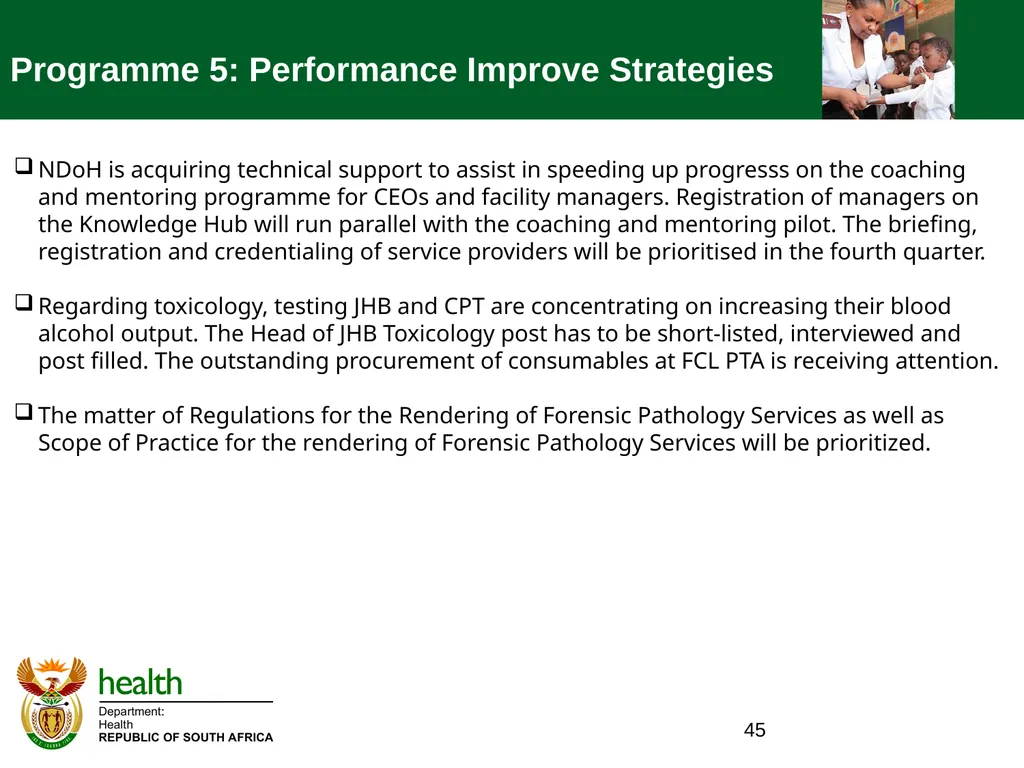
45 Programme 5: Performance Improve Strategies NDoH is acquiring technical support to assist in speeding up progresss on the coaching and mentoring programme for CEOs and facility managers. Registration of managers on the Knowledge Hub will run parallel with the coaching and mentoring pilot. The briefing, registration and credentialing of service providers will be prioritised in the fourth quarter.
Regarding toxicology, testing JHB and CPT are concentrating on increasing their blood alcohol output. The Head of JHB Toxicology post has to be short-listed, interviewed and post filled. The outstanding procurement of consumables at FCL PTA is receiving attention.
The matter of Regulations for the Rendering of Forensic Pathology Services as well as Scope of Practice for the rendering of Forensic Pathology Services will be prioritized.<br>
Regarding toxicology, testing JHB and CPT are concentrating on increasing their blood alcohol output. The Head of JHB Toxicology post has to be short-listed, interviewed and post filled. The outstanding procurement of consumables at FCL PTA is receiving attention.
The matter of Regulations for the Rendering of Forensic Pathology Services as well as Scope of Practice for the rendering of Forensic Pathology Services will be prioritized.<br>
46
Progress Report PROGRAMME 6 : Health Regulation and Compliance Management 46<br>
47
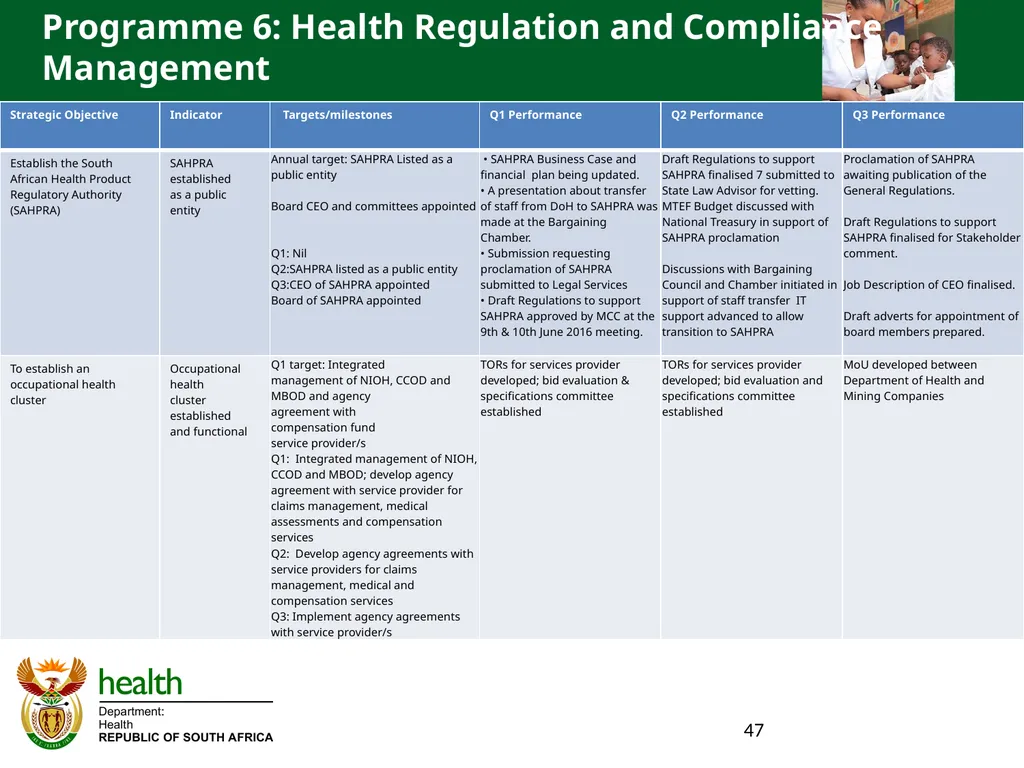
Programme 6: Health Regulation and Compliance Management 47<br>
48
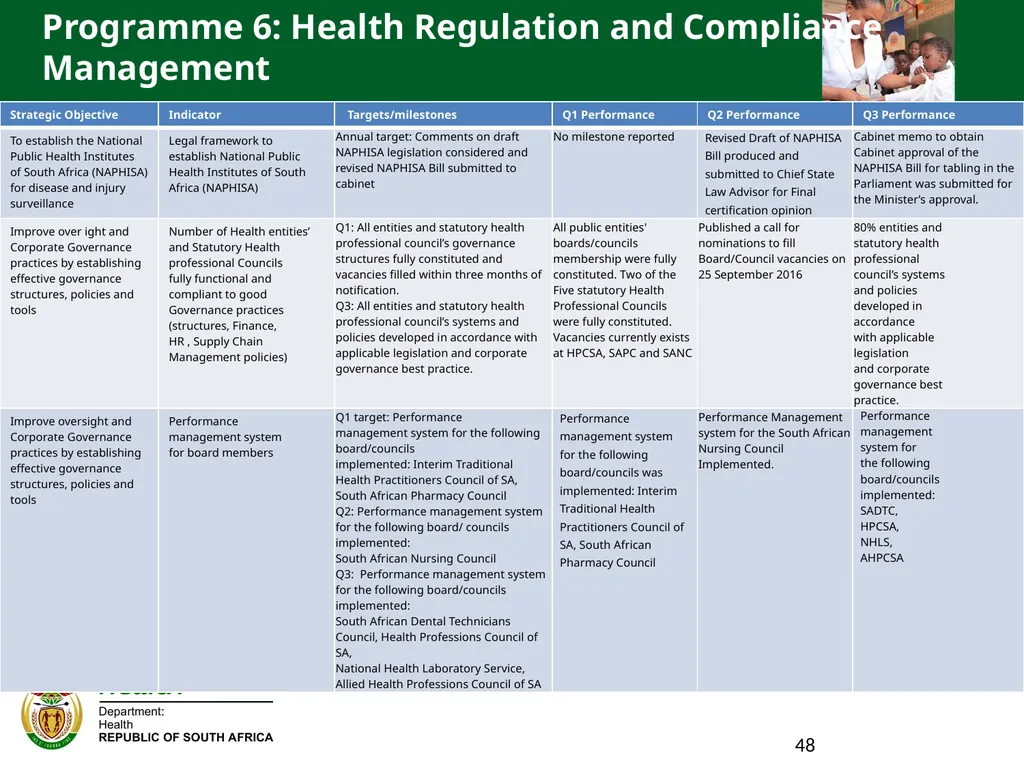
Programme 6: Health Regulation and Compliance Management 48<br>
49
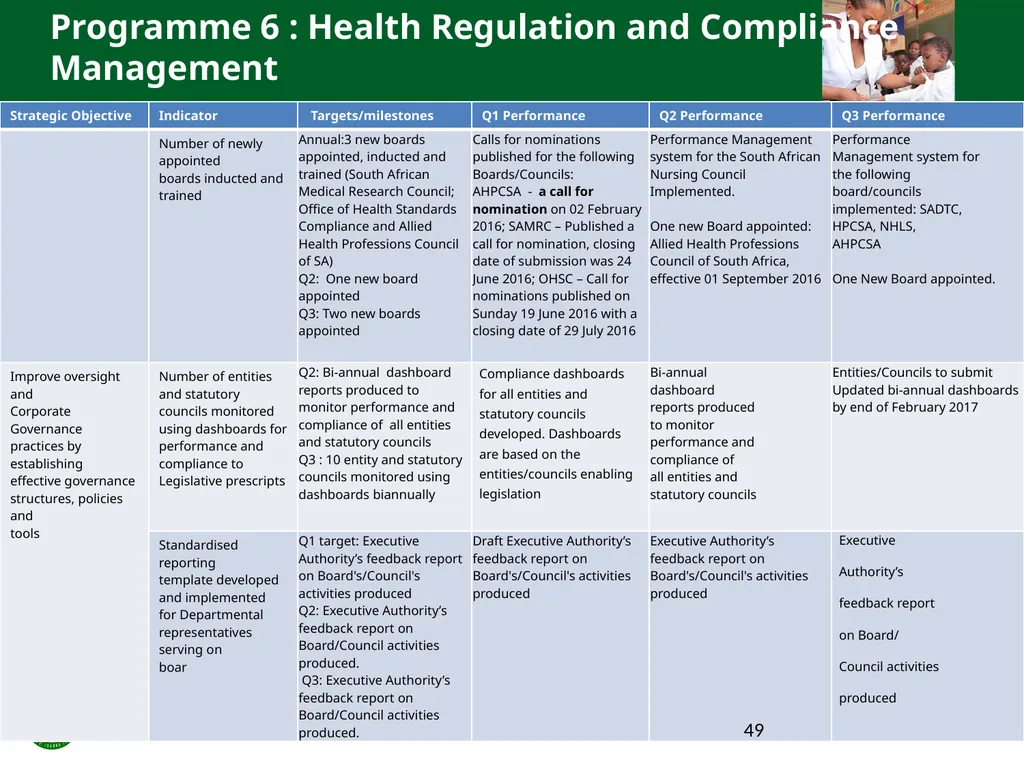
Programme 6 : Health Regulation and Compliance Management 49<br>
50
Financial Report as on 31 December 2016 50<br>
51
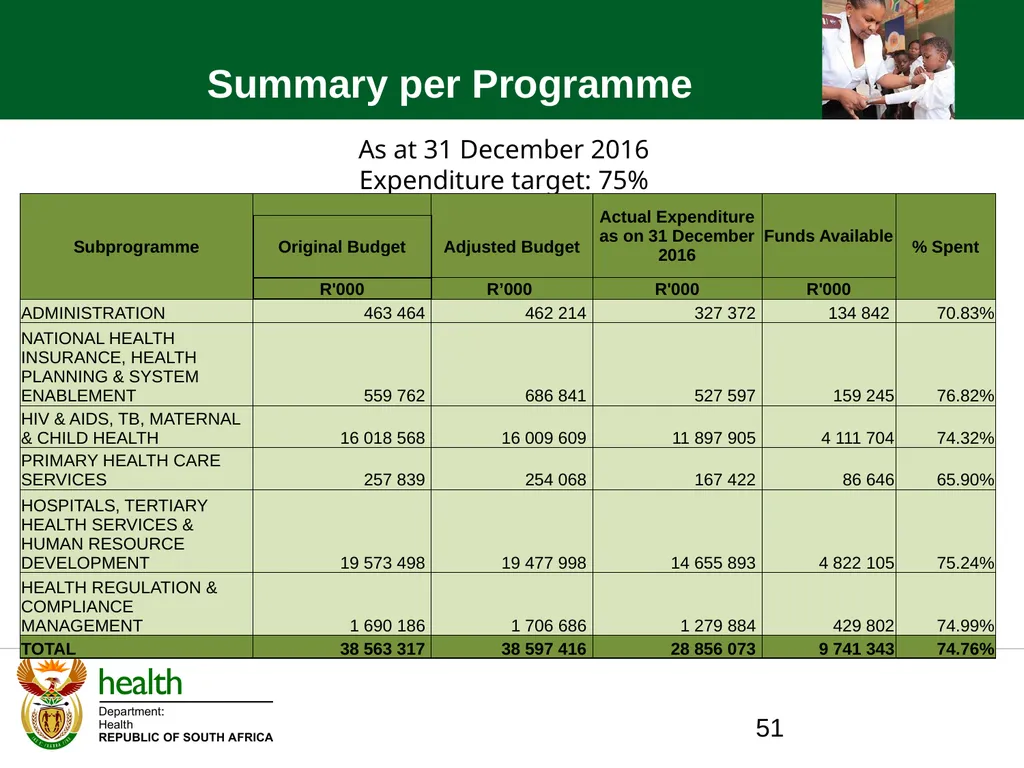
Summary per Programme As at 31 December 2016
Expenditure target: 75% 51<br>
Expenditure target: 75% 51<br>
52
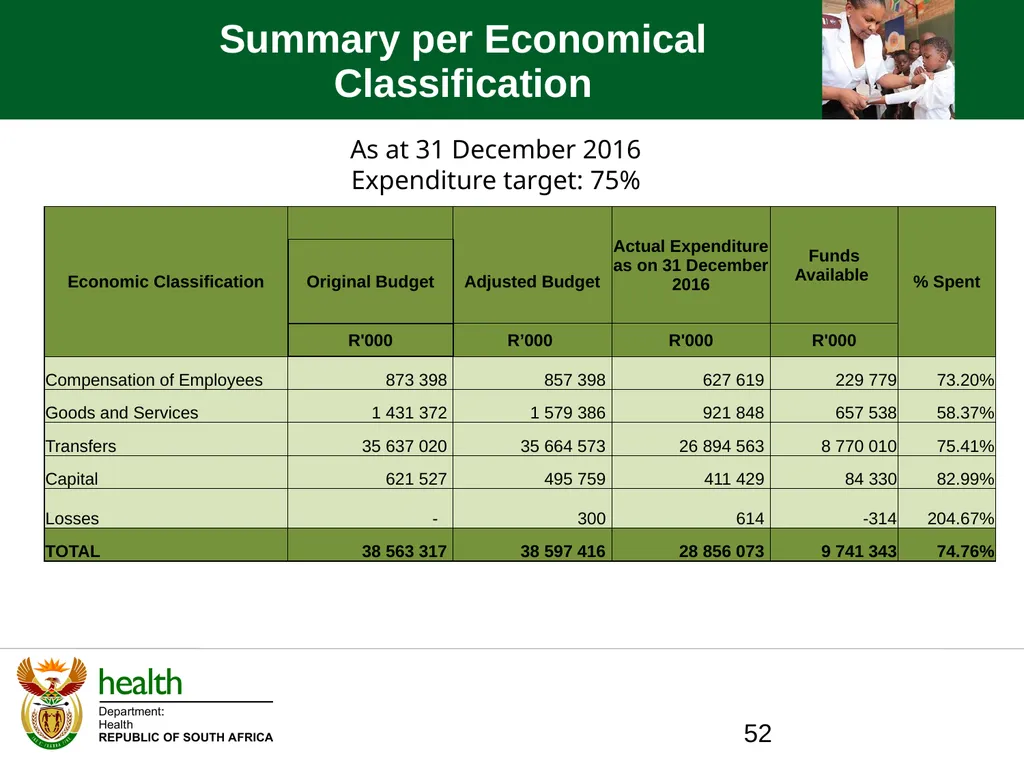
Summary per Economical Classification As at 31 December 2016
Expenditure target: 75% 52<br>
Expenditure target: 75% 52<br>
53
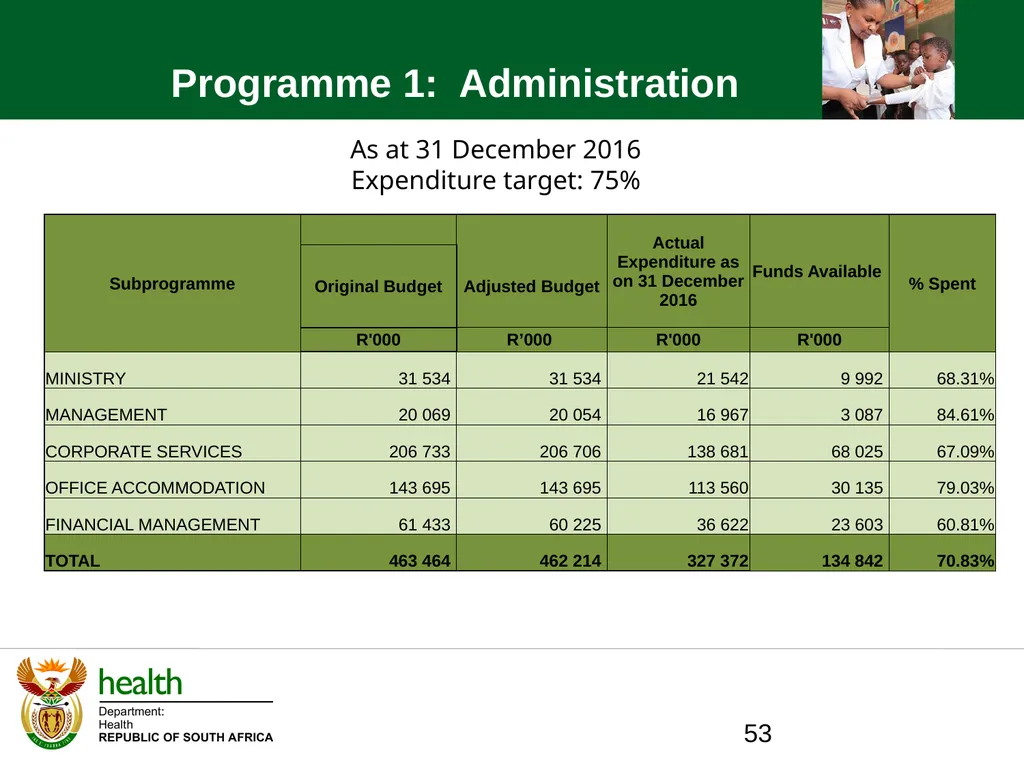
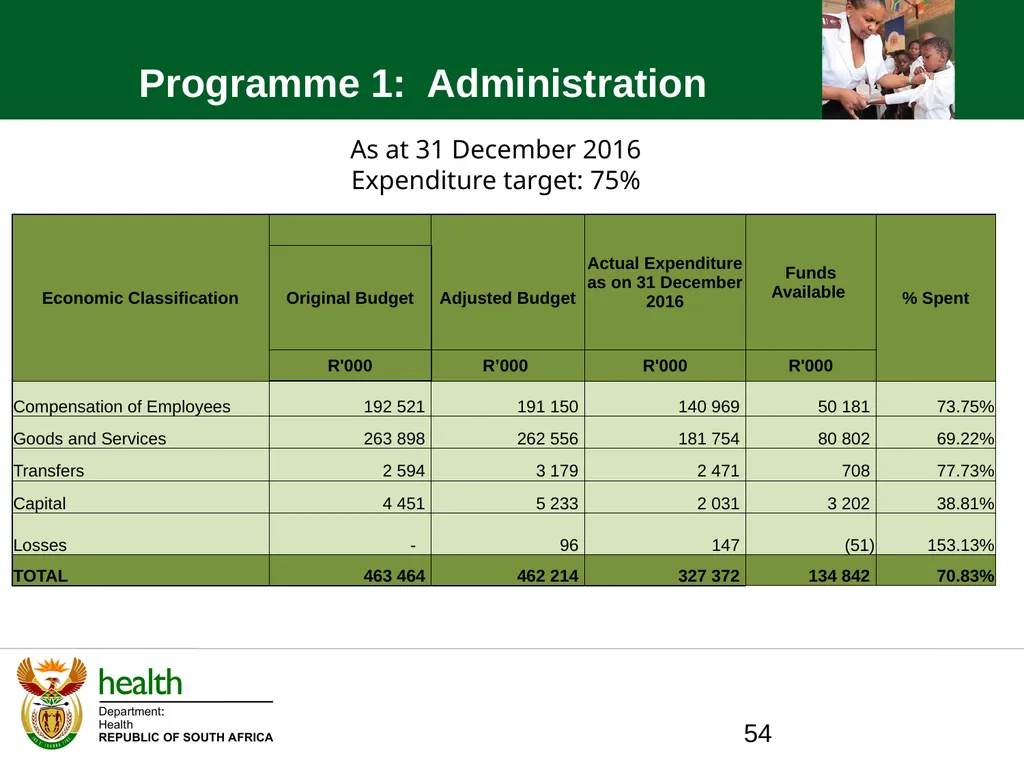
Programme 1: Administration As at 31 December 2016
Expenditure target: 75% 53<br>
Expenditure target: 75% 53<br>
54
Programme 1: Administration As at 31 December 2016
Expenditure target: 75% 54<br>
Expenditure target: 75% 54<br>
55
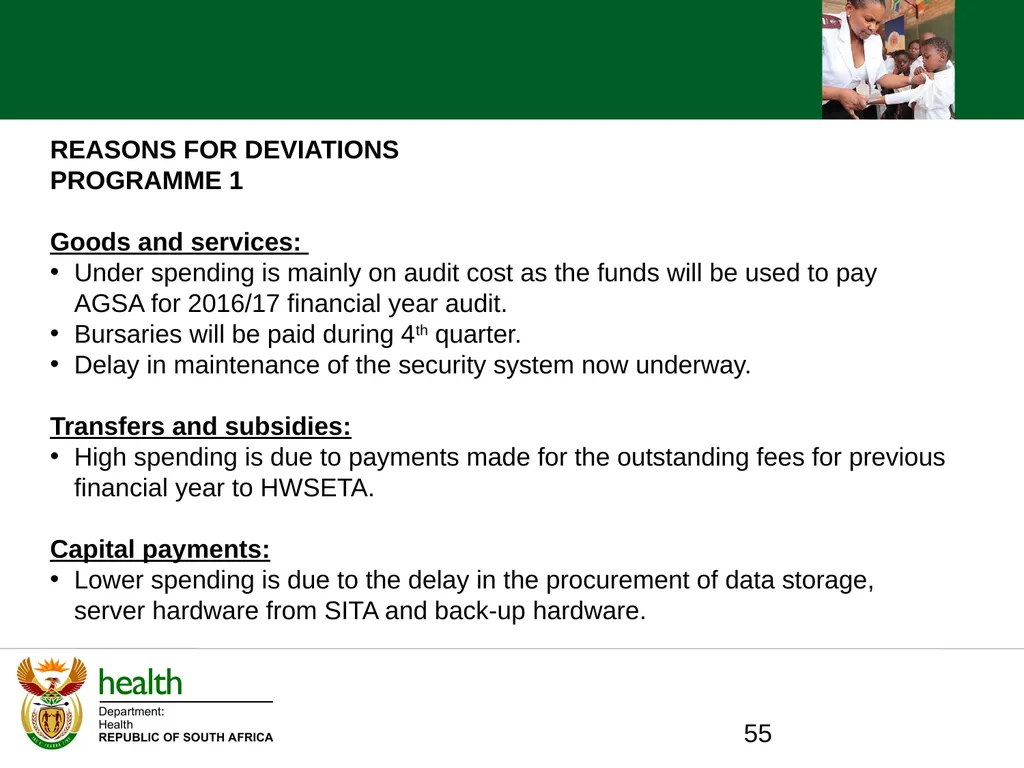
REASONS FOR DEVIATIONS
PROGRAMME 1
Goods and services:
Under spending is mainly on audit cost as the funds will be used to pay AGSA for 2016/17 financial year audit.
Bursaries will be paid during 4th quarter.
Delay in maintenance of the security system now underway.
Transfers and subsidies:
High spending is due to payments made for the outstanding fees for previous financial year to HWSETA.
Capital payments:
Lower spending is due to the delay in the procurement of data storage, server hardware from SITA and back-up hardware. 55<br>
PROGRAMME 1
Goods and services:
Under spending is mainly on audit cost as the funds will be used to pay AGSA for 2016/17 financial year audit.
Bursaries will be paid during 4th quarter.
Delay in maintenance of the security system now underway.
Transfers and subsidies:
High spending is due to payments made for the outstanding fees for previous financial year to HWSETA.
Capital payments:
Lower spending is due to the delay in the procurement of data storage, server hardware from SITA and back-up hardware. 55<br>
56
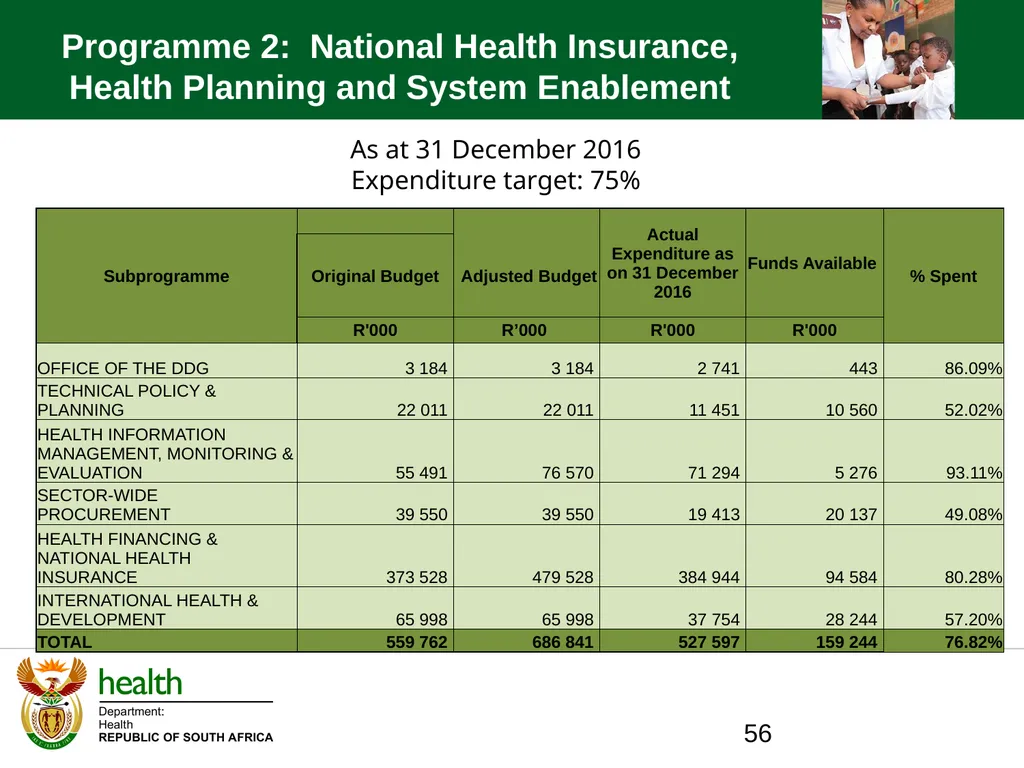
Programme 2: National Health Insurance, Health Planning and System Enablement As at 31 December 2016
Expenditure target: 75% 56<br>
Expenditure target: 75% 56<br>
57
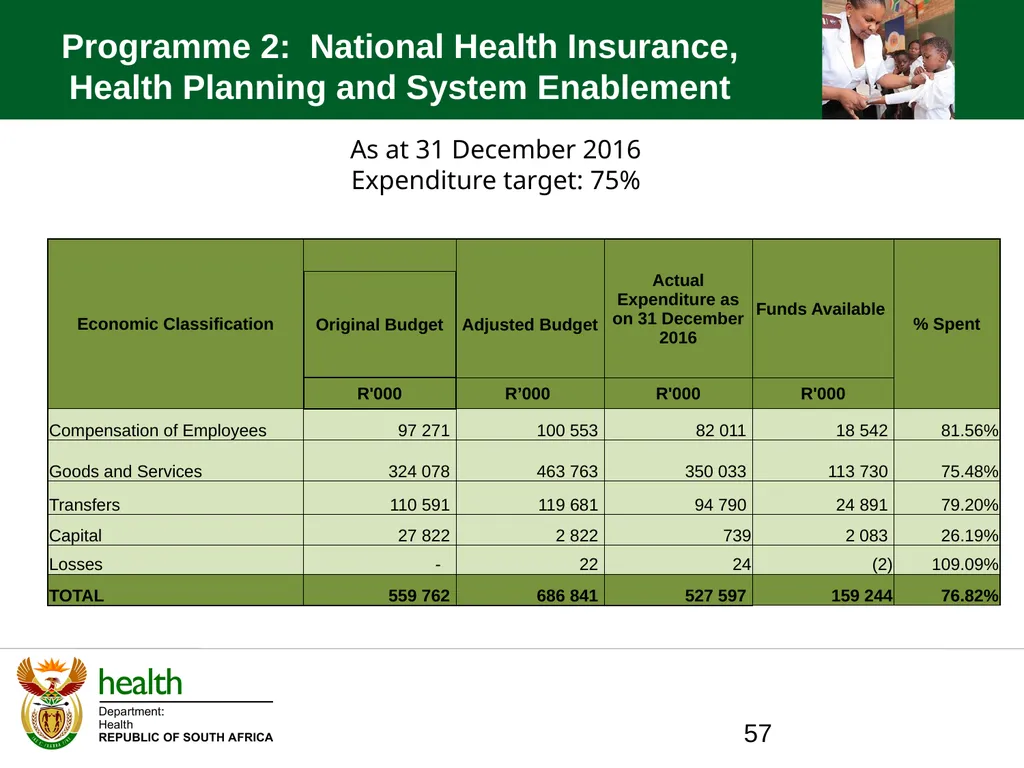
Programme 2: National Health Insurance, Health Planning and System Enablement As at 31 December 2016
Expenditure target: 75% 57<br>
Expenditure target: 75% 57<br>
58
REASONS FOR DEVIATIONS
PROGRAMME 2
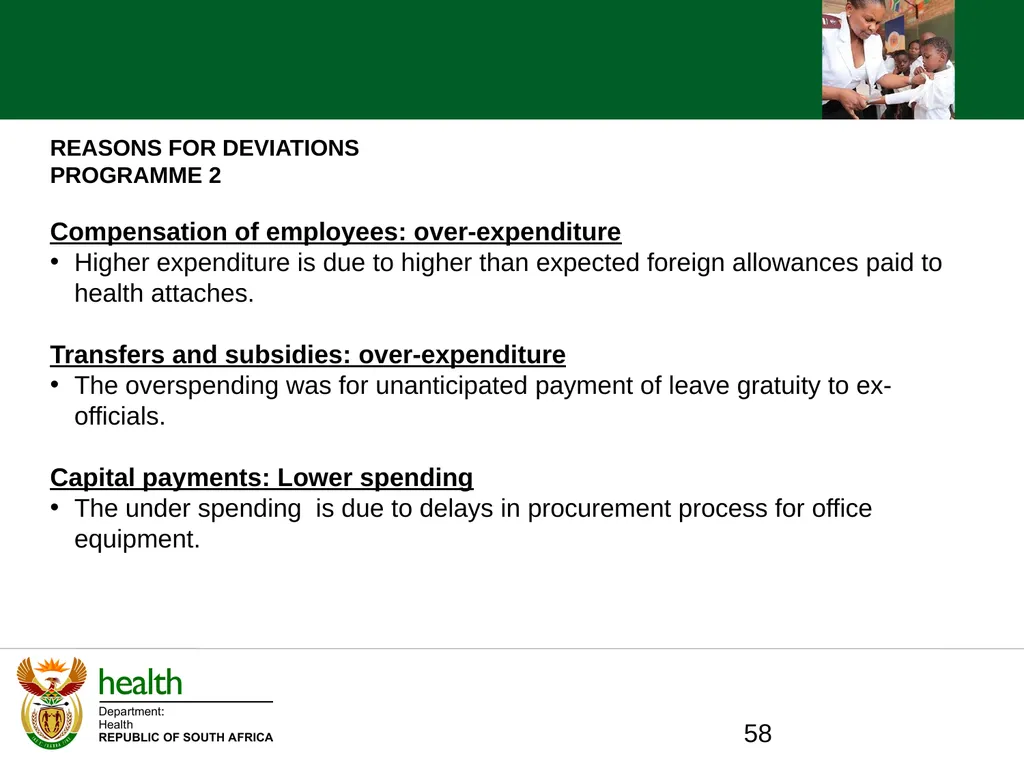
Compensation of employees: over-expenditure
Higher expenditure is due to higher than expected foreign allowances paid to health attaches.
Transfers and subsidies: over-expenditure
The overspending was for unanticipated payment of leave gratuity to ex-officials.
Capital payments: Lower spending
The under spending is due to delays in procurement process for office equipment. 58<br>
PROGRAMME 2
Compensation of employees: over-expenditure
Higher expenditure is due to higher than expected foreign allowances paid to health attaches.
Transfers and subsidies: over-expenditure
The overspending was for unanticipated payment of leave gratuity to ex-officials.
Capital payments: Lower spending
The under spending is due to delays in procurement process for office equipment. 58<br>
59
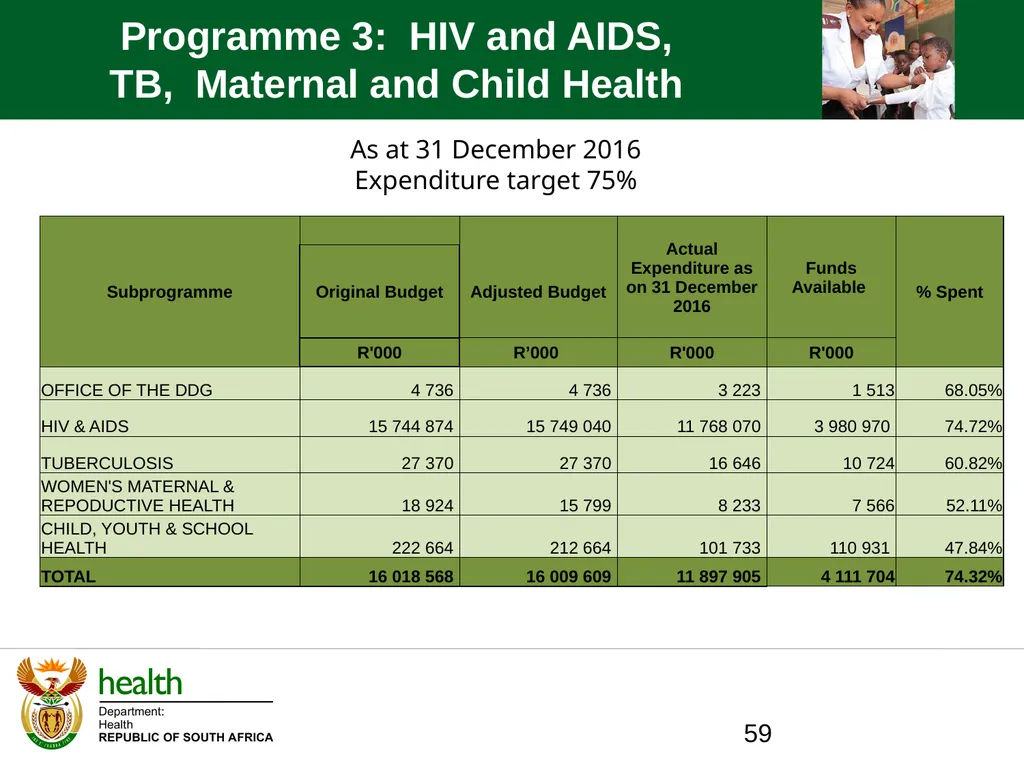
Programme 3: HIV and AIDS, TB, Maternal and Child Health As at 31 December 2016
Expenditure target 75% 59<br>
Expenditure target 75% 59<br>
60
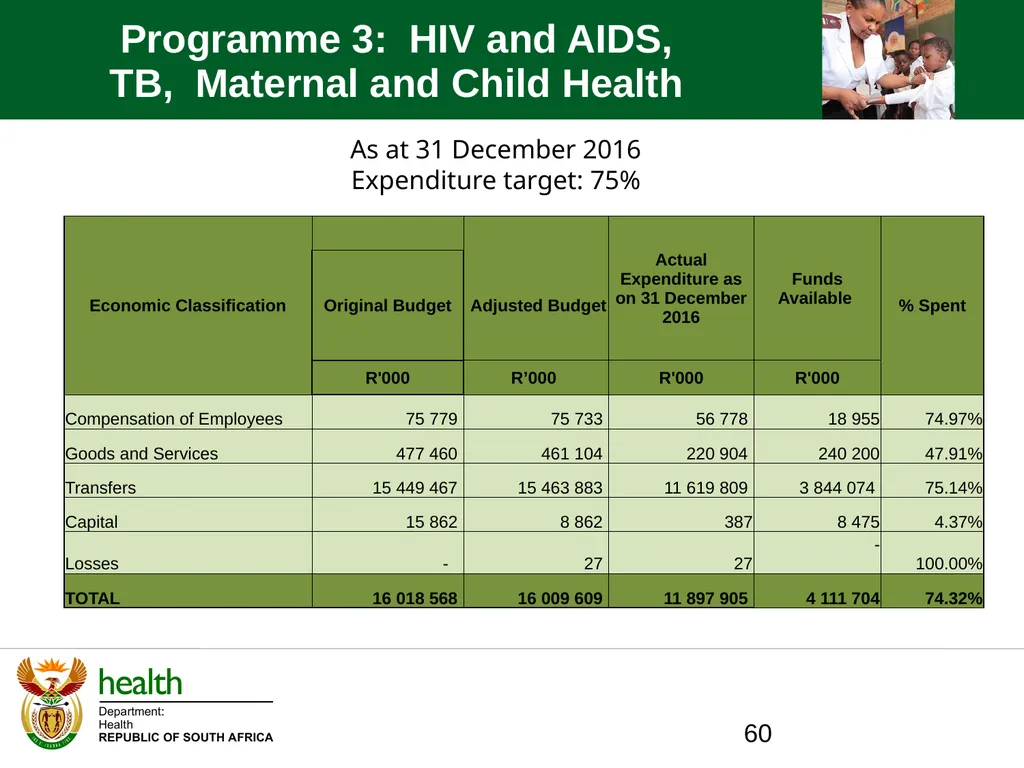
Programme 3: HIV and AIDS, TB, Maternal and Child Health As at 31 December 2016
Expenditure target: 75% 60<br>
Expenditure target: 75% 60<br>
61
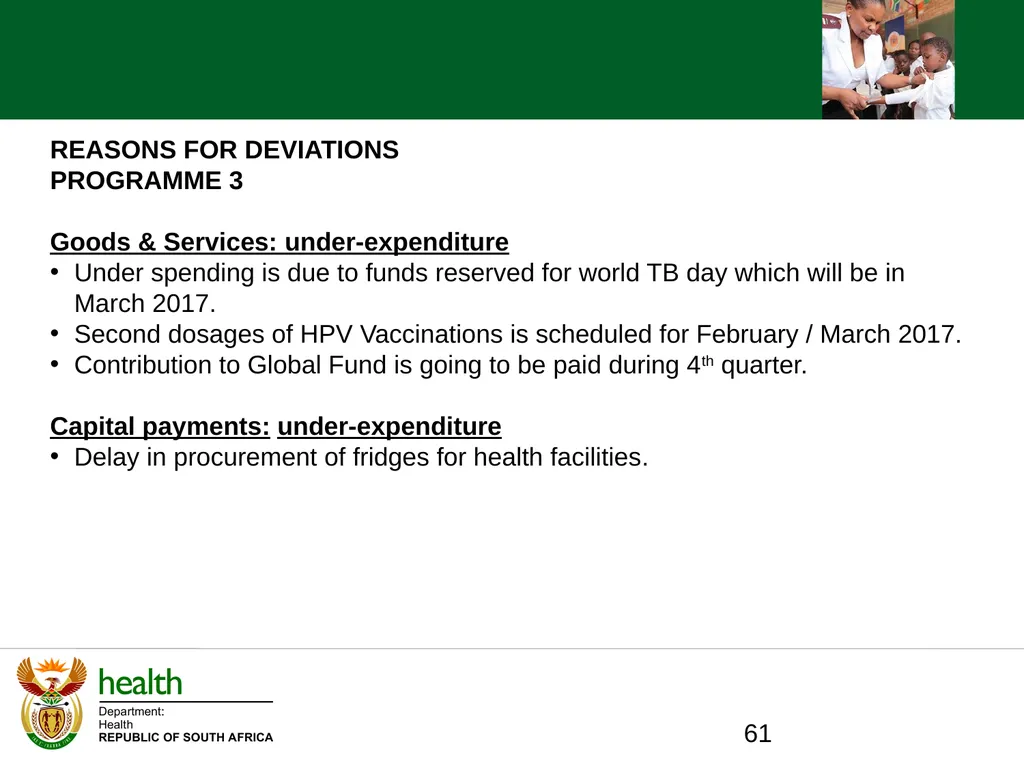
REASONS FOR DEVIATIONS
PROGRAMME 3
Goods & Services: under-expenditure
Under spending is due to funds reserved for world TB day which will be in March 2017.
Second dosages of HPV Vaccinations is scheduled for February / March 2017.
Contribution to Global Fund is going to be paid during 4th quarter.
Capital payments: under-expenditure
Delay in procurement of fridges for health facilities. 61<br>
PROGRAMME 3
Goods & Services: under-expenditure
Under spending is due to funds reserved for world TB day which will be in March 2017.
Second dosages of HPV Vaccinations is scheduled for February / March 2017.
Contribution to Global Fund is going to be paid during 4th quarter.
Capital payments: under-expenditure
Delay in procurement of fridges for health facilities. 61<br>
62
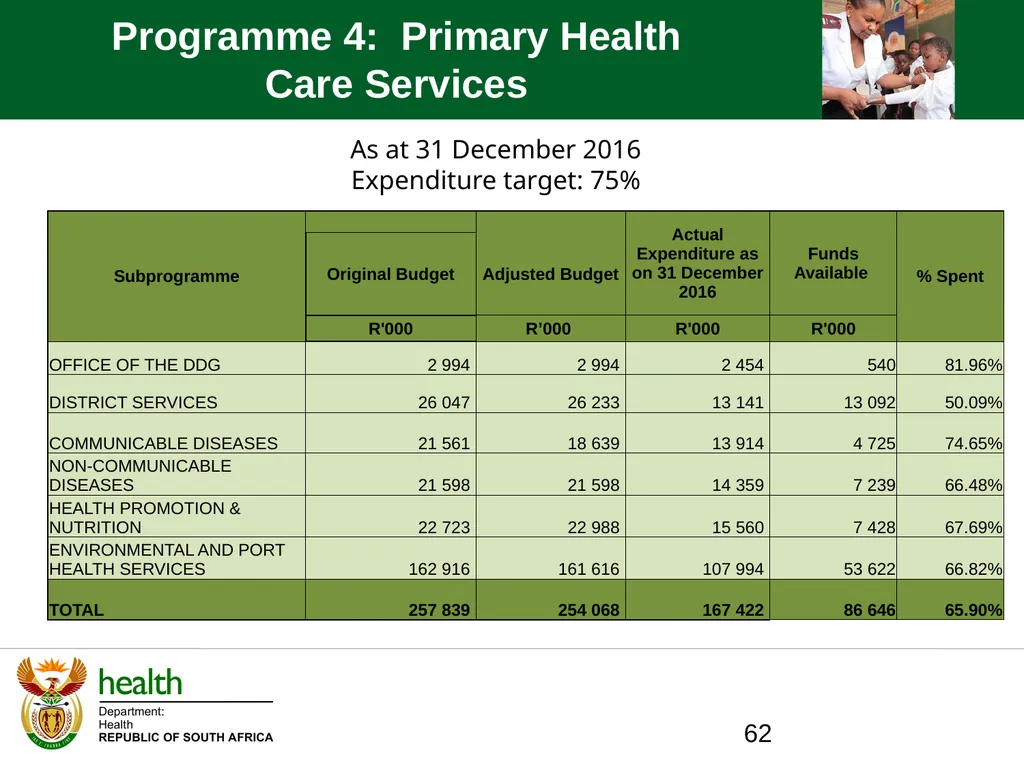
Programme 4: Primary Health Care Services As at 31 December 2016
Expenditure target: 75% 62<br>
Expenditure target: 75% 62<br>
63
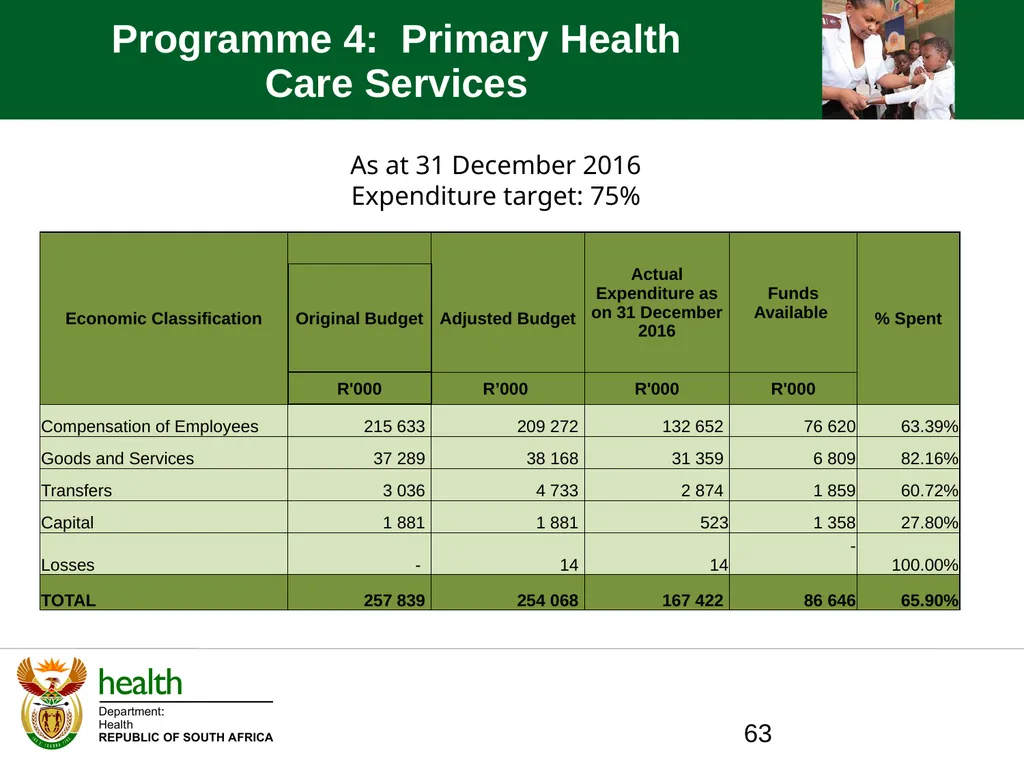
Programme 4: Primary Health Care Services As at 31 December 2016
Expenditure target: 75% 63<br>
Expenditure target: 75% 63<br>
64
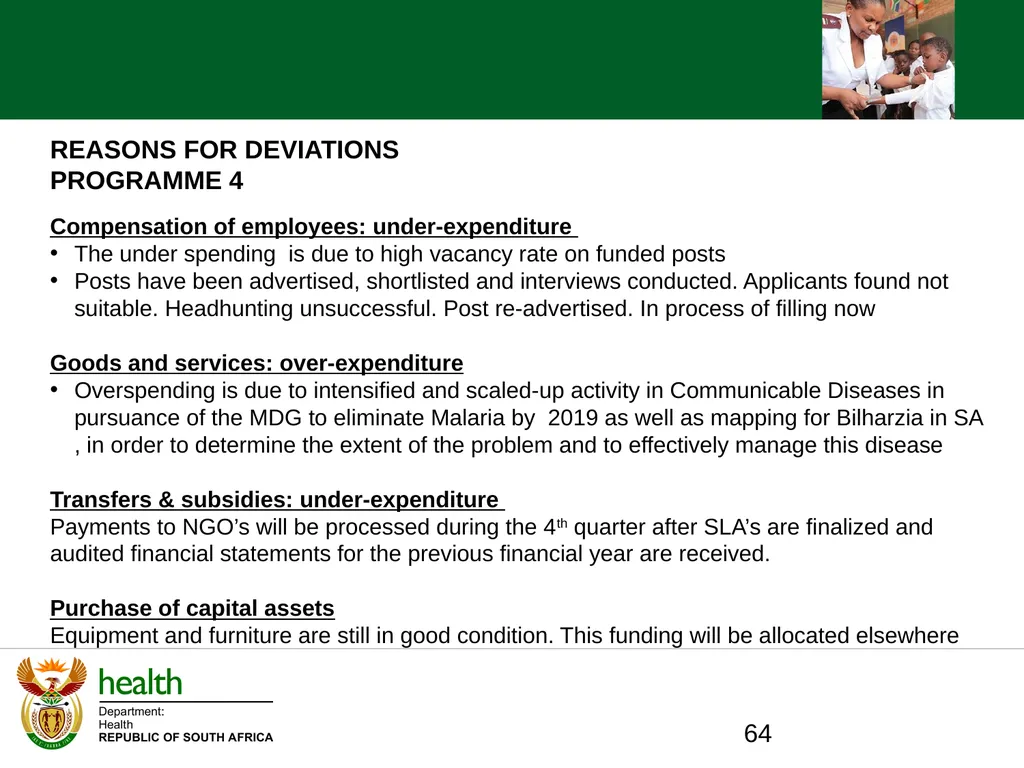
REASONS FOR DEVIATIONS
PROGRAMME 4
Compensation of employees: under-expenditure
The under spending is due to high vacancy rate on funded posts
Posts have been advertised, shortlisted and interviews conducted. Applicants found not suitable. Headhunting unsuccessful. Post re-advertised. In process of filling now
Goods and services: over-expenditure
Overspending is due to intensified and scaled-up activity in Communicable Diseases in pursuance of the MDG to eliminate Malaria by 2019 as well as mapping for Bilharzia in SA , in order to determine the extent of the problem and to effectively manage this disease
Transfers & subsidies: under-expenditure
Payments to NGO’s will be processed during the 4th quarter after SLA’s are finalized and audited financial statements for the previous financial year are received.
Purchase of capital assets
Equipment and furniture are still in good condition. This funding will be allocated elsewhere 64<br>
PROGRAMME 4
Compensation of employees: under-expenditure
The under spending is due to high vacancy rate on funded posts
Posts have been advertised, shortlisted and interviews conducted. Applicants found not suitable. Headhunting unsuccessful. Post re-advertised. In process of filling now
Goods and services: over-expenditure
Overspending is due to intensified and scaled-up activity in Communicable Diseases in pursuance of the MDG to eliminate Malaria by 2019 as well as mapping for Bilharzia in SA , in order to determine the extent of the problem and to effectively manage this disease
Transfers & subsidies: under-expenditure
Payments to NGO’s will be processed during the 4th quarter after SLA’s are finalized and audited financial statements for the previous financial year are received.
Purchase of capital assets
Equipment and furniture are still in good condition. This funding will be allocated elsewhere 64<br>
65
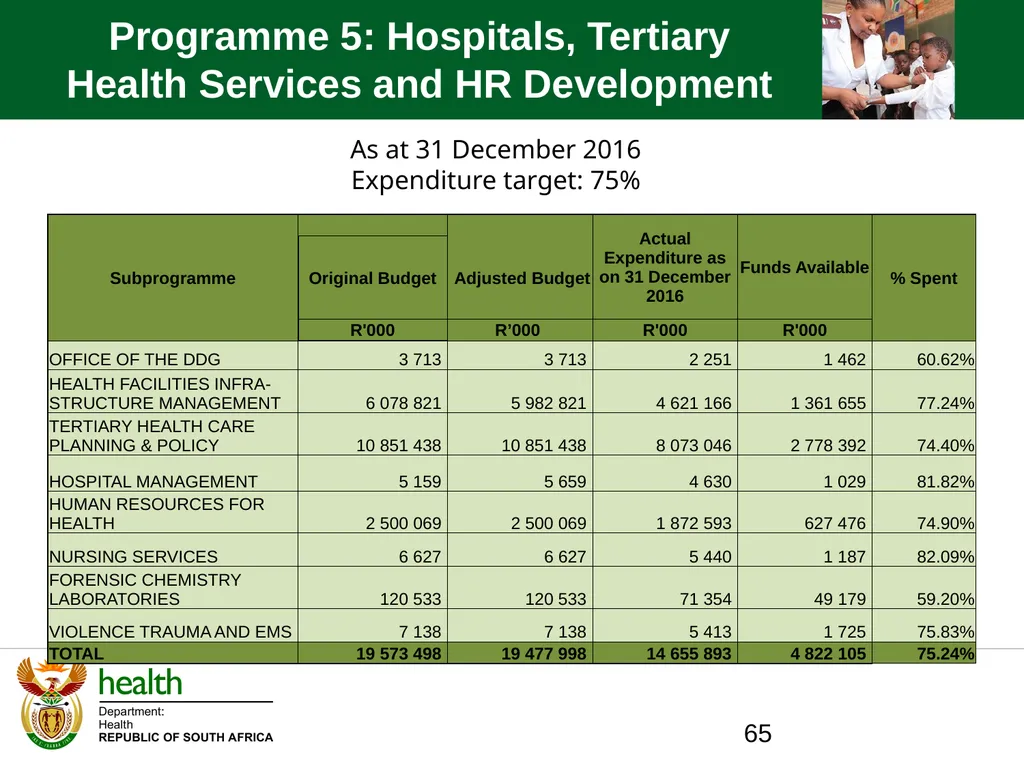
Programme 5: Hospitals, Tertiary Health Services and HR Development As at 31 December 2016
Expenditure target: 75% 65<br>
Expenditure target: 75% 65<br>
66
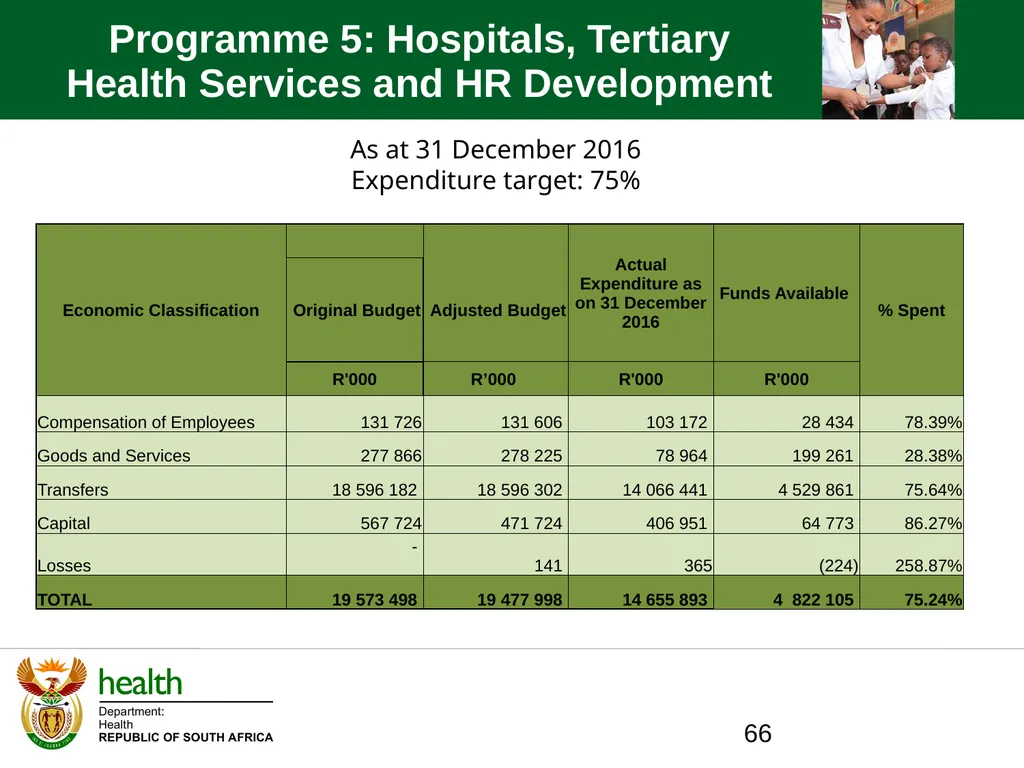
Programme 5: Hospitals, Tertiary Health Services and HR Development As at 31 December 2016
Expenditure target: 75% 66<br>
Expenditure target: 75% 66<br>
67
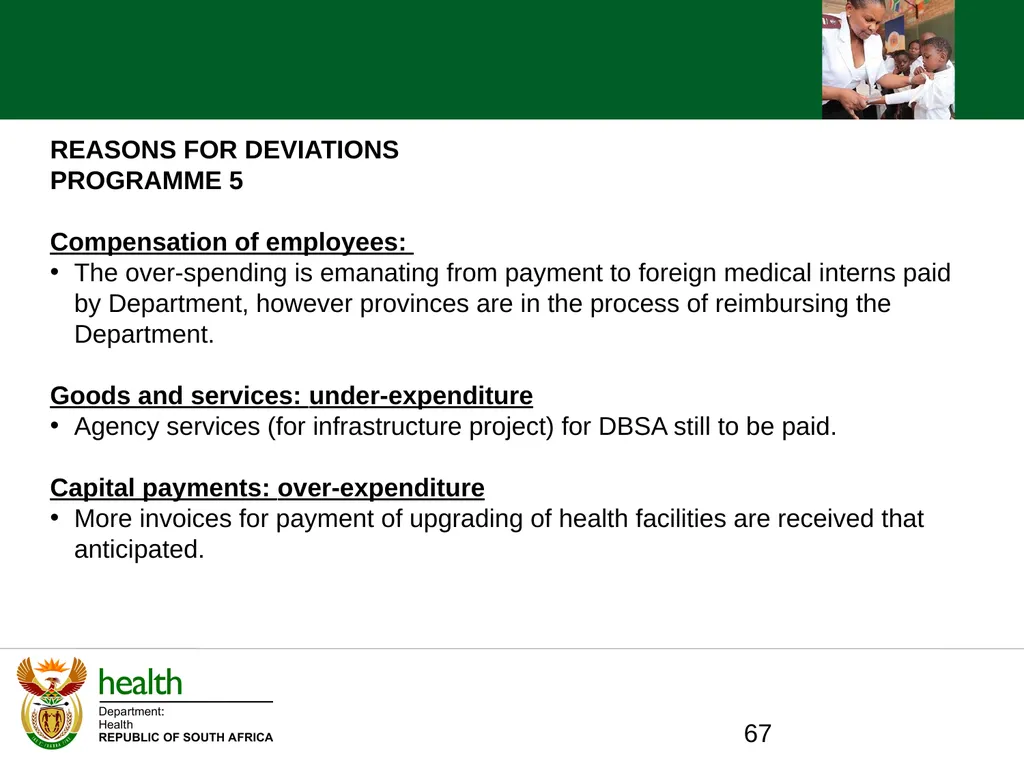
REASONS FOR DEVIATIONS
PROGRAMME 5
Compensation of employees:
The over-spending is emanating from payment to foreign medical interns paid by Department, however provinces are in the process of reimbursing the Department.
Goods and services: under-expenditure
Agency services (for infrastructure project) for DBSA still to be paid.
Capital payments: over-expenditure
More invoices for payment of upgrading of health facilities are received that anticipated. 67<br>
PROGRAMME 5
Compensation of employees:
The over-spending is emanating from payment to foreign medical interns paid by Department, however provinces are in the process of reimbursing the Department.
Goods and services: under-expenditure
Agency services (for infrastructure project) for DBSA still to be paid.
Capital payments: over-expenditure
More invoices for payment of upgrading of health facilities are received that anticipated. 67<br>
68
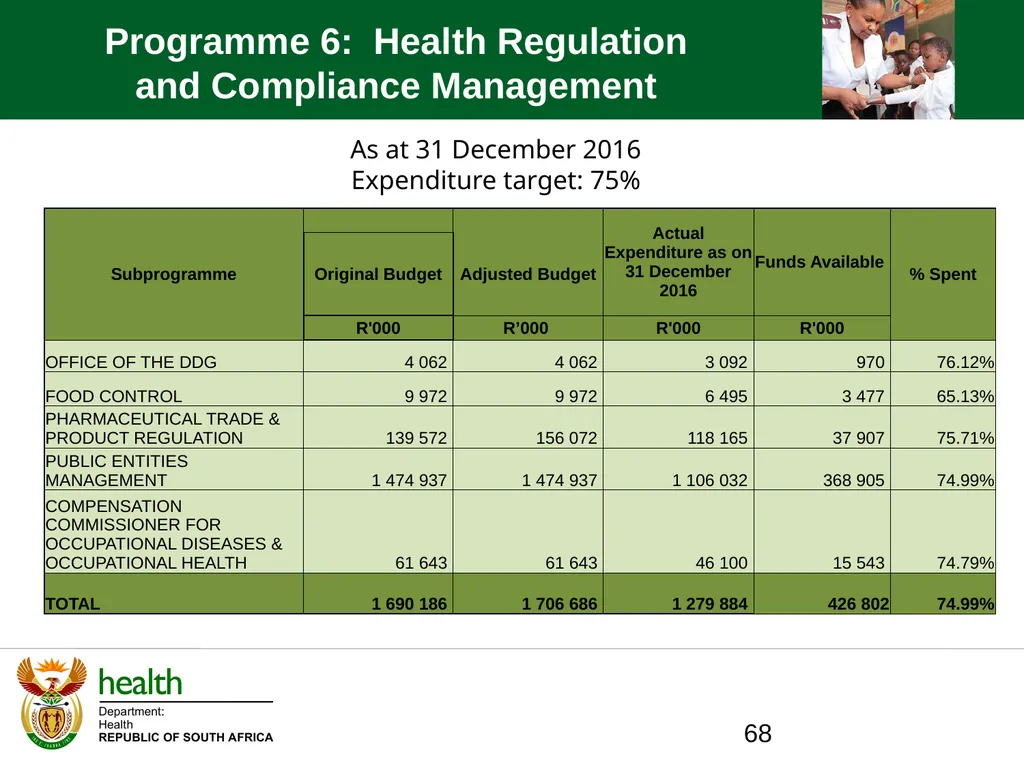
Programme 6: Health Regulation and Compliance Management As at 31 December 2016
Expenditure target: 75% 68<br>
Expenditure target: 75% 68<br>
69
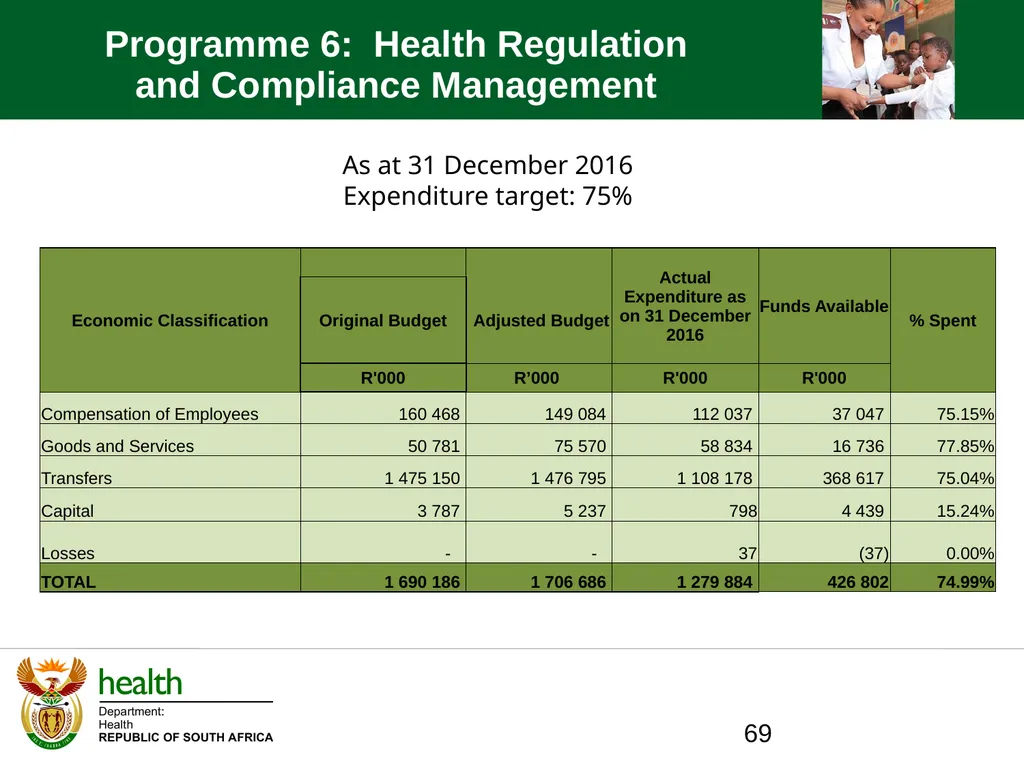
Programme 6: Health Regulation and Compliance Management As at 31 December 2016
Expenditure target: 75% 69<br>
Expenditure target: 75% 69<br>
70
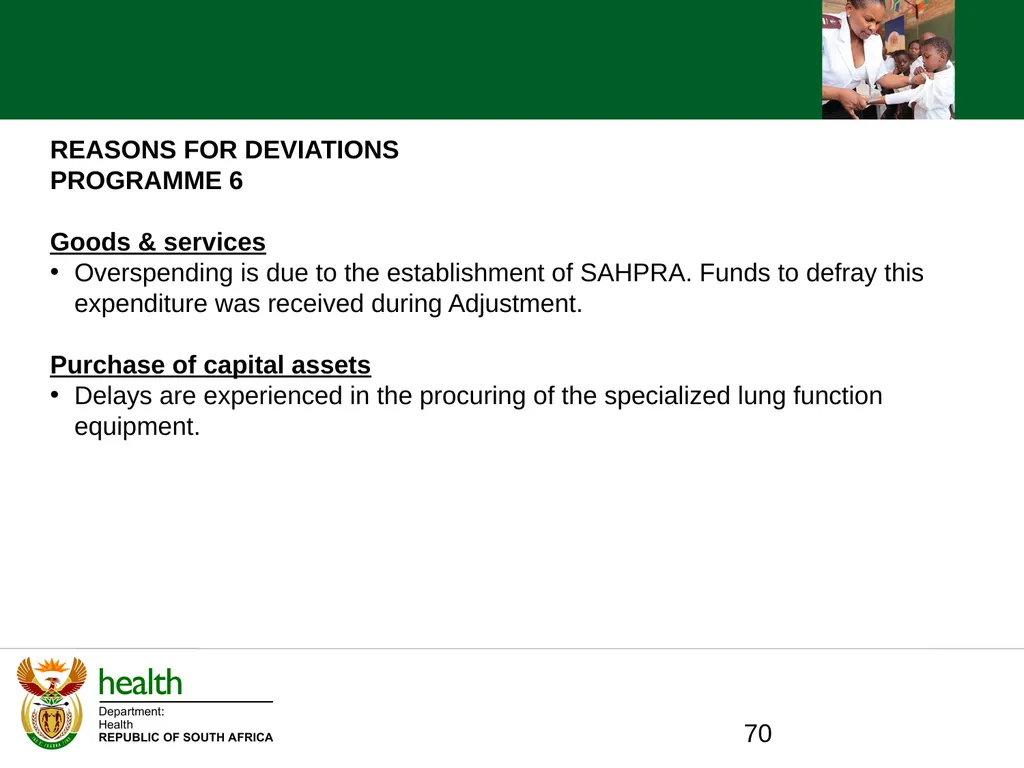
REASONS FOR DEVIATIONS
PROGRAMME 6
Goods & services
Overspending is due to the establishment of SAHPRA. Funds to defray this expenditure was received during Adjustment.
Purchase of capital assets
Delays are experienced in the procuring of the specialized lung function equipment. 70<br>
PROGRAMME 6
Goods & services
Overspending is due to the establishment of SAHPRA. Funds to defray this expenditure was received during Adjustment.
Purchase of capital assets
Delays are experienced in the procuring of the specialized lung function equipment. 70<br>
71
Conditional Grants Report as at
31 December 2016 71<br>
31 December 2016 71<br>
72
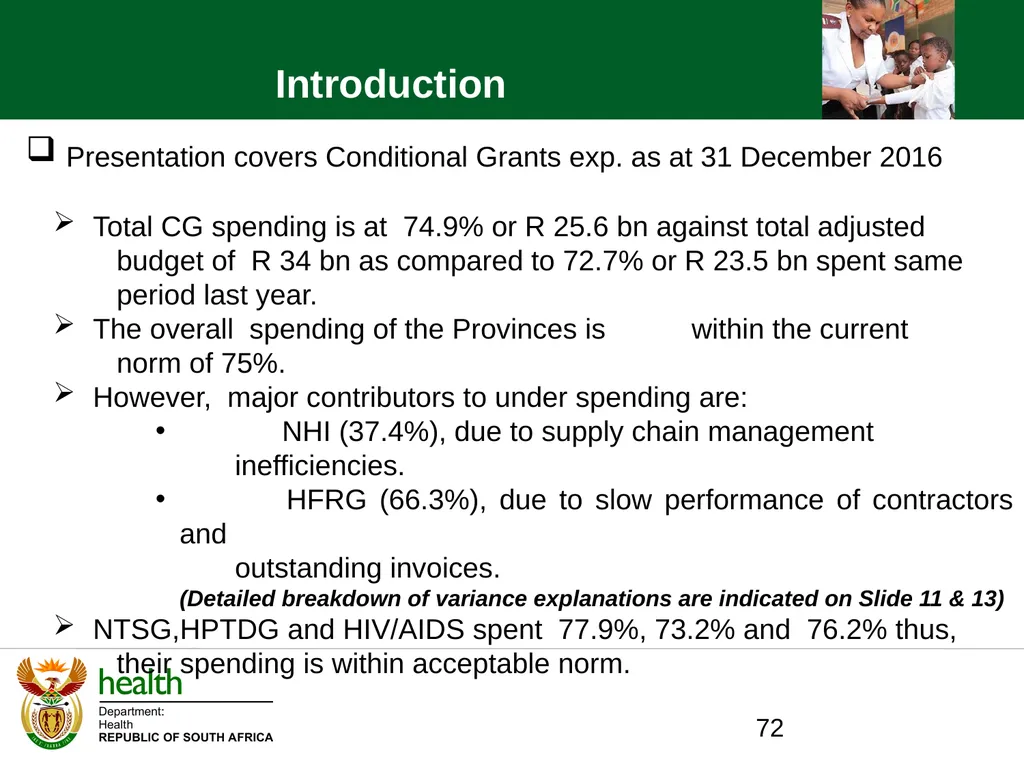
Presentation covers Conditional Grants exp. as at 31 December 2016
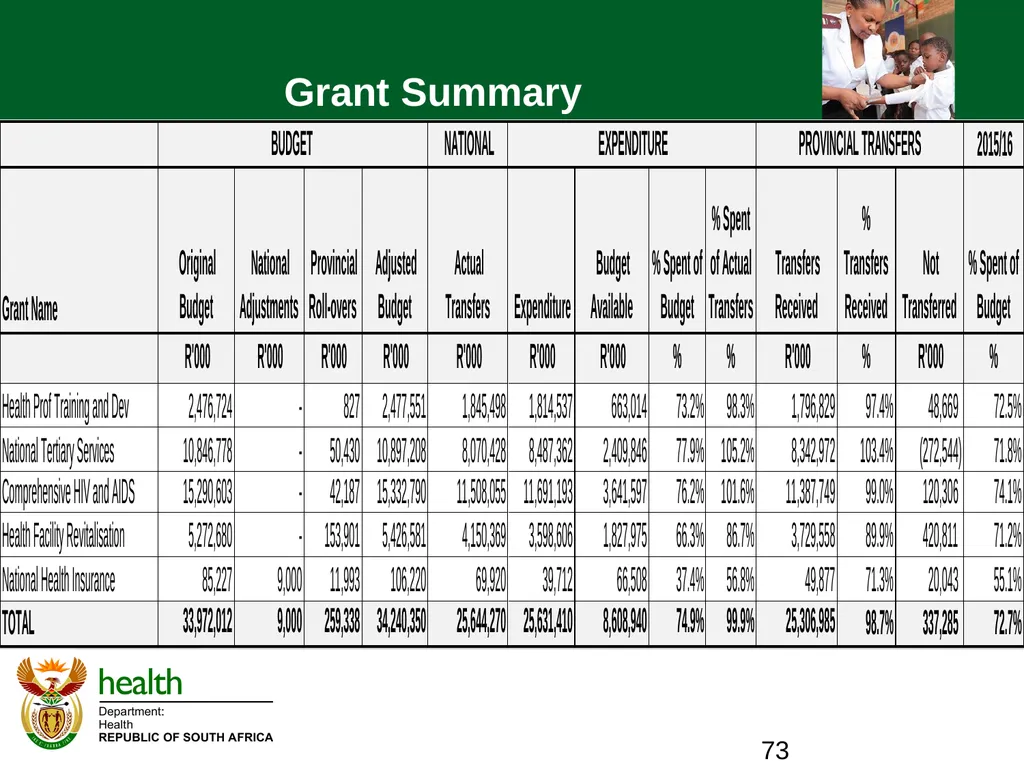
Total CG spending is at 74.9% or R 25.6 bn against total adjusted
budget of R 34 bn as compared to 72.7% or R 23.5 bn spent same
period last year.
The overall spending of the Provinces is within the current
norm of 75%.
However, major contributors to under spending are:
NHI (37.4%), due to supply chain management
inefficiencies.
HFRG (66.3%), due to slow performance of contractors and
outstanding invoices.
(Detailed breakdown of variance explanations are indicated on Slide 11 & 13)
NTSG,HPTDG and HIV/AIDS spent 77.9%, 73.2% and 76.2% thus,
their spending is within acceptable norm. Introduction 72<br>
Total CG spending is at 74.9% or R 25.6 bn against total adjusted
budget of R 34 bn as compared to 72.7% or R 23.5 bn spent same
period last year.
The overall spending of the Provinces is within the current
norm of 75%.
However, major contributors to under spending are:
NHI (37.4%), due to supply chain management
inefficiencies.
HFRG (66.3%), due to slow performance of contractors and
outstanding invoices.
(Detailed breakdown of variance explanations are indicated on Slide 11 & 13)
NTSG,HPTDG and HIV/AIDS spent 77.9%, 73.2% and 76.2% thus,
their spending is within acceptable norm. Introduction 72<br>
73
Grant Summary 73<br>
74
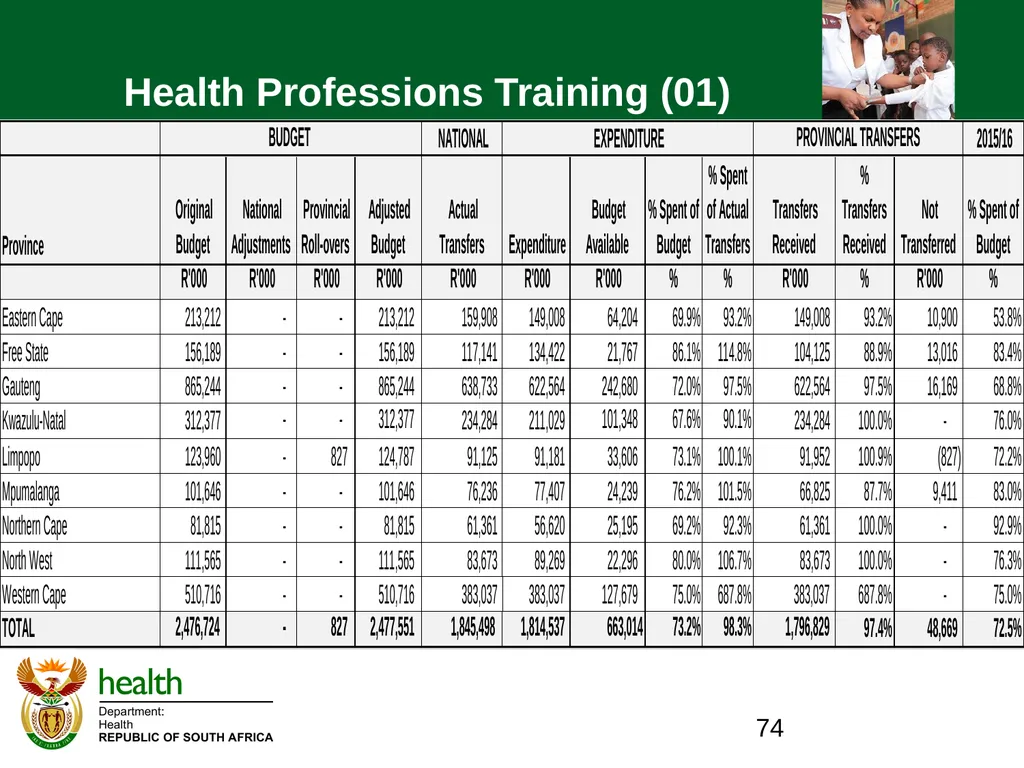
Health Professions Training (01) 74<br>
75
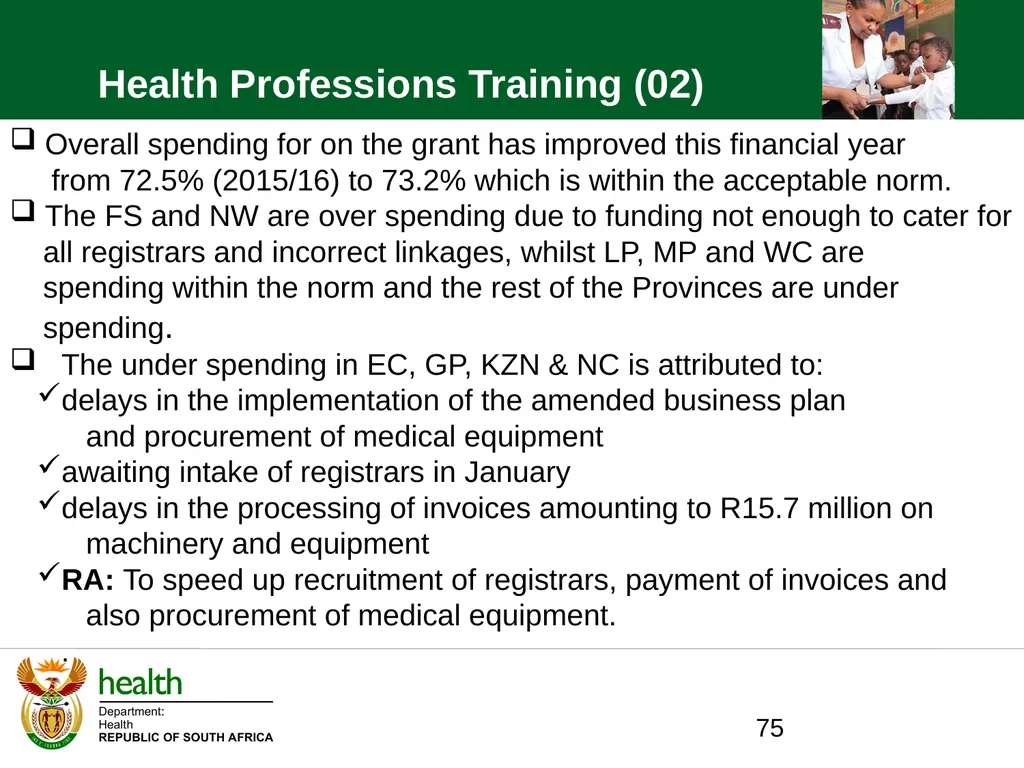
Health Professions Training (02) Overall spending for on the grant has improved this financial year
from 72.5% (2015/16) to 73.2% which is within the acceptable norm.
The FS and NW are over spending due to funding not enough to cater for
all registrars and incorrect linkages, whilst LP, MP and WC are
spending within the norm and the rest of the Provinces are under
spending.
The under spending in EC, GP, KZN & NC is attributed to:
delays in the implementation of the amended business plan
and procurement of medical equipment
awaiting intake of registrars in January
delays in the processing of invoices amounting to R15.7 million on
machinery and equipment
RA: To speed up recruitment of registrars, payment of invoices and
also procurement of medical equipment.
. 75<br>
from 72.5% (2015/16) to 73.2% which is within the acceptable norm.
The FS and NW are over spending due to funding not enough to cater for
all registrars and incorrect linkages, whilst LP, MP and WC are
spending within the norm and the rest of the Provinces are under
spending.
The under spending in EC, GP, KZN & NC is attributed to:
delays in the implementation of the amended business plan
and procurement of medical equipment
awaiting intake of registrars in January
delays in the processing of invoices amounting to R15.7 million on
machinery and equipment
RA: To speed up recruitment of registrars, payment of invoices and
also procurement of medical equipment.
. 75<br>
76
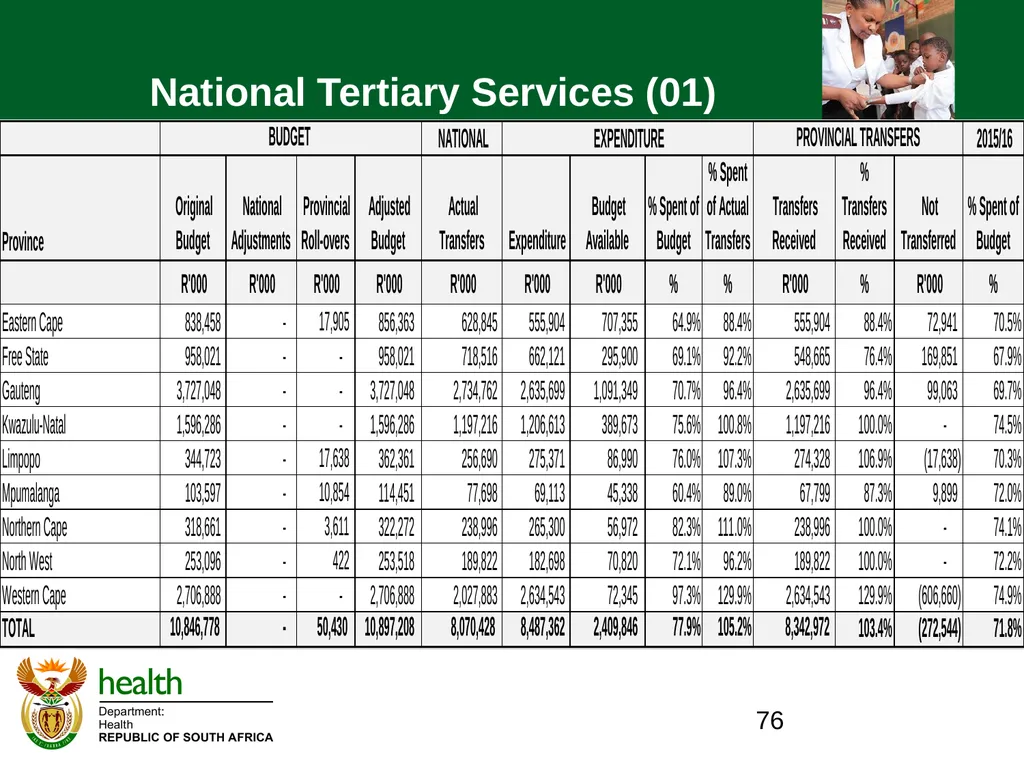
National Tertiary Services (01) 76<br>
77
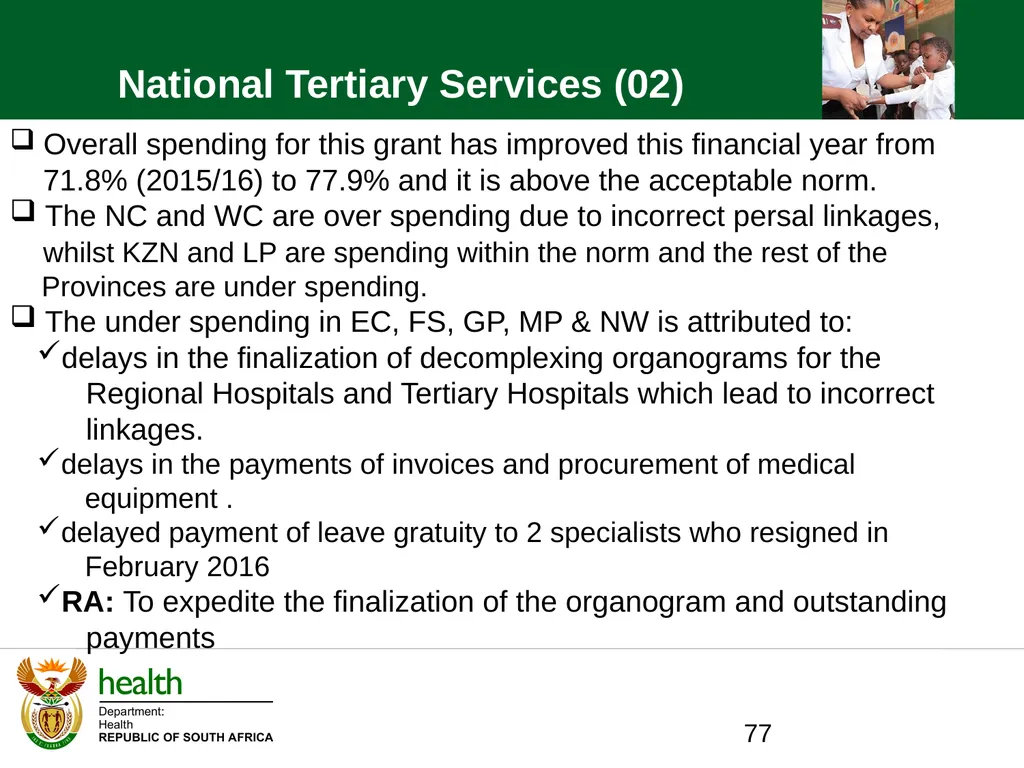
77 National Tertiary Services (02) Overall spending for this grant has improved this financial year from
71.8% (2015/16) to 77.9% and it is above the acceptable norm.
The NC and WC are over spending due to incorrect persal linkages,
whilst KZN and LP are spending within the norm and the rest of the
Provinces are under spending.
The under spending in EC, FS, GP, MP & NW is attributed to:
delays in the finalization of decomplexing organograms for the
Regional Hospitals and Tertiary Hospitals which lead to incorrect
linkages.
delays in the payments of invoices and procurement of medical
equipment .
delayed payment of leave gratuity to 2 specialists who resigned in
February 2016
RA: To expedite the finalization of the organogram and outstanding
payments<br>
71.8% (2015/16) to 77.9% and it is above the acceptable norm.
The NC and WC are over spending due to incorrect persal linkages,
whilst KZN and LP are spending within the norm and the rest of the
Provinces are under spending.
The under spending in EC, FS, GP, MP & NW is attributed to:
delays in the finalization of decomplexing organograms for the
Regional Hospitals and Tertiary Hospitals which lead to incorrect
linkages.
delays in the payments of invoices and procurement of medical
equipment .
delayed payment of leave gratuity to 2 specialists who resigned in
February 2016
RA: To expedite the finalization of the organogram and outstanding
payments<br>
78
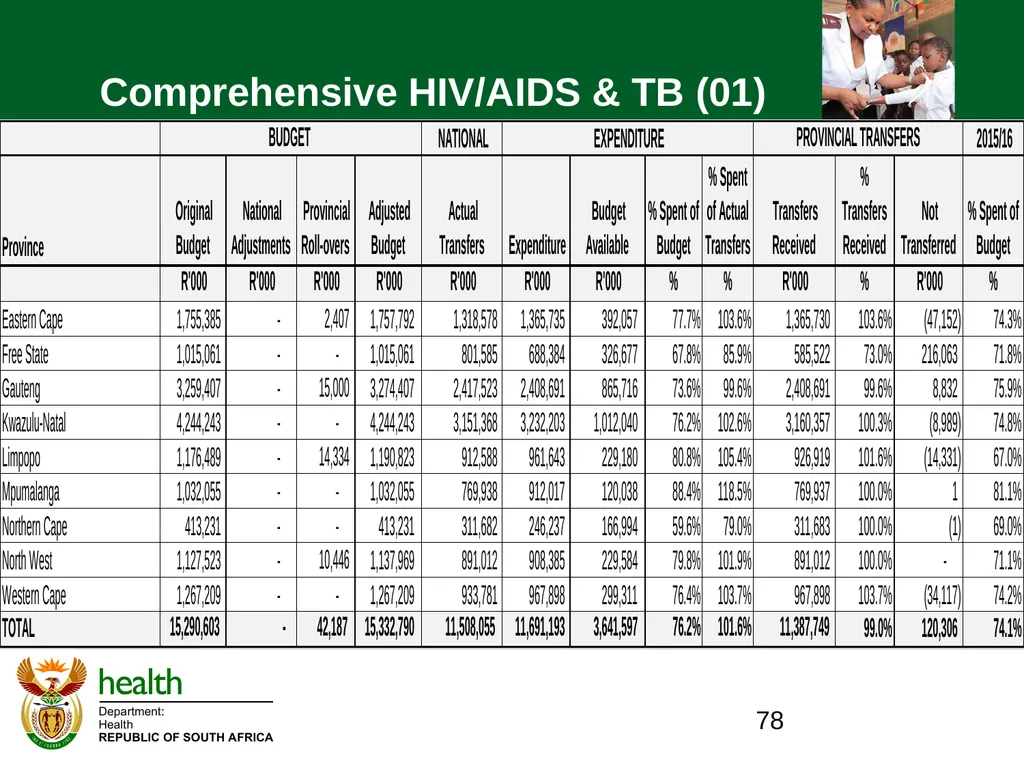
Comprehensive HIV/AIDS & TB (01) 78<br>
79
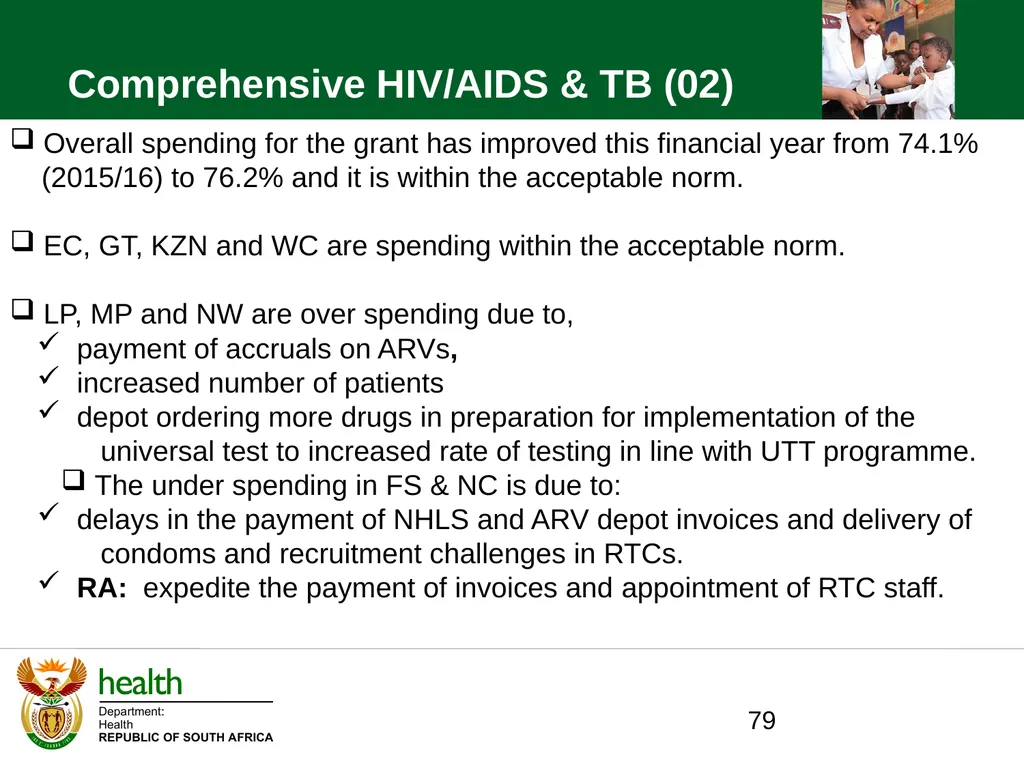
Comprehensive HIV/AIDS & TB (02) Overall spending for the grant has improved this financial year from 74.1%
(2015/16) to 76.2% and it is within the acceptable norm.
EC, GT, KZN and WC are spending within the acceptable norm.
LP, MP and NW are over spending due to,
payment of accruals on ARVs,
increased number of patients
depot ordering more drugs in preparation for implementation of the
universal test to increased rate of testing in line with UTT programme.
The under spending in FS & NC is due to:
delays in the payment of NHLS and ARV depot invoices and delivery of
condoms and recruitment challenges in RTCs.
RA: expedite the payment of invoices and appointment of RTC staff. 79<br>
(2015/16) to 76.2% and it is within the acceptable norm.
EC, GT, KZN and WC are spending within the acceptable norm.
LP, MP and NW are over spending due to,
payment of accruals on ARVs,
increased number of patients
depot ordering more drugs in preparation for implementation of the
universal test to increased rate of testing in line with UTT programme.
The under spending in FS & NC is due to:
delays in the payment of NHLS and ARV depot invoices and delivery of
condoms and recruitment challenges in RTCs.
RA: expedite the payment of invoices and appointment of RTC staff. 79<br>
80
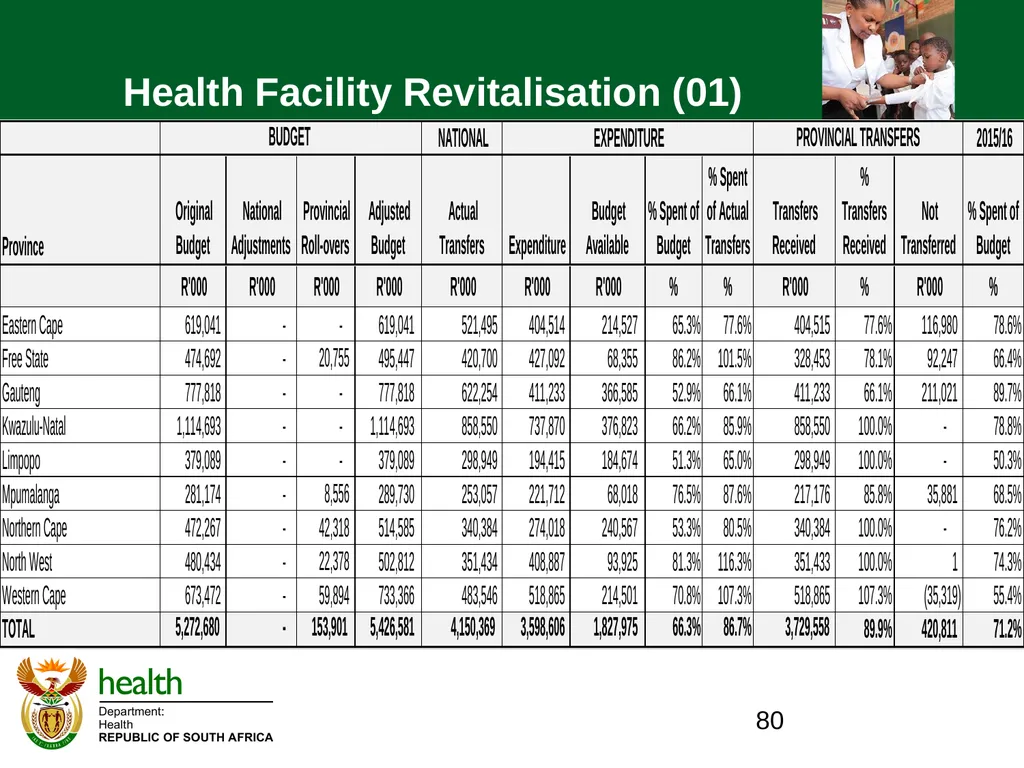
Health Facility Revitalisation (01) 80<br>
81
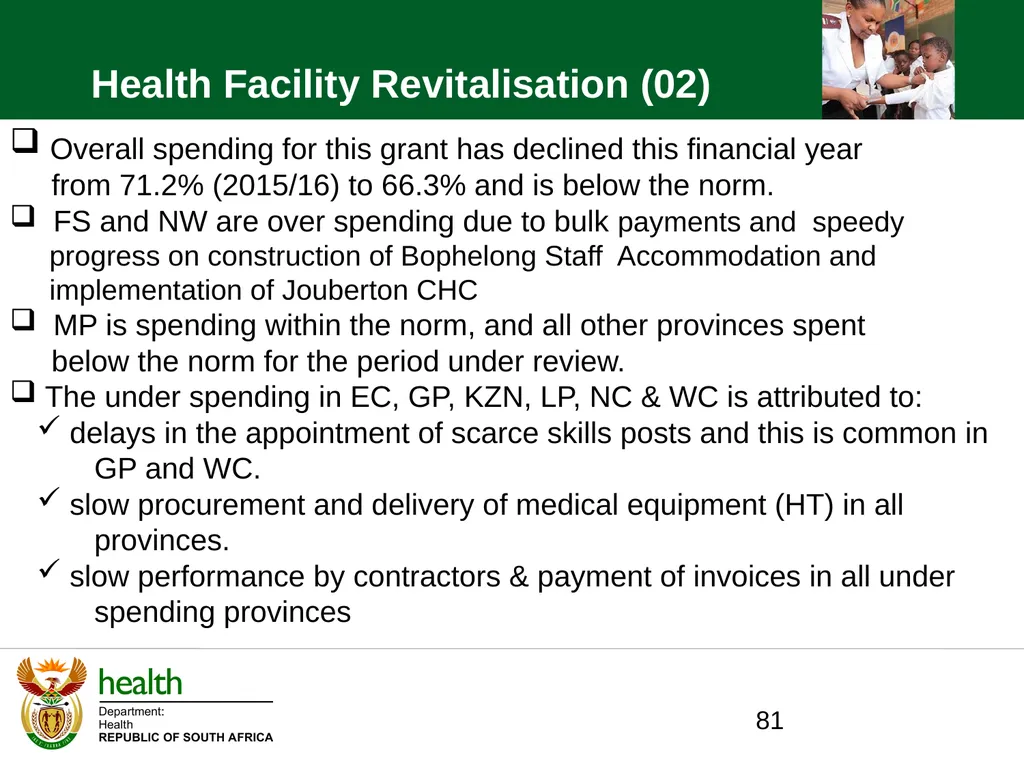
Health Facility Revitalisation (02) Overall spending for this grant has declined this financial year
from 71.2% (2015/16) to 66.3% and is below the norm.
FS and NW are over spending due to bulk payments and speedy
progress on construction of Bophelong Staff Accommodation and
implementation of Jouberton CHC
MP is spending within the norm, and all other provinces spent
below the norm for the period under review.
The under spending in EC, GP, KZN, LP, NC & WC is attributed to:
delays in the appointment of scarce skills posts and this is common in
GP and WC.
slow procurement and delivery of medical equipment (HT) in all
provinces.
slow performance by contractors & payment of invoices in all under
spending provinces 81<br>
from 71.2% (2015/16) to 66.3% and is below the norm.
FS and NW are over spending due to bulk payments and speedy
progress on construction of Bophelong Staff Accommodation and
implementation of Jouberton CHC
MP is spending within the norm, and all other provinces spent
below the norm for the period under review.
The under spending in EC, GP, KZN, LP, NC & WC is attributed to:
delays in the appointment of scarce skills posts and this is common in
GP and WC.
slow procurement and delivery of medical equipment (HT) in all
provinces.
slow performance by contractors & payment of invoices in all under
spending provinces 81<br>
82
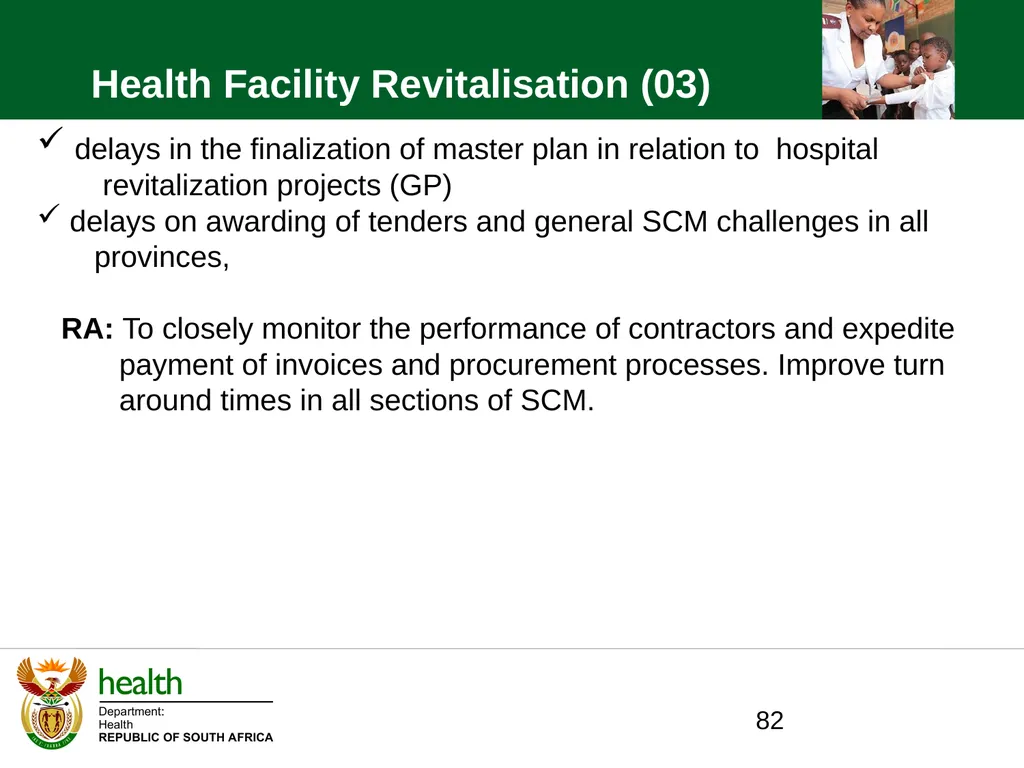
Health Facility Revitalisation (03) delays in the finalization of master plan in relation to hospital
revitalization projects (GP)
delays on awarding of tenders and general SCM challenges in all
provinces,
RA: To closely monitor the performance of contractors and expedite
payment of invoices and procurement processes. Improve turn
around times in all sections of SCM. 82<br>
revitalization projects (GP)
delays on awarding of tenders and general SCM challenges in all
provinces,
RA: To closely monitor the performance of contractors and expedite
payment of invoices and procurement processes. Improve turn
around times in all sections of SCM. 82<br>
83
National Health Insurance (01) 83<br>
84
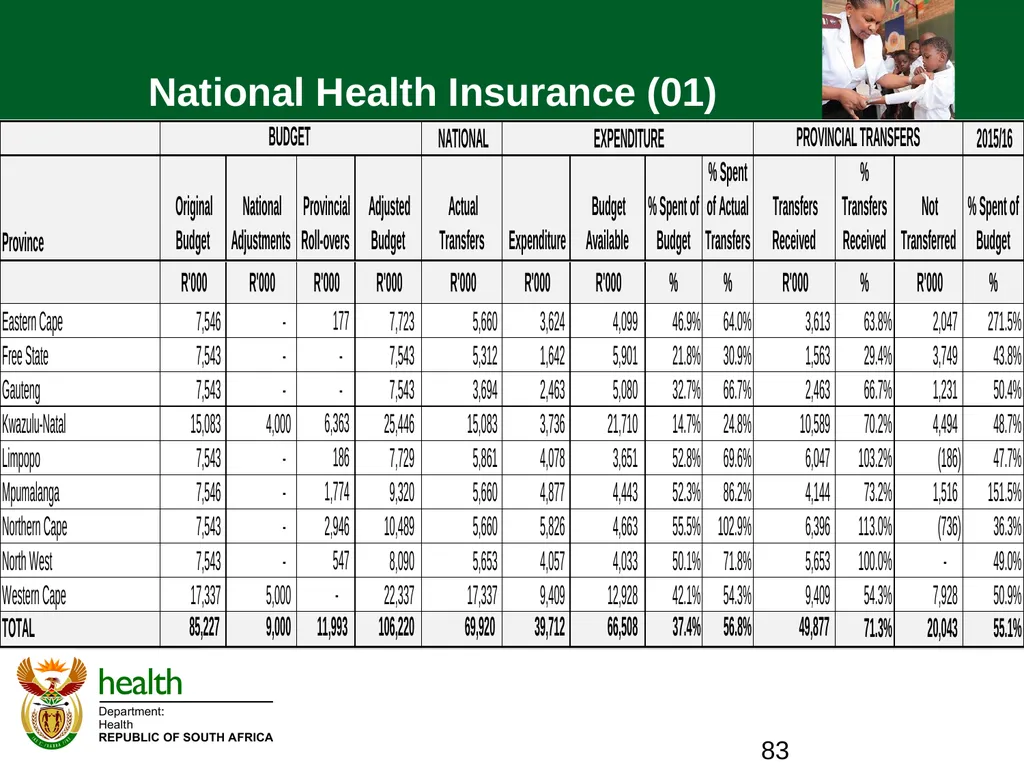
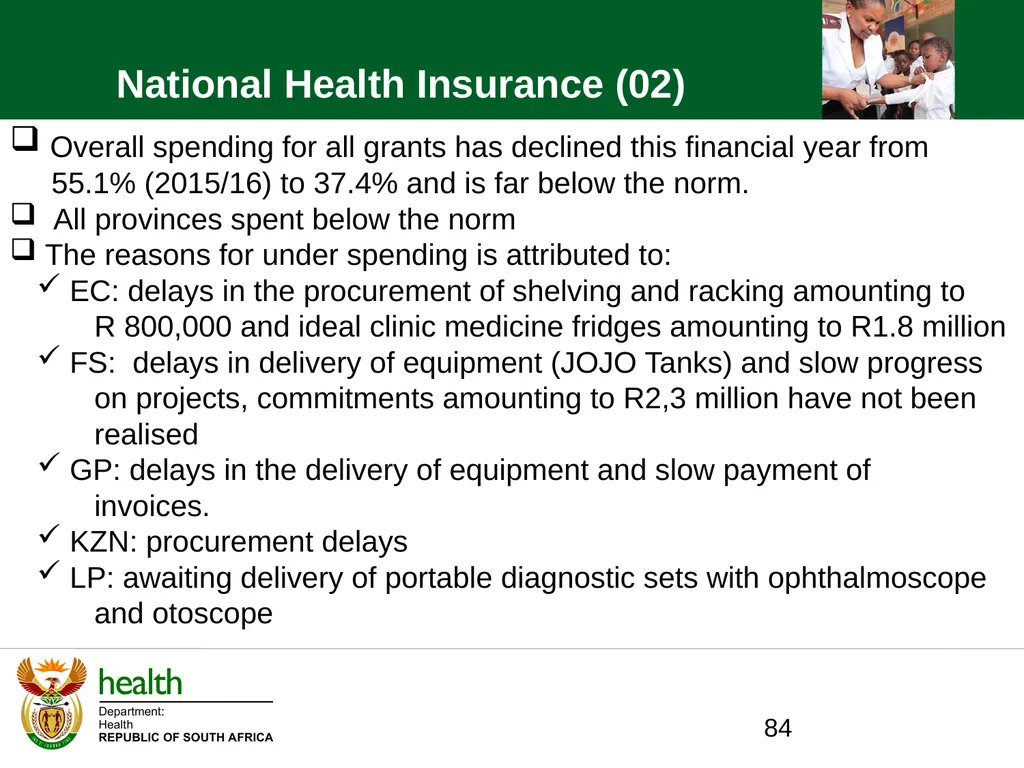
National Health Insurance (02) Overall spending for all grants has declined this financial year from
55.1% (2015/16) to 37.4% and is far below the norm.
All provinces spent below the norm
The reasons for under spending is attributed to:
EC: delays in the procurement of shelving and racking amounting to
R 800,000 and ideal clinic medicine fridges amounting to R1.8 million
FS: delays in delivery of equipment (JOJO Tanks) and slow progress
on projects, commitments amounting to R2,3 million have not been
realised
GP: delays in the delivery of equipment and slow payment of
invoices.
KZN: procurement delays
LP: awaiting delivery of portable diagnostic sets with ophthalmoscope
and otoscope 84<br>
55.1% (2015/16) to 37.4% and is far below the norm.
All provinces spent below the norm
The reasons for under spending is attributed to:
EC: delays in the procurement of shelving and racking amounting to
R 800,000 and ideal clinic medicine fridges amounting to R1.8 million
FS: delays in delivery of equipment (JOJO Tanks) and slow progress
on projects, commitments amounting to R2,3 million have not been
realised
GP: delays in the delivery of equipment and slow payment of
invoices.
KZN: procurement delays
LP: awaiting delivery of portable diagnostic sets with ophthalmoscope
and otoscope 84<br>
85
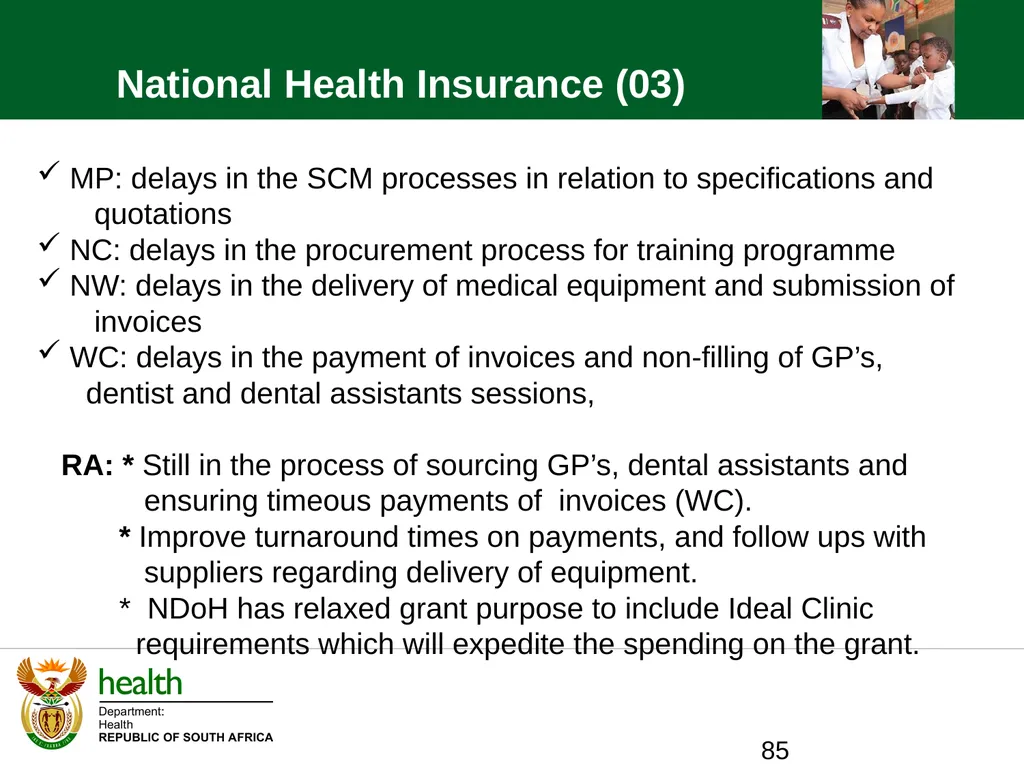
National Health Insurance (03) MP: delays in the SCM processes in relation to specifications and
quotations
NC: delays in the procurement process for training programme
NW: delays in the delivery of medical equipment and submission of
invoices
WC: delays in the payment of invoices and non-filling of GP’s,
dentist and dental assistants sessions,
RA: * Still in the process of sourcing GP’s, dental assistants and
ensuring timeous payments of invoices (WC).
* Improve turnaround times on payments, and follow ups with
suppliers regarding delivery of equipment.
* NDoH has relaxed grant purpose to include Ideal Clinic
requirements which will expedite the spending on the grant. 85<br>
quotations
NC: delays in the procurement process for training programme
NW: delays in the delivery of medical equipment and submission of
invoices
WC: delays in the payment of invoices and non-filling of GP’s,
dentist and dental assistants sessions,
RA: * Still in the process of sourcing GP’s, dental assistants and
ensuring timeous payments of invoices (WC).
* Improve turnaround times on payments, and follow ups with
suppliers regarding delivery of equipment.
* NDoH has relaxed grant purpose to include Ideal Clinic
requirements which will expedite the spending on the grant. 85<br>
86
National Health Insurance (04) * NDoH is in the process of visiting all provinces to ensure acceleration
of expenditure especially on problematic grants as aforementioned.
* It should be noted that the grant will be fully spent. 86<br>
of expenditure especially on problematic grants as aforementioned.
* It should be noted that the grant will be fully spent. 86<br>
87
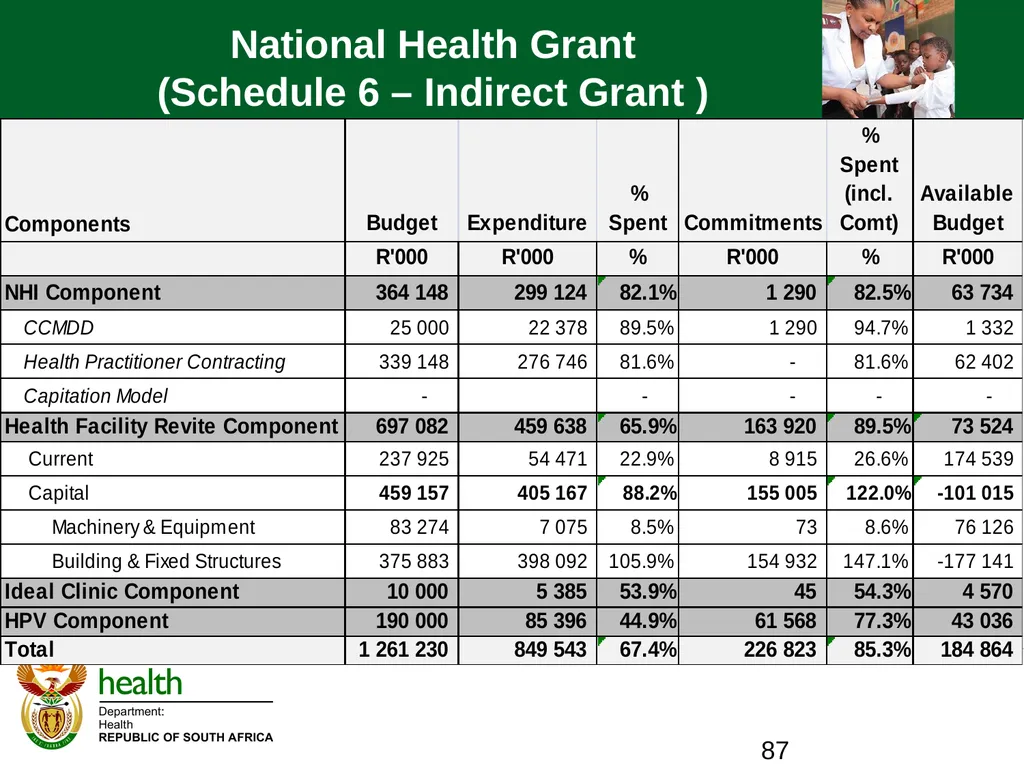
National Health Grant
(Schedule 6 – Indirect Grant ) 87<br>
(Schedule 6 – Indirect Grant ) 87<br>
88
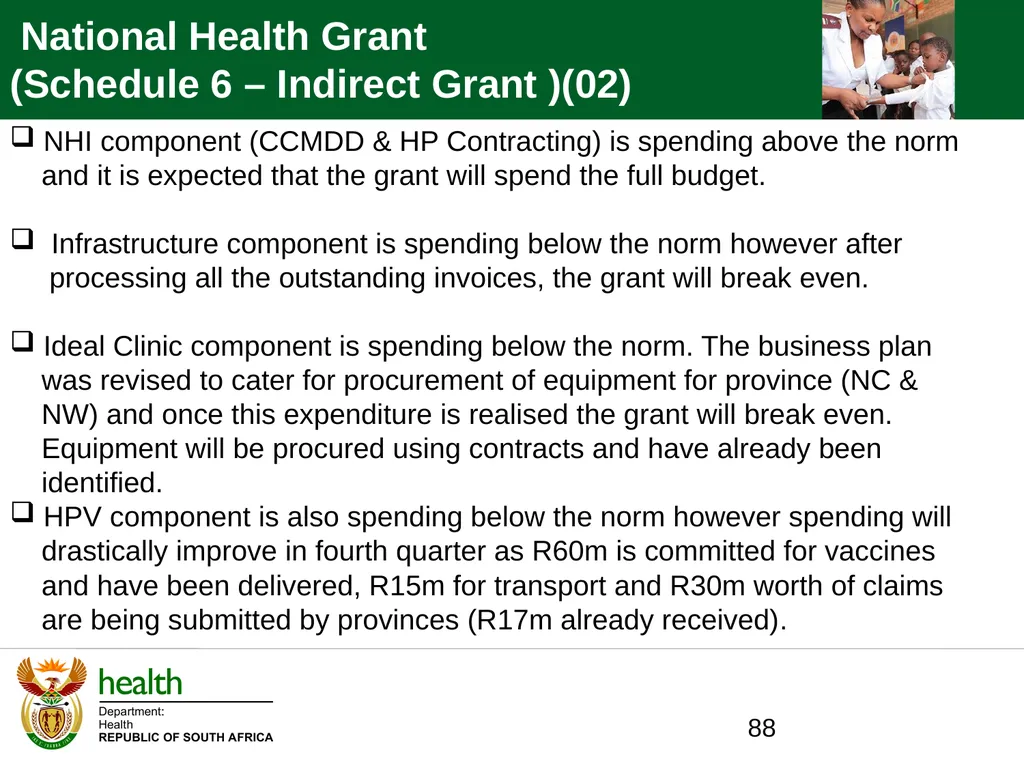
National Health Grant
(Schedule 6 – Indirect Grant )(02) NHI component (CCMDD & HP Contracting) is spending above the norm
and it is expected that the grant will spend the full budget.
Infrastructure component is spending below the norm however after
processing all the outstanding invoices, the grant will break even.
Ideal Clinic component is spending below the norm. The business plan
was revised to cater for procurement of equipment for province (NC &
NW) and once this expenditure is realised the grant will break even.
Equipment will be procured using contracts and have already been
identified.
HPV component is also spending below the norm however spending will
drastically improve in fourth quarter as R60m is committed for vaccines
and have been delivered, R15m for transport and R30m worth of claims
are being submitted by provinces (R17m already received). 88<br>
(Schedule 6 – Indirect Grant )(02) NHI component (CCMDD & HP Contracting) is spending above the norm
and it is expected that the grant will spend the full budget.
Infrastructure component is spending below the norm however after
processing all the outstanding invoices, the grant will break even.
Ideal Clinic component is spending below the norm. The business plan
was revised to cater for procurement of equipment for province (NC &
NW) and once this expenditure is realised the grant will break even.
Equipment will be procured using contracts and have already been
identified.
HPV component is also spending below the norm however spending will
drastically improve in fourth quarter as R60m is committed for vaccines
and have been delivered, R15m for transport and R30m worth of claims
are being submitted by provinces (R17m already received). 88<br>
89
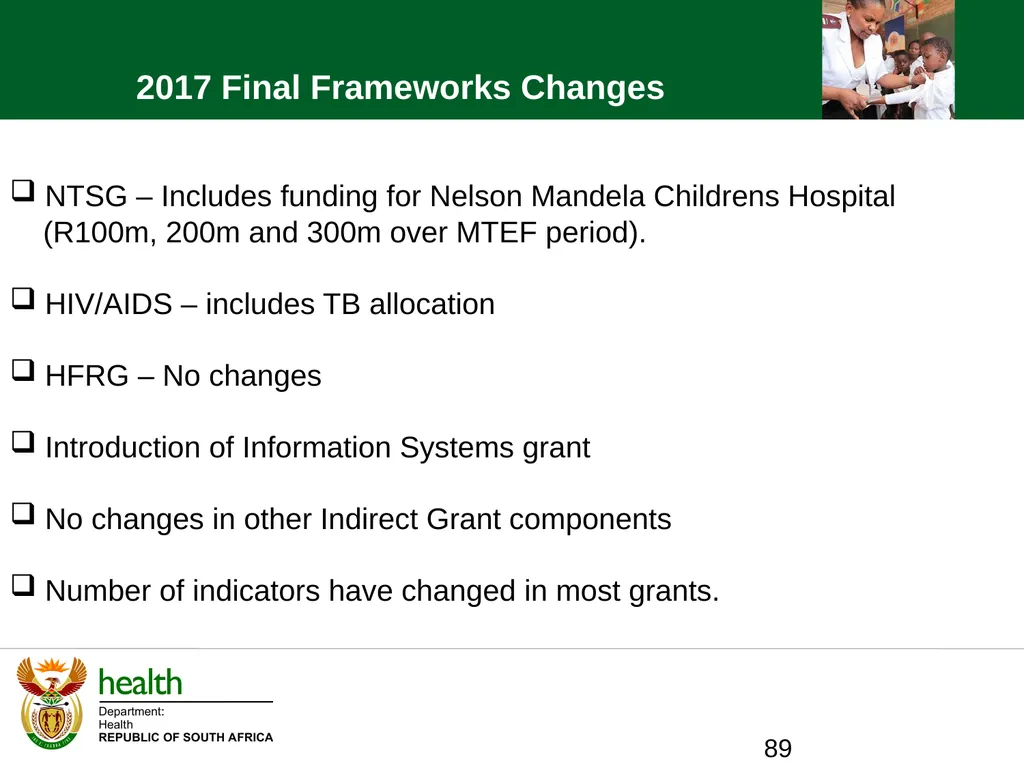
2017 Final Frameworks Changes NTSG – Includes funding for Nelson Mandela Childrens Hospital
(R100m, 200m and 300m over MTEF period).
HIV/AIDS – includes TB allocation
HFRG – No changes
Introduction of Information Systems grant
No changes in other Indirect Grant components
Number of indicators have changed in most grants. 89<br>
(R100m, 200m and 300m over MTEF period).
HIV/AIDS – includes TB allocation
HFRG – No changes
Introduction of Information Systems grant
No changes in other Indirect Grant components
Number of indicators have changed in most grants. 89<br>
90
MomConnect Parliamentary Portfolio Committee
07 February 2017 90<br>
07 February 2017 90<br>
91
Maternal Mortality The maternal mortality ratio has been falling annually; current institutional MMR is 119.1/100 000 births (DOH annual report 15/16)
The APP target for 2019 is 100; The SDG target for 2030 is 70
Numerous factors impact on the number of maternal deaths.
These include patient behavioural factors such as early antenatal booking; eating healthy diet; going to clinics if any risk factors (e.g. swelling of legs indicating hypertension; bleeding indicating possible antepartum haemorrhage); getting to delivery early; taking ARVs if HIV positive.
MomConnect has been shown in independent studies that mothers who receive messages have improved knowledge and attitudes in relation to risk factors
MomConnect has also been shown to impact on the supply side and through complaints from pregnant women stock outs of drugs (e.g. iron tablets) and vaccines (for under ones) has improved.
NurseConnect (aimed at health professionals) will improve the quality of care offered. 91<br>
The APP target for 2019 is 100; The SDG target for 2030 is 70
Numerous factors impact on the number of maternal deaths.
These include patient behavioural factors such as early antenatal booking; eating healthy diet; going to clinics if any risk factors (e.g. swelling of legs indicating hypertension; bleeding indicating possible antepartum haemorrhage); getting to delivery early; taking ARVs if HIV positive.
MomConnect has been shown in independent studies that mothers who receive messages have improved knowledge and attitudes in relation to risk factors
MomConnect has also been shown to impact on the supply side and through complaints from pregnant women stock outs of drugs (e.g. iron tablets) and vaccines (for under ones) has improved.
NurseConnect (aimed at health professionals) will improve the quality of care offered. 91<br>
92
Infant mortality The infant mortality rate (IMR) has reduced from 35/1000 live births in 2009 to 27 in 2015
(Rapid Mortality Surveillance – MRC)
The main contributing factors to IMR are neonatal deaths; HIV; diarrhoeal disease; malnutrition; pneumonia.
MomConnect gives moms and caregivers information about immunisations, breast feeding; healthy diets for infants; PMTCT; danger signs.
By giving mothers information and knowledge and impacting on their behaviour MomConnect contributes to reducing all the contributing factors to IMR 92<br>
(Rapid Mortality Surveillance – MRC)
The main contributing factors to IMR are neonatal deaths; HIV; diarrhoeal disease; malnutrition; pneumonia.
MomConnect gives moms and caregivers information about immunisations, breast feeding; healthy diets for infants; PMTCT; danger signs.
By giving mothers information and knowledge and impacting on their behaviour MomConnect contributes to reducing all the contributing factors to IMR 92<br>
93
Number of women receiving messages
through Momconnect Cumulatively 1.36m women (since 2014) have received twice weekly messages about their pregnancy and about the health of their infants post delivery to year one
1126 spontaneous complaints have been received since 2014 and in the same period 7738 compliments have been received. 93<br>
1126 spontaneous complaints have been received since 2014 and in the same period 7738 compliments have been received. 93<br>
94
Nurseconnect Linked to Momconnect is Nurseconnect to provide messages to midwives and nurses providing antenatal care
Since May 2016 over 14 000 nurses have registered and receive twice weekly messages
These messages are motivational as well as technical in nature
This service is intended to support front line workers (a help desk is being developed to provide additional support to them) 94<br>
Since May 2016 over 14 000 nurses have registered and receive twice weekly messages
These messages are motivational as well as technical in nature
This service is intended to support front line workers (a help desk is being developed to provide additional support to them) 94<br>
95
The End 95<br>