
Question: Why do standards exist? Objectives:
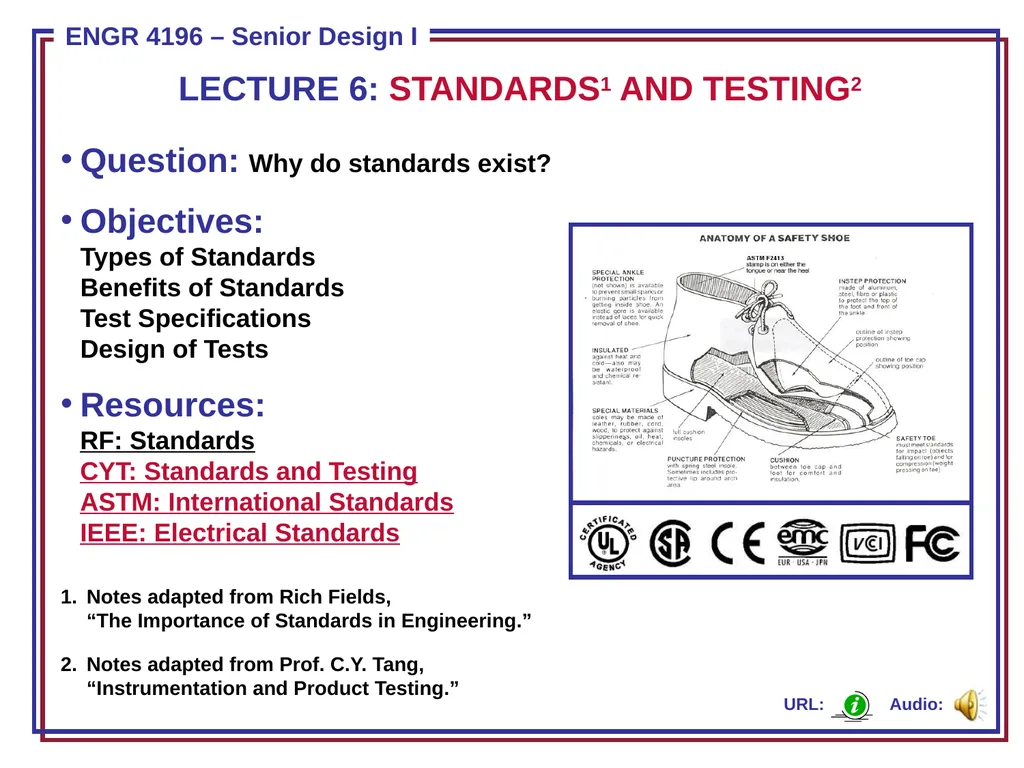
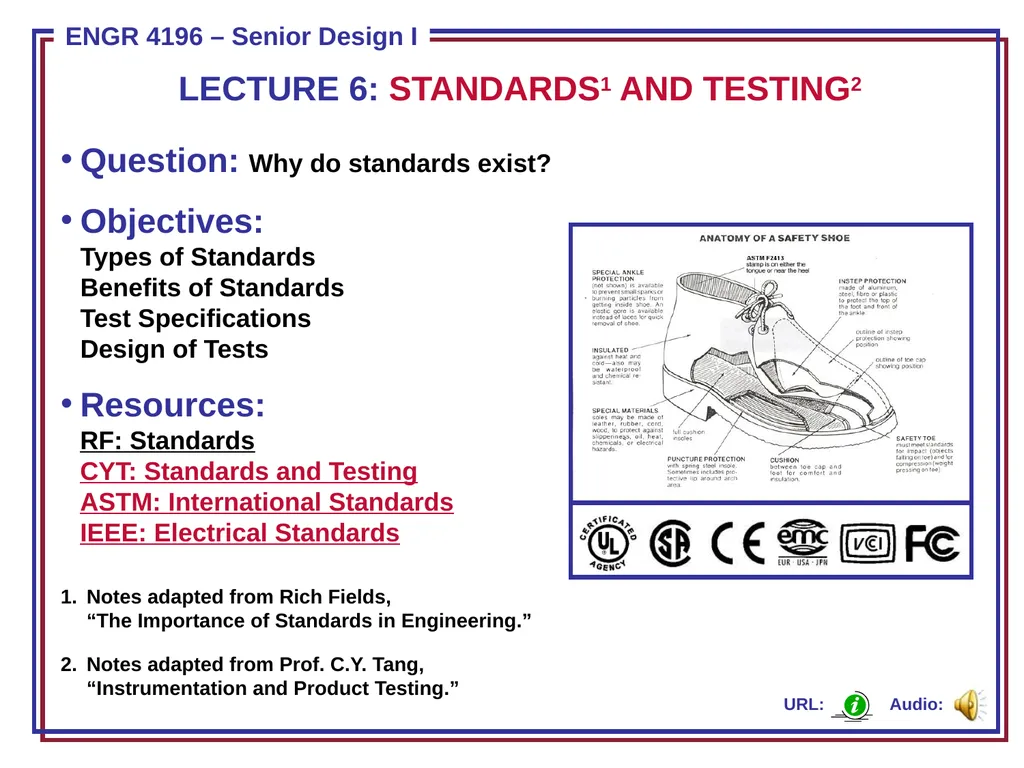


Description: Question: Why do standards exist? Objectives: Types of Standards Benefits of Standards Test Specifications Design of Tests Resources: RF: Standards CYT: Standards and Testing ASTM: International Standards IEEE: Electrical Standards Notes
Related Topics
Download Presentation
"Question: Why do standards exist? Objectives:" is the property of its rightful owner. Permission is granted to download and print the materials on this website for personal, non-commercial use only, and to display it on your personal computer provided you do not modify the materials and that you retain all copyright notices contained in the materials. By downloading content from our website, you accept the terms of this agreement.
Presentation Transcript
slide1. Question: Why do standards exist?
Objectives: Types of Standards Benefits of Standards Test Specifications Design of Tests
Resources: RF: Standards CYT: Standards and Testing ASTM: International Standards IEEE: Electrical Standards
Notes adapted from Rich Fields, “The Importance of Standards in Engineering.”
Notes adapted from Prof. C.Y. Tang, “Instrumentation and Product Testing.” LECTURE 6: STANDARDS1 AND TESTING2<br>
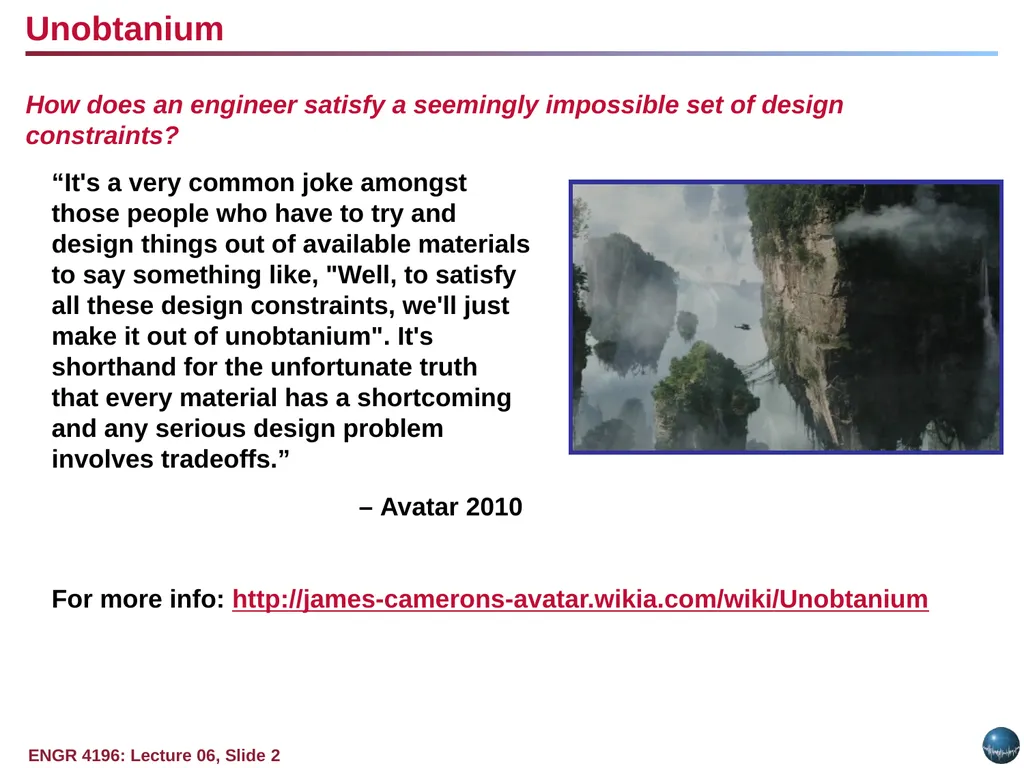
slide2. How does an engineer satisfy a seemingly impossible set of design constraints?
“It's a very common joke amongst those people who have to try and design things out of available materials to say something like, "Well, to satisfy all these design constraints, we'll just make it out of unobtanium". It's shorthand for the unfortunate truth that every material has a shortcoming and any serious design problem involves tradeoffs.”
– Avatar 2010
For more info: http://james-camerons-avatar.wikia.com/wiki/Unobtanium Unobtanium<br>
slide3. “Standards generally go unnoticed. They are mostly quiet, unseen forces, such as specifications, regulations, and protocols, that ensure that things work properly, interactively, and responsibly.
How standards come about is a mystery to most people should they even ponder the question.”
John Gibbons, Forward to U. S. Congress Office of Technology Assessment TCT-512, Global Standards: Building Blocks for the Future, March 1992 The Mystery of Standards<br>
slide4. A simplistic but idealized working definition…
Standard - a document, developed and used by consensus of the stakeholders, which describes how a product is to be obtained or used.
document - can be electronic or paper
stakeholders – includes anyone with an interest without restriction
product - can include hardware, software, analysis result, test result, protocol, definition, etc.
obtained or used - can mean designed, built, procured, calculated, tested, etc. What is a Standard?<br>
slide5. Relevant and necessary, by providing specific value to benefit development of a product.
Singular, by focusing on a specific concept.
Unambiguous, by not being subject to multiple interpretations.
Consistent, by not conflicting with other documents within its family of standards.
Auditable (measureable), with a quantitative exit criterion showing that the standard was followed. Features of an Ideal Standard<br>
slide6. Best practices (things that have worked well)
Lessons learned (things that haven’t worked well)
Recent research results
Able to stimulate further research in related areas
Standards cannot be created for every situation
Sometimes necessary in real practice for a subject matter expert to extrapolate from one or more existing standards and design principles to solve a specific need What Does (and Doesn’t) Go Into a Standard?<br>
slide7. Technical terminology
Material specifications
Process specifications
Test methods (and practices and guides)
Test fixtures
Data reduction methods
Data reporting formats
Test matrices
Statistical procedures
Analysis methods
…and more… Types of Standards for Composites<br>
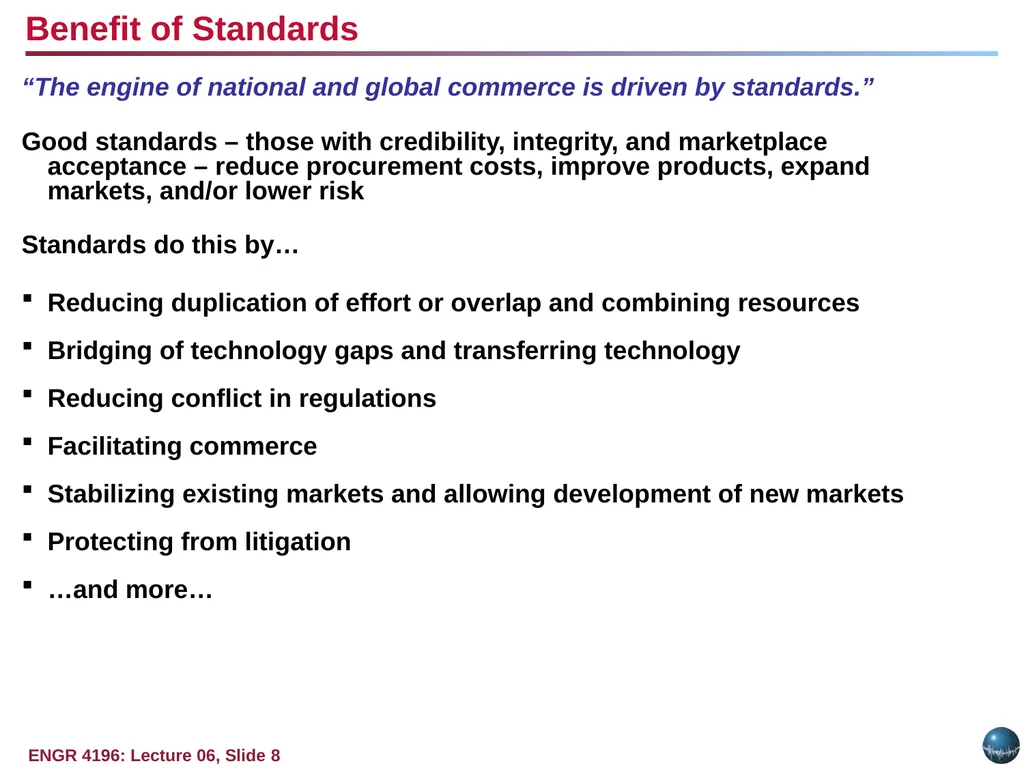
slide8. “The engine of national and global commerce is driven by standards.”
Good standards – those with credibility, integrity, and marketplace acceptance – reduce procurement costs, improve products, expand markets, and/or lower risk
Standards do this by…
Reducing duplication of effort or overlap and combining resources
Bridging of technology gaps and transferring technology
Reducing conflict in regulations
Facilitating commerce
Stabilizing existing markets and allowing development of new markets
Protecting from litigation
…and more… Benefit of Standards<br>
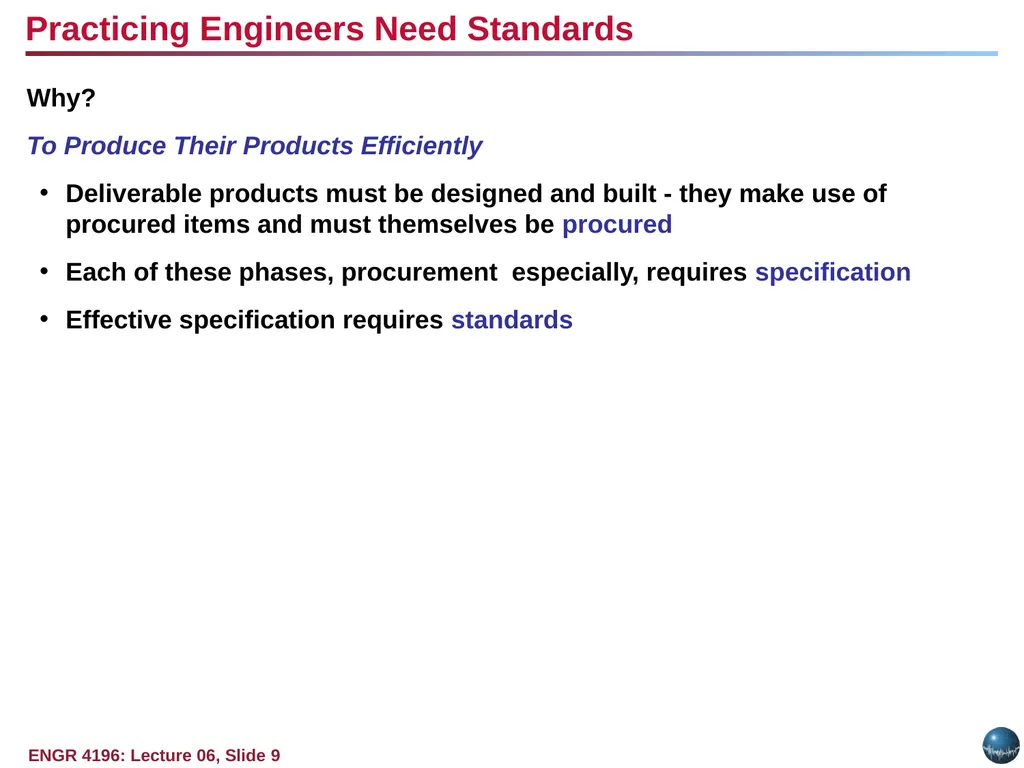
slide9. Why?
To Produce Their Products Efficiently
Deliverable products must be designed and built - they make use of procured items and must themselves be procured
Each of these phases, procurement especially, requires specification
Effective specification requires standards Practicing Engineers Need Standards<br>
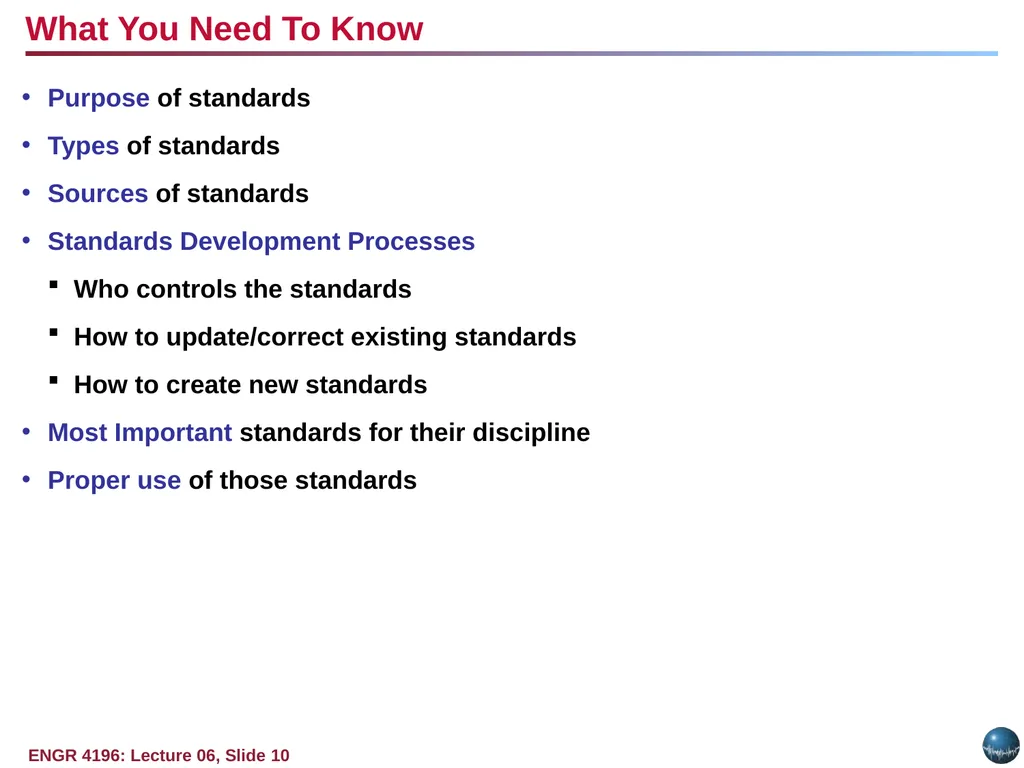
slide10. Purpose of standards
Types of standards
Sources of standards
Standards Development Processes
Who controls the standards
How to update/correct existing standards
How to create new standards
Most Important standards for their discipline
Proper use of those standards What You Need To Know<br>
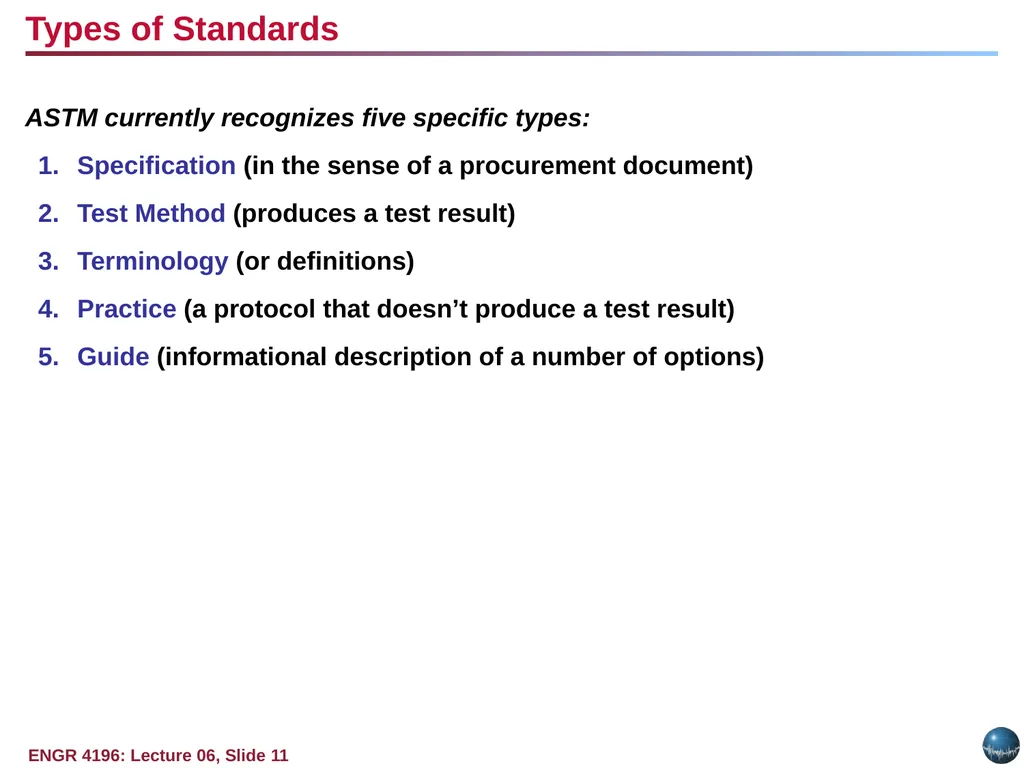
slide11. ASTM currently recognizes five specific types:
Specification (in the sense of a procurement document)
Test Method (produces a test result)
Terminology (or definitions)
Practice (a protocol that doesn’t produce a test result)
Guide (informational description of a number of options) Types of Standards<br>
slide12. The term specification has both a generic meaning and a targeted meaning:
Generic – part of common compound term indicating any type of standard, as in “standard specification”
Targeted – a specific type of “standard,” as per ASTM, which forms the basis for procurement of a product “Terminology Wars”: Specification vs. Standard<br>
slide13. International SDO – An accepted set of principles by which an organization engaged in the development of international standards must comply has been adopted by the World Trade Organization (WTO), Committee on Technical Barriers to Trade*
ISO conforms to this definition, but – contrary to what ISO prefers to emphasize – ISO (and its sister IEC) is not the only International SDO
*G/TBT/ 1/REV. 8. Section IX, Decision of the Committee on Principles for the Development of International Standards, Guides and Recommendations with Relation to Articles 2, 5 and Annex 3 of the Agreement. Standards Development Organizations (SDO)<br>
slide14. US has a unique stakeholder-driven standards development process, using a large number (~400) of decentralized, non-governmental (and often international) SDOs ranging in size from very large and broad-based, to very small and specific SDOs, with ANSI (not a standards producer) as the official US coordinator
Rest of world uses a politically-driven, government-based, standards development process – with ISO/IEC at the top level of this Differences in Standards Development Philosophies<br>
slide15. International Organization for Standarization (ISO): “International,” but Europe-driven, with a one-country/one vote approach that gives Europe a definite voting edge
US-based SDOs now advertise their global-ness, and the major US SDO’s meet the WTO definition of “international” equally well or better than ISO
American Society for Testing and Materials International (ASTM International): largest US-based SDO, with substantial global participation, voting by individual stakeholders, and more inclusive definition of “consensus” than ISO
Society of Automotive Engineers (SAE International): US-based, but substantial global participation; and not just “Automotive” Technical content from US-based SDOs has driven a disproportionate amount of standards development for the rest of the world, including the standards of ISO. Let’s Get Modern – and Honest<br>
slide16. “The good thing about standards is that there are many of them.”
A product should be designed to comply with industry standards (such as the requirements of dimensional, physical, mechanical, electrical properties).
While designing to standards does not ensure a safe product, standards do tend to create safer products.
Advertise and market wisely. Occasionally, a company creates potential product misuse situations though its advertisements, marketing materials, and sales personnel. Product liability loss prevention is not the sole responsibility of the product designer or manufacturer; misrepresentation and exaggeration in advertisements and marketing materials may also be involved.
The infomercial has underscored the importance of testing. Standards and Testing<br>
slide17. According to a product’s nature, specifications and international regulations, various types of tests such as
Safety tests
Life tests (reliability)
Functional tests, and
Packaging tests
must be preformed to assure conformance and quality.
There are many different types of products and their associated tests.
Chemical Testing
Construction Materials
Electrical and Electronic Products
Food
Textiles and Garments
Toys and Children's Products, etc. Product Testing<br>
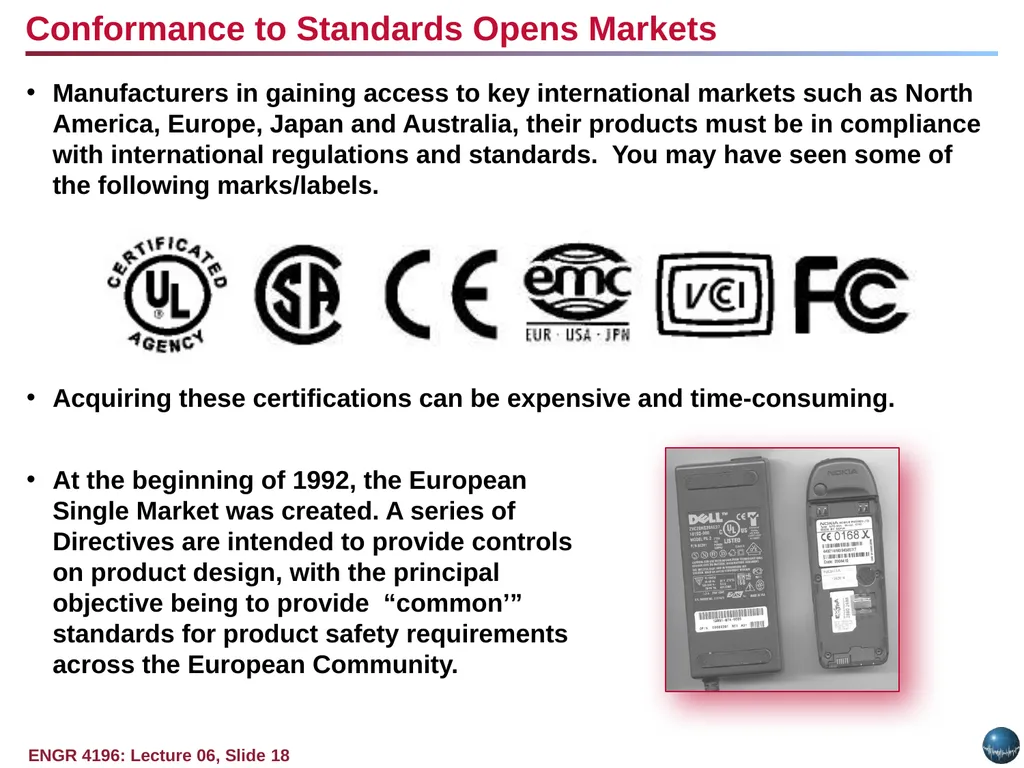
slide18. Manufacturers in gaining access to key international markets such as North America, Europe, Japan and Australia, their products must be in compliance with international regulations and standards. You may have seen some of the following marks/labels.
Acquiring these certifications can be expensive and time-consuming.
At the beginning of 1992, the European Single Market was created. A series of Directives are intended to provide controls on product design, with the principal objective being to provide “common’” standards for product safety requirements across the European Community. Conformance to Standards Opens Markets<br>
slide19. The act of fixing the CE mark to the product, and signing the Declaration of Conformity, constitutes a declaration by the manufacturer that the product meets the requirements of all the Directives (official instructions) which apply to it.
The CE Marking is a legal requirement for products covered by one or more of the European Union (EU) Directives stipulating its use. It signifies that the supplier of the product has verified that the product complies with the requirements of the relevant Directives.
The Manufacturer or their legally appointed representative in the EU can be liable to a fine or a prison sentence if the product is found not to comply with the requirements of all the relevant Directives. A challenge can be initiated by anyone who believes a product to be dangerous (including your competitors). Standards Imply Certification by Testing<br>
slide20. General product testing procedures:
Raise problems: Emulation of practical using situation (proper and improper uses)
Confirm test criteria: Directives and Standards
Plan for the test: Facilities setup and test sequence
Test implementation: Record and Analysis
A product test should be also designed and performed to comply with industry standards.
Example: Product Testing for Safety of Toys
Step 1:
Emulate the users of the toy under various situations (normal and abnormal)
Analyze and study the features/functions of the toy
Identify the potential hazards of playing the toy (include packing) Scientific Goals of a Test Procedure<br>
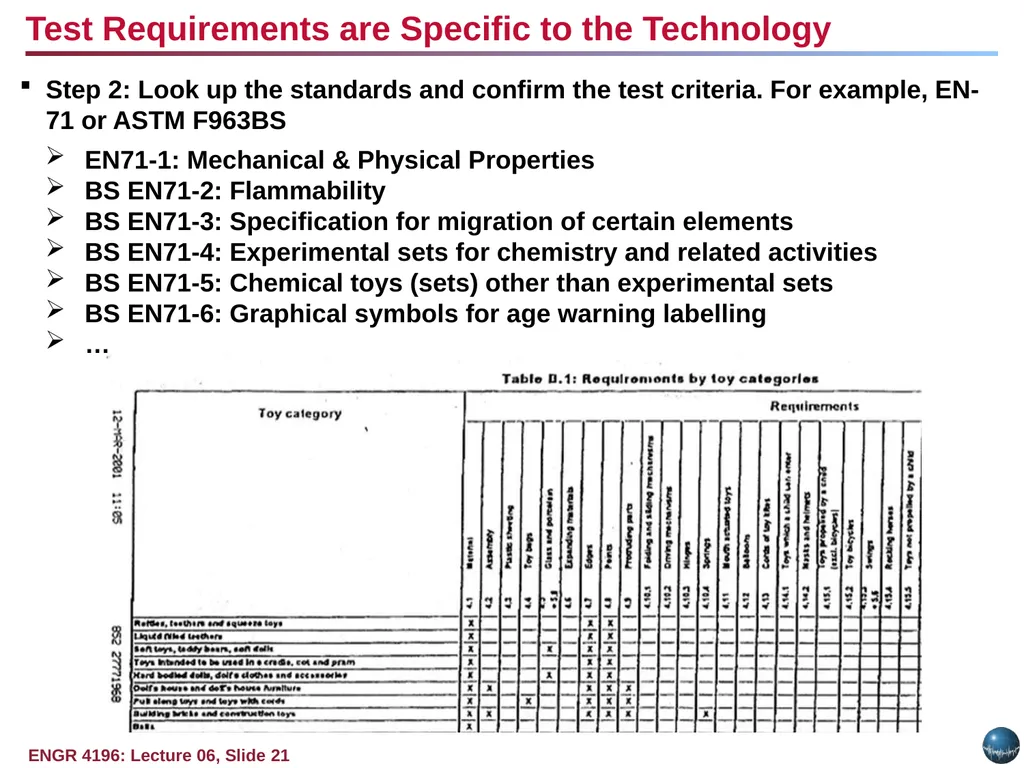
slide21. Test Requirements are Specific to the Technology Step 2: Look up the standards and confirm the test criteria. For example, EN-71 or ASTM F963BS
EN71-1: Mechanical & Physical Properties
BS EN71-2: Flammability
BS EN71-3: Specification for migration of certain elements
BS EN71-4: Experimental sets for chemistry and related activities
BS EN71-5: Chemical toys (sets) other than experimental sets
BS EN71-6: Graphical symbols for age warning labelling
…<br>
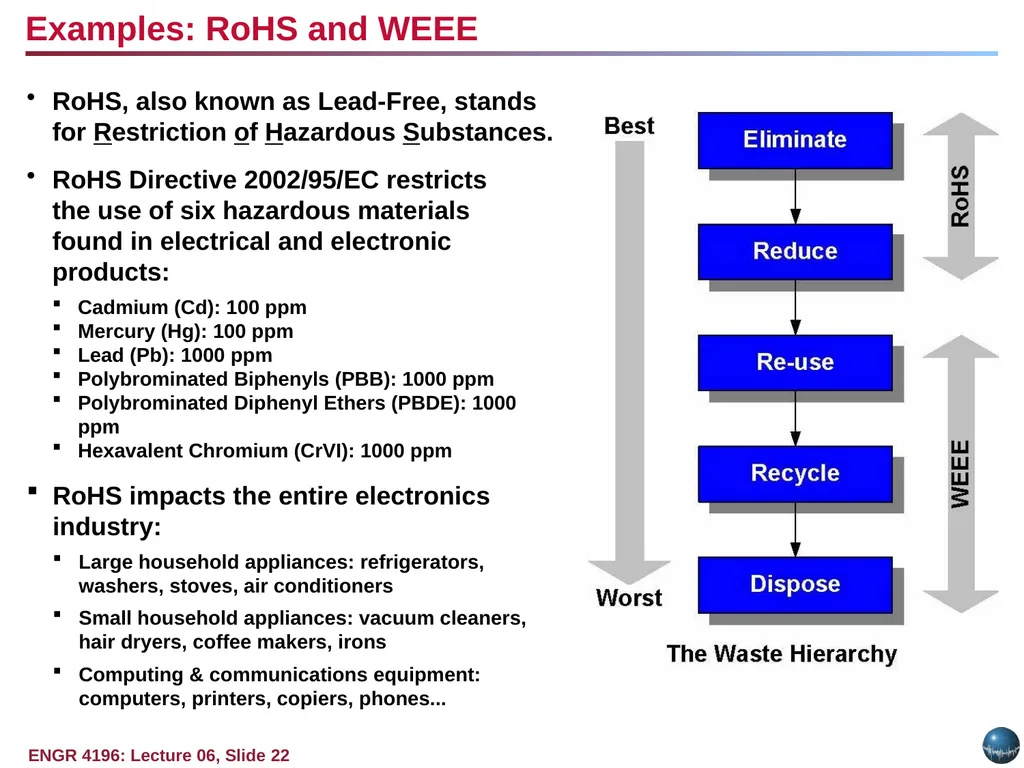
slide22. RoHS, also known as Lead-Free, stands for Restriction of Hazardous Substances.
RoHS Directive 2002/95/EC restricts the use of six hazardous materials found in electrical and electronic products:
Cadmium (Cd): 100 ppm
Mercury (Hg): 100 ppm
Lead (Pb): 1000 ppm
Polybrominated Biphenyls (PBB): 1000 ppm
Polybrominated Diphenyl Ethers (PBDE): 1000 ppm
Hexavalent Chromium (CrVI): 1000 ppm
RoHS impacts the entire electronics industry:
Large household appliances: refrigerators, washers, stoves, air conditioners
Small household appliances: vacuum cleaners, hair dryers, coffee makers, irons
Computing & communications equipment: computers, printers, copiers, phones... Examples: RoHS and WEEE<br>
slide23. The following products are currently exempted from RoHS compliance:
Large stationary industrial tools
Control and monitoring equipment
National security use and military equipment
Medical devices
Some light bulbs and some batteries
Spare parts for electronic equipment in the market before July 1, 2006.
Countries work on their own version of RoHS:
RPCEP (Regulation for Pollution Control of Electronic Products): China
JGPSSI (Japan Green Procurement Survey Standardization Initiative): Japan
SB20 (Electronic Waste Recycling Act of 2003): California, USA
Adopting the EU RoHs Directive: Australia, Canada, Korea, Taiwan ROHS Exemptions and Variations<br>
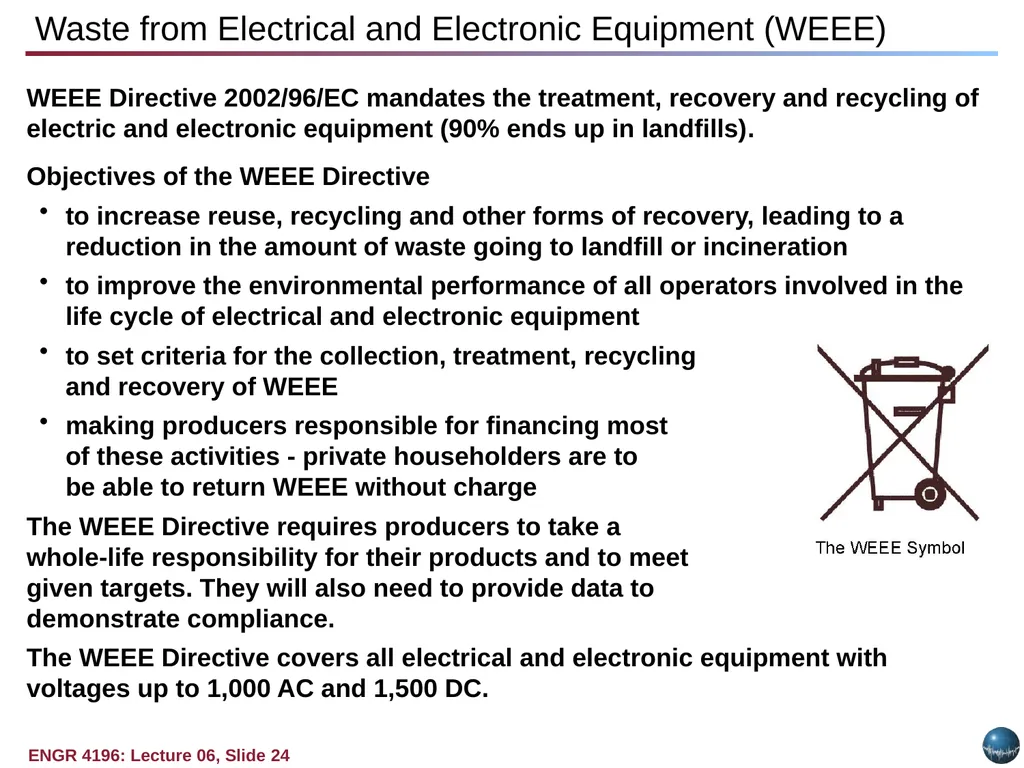
slide24. WEEE Directive 2002/96/EC mandates the treatment, recovery and recycling of electric and electronic equipment (90% ends up in landfills).
Objectives of the WEEE Directive
to increase reuse, recycling and other forms of recovery, leading to a reduction in the amount of waste going to landfill or incineration
to improve the environmental performance of all operators involved in the life cycle of electrical and electronic equipment
to set criteria for the collection, treatment, recycling and recovery of WEEE
making producers responsible for financing most of these activities - private householders are to be able to return WEEE without charge
The WEEE Directive requires producers to take a whole-life responsibility for their products and to meet given targets. They will also need to provide data to demonstrate compliance.
The WEEE Directive covers all electrical and electronic equipment with voltages up to 1,000 AC and 1,500 DC. Waste from Electrical and Electronic Equipment (WEEE)<br>
slide25. Every senior design project should address standards relevant to its discipline in the design constraints.
Design constraints must be tested through tests described in the test specification section.
The results of tests must be reported in the test certification section.
The final project demonstration at the end of Senior Design II must include a “live” demonstration of your project including a demonstration of how you meet your critical design constraints. Summary<br>
Objectives: Types of Standards Benefits of Standards Test Specifications Design of Tests
Resources: RF: Standards CYT: Standards and Testing ASTM: International Standards IEEE: Electrical Standards
Notes adapted from Rich Fields, “The Importance of Standards in Engineering.”
Notes adapted from Prof. C.Y. Tang, “Instrumentation and Product Testing.” LECTURE 6: STANDARDS1 AND TESTING2<br>
slide2. How does an engineer satisfy a seemingly impossible set of design constraints?
“It's a very common joke amongst those people who have to try and design things out of available materials to say something like, "Well, to satisfy all these design constraints, we'll just make it out of unobtanium". It's shorthand for the unfortunate truth that every material has a shortcoming and any serious design problem involves tradeoffs.”
– Avatar 2010
For more info: http://james-camerons-avatar.wikia.com/wiki/Unobtanium Unobtanium<br>
slide3. “Standards generally go unnoticed. They are mostly quiet, unseen forces, such as specifications, regulations, and protocols, that ensure that things work properly, interactively, and responsibly.
How standards come about is a mystery to most people should they even ponder the question.”
John Gibbons, Forward to U. S. Congress Office of Technology Assessment TCT-512, Global Standards: Building Blocks for the Future, March 1992 The Mystery of Standards<br>
slide4. A simplistic but idealized working definition…
Standard - a document, developed and used by consensus of the stakeholders, which describes how a product is to be obtained or used.
document - can be electronic or paper
stakeholders – includes anyone with an interest without restriction
product - can include hardware, software, analysis result, test result, protocol, definition, etc.
obtained or used - can mean designed, built, procured, calculated, tested, etc. What is a Standard?<br>
slide5. Relevant and necessary, by providing specific value to benefit development of a product.
Singular, by focusing on a specific concept.
Unambiguous, by not being subject to multiple interpretations.
Consistent, by not conflicting with other documents within its family of standards.
Auditable (measureable), with a quantitative exit criterion showing that the standard was followed. Features of an Ideal Standard<br>
slide6. Best practices (things that have worked well)
Lessons learned (things that haven’t worked well)
Recent research results
Able to stimulate further research in related areas
Standards cannot be created for every situation
Sometimes necessary in real practice for a subject matter expert to extrapolate from one or more existing standards and design principles to solve a specific need What Does (and Doesn’t) Go Into a Standard?<br>
slide7. Technical terminology
Material specifications
Process specifications
Test methods (and practices and guides)
Test fixtures
Data reduction methods
Data reporting formats
Test matrices
Statistical procedures
Analysis methods
…and more… Types of Standards for Composites<br>
slide8. “The engine of national and global commerce is driven by standards.”
Good standards – those with credibility, integrity, and marketplace acceptance – reduce procurement costs, improve products, expand markets, and/or lower risk
Standards do this by…
Reducing duplication of effort or overlap and combining resources
Bridging of technology gaps and transferring technology
Reducing conflict in regulations
Facilitating commerce
Stabilizing existing markets and allowing development of new markets
Protecting from litigation
…and more… Benefit of Standards<br>
slide9. Why?
To Produce Their Products Efficiently
Deliverable products must be designed and built - they make use of procured items and must themselves be procured
Each of these phases, procurement especially, requires specification
Effective specification requires standards Practicing Engineers Need Standards<br>
slide10. Purpose of standards
Types of standards
Sources of standards
Standards Development Processes
Who controls the standards
How to update/correct existing standards
How to create new standards
Most Important standards for their discipline
Proper use of those standards What You Need To Know<br>
slide11. ASTM currently recognizes five specific types:
Specification (in the sense of a procurement document)
Test Method (produces a test result)
Terminology (or definitions)
Practice (a protocol that doesn’t produce a test result)
Guide (informational description of a number of options) Types of Standards<br>
slide12. The term specification has both a generic meaning and a targeted meaning:
Generic – part of common compound term indicating any type of standard, as in “standard specification”
Targeted – a specific type of “standard,” as per ASTM, which forms the basis for procurement of a product “Terminology Wars”: Specification vs. Standard<br>
slide13. International SDO – An accepted set of principles by which an organization engaged in the development of international standards must comply has been adopted by the World Trade Organization (WTO), Committee on Technical Barriers to Trade*
ISO conforms to this definition, but – contrary to what ISO prefers to emphasize – ISO (and its sister IEC) is not the only International SDO
*G/TBT/ 1/REV. 8. Section IX, Decision of the Committee on Principles for the Development of International Standards, Guides and Recommendations with Relation to Articles 2, 5 and Annex 3 of the Agreement. Standards Development Organizations (SDO)<br>
slide14. US has a unique stakeholder-driven standards development process, using a large number (~400) of decentralized, non-governmental (and often international) SDOs ranging in size from very large and broad-based, to very small and specific SDOs, with ANSI (not a standards producer) as the official US coordinator
Rest of world uses a politically-driven, government-based, standards development process – with ISO/IEC at the top level of this Differences in Standards Development Philosophies<br>
slide15. International Organization for Standarization (ISO): “International,” but Europe-driven, with a one-country/one vote approach that gives Europe a definite voting edge
US-based SDOs now advertise their global-ness, and the major US SDO’s meet the WTO definition of “international” equally well or better than ISO
American Society for Testing and Materials International (ASTM International): largest US-based SDO, with substantial global participation, voting by individual stakeholders, and more inclusive definition of “consensus” than ISO
Society of Automotive Engineers (SAE International): US-based, but substantial global participation; and not just “Automotive” Technical content from US-based SDOs has driven a disproportionate amount of standards development for the rest of the world, including the standards of ISO. Let’s Get Modern – and Honest<br>
slide16. “The good thing about standards is that there are many of them.”
A product should be designed to comply with industry standards (such as the requirements of dimensional, physical, mechanical, electrical properties).
While designing to standards does not ensure a safe product, standards do tend to create safer products.
Advertise and market wisely. Occasionally, a company creates potential product misuse situations though its advertisements, marketing materials, and sales personnel. Product liability loss prevention is not the sole responsibility of the product designer or manufacturer; misrepresentation and exaggeration in advertisements and marketing materials may also be involved.
The infomercial has underscored the importance of testing. Standards and Testing<br>
slide17. According to a product’s nature, specifications and international regulations, various types of tests such as
Safety tests
Life tests (reliability)
Functional tests, and
Packaging tests
must be preformed to assure conformance and quality.
There are many different types of products and their associated tests.
Chemical Testing
Construction Materials
Electrical and Electronic Products
Food
Textiles and Garments
Toys and Children's Products, etc. Product Testing<br>
slide18. Manufacturers in gaining access to key international markets such as North America, Europe, Japan and Australia, their products must be in compliance with international regulations and standards. You may have seen some of the following marks/labels.
Acquiring these certifications can be expensive and time-consuming.
At the beginning of 1992, the European Single Market was created. A series of Directives are intended to provide controls on product design, with the principal objective being to provide “common’” standards for product safety requirements across the European Community. Conformance to Standards Opens Markets<br>
slide19. The act of fixing the CE mark to the product, and signing the Declaration of Conformity, constitutes a declaration by the manufacturer that the product meets the requirements of all the Directives (official instructions) which apply to it.
The CE Marking is a legal requirement for products covered by one or more of the European Union (EU) Directives stipulating its use. It signifies that the supplier of the product has verified that the product complies with the requirements of the relevant Directives.
The Manufacturer or their legally appointed representative in the EU can be liable to a fine or a prison sentence if the product is found not to comply with the requirements of all the relevant Directives. A challenge can be initiated by anyone who believes a product to be dangerous (including your competitors). Standards Imply Certification by Testing<br>
slide20. General product testing procedures:
Raise problems: Emulation of practical using situation (proper and improper uses)
Confirm test criteria: Directives and Standards
Plan for the test: Facilities setup and test sequence
Test implementation: Record and Analysis
A product test should be also designed and performed to comply with industry standards.
Example: Product Testing for Safety of Toys
Step 1:
Emulate the users of the toy under various situations (normal and abnormal)
Analyze and study the features/functions of the toy
Identify the potential hazards of playing the toy (include packing) Scientific Goals of a Test Procedure<br>
slide21. Test Requirements are Specific to the Technology Step 2: Look up the standards and confirm the test criteria. For example, EN-71 or ASTM F963BS
EN71-1: Mechanical & Physical Properties
BS EN71-2: Flammability
BS EN71-3: Specification for migration of certain elements
BS EN71-4: Experimental sets for chemistry and related activities
BS EN71-5: Chemical toys (sets) other than experimental sets
BS EN71-6: Graphical symbols for age warning labelling
…<br>
slide22. RoHS, also known as Lead-Free, stands for Restriction of Hazardous Substances.
RoHS Directive 2002/95/EC restricts the use of six hazardous materials found in electrical and electronic products:
Cadmium (Cd): 100 ppm
Mercury (Hg): 100 ppm
Lead (Pb): 1000 ppm
Polybrominated Biphenyls (PBB): 1000 ppm
Polybrominated Diphenyl Ethers (PBDE): 1000 ppm
Hexavalent Chromium (CrVI): 1000 ppm
RoHS impacts the entire electronics industry:
Large household appliances: refrigerators, washers, stoves, air conditioners
Small household appliances: vacuum cleaners, hair dryers, coffee makers, irons
Computing & communications equipment: computers, printers, copiers, phones... Examples: RoHS and WEEE<br>
slide23. The following products are currently exempted from RoHS compliance:
Large stationary industrial tools
Control and monitoring equipment
National security use and military equipment
Medical devices
Some light bulbs and some batteries
Spare parts for electronic equipment in the market before July 1, 2006.
Countries work on their own version of RoHS:
RPCEP (Regulation for Pollution Control of Electronic Products): China
JGPSSI (Japan Green Procurement Survey Standardization Initiative): Japan
SB20 (Electronic Waste Recycling Act of 2003): California, USA
Adopting the EU RoHs Directive: Australia, Canada, Korea, Taiwan ROHS Exemptions and Variations<br>
slide24. WEEE Directive 2002/96/EC mandates the treatment, recovery and recycling of electric and electronic equipment (90% ends up in landfills).
Objectives of the WEEE Directive
to increase reuse, recycling and other forms of recovery, leading to a reduction in the amount of waste going to landfill or incineration
to improve the environmental performance of all operators involved in the life cycle of electrical and electronic equipment
to set criteria for the collection, treatment, recycling and recovery of WEEE
making producers responsible for financing most of these activities - private householders are to be able to return WEEE without charge
The WEEE Directive requires producers to take a whole-life responsibility for their products and to meet given targets. They will also need to provide data to demonstrate compliance.
The WEEE Directive covers all electrical and electronic equipment with voltages up to 1,000 AC and 1,500 DC. Waste from Electrical and Electronic Equipment (WEEE)<br>
slide25. Every senior design project should address standards relevant to its discipline in the design constraints.
Design constraints must be tested through tests described in the test specification section.
The results of tests must be reported in the test certification section.
The final project demonstration at the end of Senior Design II must include a “live” demonstration of your project including a demonstration of how you meet your critical design constraints. Summary<br>