
Questions from Yesterday: Stoichiometry Working
Description: Questions from Yesterday: Stoichiometry Working Group Deep chlorophyll maximum iron limitation phenomenon T, I Particulate metals - comparisons to Th based export T, I What does the slope of metal:phosphate mean (d and p)? Spatial
Related Topics
Download Presentation
"Questions from Yesterday: Stoichiometry Working" is the property of its rightful owner. Permission is granted to download and print the materials on this website for personal, non-commercial use only, and to display it on your personal computer provided you do not modify the materials and that you retain all copyright notices contained in the materials. By downloading content from our website, you accept the terms of this agreement.
Presentation Transcript
slide1. Questions from Yesterday:
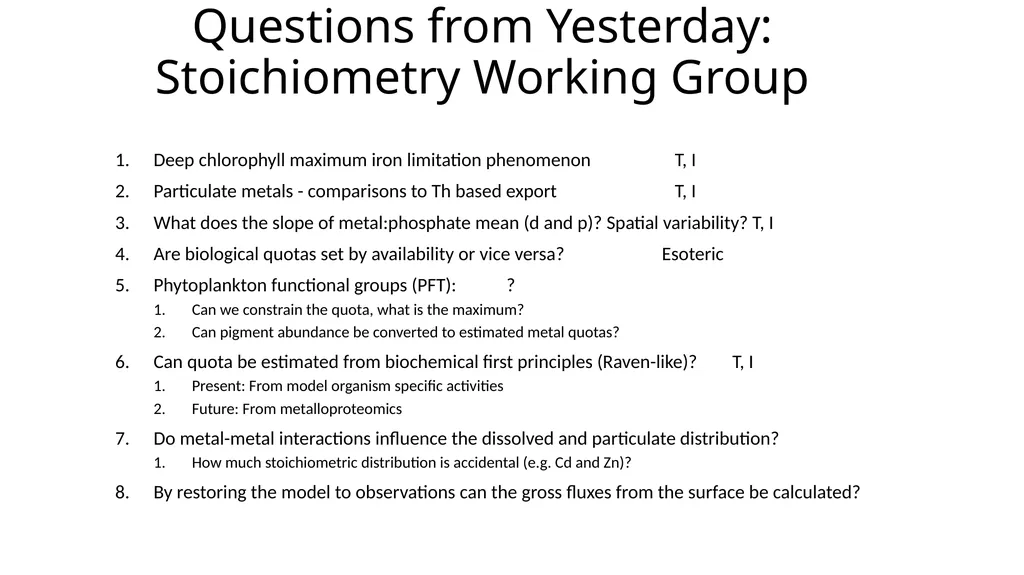
Stoichiometry Working Group Deep chlorophyll maximum iron limitation phenomenon T, I
Particulate metals - comparisons to Th based export T, I
What does the slope of metal:phosphate mean (d and p)? Spatial variability? T, I
Are biological quotas set by availability or vice versa? Esoteric
Phytoplankton functional groups (PFT): ?
Can we constrain the quota, what is the maximum?
Can pigment abundance be converted to estimated metal quotas?
Can quota be estimated from biochemical first principles (Raven-like)? T, I
Present: From model organism specific activities
Future: From metalloproteomics
Do metal-metal interactions influence the dissolved and particulate distribution?
How much stoichiometric distribution is accidental (e.g. Cd and Zn)?
By restoring the model to observations can the gross fluxes from the surface be calculated?<br>
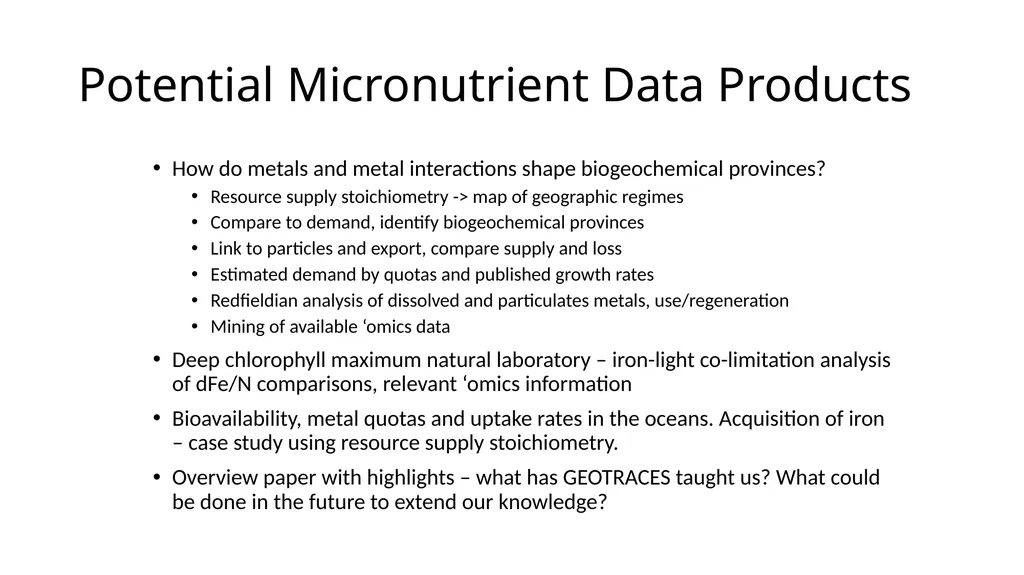
slide2. Potential Micronutrient Data Products How do metals and metal interactions shape biogeochemical provinces?
Resource supply stoichiometry -> map of geographic regimes
Compare to demand, identify biogeochemical provinces
Link to particles and export, compare supply and loss
Estimated demand by quotas and published growth rates
Redfieldian analysis of dissolved and particulates metals, use/regeneration
Mining of available ‘omics data
Deep chlorophyll maximum natural laboratory – iron-light co-limitation analysis of dFe/N comparisons, relevant ‘omics information
Bioavailability, metal quotas and uptake rates in the oceans. Acquisition of iron – case study using resource supply stoichiometry.
Overview paper with highlights – what has GEOTRACES taught us? What could be done in the future to extend our knowledge?<br>
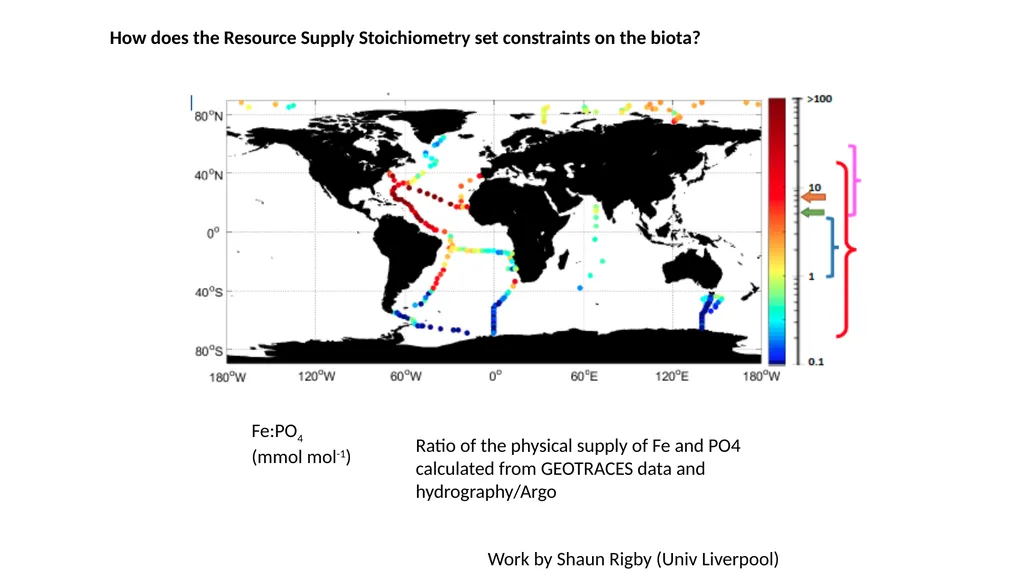
slide3. Work by Shaun Rigby (Univ Liverpool) Fe:PO4
(mmol mol-1) Ratio of the physical supply of Fe and PO4 calculated from GEOTRACES data and hydrography/Argo How does the Resource Supply Stoichiometry set constraints on the biota?<br>
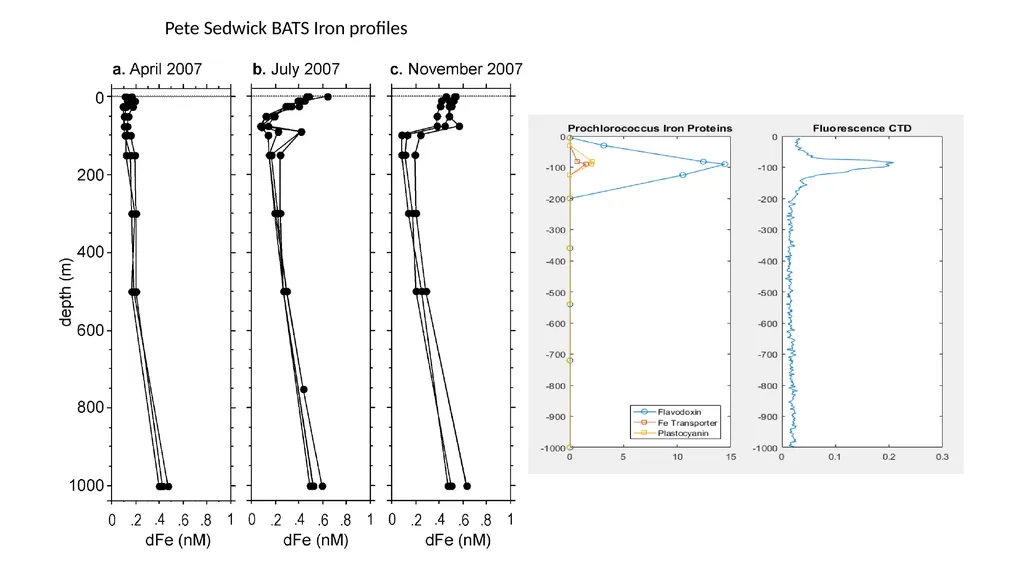
slide4. Pete Sedwick BATS Iron profiles<br>
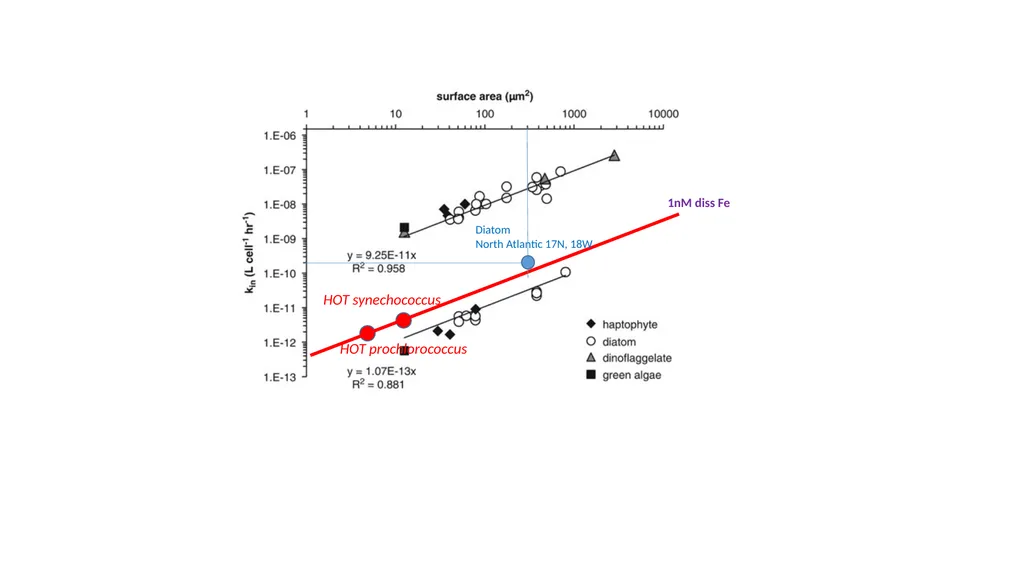
slide5. HOT prochlorococcus HOT synechococcus 1nM diss Fe<br>
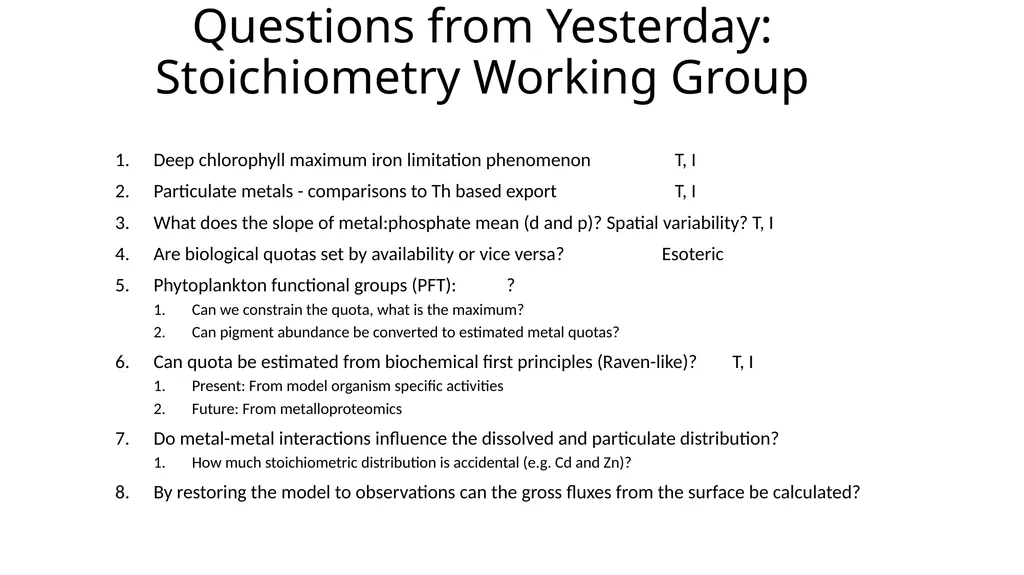
Particulate metals - comparisons to Th based export T, I
What does the slope of metal:phosphate mean (d and p)? Spatial variability? T, I
Are biological quotas set by availability or vice versa? Esoteric
Phytoplankton functional groups (PFT): ?
Can we constrain the quota, what is the maximum?
Can pigment abundance be converted to estimated metal quotas?
Can quota be estimated from biochemical first principles (Raven-like)? T, I
Present: From model organism specific activities
Future: From metalloproteomics
Do metal-metal interactions influence the dissolved and particulate distribution?
How much stoichiometric distribution is accidental (e.g. Cd and Zn)?
By restoring the model to observations can the gross fluxes from the surface be calculated?<br>
slide2. Potential Micronutrient Data Products How do metals and metal interactions shape biogeochemical provinces?
Resource supply stoichiometry -> map of geographic regimes
Compare to demand, identify biogeochemical provinces
Link to particles and export, compare supply and loss
Estimated demand by quotas and published growth rates
Redfieldian analysis of dissolved and particulates metals, use/regeneration
Mining of available ‘omics data
Deep chlorophyll maximum natural laboratory – iron-light co-limitation analysis of dFe/N comparisons, relevant ‘omics information
Bioavailability, metal quotas and uptake rates in the oceans. Acquisition of iron – case study using resource supply stoichiometry.
Overview paper with highlights – what has GEOTRACES taught us? What could be done in the future to extend our knowledge?<br>
slide3. Work by Shaun Rigby (Univ Liverpool) Fe:PO4
(mmol mol-1) Ratio of the physical supply of Fe and PO4 calculated from GEOTRACES data and hydrography/Argo How does the Resource Supply Stoichiometry set constraints on the biota?<br>
slide4. Pete Sedwick BATS Iron profiles<br>
slide5. HOT prochlorococcus HOT synechococcus 1nM diss Fe<br>