RD Collaboration Agreements AGENDA Introduction to Collaboration Agreements Definition and types Main areas and users Workflow Current situation Data analysis What are RD Collaboration Agreements? Scientific and technical collaborations
"R&D Collaboration Agreements AGENDA Introduction" is the property of its rightful owner. Permission is granted to
download and print the materials on this website for personal, non-commercial use only, and to display it
on your personal computer provided you do not modify the materials and that you retain all copyright
notices contained in the materials. By downloading content from our website, you accept the terms of this
agreement.
Presentation Transcript
01
R&D Collaboration Agreements<br>
02
AGENDA
Introduction to Collaboration Agreements
Definition and types
Main areas and users
Workflow
Current situation
Data analysis<br>
03
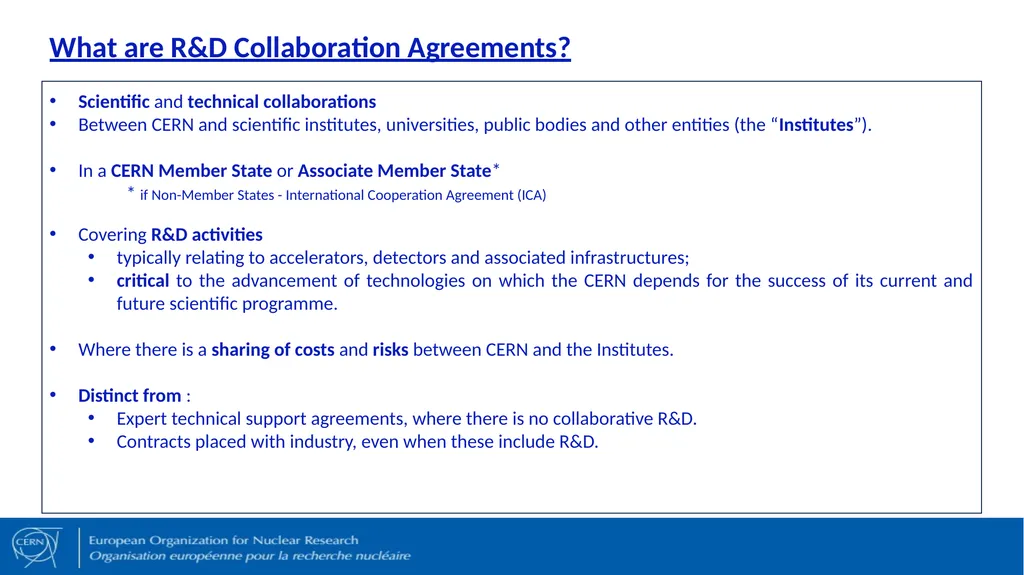
What are R&D Collaboration Agreements?
Scientific and technical collaborations
Between CERN and scientific institutes, universities, public bodies and other entities (the “Institutes”).
In a CERN Member State or Associate Member State*
* if Non-Member States - International Cooperation Agreement (ICA)
Covering R&D activities
typically relating to accelerators, detectors and associated infrastructures;
critical to the advancement of technologies on which the CERN depends for the success of its current and future scientific programme.
Where there is a sharing of costs and risks between CERN and the Institutes.
Distinct from :
Expert technical support agreements, where there is no collaborative R&D.
Contracts placed with industry, even when these include R&D.<br>
04
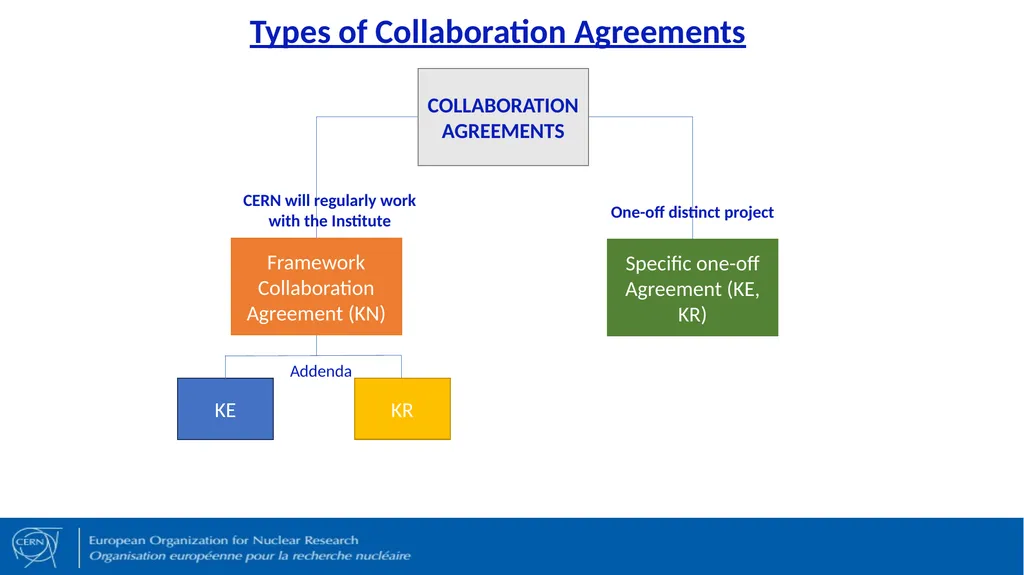
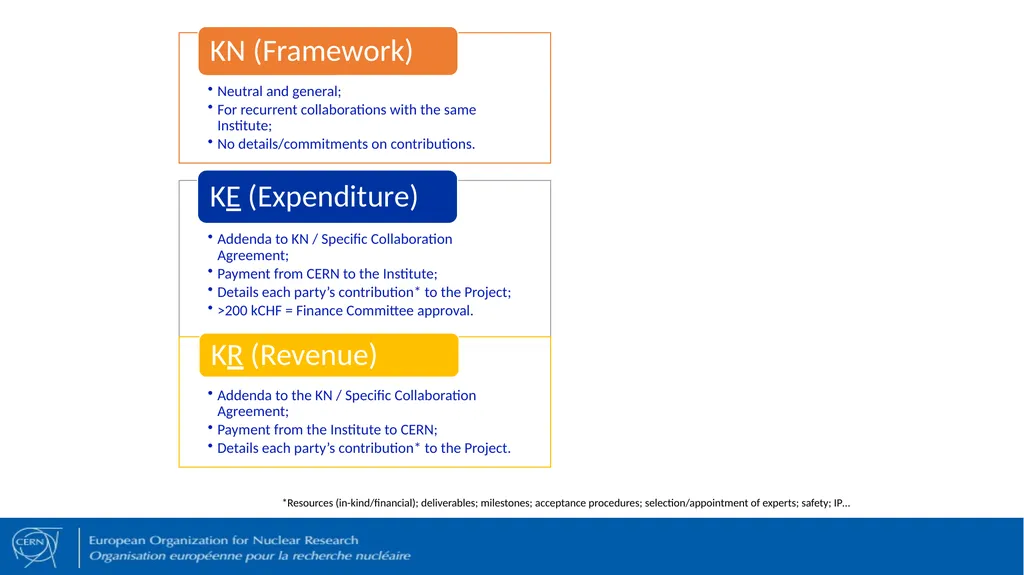
Types of Collaboration Agreements COLLABORATION
AGREEMENTS Specific one-off Agreement (KE, KR) Framework Collaboration Agreement (KN) KE KR One-off distinct project CERN will regularly work
with the Institute Addenda<br>
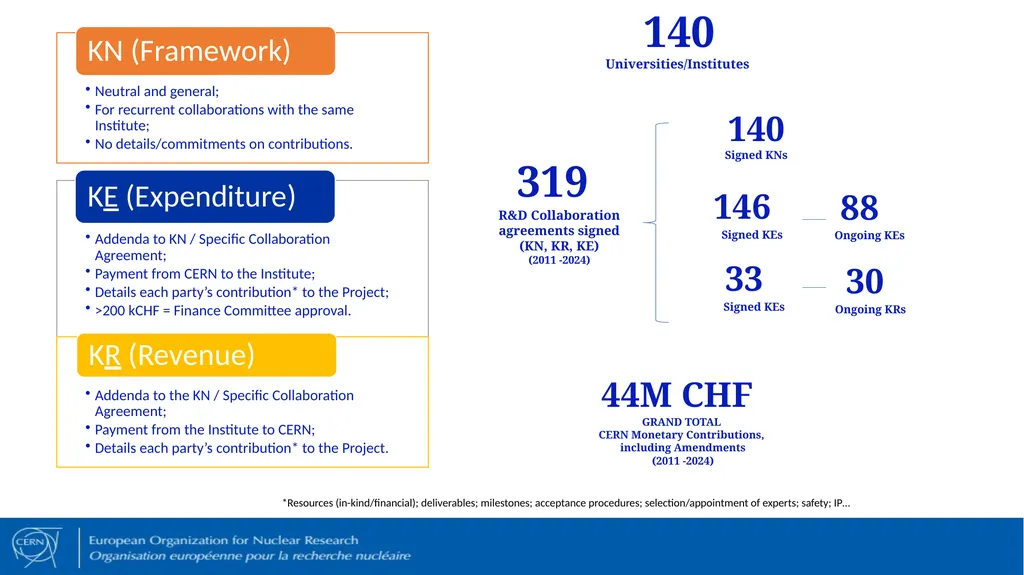
*Resources (in-kind/financial); deliverables; milestones; acceptance procedures; selection/appointment of experts; safety; IP… 319
R&D Collaboration
agreements signed
(KN, KR, KE)
(2011 -2024) 44M CHF
GRAND TOTAL
CERN Monetary Contributions,
including Amendments
(2011 -2024) 140
Universities/Institutes 30
Ongoing KRs 88
Ongoing KEs 140
Signed KNs 146
Signed KEs 33
Signed KEs<br>
07
Treatment of excavated materials Robotics and automation Integration Design of accelerator systems and infrastructure Design for manufacturing Material science (carbon fiber carbon composites, liquid lead absorption) HL-LHC<br>
08
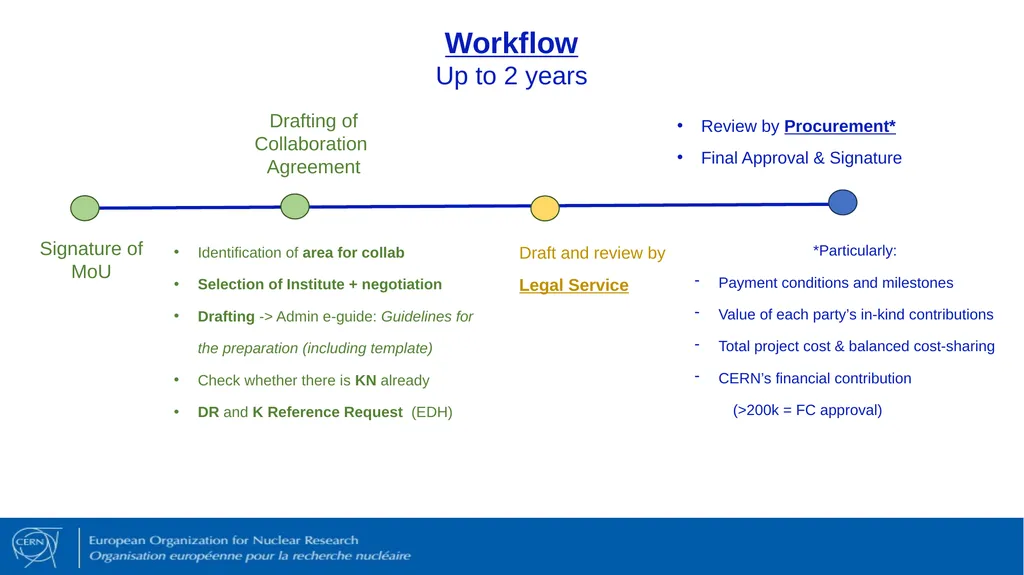
Signature of MoU Drafting of
Collaboration
Agreement Identification of area for collab
Selection of Institute + negotiation
Drafting -> Admin e-guide: Guidelines for the preparation (including template)
Check whether there is KN already
DR and K Reference Request (EDH) Draft and review by Legal Service Review by Procurement*
Final Approval & Signature Workflow
Up to 2 years *Particularly:
Payment conditions and milestones
Value of each party’s in-kind contributions
Total project cost & balanced cost-sharing
CERN’s financial contribution
(>200k = FC approval)<br>
09
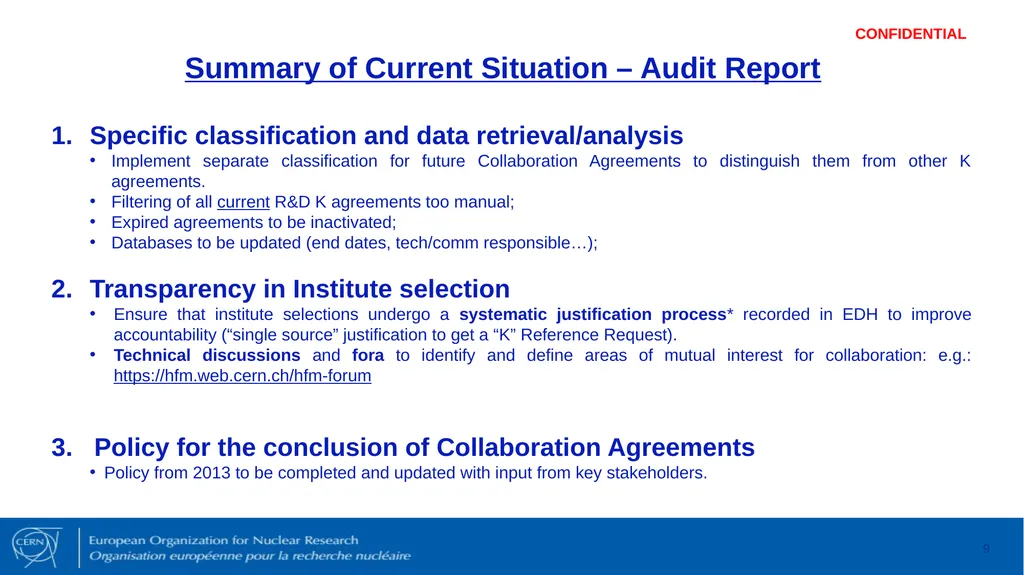
9 Specific classification and data retrieval/analysis
Implement separate classification for future Collaboration Agreements to distinguish them from other K agreements.
Filtering of all current R&D K agreements too manual;
Expired agreements to be inactivated;
Databases to be updated (end dates, tech/comm responsible…);
Transparency in Institute selection
Ensure that institute selections undergo a systematic justification process* recorded in EDH to improve accountability (“single source” justification to get a “K” Reference Request).
Technical discussions and fora to identify and define areas of mutual interest for collaboration: e.g.: https://hfm.web.cern.ch/hfm-forum
Policy for the conclusion of Collaboration Agreements
Policy from 2013 to be completed and updated with input from key stakeholders. Summary of Current Situation – Audit Report CONFIDENTIAL<br>
10
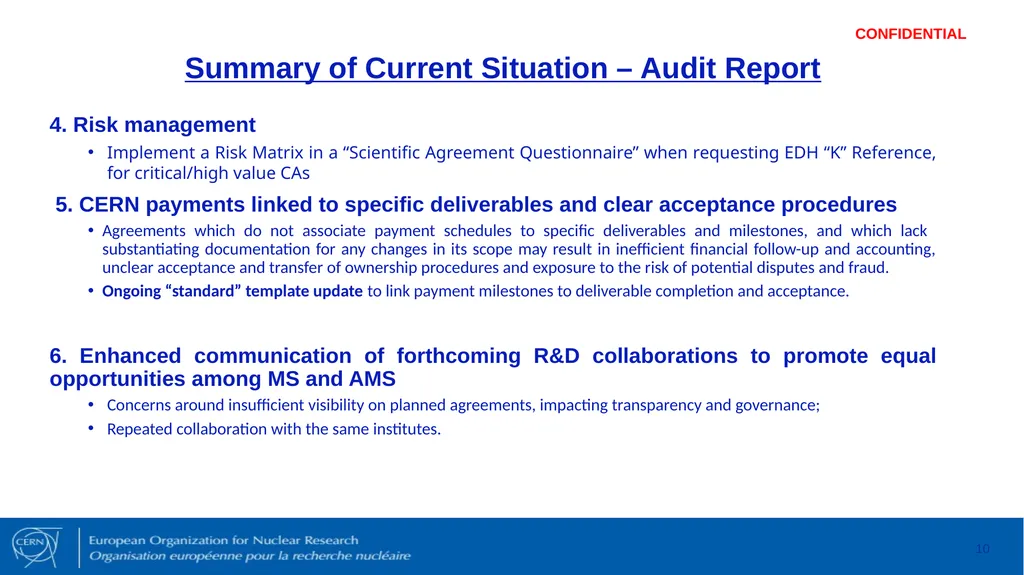
10 Summary of Current Situation – Audit Report CONFIDENTIAL 4. Risk management
Implement a Risk Matrix in a “Scientific Agreement Questionnaire” when requesting EDH “K” Reference, for critical/high value CAs
5. CERN payments linked to specific deliverables and clear acceptance procedures
Agreements which do not associate payment schedules to specific deliverables and milestones, and which lack substantiating documentation for any changes in its scope may result in inefficient financial follow-up and accounting, unclear acceptance and transfer of ownership procedures and exposure to the risk of potential disputes and fraud.
Ongoing “standard” template update to link payment milestones to deliverable completion and acceptance.
6. Enhanced communication of forthcoming R&D collaborations to promote equal opportunities among MS and AMS
Concerns around insufficient visibility on planned agreements, impacting transparency and governance;
Repeated collaboration with the same institutes.<br>
11
CERN’s criteria for entering into collaboration agreements
Technical competence and experience of the institute in the relevant domain.
Willingness of the institute to participate in the collaboration, to share in its risks and to contribute to its costs.
Scope for building long-term relationships on which future CERN projects may depend, including the establishment of an industrial base.
Need to establish a global network of collaborators, in line with the recommendations of the European Strategy for Particle Physics (ESPP).<br>
12
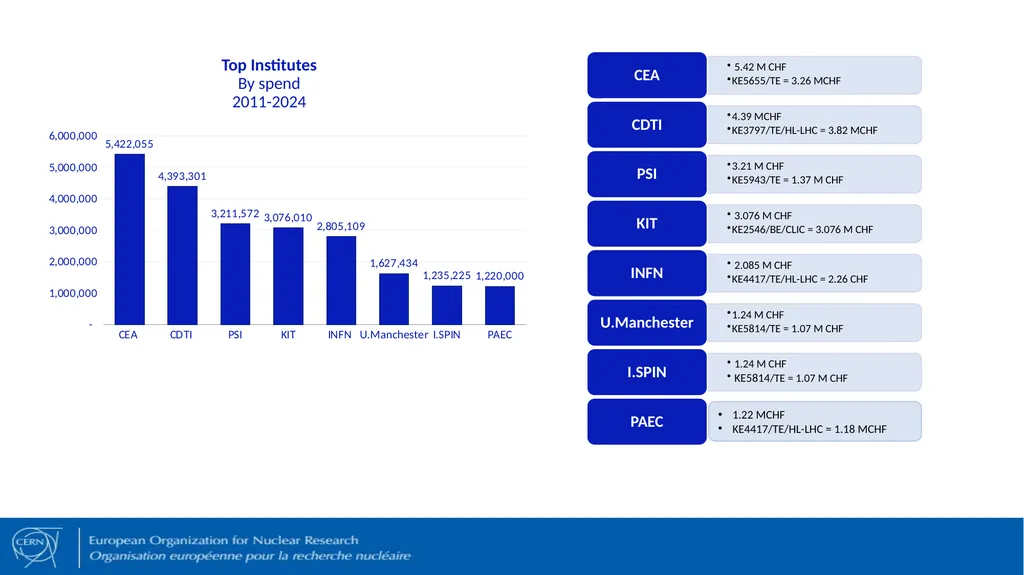
Top Institutes By spend 2011-2024 1.22 MCHF
KE4417/TE/HL-LHC = 1.18 MCHF<br>
13
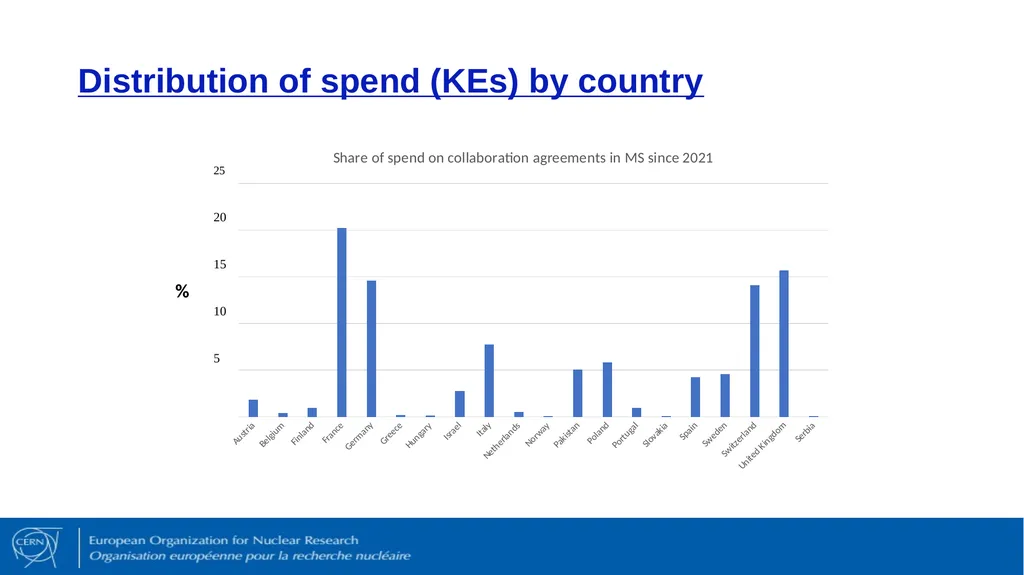
Distribution of spend (KEs) by country %<br>
14
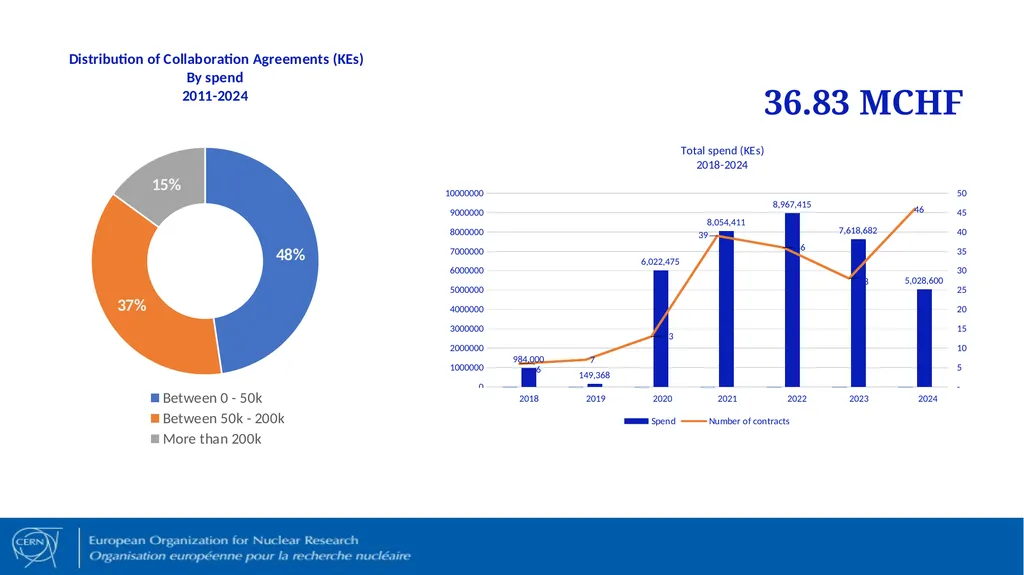
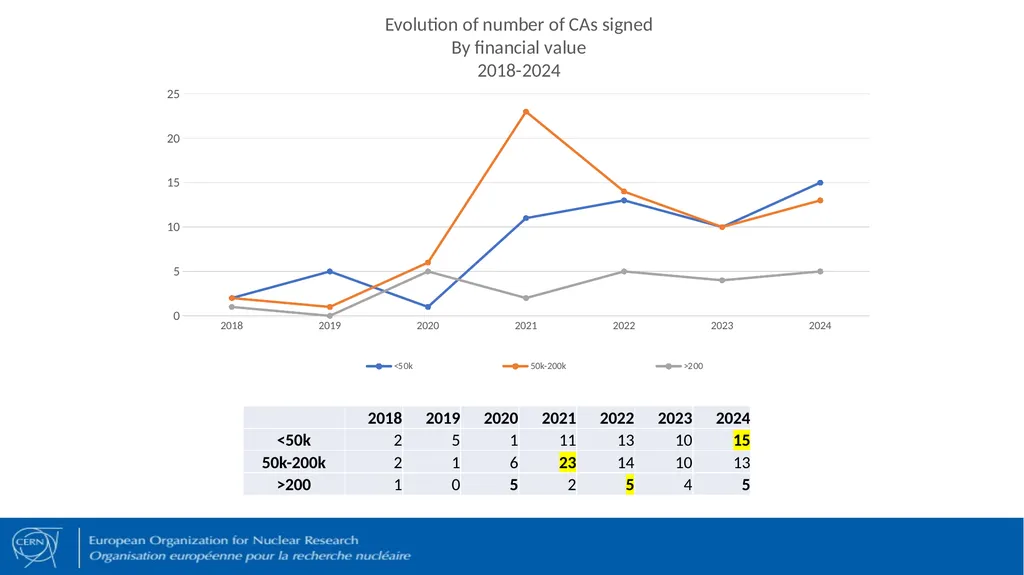
36.83 MCHF 2018 2019 2020 2021 2022 2023 2024<br>
15
Summary Not all K agreements are CAs, but all CAs are K agreements;
KN (Framework), KE (Expenditure), KR (Revenue);
The entire process can take up to 2 years;
Balanced shared of costs between CERN and the Institute;
Cost of the Project = sum of all in-kind contributions;
CERN’s financial contribution is made to balance out the situation;
Top Institutes by Spend are CEA, CDTI & PSI (only a couple high value CAs);
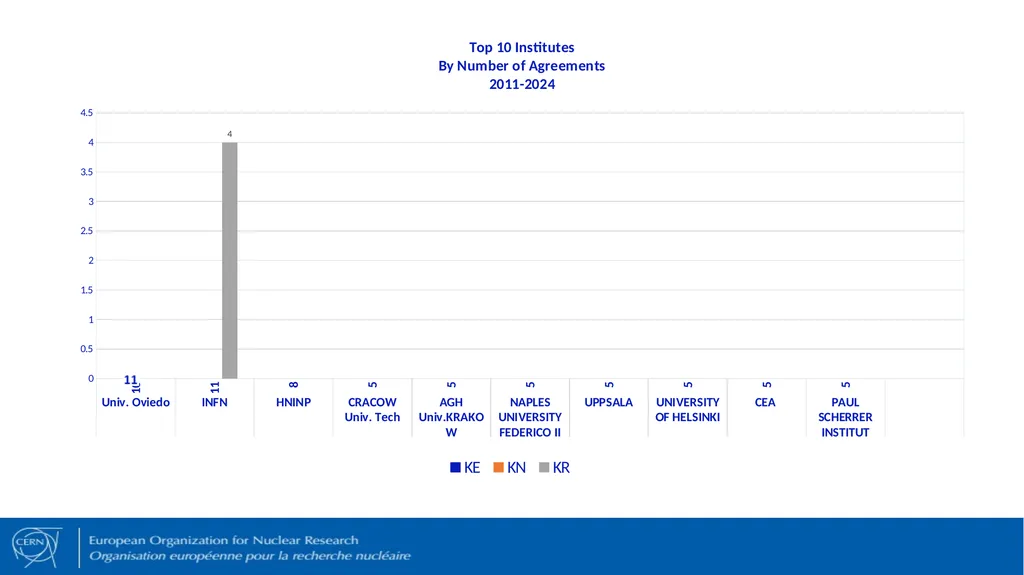
Top Institutes by Number of Agreements are U.Oviedo, INFN, HNINP (between 11 – 8 agreements each, most of them <200 kCHF);
Main current Collaboration Agreement users are FCC and HFM.
Risks related to Collaboration Agreements may go unidentified and be difficult to mitigate.<br>