Rationality and Effectiveness in Regulation Luis Ferney Moreno PhD 23092026 Our Understanding of Regulation Regulation sits on a legal foundation, but its design requires economics, engineering, and data science to work in practice.
"Rationality and Effectiveness in Regulation Luis" is the property of its rightful owner. Permission is granted to
download and print the materials on this website for personal, non-commercial use only, and to display it
on your personal computer provided you do not modify the materials and that you retain all copyright
notices contained in the materials. By downloading content from our website, you accept the terms of this
agreement.
Presentation Transcript
01
Rationality and Effectiveness in Regulation
Luis Ferney Moreno PhD 23/09/2026<br>
02
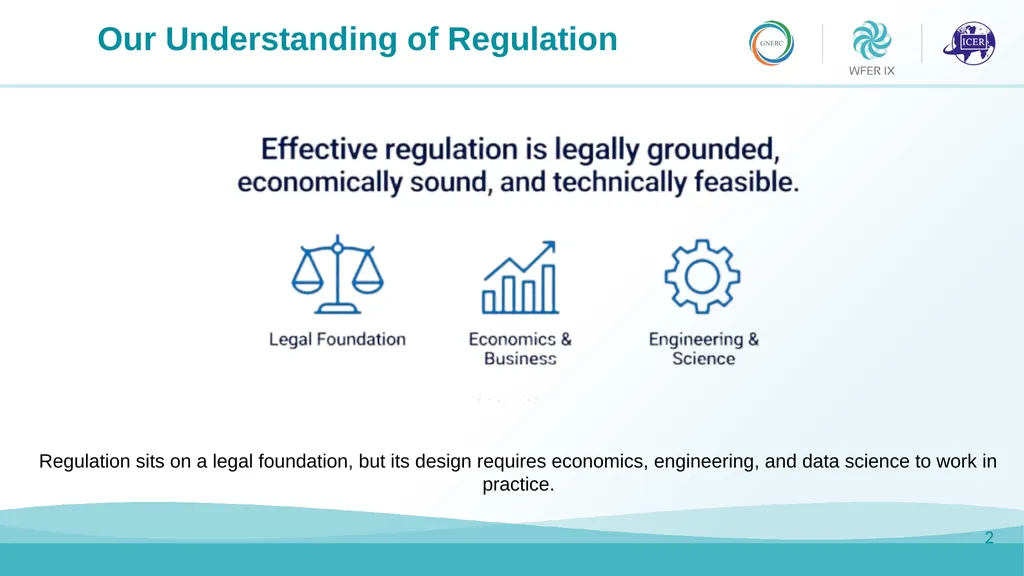
Our Understanding of Regulation Regulation sits on a legal foundation, but its design requires economics, engineering, and data science to work in practice.<br>
03
Rationality of regulatory decision-making<br>
04
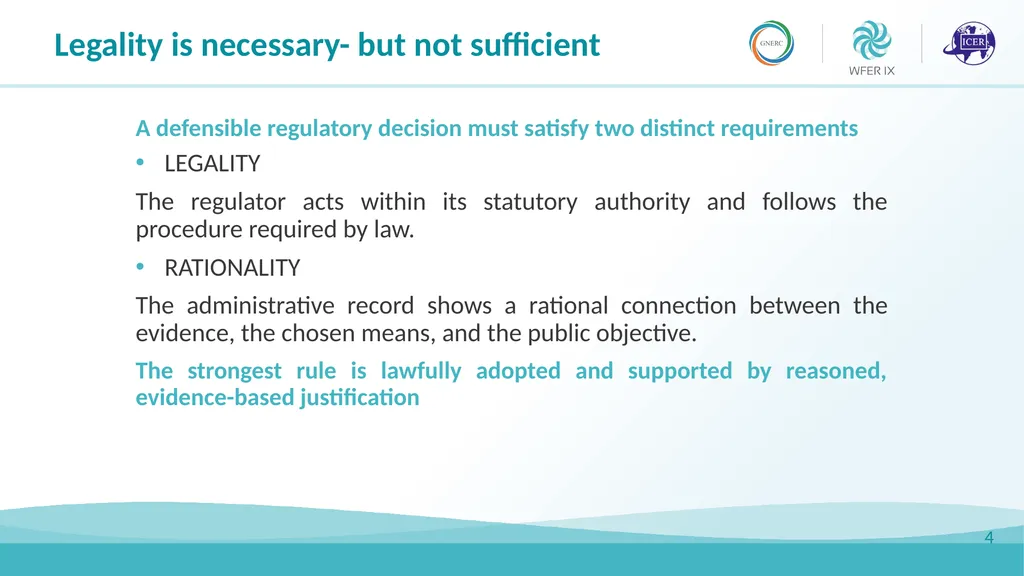
Legality is necessary- but not sufficient LEGALITY
The regulator acts within its statutory authority and follows the procedure required by law.
RATIONALITY
The administrative record shows a rational connection between the evidence, the chosen means, and the public objective.
The strongest rule is lawfully adopted and supported by reasoned, evidence-based justification A defensible regulatory decision must satisfy two distinct requirements<br>
05
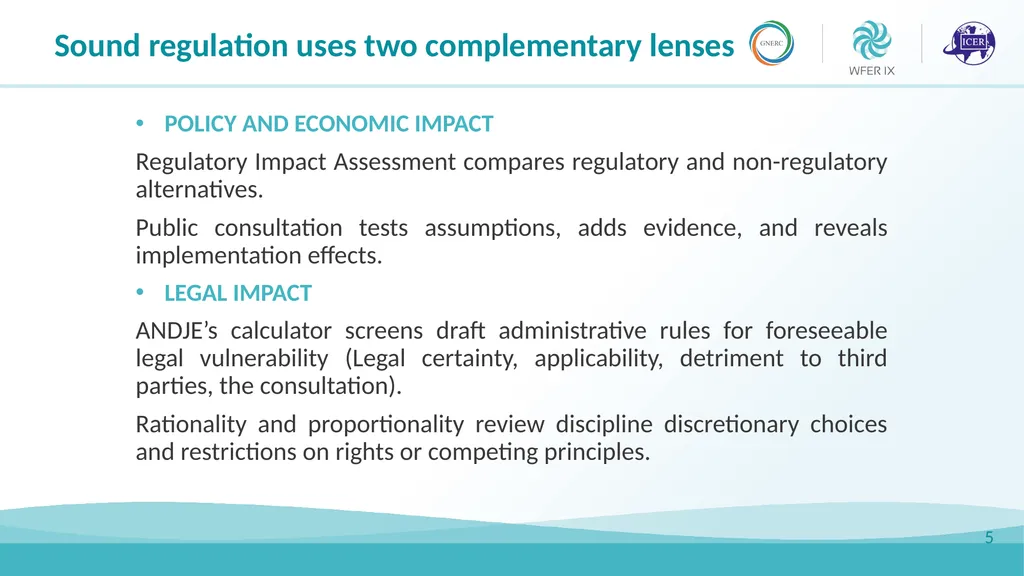
Sound regulation uses two complementary lenses POLICY AND ECONOMIC IMPACT
Regulatory Impact Assessment compares regulatory and non-regulatory alternatives.
Public consultation tests assumptions, adds evidence, and reveals implementation effects.
LEGAL IMPACT
ANDJE’s calculator screens draft administrative rules for foreseeable legal vulnerability (Legal certainty, applicability, detriment to third parties, the consultation).
Rationality and proportionality review discipline discretionary choices and restrictions on rights or competing principles.<br>
06
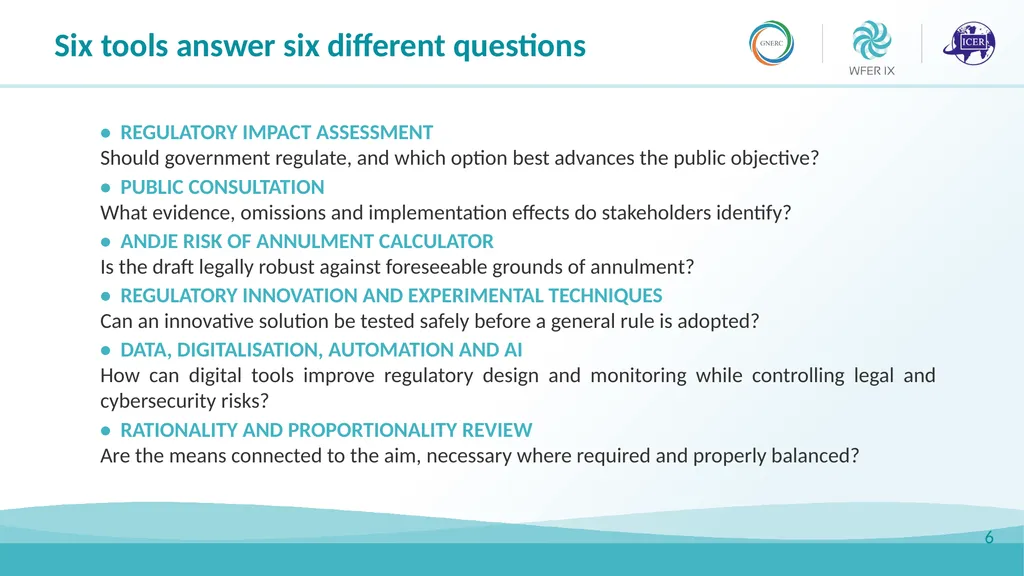
Six tools answer six different questions • REGULATORY IMPACT ASSESSMENT
Should government regulate, and which option best advances the public objective?
• PUBLIC CONSULTATION
What evidence, omissions and implementation effects do stakeholders identify?
• ANDJE RISK OF ANNULMENT CALCULATOR
Is the draft legally robust against foreseeable grounds of annulment?
• REGULATORY INNOVATION AND EXPERIMENTAL TECHNIQUES
Can an innovative solution be tested safely before a general rule is adopted?
• DATA, DIGITALISATION, AUTOMATION AND AI
How can digital tools improve regulatory design and monitoring while controlling legal and cybersecurity risks?
• RATIONALITY AND PROPORTIONALITY REVIEW
Are the means connected to the aim, necessary where required and properly balanced?<br>
07
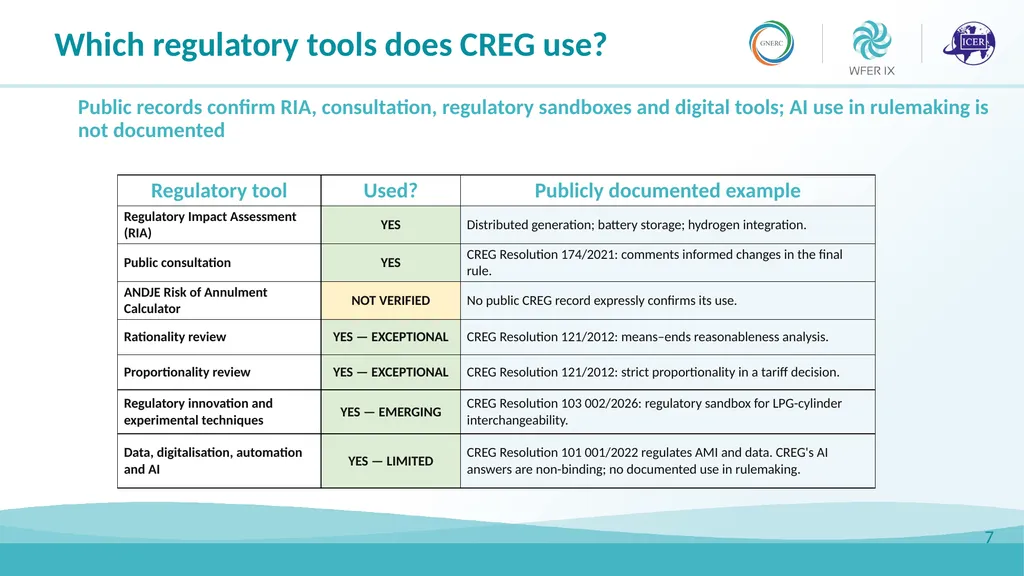
Which regulatory tools does CREG use? Public records confirm RIA, consultation, regulatory sandboxes and digital tools; AI use in rulemaking is not documented<br>
08
Regulatory effectiveness Implementation, compliance and achievement of outcomes<br>
09
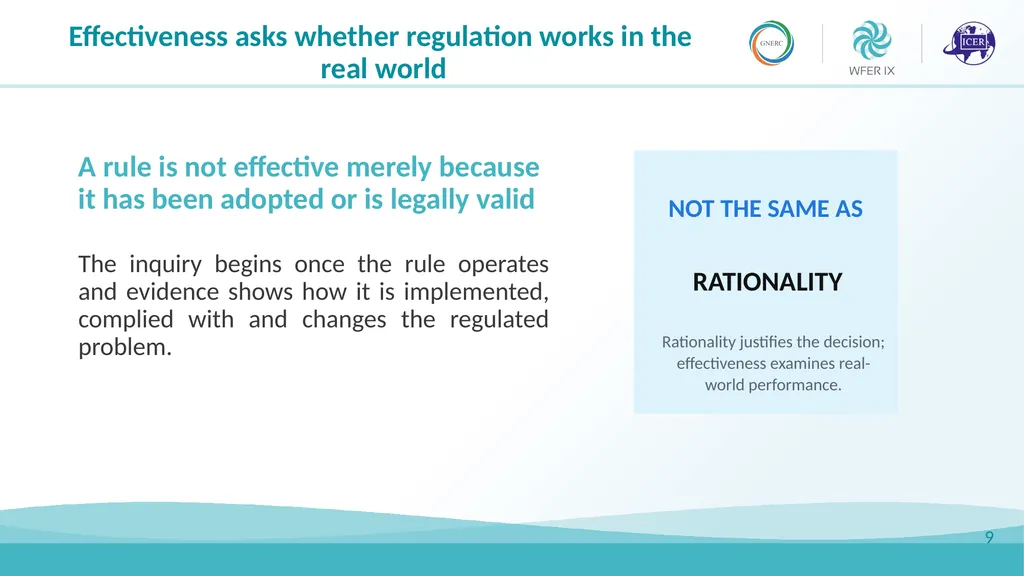
The inquiry begins once the rule operates and evidence shows how it is implemented, complied with and changes the regulated problem. Effectiveness asks whether regulation works in the real world A rule is not effective merely because it has been adopted or is legally valid NOT THE SAME AS RATIONALITY Rationality justifies the decision; effectiveness examines real-world performance.<br>
10
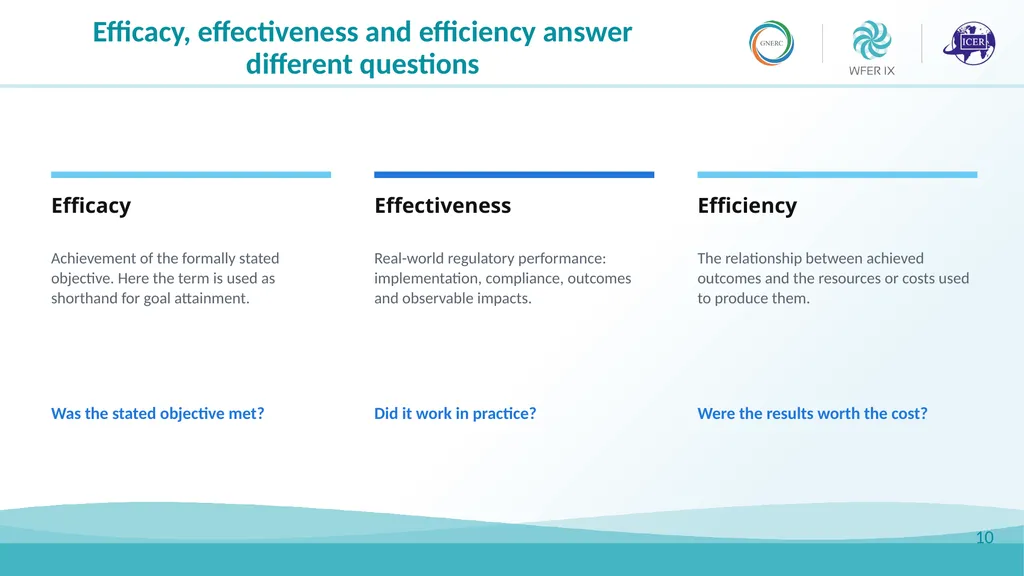
Efficacy, effectiveness and efficiency answer different questions Efficacy Achievement of the formally stated objective. Here the term is used as shorthand for goal attainment. Was the stated objective met? Effectiveness Real-world regulatory performance: implementation, compliance, outcomes and observable impacts. Did it work in practice? Efficiency The relationship between achieved outcomes and the resources or costs used to produce them. Were the results worth the cost?<br>
11
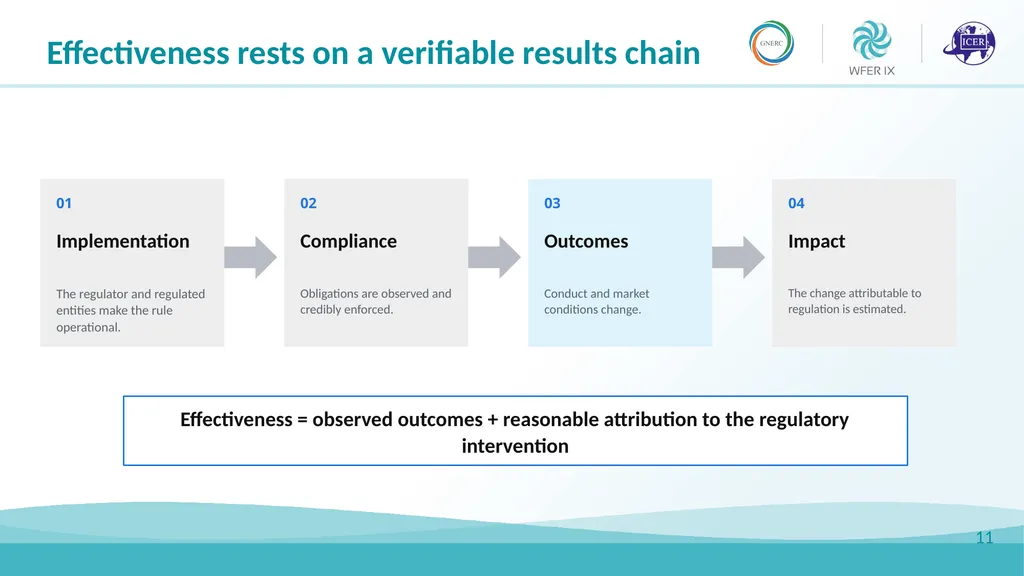
Effectiveness rests on a verifiable results chain 01 Implementation The regulator and regulated entities make the rule operational. 02 Compliance Obligations are observed and credibly enforced. 03 Outcomes Conduct and market conditions change. 04 Impact The change attributable to regulation is estimated. Effectiveness = observed outcomes + reasonable attribution to the regulatory intervention<br>
12
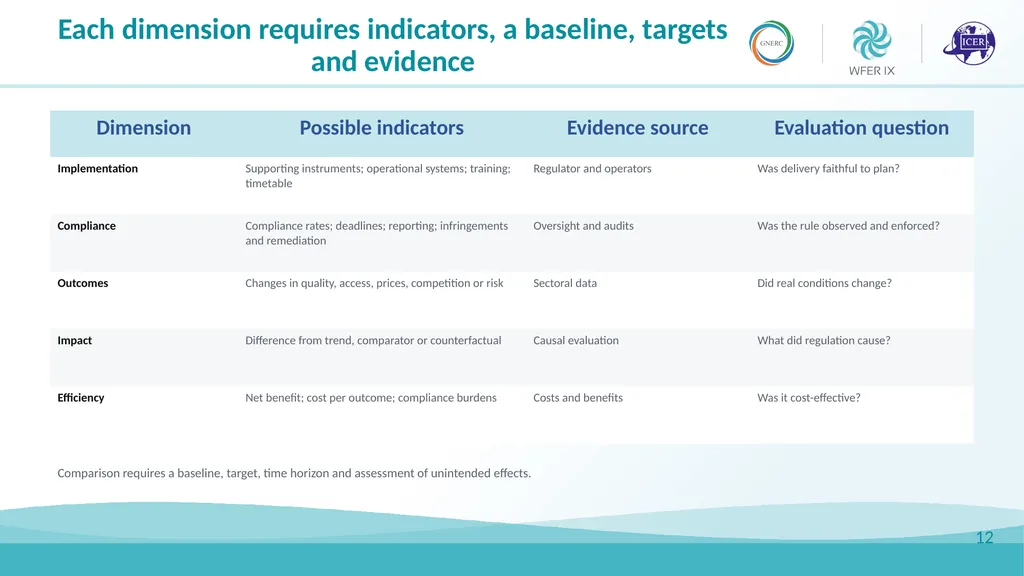
Each dimension requires indicators, a baseline, targets and evidence Comparison requires a baseline, target, time horizon and assessment of unintended effects.<br>
13
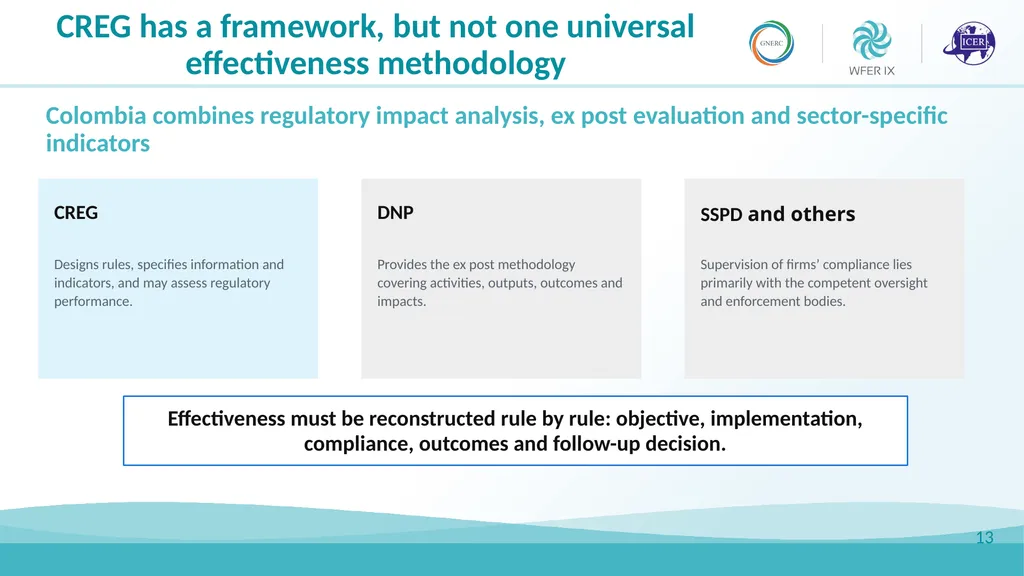
CREG has a framework, but not one universal effectiveness methodology Effectiveness must be reconstructed rule by rule: objective, implementation, compliance, outcomes and follow-up decision. Colombia combines regulatory impact analysis, ex post evaluation and sector-specific indicators CREG Designs rules, specifies information and indicators, and may assess regulatory performance. DNP Provides the ex post methodology covering activities, outputs, outcomes and impacts. SSPD and others Supervision of firms’ compliance lies primarily with the competent oversight and enforcement bodies.<br>
14
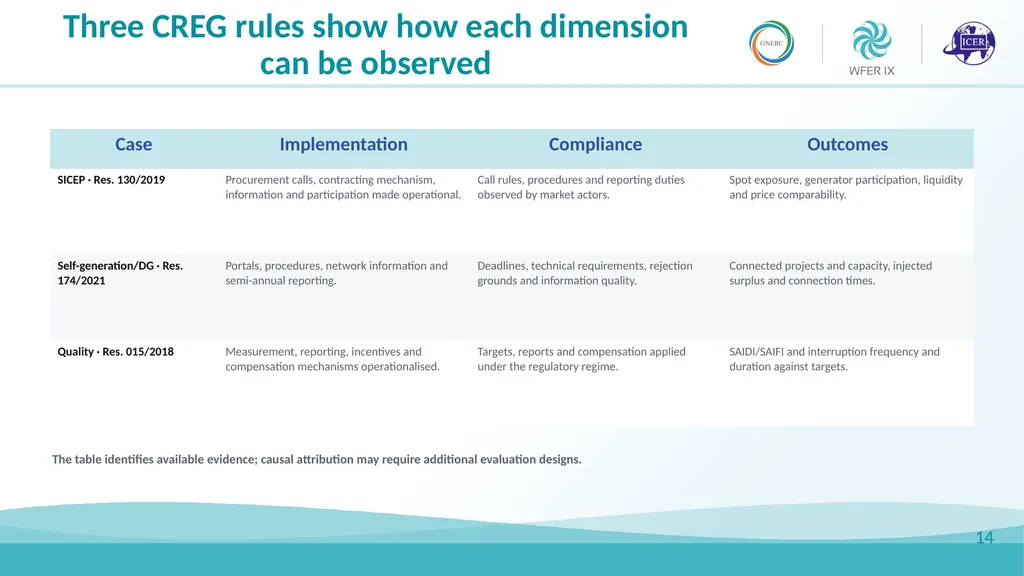
Three CREG rules show how each dimension can be observed The table identifies available evidence; causal attribution may require additional evaluation designs.<br>
15
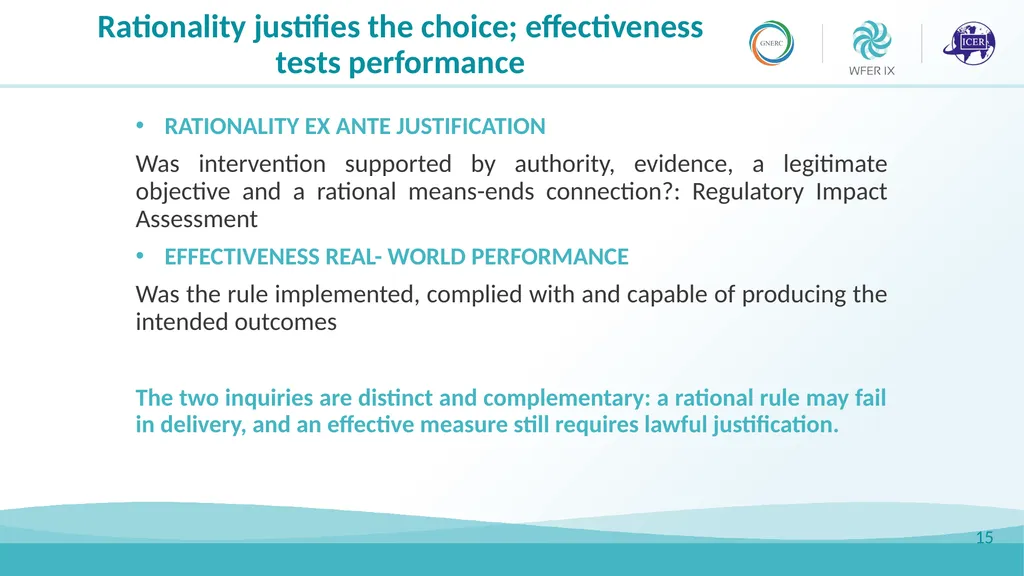
Rationality justifies the choice; effectiveness tests performance RATIONALITY EX ANTE JUSTIFICATION
Was intervention supported by authority, evidence, a legitimate objective and a rational means-ends connection?: Regulatory Impact Assessment
EFFECTIVENESS REAL- WORLD PERFORMANCE
Was the rule implemented, complied with and capable of producing the intended outcomes
The two inquiries are distinct and complementary: a rational rule may fail in delivery, and an effective measure still requires lawful justification.<br>