
RBHS Faculty Search Committee Training Roadmap
LS
Published · 27 slides · 0 views
1 / 1

Description
RBHS Faculty Search Committee Training Roadmap IntroductionEngagement Activity Search Committee Charge General Expectations Policies and Procedures Advertising and Recruitment Review of Applications Interviews and Campus Visits Presenting
Related Topics
Share
Embed code
Download this presentation From Below
"RBHS Faculty Search Committee Training Roadmap" is the property of its rightful owner. Permission is granted to download and print the materials on this website for personal, non-commercial use only, and to display it on your personal computer provided you do not modify the materials and that you retain all copyright notices contained in the materials. By downloading content from our website, you accept the terms of this agreement.
Presentation Transcript
01
RBHS Faculty Search Committee Training<br>
02
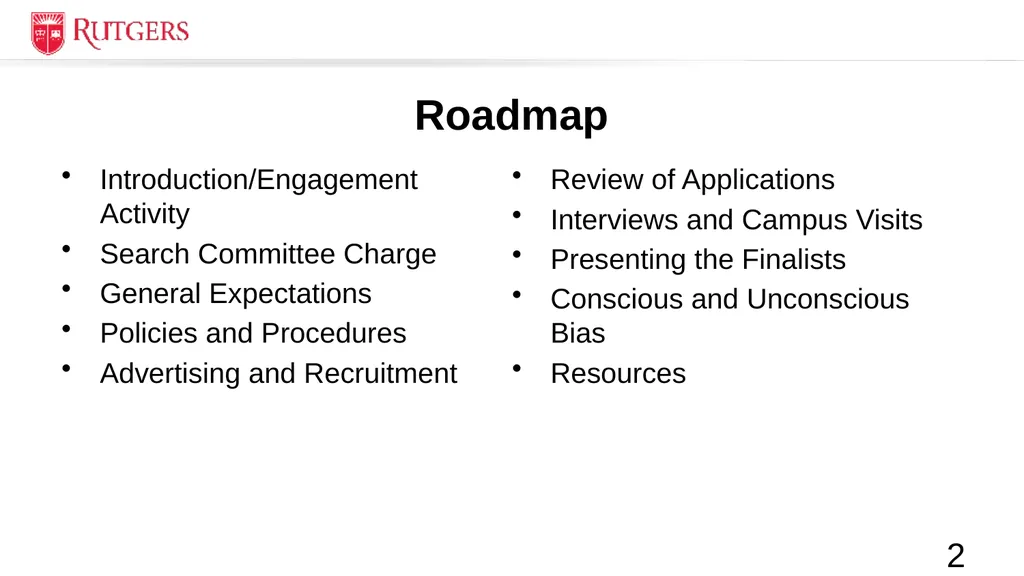
Roadmap Introduction/Engagement Activity
Search Committee Charge
General Expectations
Policies and Procedures
Advertising and Recruitment
Review of Applications
Interviews and Campus Visits
Presenting the Finalists
Conscious and Unconscious Bias
Resources 2<br>
Search Committee Charge
General Expectations
Policies and Procedures
Advertising and Recruitment
Review of Applications
Interviews and Campus Visits
Presenting the Finalists
Conscious and Unconscious Bias
Resources 2<br>
03
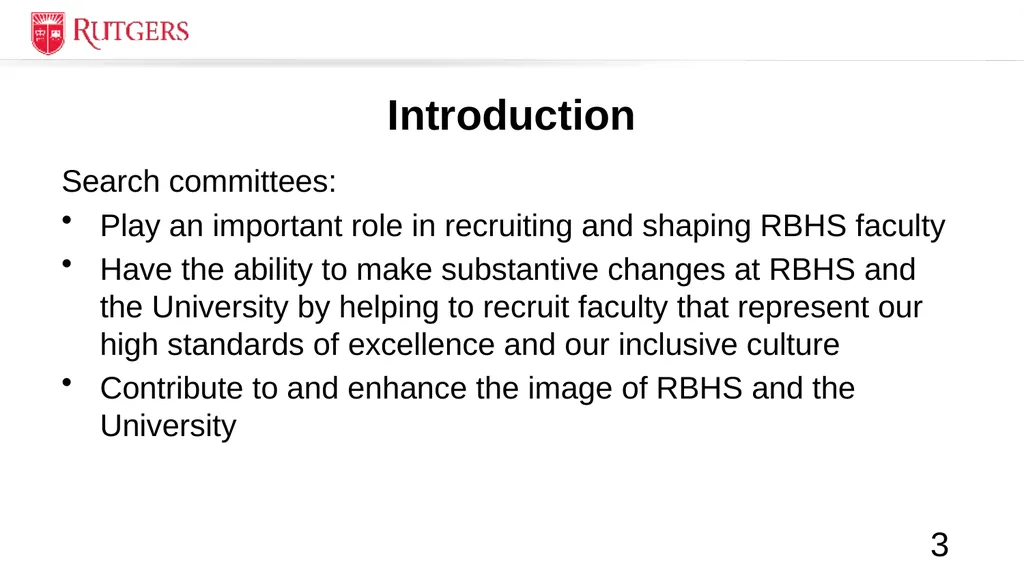
Introduction Search committees:
Play an important role in recruiting and shaping RBHS faculty
Have the ability to make substantive changes at RBHS and the University by helping to recruit faculty that represent our high standards of excellence and our inclusive culture
Contribute to and enhance the image of RBHS and the University 3<br>
Play an important role in recruiting and shaping RBHS faculty
Have the ability to make substantive changes at RBHS and the University by helping to recruit faculty that represent our high standards of excellence and our inclusive culture
Contribute to and enhance the image of RBHS and the University 3<br>
04
Introductions and Engagement Activity Introduce yourself
Name, Rank/Title, School/Department
What are the elements of a good search?
What are the biggest challenges to recruiting the best candidates? 4<br>
Name, Rank/Title, School/Department
What are the elements of a good search?
What are the biggest challenges to recruiting the best candidates? 4<br>
05
Search Committee Charge – Search Details Position(s) to be filled – rank(s)/title(s)
Scope of the search – internal, local, national or international
Deadlines
Discuss any unique factors or history regarding this search (i.e. a reposted position, challenges during prior recruitments, challenges within the department/school) 5<br>
Scope of the search – internal, local, national or international
Deadlines
Discuss any unique factors or history regarding this search (i.e. a reposted position, challenges during prior recruitments, challenges within the department/school) 5<br>
06
General Expectations Attendance – search members are required to attend all search committee meetings and activities
Keep all materials and proceedings related to the search committee confidential.
Decide, ahead of time, if voting will be unanimous or majority, if you will allow absentee votes, or confidential ballots. Confidential voting is a best practice because it protects vulnerable faculty from undue influence, allows for each voice to be heard, and can reduce inter-departmental disagreements. 6<br>
Keep all materials and proceedings related to the search committee confidential.
Decide, ahead of time, if voting will be unanimous or majority, if you will allow absentee votes, or confidential ballots. Confidential voting is a best practice because it protects vulnerable faculty from undue influence, allows for each voice to be heard, and can reduce inter-departmental disagreements. 6<br>
07
Policies and Procedures Faculty Appointments Manual
RBHS Diversity and Inclusion Statement
Rutgers Diversity and Employment Equity 7<br>
RBHS Diversity and Inclusion Statement
Rutgers Diversity and Employment Equity 7<br>
08
Advertising and Recruitment The search committee may participate in the development of the job description
The search committee may suggest venues, or additional venues, for advertisement of the position
The search committee participates in the search process not just the selection process
Committee members shall contact professional organizations, colleagues, prior students, and other professional contacts to spread the word about the position
Committee members share input on where the position should be advertised in order to attract a diverse pool of candidates 8<br>
The search committee may suggest venues, or additional venues, for advertisement of the position
The search committee participates in the search process not just the selection process
Committee members shall contact professional organizations, colleagues, prior students, and other professional contacts to spread the word about the position
Committee members share input on where the position should be advertised in order to attract a diverse pool of candidates 8<br>
09
Review of Applications Starting with the criteria in the position description, the committee should discuss and agree on how it will define and weigh competencies and qualifications.
Creating an evaluation matrix or rubric will streamline the initial review of candidates. (Example: HERC Evaluation Template)
Review applications and select candidate for interview.
Note: once applicants are selected, the department administrator submits the list through ROCS to the Office of Employment Equity (OEE) who will approve the candidate list for interviewing. Interviews may NOT be scheduled until approval from OEE. 9<br>
Creating an evaluation matrix or rubric will streamline the initial review of candidates. (Example: HERC Evaluation Template)
Review applications and select candidate for interview.
Note: once applicants are selected, the department administrator submits the list through ROCS to the Office of Employment Equity (OEE) who will approve the candidate list for interviewing. Interviews may NOT be scheduled until approval from OEE. 9<br>
10
Interviews and Campus Visits The goals of the interview process are to gather information about candidates, create a positive image of the department, school, and RBHS, present a realistic description of the position, ensure that all applicants have been treated fairly, establish adequate records in the event the selection decision must be justified, and, ultimately, to select qualified candidates to present to the hiring officer.
Ensure equitable treatment of all candidates with consistency in scheduling logistics, information, meals, transportation, lodging, and campus tours.
Ask candidates who, if anyone, they would like to meet outside your department/unit (let them take the lead in identifying if they would like to speak with, perhaps other women faculty or faculty from underrepresented populations, potential collaborators, etc.). 10<br>
Ensure equitable treatment of all candidates with consistency in scheduling logistics, information, meals, transportation, lodging, and campus tours.
Ask candidates who, if anyone, they would like to meet outside your department/unit (let them take the lead in identifying if they would like to speak with, perhaps other women faculty or faculty from underrepresented populations, potential collaborators, etc.). 10<br>
11
Interviews and Campus Visits Determine what materials and information will be provided to the candidates in advance of the interview process.
Decide on the interview format for candidates
Initial interviews may be done in person or by videoconference or telephone but all initial interviews should follow the same format.
Generally, it is required that final interviews be done in person but there may be exceptions given the COVID-19 crisis.
During the final interviews, this may include additional meetings with RU faculty, deans, and leadership. 11<br>
Decide on the interview format for candidates
Initial interviews may be done in person or by videoconference or telephone but all initial interviews should follow the same format.
Generally, it is required that final interviews be done in person but there may be exceptions given the COVID-19 crisis.
During the final interviews, this may include additional meetings with RU faculty, deans, and leadership. 11<br>
12
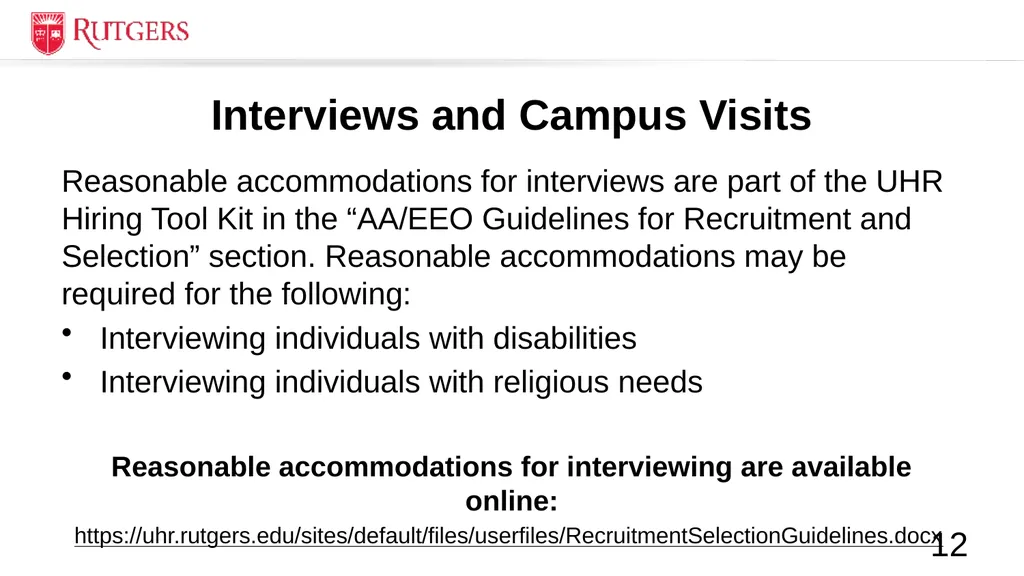
Interviews and Campus Visits Reasonable accommodations for interviews are part of the UHR Hiring Tool Kit in the “AA/EEO Guidelines for Recruitment and Selection” section. Reasonable accommodations may be required for the following:
Interviewing individuals with disabilities
Interviewing individuals with religious needs
Reasonable accommodations for interviewing are available online:
https://uhr.rutgers.edu/sites/default/files/userfiles/RecruitmentSelectionGuidelines.docx 12<br>
Interviewing individuals with disabilities
Interviewing individuals with religious needs
Reasonable accommodations for interviewing are available online:
https://uhr.rutgers.edu/sites/default/files/userfiles/RecruitmentSelectionGuidelines.docx 12<br>
13
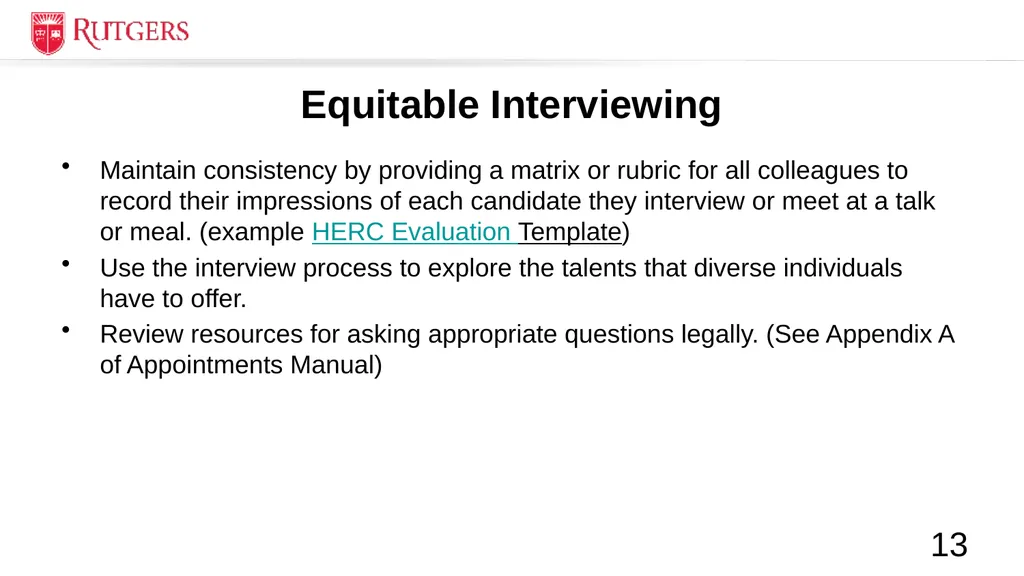
Equitable Interviewing Maintain consistency by providing a matrix or rubric for all colleagues to record their impressions of each candidate they interview or meet at a talk or meal. (example HERC Evaluation Template)
Use the interview process to explore the talents that diverse individuals have to offer.
Review resources for asking appropriate questions legally. (See Appendix A of Appointments Manual) 13<br>
Use the interview process to explore the talents that diverse individuals have to offer.
Review resources for asking appropriate questions legally. (See Appendix A of Appointments Manual) 13<br>
14
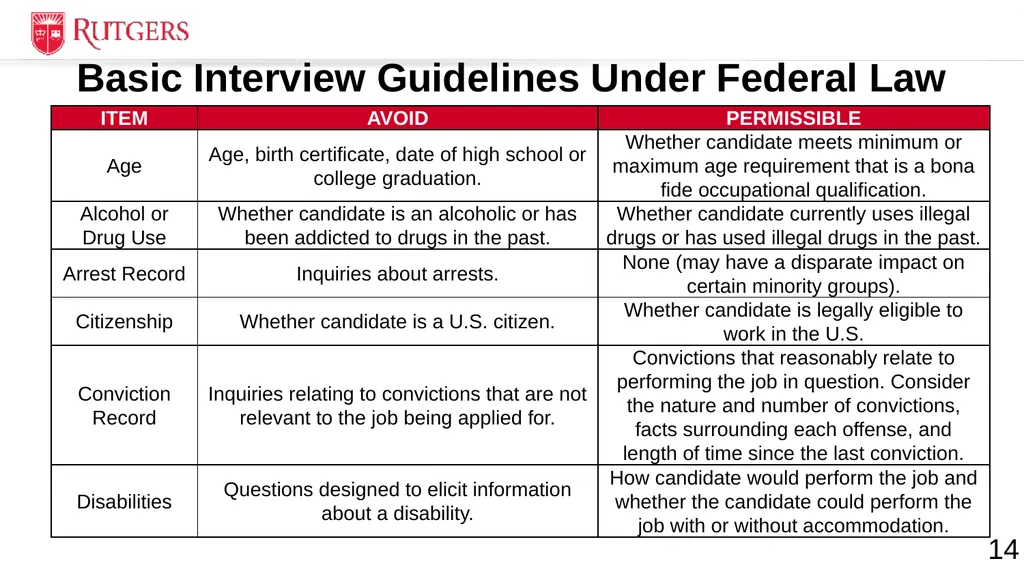
Basic Interview Guidelines Under Federal Law 14<br>
15
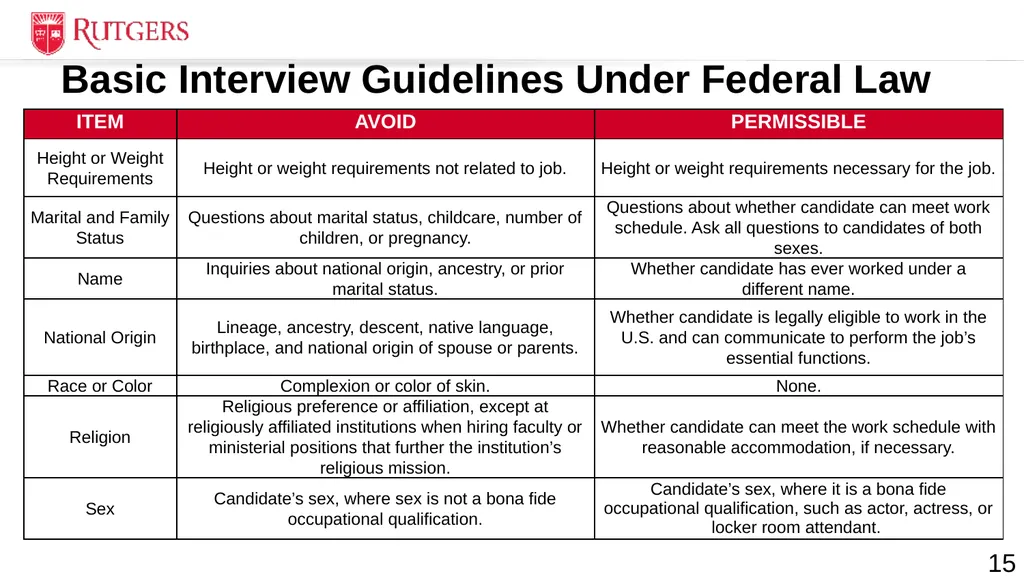
Basic Interview Guidelines Under Federal Law 15<br>
16
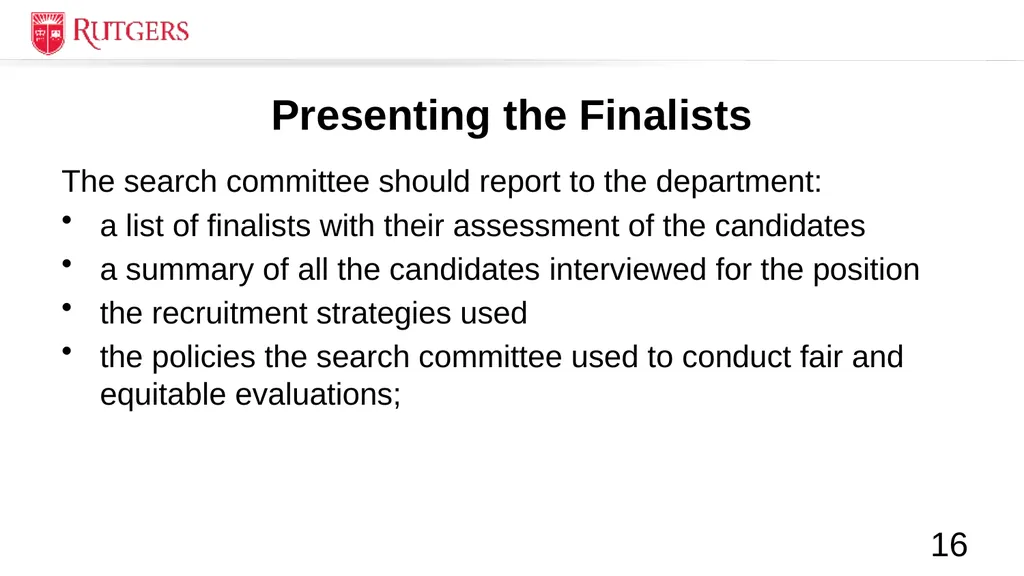
Presenting the Finalists The search committee should report to the department:
a list of finalists with their assessment of the candidates
a summary of all the candidates interviewed for the position
the recruitment strategies used
the policies the search committee used to conduct fair and equitable evaluations; 16<br>
a list of finalists with their assessment of the candidates
a summary of all the candidates interviewed for the position
the recruitment strategies used
the policies the search committee used to conduct fair and equitable evaluations; 16<br>
17
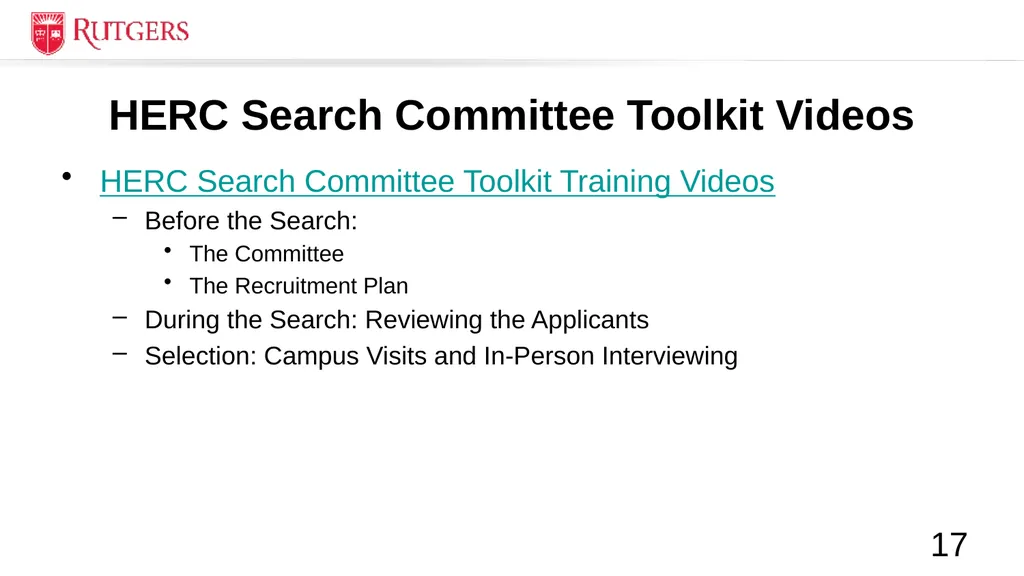
HERC Search Committee Toolkit Videos HERC Search Committee Toolkit Training Videos
Before the Search:
The Committee
The Recruitment Plan
During the Search: Reviewing the Applicants
Selection: Campus Visits and In-Person Interviewing 17<br>
Before the Search:
The Committee
The Recruitment Plan
During the Search: Reviewing the Applicants
Selection: Campus Visits and In-Person Interviewing 17<br>
18
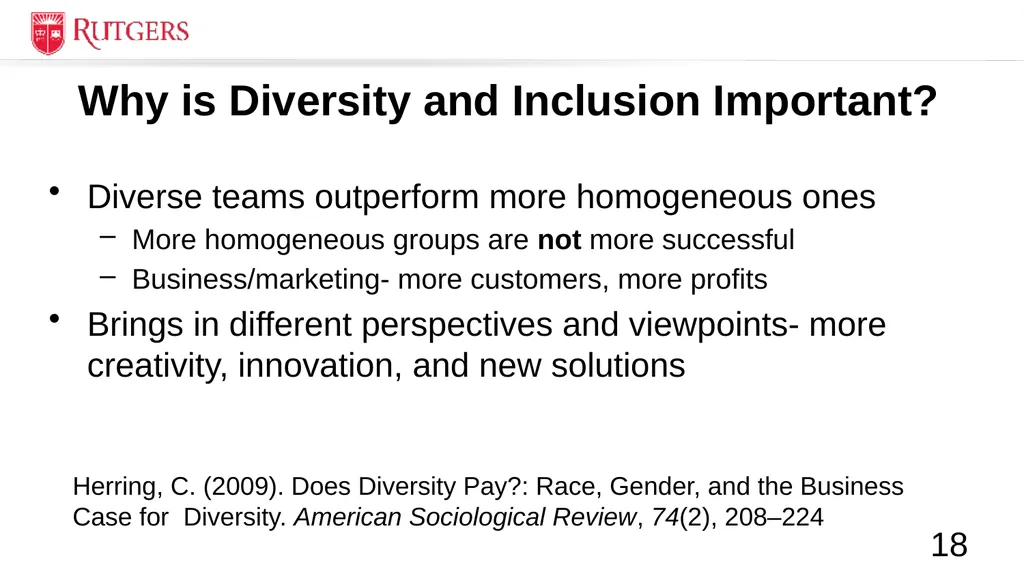
Why is Diversity and Inclusion Important? Diverse teams outperform more homogeneous ones
More homogeneous groups are not more successful
Business/marketing- more customers, more profits
Brings in different perspectives and viewpoints- more creativity, innovation, and new solutions 18 Herring, C. (2009). Does Diversity Pay?: Race, Gender, and the Business Case for Diversity. American Sociological Review, 74(2), 208–224<br>
More homogeneous groups are not more successful
Business/marketing- more customers, more profits
Brings in different perspectives and viewpoints- more creativity, innovation, and new solutions 18 Herring, C. (2009). Does Diversity Pay?: Race, Gender, and the Business Case for Diversity. American Sociological Review, 74(2), 208–224<br>
19
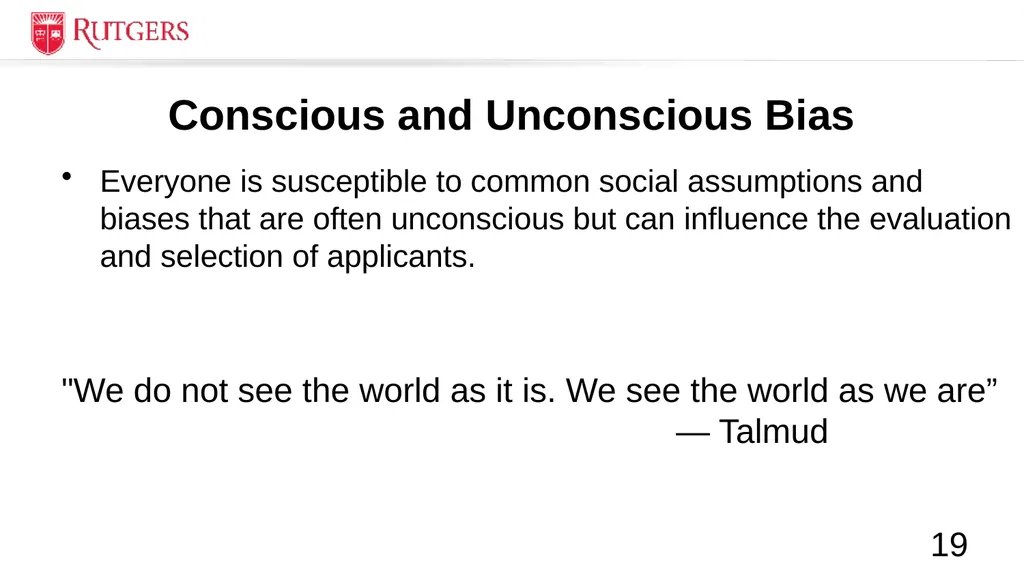
Conscious and Unconscious Bias Everyone is susceptible to common social assumptions and biases that are often unconscious but can influence the evaluation and selection of applicants.
"We do not see the world as it is. We see the world as we are” — Talmud 19<br>
"We do not see the world as it is. We see the world as we are” — Talmud 19<br>
20
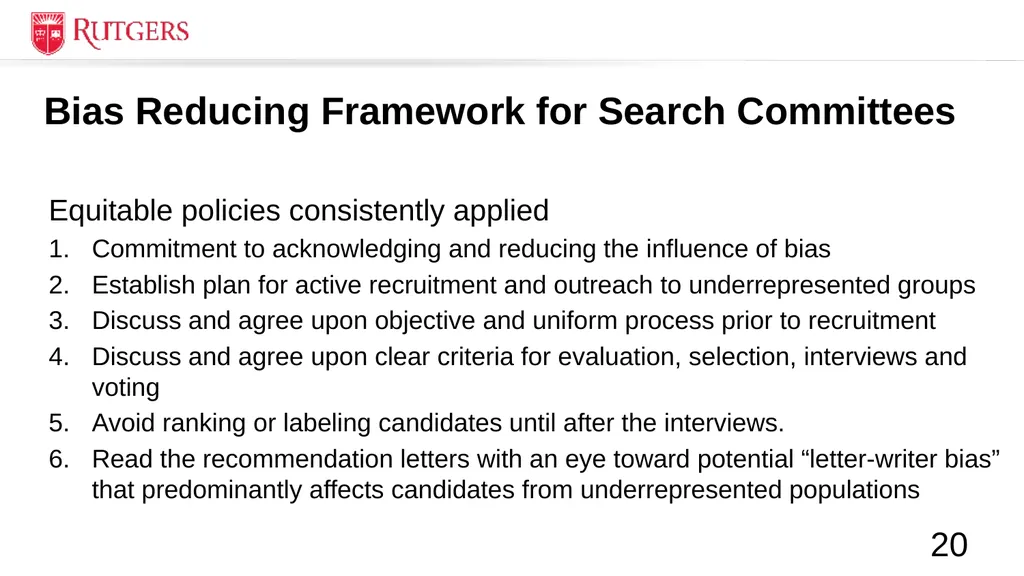
Bias Reducing Framework for Search Committees Equitable policies consistently applied
Commitment to acknowledging and reducing the influence of bias
Establish plan for active recruitment and outreach to underrepresented groups
Discuss and agree upon objective and uniform process prior to recruitment
Discuss and agree upon clear criteria for evaluation, selection, interviews and voting
Avoid ranking or labeling candidates until after the interviews.
Read the recommendation letters with an eye toward potential “letter-writer bias” that predominantly affects candidates from underrepresented populations 20<br>
Commitment to acknowledging and reducing the influence of bias
Establish plan for active recruitment and outreach to underrepresented groups
Discuss and agree upon objective and uniform process prior to recruitment
Discuss and agree upon clear criteria for evaluation, selection, interviews and voting
Avoid ranking or labeling candidates until after the interviews.
Read the recommendation letters with an eye toward potential “letter-writer bias” that predominantly affects candidates from underrepresented populations 20<br>
21
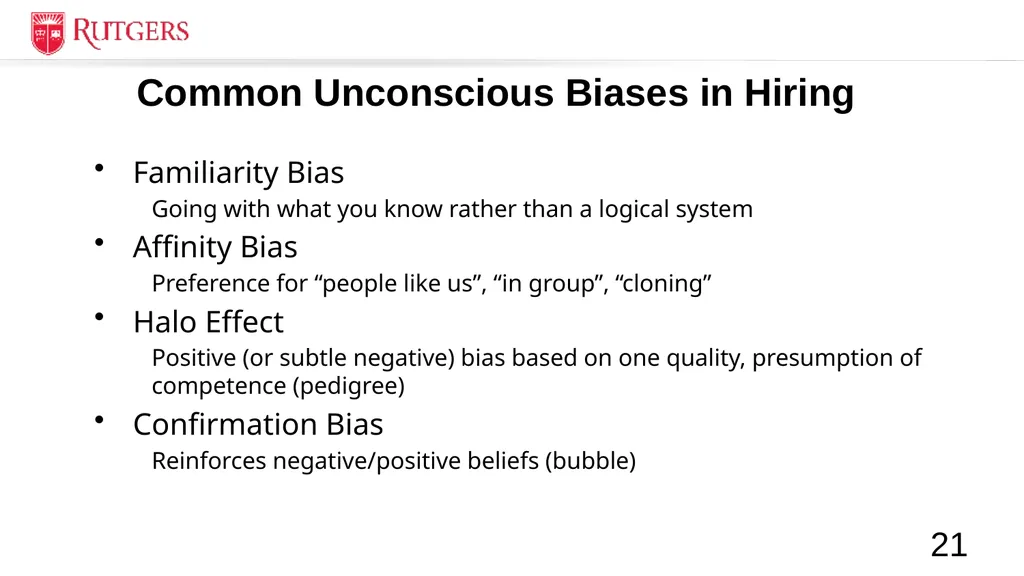
Common Unconscious Biases in Hiring Familiarity Bias
Going with what you know rather than a logical system
Affinity Bias
Preference for “people like us”, “in group”, “cloning”
Halo Effect
Positive (or subtle negative) bias based on one quality, presumption of competence (pedigree)
Confirmation Bias
Reinforces negative/positive beliefs (bubble) 21<br>
Going with what you know rather than a logical system
Affinity Bias
Preference for “people like us”, “in group”, “cloning”
Halo Effect
Positive (or subtle negative) bias based on one quality, presumption of competence (pedigree)
Confirmation Bias
Reinforces negative/positive beliefs (bubble) 21<br>
22
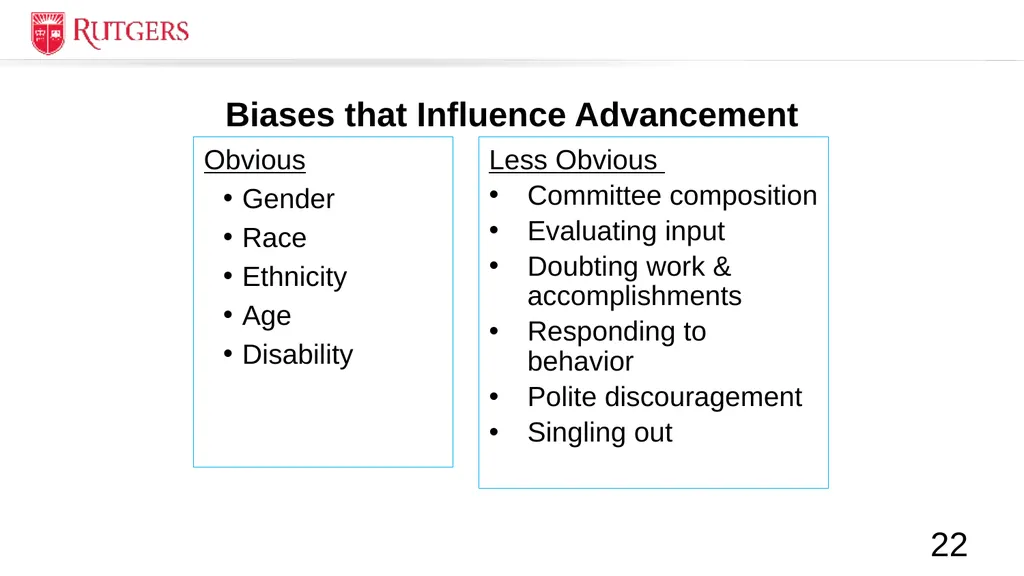
Biases that Influence Advancement Obvious
Gender
Race
Ethnicity
Age
Disability Less Obvious
Committee composition
Evaluating input
Doubting work & accomplishments
Responding to behavior
Polite discouragement
Singling out 22<br>
Gender
Race
Ethnicity
Age
Disability Less Obvious
Committee composition
Evaluating input
Doubting work & accomplishments
Responding to behavior
Polite discouragement
Singling out 22<br>
23
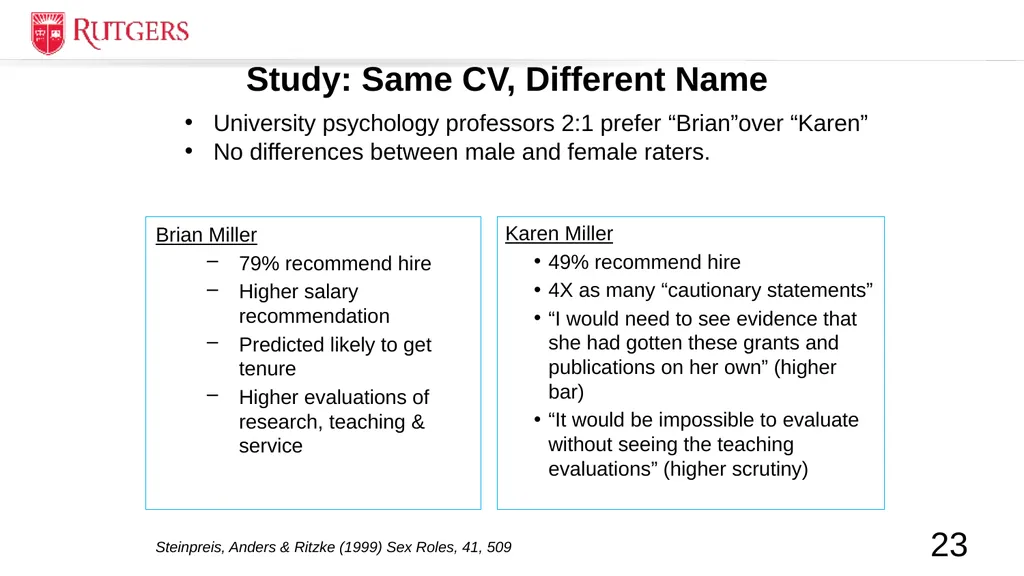
Study: Same CV, Different Name University psychology professors 2:1 prefer “Brian”over “Karen”
No differences between male and female raters. Brian Miller
79% recommend hire
Higher salary recommendation
Predicted likely to get tenure
Higher evaluations of research, teaching & service Karen Miller
49% recommend hire
4X as many “cautionary statements”
“I would need to see evidence that she had gotten these grants and publications on her own” (higher bar)
“It would be impossible to evaluate without seeing the teaching evaluations” (higher scrutiny) Steinpreis, Anders & Ritzke (1999) Sex Roles, 41, 509 23<br>
No differences between male and female raters. Brian Miller
79% recommend hire
Higher salary recommendation
Predicted likely to get tenure
Higher evaluations of research, teaching & service Karen Miller
49% recommend hire
4X as many “cautionary statements”
“I would need to see evidence that she had gotten these grants and publications on her own” (higher bar)
“It would be impossible to evaluate without seeing the teaching evaluations” (higher scrutiny) Steinpreis, Anders & Ritzke (1999) Sex Roles, 41, 509 23<br>
24
Note: The information shared in this presentation regarding unconscious bias are just brief highlights. Additional training can be arranged by contacting the Vice Chancellor for Diversity and Inclusion, Sangeeta Lamba, MD, MS-HPEd at lambasa@rutgers.edu. 24<br>
25
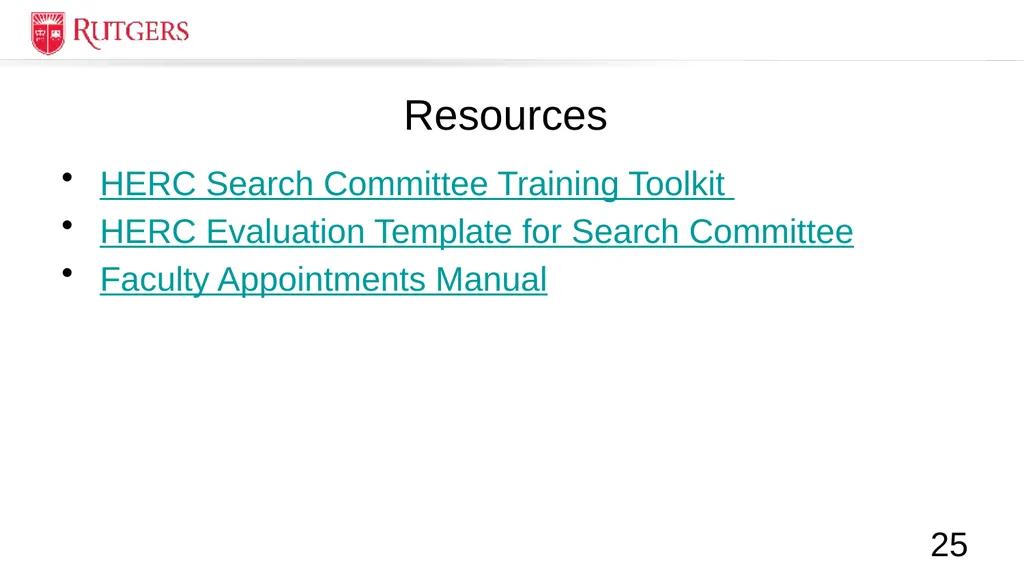
Resources HERC Search Committee Training Toolkit
HERC Evaluation Template for Search Committee
Faculty Appointments Manual 25<br>
HERC Evaluation Template for Search Committee
Faculty Appointments Manual 25<br>
26
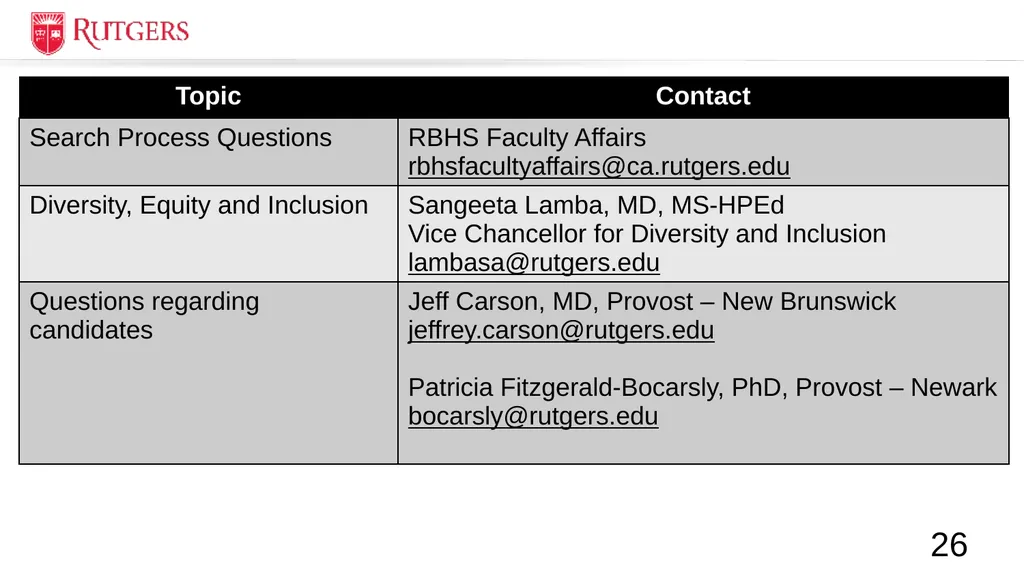
26<br>