
Reading ROOT files in any browser ROOT I/O in
OM
Published · 30 slides · 0 views

1 / 1

Description
Reading ROOT files in any browser ROOT IO in JavaScript Bertrand Bellenot CERN, PH-SFT introduction Bertrand Bellenot, CERN, PH-SFT CHEP12, 24-May, 2012, NYC, US How to share thousands of histograms on the web, without having to generate
Related Topics
Share
Embed code
Download this presentation From Below
"Reading ROOT files in any browser ROOT I/O in" is the property of its rightful owner. Permission is granted to download and print the materials on this website for personal, non-commercial use only, and to display it on your personal computer provided you do not modify the materials and that you retain all copyright notices contained in the materials. By downloading content from our website, you accept the terms of this agreement.
Presentation Transcript
01
Reading ROOT files in any browser ROOT I/O in JavaScript Bertrand Bellenot
CERN, PH-SFT<br>
CERN, PH-SFT<br>
02
introduction Bertrand Bellenot, CERN, PH-SFT CHEP’12, 24-May, 2012, NYC, US How to share thousands of histograms on the web, without having to generate picture files (gif, jpg, …)?
How to easily share a ROOT file?
How to browse & display the content of a ROOT file from any platform (even from a smartphone or tablet)?
Online monitoring?
And obviously, all that without having to install ROOT anywhere? 2<br>
How to easily share a ROOT file?
How to browse & display the content of a ROOT file from any platform (even from a smartphone or tablet)?
Online monitoring?
And obviously, all that without having to install ROOT anywhere? 2<br>
03
Requirements Bertrand Bellenot, CERN, PH-SFT CHEP’12, 24-May, 2012, NYC, US The solution should be:
Portable: use available web browser
Lightweight: no library or application to install
Easy to use (user side)
Easy to extend and maintain (developer side)
Fast, with a small memory footprint 3<br>
Portable: use available web browser
Lightweight: no library or application to install
Easy to use (user side)
Easy to extend and maintain (developer side)
Fast, with a small memory footprint 3<br>
04
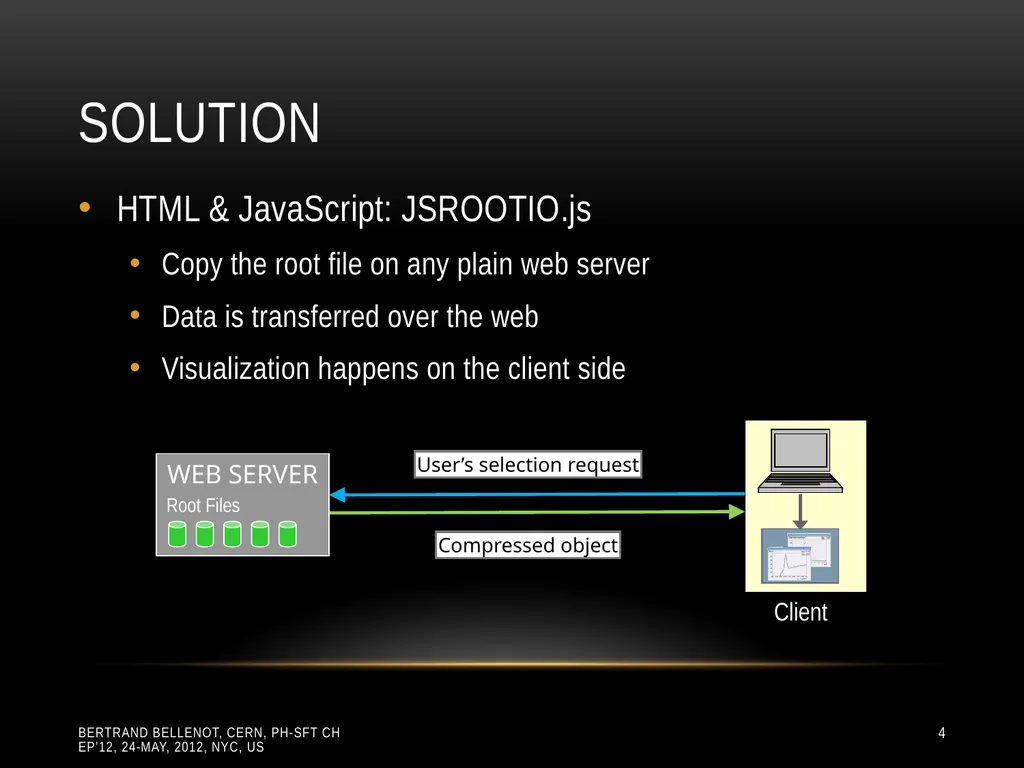
Solution Bertrand Bellenot, CERN, PH-SFT CHEP’12, 24-May, 2012, NYC, US 4 HTML & JavaScript: JSROOTIO.js
Copy the root file on any plain web server
Data is transferred over the web
Visualization happens on the client side User’s selection request Compressed object<br>
Copy the root file on any plain web server
Data is transferred over the web
Visualization happens on the client side User’s selection request Compressed object<br>
05
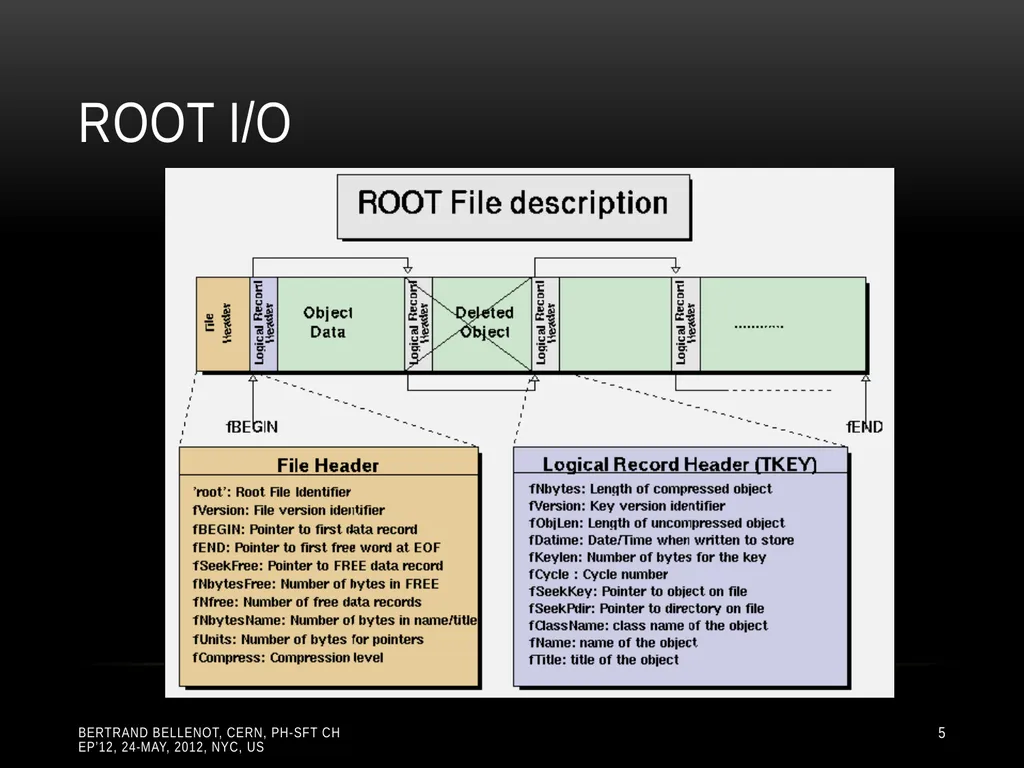
ROOT I/O Bertrand Bellenot, CERN, PH-SFT CHEP’12, 24-May, 2012, NYC, US 5<br>
06
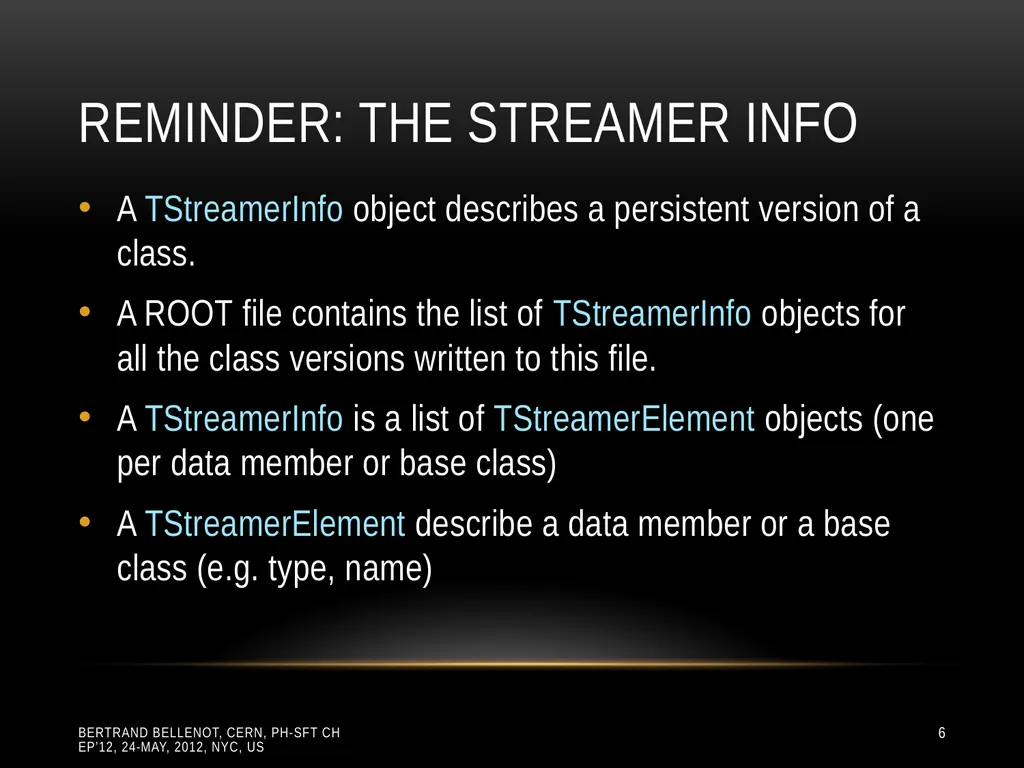
Reminder: The Streamer Info A TStreamerInfo object describes a persistent version of a class.
A ROOT file contains the list of TStreamerInfo objects for all the class versions written to this file.
A TStreamerInfo is a list of TStreamerElement objects (one per data member or base class)
A TStreamerElement describe a data member or a base class (e.g. type, name) Bertrand Bellenot, CERN, PH-SFT CHEP’12, 24-May, 2012, NYC, US 6<br>
A ROOT file contains the list of TStreamerInfo objects for all the class versions written to this file.
A TStreamerInfo is a list of TStreamerElement objects (one per data member or base class)
A TStreamerElement describe a data member or a base class (e.g. type, name) Bertrand Bellenot, CERN, PH-SFT CHEP’12, 24-May, 2012, NYC, US 6<br>
07
Reading the file When opening the file:
Read the list of streamer info
Read the list of keys and display them in a list tree
When the user select an item in the list tree (and only then)
Read the compressed buffer from the file
Inflate the buffer
Stream the object from the inflated buffer using the streamer info Bertrand Bellenot, CERN, PH-SFT CHEP’12, 24-May, 2012, NYC, US 7<br>
Read the list of streamer info
Read the list of keys and display them in a list tree
When the user select an item in the list tree (and only then)
Read the compressed buffer from the file
Inflate the buffer
Stream the object from the inflated buffer using the streamer info Bertrand Bellenot, CERN, PH-SFT CHEP’12, 24-May, 2012, NYC, US 7<br>
08
Reading the file Use the XMLHttpRequest AJAX API to perform the HTTP HEAD and GET requests
This API is highly browser dependent:
On IE, the binary data is in its responseBody data member (VBScript format), and has to be converted into a JavaScript string
On other browsers, the data can be in response, mozResponse, mozResponseArrayBuffer, or responseText...
Thanks to Ioannis Charalampidis, who kindly provided a working cross-browser solution Bertrand Bellenot, CERN, PH-SFT CHEP’12, 24-May, 2012, NYC, US 8<br>
This API is highly browser dependent:
On IE, the binary data is in its responseBody data member (VBScript format), and has to be converted into a JavaScript string
On other browsers, the data can be in response, mozResponse, mozResponseArrayBuffer, or responseText...
Thanks to Ioannis Charalampidis, who kindly provided a working cross-browser solution Bertrand Bellenot, CERN, PH-SFT CHEP’12, 24-May, 2012, NYC, US 8<br>
09
READING partial ROOT file Using HTTP byte range (available in HTTP/1.1) to download only a single compressed object when the user wants to read it
Minimizes data transfer and memory usage
Some browsers don’t support this feature yet (e.g. Opera) Bertrand Bellenot, CERN, PH-SFT CHEP’12, 24-May, 2012, NYC, US 9<br>
Minimizes data transfer and memory usage
Some browsers don’t support this feature yet (e.g. Opera) Bertrand Bellenot, CERN, PH-SFT CHEP’12, 24-May, 2012, NYC, US 9<br>
10
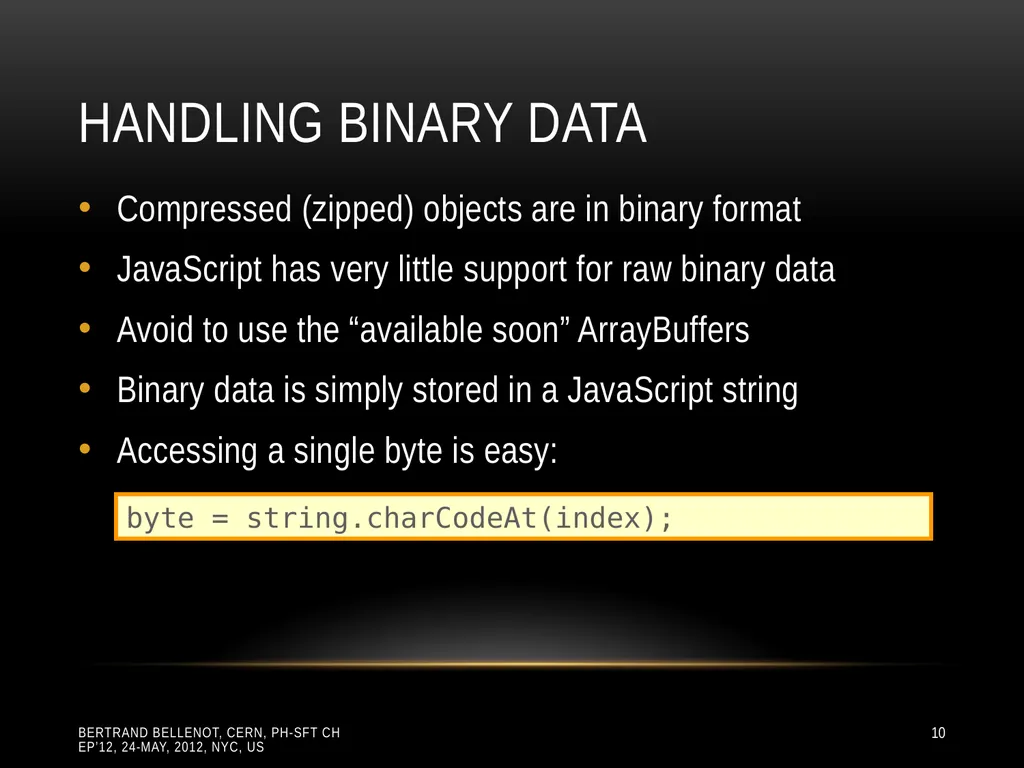
Handling binary data Compressed (zipped) objects are in binary format
JavaScript has very little support for raw binary data
Avoid to use the “available soon” ArrayBuffers
Binary data is simply stored in a JavaScript string
Accessing a single byte is easy: byte = string.charCodeAt(index); Bertrand Bellenot, CERN, PH-SFT CHEP’12, 24-May, 2012, NYC, US 10<br>
JavaScript has very little support for raw binary data
Avoid to use the “available soon” ArrayBuffers
Binary data is simply stored in a JavaScript string
Accessing a single byte is easy: byte = string.charCodeAt(index); Bertrand Bellenot, CERN, PH-SFT CHEP’12, 24-May, 2012, NYC, US 10<br>
11
READING the keys The keys are not compressed
They contain basic information on the object they describe, like its name and its type
First step was quite easy, starting from already working code written by Axel Naumann
Formatting and displaying the keys is done with a JavaScript tree menu Bertrand Bellenot, CERN, PH-SFT CHEP’12, 24-May, 2012, NYC, US 11<br>
They contain basic information on the object they describe, like its name and its type
First step was quite easy, starting from already working code written by Axel Naumann
Formatting and displaying the keys is done with a JavaScript tree menu Bertrand Bellenot, CERN, PH-SFT CHEP’12, 24-May, 2012, NYC, US 11<br>
12
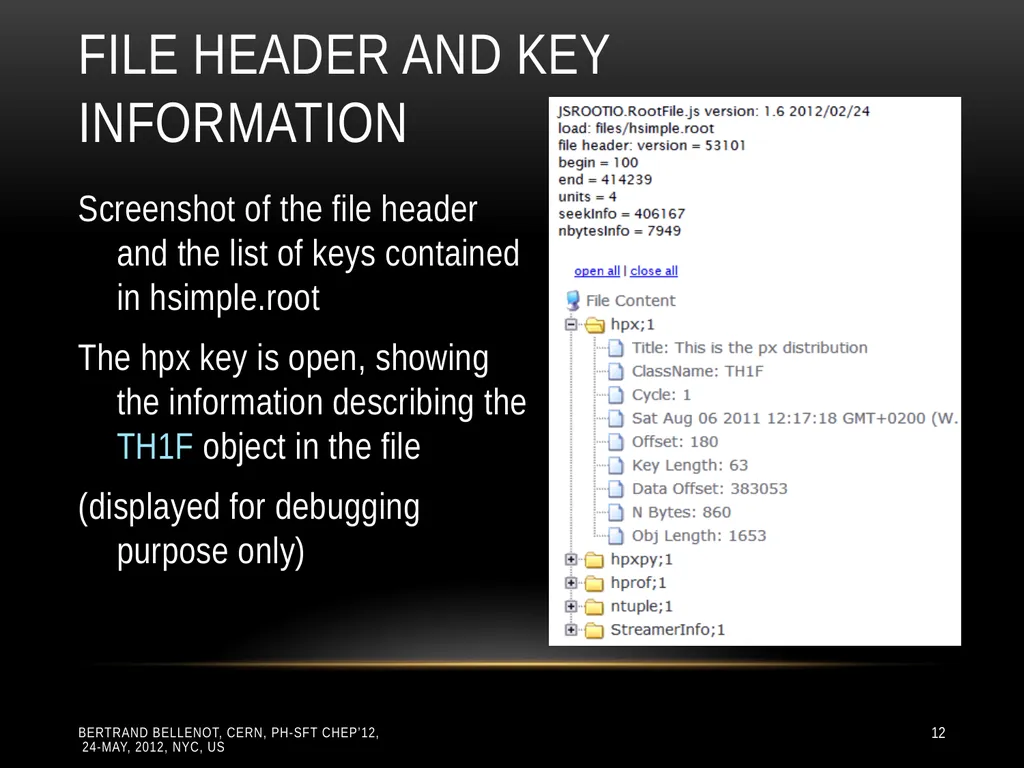
Screenshot of the file header and the list of keys contained in hsimple.root
The hpx key is open, showing the information describing the TH1F object in the file
(displayed for debugging purpose only) File header and key information Bertrand Bellenot, CERN, PH-SFT CHEP’12, 24-May, 2012, NYC, US 12<br>
The hpx key is open, showing the information describing the TH1F object in the file
(displayed for debugging purpose only) File header and key information Bertrand Bellenot, CERN, PH-SFT CHEP’12, 24-May, 2012, NYC, US 12<br>
13
Inflating & decoding The Streamer Info Inflating (unzipping) the buffers required:
A JavaScript implementation of zlib’s inflate function from: http://www.onicos.com/staff/iz/amuse/javascript/expert/inflate.txt
Implementing the streamer info functionality in JavaScript involved:
reverse engineering and parallel debugging of C++ and JavaScript
valuable help from Philippe Canal
Streamer info can be displayed for educational / informational purposes Bertrand Bellenot, CERN, PH-SFT CHEP’12, 24-May, 2012, NYC, US 13<br>
A JavaScript implementation of zlib’s inflate function from: http://www.onicos.com/staff/iz/amuse/javascript/expert/inflate.txt
Implementing the streamer info functionality in JavaScript involved:
reverse engineering and parallel debugging of C++ and JavaScript
valuable help from Philippe Canal
Streamer info can be displayed for educational / informational purposes Bertrand Bellenot, CERN, PH-SFT CHEP’12, 24-May, 2012, NYC, US 13<br>
14
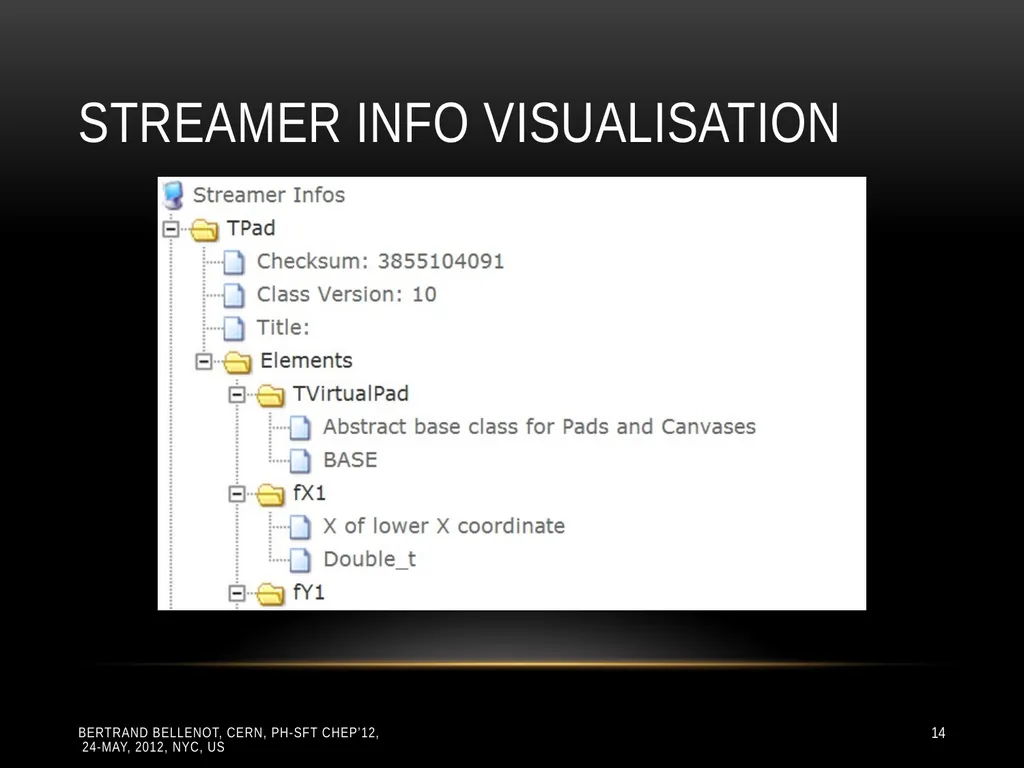
streamer Info Visualisation Bertrand Bellenot, CERN, PH-SFT CHEP’12, 24-May, 2012, NYC, US 14<br>
15
READING objects, First version At the beginning, the classes’ streamers were hard-coded. This approach has several issues:
Streamers must be updated with every change in the original class
Add a new streamer for every new class
The library is growing with every new streamer
The only (partially) supported classes were TH1, TH2, TGraph, and TProfile Bertrand Bellenot, CERN, PH-SFT CHEP’12, 24-May, 2012, NYC, US 15<br>
Streamers must be updated with every change in the original class
Add a new streamer for every new class
The library is growing with every new streamer
The only (partially) supported classes were TH1, TH2, TGraph, and TProfile Bertrand Bellenot, CERN, PH-SFT CHEP’12, 24-May, 2012, NYC, US 15<br>
16
Reading objects, actual status One very nice feature of JavaScript is the possibility to dynamically (at runtime) create classes
Allowed to implement dynamic streamers (automatically generated from the streamer info)
Allows to potentially read any object from a ROOT file, as soon as we can read the streamer info of its class
Navigation in (sub)directories inside a file is fully supported Bertrand Bellenot, CERN, PH-SFT CHEP’12, 24-May, 2012, NYC, US 16<br>
Allowed to implement dynamic streamers (automatically generated from the streamer info)
Allows to potentially read any object from a ROOT file, as soon as we can read the streamer info of its class
Navigation in (sub)directories inside a file is fully supported Bertrand Bellenot, CERN, PH-SFT CHEP’12, 24-May, 2012, NYC, US 16<br>
17
Graphics A JavaScript charting library (HighCharts) is used to display the histograms and graphs (http://www.highcharts.com)
It is released under the Creative Commons Attribution-Non Commercial 3.0 License, allowing to adapt it to ROOT’s needs
Some missing functionalities (e.g. error bars, lego plots) have to be implemented
A summer student will start to work on it Bertrand Bellenot, CERN, PH-SFT CHEP’12, 24-May, 2012, NYC, US 17<br>
It is released under the Creative Commons Attribution-Non Commercial 3.0 License, allowing to adapt it to ROOT’s needs
Some missing functionalities (e.g. error bars, lego plots) have to be implemented
A summer student will start to work on it Bertrand Bellenot, CERN, PH-SFT CHEP’12, 24-May, 2012, NYC, US 17<br>
18
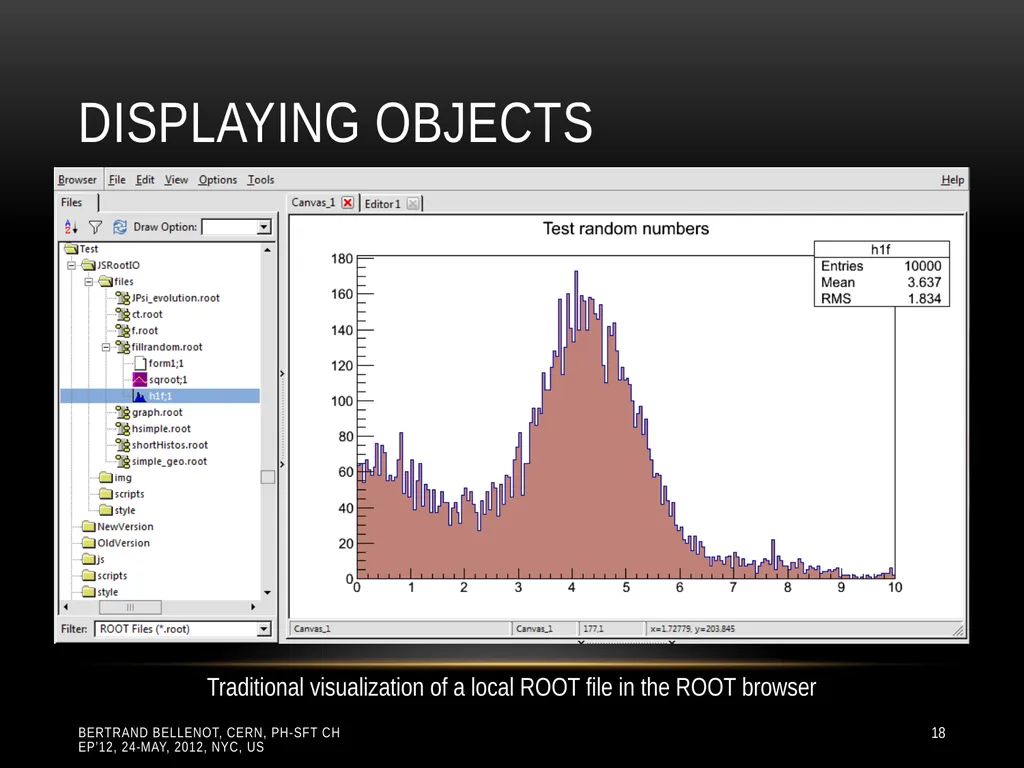
Displaying objects Traditional visualization of a local ROOT file in the ROOT browser Bertrand Bellenot, CERN, PH-SFT CHEP’12, 24-May, 2012, NYC, US 18<br>
19
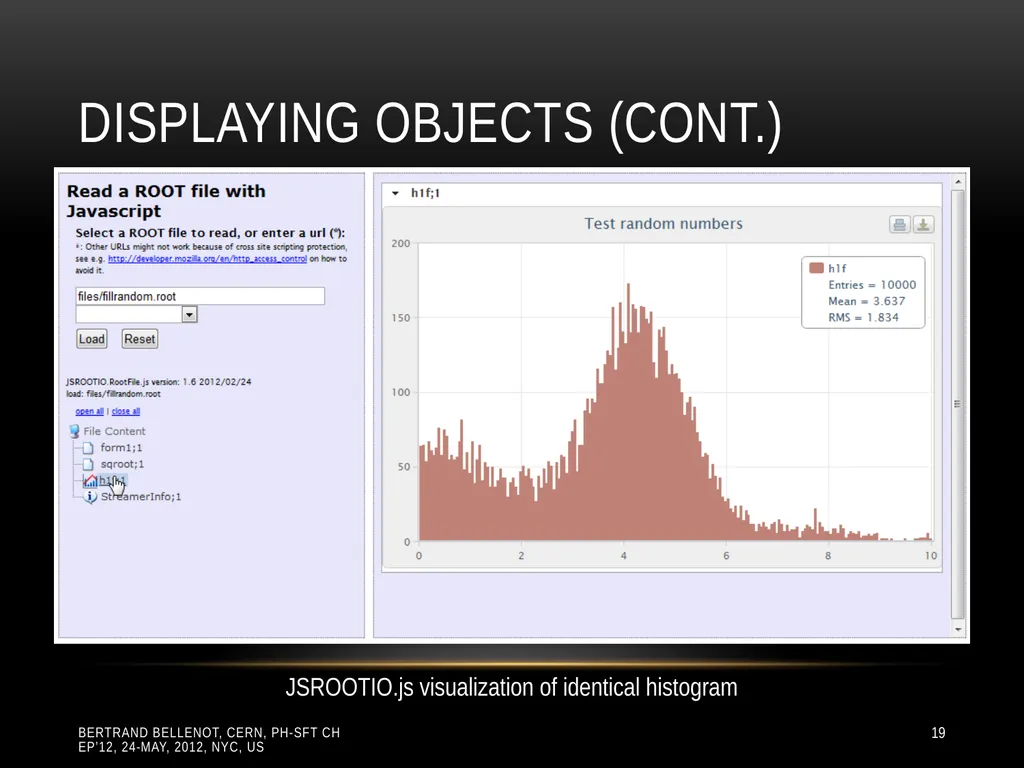
Displaying objects (cont.) JSROOTIO.js visualization of identical histogram Bertrand Bellenot, CERN, PH-SFT CHEP’12, 24-May, 2012, NYC, US 19<br>
20
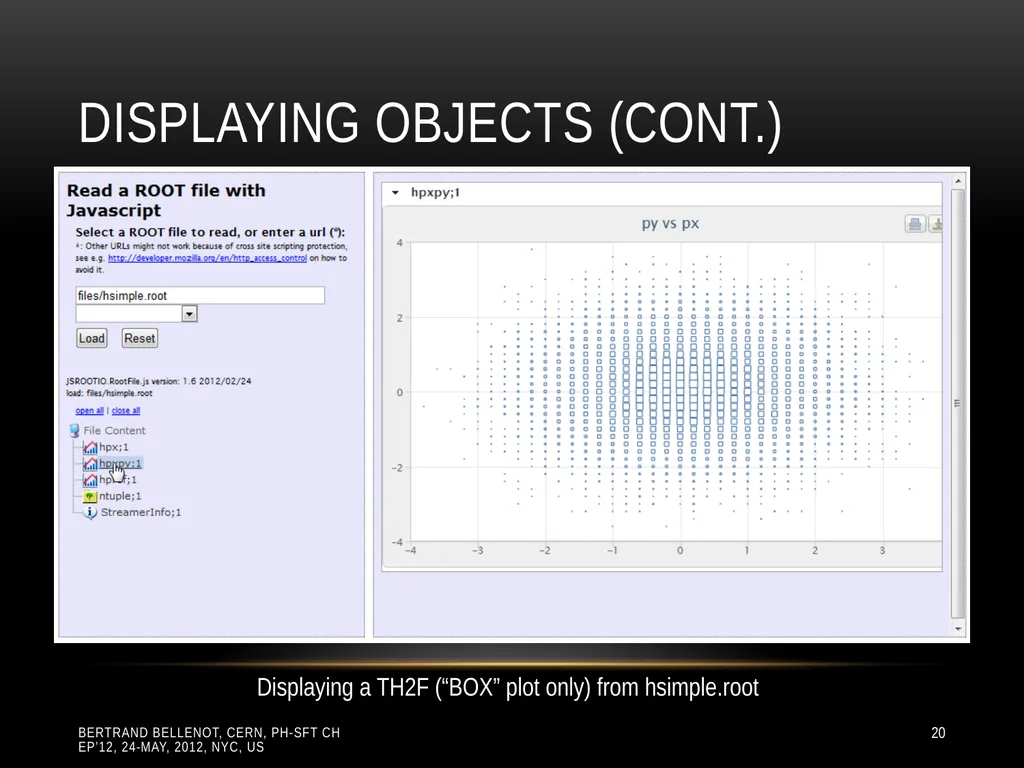
Displaying objects (cont.) Displaying a TH2F (“BOX” plot only) from hsimple.root Bertrand Bellenot, CERN, PH-SFT CHEP’12, 24-May, 2012, NYC, US 20<br>
21
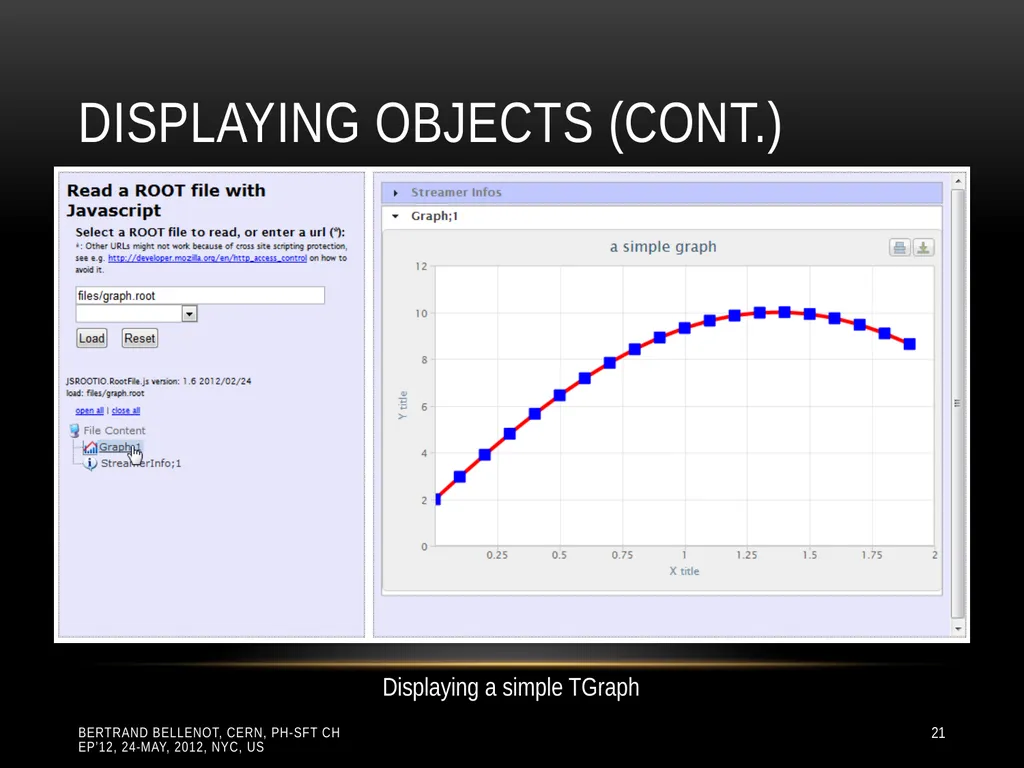
Displaying objects (cont.) Displaying a simple TGraph Bertrand Bellenot, CERN, PH-SFT CHEP’12, 24-May, 2012, NYC, US 21<br>
22
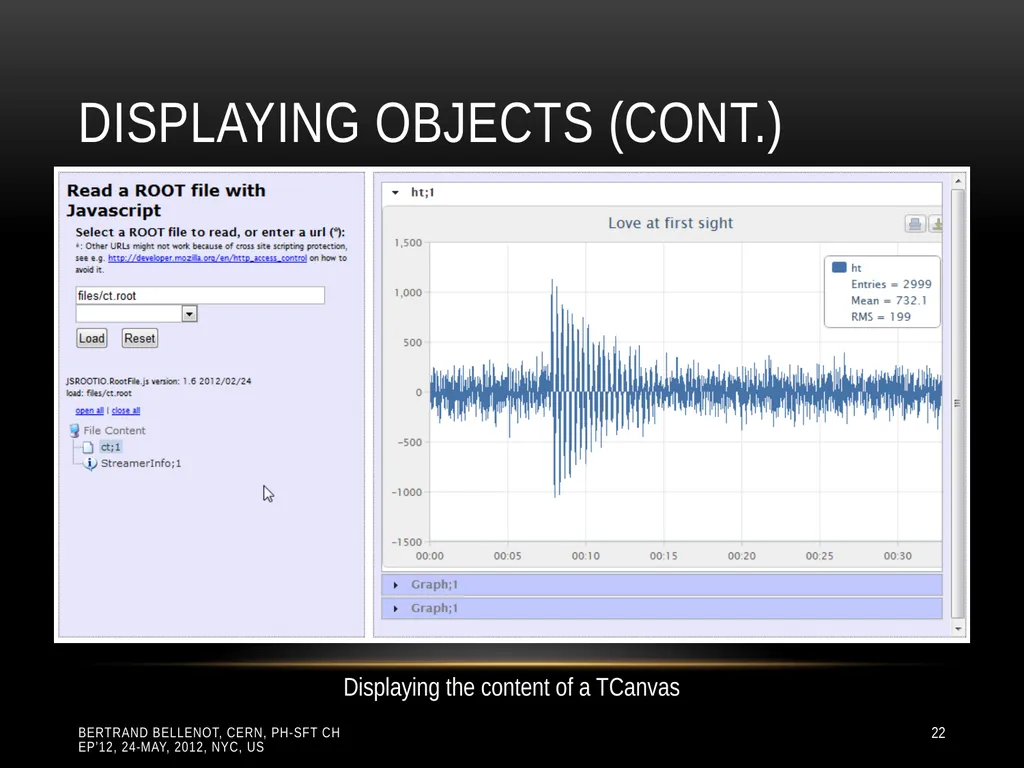
Displaying objects (cont.) Bertrand Bellenot, CERN, PH-SFT CHEP’12, 24-May, 2012, NYC, US Displaying the content of a TCanvas 22<br>
23
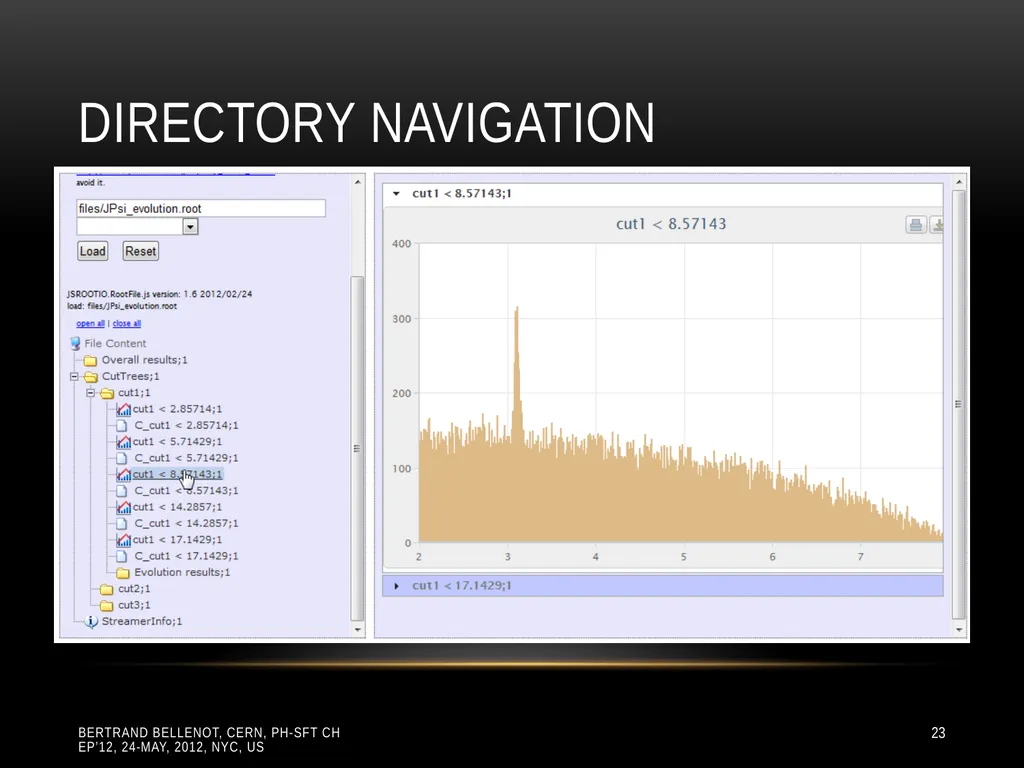
Directory Navigation Bertrand Bellenot, CERN, PH-SFT CHEP’12, 24-May, 2012, NYC, US 23<br>
24
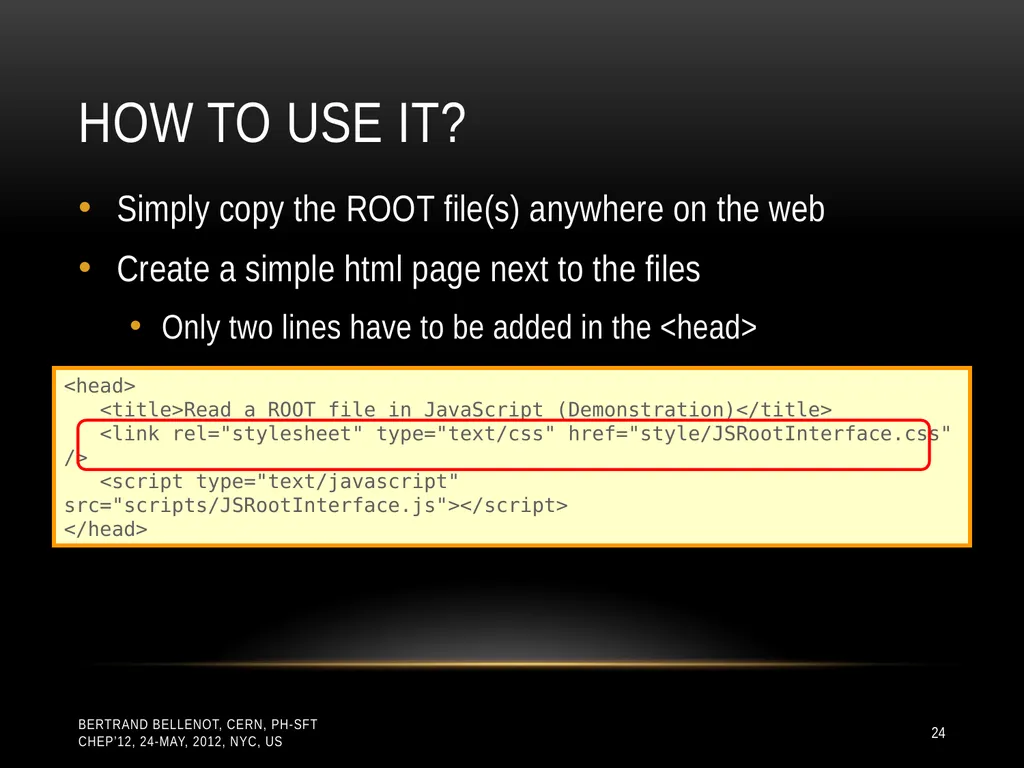
How to use it? Bertrand Bellenot, CERN, PH-SFT CHEP’12, 24-May, 2012, NYC, US Simply copy the ROOT file(s) anywhere on the web
Create a simple html page next to the files
Only two lines have to be added in the <head> 24 <head>
<title>Read a ROOT file in JavaScript (Demonstration)</title>
<link rel="stylesheet" type="text/css" href="style/JSRootInterface.css" />
<script type="text/javascript" src="scripts/JSRootInterface.js"></script>
</head><br>
Create a simple html page next to the files
Only two lines have to be added in the <head> 24 <head>
<title>Read a ROOT file in JavaScript (Demonstration)</title>
<link rel="stylesheet" type="text/css" href="style/JSRootInterface.css" />
<script type="text/javascript" src="scripts/JSRootInterface.js"></script>
</head><br>
25
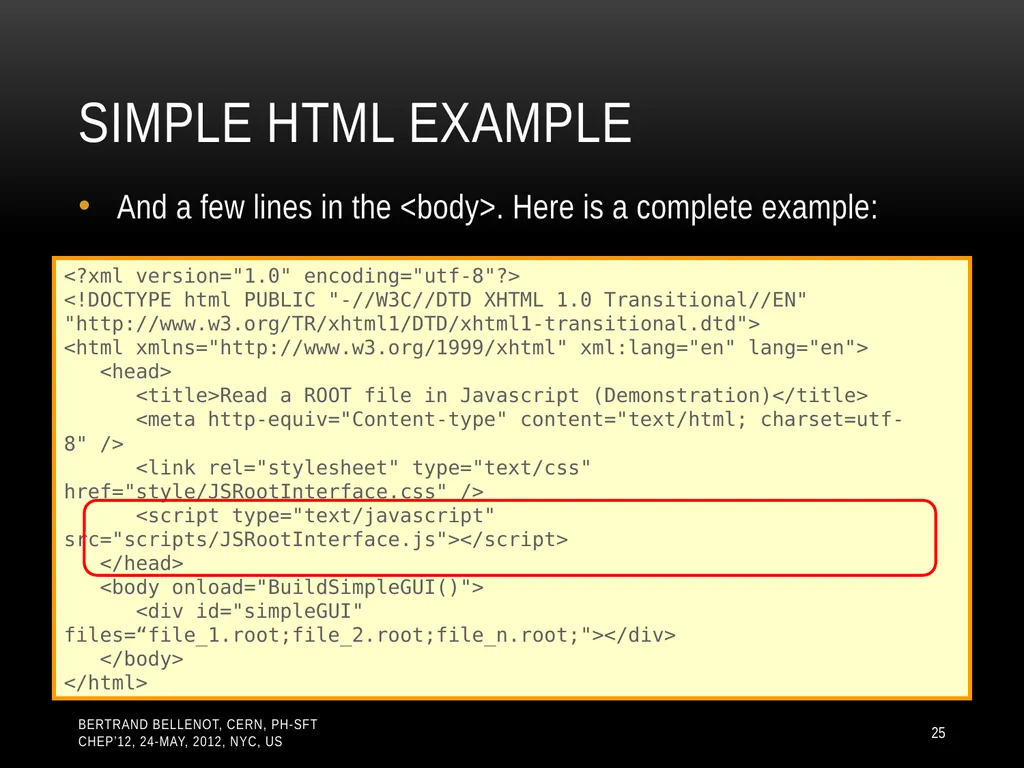
Simple html Example Bertrand Bellenot, CERN, PH-SFT CHEP’12, 24-May, 2012, NYC, US And a few lines in the <body>. Here is a complete example: 25 <?xml version="1.0" encoding="utf-8"?>
<!DOCTYPE html PUBLIC "-//W3C//DTD XHTML 1.0 Transitional//EN"
"http://www.w3.org/TR/xhtml1/DTD/xhtml1-transitional.dtd">
<html xmlns="http://www.w3.org/1999/xhtml" xml:lang="en" lang="en">
<head>
<title>Read a ROOT file in Javascript (Demonstration)</title>
<meta http-equiv="Content-type" content="text/html; charset=utf-8" />
<link rel="stylesheet" type="text/css" href="style/JSRootInterface.css" />
<script type="text/javascript" src="scripts/JSRootInterface.js"></script>
</head>
<body onload="BuildSimpleGUI()">
<div id="simpleGUI" files=“file_1.root;file_2.root;file_n.root;"></div>
</body>
</html><br>
<!DOCTYPE html PUBLIC "-//W3C//DTD XHTML 1.0 Transitional//EN"
"http://www.w3.org/TR/xhtml1/DTD/xhtml1-transitional.dtd">
<html xmlns="http://www.w3.org/1999/xhtml" xml:lang="en" lang="en">
<head>
<title>Read a ROOT file in Javascript (Demonstration)</title>
<meta http-equiv="Content-type" content="text/html; charset=utf-8" />
<link rel="stylesheet" type="text/css" href="style/JSRootInterface.css" />
<script type="text/javascript" src="scripts/JSRootInterface.js"></script>
</head>
<body onload="BuildSimpleGUI()">
<div id="simpleGUI" files=“file_1.root;file_2.root;file_n.root;"></div>
</body>
</html><br>
26
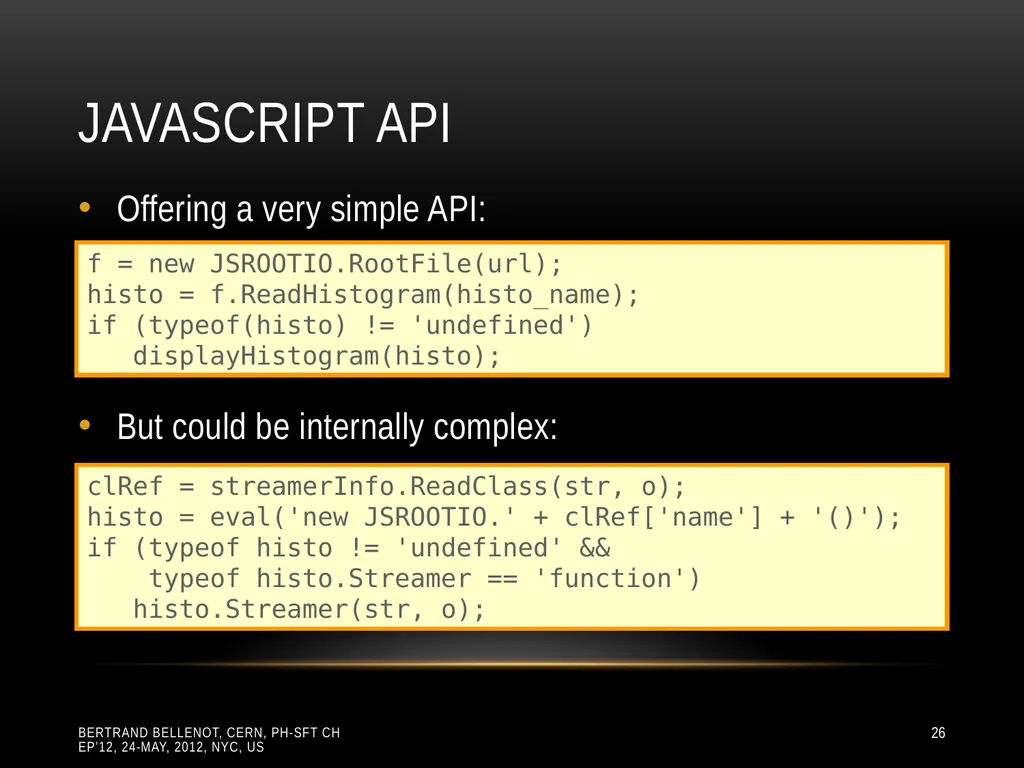
JavaScript API Offering a very simple API:
But could be internally complex: f = new JSROOTIO.RootFile(url); histo = f.ReadHistogram(histo_name); if (typeof(histo) != 'undefined') displayHistogram(histo); clRef = streamerInfo.ReadClass(str, o);
histo = eval('new JSROOTIO.' + clRef['name'] + '()');
if (typeof histo != 'undefined' &&
typeof histo.Streamer == 'function') histo.Streamer(str, o); Bertrand Bellenot, CERN, PH-SFT CHEP’12, 24-May, 2012, NYC, US 26<br>
But could be internally complex: f = new JSROOTIO.RootFile(url); histo = f.ReadHistogram(histo_name); if (typeof(histo) != 'undefined') displayHistogram(histo); clRef = streamerInfo.ReadClass(str, o);
histo = eval('new JSROOTIO.' + clRef['name'] + '()');
if (typeof histo != 'undefined' &&
typeof histo.Streamer == 'function') histo.Streamer(str, o); Bertrand Bellenot, CERN, PH-SFT CHEP’12, 24-May, 2012, NYC, US 26<br>
27
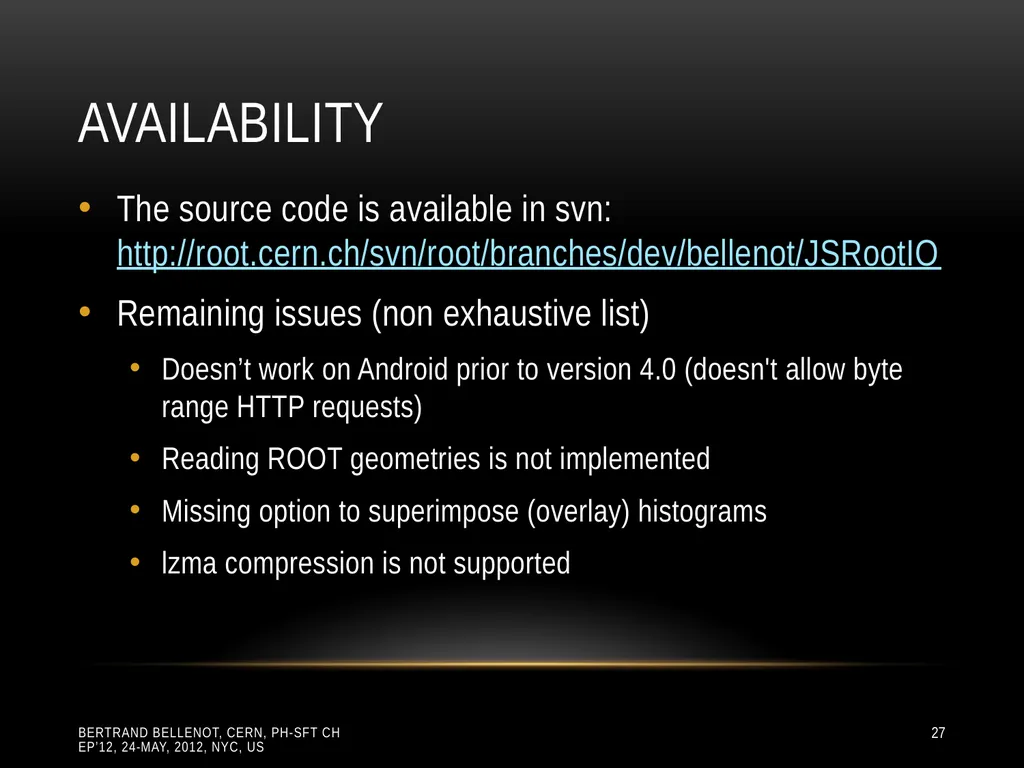
Availability The source code is available in svn:
http://root.cern.ch/svn/root/branches/dev/bellenot/JSRootIO
Remaining issues (non exhaustive list)
Doesn’t work on Android prior to version 4.0 (doesn't allow byte range HTTP requests)
Reading ROOT geometries is not implemented
Missing option to superimpose (overlay) histograms
lzma compression is not supported Bertrand Bellenot, CERN, PH-SFT CHEP’12, 24-May, 2012, NYC, US 27<br>
Remaining issues (non exhaustive list)
Doesn’t work on Android prior to version 4.0 (doesn't allow byte range HTTP requests)
Reading ROOT geometries is not implemented
Missing option to superimpose (overlay) histograms
lzma compression is not supported Bertrand Bellenot, CERN, PH-SFT CHEP’12, 24-May, 2012, NYC, US 27<br>
28
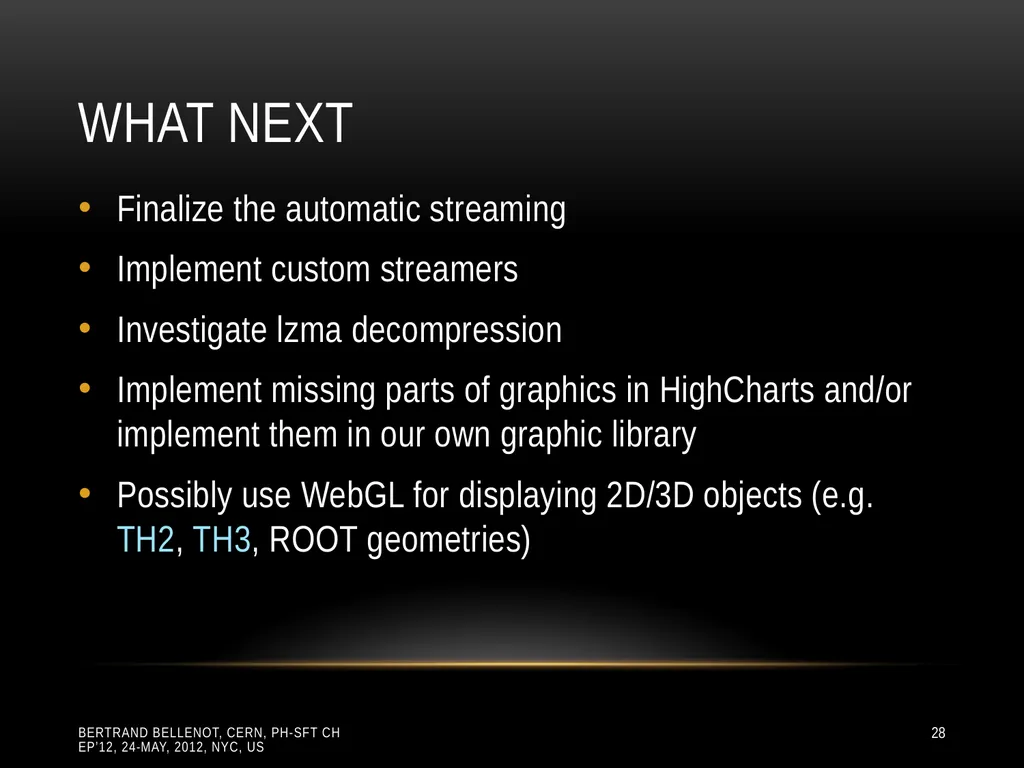
What next Finalize the automatic streaming
Implement custom streamers
Investigate lzma decompression
Implement missing parts of graphics in HighCharts and/or implement them in our own graphic library
Possibly use WebGL for displaying 2D/3D objects (e.g. TH2, TH3, ROOT geometries) Bertrand Bellenot, CERN, PH-SFT CHEP’12, 24-May, 2012, NYC, US 28<br>
Implement custom streamers
Investigate lzma decompression
Implement missing parts of graphics in HighCharts and/or implement them in our own graphic library
Possibly use WebGL for displaying 2D/3D objects (e.g. TH2, TH3, ROOT geometries) Bertrand Bellenot, CERN, PH-SFT CHEP’12, 24-May, 2012, NYC, US 28<br>
29
Conclusion We are still in an early stage, and there is still quite some work in front of us
Already working and usable, thanks to very valuable feedback from early users
More features are coming
Feel free to try and to send feedback & requests Bertrand Bellenot, CERN, PH-SFT CHEP’12, 24-May, 2012, NYC, US 29<br>
Already working and usable, thanks to very valuable feedback from early users
More features are coming
Feel free to try and to send feedback & requests Bertrand Bellenot, CERN, PH-SFT CHEP’12, 24-May, 2012, NYC, US 29<br>
30
Bertrand Bellenot, CERN, PH-SFT CHEP’12, 24-May, 2012, NYC, US And don’t forget to pass by our (CERN PH-SFT) booth, located at the 4th floor, here in Kimmel, to see a live demo or any other amazing development done in our group! 30<br>