Real estate is defined as the physical land and

Published  . 0 views
↓ Download
Real estate is defined as the physical land and
1 / 1
Real estate is defined as the physical land and - slide 1 of 79 Real estate is defined as the physical land and - slide 2 of 79 Real estate is defined as the physical land and - slide 3 of 79 Real estate is defined as the physical land and - slide 4 of 79 Real estate is defined as the physical land and - slide 5 of 79 Real estate is defined as the physical land and - slide 6 of 79 Real estate is defined as the physical land and - slide 7 of 79 Real estate is defined as the physical land and - slide 8 of 79 Real estate is defined as the physical land and - slide 9 of 79 Real estate is defined as the physical land and - slide 10 of 79 Real estate is defined as the physical land and - slide 11 of 79 Real estate is defined as the physical land and - slide 12 of 79 Real estate is defined as the physical land and - slide 13 of 79 Real estate is defined as the physical land and - slide 14 of 79 Real estate is defined as the physical land and - slide 15 of 79 Real estate is defined as the physical land and - slide 16 of 79 Real estate is defined as the physical land and - slide 17 of 79 Real estate is defined as the physical land and - slide 18 of 79 Real estate is defined as the physical land and - slide 19 of 79 Real estate is defined as the physical land and - slide 20 of 79 Real estate is defined as the physical land and - slide 21 of 79 Real estate is defined as the physical land and - slide 22 of 79 Real estate is defined as the physical land and - slide 23 of 79 Real estate is defined as the physical land and - slide 24 of 79 Real estate is defined as the physical land and - slide 25 of 79 Real estate is defined as the physical land and - slide 26 of 79 Real estate is defined as the physical land and - slide 27 of 79 Real estate is defined as the physical land and - slide 28 of 79 Real estate is defined as the physical land and - slide 29 of 79 Real estate is defined as the physical land and - slide 30 of 79 Real estate is defined as the physical land and - slide 31 of 79 Real estate is defined as the physical land and - slide 32 of 79 Real estate is defined as the physical land and - slide 33 of 79 Real estate is defined as the physical land and - slide 34 of 79 Real estate is defined as the physical land and - slide 35 of 79 Real estate is defined as the physical land and - slide 36 of 79 Real estate is defined as the physical land and - slide 37 of 79 Real estate is defined as the physical land and - slide 38 of 79 Real estate is defined as the physical land and - slide 39 of 79 Real estate is defined as the physical land and - slide 40 of 79 Real estate is defined as the physical land and - slide 41 of 79 Real estate is defined as the physical land and - slide 42 of 79 Real estate is defined as the physical land and - slide 43 of 79 Real estate is defined as the physical land and - slide 44 of 79 Real estate is defined as the physical land and - slide 45 of 79 Real estate is defined as the physical land and - slide 46 of 79 Real estate is defined as the physical land and - slide 47 of 79 Real estate is defined as the physical land and - slide 48 of 79 Real estate is defined as the physical land and - slide 49 of 79 Real estate is defined as the physical land and - slide 50 of 79 Real estate is defined as the physical land and - slide 51 of 79 Real estate is defined as the physical land and - slide 52 of 79 Real estate is defined as the physical land and - slide 53 of 79 Real estate is defined as the physical land and - slide 54 of 79 Real estate is defined as the physical land and - slide 55 of 79 Real estate is defined as the physical land and - slide 56 of 79 Real estate is defined as the physical land and - slide 57 of 79 Real estate is defined as the physical land and - slide 58 of 79 Real estate is defined as the physical land and - slide 59 of 79 Real estate is defined as the physical land and - slide 60 of 79 Real estate is defined as the physical land and - slide 61 of 79 Real estate is defined as the physical land and - slide 62 of 79 Real estate is defined as the physical land and - slide 63 of 79 Real estate is defined as the physical land and - slide 64 of 79 Real estate is defined as the physical land and - slide 65 of 79 Real estate is defined as the physical land and - slide 66 of 79 Real estate is defined as the physical land and - slide 67 of 79 Real estate is defined as the physical land and - slide 68 of 79 Real estate is defined as the physical land and - slide 69 of 79 Real estate is defined as the physical land and - slide 70 of 79 Real estate is defined as the physical land and - slide 71 of 79 Real estate is defined as the physical land and - slide 72 of 79 Real estate is defined as the physical land and - slide 73 of 79 Real estate is defined as the physical land and - slide 74 of 79 Real estate is defined as the physical land and - slide 75 of 79 Real estate is defined as the physical land and - slide 76 of 79 Real estate is defined as the physical land and - slide 77 of 79 Real estate is defined as the physical land and - slide 78 of 79 Real estate is defined as the physical land and - slide 79 of 79
Description: Real estate is defined as the physical land and those human-made items, which attach to the land. It is the physical, tangible thing which can be seen and touched, together with all additions on, above, or below the ground. Real property

Related Topics

Download Presentation

"Real estate is defined as the physical land and" is the property of its rightful owner. Permission is granted to download and print the materials on this website for personal, non-commercial use only, and to display it on your personal computer provided you do not modify the materials and that you retain all copyright notices contained in the materials. By downloading content from our website, you accept the terms of this agreement.

Presentation Transcript

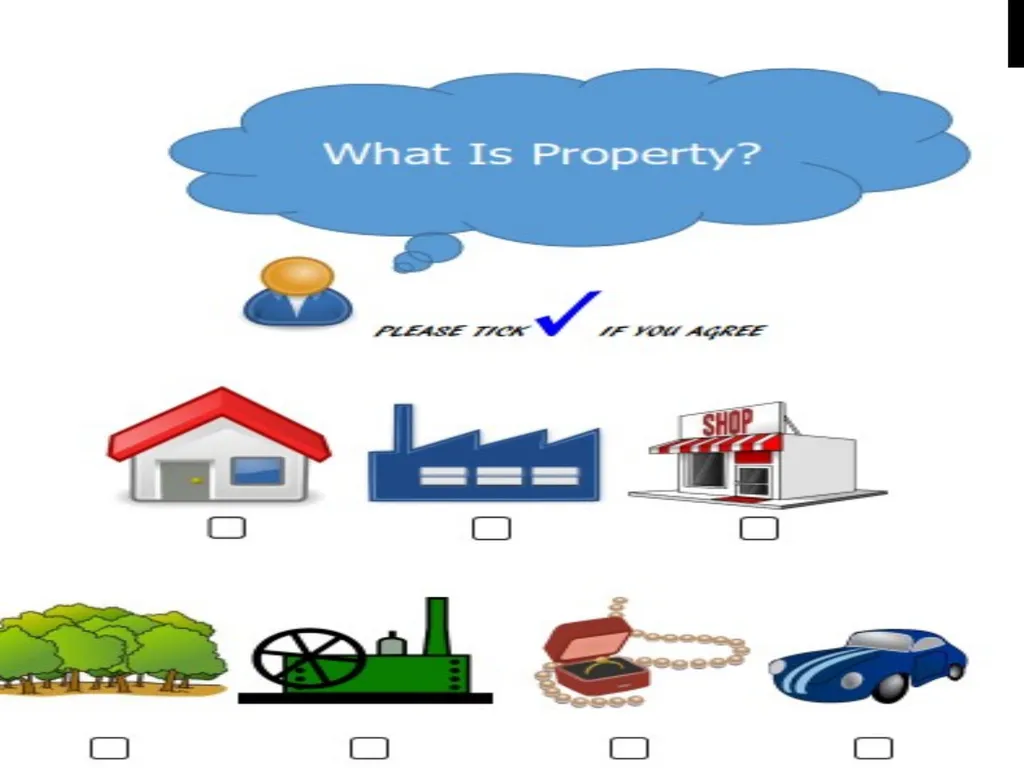
slide2. Real estate is defined as the physical land and those human-made items, which attach to the land. It is the physical, tangible “thing” which can be seen and touched, together with all additions on, above, or below the ground.

Real property includes all the rights, interest and benefits related to the ownership of real estate. An interest or interest in real property is normally demonstrated by some evidence of ownership (e.g. a title deed) separate from the physical real estate.

Personal property includes interests in tangible and intangible items which are not real estate. Items of tangible personal property are not permanently affixed to real estate and are generally characterized by their move-ability.<br>
slide3. Land is Unique In Location and it’s Composition
Physically Immobile
Durable
Supply is finite
Useful to People 3<br>
slide4. Concepts Governmental and Legal
the focus of law is on ownership rights
Legal Definition
Land… includes not only the ground, or soil, but everything that is attached to the earth, whether by course of nature, as are trees and herbage, or by the hand of man, as are houses and other buildings. It includes not only the surface of the earth but everything under it and over it. Thus in legal theory, the surface of the earth is just part of an inverted pyramid having its tip, or apex at the center of the earth, extending outward through the surface of the earth at the boundary lines of the tract, and continuing upward to the heavens. 4<br>
slide5. Concepts, con’t... Geographic
Diverse physical characteristics
May be used for many purposes
Use influenced by geographic considerations
Legal
Individuals hold private rights to own and use land
public rights to shared use
Land: “The earth’s surface, both land and water, and anything that is attached to it whether by the course of nature of human hands.”
Subsurface rights
Surface rights
Suprasurface rights 5<br>
slide6. Concepts, con’t... Social
resource that all individuals share
marketable commodity
Conflicts between groups with different views on land use
Environmental and Historic preservation concerns 6<br>
slide7. Concepts con’t... Economic
Major source of wealth
Can be used for multiple purposes
Restrictions
Public right to use of the nation’s airspace
Highest and Best Use
Physical Characteristics
Locational Characteristics 7<br>
slide8. Definitions Real Estate
Physical Land and Appurtenances affixed to the land (e.g., structures)
Real Property
all interests, benefits and rights inherent in the ownership of real estate
bundle of rights
Personal Property
Moveable items not permanently affixed to, or part of, the real estate 8<br>
slide9. Types of Real Property Fee Simple Estate
all interests, benefits, and rights inherent in the ownership
Leased Fee Estate
an ownership interest held by a landlord
Leasehold Estate
an ownership interest held by the lessee
Life Estate
Total rights of use, occupancy and control limited to the lifetime of a designated party.
Easement
A conveyance of use, but not ownership 9<br>
slide10. Types of Real Property, con’t... Partial Interest
divided or undivided rights in real estate that represent less than the whole
Specialized fractional ownership
Condominium
Cooperative
Timesharing
Vertical Interest
Subsurface and air rights 10<br>
slide11. Limitations on Ownership Public: Four Powers of Government that restrict private ownership
Police Power
the right of government under which property is regulated to protect public safety (e.g. zoning, building codes)
Escheat
Property reverts to the state when its owner dies without a will or any ascertainable heirs
Taxation
right of government to raise revenue through assessments (e.g. property tax, special assessments)
Eminent domain
right of government to take private property for public use 11<br>
slide12. Limitations on Ownership, con’t... Private
Deed Restriction
limitation that passes with the land regardless of the owner
Easement
access, drainage, view
Encroachment
trespassing on the domain of another
Lease
Mortgage
Lien 12<br>
slide13. Bundle of Rights Contains all of the interests in Real Property
Use and/or improve
Sell
Lease
Enter
Give it Away
or do nothing 13 Each interest can be separated and traded from the bundle<br>
slide14. List the name and real property and personal property and submit at the end of the class????????<br>
slide15. Misconceptions About Valuation (Damodaran, 2002) Myth 1. Since valuation models are quantitative, valuation is objective
Reality:The models that we use in valuation may be quantitative, but the inputs leave plenty of room for subjective judgments. Thus, the final value that we obtain from these models is colored by the bias that we bring into the process.
The obvious solution is to eliminate all bias before starting on a valuation, but this is easier said than done.<br>
slide16. Myths about valuation Myth 2. A well-researched and well-done valuation is timeless
Reality: The value obtained from any valuation model is affected by market-wide information. As a consequence, the value will change as new information is revealed. Given the constant flow change of the financial and real estate markets, a valuation done on property ages with time, and has to be updated to reflect current information<br>
slide17. Myths about valuation........ Myth 3. A good valuation provides a precise estimate of value
Reality: Even at the end of the most careful and detailed valuation, there will be uncertainty about the final numbers, coming from the assumptions that we make about the future of the company and the economy. It is unrealistic to expect an absolute certainty in valuation, since there will always be a certain bias in estimation of future cash flows and discount rates. This means that you have to give yourself a reasonable margin for error in making valuations.<br>
slide18. Myths about valuation......... Myth 4. The more quantitative a model, the better the valuation
Reality: As models become more complex, the number of inputs needed to value a property increases, bringing with it the potential for input errors. These problems are compounded when models become so complex that they become ‘black boxes’.
Often the blame gets attached to the model rather than the analyst when a valuation fails: “It was not my fault. The model did it.”<br>
slide19. Myths about valuation....... Myth5: The appraised value of a property will vary, depending upon whether the appraisal is conducted for the buyer or the seller.
Reality
The appraiser has no vested interest in the outcome of the appraisal and should render services with independence, objectivity and impartiality - no matter for whom the appraisal is conducted.

Myth6: Market value should approximate replacement cost. Reality:
Market value is based on what a willing buyer likely would pay a willing seller for a particular property, with neither being under pressure to buy or sell. Replacement cost is the money amount required to reconstruct a property in-kind.<br>
slide20. Myths about valuation....... Myth7: In a robust economy - when the sales prices of homes in a given area are reported to be rising by a particular percentage - the value of individual properties in the area can be expected to appreciate by that same percentage. Reality:
Value appreciation of a specific property must be determined on an individualized basis, factoring in data on comparable properties and other relevant considerations. This is true in good times as well as bad.<br>
slide21. Myths about valuation ....... Myth8: You generally can tell what a property is worth simply by looking at the outside. Reality:
Property value is determined by a number of factors, including location, condition, improvements, amenities, and market trends
Myth9: An Appraisal is the same as a home inspection. Reality:
An Appraisal does not serve the same purpose as an inspection. The Appraiser forms an opinion of value in the Appraisal process and resulting report. A home inspector determines the condition of the home and its major components and reports these findings.<br>
slide22. Valuation;
Valuation can be defined as : " the art, or science, of estimating opinion value, for a specific purpose, of a particular interest in property at a particular moment in time, taking into account all the features of the property and also considering all the underlying economic factors of the market, including the range of alternative investments".
Real estate valuation is also known as real estate analysis or real estate appraisal, defined as: “an estimate of value of an adequately described property interest as of a specific date” (wiedemer, 2002). Basically, in any valuation exercise, the ultimate objective of value is to determine the "market value" of a subject property given all the facts.<br>
slide23. Valuation is not simply a mathematical process although opinions are expressed in mathematical form.
It is much more than that, and probably the larger part of valuation process depends upon the valuer forming opinions.
Valuer has to look at a range of facts and try to predict the future.
Valuer has to weigh up all the facts particular situation , and having done so, then form opinions upon which his value will be based.<br>
slide24. The valuation of property becomes a more and more complex and sophisticated procedure.
Valuation is an art as it requires an ability to analyze the relevant data and make the necessary assumptions in order to form a reasoned judgment on the problem.
This is scientifically converted into a value estimate by the use of appropriate and precise mathematical methodology.
Valuation as such is a problem solving process consisting of many inter-related steps of varying complexities requiring the competence and integrity of a trained valuer.<br>
slide25. "market value" "Market Value " in valuation can be defined as "money or money worth obtained from a person or persons willing and able to purchase an article when it is offered for sale by a willing seller".
There is no compulsion on either the vendor/seller or purchaser to enter into a transaction.
The seller/vendor will only sell if he obtains what He requires and the purchaser will only buy if he can do so at what he consider Satisfactory price.
They are both willing parties to the transaction because they both consider the deal to be to their own personal advantage.<br>
slide26. Basis of Valuation other than market value Value in Use. The value a specific property has for a specific use
to a specific user and therefore non-market related.
The accounting definition of Value in Use is the present value of estimated future cash flows expected to arise from the continuing use of an asset and from its disposal at the end of its useful life.
Investment Value or Worth. The value of property to a particular investor, or a class of investors, for identified investment objectives. The investment value or worth of a property asset may be higher or lower than the Market Value of the property asset.
Going Concern Value. The value of a business as a whole. Going Concern Value can apply only to a property that is a constituent part of a business or entity.<br>
slide27. Insurable Value. The value of property by definitions contained in an insurance contract or policy.
Assessed or Taxable Value is a value that is based on definitions contained within applicable laws relating to the assessment and/or taxation of property.
Liquidation or Forced Sale Value. The amount that may reasonably be received from the sale of a property within a time frame too short to meet the marketing time frame required by the Market Value definition.
Mortgage Lending Value. The value of the property as determined by the Valuer making a prudent assessment of the future marketability of the property by taking into account long-term sustainable aspect of the property, the normal and local market conditions and the current use and alternative appropriate uses of the property.<br>
slide28. The Valuer’s Role A valuer may be required;
To advise a vendor/seller on the price he should ask for his property,
A prospective tenant on the annual rent he should pay,
A mortgagee on the value of the security, and
A person disposed under compulsory powers on the
compensation he can claim.
Moreover;
Good decision-making requires that the decision maker know the value of the assets involved in a transaction.
This problem can be reduced in real estate transactions by using the services of a professional valuer/appraiser who is trained in estimating real estate value.<br>
slide29. REASONS FOR VALUING PROPERTY, such as:
To buy or sell;
To let or take a lease or agree a rent review
To assess tax or business rates payable
For insurance
To obtain a compensation payment
To borrow money using the property as ‘security’;
To show its value as a fixed asset on a company balance sheet;
To develop or redevelop.<br>
slide30. Types of Property Value Market value
Going concern value
Mortgage value
Rental value
Fair value
Leasehold value Insurable value
Alternative use value
Existing use value
Forced sale value
Asset value<br>
slide31. Many of these value type could apply to a specific property at a time- and all are likely to be different figures.
Therefore, to ask ‘what is the value of this building?’ is a meaningless question.
A valuer must know which specific value or values valuer is required to find; and before proceeding must clearly define and firmly agree this in writing with a client.<br>
slide32. General Valuation Concepts and Principles An explanation of valuation concepts and principles where partly extracted from the International Valuation Standards (IVS)
Land is essential to our lives and our existence. Its importance brings land into focus for consideration by lawyers, geographers, sociologist and economist(valuers).
As each of these disciplines relates to land and to uses of land, the societies and nations of our world are affected.<br>
slide33. Land and property concepts land
as if vacant
or of land and improvements,
is an economic concept. Whether vacant or improved, land is also referred to as real estate.
Value is created by real estate’s utility or capacity to satisfy the needs and wants of human societies.
Characteristics those contributing to value are real estate’s general uniqueness, durability, fixity of location, relatively limited supply, and the specific utility of a given site.<br>
slide34. Property;

Property is a legal concept encompassing all the interests, rights and benefit related to ownership.

Property consists of the rights of ownership, which entitle the owner to a specific interest or interests in what is owned.

To distinguish between real estate, which is a physical entity, and its ownership which is a legal concept, the ownership of real estate is called real property.<br>
slide35. The combination of rights associated with the ownership of real property is, in some States, referred to as the bundle of rights.
The bundle of rights concept relates property ownership to a bundle of sticks with each stick representing a distinct and separate right of the property owner,
e.g. the right to use, to sell, to lease, to give away, or to choose to exercise all or none of these rights.<br>
slide36. Property Valuers, Asset Valuers and Appraisers;
are those who deal with the special discipline of economics associated with the preparing and reporting valuations.
As professionals, Valuers must meet rigorous(demanding) tests of education, training, competence and demonstrated skills.
They must also exhibit and maintain a code of conduct (ethics and competency) and Standards of Professional Practice and follow Generally Accepted Valuation Principles.<br>
slide37. Value
The monetary worth of a property, good or service to buyers and sellers at a given time. The present worth of future benefits that accrue to real property ownership.
Value is an economic concept referring to the price most likely to be concluded by the buyers and sellers of a good or service that is available for purchase
Price
The amount a particular purchaser agrees to pay and a particular seller agrees to accept under the circumstances surrounding their transaction.
Price is an indication of a relative value placed upon the goods or services by the particular buyer and/or seller under particular circumstances.
Cost
The total dollar expenditure for an improvement (structure). Cost is usually an expression of what has been paid for a commodity or the amount required to create or produce the good or service Value, Price and Cost<br>
slide38. Utility
ability of a product to satisfy a human want, need or desire
Scarcity
supply relative to demand
Desire
wish to satisfy a human need
Effective Purchasing Power
ability of an individual or group to purchase Factors of Value<br>
slide39. As value is a function of supply and demand, a consideration of the factors which are likely to affect either the supply of or the demand for property.
Any increases or decreases in population will obviously affect property values. If there is an increase, all other things being equal, demand will increase. A larger population will require more housing in which to live, more buildings in which to work, and more buildings .
Changes in the age distribution o f the population may a f f e c t property values. For example, in one period a large proportion of the population may be aged under 40, and in another period the majority of the population may be over 40. Factors which Causes Changes in the Value of Property<br>
slide40. Any change in the proportion of married people to single people will also be reflected in the demand for different t y p e s of properties, and hence i n property values. Single people are more likely to be satisfied with one-room bedsitters than are married couples, who, even if they are extremely happily married, will sometimes wish to have the privacy of a room to themselves.
Changes in the age distribution of the population and changes in the proportion of married to single people may also affect the size of average disposable income, which in tum is likely to affect the amount of money which individuals have available for house purchase. Population trends are therefore very important indicators of possible future changes in demand which might result from variations o f this type. Factors which Causes Changes in the Value of Property<br>
slide41. Changes in fashion an d taste also affect property values.
The fashionableness of areas can change, places which at one time were not particularly fashionable as places in which to live, but which later became so, with the consequence that the prices of houses in those areas rose.
Changes in the type of society ! The change from an agrarian society to an industrial society is probably the most obvious example, and to a limited extent this change is still taking place today in that people are still moving from jobs on the land to work in industrial areas.<br>
slide42. Changes in technology may also affect property values. In colder climates a house with central heating is invariably more valuable than a similar house which does not have central heating.
Changes in building method s may affect property values. the new techniques do result in an increased supply of new buildings.
Not only does the ease or difficulty of obtaining finance affect property prices, the cost of such finance is also very important. Even though plentiful funds may be available for property purchase, if the cost of borrowing is high potential p u r c h a s e r s may be deterred from entering the market<br>
slide43. Proximity to good means of communication is a great advantage with virtually any property.
Planning control probably has a greater effect on property values than any other single factor, possibly even greater than all other factors combined.<br>
slide44. There are many factors which will cause variations in value between what might otherwise appear to be similar blocks of land or similar properties.

Apart from the individual features of properties, there is a range of specific considerations which are likely to be relevant to the value of any particular property. Variations in Value between Properties<br>
slide45. 1. The situation of a property within a particular locality may be very important particularly if there are variations in the quality of the environment within t h e locality.
2. Proximity to local amenities can be a positive benefit unless a property is so close that it suffers disadvantages, for example from excessive traffic loads generated by a nearby shopping center or from the periodic noise emanating from and occasional traffic congestion caused by a local school.
3. The adequacy of access on to a site and the length of road frontage can be important factors in determining value. A property with inadequate road frontage can be disadvantaged while at the other extreme excessively long road frontages can result in excessively high fencing costs and possibly also security problems which may in fact adversely affect market value.<br>
slide46. 4. Site area is an important consideration as unless site size is sufficiently large for the current or intended use of a property market value is likely to be depreciated. At the other extreme, value is likely to be enhanced if the size of a site is sufficiently large to offer potential for the extension of existing uses or for the further subdivision of the site and the subsequent sale of part of it.
5. The overall shape of a site and the relationship between its width and depth may affect both site value and the value of any property placed on it. Awkwardly shaped sites can result in the use of parts of them being severely restricted, while where sites are either too narrow or too wide in relation to their overall area there may be serious design constraints which reduce total value below that which would apply to a more appropriately shaped site of the same area.
6. The slope of a site or the relative position of a site on sloping land can be an important determinant of value. If there is an excessive slope to a site it could substantially increase initial development costs, while it could subsequently put off potential purchasers of a completed property..<br>
slide47. 7.With residential properties in particular the existence or non-existence of a good view may, as hinted above, result in substantial variations in value between otherwise similar properties, and as example north aspect in Bahir Dar may be desirable features with resultant bonuses in value.
8.The possible e x p o s u r e of any type of property to such things as flooding, subsidence or problems from soil erosion is likely to have a considerable effect on value.
9.There will often be a range of features of the above type which cause variations in value between otherwise similar properties in a particular locality, and an important part of the valuer’s job will be to identify such features and subsequently to take them into account in the valuation process.<br>
slide49. Many applied principles are applied in valuing real estate.
They include the principles of supply and demand; competition; substitution; anticipation, or expectation; change; and others.
Common to all these principles is their direct or indirect effect on the degree of utility and productivity of a property.
Therefore, it may be stated that the utility of real estate reflects the combined influence of all market forces that come to bear upon the value of property. Principles of valuation<br>
slide50. 1.The Principle of Supply and Demand
The same theory underlying all economic practice is that scarcity influences supply and that what people want and can purchase controls the demand.
The interaction between the supply of and demand for a particular property will influence the value of the property. principles of valuation . 2.The Principle of Substitution
A prudent buyer will pay no more for a property than the cost of a substitute property that will provide equivalent usefulness.<br>
slide51. 3. The Principle of Profit Maximization and Highest and Best Use
The highest and best use of a property is the use that will be bringing the owner the highest economic benefit over the long run.
Under our economic system, land is largely allocated according to market. Given the public restriction imposed on property owners, the profit maximization principle refers to the tendency of the market to allocate land to uses that earn the highest income.
Determining the highest and best use is central to estimating market value because the use of a property for other than the current (or proposed) use may yield higher benefits to both the investor (owner of the property) and the lender regarding greater investment returns and/or less risk than originally anticipated.<br>
slide52. Component parts of real estate assume value according to how much they contribute to market value; this is the principle of contribution.
The value of given feature of a property is worth only as much as the amount of money it contributes to the value of the property as a whole. 4.The Principle of Contribution 5. The Principle of Conformity

To achieve maximum value, land use must conform to the surrounding area.
An over-improvement house priced at 5000, 000birr built in a neighborhood of low cost house i.e. priced at 10, 000birr will lower the value of the larger house.<br>
slide53. Anticipation means that the prices are an expression of present worth of future benefit of ownership.
Since, value is considered to be the worth of all present and future benefits resulting from property ownership, the owner’s anticipation about the future benefits the property will provide and the present worth of those benefits have to be evaluated.
This concept is particularly important in valuing income property that requires a projection of future income over early years of investment. The principle of anticipation means the market value follows from future benefits of ownership. 6.Anticipation<br>
slide54. It must not be assumed that real estate and real estate markets function under static condition.
The real estate market is dynamic rather than static.
Government policies, economic trends changes and the real estate markets changes accordingly.
Socioeconomic forces are constantly changing, causing constant changes in value.
Thus, market value today may not be the same as market value yesterday or tomorrow. 7.Change<br>
slide55. 8 .Principle of progression
The worth of a lesser-valued object tends to be enhanced by association with many similar objects of greater value (inadequacy or under improvement).
9. Principle of regression
The worth of a greater-valued object is reduced by association with many lesser-valued objects of the same type (super adequacy or over-improvement).
10. Principle of competition
Competition is created where substantial profits are being made.
If there is a profitable demand for residential construction, competition among builders will become very apparent. This could lead to an increase in supply in relation to the demand, resulting in lower selling prices and unprofitable competition, leading to renewed decline in supply.<br>
slide56. Value is created and sustained when contrasting, opposing, or interacting elements are in equilibrium, or balance.

Proper mix of varying land uses creates value.
Imbalance is created by an over-improvement or an under-improvement.
Balance is created by developing the site to its highest and best use. 11.Principle of balance<br>
slide57. Forces that Influence Real Property Values Social trends
Economic circumstances
Governmental controls
Environmental conditions<br>
slide58. SOCIAL TRENDS Attitudes towards ownership
Lifestyle options
Educational levels
Typical family size
Cultural origin
Observable effects:
Occupancy levels
Tenant turnover
Rent levels
Neighbourhood appearance<br>
slide59. Economic Circumstances Demand factors
Purchasing power
Employment
Wage levels
Industrial expansion
Price levels
Availability of mortgage credit
Supply factors
The stock of vacant and improved properties
New development
Construction costs<br>
slide60. Governmental controls Public services
Police and fire protection
Transportation networks
Local zoning, building codes
Property use
Development density
Building height etc
Special legislation
Rent control
Restrictions on forms of ownership
Environmental legislation regulating new development<br>
slide61. Environmental conditions Natural resources
Climate: snowfall, rainfall, temperature and humidity in the area
Toxic contaminants
Natural barriers: rivers, mountains, lakes
Man-made resources
Transportation systems: highway systems, railroads, access to airports
Location: access to public transport, parks, schools, shopping areas etc.<br>
slide62. 3. The Valuation Process The valuation process is a systematic set of procedures an appraiser follows to provide answers to a client’s questions about the real property value

The valuation process begins when the valuer agrees to take an assignment and ends when the conclusions of the appraisal are reported to the client<br>
slide63. The Valuation Process… Step 1. Identification Of The Problem
Step 2. Scope Of Work Determination
Step 3. Data Collection And Property Description
Step 4. Data Analysis
Step 5. Site Value Opinion
Step 6. Applications Of The Approaches To Value
Step 7. Reconciliation Of Value Indications And Final Opinion Of Value
Step 8. Report Of Defined Value<br>
slide64. Defining the problem
Identification of the real estate to be appraised
Address, common name, legal description
Identification of the property rights to be valued
Fee simple
Partial interests; lease, life estate, undivided interests
Use of the appraisal
Value for purchase or sale, loan, tax, lease, other
Definition of value; market, use, investment, etc
Date , other limiting factors to the appraisal<br>
slide65. 2.SCOPE OF WORK The scope of work is the amount and type of information researched and the analysis applied in an assignment.
The appraiser is responsible for determining the appropriate scope of work in the appraisal assignment, given the client’s intended use and the nature of the problem to be solved.
Defining the scope of work helps the appraiser identify resources and data that will be needed in the assignment<br>
slide66. Scope of work… The level of detail?
What are you asked to do?
What should you do?
How deep should you dig?
How well should you inspect?
Planning the appraisal<br>
slide67. 3.Data Collection and Property Description Market area data
General characteristics of the region, city, and neighborhood
Subject property data (income and expense data etc, property in spection)
Specific characteristics of land and improvements
Supply and demand; other properties around, demand studies, how long have they been on the market.<br>
slide68. Data Collection and Property Description… Comparable property data
Comparable sales
Comparable listings (offerings)
Vacancy rates
Cost and depreciation comparables
Income and expense comparables
Capitalization rates (RO, GIM, NIM etc.)<br>
slide69. 4. Data Analysis Market analysis
Demand studies
Supply studies
Marketability studies
Highest and best use analysis
Site as though vacant
Property as improved<br>
slide70. Highest and best use
Vacant land
With improvements

1. Criteria's for HBU
A Four Step Process
Legal Use
Physically Possible
Financially Feasible
Maximally Productive<br>
slide71. 5. Determination of land value Land Value Estimate
The Cost Approach
Income Capitalization
Sale comparable
Procedures to estimate Land Value
Sales Comparison
Allocation
Extraction
Subdivision Development
Land Residual Technique
Ground Rent Capitalization LAND VALUE<br>
slide72. 6. Application of the Three Approaches COST APPROACH image
INCOME CAPITALIZATION Approach (Not usually applicable to single family homes)
SALES COMPARISON APPROACH (Not usually applicable to specialized property e.g. garbage disposal plant, church building)<br>
slide73. 7. Reconcillation the value Final reconciliation of value indications
– Single value or range of values
Report Of Defined Value - Appraisal Report
– Last step in the process
– End product of experience and judgment of appraiser
– Summarizes data, methods and reasoning leading to value conclusion<br>
slide74. 8.reporting Type of Report
Uniform Standards of Professional Appraisal Practice
(USPAP)
Three Types of Report Formats
1.Self-Contained
Self-Contained Appraisal Reports can have one, two, or three approaches to value, depending on the situation of the property and use of the appraisal. Typically, Self-Contained Reports are only used in commercial valuation settings due to the amount of information presented
The advantage of this report is that if you are looking for details, this has it. A Self-Contained Report will contain a significant amount of data to which the client can analyze on their own accord<br>
slide75. Summary
This is the most common appraisal report within the industry because it satisfies the needs of lenders and large institutions, without getting into a high level of detail. Summary Appraisal Reports can have one, two, or three approaches to value, depending on the situation of the property and use of the appraisal.
Restricted
A Restricted Use Appraisal presents the most minimal level of detail out of all the report types. This is the least common appraisal report type because it does not satisfy the needs of most lenders and intended uses.
A Restricted Use report has less detail than both a Summary Report, and Self-Contained Report.<br>
slide76. Supplemental Standards
Code of Professional Ethics & Standards of
Professional Appraisal Practice of the Appraisal Institute
Other Appraisal Organizations
American Society of Appraisers
American Society of Farm Managers & Rural Appraisers
International Association of Assessing Officers
International Right of Way Association
National Association of Independent Fee Appraisers
National Association of master Appraisers<br>
slide77. 77 Reporting USPAP Standards Rule 2-1
Each written or oral real property appraisal report must
Clearly and accurately set forth the appraisal in a manner that will not be misleading;
Contain sufficient information to enable the intended users of the appraisal to understand the report properly; and
Clearly and accurately disclose all assumptions, extraordinary assumptions, hypothetical conditions, and limiting conditions used in the assignment.<br>
slide78. 78 Report Content USPAP Standards Rule 2-2
State the identity of the client and any intended users, by name or type
State the intended use of the appraisal
Describe information sufficient to identify the real estate involved in the appraisal, including the physical and economic property characteristics relevant to the assignment
State the real property interest appraised
State the type and definition of value and city the source of the definition
State the effective date of the appraisal and the date of the report
Describe the scope of work used to develop the appraisal<br>
slide79. Describe the information analyzed, the appraisal methods and techniques employed, and the reasoning that supports the analyses, opinions, and conclusions; exclusion of the sales comparison approach, cost approach, or income approach must be explained;
State the use of the real estate existing as of the date of value and the use of the real estate reflected in the appraisal; and, when an opinion of highest and best use was developed by the appraiser, describe the support and rationale for that opinion;
Clearly and conspicuously:
State all extraordinary assumptions and hypothetical conditions; and
State that their use might have affected the assignment results; and
Include a signed certification in accordance with Standards Rule 2-3<br>