
Recap: Negotiation Skills and Substantive Topics

Description: Recap: Negotiation Skills and Substantive Topics Public International Law Policy Group Public International Law Policy Group Conflict Mediation and Peace Negotiations Public International Law Policy Group The Key Principles of
Related Topics
Download Presentation
"Recap: Negotiation Skills and Substantive Topics" is the property of its rightful owner. Permission is granted to download and print the materials on this website for personal, non-commercial use only, and to display it on your personal computer provided you do not modify the materials and that you retain all copyright notices contained in the materials. By downloading content from our website, you accept the terms of this agreement.
Presentation Transcript
slide1. Recap: Negotiation Skills and Substantive Topics Public International Law & Policy Group Public International Law & Policy Group<br>
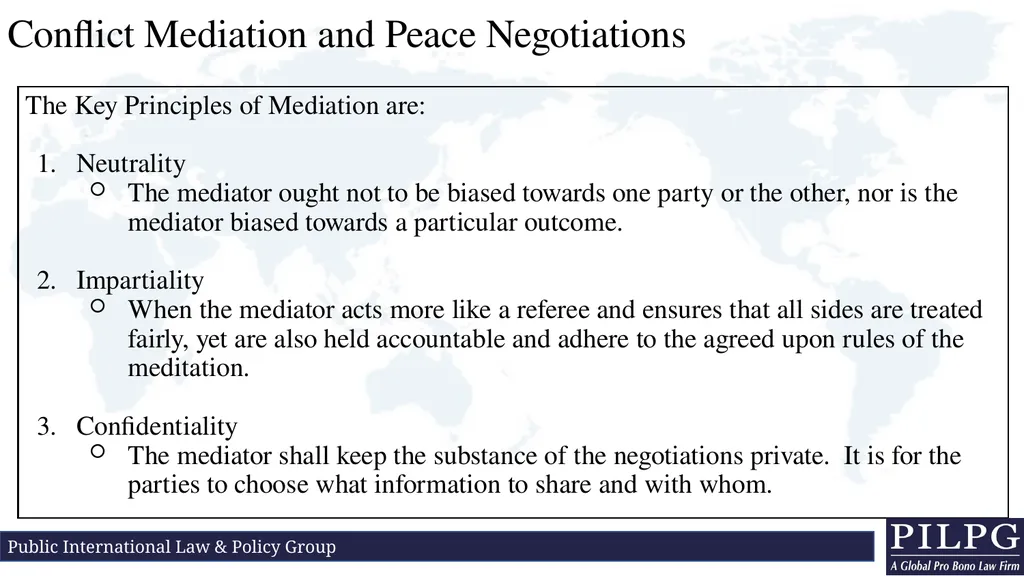
slide2. Conflict Mediation and Peace Negotiations Public International Law & Policy Group The Key Principles of Mediation are:
Neutrality
The mediator ought not to be biased towards one party or the other, nor is the mediator biased towards a particular outcome.
Impartiality
When the mediator acts more like a referee and ensures that all sides are treated fairly, yet are also held accountable and adhere to the agreed upon rules of the meditation.
Confidentiality
The mediator shall keep the substance of the negotiations private. It is for the parties to choose what information to share and with whom.<br>
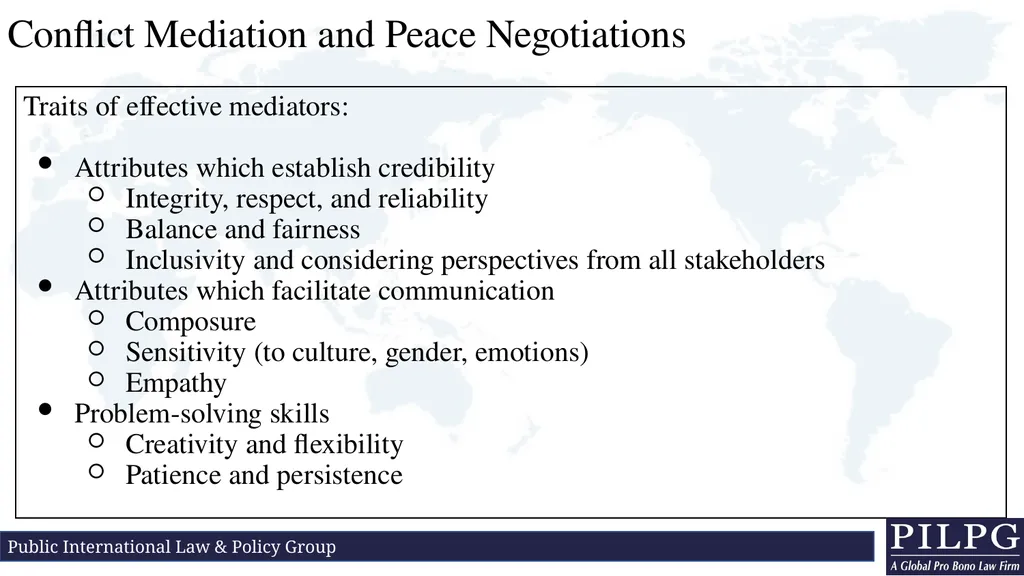
slide3. Conflict Mediation and Peace Negotiations Public International Law & Policy Group Traits of effective mediators:
Attributes which establish credibility
Integrity, respect, and reliability
Balance and fairness
Inclusivity and considering perspectives from all stakeholders
Attributes which facilitate communication
Composure
Sensitivity (to culture, gender, emotions)
Empathy
Problem-solving skills
Creativity and flexibility
Patience and persistence<br>
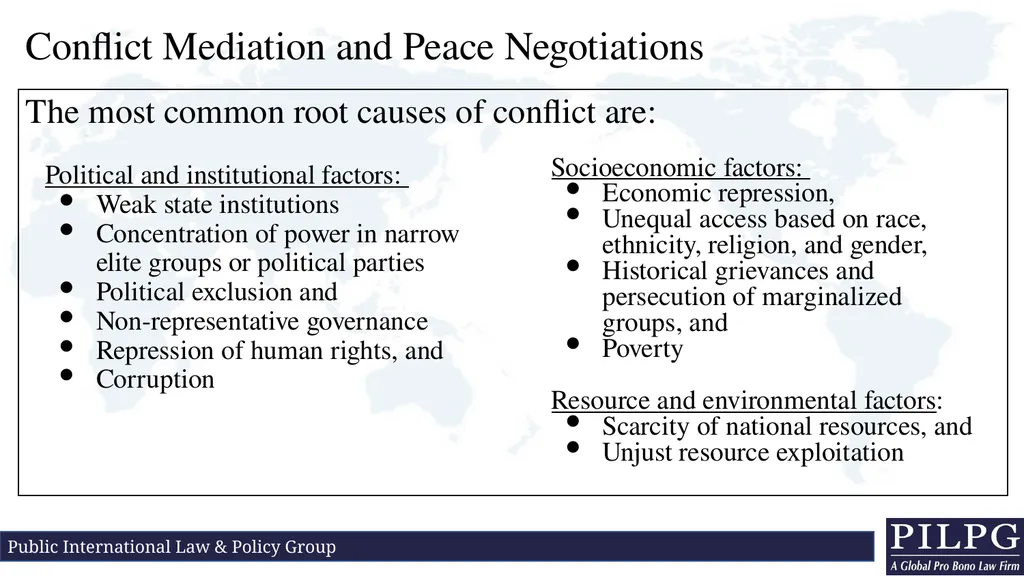
slide4. Conflict Mediation and Peace Negotiations Public International Law & Policy Group The most common root causes of conflict are: Political and institutional factors:
Weak state institutions
Concentration of power in narrow elite groups or political parties
Political exclusion and
Non-representative governance
Repression of human rights, and
Corruption Socioeconomic factors:
Economic repression,
Unequal access based on race, ethnicity, religion, and gender,
Historical grievances and persecution of marginalized groups, and
Poverty
Resource and environmental factors:
Scarcity of national resources, and
Unjust resource exploitation<br>
slide5. Ceasefires and Related Security Arrangements Public International Law & Policy Group There are various types of related agreements, from cessation of hostilities agreements to more formal ceasefires, that tend to build upon one another.
Specific vocabulary is less important that understanding the functions of each.
Typically, humanitarian or preliminary ceasefires help parties establish communication and trust, creating a foundation to build upon.
Going through the formal steps or this kind of progression is not necessary.<br>
slide6. Ceasefires and Related Security Arrangements Public International Law & Policy Group International or third party actors play an important role supporting the conflict parties by providing training workshops and advisory support to navigate the distinct technical challenges that arise at each stage along the ceasefire process.
However, it is always essential that the conflict parties fully own their ceasefire process, and that the parties are not pressured into agreements they are not yet ready for which could derail the whole process.
Important: Parties must decide how the ceasefire will be managed, what system of monitoring and verification will be used, who handles interim security, and how civilians and civil society will be involved in the process.<br>
slide7. Ceasefire Monitoring and Verification Public International Law & Policy Group Ceasefire management is the process through which the conflict parties coordinate and supervise the implementation of terms set out in the ceasefire agreement and handle the inevitable incidents that arise during this process.
Ceasefire monitoring is a much broader process that involves the general observation of compliance or behavior that relates to the ceasefire.
Ceasefire verification and monitoring are two closely related, but clearly distinct tasks. Both can play an important role in the ceasefire implementation process.
Ceasefire verification refers specifically to the technical assessment of the conflict party’s compliance with some specific terms in the ceasefire agreement.<br>
slide8. Confidence and Security Building Measures Public International Law & Policy Group Confidence-Building Measures (CBMs): CMBS are mutually and freely accepted
arrangements focused on building confidence in the political, socio-economic, or
environmental spheres, such as natural disaster response. These tools are designed
to lower tensions by increasing information, reducing misunderstanding, or
misreading the actions of others.
They foster trust and bridge dividing lines in areas of tension as
contributions to building sustainable peace and stability. CBMs can also play
a significant role in post-conflict rehabilitation and reconciliation.<br>
slide9. Confidence and Security Building Measures Public International Law & Policy Group Confidence- and Security-Building Measures (CSBMs): CSBMs are a subset
of CBMs that have a more military character or dimension to them. CSBMs
contribute to reducing the dangers of armed conflict and of misunderstanding or
miscalculation of military activities which could give rise to apprehension,
particularly in a situation where parties involved lack clear and timely information.
Information exchange between potentially hostile forces is key, and verification
of the information shared can include evaluation visits of military formations
or units.<br>
slide10. Confidence and Security Building Measures Public International Law & Policy Group Risk Reduction and Stability Tools (RRSTs): RRSTs can encompass CSBMs but
are broader in scope and more specialized. There are three main elements that
underpin RRSTs:
1) building confidence and predictability through dialogue;
2) increasing clarity, communication and understanding; and
3) implementing effective crisis prevention and crisis management tools.<br>
slide11. Confidence and Security Building Measures Public International Law & Policy Group Why are CSBMs valuable?
● CSBMs can lower the likelihood of misperception.
● CSBMs can prevent unintended escalation.
● CSBMs can promote responsible behavior.
● CSBMs offer platforms for dialogue.
Forums or dialogues, whether official (track 1), unofficial (track 2), or featuring a mix of government and non-governmental participants (track 1.5), provide the opportunity for all parties to discuss their security concerns, gain deeper understanding of the other side’s perspective, and identify priorities and potential overlap that can be addressed through further collaboration.<br>
slide12. Confidence and Security Building Measures Public International Law & Policy Group ● CSBMs build relationships.
● CSBMs promote stability through transparency.
● CSBMs lay the groundwork for further cooperation (may also be used to tackle initial obstacles associated with more ambitious collaboration by building trust as a credible partner incrementally).<br>
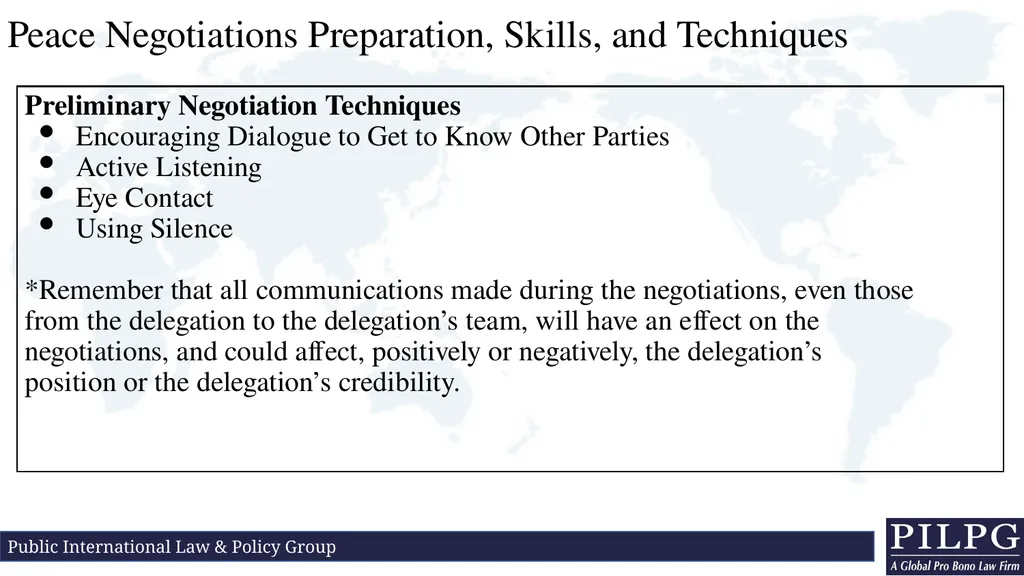
slide13. Peace Negotiations Preparation, Skills, and Techniques Public International Law & Policy Group Preliminary Negotiation Techniques
Encouraging Dialogue to Get to Know Other Parties
Active Listening
Eye Contact
Using Silence
*Remember that all communications made during the negotiations, even those
from the delegation to the delegation’s team, will have an effect on the
negotiations, and could affect, positively or negatively, the delegation’s
position or the delegation’s credibility.<br>
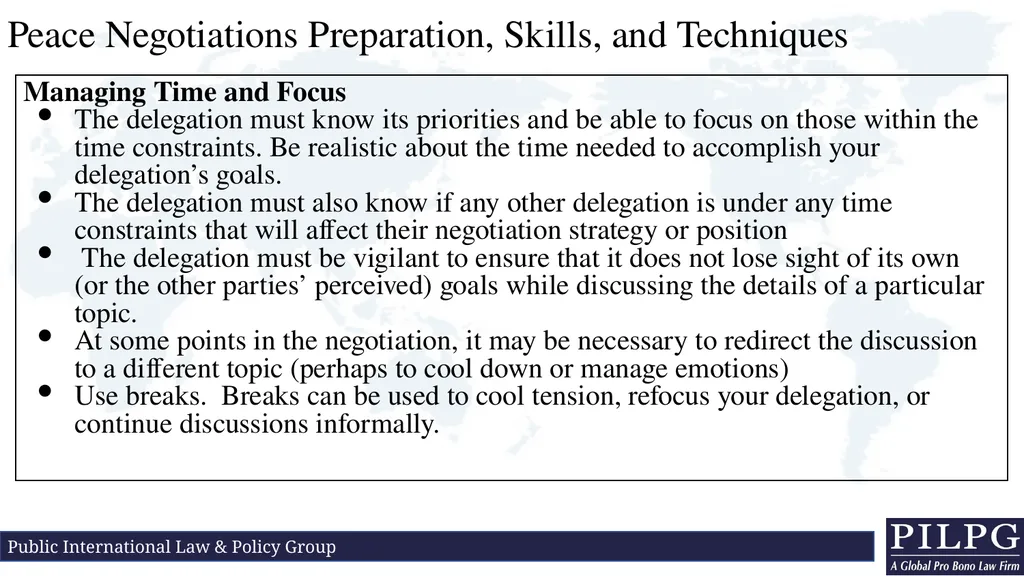
slide14. Peace Negotiations Preparation, Skills, and Techniques Public International Law & Policy Group Managing Time and Focus
The delegation must know its priorities and be able to focus on those within the time constraints. Be realistic about the time needed to accomplish your delegation’s goals.
The delegation must also know if any other delegation is under any time constraints that will affect their negotiation strategy or position
The delegation must be vigilant to ensure that it does not lose sight of its own (or the other parties’ perceived) goals while discussing the details of a particular topic.
At some points in the negotiation, it may be necessary to redirect the discussion to a different topic (perhaps to cool down or manage emotions)
Use breaks. Breaks can be used to cool tension, refocus your delegation, or continue discussions informally.<br>
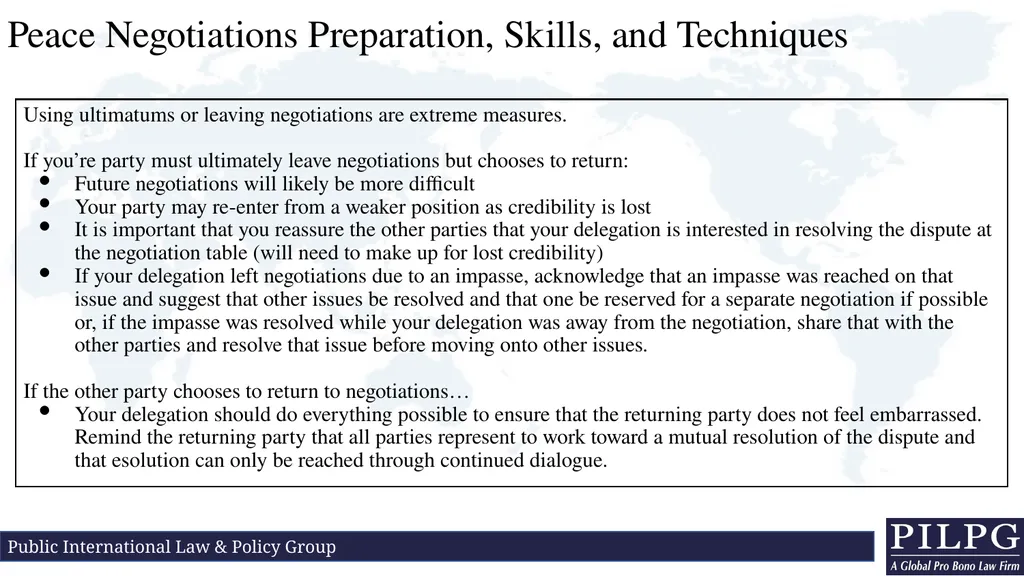
slide15. Peace Negotiations Preparation, Skills, and Techniques Public International Law & Policy Group Using ultimatums or leaving negotiations are extreme measures.
If you’re party must ultimately leave negotiations but chooses to return:
Future negotiations will likely be more difficult
Your party may re-enter from a weaker position as credibility is lost
It is important that you reassure the other parties that your delegation is interested in resolving the dispute at the negotiation table (will need to make up for lost credibility)
If your delegation left negotiations due to an impasse, acknowledge that an impasse was reached on that issue and suggest that other issues be resolved and that one be reserved for a separate negotiation if possible or, if the impasse was resolved while your delegation was away from the negotiation, share that with the other parties and resolve that issue before moving onto other issues.
If the other party chooses to return to negotiations…
Your delegation should do everything possible to ensure that the returning party does not feel embarrassed. Remind the returning party that all parties represent to work toward a mutual resolution of the dispute and that esolution can only be reached through continued dialogue.<br>
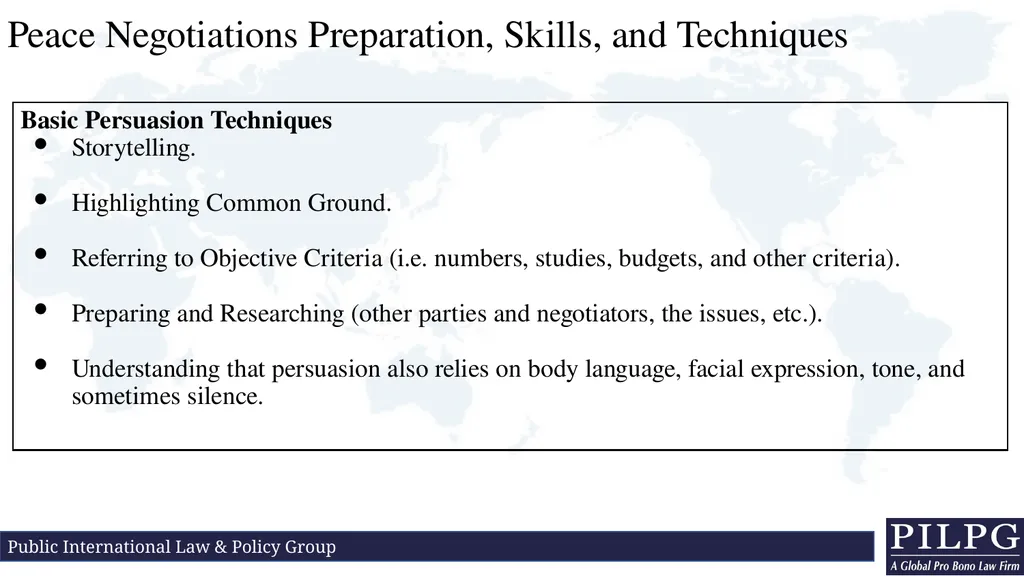
slide16. Peace Negotiations Preparation, Skills, and Techniques Public International Law & Policy Group Basic Persuasion Techniques
Storytelling.
Highlighting Common Ground.
Referring to Objective Criteria (i.e. numbers, studies, budgets, and other criteria).
Preparing and Researching (other parties and negotiators, the issues, etc.).
Understanding that persuasion also relies on body language, facial expression, tone, and sometimes silence.<br>
slide17. Questions? Public International Law & Policy Group<br>
slide2. Conflict Mediation and Peace Negotiations Public International Law & Policy Group The Key Principles of Mediation are:
Neutrality
The mediator ought not to be biased towards one party or the other, nor is the mediator biased towards a particular outcome.
Impartiality
When the mediator acts more like a referee and ensures that all sides are treated fairly, yet are also held accountable and adhere to the agreed upon rules of the meditation.
Confidentiality
The mediator shall keep the substance of the negotiations private. It is for the parties to choose what information to share and with whom.<br>
slide3. Conflict Mediation and Peace Negotiations Public International Law & Policy Group Traits of effective mediators:
Attributes which establish credibility
Integrity, respect, and reliability
Balance and fairness
Inclusivity and considering perspectives from all stakeholders
Attributes which facilitate communication
Composure
Sensitivity (to culture, gender, emotions)
Empathy
Problem-solving skills
Creativity and flexibility
Patience and persistence<br>
slide4. Conflict Mediation and Peace Negotiations Public International Law & Policy Group The most common root causes of conflict are: Political and institutional factors:
Weak state institutions
Concentration of power in narrow elite groups or political parties
Political exclusion and
Non-representative governance
Repression of human rights, and
Corruption Socioeconomic factors:
Economic repression,
Unequal access based on race, ethnicity, religion, and gender,
Historical grievances and persecution of marginalized groups, and
Poverty
Resource and environmental factors:
Scarcity of national resources, and
Unjust resource exploitation<br>
slide5. Ceasefires and Related Security Arrangements Public International Law & Policy Group There are various types of related agreements, from cessation of hostilities agreements to more formal ceasefires, that tend to build upon one another.
Specific vocabulary is less important that understanding the functions of each.
Typically, humanitarian or preliminary ceasefires help parties establish communication and trust, creating a foundation to build upon.
Going through the formal steps or this kind of progression is not necessary.<br>
slide6. Ceasefires and Related Security Arrangements Public International Law & Policy Group International or third party actors play an important role supporting the conflict parties by providing training workshops and advisory support to navigate the distinct technical challenges that arise at each stage along the ceasefire process.
However, it is always essential that the conflict parties fully own their ceasefire process, and that the parties are not pressured into agreements they are not yet ready for which could derail the whole process.
Important: Parties must decide how the ceasefire will be managed, what system of monitoring and verification will be used, who handles interim security, and how civilians and civil society will be involved in the process.<br>
slide7. Ceasefire Monitoring and Verification Public International Law & Policy Group Ceasefire management is the process through which the conflict parties coordinate and supervise the implementation of terms set out in the ceasefire agreement and handle the inevitable incidents that arise during this process.
Ceasefire monitoring is a much broader process that involves the general observation of compliance or behavior that relates to the ceasefire.
Ceasefire verification and monitoring are two closely related, but clearly distinct tasks. Both can play an important role in the ceasefire implementation process.
Ceasefire verification refers specifically to the technical assessment of the conflict party’s compliance with some specific terms in the ceasefire agreement.<br>
slide8. Confidence and Security Building Measures Public International Law & Policy Group Confidence-Building Measures (CBMs): CMBS are mutually and freely accepted
arrangements focused on building confidence in the political, socio-economic, or
environmental spheres, such as natural disaster response. These tools are designed
to lower tensions by increasing information, reducing misunderstanding, or
misreading the actions of others.
They foster trust and bridge dividing lines in areas of tension as
contributions to building sustainable peace and stability. CBMs can also play
a significant role in post-conflict rehabilitation and reconciliation.<br>
slide9. Confidence and Security Building Measures Public International Law & Policy Group Confidence- and Security-Building Measures (CSBMs): CSBMs are a subset
of CBMs that have a more military character or dimension to them. CSBMs
contribute to reducing the dangers of armed conflict and of misunderstanding or
miscalculation of military activities which could give rise to apprehension,
particularly in a situation where parties involved lack clear and timely information.
Information exchange between potentially hostile forces is key, and verification
of the information shared can include evaluation visits of military formations
or units.<br>
slide10. Confidence and Security Building Measures Public International Law & Policy Group Risk Reduction and Stability Tools (RRSTs): RRSTs can encompass CSBMs but
are broader in scope and more specialized. There are three main elements that
underpin RRSTs:
1) building confidence and predictability through dialogue;
2) increasing clarity, communication and understanding; and
3) implementing effective crisis prevention and crisis management tools.<br>
slide11. Confidence and Security Building Measures Public International Law & Policy Group Why are CSBMs valuable?
● CSBMs can lower the likelihood of misperception.
● CSBMs can prevent unintended escalation.
● CSBMs can promote responsible behavior.
● CSBMs offer platforms for dialogue.
Forums or dialogues, whether official (track 1), unofficial (track 2), or featuring a mix of government and non-governmental participants (track 1.5), provide the opportunity for all parties to discuss their security concerns, gain deeper understanding of the other side’s perspective, and identify priorities and potential overlap that can be addressed through further collaboration.<br>
slide12. Confidence and Security Building Measures Public International Law & Policy Group ● CSBMs build relationships.
● CSBMs promote stability through transparency.
● CSBMs lay the groundwork for further cooperation (may also be used to tackle initial obstacles associated with more ambitious collaboration by building trust as a credible partner incrementally).<br>
slide13. Peace Negotiations Preparation, Skills, and Techniques Public International Law & Policy Group Preliminary Negotiation Techniques
Encouraging Dialogue to Get to Know Other Parties
Active Listening
Eye Contact
Using Silence
*Remember that all communications made during the negotiations, even those
from the delegation to the delegation’s team, will have an effect on the
negotiations, and could affect, positively or negatively, the delegation’s
position or the delegation’s credibility.<br>
slide14. Peace Negotiations Preparation, Skills, and Techniques Public International Law & Policy Group Managing Time and Focus
The delegation must know its priorities and be able to focus on those within the time constraints. Be realistic about the time needed to accomplish your delegation’s goals.
The delegation must also know if any other delegation is under any time constraints that will affect their negotiation strategy or position
The delegation must be vigilant to ensure that it does not lose sight of its own (or the other parties’ perceived) goals while discussing the details of a particular topic.
At some points in the negotiation, it may be necessary to redirect the discussion to a different topic (perhaps to cool down or manage emotions)
Use breaks. Breaks can be used to cool tension, refocus your delegation, or continue discussions informally.<br>
slide15. Peace Negotiations Preparation, Skills, and Techniques Public International Law & Policy Group Using ultimatums or leaving negotiations are extreme measures.
If you’re party must ultimately leave negotiations but chooses to return:
Future negotiations will likely be more difficult
Your party may re-enter from a weaker position as credibility is lost
It is important that you reassure the other parties that your delegation is interested in resolving the dispute at the negotiation table (will need to make up for lost credibility)
If your delegation left negotiations due to an impasse, acknowledge that an impasse was reached on that issue and suggest that other issues be resolved and that one be reserved for a separate negotiation if possible or, if the impasse was resolved while your delegation was away from the negotiation, share that with the other parties and resolve that issue before moving onto other issues.
If the other party chooses to return to negotiations…
Your delegation should do everything possible to ensure that the returning party does not feel embarrassed. Remind the returning party that all parties represent to work toward a mutual resolution of the dispute and that esolution can only be reached through continued dialogue.<br>
slide16. Peace Negotiations Preparation, Skills, and Techniques Public International Law & Policy Group Basic Persuasion Techniques
Storytelling.
Highlighting Common Ground.
Referring to Objective Criteria (i.e. numbers, studies, budgets, and other criteria).
Preparing and Researching (other parties and negotiators, the issues, etc.).
Understanding that persuasion also relies on body language, facial expression, tone, and sometimes silence.<br>
slide17. Questions? Public International Law & Policy Group<br>