
Recommended Practices for Determining,
BR
Published · 20 slides · 0 views
1 / 1
Description
Recommended Practices for Determining, Communicating and Utilizing Adverse Effect Data Related to Nonclinical Studies James A. Popp PoppStratoxon.com Presented on behalf of the Society of Toxicologic Pathology Adversity Working Group
Related Topics
Share
Embed code
Download this presentation From Below
"Recommended Practices for Determining," is the property of its rightful owner. Permission is granted to download and print the materials on this website for personal, non-commercial use only, and to display it on your personal computer provided you do not modify the materials and that you retain all copyright notices contained in the materials. By downloading content from our website, you accept the terms of this agreement.
Presentation Transcript
01
Recommended Practices for Determining, Communicating and Utilizing Adverse Effect Data Related to Nonclinical Studies James A. Popp
Popp@Stratoxon.com
Presented on behalf of the Society of Toxicologic Pathology
Adversity Working Group<br>
Popp@Stratoxon.com
Presented on behalf of the Society of Toxicologic Pathology
Adversity Working Group<br>
02
Background
STP Activity Draft recommendations
Initially formulated by the Adversity Working Group of the Society of Toxicologic Pathology
Modified based on comments from numerous STP members
Further refinement will be considered based on additional suggestions for modification
Your comments are welcome and appreciated
Final version of recommendations will be published in the journal Toxicologic Pathology<br>
Initially formulated by the Adversity Working Group of the Society of Toxicologic Pathology
Modified based on comments from numerous STP members
Further refinement will be considered based on additional suggestions for modification
Your comments are welcome and appreciated
Final version of recommendations will be published in the journal Toxicologic Pathology<br>
03
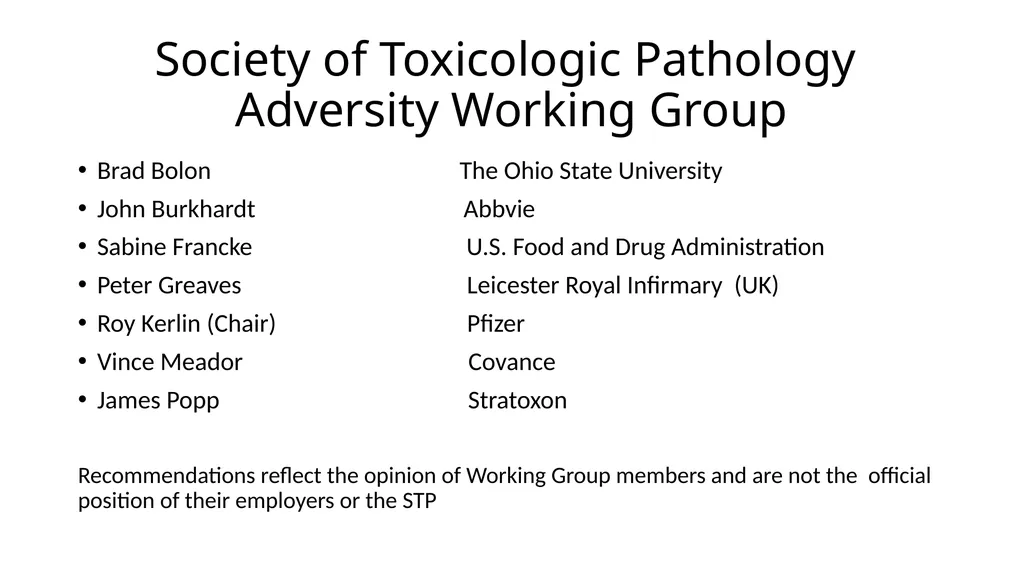
Society of Toxicologic Pathology
Adversity Working Group Brad Bolon The Ohio State University
John Burkhardt Abbvie
Sabine Francke U.S. Food and Drug Administration
Peter Greaves Leicester Royal Infirmary (UK)
Roy Kerlin (Chair) Pfizer
Vince Meador Covance
James Popp Stratoxon
Recommendations reflect the opinion of Working Group members and are not the official position of their employers or the STP<br>
John Burkhardt Abbvie
Sabine Francke U.S. Food and Drug Administration
Peter Greaves Leicester Royal Infirmary (UK)
Roy Kerlin (Chair) Pfizer
Vince Meador Covance
James Popp Stratoxon
Recommendations reflect the opinion of Working Group members and are not the official position of their employers or the STP<br>
04
Adverse
NOAEL Identification of an “adverse” effect leading to the designation of a “NOAEL” in nonclinical studies has too frequently resulted in confusion, misunderstandings and in some cases unnecessary contentious situations
Agreement or standardization of basic principles related to “adversity” and “NOAEL” could vastly improve the understanding and importance of nonclinical study results for clinicians and regulators<br>
Agreement or standardization of basic principles related to “adversity” and “NOAEL” could vastly improve the understanding and importance of nonclinical study results for clinicians and regulators<br>
05
Basic Issues Related to Use of the Terms
“Adverse” and “NOAEL” Inconsistent approaches and opinions related to what effects are “Adverse” thereby affecting the “NOAEL”
Variable approaches for communicating adverse effects in nonclinical studies
Report
Summary Documents
Data tables
Differences in approaches and opinions related to using adverse effect data and NOAEL in the assessment of human risk<br>
Variable approaches for communicating adverse effects in nonclinical studies
Report
Summary Documents
Data tables
Differences in approaches and opinions related to using adverse effect data and NOAEL in the assessment of human risk<br>
06
Objective of STP Effort Primary Objective
Develop recommendations to improve the
Identification
Communication
Utilization
of adverse effects found in nonclinical studies
Ultimate Objective
Contribute to more effective and efficient product development through improved communication and reporting<br>
Develop recommendations to improve the
Identification
Communication
Utilization
of adverse effects found in nonclinical studies
Ultimate Objective
Contribute to more effective and efficient product development through improved communication and reporting<br>
07
Background
Adversity and NOAEL Multiple and sometimes conflicting definitions of “adversity” have been provided in the literature (reference analysis included in publication)
Concept of “adversity” has been variably based on:
Objective evaluation of data (statistical assessment)
Subjective evaluation of data (consideration of broader knowledge of biology including tissue, cellular and molecular understanding of responses to xenobiotics)
Professional judgment relying on either or both objective and subjective assessment of data<br>
Concept of “adversity” has been variably based on:
Objective evaluation of data (statistical assessment)
Subjective evaluation of data (consideration of broader knowledge of biology including tissue, cellular and molecular understanding of responses to xenobiotics)
Professional judgment relying on either or both objective and subjective assessment of data<br>
08
Recommendations Recommendations of the STP Adversity Working Group are presented in the order they apply in the course of performance and communication of results from a nonclinical study
Three sections of recommendations
Determining “Adversity” and “NOAEL”
Communicating “Adversity” and “NOAEL”
Using “Adversity” and “NOAEL” in assessing human risk<br>
Three sections of recommendations
Determining “Adversity” and “NOAEL”
Communicating “Adversity” and “NOAEL”
Using “Adversity” and “NOAEL” in assessing human risk<br>
09
Recommendation 1
(Determining “Adversity” and “NOAEL”) “Adversity” is a term indicating “harm” to the test animal within the constraints of a given study design (dose, duration etc.)
Comment
Not all changes are harmful (i.e. capable of detrimentally impacting an animal’s performance or lifespan, either under normal conditions or if challenged)
Only harmful changes are adverse
Test article-related changes that are not harmful are “non-adverse”<br>
Comment
Not all changes are harmful (i.e. capable of detrimentally impacting an animal’s performance or lifespan, either under normal conditions or if challenged)
Only harmful changes are adverse
Test article-related changes that are not harmful are “non-adverse”<br>
10
Recommendation 1
(Determining “Adversity” and “NOAEL”) “Adversity” is a term indicating “harm” to the test animal within the constraints of a given study design (dose, duration etc.)
Additional comment
Reversibility alone is insufficient evidence to determine adversity
Reversibility data can be useful for confirming an assessment of adversity
Reversibility may impact the subsequent assessment of human risk<br>
Additional comment
Reversibility alone is insufficient evidence to determine adversity
Reversibility data can be useful for confirming an assessment of adversity
Reversibility may impact the subsequent assessment of human risk<br>
11
Recommendation 2
(Determining “Adversity” and “NOAEL”) Decision whether test article-related effects (or group of related effects) in a nonclinical study are considered “adverse” or “non-adverse” should be unambiguously stated and justified in sub-reports and/or the study report
Comment
A decision regarding a designation of adversity represents an interpretation
Reasons for the interpretation should be:
Clear
Concise
Complete<br>
Comment
A decision regarding a designation of adversity represents an interpretation
Reasons for the interpretation should be:
Clear
Concise
Complete<br>
12
Recommendation 3
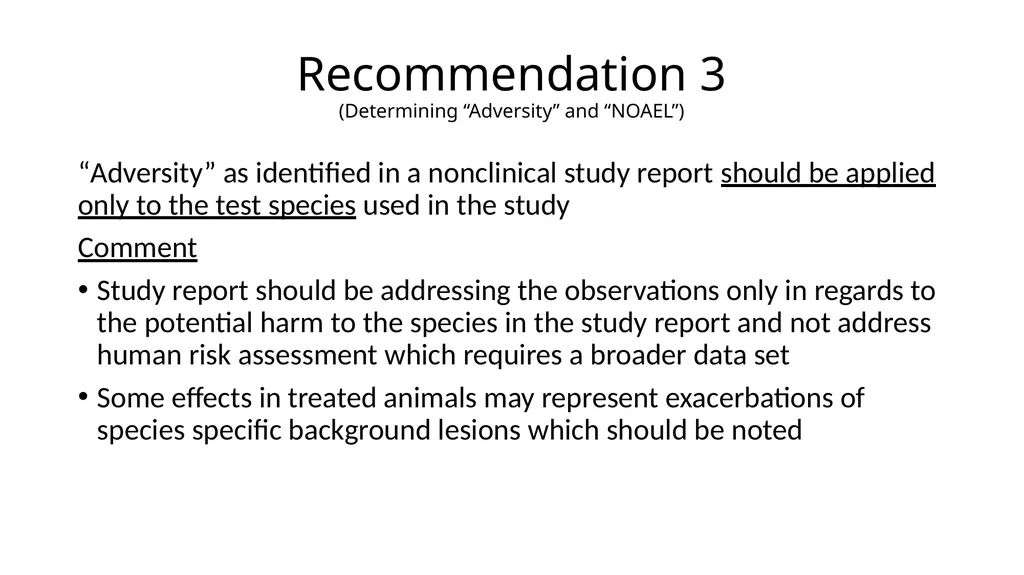
(Determining “Adversity” and “NOAEL”) “Adversity” as identified in a nonclinical study report should be applied only to the test species used in the study
Comment
Study report should be addressing the observations only in regards to the potential harm to the species in the study report and not address human risk assessment which requires a broader data set
Some effects in treated animals may represent exacerbations of species specific background lesions which should be noted<br>
Comment
Study report should be addressing the observations only in regards to the potential harm to the species in the study report and not address human risk assessment which requires a broader data set
Some effects in treated animals may represent exacerbations of species specific background lesions which should be noted<br>
13
Recommendation 4
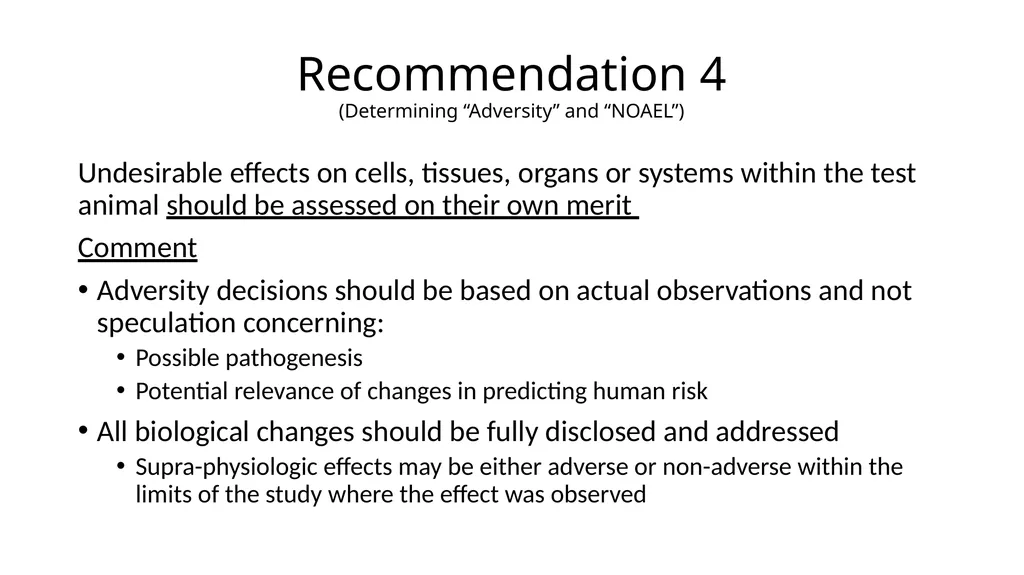
(Determining “Adversity” and “NOAEL”) Undesirable effects on cells, tissues, organs or systems within the test animal should be assessed on their own merit
Comment
Adversity decisions should be based on actual observations and not speculation concerning:
Possible pathogenesis
Potential relevance of changes in predicting human risk
All biological changes should be fully disclosed and addressed
Supra-physiologic effects may be either adverse or non-adverse within the limits of the study where the effect was observed<br>
Comment
Adversity decisions should be based on actual observations and not speculation concerning:
Possible pathogenesis
Potential relevance of changes in predicting human risk
All biological changes should be fully disclosed and addressed
Supra-physiologic effects may be either adverse or non-adverse within the limits of the study where the effect was observed<br>
14
Recommendation 5
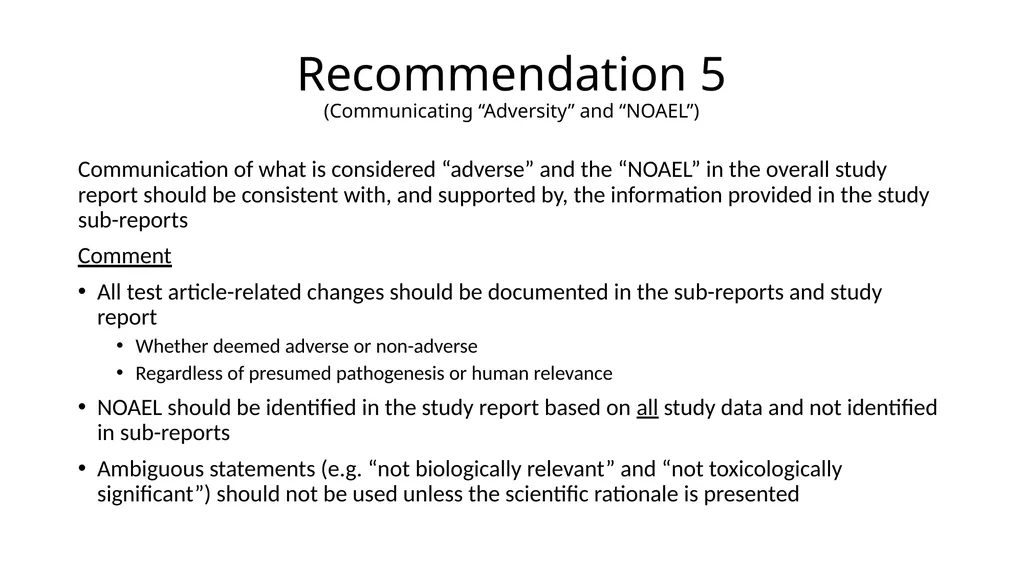
(Communicating “Adversity” and “NOAEL”) Communication of what is considered “adverse” and the “NOAEL” in the overall study report should be consistent with, and supported by, the information provided in the study sub-reports
Comment
All test article-related changes should be documented in the sub-reports and study report
Whether deemed adverse or non-adverse
Regardless of presumed pathogenesis or human relevance
NOAEL should be identified in the study report based on all study data and not identified in sub-reports
Ambiguous statements (e.g. “not biologically relevant” and “not toxicologically significant”) should not be used unless the scientific rationale is presented<br>
Comment
All test article-related changes should be documented in the sub-reports and study report
Whether deemed adverse or non-adverse
Regardless of presumed pathogenesis or human relevance
NOAEL should be identified in the study report based on all study data and not identified in sub-reports
Ambiguous statements (e.g. “not biologically relevant” and “not toxicologically significant”) should not be used unless the scientific rationale is presented<br>
15
Recommendation 6
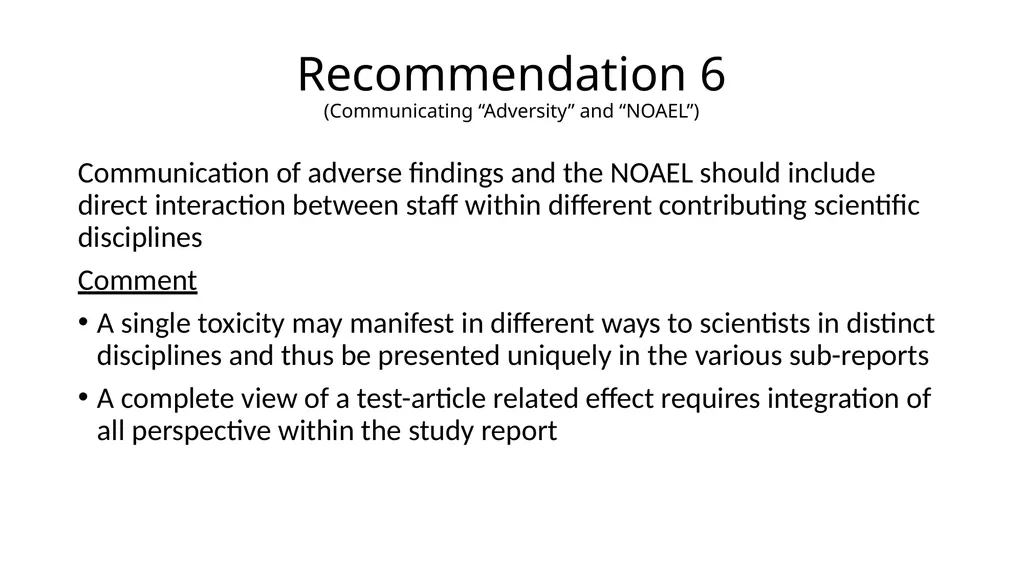
(Communicating “Adversity” and “NOAEL”) Communication of adverse findings and the NOAEL should include direct interaction between staff within different contributing scientific disciplines
Comment
A single toxicity may manifest in different ways to scientists in distinct disciplines and thus be presented uniquely in the various sub-reports
A complete view of a test-article related effect requires integration of all perspective within the study report<br>
Comment
A single toxicity may manifest in different ways to scientists in distinct disciplines and thus be presented uniquely in the various sub-reports
A complete view of a test-article related effect requires integration of all perspective within the study report<br>
16
Recommendation 7
(Communicating “Adversity” and “NOAEL”) The basis for establishing the NOAEL for a test article should be stated in an overview document based on data from multiple studies
Comment
Integration is necessary because a NOAEL identified in one study may be discounted as irrelevant within an overview document based on data from another study
Selection of the NOAEL in the most sensitive species requires analysis of data from all available studies<br>
Comment
Integration is necessary because a NOAEL identified in one study may be discounted as irrelevant within an overview document based on data from another study
Selection of the NOAEL in the most sensitive species requires analysis of data from all available studies<br>
17
Recommendation 8
(Communicating “Adversity” and “NOAEL”) In order to place the NOAELs in appropriate context, their use in data tables should be referenced to explanatory text in the document
Comment
Rationale provided in text provides critical insight regarding the basis for the NOAEL
Use of the NOAEL without an understanding of the effects observed in nonclinical studies can lead to inappropriate drug development decisions<br>
Comment
Rationale provided in text provides critical insight regarding the basis for the NOAEL
Use of the NOAEL without an understanding of the effects observed in nonclinical studies can lead to inappropriate drug development decisions<br>
18
Recommendation 9
(Using “Adversity” and “NOAEL” in assessing potential human risk) Nonclinical scientists, including toxicologists, pathologists and other contributing scientists who interpret data from non-clinical studies should be active participants in assessing and communicating human risk
Comment
Individuals who generate sub-reports are best qualified to explain the data set and its interpretation
Nonclinical scientists from multiple disciplines provide valuable insight in
Assisting the study director to weigh the evidence to set the NOAEL
Advising the clinical research team with respect to setting the initial dose<br>
Comment
Individuals who generate sub-reports are best qualified to explain the data set and its interpretation
Nonclinical scientists from multiple disciplines provide valuable insight in
Assisting the study director to weigh the evidence to set the NOAEL
Advising the clinical research team with respect to setting the initial dose<br>
19
Recommendation 10
(Using “Adversity” and “NOAEL” in assessing potential human risk) All available data from all nonclinical studies must be evaluated together to define potential toxicities and predict human risk
Comment
Experimental studies designed to understand the pathogenesis of a nonclinical study finding may profoundly influence the human risk profile
Assessment of human risk should be based on all available data
Nonclinical studies
Clinical studies
Literature of structurally related or similar acting agents<br>
Comment
Experimental studies designed to understand the pathogenesis of a nonclinical study finding may profoundly influence the human risk profile
Assessment of human risk should be based on all available data
Nonclinical studies
Clinical studies
Literature of structurally related or similar acting agents<br>
20
Summary Recommended practices are intended to produce a more consistent approach to determining, communicating and utilizing information on adverse effects noted in nonclinical studies
Consistency of approaches will minimize misunderstandings related to the nonclinical effects and the implications of these effects for indicating potential human risk
Identification of an effect as adverse and the resultant NOAEL designation will continue to be based on scientific interpretation of the available nonclinical data<br>
Consistency of approaches will minimize misunderstandings related to the nonclinical effects and the implications of these effects for indicating potential human risk
Identification of an effect as adverse and the resultant NOAEL designation will continue to be based on scientific interpretation of the available nonclinical data<br>