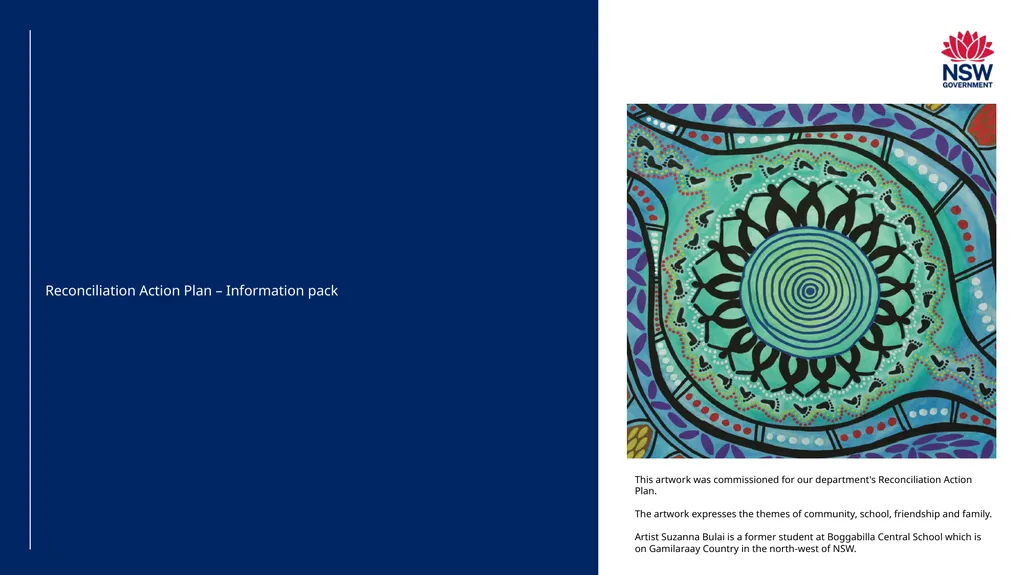
Reconciliation Action Plan Information pack This artwork was commissioned for our departments Reconciliation Action Plan. The artwork expresses the themes of community, school, friendship and family. Artist Suzanna Bulai is a former
"Reconciliation Action Plan – Information pack This" is the property of its rightful owner. Permission is granted to
download and print the materials on this website for personal, non-commercial use only, and to display it
on your personal computer provided you do not modify the materials and that you retain all copyright
notices contained in the materials. By downloading content from our website, you accept the terms of this
agreement.
Share
Embed code
Presentation Transcript
01
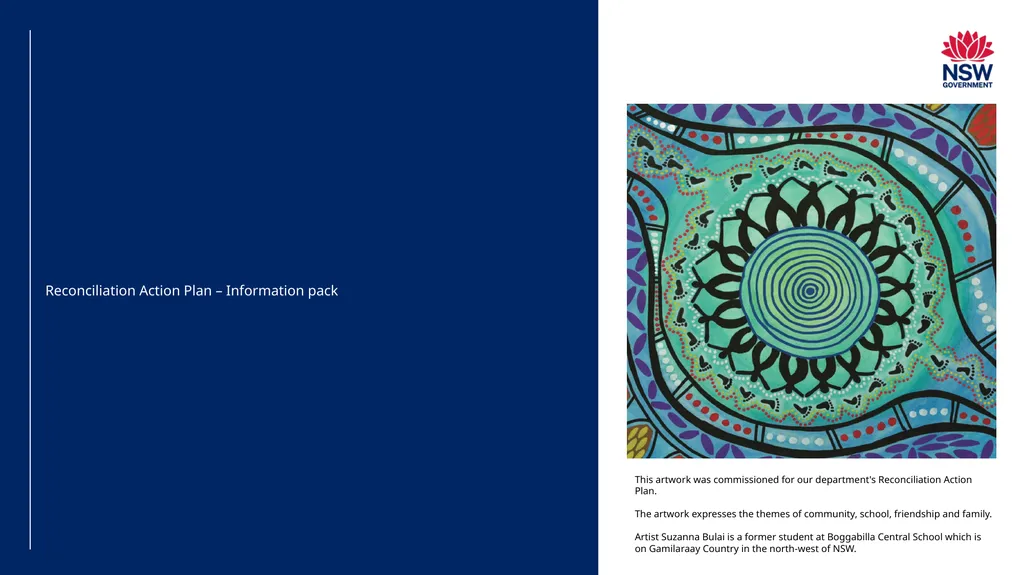
Reconciliation Action Plan – Information pack This artwork was commissioned for our department's Reconciliation Action Plan.
The artwork expresses the themes of community, school, friendship and family.
Artist Suzanna Bulai is a former student at Boggabilla Central School which is on Gamilaraay Country in the north-west of NSW.<br>
02
Acknowledgement of Country Reconciliation Action Plan Toolkit The NSW Department of Education acknowledge the Traditional Custodians of the lands where we work and the places in which we live.
We celebrate the First Peoples’ unique cultural and spiritual relationship to Country, and their rich contribution to Australia.
We pay respect to Ancestors and Elders past, present and future.
The department recognises that by acknowledging our past, we are laying the groundwork for a just equitable and reconciled Australia.<br>
03
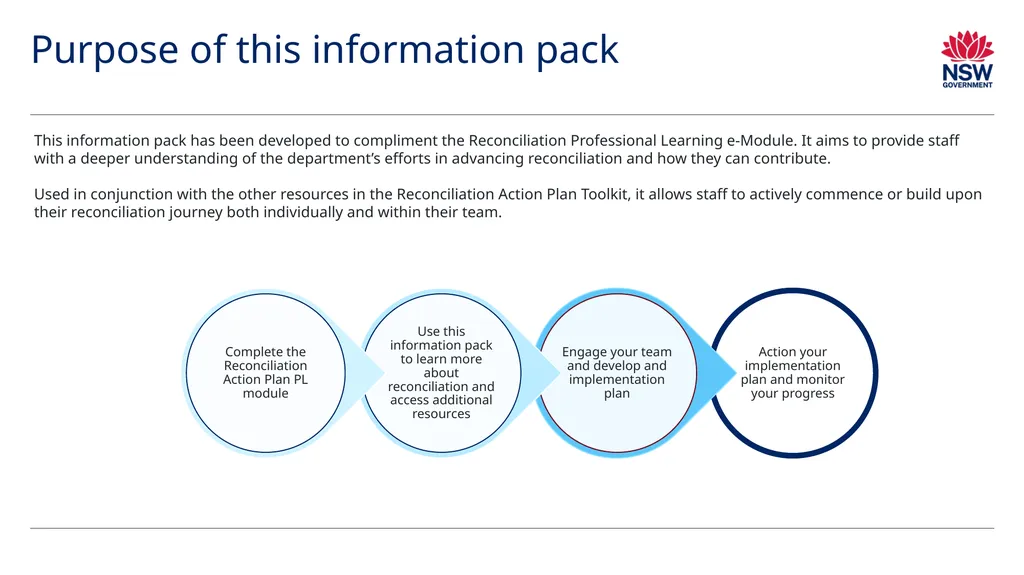
Purpose of this information pack This information pack has been developed to compliment the Reconciliation Professional Learning e-Module. It aims to provide staff with a deeper understanding of the department’s efforts in advancing reconciliation and how they can contribute.
Used in conjunction with the other resources in the Reconciliation Action Plan Toolkit, it allows staff to actively commence or build upon their reconciliation journey both individually and within their team.<br>
04
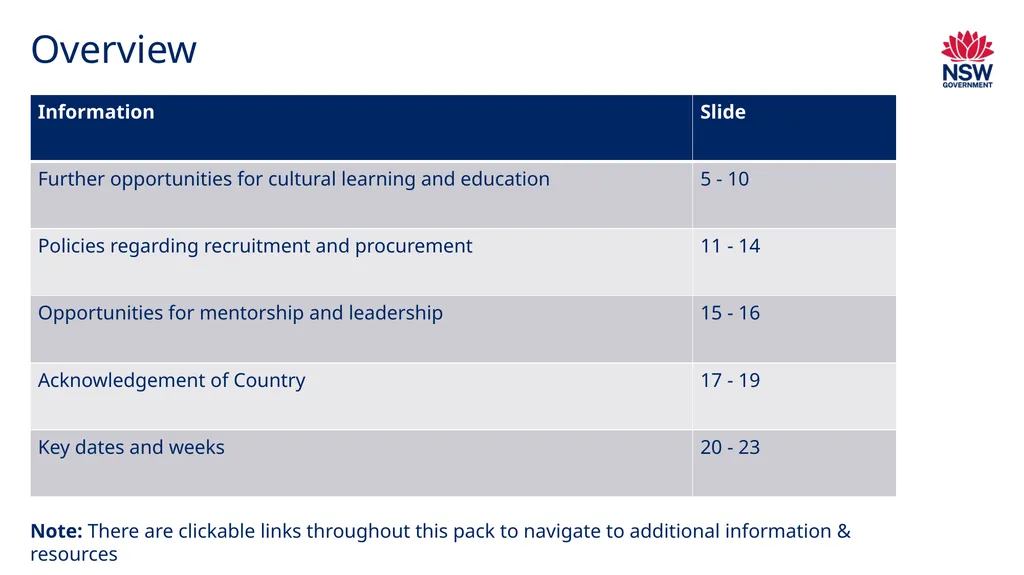
Overview Note: There are clickable links throughout this pack to navigate to additional information & resources<br>
05
Further opportunities for cultural learning and education Reconciliation Action Plan Toolkit<br>
06
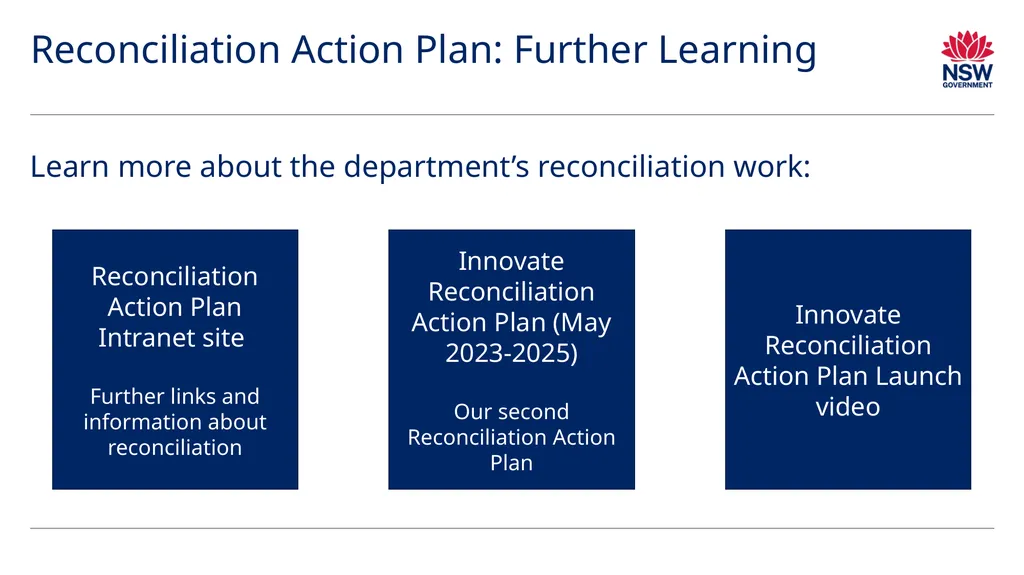
Reconciliation Action Plan: Further Learning Reconciliation Action Plan Intranet site
Further links and information about reconciliation Learn more about the department’s reconciliation work: Innovate Reconciliation Action Plan Launch video Innovate Reconciliation Action Plan (May 2023-2025)
Our second Reconciliation Action Plan<br>
07
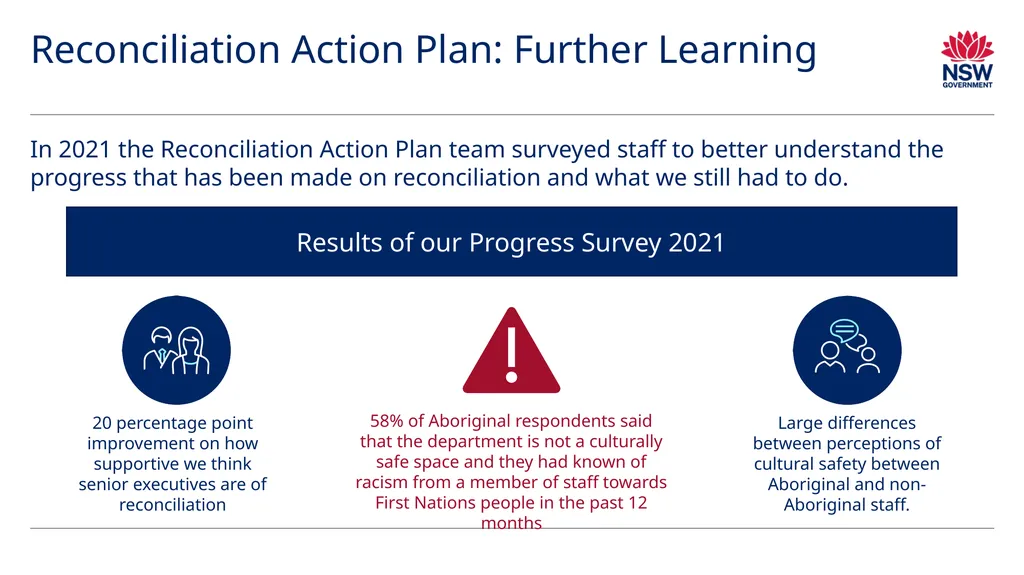
Reconciliation Action Plan: Further Learning Results of our Progress Survey 2021 In 2021 the Reconciliation Action Plan team surveyed staff to better understand the progress that has been made on reconciliation and what we still had to do. 20 percentage point improvement on how supportive we think senior executives are of reconciliation 58% of Aboriginal respondents said that the department is not a culturally safe space and they had known of racism from a member of staff towards First Nations people in the past 12 months Large differences between perceptions of cultural safety between Aboriginal and non-Aboriginal staff.<br>
08
Reconciliation Action Plan: Further engagement RAP Yammer RAP Webinars RAP Newsletter Stay up to date:<br>
09
Anti-racism resources and training Anti-Racism Policy Training Challenging Racism professional learning Australian Human Rights Commission guide to conversations about racism Mechanisms for challenging racism<br>
10
Additional learning and resources Aboriginal Cultural Education
Professional Learning Information on Closing the Gap NSW Aboriginal Education Consultative Group (AECG) Connecting to Country Learn more about the NSW Aboriginal Education Consultative Group (AECG)<br>
11
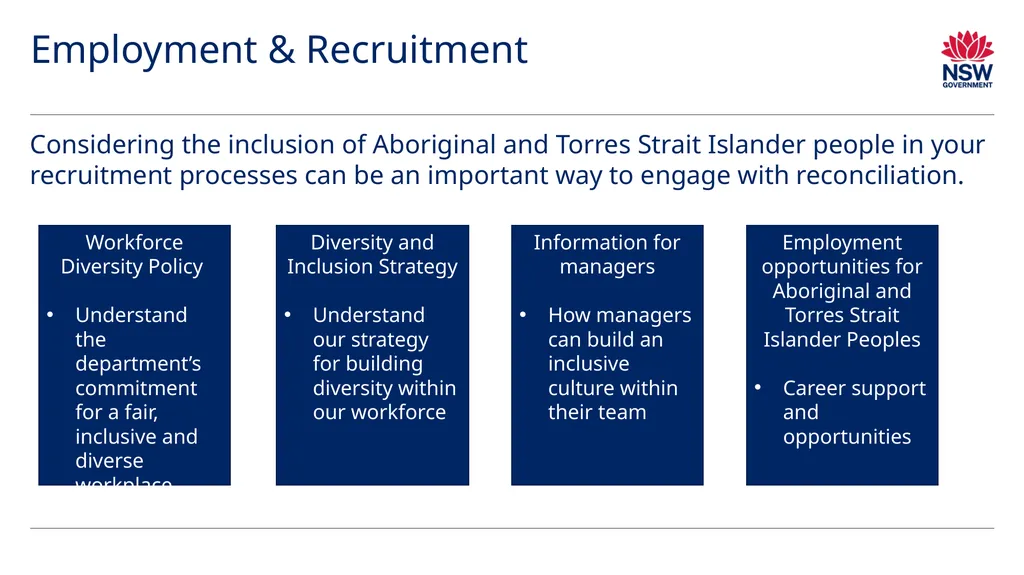
Policies regarding recruitment and procurement Reconciliation Action Plan Toolkit<br>
Understand the department’s commitment for a fair, inclusive and diverse workplace Diversity and Inclusion Strategy
Understand our strategy for building diversity within our workforce Considering the inclusion of Aboriginal and Torres Strait Islander people in your recruitment processes can be an important way to engage with reconciliation. Information for managers
How managers can build an inclusive culture within their team Employment opportunities for Aboriginal and Torres Strait Islander Peoples
Career support and opportunities<br>
13
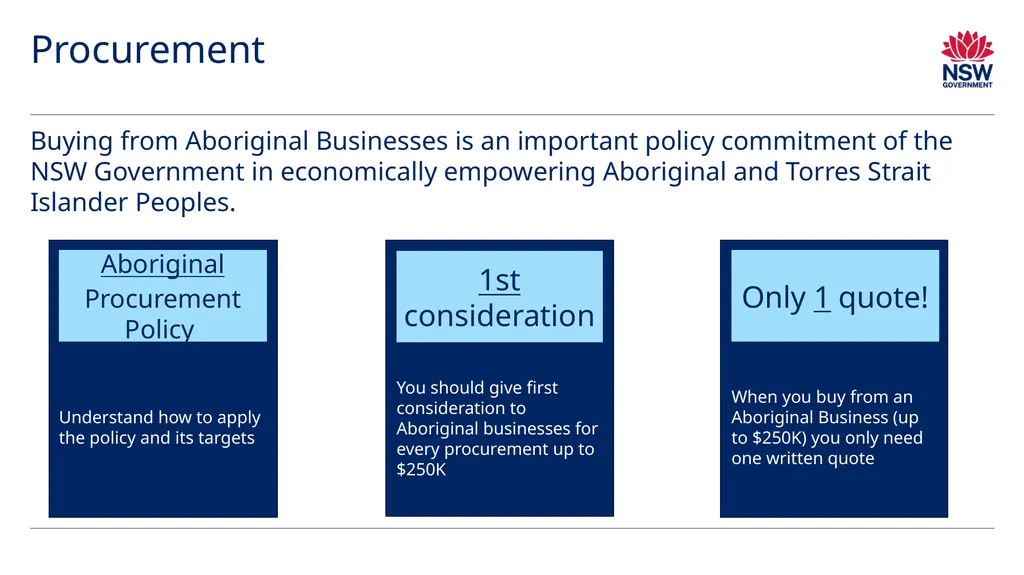
Procurement Buying from Aboriginal Businesses is an important policy commitment of the NSW Government in economically empowering Aboriginal and Torres Strait Islander Peoples.<br>
14
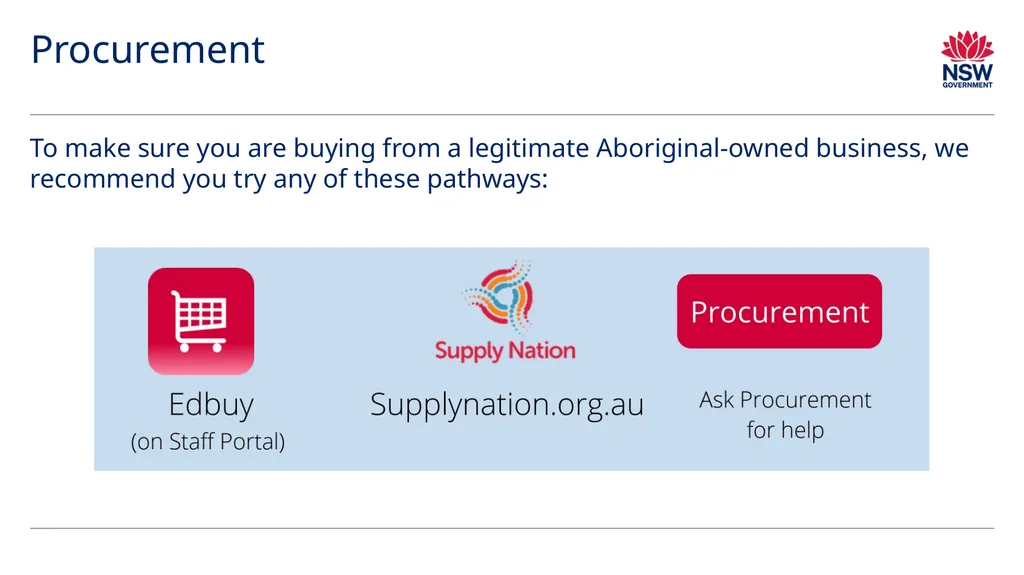
Procurement To make sure you are buying from a legitimate Aboriginal-owned business, we recommend you try any of these pathways:<br>
15
Opportunities for leadership & mentoring Reconciliation Action Plan Toolkit<br>
16
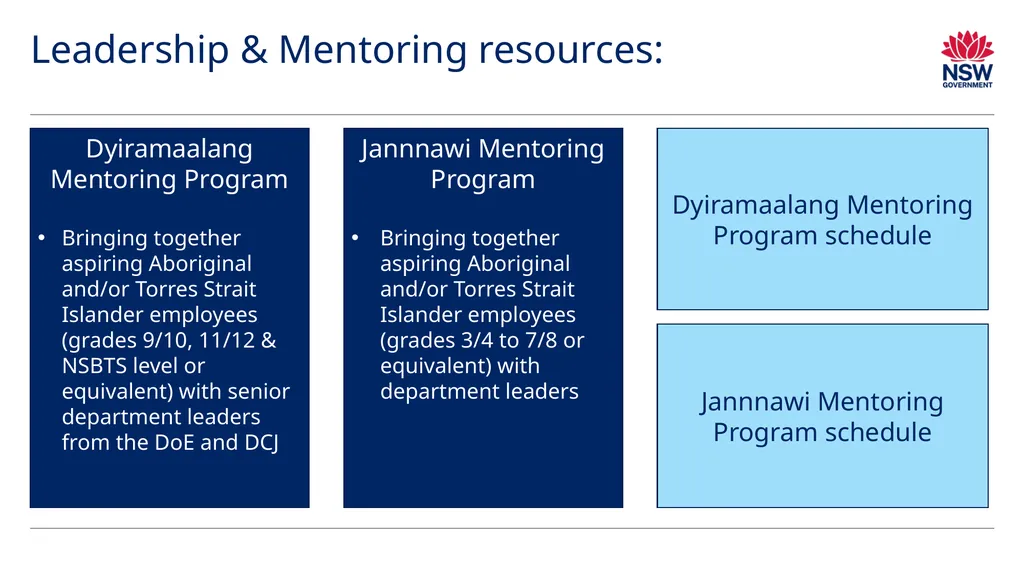
Leadership & Mentoring resources: Dyiramaalang Mentoring Program
Bringing together aspiring Aboriginal and/or Torres Strait Islander employees (grades 9/10, 11/12 & NSBTS level or equivalent) with senior department leaders from the DoE and DCJ Dyiramaalang Mentoring Program schedule Jannnawi Mentoring Program
Bringing together aspiring Aboriginal and/or Torres Strait Islander employees (grades 3/4 to 7/8 or equivalent) with department leaders Jannnawi Mentoring Program schedule<br>
17
Acknowledgement of Country Reconciliation Action Plan Toolkit<br>
18
Learn more about acknowledging Country Acknowledgement of and Welcome to Country
Learn the difference between a Welcome to Country and an Acknowledgement of Country and find guidelines and resources about how to incorporate them in your workplace and events. It’s important to recognise and celebrate Aboriginal and Torres Strait Islander peoples’ unique relationship to Country and build understanding within our workplaces.<br>
19
Learn more about acknowledging Country Finding out what Country you are working from is important. You could reflect this knowledge in Acknowledgements and signage at your place of work. List of traditional place names Whose Country am I on?
AIATSIS resources for identifying traditional owners Aboriginal and Torres Strait Islander languages<br>
20
Significant dates Reconciliation Action Plan Toolkit<br>
21
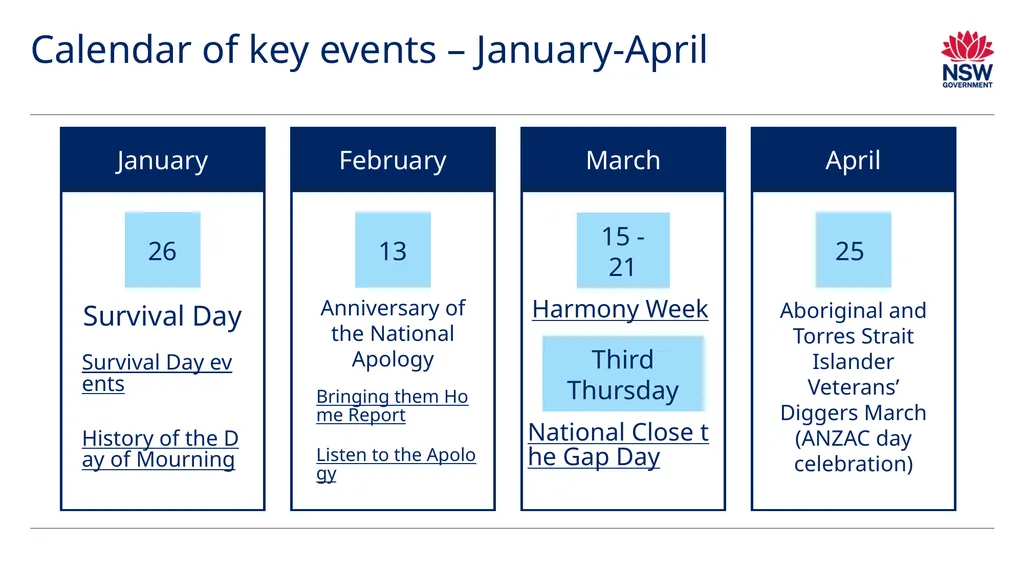
Calendar of key events – January-April January February March April 26 Survival Day Survival Day events
History of the Day of Mourning 13 Anniversary of the National Apology Bringing them Home Report
Listen to the Apology 15 - 21 25 Harmony Week Third Thursday National Close the Gap Day Aboriginal and Torres Strait Islander Veterans’ Diggers March (ANZAC day celebration)<br>
22
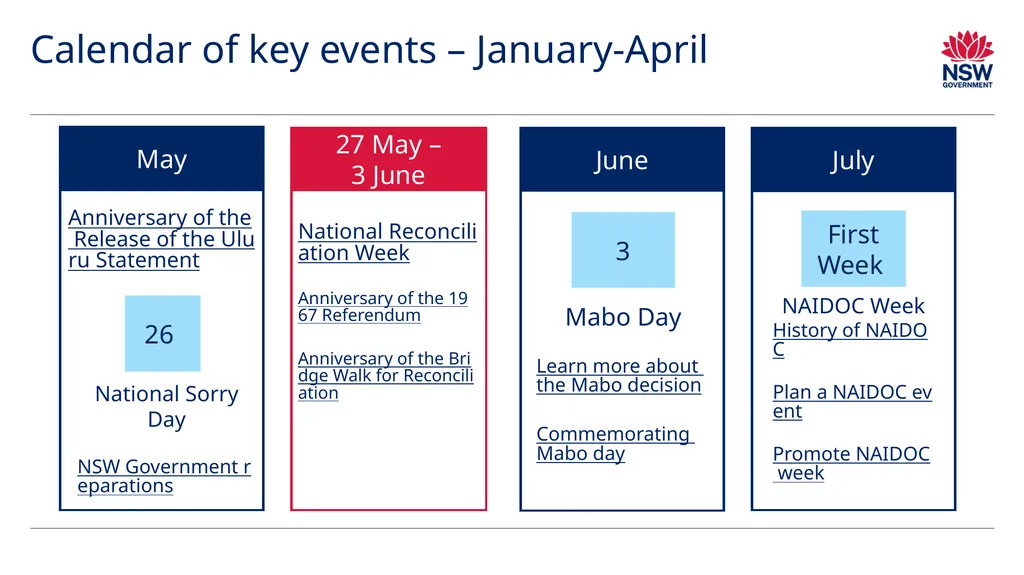
Calendar of key events – January-April May July Anniversary of the Release of the Uluru Statement 3 First Week Mabo Day
Learn more about the Mabo decision
Commemorating Mabo day NAIDOC Week
History of NAIDOC
Plan a NAIDOC event
Promote NAIDOC week 26 National Sorry Day
NSW Government reparations 27 May –
3 June National Reconciliation Week
Anniversary of the 1967 Referendum
Anniversary of the Bridge Walk for Reconciliation June<br>
23
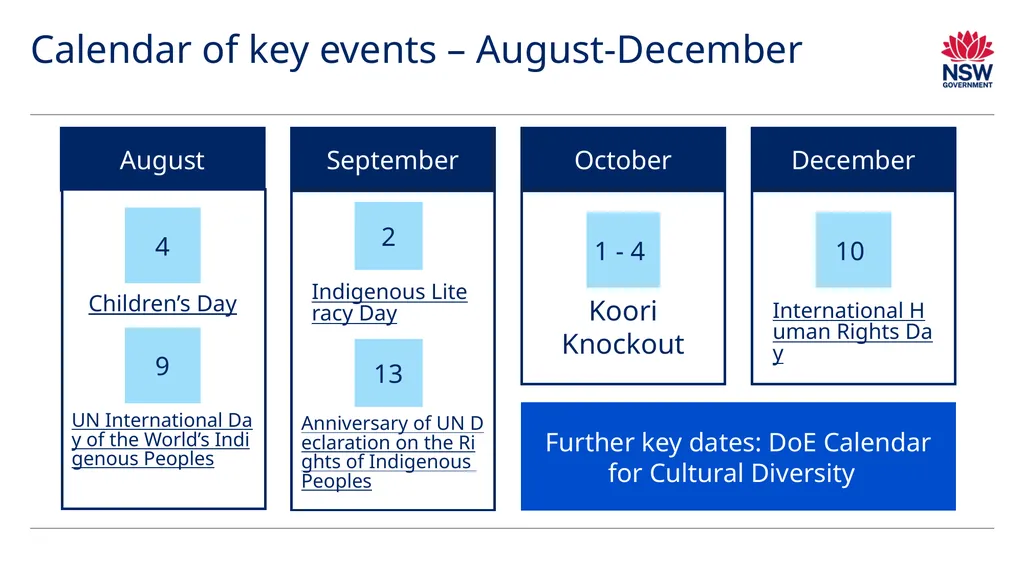
Calendar of key events – August-December August September October December 4 Children’s Day 1 - 4 10 Koori Knockout International Human Rights Day 9 UN International Day of the World’s Indigenous Peoples 2 Indigenous Literacy Day Anniversary of UN Declaration on the Rights of Indigenous Peoples 13 Further key dates: DoE Calendar for Cultural Diversity<br>
24
Next steps Reconciliation Action Plan Toolkit<br>
25
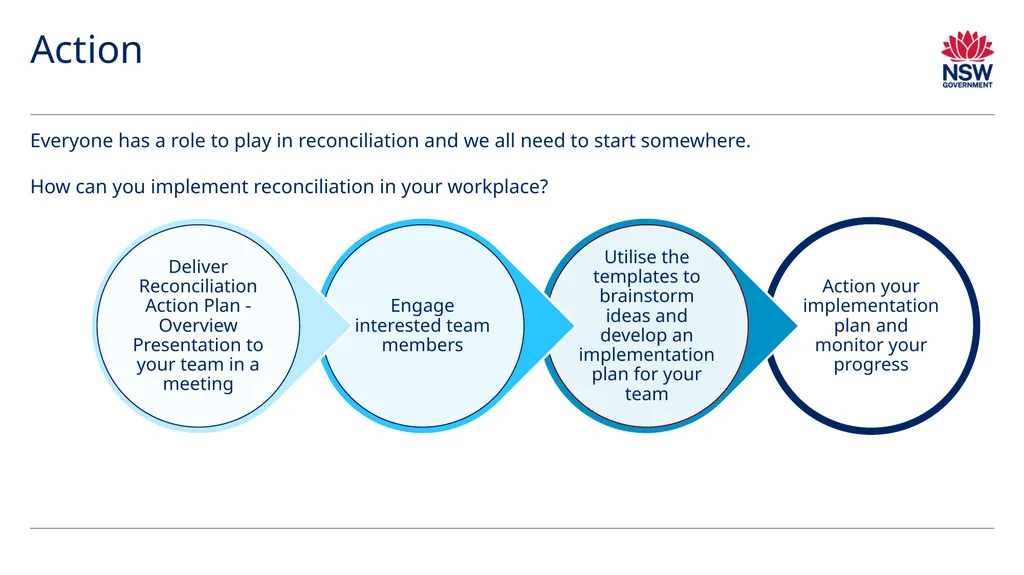
Action Everyone has a role to play in reconciliation and we all need to start somewhere.
How can you implement reconciliation in your workplace?<br>