
Reconstruction: The Challenges of Reunification

Description: Reconstruction: The Challenges of Reunification https:education.texashistory.unt.edu Essential Questions: How would you define the period known as Reconstruction? What were some of the key policies of Reconstruction that impacted Texans?
Related Topics
Download Presentation
"Reconstruction: The Challenges of Reunification" is the property of its rightful owner. Permission is granted to download and print the materials on this website for personal, non-commercial use only, and to display it on your personal computer provided you do not modify the materials and that you retain all copyright notices contained in the materials. By downloading content from our website, you accept the terms of this agreement.
Presentation Transcript
slide1. Reconstruction:
The Challenges of Reunification https://education.texashistory.unt.edu<br>
slide2. Essential Questions: How would you define the period known as Reconstruction?
What were some of the key policies of Reconstruction that impacted Texans?
How did Reconstruction policies impact the newly freed people? https://education.texashistory.unt.edu<br>
slide3. Timeline of Reconstruction Use a timeline to record the key events or issues of Reconstruction. For each year, include the event or issue, a description and/or an image. https://education.texashistory.unt.edu<br>
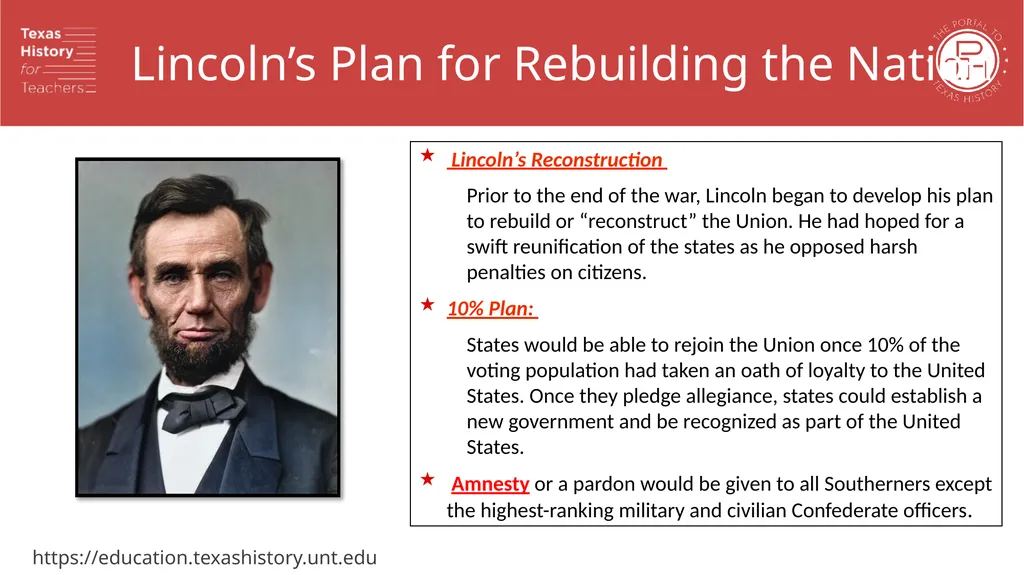
slide4. Lincoln’s Plan for Rebuilding the Nation Lincoln’s Reconstruction
Prior to the end of the war, Lincoln began to develop his plan to rebuild or “reconstruct” the Union. He had hoped for a swift reunification of the states as he opposed harsh penalties on citizens.
10% Plan:
States would be able to rejoin the Union once 10% of the voting population had taken an oath of loyalty to the United States. Once they pledge allegiance, states could establish a new government and be recognized as part of the United States.
Amnesty or a pardon would be given to all Southerners except the highest-ranking military and civilian Confederate officers. https://education.texashistory.unt.edu<br>
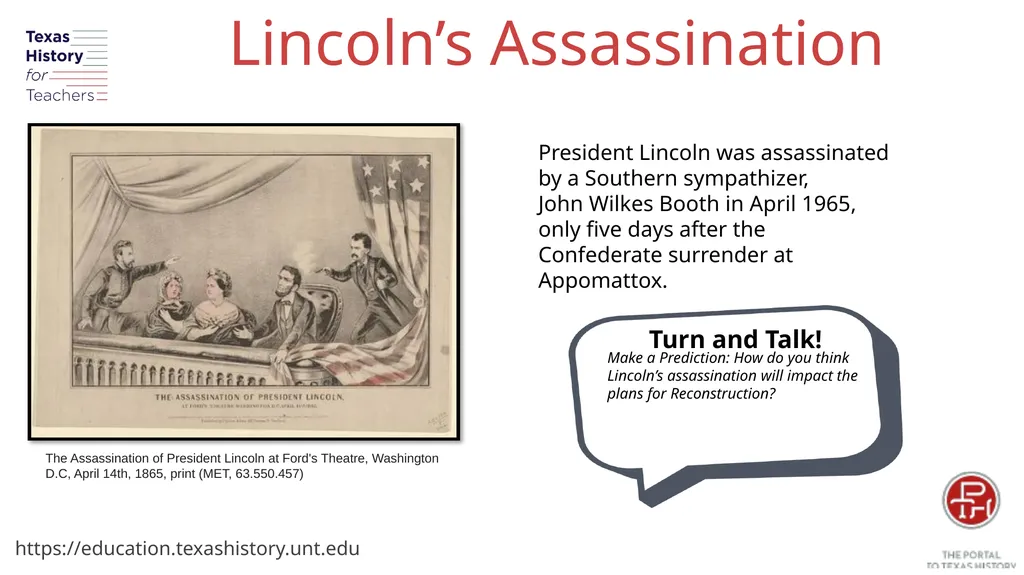
slide5. Lincoln’s Assassination The Assassination of President Lincoln at Ford's Theatre, Washington D.C, April 14th, 1865, print (MET, 63.550.457) President Lincoln was assassinated by a Southern sympathizer,
John Wilkes Booth in April 1965, only five days after the Confederate surrender at Appomattox. Turn and Talk! Make a Prediction: How do you think Lincoln’s assassination will impact the plans for Reconstruction?<br>
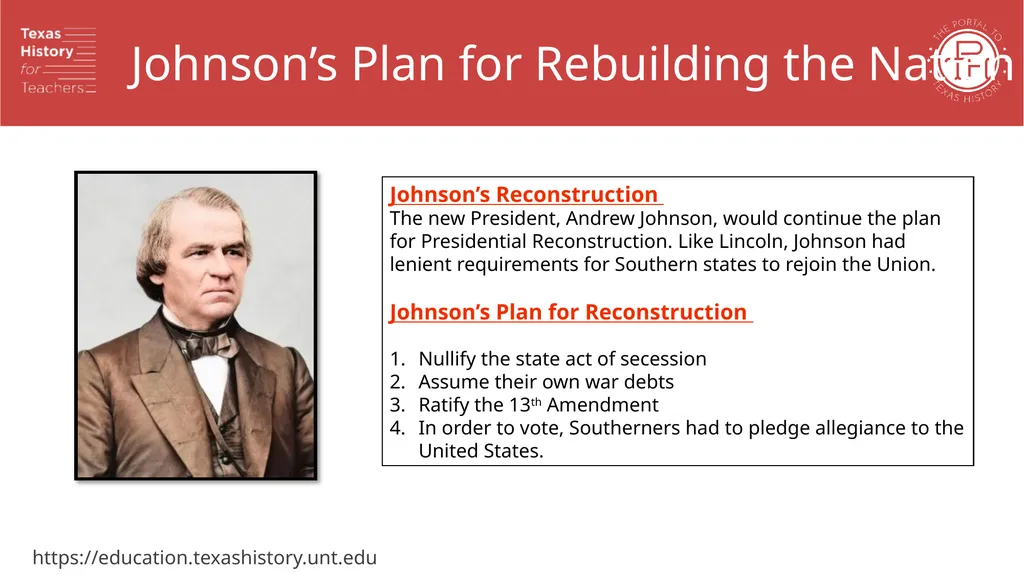
slide6. Johnson’s Plan for Rebuilding the Nation Johnson’s Reconstruction
The new President, Andrew Johnson, would continue the plan for Presidential Reconstruction. Like Lincoln, Johnson had lenient requirements for Southern states to rejoin the Union.
Johnson’s Plan for Reconstruction
Nullify the state act of secession
Assume their own war debts
Ratify the 13th Amendment
In order to vote, Southerners had to pledge allegiance to the United States. https://education.texashistory.unt.edu<br>
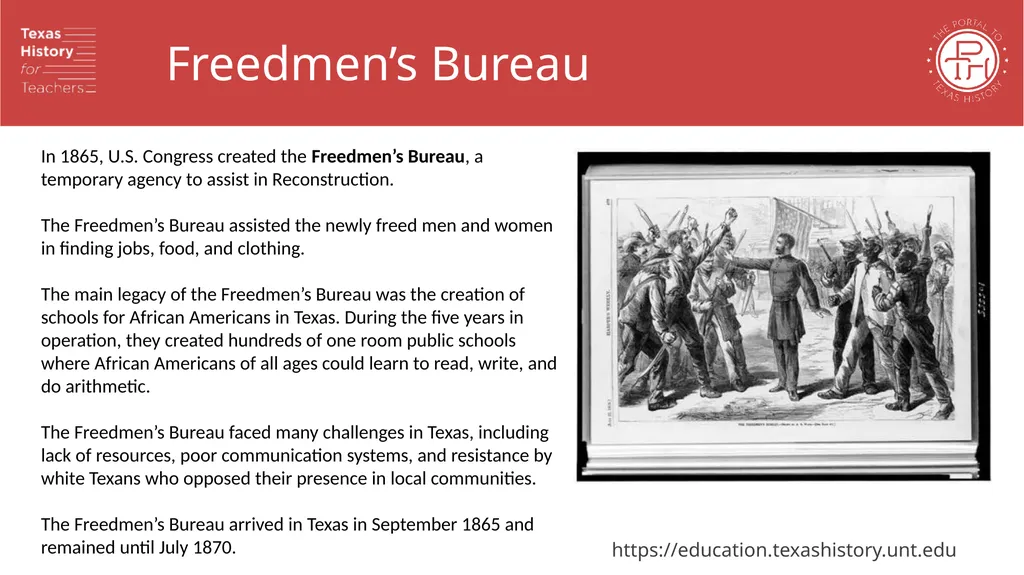
slide7. Freedmen’s Bureau In 1865, U.S. Congress created the Freedmen’s Bureau, a temporary agency to assist in Reconstruction.
The Freedmen’s Bureau assisted the newly freed men and women in finding jobs, food, and clothing.
The main legacy of the Freedmen’s Bureau was the creation of schools for African Americans in Texas. During the five years in operation, they created hundreds of one room public schools where African Americans of all ages could learn to read, write, and do arithmetic.
The Freedmen’s Bureau faced many challenges in Texas, including lack of resources, poor communication systems, and resistance by white Texans who opposed their presence in local communities.
The Freedmen’s Bureau arrived in Texas in September 1865 and remained until July 1870. https://education.texashistory.unt.edu<br>
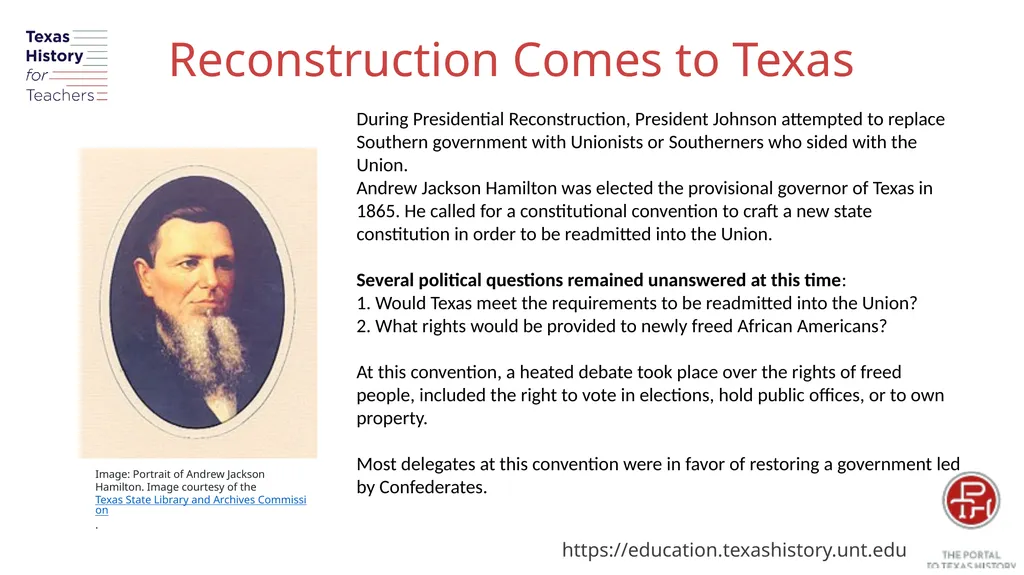
slide8. Reconstruction Comes to Texas During Presidential Reconstruction, President Johnson attempted to replace Southern government with Unionists or Southerners who sided with the Union.
Andrew Jackson Hamilton was elected the provisional governor of Texas in 1865. He called for a constitutional convention to craft a new state constitution in order to be readmitted into the Union.
Several political questions remained unanswered at this time:
1. Would Texas meet the requirements to be readmitted into the Union?
2. What rights would be provided to newly freed African Americans?
At this convention, a heated debate took place over the rights of freed people, included the right to vote in elections, hold public offices, or to own property.
Most delegates at this convention were in favor of restoring a government led by Confederates. Image: Portrait of Andrew Jackson Hamilton. Image courtesy of the Texas State Library and Archives Commission.<br>
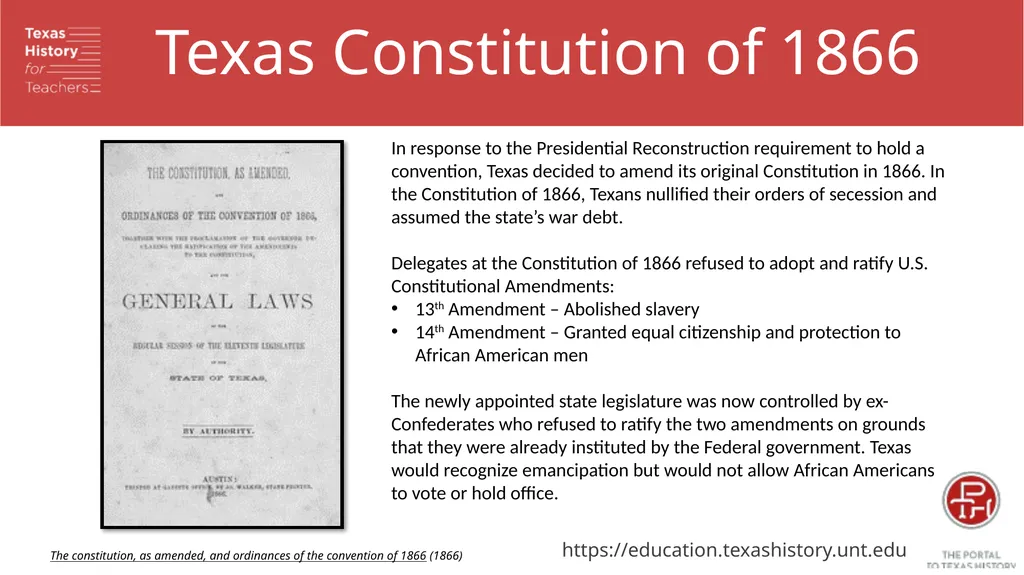
slide9. Texas Constitution of 1866 In response to the Presidential Reconstruction requirement to hold a convention, Texas decided to amend its original Constitution in 1866. In the Constitution of 1866, Texans nullified their orders of secession and assumed the state’s war debt.
Delegates at the Constitution of 1866 refused to adopt and ratify U.S. Constitutional Amendments:
13th Amendment – Abolished slavery
14th Amendment – Granted equal citizenship and protection to African American men
The newly appointed state legislature was now controlled by ex-Confederates who refused to ratify the two amendments on grounds that they were already instituted by the Federal government. Texas would recognize emancipation but would not allow African Americans to vote or hold office. The constitution, as amended, and ordinances of the convention of 1866 (1866)<br>
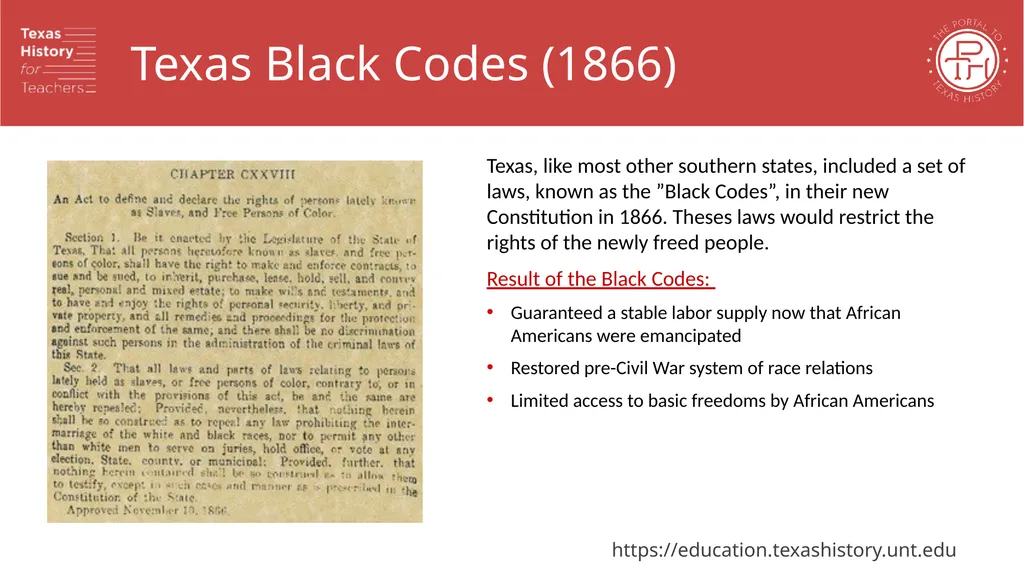
slide10. Texas Black Codes (1866) Texas, like most other southern states, included a set of laws, known as the ”Black Codes”, in their new Constitution in 1866. Theses laws would restrict the rights of the newly freed people.
Result of the Black Codes:
Guaranteed a stable labor supply now that African Americans were emancipated
Restored pre-Civil War system of race relations
Limited access to basic freedoms by African Americans https://education.texashistory.unt.edu<br>
slide11. https://education.texashistory.unt.edu Think Like a Historian: Primary Source: Texas Black Codes Think - Pair - Share
Using the guided questions, analyze the primary source document regarding the Texas Black Codes
Support your claims using text evidence. Document Analysis Questions
Based on the document, what are some of the rights granted to the newly free people in Texas?
Based on the document, what are some of the restrictions placed on newly free people in Texas?
How do the Black Codes align to the rights granted in the Civil War Amendments?
What can infer about the impact of the Black Codes on the newly freed people?<br>
slide12. https://education.texashistory.unt.edu Radical Republican Plan for Reconstruction During the early years of Reconstructions, major disagreements took place over who should be leading Reconstruction. Many leaders felt that Congress should have the right to lead Reconstruction as the Constitution allowed Congress the power to admit states into the Union – not the President. Many Northerners also felt that Presidential Reconstruction policies under Johnson were too lenient on ex-Confederates and were not successful in granting rights to the newly freed people.
In addition to these issues was the fact that many Southern representatives to Congress were former Confederate army officers, government officials, or supporters of secession. These Southern leaders rejected federal control, defied policies, and passed laws (Black Codes) that went against Northern ideas for Reconstruction.
Bitter disagreements led to the emergence of a group of leaders, Radical Republicans, who would fiercely go against Southern leadership by placing tougher restrictions on Southern states. They would also be advocates for African American voting rights to gain political favor with the freedmen.<br>
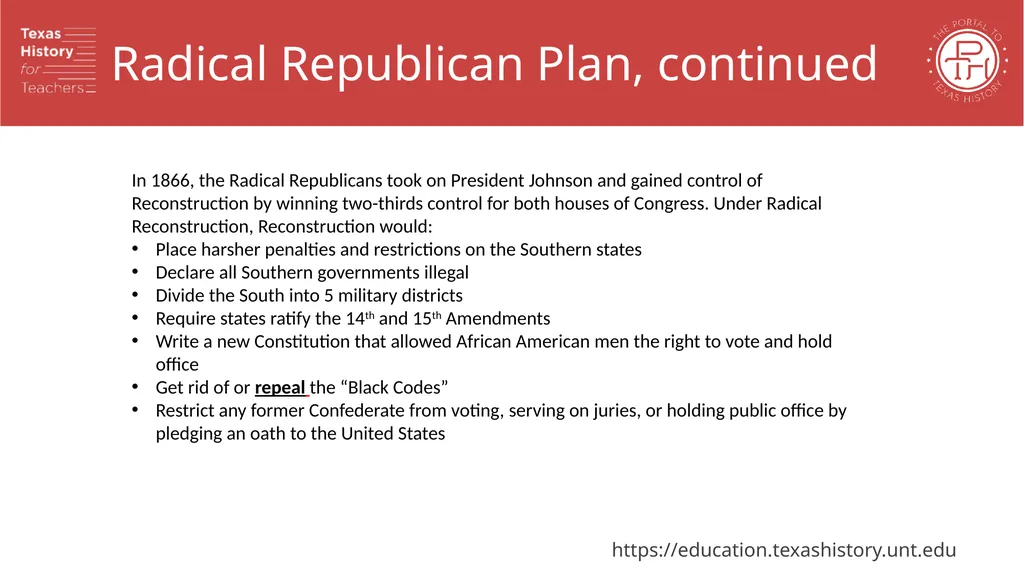
slide13. https://education.texashistory.unt.edu Radical Republican Plan, continued In 1866, the Radical Republicans took on President Johnson and gained control of Reconstruction by winning two-thirds control for both houses of Congress. Under Radical Reconstruction, Reconstruction would:
Place harsher penalties and restrictions on the Southern states
Declare all Southern governments illegal
Divide the South into 5 military districts
Require states ratify the 14th and 15th Amendments
Write a new Constitution that allowed African American men the right to vote and hold office
Get rid of or repeal the “Black Codes”
Restrict any former Confederate from voting, serving on juries, or holding public office by pledging an oath to the United States<br>
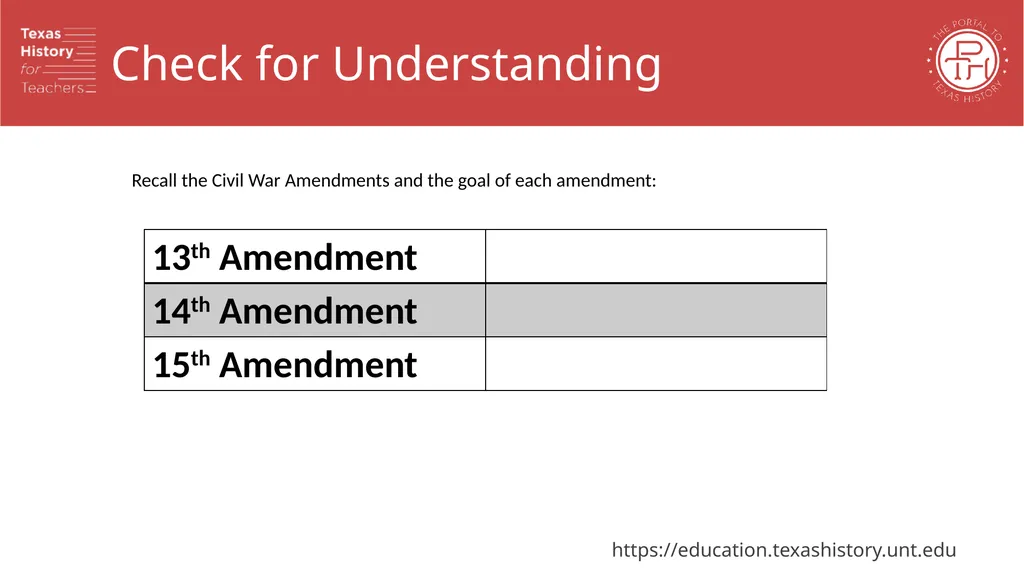
slide14. https://education.texashistory.unt.edu Check for Understanding Recall the Civil War Amendments and the goal of each amendment:<br>
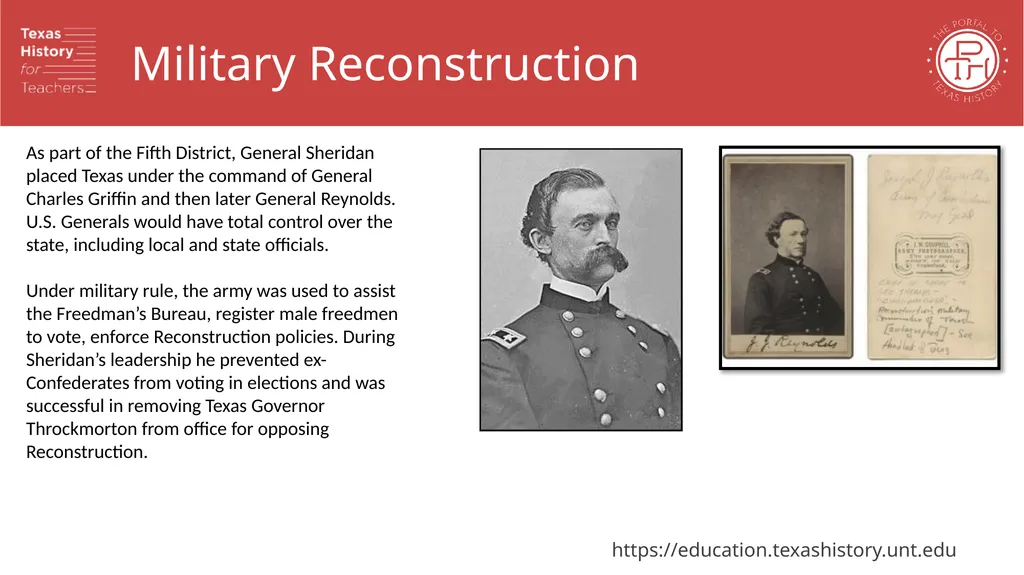
slide15. https://education.texashistory.unt.edu Military Reconstruction As part of the Fifth District, General Sheridan placed Texas under the command of General Charles Griffin and then later General Reynolds. U.S. Generals would have total control over the state, including local and state officials.
Under military rule, the army was used to assist the Freedman’s Bureau, register male freedmen to vote, enforce Reconstruction policies. During Sheridan’s leadership he prevented ex-Confederates from voting in elections and was successful in removing Texas Governor Throckmorton from office for opposing Reconstruction.<br>
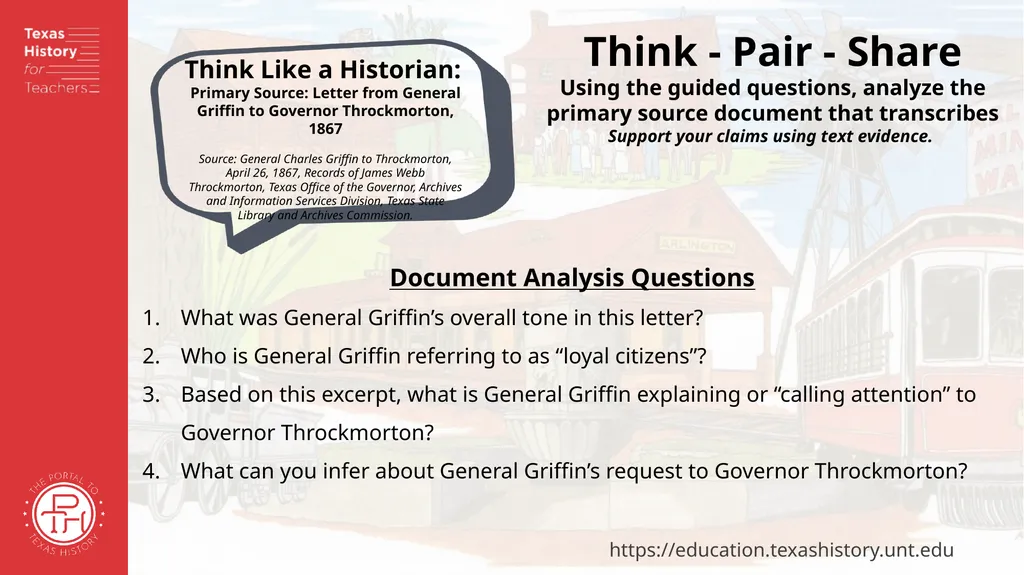
slide16. https://education.texashistory.unt.edu Think Like a Historian: Primary Source: Letter from General Griffin to Governor Throckmorton, 1867
Source: General Charles Griffin to Throckmorton, April 26, 1867, Records of James Webb Throckmorton, Texas Office of the Governor, Archives and Information Services Division, Texas State Library and Archives Commission. Think - Pair - Share
Using the guided questions, analyze the primary source document that transcribes
Support your claims using text evidence. Document Analysis Questions
What was General Griffin’s overall tone in this letter?
Who is General Griffin referring to as “loyal citizens”?
Based on this excerpt, what is General Griffin explaining or “calling attention” to Governor Throckmorton?
What can you infer about General Griffin’s request to Governor Throckmorton?<br>
slide17. https://education.texashistory.unt.edu Constitution of 1869 During military Reconstruction, hundreds of officials were replaced with Republicans. A constitutional convention was called in 1868, marking the first time many African Americans would be allowed to vote.
Republicans won majority of the seats, including 10 seats being occupied by African American delegates.
The convention would work to protect the voting rights of men regardless of race and allow African American men the right to hold office. Increased rights to education and the protection of public land would also be a focus of the convention.
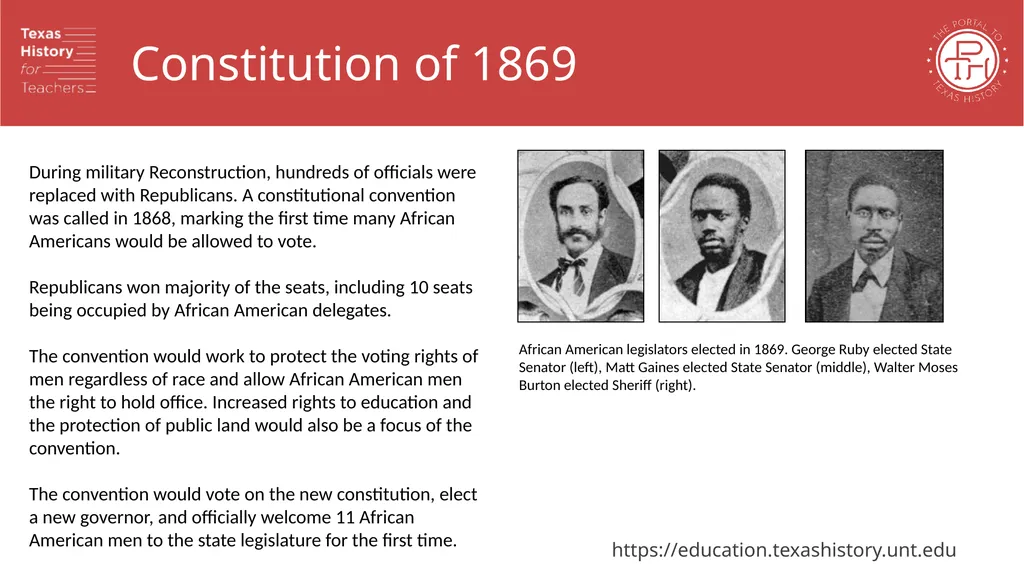
The convention would vote on the new constitution, elect a new governor, and officially welcome 11 African American men to the state legislature for the first time. African American legislators elected in 1869. George Ruby elected State Senator (left), Matt Gaines elected State Senator (middle), Walter Moses Burton elected Sheriff (right).<br>
slide18. https://education.texashistory.unt.edu Expansion of Voting – African Americans Reconstruction under the control of Republicans resulted in the increase in political participation of African Americans. Between 1866 and 1868 almost 50,000 freed men across Texas had registered to vote.
By 1870, African Americans would hold several political offices across the state at the local, county, and state levels.
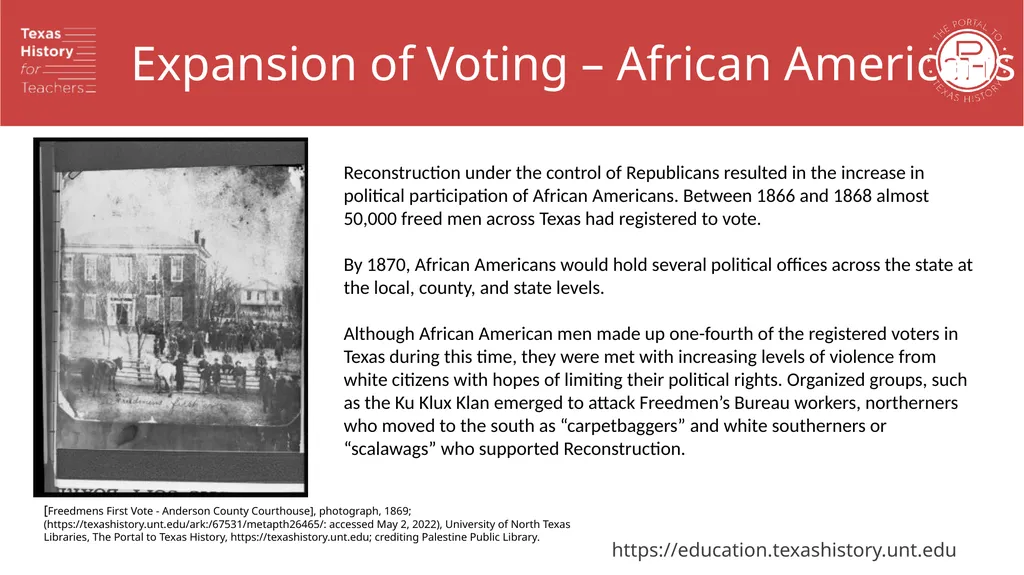
Although African American men made up one-fourth of the registered voters in Texas during this time, they were met with increasing levels of violence from white citizens with hopes of limiting their political rights. Organized groups, such as the Ku Klux Klan emerged to attack Freedmen’s Bureau workers, northerners who moved to the south as “carpetbaggers” and white southerners or “scalawags” who supported Reconstruction. [Freedmens First Vote - Anderson County Courthouse], photograph, 1869; (https://texashistory.unt.edu/ark:/67531/metapth26465/: accessed May 2, 2022), University of North Texas Libraries, The Portal to Texas History, https://texashistory.unt.edu; crediting Palestine Public Library.<br>
slide19. Texas Rejoins the Union The 1869 governor’s election was won by Radical Republican Edmund J. Davis. Having control of the governor’s seat and the Texas legislature, Radical Republicans, including 14 elected African Americans agreed to ratify the Civil War Amendments:
Thirteenth – Abolished Slavery
Fourteenth – Granted African Americans citizenship
Fifteenth Amendments – Allowed African American men the right to vote and hold office
Texas finally met all requirements needed to regain entry into the Union.
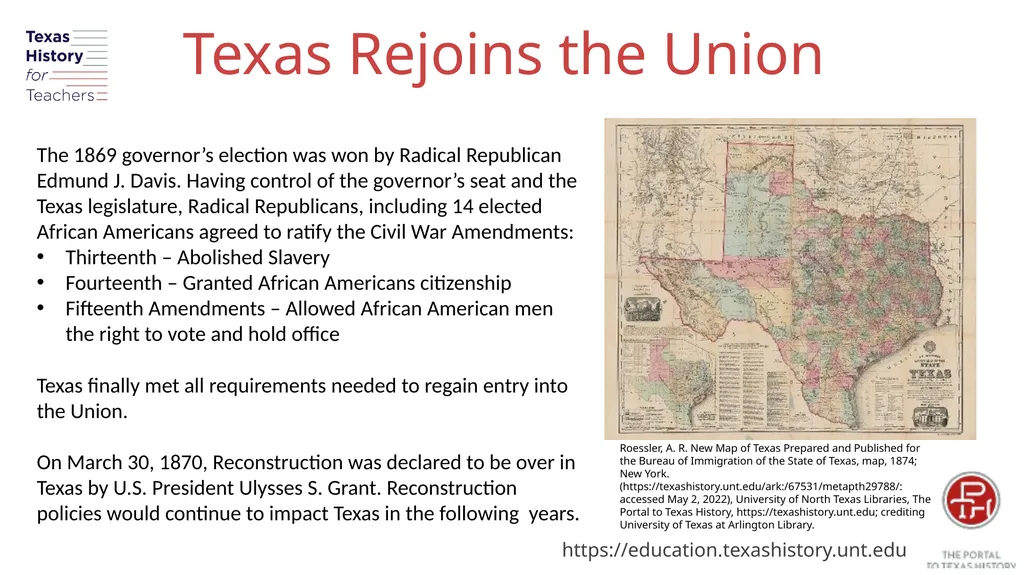
On March 30, 1870, Reconstruction was declared to be over in Texas by U.S. President Ulysses S. Grant. Reconstruction policies would continue to impact Texas in the following years. Roessler, A. R. New Map of Texas Prepared and Published for the Bureau of Immigration of the State of Texas, map, 1874; New York. (https://texashistory.unt.edu/ark:/67531/metapth29788/: accessed May 2, 2022), University of North Texas Libraries, The Portal to Texas History, https://texashistory.unt.edu; crediting University of Texas at Arlington Library.<br>
slide20. https://education.texashistory.unt.edu Apply your knowledge: Use notes and activities from this lesson to support your thinking process. Think - Pair - Share
Using the lesson essential questions discussed at the beginning of the lesson and your newly gained perspective about the events of Reconstruction answer the following questions using text evidence. Essential Questions - Exit Ticket
How would you define the period known as Reconstruction?
What were some of the key differences in the policies of Reconstruction?
How did Reconstruction policies impact the newly freed people?<br>
slide2. Essential Questions: How would you define the period known as Reconstruction?
What were some of the key policies of Reconstruction that impacted Texans?
How did Reconstruction policies impact the newly freed people? https://education.texashistory.unt.edu<br>
slide3. Timeline of Reconstruction Use a timeline to record the key events or issues of Reconstruction. For each year, include the event or issue, a description and/or an image. https://education.texashistory.unt.edu<br>
slide4. Lincoln’s Plan for Rebuilding the Nation Lincoln’s Reconstruction
Prior to the end of the war, Lincoln began to develop his plan to rebuild or “reconstruct” the Union. He had hoped for a swift reunification of the states as he opposed harsh penalties on citizens.
10% Plan:
States would be able to rejoin the Union once 10% of the voting population had taken an oath of loyalty to the United States. Once they pledge allegiance, states could establish a new government and be recognized as part of the United States.
Amnesty or a pardon would be given to all Southerners except the highest-ranking military and civilian Confederate officers. https://education.texashistory.unt.edu<br>
slide5. Lincoln’s Assassination The Assassination of President Lincoln at Ford's Theatre, Washington D.C, April 14th, 1865, print (MET, 63.550.457) President Lincoln was assassinated by a Southern sympathizer,
John Wilkes Booth in April 1965, only five days after the Confederate surrender at Appomattox. Turn and Talk! Make a Prediction: How do you think Lincoln’s assassination will impact the plans for Reconstruction?<br>
slide6. Johnson’s Plan for Rebuilding the Nation Johnson’s Reconstruction
The new President, Andrew Johnson, would continue the plan for Presidential Reconstruction. Like Lincoln, Johnson had lenient requirements for Southern states to rejoin the Union.
Johnson’s Plan for Reconstruction
Nullify the state act of secession
Assume their own war debts
Ratify the 13th Amendment
In order to vote, Southerners had to pledge allegiance to the United States. https://education.texashistory.unt.edu<br>
slide7. Freedmen’s Bureau In 1865, U.S. Congress created the Freedmen’s Bureau, a temporary agency to assist in Reconstruction.
The Freedmen’s Bureau assisted the newly freed men and women in finding jobs, food, and clothing.
The main legacy of the Freedmen’s Bureau was the creation of schools for African Americans in Texas. During the five years in operation, they created hundreds of one room public schools where African Americans of all ages could learn to read, write, and do arithmetic.
The Freedmen’s Bureau faced many challenges in Texas, including lack of resources, poor communication systems, and resistance by white Texans who opposed their presence in local communities.
The Freedmen’s Bureau arrived in Texas in September 1865 and remained until July 1870. https://education.texashistory.unt.edu<br>
slide8. Reconstruction Comes to Texas During Presidential Reconstruction, President Johnson attempted to replace Southern government with Unionists or Southerners who sided with the Union.
Andrew Jackson Hamilton was elected the provisional governor of Texas in 1865. He called for a constitutional convention to craft a new state constitution in order to be readmitted into the Union.
Several political questions remained unanswered at this time:
1. Would Texas meet the requirements to be readmitted into the Union?
2. What rights would be provided to newly freed African Americans?
At this convention, a heated debate took place over the rights of freed people, included the right to vote in elections, hold public offices, or to own property.
Most delegates at this convention were in favor of restoring a government led by Confederates. Image: Portrait of Andrew Jackson Hamilton. Image courtesy of the Texas State Library and Archives Commission.<br>
slide9. Texas Constitution of 1866 In response to the Presidential Reconstruction requirement to hold a convention, Texas decided to amend its original Constitution in 1866. In the Constitution of 1866, Texans nullified their orders of secession and assumed the state’s war debt.
Delegates at the Constitution of 1866 refused to adopt and ratify U.S. Constitutional Amendments:
13th Amendment – Abolished slavery
14th Amendment – Granted equal citizenship and protection to African American men
The newly appointed state legislature was now controlled by ex-Confederates who refused to ratify the two amendments on grounds that they were already instituted by the Federal government. Texas would recognize emancipation but would not allow African Americans to vote or hold office. The constitution, as amended, and ordinances of the convention of 1866 (1866)<br>
slide10. Texas Black Codes (1866) Texas, like most other southern states, included a set of laws, known as the ”Black Codes”, in their new Constitution in 1866. Theses laws would restrict the rights of the newly freed people.
Result of the Black Codes:
Guaranteed a stable labor supply now that African Americans were emancipated
Restored pre-Civil War system of race relations
Limited access to basic freedoms by African Americans https://education.texashistory.unt.edu<br>
slide11. https://education.texashistory.unt.edu Think Like a Historian: Primary Source: Texas Black Codes Think - Pair - Share
Using the guided questions, analyze the primary source document regarding the Texas Black Codes
Support your claims using text evidence. Document Analysis Questions
Based on the document, what are some of the rights granted to the newly free people in Texas?
Based on the document, what are some of the restrictions placed on newly free people in Texas?
How do the Black Codes align to the rights granted in the Civil War Amendments?
What can infer about the impact of the Black Codes on the newly freed people?<br>
slide12. https://education.texashistory.unt.edu Radical Republican Plan for Reconstruction During the early years of Reconstructions, major disagreements took place over who should be leading Reconstruction. Many leaders felt that Congress should have the right to lead Reconstruction as the Constitution allowed Congress the power to admit states into the Union – not the President. Many Northerners also felt that Presidential Reconstruction policies under Johnson were too lenient on ex-Confederates and were not successful in granting rights to the newly freed people.
In addition to these issues was the fact that many Southern representatives to Congress were former Confederate army officers, government officials, or supporters of secession. These Southern leaders rejected federal control, defied policies, and passed laws (Black Codes) that went against Northern ideas for Reconstruction.
Bitter disagreements led to the emergence of a group of leaders, Radical Republicans, who would fiercely go against Southern leadership by placing tougher restrictions on Southern states. They would also be advocates for African American voting rights to gain political favor with the freedmen.<br>
slide13. https://education.texashistory.unt.edu Radical Republican Plan, continued In 1866, the Radical Republicans took on President Johnson and gained control of Reconstruction by winning two-thirds control for both houses of Congress. Under Radical Reconstruction, Reconstruction would:
Place harsher penalties and restrictions on the Southern states
Declare all Southern governments illegal
Divide the South into 5 military districts
Require states ratify the 14th and 15th Amendments
Write a new Constitution that allowed African American men the right to vote and hold office
Get rid of or repeal the “Black Codes”
Restrict any former Confederate from voting, serving on juries, or holding public office by pledging an oath to the United States<br>
slide14. https://education.texashistory.unt.edu Check for Understanding Recall the Civil War Amendments and the goal of each amendment:<br>
slide15. https://education.texashistory.unt.edu Military Reconstruction As part of the Fifth District, General Sheridan placed Texas under the command of General Charles Griffin and then later General Reynolds. U.S. Generals would have total control over the state, including local and state officials.
Under military rule, the army was used to assist the Freedman’s Bureau, register male freedmen to vote, enforce Reconstruction policies. During Sheridan’s leadership he prevented ex-Confederates from voting in elections and was successful in removing Texas Governor Throckmorton from office for opposing Reconstruction.<br>
slide16. https://education.texashistory.unt.edu Think Like a Historian: Primary Source: Letter from General Griffin to Governor Throckmorton, 1867
Source: General Charles Griffin to Throckmorton, April 26, 1867, Records of James Webb Throckmorton, Texas Office of the Governor, Archives and Information Services Division, Texas State Library and Archives Commission. Think - Pair - Share
Using the guided questions, analyze the primary source document that transcribes
Support your claims using text evidence. Document Analysis Questions
What was General Griffin’s overall tone in this letter?
Who is General Griffin referring to as “loyal citizens”?
Based on this excerpt, what is General Griffin explaining or “calling attention” to Governor Throckmorton?
What can you infer about General Griffin’s request to Governor Throckmorton?<br>
slide17. https://education.texashistory.unt.edu Constitution of 1869 During military Reconstruction, hundreds of officials were replaced with Republicans. A constitutional convention was called in 1868, marking the first time many African Americans would be allowed to vote.
Republicans won majority of the seats, including 10 seats being occupied by African American delegates.
The convention would work to protect the voting rights of men regardless of race and allow African American men the right to hold office. Increased rights to education and the protection of public land would also be a focus of the convention.
The convention would vote on the new constitution, elect a new governor, and officially welcome 11 African American men to the state legislature for the first time. African American legislators elected in 1869. George Ruby elected State Senator (left), Matt Gaines elected State Senator (middle), Walter Moses Burton elected Sheriff (right).<br>
slide18. https://education.texashistory.unt.edu Expansion of Voting – African Americans Reconstruction under the control of Republicans resulted in the increase in political participation of African Americans. Between 1866 and 1868 almost 50,000 freed men across Texas had registered to vote.
By 1870, African Americans would hold several political offices across the state at the local, county, and state levels.
Although African American men made up one-fourth of the registered voters in Texas during this time, they were met with increasing levels of violence from white citizens with hopes of limiting their political rights. Organized groups, such as the Ku Klux Klan emerged to attack Freedmen’s Bureau workers, northerners who moved to the south as “carpetbaggers” and white southerners or “scalawags” who supported Reconstruction. [Freedmens First Vote - Anderson County Courthouse], photograph, 1869; (https://texashistory.unt.edu/ark:/67531/metapth26465/: accessed May 2, 2022), University of North Texas Libraries, The Portal to Texas History, https://texashistory.unt.edu; crediting Palestine Public Library.<br>
slide19. Texas Rejoins the Union The 1869 governor’s election was won by Radical Republican Edmund J. Davis. Having control of the governor’s seat and the Texas legislature, Radical Republicans, including 14 elected African Americans agreed to ratify the Civil War Amendments:
Thirteenth – Abolished Slavery
Fourteenth – Granted African Americans citizenship
Fifteenth Amendments – Allowed African American men the right to vote and hold office
Texas finally met all requirements needed to regain entry into the Union.
On March 30, 1870, Reconstruction was declared to be over in Texas by U.S. President Ulysses S. Grant. Reconstruction policies would continue to impact Texas in the following years. Roessler, A. R. New Map of Texas Prepared and Published for the Bureau of Immigration of the State of Texas, map, 1874; New York. (https://texashistory.unt.edu/ark:/67531/metapth29788/: accessed May 2, 2022), University of North Texas Libraries, The Portal to Texas History, https://texashistory.unt.edu; crediting University of Texas at Arlington Library.<br>
slide20. https://education.texashistory.unt.edu Apply your knowledge: Use notes and activities from this lesson to support your thinking process. Think - Pair - Share
Using the lesson essential questions discussed at the beginning of the lesson and your newly gained perspective about the events of Reconstruction answer the following questions using text evidence. Essential Questions - Exit Ticket
How would you define the period known as Reconstruction?
What were some of the key differences in the policies of Reconstruction?
How did Reconstruction policies impact the newly freed people?<br>