Recovery Navigator Program by Susan Peacey, King County, BHDD RNP Project Manager and reginal Administrator The RNP was mandated by the Senate Bill 5476 2021 addressing the State versus Blake decision and updated in 2023 through Senate Bill
"Recovery Navigator Program by Susan Peacey, King" is the property of its rightful owner. Permission is granted to
download and print the materials on this website for personal, non-commercial use only, and to display it
on your personal computer provided you do not modify the materials and that you retain all copyright
notices contained in the materials. By downloading content from our website, you accept the terms of this
agreement.
Presentation Transcript
01
Recovery Navigator Program by Susan Peacey, King County, BHDD RNP Project Manager and reginal Administrator The RNP was mandated by the Senate Bill 5476 2021 addressing the State versus Blake decision and updated in 2023 through Senate Bill 5536
Assist persons with Substance Use Disorders/ Mental Health or other Behavioral Health through accessing outreach, treatment, and Recovery Support Services
This program is a community-based outreach/engagement program that seeks to engage individuals who may benefit from behavioral health treatment<br>
02
Recovery Navigator Program Law Enforcement is the priority referral for RNP with pre-arrest diversion and will be adding prosecution as a priority for pre-trial referrals soon as well.
Low Barrier approach, Harm Reduction, non-compliance structure to build trust with individuals
“Moving at the speed of Trust”<br>
03
Recovery Navigator Program Design priority population<br>
04
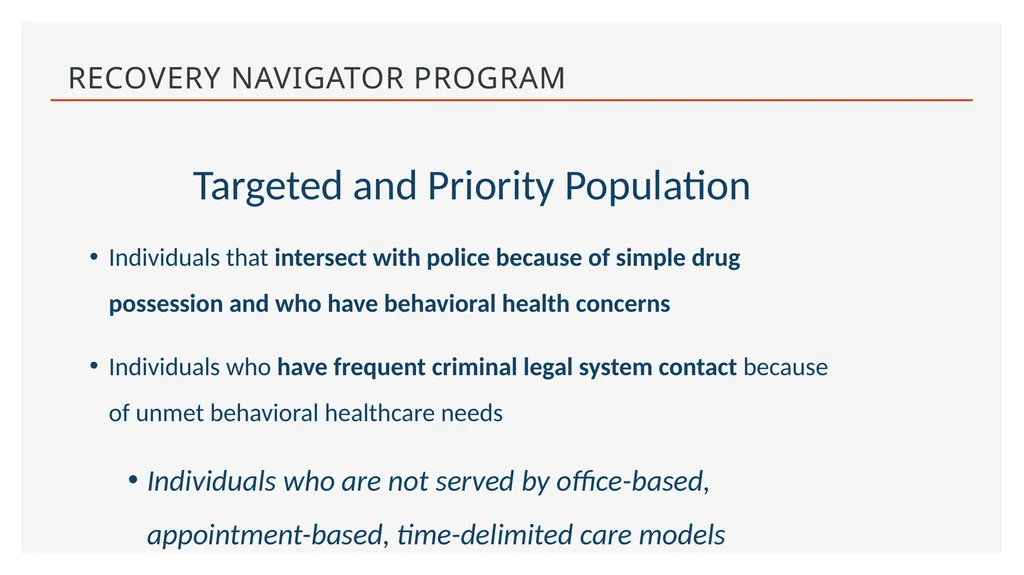
Recovery Navigator Program Targeted and Priority Population
Individuals that intersect with police because of simple drug possession and who have behavioral health concerns
Individuals who have frequent criminal legal system contact because of unmet behavioral healthcare needs
Individuals who are not served by office-based, appointment-based, time-delimited care models<br>
05
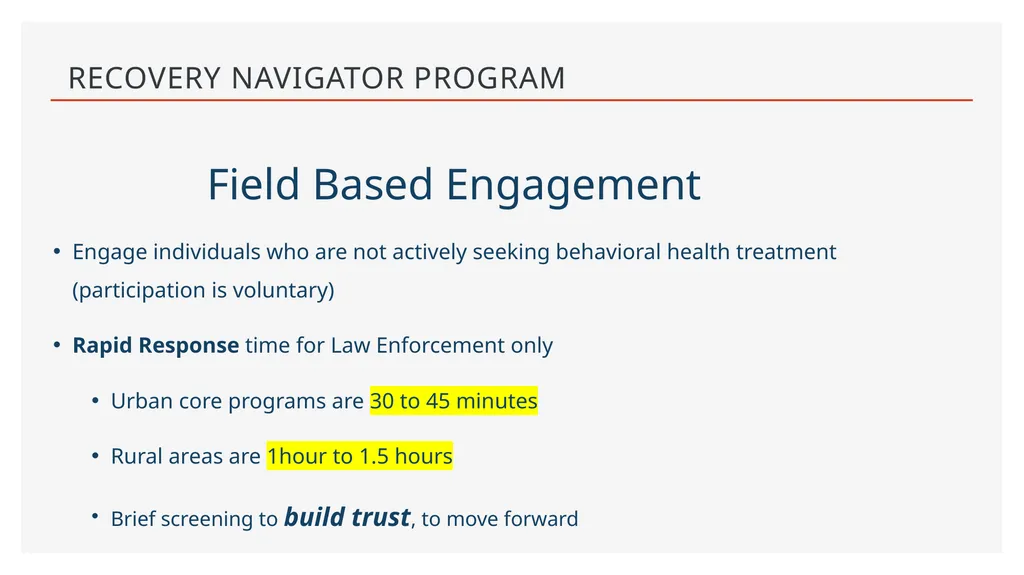
Recovery Navigator Program Field Based Engagement
Engage individuals who are not actively seeking behavioral health treatment (participation is voluntary)
Rapid Response time for Law Enforcement only
Urban core programs are 30 to 45 minutes
Rural areas are 1hour to 1.5 hours
Brief screening to build trust, to move forward<br>
06
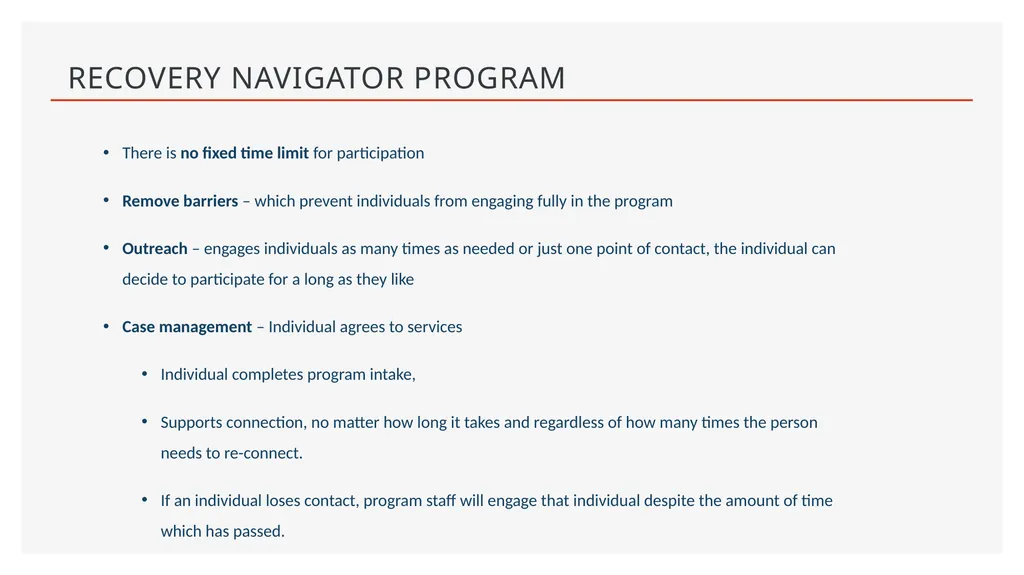
Recovery Navigator Program There is no fixed time limit for participation
Remove barriers – which prevent individuals from engaging fully in the program
Outreach – engages individuals as many times as needed or just one point of contact, the individual can decide to participate for a long as they like
Case management – Individual agrees to services
Individual completes program intake,
Supports connection, no matter how long it takes and regardless of how many times the person needs to re-connect.
If an individual loses contact, program staff will engage that individual despite the amount of time which has passed.<br>
07
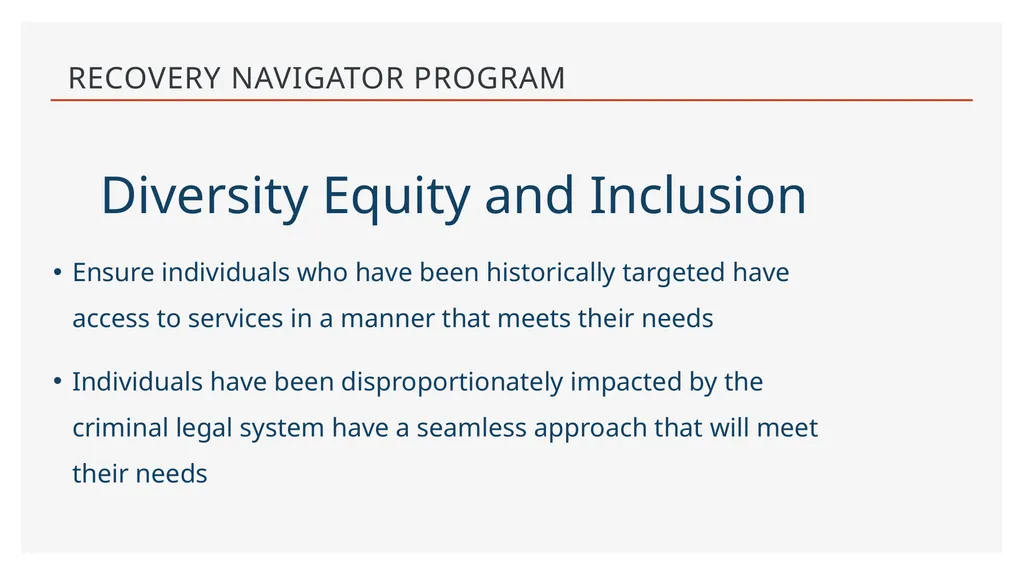
Recovery Navigator Program Diversity Equity and Inclusion
Ensure individuals who have been historically targeted have access to services in a manner that meets their needs
Individuals have been disproportionately impacted by the criminal legal system have a seamless approach that will meet their needs<br>
08
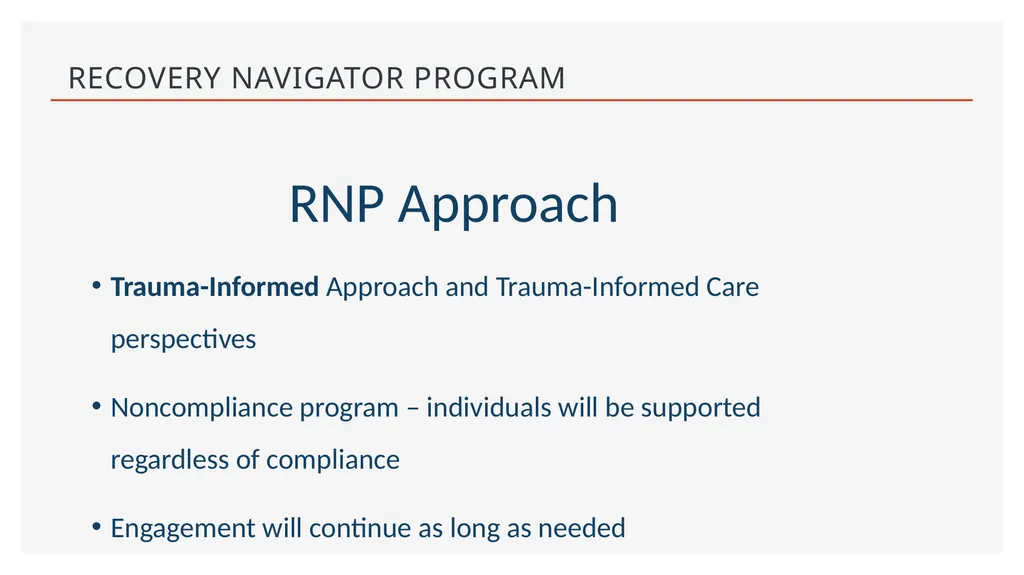
Recovery Navigator Program RNP Approach
Trauma-Informed Approach and Trauma-Informed Care perspectives
Noncompliance program – individuals will be supported regardless of compliance
Engagement will continue as long as needed<br>
09
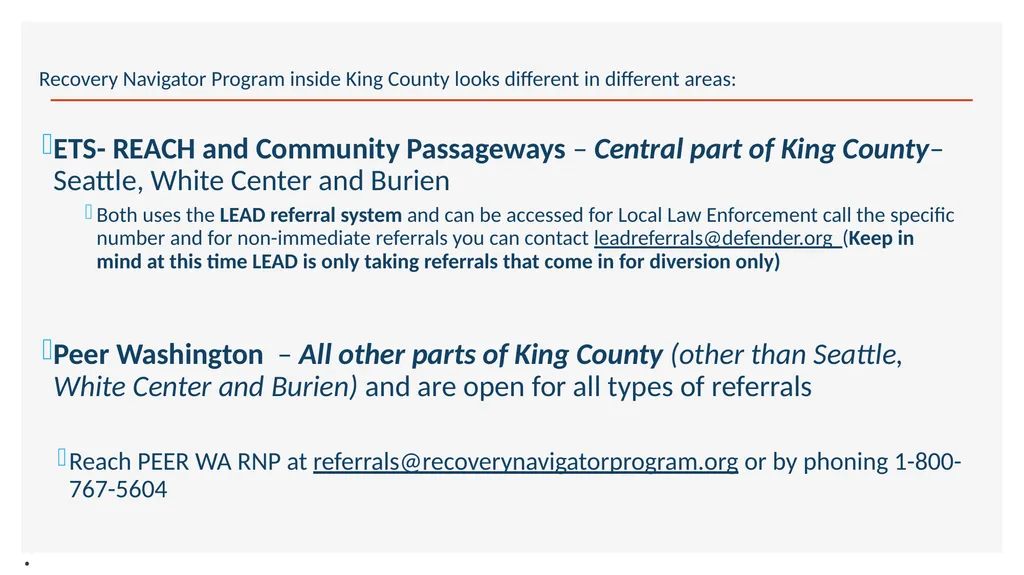
. Recovery Navigator Program inside King County looks different in different areas:
ETS- REACH and Community Passageways – Central part of King County– Seattle, White Center and Burien
Both uses the LEAD referral system and can be accessed for Local Law Enforcement call the specific number and for non-immediate referrals you can contact leadreferrals@defender.org (Keep in mind at this time LEAD is only taking referrals that come in for diversion only)
Peer Washington – All other parts of King County (other than Seattle, White Center and Burien) and are open for all types of referrals
Reach PEER WA RNP at referrals@recoverynavigatorprogram.org or by phoning 1-800-767-5604<br>
10
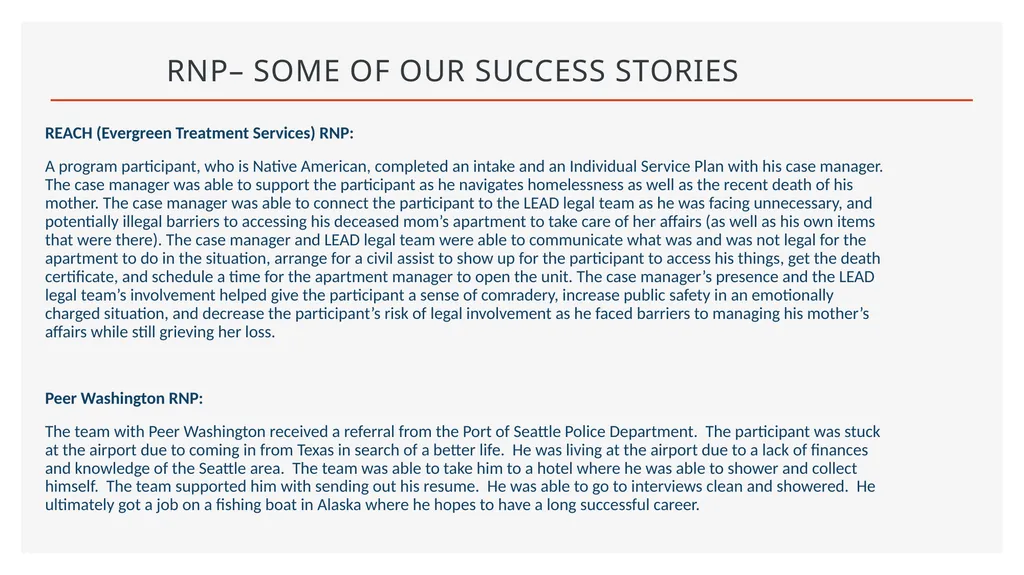
REACH (Evergreen Treatment Services) RNP:
A program participant, who is Native American, completed an intake and an Individual Service Plan with his case manager. The case manager was able to support the participant as he navigates homelessness as well as the recent death of his mother. The case manager was able to connect the participant to the LEAD legal team as he was facing unnecessary, and potentially illegal barriers to accessing his deceased mom’s apartment to take care of her affairs (as well as his own items that were there). The case manager and LEAD legal team were able to communicate what was and was not legal for the apartment to do in the situation, arrange for a civil assist to show up for the participant to access his things, get the death certificate, and schedule a time for the apartment manager to open the unit. The case manager’s presence and the LEAD legal team’s involvement helped give the participant a sense of comradery, increase public safety in an emotionally charged situation, and decrease the participant’s risk of legal involvement as he faced barriers to managing his mother’s affairs while still grieving her loss.
Peer Washington RNP:
The team with Peer Washington received a referral from the Port of Seattle Police Department. The participant was stuck at the airport due to coming in from Texas in search of a better life. He was living at the airport due to a lack of finances and knowledge of the Seattle area. The team was able to take him to a hotel where he was able to shower and collect himself. The team supported him with sending out his resume. He was able to go to interviews clean and showered. He ultimately got a job on a fishing boat in Alaska where he hopes to have a long successful career. RNP– Some of our Success Stories<br>
11
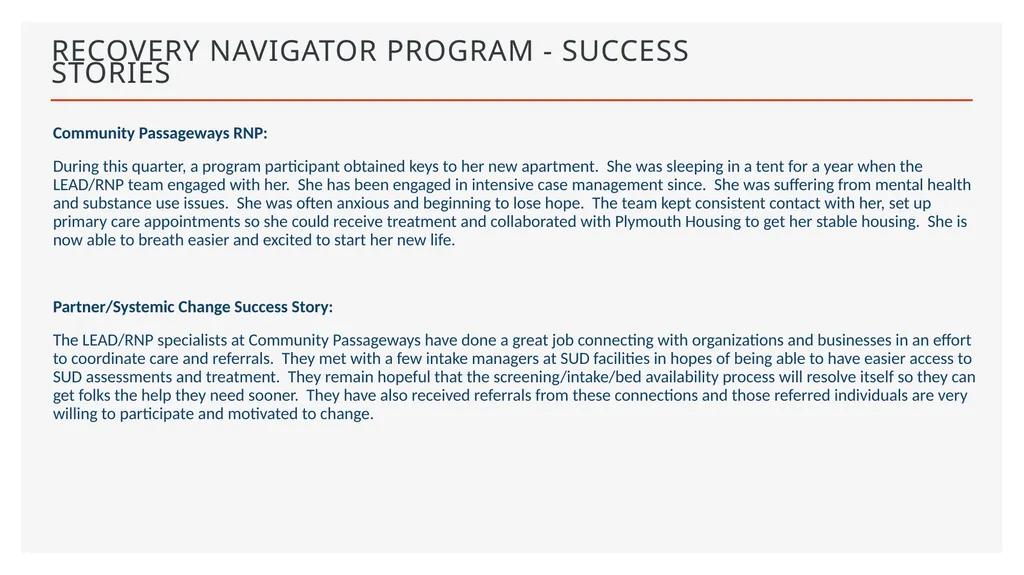
Recovery Navigator Program - Success Stories Community Passageways RNP:
During this quarter, a program participant obtained keys to her new apartment. She was sleeping in a tent for a year when the LEAD/RNP team engaged with her. She has been engaged in intensive case management since. She was suffering from mental health and substance use issues. She was often anxious and beginning to lose hope. The team kept consistent contact with her, set up primary care appointments so she could receive treatment and collaborated with Plymouth Housing to get her stable housing. She is now able to breath easier and excited to start her new life.
Partner/Systemic Change Success Story:
The LEAD/RNP specialists at Community Passageways have done a great job connecting with organizations and businesses in an effort to coordinate care and referrals. They met with a few intake managers at SUD facilities in hopes of being able to have easier access to SUD assessments and treatment. They remain hopeful that the screening/intake/bed availability process will resolve itself so they can get folks the help they need sooner. They have also received referrals from these connections and those referred individuals are very willing to participate and motivated to change.<br>
12
Recovery Navigator Program Questions / Comments
Thank you
Susan Peacey
Recovery Navigator Project Manager and King County RNP Regional Administrator
King County – BHRD
speacey@kingcounty.gov<br>