04
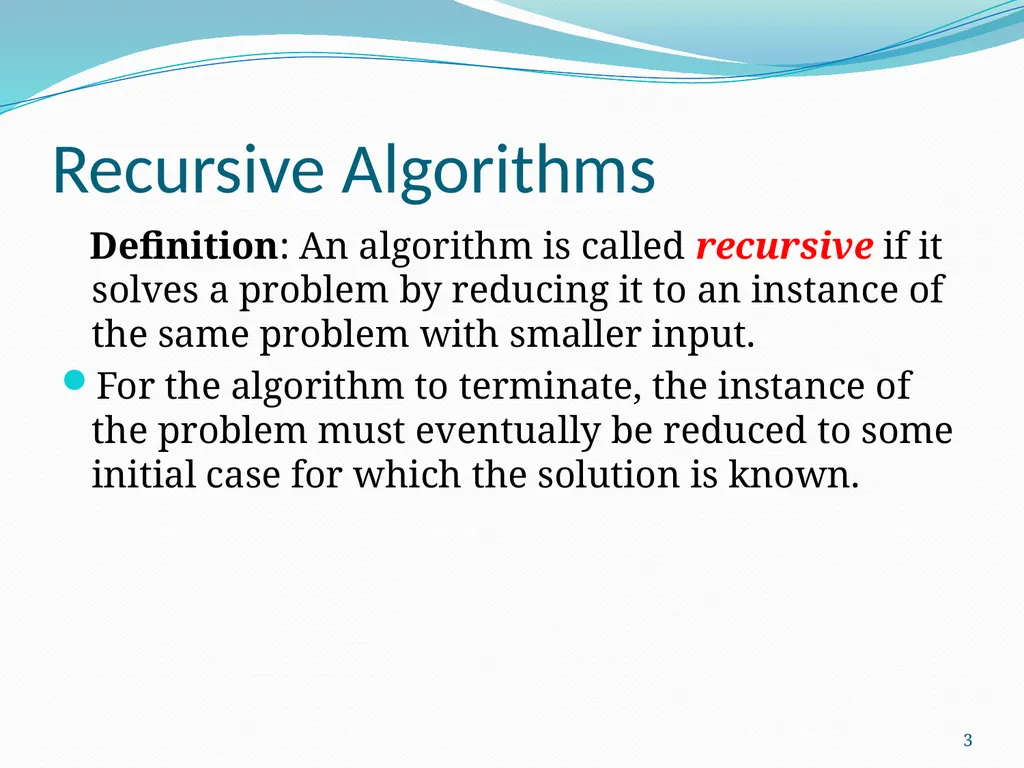
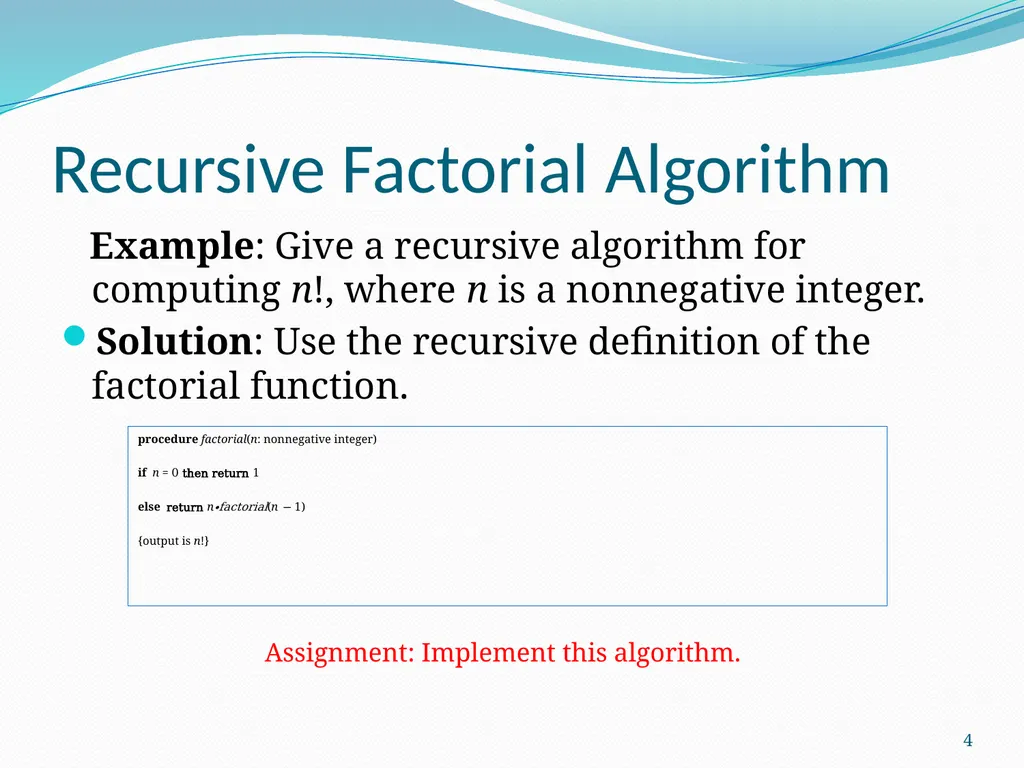
Recursive Factorial Algorithm Example: Give a recursive algorithm for computing n!, where n is a nonnegative integer.
Solution: Use the recursive definition of the factorial function. procedure factorial(n: nonnegative integer)
if n = 0 then return 1
else return n∙factorial(n − 1)
{output is n!} 4 Assignment: Implement this algorithm.<br>
05
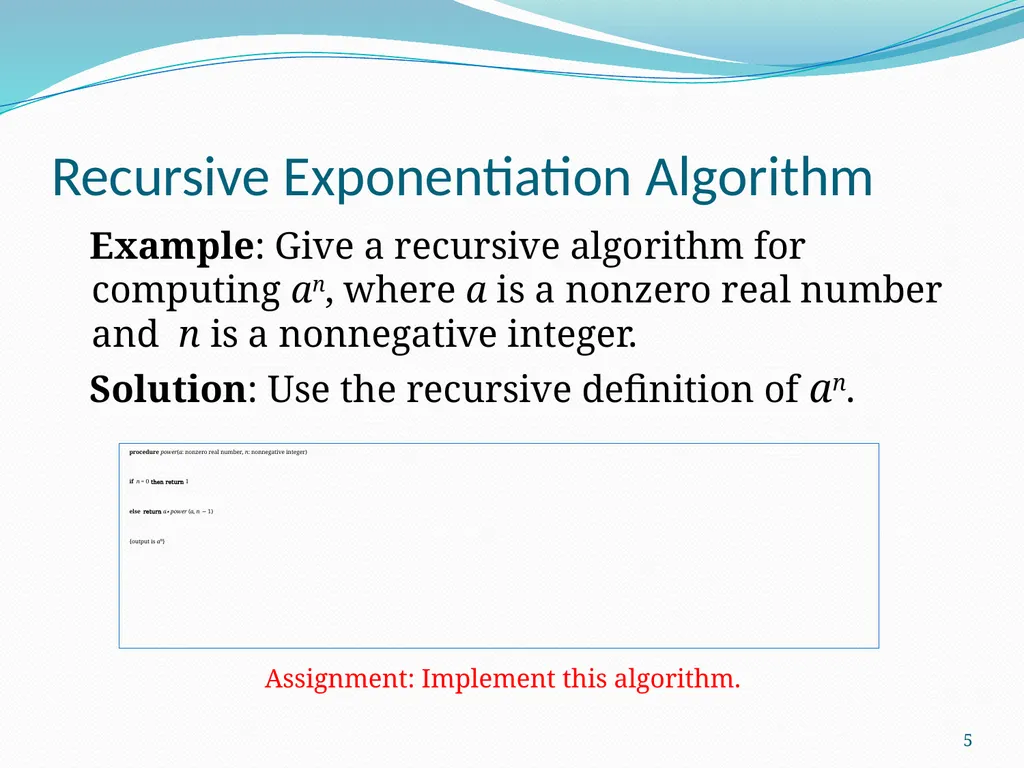
Recursive Exponentiation Algorithm Example: Give a recursive algorithm for computing an, where a is a nonzero real number and n is a nonnegative integer.
Solution: Use the recursive definition of an. procedure power(a: nonzero real number, n: nonnegative integer)
if n = 0 then return 1
else return a∙ power (a, n − 1)
{output is an} 5 Assignment: Implement this algorithm.<br>
06
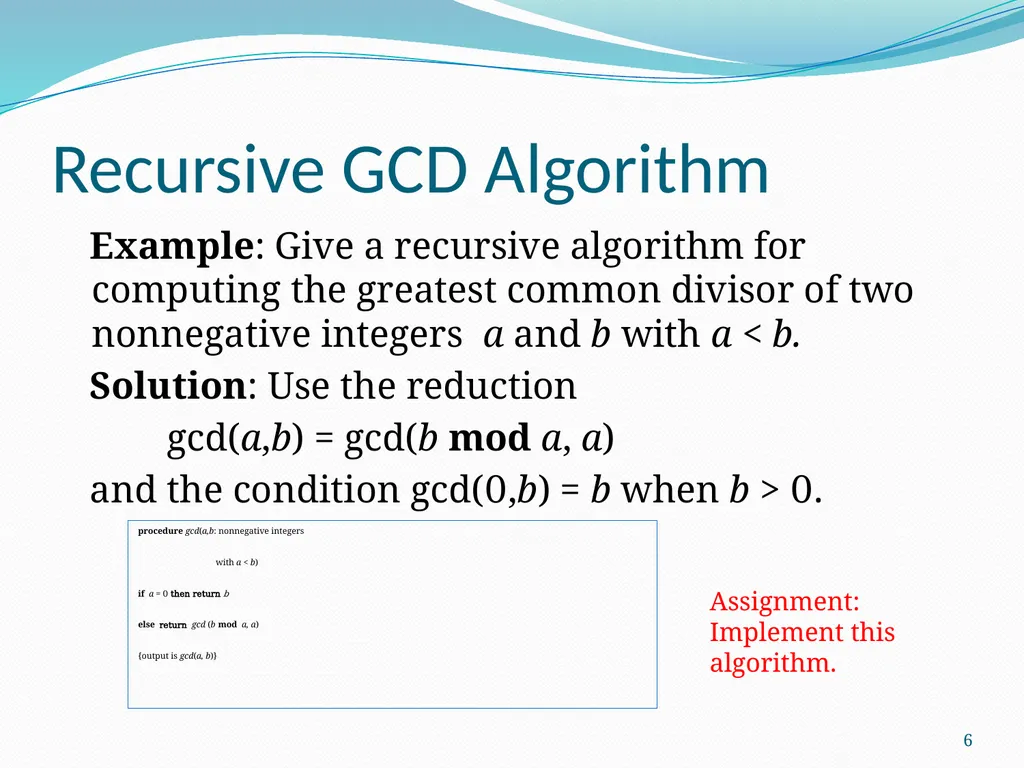
Recursive GCD Algorithm Example: Give a recursive algorithm for computing the greatest common divisor of two nonnegative integers a and b with a < b.
Solution: Use the reduction
gcd(a,b) = gcd(b mod a, a)
and the condition gcd(0,b) = b when b > 0. procedure gcd(a,b: nonnegative integers
with a < b)
if a = 0 then return b
else return gcd (b mod a, a)
{output is gcd(a, b)} 6 Assignment: Implement this algorithm.<br>
07
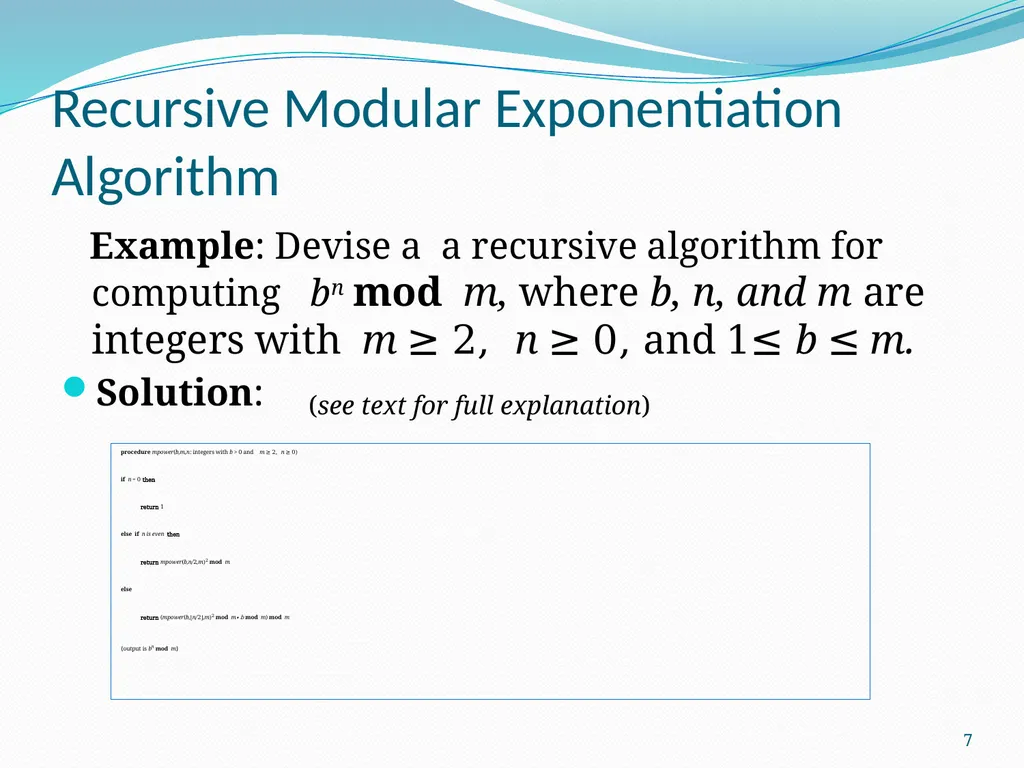
Example: Devise a a recursive algorithm for computing bn mod m, where b, n, and m are integers with m ≥ 2, n ≥ 0, and 1≤ b ≤ m.
Solution: Recursive Modular Exponentiation Algorithm procedure mpower(b,m,n: integers with b > 0 and m ≥ 2, n ≥ 0)
if n = 0 then
return 1
else if n is even then
return mpower(b,n/2,m)2 mod m
else
return (mpower(b,⌊n/2⌋,m)2 mod m∙ b mod m) mod m
{output is bn mod m} (see text for full explanation) 7<br>
08
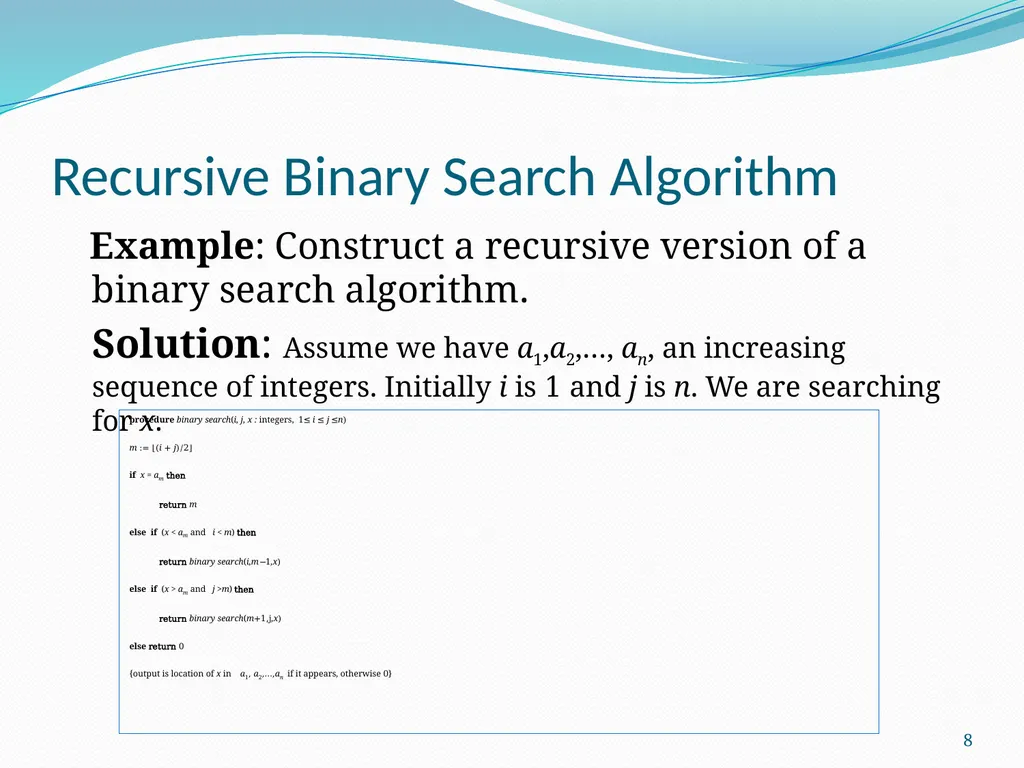
Recursive Binary Search Algorithm Example: Construct a recursive version of a binary search algorithm.
Solution: Assume we have a1,a2,…, an, an increasing sequence of integers. Initially i is 1 and j is n. We are searching for x. procedure binary search(i, j, x : integers, 1≤ i ≤ j ≤n)
m := ⌊(i + j)/2⌋
if x = am then
return m
else if (x < am and i < m) then
return binary search(i,m−1,x)
else if (x > am and j >m) then
return binary search(m+1,j,x)
else return 0
{output is location of x in a1, a2,…,an if it appears, otherwise 0} 8<br>
09
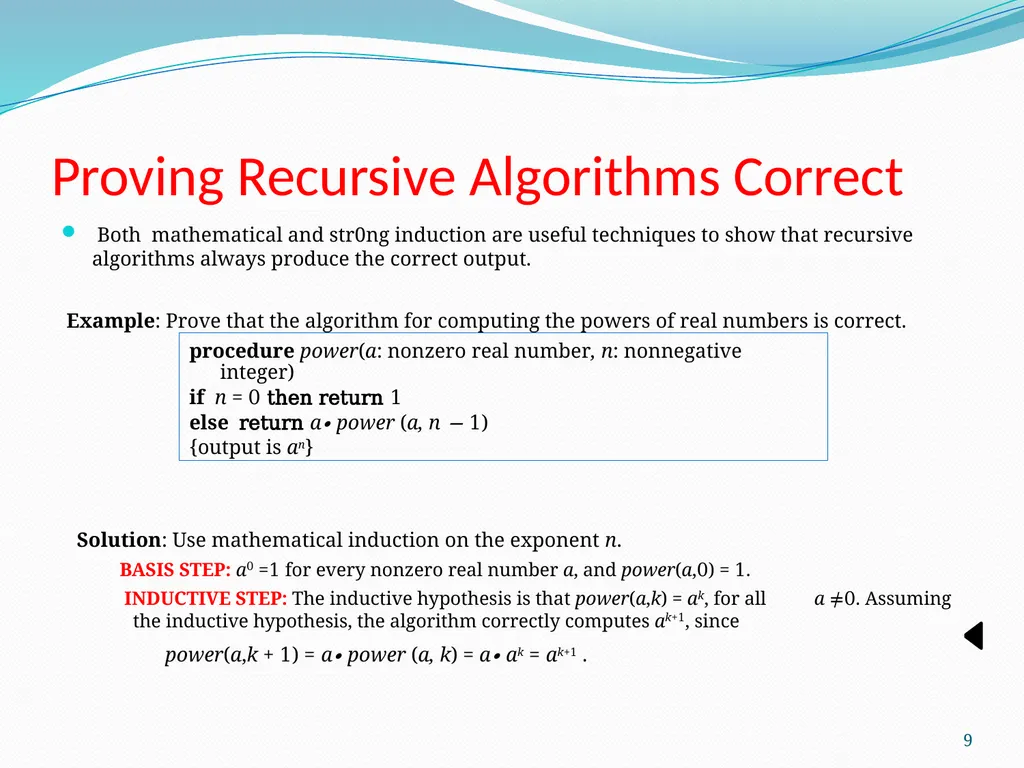
Proving Recursive Algorithms Correct Both mathematical and str0ng induction are useful techniques to show that recursive algorithms always produce the correct output.
Example: Prove that the algorithm for computing the powers of real numbers is correct.
Solution: Use mathematical induction on the exponent n.
BASIS STEP: a0 =1 for every nonzero real number a, and power(a,0) = 1.
INDUCTIVE STEP: The inductive hypothesis is that power(a,k) = ak, for all a ≠0. Assuming the inductive hypothesis, the algorithm correctly computes ak+1, since
power(a,k + 1) = a∙ power (a, k) = a∙ ak = ak+1 . procedure power(a: nonzero real number, n: nonnegative integer)
if n = 0 then return 1
else return a∙ power (a, n − 1)
{output is an} −2 . 9<br>
10
Merge Sort Merge Sort works by iteratively splitting a list (with an even number of elements) into two sublists of equal length until each sublist has one element.
Each sublist is represented by a balanced binary tree.
At each step a pair of sublists is successively merged into a list with the elements in increasing order. The process ends when all the sublists have been merged.
The succession of merged lists is represented by a binary tree. 10<br>
11
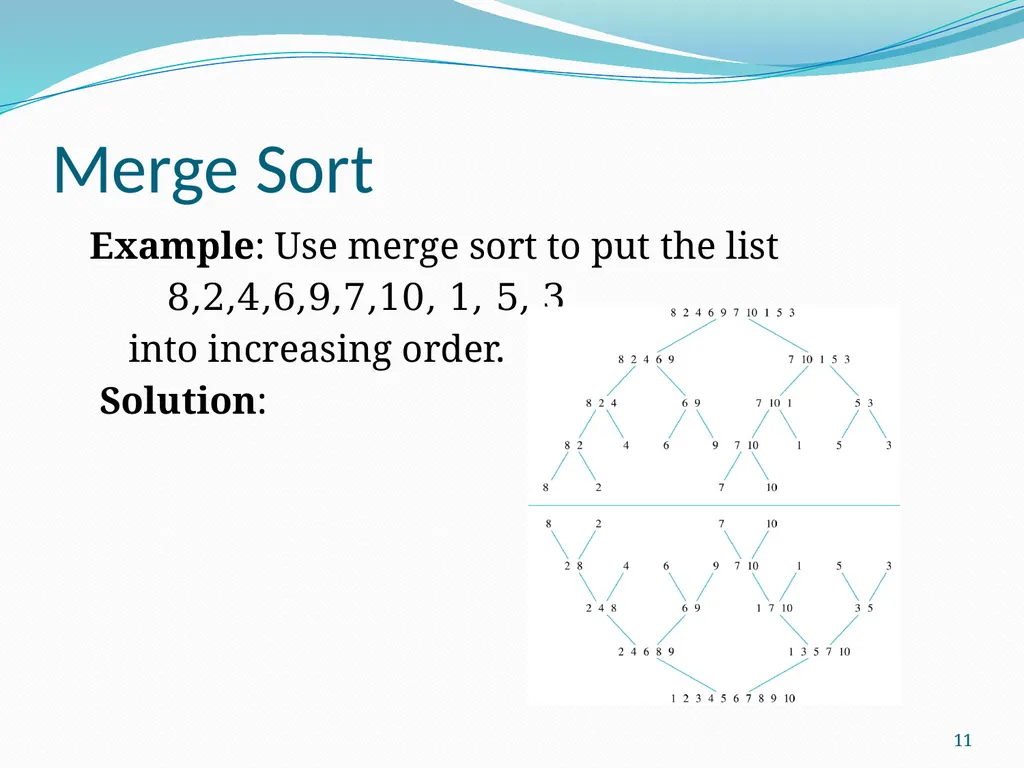
Merge Sort Example: Use merge sort to put the list
8,2,4,6,9,7,10, 1, 5, 3
into increasing order.
Solution: 11<br>
12
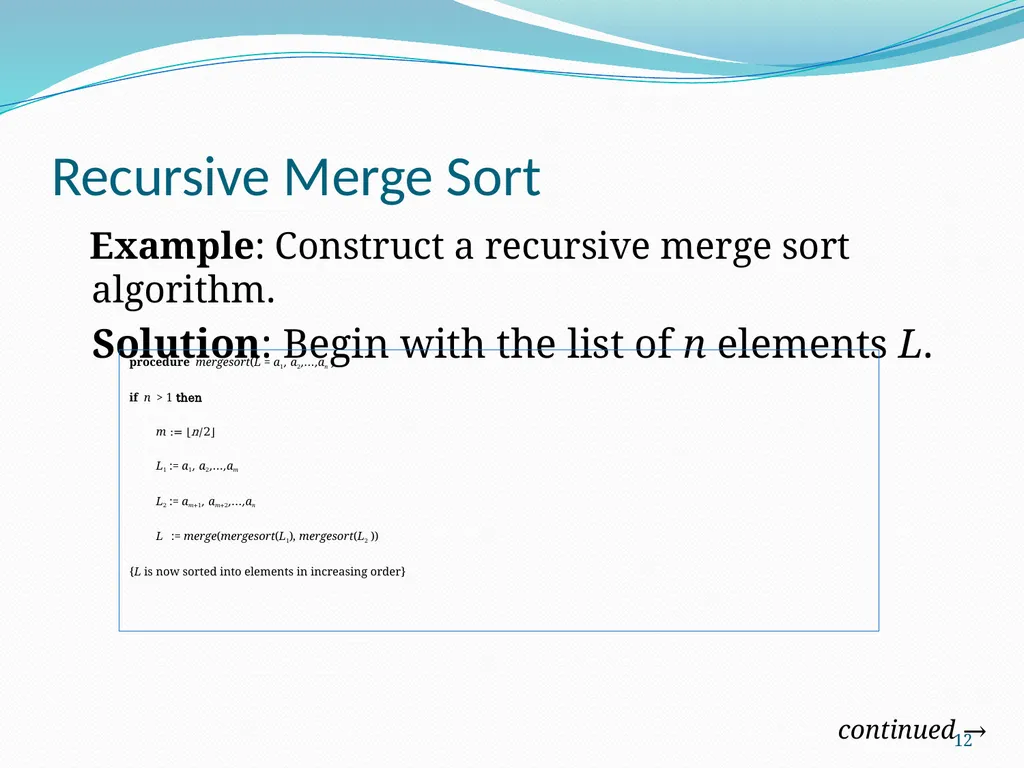
Recursive Merge Sort Example: Construct a recursive merge sort algorithm.
Solution: Begin with the list of n elements L. procedure mergesort(L = a1, a2,…,an )
if n > 1 then
m := ⌊n/2⌋
L1 := a1, a2,…,am
L2 := am+1, am+2,…,an
L := merge(mergesort(L1), mergesort(L2 ))
{L is now sorted into elements in increasing order} continued → 12<br>
13
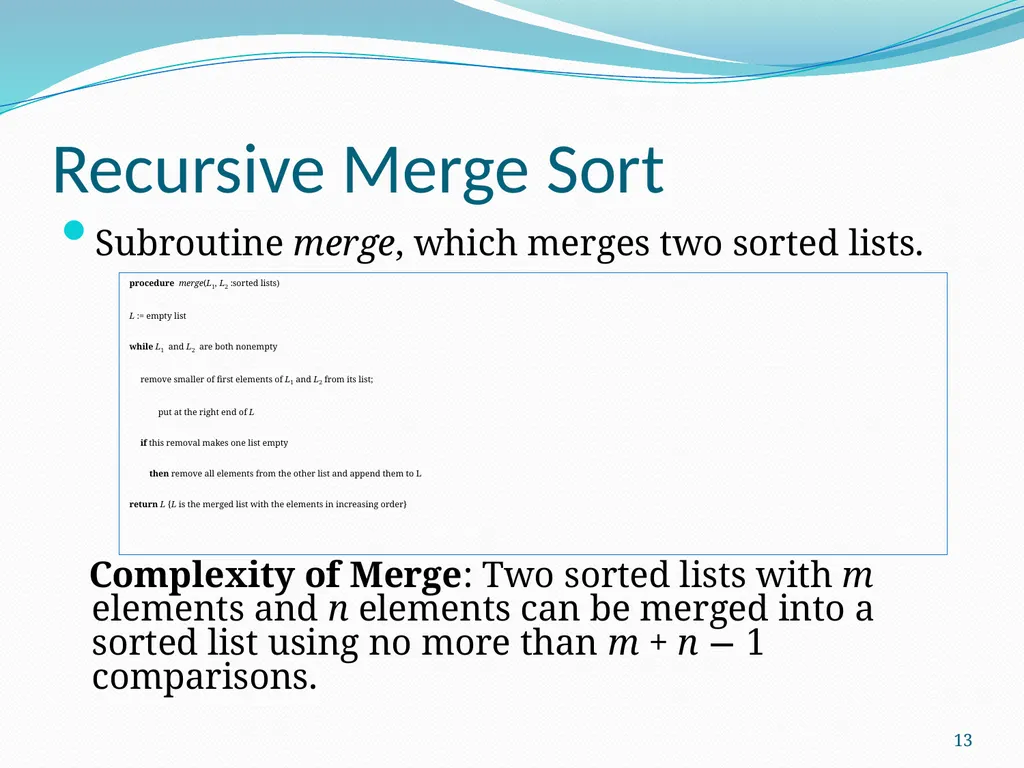
Recursive Merge Sort Subroutine merge, which merges two sorted lists.
Complexity of Merge: Two sorted lists with m elements and n elements can be merged into a sorted list using no more than m + n − 1 comparisons. procedure merge(L1, L2 :sorted lists)
L := empty list
while L1 and L2 are both nonempty
remove smaller of first elements of L1 and L2 from its list;
put at the right end of L
if this removal makes one list empty
then remove all elements from the other list and append them to L
return L {L is the merged list with the elements in increasing order} 13<br>
14
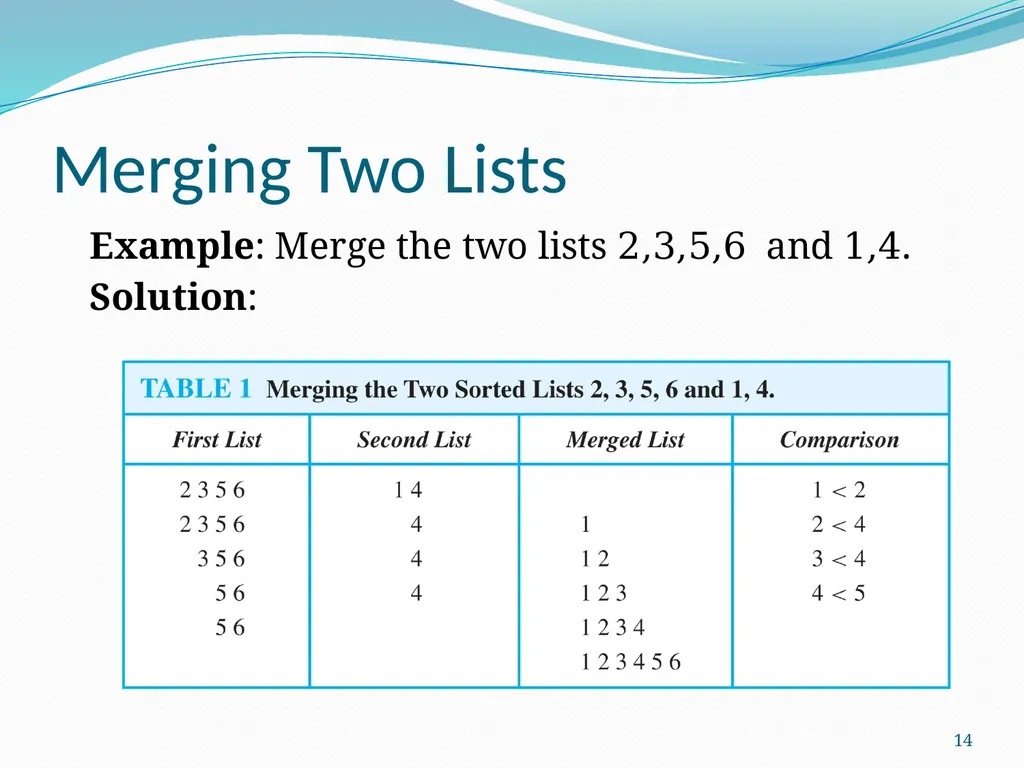
Merging Two Lists Example: Merge the two lists 2,3,5,6 and 1,4.
Solution: 14<br>
15
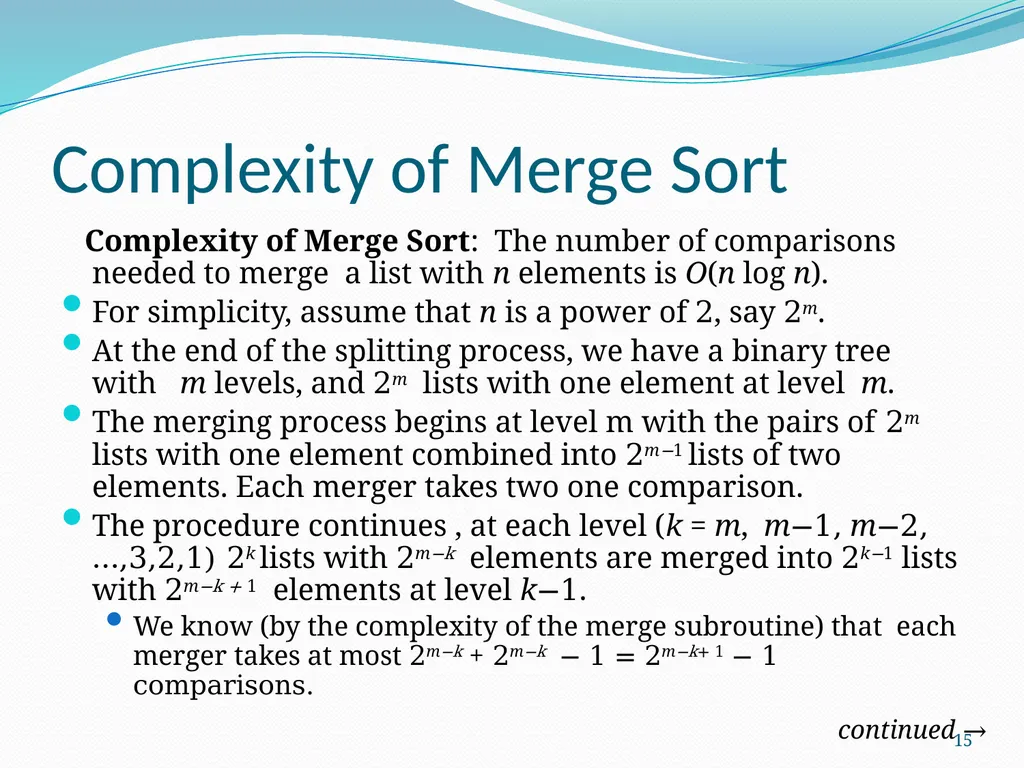
Complexity of Merge Sort Complexity of Merge Sort: The number of comparisons needed to merge a list with n elements is O(n log n).
For simplicity, assume that n is a power of 2, say 2m.
At the end of the splitting process, we have a binary tree with m levels, and 2m lists with one element at level m.
The merging process begins at level m with the pairs of 2m lists with one element combined into 2m−1 lists of two elements. Each merger takes two one comparison.
The procedure continues , at each level (k = m, m−1, m−2,…,3,2,1) 2k lists with 2m−k elements are merged into 2k−1 lists with 2m−k + 1 elements at level k−1.
We know (by the complexity of the merge subroutine) that each merger takes at most 2m−k + 2m−k − 1 = 2m−k+ 1 − 1 comparisons. continued → 15<br>
16
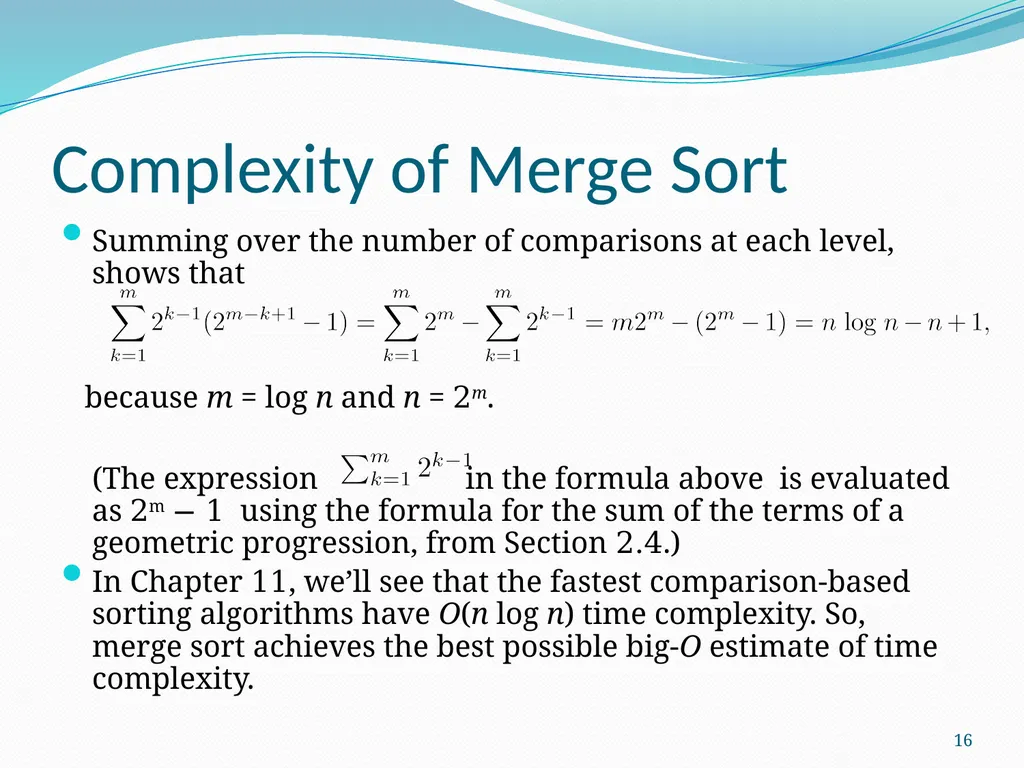
Complexity of Merge Sort Summing over the number of comparisons at each level, shows that
because m = log n and n = 2m.
(The expression in the formula above is evaluated as 2m − 1 using the formula for the sum of the terms of a geometric progression, from Section 2.4.)
In Chapter 11, we’ll see that the fastest comparison-based sorting algorithms have O(n log n) time complexity. So, merge sort achieves the best possible big-O estimate of time complexity. 16<br>