
Reflections on the availability of preservatives


Description: Reflections on the availability of preservatives used in treated articles and issues relating to skin sensitisation CA-Dec20-7.1. CA meeting of December 2020 Hazard categories for skin sensitisers Source: Guidance on the Application of the
Related Topics
Download Presentation
"Reflections on the availability of preservatives" is the property of its rightful owner. Permission is granted to download and print the materials on this website for personal, non-commercial use only, and to display it on your personal computer provided you do not modify the materials and that you retain all copyright notices contained in the materials. By downloading content from our website, you accept the terms of this agreement.
Presentation Transcript
slide1. Reflections on the availability of preservatives used in treated
articles and issues
relating to skin sensitisation CA-Dec20-7.1. CA meeting of December 2020<br>
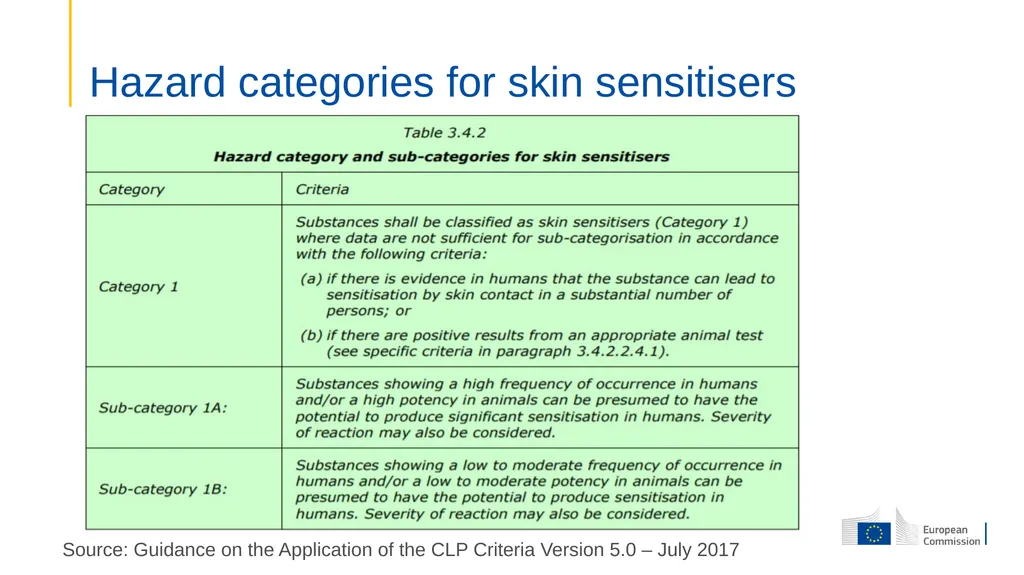
slide2. Hazard categories for skin sensitisers Source: Guidance on the Application of the CLP Criteria Version 5.0 – July 2017<br>
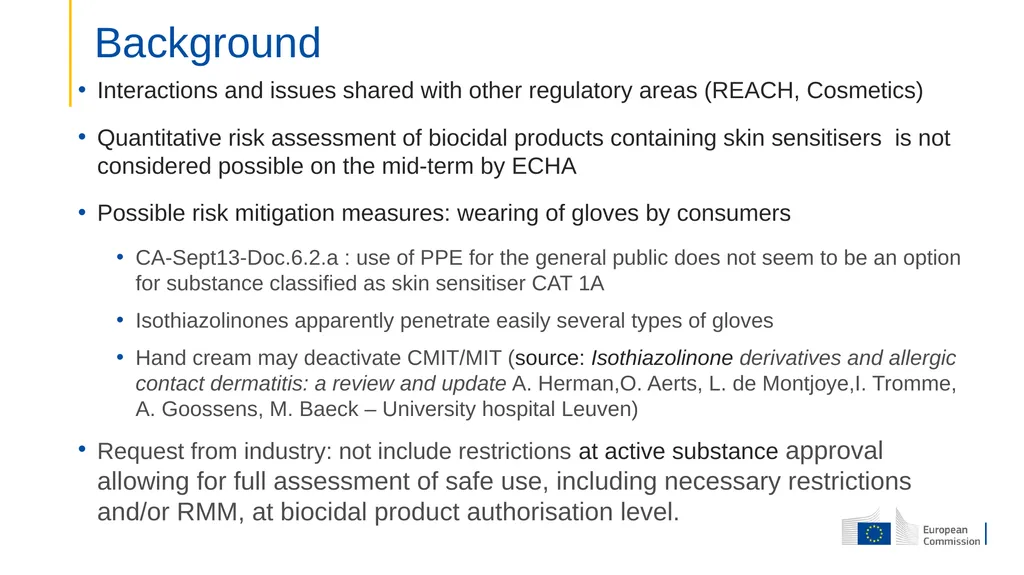
slide3. Interactions and issues shared with other regulatory areas (REACH, Cosmetics)
Quantitative risk assessment of biocidal products containing skin sensitisers is not considered possible on the mid-term by ECHA
Possible risk mitigation measures: wearing of gloves by consumers
CA-Sept13-Doc.6.2.a : use of PPE for the general public does not seem to be an option for substance classified as skin sensitiser CAT 1A
Isothiazolinones apparently penetrate easily several types of gloves
Hand cream may deactivate CMIT/MIT (source: Isothiazolinone derivatives and allergic contact dermatitis: a review and update A. Herman,O. Aerts, L. de Montjoye,I. Tromme, A. Goossens, M. Baeck – University hospital Leuven)
Request from industry: not include restrictions at active substance approval allowing for full assessment of safe use, including necessary restrictions and/or RMM, at biocidal product authorisation level. Background<br>
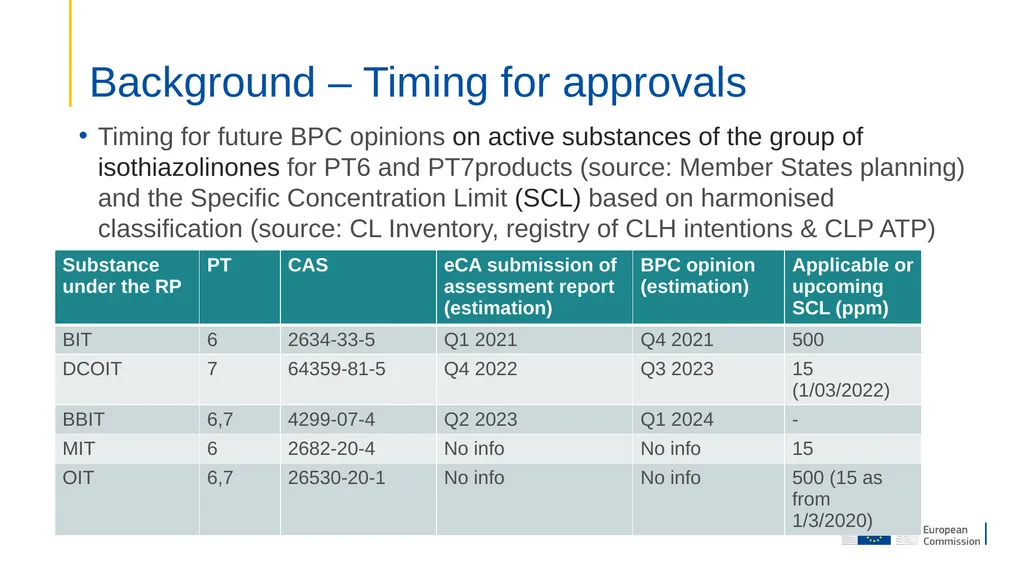
slide4. Timing for future BPC opinions on active substances of the group of isothiazolinones for PT6 and PT7products (source: Member States planning) and the Specific Concentration Limit (SCL) based on harmonised classification (source: CL Inventory, registry of CLH intentions & CLP ATP) Background – Timing for approvals<br>
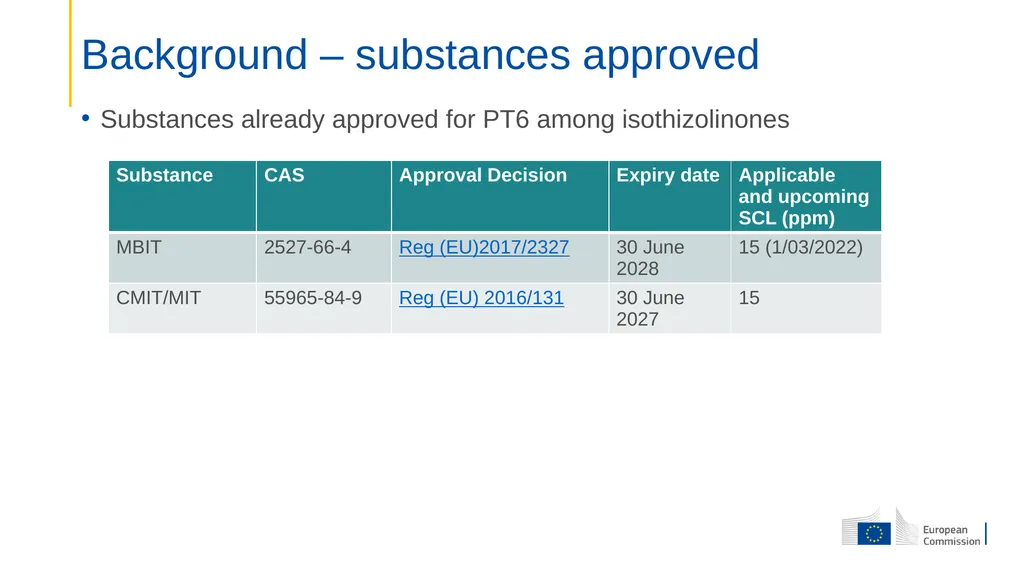
slide5. Substances already approved for PT6 among isothizolinones Background – substances approved<br>
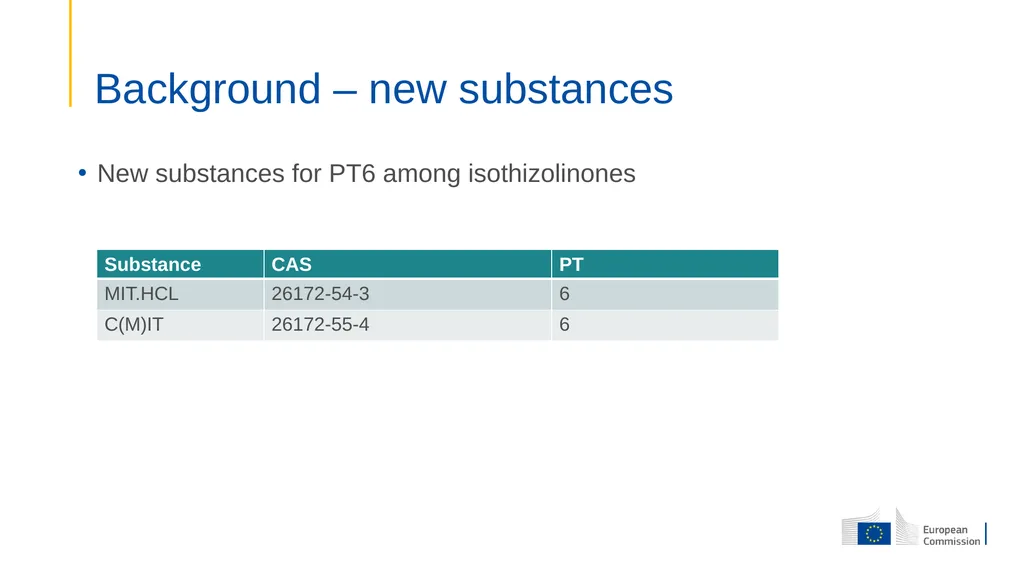
slide6. New substances for PT6 among isothizolinones Background – new substances<br>
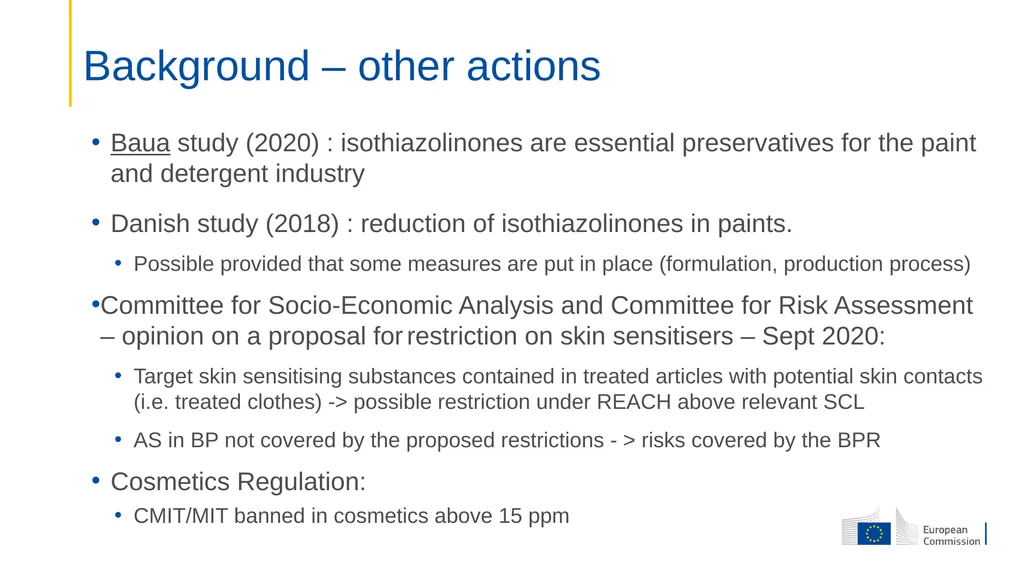
slide7. Baua study (2020) : isothiazolinones are essential preservatives for the paint and detergent industry
Danish study (2018) : reduction of isothiazolinones in paints.
Possible provided that some measures are put in place (formulation, production process)
Committee for Socio-Economic Analysis and Committee for Risk Assessment – opinion on a proposal for restriction on skin sensitisers – Sept 2020:
Target skin sensitising substances contained in treated articles with potential skin contacts (i.e. treated clothes) -> possible restriction under REACH above relevant SCL
AS in BP not covered by the proposed restrictions - > risks covered by the BPR
Cosmetics Regulation:
CMIT/MIT banned in cosmetics above 15 ppm Background – other actions<br>
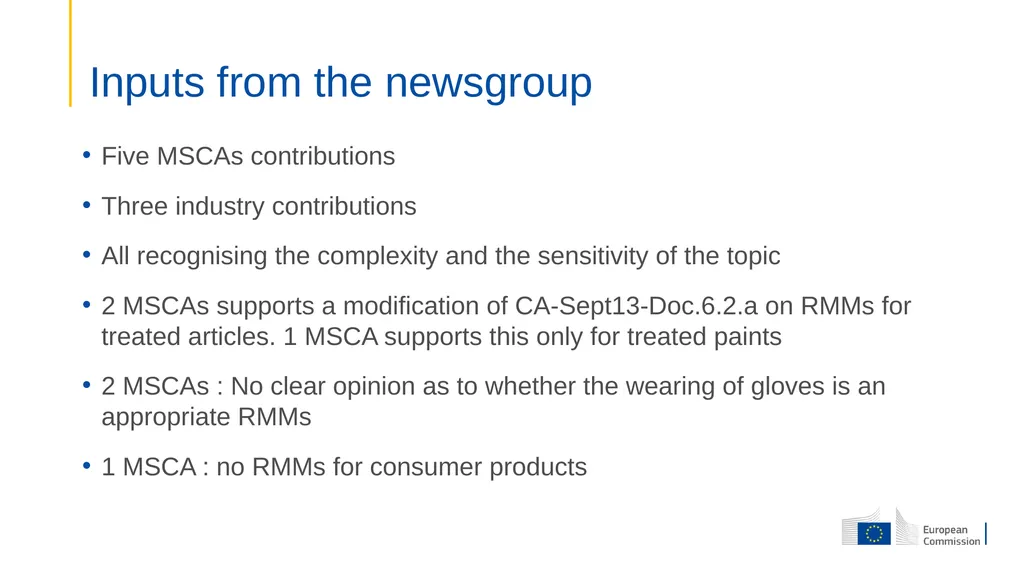
slide8. Five MSCAs contributions
Three industry contributions
All recognising the complexity and the sensitivity of the topic
2 MSCAs supports a modification of CA-Sept13-Doc.6.2.a on RMMs for treated articles. 1 MSCA supports this only for treated paints
2 MSCAs : No clear opinion as to whether the wearing of gloves is an appropriate RMMs
1 MSCA : no RMMs for consumer products Inputs from the newsgroup<br>
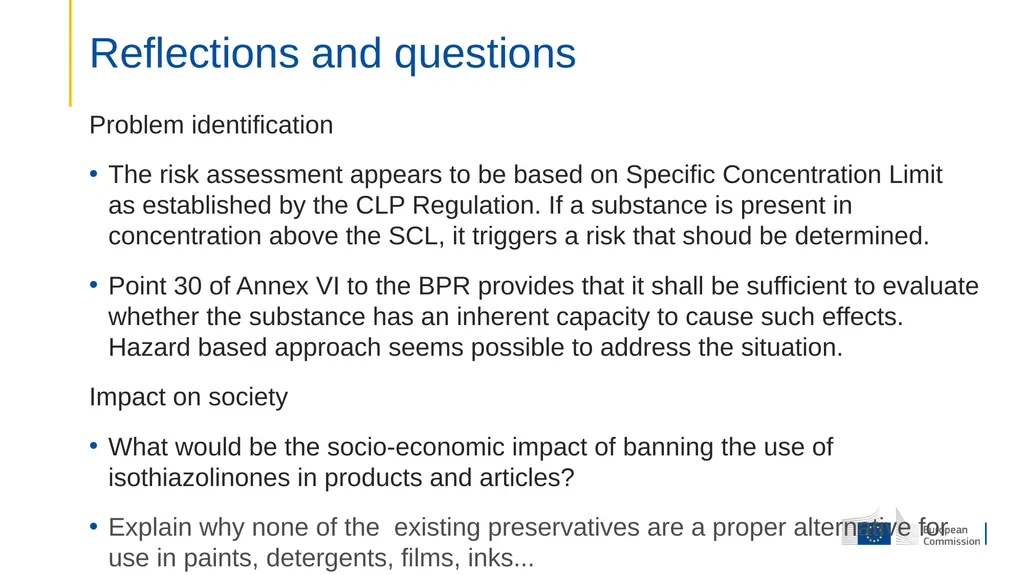
slide9. Problem identification
The risk assessment appears to be based on Specific Concentration Limit as established by the CLP Regulation. If a substance is present in concentration above the SCL, it triggers a risk that shoud be determined.
Point 30 of Annex VI to the BPR provides that it shall be sufficient to evaluate whether the substance has an inherent capacity to cause such effects. Hazard based approach seems possible to address the situation.
Impact on society
What would be the socio-economic impact of banning the use of isothiazolinones in products and articles?
Explain why none of the existing preservatives are a proper alternative for use in paints, detergents, films, inks... Reflections and questions<br>
slide10. Taken into account all the elements above, do you consider that a problem exists/may develop for the availability of effective preservatives?
If so, please specify the potential negative impacts for society of the lack of effective preservatives and propose what would be the most appropriate way forward to address this problem? Requests addressed to the CA-meeting<br>
slide2. Hazard categories for skin sensitisers Source: Guidance on the Application of the CLP Criteria Version 5.0 – July 2017<br>
slide3. Interactions and issues shared with other regulatory areas (REACH, Cosmetics)
Quantitative risk assessment of biocidal products containing skin sensitisers is not considered possible on the mid-term by ECHA
Possible risk mitigation measures: wearing of gloves by consumers
CA-Sept13-Doc.6.2.a : use of PPE for the general public does not seem to be an option for substance classified as skin sensitiser CAT 1A
Isothiazolinones apparently penetrate easily several types of gloves
Hand cream may deactivate CMIT/MIT (source: Isothiazolinone derivatives and allergic contact dermatitis: a review and update A. Herman,O. Aerts, L. de Montjoye,I. Tromme, A. Goossens, M. Baeck – University hospital Leuven)
Request from industry: not include restrictions at active substance approval allowing for full assessment of safe use, including necessary restrictions and/or RMM, at biocidal product authorisation level. Background<br>
slide4. Timing for future BPC opinions on active substances of the group of isothiazolinones for PT6 and PT7products (source: Member States planning) and the Specific Concentration Limit (SCL) based on harmonised classification (source: CL Inventory, registry of CLH intentions & CLP ATP) Background – Timing for approvals<br>
slide5. Substances already approved for PT6 among isothizolinones Background – substances approved<br>
slide6. New substances for PT6 among isothizolinones Background – new substances<br>
slide7. Baua study (2020) : isothiazolinones are essential preservatives for the paint and detergent industry
Danish study (2018) : reduction of isothiazolinones in paints.
Possible provided that some measures are put in place (formulation, production process)
Committee for Socio-Economic Analysis and Committee for Risk Assessment – opinion on a proposal for restriction on skin sensitisers – Sept 2020:
Target skin sensitising substances contained in treated articles with potential skin contacts (i.e. treated clothes) -> possible restriction under REACH above relevant SCL
AS in BP not covered by the proposed restrictions - > risks covered by the BPR
Cosmetics Regulation:
CMIT/MIT banned in cosmetics above 15 ppm Background – other actions<br>
slide8. Five MSCAs contributions
Three industry contributions
All recognising the complexity and the sensitivity of the topic
2 MSCAs supports a modification of CA-Sept13-Doc.6.2.a on RMMs for treated articles. 1 MSCA supports this only for treated paints
2 MSCAs : No clear opinion as to whether the wearing of gloves is an appropriate RMMs
1 MSCA : no RMMs for consumer products Inputs from the newsgroup<br>
slide9. Problem identification
The risk assessment appears to be based on Specific Concentration Limit as established by the CLP Regulation. If a substance is present in concentration above the SCL, it triggers a risk that shoud be determined.
Point 30 of Annex VI to the BPR provides that it shall be sufficient to evaluate whether the substance has an inherent capacity to cause such effects. Hazard based approach seems possible to address the situation.
Impact on society
What would be the socio-economic impact of banning the use of isothiazolinones in products and articles?
Explain why none of the existing preservatives are a proper alternative for use in paints, detergents, films, inks... Reflections and questions<br>
slide10. Taken into account all the elements above, do you consider that a problem exists/may develop for the availability of effective preservatives?
If so, please specify the potential negative impacts for society of the lack of effective preservatives and propose what would be the most appropriate way forward to address this problem? Requests addressed to the CA-meeting<br>