
Regulatory control C.A. (Chuck) McDermott, P.Eng.








Description: Regulatory control C.A. (Chuck) McDermott, P.Eng. Canada CAMcDermotticloud.com Contents Overview of regulatory control Legislative framework Regulatory framework Regulations and guides Authorization Review and assessment Inspection
Related Topics
Download Presentation
"Regulatory control C.A. (Chuck) McDermott, P.Eng." is the property of its rightful owner. Permission is granted to download and print the materials on this website for personal, non-commercial use only, and to display it on your personal computer provided you do not modify the materials and that you retain all copyright notices contained in the materials. By downloading content from our website, you accept the terms of this agreement.
Presentation Transcript
slide1. Regulatory control C.A. (Chuck) McDermott, P.Eng.
Canada
C_A_McDermott@icloud.com<br>
slide2. Contents Overview of regulatory control
Legislative framework
Regulatory framework
Regulations and guides
Authorization
Review and assessment
Inspection
Enforcement 7-18 May – 18-29 June 2018 Regulatory control 2<br>
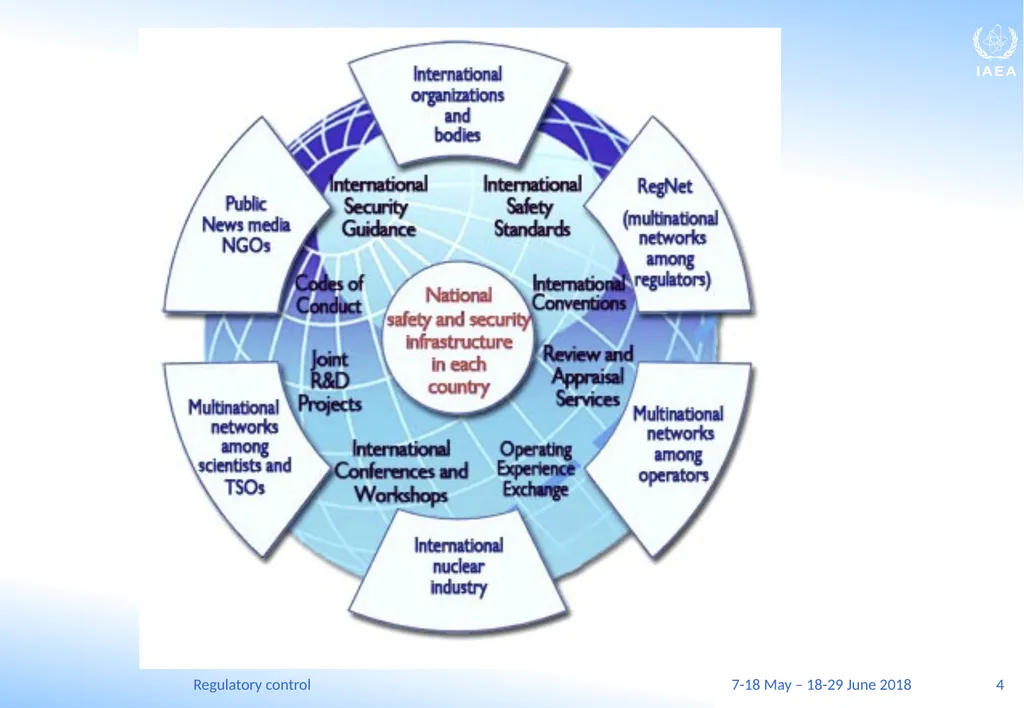
slide3. Global nuclear safety and security framework<br>
slide4. 7-18 May – 18-29 June 2018 Regulatory control 4<br>
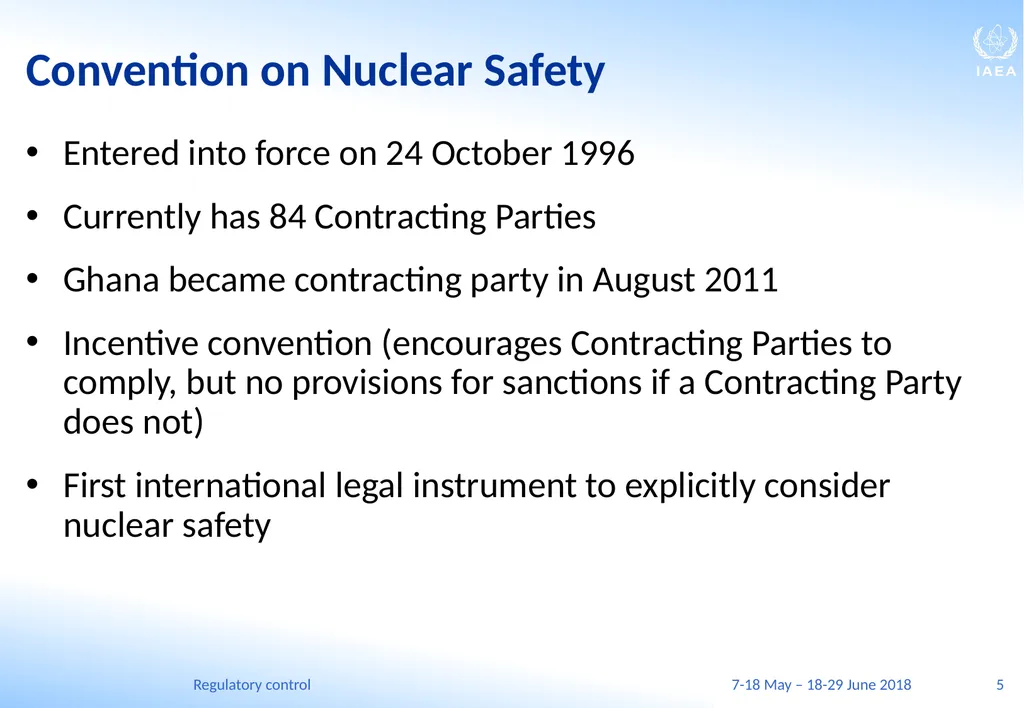
slide5. Convention on Nuclear Safety Entered into force on 24 October 1996
Currently has 84 Contracting Parties
Ghana became contracting party in August 2011
Incentive convention (encourages Contracting Parties to comply, but no provisions for sanctions if a Contracting Party does not)
First international legal instrument to explicitly consider nuclear safety 7-18 May – 18-29 June 2018 Regulatory control 5<br>
slide6. Elements of the national safety infrastructure Legal framework
Regulatory body
Technical and industrial framework
Scientific and economic framework
Nuclear education and training 7-18 May – 18-29 June 2018 Regulatory control 6<br>
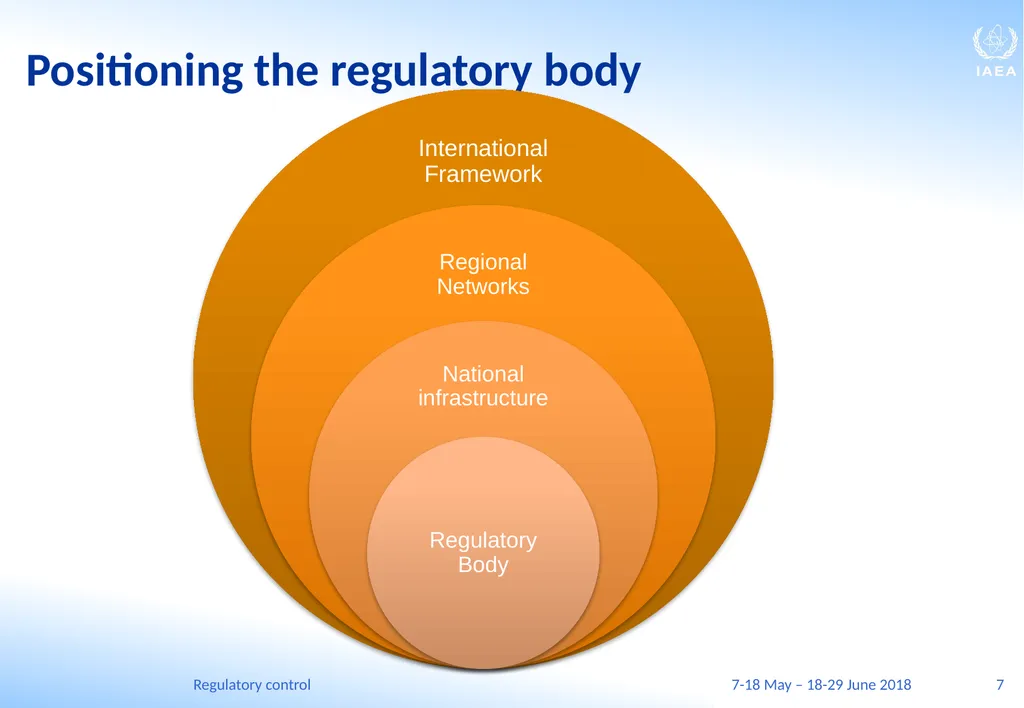
slide7. Positioning the regulatory body 7-18 May – 18-29 June 2018 Regulatory control 7<br>
slide8. Overview of regulatory control<br>
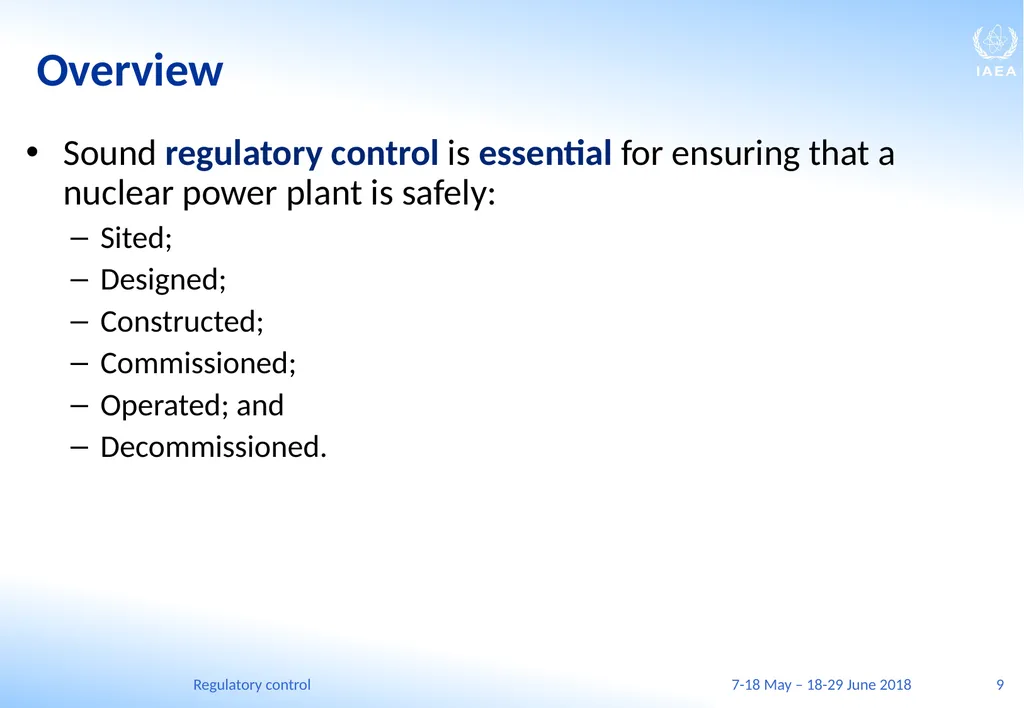
slide9. Overview Sound regulatory control is essential for ensuring that a nuclear power plant is safely:
Sited;
Designed;
Constructed;
Commissioned;
Operated; and
Decommissioned. 7-18 May – 18-29 June 2018 Regulatory control 9<br>
slide10. Overview (Cont’d) Regulatory body acts independently of authorized party in national interest to ensure that level of safety is appropriate.
However, this does not reduce the responsibility of authorized party to ensure that its activities are safe. 7-18 May – 18-29 June 2018 Regulatory control 10<br>
slide11. Main functions of a regulatory body (RB) Establishing requirements;
Issuing authorizations;
Reviewing and assessing submissions from applicants and authorized parties;
Inspecting facilities and activities;
Enforcing compliance; and,
Communicating with interested parties. 7-18 May – 18-29 June 2018 Regulatory control 11<br>
slide12. Legislative framework<br>
slide13. Learning objectives Describe the legislative framework that is necessary for regulatory control to be effective.
Describe a possible legal structure of a comprehensive nuclear law. 7-18 May – 18-29 June 2018 Regulatory control 13<br>
slide14. Legislative framework Achieving and maintaining a high level of safety in nuclear power plants (NPPs) depends on sound legislative framework
Legislative framework describes how State will control the use of nuclear energy and provide necessary mechanisms and resources for this control
IAEA Safety Standard GSR Part 1: Governmental, Legal and Regulatory Framework for Safety describes requirements for an adequate legislative framework
This course focuses on NPPs, although most concepts are applicable to all nuclear facilities and activities 7-18 May – 18-29 June 2018 Regulatory control 14<br>
slide15. Prime responsibility for safety First principle in IAEA Safety Fundamentals (SF-1) states:
"The prime responsibility for safety must rest with the person or organization responsible for facilities and activities that give rise to radiation risks".
The operating organization (authorized party) has essential and central role and, therefore, bears an important responsibility.
Legislative framework must ensure that prime responsibility remains with authorized party. 7-18 May – 18-29 June 2018 Regulatory control 15<br>
slide16. Legislative provisions Legislation is how a State establishes control over use of nuclear energy
Legislation should:
Set out objectives for protecting individuals, society and the environment;
Articulate national policy and strategies for nuclear safety;
Prohibit use of nuclear energy without authorization;
Establish a RB with appropriate authority;
Provide RB with adequate human and financial resources; and,
Establish offences and corresponding penalties for contraventions. 7-18 May – 18-29 June 2018 Regulatory control 16<br>
slide17. Legislative provisions (cont’d) Legislation should give RB authority to:
Define and develop policies, safety principles/requirements and associated criteria;
Establish regulations and issue guidance;
Issue, amend, suspend or revoke authorizations;
Inspect for compliance
Enforce its regulations
Communicate and liaise directly with public, other interested parties, other RBs and international organizations 7-18 May – 18-29 June 2018 Regulatory control 17<br>
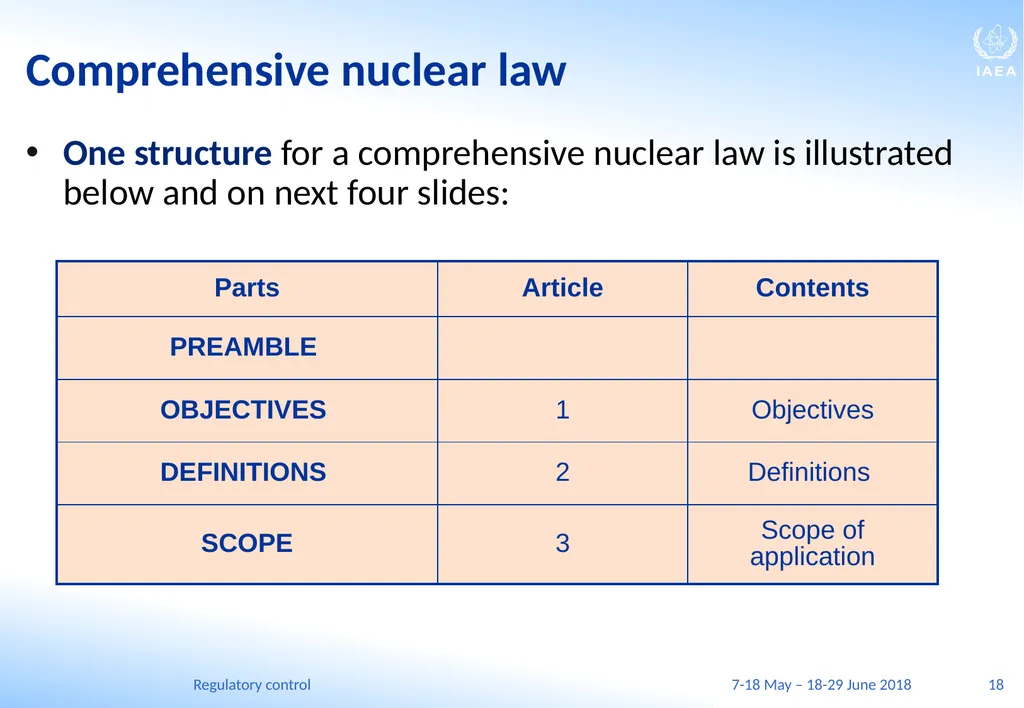
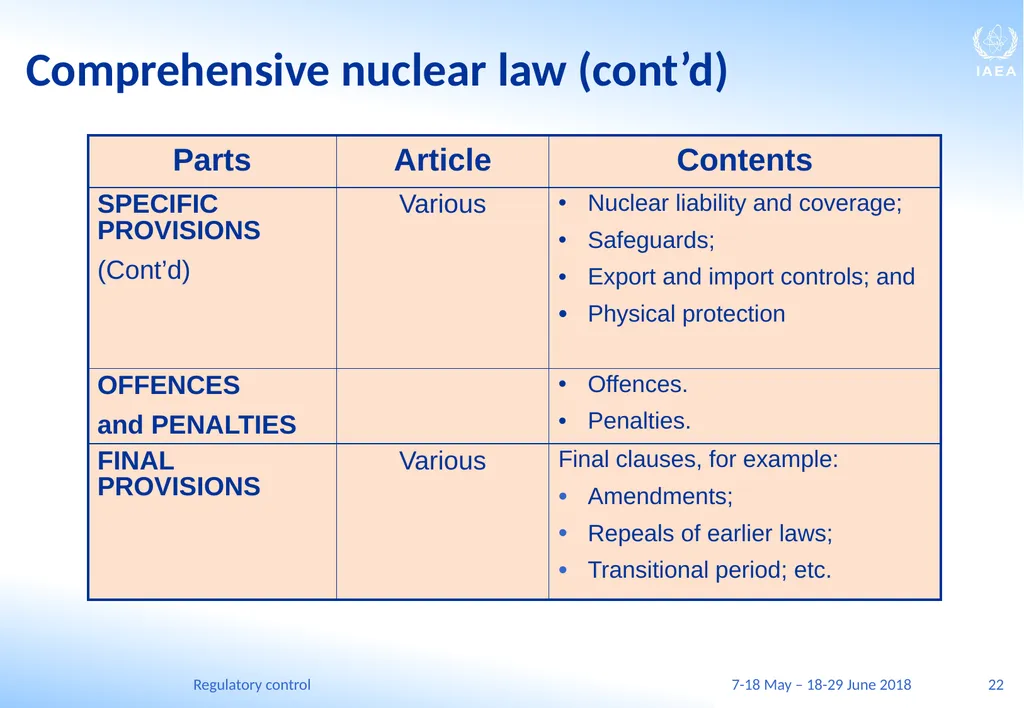
slide18. Comprehensive nuclear law One structure for a comprehensive nuclear law is illustrated below and on next four slides: 7-18 May – 18-29 June 2018 Regulatory control 18<br>
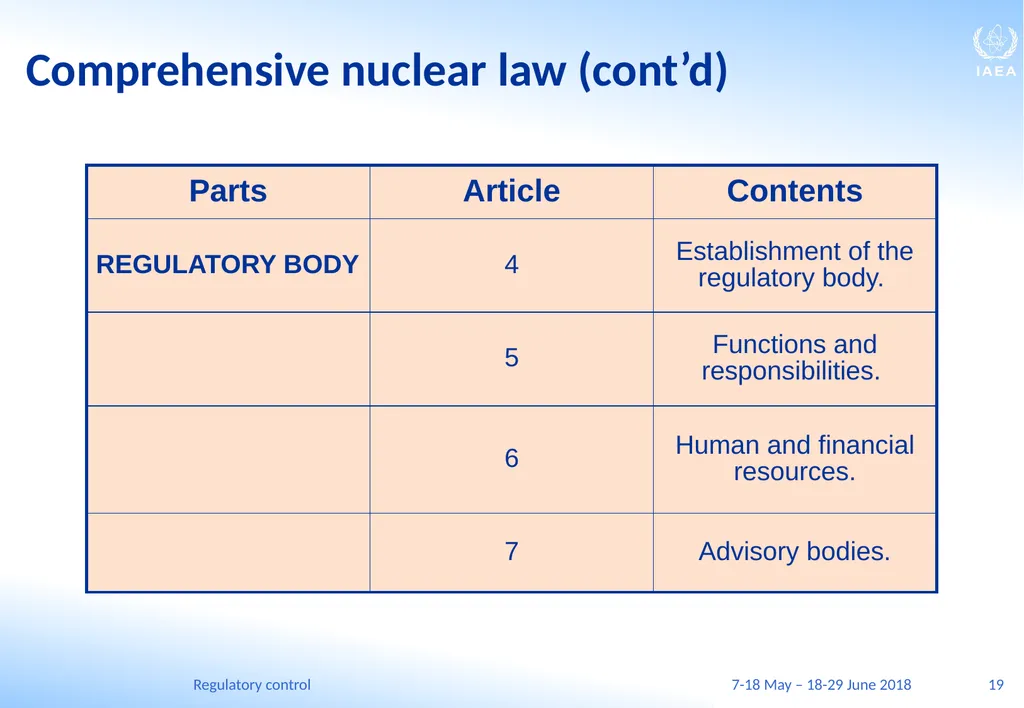
slide19. Comprehensive nuclear law (cont’d) 7-18 May – 18-29 June 2018 Regulatory control 19<br>
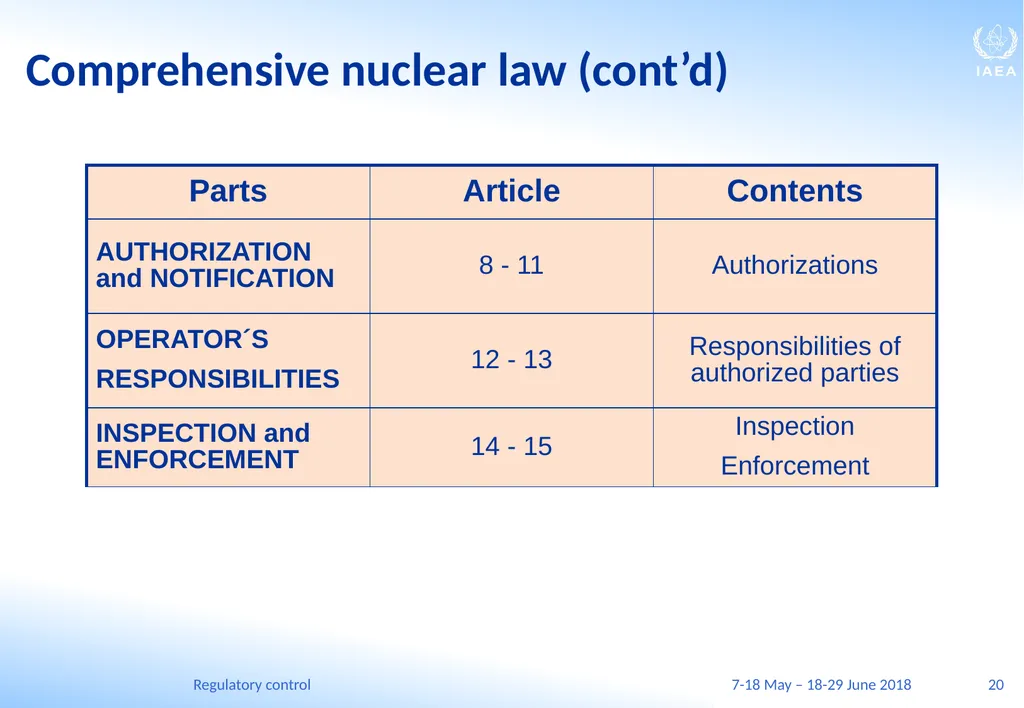
slide20. Comprehensive nuclear law (cont’d) 7-18 May – 18-29 June 2018 Regulatory control 20<br>
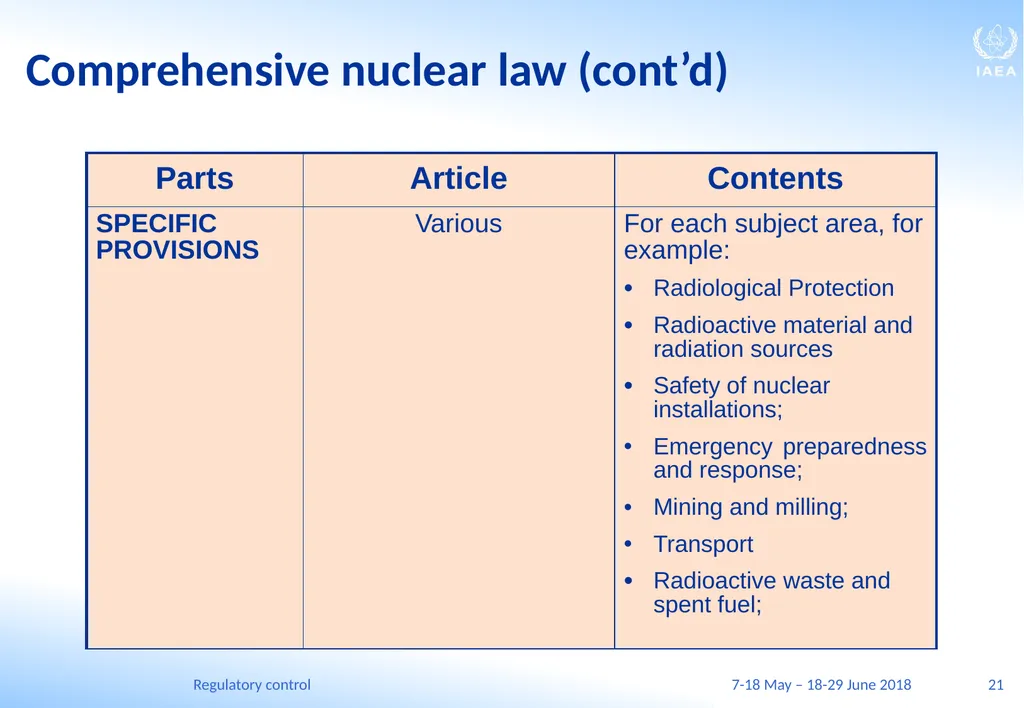
slide21. Comprehensive nuclear law (cont’d) 7-18 May – 18-29 June 2018 Regulatory control 21<br>
slide22. Comprehensive nuclear law (cont’d) 7-18 May – 18-29 June 2018 Regulatory control 22<br>
slide23. Regulatory framework<br>
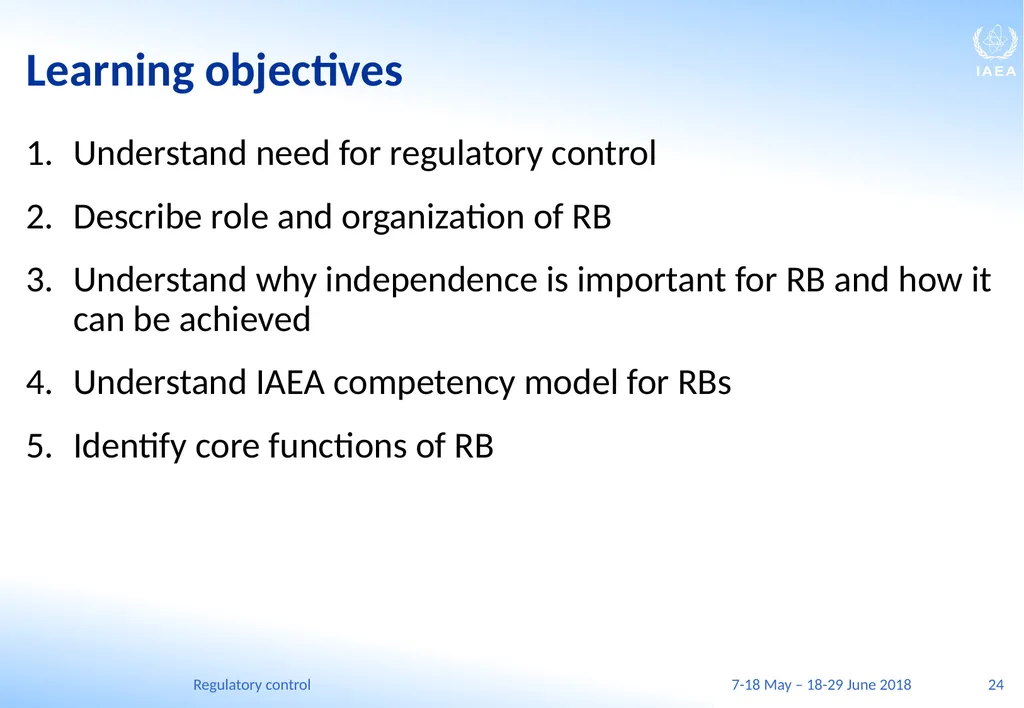
slide24. Learning objectives Understand need for regulatory control
Describe role and organization of RB
Understand why independence is important for RB and how it can be achieved
Understand IAEA competency model for RBs
Identify core functions of RB 7-18 May – 18-29 June 2018 Regulatory control 24<br>
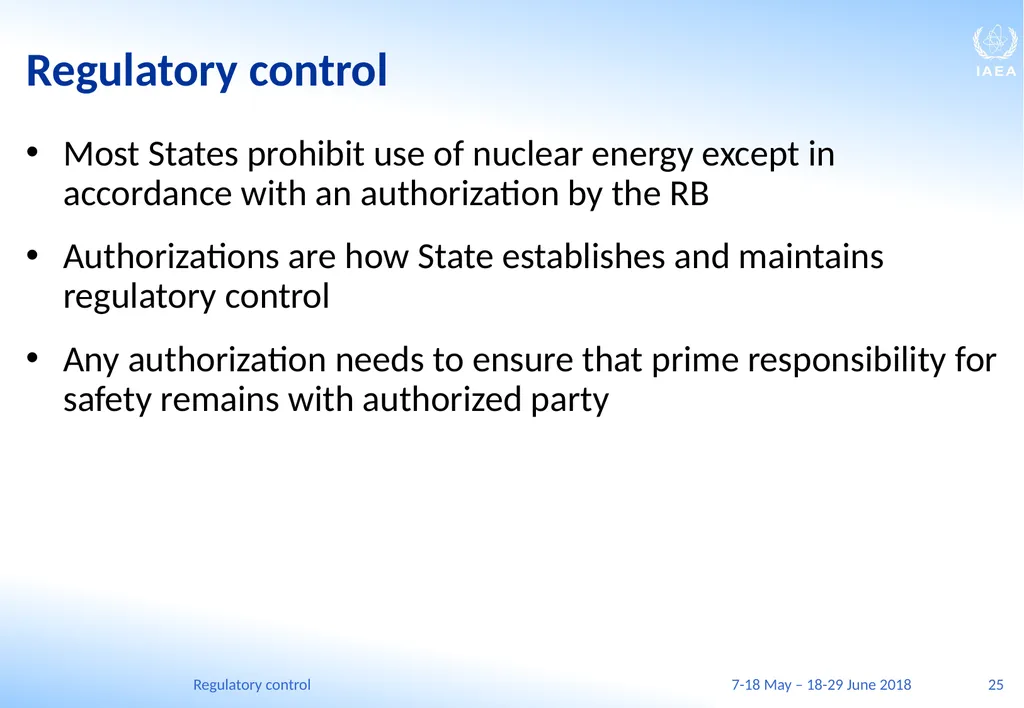
slide25. Regulatory control Most States prohibit use of nuclear energy except in accordance with an authorization by the RB
Authorizations are how State establishes and maintains regulatory control
Any authorization needs to ensure that prime responsibility for safety remains with authorized party 7-18 May – 18-29 June 2018 Regulatory control 25<br>
slide26. Regulatory control (cont’d) States use various terms for the concept of authorization, such as licence, permit or certificate.
IAEA (and this presentation) uses the terms authorization and authorized party.
An authorization is a formal permission issued to an authorized party, allowing the authorized party to site, construct, commission, operate or decommission a NPP.
Most authorizations include conditions that authorized party must comply with. 7-18 May – 18-29 June 2018 Regulatory control 26<br>
slide27. Overlapping jurisdictions In most States, RB is not the only authority that regulates some aspect of an NPP. Other authorities that may be involved include:
Industrial health and safety authorities;
Public health authorities;
Environmental authorities;
Building and electrical code authorities;
Transport authorities (both for transport of dangerous good and for navigation purposes);
Emergency preparedness and response authorities;
Etc. 7-18 May – 18-29 June 2018 Regulatory control 27<br>
slide28. Overlapping jurisdictions (cont’d) To avoid conflicts, RB should establish formal agreements with other authorities to clearly define how they will operate in a coordinated manner to limit regulatory gaps and overlaps.
Even with formal agreements, good communication between various authorities is essential. 7-18 May – 18-29 June 2018 Regulatory control 28<br>
slide29. The RB RB is how the State exercises control over the safety of NPPs.
It includes:
Sufficient competent technical staff
Legal support
Administrative support
Many RBs make use of advisory bodies of outside independent experts, but they are normally separate from RB. 7-18 May – 18-29 June 2018 Regulatory control 29<br>
slide30. Organization of the RB RB should be structured so it is capable of carrying out functions effectively, efficiently and independently
Appropriate structure of RB depends on many factors, including:
Nature of the national legal infrastructure
State’s cultural attitudes and traditions
Existing governmental organization and procedures
Technical, financial and human resources available in State
Number and nature of regulated facilities and activities in State 7-18 May – 18-29 June 2018 Regulatory control 30<br>
slide31. Organization of the RB (cont’d) In some States, there is more than one responsible authority.
Typical situation is where one authority regulates radiation safety, while another regulates safety of facilities.
In these cases, government must establish arrangements that ensure regulatory responsibilities and functions are clearly defined and coordinated. 7-18 May – 18-29 June 2018 Regulatory control 31<br>
slide32. Organization of the RB (cont’d) If RB is not entirely self-sufficient in a technical or functional area, it should have the authority to seek advice or assistance from outside sources.
When such external advice or assistance is provided, arrangements should be made to ensure that those providing it are effectively independent.
Receiving external advice or assistance does not relieve RB of its responsibility for decision-making. 7-18 May – 18-29 June 2018 Regulatory control 32<br>
slide33. Independence of the RB An important attribute of RB is its freedom from unwarranted interference in its regulatory functions.
The Convention on Nuclear Safety states:
“Each contracting party shall take the appropriate steps to ensure an effective separation between the functions of the RB and those of any other body or organization concerned with the promotion or utilization of nuclear energy.”
Even so, an independent RB will not be entirely separate from other governmental bodies. 7-18 May – 18-29 June 2018 Regulatory control 33<br>
slide34. Independence of the RB (cont’d) Measures that support effective independence include:
Sufficient competent staff
Sufficient financial resources
Ability to make independent regulatory judgements and decisions
Freedom from political and economic pressures
Freedom from pressures from government departments, authorized parties, or other organizations
Ability to give independent advice to government bodies on safety matters
Access to the highest levels of government
Ability to liaise with RBs of other States and with international organizations 7-18 May – 18-29 June 2018 Regulatory control 34<br>
slide35. Management system of RB RB must establish an integrated management system that meets requirements of IAEA Safety Standard GSR Part 2.
The module on Management Systems describes these requirements in detail and all are applicable to RB. 7-18 May – 18-29 June 2018 Regulatory control 35<br>
slide36. Staffing and training for RB Ability of RB to fulfil its responsibilities depends largely on competence of its staff.
IAEA Safety Standards and Safety Report No. 79 provide guidance on managing the competence of RBs.
Report 79 also provides guidance on delivering training and other elements of competence development.
IAEA TECDOC 1757: “Methodology for the Systematic Assessment of Regulatory Competence Needs (SARCoN) for RBs of Nuclear Installations” also provides useful information. 7-18 May – 18-29 June 2018 Regulatory control 36<br>
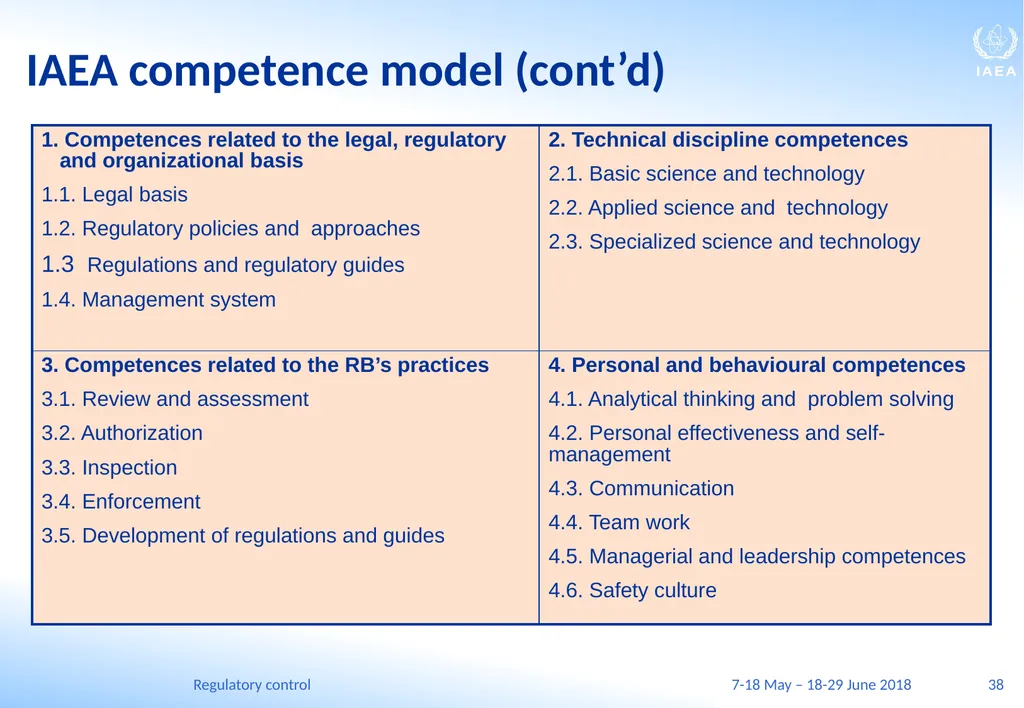
slide37. IAEA competence model Competences comprise a combination of knowledge, skills and attitudes (KSAs).
KSAs for each position in RB need to be established.
IAEA competence model is based on a quadrant structure shown on next slide. 7-18 May – 18-29 June 2018 Regulatory control 37<br>
slide38. IAEA competence model (cont’d) 7-18 May – 18-29 June 2018 Regulatory control 38<br>
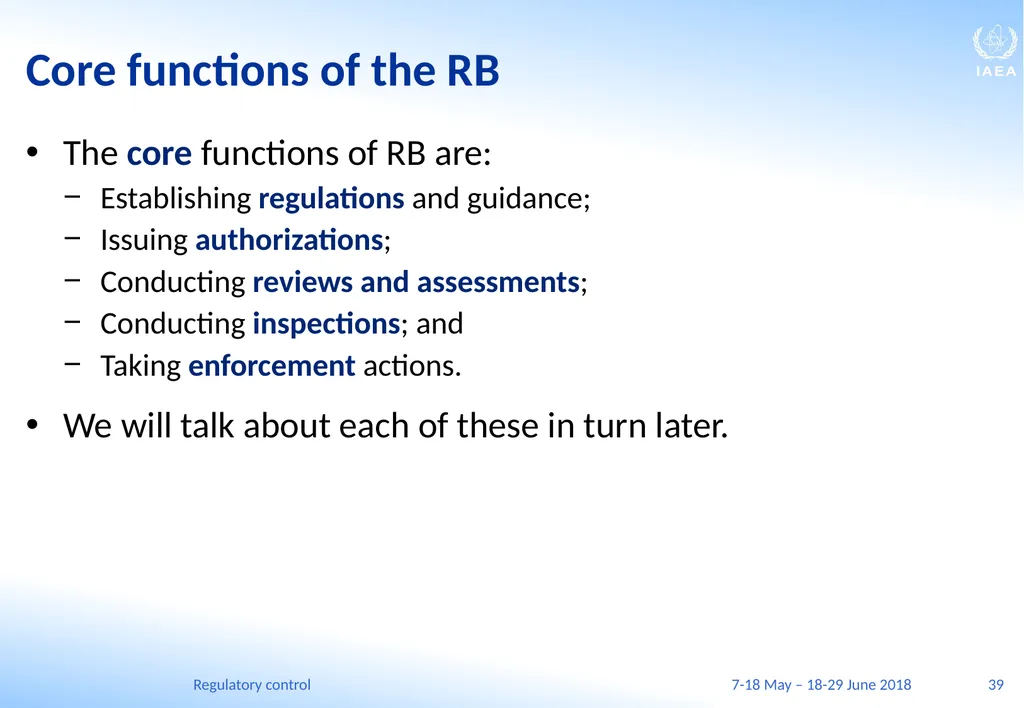
slide39. Core functions of the RB The core functions of RB are:
Establishing regulations and guidance;
Issuing authorizations;
Conducting reviews and assessments;
Conducting inspections; and
Taking enforcement actions.
We will talk about each of these in turn later. 7-18 May – 18-29 June 2018 Regulatory control 39<br>
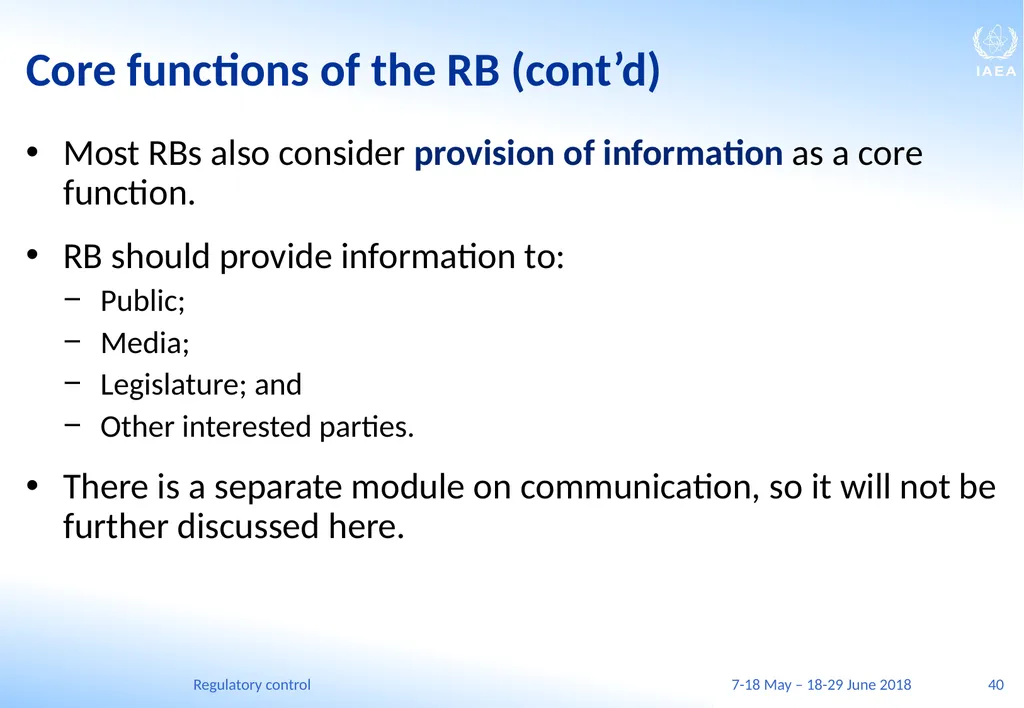
slide40. Core functions of the RB (cont’d) Most RBs also consider provision of information as a core function.
RB should provide information to:
Public;
Media;
Legislature; and
Other interested parties.
There is a separate module on communication, so it will not be further discussed here. 7-18 May – 18-29 June 2018 Regulatory control 40<br>
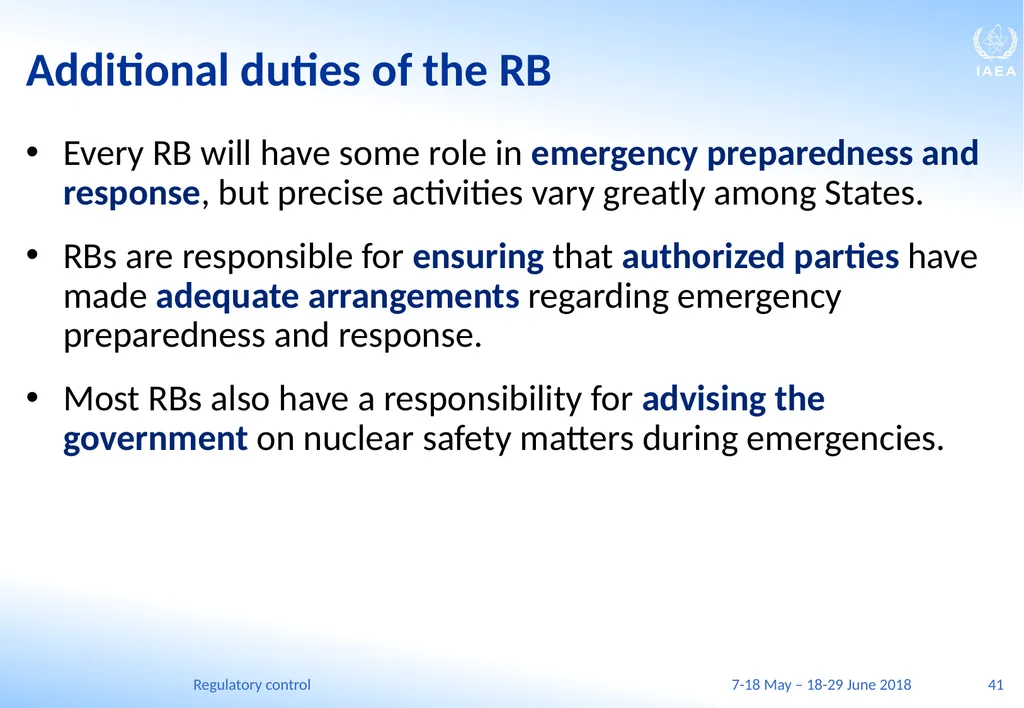
slide41. Additional duties of the RB Every RB will have some role in emergency preparedness and response, but precise activities vary greatly among States.
RBs are responsible for ensuring that authorized parties have made adequate arrangements regarding emergency preparedness and response.
Most RBs also have a responsibility for advising the government on nuclear safety matters during emergencies. 7-18 May – 18-29 June 2018 Regulatory control 41<br>
slide42. Additional duties of the RB (cont’d) Specific to each State, but may include:
Advising the government and other authorities on matters related to NPP safety;
Confirming competence of personnel responsible for the safe operation of NPPs;
Independent radiological monitoring in and around NPPs;
Independent testing and quality control measurements;
Initiating and coordinating safety-related research and development;
Providing personnel monitoring services and conducting medical examinations;
Monitoring of nuclear non-proliferation and implementing safeguards activities. 7-18 May – 18-29 June 2018 Regulatory control 42<br>
slide43. Regulations and guidance<br>
slide44. Learning objectives Identify IAEA guidance on regulations and guides
Describe purpose of regulations and guides 7-18 May – 18-29 June 2018 Regulatory control 44<br>
slide45. IAEA guidance on regulations and guides GSR Part 1 has three requirements on regulations and guides
Requirement 32:
The RB shall establish or adopt regulations and guides to specify the principles, requirements and associated criteria for safety upon which its regulatory judgements, decisions and actions are based.
Requirement 33:
Regulations and guides shall be reviewed and revised as necessary to keep them up to date, with due consideration of relevant international safety standards and technical standards and of relevant experience gained 7-18 May – 18-29 June 2018 Regulatory control 45<br>
slide46. IAEA guidance on regulations and guides (cont’d) Requirement 34:
The RB shall notify interested parties and the public of the principles and associated criteria for safety established in its regulations and guides, and shall make its regulations and guides available. 7-18 May – 18-29 June 2018 Regulatory control 46<br>
slide47. Regulations and guides Regulations and guides provide the basis for other RB core functions and therefore should be in place early in nuclear power programme.
The IAEA Safety Requirements documents are written in a way that the RB can easily transform into regulations. 7-18 May – 18-29 June 2018 Regulatory control 47<br>
slide48. Need for regulations and guidance Regulations are mandatory requirements that authorized parties must comply with.
Guides provide advice on how applicants and authorized parties can meet the regulations.
Guides are not usually mandatory. Applicants and authorized parties are usually free to propose alternative ways of satisfying the Regulations.
States embarking on a nuclear power programme will already have some regulations and guides in place (radiation protection and possibly the authorization process). 7-18 May – 18-29 June 2018 Regulatory control 48<br>
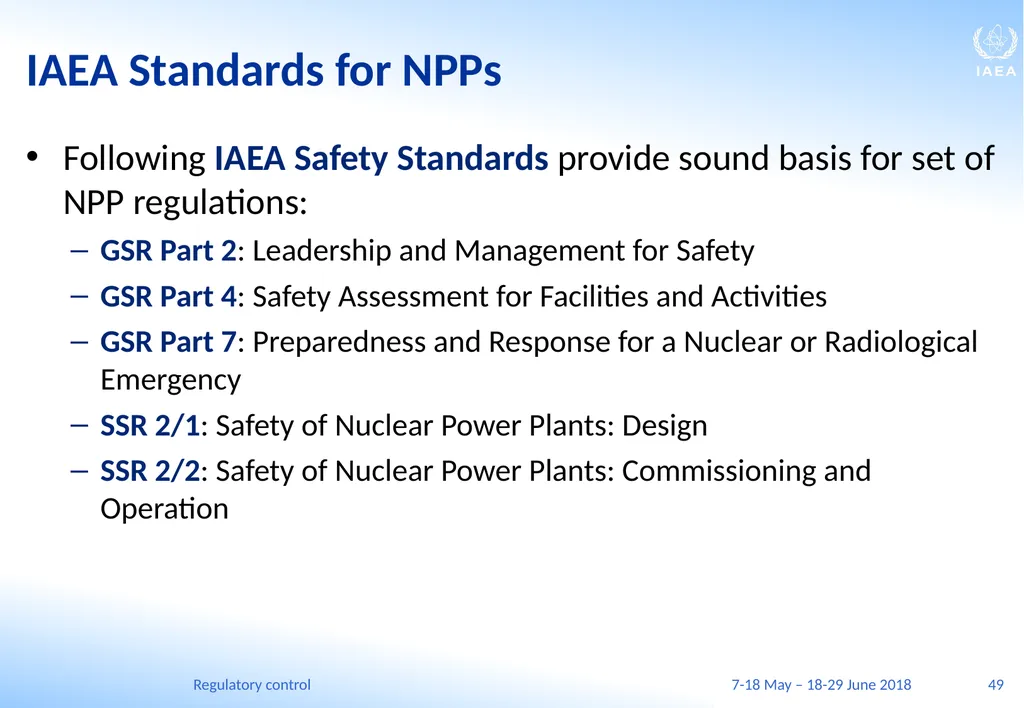
slide49. IAEA Standards for NPPs Following IAEA Safety Standards provide sound basis for set of NPP regulations:
GSR Part 2: Leadership and Management for Safety
GSR Part 4: Safety Assessment for Facilities and Activities
GSR Part 7: Preparedness and Response for a Nuclear or Radiological Emergency
SSR 2/1: Safety of Nuclear Power Plants: Design
SSR 2/2: Safety of Nuclear Power Plants: Commissioning and Operation 7-18 May – 18-29 June 2018 Regulatory control 49<br>
slide50. IAEA Standards for NPPs (cont’d) If a State does not already have regulations in place regarding radiation safety, GSR Part 3: Radiation Protection and Safety of Radiation Sources: International Basic Safety Standards provides a basis for those regulations 7-18 May – 18-29 June 2018 Regulatory control 50<br>
slide51. Exercise Chapter 5 of SSR 2/1: Safety of Nuclear Power Plants addresses general plant design and includes five sections (shown on next slide)
Divide into five groups
Activity: For your assigned section
Do current regulations in your country address the SSR 2/1 requirements?
If yes, describe how you came to that conclusion.
If no, draft a regulation that would address the SSR 2/1 requirements. 7-18 May – 18-29 June 2018 Regulatory control 51<br>
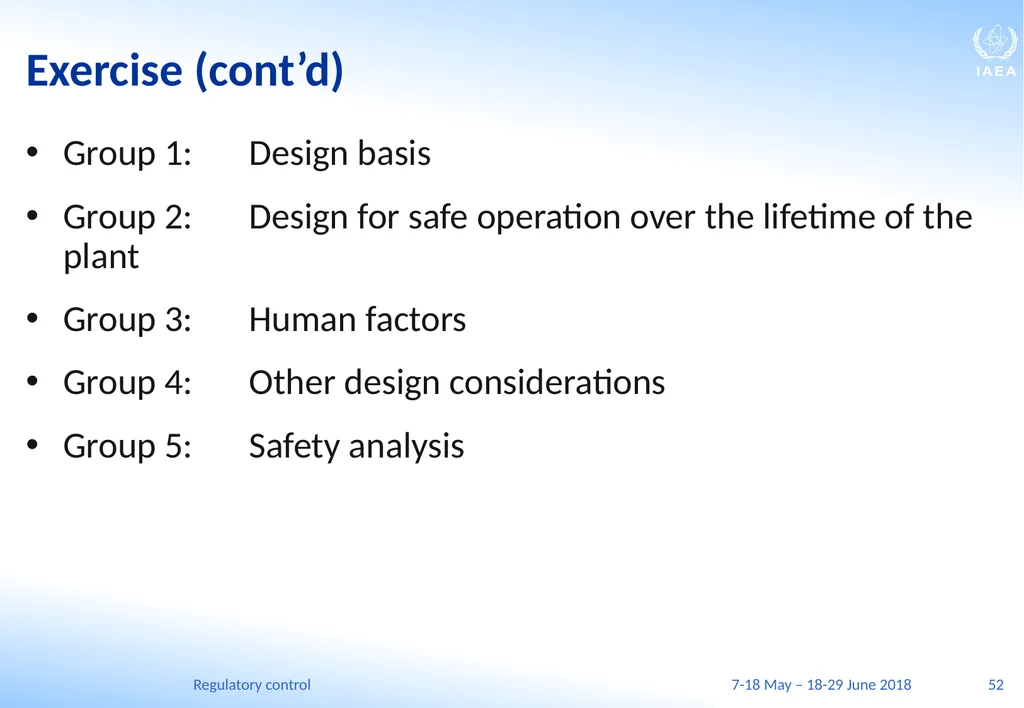
slide52. Exercise (cont’d) Group 1: Design basis
Group 2: Design for safe operation over the lifetime of the plant
Group 3: Human factors
Group 4: Other design considerations
Group 5: Safety analysis 7-18 May – 18-29 June 2018 Regulatory control 52<br>
slide53. Authorization<br>
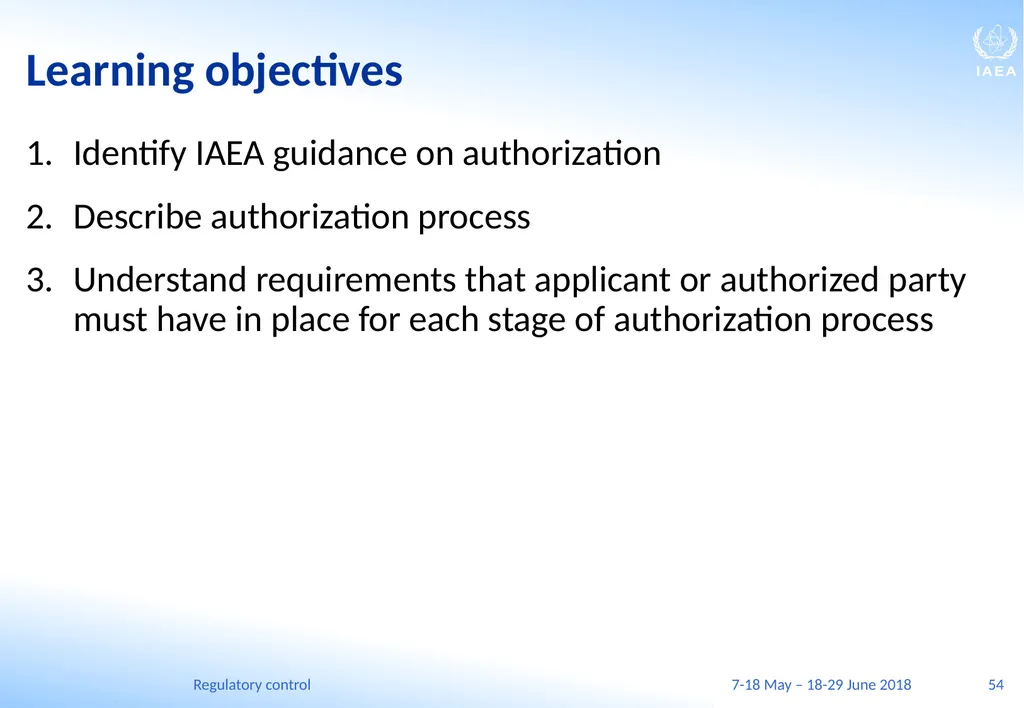
slide54. Learning objectives Identify IAEA guidance on authorization
Describe authorization process
Understand requirements that applicant or authorized party must have in place for each stage of authorization process 7-18 May – 18-29 June 2018 Regulatory control 54<br>
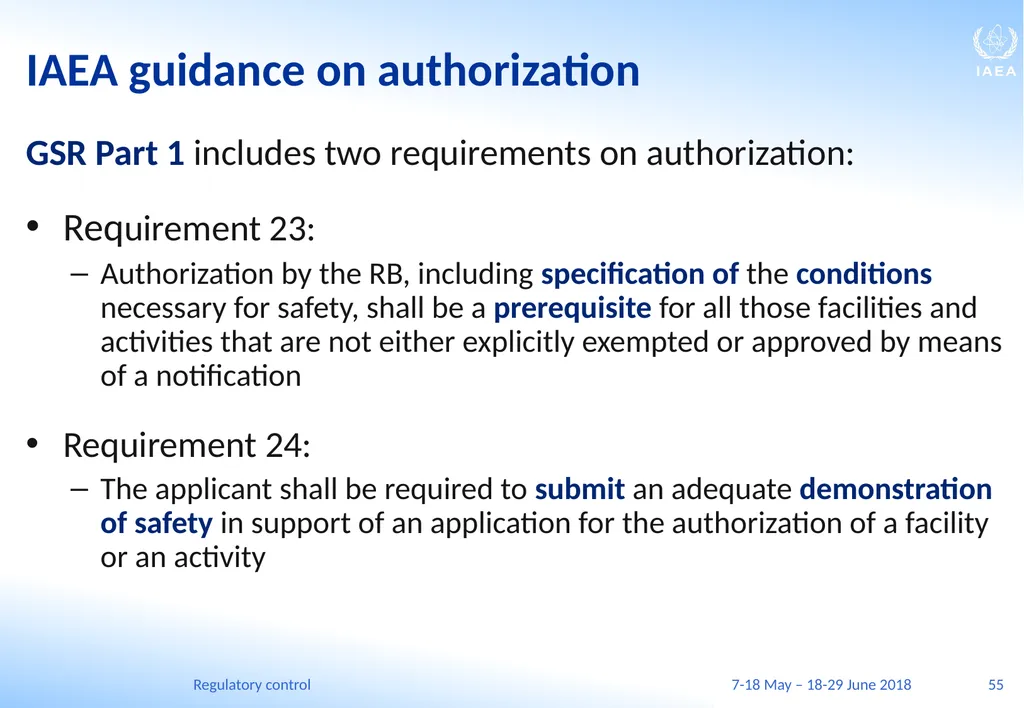
slide55. IAEA guidance on authorization GSR Part 1 includes two requirements on authorization:
Requirement 23:
Authorization by the RB, including specification of the conditions necessary for safety, shall be a prerequisite for all those facilities and activities that are not either explicitly exempted or approved by means of a notification
Requirement 24:
The applicant shall be required to submit an adequate demonstration of safety in support of an application for the authorization of a facility or an activity 7-18 May – 18-29 June 2018 Regulatory control 55<br>
slide56. Definitions Authorization (licence, permit): A legal document issued by RB granting permission to create a NPP and to perform specified activities
Authorized party (licensee): Person or organization having overall responsibility for a NPP and possessing all necessary authorizations
Applicant: Person or organization who applies for authorization 7-18 May – 18-29 June 2018 Regulatory control 56<br>
slide57. Prime responsibility for safety Authorization must assign prime responsibility for safety to authorized party
Compliance with regulations and requirements imposed by RB does not relieve authorized party of its prime responsibility for safety
Applicant/authorized party must demonstrate to the satisfaction of the RB that this prime responsibility has been and will continue to be fulfilled 7-18 May – 18-29 June 2018 Regulatory control 57<br>
slide58. Authorization principles Authorization process should:
Ensure important safety issues are dealt with properly
Be understood by concerned parties
Be predictable (well defined, clear, transparent and traceable)
Be systematic
Include discrete steps
Follow a logical order
Minimize duplication
Provide clear division of responsibilities
Give the public opportunities for early participation 7-18 May – 18-29 June 2018 Regulatory control 58<br>
slide59. Duration of authorization Authorizations may be granted:
For a specific time period (e.g. 10 years, 40 years)
for a specific stage in the lifetime of the nuclear installation
For an indefinite period of time (a permanent authorization)
For a specific activity 7-18 May – 18-29 June 2018 Regulatory control 59<br>
slide60. Basis for authorization Authorization establishes regulatory control over NPP
Relates State’s legal and regulatory framework to duties of authorized party
Involves fulfilment of regulatory requirements
Requires formal submissions by applicant
May also include agreements and commitments made between RB and applicant
Documents submitted in support of application are part of basis for authorization 7-18 May – 18-29 June 2018 Regulatory control 60<br>
slide61. Considerations for authorization Authorization should only be given when RB has confirmed that NPP is going to be used or conducted in a manner that does not pose an undue risk to workers, the public or the environment
Requires confirmation that applicant can fulfil its safety obligations
Authorization should be based on predefined documents that applicant submitted to RB
These documents should be reviewed by RB and should be updated regularly by authorized party 7-18 May – 18-29 June 2018 Regulatory control 61<br>
slide62. Considerations for authorization (cont’d) A clear and explicit set of requirements, criteria and standards forming the basis for authorization should be defined by regulation and by RB
A graded approach should be taken by RB when performing reviews, assessments or inspections
Applicant and RB should take into account international good practices
Analysis approach to safety should include deterministic and probabilistic methodologies and analytical tools
Integration of safety and security should be addressed 7-18 May – 18-29 June 2018 Regulatory control 62<br>
slide63. Role of the RB Publish requirements for application for authorization
Conduct reviews and assessments of applications and other submissions
Make regulatory decisions and to grant, amend, suspend or revoke authorizations
Conduct early assessment of competence and capability of applicant
Establish formal management system for dealing with applications 7-18 May – 18-29 June 2018 Regulatory control 63<br>
slide64. Role of the RB (cont’d) Set out arrangements for requesting further information from applicant
Inform applicant of decision
Record and keep documentation relevant to issuing of authorization 7-18 May – 18-29 June 2018 Regulatory control 64<br>
slide65. Role of the RB (cont’d) RB may request reassessment of safety in light of:
Operating experience
Information from research and development programmes and new knowledge of technical matters
Changes in regulatory requirements
Changes in the site conditions 7-18 May – 18-29 June 2018 Regulatory control 65<br>
slide66. Role of the applicant Prepare and submit a comprehensive application to RB that demonstrates that priority is given to safety
Meet its responsibility for safety at NPP
Understand design basis and safety analyses for NPP, and limits and conditions under which it must be operated
Exercise control over contractors
Implement process for modifications
Have design capability and effective external relationship with original designer 7-18 May – 18-29 June 2018 Regulatory control 66<br>
slide67. Role of the applicant (cont’d) Assess safety in a systematic manner and on a regular basis.
Maintain adequate human and financial resources
Implement procedures for:
Controlling NPP within specified limits
Managing anticipated operational occurrences and accident conditions
Responding to a nuclear or radiological emergency
Periodically assess, review and revise procedures 7-18 May – 18-29 June 2018 Regulatory control 67<br>
slide68. Main contents of an authorization Unique authorization identification
Issuing authority
Identification of authorized party
Description of the NPP
Maximum allowable inventories of nuclear material
Requirements for notifying RB of any modifications that are significant to safety
Obligations of authorized party regarding safety 7-18 May – 18-29 June 2018 Regulatory control 68<br>
slide69. Main contents of an authorization (cont’d) Any limits on operation (e.g. power levels, dose limits, discharge limits, action levels, duration of authorization)
Requirements for reporting to RB:
events and incidents
routine reports
Requirements for retention of records
Requirements for arrangements for emergency preparedness
Documents which form basis for issuing the authorization 7-18 May – 18-29 June 2018 Regulatory control 69<br>
slide70. Conditions of the authorization Authorization should also include conditions, which are specific to the NPP
Can be groups into categories:
Conditions that set technical limits and thresholds
Conditions that specify procedures and modes of operation
Conditions pertaining to administrative matters
Conditions relating to inspection and enforcement
Conditions pertaining to the response to abnormal circumstances
In many cases, conditions will reference authorized party documents 7-18 May – 18-29 June 2018 Regulatory control 70<br>
slide71. Public participation Public should be given opportunity to present views during certain steps of authorization process
This reinforces RB credibility and enhances public confidence in nuclear regulatory regime
Process should allow for challenging the issuing of an authorization on health and safety grounds
Public participation should continue throughout the lifetime of NPP
More information on public information in another module 7-18 May – 18-29 June 2018 Regulatory control 71<br>
slide72. Graded approach Resources devoted to authorization must be commensurate with magnitude of radiation risks
Application of graded approach by RB focuses how NPP is assessed, without unduly limiting authorized party and NPP operation
RB should use graded approach to determine scope, extent and level of detail of and effort to be devoted to authorization
Efforts should focus on aspects which involve untested (innovative) features 7-18 May – 18-29 June 2018 Regulatory control 72<br>
slide73. Factors affecting graded approach Account should be taken of:
occupational doses
radioactive discharges
generation of radioactive waste
potential consequences of anticipated operational occurrences and accidents
possibility of occurrence of very low probability events with potentially high consequences
maturity of applicant / authorized party organization
use of proven designs, practices and procedures
operating experience at similar NPPs 7-18 May – 18-29 June 2018 Regulatory control 73<br>
slide74. Factors affecting graded approach (cont’d) uncertainties in performance of the NPP
availability of competent staff and experienced managers, contractors and suppliers
extent and difficulty of effort required to construct, maintain, operate and decommission
number of related processes
reliability and complexity of SSCs and their accessibility for maintenance, inspection, testing and repair.
Application of graded approach should be reassessed throughout authorization process. Adjustments may be made as better understanding of risks is obtained 7-18 May – 18-29 June 2018 Regulatory control 74<br>
slide75. Site authorization Before granting authorization for siting, RB should be satisfied that:
Applicant is competent and capable
Site characteristics are acceptable
Baseline radiological survey is complete
Basic design of NPP will meet safety requirements
Applicant has adequate management system
Research and development plans are adequate
Arrangements for decommissioning and management of radioactive waste are adequate 7-18 May – 18-29 June 2018 Regulatory control 75<br>
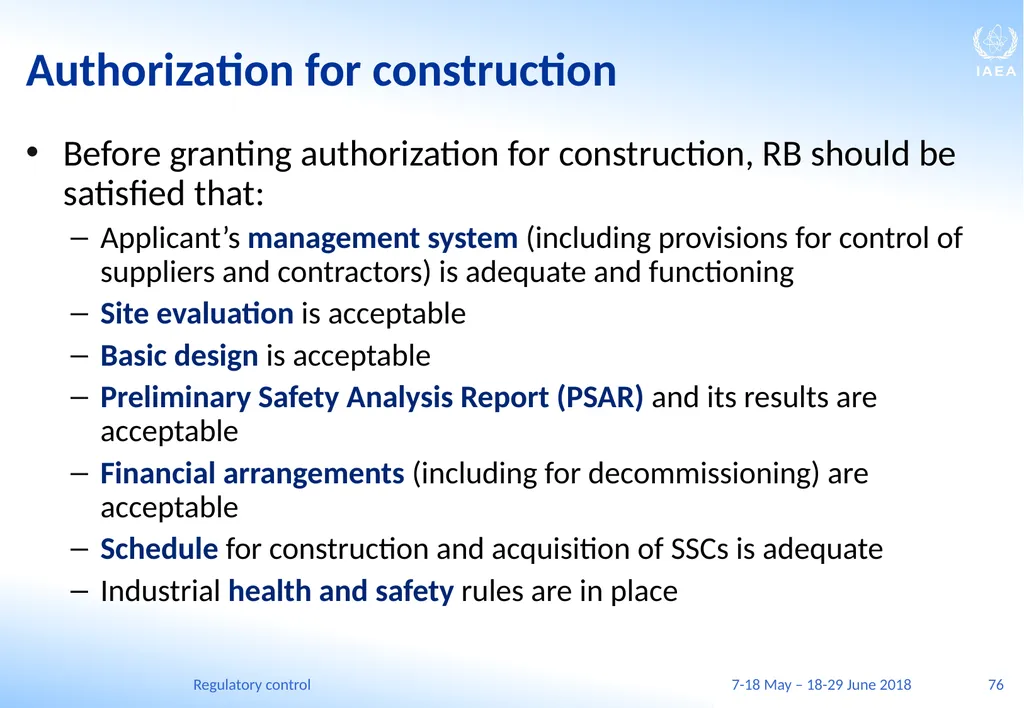
slide76. Authorization for construction Before granting authorization for construction, RB should be satisfied that:
Applicant’s management system (including provisions for control of suppliers and contractors) is adequate and functioning
Site evaluation is acceptable
Basic design is acceptable
Preliminary Safety Analysis Report (PSAR) and its results are acceptable
Financial arrangements (including for decommissioning) are acceptable
Schedule for construction and acquisition of SSCs is adequate
Industrial health and safety rules are in place 7-18 May – 18-29 June 2018 Regulatory control 76<br>
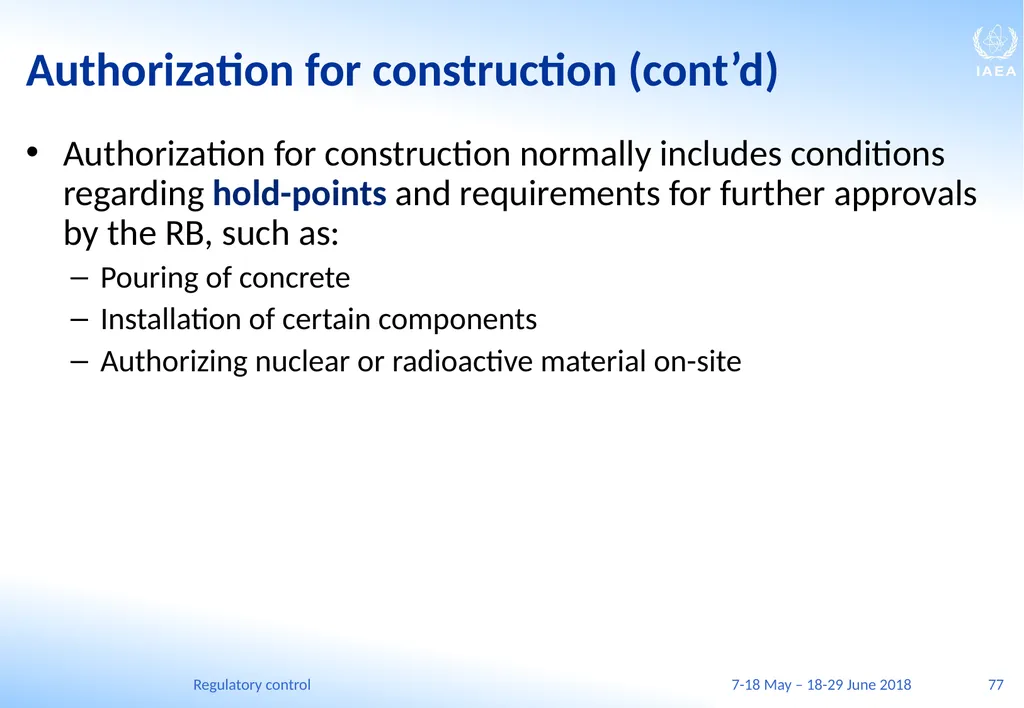
slide77. Authorization for construction (cont’d) Authorization for construction normally includes conditions regarding hold-points and requirements for further approvals by the RB, such as:
Pouring of concrete
Installation of certain components
Authorizing nuclear or radioactive material on-site 7-18 May – 18-29 June 2018 Regulatory control 77<br>
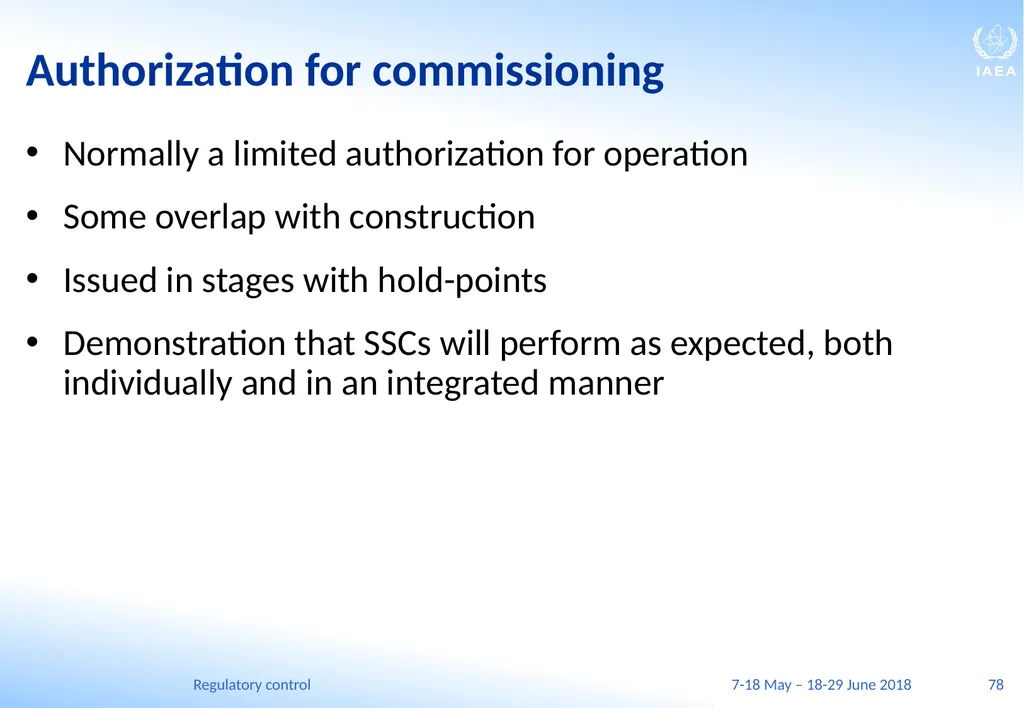
slide78. Authorization for commissioning Normally a limited authorization for operation
Some overlap with construction
Issued in stages with hold-points
Demonstration that SSCs will perform as expected, both individually and in an integrated manner 7-18 May – 18-29 June 2018 Regulatory control 78<br>
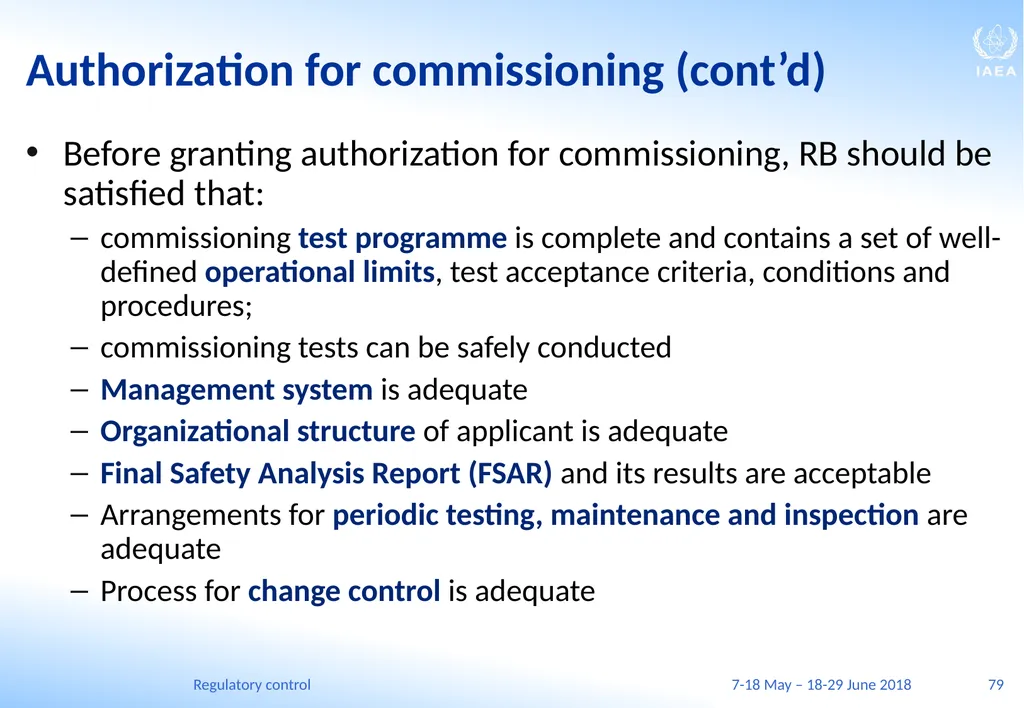
slide79. Authorization for commissioning (cont’d) Before granting authorization for commissioning, RB should be satisfied that:
commissioning test programme is complete and contains a set of well-defined operational limits, test acceptance criteria, conditions and procedures;
commissioning tests can be safely conducted
Management system is adequate
Organizational structure of applicant is adequate
Final Safety Analysis Report (FSAR) and its results are acceptable
Arrangements for periodic testing, maintenance and inspection are adequate
Process for change control is adequate 7-18 May – 18-29 June 2018 Regulatory control 79<br>
slide80. Authorization of fuel loading Before authorizing loading of nuclear fuel, RB must be satisfied that:
As-built is reconciled against design
Results of non-nuclear commissioning tests are acceptable
Provisions for radiological protection are in place
Operating instructions and procedures, especially operating procedures and emergency operating procedures are adequate
Recording and reporting systems are in place 7-18 May – 18-29 June 2018 Regulatory control 80<br>
slide81. Authorization of fuel loading (cont’d) Before authorizing loading of nuclear fuel, RB must be satisfied that (cont’d):
Arrangements for training and qualification of NPP personnel, including staffing levels and fitness for duty are adequate
Authorized party management system is adequate
On-site and off-site emergency preparedness are in place
Accounting measures for nuclear and radioactive materials are in place
Physical protection is adequate
Arrangements for periodic testing, maintenance, inspection, control of modifications and surveillance are in place 7-18 May – 18-29 June 2018 Regulatory control 81<br>
slide82. Authorization of routine operation Before authorizing routine NPP operation at full power, the RB must be satisfied that:
Results of commissioning tests are acceptable
Limits and conditions for operation are in place
FSAR has been updated 7-18 May – 18-29 June 2018 Regulatory control 82<br>
slide83. Discussion One of the considerations is that of public involvement.
What ideas do you have on how the RB can meaningfully involve the public in its authorization activities? 7-18 May – 18-29 June 2018 Regulatory control 83<br>
slide84. Review and assessment<br>
slide85. Learning objectives Identify the IAEA guidance on review and assessment
Describe the purpose of review and assessment by the RB
Describe the general steps in review and assessment
Understand the concept of defence in depth 7-18 May – 18-29 June 2018 Regulatory control 85<br>
slide86. IAEA guidance on review and assessment GSR Part 1 includes two requirements on review and assessment:
Requirement 25:
The RB shall review and assess relevant information… to determine whether facilities and activities comply with regulatory requirements and the conditions specified in the authorization. This review and assessment… shall be performed prior to authorization and again over the lifetime of the facility….
Requirement 26:
Review and assessment of a facility or an activity shall be commensurate with the radiation risks associated with the facility or activity, in accordance with a graded approach 7-18 May – 18-29 June 2018 Regulatory control 86<br>
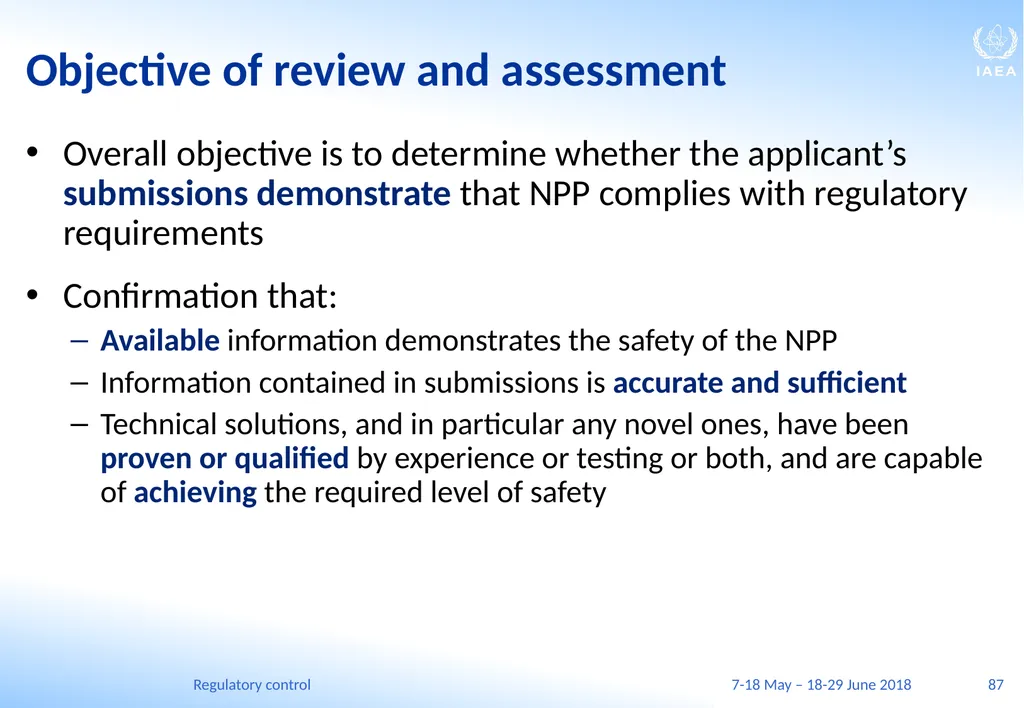
slide87. Objective of review and assessment Overall objective is to determine whether the applicant’s submissions demonstrate that NPP complies with regulatory requirements
Confirmation that:
Available information demonstrates the safety of the NPP
Information contained in submissions is accurate and sufficient
Technical solutions, and in particular any novel ones, have been proven or qualified by experience or testing or both, and are capable of achieving the required level of safety 7-18 May – 18-29 June 2018 Regulatory control 87<br>
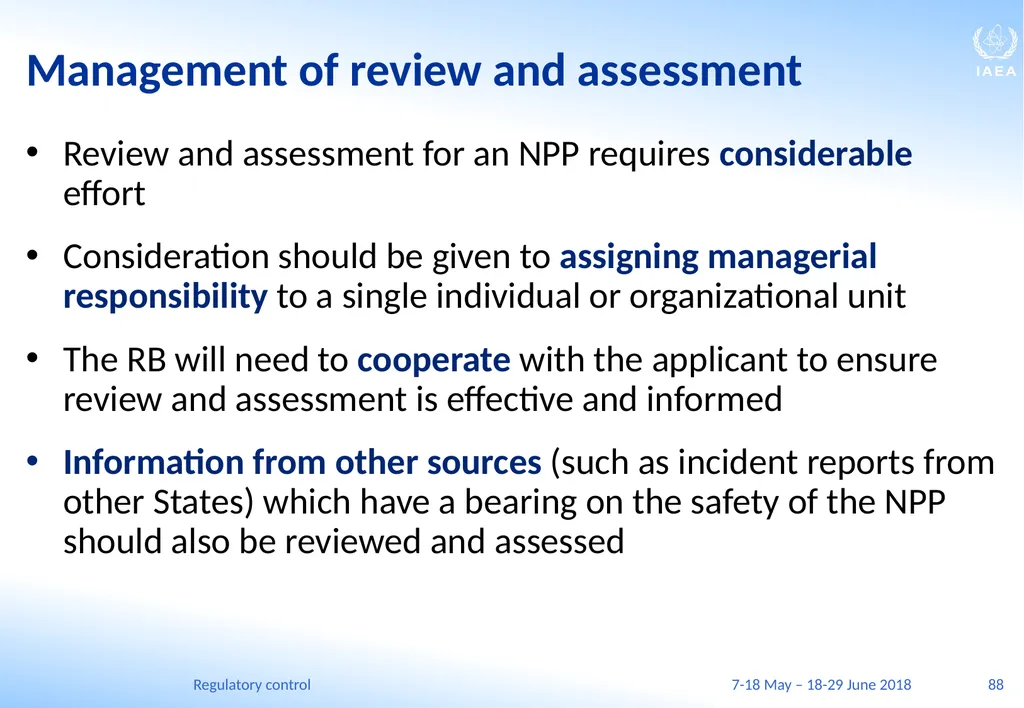
slide88. Management of review and assessment Review and assessment for an NPP requires considerable effort
Consideration should be given to assigning managerial responsibility to a single individual or organizational unit
The RB will need to cooperate with the applicant to ensure review and assessment is effective and informed
Information from other sources (such as incident reports from other States) which have a bearing on the safety of the NPP should also be reviewed and assessed 7-18 May – 18-29 June 2018 Regulatory control 88<br>
slide89. Management of review and assessment (cont’d) Management of review and assessment should include responsibility for:
Planning and directing the process
Preparing procedures
Coordinating information exchange between RB and applicant
Log and follow-up all documents sent or received
Monitoring status of submissions and reviews and assessments against schedule
Making arrangements for various parts of RB to combine expertise 7-18 May – 18-29 June 2018 Regulatory control 89<br>
slide90. Management of review and assessment (cont’d) The management of review and assessment should include responsibility for (cont’d):
Making arrangements for coordination between activities
Making arrangements for liaison with consultants, advisory committees or other organizations
Facilitating consultation with other RBs and government departments
Collating and disseminating overall findings
Planning for public consultation
Planning for any hearing process
Qualification and training of RB personnel 7-18 May – 18-29 June 2018 Regulatory control 90<br>
slide91. Scheduling of submissions RB should advise applicant of the period of time that it will take for the review and assessment
RB and applicant should reach agreement on schedule
RB needs to recognize that information initially submitted may be incomplete
Important issues will arise, necessitating additional studies and extending the time necessary for RB review and assessment
RB should make best effort to comply with schedule, but must not compromise its responsibilities 7-18 May – 18-29 June 2018 Regulatory control 91<br>
slide92. Use of consultants RB must have sufficient competent staff to conduct review and assessment
Even so, in some cases the RB may not have all the specialized technical knowledge required and will need to engage consultants
RB should have competent staff to oversee and evaluate the work of consultants
Use of consultants does not relieve RB its responsibilities 7-18 May – 18-29 June 2018 Regulatory control 92<br>
slide93. Relationship between RB and applicant Formal communication between applicant and RB should be established
Informal communications among specialists to clarify issues should be encouraged, but requests for additional work must go through formal channels
Where an applicant’s contractor has needed information, applicant must make necessary arrangements. This may include direct contact between RB and contractor
These contacts must not diminish applicant’s responsibility 7-18 May – 18-29 June 2018 Regulatory control 93<br>
slide94. Relationship with RBs of other States and international organizations Particularly useful where other RBs have experience in authorizing similar facilities
Specific reasons include:
Gaining knowledge of authorization basis
Gaining knowledge of a novel facility
Adding to database of operating experience
Gaining knowledge of different methods of analysis, such as methods using computer codes
Gaining knowledge of applicant’s contractors
Obtaining information on facilities in other States which may have an influence on safety 7-18 May – 18-29 June 2018 Regulatory control 94<br>
slide95. Review and assessment plan Perform an acceptance review. Submissions that are deficient are returned to applicant for correction
Define scope of review and assessment
Specify acceptance criteria
Identify additional information needed
Perform a step by step review and assessment procedure to determine whether the acceptance criteria are met
Decide on acceptability of applicant’s submission 7-18 May – 18-29 June 2018 Regulatory control 95<br>
slide96. Scope and depth of review and assessment Depends on several factors, including:
Novelty
Complexity
Previous experience
Major feature is analysis of normal and fault conditions
Is not a repetition of work done by applicant
Rather, it is work done to confirm that applicant’s submissions are accurate and sufficient 7-18 May – 18-29 June 2018 Regulatory control 96<br>
slide97. Bases for decisions Factors that should be taken into account include:
Extent to which safety objectives and regulatory requirements are met
Depth and detail of submission
Current state of knowledge
Confidence in the conclusions
RB will not have, in advance, requirements covering all areas subject to review and assessment. RB will need to evaluate acceptability of applicant’s proposals on a case-by-case basis using general principles
Be careful when using industry standards for components 7-18 May – 18-29 June 2018 Regulatory control 97<br>
slide98. Reference (generic) submissions Definitions:
Reference NPP: A designated existing NPP who’s design will be copied in other locations
Generic NPP: A NPP design that will be constructed with relatively minor modifications in various locations
Reference or generic submissions may be appropriate where applicant will make multiple submissions
RB should apply same rigour in its review as for other submissions 7-18 May – 18-29 June 2018 Regulatory control 98<br>
slide99. Reference (generic) submissions (cont’d) RB cannot grant authorization based solely on reference or generic submission since safety depends on siting related, managerial and operational aspects
RB authorization should be limited to generic design
For a specific NPP, the applicant would then only need a submission concentrated on where the proposed NPP differs from reference or generic NPP 7-18 May – 18-29 June 2018 Regulatory control 99<br>
slide100. NPPs already authorized in another State RB must still perform independent review and assessment
RB may take into account other State’s RB review and assessment
RB should establish close contact with other State’s RB to facilitate review and assessment 7-18 May – 18-29 June 2018 Regulatory control 100<br>
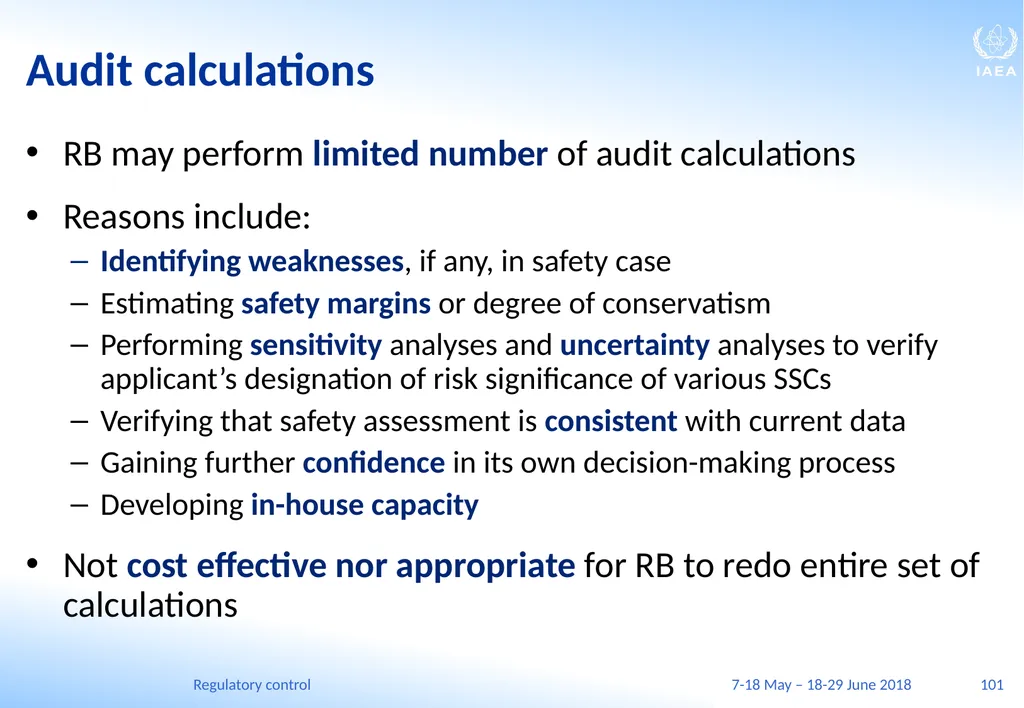
slide101. Audit calculations RB may perform limited number of audit calculations
Reasons include:
Identifying weaknesses, if any, in safety case
Estimating safety margins or degree of conservatism
Performing sensitivity analyses and uncertainty analyses to verify applicant’s designation of risk significance of various SSCs
Verifying that safety assessment is consistent with current data
Gaining further confidence in its own decision-making process
Developing in-house capacity
Not cost effective nor appropriate for RB to redo entire set of calculations 7-18 May – 18-29 June 2018 Regulatory control 101<br>
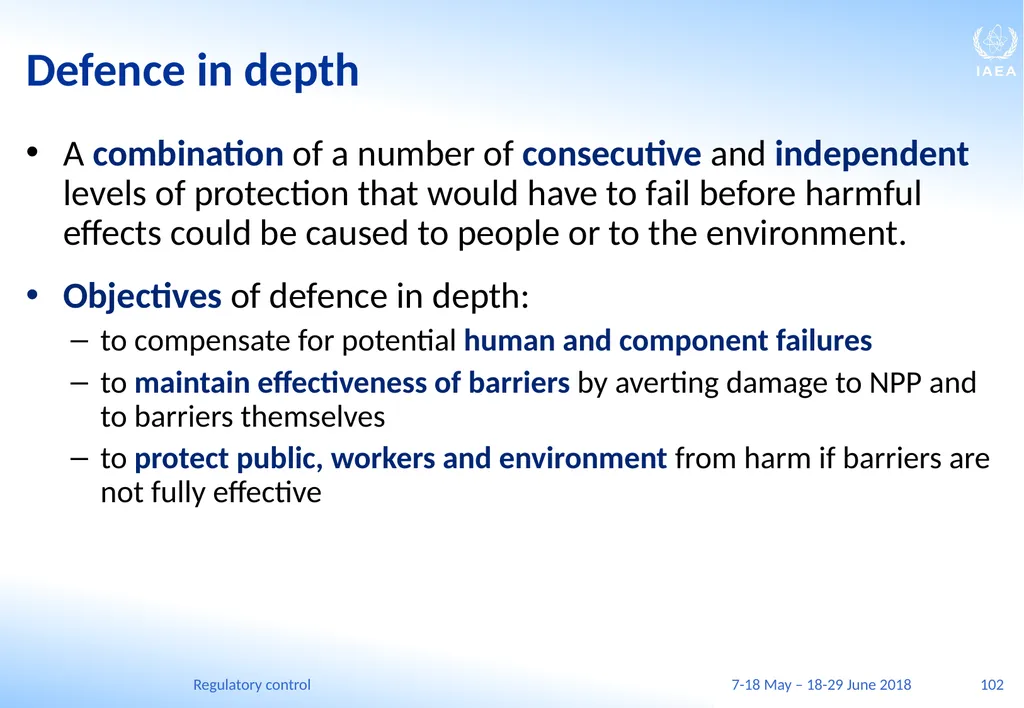
slide102. Defence in depth A combination of a number of consecutive and independent levels of protection that would have to fail before harmful effects could be caused to people or to the environment.
Objectives of defence in depth:
to compensate for potential human and component failures
to maintain effectiveness of barriers by averting damage to NPP and to barriers themselves
to protect public, workers and environment from harm if barriers are not fully effective 7-18 May – 18-29 June 2018 Regulatory control 102<br>
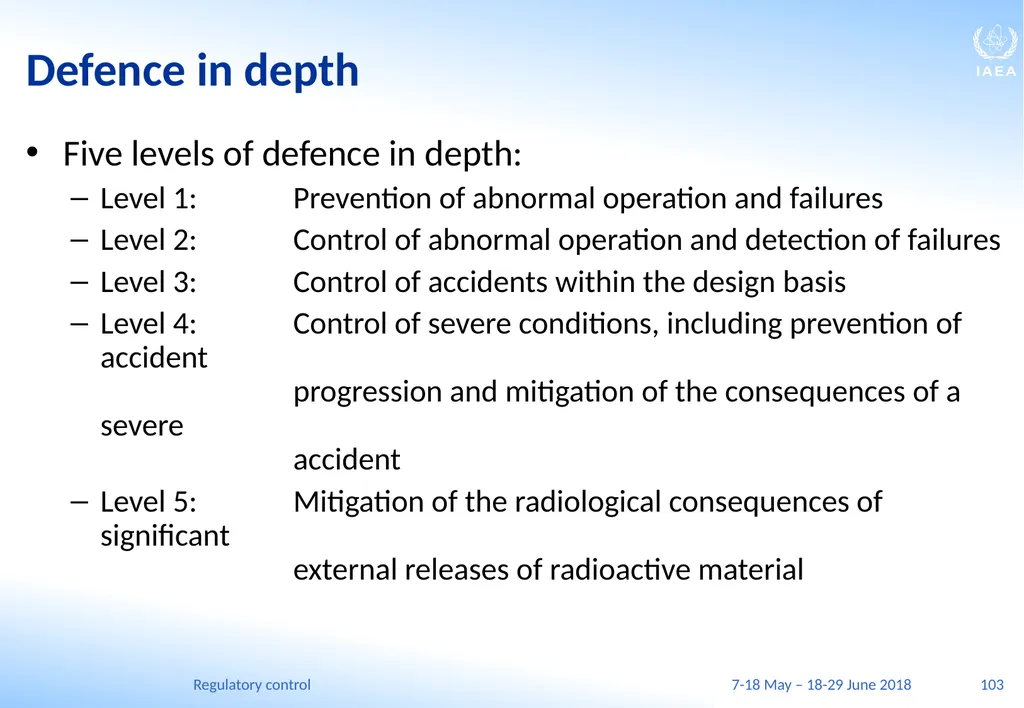
slide103. Defence in depth Five levels of defence in depth:
Level 1: Prevention of abnormal operation and failures
Level 2: Control of abnormal operation and detection of failures
Level 3: Control of accidents within the design basis
Level 4: Control of severe conditions, including prevention of accident progression and mitigation of the consequences of a severe accident
Level 5: Mitigation of the radiological consequences of significant external releases of radioactive material 7-18 May – 18-29 June 2018 Regulatory control 103<br>
slide104. Inspection<br>
slide105. Learning objectives Identify the IAEA guidance on inspections
Describe the types of inspections that RB should perform
Describe the general steps in preparing for an inspection
Describe the basic elements of an inspector training and qualification programme 7-18 May – 18-29 June 2018 Regulatory control 105<br>
slide106. IAEA guidance on inspection GSR Part 1 includes three requirements on inspection:
Requirement 27:
The RB shall carry out inspections of facilities and activities to verify that the authorized party is in compliance with the regulatory requirements and with the conditions specified in the authorization
Requirement 28:
Inspections of facilities and activities shall include programmed inspections and reactive inspections, both announced and unannounced 7-18 May – 18-29 June 2018 Regulatory control 106<br>
slide107. IAEA guidance on inspection (cont’d) Requirement 29:
Inspections of facilities and activities shall be commensurate with the radiation risks associated with the facility or activity, in accordance with a graded approach 7-18 May – 18-29 June 2018 Regulatory control 107<br>
slide108. General aspects of inspection The primary purpose of regulatory inspections is to independently provide a high level of assurance that activities performed at the NPP comply with regulations and conditions of authorization.
Inspection by the RB must not diminish the prime responsibility for safety of the authorized party
Inspection by the RB is not a substitute for control, supervision and verification activities by the authorized party
Inspection is unlike other regulatory activities in that it is not conducted at the RB’s offices 7-18 May – 18-29 June 2018 Regulatory control 108<br>
slide109. Graded approach to inspection The RB inspection programme will only inspect a small sample of the authorized body’s activities
The RB should use a graded approach to select those authorized party programmes, activities and facilities that are risk significant for inspection
The RB can use insights from its review and assessment activities to determine the risk significance 7-18 May – 18-29 June 2018 Regulatory control 109<br>
slide110. Types of inspections Inspections can be classified in three ways:
Programmed or reactive
Announced or unannounced
Individual inspector or team inspection 7-18 May – 18-29 June 2018 Regulatory control 110<br>
slide111. Programmed inspections The need for and scope of these inspections is determined as part of the RB’s planning cycle
The inspection programme should include a sample of many different activities and structures, systems and components (SSCs) in the NPP
Some authorized party activities, programmes or SSCs will be inspected more than once a year, while others may only be inspected annually, every two years, every five years or once in an authorization period 7-18 May – 18-29 June 2018 Regulatory control 111<br>
slide112. Reactive inspections Inspections that are not identified during the RB planning cycle
Usually the result of operating experience or an abnormal occurrence
Requires the RB to have some flexibility
Although the scope of reactive inspections cannot be known during the planning cycle, the RB should allocate some resources (inspector, financial, time) for reactive inspections
The authorized party must investigate all abnormal occurrences, regardless of whether the RB is conducting a reactive inspection 7-18 May – 18-29 June 2018 Regulatory control 112<br>
slide113. Announced inspections The RB gives the authorized party notice of the inspection
The inspector can obtain required documentation in advance.
The inspector can schedule the inspection to ensure that:
Activities the inspector needs to see will take place
Equipment the inspector needs to see is available
Personnel the inspector needs to interview are available
However:
The authorized party has the opportunity to correct deficiencies or non-compliances
The inspector may not get an accurate view of typical authorized party behaviour 7-18 May – 18-29 June 2018 Regulatory control 113<br>
slide114. Unannounced inspections An unannounced inspection allows the inspector to see the facility or activity as is. The authorized party does not have time to correct deficiencies or non-compliances.
For RBs with resident inspectors, most of the resident inspector inspections can be unannounced.
However:
Key personnel may not be available;
The part of the facility that the inspector wants to inspect may not be accessible
The authorized party may not be performing the activity that the inspector wants to inspect 7-18 May – 18-29 June 2018 Regulatory control 114<br>
slide115. Preparation for an inspection Regardless of the type of inspection, preparation is essential.
In all cases, preparation should include:
Confirmation of the scope of the inspection
Review of the applicable regulations or conditions of authorization
Review of previous inspection reports and enforcement actions
Review of correspondence between the RB and the authorized party
Review of authorized party documentation 7-18 May – 18-29 June 2018 Regulatory control 115<br>
slide116. Data gathering techniques Review of documents
Observation of SSC or activity
Interviews
Tests and measurements 7-18 May – 18-29 June 2018 Regulatory control 116<br>
slide117. Review of documents In many cases, this can (and should) be done before arriving at the NPP
Some examples include:
Authorized party inspection reports
Operating logs
Modification and maintenance records
Training records
Radiation survey results
Procedures 7-18 May – 18-29 June 2018 Regulatory control 117<br>
slide118. Direct observation A reliable method for inspection
Things to observe:
Equipment condition (serviceability, availability, leaks, valve line-up, etc.)
System parameters (temperatures, pressures, levels, flows, etc.)
Activities (shift turnover, safety system testing, operator routines, maintenance activities, construction activities, emergency drills, etc.)
For equipment, take pictures if possible
Do not touch, do not interfere
Introduce yourself when observing activities 7-18 May – 18-29 June 2018 Regulatory control 118<br>
slide119. Interviews Useful for obtaining background information
Interview a cross-section of staff (operators, mechanics, technicians, supervisors, specialists, managers)
Prepare questions in advance
Open-ended (questions that start with “please describe” “please explain”)
Interview in a location that will put person at ease (private but close to their workplace)
Listen and do not interrupt
Think about how you will validate what you were told 7-18 May – 18-29 June 2018 Regulatory control 119<br>
slide120. Tests and measurements Limited opportunities in operating NPPs:
Radiation surveys
Environmental sampling
For construction, if the authorized party is taking samples of concrete or metals, you could ask for a sample and subject it to independent testing
Never touch anything without explicit authorized party approval
Never remove anything from NPP without telling authorized party 7-18 May – 18-29 June 2018 Regulatory control 120<br>
slide121. Inspector behaviour For the vast majority of authorized party staff, inspectors are the only interaction with the RB
Know, understand and follow all RB processes and procedures regarding inspection
Be prepared
Be professional at all times
Treat authorized party staff with respect 7-18 May – 18-29 June 2018 Regulatory control 121<br>
slide122. Inspector behaviour (cont’d) Follow all authorized party rules unless they conflict with RB rules
Recognize that authorized party staff will have more knowledge and skill in NPP construction or operation than you
Adopt a “no surprises” approach: let someone know if you see something wrong
Take notes
Do not act as a consultant for the authorized party 7-18 May – 18-29 June 2018 Regulatory control 122<br>
slide123. Inspection reports The RB should establish a standard format for inspection reports
The inspection report should be completed as soon as possible following the completion of the inspection.
In many cases, the inspector may be able to provide a copy of the inspection report at the close of the inspection
Inspection reports should feedback into the regulatory process 7-18 May – 18-29 June 2018 Regulatory control 123<br>
slide124. Training and qualification of inspectors Training and qualification of inspectors requires substantial effort from the RB
Not possible to obtain an “inspector’s designation” from a university, college or other organization
In addition to technical training on NPPs, inspectors need training in inspection techniques, communication skills, legal aspects, etc.
On-the-job training, under the supervision of an experienced inspector, is a common training method
Experience shows that training and qualification of an inspector will take between 18 and 24 months 7-18 May – 18-29 June 2018 Regulatory control 124<br>
slide125. Exercise In two months time, the authorized party will begin pouring the base mat for the reactor building at your new NPP.
You have just been assigned responsibility for leading a team of four conducting an inspection of this activity
In groups of 4, complete the following:
Describe the major activities you will do to prepare for the inspection
Describe the expertise that the team should have
Describe where will you find the regulatory requirements for the inspection 7-18 May – 18-29 June 2018 Regulatory control 125<br>
slide126. Enforcement<br>
slide127. Learning objectives Identify IAEA guidance on enforcement
Describe enforcement options for a RB
Describe the factors a RB should consider regarding enforcement 7-18 May – 18-29 June 2018 Regulatory control 127<br>
slide128. IAEA guidance on enforcement GSR Part 1 includes two requirements on enforcement:
Requirement 30
The RB shall establish and implement an enforcement policy within the legal framework for responding to non-compliances by authorized parties with regulatory requirements or with any conditions specified in the authorization
Requirement 31
In the event that risks are identified, including risks unforeseen in the authorization process, the RB shall require corrective actions to be taken by authorized parties 7-18 May – 18-29 June 2018 Regulatory control 128<br>
slide129. Enforcement RB must have authority to enforce regulatory requirements.
Goal of any enforcement action is to return the authorized party to compliance.
In fulfilling its statutory obligations, the RB must ensure that corrective actions are taken if unsafe or potentially unsafe conditions are detected. 7-18 May – 18-29 June 2018 Regulatory control 129<br>
slide130. Enforcement (cont’d) Enforcement actions must:
Respond to the non-compliance; and
Be commensurate with the seriousness of the non-compliance.
Thus, there is a range of different enforcement actions, from written warnings to penalties and, ultimately, withdrawal of an authorization.
In all cases, the authorized party is required to:
Remedy the non-compliance;
Perform an investigation, and
Take all necessary measures to prevent recurrence. 7-18 May – 18-29 June 2018 Regulatory control 130<br>
slide131. Factors to be considered for enforcement The safety significance of the deficiency;
The complexity of the corrective action needed;
The seriousness of the violation;
Whether it was a repeat violation;
Whether it was a wilful violation;
Who noted and reported the non-conformance;
The past performance of the authorized party; and
The need for consistency in the treatment of authorized parties. 7-18 May – 18-29 June 2018 Regulatory control 131<br>
slide132. Written warnings or directives The most common form of enforcement action
In the case of NPPs, usually sufficient to remedy the safety issue
Should identify:
The nature and basis of the violation
The period of time permitted for taking remedial action
Any compensatory measures to be taken (if any) until remedial action is complete 7-18 May – 18-29 June 2018 Regulatory control 132<br>
slide133. Orders to curtail specific activities If there is:
Evidence of a deterioration in the level of safety; or
In the event of serious violations which in the judgement of the RB pose an imminent radiological hazard to workers, the public or the environment,
the RB must require the authorized party to:
Curtail activities; and
To take any further action necessary to restore an adequate level of safety. 7-18 May – 18-29 June 2018 Regulatory control 133<br>
slide134. Modifying, suspending or revoking an authorization For NPPs, modifying the authorization (usually by requiring the reactor to be and remain shutdown) is preferable:
Keeps authorized party under regulatory control
All conditions of authorization remain in effect
Used in the event of a continuing or serious non-compliance that poses an immediate threat to the health and safety of persons or the environment 7-18 May – 18-29 June 2018 Regulatory control 134<br>
slide135. Penalties The RB should have the authority to:
Impose or recommend penalties, for example, fines on the authorized party; and/or
Institute or recommend prosecution through the State legal system
The use of penalties is usually reserved for serious or repeated violations, or for wilful non-compliance. 7-18 May – 18-29 June 2018 Regulatory control 135<br>
slide136. Appeal of enforcement actions Authorized party should be able seek a review of enforcement action, either through:
An independent judicial body; or
A government appeals process
Authorized party must comply with enforcement action while review is underway 7-18 May – 18-29 June 2018 Regulatory control 136<br>
slide137. Inspectors and enforcement Authority of inspectors to take on-the-spot enforcement action varies from State to State.
Where an individual inspector does not have authority to take on-the-spot action, measures must be in place to ensure that timely action will be taken.
For NPPs, situations that require inspectors to take immediate on-the-spot enforcement action are rare. 7-18 May – 18-29 June 2018 Regulatory control 137<br>
slide138. Enforcement process In most cases, implementing corrective actions will take time. Time allowed, and whether compensatory measures should be put in place in the meantime, will depend on increase to risk posed by deficiency.
Once authorized party has completed corrective actions, RB should consider conducting a follow-up inspection to confirm that corrective actions are effective.
RB should keep records of decisions relating to enforcement actions. 7-18 May – 18-29 June 2018 Regulatory control 138<br>
slide139. Exercise For the situations on the following two slides:
Determine whether there is a non-compliance
For the non-compliances:
rank them from most to least serious
Determine the appropriate enforcement action 7-18 May – 18-29 June 2018 Regulatory control 139<br>
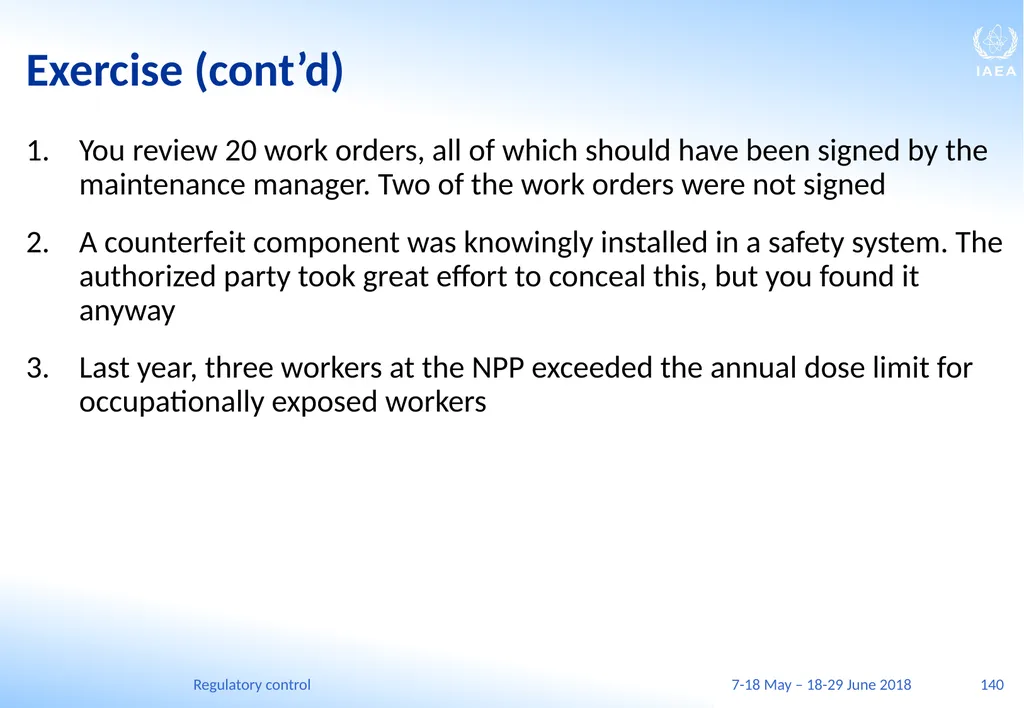
slide140. Exercise (cont’d) You review 20 work orders, all of which should have been signed by the maintenance manager. Two of the work orders were not signed
A counterfeit component was knowingly installed in a safety system. The authorized party took great effort to conceal this, but you found it anyway
Last year, three workers at the NPP exceeded the annual dose limit for occupationally exposed workers 7-18 May – 18-29 June 2018 Regulatory control 140<br>
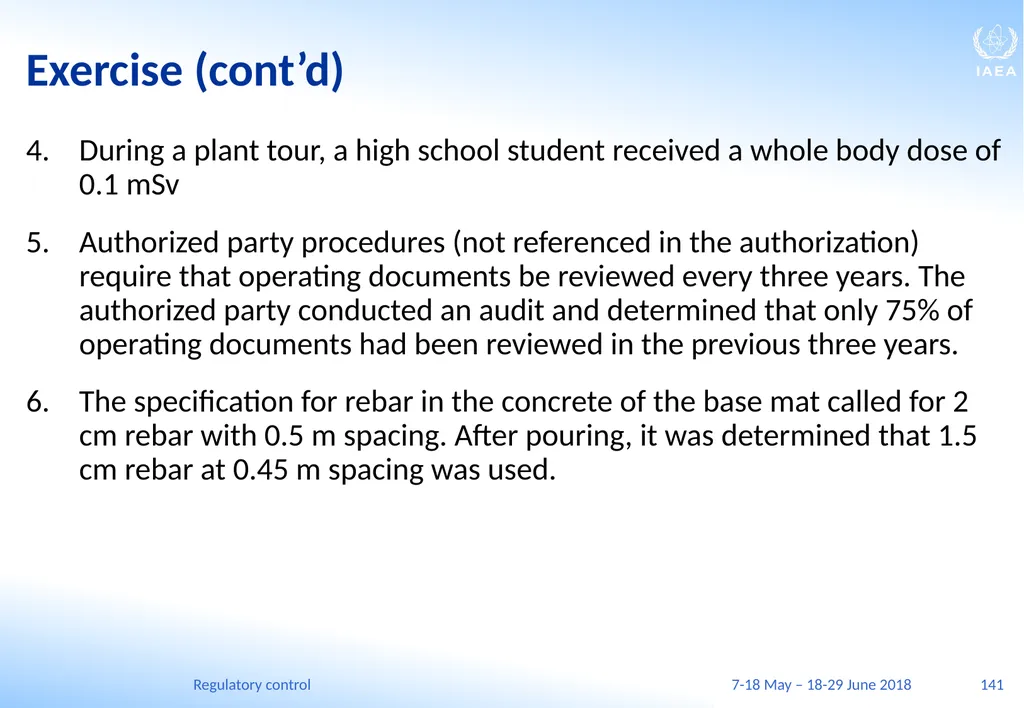
slide141. Exercise (cont’d) During a plant tour, a high school student received a whole body dose of 0.1 mSv
Authorized party procedures (not referenced in the authorization) require that operating documents be reviewed every three years. The authorized party conducted an audit and determined that only 75% of operating documents had been reviewed in the previous three years.
The specification for rebar in the concrete of the base mat called for 2 cm rebar with 0.5 m spacing. After pouring, it was determined that 1.5 cm rebar at 0.45 m spacing was used. 7-18 May – 18-29 June 2018 Regulatory control 141<br>
slide142. Summary<br>
slide143. Summary Overview of regulatory control
Legislative framework
Regulatory framework
Regulations and guides
Authorization
Review and assessment
Inspection
Enforcement 15-26 January - 19-30 March 2018 Regulatory control 143<br>
slide144. Key points The prime responsibility for safety must rest with the authorized party
Role of RB is to ensure that authorized party takes its responsibility seriously
Core functions of the RB
Regulations and guides
Authorization
Review and assessment
Inspection
Enforcement 15-26 January - 19-30 March 2018 Regulatory control 144<br>
slide145. List of abbreviations FSAR final safety analysis report
KSA knowledge, skills and attitudes
NPP nuclear power plant
PSAR preliminary safety analysis report
RB regulatory body
SSCs structures, systems and components 15-26 January - 19-30 March 2018 Regulatory control 145<br>
slide146. References SF-1: Fundamental Safety Principles
GSR Part 1: Governmental, Legal and Regulatory Framework for Safety
GSR Part 2: Leadership and Management for Safety
GSR Part 3: Radiation Protection and Safety of Radiation Sources: International Basic Safety Standards
GSR Part 4: Safety Assessment for Facilities and Activities 15-26 January - 19-30 March 2018 Regulatory control 146<br>
slide147. References GSR Part 7: Preparedness and Response for a Nuclear or Radiological Emergency
SSR 2/1: Safety of Nuclear Power Plants: Design
SSR 2/2: Safety of Nuclear Power Plants: Commissioning and Operation
GS-G-1.1: Organization and Staffing of the Regulatory Body for Nuclear Facilities
GS-G-1.2: Review and Assessment of Nuclear Facilities by the Regulatory Body 15-26 January - 19-30 March 2018 Regulatory control 147<br>
slide148. References GS-G-1.3: Regulatory Inspection of Nuclear Facilities and Enforcement by the Regulatory Body
GSG-4: Use of External Experts by the Regulatory Body
SSG-12: Licensing Process for Nuclear Installations
SSG-16: Establishing the Safety Infrastructure for a Nuclear Power Programme
Safety Report No. 79
IAEA TECDOC 1757: Methodology for the Systematic Assessment of Regulatory Competence Needs (SARCoN) for Regulatory Bodies of Nuclear Installations 15-26 January - 19-30 March 2018 Regulatory control 148<br>
slide149. Use this box for any additional message Thank you!<br>
Canada
C_A_McDermott@icloud.com<br>
slide2. Contents Overview of regulatory control
Legislative framework
Regulatory framework
Regulations and guides
Authorization
Review and assessment
Inspection
Enforcement 7-18 May – 18-29 June 2018 Regulatory control 2<br>
slide3. Global nuclear safety and security framework<br>
slide4. 7-18 May – 18-29 June 2018 Regulatory control 4<br>
slide5. Convention on Nuclear Safety Entered into force on 24 October 1996
Currently has 84 Contracting Parties
Ghana became contracting party in August 2011
Incentive convention (encourages Contracting Parties to comply, but no provisions for sanctions if a Contracting Party does not)
First international legal instrument to explicitly consider nuclear safety 7-18 May – 18-29 June 2018 Regulatory control 5<br>
slide6. Elements of the national safety infrastructure Legal framework
Regulatory body
Technical and industrial framework
Scientific and economic framework
Nuclear education and training 7-18 May – 18-29 June 2018 Regulatory control 6<br>
slide7. Positioning the regulatory body 7-18 May – 18-29 June 2018 Regulatory control 7<br>
slide8. Overview of regulatory control<br>
slide9. Overview Sound regulatory control is essential for ensuring that a nuclear power plant is safely:
Sited;
Designed;
Constructed;
Commissioned;
Operated; and
Decommissioned. 7-18 May – 18-29 June 2018 Regulatory control 9<br>
slide10. Overview (Cont’d) Regulatory body acts independently of authorized party in national interest to ensure that level of safety is appropriate.
However, this does not reduce the responsibility of authorized party to ensure that its activities are safe. 7-18 May – 18-29 June 2018 Regulatory control 10<br>
slide11. Main functions of a regulatory body (RB) Establishing requirements;
Issuing authorizations;
Reviewing and assessing submissions from applicants and authorized parties;
Inspecting facilities and activities;
Enforcing compliance; and,
Communicating with interested parties. 7-18 May – 18-29 June 2018 Regulatory control 11<br>
slide12. Legislative framework<br>
slide13. Learning objectives Describe the legislative framework that is necessary for regulatory control to be effective.
Describe a possible legal structure of a comprehensive nuclear law. 7-18 May – 18-29 June 2018 Regulatory control 13<br>
slide14. Legislative framework Achieving and maintaining a high level of safety in nuclear power plants (NPPs) depends on sound legislative framework
Legislative framework describes how State will control the use of nuclear energy and provide necessary mechanisms and resources for this control
IAEA Safety Standard GSR Part 1: Governmental, Legal and Regulatory Framework for Safety describes requirements for an adequate legislative framework
This course focuses on NPPs, although most concepts are applicable to all nuclear facilities and activities 7-18 May – 18-29 June 2018 Regulatory control 14<br>
slide15. Prime responsibility for safety First principle in IAEA Safety Fundamentals (SF-1) states:
"The prime responsibility for safety must rest with the person or organization responsible for facilities and activities that give rise to radiation risks".
The operating organization (authorized party) has essential and central role and, therefore, bears an important responsibility.
Legislative framework must ensure that prime responsibility remains with authorized party. 7-18 May – 18-29 June 2018 Regulatory control 15<br>
slide16. Legislative provisions Legislation is how a State establishes control over use of nuclear energy
Legislation should:
Set out objectives for protecting individuals, society and the environment;
Articulate national policy and strategies for nuclear safety;
Prohibit use of nuclear energy without authorization;
Establish a RB with appropriate authority;
Provide RB with adequate human and financial resources; and,
Establish offences and corresponding penalties for contraventions. 7-18 May – 18-29 June 2018 Regulatory control 16<br>
slide17. Legislative provisions (cont’d) Legislation should give RB authority to:
Define and develop policies, safety principles/requirements and associated criteria;
Establish regulations and issue guidance;
Issue, amend, suspend or revoke authorizations;
Inspect for compliance
Enforce its regulations
Communicate and liaise directly with public, other interested parties, other RBs and international organizations 7-18 May – 18-29 June 2018 Regulatory control 17<br>
slide18. Comprehensive nuclear law One structure for a comprehensive nuclear law is illustrated below and on next four slides: 7-18 May – 18-29 June 2018 Regulatory control 18<br>
slide19. Comprehensive nuclear law (cont’d) 7-18 May – 18-29 June 2018 Regulatory control 19<br>
slide20. Comprehensive nuclear law (cont’d) 7-18 May – 18-29 June 2018 Regulatory control 20<br>
slide21. Comprehensive nuclear law (cont’d) 7-18 May – 18-29 June 2018 Regulatory control 21<br>
slide22. Comprehensive nuclear law (cont’d) 7-18 May – 18-29 June 2018 Regulatory control 22<br>
slide23. Regulatory framework<br>
slide24. Learning objectives Understand need for regulatory control
Describe role and organization of RB
Understand why independence is important for RB and how it can be achieved
Understand IAEA competency model for RBs
Identify core functions of RB 7-18 May – 18-29 June 2018 Regulatory control 24<br>
slide25. Regulatory control Most States prohibit use of nuclear energy except in accordance with an authorization by the RB
Authorizations are how State establishes and maintains regulatory control
Any authorization needs to ensure that prime responsibility for safety remains with authorized party 7-18 May – 18-29 June 2018 Regulatory control 25<br>
slide26. Regulatory control (cont’d) States use various terms for the concept of authorization, such as licence, permit or certificate.
IAEA (and this presentation) uses the terms authorization and authorized party.
An authorization is a formal permission issued to an authorized party, allowing the authorized party to site, construct, commission, operate or decommission a NPP.
Most authorizations include conditions that authorized party must comply with. 7-18 May – 18-29 June 2018 Regulatory control 26<br>
slide27. Overlapping jurisdictions In most States, RB is not the only authority that regulates some aspect of an NPP. Other authorities that may be involved include:
Industrial health and safety authorities;
Public health authorities;
Environmental authorities;
Building and electrical code authorities;
Transport authorities (both for transport of dangerous good and for navigation purposes);
Emergency preparedness and response authorities;
Etc. 7-18 May – 18-29 June 2018 Regulatory control 27<br>
slide28. Overlapping jurisdictions (cont’d) To avoid conflicts, RB should establish formal agreements with other authorities to clearly define how they will operate in a coordinated manner to limit regulatory gaps and overlaps.
Even with formal agreements, good communication between various authorities is essential. 7-18 May – 18-29 June 2018 Regulatory control 28<br>
slide29. The RB RB is how the State exercises control over the safety of NPPs.
It includes:
Sufficient competent technical staff
Legal support
Administrative support
Many RBs make use of advisory bodies of outside independent experts, but they are normally separate from RB. 7-18 May – 18-29 June 2018 Regulatory control 29<br>
slide30. Organization of the RB RB should be structured so it is capable of carrying out functions effectively, efficiently and independently
Appropriate structure of RB depends on many factors, including:
Nature of the national legal infrastructure
State’s cultural attitudes and traditions
Existing governmental organization and procedures
Technical, financial and human resources available in State
Number and nature of regulated facilities and activities in State 7-18 May – 18-29 June 2018 Regulatory control 30<br>
slide31. Organization of the RB (cont’d) In some States, there is more than one responsible authority.
Typical situation is where one authority regulates radiation safety, while another regulates safety of facilities.
In these cases, government must establish arrangements that ensure regulatory responsibilities and functions are clearly defined and coordinated. 7-18 May – 18-29 June 2018 Regulatory control 31<br>
slide32. Organization of the RB (cont’d) If RB is not entirely self-sufficient in a technical or functional area, it should have the authority to seek advice or assistance from outside sources.
When such external advice or assistance is provided, arrangements should be made to ensure that those providing it are effectively independent.
Receiving external advice or assistance does not relieve RB of its responsibility for decision-making. 7-18 May – 18-29 June 2018 Regulatory control 32<br>
slide33. Independence of the RB An important attribute of RB is its freedom from unwarranted interference in its regulatory functions.
The Convention on Nuclear Safety states:
“Each contracting party shall take the appropriate steps to ensure an effective separation between the functions of the RB and those of any other body or organization concerned with the promotion or utilization of nuclear energy.”
Even so, an independent RB will not be entirely separate from other governmental bodies. 7-18 May – 18-29 June 2018 Regulatory control 33<br>
slide34. Independence of the RB (cont’d) Measures that support effective independence include:
Sufficient competent staff
Sufficient financial resources
Ability to make independent regulatory judgements and decisions
Freedom from political and economic pressures
Freedom from pressures from government departments, authorized parties, or other organizations
Ability to give independent advice to government bodies on safety matters
Access to the highest levels of government
Ability to liaise with RBs of other States and with international organizations 7-18 May – 18-29 June 2018 Regulatory control 34<br>
slide35. Management system of RB RB must establish an integrated management system that meets requirements of IAEA Safety Standard GSR Part 2.
The module on Management Systems describes these requirements in detail and all are applicable to RB. 7-18 May – 18-29 June 2018 Regulatory control 35<br>
slide36. Staffing and training for RB Ability of RB to fulfil its responsibilities depends largely on competence of its staff.
IAEA Safety Standards and Safety Report No. 79 provide guidance on managing the competence of RBs.
Report 79 also provides guidance on delivering training and other elements of competence development.
IAEA TECDOC 1757: “Methodology for the Systematic Assessment of Regulatory Competence Needs (SARCoN) for RBs of Nuclear Installations” also provides useful information. 7-18 May – 18-29 June 2018 Regulatory control 36<br>
slide37. IAEA competence model Competences comprise a combination of knowledge, skills and attitudes (KSAs).
KSAs for each position in RB need to be established.
IAEA competence model is based on a quadrant structure shown on next slide. 7-18 May – 18-29 June 2018 Regulatory control 37<br>
slide38. IAEA competence model (cont’d) 7-18 May – 18-29 June 2018 Regulatory control 38<br>
slide39. Core functions of the RB The core functions of RB are:
Establishing regulations and guidance;
Issuing authorizations;
Conducting reviews and assessments;
Conducting inspections; and
Taking enforcement actions.
We will talk about each of these in turn later. 7-18 May – 18-29 June 2018 Regulatory control 39<br>
slide40. Core functions of the RB (cont’d) Most RBs also consider provision of information as a core function.
RB should provide information to:
Public;
Media;
Legislature; and
Other interested parties.
There is a separate module on communication, so it will not be further discussed here. 7-18 May – 18-29 June 2018 Regulatory control 40<br>
slide41. Additional duties of the RB Every RB will have some role in emergency preparedness and response, but precise activities vary greatly among States.
RBs are responsible for ensuring that authorized parties have made adequate arrangements regarding emergency preparedness and response.
Most RBs also have a responsibility for advising the government on nuclear safety matters during emergencies. 7-18 May – 18-29 June 2018 Regulatory control 41<br>
slide42. Additional duties of the RB (cont’d) Specific to each State, but may include:
Advising the government and other authorities on matters related to NPP safety;
Confirming competence of personnel responsible for the safe operation of NPPs;
Independent radiological monitoring in and around NPPs;
Independent testing and quality control measurements;
Initiating and coordinating safety-related research and development;
Providing personnel monitoring services and conducting medical examinations;
Monitoring of nuclear non-proliferation and implementing safeguards activities. 7-18 May – 18-29 June 2018 Regulatory control 42<br>
slide43. Regulations and guidance<br>
slide44. Learning objectives Identify IAEA guidance on regulations and guides
Describe purpose of regulations and guides 7-18 May – 18-29 June 2018 Regulatory control 44<br>
slide45. IAEA guidance on regulations and guides GSR Part 1 has three requirements on regulations and guides
Requirement 32:
The RB shall establish or adopt regulations and guides to specify the principles, requirements and associated criteria for safety upon which its regulatory judgements, decisions and actions are based.
Requirement 33:
Regulations and guides shall be reviewed and revised as necessary to keep them up to date, with due consideration of relevant international safety standards and technical standards and of relevant experience gained 7-18 May – 18-29 June 2018 Regulatory control 45<br>
slide46. IAEA guidance on regulations and guides (cont’d) Requirement 34:
The RB shall notify interested parties and the public of the principles and associated criteria for safety established in its regulations and guides, and shall make its regulations and guides available. 7-18 May – 18-29 June 2018 Regulatory control 46<br>
slide47. Regulations and guides Regulations and guides provide the basis for other RB core functions and therefore should be in place early in nuclear power programme.
The IAEA Safety Requirements documents are written in a way that the RB can easily transform into regulations. 7-18 May – 18-29 June 2018 Regulatory control 47<br>
slide48. Need for regulations and guidance Regulations are mandatory requirements that authorized parties must comply with.
Guides provide advice on how applicants and authorized parties can meet the regulations.
Guides are not usually mandatory. Applicants and authorized parties are usually free to propose alternative ways of satisfying the Regulations.
States embarking on a nuclear power programme will already have some regulations and guides in place (radiation protection and possibly the authorization process). 7-18 May – 18-29 June 2018 Regulatory control 48<br>
slide49. IAEA Standards for NPPs Following IAEA Safety Standards provide sound basis for set of NPP regulations:
GSR Part 2: Leadership and Management for Safety
GSR Part 4: Safety Assessment for Facilities and Activities
GSR Part 7: Preparedness and Response for a Nuclear or Radiological Emergency
SSR 2/1: Safety of Nuclear Power Plants: Design
SSR 2/2: Safety of Nuclear Power Plants: Commissioning and Operation 7-18 May – 18-29 June 2018 Regulatory control 49<br>
slide50. IAEA Standards for NPPs (cont’d) If a State does not already have regulations in place regarding radiation safety, GSR Part 3: Radiation Protection and Safety of Radiation Sources: International Basic Safety Standards provides a basis for those regulations 7-18 May – 18-29 June 2018 Regulatory control 50<br>
slide51. Exercise Chapter 5 of SSR 2/1: Safety of Nuclear Power Plants addresses general plant design and includes five sections (shown on next slide)
Divide into five groups
Activity: For your assigned section
Do current regulations in your country address the SSR 2/1 requirements?
If yes, describe how you came to that conclusion.
If no, draft a regulation that would address the SSR 2/1 requirements. 7-18 May – 18-29 June 2018 Regulatory control 51<br>
slide52. Exercise (cont’d) Group 1: Design basis
Group 2: Design for safe operation over the lifetime of the plant
Group 3: Human factors
Group 4: Other design considerations
Group 5: Safety analysis 7-18 May – 18-29 June 2018 Regulatory control 52<br>
slide53. Authorization<br>
slide54. Learning objectives Identify IAEA guidance on authorization
Describe authorization process
Understand requirements that applicant or authorized party must have in place for each stage of authorization process 7-18 May – 18-29 June 2018 Regulatory control 54<br>
slide55. IAEA guidance on authorization GSR Part 1 includes two requirements on authorization:
Requirement 23:
Authorization by the RB, including specification of the conditions necessary for safety, shall be a prerequisite for all those facilities and activities that are not either explicitly exempted or approved by means of a notification
Requirement 24:
The applicant shall be required to submit an adequate demonstration of safety in support of an application for the authorization of a facility or an activity 7-18 May – 18-29 June 2018 Regulatory control 55<br>
slide56. Definitions Authorization (licence, permit): A legal document issued by RB granting permission to create a NPP and to perform specified activities
Authorized party (licensee): Person or organization having overall responsibility for a NPP and possessing all necessary authorizations
Applicant: Person or organization who applies for authorization 7-18 May – 18-29 June 2018 Regulatory control 56<br>
slide57. Prime responsibility for safety Authorization must assign prime responsibility for safety to authorized party
Compliance with regulations and requirements imposed by RB does not relieve authorized party of its prime responsibility for safety
Applicant/authorized party must demonstrate to the satisfaction of the RB that this prime responsibility has been and will continue to be fulfilled 7-18 May – 18-29 June 2018 Regulatory control 57<br>
slide58. Authorization principles Authorization process should:
Ensure important safety issues are dealt with properly
Be understood by concerned parties
Be predictable (well defined, clear, transparent and traceable)
Be systematic
Include discrete steps
Follow a logical order
Minimize duplication
Provide clear division of responsibilities
Give the public opportunities for early participation 7-18 May – 18-29 June 2018 Regulatory control 58<br>
slide59. Duration of authorization Authorizations may be granted:
For a specific time period (e.g. 10 years, 40 years)
for a specific stage in the lifetime of the nuclear installation
For an indefinite period of time (a permanent authorization)
For a specific activity 7-18 May – 18-29 June 2018 Regulatory control 59<br>
slide60. Basis for authorization Authorization establishes regulatory control over NPP
Relates State’s legal and regulatory framework to duties of authorized party
Involves fulfilment of regulatory requirements
Requires formal submissions by applicant
May also include agreements and commitments made between RB and applicant
Documents submitted in support of application are part of basis for authorization 7-18 May – 18-29 June 2018 Regulatory control 60<br>
slide61. Considerations for authorization Authorization should only be given when RB has confirmed that NPP is going to be used or conducted in a manner that does not pose an undue risk to workers, the public or the environment
Requires confirmation that applicant can fulfil its safety obligations
Authorization should be based on predefined documents that applicant submitted to RB
These documents should be reviewed by RB and should be updated regularly by authorized party 7-18 May – 18-29 June 2018 Regulatory control 61<br>
slide62. Considerations for authorization (cont’d) A clear and explicit set of requirements, criteria and standards forming the basis for authorization should be defined by regulation and by RB
A graded approach should be taken by RB when performing reviews, assessments or inspections
Applicant and RB should take into account international good practices
Analysis approach to safety should include deterministic and probabilistic methodologies and analytical tools
Integration of safety and security should be addressed 7-18 May – 18-29 June 2018 Regulatory control 62<br>
slide63. Role of the RB Publish requirements for application for authorization
Conduct reviews and assessments of applications and other submissions
Make regulatory decisions and to grant, amend, suspend or revoke authorizations
Conduct early assessment of competence and capability of applicant
Establish formal management system for dealing with applications 7-18 May – 18-29 June 2018 Regulatory control 63<br>
slide64. Role of the RB (cont’d) Set out arrangements for requesting further information from applicant
Inform applicant of decision
Record and keep documentation relevant to issuing of authorization 7-18 May – 18-29 June 2018 Regulatory control 64<br>
slide65. Role of the RB (cont’d) RB may request reassessment of safety in light of:
Operating experience
Information from research and development programmes and new knowledge of technical matters
Changes in regulatory requirements
Changes in the site conditions 7-18 May – 18-29 June 2018 Regulatory control 65<br>
slide66. Role of the applicant Prepare and submit a comprehensive application to RB that demonstrates that priority is given to safety
Meet its responsibility for safety at NPP
Understand design basis and safety analyses for NPP, and limits and conditions under which it must be operated
Exercise control over contractors
Implement process for modifications
Have design capability and effective external relationship with original designer 7-18 May – 18-29 June 2018 Regulatory control 66<br>
slide67. Role of the applicant (cont’d) Assess safety in a systematic manner and on a regular basis.
Maintain adequate human and financial resources
Implement procedures for:
Controlling NPP within specified limits
Managing anticipated operational occurrences and accident conditions
Responding to a nuclear or radiological emergency
Periodically assess, review and revise procedures 7-18 May – 18-29 June 2018 Regulatory control 67<br>
slide68. Main contents of an authorization Unique authorization identification
Issuing authority
Identification of authorized party
Description of the NPP
Maximum allowable inventories of nuclear material
Requirements for notifying RB of any modifications that are significant to safety
Obligations of authorized party regarding safety 7-18 May – 18-29 June 2018 Regulatory control 68<br>
slide69. Main contents of an authorization (cont’d) Any limits on operation (e.g. power levels, dose limits, discharge limits, action levels, duration of authorization)
Requirements for reporting to RB:
events and incidents
routine reports
Requirements for retention of records
Requirements for arrangements for emergency preparedness
Documents which form basis for issuing the authorization 7-18 May – 18-29 June 2018 Regulatory control 69<br>
slide70. Conditions of the authorization Authorization should also include conditions, which are specific to the NPP
Can be groups into categories:
Conditions that set technical limits and thresholds
Conditions that specify procedures and modes of operation
Conditions pertaining to administrative matters
Conditions relating to inspection and enforcement
Conditions pertaining to the response to abnormal circumstances
In many cases, conditions will reference authorized party documents 7-18 May – 18-29 June 2018 Regulatory control 70<br>
slide71. Public participation Public should be given opportunity to present views during certain steps of authorization process
This reinforces RB credibility and enhances public confidence in nuclear regulatory regime
Process should allow for challenging the issuing of an authorization on health and safety grounds
Public participation should continue throughout the lifetime of NPP
More information on public information in another module 7-18 May – 18-29 June 2018 Regulatory control 71<br>
slide72. Graded approach Resources devoted to authorization must be commensurate with magnitude of radiation risks
Application of graded approach by RB focuses how NPP is assessed, without unduly limiting authorized party and NPP operation
RB should use graded approach to determine scope, extent and level of detail of and effort to be devoted to authorization
Efforts should focus on aspects which involve untested (innovative) features 7-18 May – 18-29 June 2018 Regulatory control 72<br>
slide73. Factors affecting graded approach Account should be taken of:
occupational doses
radioactive discharges
generation of radioactive waste
potential consequences of anticipated operational occurrences and accidents
possibility of occurrence of very low probability events with potentially high consequences
maturity of applicant / authorized party organization
use of proven designs, practices and procedures
operating experience at similar NPPs 7-18 May – 18-29 June 2018 Regulatory control 73<br>
slide74. Factors affecting graded approach (cont’d) uncertainties in performance of the NPP
availability of competent staff and experienced managers, contractors and suppliers
extent and difficulty of effort required to construct, maintain, operate and decommission
number of related processes
reliability and complexity of SSCs and their accessibility for maintenance, inspection, testing and repair.
Application of graded approach should be reassessed throughout authorization process. Adjustments may be made as better understanding of risks is obtained 7-18 May – 18-29 June 2018 Regulatory control 74<br>
slide75. Site authorization Before granting authorization for siting, RB should be satisfied that:
Applicant is competent and capable
Site characteristics are acceptable
Baseline radiological survey is complete
Basic design of NPP will meet safety requirements
Applicant has adequate management system
Research and development plans are adequate
Arrangements for decommissioning and management of radioactive waste are adequate 7-18 May – 18-29 June 2018 Regulatory control 75<br>
slide76. Authorization for construction Before granting authorization for construction, RB should be satisfied that:
Applicant’s management system (including provisions for control of suppliers and contractors) is adequate and functioning
Site evaluation is acceptable
Basic design is acceptable
Preliminary Safety Analysis Report (PSAR) and its results are acceptable
Financial arrangements (including for decommissioning) are acceptable
Schedule for construction and acquisition of SSCs is adequate
Industrial health and safety rules are in place 7-18 May – 18-29 June 2018 Regulatory control 76<br>
slide77. Authorization for construction (cont’d) Authorization for construction normally includes conditions regarding hold-points and requirements for further approvals by the RB, such as:
Pouring of concrete
Installation of certain components
Authorizing nuclear or radioactive material on-site 7-18 May – 18-29 June 2018 Regulatory control 77<br>
slide78. Authorization for commissioning Normally a limited authorization for operation
Some overlap with construction
Issued in stages with hold-points
Demonstration that SSCs will perform as expected, both individually and in an integrated manner 7-18 May – 18-29 June 2018 Regulatory control 78<br>
slide79. Authorization for commissioning (cont’d) Before granting authorization for commissioning, RB should be satisfied that:
commissioning test programme is complete and contains a set of well-defined operational limits, test acceptance criteria, conditions and procedures;
commissioning tests can be safely conducted
Management system is adequate
Organizational structure of applicant is adequate
Final Safety Analysis Report (FSAR) and its results are acceptable
Arrangements for periodic testing, maintenance and inspection are adequate
Process for change control is adequate 7-18 May – 18-29 June 2018 Regulatory control 79<br>
slide80. Authorization of fuel loading Before authorizing loading of nuclear fuel, RB must be satisfied that:
As-built is reconciled against design
Results of non-nuclear commissioning tests are acceptable
Provisions for radiological protection are in place
Operating instructions and procedures, especially operating procedures and emergency operating procedures are adequate
Recording and reporting systems are in place 7-18 May – 18-29 June 2018 Regulatory control 80<br>
slide81. Authorization of fuel loading (cont’d) Before authorizing loading of nuclear fuel, RB must be satisfied that (cont’d):
Arrangements for training and qualification of NPP personnel, including staffing levels and fitness for duty are adequate
Authorized party management system is adequate
On-site and off-site emergency preparedness are in place
Accounting measures for nuclear and radioactive materials are in place
Physical protection is adequate
Arrangements for periodic testing, maintenance, inspection, control of modifications and surveillance are in place 7-18 May – 18-29 June 2018 Regulatory control 81<br>
slide82. Authorization of routine operation Before authorizing routine NPP operation at full power, the RB must be satisfied that:
Results of commissioning tests are acceptable
Limits and conditions for operation are in place
FSAR has been updated 7-18 May – 18-29 June 2018 Regulatory control 82<br>
slide83. Discussion One of the considerations is that of public involvement.
What ideas do you have on how the RB can meaningfully involve the public in its authorization activities? 7-18 May – 18-29 June 2018 Regulatory control 83<br>
slide84. Review and assessment<br>
slide85. Learning objectives Identify the IAEA guidance on review and assessment
Describe the purpose of review and assessment by the RB
Describe the general steps in review and assessment
Understand the concept of defence in depth 7-18 May – 18-29 June 2018 Regulatory control 85<br>
slide86. IAEA guidance on review and assessment GSR Part 1 includes two requirements on review and assessment:
Requirement 25:
The RB shall review and assess relevant information… to determine whether facilities and activities comply with regulatory requirements and the conditions specified in the authorization. This review and assessment… shall be performed prior to authorization and again over the lifetime of the facility….
Requirement 26:
Review and assessment of a facility or an activity shall be commensurate with the radiation risks associated with the facility or activity, in accordance with a graded approach 7-18 May – 18-29 June 2018 Regulatory control 86<br>
slide87. Objective of review and assessment Overall objective is to determine whether the applicant’s submissions demonstrate that NPP complies with regulatory requirements
Confirmation that:
Available information demonstrates the safety of the NPP
Information contained in submissions is accurate and sufficient
Technical solutions, and in particular any novel ones, have been proven or qualified by experience or testing or both, and are capable of achieving the required level of safety 7-18 May – 18-29 June 2018 Regulatory control 87<br>
slide88. Management of review and assessment Review and assessment for an NPP requires considerable effort
Consideration should be given to assigning managerial responsibility to a single individual or organizational unit
The RB will need to cooperate with the applicant to ensure review and assessment is effective and informed
Information from other sources (such as incident reports from other States) which have a bearing on the safety of the NPP should also be reviewed and assessed 7-18 May – 18-29 June 2018 Regulatory control 88<br>
slide89. Management of review and assessment (cont’d) Management of review and assessment should include responsibility for:
Planning and directing the process
Preparing procedures
Coordinating information exchange between RB and applicant
Log and follow-up all documents sent or received
Monitoring status of submissions and reviews and assessments against schedule
Making arrangements for various parts of RB to combine expertise 7-18 May – 18-29 June 2018 Regulatory control 89<br>
slide90. Management of review and assessment (cont’d) The management of review and assessment should include responsibility for (cont’d):
Making arrangements for coordination between activities
Making arrangements for liaison with consultants, advisory committees or other organizations
Facilitating consultation with other RBs and government departments
Collating and disseminating overall findings
Planning for public consultation
Planning for any hearing process
Qualification and training of RB personnel 7-18 May – 18-29 June 2018 Regulatory control 90<br>
slide91. Scheduling of submissions RB should advise applicant of the period of time that it will take for the review and assessment
RB and applicant should reach agreement on schedule
RB needs to recognize that information initially submitted may be incomplete
Important issues will arise, necessitating additional studies and extending the time necessary for RB review and assessment
RB should make best effort to comply with schedule, but must not compromise its responsibilities 7-18 May – 18-29 June 2018 Regulatory control 91<br>
slide92. Use of consultants RB must have sufficient competent staff to conduct review and assessment
Even so, in some cases the RB may not have all the specialized technical knowledge required and will need to engage consultants
RB should have competent staff to oversee and evaluate the work of consultants
Use of consultants does not relieve RB its responsibilities 7-18 May – 18-29 June 2018 Regulatory control 92<br>
slide93. Relationship between RB and applicant Formal communication between applicant and RB should be established
Informal communications among specialists to clarify issues should be encouraged, but requests for additional work must go through formal channels
Where an applicant’s contractor has needed information, applicant must make necessary arrangements. This may include direct contact between RB and contractor
These contacts must not diminish applicant’s responsibility 7-18 May – 18-29 June 2018 Regulatory control 93<br>
slide94. Relationship with RBs of other States and international organizations Particularly useful where other RBs have experience in authorizing similar facilities
Specific reasons include:
Gaining knowledge of authorization basis
Gaining knowledge of a novel facility
Adding to database of operating experience
Gaining knowledge of different methods of analysis, such as methods using computer codes
Gaining knowledge of applicant’s contractors
Obtaining information on facilities in other States which may have an influence on safety 7-18 May – 18-29 June 2018 Regulatory control 94<br>
slide95. Review and assessment plan Perform an acceptance review. Submissions that are deficient are returned to applicant for correction
Define scope of review and assessment
Specify acceptance criteria
Identify additional information needed
Perform a step by step review and assessment procedure to determine whether the acceptance criteria are met
Decide on acceptability of applicant’s submission 7-18 May – 18-29 June 2018 Regulatory control 95<br>
slide96. Scope and depth of review and assessment Depends on several factors, including:
Novelty
Complexity
Previous experience
Major feature is analysis of normal and fault conditions
Is not a repetition of work done by applicant
Rather, it is work done to confirm that applicant’s submissions are accurate and sufficient 7-18 May – 18-29 June 2018 Regulatory control 96<br>
slide97. Bases for decisions Factors that should be taken into account include:
Extent to which safety objectives and regulatory requirements are met
Depth and detail of submission
Current state of knowledge
Confidence in the conclusions
RB will not have, in advance, requirements covering all areas subject to review and assessment. RB will need to evaluate acceptability of applicant’s proposals on a case-by-case basis using general principles
Be careful when using industry standards for components 7-18 May – 18-29 June 2018 Regulatory control 97<br>
slide98. Reference (generic) submissions Definitions:
Reference NPP: A designated existing NPP who’s design will be copied in other locations
Generic NPP: A NPP design that will be constructed with relatively minor modifications in various locations
Reference or generic submissions may be appropriate where applicant will make multiple submissions
RB should apply same rigour in its review as for other submissions 7-18 May – 18-29 June 2018 Regulatory control 98<br>
slide99. Reference (generic) submissions (cont’d) RB cannot grant authorization based solely on reference or generic submission since safety depends on siting related, managerial and operational aspects
RB authorization should be limited to generic design
For a specific NPP, the applicant would then only need a submission concentrated on where the proposed NPP differs from reference or generic NPP 7-18 May – 18-29 June 2018 Regulatory control 99<br>
slide100. NPPs already authorized in another State RB must still perform independent review and assessment
RB may take into account other State’s RB review and assessment
RB should establish close contact with other State’s RB to facilitate review and assessment 7-18 May – 18-29 June 2018 Regulatory control 100<br>
slide101. Audit calculations RB may perform limited number of audit calculations
Reasons include:
Identifying weaknesses, if any, in safety case
Estimating safety margins or degree of conservatism
Performing sensitivity analyses and uncertainty analyses to verify applicant’s designation of risk significance of various SSCs
Verifying that safety assessment is consistent with current data
Gaining further confidence in its own decision-making process
Developing in-house capacity
Not cost effective nor appropriate for RB to redo entire set of calculations 7-18 May – 18-29 June 2018 Regulatory control 101<br>
slide102. Defence in depth A combination of a number of consecutive and independent levels of protection that would have to fail before harmful effects could be caused to people or to the environment.
Objectives of defence in depth:
to compensate for potential human and component failures
to maintain effectiveness of barriers by averting damage to NPP and to barriers themselves
to protect public, workers and environment from harm if barriers are not fully effective 7-18 May – 18-29 June 2018 Regulatory control 102<br>
slide103. Defence in depth Five levels of defence in depth:
Level 1: Prevention of abnormal operation and failures
Level 2: Control of abnormal operation and detection of failures
Level 3: Control of accidents within the design basis
Level 4: Control of severe conditions, including prevention of accident progression and mitigation of the consequences of a severe accident
Level 5: Mitigation of the radiological consequences of significant external releases of radioactive material 7-18 May – 18-29 June 2018 Regulatory control 103<br>
slide104. Inspection<br>
slide105. Learning objectives Identify the IAEA guidance on inspections
Describe the types of inspections that RB should perform
Describe the general steps in preparing for an inspection
Describe the basic elements of an inspector training and qualification programme 7-18 May – 18-29 June 2018 Regulatory control 105<br>
slide106. IAEA guidance on inspection GSR Part 1 includes three requirements on inspection:
Requirement 27:
The RB shall carry out inspections of facilities and activities to verify that the authorized party is in compliance with the regulatory requirements and with the conditions specified in the authorization
Requirement 28:
Inspections of facilities and activities shall include programmed inspections and reactive inspections, both announced and unannounced 7-18 May – 18-29 June 2018 Regulatory control 106<br>
slide107. IAEA guidance on inspection (cont’d) Requirement 29:
Inspections of facilities and activities shall be commensurate with the radiation risks associated with the facility or activity, in accordance with a graded approach 7-18 May – 18-29 June 2018 Regulatory control 107<br>
slide108. General aspects of inspection The primary purpose of regulatory inspections is to independently provide a high level of assurance that activities performed at the NPP comply with regulations and conditions of authorization.
Inspection by the RB must not diminish the prime responsibility for safety of the authorized party
Inspection by the RB is not a substitute for control, supervision and verification activities by the authorized party
Inspection is unlike other regulatory activities in that it is not conducted at the RB’s offices 7-18 May – 18-29 June 2018 Regulatory control 108<br>
slide109. Graded approach to inspection The RB inspection programme will only inspect a small sample of the authorized body’s activities
The RB should use a graded approach to select those authorized party programmes, activities and facilities that are risk significant for inspection
The RB can use insights from its review and assessment activities to determine the risk significance 7-18 May – 18-29 June 2018 Regulatory control 109<br>
slide110. Types of inspections Inspections can be classified in three ways:
Programmed or reactive
Announced or unannounced
Individual inspector or team inspection 7-18 May – 18-29 June 2018 Regulatory control 110<br>
slide111. Programmed inspections The need for and scope of these inspections is determined as part of the RB’s planning cycle
The inspection programme should include a sample of many different activities and structures, systems and components (SSCs) in the NPP
Some authorized party activities, programmes or SSCs will be inspected more than once a year, while others may only be inspected annually, every two years, every five years or once in an authorization period 7-18 May – 18-29 June 2018 Regulatory control 111<br>
slide112. Reactive inspections Inspections that are not identified during the RB planning cycle
Usually the result of operating experience or an abnormal occurrence
Requires the RB to have some flexibility
Although the scope of reactive inspections cannot be known during the planning cycle, the RB should allocate some resources (inspector, financial, time) for reactive inspections
The authorized party must investigate all abnormal occurrences, regardless of whether the RB is conducting a reactive inspection 7-18 May – 18-29 June 2018 Regulatory control 112<br>
slide113. Announced inspections The RB gives the authorized party notice of the inspection
The inspector can obtain required documentation in advance.
The inspector can schedule the inspection to ensure that:
Activities the inspector needs to see will take place
Equipment the inspector needs to see is available
Personnel the inspector needs to interview are available
However:
The authorized party has the opportunity to correct deficiencies or non-compliances
The inspector may not get an accurate view of typical authorized party behaviour 7-18 May – 18-29 June 2018 Regulatory control 113<br>
slide114. Unannounced inspections An unannounced inspection allows the inspector to see the facility or activity as is. The authorized party does not have time to correct deficiencies or non-compliances.
For RBs with resident inspectors, most of the resident inspector inspections can be unannounced.
However:
Key personnel may not be available;
The part of the facility that the inspector wants to inspect may not be accessible
The authorized party may not be performing the activity that the inspector wants to inspect 7-18 May – 18-29 June 2018 Regulatory control 114<br>
slide115. Preparation for an inspection Regardless of the type of inspection, preparation is essential.
In all cases, preparation should include:
Confirmation of the scope of the inspection
Review of the applicable regulations or conditions of authorization
Review of previous inspection reports and enforcement actions
Review of correspondence between the RB and the authorized party
Review of authorized party documentation 7-18 May – 18-29 June 2018 Regulatory control 115<br>
slide116. Data gathering techniques Review of documents
Observation of SSC or activity
Interviews
Tests and measurements 7-18 May – 18-29 June 2018 Regulatory control 116<br>
slide117. Review of documents In many cases, this can (and should) be done before arriving at the NPP
Some examples include:
Authorized party inspection reports
Operating logs
Modification and maintenance records
Training records
Radiation survey results
Procedures 7-18 May – 18-29 June 2018 Regulatory control 117<br>
slide118. Direct observation A reliable method for inspection
Things to observe:
Equipment condition (serviceability, availability, leaks, valve line-up, etc.)
System parameters (temperatures, pressures, levels, flows, etc.)
Activities (shift turnover, safety system testing, operator routines, maintenance activities, construction activities, emergency drills, etc.)
For equipment, take pictures if possible
Do not touch, do not interfere
Introduce yourself when observing activities 7-18 May – 18-29 June 2018 Regulatory control 118<br>
slide119. Interviews Useful for obtaining background information
Interview a cross-section of staff (operators, mechanics, technicians, supervisors, specialists, managers)
Prepare questions in advance
Open-ended (questions that start with “please describe” “please explain”)
Interview in a location that will put person at ease (private but close to their workplace)
Listen and do not interrupt
Think about how you will validate what you were told 7-18 May – 18-29 June 2018 Regulatory control 119<br>
slide120. Tests and measurements Limited opportunities in operating NPPs:
Radiation surveys
Environmental sampling
For construction, if the authorized party is taking samples of concrete or metals, you could ask for a sample and subject it to independent testing
Never touch anything without explicit authorized party approval
Never remove anything from NPP without telling authorized party 7-18 May – 18-29 June 2018 Regulatory control 120<br>
slide121. Inspector behaviour For the vast majority of authorized party staff, inspectors are the only interaction with the RB
Know, understand and follow all RB processes and procedures regarding inspection
Be prepared
Be professional at all times
Treat authorized party staff with respect 7-18 May – 18-29 June 2018 Regulatory control 121<br>
slide122. Inspector behaviour (cont’d) Follow all authorized party rules unless they conflict with RB rules
Recognize that authorized party staff will have more knowledge and skill in NPP construction or operation than you
Adopt a “no surprises” approach: let someone know if you see something wrong
Take notes
Do not act as a consultant for the authorized party 7-18 May – 18-29 June 2018 Regulatory control 122<br>
slide123. Inspection reports The RB should establish a standard format for inspection reports
The inspection report should be completed as soon as possible following the completion of the inspection.
In many cases, the inspector may be able to provide a copy of the inspection report at the close of the inspection
Inspection reports should feedback into the regulatory process 7-18 May – 18-29 June 2018 Regulatory control 123<br>
slide124. Training and qualification of inspectors Training and qualification of inspectors requires substantial effort from the RB
Not possible to obtain an “inspector’s designation” from a university, college or other organization
In addition to technical training on NPPs, inspectors need training in inspection techniques, communication skills, legal aspects, etc.
On-the-job training, under the supervision of an experienced inspector, is a common training method
Experience shows that training and qualification of an inspector will take between 18 and 24 months 7-18 May – 18-29 June 2018 Regulatory control 124<br>
slide125. Exercise In two months time, the authorized party will begin pouring the base mat for the reactor building at your new NPP.
You have just been assigned responsibility for leading a team of four conducting an inspection of this activity
In groups of 4, complete the following:
Describe the major activities you will do to prepare for the inspection
Describe the expertise that the team should have
Describe where will you find the regulatory requirements for the inspection 7-18 May – 18-29 June 2018 Regulatory control 125<br>
slide126. Enforcement<br>
slide127. Learning objectives Identify IAEA guidance on enforcement
Describe enforcement options for a RB
Describe the factors a RB should consider regarding enforcement 7-18 May – 18-29 June 2018 Regulatory control 127<br>
slide128. IAEA guidance on enforcement GSR Part 1 includes two requirements on enforcement:
Requirement 30
The RB shall establish and implement an enforcement policy within the legal framework for responding to non-compliances by authorized parties with regulatory requirements or with any conditions specified in the authorization
Requirement 31
In the event that risks are identified, including risks unforeseen in the authorization process, the RB shall require corrective actions to be taken by authorized parties 7-18 May – 18-29 June 2018 Regulatory control 128<br>
slide129. Enforcement RB must have authority to enforce regulatory requirements.
Goal of any enforcement action is to return the authorized party to compliance.
In fulfilling its statutory obligations, the RB must ensure that corrective actions are taken if unsafe or potentially unsafe conditions are detected. 7-18 May – 18-29 June 2018 Regulatory control 129<br>
slide130. Enforcement (cont’d) Enforcement actions must:
Respond to the non-compliance; and
Be commensurate with the seriousness of the non-compliance.
Thus, there is a range of different enforcement actions, from written warnings to penalties and, ultimately, withdrawal of an authorization.
In all cases, the authorized party is required to:
Remedy the non-compliance;
Perform an investigation, and
Take all necessary measures to prevent recurrence. 7-18 May – 18-29 June 2018 Regulatory control 130<br>
slide131. Factors to be considered for enforcement The safety significance of the deficiency;
The complexity of the corrective action needed;
The seriousness of the violation;
Whether it was a repeat violation;
Whether it was a wilful violation;
Who noted and reported the non-conformance;
The past performance of the authorized party; and
The need for consistency in the treatment of authorized parties. 7-18 May – 18-29 June 2018 Regulatory control 131<br>
slide132. Written warnings or directives The most common form of enforcement action
In the case of NPPs, usually sufficient to remedy the safety issue
Should identify:
The nature and basis of the violation
The period of time permitted for taking remedial action
Any compensatory measures to be taken (if any) until remedial action is complete 7-18 May – 18-29 June 2018 Regulatory control 132<br>
slide133. Orders to curtail specific activities If there is:
Evidence of a deterioration in the level of safety; or
In the event of serious violations which in the judgement of the RB pose an imminent radiological hazard to workers, the public or the environment,
the RB must require the authorized party to:
Curtail activities; and
To take any further action necessary to restore an adequate level of safety. 7-18 May – 18-29 June 2018 Regulatory control 133<br>
slide134. Modifying, suspending or revoking an authorization For NPPs, modifying the authorization (usually by requiring the reactor to be and remain shutdown) is preferable:
Keeps authorized party under regulatory control
All conditions of authorization remain in effect
Used in the event of a continuing or serious non-compliance that poses an immediate threat to the health and safety of persons or the environment 7-18 May – 18-29 June 2018 Regulatory control 134<br>
slide135. Penalties The RB should have the authority to:
Impose or recommend penalties, for example, fines on the authorized party; and/or
Institute or recommend prosecution through the State legal system
The use of penalties is usually reserved for serious or repeated violations, or for wilful non-compliance. 7-18 May – 18-29 June 2018 Regulatory control 135<br>
slide136. Appeal of enforcement actions Authorized party should be able seek a review of enforcement action, either through:
An independent judicial body; or
A government appeals process
Authorized party must comply with enforcement action while review is underway 7-18 May – 18-29 June 2018 Regulatory control 136<br>
slide137. Inspectors and enforcement Authority of inspectors to take on-the-spot enforcement action varies from State to State.
Where an individual inspector does not have authority to take on-the-spot action, measures must be in place to ensure that timely action will be taken.
For NPPs, situations that require inspectors to take immediate on-the-spot enforcement action are rare. 7-18 May – 18-29 June 2018 Regulatory control 137<br>
slide138. Enforcement process In most cases, implementing corrective actions will take time. Time allowed, and whether compensatory measures should be put in place in the meantime, will depend on increase to risk posed by deficiency.
Once authorized party has completed corrective actions, RB should consider conducting a follow-up inspection to confirm that corrective actions are effective.
RB should keep records of decisions relating to enforcement actions. 7-18 May – 18-29 June 2018 Regulatory control 138<br>
slide139. Exercise For the situations on the following two slides:
Determine whether there is a non-compliance
For the non-compliances:
rank them from most to least serious
Determine the appropriate enforcement action 7-18 May – 18-29 June 2018 Regulatory control 139<br>
slide140. Exercise (cont’d) You review 20 work orders, all of which should have been signed by the maintenance manager. Two of the work orders were not signed
A counterfeit component was knowingly installed in a safety system. The authorized party took great effort to conceal this, but you found it anyway
Last year, three workers at the NPP exceeded the annual dose limit for occupationally exposed workers 7-18 May – 18-29 June 2018 Regulatory control 140<br>
slide141. Exercise (cont’d) During a plant tour, a high school student received a whole body dose of 0.1 mSv
Authorized party procedures (not referenced in the authorization) require that operating documents be reviewed every three years. The authorized party conducted an audit and determined that only 75% of operating documents had been reviewed in the previous three years.
The specification for rebar in the concrete of the base mat called for 2 cm rebar with 0.5 m spacing. After pouring, it was determined that 1.5 cm rebar at 0.45 m spacing was used. 7-18 May – 18-29 June 2018 Regulatory control 141<br>
slide142. Summary<br>
slide143. Summary Overview of regulatory control
Legislative framework
Regulatory framework
Regulations and guides
Authorization
Review and assessment
Inspection
Enforcement 15-26 January - 19-30 March 2018 Regulatory control 143<br>
slide144. Key points The prime responsibility for safety must rest with the authorized party
Role of RB is to ensure that authorized party takes its responsibility seriously
Core functions of the RB
Regulations and guides
Authorization
Review and assessment
Inspection
Enforcement 15-26 January - 19-30 March 2018 Regulatory control 144<br>
slide145. List of abbreviations FSAR final safety analysis report
KSA knowledge, skills and attitudes
NPP nuclear power plant
PSAR preliminary safety analysis report
RB regulatory body
SSCs structures, systems and components 15-26 January - 19-30 March 2018 Regulatory control 145<br>
slide146. References SF-1: Fundamental Safety Principles
GSR Part 1: Governmental, Legal and Regulatory Framework for Safety
GSR Part 2: Leadership and Management for Safety
GSR Part 3: Radiation Protection and Safety of Radiation Sources: International Basic Safety Standards
GSR Part 4: Safety Assessment for Facilities and Activities 15-26 January - 19-30 March 2018 Regulatory control 146<br>
slide147. References GSR Part 7: Preparedness and Response for a Nuclear or Radiological Emergency
SSR 2/1: Safety of Nuclear Power Plants: Design
SSR 2/2: Safety of Nuclear Power Plants: Commissioning and Operation
GS-G-1.1: Organization and Staffing of the Regulatory Body for Nuclear Facilities
GS-G-1.2: Review and Assessment of Nuclear Facilities by the Regulatory Body 15-26 January - 19-30 March 2018 Regulatory control 147<br>
slide148. References GS-G-1.3: Regulatory Inspection of Nuclear Facilities and Enforcement by the Regulatory Body
GSG-4: Use of External Experts by the Regulatory Body
SSG-12: Licensing Process for Nuclear Installations
SSG-16: Establishing the Safety Infrastructure for a Nuclear Power Programme
Safety Report No. 79
IAEA TECDOC 1757: Methodology for the Systematic Assessment of Regulatory Competence Needs (SARCoN) for Regulatory Bodies of Nuclear Installations 15-26 January - 19-30 March 2018 Regulatory control 148<br>
slide149. Use this box for any additional message Thank you!<br>