Reindustrialization in North America: A Canadian

Published  . 0 views
↓ Download
Reindustrialization in North America: A Canadian
1 / 1
Reindustrialization in North America: A Canadian - slide 1 of 20 Reindustrialization in North America: A Canadian - slide 2 of 20 Reindustrialization in North America: A Canadian - slide 3 of 20 Reindustrialization in North America: A Canadian - slide 4 of 20 Reindustrialization in North America: A Canadian - slide 5 of 20 Reindustrialization in North America: A Canadian - slide 6 of 20 Reindustrialization in North America: A Canadian - slide 7 of 20 Reindustrialization in North America: A Canadian - slide 8 of 20 Reindustrialization in North America: A Canadian - slide 9 of 20 Reindustrialization in North America: A Canadian - slide 10 of 20 Reindustrialization in North America: A Canadian - slide 11 of 20 Reindustrialization in North America: A Canadian - slide 12 of 20 Reindustrialization in North America: A Canadian - slide 13 of 20 Reindustrialization in North America: A Canadian - slide 14 of 20 Reindustrialization in North America: A Canadian - slide 15 of 20 Reindustrialization in North America: A Canadian - slide 16 of 20 Reindustrialization in North America: A Canadian - slide 17 of 20 Reindustrialization in North America: A Canadian - slide 18 of 20 Reindustrialization in North America: A Canadian - slide 19 of 20 Reindustrialization in North America: A Canadian - slide 20 of 20
Description: Reindustrialization in North America: A Canadian Perspective Dan Ciuriak CEESP 50th Anniversary Conference Mexico City, 17 October 2013 Background and Context 3 decades of demand-side policy (1950s-1970s) resulted in: Slow growth

Related Topics

Download Presentation

"Reindustrialization in North America: A Canadian" is the property of its rightful owner. Permission is granted to download and print the materials on this website for personal, non-commercial use only, and to display it on your personal computer provided you do not modify the materials and that you retain all copyright notices contained in the materials. By downloading content from our website, you accept the terms of this agreement.

Presentation Transcript

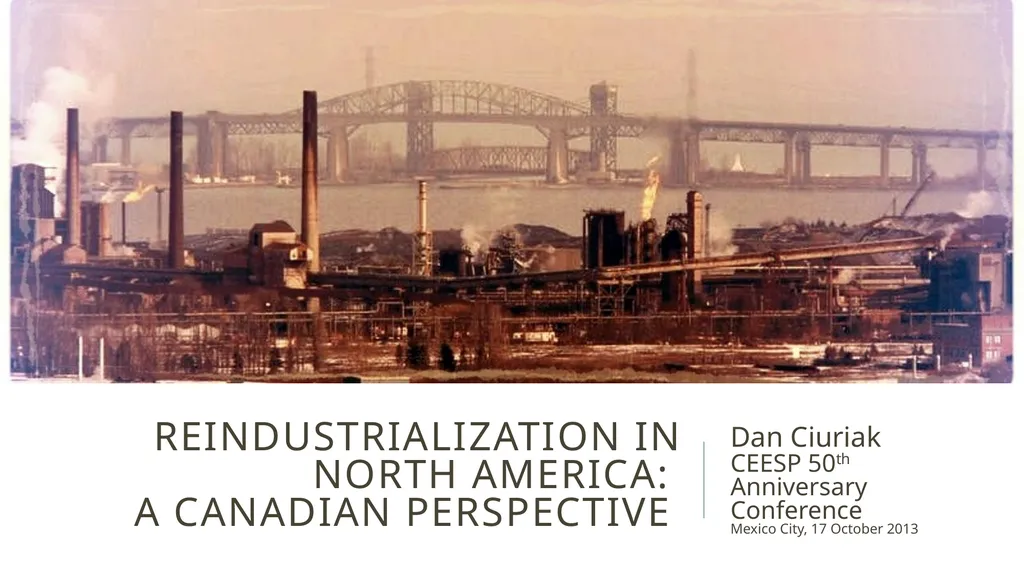
slide1. Reindustrialization in North America: A Canadian Perspective Dan Ciuriak
CEESP 50th Anniversary Conference
Mexico City, 17 October 2013<br>
slide2. Background and Context 3 decades of demand-side policy (1950s-1970s) resulted in:
Slow growth / Inflation / Fiscal deficits / Distortions/ Policy impotence
3 decades of supply-side policy (1980s-2000s) resulted in:
Slow growth / Deflation / Fiscal deficits / Distortions / Policy impotence
OECD Consensus is looking shaky
Build endowments / Structural neutrality / Incentives for private sector
Beijing Consensus not yet established:
Build capabilities / Structural shaping / incentives for private sector + developmental state
Economic theory evolving – key developments include embrace of:
Heterogeneity / Diversification / Externalities and asymmetries
Industrial policy is being revisited<br>
slide3. Canada’s “Developmental State” History Export dependent economy repeatedly hit by trade shocks from Britain and US
“Corn laws” drove Canada to Elgin-Marcy Reciprocity Agreement with US
US abrogation of Reciprocity drove Canada to Confederation and internal trade (National Policy)
First country to implement anti-dumping (1904)
The Wars and Great Depression expanded the role of government
Canada nationalized failed railways to create CN (1919) which begat CBC (1932) and Trans-Canada Airways (1936)
Managed financial sector – no bank failures during depression
Wheat Board (1935)
Industrial Development Bank (1944), Export Development Corporation (1944) and Canadian Commercial Corporation (1946) for postwar industrial development
Postwar era: infrastructure (e.g., St Lawrence Seaway) and social investments
Heavily FDI-invested yet wary of FDI (FIRA, 1973)
A Crown Corporation for every “gap” and strategic objective
Solved scale problems through trade (Auto Pact of 1965) but also through policy:
Dept of Industry (1963) / Dept of Regional Economic Expansion (1969) / Ministry of State for Science and Technology (1971) / Canada Development Corp (1971)<br>
slide4. Canada’s “Supply Side” Era Canada entered the 1980s with 67 parent Crown corporations which in turn had 128 wholly-owned subsidiaries with combined assets valued at $50 billion.
32 wholly owned Crown corporations, including 19 belonging to the federal government, were in the Financial Post’s list of top 500 Canadian corporations
Plus large portfolio holdings
Canada avoided the extremes: neither state capitalism nor laissez faire
Privatization created nationally branded companies (CN, Air Canada, etc.)
Sale of twice-nationalized Canadair in 1986 to Bombardier went with a $1.7 billion service contract to service Canadian Forces CF-18s, introducing the firm into aerospace
“Mini Big Bang” in the financial sector was staged to allow Canadian banks a first shot at the securities underwriters/brokers
Free trade with the US was accompanied by negotiated agreement to conduct pharmaceutical research in Canada
Telecoms policy created Nortel<br>
slide5. Sectoral policies continued Industrial and Regional Benefits (IRB) program (military procurement)
Protective tariffs on shipbuilding
Strategic Aerospace and Defence Initiative (SADI),
Banking: “Big shall not buy big”
Content rules for print and broadcast media
Agricultural marketing boards
Participation in de facto nationalization of North American auto industry in the 2008-09 crisis
Regional policy transformed into innovation policy (cluster policies)<br>
slide6. … but no industrial “strategy” until KBE Arguably, Canada’s first industrial “strategy” was the push for the knowledge-based economy (KBE).
The idea formed in the mid-1990s, and was eventually entrenched in Industry Canada’s mandate: “Industry Canada's mission is to foster a growing, competitive, knowledge-based Canadian economy.”
Policy orientation was squarely “horizontal” – approximating the OECD consensus
Since 2006, the framework has been “Advantage Canada”
Canada’s technology convergence stopped in the mid-1990s though masked by the stock market boom
In 2000, about 40% of the TSX was technology; over the decade since then, this share has collapsed to about 3%.
As the Canadian dollar rose post-2003, this was accompanied by the first major divergence of manufacturing share of GDP between Canada and the United States<br>
slide7. But horizontal policy had no traction…<br>
slide8. Canada and the United States: Manufacturing Share of GDP at Constant Prices, 1977-2008<br>
slide9. The Great Canadian Dutch Disease Debate<br>
slide10. Federal Budget 2013: Manufacturing becomes a Priority $1.4 billion accelerated capital cost allowance extension over the 2014-15 to 2017-18.
$920 million to renew the Federal Economic Development Agency for Southern Ontario (FedDev Ontario) for five years, starting on April 1, 2014.
$200 million for a new Advanced Manufacturing Fund in Ontario for five years, starting on April 1, 2014, funded from the renewed FedDev Ontario.
National Shipbuilding Procurement Strategy.
$1 billion over five years for the permanent Strategic Aerospace and Defence Initiative
$110 million over four years, beginning in 2014-15, and $55 million annually thereafter, for the creation of an Aerospace Technology Demonstration Program.
$92 million over two years starting in 2014-15 forestry innovation and market development.<br>
slide11. The Back Story Manufacturing is different
Major source of productivity growth (Baldwin and MacDonald 2009)
Accounts for about half of R&D in Canada
Main attractor of FDI
Manufactures dominate exports (in Canada’s case about 2/3 of exports are manufactures)
Over half of Canada’s services exports on a value-added basis are embedded in exported goods (Koopman et al. 2010)
Direct export of services is increasingly contingent on the exports of goods (“servitization” of manufacturing; Neely et al. 2011).
Multiplier effects of investment in manufacturing are greater than in services
Manufacturing is extremely diverse and has important linkages throughout the economy.
Upstream and downstream to agriculture, the resource industries, construction, transportation, telecommunications, utilities and services
Manufacturing is regionally dispersed.<br>
slide12. Business paradigm is shifting<br>
slide13. Battleground sectors emerging Worldwide, governments are targeting the next generation of growth industries
Advanced manufacturing
Clean energy
Bio-pharma
Nanotechnology
Aerospace
Canada sees promising developing in emerging clusters & indicators of uptake of advanced manufacturing techniques
Provincial governments promoting local clusters – vertical policy but with horizontal tools<br>
slide14. competing Globally for R&D and Product Mandates Almost 50% of manufacturing enterprises in Canada were engaged in activities abroad between 2007 and 2009
Intense competition exists between geographically dispersed subsidiaries for investment to retain and attract product/R&D mandates.
Firms are competing within their own family and with other supply chains to attract investments, as are countries
Of the large manufacturers that closed an existing production facility or reduced capacity, 29% also opened a new production facility or expanded production capacity in Canada
Large manufacturers with headquarters in Canada and headquarters abroad increased production capabilities in Canada at a comparable rate (34% and 28% respectively)<br>
slide15. Federal Business support framework: Reduce taxes on business (lower corporate tax, extended accelerated CCAs)
Support for R&D
Scientific Research and Experimental Development (SR&ED) provides cash refunds and/or tax credits to encourage businesses to conduct R&D in Canada – single largest source of federal support for industrial R&D
National Research Council’s Industrial Research Assistance Program (NRC-IRAP) – including a new pilot program $20 million over three years to fund SME access to research and business development services at universities, colleges and other non-profit research institutions
Government procurement – government as launch customer (Jenkins Panel)
Skills Development:
Training
Apprenticeship incentives
Targeted Initiative for Older Workers
Digital Economy Strategy promotes student enrolment in disciplines related to the digital economy.
Working in Canada Website to facilitate skill-matching http://www.workingincanada.gc.ca/home-eng.do?lang=eng
Unilateral free trade in manufacturing inputs (Budget 2010) + FTA agenda + Border initiative to facilitate participation in Global Value Chains – “Integrative Trade”:
… but with Sector Strategies (Aerospace/defence, shipbuilding, autos)<br>
slide16. Is it working? Deloitte 2013: Canada moves up to 7th place in global manufacturing competitiveness from 13th in 2010
Porter-type “competitiveness” analysis indicates factor conditions are in place
Growth in Real Investment Per Worker in the Manufacturing Sector<br>
slide17. But no clear reversal of the decline in MFG Output Monthly Survey of Manufacturing, August 2013<br>
slide18. Innovation and Exports have not turned around Canada Gets a “D” on the Innovation Report Card
“Despite a decade or so of innovation agendas and prosperity reports, Canada remains near the bottom of its peer group on innovation, ranking 13th among the 16 peer countries. Canada performs poorly on most of the 21 indicators, scoring 13 “D”s, 2 “C”s, 6 “B”s, and no “A”s. The “D” grades underline Canada’s relative weakness in all three categories of the innovation process—creation, diffusion, and transformation.” Conference Board of Canada
The technology ecosystem is battered – loss of Nortel and the troubles of Blackberry have had seismic effects on the smaller tech players
Exports remain below their 2008 level<br>
slide19. Discussion: is horizontality enough? The 60/40 economy is the observed norm (ca. 60% private/40% public), determined by natural selection based on
Relative prevalence of public vs. private goods
The differences between social and private rates of return given heterogeneous risk/return characteristics in research and investment
Private mobility vs. public immobility
Three public sector roles that need to be considered:
Public research laboratories. Business sector R&D is mostly “D”. Incentives to the private sector are not working on commercialization and they are not generating the “R” at the front end of the pipe.
Preparedness to save strategic assets – nationalize, hold, and privatize.
Crown Corporations to engage in activity that has risk/return profiles that the private sector will not touch. The alternative of using government procurement (government as launch customer) is sound but may risk significant leakage under trade rules.<br>
slide20. Thank You!<br>