01
Relations & Their Properties<br>
02
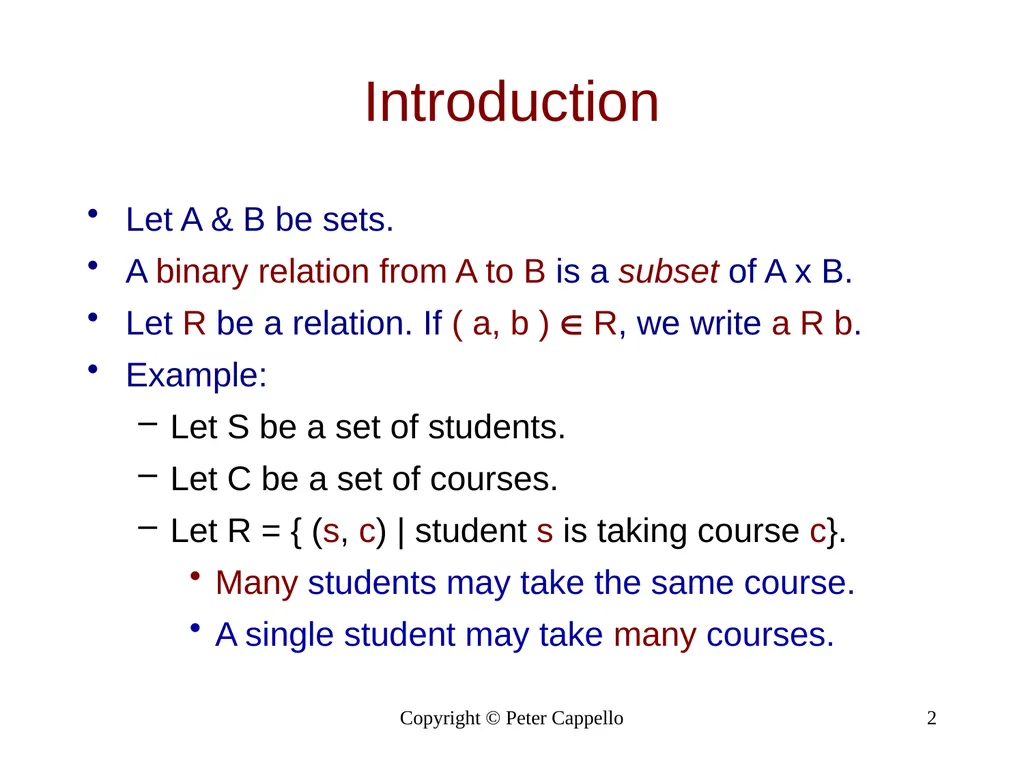
Copyright © Peter Cappello 2 Introduction Let A & B be sets.
A binary relation from A to B is a subset of A x B.
Let R be a relation. If ( a, b ) R, we write a R b.
Example:
Let S be a set of students.
Let C be a set of courses.
Let R = { (s, c) | student s is taking course c}.
Many students may take the same course.
A single student may take many courses.<br>
03
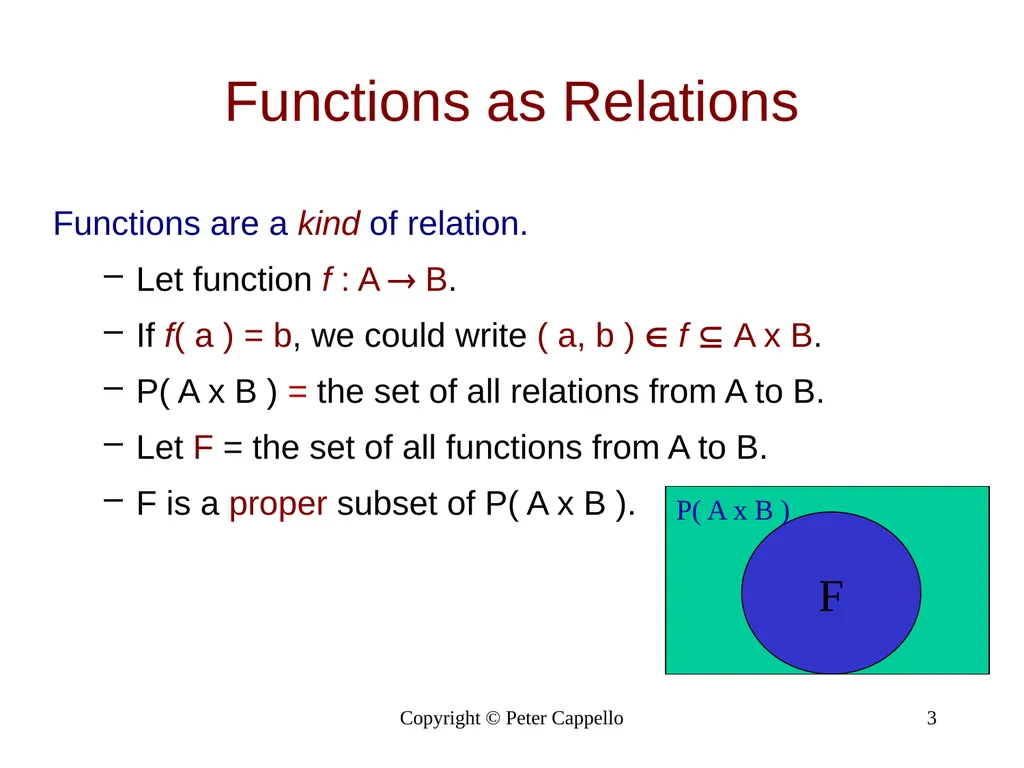
Copyright © Peter Cappello 3 Functions as Relations Functions are a kind of relation.
Let function f : A B.
If f( a ) = b, we could write ( a, b ) f A x B.
P( A x B ) = the set of all relations from A to B.
Let F = the set of all functions from A to B.
F is a proper subset of P( A x B ). F P( A x B )<br>
04
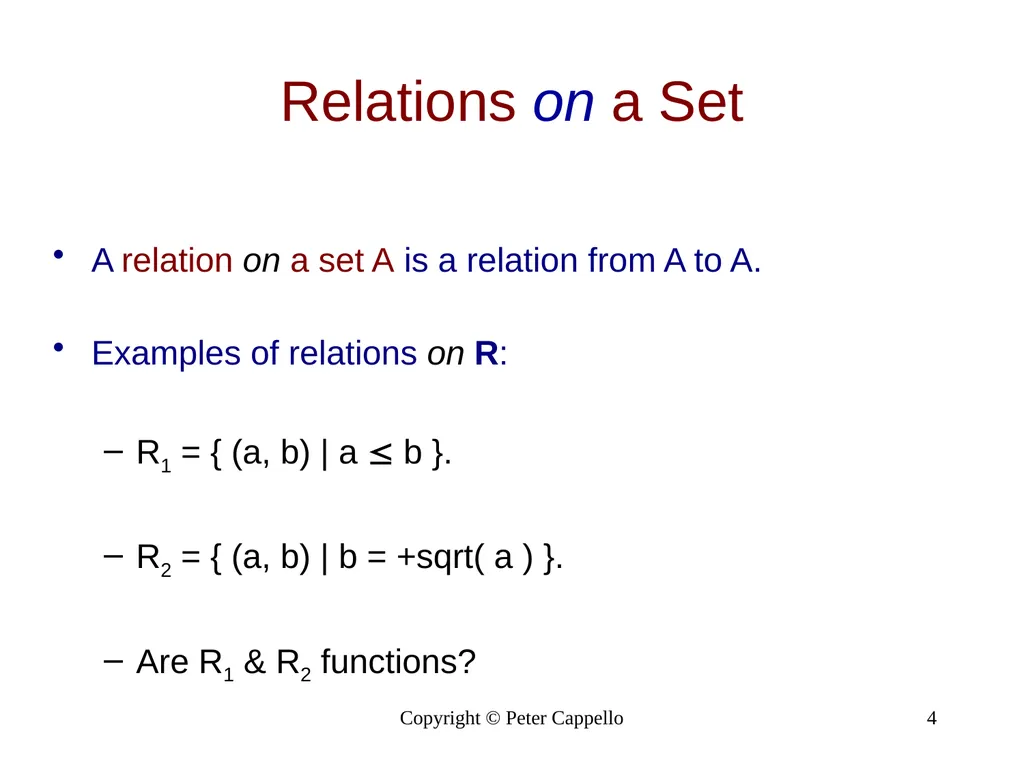
Copyright © Peter Cappello 4 Relations on a Set A relation on a set A is a relation from A to A.
Examples of relations on R:
R1 = { (a, b) | a b }.
R2 = { (a, b) | b = +sqrt( a ) }.
Are R1 & R2 functions?<br>
05
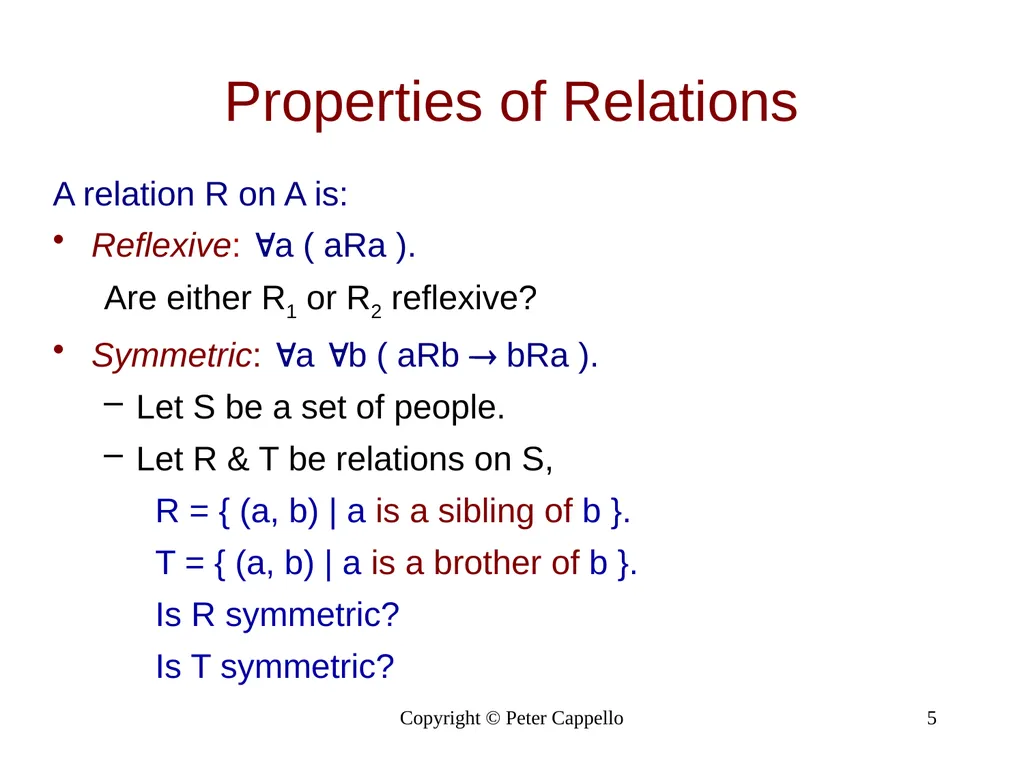
Copyright © Peter Cappello 5 Properties of Relations A relation R on A is:
Reflexive: a ( aRa ).
Are either R1 or R2 reflexive?
Symmetric: a b ( aRb bRa ).
Let S be a set of people.
Let R & T be relations on S,
R = { (a, b) | a is a sibling of b }.
T = { (a, b) | a is a brother of b }.
Is R symmetric?
Is T symmetric?<br>
06
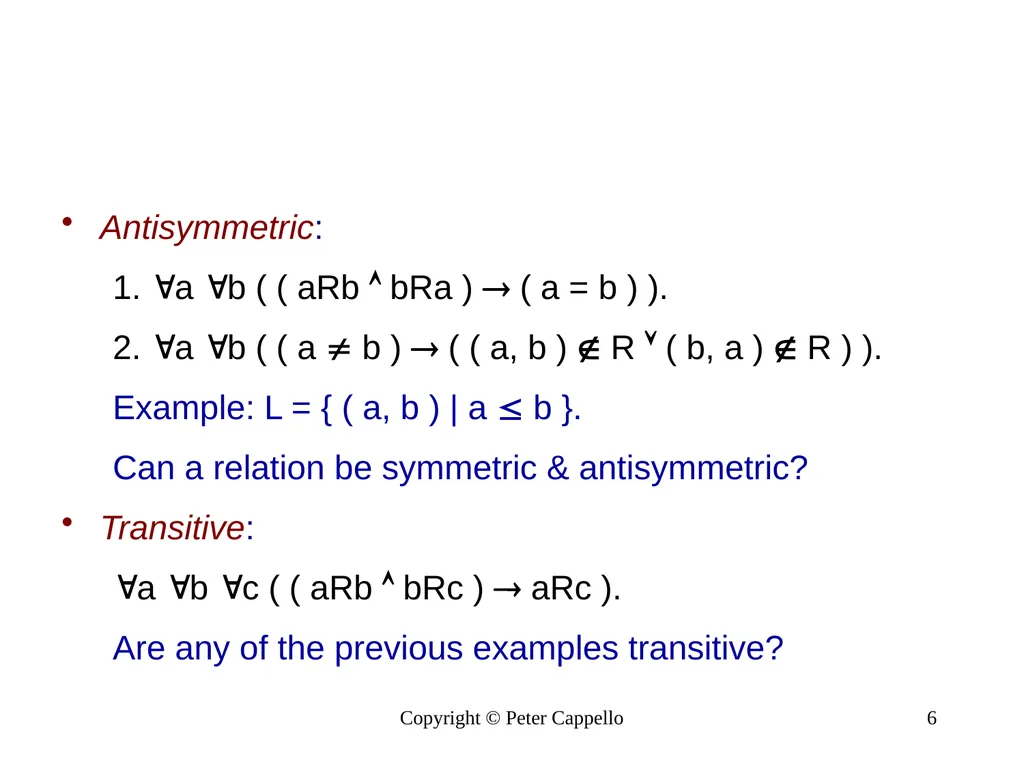
Copyright © Peter Cappello 6 Antisymmetric:
1. a b ( ( aRb bRa ) ( a = b ) ).
2. a b ( ( a b ) ( ( a, b ) R ( b, a ) R ) ).
Example: L = { ( a, b ) | a b }.
Can a relation be symmetric & antisymmetric?
Transitive:
a b c ( ( aRb bRc ) aRc ).
Are any of the previous examples transitive?<br>
07
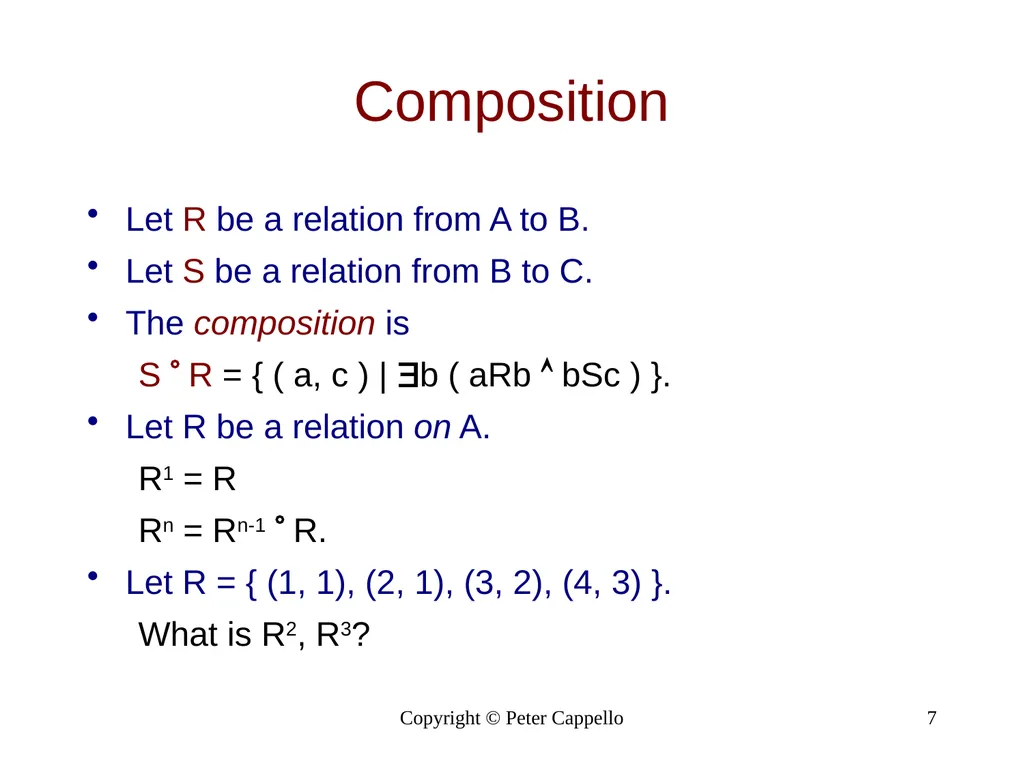
Copyright © Peter Cappello 7 Composition Let R be a relation from A to B.
Let S be a relation from B to C.
The composition is
S R = { ( a, c ) | b ( aRb bSc ) }.
Let R be a relation on A.
R1 = R
Rn = Rn-1 R.
Let R = { (1, 1), (2, 1), (3, 2), (4, 3) }.
What is R2, R3?<br>
08
Copyright © Peter Cappello 8 End 8.1<br>
09
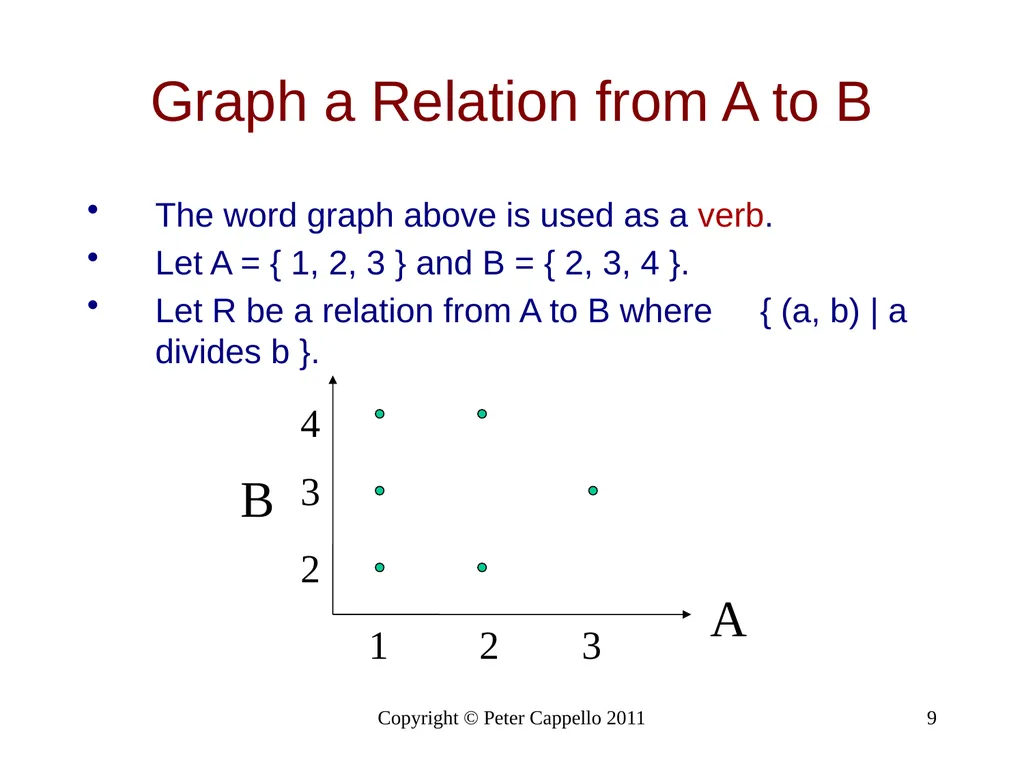
Copyright © Peter Cappello 2011 9 Graph a Relation from A to B The word graph above is used as a verb.
Let A = { 1, 2, 3 } and B = { 2, 3, 4 }.
Let R be a relation from A to B where { (a, b) | a divides b }. 1 2 3 A 2 3 4 B<br>
Show all 9 slides