Relining and Rebasing: Relining: It is the procedures used to resurface the tissue-side of a denture with new material layer, thus producing an accurate adaptation to the denture foundation area. It is usually carried out when the fitness
"Relining and Rebasing: Relining: It is the" is the property of its rightful owner. Permission is granted to
download and print the materials on this website for personal, non-commercial use only, and to display it
on your personal computer provided you do not modify the materials and that you retain all copyright
notices contained in the materials. By downloading content from our website, you accept the terms of this
agreement.
Presentation Transcript
01
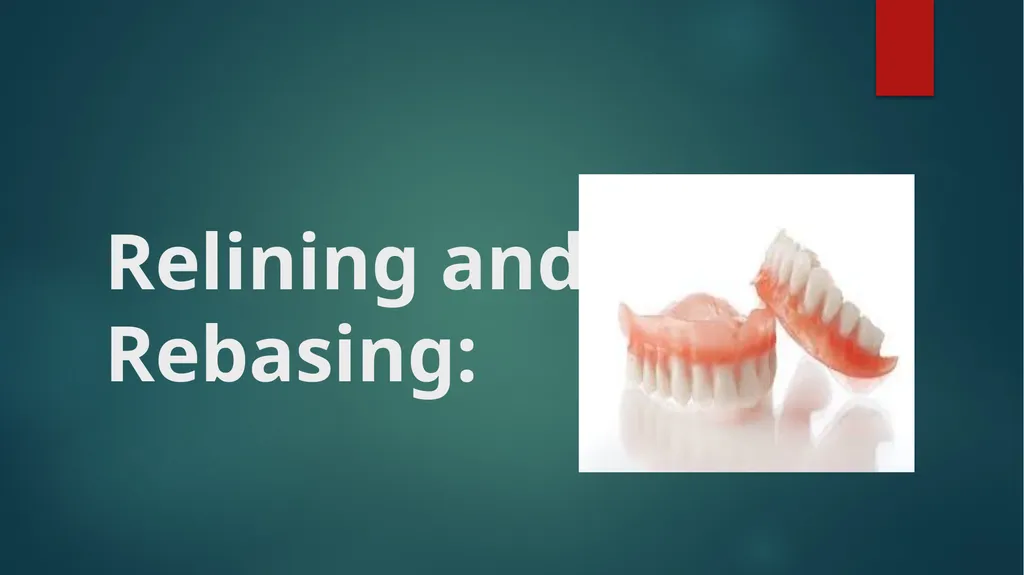
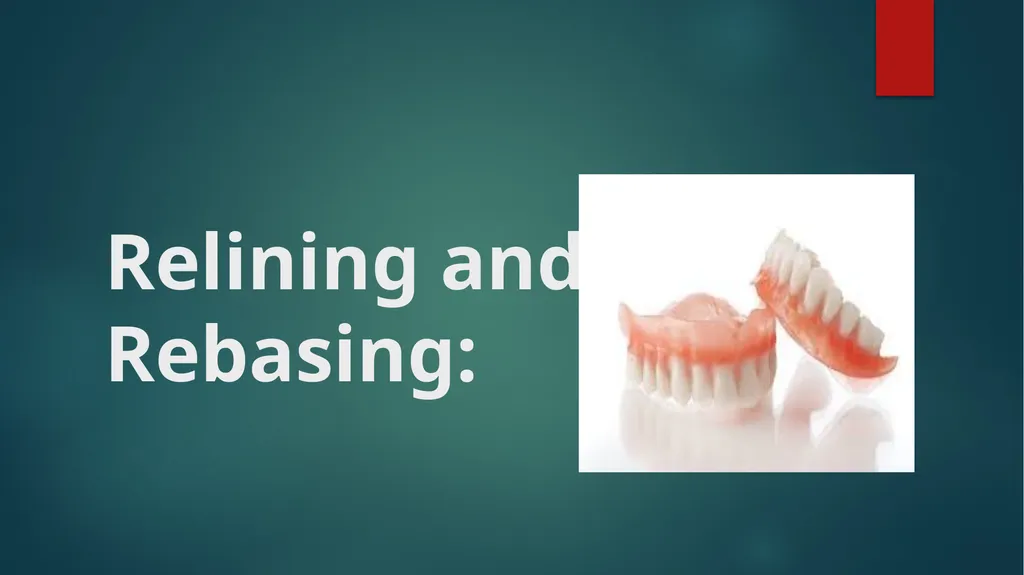
Relining and Rebasing:<br>
02
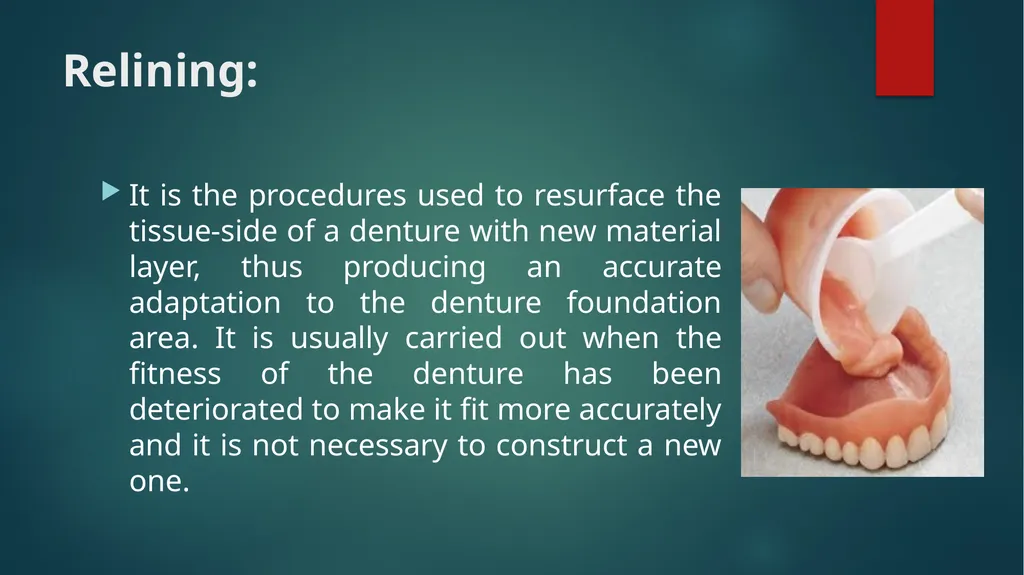
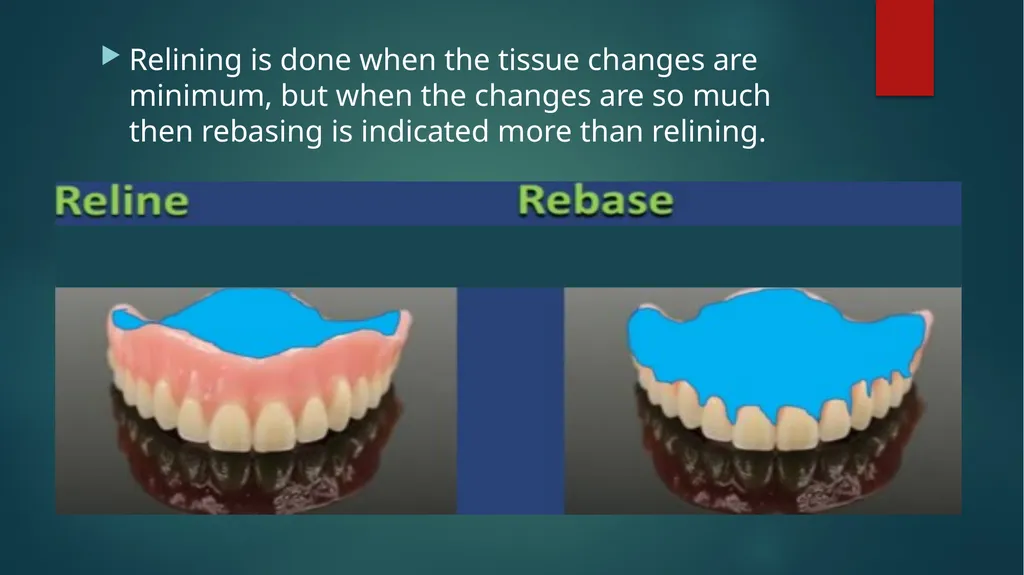
Relining: It is the procedures used to resurface the tissue-side of a denture with new material layer, thus producing an accurate adaptation to the denture foundation area. It is usually carried out when the fitness of the denture has been deteriorated to make it fit more accurately and it is not necessary to construct a new one.<br>
03
Rebasing It is the laboratory process of replacing the entire denture base material on an existing prosthesis, without changing the dental arch, and the occlusal relationship.
It is the complete change of the denture base with a new denture base material (with the same teeth).<br>
04
Relining is done when the tissue changes are minimum, but when the changes are so much then rebasing is indicated more than relining.<br>
05
Indication of Relining and Rebasing: When observed clinical changes include:
Loss of retention and stability.
Loss of occlusal vertical dimension.
Loss of support for facial tissues.
Horizontal shift of dentures: in correct occlusal relationship.
Reorientation of occlusal plane.<br>
06
Contra-indication of Relining and Rebasing: When there is increased vertical dimension (insufficient interarch space).
Poor esthetic and incorrect position of teeth.
Unsatisfactory jaw relationship in the denture.
Excessive resorption of residual ridge.
Severe osseous undercuts.
Dentures causing major speech problems.
Temporomandibular joint problems.<br>
07
Procedures Patient is instructed to leave his denture out of his mouth at least 48 hours to allow for recovery of tissues and reduce irritation caused by ill-fitted denture.
In either case where relining or rebasing is needed, a new impression is made with the existing denture base as an impression tray; this impression is made by either of two techniques:
Closed-mouth technique.
Open-mouth technique.<br>
08
The impression technique is depends on: The reason for relining or rebasing.
Whether the RPD is tooth supported or tooth tissue supported.
In the presence of an occlusal rest, sinking is prevented, where the tissue changes beneath the tooth borne RPD do not affect the support of the denture.
The need for relining in case of tooth borne RPD, as long as the support is not affected is due to:
Trapping and accumulation of food debris beneath the denture causing an unhygienic status.
Ugly appearance or bad esthetics, together with the space developed due to tissue changes which occur due to bone resorption.
Patient discomfort due to lack of contact or loss of adaptation of the denture base to the underlying tissue, especially when it is anteriorly located.
With a tooth-borne PD a closed mouth technique is recommended.<br>
09
Relining of a tooth-tissue supported RPD of FEE RPD: The distally extended RPD usually derives its support from the underlying tissue overlying the residual ridge, in such case relining is much more frequently needed than in the case of tooth supported RPD, and here an acrylic denture base is indicated where relining is much more easier.<br>
10
Causes for relining of a fee RPD: Loss of stability.
Loss of function due to loss of occlusion, this loss of function can be clinically detected by wax strips or by an articulating paper.
Loss of support causing rotation of the distally extended denture base around the fulcrum line, this is usually detected by a simple finger pressure where applied to either sides of the fulcrum line, further rotation exists means that relining is indicated. When such a positive indication of rotation exists then relining using an open-mouth technique is needed, here the impression is made with the same way of making a final impression and with zinc-oxide eugenol impression material but the pressure is applied to the Occlusal rest, so that the impression is recorded with the RPD in its same previous position. Occlusal adjustment should follow in the denture delivery stage in clinic and after relining is finished.<br>
11
Note: not all dentures are fit for relining or rebasing, there are certain requirements:
The vertical dimension should allow for an increase of about (2-3).
The centric relation should coincide with centric occlusion.
The esthetic should be evaluated.<br>
12
Clinical and laboratory procedure for relining Relining can be done either by:
1.Direct (chair side)
2. Indirect (laboratory)<br>
13
Direct (chair side) procedure Cold cured acrylic or tissue conditioner material is used, but are not very durable. Direct relining is less time consuming.
The fitting surface of the denture is cleaned, roughened, and slightly reduced.
The flanges are trimmed (to reduce danger of overextension) and the undercuts removed.
Put lubricant over polished surface to prevent the new resin material to adhere on it.<br>
14
Direct (chair side) 4. The new self-curing relining material is then mixed and applied to the fitting surface.
5. The denture is inserted and the patient asked to bite gently on the denture to ensure that the occlusion is not altered by the procedure.
6. Border molding can then be carried out. The denture is kept in situ for about 5 minutes after which it is removed and carefully examined.<br>
15
Disadvantages The material has often produced a chemical burn on the mucosa, and from exothermic reaction.
Color stability is very low and bad odor due to porosity of the material, since no flasking procedure is used.
Liability for errors and wrong positioning of the denture is great.
Improvement in the denture requirement is very little and low.
It is a short term solution.<br>
16
Indirect (laboratory) procedure Clinical procedure
The fitting surface is cleaned, the undercuts are removed and the flanges are shortened.
Minor defects and extensions can be corrected.
A wash impression by zinc oxide eugenol is making with the old denture, with the patient in light occlusal contact.<br>
17
Indirect (laboratory) procedure Laboratory procedure
Beading and boxing of the impression, then pouring the boxed impression with stone material
The denture and the cast are not separated, but any excess impression on the teeth or facial surfaces of the base is removed, then the denture flasked in the usual manner.
(Zinc oxide eugenol) elimination in hot water for 5 minutes; then separated and all the impression material is cleaned from the cast and the denture base.<br>
18
Painting the cast with a separating medium.
Paint the surface of the denture with cotton pellet moistened with monomer.
Mix the acrylic resin and place it in the flask (the new relining material should be compatible with the old denture base material chemically and esthetically).
Curing the heat cured resin.
The denture deflasked and the cast removed from the denture then polish the denture; the relined denture is ready to be inserted in the patient mouth Indirect (laboratory) procedure<br>
19
Rebasing procedure Rebasing procedure is the same as those for relining with some differences:
Impression is made and a cast is poured in the denture as in relining procedure.
The denture with the cast is mounted on an instrument as Hooper duplicator or Hanau articulator with mounting jig that maintains the relationship of teeth to the cast.
The old denture base is cut and removed.<br>
20
Rebasing procedure The original teeth are re-waxed in their previous positions on the cast.
The denture is then processed in the laboratory as for relining.
The denture deflasked and the cast removed from the denture then finished and polish the denture; the relined denture is ready to be inserted in the patient mouth.<br>