
Representation, signatures, and ethical issues in
BR
Published · 42 slides · 0 views

1 / 1



Description
Representation, signatures, and ethical issues in trademark prosecution: Practical information for attorneys Kathleen Cooney-Porter, Bob Lavache, and David Mayer November 10, 2020 If you have questions during the live stream of this
Related Topics
Share
Embed code
Download this presentation From Below
"Representation, signatures, and ethical issues in" is the property of its rightful owner. Permission is granted to download and print the materials on this website for personal, non-commercial use only, and to display it on your personal computer provided you do not modify the materials and that you retain all copyright notices contained in the materials. By downloading content from our website, you accept the terms of this agreement.
Presentation Transcript
01
Representation, signatures, and ethical issues in trademark prosecution: Practical information for attorneys Kathleen Cooney-Porter, Bob Lavache, and David Mayer
November 10, 2020<br>
November 10, 2020<br>
02
If you have questions during the live stream of this presentation, you may submit them in the chat window (to “All Panelists”). Questions not addressed during the presentation will be addressed at the end, time permitting.
If we do not reach your questions, or if you are watching this as a recording, please direct any follow-up questions via email to TMPolicy@uspto.gov with the subject line “Ethics CLE Presentation.”<br>
If we do not reach your questions, or if you are watching this as a recording, please direct any follow-up questions via email to TMPolicy@uspto.gov with the subject line “Ethics CLE Presentation.”<br>
03
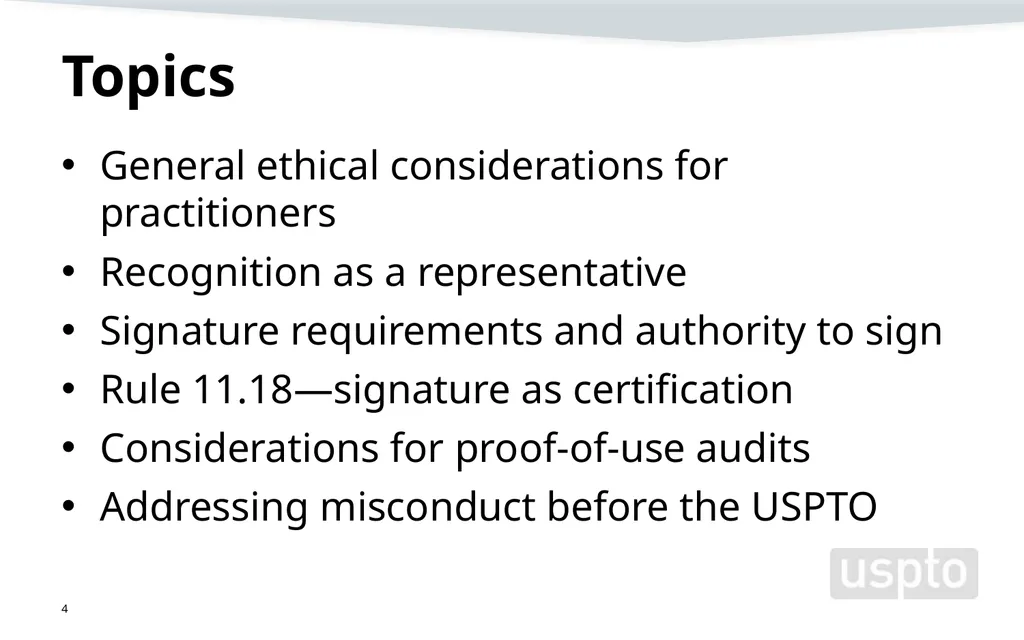
Topics General ethical considerations for practitioners
Recognition as a representative
Signature requirements and authority to sign
Rule 11.18—signature as certification
Considerations for proof-of-use audits
Addressing misconduct before the USPTO 4<br>
Recognition as a representative
Signature requirements and authority to sign
Rule 11.18—signature as certification
Considerations for proof-of-use audits
Addressing misconduct before the USPTO 4<br>
04
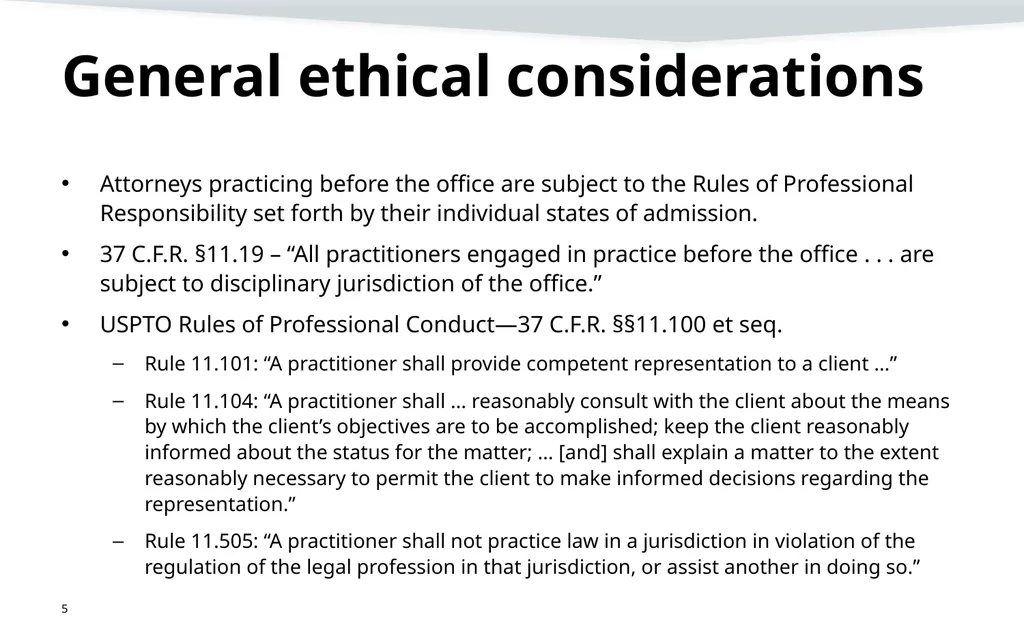
General ethical considerations Attorneys practicing before the office are subject to the Rules of Professional Responsibility set forth by their individual states of admission.
37 C.F.R. §11.19 – “All practitioners engaged in practice before the office . . . are subject to disciplinary jurisdiction of the office.”
USPTO Rules of Professional Conduct—37 C.F.R. §§11.100 et seq.
Rule 11.101: “A practitioner shall provide competent representation to a client …”
Rule 11.104: “A practitioner shall … reasonably consult with the client about the means by which the client’s objectives are to be accomplished; keep the client reasonably informed about the status for the matter; … [and] shall explain a matter to the extent reasonably necessary to permit the client to make informed decisions regarding the representation.”
Rule 11.505: “A practitioner shall not practice law in a jurisdiction in violation of the regulation of the legal profession in that jurisdiction, or assist another in doing so.” 5<br>
37 C.F.R. §11.19 – “All practitioners engaged in practice before the office . . . are subject to disciplinary jurisdiction of the office.”
USPTO Rules of Professional Conduct—37 C.F.R. §§11.100 et seq.
Rule 11.101: “A practitioner shall provide competent representation to a client …”
Rule 11.104: “A practitioner shall … reasonably consult with the client about the means by which the client’s objectives are to be accomplished; keep the client reasonably informed about the status for the matter; … [and] shall explain a matter to the extent reasonably necessary to permit the client to make informed decisions regarding the representation.”
Rule 11.505: “A practitioner shall not practice law in a jurisdiction in violation of the regulation of the legal profession in that jurisdiction, or assist another in doing so.” 5<br>
05
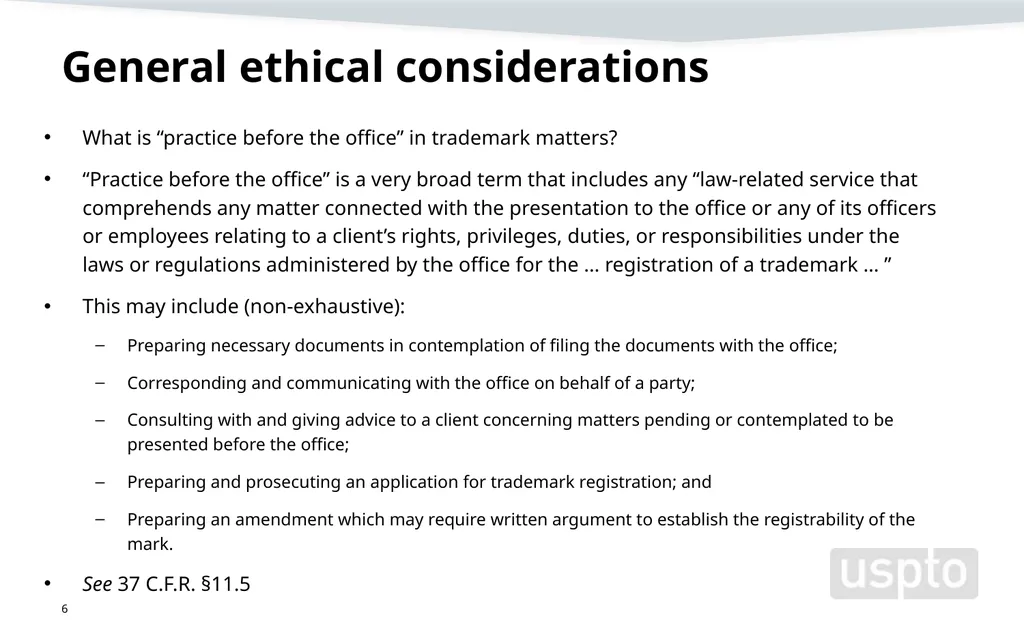
General ethical considerations What is “practice before the office” in trademark matters?
“Practice before the office” is a very broad term that includes any “law-related service that comprehends any matter connected with the presentation to the office or any of its officers or employees relating to a client’s rights, privileges, duties, or responsibilities under the laws or regulations administered by the office for the … registration of a trademark … ”
This may include (non-exhaustive):
Preparing necessary documents in contemplation of filing the documents with the office;
Corresponding and communicating with the office on behalf of a party;
Consulting with and giving advice to a client concerning matters pending or contemplated to be presented before the office;
Preparing and prosecuting an application for trademark registration; and
Preparing an amendment which may require written argument to establish the registrability of the mark.
See 37 C.F.R. §11.5 6<br>
“Practice before the office” is a very broad term that includes any “law-related service that comprehends any matter connected with the presentation to the office or any of its officers or employees relating to a client’s rights, privileges, duties, or responsibilities under the laws or regulations administered by the office for the … registration of a trademark … ”
This may include (non-exhaustive):
Preparing necessary documents in contemplation of filing the documents with the office;
Corresponding and communicating with the office on behalf of a party;
Consulting with and giving advice to a client concerning matters pending or contemplated to be presented before the office;
Preparing and prosecuting an application for trademark registration; and
Preparing an amendment which may require written argument to establish the registrability of the mark.
See 37 C.F.R. §11.5 6<br>
06
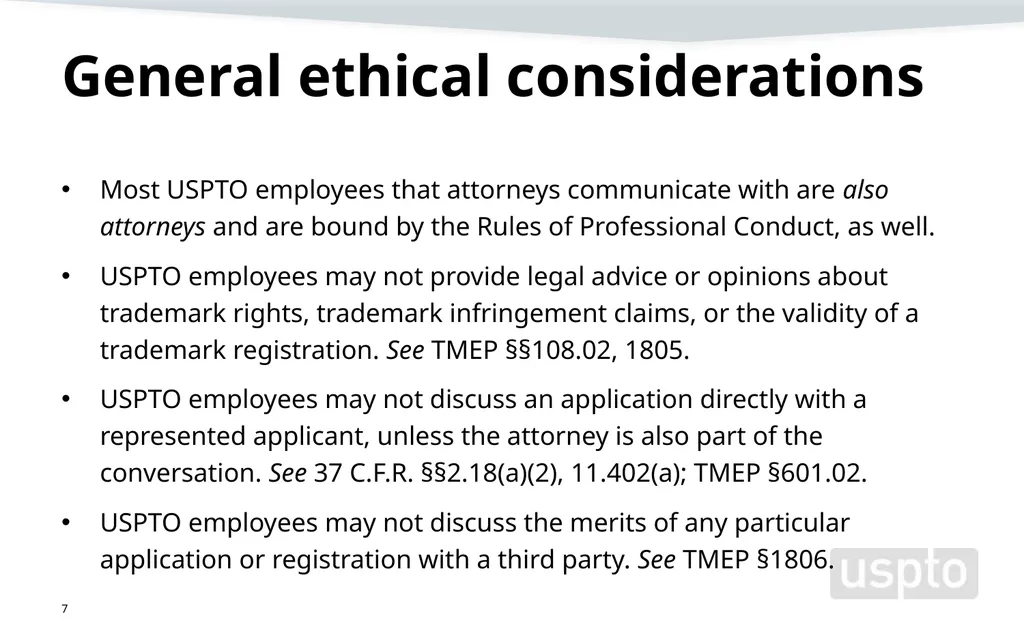
General ethical considerations Most USPTO employees that attorneys communicate with are also attorneys and are bound by the Rules of Professional Conduct, as well.
USPTO employees may not provide legal advice or opinions about trademark rights, trademark infringement claims, or the validity of a trademark registration. See TMEP §§108.02, 1805.
USPTO employees may not discuss an application directly with a represented applicant, unless the attorney is also part of the conversation. See 37 C.F.R. §§2.18(a)(2), 11.402(a); TMEP §601.02.
USPTO employees may not discuss the merits of any particular application or registration with a third party. See TMEP §1806. 7<br>
USPTO employees may not provide legal advice or opinions about trademark rights, trademark infringement claims, or the validity of a trademark registration. See TMEP §§108.02, 1805.
USPTO employees may not discuss an application directly with a represented applicant, unless the attorney is also part of the conversation. See 37 C.F.R. §§2.18(a)(2), 11.402(a); TMEP §601.02.
USPTO employees may not discuss the merits of any particular application or registration with a third party. See TMEP §1806. 7<br>
07
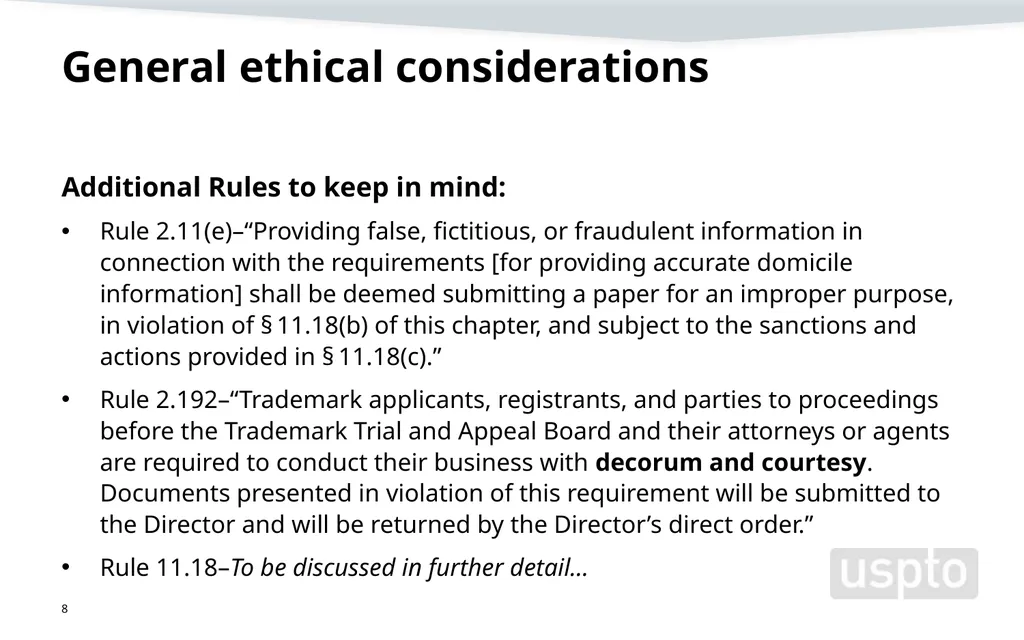
General ethical considerations Additional Rules to keep in mind:
Rule 2.11(e)–“Providing false, fictitious, or fraudulent information in connection with the requirements [for providing accurate domicile information] shall be deemed submitting a paper for an improper purpose, in violation of § 11.18(b) of this chapter, and subject to the sanctions and actions provided in § 11.18(c).”
Rule 2.192–“Trademark applicants, registrants, and parties to proceedings before the Trademark Trial and Appeal Board and their attorneys or agents are required to conduct their business with decorum and courtesy. Documents presented in violation of this requirement will be submitted to the Director and will be returned by the Director’s direct order.”
Rule 11.18–To be discussed in further detail… 8<br>
Rule 2.11(e)–“Providing false, fictitious, or fraudulent information in connection with the requirements [for providing accurate domicile information] shall be deemed submitting a paper for an improper purpose, in violation of § 11.18(b) of this chapter, and subject to the sanctions and actions provided in § 11.18(c).”
Rule 2.192–“Trademark applicants, registrants, and parties to proceedings before the Trademark Trial and Appeal Board and their attorneys or agents are required to conduct their business with decorum and courtesy. Documents presented in violation of this requirement will be submitted to the Director and will be returned by the Director’s direct order.”
Rule 11.18–To be discussed in further detail… 8<br>
08
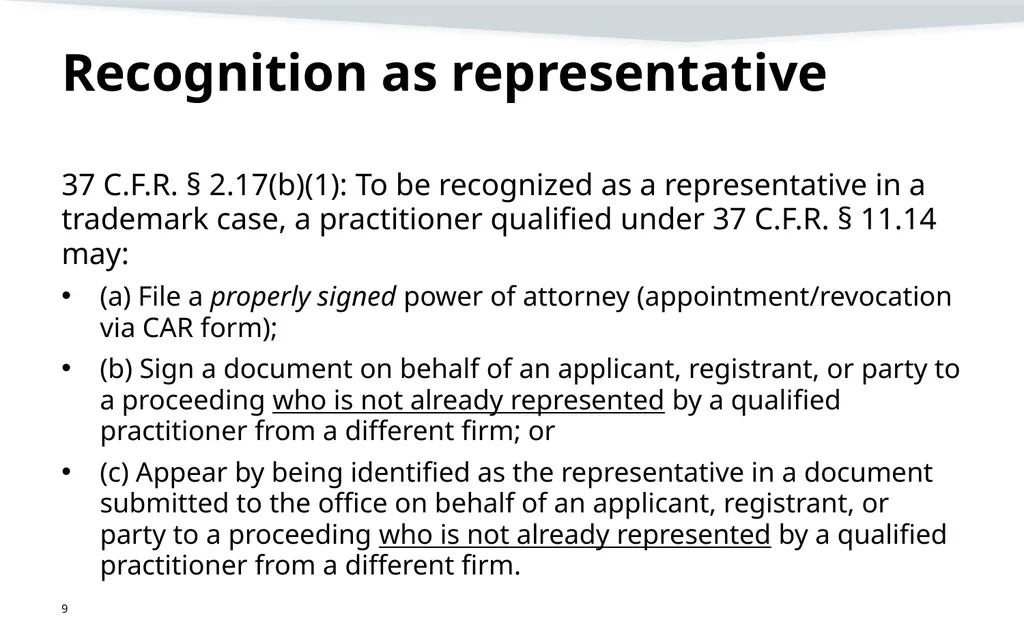
Recognition as representative 37 C.F.R. § 2.17(b)(1): To be recognized as a representative in a trademark case, a practitioner qualified under 37 C.F.R. § 11.14 may:
(a) File a properly signed power of attorney (appointment/revocation via CAR form);
(b) Sign a document on behalf of an applicant, registrant, or party to a proceeding who is not already represented by a qualified practitioner from a different firm; or
(c) Appear by being identified as the representative in a document submitted to the office on behalf of an applicant, registrant, or party to a proceeding who is not already represented by a qualified practitioner from a different firm. 9<br>
(a) File a properly signed power of attorney (appointment/revocation via CAR form);
(b) Sign a document on behalf of an applicant, registrant, or party to a proceeding who is not already represented by a qualified practitioner from a different firm; or
(c) Appear by being identified as the representative in a document submitted to the office on behalf of an applicant, registrant, or party to a proceeding who is not already represented by a qualified practitioner from a different firm. 9<br>
09
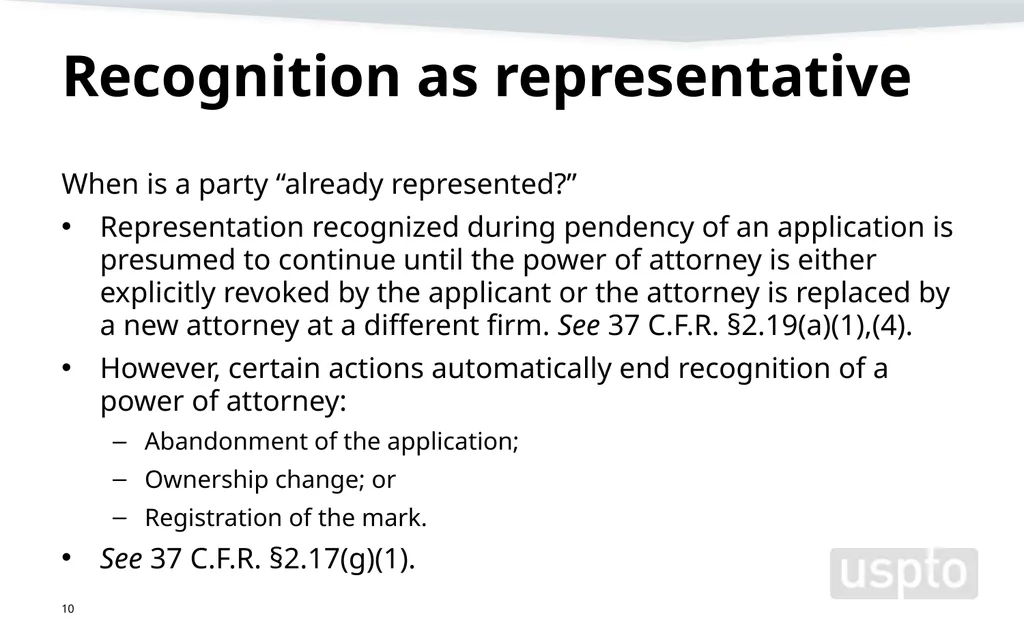
Recognition as representative When is a party “already represented?”
Representation recognized during pendency of an application is presumed to continue until the power of attorney is either explicitly revoked by the applicant or the attorney is replaced by a new attorney at a different firm. See 37 C.F.R. §2.19(a)(1),(4).
However, certain actions automatically end recognition of a power of attorney:
Abandonment of the application;
Ownership change; or
Registration of the mark.
See 37 C.F.R. §2.17(g)(1). 10<br>
Representation recognized during pendency of an application is presumed to continue until the power of attorney is either explicitly revoked by the applicant or the attorney is replaced by a new attorney at a different firm. See 37 C.F.R. §2.19(a)(1),(4).
However, certain actions automatically end recognition of a power of attorney:
Abandonment of the application;
Ownership change; or
Registration of the mark.
See 37 C.F.R. §2.17(g)(1). 10<br>
10
Recognition as representative When is a party “already represented?”
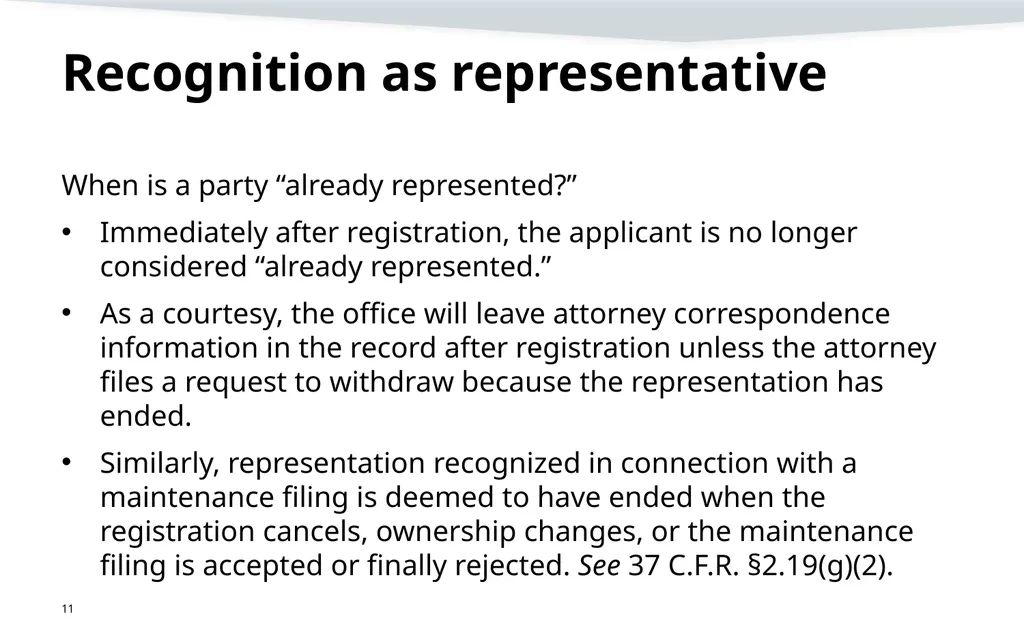
Immediately after registration, the applicant is no longer considered “already represented.”
As a courtesy, the office will leave attorney correspondence information in the record after registration unless the attorney files a request to withdraw because the representation has ended.
Similarly, representation recognized in connection with a maintenance filing is deemed to have ended when the registration cancels, ownership changes, or the maintenance filing is accepted or finally rejected. See 37 C.F.R. §2.19(g)(2). 11<br>
Immediately after registration, the applicant is no longer considered “already represented.”
As a courtesy, the office will leave attorney correspondence information in the record after registration unless the attorney files a request to withdraw because the representation has ended.
Similarly, representation recognized in connection with a maintenance filing is deemed to have ended when the registration cancels, ownership changes, or the maintenance filing is accepted or finally rejected. See 37 C.F.R. §2.19(g)(2). 11<br>
11
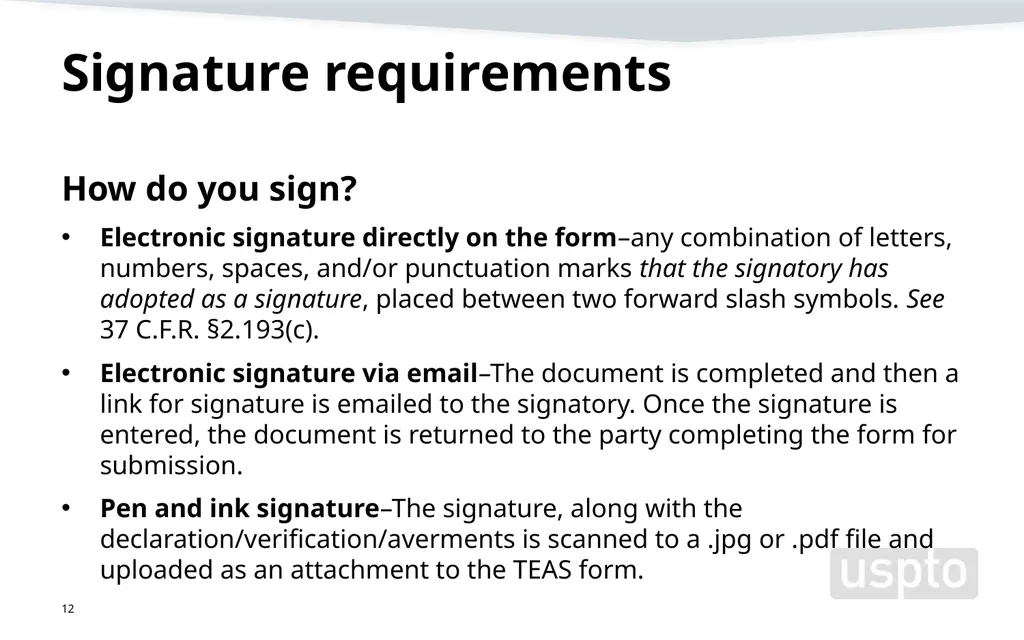
Signature requirements How do you sign?
Electronic signature directly on the form–any combination of letters, numbers, spaces, and/or punctuation marks that the signatory has adopted as a signature, placed between two forward slash symbols. See 37 C.F.R. §2.193(c).
Electronic signature via email–The document is completed and then a link for signature is emailed to the signatory. Once the signature is entered, the document is returned to the party completing the form for submission.
Pen and ink signature–The signature, along with the declaration/verification/averments is scanned to a .jpg or .pdf file and uploaded as an attachment to the TEAS form. 12<br>
Electronic signature directly on the form–any combination of letters, numbers, spaces, and/or punctuation marks that the signatory has adopted as a signature, placed between two forward slash symbols. See 37 C.F.R. §2.193(c).
Electronic signature via email–The document is completed and then a link for signature is emailed to the signatory. Once the signature is entered, the document is returned to the party completing the form for submission.
Pen and ink signature–The signature, along with the declaration/verification/averments is scanned to a .jpg or .pdf file and uploaded as an attachment to the TEAS form. 12<br>
12
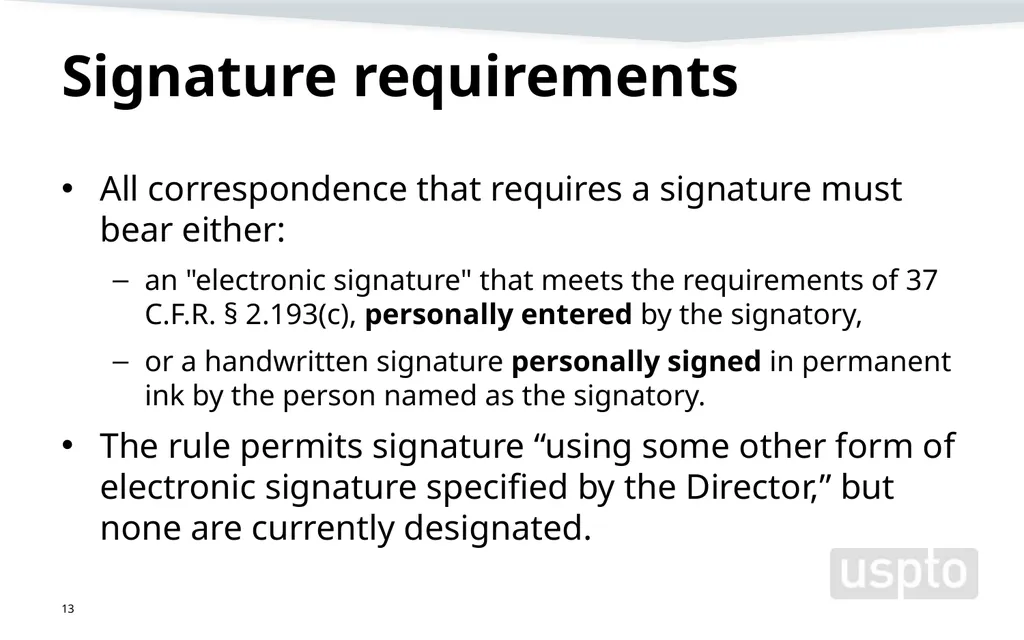
Signature requirements All correspondence that requires a signature must bear either:
an "electronic signature" that meets the requirements of 37 C.F.R. § 2.193(c), personally entered by the signatory,
or a handwritten signature personally signed in permanent ink by the person named as the signatory.
The rule permits signature “using some other form of electronic signature specified by the Director,” but none are currently designated. 13<br>
an "electronic signature" that meets the requirements of 37 C.F.R. § 2.193(c), personally entered by the signatory,
or a handwritten signature personally signed in permanent ink by the person named as the signatory.
The rule permits signature “using some other form of electronic signature specified by the Director,” but none are currently designated. 13<br>
13
Signature requirements TMEP §611.01(b): Another person (e.g., paralegal, legal assistant, secretary) may not sign the name of an attorney or other authorized signatory.
In re Dermahose Inc., 82 USPQ2d 1793 (TTAB 2007) (a declaration signed by somebody other than the identified declarant does not meet the requirements of Rule 2.20);
In re Cowan, 18 USPQ2d 1407 (Comm’r Pats. 1990) (a document signed by a third-party on behalf of another cannot be accepted).
37 C.F.R. §11.303: A practitioner owes a duty of candor to the office and may not permit the submission of a false statement of fact or law. 14<br>
In re Dermahose Inc., 82 USPQ2d 1793 (TTAB 2007) (a declaration signed by somebody other than the identified declarant does not meet the requirements of Rule 2.20);
In re Cowan, 18 USPQ2d 1407 (Comm’r Pats. 1990) (a document signed by a third-party on behalf of another cannot be accepted).
37 C.F.R. §11.303: A practitioner owes a duty of candor to the office and may not permit the submission of a false statement of fact or law. 14<br>
14
Signature requirements Signatures must be that of a real person.
Juristic entities act through their principals or officers.
See TMEP §611.06(b)-(h).
The first and last name, and the title or position, of the person who signs a document must be set forth below or adjacent to the signature. 37 C.F.R. §2.193(d). 15<br>
Juristic entities act through their principals or officers.
See TMEP §611.06(b)-(h).
The first and last name, and the title or position, of the person who signs a document must be set forth below or adjacent to the signature. 37 C.F.R. §2.193(d). 15<br>
15
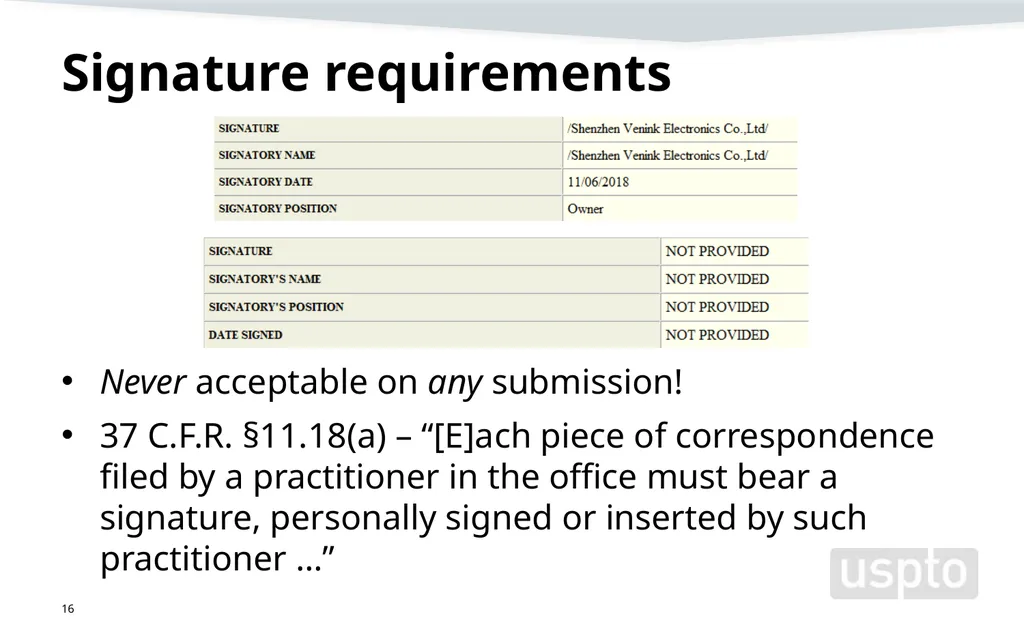
Signature requirements Never acceptable on any submission!
37 C.F.R. §11.18(a) – “[E]ach piece of correspondence filed by a practitioner in the office must bear a signature, personally signed or inserted by such practitioner …” 16<br>
37 C.F.R. §11.18(a) – “[E]ach piece of correspondence filed by a practitioner in the office must bear a signature, personally signed or inserted by such practitioner …” 16<br>
16
Authority to sign All documents submitted to the USPTO in connection with a trademark application or registration must be signed by a proper person; who the “proper person” is depends on the nature of the submission. See 37 C.F.R. §2.193(e).
Main categories:
Verifications of Fact
Responses, Amendments, Requests, and Petitions
Power of Attorney
Mixed Documents 17<br>
Main categories:
Verifications of Fact
Responses, Amendments, Requests, and Petitions
Power of Attorney
Mixed Documents 17<br>
17
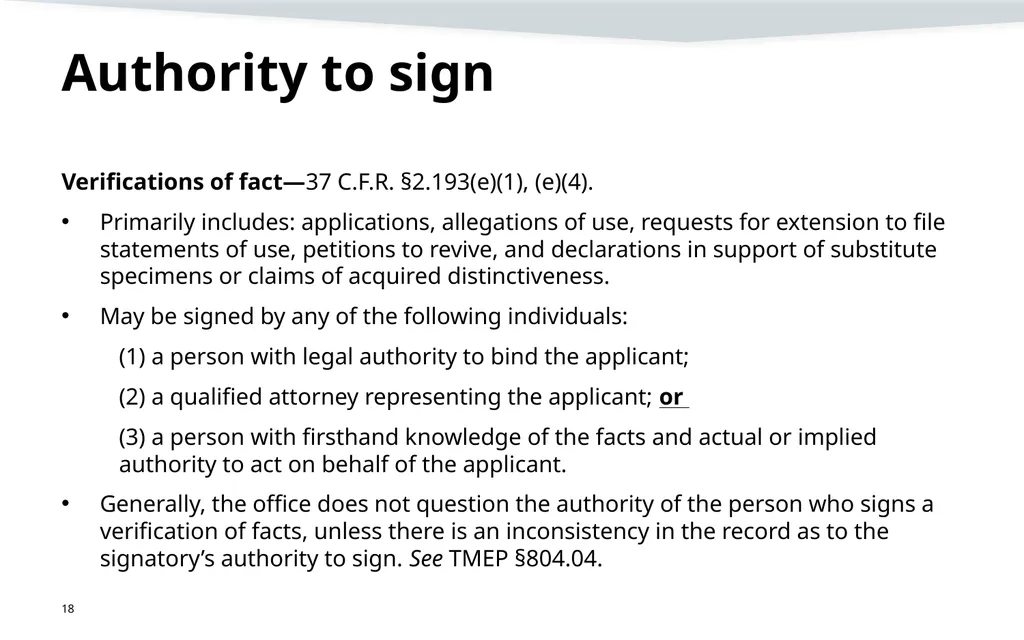
Authority to sign Verifications of fact—37 C.F.R. §2.193(e)(1), (e)(4).
Primarily includes: applications, allegations of use, requests for extension to file statements of use, petitions to revive, and declarations in support of substitute specimens or claims of acquired distinctiveness.
May be signed by any of the following individuals:
(1) a person with legal authority to bind the applicant;
(2) a qualified attorney representing the applicant; or
(3) a person with firsthand knowledge of the facts and actual or implied authority to act on behalf of the applicant.
Generally, the office does not question the authority of the person who signs a verification of facts, unless there is an inconsistency in the record as to the signatory’s authority to sign. See TMEP §804.04. 18<br>
Primarily includes: applications, allegations of use, requests for extension to file statements of use, petitions to revive, and declarations in support of substitute specimens or claims of acquired distinctiveness.
May be signed by any of the following individuals:
(1) a person with legal authority to bind the applicant;
(2) a qualified attorney representing the applicant; or
(3) a person with firsthand knowledge of the facts and actual or implied authority to act on behalf of the applicant.
Generally, the office does not question the authority of the person who signs a verification of facts, unless there is an inconsistency in the record as to the signatory’s authority to sign. See TMEP §804.04. 18<br>
18
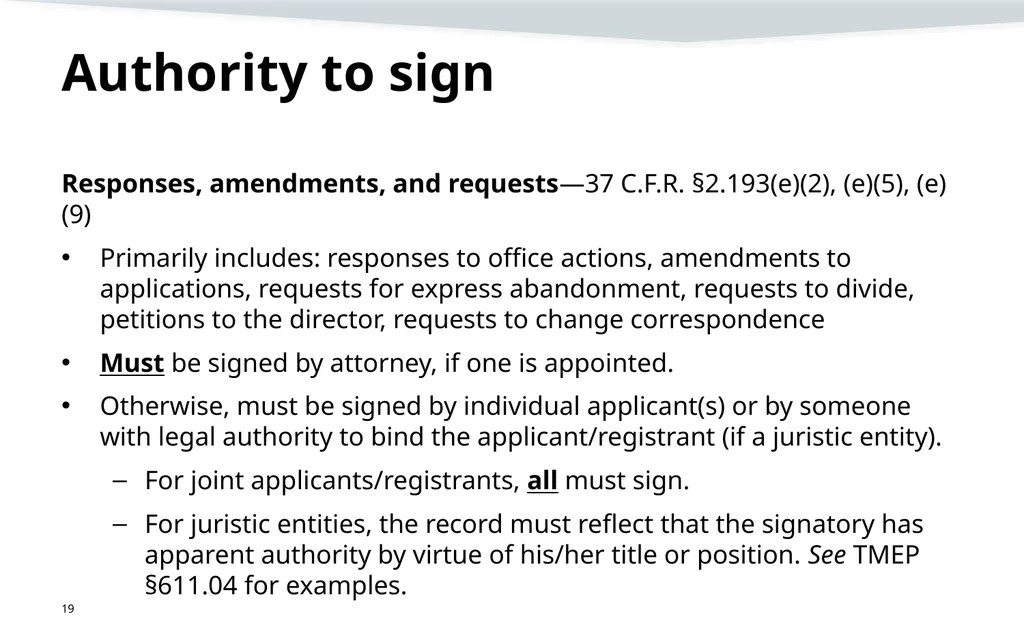
Authority to sign Responses, amendments, and requests—37 C.F.R. §2.193(e)(2), (e)(5), (e)(9)
Primarily includes: responses to office actions, amendments to applications, requests for express abandonment, requests to divide, petitions to the director, requests to change correspondence
Must be signed by attorney, if one is appointed.
Otherwise, must be signed by individual applicant(s) or by someone with legal authority to bind the applicant/registrant (if a juristic entity).
For joint applicants/registrants, all must sign.
For juristic entities, the record must reflect that the signatory has apparent authority by virtue of his/her title or position. See TMEP §611.04 for examples. 19<br>
Primarily includes: responses to office actions, amendments to applications, requests for express abandonment, requests to divide, petitions to the director, requests to change correspondence
Must be signed by attorney, if one is appointed.
Otherwise, must be signed by individual applicant(s) or by someone with legal authority to bind the applicant/registrant (if a juristic entity).
For joint applicants/registrants, all must sign.
For juristic entities, the record must reflect that the signatory has apparent authority by virtue of his/her title or position. See TMEP §611.04 for examples. 19<br>
19
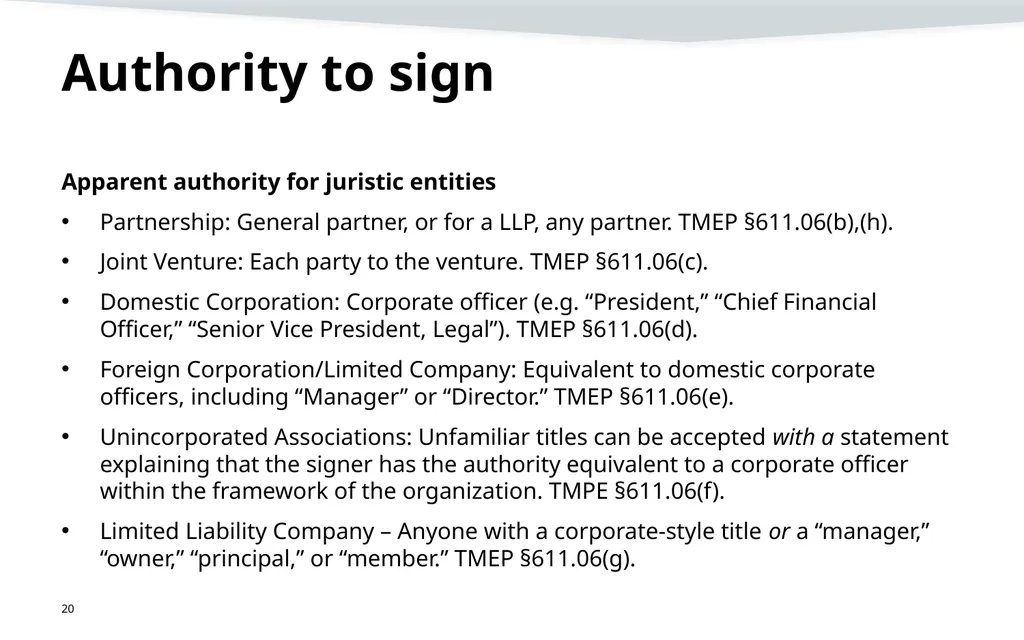
Authority to sign Apparent authority for juristic entities
Partnership: General partner, or for a LLP, any partner. TMEP §611.06(b),(h).
Joint Venture: Each party to the venture. TMEP §611.06(c).
Domestic Corporation: Corporate officer (e.g. “President,” “Chief Financial Officer,” “Senior Vice President, Legal”). TMEP §611.06(d).
Foreign Corporation/Limited Company: Equivalent to domestic corporate officers, including “Manager” or “Director.” TMEP §611.06(e).
Unincorporated Associations: Unfamiliar titles can be accepted with a statement explaining that the signer has the authority equivalent to a corporate officer within the framework of the organization. TMPE §611.06(f).
Limited Liability Company – Anyone with a corporate-style title or a “manager,” “owner,” “principal,” or “member.” TMEP §611.06(g). 20<br>
Partnership: General partner, or for a LLP, any partner. TMEP §611.06(b),(h).
Joint Venture: Each party to the venture. TMEP §611.06(c).
Domestic Corporation: Corporate officer (e.g. “President,” “Chief Financial Officer,” “Senior Vice President, Legal”). TMEP §611.06(d).
Foreign Corporation/Limited Company: Equivalent to domestic corporate officers, including “Manager” or “Director.” TMEP §611.06(e).
Unincorporated Associations: Unfamiliar titles can be accepted with a statement explaining that the signer has the authority equivalent to a corporate officer within the framework of the organization. TMPE §611.06(f).
Limited Liability Company – Anyone with a corporate-style title or a “manager,” “owner,” “principal,” or “member.” TMEP §611.06(g). 20<br>
20
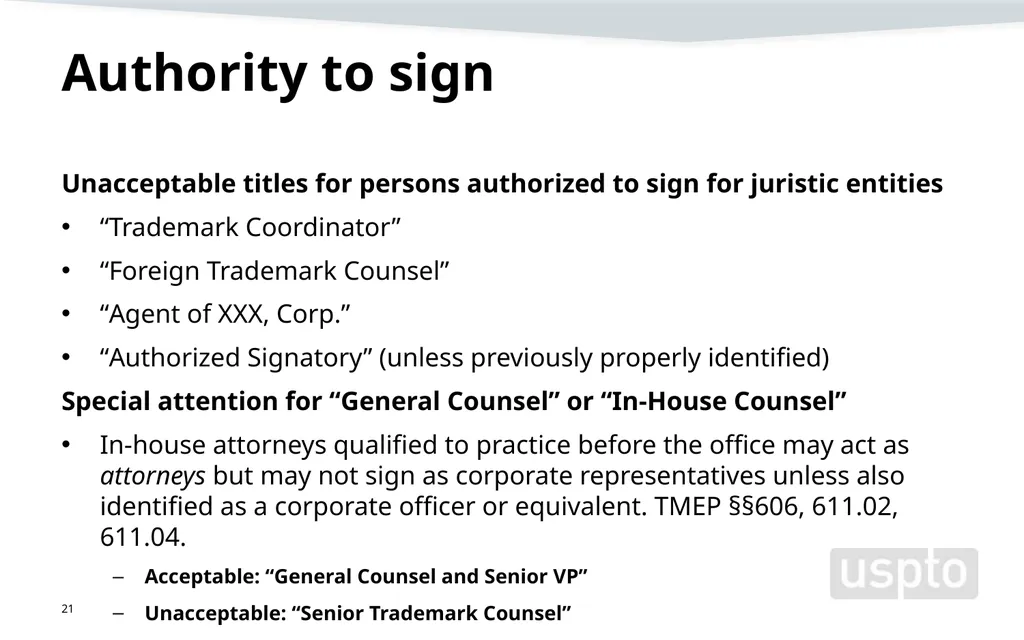
Authority to sign Unacceptable titles for persons authorized to sign for juristic entities
“Trademark Coordinator”
“Foreign Trademark Counsel”
“Agent of XXX, Corp.”
“Authorized Signatory” (unless previously properly identified)
Special attention for “General Counsel” or “In-House Counsel”
In-house attorneys qualified to practice before the office may act as attorneys but may not sign as corporate representatives unless also identified as a corporate officer or equivalent. TMEP §§606, 611.02, 611.04.
Acceptable: “General Counsel and Senior VP”
Unacceptable: “Senior Trademark Counsel” 21<br>
“Trademark Coordinator”
“Foreign Trademark Counsel”
“Agent of XXX, Corp.”
“Authorized Signatory” (unless previously properly identified)
Special attention for “General Counsel” or “In-House Counsel”
In-house attorneys qualified to practice before the office may act as attorneys but may not sign as corporate representatives unless also identified as a corporate officer or equivalent. TMEP §§606, 611.02, 611.04.
Acceptable: “General Counsel and Senior VP”
Unacceptable: “Senior Trademark Counsel” 21<br>
21
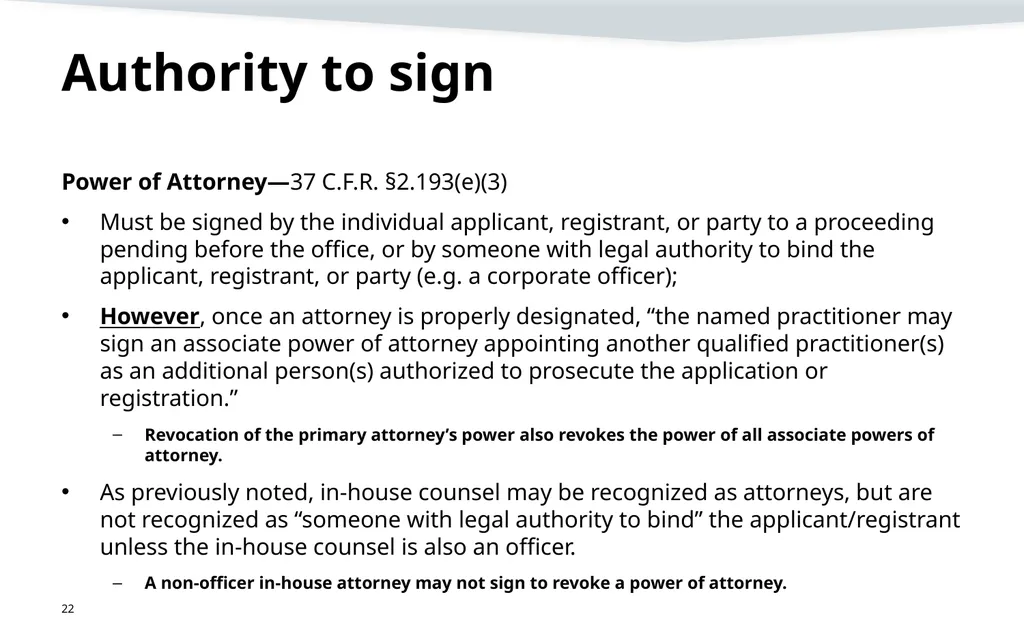
Authority to sign Power of Attorney—37 C.F.R. §2.193(e)(3)
Must be signed by the individual applicant, registrant, or party to a proceeding pending before the office, or by someone with legal authority to bind the applicant, registrant, or party (e.g. a corporate officer);
However, once an attorney is properly designated, “the named practitioner may sign an associate power of attorney appointing another qualified practitioner(s) as an additional person(s) authorized to prosecute the application or registration.”
Revocation of the primary attorney’s power also revokes the power of all associate powers of attorney.
As previously noted, in-house counsel may be recognized as attorneys, but are not recognized as “someone with legal authority to bind” the applicant/registrant unless the in-house counsel is also an officer.
A non-officer in-house attorney may not sign to revoke a power of attorney. 22<br>
Must be signed by the individual applicant, registrant, or party to a proceeding pending before the office, or by someone with legal authority to bind the applicant, registrant, or party (e.g. a corporate officer);
However, once an attorney is properly designated, “the named practitioner may sign an associate power of attorney appointing another qualified practitioner(s) as an additional person(s) authorized to prosecute the application or registration.”
Revocation of the primary attorney’s power also revokes the power of all associate powers of attorney.
As previously noted, in-house counsel may be recognized as attorneys, but are not recognized as “someone with legal authority to bind” the applicant/registrant unless the in-house counsel is also an officer.
A non-officer in-house attorney may not sign to revoke a power of attorney. 22<br>
22
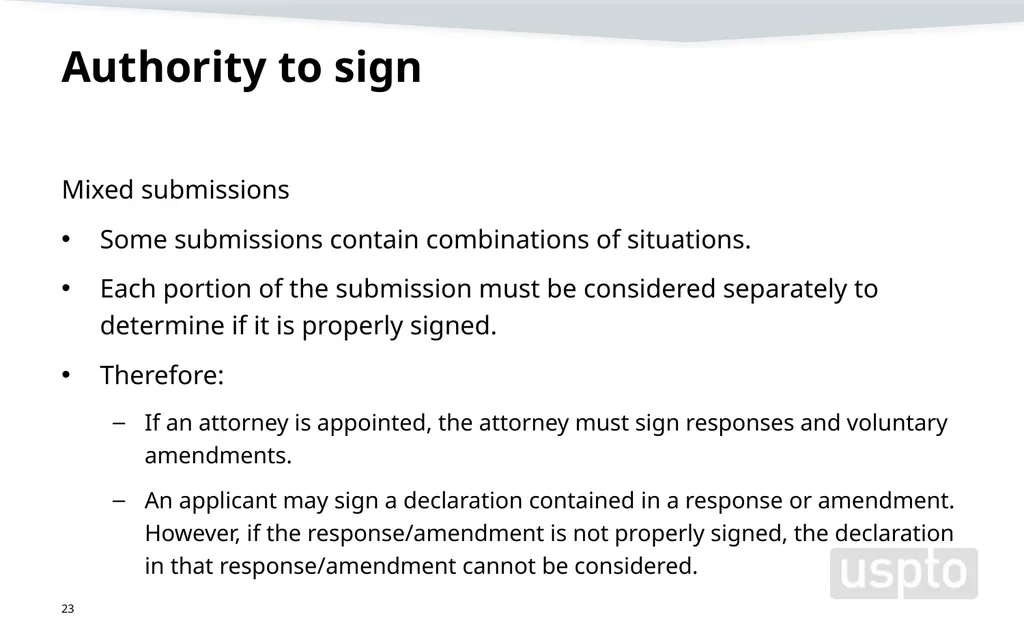
Authority to sign Mixed submissions
Some submissions contain combinations of situations.
Each portion of the submission must be considered separately to determine if it is properly signed.
Therefore:
If an attorney is appointed, the attorney must sign responses and voluntary amendments.
An applicant may sign a declaration contained in a response or amendment. However, if the response/amendment is not properly signed, the declaration in that response/amendment cannot be considered. 23<br>
Some submissions contain combinations of situations.
Each portion of the submission must be considered separately to determine if it is properly signed.
Therefore:
If an attorney is appointed, the attorney must sign responses and voluntary amendments.
An applicant may sign a declaration contained in a response or amendment. However, if the response/amendment is not properly signed, the declaration in that response/amendment cannot be considered. 23<br>
23
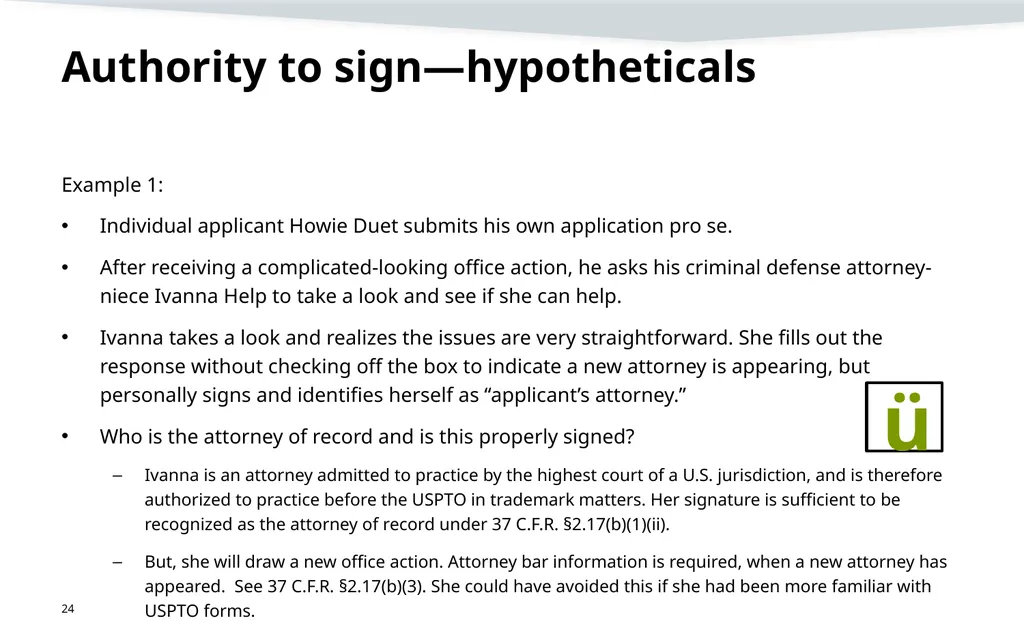
Authority to sign—hypotheticals Example 1:
Individual applicant Howie Duet submits his own application pro se.
After receiving a complicated-looking office action, he asks his criminal defense attorney-niece Ivanna Help to take a look and see if she can help.
Ivanna takes a look and realizes the issues are very straightforward. She fills out the response without checking off the box to indicate a new attorney is appearing, but personally signs and identifies herself as “applicant’s attorney.”
Who is the attorney of record and is this properly signed?
Ivanna is an attorney admitted to practice by the highest court of a U.S. jurisdiction, and is therefore authorized to practice before the USPTO in trademark matters. Her signature is sufficient to be recognized as the attorney of record under 37 C.F.R. §2.17(b)(1)(ii).
But, she will draw a new office action. Attorney bar information is required, when a new attorney has appeared. See 37 C.F.R. §2.17(b)(3). She could have avoided this if she had been more familiar with USPTO forms. 24 ü<br>
Individual applicant Howie Duet submits his own application pro se.
After receiving a complicated-looking office action, he asks his criminal defense attorney-niece Ivanna Help to take a look and see if she can help.
Ivanna takes a look and realizes the issues are very straightforward. She fills out the response without checking off the box to indicate a new attorney is appearing, but personally signs and identifies herself as “applicant’s attorney.”
Who is the attorney of record and is this properly signed?
Ivanna is an attorney admitted to practice by the highest court of a U.S. jurisdiction, and is therefore authorized to practice before the USPTO in trademark matters. Her signature is sufficient to be recognized as the attorney of record under 37 C.F.R. §2.17(b)(1)(ii).
But, she will draw a new office action. Attorney bar information is required, when a new attorney has appeared. See 37 C.F.R. §2.17(b)(3). She could have avoided this if she had been more familiar with USPTO forms. 24 ü<br>
24
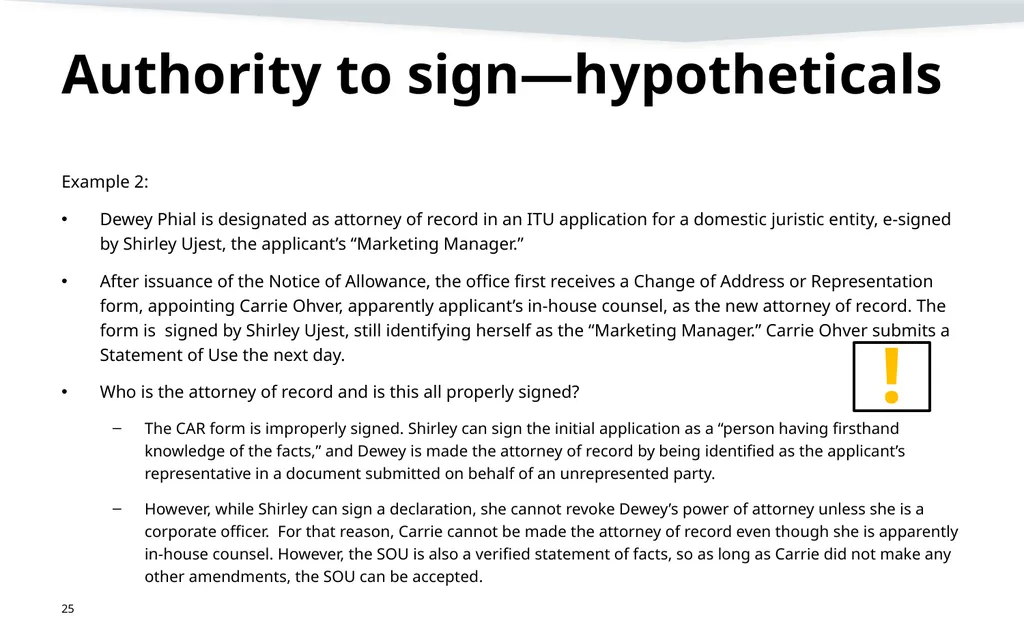
Authority to sign—hypotheticals Example 2:
Dewey Phial is designated as attorney of record in an ITU application for a domestic juristic entity, e-signed by Shirley Ujest, the applicant’s “Marketing Manager.”
After issuance of the Notice of Allowance, the office first receives a Change of Address or Representation form, appointing Carrie Ohver, apparently applicant’s in-house counsel, as the new attorney of record. The form is signed by Shirley Ujest, still identifying herself as the “Marketing Manager.” Carrie Ohver submits a Statement of Use the next day.
Who is the attorney of record and is this all properly signed?
The CAR form is improperly signed. Shirley can sign the initial application as a “person having firsthand knowledge of the facts,” and Dewey is made the attorney of record by being identified as the applicant’s representative in a document submitted on behalf of an unrepresented party.
However, while Shirley can sign a declaration, she cannot revoke Dewey’s power of attorney unless she is a corporate officer. For that reason, Carrie cannot be made the attorney of record even though she is apparently in-house counsel. However, the SOU is also a verified statement of facts, so as long as Carrie did not make any other amendments, the SOU can be accepted. 25 !<br>
Dewey Phial is designated as attorney of record in an ITU application for a domestic juristic entity, e-signed by Shirley Ujest, the applicant’s “Marketing Manager.”
After issuance of the Notice of Allowance, the office first receives a Change of Address or Representation form, appointing Carrie Ohver, apparently applicant’s in-house counsel, as the new attorney of record. The form is signed by Shirley Ujest, still identifying herself as the “Marketing Manager.” Carrie Ohver submits a Statement of Use the next day.
Who is the attorney of record and is this all properly signed?
The CAR form is improperly signed. Shirley can sign the initial application as a “person having firsthand knowledge of the facts,” and Dewey is made the attorney of record by being identified as the applicant’s representative in a document submitted on behalf of an unrepresented party.
However, while Shirley can sign a declaration, she cannot revoke Dewey’s power of attorney unless she is a corporate officer. For that reason, Carrie cannot be made the attorney of record even though she is apparently in-house counsel. However, the SOU is also a verified statement of facts, so as long as Carrie did not make any other amendments, the SOU can be accepted. 25 !<br>
25
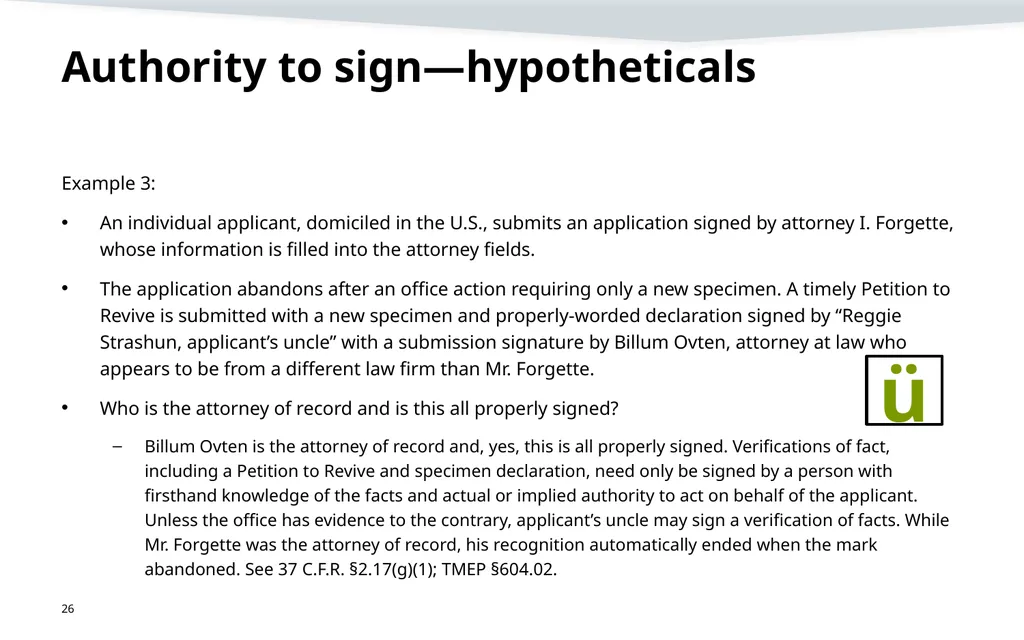
Authority to sign—hypotheticals Example 3:
An individual applicant, domiciled in the U.S., submits an application signed by attorney I. Forgette, whose information is filled into the attorney fields.
The application abandons after an office action requiring only a new specimen. A timely Petition to Revive is submitted with a new specimen and properly-worded declaration signed by “Reggie Strashun, applicant’s uncle” with a submission signature by Billum Ovten, attorney at law who appears to be from a different law firm than Mr. Forgette.
Who is the attorney of record and is this all properly signed?
Billum Ovten is the attorney of record and, yes, this is all properly signed. Verifications of fact, including a Petition to Revive and specimen declaration, need only be signed by a person with firsthand knowledge of the facts and actual or implied authority to act on behalf of the applicant. Unless the office has evidence to the contrary, applicant’s uncle may sign a verification of facts. While Mr. Forgette was the attorney of record, his recognition automatically ended when the mark abandoned. See 37 C.F.R. §2.17(g)(1); TMEP §604.02. 26 ü<br>
An individual applicant, domiciled in the U.S., submits an application signed by attorney I. Forgette, whose information is filled into the attorney fields.
The application abandons after an office action requiring only a new specimen. A timely Petition to Revive is submitted with a new specimen and properly-worded declaration signed by “Reggie Strashun, applicant’s uncle” with a submission signature by Billum Ovten, attorney at law who appears to be from a different law firm than Mr. Forgette.
Who is the attorney of record and is this all properly signed?
Billum Ovten is the attorney of record and, yes, this is all properly signed. Verifications of fact, including a Petition to Revive and specimen declaration, need only be signed by a person with firsthand knowledge of the facts and actual or implied authority to act on behalf of the applicant. Unless the office has evidence to the contrary, applicant’s uncle may sign a verification of facts. While Mr. Forgette was the attorney of record, his recognition automatically ended when the mark abandoned. See 37 C.F.R. §2.17(g)(1); TMEP §604.02. 26 ü<br>
26
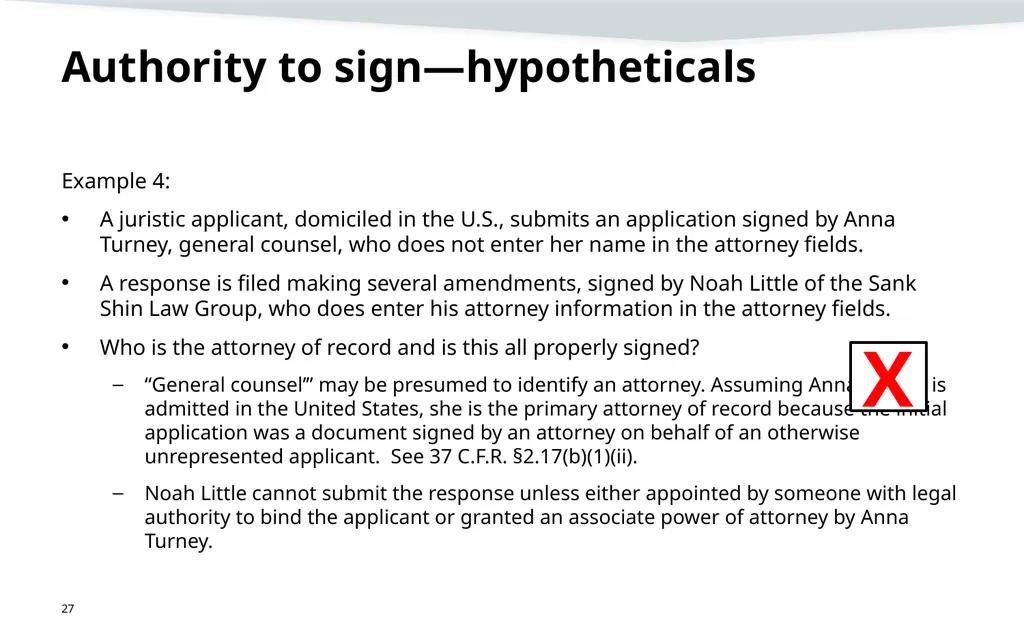
Authority to sign—hypotheticals Example 4:
A juristic applicant, domiciled in the U.S., submits an application signed by Anna Turney, general counsel, who does not enter her name in the attorney fields.
A response is filed making several amendments, signed by Noah Little of the Sank Shin Law Group, who does enter his attorney information in the attorney fields.
Who is the attorney of record and is this all properly signed?
“General counsel’” may be presumed to identify an attorney. Assuming Anna Turney is admitted in the United States, she is the primary attorney of record because the initial application was a document signed by an attorney on behalf of an otherwise unrepresented applicant. See 37 C.F.R. §2.17(b)(1)(ii).
Noah Little cannot submit the response unless either appointed by someone with legal authority to bind the applicant or granted an associate power of attorney by Anna Turney. 27 X<br>
A juristic applicant, domiciled in the U.S., submits an application signed by Anna Turney, general counsel, who does not enter her name in the attorney fields.
A response is filed making several amendments, signed by Noah Little of the Sank Shin Law Group, who does enter his attorney information in the attorney fields.
Who is the attorney of record and is this all properly signed?
“General counsel’” may be presumed to identify an attorney. Assuming Anna Turney is admitted in the United States, she is the primary attorney of record because the initial application was a document signed by an attorney on behalf of an otherwise unrepresented applicant. See 37 C.F.R. §2.17(b)(1)(ii).
Noah Little cannot submit the response unless either appointed by someone with legal authority to bind the applicant or granted an associate power of attorney by Anna Turney. 27 X<br>
27
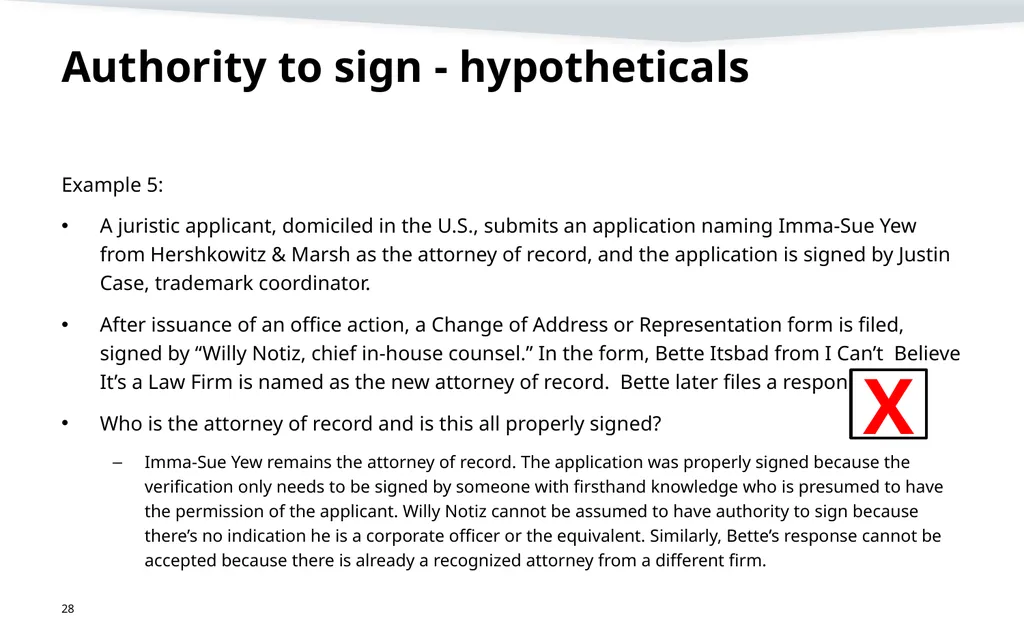
Authority to sign - hypotheticals Example 5:
A juristic applicant, domiciled in the U.S., submits an application naming Imma-Sue Yew from Hershkowitz & Marsh as the attorney of record, and the application is signed by Justin Case, trademark coordinator.
After issuance of an office action, a Change of Address or Representation form is filed, signed by “Willy Notiz, chief in-house counsel.” In the form, Bette Itsbad from I Can’t Believe It’s a Law Firm is named as the new attorney of record. Bette later files a response.
Who is the attorney of record and is this all properly signed?
Imma-Sue Yew remains the attorney of record. The application was properly signed because the verification only needs to be signed by someone with firsthand knowledge who is presumed to have the permission of the applicant. Willy Notiz cannot be assumed to have authority to sign because there’s no indication he is a corporate officer or the equivalent. Similarly, Bette’s response cannot be accepted because there is already a recognized attorney from a different firm. 28 X<br>
A juristic applicant, domiciled in the U.S., submits an application naming Imma-Sue Yew from Hershkowitz & Marsh as the attorney of record, and the application is signed by Justin Case, trademark coordinator.
After issuance of an office action, a Change of Address or Representation form is filed, signed by “Willy Notiz, chief in-house counsel.” In the form, Bette Itsbad from I Can’t Believe It’s a Law Firm is named as the new attorney of record. Bette later files a response.
Who is the attorney of record and is this all properly signed?
Imma-Sue Yew remains the attorney of record. The application was properly signed because the verification only needs to be signed by someone with firsthand knowledge who is presumed to have the permission of the applicant. Willy Notiz cannot be assumed to have authority to sign because there’s no indication he is a corporate officer or the equivalent. Similarly, Bette’s response cannot be accepted because there is already a recognized attorney from a different firm. 28 X<br>
28
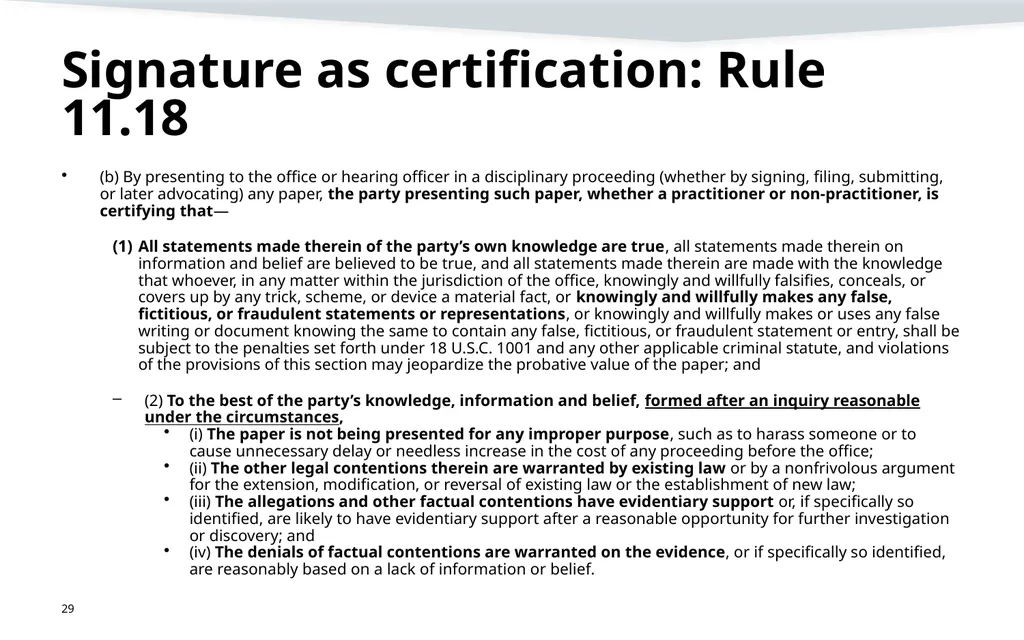
Signature as certification: Rule 11.18 (b) By presenting to the office or hearing officer in a disciplinary proceeding (whether by signing, filing, submitting, or later advocating) any paper, the party presenting such paper, whether a practitioner or non-practitioner, is certifying that—
All statements made therein of the party’s own knowledge are true, all statements made therein on information and belief are believed to be true, and all statements made therein are made with the knowledge that whoever, in any matter within the jurisdiction of the office, knowingly and willfully falsifies, conceals, or covers up by any trick, scheme, or device a material fact, or knowingly and willfully makes any false, fictitious, or fraudulent statements or representations, or knowingly and willfully makes or uses any false writing or document knowing the same to contain any false, fictitious, or fraudulent statement or entry, shall be subject to the penalties set forth under 18 U.S.C. 1001 and any other applicable criminal statute, and violations of the provisions of this section may jeopardize the probative value of the paper; and
(2) To the best of the party’s knowledge, information and belief, formed after an inquiry reasonable under the circumstances,
(i) The paper is not being presented for any improper purpose, such as to harass someone or to cause unnecessary delay or needless increase in the cost of any proceeding before the office;
(ii) The other legal contentions therein are warranted by existing law or by a nonfrivolous argument for the extension, modification, or reversal of existing law or the establishment of new law;
(iii) The allegations and other factual contentions have evidentiary support or, if specifically so identified, are likely to have evidentiary support after a reasonable opportunity for further investigation or discovery; and
(iv) The denials of factual contentions are warranted on the evidence, or if specifically so identified, are reasonably based on a lack of information or belief. 29<br>
All statements made therein of the party’s own knowledge are true, all statements made therein on information and belief are believed to be true, and all statements made therein are made with the knowledge that whoever, in any matter within the jurisdiction of the office, knowingly and willfully falsifies, conceals, or covers up by any trick, scheme, or device a material fact, or knowingly and willfully makes any false, fictitious, or fraudulent statements or representations, or knowingly and willfully makes or uses any false writing or document knowing the same to contain any false, fictitious, or fraudulent statement or entry, shall be subject to the penalties set forth under 18 U.S.C. 1001 and any other applicable criminal statute, and violations of the provisions of this section may jeopardize the probative value of the paper; and
(2) To the best of the party’s knowledge, information and belief, formed after an inquiry reasonable under the circumstances,
(i) The paper is not being presented for any improper purpose, such as to harass someone or to cause unnecessary delay or needless increase in the cost of any proceeding before the office;
(ii) The other legal contentions therein are warranted by existing law or by a nonfrivolous argument for the extension, modification, or reversal of existing law or the establishment of new law;
(iii) The allegations and other factual contentions have evidentiary support or, if specifically so identified, are likely to have evidentiary support after a reasonable opportunity for further investigation or discovery; and
(iv) The denials of factual contentions are warranted on the evidence, or if specifically so identified, are reasonably based on a lack of information or belief. 29<br>
29
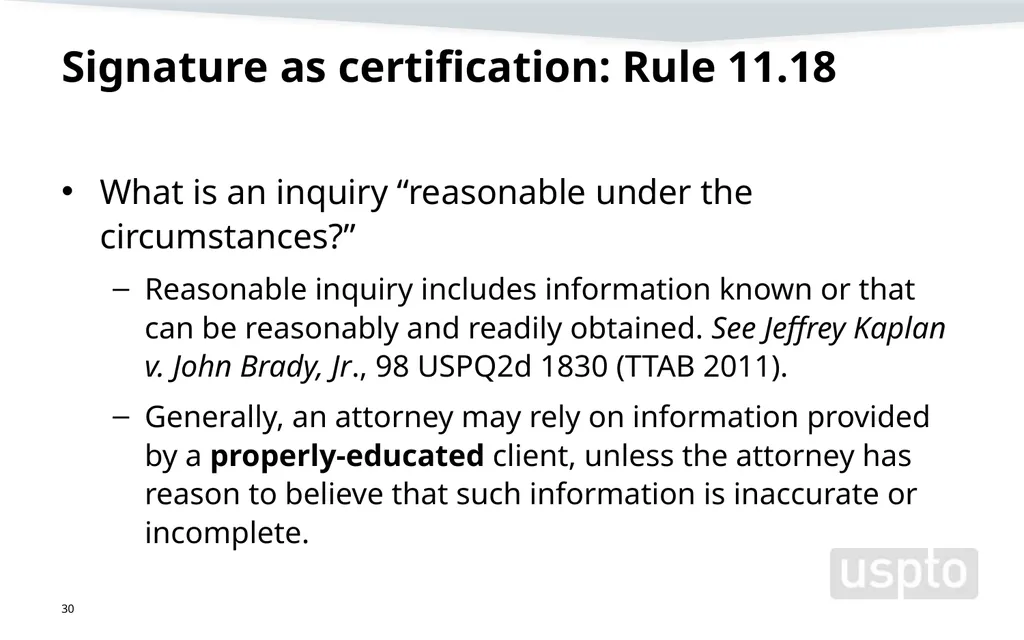
Signature as certification: Rule 11.18 What is an inquiry “reasonable under the circumstances?”
Reasonable inquiry includes information known or that can be reasonably and readily obtained. See Jeffrey Kaplan v. John Brady, Jr., 98 USPQ2d 1830 (TTAB 2011).
Generally, an attorney may rely on information provided by a properly-educated client, unless the attorney has reason to believe that such information is inaccurate or incomplete. 30<br>
Reasonable inquiry includes information known or that can be reasonably and readily obtained. See Jeffrey Kaplan v. John Brady, Jr., 98 USPQ2d 1830 (TTAB 2011).
Generally, an attorney may rely on information provided by a properly-educated client, unless the attorney has reason to believe that such information is inaccurate or incomplete. 30<br>
30
Signature as certification: Rule 11.18 What is a “reasonable inquiry” for attorneys signing declarations supporting specimens?
What is a “reasonable inquiry” for attorneys who are merely submitting responses containing declarations signed by their clients? 31<br>
What is a “reasonable inquiry” for attorneys who are merely submitting responses containing declarations signed by their clients? 31<br>
31
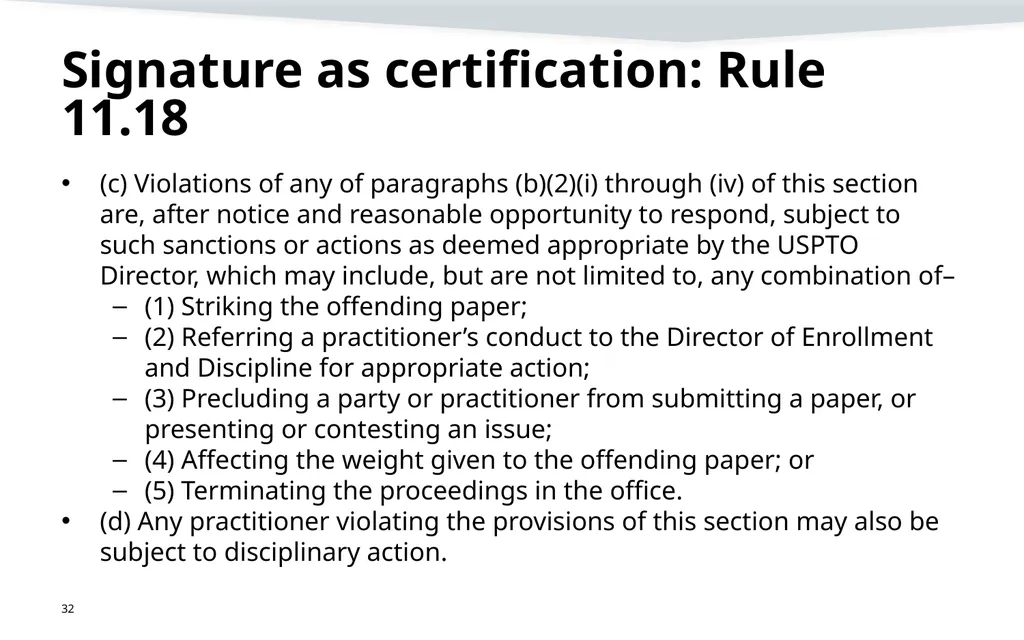
Signature as certification: Rule 11.18 (c) Violations of any of paragraphs (b)(2)(i) through (iv) of this section are, after notice and reasonable opportunity to respond, subject to such sanctions or actions as deemed appropriate by the USPTO Director, which may include, but are not limited to, any combination of–
(1) Striking the offending paper;
(2) Referring a practitioner’s conduct to the Director of Enrollment and Discipline for appropriate action;
(3) Precluding a party or practitioner from submitting a paper, or presenting or contesting an issue;
(4) Affecting the weight given to the offending paper; or
(5) Terminating the proceedings in the office.
(d) Any practitioner violating the provisions of this section may also be subject to disciplinary action. 32<br>
(1) Striking the offending paper;
(2) Referring a practitioner’s conduct to the Director of Enrollment and Discipline for appropriate action;
(3) Precluding a party or practitioner from submitting a paper, or presenting or contesting an issue;
(4) Affecting the weight given to the offending paper; or
(5) Terminating the proceedings in the office.
(d) Any practitioner violating the provisions of this section may also be subject to disciplinary action. 32<br>
32
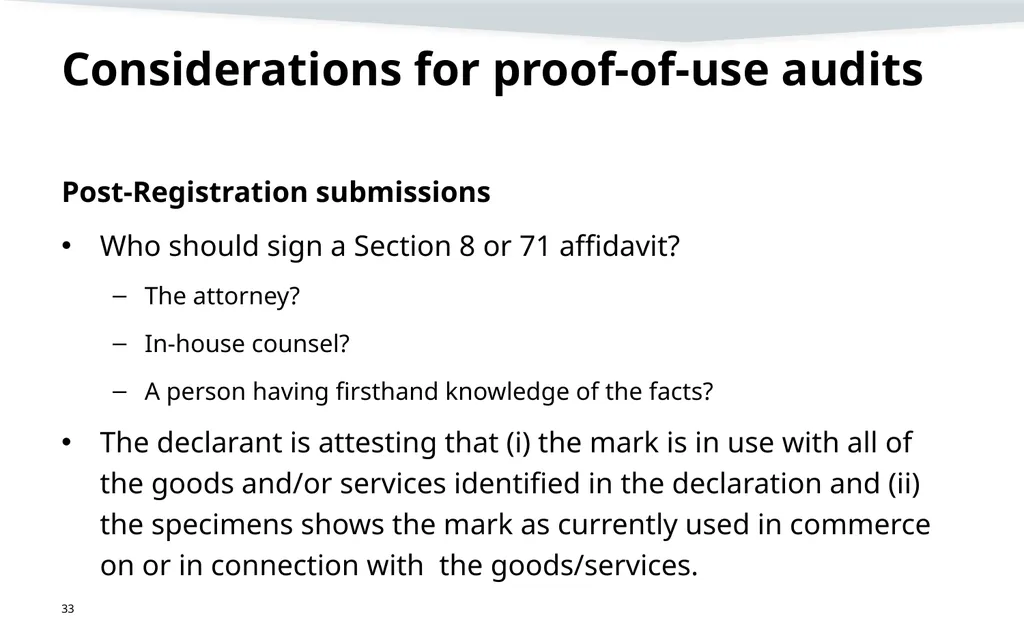
Considerations for proof-of-use audits Post-Registration submissions
Who should sign a Section 8 or 71 affidavit?
The attorney?
In-house counsel?
A person having firsthand knowledge of the facts?
The declarant is attesting that (i) the mark is in use with all of the goods and/or services identified in the declaration and (ii) the specimens shows the mark as currently used in commerce on or in connection with the goods/services. 33<br>
Who should sign a Section 8 or 71 affidavit?
The attorney?
In-house counsel?
A person having firsthand knowledge of the facts?
The declarant is attesting that (i) the mark is in use with all of the goods and/or services identified in the declaration and (ii) the specimens shows the mark as currently used in commerce on or in connection with the goods/services. 33<br>
33
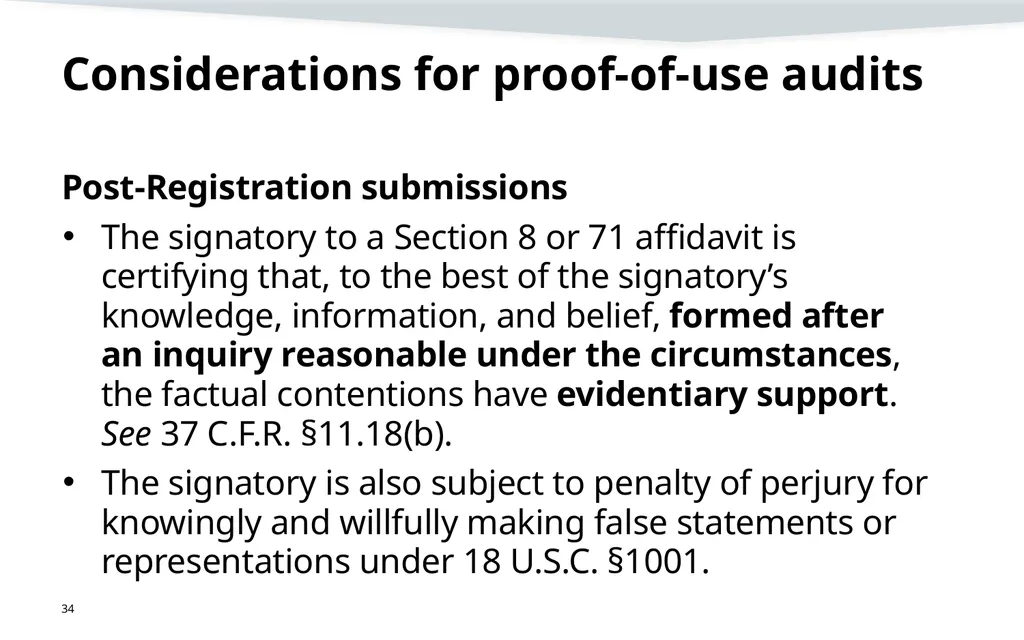
Considerations for proof-of-use audits Post-Registration submissions
The signatory to a Section 8 or 71 affidavit is certifying that, to the best of the signatory’s knowledge, information, and belief, formed after an inquiry reasonable under the circumstances, the factual contentions have evidentiary support. See 37 C.F.R. §11.18(b).
The signatory is also subject to penalty of perjury for knowingly and willfully making false statements or representations under 18 U.S.C. §1001. 34<br>
The signatory to a Section 8 or 71 affidavit is certifying that, to the best of the signatory’s knowledge, information, and belief, formed after an inquiry reasonable under the circumstances, the factual contentions have evidentiary support. See 37 C.F.R. §11.18(b).
The signatory is also subject to penalty of perjury for knowingly and willfully making false statements or representations under 18 U.S.C. §1001. 34<br>
34
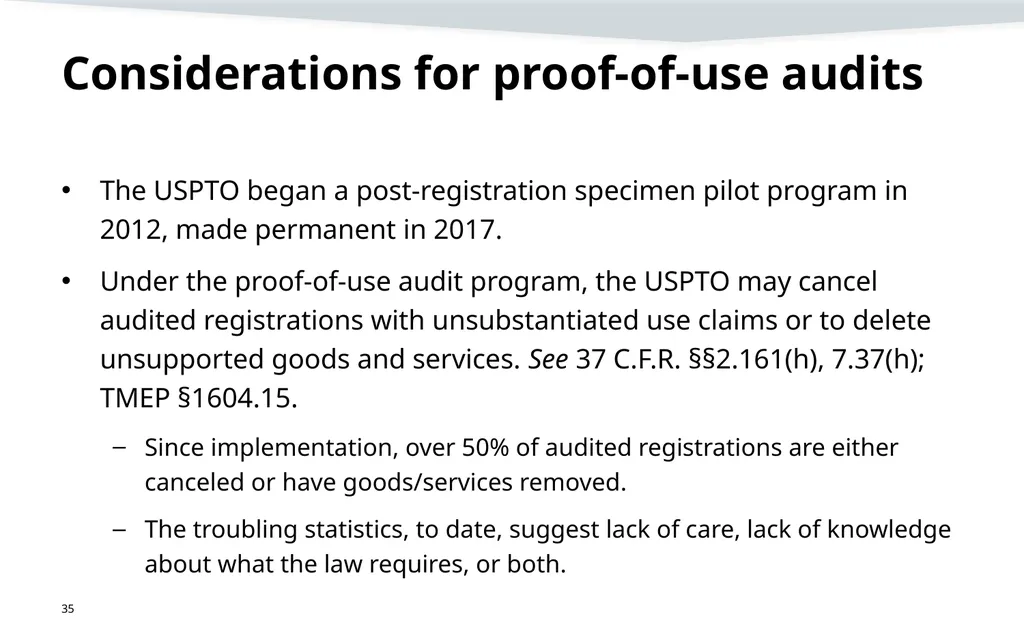
Considerations for proof-of-use audits The USPTO began a post-registration specimen pilot program in 2012, made permanent in 2017.
Under the proof-of-use audit program, the USPTO may cancel audited registrations with unsubstantiated use claims or to delete unsupported goods and services. See 37 C.F.R. §§2.161(h), 7.37(h); TMEP §1604.15.
Since implementation, over 50% of audited registrations are either canceled or have goods/services removed.
The troubling statistics, to date, suggest lack of care, lack of knowledge about what the law requires, or both. 35<br>
Under the proof-of-use audit program, the USPTO may cancel audited registrations with unsubstantiated use claims or to delete unsupported goods and services. See 37 C.F.R. §§2.161(h), 7.37(h); TMEP §1604.15.
Since implementation, over 50% of audited registrations are either canceled or have goods/services removed.
The troubling statistics, to date, suggest lack of care, lack of knowledge about what the law requires, or both. 35<br>
35
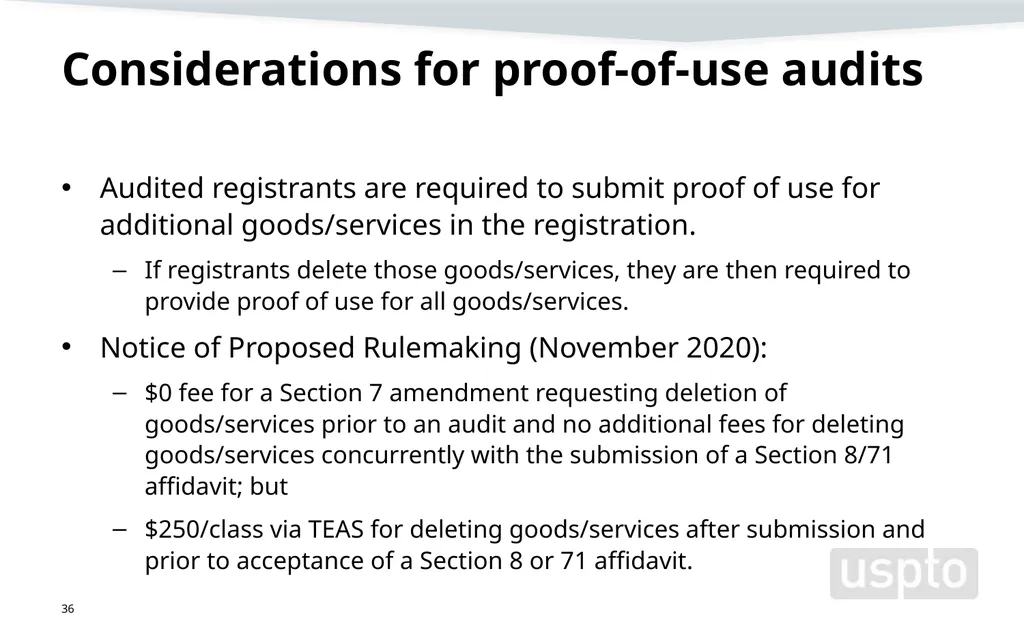
Considerations for proof-of-use audits Audited registrants are required to submit proof of use for additional goods/services in the registration.
If registrants delete those goods/services, they are then required to provide proof of use for all goods/services.
Notice of Proposed Rulemaking (November 2020):
$0 fee for a Section 7 amendment requesting deletion of goods/services prior to an audit and no additional fees for deleting goods/services concurrently with the submission of a Section 8/71 affidavit; but
$250/class via TEAS for deleting goods/services after submission and prior to acceptance of a Section 8 or 71 affidavit. 36<br>
If registrants delete those goods/services, they are then required to provide proof of use for all goods/services.
Notice of Proposed Rulemaking (November 2020):
$0 fee for a Section 7 amendment requesting deletion of goods/services prior to an audit and no additional fees for deleting goods/services concurrently with the submission of a Section 8/71 affidavit; but
$250/class via TEAS for deleting goods/services after submission and prior to acceptance of a Section 8 or 71 affidavit. 36<br>
36
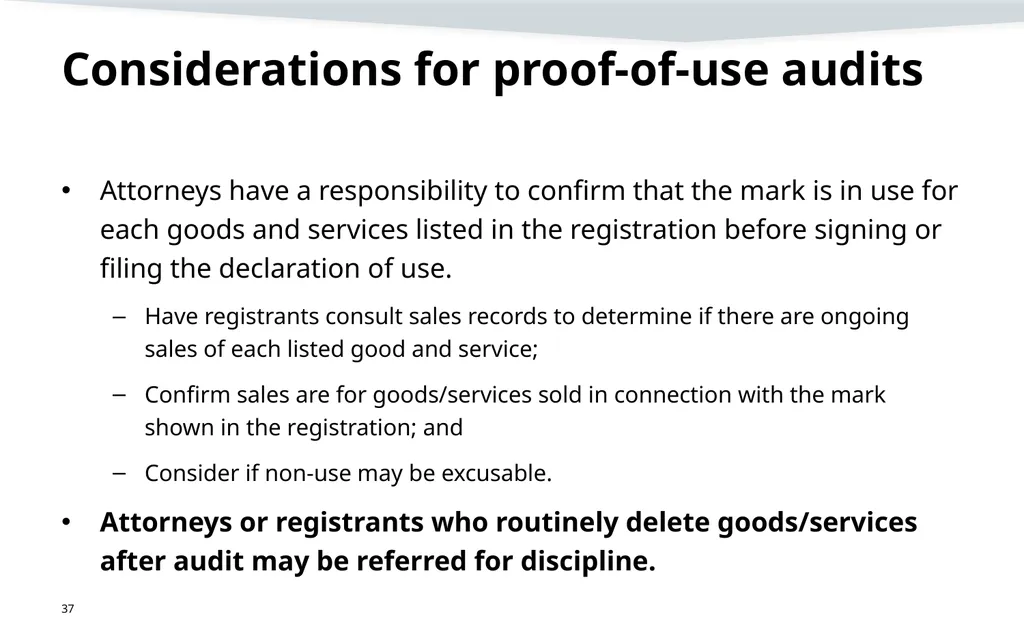
Considerations for proof-of-use audits Attorneys have a responsibility to confirm that the mark is in use for each goods and services listed in the registration before signing or filing the declaration of use.
Have registrants consult sales records to determine if there are ongoing sales of each listed good and service;
Confirm sales are for goods/services sold in connection with the mark shown in the registration; and
Consider if non-use may be excusable.
Attorneys or registrants who routinely delete goods/services after audit may be referred for discipline. 37<br>
Have registrants consult sales records to determine if there are ongoing sales of each listed good and service;
Confirm sales are for goods/services sold in connection with the mark shown in the registration; and
Consider if non-use may be excusable.
Attorneys or registrants who routinely delete goods/services after audit may be referred for discipline. 37<br>
37
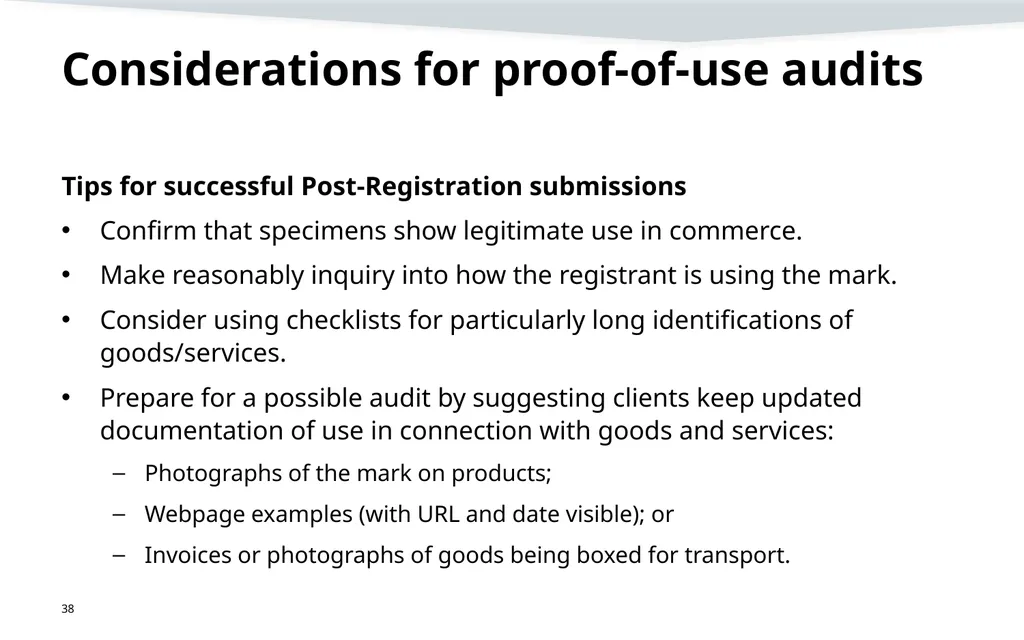
Considerations for proof-of-use audits Tips for successful Post-Registration submissions
Confirm that specimens show legitimate use in commerce.
Make reasonably inquiry into how the registrant is using the mark.
Consider using checklists for particularly long identifications of goods/services.
Prepare for a possible audit by suggesting clients keep updated documentation of use in connection with goods and services:
Photographs of the mark on products;
Webpage examples (with URL and date visible); or
Invoices or photographs of goods being boxed for transport. 38<br>
Confirm that specimens show legitimate use in commerce.
Make reasonably inquiry into how the registrant is using the mark.
Consider using checklists for particularly long identifications of goods/services.
Prepare for a possible audit by suggesting clients keep updated documentation of use in connection with goods and services:
Photographs of the mark on products;
Webpage examples (with URL and date visible); or
Invoices or photographs of goods being boxed for transport. 38<br>
38
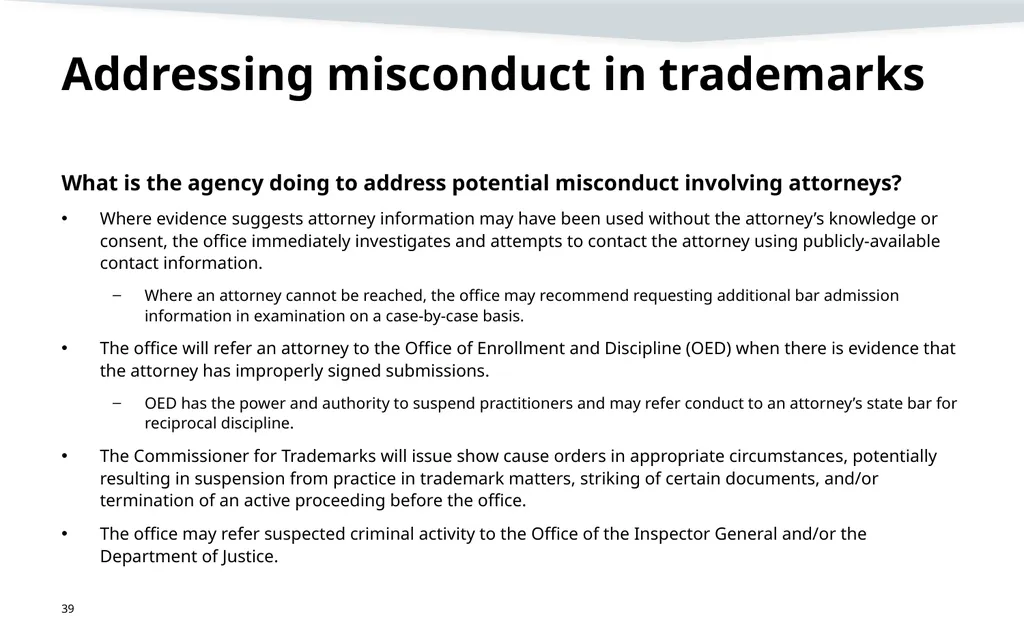
Addressing misconduct in trademarks What is the agency doing to address potential misconduct involving attorneys?
Where evidence suggests attorney information may have been used without the attorney’s knowledge or consent, the office immediately investigates and attempts to contact the attorney using publicly-available contact information.
Where an attorney cannot be reached, the office may recommend requesting additional bar admission information in examination on a case-by-case basis.
The office will refer an attorney to the Office of Enrollment and Discipline (OED) when there is evidence that the attorney has improperly signed submissions.
OED has the power and authority to suspend practitioners and may refer conduct to an attorney’s state bar for reciprocal discipline.
The Commissioner for Trademarks will issue show cause orders in appropriate circumstances, potentially resulting in suspension from practice in trademark matters, striking of certain documents, and/or termination of an active proceeding before the office.
The office may refer suspected criminal activity to the Office of the Inspector General and/or the Department of Justice. 39<br>
Where evidence suggests attorney information may have been used without the attorney’s knowledge or consent, the office immediately investigates and attempts to contact the attorney using publicly-available contact information.
Where an attorney cannot be reached, the office may recommend requesting additional bar admission information in examination on a case-by-case basis.
The office will refer an attorney to the Office of Enrollment and Discipline (OED) when there is evidence that the attorney has improperly signed submissions.
OED has the power and authority to suspend practitioners and may refer conduct to an attorney’s state bar for reciprocal discipline.
The Commissioner for Trademarks will issue show cause orders in appropriate circumstances, potentially resulting in suspension from practice in trademark matters, striking of certain documents, and/or termination of an active proceeding before the office.
The office may refer suspected criminal activity to the Office of the Inspector General and/or the Department of Justice. 39<br>
39
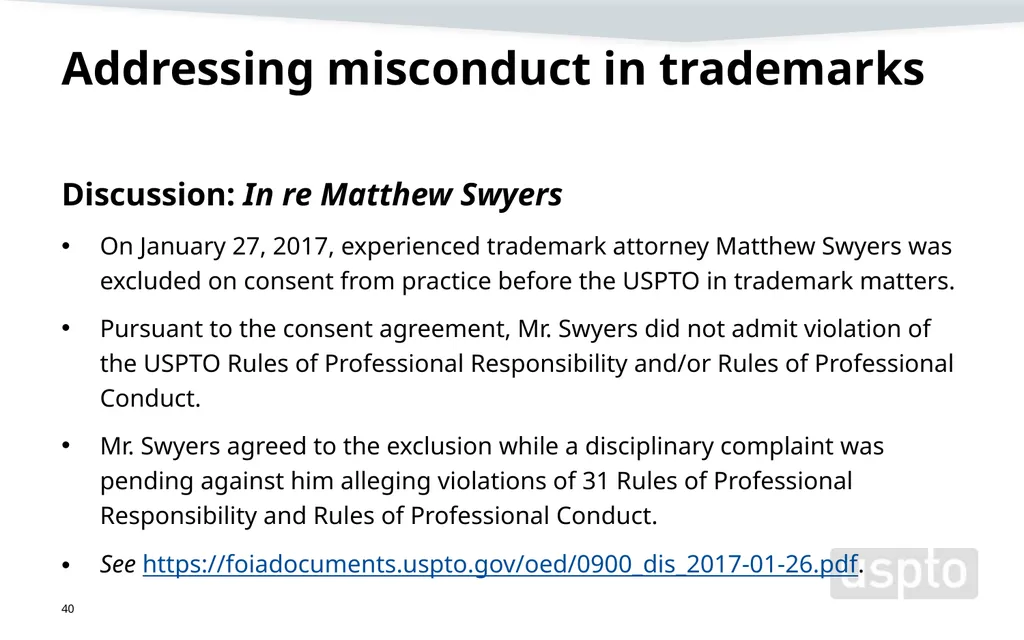
Addressing misconduct in trademarks Discussion: In re Matthew Swyers
On January 27, 2017, experienced trademark attorney Matthew Swyers was excluded on consent from practice before the USPTO in trademark matters.
Pursuant to the consent agreement, Mr. Swyers did not admit violation of the USPTO Rules of Professional Responsibility and/or Rules of Professional Conduct.
Mr. Swyers agreed to the exclusion while a disciplinary complaint was pending against him alleging violations of 31 Rules of Professional Responsibility and Rules of Professional Conduct.
See https://foiadocuments.uspto.gov/oed/0900_dis_2017-01-26.pdf. 40<br>
On January 27, 2017, experienced trademark attorney Matthew Swyers was excluded on consent from practice before the USPTO in trademark matters.
Pursuant to the consent agreement, Mr. Swyers did not admit violation of the USPTO Rules of Professional Responsibility and/or Rules of Professional Conduct.
Mr. Swyers agreed to the exclusion while a disciplinary complaint was pending against him alleging violations of 31 Rules of Professional Responsibility and Rules of Professional Conduct.
See https://foiadocuments.uspto.gov/oed/0900_dis_2017-01-26.pdf. 40<br>
40
Questions?<br>
41
If we did not reach your question, please send it via email to TMPolicy@uspto.gov with the subject line “Ethics CLE Presentation.”
Kathleen Cooney-Porter
Kathleen.Cooneyporter@uspto.gov<br>
Kathleen Cooney-Porter
Kathleen.Cooneyporter@uspto.gov<br>