
Representative Vehicle Explanation of draft



Description: Representative Vehicle Explanation of draft Vehicle LCA: Representative vehicle is key link between declaration and application Vehicle LCA Electricity Modeling Primary data share Secondary data set End of life modeling Representative
Related Topics
Download Presentation
"Representative Vehicle Explanation of draft" is the property of its rightful owner. Permission is granted to download and print the materials on this website for personal, non-commercial use only, and to display it on your personal computer provided you do not modify the materials and that you retain all copyright notices contained in the materials. By downloading content from our website, you accept the terms of this agreement.
Presentation Transcript
slide1. Representative Vehicle Explanation of draft<br>
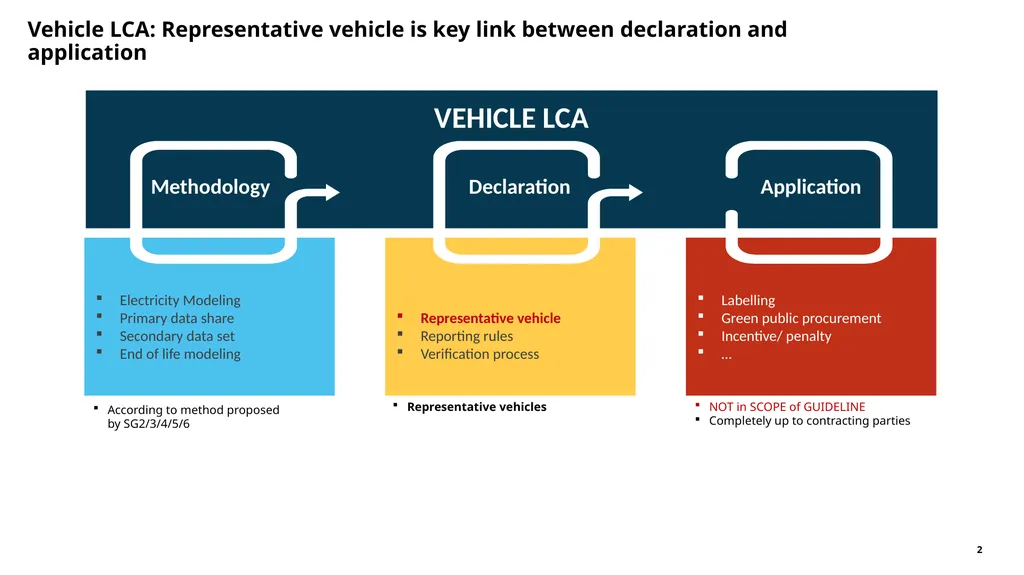
slide2. Vehicle LCA: Representative vehicle is key link between declaration and application Vehicle LCA Electricity Modeling
Primary data share
Secondary data set
End of life modeling Representative vehicle
Reporting rules
Verification process Labelling
Green public procurement
Incentive/ penalty
… Methodology Declaration Application According to method proposed by SG2/3/4/5/6 Representative vehicles NOT in SCOPE of GUIDELINE
Completely up to contracting parties<br>
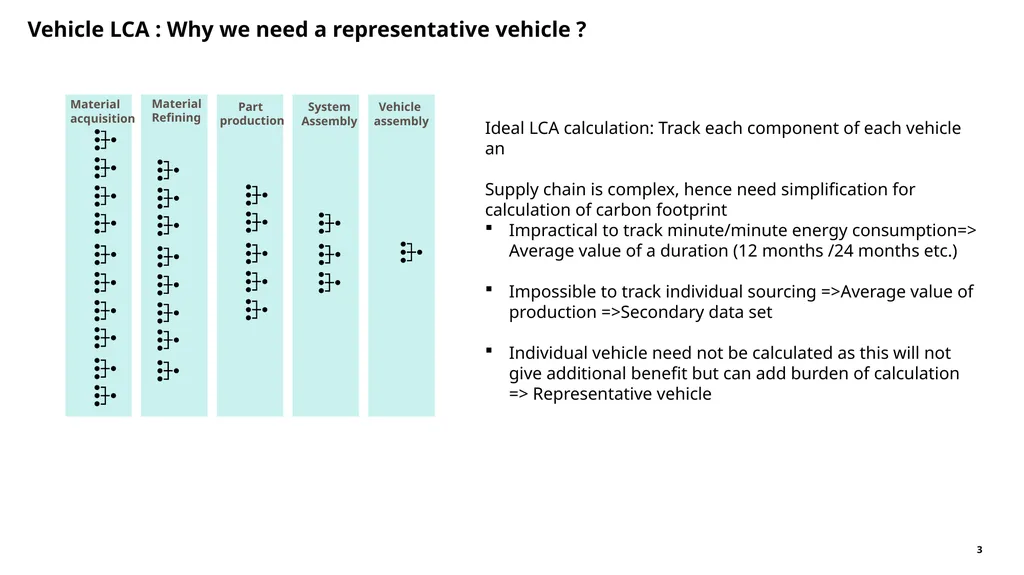
slide3. Vehicle LCA : Why we need a representative vehicle ? Material
acquisition Material
Refining Vehicle
assembly System
Assembly Part
production Ideal LCA calculation: Track each component of each vehicle an
Supply chain is complex, hence need simplification for calculation of carbon footprint
Impractical to track minute/minute energy consumption=> Average value of a duration (12 months /24 months etc.)
Impossible to track individual sourcing =>Average value of production =>Secondary data set
Individual vehicle need not be calculated as this will not give additional benefit but can add burden of calculation => Representative vehicle<br>
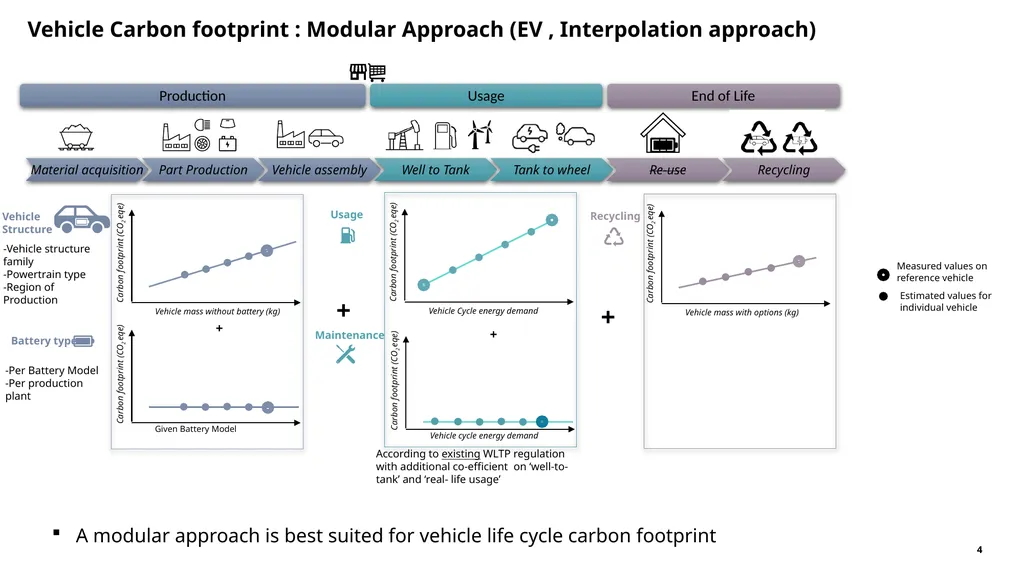
slide4. Vehicle Carbon footprint : Modular Approach (EV , Interpolation approach) Material acquisition Part Production Vehicle assembly Well to Tank Tank to wheel Re-use Recycling End of Life Usage Production Vehicle mass without battery (kg) Given Battery Model Carbon footprint (CO2 eqe) Carbon footprint (CO2 eqe) + Vehicle mass with options (kg) Carbon footprint (CO2 eqe) Vehicle Cycle energy demand Carbon footprint (CO2 eqe) + + -Per Battery Model
-Per production plant According to existing WLTP regulation with additional co-efficient on ‘well-to-tank’ and ‘real- life usage’ Measured values on reference vehicle Estimated values for individual vehicle A modular approach is best suited for vehicle life cycle carbon footprint -Vehicle structure family
-Powertrain type
-Region of Production Vehicle cycle energy demand Carbon footprint (CO2 eqe) + Battery type Vehicle
Structure Usage Maintenance Recycling<br>
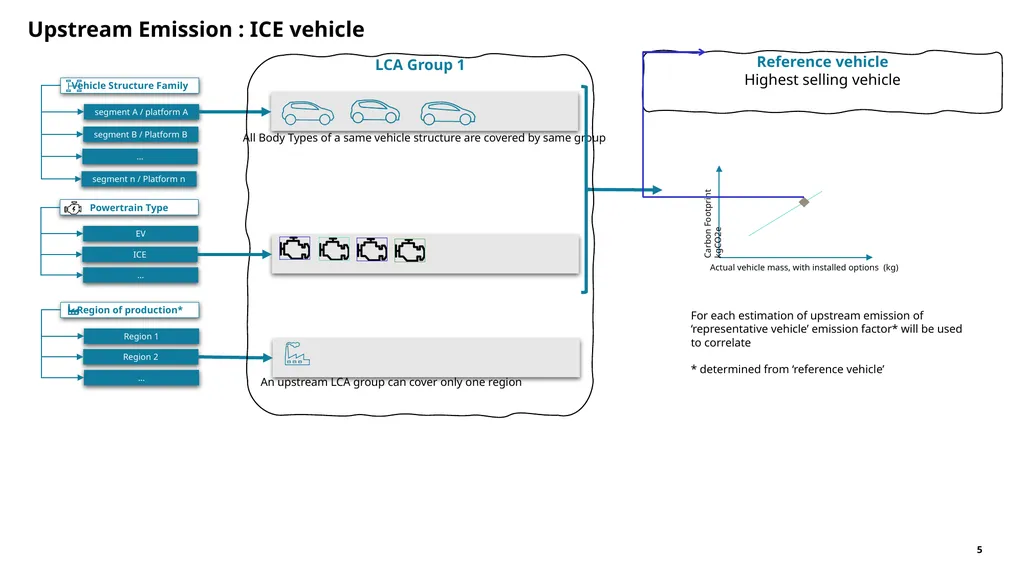
slide5. Upstream Emission : ICE vehicle Vehicle Structure Family segment A / platform A segment B / Platform B segment n / Platform n … Region of production* Region 1 Region 2 … All Body Types of a same vehicle structure are covered by same group An upstream LCA group can cover only one region LCA Group 1 Reference vehicle
Highest selling vehicle For each estimation of upstream emission of ‘representative vehicle’ emission factor* will be used to correlate
* determined from ‘reference vehicle’ Powertrain Type EV ICE …<br>
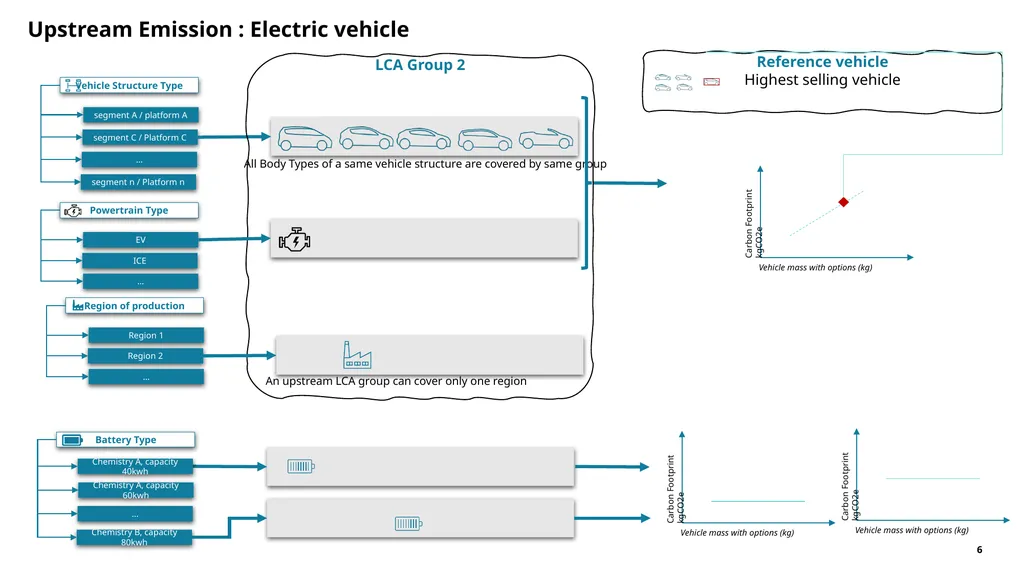
slide6. Upstream Emission : Electric vehicle Vehicle Structure Type segment A / platform A segment C / Platform C segment n / Platform n … All Body Types of a same vehicle structure are covered by same group LCA Group 2 Reference vehicle
Highest selling vehicle Region of production Region 1 Region 2 … An upstream LCA group can cover only one region Powertrain Type EV ICE …<br>
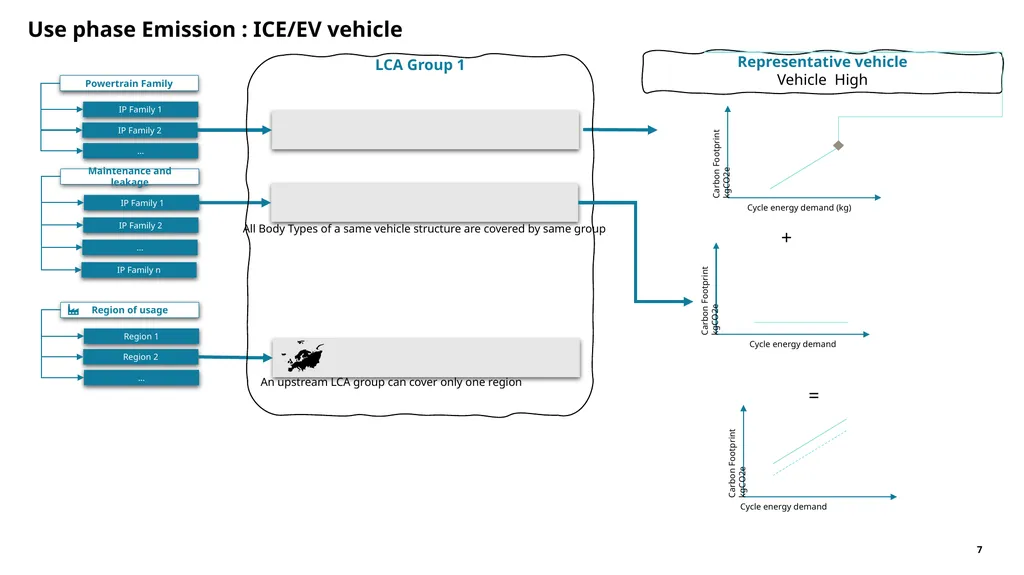
slide7. Use phase Emission : ICE/EV vehicle Maintenance and leakage IP Family 1 IP Family 2 IP Family n … Region of usage Region 1 Region 2 … Powertrain Family IP Family 1 IP Family 2 … All Body Types of a same vehicle structure are covered by same group An upstream LCA group can cover only one region LCA Group 1 Representative vehicle
Vehicle High + =<br>
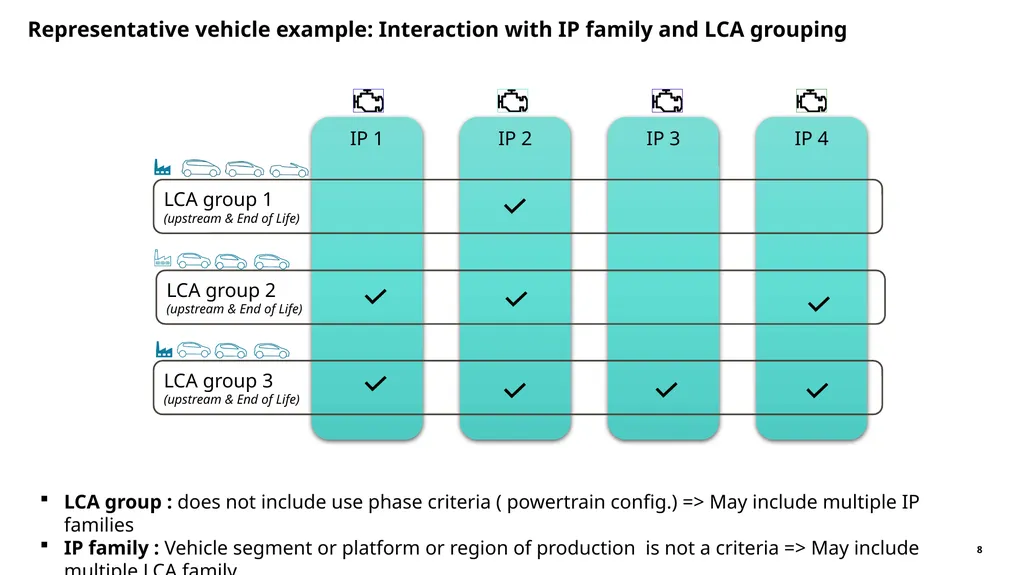
slide8. IP 3 IP 4 IP 1 IP 2 Representative vehicle example: Interaction with IP family and LCA grouping LCA group : does not include use phase criteria ( powertrain config.) => May include multiple IP families
IP family : Vehicle segment or platform or region of production is not a criteria => May include multiple LCA family LCA group 1
(upstream & End of Life) LCA group 3
(upstream & End of Life) LCA group 2
(upstream & End of Life)<br>
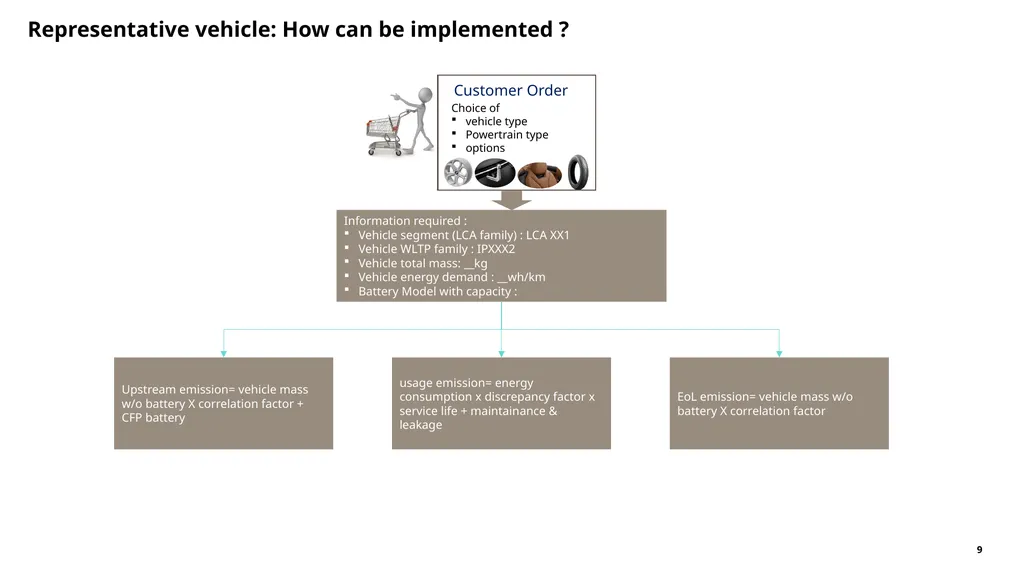
slide9. Representative vehicle: How can be implemented ? Information required :
Vehicle segment (LCA family) : LCA XX1
Vehicle WLTP family : IPXXX2
Vehicle total mass: __kg
Vehicle energy demand : __wh/km
Battery Model with capacity : Upstream emission= vehicle mass w/o battery X correlation factor + CFP battery usage emission= energy consumption x discrepancy factor x service life + maintainance & leakage EoL emission= vehicle mass w/o battery X correlation factor<br>
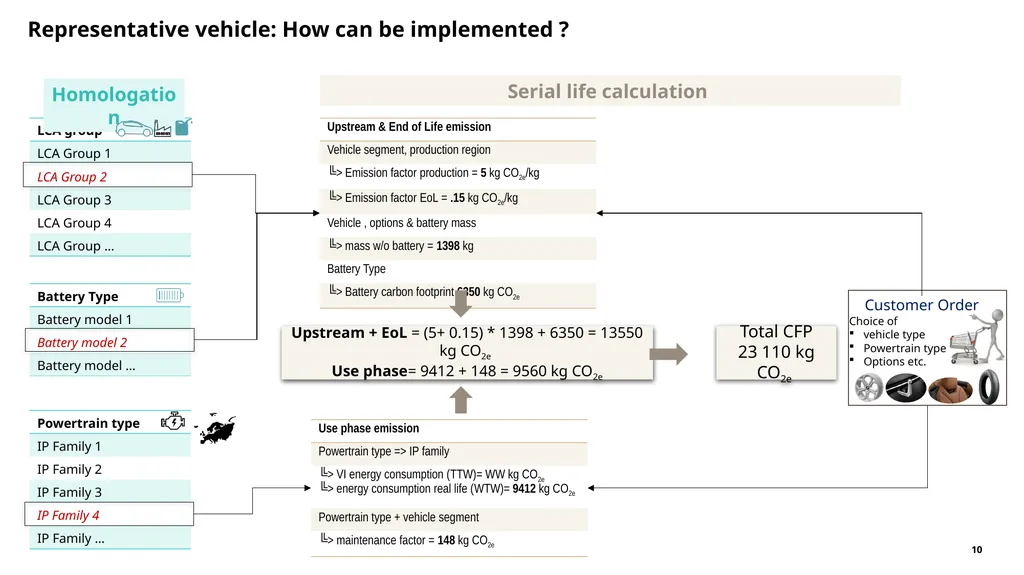
slide10. Representative vehicle: How can be implemented ? Homologation Serial life calculation Upstream + EoL = (5+ 0.15) * 1398 + 6350 = 13550 kg CO2e
Use phase= 9412 + 148 = 9560 kg CO2e Total CFP
23 110 kg CO2e<br>
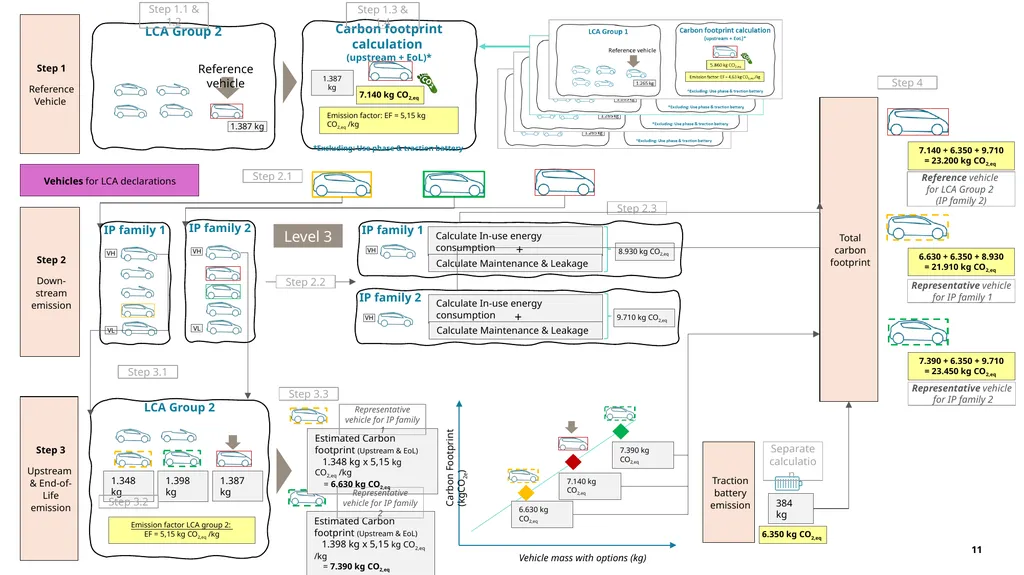
slide11. 384 kg Step 1
Reference Vehicle Step 3
Upstream & End-of-Life emission Vehicles for LCA declarations Step 2
Down-stream emission 1.387 kg 1.398 kg 1.348 kg IP family 2 VH VL IP family 1 VH VL Step 2.1 Step 1.1 & 1.2 Step 1.3 & 1.4 LCA Group 2 Step 3.1 Step 3.2 Emission factor LCA group 2: EF = 5,15 kg CO2,eq /kg Estimated Carbon footprint (Upstream & EoL) 1.348 kg x 5,15 kg CO2,eq /kg = 6.630 kg CO2,eq Estimated Carbon footprint (Upstream & EoL) 1.398 kg x 5,15 kg CO2,eq /kg = 7.390 kg CO2,eq Step 3.3 Traction battery emission 6.350 kg CO2,eq Total carbon footprint 7.390 + 6.350 + 9.710
= 23.450 kg CO2,eq 6.630 + 6.350 + 8.930
= 21.910 kg CO2,eq 7.140 + 6.350 + 9.710
= 23.200 kg CO2,eq Step 4 Separate calculation 1.387 kg Representative vehicle for IP family 1 Representative vehicle for IP family 2 Representative vehicle for IP family 1 Representative vehicle for IP family 2 Reference vehicle for LCA Group 2 (IP family 2) Level 3 VH IP family 1 VH IP family 2 Calculate In-use energy consumption Calculate Maintenance & Leakage Step 2.2 8.930 kg CO2,eq 9.710 kg CO2,eq Calculate In-use energy consumption Calculate Maintenance & Leakage + + Step 2.3<br>
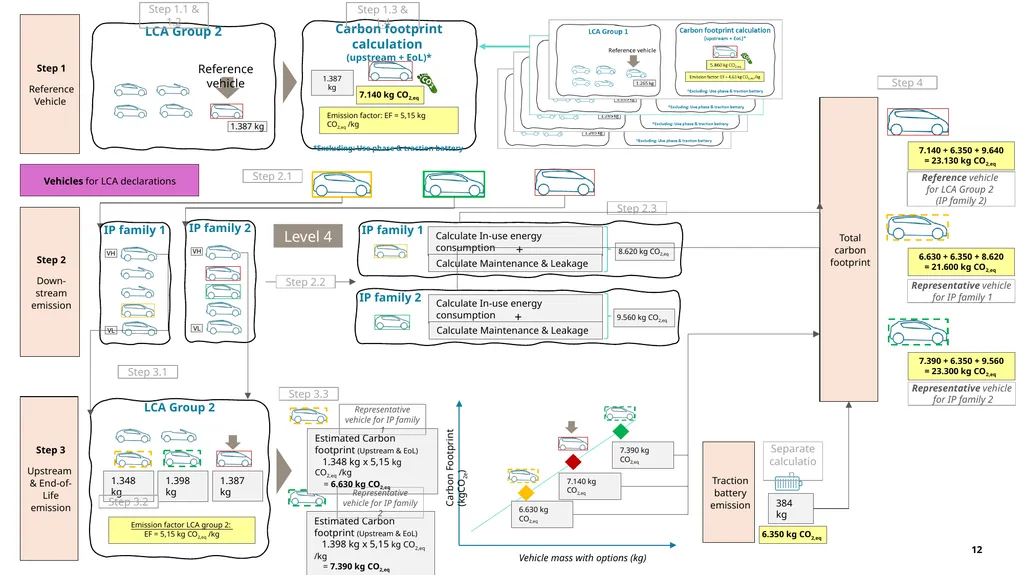
slide12. 384 kg Step 1
Reference Vehicle Step 3
Upstream & End-of-Life emission Vehicles for LCA declarations Step 2
Down-stream emission 1.387 kg 1.398 kg 1.348 kg IP family 2 VH VL IP family 1 VH VL Step 2.1 Step 1.1 & 1.2 Step 1.3 & 1.4 LCA Group 2 Step 3.1 Step 3.2 Emission factor LCA group 2: EF = 5,15 kg CO2,eq /kg Estimated Carbon footprint (Upstream & EoL) 1.348 kg x 5,15 kg CO2,eq /kg = 6.630 kg CO2,eq Estimated Carbon footprint (Upstream & EoL) 1.398 kg x 5,15 kg CO2,eq /kg = 7.390 kg CO2,eq Step 3.3 Traction battery emission 6.350 kg CO2,eq Total carbon footprint 7.390 + 6.350 + 9.560
= 23.300 kg CO2,eq 6.630 + 6.350 + 8.620
= 21.600 kg CO2,eq 7.140 + 6.350 + 9.640
= 23.130 kg CO2,eq Step 4 Separate calculation 1.387 kg Representative vehicle for IP family 1 Representative vehicle for IP family 2 Representative vehicle for IP family 1 Representative vehicle for IP family 2 Reference vehicle for LCA Group 2 (IP family 2) IP family 1 IP family 2 Calculate In-use energy consumption Calculate Maintenance & Leakage Step 2.2 8.620 kg CO2,eq 9.560 kg CO2,eq Calculate In-use energy consumption Calculate Maintenance & Leakage + + Step 2.3 Level 4<br>
slide13. Department / Date<br>
slide14. Upstream Emission : Electric vehicle Vehicle Structure Type segment A / platform A segment C / Platform C segment n / Platform n … Battery Type Chemistry A, capacity 40kwh Chemistry A, capacity 60kwh Chemistry B, capacity 80kwh … Region of production Region 1 Region 2 … + All Body Types of a same vehicle structure are covered by same group An upstream LCA group can cover only one region = LCA Group 2 Reference vehicle
Highest selling vehicle + = Powertrain Type EV ICE …<br>
slide2. Vehicle LCA: Representative vehicle is key link between declaration and application Vehicle LCA Electricity Modeling
Primary data share
Secondary data set
End of life modeling Representative vehicle
Reporting rules
Verification process Labelling
Green public procurement
Incentive/ penalty
… Methodology Declaration Application According to method proposed by SG2/3/4/5/6 Representative vehicles NOT in SCOPE of GUIDELINE
Completely up to contracting parties<br>
slide3. Vehicle LCA : Why we need a representative vehicle ? Material
acquisition Material
Refining Vehicle
assembly System
Assembly Part
production Ideal LCA calculation: Track each component of each vehicle an
Supply chain is complex, hence need simplification for calculation of carbon footprint
Impractical to track minute/minute energy consumption=> Average value of a duration (12 months /24 months etc.)
Impossible to track individual sourcing =>Average value of production =>Secondary data set
Individual vehicle need not be calculated as this will not give additional benefit but can add burden of calculation => Representative vehicle<br>
slide4. Vehicle Carbon footprint : Modular Approach (EV , Interpolation approach) Material acquisition Part Production Vehicle assembly Well to Tank Tank to wheel Re-use Recycling End of Life Usage Production Vehicle mass without battery (kg) Given Battery Model Carbon footprint (CO2 eqe) Carbon footprint (CO2 eqe) + Vehicle mass with options (kg) Carbon footprint (CO2 eqe) Vehicle Cycle energy demand Carbon footprint (CO2 eqe) + + -Per Battery Model
-Per production plant According to existing WLTP regulation with additional co-efficient on ‘well-to-tank’ and ‘real- life usage’ Measured values on reference vehicle Estimated values for individual vehicle A modular approach is best suited for vehicle life cycle carbon footprint -Vehicle structure family
-Powertrain type
-Region of Production Vehicle cycle energy demand Carbon footprint (CO2 eqe) + Battery type Vehicle
Structure Usage Maintenance Recycling<br>
slide5. Upstream Emission : ICE vehicle Vehicle Structure Family segment A / platform A segment B / Platform B segment n / Platform n … Region of production* Region 1 Region 2 … All Body Types of a same vehicle structure are covered by same group An upstream LCA group can cover only one region LCA Group 1 Reference vehicle
Highest selling vehicle For each estimation of upstream emission of ‘representative vehicle’ emission factor* will be used to correlate
* determined from ‘reference vehicle’ Powertrain Type EV ICE …<br>
slide6. Upstream Emission : Electric vehicle Vehicle Structure Type segment A / platform A segment C / Platform C segment n / Platform n … All Body Types of a same vehicle structure are covered by same group LCA Group 2 Reference vehicle
Highest selling vehicle Region of production Region 1 Region 2 … An upstream LCA group can cover only one region Powertrain Type EV ICE …<br>
slide7. Use phase Emission : ICE/EV vehicle Maintenance and leakage IP Family 1 IP Family 2 IP Family n … Region of usage Region 1 Region 2 … Powertrain Family IP Family 1 IP Family 2 … All Body Types of a same vehicle structure are covered by same group An upstream LCA group can cover only one region LCA Group 1 Representative vehicle
Vehicle High + =<br>
slide8. IP 3 IP 4 IP 1 IP 2 Representative vehicle example: Interaction with IP family and LCA grouping LCA group : does not include use phase criteria ( powertrain config.) => May include multiple IP families
IP family : Vehicle segment or platform or region of production is not a criteria => May include multiple LCA family LCA group 1
(upstream & End of Life) LCA group 3
(upstream & End of Life) LCA group 2
(upstream & End of Life)<br>
slide9. Representative vehicle: How can be implemented ? Information required :
Vehicle segment (LCA family) : LCA XX1
Vehicle WLTP family : IPXXX2
Vehicle total mass: __kg
Vehicle energy demand : __wh/km
Battery Model with capacity : Upstream emission= vehicle mass w/o battery X correlation factor + CFP battery usage emission= energy consumption x discrepancy factor x service life + maintainance & leakage EoL emission= vehicle mass w/o battery X correlation factor<br>
slide10. Representative vehicle: How can be implemented ? Homologation Serial life calculation Upstream + EoL = (5+ 0.15) * 1398 + 6350 = 13550 kg CO2e
Use phase= 9412 + 148 = 9560 kg CO2e Total CFP
23 110 kg CO2e<br>
slide11. 384 kg Step 1
Reference Vehicle Step 3
Upstream & End-of-Life emission Vehicles for LCA declarations Step 2
Down-stream emission 1.387 kg 1.398 kg 1.348 kg IP family 2 VH VL IP family 1 VH VL Step 2.1 Step 1.1 & 1.2 Step 1.3 & 1.4 LCA Group 2 Step 3.1 Step 3.2 Emission factor LCA group 2: EF = 5,15 kg CO2,eq /kg Estimated Carbon footprint (Upstream & EoL) 1.348 kg x 5,15 kg CO2,eq /kg = 6.630 kg CO2,eq Estimated Carbon footprint (Upstream & EoL) 1.398 kg x 5,15 kg CO2,eq /kg = 7.390 kg CO2,eq Step 3.3 Traction battery emission 6.350 kg CO2,eq Total carbon footprint 7.390 + 6.350 + 9.710
= 23.450 kg CO2,eq 6.630 + 6.350 + 8.930
= 21.910 kg CO2,eq 7.140 + 6.350 + 9.710
= 23.200 kg CO2,eq Step 4 Separate calculation 1.387 kg Representative vehicle for IP family 1 Representative vehicle for IP family 2 Representative vehicle for IP family 1 Representative vehicle for IP family 2 Reference vehicle for LCA Group 2 (IP family 2) Level 3 VH IP family 1 VH IP family 2 Calculate In-use energy consumption Calculate Maintenance & Leakage Step 2.2 8.930 kg CO2,eq 9.710 kg CO2,eq Calculate In-use energy consumption Calculate Maintenance & Leakage + + Step 2.3<br>
slide12. 384 kg Step 1
Reference Vehicle Step 3
Upstream & End-of-Life emission Vehicles for LCA declarations Step 2
Down-stream emission 1.387 kg 1.398 kg 1.348 kg IP family 2 VH VL IP family 1 VH VL Step 2.1 Step 1.1 & 1.2 Step 1.3 & 1.4 LCA Group 2 Step 3.1 Step 3.2 Emission factor LCA group 2: EF = 5,15 kg CO2,eq /kg Estimated Carbon footprint (Upstream & EoL) 1.348 kg x 5,15 kg CO2,eq /kg = 6.630 kg CO2,eq Estimated Carbon footprint (Upstream & EoL) 1.398 kg x 5,15 kg CO2,eq /kg = 7.390 kg CO2,eq Step 3.3 Traction battery emission 6.350 kg CO2,eq Total carbon footprint 7.390 + 6.350 + 9.560
= 23.300 kg CO2,eq 6.630 + 6.350 + 8.620
= 21.600 kg CO2,eq 7.140 + 6.350 + 9.640
= 23.130 kg CO2,eq Step 4 Separate calculation 1.387 kg Representative vehicle for IP family 1 Representative vehicle for IP family 2 Representative vehicle for IP family 1 Representative vehicle for IP family 2 Reference vehicle for LCA Group 2 (IP family 2) IP family 1 IP family 2 Calculate In-use energy consumption Calculate Maintenance & Leakage Step 2.2 8.620 kg CO2,eq 9.560 kg CO2,eq Calculate In-use energy consumption Calculate Maintenance & Leakage + + Step 2.3 Level 4<br>
slide13. Department / Date<br>
slide14. Upstream Emission : Electric vehicle Vehicle Structure Type segment A / platform A segment C / Platform C segment n / Platform n … Battery Type Chemistry A, capacity 40kwh Chemistry A, capacity 60kwh Chemistry B, capacity 80kwh … Region of production Region 1 Region 2 … + All Body Types of a same vehicle structure are covered by same group An upstream LCA group can cover only one region = LCA Group 2 Reference vehicle
Highest selling vehicle + = Powertrain Type EV ICE …<br>