04
The Mesozoic Era Copyright © McGraw-Hill Education Mesozoic Paleogeography
The mass extinction event that ended the Paleozoic Era ushered in new opportunities for animals and plants of the Mesozoic Era. While some groups of these organisms that lived during the Mesozoic Era remain on Earth today, none of the giant reptiles that dominated the land, sea, and air and typified the period survived.<br>
05
The Mesozoic Era Copyright © McGraw-Hill Education Mesozoic Paleogeography
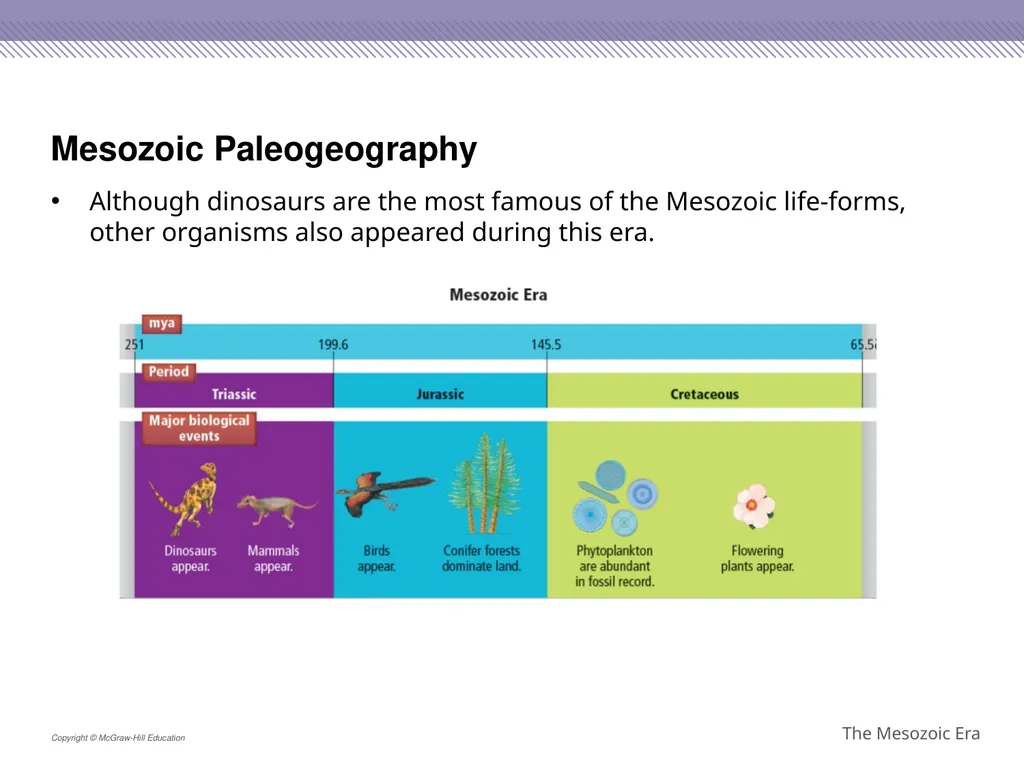
Although dinosaurs are the most famous of the Mesozoic life-forms, other organisms also appeared during this era.<br>
06
The Mesozoic Era Copyright © McGraw-Hill Education Mesozoic Paleogeography
Breakup of Pangaea
When the Mesozoic Era began, a single global ocean and a single continent—Pangaea— defined Earth’s paleogeography. During the late Triassic Period, Pangaea began to break apart.<br>
07
The Mesozoic Era Copyright © McGraw-Hill Education Mesozoic Paleogeography
Breakup of Pangaea
The heat beneath Pangaea caused the continent to expand, and Pangaea’s brittle lithosphere began to crack. Some of the large cracks, called rifts, gradually widened, and the landmass began spreading apart.<br>
08
The Mesozoic Era Copyright © McGraw-Hill Education Mesozoic Paleogeography
Seaways
As the continents continued to split apart, mid-ocean rift systems developed at the junctures, and the widening seaways became oceans.<br>
09
The Mesozoic Era Copyright © McGraw-Hill Education Mesozoic Paleogeography
Seaways
The Atlantic Ocean began forming in the Triassic as North America rifted away from Europe and Africa. Some of the spreading areas at this juncture joined to form a long, continuous rift system called the Mid-Atlantic Ridge.<br>
10
The Mesozoic Era Copyright © McGraw-Hill Education Mesozoic Paleogeography
Changing sea level
The formation of mid-ocean rift systems was partly responsible for a rise in sea level during the Mesozoic.
However, sea level dropped at the end of the Triassic, and desertlike conditions developed in western North America.<br>
11
The Mesozoic Era Copyright © McGraw-Hill Education Mesozoic Paleogeography
Changing sea level
Sea level rose again during the Jurassic, and a shallow sea formed in North America’s center. The ocean continued to rise during the Cretaceous, covering much of North America’s interior.<br>
12
The Mesozoic Era Copyright © McGraw-Hill Education Mesozoic Paleogeography
Changing sea level
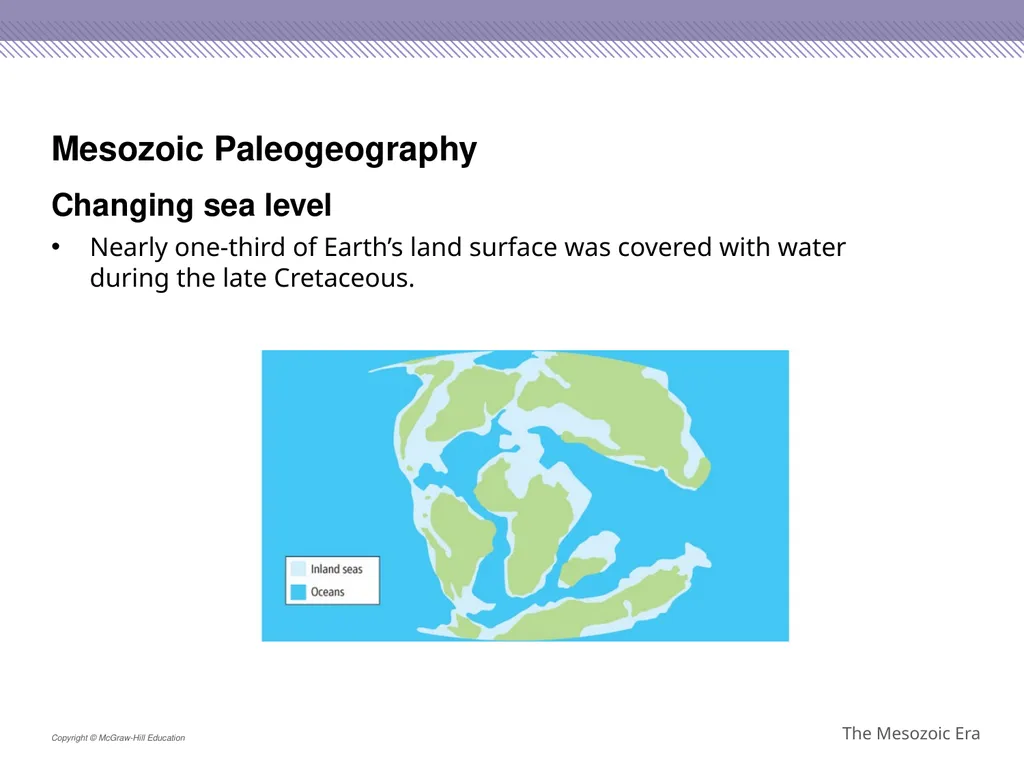
Nearly one-third of Earth’s land surface was covered with water during the late Cretaceous.<br>
13
The Mesozoic Era Copyright © McGraw-Hill Education Mountain Building
The breakup of Pangaea proceeded during the Mesozoic and early Cenozoic. During this time, multiple mountain-building episodes occurred along Laurentia’s western margin, while little was happening along its eastern edge.<br>
14
The Mesozoic Era Copyright © McGraw-Hill Education Mountain Building
Cordillera
Much of the mountain building that occurred in western Laurentia was caused by the subduction of the oceanic Farallon Plate beneath Laurentia’s western margin.<br>
15
The Mesozoic Era Copyright © McGraw-Hill Education Mountain Building
Cordillera
As the Farallon Plate descended, many structural features of the present-day Rocky Mountains, Sierra Nevada, and other western mountain ranges were formed.
Geologists call these ranges collectively the North American Cordillera.<br>
16
The Mesozoic Era Copyright © McGraw-Hill Education Mountain Building
Cordillera
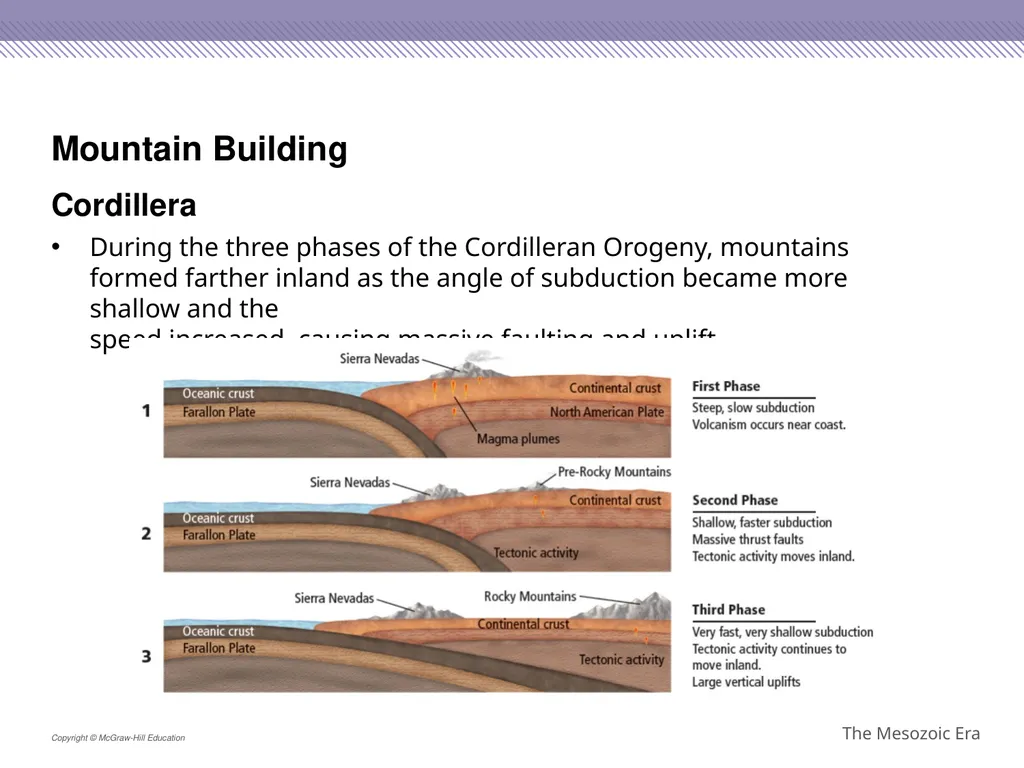
The first phase of the Cordilleran Orogeny occurred during the late Jurassic and early Cretaceous when subduction proceeded slowly and the oceanic plate descended at a steep angle, producing magma, which at the site of the emerging Sierra Nevadas.<br>
17
The Mesozoic Era Copyright © McGraw-Hill Education Mountain Building
Cordillera
The second phase of the Cordilleran Orogeny occurred during the Cretaceous when subduction increased in speed but the oceanic plate descended at a shallow angle.<br>
18
The Mesozoic Era Copyright © McGraw-Hill Education Mountain Building
Cordillera
During the third phase of the Cordilleran Orogeny, which began during the late Cretaceous and continued into the Cenozoic, subduction was even more shallow and rapid than it was during the second phase.<br>
19
The Mesozoic Era Copyright © McGraw-Hill Education Mountain Building
Cordillera
During the three phases of the Cordilleran Orogeny, mountains formed farther inland as the angle of subduction became more shallow and the�speed increased, causing massive faulting and uplift.<br>
20
The Mesozoic Era Copyright © McGraw-Hill Education Mesozoic Life
As Pangaea broke apart during the early Mesozoic, much of the habitat on the continental shelves that was lost during Pangaea's formation once again became available.
New marine organisms, ranging from large predatory reptiles to tiny photosynthetic phytoplankton, evolved to fill these niches.<br>
21
The Mesozoic Era Copyright © McGraw-Hill Education Mesozoic Life
Phytoplankton were, and are today, microscopic organisms at the base of the marine food chain. These organisms were abundant during the Cretaceous. The remains of their shell-like hard parts are found in chalk deposits worldwide.<br>
22
The Mesozoic Era Copyright © McGraw-Hill Education Mesozoic Life
Plant life
As the cool climate that characterized the late Paleozoic came to an end during the Mesozoic, plant life changed sharply. The large, temperate swamps dried as the climate warmed. Tall cycad trees, ginkgos, pine trees, and other conifers evolved during the Jurassic.<br>
23
The Mesozoic Era Copyright © McGraw-Hill Education Mesozoic Life
Terrestrial animals
An amniotic egg is an egg that has a shell and provides a complete environment for a developing embryo.
The dominant Mesozoic animals were the reptiles. Amniotic eggs made it possible for reptiles, including dinosaurs, to roam widely.<br>
24
The Mesozoic Era Copyright © McGraw-Hill Education Mesozoic Life
Terrestrial animals
Archosaurs are a group of reptiles which includes dinosaurs and crocodilians. Archosaurs have a hip structure that allows the legs to be held underneath the body. This enabled some dinosaurs to run with an upright posture.<br>
25
The Mesozoic Era Copyright © McGraw-Hill Education Mesozoic Life
Mass extinction
At the end of the Mesozoic, an extinction event devastated terrestrial dinosaurs, most marine reptiles, plants, and many other organisms.<br>
26
The Mesozoic Era Copyright © McGraw-Hill Education Mesozoic Life
Mass extinction
Today, most scientists agree that the combination of massive volcanism, which stressed Earth’s climate, and a large meteorite impact that occurred at the end of the Cretaceous is responsible for the extinction event.<br>
27
The Mesozoic Era Copyright © McGraw-Hill Education Mesozoic Life
Mass extinction
Evidence of a large meteorite impact includes an impact site—Chicxulub Crater—on Mexico’s Yucatan Peninsula, and a clay layer that separates Cretaceous rocks from rocks of the first period of the Cenozoic.
Found worldwide, this layer contains an unusually high amount of iridium, a rare metal in Earth’s rocks but a relatively common metal in asteroids.<br>
28
Copyright © McGraw-Hill Education Major Extinctions in the Phanerozoic The Mesozoic Era Go to your ConnectED resources to play Interactive Table: Major Extinctions in the Phanerozoic.<br>
29
Copyright © McGraw-Hill Education Review
Essential Questions
How did the breakup of Pangaea affect Earth’s life-forms and paleogeography?
How did the mountains of western North America form?
What are possible causes for the extinction of the non-avian dinosaurs and other Mesozoic life-forms?
Vocabulary phytoplankton
amniotic egg iridium The Mesozoic Era<br>