
Research Contracts and Agreements Sarah J. White,
TF
Published · 53 slides · 0 views

1 / 1






Description
Research Contracts and Agreements Sarah J. White, MA, EdM RESEARCH 103 Session 2: What is a contract? A contract is an agreement that obligates all parties to do or not do certain act(s) Mutual Assent (offer and acceptance) Legal
Related Topics
Share
Embed code
Download this presentation From Below
"Research Contracts and Agreements Sarah J. White," is the property of its rightful owner. Permission is granted to download and print the materials on this website for personal, non-commercial use only, and to display it on your personal computer provided you do not modify the materials and that you retain all copyright notices contained in the materials. By downloading content from our website, you accept the terms of this agreement.
Presentation Transcript
01
Research Contracts and Agreements Sarah J. White, MA, EdM RESEARCH 103
Session 2:<br>
Session 2:<br>
02
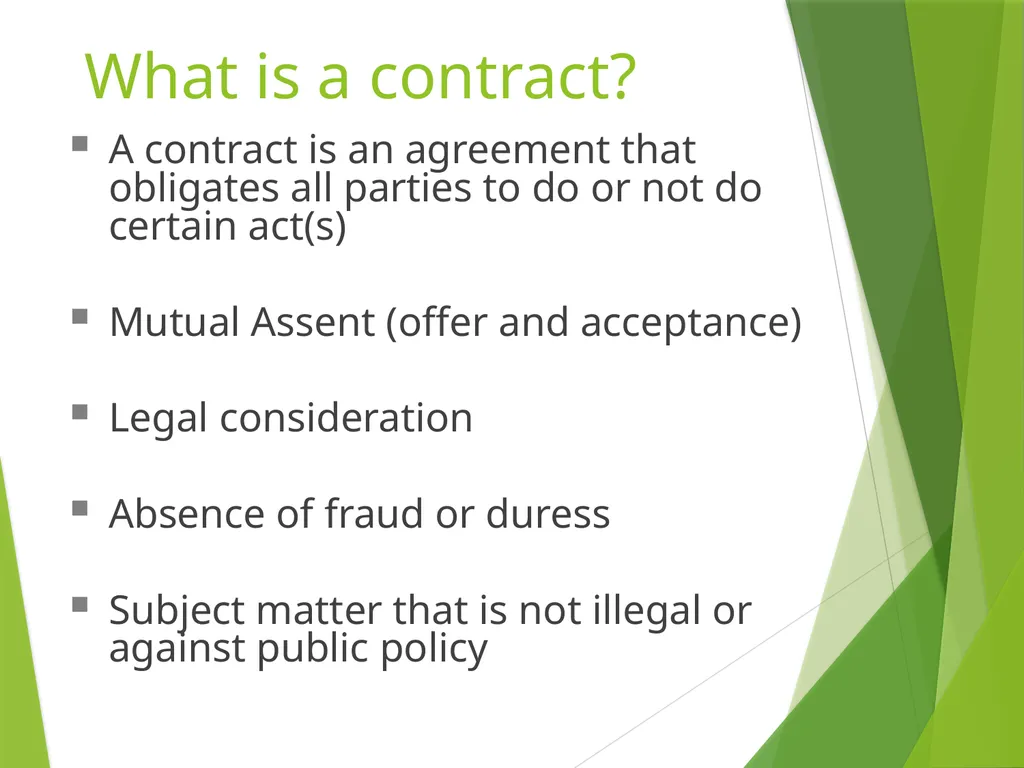
What is a contract? A contract is an agreement that obligates all parties to do or not do certain act(s)
Mutual Assent (offer and acceptance)
Legal consideration
Absence of fraud or duress
Subject matter that is not illegal or against public policy<br>
Mutual Assent (offer and acceptance)
Legal consideration
Absence of fraud or duress
Subject matter that is not illegal or against public policy<br>
03
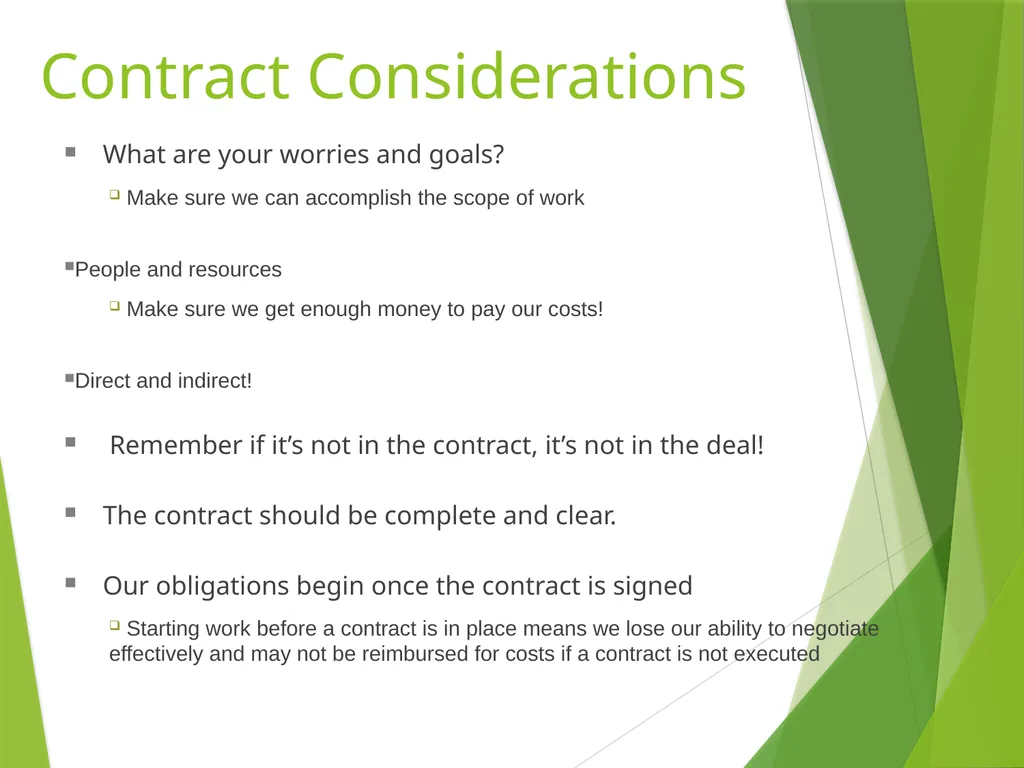
Contract Considerations What are your worries and goals?
Make sure we can accomplish the scope of work
People and resources
Make sure we get enough money to pay our costs!
Direct and indirect!
Remember if it’s not in the contract, it’s not in the deal!
The contract should be complete and clear.
Our obligations begin once the contract is signed
Starting work before a contract is in place means we lose our ability to negotiate effectively and may not be reimbursed for costs if a contract is not executed<br>
Make sure we can accomplish the scope of work
People and resources
Make sure we get enough money to pay our costs!
Direct and indirect!
Remember if it’s not in the contract, it’s not in the deal!
The contract should be complete and clear.
Our obligations begin once the contract is signed
Starting work before a contract is in place means we lose our ability to negotiate effectively and may not be reimbursed for costs if a contract is not executed<br>
04
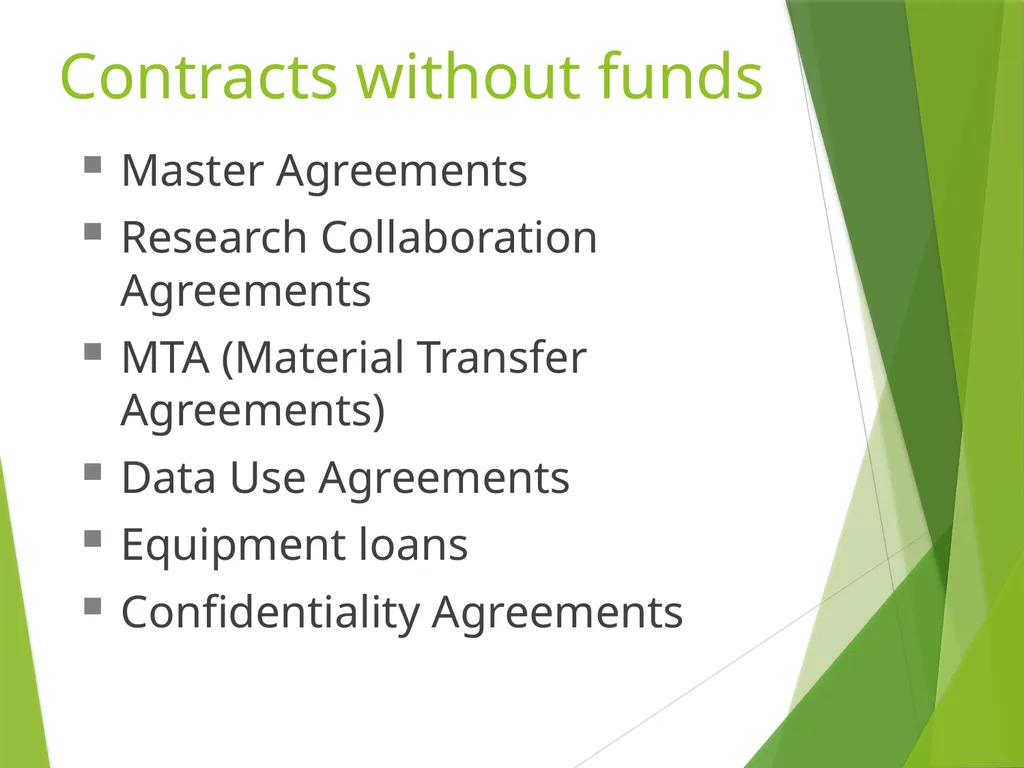
Contracts without funds Master Agreements
Research Collaboration Agreements
MTA (Material Transfer Agreements)
Data Use Agreements
Equipment loans
Confidentiality Agreements<br>
Research Collaboration Agreements
MTA (Material Transfer Agreements)
Data Use Agreements
Equipment loans
Confidentiality Agreements<br>
05
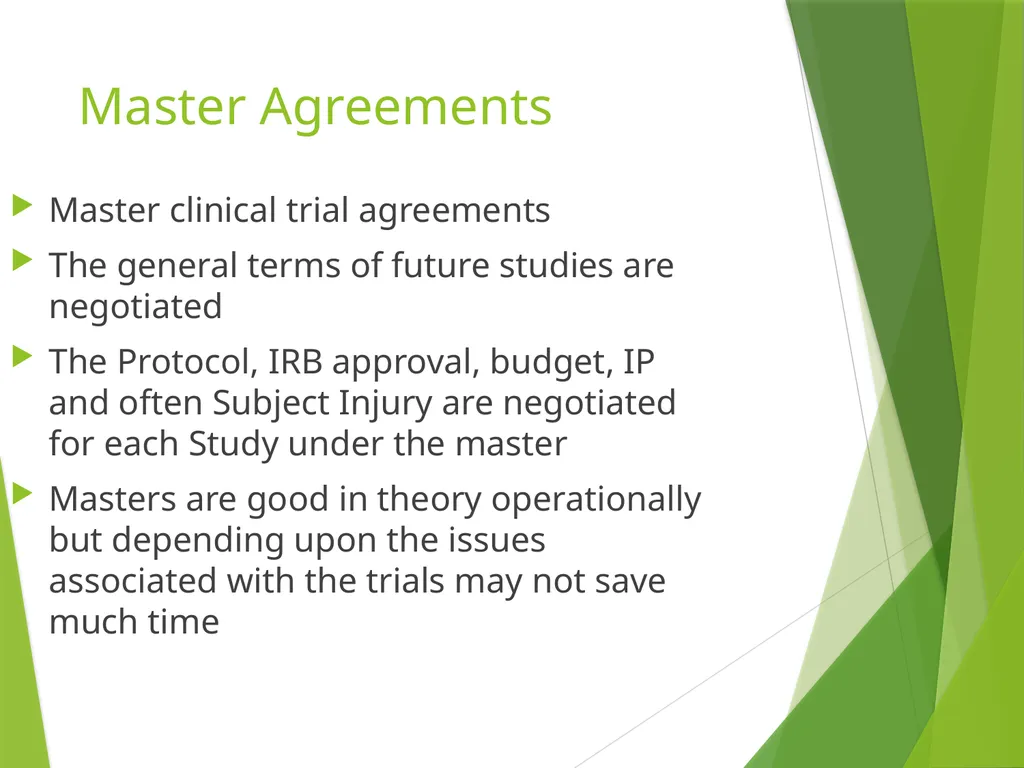
Master Agreements Master clinical trial agreements
The general terms of future studies are negotiated
The Protocol, IRB approval, budget, IP and often Subject Injury are negotiated for each Study under the master
Masters are good in theory operationally but depending upon the issues associated with the trials may not save much time<br>
The general terms of future studies are negotiated
The Protocol, IRB approval, budget, IP and often Subject Injury are negotiated for each Study under the master
Masters are good in theory operationally but depending upon the issues associated with the trials may not save much time<br>
06
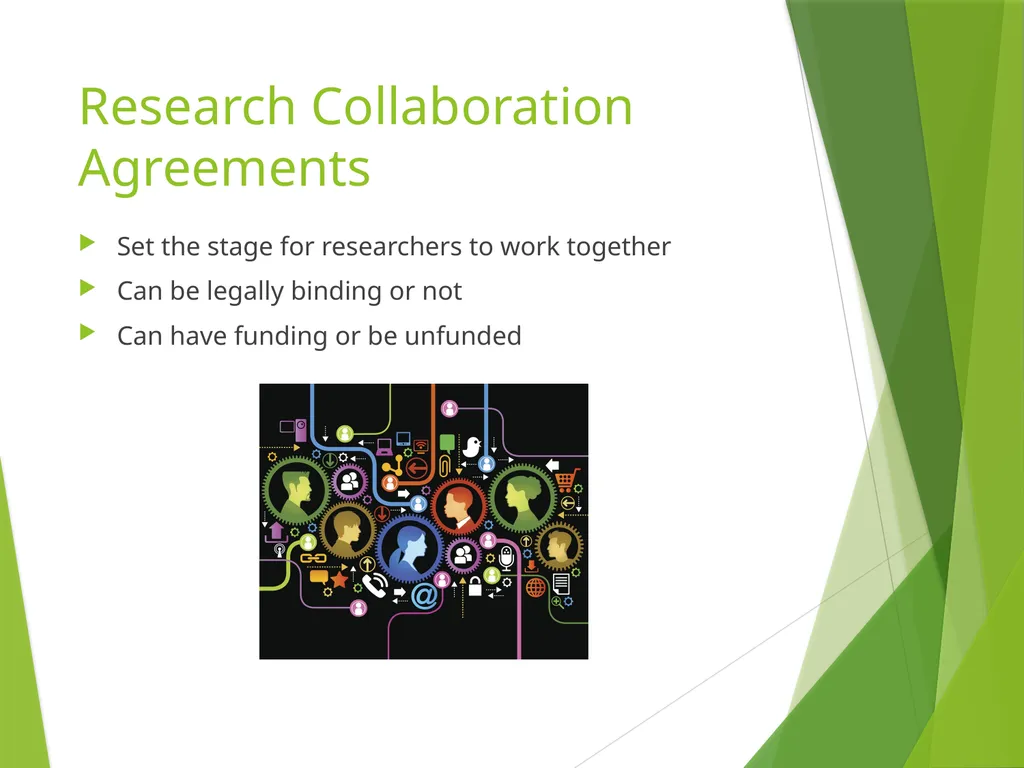
Research Collaboration Agreements Set the stage for researchers to work together
Can be legally binding or not
Can have funding or be unfunded<br>
Can be legally binding or not
Can have funding or be unfunded<br>
07
Material Transfer Agreement Material Transfer Agreement (MTA) is a contract used to effect the transfer of one or more materials from the owner or authorized licensee to an institution for research purposes.
Transactions may be between non-profit or for-profit institutions in any combination.
Materials may be biological or chemical and include the original material, derivatives, and progeny.
Form used is typically that of the providing institution but if the material is biological and both parties are signatories to the Uniform Biological Materials Transfer Agreement (UBMTA) Master Agreement, then the UBMTA may be used for proprietary materials or the Simple Letter Agreement for non-proprietary materials<br>
Transactions may be between non-profit or for-profit institutions in any combination.
Materials may be biological or chemical and include the original material, derivatives, and progeny.
Form used is typically that of the providing institution but if the material is biological and both parties are signatories to the Uniform Biological Materials Transfer Agreement (UBMTA) Master Agreement, then the UBMTA may be used for proprietary materials or the Simple Letter Agreement for non-proprietary materials<br>
08
Data Use Agreements Data Use Agreement (DUA): is a contractual agreement used to define how access to and/or exchanged data may be used. The primary consideration is the protection of protected health data PHI in accordance with HIPAA Regulations 45 CFR Part 160-164
The DUA details:
Permitted use(s) and disclosure of the data, primarily thought publication of research results of the provided data and sets forth the data recipient’s responsibility’s with respect to them.
Establishes a term for the use of the provided data and conditions which would be considered to breach the agreement.
Specifies the storage, security, access, retention and disposal parameters<br>
The DUA details:
Permitted use(s) and disclosure of the data, primarily thought publication of research results of the provided data and sets forth the data recipient’s responsibility’s with respect to them.
Establishes a term for the use of the provided data and conditions which would be considered to breach the agreement.
Specifies the storage, security, access, retention and disposal parameters<br>
09
Equipment Loan Agreement Agreements to transfer equipment for use in specific research in return for data or information about the equipment.
Can be simple or complex
Issues:
Who owns it once the research is done?
Who pairs for damage and repairs?
Do we need additional insurance?
Are there safety issues?
Can the equipment be used on humans?<br>
Can be simple or complex
Issues:
Who owns it once the research is done?
Who pairs for damage and repairs?
Do we need additional insurance?
Are there safety issues?
Can the equipment be used on humans?<br>
10
Confidentiality Agreements Other names: Nondisclosure Agreement, Secrecy Agreement, Confidential Disclosure Agreement
Protects Proprietary Information
Proprietary: exclusively owned; protected by trademark or patent or copyright, e.g., proprietary drug
Mutual or Unilateral<br>
Protects Proprietary Information
Proprietary: exclusively owned; protected by trademark or patent or copyright, e.g., proprietary drug
Mutual or Unilateral<br>
11
Negotiation Issues for Agreements without funding PII/HIPPA
Intellectual Property
Publication
Arbitration
Indemnification/Liability
Governing Law<br>
Intellectual Property
Publication
Arbitration
Indemnification/Liability
Governing Law<br>
12
Contracts with Funds Sponsored Research Agreements (basic science)
Clinical Research Agreements
Clinical Trial Agreements Fixed price
Cost Reimbursement<br>
Clinical Research Agreements
Clinical Trial Agreements Fixed price
Cost Reimbursement<br>
13
Clinical Trials and Clinical Research Agreements Clinical trials of experimental drugs or devices proceed through four phases
Different negotiation issues come into play depending upon the phase of the research
Device: Clinical trials may study the safety and effectiveness (efficacy) of devices, such as stints or pacemakers<br>
Different negotiation issues come into play depending upon the phase of the research
Device: Clinical trials may study the safety and effectiveness (efficacy) of devices, such as stints or pacemakers<br>
14
Clinical Trial NIH Definition A research study in which one or more human subjects are prospectively assigned to one or more interventions (which may include placebo or other control) to evaluate the effects of those interventions on health-related biomedical or behavioral outcomes.
https://www.niaid.nih.gov/grants-contracts/clinical-trial-research#clinical<br>
https://www.niaid.nih.gov/grants-contracts/clinical-trial-research#clinical<br>
15
It is a clinical trial when… The Study involves human participants
Participants are assigned prospectively to an intervention
The study will evaluate the effect of the intervention
There is a health-related biomedical outcome Study may or may not require a comparison group or use a placebo
Study is only designed to assess the pharmacokinetics, safety, and/or maximum tolerated dose of an investigational drug
Study has a biomedical intervention
Study is designed as a BESH<br>
Participants are assigned prospectively to an intervention
The study will evaluate the effect of the intervention
There is a health-related biomedical outcome Study may or may not require a comparison group or use a placebo
Study is only designed to assess the pharmacokinetics, safety, and/or maximum tolerated dose of an investigational drug
Study has a biomedical intervention
Study is designed as a BESH<br>
16
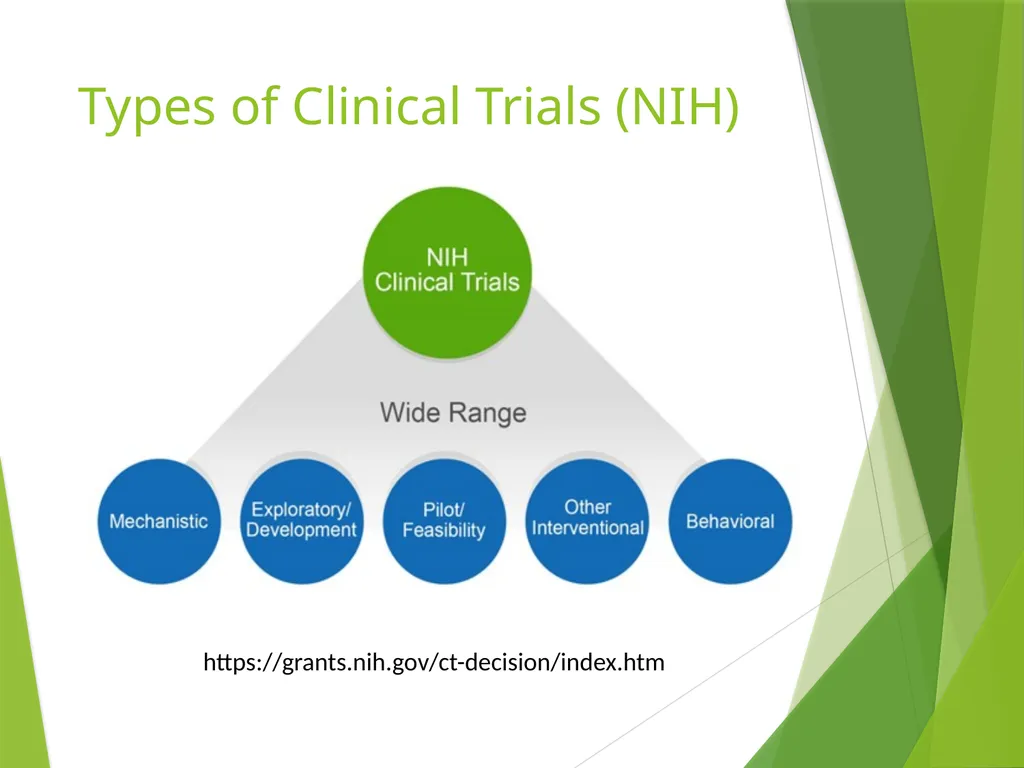
Types of Clinical Trials (NIH) https://grants.nih.gov/ct-decision/index.htm<br>
17
Ethical Conduct of Research Stewardship
Biomedical ethics
Protection of animals and humans
Compliance environment
Misconduct<br>
Biomedical ethics
Protection of animals and humans
Compliance environment
Misconduct<br>
18
Treaty of Helsinki The World Medical Association developed declaration of Helsinki as a statement of ethical principles to provide guidance to physicians and other participants in medical research involving human subjects. It is the duty of the physician to promote and safeguard the health of the people. The physician’s knowledge and conscience are dedicated to the fulfillment of this duty.<br>
19
Belmont Report Key concepts:
Respect for persons
Beneficence
Justice
Federal Policy for the Protection of Human Subjects ('Common Rule')
https://www.hhs.gov/ohrp/regulations-and-policy/regulations/common-rule/index.html<br>
Respect for persons
Beneficence
Justice
Federal Policy for the Protection of Human Subjects ('Common Rule')
https://www.hhs.gov/ohrp/regulations-and-policy/regulations/common-rule/index.html<br>
20
Conflict of Interest/
Conflict of Commitment Conflict of Interest—situations in which an individual’s University activities might be, or might appear to be, influenced by considerations of personal gain (financial or otherwise)
Conflict of commitment—situations where an individual’s outside activities (consulting, public service, or pro bono efforts) may interfere or appear to interfere with the quality or performance of University duties<br>
Conflict of commitment—situations where an individual’s outside activities (consulting, public service, or pro bono efforts) may interfere or appear to interfere with the quality or performance of University duties<br>
21
Clinical Trials.Gov Prior to enrollment of the first subject in the Study, Sponsor agrees to ensure that the Study is fully registered on www.clinicaltrials.gov in accordance with the requirements of the International Committee of Medical Journal Editors (ICMJE) and Public Law 110-85. Results of this Study will be reported in compliance with applicable laws.<br>
22
Clinical Trial Phases<br>
23
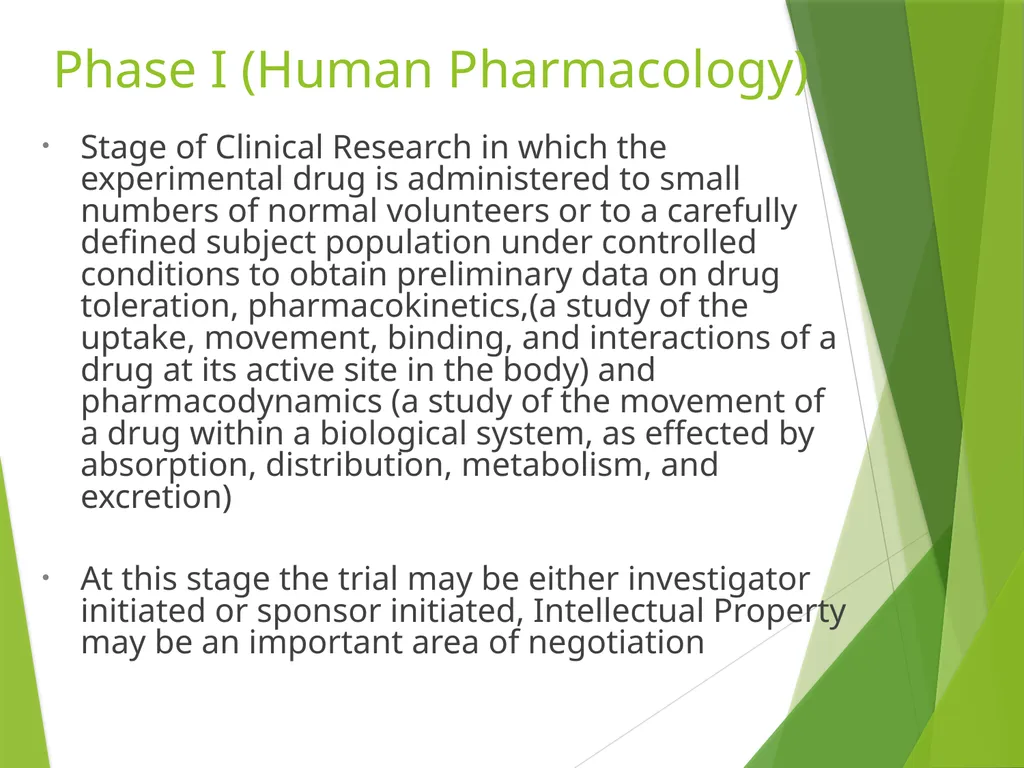
Phase I (Human Pharmacology) Stage of Clinical Research in which the experimental drug is administered to small numbers of normal volunteers or to a carefully defined subject population under controlled conditions to obtain preliminary data on drug toleration, pharmacokinetics,(a study of the uptake, movement, binding, and interactions of a drug at its active site in the body) and pharmacodynamics (a study of the movement of a drug within a biological system, as effected by absorption, distribution, metabolism, and excretion)
At this stage the trial may be either investigator initiated or sponsor initiated, Intellectual Property may be an important area of negotiation<br>
At this stage the trial may be either investigator initiated or sponsor initiated, Intellectual Property may be an important area of negotiation<br>
24
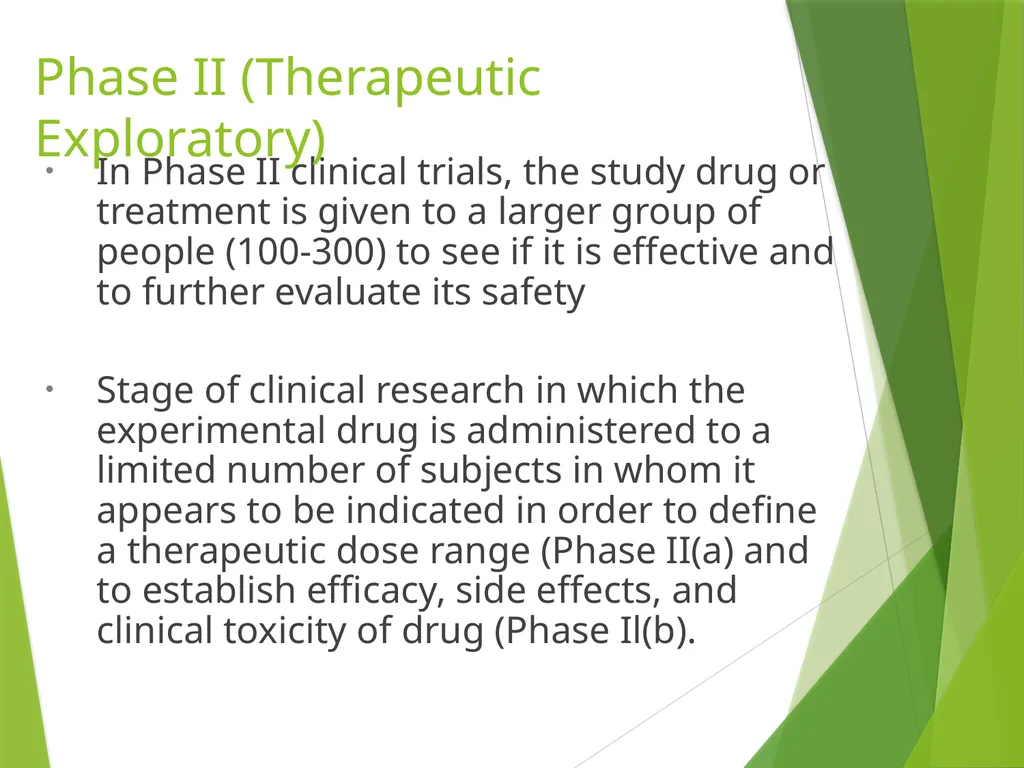
In Phase II clinical trials, the study drug or treatment is given to a larger group of people (100-300) to see if it is effective and to further evaluate its safety
Stage of clinical research in which the experimental drug is administered to a limited number of subjects in whom it appears to be indicated in order to define a therapeutic dose range (Phase II(a) and to establish efficacy, side effects, and clinical toxicity of drug (Phase Il(b). Phase II (Therapeutic Exploratory)<br>
Stage of clinical research in which the experimental drug is administered to a limited number of subjects in whom it appears to be indicated in order to define a therapeutic dose range (Phase II(a) and to establish efficacy, side effects, and clinical toxicity of drug (Phase Il(b). Phase II (Therapeutic Exploratory)<br>
25
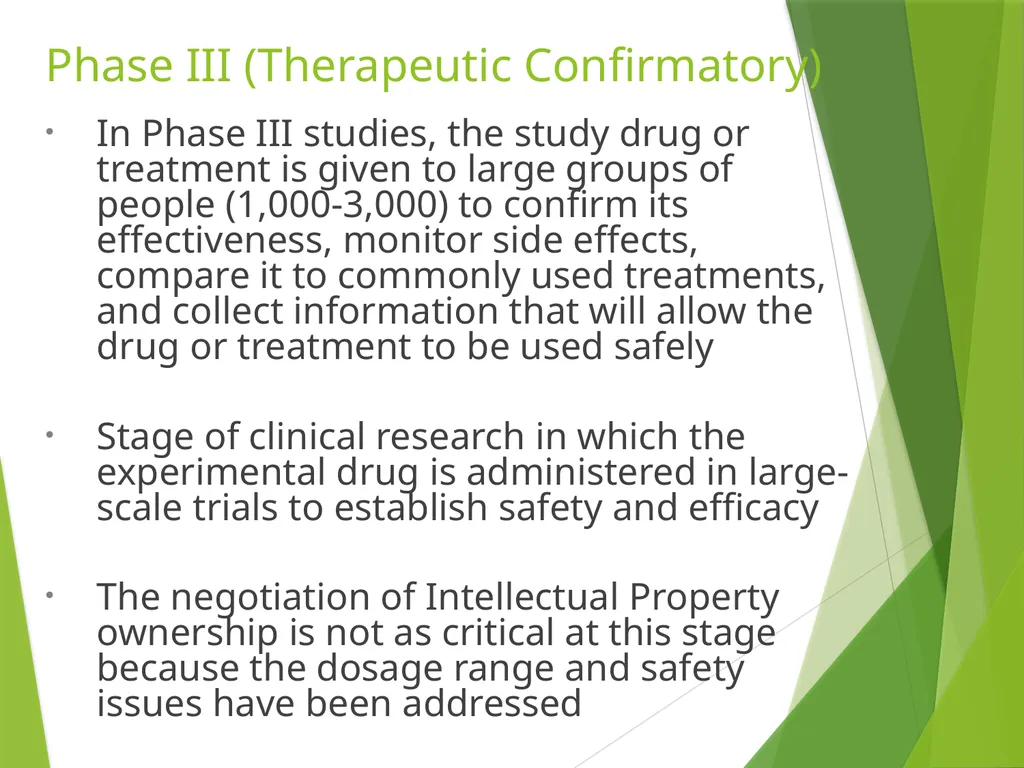
Phase III (Therapeutic Confirmatory) In Phase III studies, the study drug or treatment is given to large groups of people (1,000-3,000) to confirm its effectiveness, monitor side effects, compare it to commonly used treatments, and collect information that will allow the drug or treatment to be used safely
Stage of clinical research in which the experimental drug is administered in large-scale trials to establish safety and efficacy
The negotiation of Intellectual Property ownership is not as critical at this stage because the dosage range and safety issues have been addressed<br>
Stage of clinical research in which the experimental drug is administered in large-scale trials to establish safety and efficacy
The negotiation of Intellectual Property ownership is not as critical at this stage because the dosage range and safety issues have been addressed<br>
26
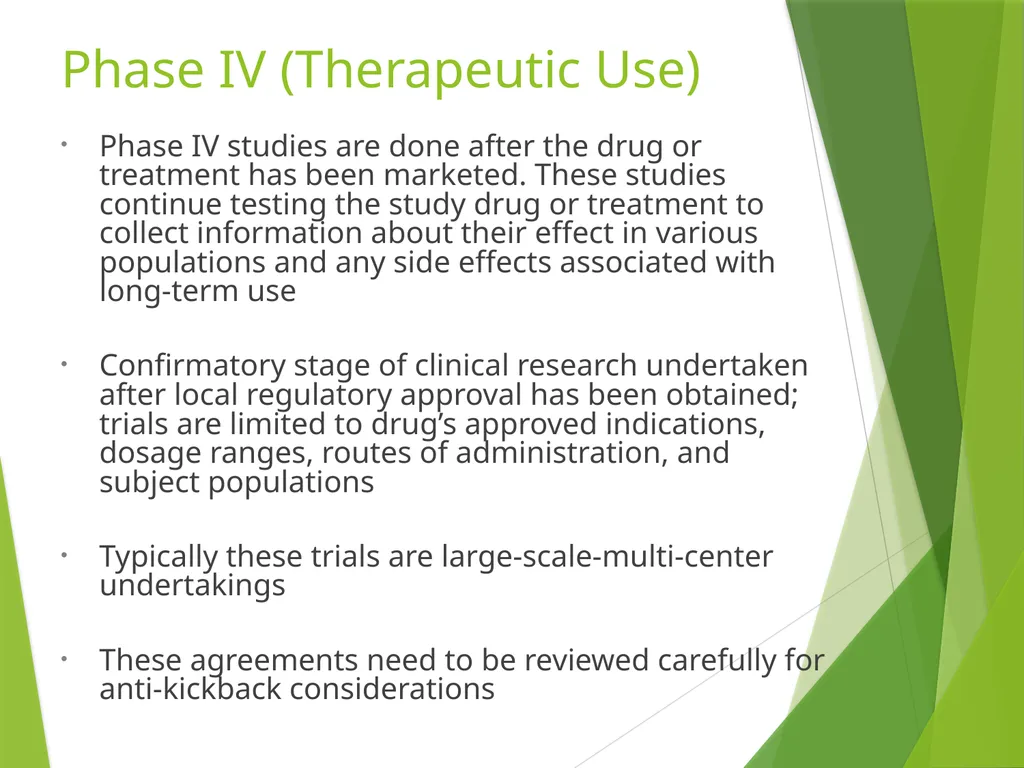
Phase IV (Therapeutic Use) Phase IV studies are done after the drug or treatment has been marketed. These studies continue testing the study drug or treatment to collect information about their effect in various populations and any side effects associated with long-term use
Confirmatory stage of clinical research undertaken after local regulatory approval has been obtained; trials are limited to drug’s approved indications, dosage ranges, routes of administration, and subject populations
Typically these trials are large-scale-multi-center undertakings
These agreements need to be reviewed carefully for anti-kickback considerations<br>
Confirmatory stage of clinical research undertaken after local regulatory approval has been obtained; trials are limited to drug’s approved indications, dosage ranges, routes of administration, and subject populations
Typically these trials are large-scale-multi-center undertakings
These agreements need to be reviewed carefully for anti-kickback considerations<br>
27
What is compassionate use? This is a term of art used when a drug or device has not received FDA approval but is in process (somewhere between Phase I and II) physicians sometimes work together to request an exemption from the FDA for “compassionate use,” (technically this is referred to as a Treatment IND)
Expanded Access is a term used for drugs in Phase III clinical trials
Compassionate use means that no other currently approved treatment is viable for the patient; most commonly these are used with cancer patients<br>
Expanded Access is a term used for drugs in Phase III clinical trials
Compassionate use means that no other currently approved treatment is viable for the patient; most commonly these are used with cancer patients<br>
28
Compassionate use (continued) Contractually we use a Material Transfer Agreement
A significant consideration can be the cost of the experimental therapeutic (i.e. costs are very high to produce pharmaceutical grade drugs in very small quantities) the MTA allows the hospital to charge the secondary payer for the cost.
Prior approval for the research exemption must be obtained from the health insurance provider<br>
A significant consideration can be the cost of the experimental therapeutic (i.e. costs are very high to produce pharmaceutical grade drugs in very small quantities) the MTA allows the hospital to charge the secondary payer for the cost.
Prior approval for the research exemption must be obtained from the health insurance provider<br>
29
Roles and Responsibilities and Routing<br>
30
It takes a village…roles and responsibilities in establishing a clinical trial Protocol driven
Principal Investigator
Clinical Research Coordinator
Institutional Review Board Coordinator
Investigational Pharmacist
Contract driven
Contract negotiator
Business Administrator<br>
Principal Investigator
Clinical Research Coordinator
Institutional Review Board Coordinator
Investigational Pharmacist
Contract driven
Contract negotiator
Business Administrator<br>
31
Institutional Contract Approval Process Institutions that conduct research need to ensure separation of duties and responsibilities related to the design, conduct and reporting of the research
Accordingly, research institutions need to have a mechanism by which they record that the PI, and the various business units involved properly understand both institutional policies and procedures as well as the specific compliance responsibilities associated with the contract
Typically, this is done using an electronic workflow system.<br>
Accordingly, research institutions need to have a mechanism by which they record that the PI, and the various business units involved properly understand both institutional policies and procedures as well as the specific compliance responsibilities associated with the contract
Typically, this is done using an electronic workflow system.<br>
32
Required Sign-offs Principal Investigator
Department Chair
CoM Dean/designee
Institutional Official/ Authorized University Signatory/Official signing for Applicant Organization<br>
Department Chair
CoM Dean/designee
Institutional Official/ Authorized University Signatory/Official signing for Applicant Organization<br>
33
Clinical study-specific documentation CTA plus any relevant attachments
Protocols (or statement of work)
Sponsor budget
Internal budget—to show indirect costs
Informed Consent
Relevant E-mail correspondence with sponsor
Registering a Clinical Trial
Clinicaltrials.gov<br>
Protocols (or statement of work)
Sponsor budget
Internal budget—to show indirect costs
Informed Consent
Relevant E-mail correspondence with sponsor
Registering a Clinical Trial
Clinicaltrials.gov<br>
34
Clinical Trial Negotiation<br>
35
Who are we negotiating with? Clinical Research Organizations
Sponsors
Partnering Hospitals and other Covered Entities<br>
Sponsors
Partnering Hospitals and other Covered Entities<br>
36
Sponsor, CRO and Site Responsibilities (Whereas…) Clinical research is a regulated industry.
Responsibility on the part of sponsors, CROs and sites to comply with the study protocol, government laws and regulations.
The purpose of this section is to document that the research site will comply with laws, the participating physicians and institution are qualified to conduct research, and the institution will inform the sponsor of Institutional Review Board (IRB)
UTHSC and the CROs are both required to notify the IRB directly of any non-compliance that could impact the safety and well-being of trial subjects.<br>
Responsibility on the part of sponsors, CROs and sites to comply with the study protocol, government laws and regulations.
The purpose of this section is to document that the research site will comply with laws, the participating physicians and institution are qualified to conduct research, and the institution will inform the sponsor of Institutional Review Board (IRB)
UTHSC and the CROs are both required to notify the IRB directly of any non-compliance that could impact the safety and well-being of trial subjects.<br>
37
Description of the Project (Recitals) The purpose of this section is to explicitly state the research project description. You want to document the overarching purpose of the agreement in this section.
In the United States, with the Sunshine Act, there is an increased scrutiny on payments made to health care organizations and health care professionals. The project description provides the necessary details on the nature of the agreement.
In the event there is a compliance audit questioning financial payments to the research site, the project description can provide clarity.<br>
In the United States, with the Sunshine Act, there is an increased scrutiny on payments made to health care organizations and health care professionals. The project description provides the necessary details on the nature of the agreement.
In the event there is a compliance audit questioning financial payments to the research site, the project description can provide clarity.<br>
38
Contractual Negotiation Issues Budget
Publication
Record Retention
Intellectual Property
HIPAA
Subject Materials
Dispute Resolution/Arbitration
Indemnification/Liability
Payer(s) Subject Injury Costs
Insurance
Termination<br>
Publication
Record Retention
Intellectual Property
HIPAA
Subject Materials
Dispute Resolution/Arbitration
Indemnification/Liability
Payer(s) Subject Injury Costs
Insurance
Termination<br>
39
What is a budget? It is often said that the budget for a sponsored project should be the “financial expression of the statement of work” which can be translated to mean that all costs of conducting the project, both direct and indirect, should be considered when developing a budget. A successful clinical trial includes a budget that adequately meets the financial needs of conducting the trial. It is in the best interest of both parties to develop a clinical trial budget that represents a fair market value for the research and services provided. Sponsors need to ensure they negotiate financial terms that will provide a fair return on the investment of their stockholders while avoiding the perception that a clinical trial budget is an attempt to influence investigator behavior. Institutions need financial terms that allow the trial to be self-supporting. Institutions rarely have the ability to absorb the costs of conducting the study internally and do not have the financial capability to assume a resulting deficit when all costs of conducting the clinical trial, both fixed and up front, are not reimbursed by the agreed upon budget. In addition, when negotiating clinical trial budgets, Institutions need to be cognizant of the impact the budget may have accurate clinical billing in the future.<br>
40
Publication UT must protect its doctors right to publish freely—academic freedom
Researcher must be able to document and verify findings
Review by sponsor for confidential and proprietary information
Sponsor may comment but may not edit or approve
Reasonable time frame for review<br>
Researcher must be able to document and verify findings
Review by sponsor for confidential and proprietary information
Sponsor may comment but may not edit or approve
Reasonable time frame for review<br>
41
Record Retention The purpose of a clinical trial is to collect safety and effectiveness data on a given medical product.
But what happens if the clinical site provides incomplete or incorrect data to the sponsor? Or is hesitant to allow a CRO to monitor the data at the site?
The purpose of this section is to document the agreement between the site and the sponsor on how long the trial data will be stored for after the trial is completed. If records must be kept for long periods of time this clause should require Sponsor reimbursement for storage costs
This section typically also includes the sponsor's right to audit the site or verify data on a regular basis, and the site’s responsibility to cooperate with the sponsor or a regulatory agency, such as the FDA.<br>
But what happens if the clinical site provides incomplete or incorrect data to the sponsor? Or is hesitant to allow a CRO to monitor the data at the site?
The purpose of this section is to document the agreement between the site and the sponsor on how long the trial data will be stored for after the trial is completed. If records must be kept for long periods of time this clause should require Sponsor reimbursement for storage costs
This section typically also includes the sponsor's right to audit the site or verify data on a regular basis, and the site’s responsibility to cooperate with the sponsor or a regulatory agency, such as the FDA.<br>
42
Intellectual Property Intellectual property includes patents, copyrights trademarks and technical know how. The creators of IP are legally entitled to protect their property
UTHS may not agree to assign property to any entity other than the University of Tennessee Health Science Foundation (UTHSC)<br>
UTHS may not agree to assign property to any entity other than the University of Tennessee Health Science Foundation (UTHSC)<br>
43
Subject Materials Subject Material means any biologic material of human origin including, without limitation, tissues, blood, plasma, urine, spinal fluid, or other fluids derived from the Study subjects in accordance with and pursuant to the Protocol (“Subject Material”).
Institution agrees to make the Subject Material available to the Sponsor in accordance with the Protocol for the purposes of the Study. The Subject Material may be used by the Sponsor, central lab, or other contracted party only as allowed by the Study subject’s informed consent form or pertinent institutional review board(s). Sponsor agrees that any use of Subject Materials, other than as allowed by the Study subject’s informed consent form, will require additional IRB review and approval<br>
Institution agrees to make the Subject Material available to the Sponsor in accordance with the Protocol for the purposes of the Study. The Subject Material may be used by the Sponsor, central lab, or other contracted party only as allowed by the Study subject’s informed consent form or pertinent institutional review board(s). Sponsor agrees that any use of Subject Materials, other than as allowed by the Study subject’s informed consent form, will require additional IRB review and approval<br>
44
HIPAA UTHSC must ensure that the requirements of the Health Insurance Portability and Accountability Act of 1996 are met. This Act protects the privacy of individually identifiable health Information
HIPAA compliance requires that no person to whom health records are disclosed may disclose them for any other purpose than that for which they were disclosed without getting the patient’s authorization to re-disclose.<br>
HIPAA compliance requires that no person to whom health records are disclosed may disclose them for any other purpose than that for which they were disclosed without getting the patient’s authorization to re-disclose.<br>
45
Jurisdiction UTHSC may not agree to be subject to another jurisdiction’s law or its courts (this clause is sometimes referred to as Governing Law)
UT will agree only to Tennessee law or
Silence<br>
UT will agree only to Tennessee law or
Silence<br>
46
Dispute Resolution and Arbitration What happens if the sponsor or the site has a dispute?
The purpose of this section to explain how issues will be escalated and attempts will be made to resolve them through mutual resolution.
Cure period
Many organizations cannot agree to binding arbitration<br>
The purpose of this section to explain how issues will be escalated and attempts will be made to resolve them through mutual resolution.
Cure period
Many organizations cannot agree to binding arbitration<br>
47
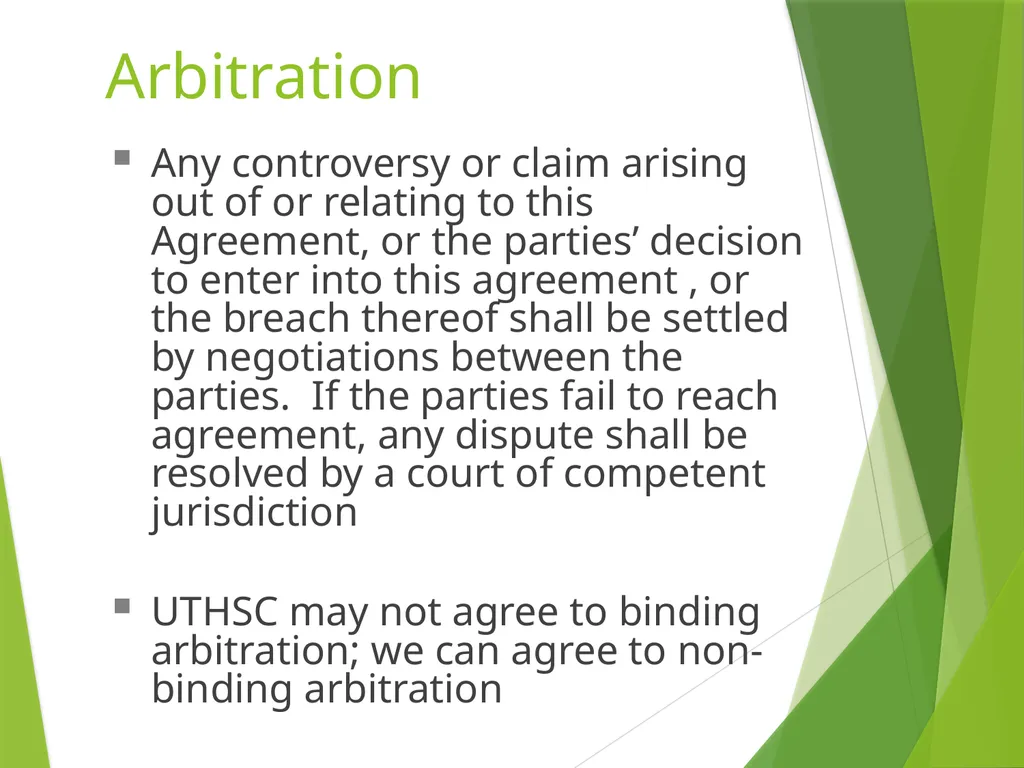
Arbitration Any controversy or claim arising out of or relating to this Agreement, or the parties’ decision to enter into this agreement , or the breach thereof shall be settled by negotiations between the parties. If the parties fail to reach agreement, any dispute shall be resolved by a court of competent jurisdiction
UTHSC may not agree to binding arbitration; we can agree to non-binding arbitration<br>
UTHSC may not agree to binding arbitration; we can agree to non-binding arbitration<br>
48
Indemnification/Liability Research Institutions typically require that the sponsor indemnify them and the sites where the study/trial will take place
Purpose if something goes wrong with a trial who pays to make things right<br>
Purpose if something goes wrong with a trial who pays to make things right<br>
49
Insurance The purpose of this clause is to document that the parties have adequate resources to pay for management of all serious adverse events suffered by a subject in a clinical trial
Institutions should understand the risks and set insurance requirements accordingly
Risk assessment<br>
Institutions should understand the risks and set insurance requirements accordingly
Risk assessment<br>
50
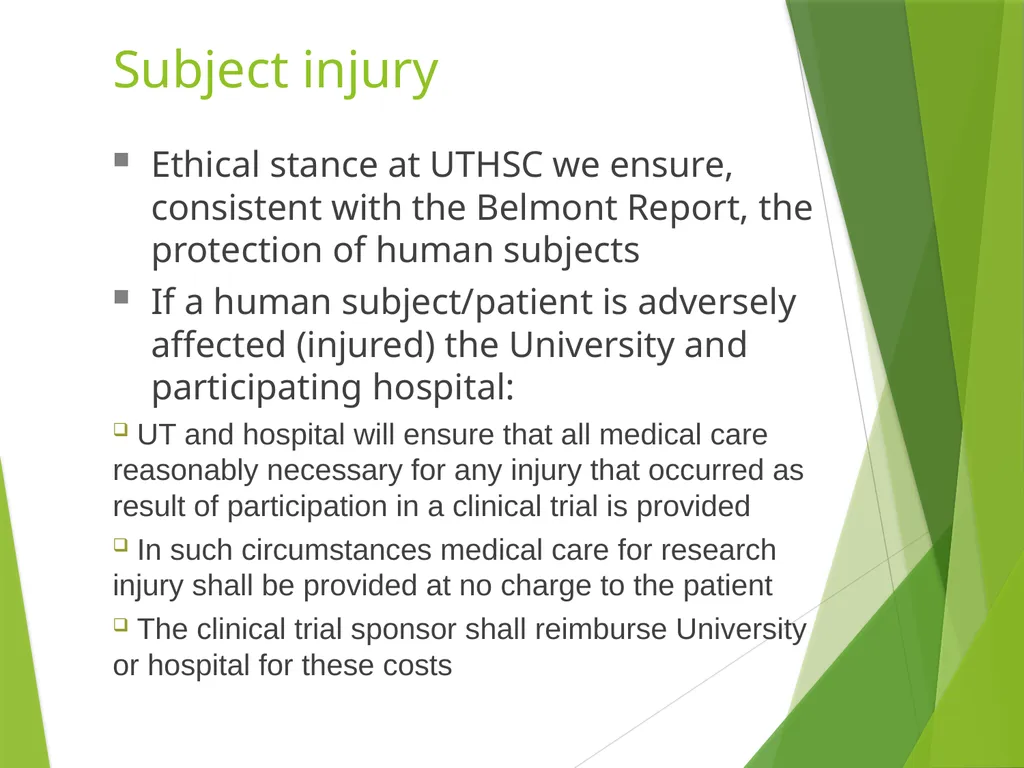
Subject injury Ethical stance at UTHSC we ensure, consistent with the Belmont Report, the protection of human subjects
If a human subject/patient is adversely affected (injured) the University and participating hospital:
UT and hospital will ensure that all medical care reasonably necessary for any injury that occurred as result of participation in a clinical trial is provided
In such circumstances medical care for research injury shall be provided at no charge to the patient
The clinical trial sponsor shall reimburse University or hospital for these costs<br>
If a human subject/patient is adversely affected (injured) the University and participating hospital:
UT and hospital will ensure that all medical care reasonably necessary for any injury that occurred as result of participation in a clinical trial is provided
In such circumstances medical care for research injury shall be provided at no charge to the patient
The clinical trial sponsor shall reimburse University or hospital for these costs<br>
51
Payer(s) (as opposed to prayers)
for Subject Injury Sponsors want the ability to share or avoid paying these costs so they structure clauses accordingly
Often a deal breaker for academic medical centers
UTHSC will only allow injury costs to be charged to a subjects insurance where allowed by federal or state statute<br>
Often a deal breaker for academic medical centers
UTHSC will only allow injury costs to be charged to a subjects insurance where allowed by federal or state statute<br>
52
Prayers continue… Problem is the order of who pays and how much they pay:
sponsors want secondary payers and Medicare/Medicaid to pay first: they ask for evidence that the claim has been rejected
We cannot do this and we cannot allow requested for trial payments to accidentally default to the patient enrolled in the clinical trial
We must be able to recover costs for subject injury<br>
sponsors want secondary payers and Medicare/Medicaid to pay first: they ask for evidence that the claim has been rejected
We cannot do this and we cannot allow requested for trial payments to accidentally default to the patient enrolled in the clinical trial
We must be able to recover costs for subject injury<br>
53
Termination For convenience and for cause:
PI, patient population, or clinical support staff no longer available
Non-compliance with national, state or local laws and regulations
Change in business strategy requiring the sponsor to terminate a trial early
IRB may determine the trial is no longer safe for the subjects
All parties on the CTA could be required to provide 30-45 day notice depending on the reason for termination.
If agreed on a signed CTA, sponsors will have the right to data collected prior to contract termination and sites will receive compensation for trial activities performed by the research staff.<br>
PI, patient population, or clinical support staff no longer available
Non-compliance with national, state or local laws and regulations
Change in business strategy requiring the sponsor to terminate a trial early
IRB may determine the trial is no longer safe for the subjects
All parties on the CTA could be required to provide 30-45 day notice depending on the reason for termination.
If agreed on a signed CTA, sponsors will have the right to data collected prior to contract termination and sites will receive compensation for trial activities performed by the research staff.<br>