
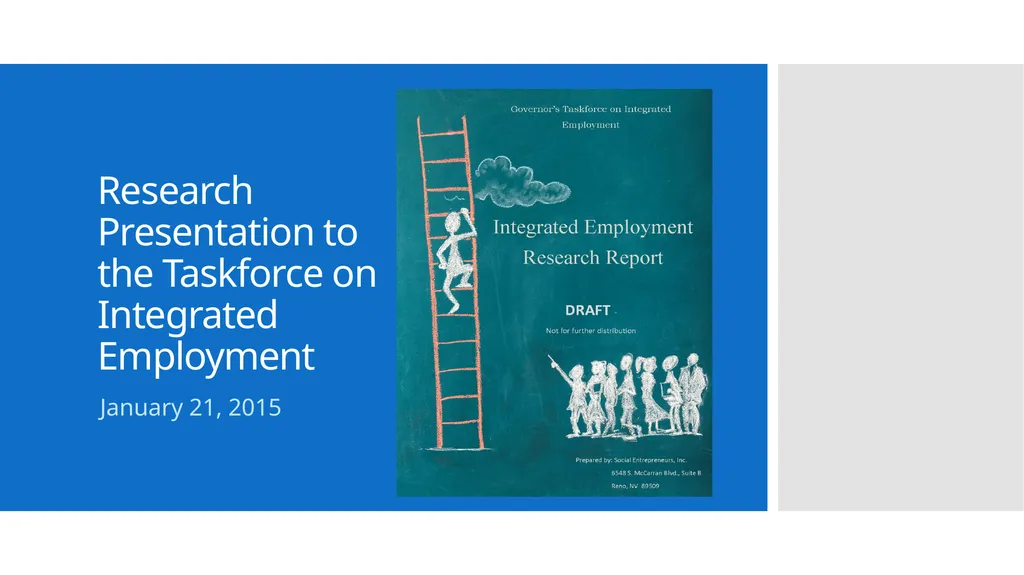
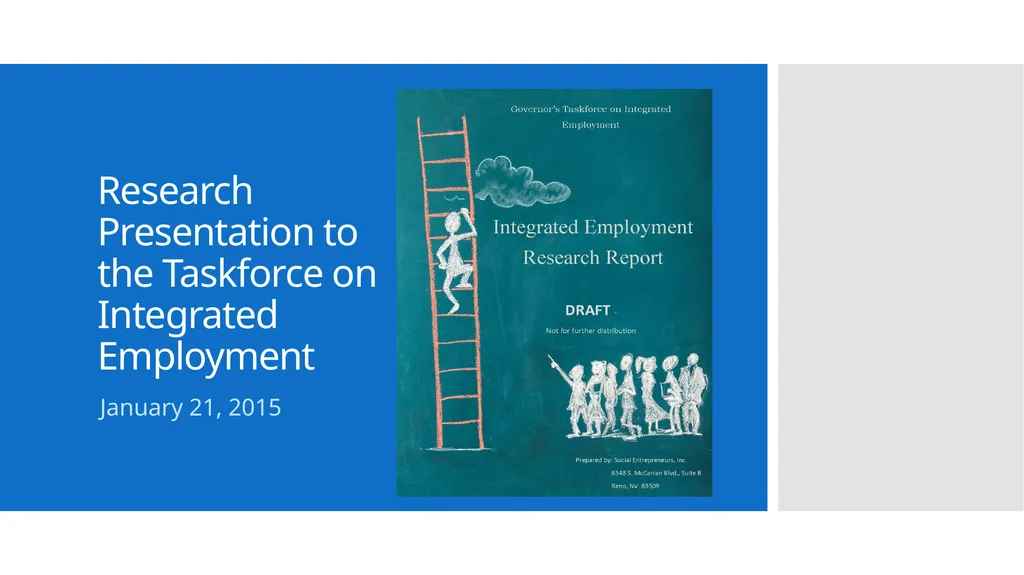
Research Presentation to the Taskforce on










Description: Research Presentation to the Taskforce on Integrated Employment January 21, 2015 Executive Order 2014-2016 Mission The Taskforce mission is to develop and implement a sustainable system for individuals with intellectual and developmental
Related Topics
Download Presentation
"Research Presentation to the Taskforce on" is the property of its rightful owner. Permission is granted to download and print the materials on this website for personal, non-commercial use only, and to display it on your personal computer provided you do not modify the materials and that you retain all copyright notices contained in the materials. By downloading content from our website, you accept the terms of this agreement.
Presentation Transcript
slide1. Research Presentation to the Taskforce on Integrated Employment January 21, 2015<br>
slide2. Executive Order 2014-2016 Mission
The Taskforce mission is to develop and implement a sustainable system for individuals with intellectual and developmental disabilities (IDD) to achieve competitive, integrated employment in the setting of their choice.<br>
slide3. Charge to the Taskforce The Taskforce is responsible for examining and evaluating current employment programs, resources, funding, available training, and employment opportunities for individuals with intellectual/developmental disabilities…and
is also responsible for developing a three, five, and ten-year strategic plan (2015-2025) that will result in “creating a more integrated workforce and expanding competitive employment opportunities for individuals with intellectual/developmental disabilities.”<br>
slide4. Contents of the Research Report Overview of the current situation in Nevada regarding integrated employment practices and programs for individuals with IDD
Models and best practices to support and promote education, employment opportunities and outcomes, and other habilitation services for individuals with IDD
Policies and legislation needed to create a more diversified, inclusive, and integrated workforce
Funding opportunities, potential partners, and collaborations to consider<br>
slide5. About the Research Research included review of over 50 national and state reports, briefs, papers and plans related to Integrated Employment. Some key resources…
Office of Disability Employment Policy. Integrated Employment Toolkit.
The National Governors Association Center for Best Practices (NGA Center,2012). A Better Bottom Line: Employing people with disabilities. Blueprint for Governors.<br>
slide6. About the Research National organizations have developed a series of reports, recommendations and briefs related to Integrated Employment or Integrated Competitive Employment (ICE).
The State Employment Leadership Network Accomplishments Report summarizes progress in seventeen member states in 2009-2010 in areas such as waiver service definitions, Employment First policies and strategies, funding and rate methodology changes, and sharing data across state agencies.<br>
slide7. About the Research Association of People Supporting Employment First (APSE) providing a starting point with the APSE Employment First Statement.
The Institute for Community Inclusion, (Butterworth, J., Smith, F., Hall, A., Migliore, A., Winsor, J., & Domin, D.) has published annually, StateData: The national report on employment services and outcomes.
State Activities to Implement Employment First as the Employment Strategy for Individuals with Intellectual and Developmental Disabilities (Jennings, Jr., E. T., & Zhiwei, Z.,2013).<br>
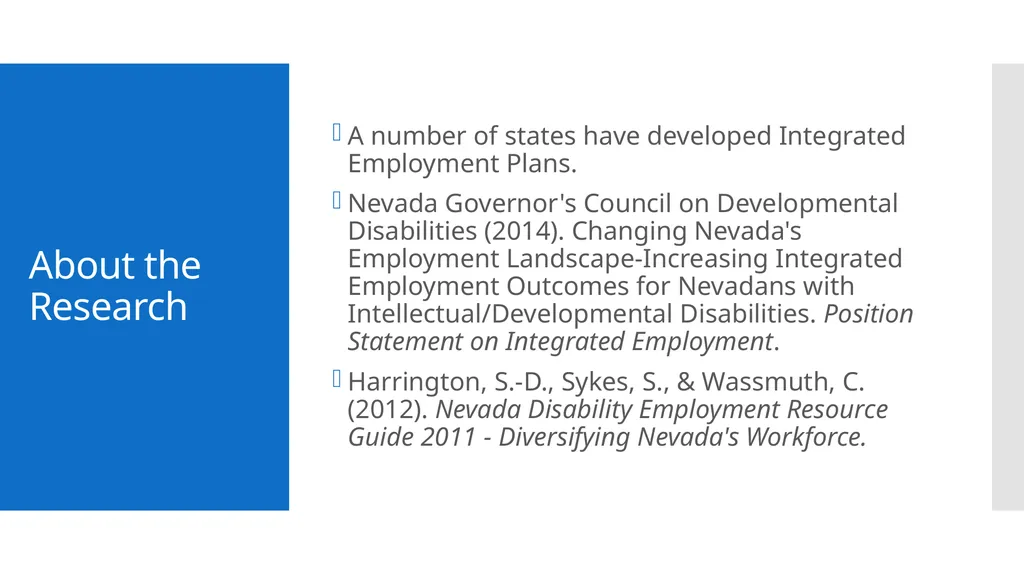
slide8. About the Research A number of states have developed Integrated Employment Plans.
Nevada Governor's Council on Developmental Disabilities (2014). Changing Nevada's Employment Landscape-Increasing Integrated Employment Outcomes for Nevadans with Intellectual/Developmental Disabilities. Position Statement on Integrated Employment.
Harrington, S.-D., Sykes, S., & Wassmuth, C. (2012). Nevada Disability Employment Resource Guide 2011 - Diversifying Nevada's Workforce.<br>
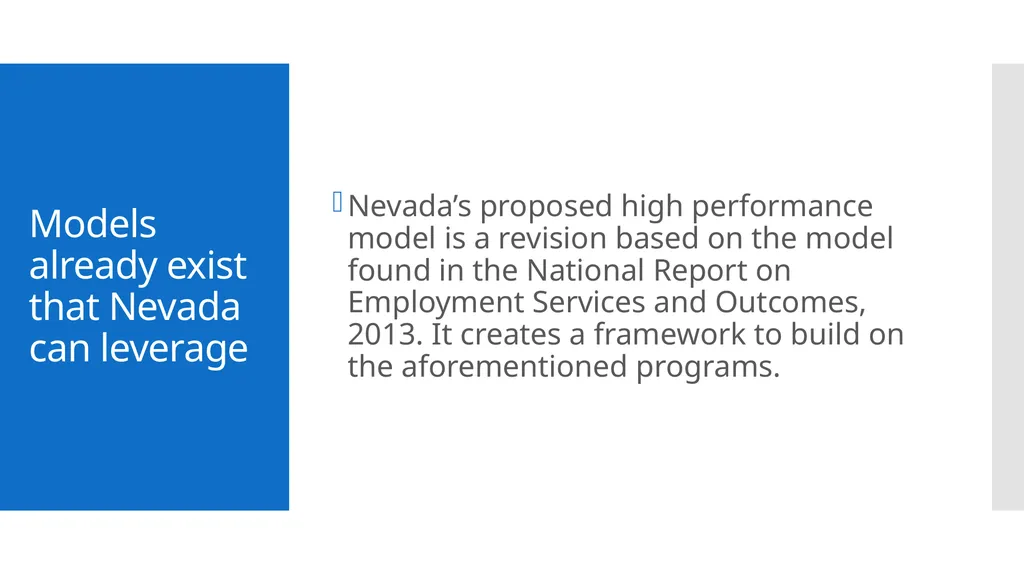
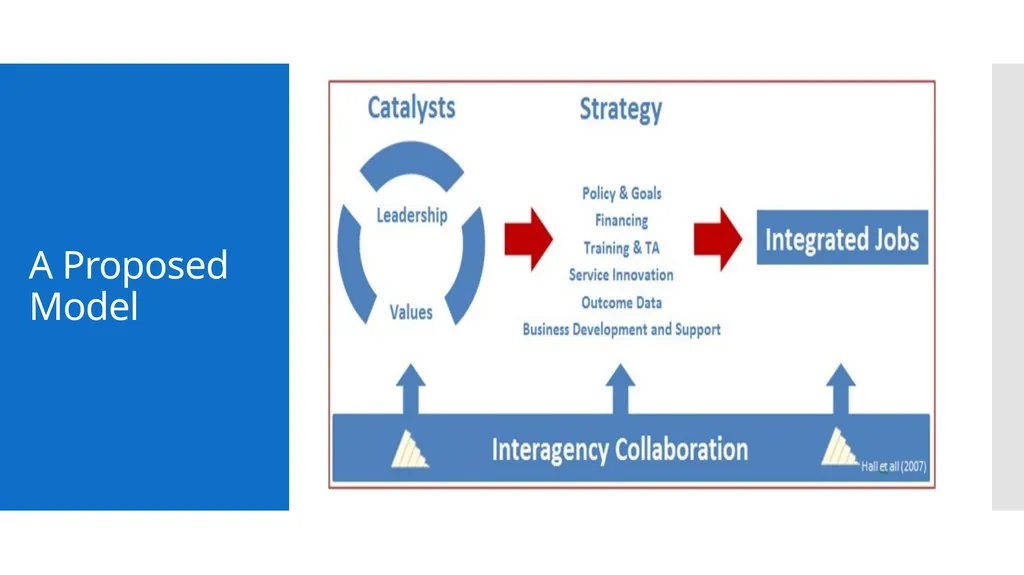
slide9. Models already exist that Nevada can leverage Nevada’s proposed high performance model is a revision based on the model found in the National Report on Employment Services and Outcomes, 2013. It creates a framework to build on the aforementioned programs.<br>
slide10. A Proposed Model<br>
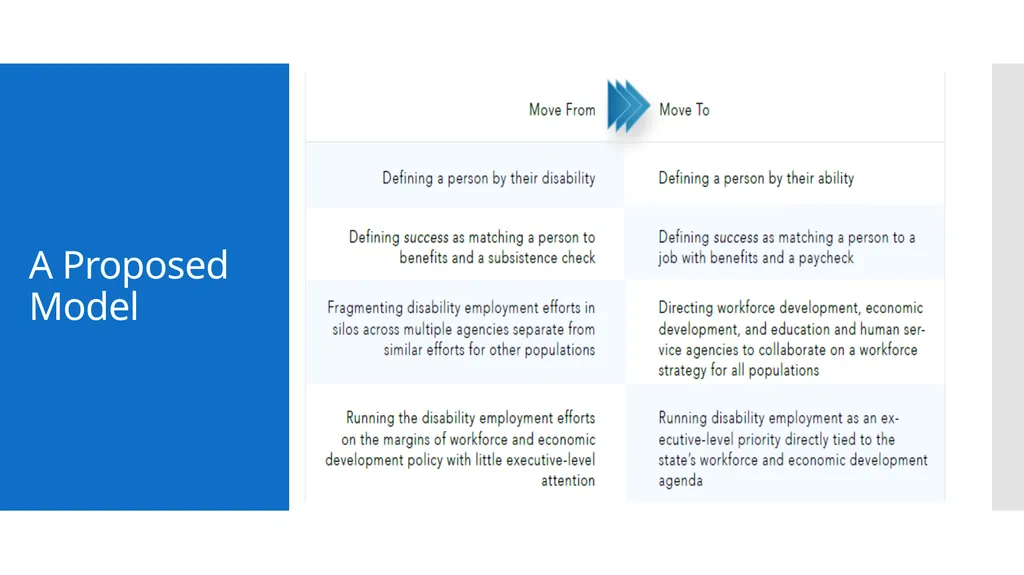
slide11. A Proposed Model<br>
slide12. Key Themes from the Research<br>
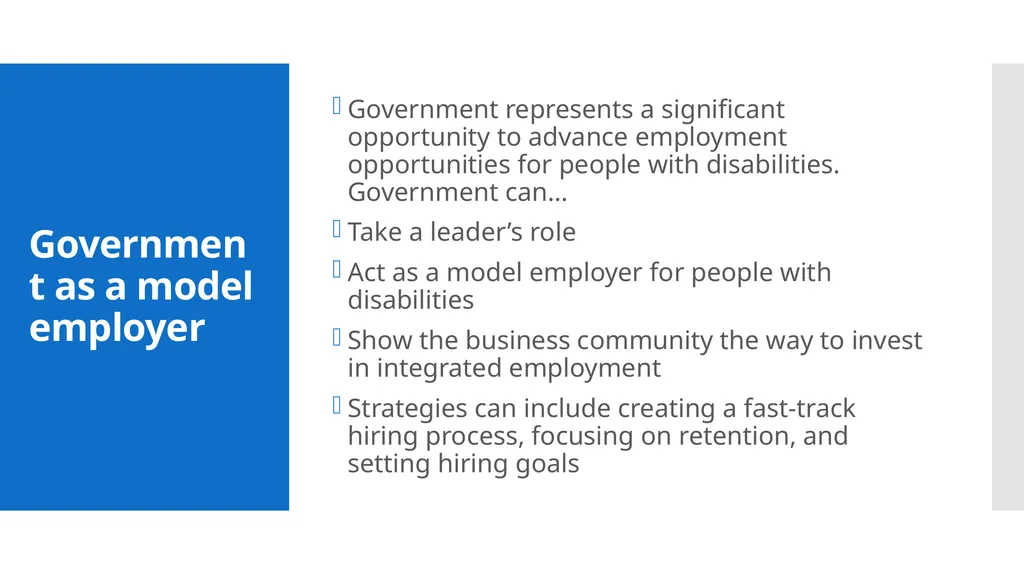
slide13. Government as a model employer Government represents a significant opportunity to advance employment opportunities for people with disabilities. Government can…
Take a leader’s role
Act as a model employer for people with disabilities
Show the business community the way to invest in integrated employment
Strategies can include creating a fast-track hiring process, focusing on retention, and setting hiring goals<br>
slide14. Businesses as an employer and partner The business community is critical to improving employment outcomes for people with disabilities
Businesses are willing but need support from schools and government to address barriers that people with disabilities face
To engage business, the Taskforce needs to understand the business perspective AND
Show businesses how hiring people with disabilities will meet businesses’ needs (loyalty, productivity)
Government should not rely solely on the business community but be a long-term support agent and resource<br>
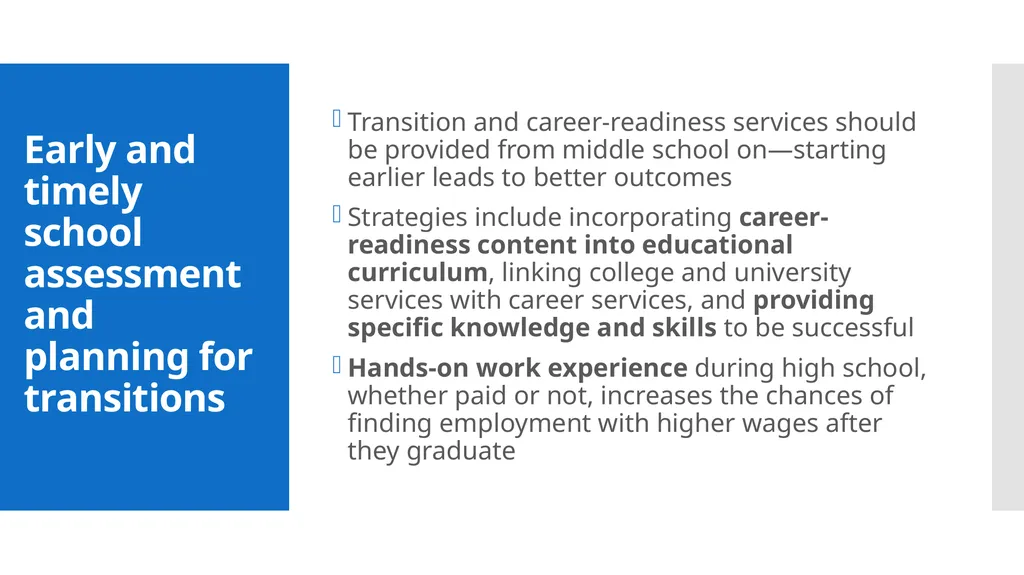
slide15. Early and timely school assessment and planning for transitions Transition and career-readiness services should be provided from middle school on—starting earlier leads to better outcomes
Strategies include incorporating career-readiness content into educational curriculum, linking college and university services with career services, and providing specific knowledge and skills to be successful
Hands-on work experience during high school, whether paid or not, increases the chances of finding employment with higher wages after they graduate<br>
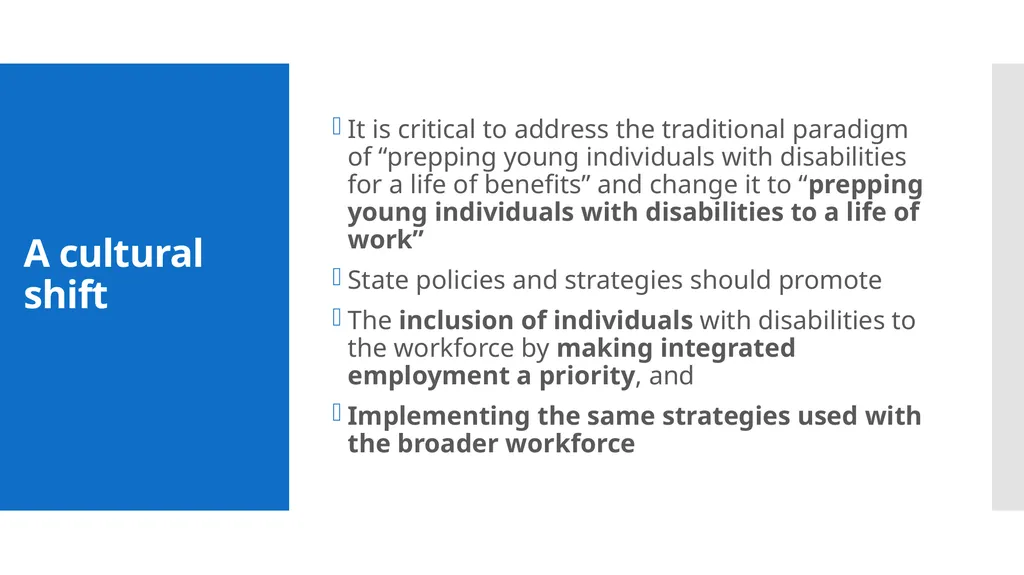
slide16. A cultural shift It is critical to address the traditional paradigm of “prepping young individuals with disabilities for a life of benefits” and change it to “prepping young individuals with disabilities to a life of work”
State policies and strategies should promote
The inclusion of individuals with disabilities to the workforce by making integrated employment a priority, and
Implementing the same strategies used with the broader workforce<br>
slide17. Coordinated schools and economic development authorities Close coordination between schools and economic development authorities is critical
This allows schools to help students with disabilities develop the right skills they need to enter the workforce
Employers then benefit from a broader pool of skilled applicants<br>
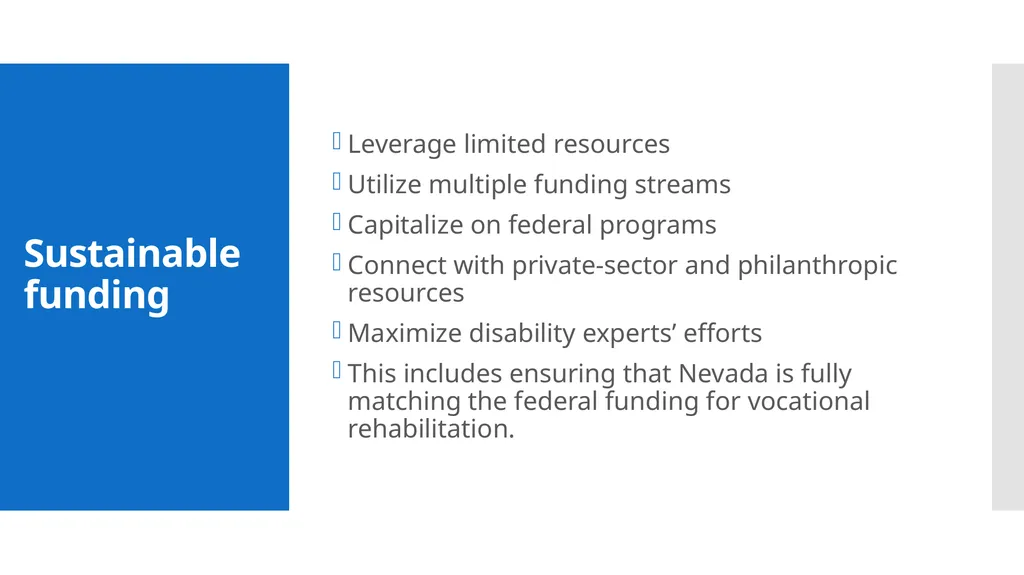
slide18. Sustainable funding Leverage limited resources
Utilize multiple funding streams
Capitalize on federal programs
Connect with private-sector and philanthropic resources
Maximize disability experts’ efforts
This includes ensuring that Nevada is fully matching the federal funding for vocational rehabilitation.<br>
slide19. Orientation to results Set and measure progress toward employment goals
Set and measure the return on investment of disability employment programs
Use information on progress to improve programs
Encourage others to participate in measuring results<br>
slide20. Current Situation Part 1--Data<br>
slide21. Nevada Governor’s Council on Developmental Disabilities, Position Paper Supported employment outcomes for Nevadans with intellectual/developmental disabilities should include:
Working in the community at competitive wages
Making a financial impact on the economy
Diversifying the workforce
Improving quality of life<br>
slide22. Nevada Governor’s Council on Developmental Disabilities, Position Paper All adults in Nevada— including Nevadans with intellectual/developmental disabilities— should expect independence and competitive employment
However, for those Nevadans with IDD who do not currently choose employment, meaningful day habilitation should be an option<br>
slide23. Nevada Governor’s Council on Developmental Disabilities, Position Paper Optimize the use of limited resources and make some financial concessions to make supportive employment services fiscally viable
Rehabilitation Division funding could be used to leverage job and day training services to provide meaningful job readiness skills and prepare individuals for competitive employment
Day habilitation’s providers should improve and increase programming geared toward competitive employment and become a provider of supported employment job development services<br>
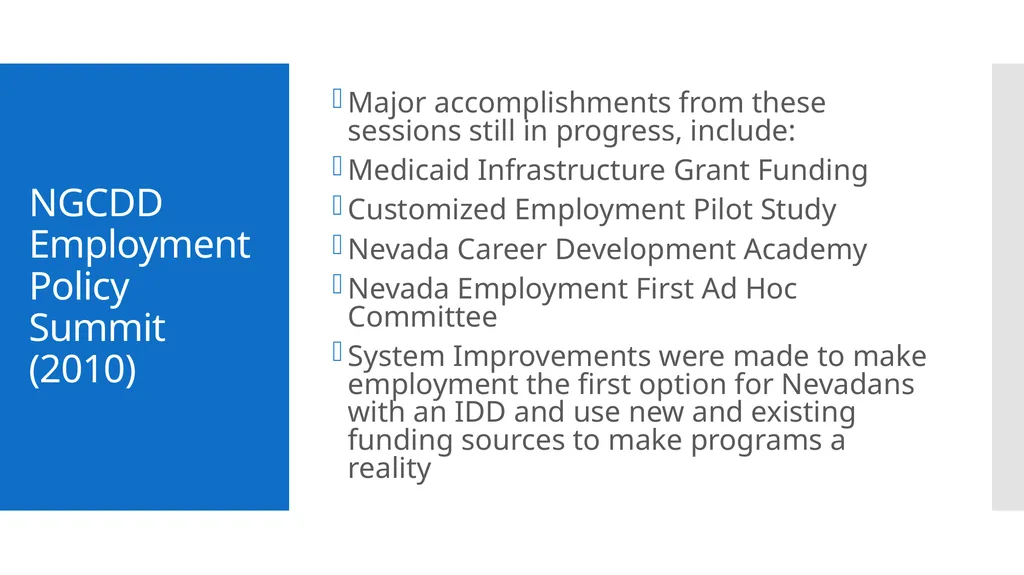
slide24. NGCDD Employment Policy Summit (2010) Major accomplishments from these sessions still in progress, include:
Medicaid Infrastructure Grant Funding
Customized Employment Pilot Study
Nevada Career Development Academy
Nevada Employment First Ad Hoc Committee
System Improvements were made to make employment the first option for Nevadans with an IDD and use new and existing funding sources to make programs a reality<br>
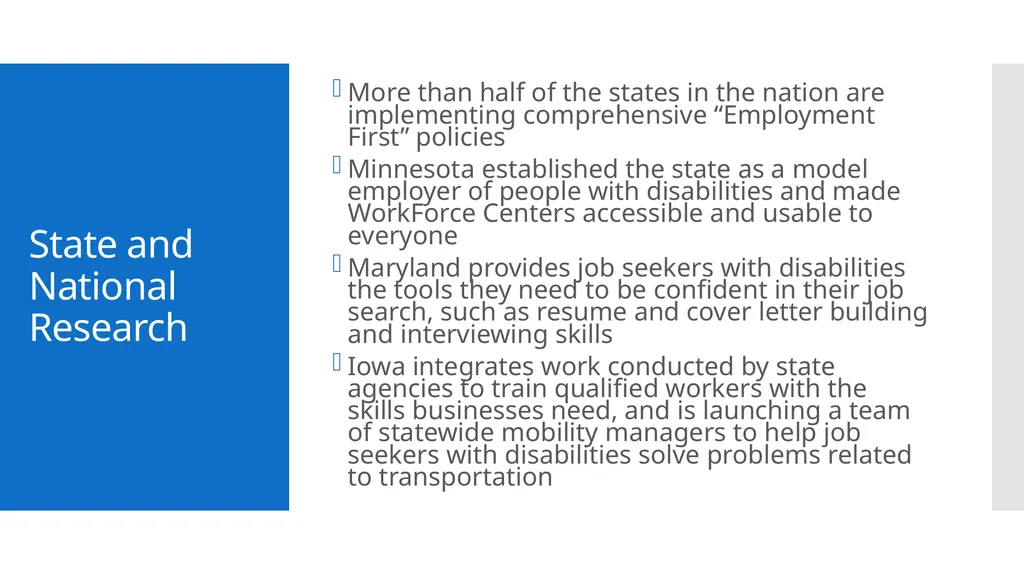
slide25. State and National Research More than half of the states in the nation are implementing comprehensive “Employment First” policies
Minnesota established the state as a model employer of people with disabilities and made WorkForce Centers accessible and usable to everyone
Maryland provides job seekers with disabilities the tools they need to be confident in their job search, such as resume and cover letter building and interviewing skills
Iowa integrates work conducted by state agencies to train qualified workers with the skills businesses need, and is launching a team of statewide mobility managers to help job seekers with disabilities solve problems related to transportation<br>
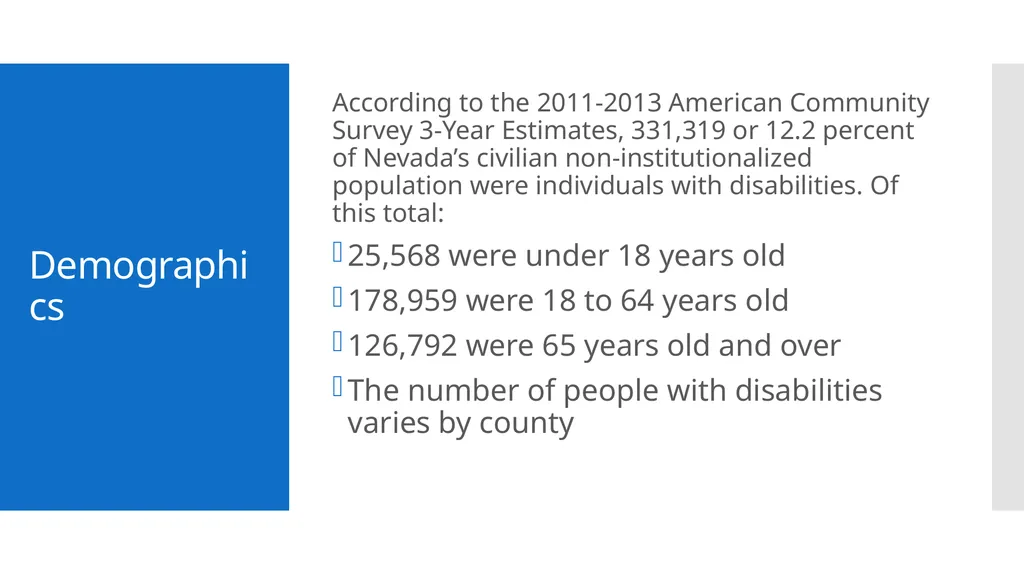
slide26. Demographics According to the 2011-2013 American Community Survey 3-Year Estimates, 331,319 or 12.2 percent of Nevada’s civilian non-institutionalized population were individuals with disabilities. Of this total:
25,568 were under 18 years old
178,959 were 18 to 64 years old
126,792 were 65 years old and over
The number of people with disabilities varies by county<br>
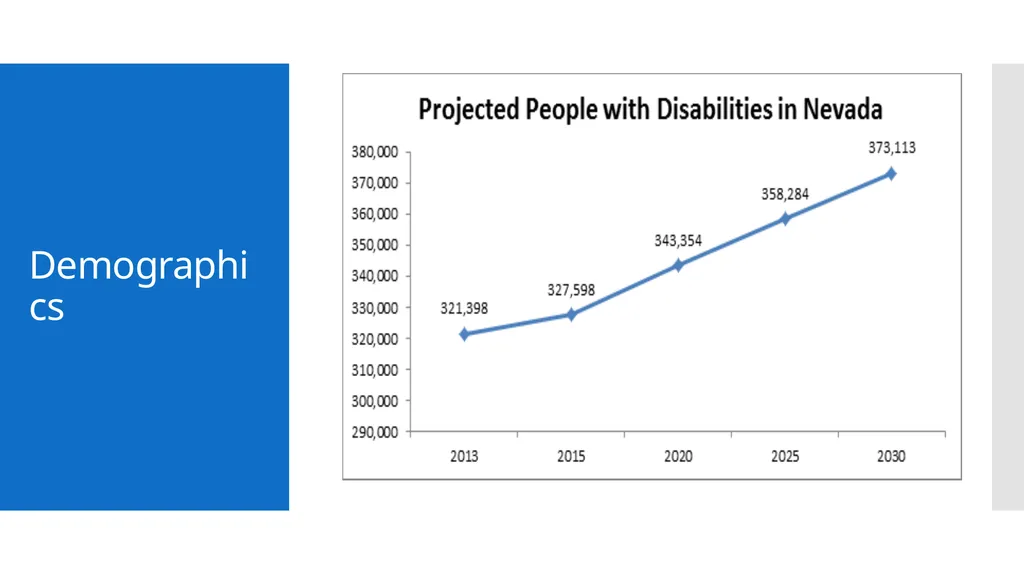
slide27. Demographics<br>
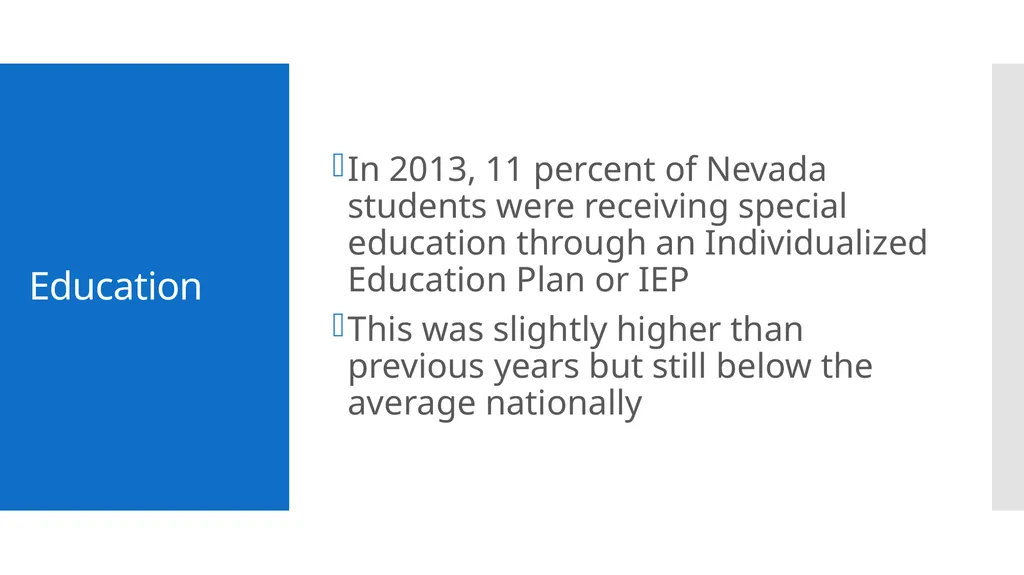
slide28. Education In 2013, 11 percent of Nevada students were receiving special education through an Individualized Education Plan or IEP
This was slightly higher than previous years but still below the average nationally<br>
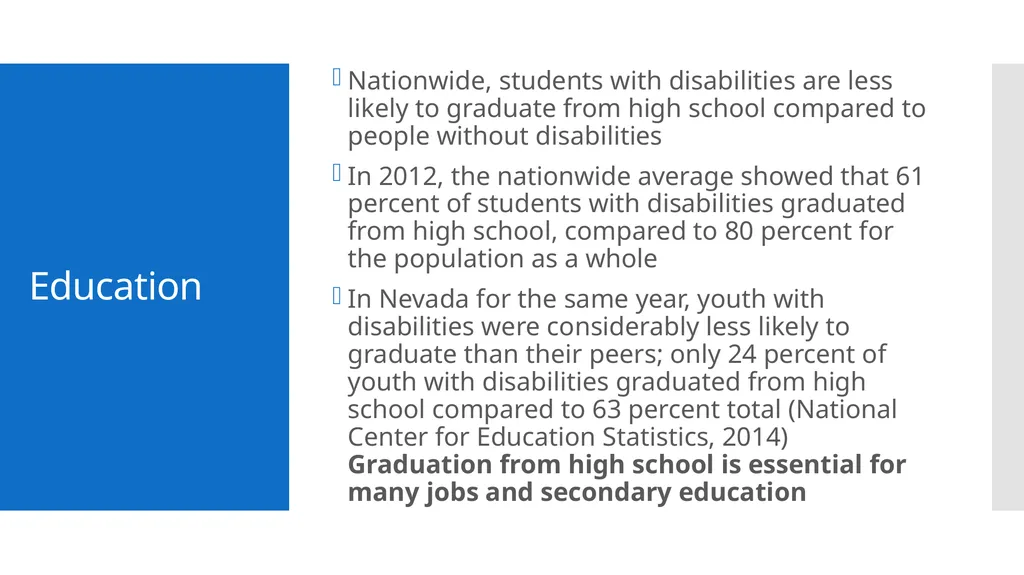
slide29. Education Nationwide, students with disabilities are less likely to graduate from high school compared to people without disabilities
In 2012, the nationwide average showed that 61 percent of students with disabilities graduated from high school, compared to 80 percent for the population as a whole
In Nevada for the same year, youth with disabilities were considerably less likely to graduate than their peers; only 24 percent of youth with disabilities graduated from high school compared to 63 percent total (National Center for Education Statistics, 2014) Graduation from high school is essential for many jobs and secondary education<br>
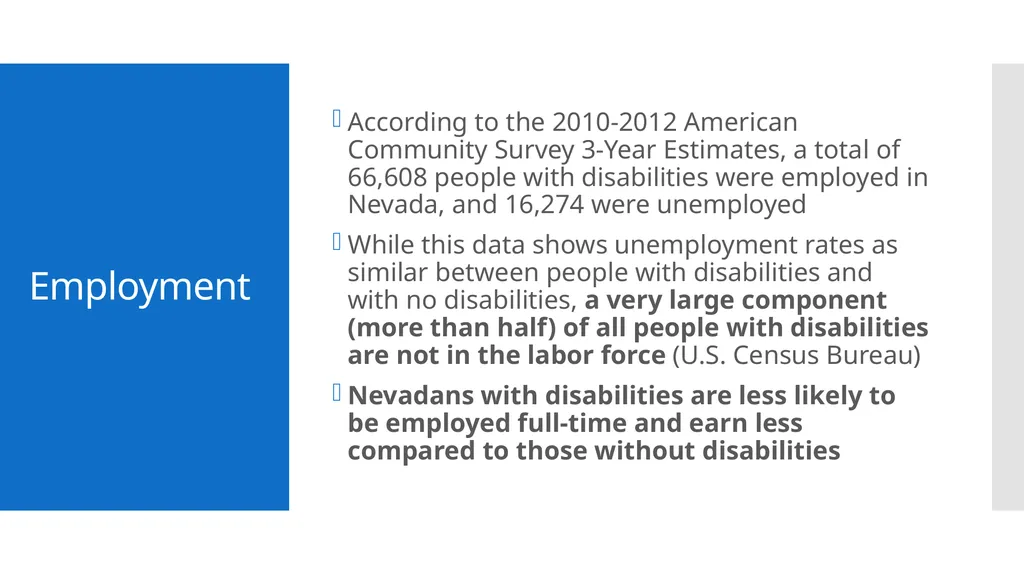
slide30. Employment According to the 2010-2012 American Community Survey 3-Year Estimates, a total of 66,608 people with disabilities were employed in Nevada, and 16,274 were unemployed
While this data shows unemployment rates as similar between people with disabilities and with no disabilities, a very large component (more than half) of all people with disabilities are not in the labor force (U.S. Census Bureau)
Nevadans with disabilities are less likely to be employed full-time and earn less compared to those without disabilities<br>
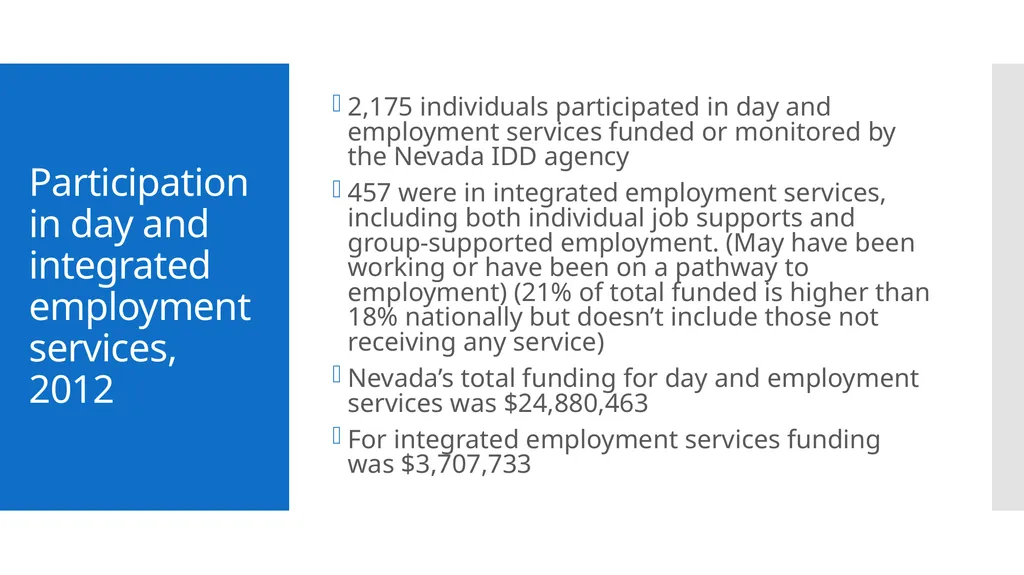
slide31. Participation in day and integrated employment services, 2012 2,175 individuals participated in day and employment services funded or monitored by the Nevada IDD agency
457 were in integrated employment services, including both individual job supports and group-supported employment. (May have been working or have been on a pathway to employment) (21% of total funded is higher than 18% nationally but doesn’t include those not receiving any service)
Nevada’s total funding for day and employment services was $24,880,463
For integrated employment services funding was $3,707,733<br>
slide32. Themes and Strategies Part 1--Research<br>
slide33. Government as a model employer Make disability employment part of the state workforce development strategy (policy, program and funding)
Be a model employer by increasing the number of people with disabilities working in state government (policy)
Make state employment website accessible, known, easy to navigate
Redirect resources to integrated employment services
Ensure sufficient integrated transition, employment, vocational, and day services and supports<br>
slide34. Government as a model employer Support Collaboration across agencies serving people with disabilities
Support Entrepreneurs with Disabilities (include business development and incubators)
Certify disability-owned businesses<br>
slide35. Businesses as an employer and partner Engage businesses and assess their needs
Help businesses find people with disabilities that match their needs
Dedicate staff with business expertise who can make the business case
Assign one point of contact from the state to work with employers over the long term
Providing skills assessment and training
Navigate the complexities of benefits related to workers with disabilities<br>
slide36. Businesses as an employer and partner Work with multiple businesses within a sector
Link to Economic Development efforts
Include small businesses<br>
slide37. Early and timely school assessment and planning for transitions Incorporate career-readiness content into educational curriculum
Link state colleges’ and universities’ disability services with career services
Provide students with specific knowledge and skills to be successful
Assess early and envision a life of work
Identify dreams<br>
slide38. A cultural shift Ensure policies prioritize employment
Allocate resources toward integrated employment
Engage all stakeholders in planning the transition
Engage the public and educate them about ICE to reset expectations across the state
Shift thinking from disability to ABILITY<br>
slide39. Coordinated schools and economic development authorities Integrate youth with disabilities in existing state efforts to improve college and career readiness
Co-locate vocational rehabilitation counselors and services in high schools
Provide other career-readiness and career exploration services, such as career and job fairs, job shadowing, and career-focused mentoring<br>
slide40. Sustainable funding Ensure that Nevada is fully matching the federal funding for vocational rehabilitation
Establish clear goals for rates and contracting structures
Make changes to funding rates based on the real costs of providing high quality integrated employment
Convene all agencies that pay for employment services
Work on systemic change to the funding system
Provide easy-to-understand resources for individuals, families, and employers to learn about the benefit options<br>
slide41. Orientation to results Set and measure progress toward employment goals
Set and measure the return on investment of disability employment programs
Use information on progress e to improve programs
Encourage others to participate in measuring results
Strengthen data collection systems<br>
slide42. Recommendations for Strategic Planning<br>
slide43. NGCDD Employment Policy Involve all stakeholders in the improvement of interagency collaboration and communication.
Engage individuals with disabilities in developmental career experiences at a younger age.
Develop and institute training and educational systems and public awareness programs for people with disabilities, providers, families, employers, and community partners that focus on employment of individuals with developmental disabilities.<br>
slide44. NGCDD Employment Policy Review, define, revise, implement and enforce a reimbursement structure for service providers that increases employment of persons with disabilities.
Expand and enhance transportation options for persons with disabilities.
Define, expand and educate the use of assistive technology to increase employment options.<br>
slide45. Characteristics of Successful Implementation of Employment First There are measurable increases in employment of citizens with disabilities within the general workforce, earning minimum wage or higher with benefits.
Greater opportunities exist for citizens with disabilities to pursue self-employment and the development of microenterprises.
Employment is the first and preferred option when exploring goals and a life path for citizens with disabilities.<br>
slide46. Characteristics of Successful Implementation of Employment First Citizens with disabilities are employed within the general workforce, regardless of the severity of disability and assistance required.
Young people with disabilities have work experiences that are typical of other teenagers and young adults.
Employers universally value individuals with disabilities as an integral part of their workforce, and include people with disabilities within general recruitment and hiring efforts as standard practice.<br>
slide47. Characteristics of Successful Implementation of Employment First Individuals with disabilities have increased incomes, financial assets, and economic wealth.
Citizens with disabilities have greater opportunities to advance in their careers, by taking full advantage of their individual strengths and talents.
Funding is sufficient so that quality services and supports are available as needed for long-term employment success.
A decision not to consider employment in the community for an individual is re-evaluated on a regular basis; the reasons and rationale for this decision are fully documented and addressed in service provision.<br>
slide48. Recommend-ations related to implementing principle goals of Employment First Increase expectations about the employment potential of youth and adults with disabilities, including those with complex lives for whom competitive employment has been very limited.
Develop a unified state and local public policy agenda and framework.
Promote (re)investment of public resources to increase opportunities and access.<br>
slide49. Recommend-ations related to implementing principle goals of Employment First Implement policies and practices that educate job seekers about possibilities and encourage employment as a real choice.
Increase the employment participation rate of Nevadans with disabilities in the workforce.
Promote economic prosperity of vastly unemployed and underemployed Nevadans with disabilities.<br>
slide50. Recommend-ations on a framework for systems change (SELN) Leadership
Clear and unambiguous commitment to employment in individual community jobs, from top leadership through all levels in the system. Local and state-level administrators are champions for employment.
Strategic goals and operating policies
Employment is identified as the preferred outcome in state developmental disabilities policy, and is supported by program goals and operating practices that are clearly designed to achieve that objective.<br>
slide51. Recommend-ations on a framework for systems change (SELN) Financing and policies
The outcome of employment in individual integrated community jobs is emphasized and supported through the state’s resource allocation formulas, reimbursement methods, and rate setting practices.
Training and technical assistance
High-performing employment systems invest in the development and maintenance of a strong, competent workforce, building the skills of job coaches and developers, supervisors, and key staff.<br>
slide52. Recommend-ations on a framework for systems change (SELN) Interagency collaboration and partnership
Building relationships with key state and local agency partners, such as vocational rehabilitation, education, mental health, and the state Medicaid agency, removes barriers to employment supports as people transition from one funding stream to another.
Services and service definitions
Service definitions and support strategies are structured and aligned to facilitate the delivery of employment supports to all individuals with developmental disabilities, regardless of the intensity of their needs.<br>
slide53. Recommend-ations on a framework for systems change (SELN) Performance measurement and data management
Comprehensive data systems are used to measure progress, benchmark performance, and document outcomes. Information is gathered on key indicators across employment and other related systems and is used to evaluate and track results, inform policy, and improve provider contracts and service agreements. Data are shared with other state agencies to report results and improve quality.<br>
slide54. Questions?<br>
slide55. Reminder This is one piece of the puzzle
Outreach is underway and people’s voices are very important
We aren’t deciding anything today in terms of goals<br>
slide56. Discussion What do you want to know more about?
What can you add to what we have learned?
What are your key takeaways?<br>
slide2. Executive Order 2014-2016 Mission
The Taskforce mission is to develop and implement a sustainable system for individuals with intellectual and developmental disabilities (IDD) to achieve competitive, integrated employment in the setting of their choice.<br>
slide3. Charge to the Taskforce The Taskforce is responsible for examining and evaluating current employment programs, resources, funding, available training, and employment opportunities for individuals with intellectual/developmental disabilities…and
is also responsible for developing a three, five, and ten-year strategic plan (2015-2025) that will result in “creating a more integrated workforce and expanding competitive employment opportunities for individuals with intellectual/developmental disabilities.”<br>
slide4. Contents of the Research Report Overview of the current situation in Nevada regarding integrated employment practices and programs for individuals with IDD
Models and best practices to support and promote education, employment opportunities and outcomes, and other habilitation services for individuals with IDD
Policies and legislation needed to create a more diversified, inclusive, and integrated workforce
Funding opportunities, potential partners, and collaborations to consider<br>
slide5. About the Research Research included review of over 50 national and state reports, briefs, papers and plans related to Integrated Employment. Some key resources…
Office of Disability Employment Policy. Integrated Employment Toolkit.
The National Governors Association Center for Best Practices (NGA Center,2012). A Better Bottom Line: Employing people with disabilities. Blueprint for Governors.<br>
slide6. About the Research National organizations have developed a series of reports, recommendations and briefs related to Integrated Employment or Integrated Competitive Employment (ICE).
The State Employment Leadership Network Accomplishments Report summarizes progress in seventeen member states in 2009-2010 in areas such as waiver service definitions, Employment First policies and strategies, funding and rate methodology changes, and sharing data across state agencies.<br>
slide7. About the Research Association of People Supporting Employment First (APSE) providing a starting point with the APSE Employment First Statement.
The Institute for Community Inclusion, (Butterworth, J., Smith, F., Hall, A., Migliore, A., Winsor, J., & Domin, D.) has published annually, StateData: The national report on employment services and outcomes.
State Activities to Implement Employment First as the Employment Strategy for Individuals with Intellectual and Developmental Disabilities (Jennings, Jr., E. T., & Zhiwei, Z.,2013).<br>
slide8. About the Research A number of states have developed Integrated Employment Plans.
Nevada Governor's Council on Developmental Disabilities (2014). Changing Nevada's Employment Landscape-Increasing Integrated Employment Outcomes for Nevadans with Intellectual/Developmental Disabilities. Position Statement on Integrated Employment.
Harrington, S.-D., Sykes, S., & Wassmuth, C. (2012). Nevada Disability Employment Resource Guide 2011 - Diversifying Nevada's Workforce.<br>
slide9. Models already exist that Nevada can leverage Nevada’s proposed high performance model is a revision based on the model found in the National Report on Employment Services and Outcomes, 2013. It creates a framework to build on the aforementioned programs.<br>
slide10. A Proposed Model<br>
slide11. A Proposed Model<br>
slide12. Key Themes from the Research<br>
slide13. Government as a model employer Government represents a significant opportunity to advance employment opportunities for people with disabilities. Government can…
Take a leader’s role
Act as a model employer for people with disabilities
Show the business community the way to invest in integrated employment
Strategies can include creating a fast-track hiring process, focusing on retention, and setting hiring goals<br>
slide14. Businesses as an employer and partner The business community is critical to improving employment outcomes for people with disabilities
Businesses are willing but need support from schools and government to address barriers that people with disabilities face
To engage business, the Taskforce needs to understand the business perspective AND
Show businesses how hiring people with disabilities will meet businesses’ needs (loyalty, productivity)
Government should not rely solely on the business community but be a long-term support agent and resource<br>
slide15. Early and timely school assessment and planning for transitions Transition and career-readiness services should be provided from middle school on—starting earlier leads to better outcomes
Strategies include incorporating career-readiness content into educational curriculum, linking college and university services with career services, and providing specific knowledge and skills to be successful
Hands-on work experience during high school, whether paid or not, increases the chances of finding employment with higher wages after they graduate<br>
slide16. A cultural shift It is critical to address the traditional paradigm of “prepping young individuals with disabilities for a life of benefits” and change it to “prepping young individuals with disabilities to a life of work”
State policies and strategies should promote
The inclusion of individuals with disabilities to the workforce by making integrated employment a priority, and
Implementing the same strategies used with the broader workforce<br>
slide17. Coordinated schools and economic development authorities Close coordination between schools and economic development authorities is critical
This allows schools to help students with disabilities develop the right skills they need to enter the workforce
Employers then benefit from a broader pool of skilled applicants<br>
slide18. Sustainable funding Leverage limited resources
Utilize multiple funding streams
Capitalize on federal programs
Connect with private-sector and philanthropic resources
Maximize disability experts’ efforts
This includes ensuring that Nevada is fully matching the federal funding for vocational rehabilitation.<br>
slide19. Orientation to results Set and measure progress toward employment goals
Set and measure the return on investment of disability employment programs
Use information on progress to improve programs
Encourage others to participate in measuring results<br>
slide20. Current Situation Part 1--Data<br>
slide21. Nevada Governor’s Council on Developmental Disabilities, Position Paper Supported employment outcomes for Nevadans with intellectual/developmental disabilities should include:
Working in the community at competitive wages
Making a financial impact on the economy
Diversifying the workforce
Improving quality of life<br>
slide22. Nevada Governor’s Council on Developmental Disabilities, Position Paper All adults in Nevada— including Nevadans with intellectual/developmental disabilities— should expect independence and competitive employment
However, for those Nevadans with IDD who do not currently choose employment, meaningful day habilitation should be an option<br>
slide23. Nevada Governor’s Council on Developmental Disabilities, Position Paper Optimize the use of limited resources and make some financial concessions to make supportive employment services fiscally viable
Rehabilitation Division funding could be used to leverage job and day training services to provide meaningful job readiness skills and prepare individuals for competitive employment
Day habilitation’s providers should improve and increase programming geared toward competitive employment and become a provider of supported employment job development services<br>
slide24. NGCDD Employment Policy Summit (2010) Major accomplishments from these sessions still in progress, include:
Medicaid Infrastructure Grant Funding
Customized Employment Pilot Study
Nevada Career Development Academy
Nevada Employment First Ad Hoc Committee
System Improvements were made to make employment the first option for Nevadans with an IDD and use new and existing funding sources to make programs a reality<br>
slide25. State and National Research More than half of the states in the nation are implementing comprehensive “Employment First” policies
Minnesota established the state as a model employer of people with disabilities and made WorkForce Centers accessible and usable to everyone
Maryland provides job seekers with disabilities the tools they need to be confident in their job search, such as resume and cover letter building and interviewing skills
Iowa integrates work conducted by state agencies to train qualified workers with the skills businesses need, and is launching a team of statewide mobility managers to help job seekers with disabilities solve problems related to transportation<br>
slide26. Demographics According to the 2011-2013 American Community Survey 3-Year Estimates, 331,319 or 12.2 percent of Nevada’s civilian non-institutionalized population were individuals with disabilities. Of this total:
25,568 were under 18 years old
178,959 were 18 to 64 years old
126,792 were 65 years old and over
The number of people with disabilities varies by county<br>
slide27. Demographics<br>
slide28. Education In 2013, 11 percent of Nevada students were receiving special education through an Individualized Education Plan or IEP
This was slightly higher than previous years but still below the average nationally<br>
slide29. Education Nationwide, students with disabilities are less likely to graduate from high school compared to people without disabilities
In 2012, the nationwide average showed that 61 percent of students with disabilities graduated from high school, compared to 80 percent for the population as a whole
In Nevada for the same year, youth with disabilities were considerably less likely to graduate than their peers; only 24 percent of youth with disabilities graduated from high school compared to 63 percent total (National Center for Education Statistics, 2014) Graduation from high school is essential for many jobs and secondary education<br>
slide30. Employment According to the 2010-2012 American Community Survey 3-Year Estimates, a total of 66,608 people with disabilities were employed in Nevada, and 16,274 were unemployed
While this data shows unemployment rates as similar between people with disabilities and with no disabilities, a very large component (more than half) of all people with disabilities are not in the labor force (U.S. Census Bureau)
Nevadans with disabilities are less likely to be employed full-time and earn less compared to those without disabilities<br>
slide31. Participation in day and integrated employment services, 2012 2,175 individuals participated in day and employment services funded or monitored by the Nevada IDD agency
457 were in integrated employment services, including both individual job supports and group-supported employment. (May have been working or have been on a pathway to employment) (21% of total funded is higher than 18% nationally but doesn’t include those not receiving any service)
Nevada’s total funding for day and employment services was $24,880,463
For integrated employment services funding was $3,707,733<br>
slide32. Themes and Strategies Part 1--Research<br>
slide33. Government as a model employer Make disability employment part of the state workforce development strategy (policy, program and funding)
Be a model employer by increasing the number of people with disabilities working in state government (policy)
Make state employment website accessible, known, easy to navigate
Redirect resources to integrated employment services
Ensure sufficient integrated transition, employment, vocational, and day services and supports<br>
slide34. Government as a model employer Support Collaboration across agencies serving people with disabilities
Support Entrepreneurs with Disabilities (include business development and incubators)
Certify disability-owned businesses<br>
slide35. Businesses as an employer and partner Engage businesses and assess their needs
Help businesses find people with disabilities that match their needs
Dedicate staff with business expertise who can make the business case
Assign one point of contact from the state to work with employers over the long term
Providing skills assessment and training
Navigate the complexities of benefits related to workers with disabilities<br>
slide36. Businesses as an employer and partner Work with multiple businesses within a sector
Link to Economic Development efforts
Include small businesses<br>
slide37. Early and timely school assessment and planning for transitions Incorporate career-readiness content into educational curriculum
Link state colleges’ and universities’ disability services with career services
Provide students with specific knowledge and skills to be successful
Assess early and envision a life of work
Identify dreams<br>
slide38. A cultural shift Ensure policies prioritize employment
Allocate resources toward integrated employment
Engage all stakeholders in planning the transition
Engage the public and educate them about ICE to reset expectations across the state
Shift thinking from disability to ABILITY<br>
slide39. Coordinated schools and economic development authorities Integrate youth with disabilities in existing state efforts to improve college and career readiness
Co-locate vocational rehabilitation counselors and services in high schools
Provide other career-readiness and career exploration services, such as career and job fairs, job shadowing, and career-focused mentoring<br>
slide40. Sustainable funding Ensure that Nevada is fully matching the federal funding for vocational rehabilitation
Establish clear goals for rates and contracting structures
Make changes to funding rates based on the real costs of providing high quality integrated employment
Convene all agencies that pay for employment services
Work on systemic change to the funding system
Provide easy-to-understand resources for individuals, families, and employers to learn about the benefit options<br>
slide41. Orientation to results Set and measure progress toward employment goals
Set and measure the return on investment of disability employment programs
Use information on progress e to improve programs
Encourage others to participate in measuring results
Strengthen data collection systems<br>
slide42. Recommendations for Strategic Planning<br>
slide43. NGCDD Employment Policy Involve all stakeholders in the improvement of interagency collaboration and communication.
Engage individuals with disabilities in developmental career experiences at a younger age.
Develop and institute training and educational systems and public awareness programs for people with disabilities, providers, families, employers, and community partners that focus on employment of individuals with developmental disabilities.<br>
slide44. NGCDD Employment Policy Review, define, revise, implement and enforce a reimbursement structure for service providers that increases employment of persons with disabilities.
Expand and enhance transportation options for persons with disabilities.
Define, expand and educate the use of assistive technology to increase employment options.<br>
slide45. Characteristics of Successful Implementation of Employment First There are measurable increases in employment of citizens with disabilities within the general workforce, earning minimum wage or higher with benefits.
Greater opportunities exist for citizens with disabilities to pursue self-employment and the development of microenterprises.
Employment is the first and preferred option when exploring goals and a life path for citizens with disabilities.<br>
slide46. Characteristics of Successful Implementation of Employment First Citizens with disabilities are employed within the general workforce, regardless of the severity of disability and assistance required.
Young people with disabilities have work experiences that are typical of other teenagers and young adults.
Employers universally value individuals with disabilities as an integral part of their workforce, and include people with disabilities within general recruitment and hiring efforts as standard practice.<br>
slide47. Characteristics of Successful Implementation of Employment First Individuals with disabilities have increased incomes, financial assets, and economic wealth.
Citizens with disabilities have greater opportunities to advance in their careers, by taking full advantage of their individual strengths and talents.
Funding is sufficient so that quality services and supports are available as needed for long-term employment success.
A decision not to consider employment in the community for an individual is re-evaluated on a regular basis; the reasons and rationale for this decision are fully documented and addressed in service provision.<br>
slide48. Recommend-ations related to implementing principle goals of Employment First Increase expectations about the employment potential of youth and adults with disabilities, including those with complex lives for whom competitive employment has been very limited.
Develop a unified state and local public policy agenda and framework.
Promote (re)investment of public resources to increase opportunities and access.<br>
slide49. Recommend-ations related to implementing principle goals of Employment First Implement policies and practices that educate job seekers about possibilities and encourage employment as a real choice.
Increase the employment participation rate of Nevadans with disabilities in the workforce.
Promote economic prosperity of vastly unemployed and underemployed Nevadans with disabilities.<br>
slide50. Recommend-ations on a framework for systems change (SELN) Leadership
Clear and unambiguous commitment to employment in individual community jobs, from top leadership through all levels in the system. Local and state-level administrators are champions for employment.
Strategic goals and operating policies
Employment is identified as the preferred outcome in state developmental disabilities policy, and is supported by program goals and operating practices that are clearly designed to achieve that objective.<br>
slide51. Recommend-ations on a framework for systems change (SELN) Financing and policies
The outcome of employment in individual integrated community jobs is emphasized and supported through the state’s resource allocation formulas, reimbursement methods, and rate setting practices.
Training and technical assistance
High-performing employment systems invest in the development and maintenance of a strong, competent workforce, building the skills of job coaches and developers, supervisors, and key staff.<br>
slide52. Recommend-ations on a framework for systems change (SELN) Interagency collaboration and partnership
Building relationships with key state and local agency partners, such as vocational rehabilitation, education, mental health, and the state Medicaid agency, removes barriers to employment supports as people transition from one funding stream to another.
Services and service definitions
Service definitions and support strategies are structured and aligned to facilitate the delivery of employment supports to all individuals with developmental disabilities, regardless of the intensity of their needs.<br>
slide53. Recommend-ations on a framework for systems change (SELN) Performance measurement and data management
Comprehensive data systems are used to measure progress, benchmark performance, and document outcomes. Information is gathered on key indicators across employment and other related systems and is used to evaluate and track results, inform policy, and improve provider contracts and service agreements. Data are shared with other state agencies to report results and improve quality.<br>
slide54. Questions?<br>
slide55. Reminder This is one piece of the puzzle
Outreach is underway and people’s voices are very important
We aren’t deciding anything today in terms of goals<br>
slide56. Discussion What do you want to know more about?
What can you add to what we have learned?
What are your key takeaways?<br>