
Research Project on Understanding challenges and
A
Published · 27 slides · 0 views
1 / 1

Description
Research Project on Understanding challenges and identifying entry points for solutions in eliciting individual-level responses among women in West Africa Key findings 1 Overview 2 Research Background Objectives 3 Proxy Respondents: A
Related Topics
Share
Embed code
Download this presentation From Below
"Research Project on Understanding challenges and" is the property of its rightful owner. Permission is granted to download and print the materials on this website for personal, non-commercial use only, and to display it on your personal computer provided you do not modify the materials and that you retain all copyright notices contained in the materials. By downloading content from our website, you accept the terms of this agreement.
Presentation Transcript
01
Research Project on
Understanding challenges and identifying entry points for solutions in eliciting individual-level responses among women in West Africa Key findings 1<br>
02
Overview 2<br>
03
Research Background & Objectives 3<br>
04
Proxy Respondents: A Source of Bias in Survey Results The use of proxy respondents− a person responding to a survey questionnaire on behalf of others− is a common practice in surveys, but it can be a source of bias for the data collected.
The proxy responding bias comes from the fact that the proxy respondent may provide a different response than the actual individual.
Lower labor force participation from proxy reports than those from self-reports; Bardasi et al. (2010)
The use of the “proxy respondent” leads to an underestimation of the employment rate among employees and those who work on their own accounts; Kilic et al. (2020). 4<br>
The proxy responding bias comes from the fact that the proxy respondent may provide a different response than the actual individual.
Lower labor force participation from proxy reports than those from self-reports; Bardasi et al. (2010)
The use of the “proxy respondent” leads to an underestimation of the employment rate among employees and those who work on their own accounts; Kilic et al. (2020). 4<br>
05
Role of Proxy Responses in Gender Statistics The existing evidence shows that the incidence of proxy response is higher among women than men, which can lead to biased gender statistics.
Comparison of wives’ income reports from wives themselves and those from husbands shows that the two reports match in only 6 percent of the households, and in 66 percent of households, the husband underestimated his wife’s income by an average of 47 percent (Fisher et al 2010).
Why proxy response?
Existing social norms could be one of the barriers that can impact the ability of women to be interviewed and provide unbiased responses (Volmer et al. 2021).
Survey specific factors such as ratio of male-female enumerators and return visit policies could be additional barriers in eliciting female responses. 5<br>
Comparison of wives’ income reports from wives themselves and those from husbands shows that the two reports match in only 6 percent of the households, and in 66 percent of households, the husband underestimated his wife’s income by an average of 47 percent (Fisher et al 2010).
Why proxy response?
Existing social norms could be one of the barriers that can impact the ability of women to be interviewed and provide unbiased responses (Volmer et al. 2021).
Survey specific factors such as ratio of male-female enumerators and return visit policies could be additional barriers in eliciting female responses. 5<br>
06
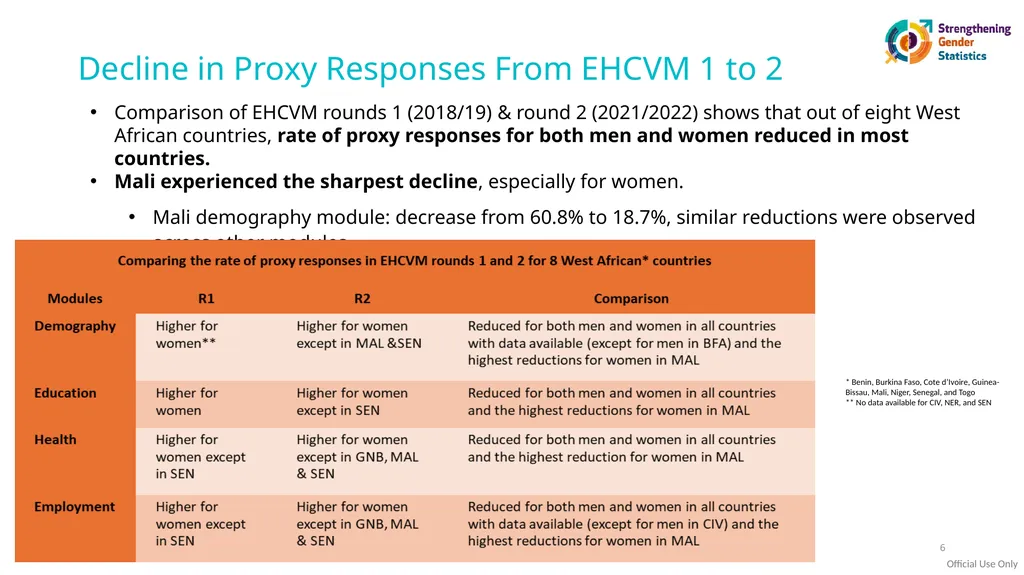
Decline in Proxy Responses From EHCVM 1 to 2 Comparison of EHCVM rounds 1 (2018/19) & round 2 (2021/2022) shows that out of eight West African countries, rate of proxy responses for both men and women reduced in most countries.
Mali experienced the sharpest decline, especially for women.
Mali demography module: decrease from 60.8% to 18.7%, similar reductions were observed across other modules. 6 * Benin, Burkina Faso, Cote d’Ivoire, Guinea-Bissau, Mali, Niger, Senegal, and Togo
** No data available for CIV, NER, and SEN<br>
Mali experienced the sharpest decline, especially for women.
Mali demography module: decrease from 60.8% to 18.7%, similar reductions were observed across other modules. 6 * Benin, Burkina Faso, Cote d’Ivoire, Guinea-Bissau, Mali, Niger, Senegal, and Togo
** No data available for CIV, NER, and SEN<br>
07
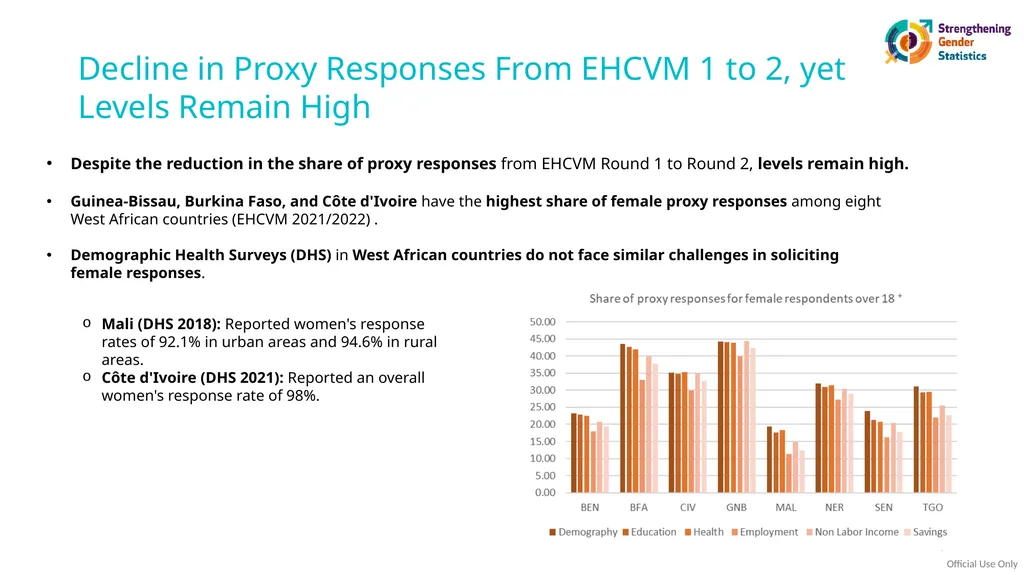
Decline in Proxy Responses From EHCVM 1 to 2, yet Levels Remain High Despite the reduction in the share of proxy responses from EHCVM Round 1 to Round 2, levels remain high.
Guinea-Bissau, Burkina Faso, and Côte d'Ivoire have the highest share of female proxy responses among eight West African countries (EHCVM 2021/2022) .
Demographic Health Surveys (DHS) in West African countries do not face similar challenges in soliciting female responses. 7 Mali (DHS 2018): Reported women's response rates of 92.1% in urban areas and 94.6% in rural areas.
Côte d'Ivoire (DHS 2021): Reported an overall women's response rate of 98%.<br>
Guinea-Bissau, Burkina Faso, and Côte d'Ivoire have the highest share of female proxy responses among eight West African countries (EHCVM 2021/2022) .
Demographic Health Surveys (DHS) in West African countries do not face similar challenges in soliciting female responses. 7 Mali (DHS 2018): Reported women's response rates of 92.1% in urban areas and 94.6% in rural areas.
Côte d'Ivoire (DHS 2021): Reported an overall women's response rate of 98%.<br>
08
Research Design 8<br>
09
Research Objectives & Design Key objectives
Understand perceived challenges in eliciting female responses, adopted solutions to reduce the share of female proxy responses, and any barriers to adopting solutions through explorative qualitative inquiry in seven WAEMU countries from the perspective of NSOs.
Research question: What are the perceived challenges, existing solutions, and barriers to adopting existing solutions employed in eliciting individual-level responses among women in West Africa?
Key Informant Interviews (KIIs) with staff from NSOs in seven (francophone) WAEMU countries. 9<br>
Understand perceived challenges in eliciting female responses, adopted solutions to reduce the share of female proxy responses, and any barriers to adopting solutions through explorative qualitative inquiry in seven WAEMU countries from the perspective of NSOs.
Research question: What are the perceived challenges, existing solutions, and barriers to adopting existing solutions employed in eliciting individual-level responses among women in West Africa?
Key Informant Interviews (KIIs) with staff from NSOs in seven (francophone) WAEMU countries. 9<br>
10
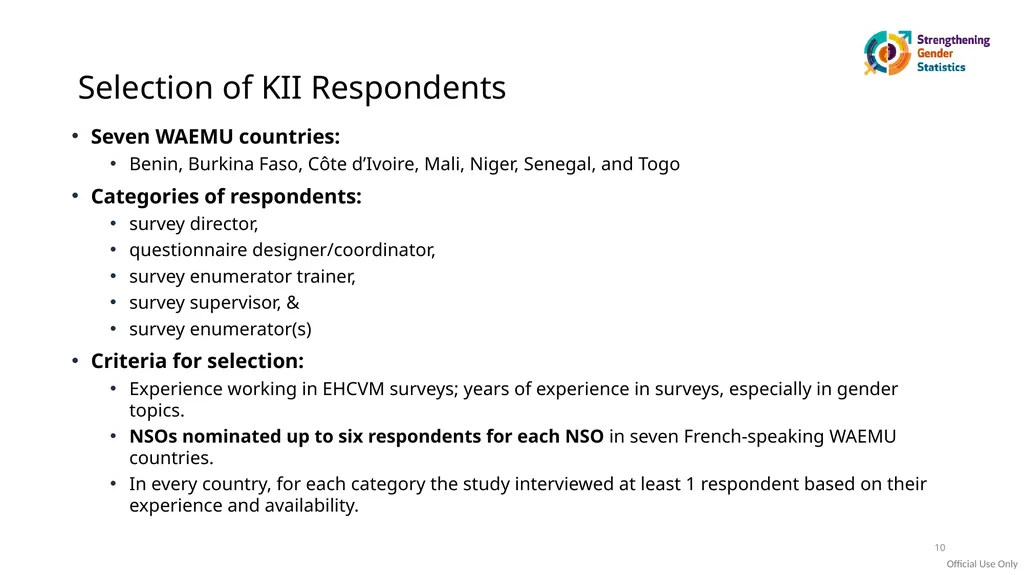
Selection of KII Respondents Seven WAEMU countries:
Benin, Burkina Faso, Côte d’Ivoire, Mali, Niger, Senegal, and Togo
Categories of respondents:
survey director,
questionnaire designer/coordinator,
survey enumerator trainer,
survey supervisor, &
survey enumerator(s)
Criteria for selection:
Experience working in EHCVM surveys; years of experience in surveys, especially in gender topics.
NSOs nominated up to six respondents for each NSO in seven French-speaking WAEMU countries.
In every country, for each category the study interviewed at least 1 respondent based on their experience and availability. 10<br>
Benin, Burkina Faso, Côte d’Ivoire, Mali, Niger, Senegal, and Togo
Categories of respondents:
survey director,
questionnaire designer/coordinator,
survey enumerator trainer,
survey supervisor, &
survey enumerator(s)
Criteria for selection:
Experience working in EHCVM surveys; years of experience in surveys, especially in gender topics.
NSOs nominated up to six respondents for each NSO in seven French-speaking WAEMU countries.
In every country, for each category the study interviewed at least 1 respondent based on their experience and availability. 10<br>
11
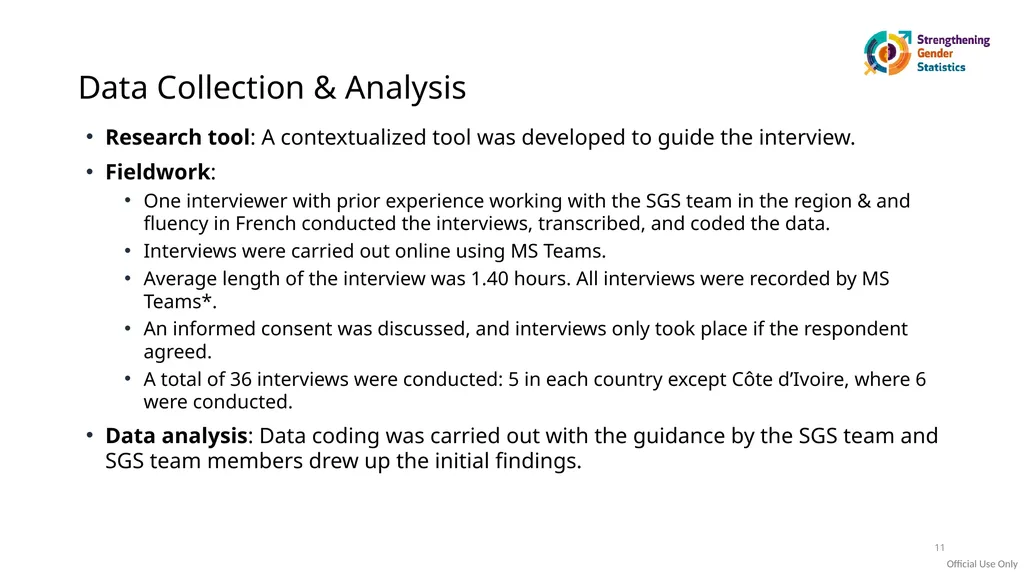
Data Collection & Analysis Research tool: A contextualized tool was developed to guide the interview.
Fieldwork:
One interviewer with prior experience working with the SGS team in the region & and fluency in French conducted the interviews, transcribed, and coded the data.
Interviews were carried out online using MS Teams.
Average length of the interview was 1.40 hours. All interviews were recorded by MS Teams*.
An informed consent was discussed, and interviews only took place if the respondent agreed.
A total of 36 interviews were conducted: 5 in each country except Côte d’Ivoire, where 6 were conducted.
Data analysis: Data coding was carried out with the guidance by the SGS team and SGS team members drew up the initial findings. 11<br>
Fieldwork:
One interviewer with prior experience working with the SGS team in the region & and fluency in French conducted the interviews, transcribed, and coded the data.
Interviews were carried out online using MS Teams.
Average length of the interview was 1.40 hours. All interviews were recorded by MS Teams*.
An informed consent was discussed, and interviews only took place if the respondent agreed.
A total of 36 interviews were conducted: 5 in each country except Côte d’Ivoire, where 6 were conducted.
Data analysis: Data coding was carried out with the guidance by the SGS team and SGS team members drew up the initial findings. 11<br>
12
Key Research Findings 12<br>
13
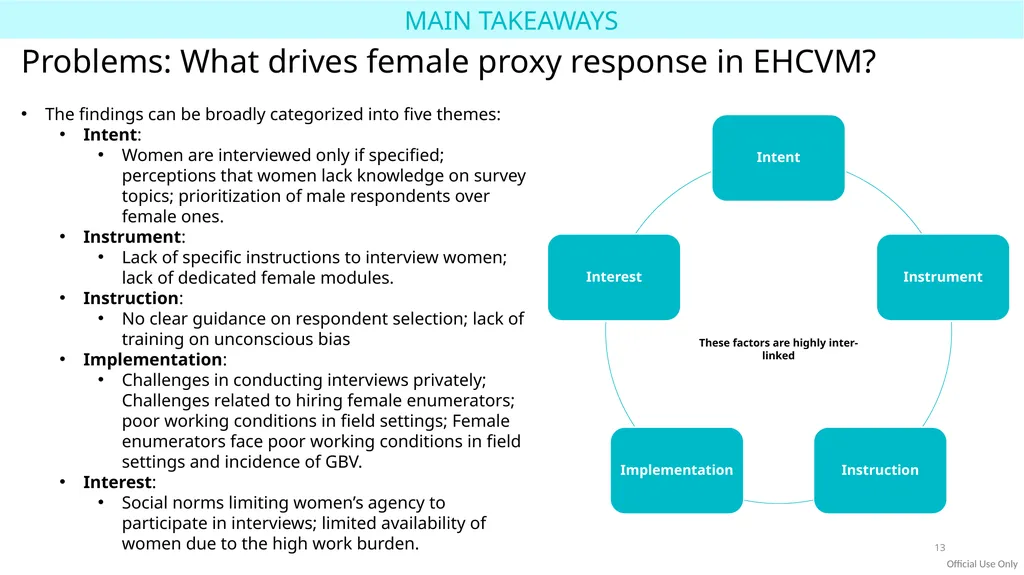
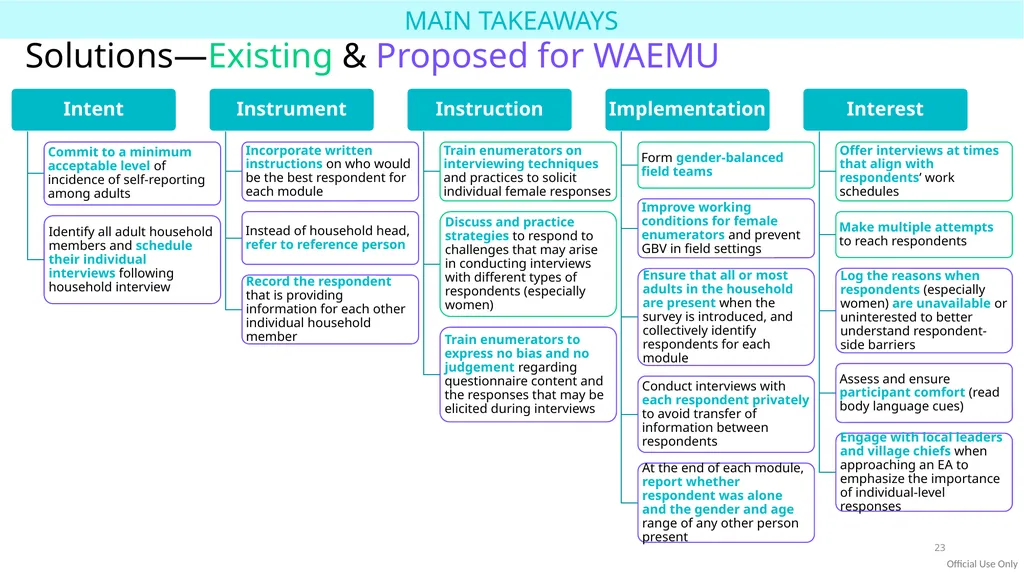
Problems: What drives female proxy response in EHCVM? 13 The findings can be broadly categorized into five themes:
Intent:
Women are interviewed only if specified; perceptions that women lack knowledge on survey topics; prioritization of male respondents over female ones.
Instrument:
Lack of specific instructions to interview women; lack of dedicated female modules.
Instruction:
No clear guidance on respondent selection; lack of training on unconscious bias
Implementation:
Challenges in conducting interviews privately; Challenges related to hiring female enumerators; poor working conditions in field settings; Female enumerators face poor working conditions in field settings and incidence of GBV.
Interest:
Social norms limiting women’s agency to participate in interviews; limited availability of women due to the high work burden. These factors are highly inter-linked MAIN TAKEAWAYS<br>
Intent:
Women are interviewed only if specified; perceptions that women lack knowledge on survey topics; prioritization of male respondents over female ones.
Instrument:
Lack of specific instructions to interview women; lack of dedicated female modules.
Instruction:
No clear guidance on respondent selection; lack of training on unconscious bias
Implementation:
Challenges in conducting interviews privately; Challenges related to hiring female enumerators; poor working conditions in field settings; Female enumerators face poor working conditions in field settings and incidence of GBV.
Interest:
Social norms limiting women’s agency to participate in interviews; limited availability of women due to the high work burden. These factors are highly inter-linked MAIN TAKEAWAYS<br>
14
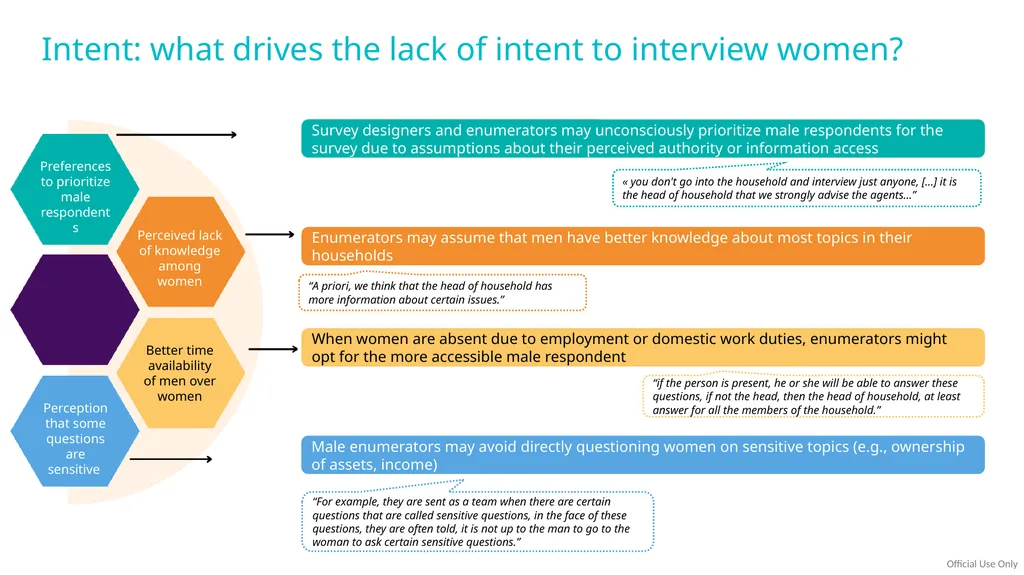
Intent: what drives the lack of intent to interview women?<br>
15
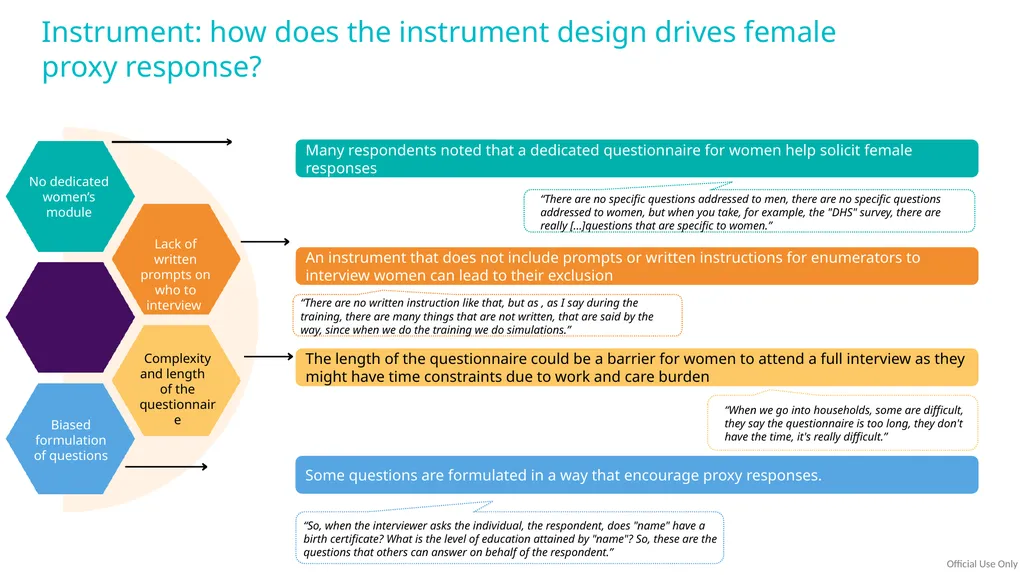
Instrument: how does the instrument design drives female proxy response? “There are no written instruction like that, but as , as I say during the training, there are many things that are not written, that are said by the way, since when we do the training we do simulations.”<br>
16
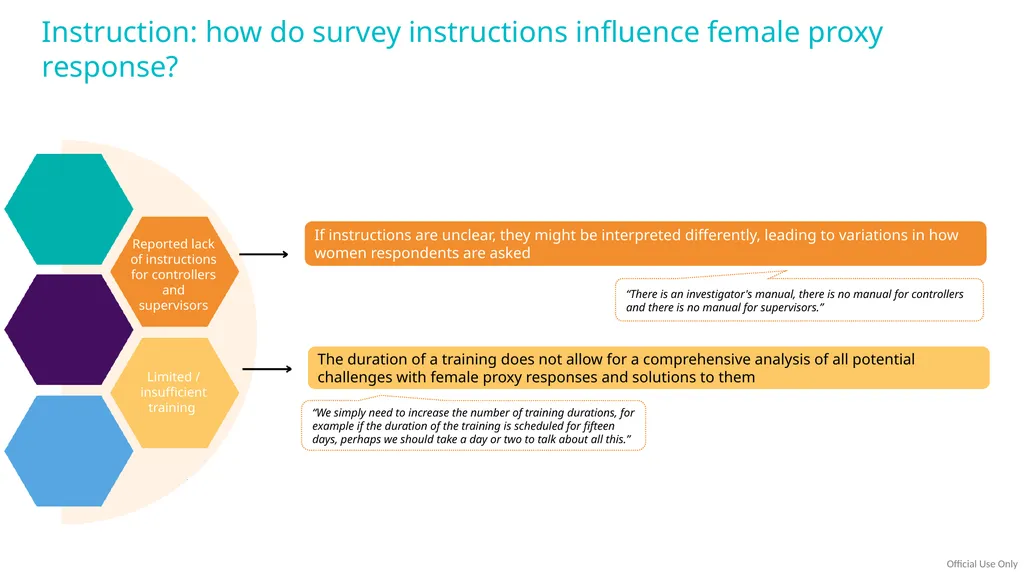
Instruction: how do survey instructions influence female proxy response?<br>
17
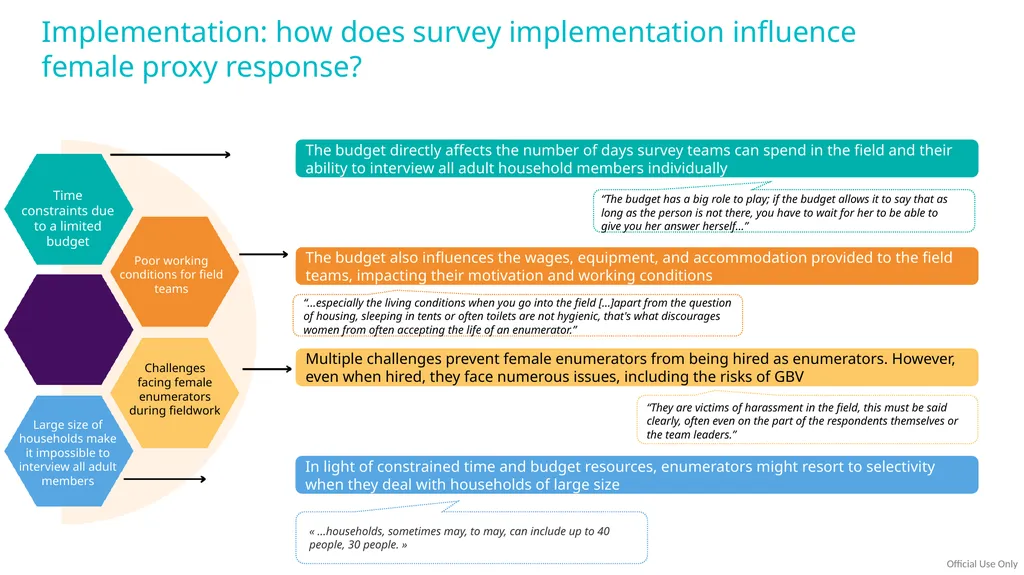
Implementation: how does survey implementation influence female proxy response?<br>
18
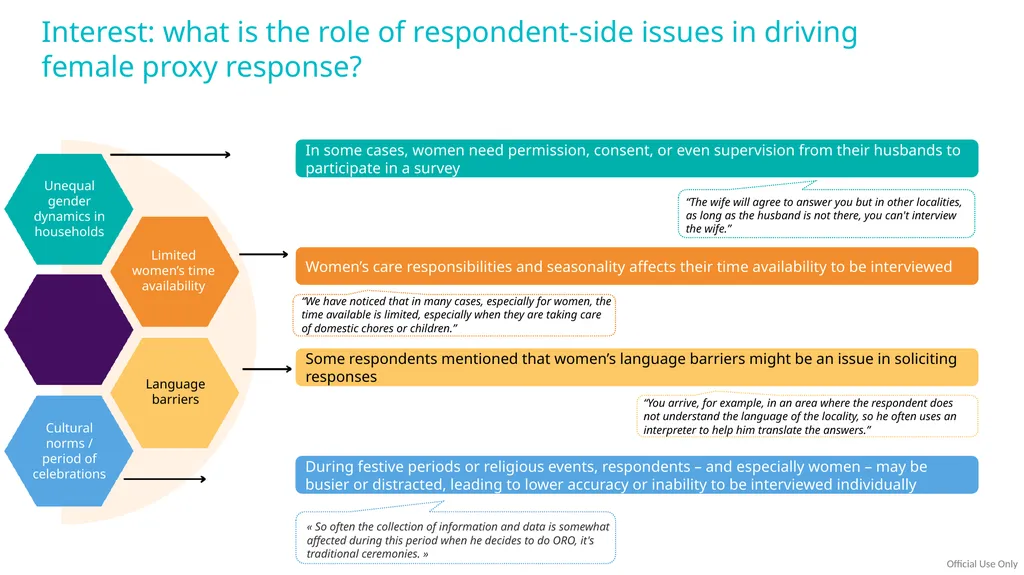
Interest: what is the role of respondent-side issues in driving female proxy response? “We have noticed that in many cases, especially for women, the time available is limited, especially when they are taking care of domestic chores or children.”<br>
19
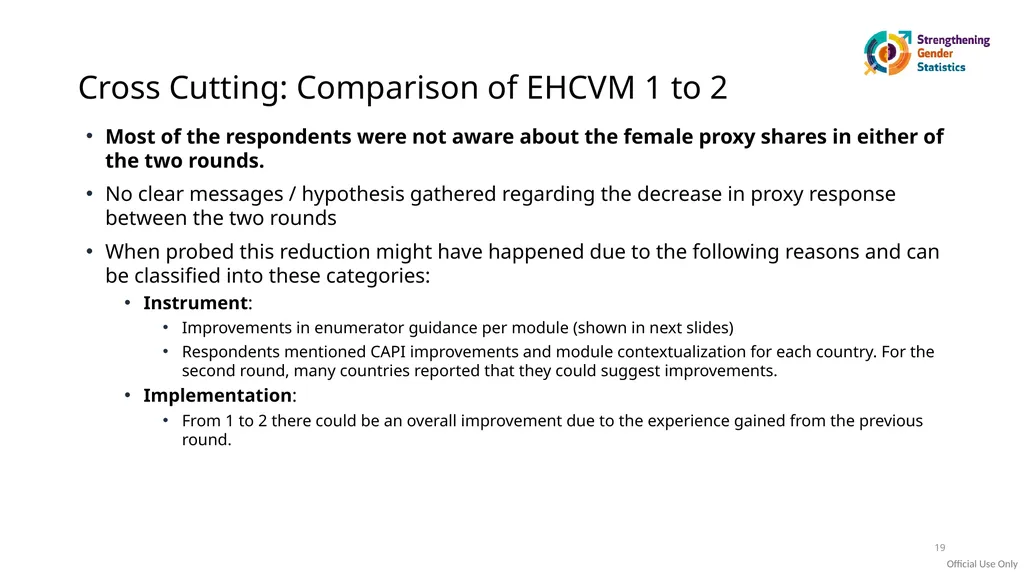
Cross Cutting: Comparison of EHCVM 1 to 2 Most of the respondents were not aware about the female proxy shares in either of the two rounds.
No clear messages / hypothesis gathered regarding the decrease in proxy response between the two rounds
When probed this reduction might have happened due to the following reasons and can be classified into these categories:
Instrument:
Improvements in enumerator guidance per module (shown in next slides)
Respondents mentioned CAPI improvements and module contextualization for each country. For the second round, many countries reported that they could suggest improvements.
Implementation:
From 1 to 2 there could be an overall improvement due to the experience gained from the previous round. 19<br>
No clear messages / hypothesis gathered regarding the decrease in proxy response between the two rounds
When probed this reduction might have happened due to the following reasons and can be classified into these categories:
Instrument:
Improvements in enumerator guidance per module (shown in next slides)
Respondents mentioned CAPI improvements and module contextualization for each country. For the second round, many countries reported that they could suggest improvements.
Implementation:
From 1 to 2 there could be an overall improvement due to the experience gained from the previous round. 19<br>
20
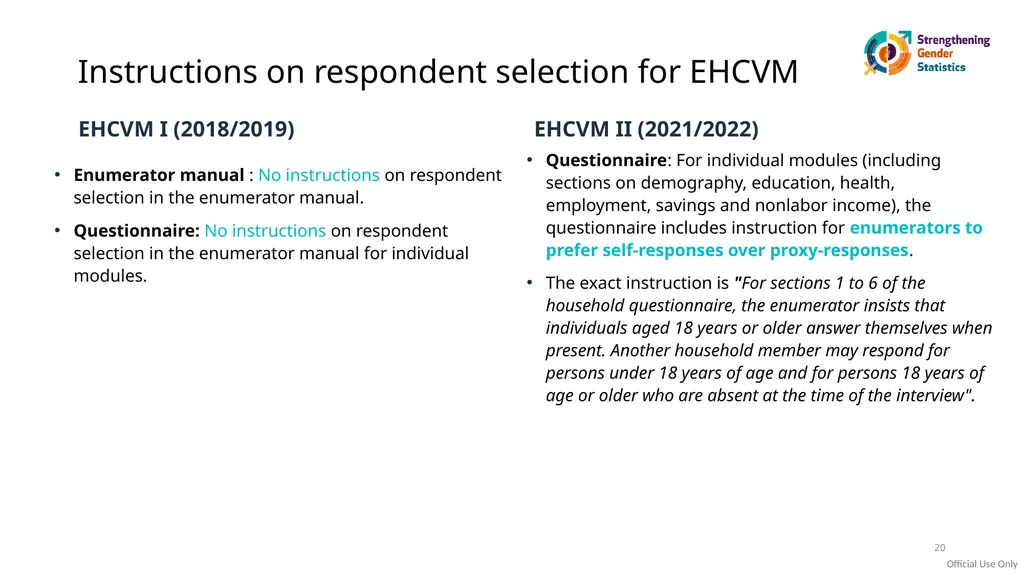
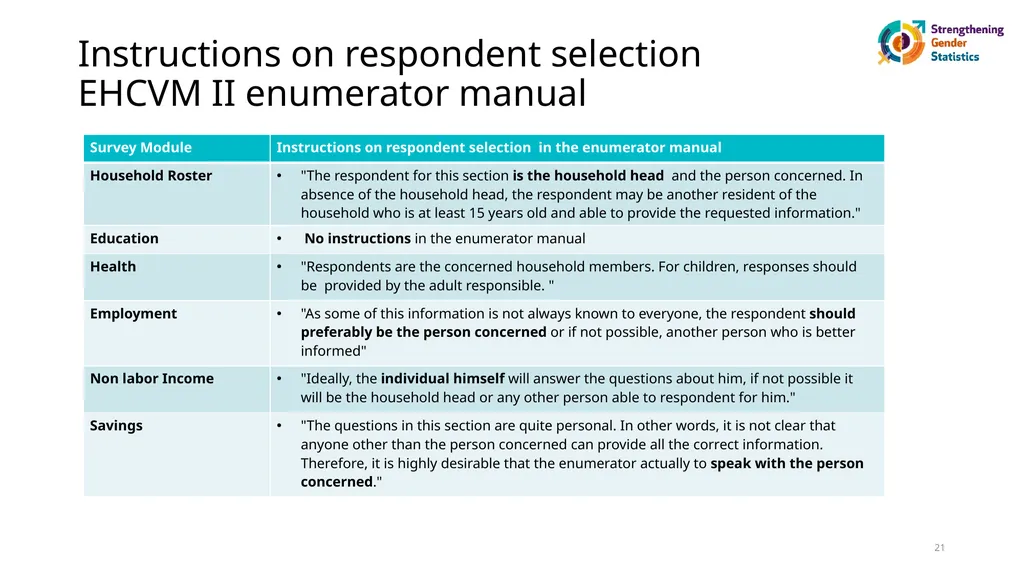
Instructions on respondent selection for EHCVM EHCVM I (2018/2019) Enumerator manual : No instructions on respondent selection in the enumerator manual.
Questionnaire: No instructions on respondent selection in the enumerator manual for individual modules. EHCVM II (2021/2022) Questionnaire: For individual modules (including sections on demography, education, health, employment, savings and nonlabor income), the questionnaire includes instruction for enumerators to prefer self-responses over proxy-responses.
The exact instruction is "For sections 1 to 6 of the household questionnaire, the enumerator insists that individuals aged 18 years or older answer themselves when present. Another household member may respond for persons under 18 years of age and for persons 18 years of age or older who are absent at the time of the interview". 20<br>
Questionnaire: No instructions on respondent selection in the enumerator manual for individual modules. EHCVM II (2021/2022) Questionnaire: For individual modules (including sections on demography, education, health, employment, savings and nonlabor income), the questionnaire includes instruction for enumerators to prefer self-responses over proxy-responses.
The exact instruction is "For sections 1 to 6 of the household questionnaire, the enumerator insists that individuals aged 18 years or older answer themselves when present. Another household member may respond for persons under 18 years of age and for persons 18 years of age or older who are absent at the time of the interview". 20<br>
21
Instructions on respondent selection
EHCVM II enumerator manual 21<br>
22
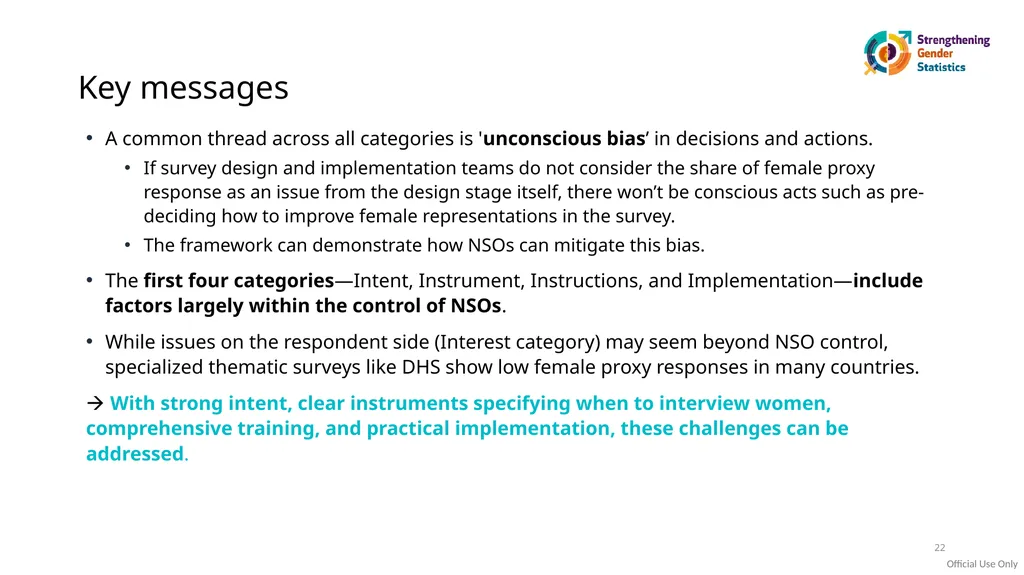
Key messages A common thread across all categories is 'unconscious bias’ in decisions and actions.
If survey design and implementation teams do not consider the share of female proxy response as an issue from the design stage itself, there won’t be conscious acts such as pre-deciding how to improve female representations in the survey.
The framework can demonstrate how NSOs can mitigate this bias.
The first four categories—Intent, Instrument, Instructions, and Implementation—include factors largely within the control of NSOs.
While issues on the respondent side (Interest category) may seem beyond NSO control, specialized thematic surveys like DHS show low female proxy responses in many countries.
With strong intent, clear instruments specifying when to interview women, comprehensive training, and practical implementation, these challenges can be addressed. 22<br>
If survey design and implementation teams do not consider the share of female proxy response as an issue from the design stage itself, there won’t be conscious acts such as pre-deciding how to improve female representations in the survey.
The framework can demonstrate how NSOs can mitigate this bias.
The first four categories—Intent, Instrument, Instructions, and Implementation—include factors largely within the control of NSOs.
While issues on the respondent side (Interest category) may seem beyond NSO control, specialized thematic surveys like DHS show low female proxy responses in many countries.
With strong intent, clear instruments specifying when to interview women, comprehensive training, and practical implementation, these challenges can be addressed. 22<br>
23
Solutions—Existing & Proposed for WAEMU 23 MAIN TAKEAWAYS<br>
24
Thank you! 24<br>
25
Annex 25<br>
26
Initiatives to Improve Gender Data Quality in Poverty Surveys Significant efforts to address methodological concerns and practical challenges related to economic gender data, including improving individual responses in poverty-related surveys.
Gender Asset Gap project (2009); The UN Evidence and Data for Gender Equality (EDGE) initiative (2013):;The Methodological Experiment on Measuring Asset Ownership from a Gender Perspective (MEXA) (2014); The Women’s Work and Employment Partnership (WWEP).
Recommendations fed into the Living Standards Measurement Study – Plus (LSMS+) program
Enhanced the availability and quality of intra-household, self-reported, individual-disaggregated survey data
Piggybacked on national surveys conducted by NSOs in Cambodia, Ethiopia, Malawi, Nepal, Tanzania and Sudan and administered questionnaire modules on asset ownership, labor and non‑farm enterprises that are anchored in international best practices
Attempted to interview all adult household members in private
Response rates between 78 and 96%
Results fed directly into SGS Guidance Document on Engendering Household Surveys
Despite the availability of international guidelines and key surveys (LSMS+, DHS, etc.) role modelling best practices in their operations, the efforts to improve individual responses have not been translated seamlessly into survey operations. 26<br>
Gender Asset Gap project (2009); The UN Evidence and Data for Gender Equality (EDGE) initiative (2013):;The Methodological Experiment on Measuring Asset Ownership from a Gender Perspective (MEXA) (2014); The Women’s Work and Employment Partnership (WWEP).
Recommendations fed into the Living Standards Measurement Study – Plus (LSMS+) program
Enhanced the availability and quality of intra-household, self-reported, individual-disaggregated survey data
Piggybacked on national surveys conducted by NSOs in Cambodia, Ethiopia, Malawi, Nepal, Tanzania and Sudan and administered questionnaire modules on asset ownership, labor and non‑farm enterprises that are anchored in international best practices
Attempted to interview all adult household members in private
Response rates between 78 and 96%
Results fed directly into SGS Guidance Document on Engendering Household Surveys
Despite the availability of international guidelines and key surveys (LSMS+, DHS, etc.) role modelling best practices in their operations, the efforts to improve individual responses have not been translated seamlessly into survey operations. 26<br>
27
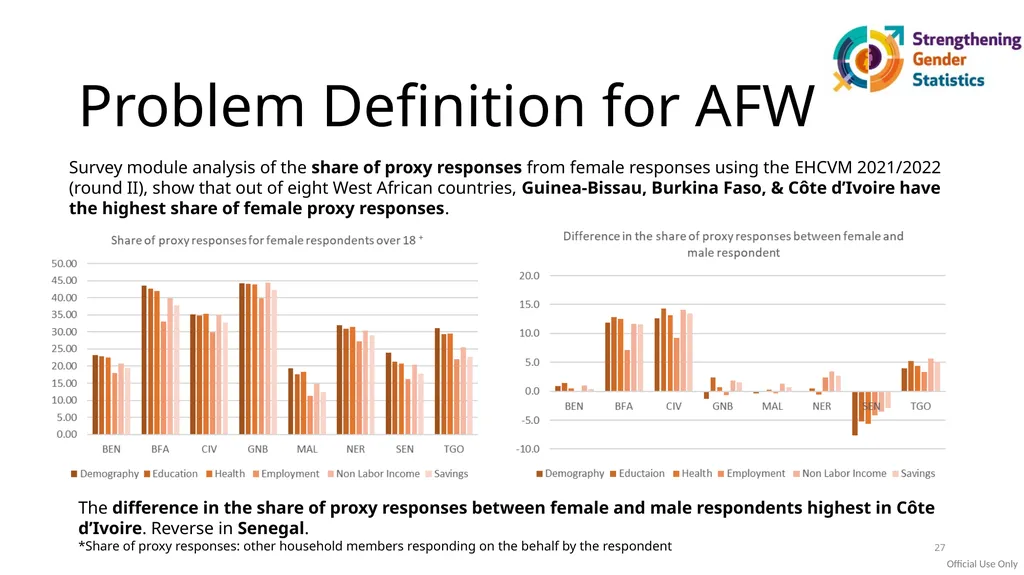
Problem Definition for AFW Survey module analysis of the share of proxy responses from female responses using the EHCVM 2021/2022 (round II), show that out of eight West African countries, Guinea-Bissau, Burkina Faso, & Côte d’Ivoire have the highest share of female proxy responses. The difference in the share of proxy responses between female and male respondents highest in Côte d’Ivoire. Reverse in Senegal.
*Share of proxy responses: other household members responding on the behalf by the respondent 27<br>
*Share of proxy responses: other household members responding on the behalf by the respondent 27<br>