
RESHAPING EDUCATIONAL METHODOLOGIES TO FIT AI
LV
Published · 14 slides · 0 views

1 / 1


Description
RESHAPING EDUCATIONAL METHODOLOGIES TO FIT AI TOPIC: Applying AI solutions to facilitate vocabulary learning Presented by: DEBORA GJONI 2025 NATO BILC PROFESSIONAL DEVELOPMENT SEMINAR INTRODUCTION Information technology today occupies a
Related Topics
Share
Embed code
Download this presentation From Below
"RESHAPING EDUCATIONAL METHODOLOGIES TO FIT AI" is the property of its rightful owner. Permission is granted to download and print the materials on this website for personal, non-commercial use only, and to display it on your personal computer provided you do not modify the materials and that you retain all copyright notices contained in the materials. By downloading content from our website, you accept the terms of this agreement.
Presentation Transcript
01
RESHAPING EDUCATIONAL METHODOLOGIES TO FIT AI
TOPIC: Applying AI solutions to facilitate vocabulary learning Presented by: DEBORA GJONI
2025 NATO BILC PROFESSIONAL DEVELOPMENT SEMINAR<br>
2025 NATO BILC PROFESSIONAL DEVELOPMENT SEMINAR<br>
02
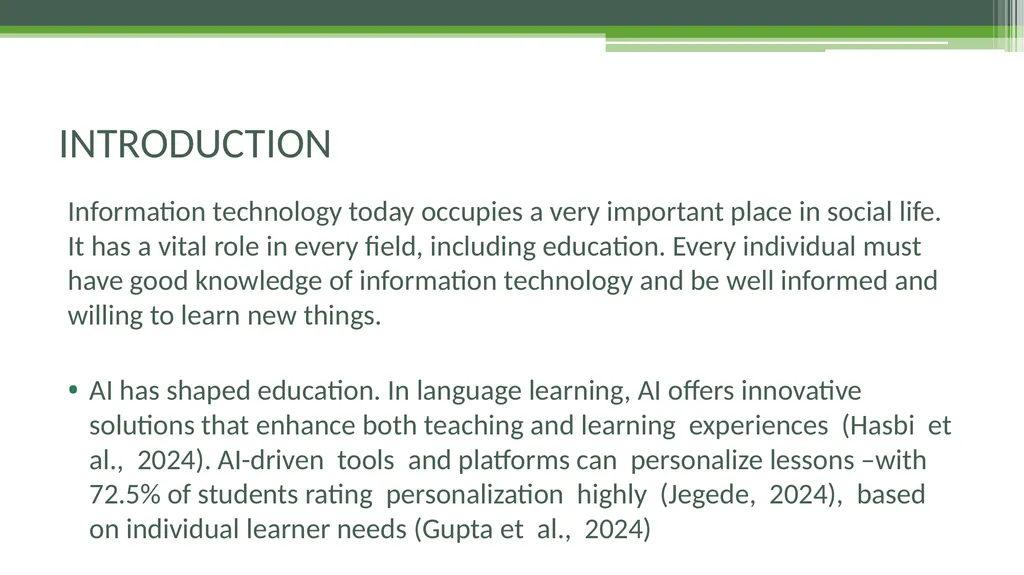
INTRODUCTION Information technology today occupies a very important place in social life. It has a vital role in every field, including education. Every individual must have good knowledge of information technology and be well informed and willing to learn new things.
AI has shaped education. In language learning, AI offers innovative solutions that enhance both teaching and learning experiences (Hasbi et al., 2024). AI-driven tools and platforms can personalize lessons –with 72.5% of students rating personalization highly (Jegede, 2024), based on individual learner needs (Gupta et al., 2024)<br>
AI has shaped education. In language learning, AI offers innovative solutions that enhance both teaching and learning experiences (Hasbi et al., 2024). AI-driven tools and platforms can personalize lessons –with 72.5% of students rating personalization highly (Jegede, 2024), based on individual learner needs (Gupta et al., 2024)<br>
03
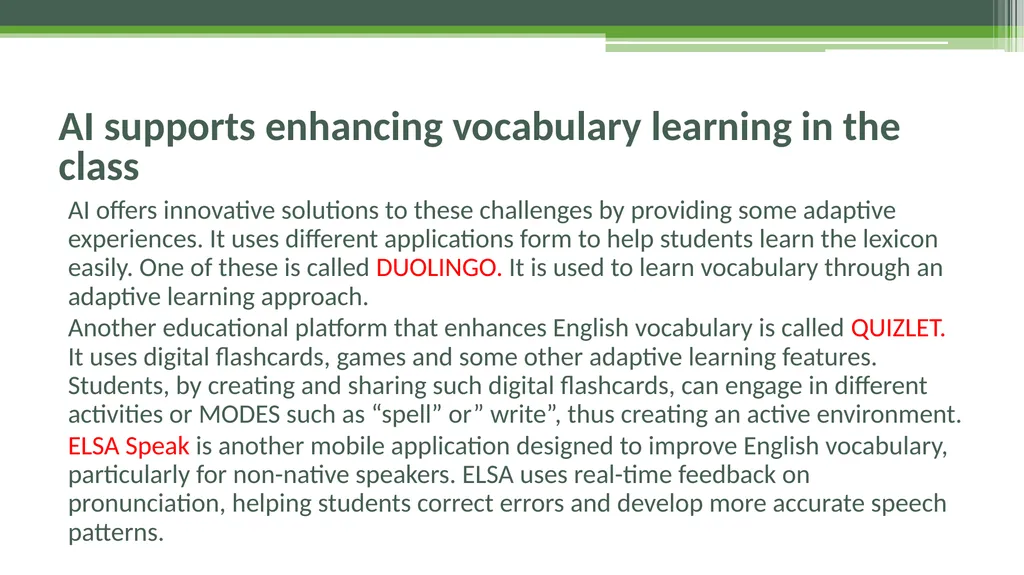
AI supports enhancing vocabulary learning in the class AI offers innovative solutions to these challenges by providing some adaptive experiences. It uses different applications form to help students learn the lexicon easily. One of these is called DUOLINGO. It is used to learn vocabulary through an adaptive learning approach.
Another educational platform that enhances English vocabulary is called QUIZLET. It uses digital flashcards, games and some other adaptive learning features. Students, by creating and sharing such digital flashcards, can engage in different activities or MODES such as “spell” or” write”, thus creating an active environment.
ELSA Speak is another mobile application designed to improve English vocabulary, particularly for non-native speakers. ELSA uses real-time feedback on pronunciation, helping students correct errors and develop more accurate speech patterns.<br>
Another educational platform that enhances English vocabulary is called QUIZLET. It uses digital flashcards, games and some other adaptive learning features. Students, by creating and sharing such digital flashcards, can engage in different activities or MODES such as “spell” or” write”, thus creating an active environment.
ELSA Speak is another mobile application designed to improve English vocabulary, particularly for non-native speakers. ELSA uses real-time feedback on pronunciation, helping students correct errors and develop more accurate speech patterns.<br>
04
Benefits of AL in vocabulary learning 1. Personalized learning
2. Immediate feedback
3. Contextual learning
4. Accessibility and flexibility<br>
2. Immediate feedback
3. Contextual learning
4. Accessibility and flexibility<br>
05
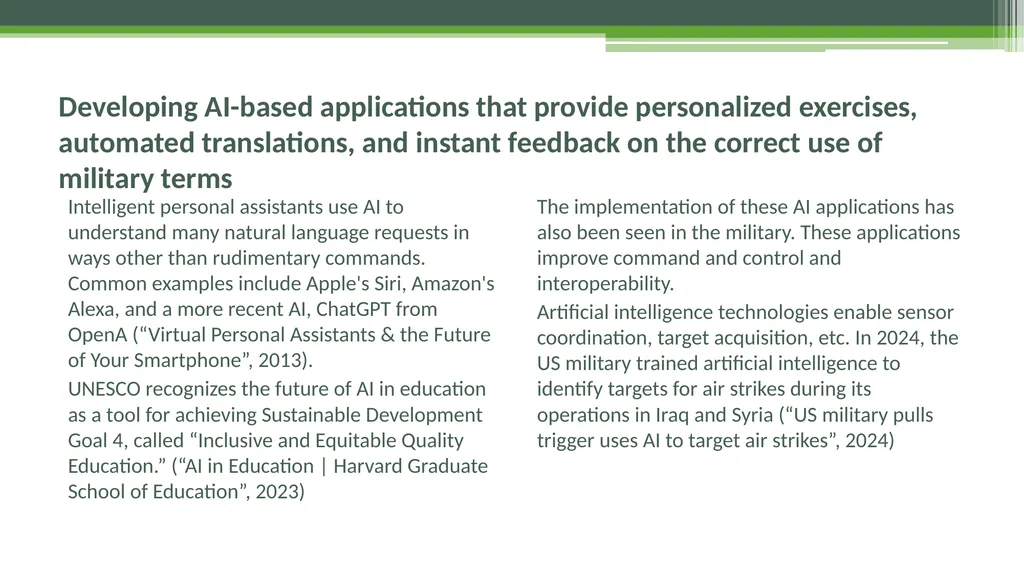
Developing AI-based applications that provide personalized exercises, automated translations, and instant feedback on the correct use of military terms Intelligent personal assistants use AI to understand many natural language requests in ways other than rudimentary commands. Common examples include Apple's Siri, Amazon's Alexa, and a more recent AI, ChatGPT from OpenA (“Virtual Personal Assistants & the Future of Your Smartphone”, 2013).
UNESCO recognizes the future of AI in education as a tool for achieving Sustainable Development Goal 4, called “Inclusive and Equitable Quality Education.” (“AI in Education | Harvard Graduate School of Education”, 2023) The implementation of these AI applications has also been seen in the military. These applications improve command and control and interoperability.
Artificial intelligence technologies enable sensor coordination, target acquisition, etc. In 2024, the US military trained artificial intelligence to identify targets for air strikes during its operations in Iraq and Syria (“US military pulls trigger uses AI to target air strikes”, 2024)<br>
UNESCO recognizes the future of AI in education as a tool for achieving Sustainable Development Goal 4, called “Inclusive and Equitable Quality Education.” (“AI in Education | Harvard Graduate School of Education”, 2023) The implementation of these AI applications has also been seen in the military. These applications improve command and control and interoperability.
Artificial intelligence technologies enable sensor coordination, target acquisition, etc. In 2024, the US military trained artificial intelligence to identify targets for air strikes during its operations in Iraq and Syria (“US military pulls trigger uses AI to target air strikes”, 2024)<br>
06
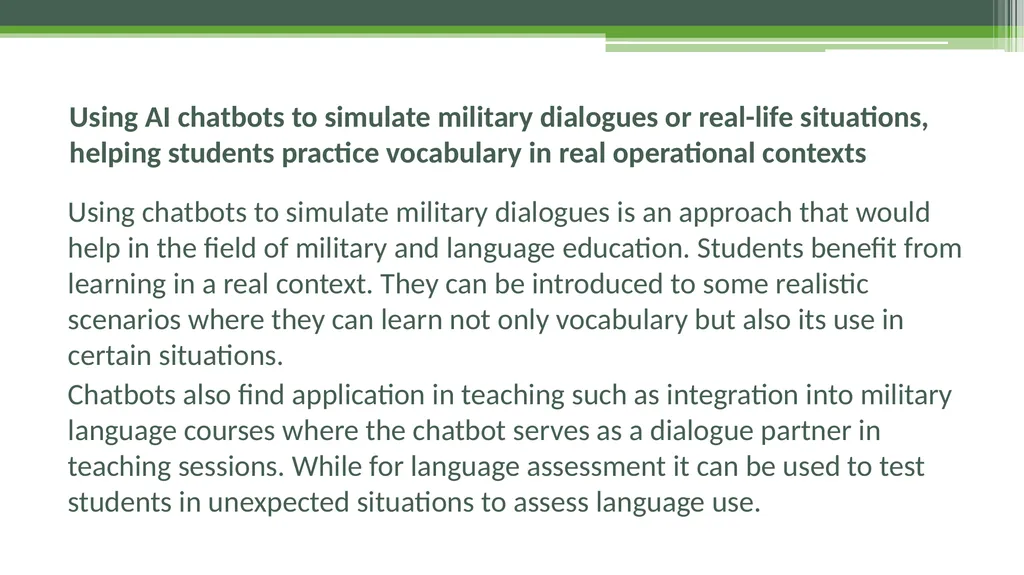
Using AI chatbots to simulate military dialogues or real-life situations, helping students practice vocabulary in real operational contexts Using chatbots to simulate military dialogues is an approach that would help in the field of military and language education. Students benefit from learning in a real context. They can be introduced to some realistic scenarios where they can learn not only vocabulary but also its use in certain situations.
Chatbots also find application in teaching such as integration into military language courses where the chatbot serves as a dialogue partner in teaching sessions. While for language assessment it can be used to test students in unexpected situations to assess language use.<br>
Chatbots also find application in teaching such as integration into military language courses where the chatbot serves as a dialogue partner in teaching sessions. While for language assessment it can be used to test students in unexpected situations to assess language use.<br>
07
The challenges teachers face when dealing with artificial intelligence Teachers face numerous challenges when integrating artificial intelligence into education. These include privacy and security concerns in data analysis, managing the workload associated with new technologies, and the need to address the challenges of new technologies. There is currently little research on the impact of artificial intelligence on education, which leads to a greater impact on education when faced with risks.
Another challenge lies in the issue of the distribution of educational resources. This means that the distribution of these resources faces a large gap between technologically developed and underdeveloped countries. This is also related to the issue of shaping values.<br>
Another challenge lies in the issue of the distribution of educational resources. This means that the distribution of these resources faces a large gap between technologically developed and underdeveloped countries. This is also related to the issue of shaping values.<br>
08
The challenges teachers face when dealing with artificial intelligence In these conditions, the question arises: How does a teacher face the challenges when faced with artificial intelligence? Managing challenges when a teacher faces artificial intelligence is quite dynamic. In addition to these facts, the lack of resources to have access to schools is another challenge in itself. This requires high funding and costs to provide the right technological tools. Cultural differences are another challenge, where the teacher must adapt teaching materials to reflect the cultural diversity of the students.<br>
09
CONCLUSION Using Artificial Intelligence (AI) in teaching military terminology can make learning more engaging, interactive, and effective. Tools like AI chatbots, vocabulary trainers, and virtual simulations allow students to practice terminology in realistic scenarios, get instant feedback, and build confidence.
Some AI tools require a strong internet connection or special equipment, which might not always be available. Teachers must also make sure the content is accurate, ethically used, and appropriate for the specific military context.<br>
Some AI tools require a strong internet connection or special equipment, which might not always be available. Teachers must also make sure the content is accurate, ethically used, and appropriate for the specific military context.<br>
10
APPENDIX Scenario: Coordination of a joint patrol with foreign allies (NATO)
Dialogue: Student vs. Chatbot (Allied Officer)
Chatbot (NATO Officer): Good morning, Lieutenant. Are you ready for the joint patrol briefing?
Student: Yes, good morning. I have prepared the map and patrol route.
Chatbot: Great. Could you walk me through the main path and the alternate one?
Student: Sure. The primary route goes through Sector Alpha and reaches Checkpoint 4. If needed, we’ll switch to the secondary route through Sector Bravo, which reconnects with the main path at Checkpoint 6.<br>
Dialogue: Student vs. Chatbot (Allied Officer)
Chatbot (NATO Officer): Good morning, Lieutenant. Are you ready for the joint patrol briefing?
Student: Yes, good morning. I have prepared the map and patrol route.
Chatbot: Great. Could you walk me through the main path and the alternate one?
Student: Sure. The primary route goes through Sector Alpha and reaches Checkpoint 4. If needed, we’ll switch to the secondary route through Sector Bravo, which reconnects with the main path at Checkpoint 6.<br>
11
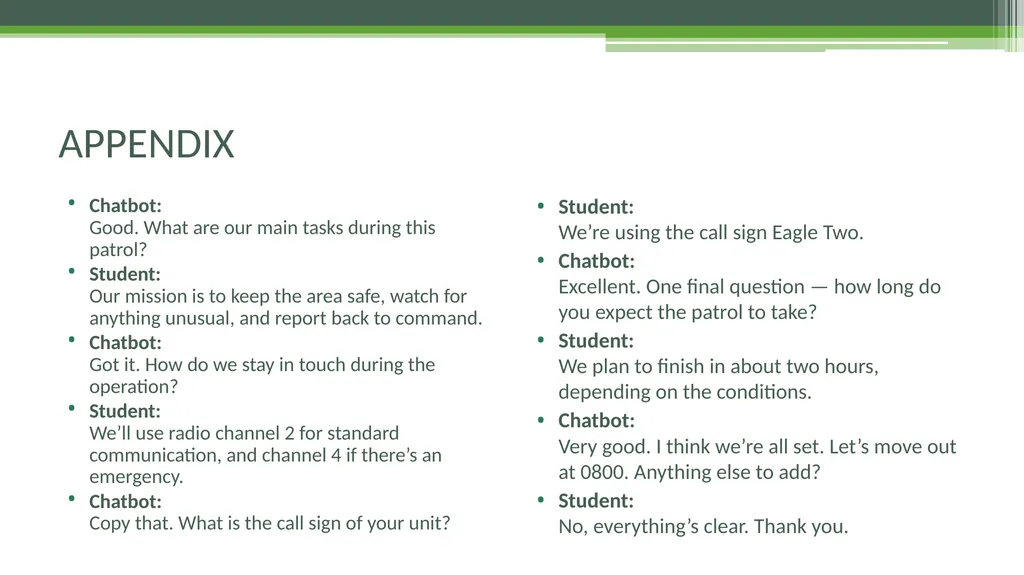
APPENDIX Chatbot:
Good. What are our main tasks during this patrol?
Student: Our mission is to keep the area safe, watch for anything unusual, and report back to command.
Chatbot: Got it. How do we stay in touch during the operation?
Student: We’ll use radio channel 2 for standard communication, and channel 4 if there’s an emergency.
Chatbot: Copy that. What is the call sign of your unit? Student: We’re using the call sign Eagle Two.
Chatbot: Excellent. One final question — how long do you expect the patrol to take?
Student: We plan to finish in about two hours, depending on the conditions.
Chatbot: Very good. I think we’re all set. Let’s move out at 0800. Anything else to add?
Student: No, everything’s clear. Thank you.<br>
Student: Our mission is to keep the area safe, watch for anything unusual, and report back to command.
Chatbot: Got it. How do we stay in touch during the operation?
Student: We’ll use radio channel 2 for standard communication, and channel 4 if there’s an emergency.
Chatbot: Copy that. What is the call sign of your unit? Student: We’re using the call sign Eagle Two.
Chatbot: Excellent. One final question — how long do you expect the patrol to take?
Student: We plan to finish in about two hours, depending on the conditions.
Chatbot: Very good. I think we’re all set. Let’s move out at 0800. Anything else to add?
Student: No, everything’s clear. Thank you.<br>
12
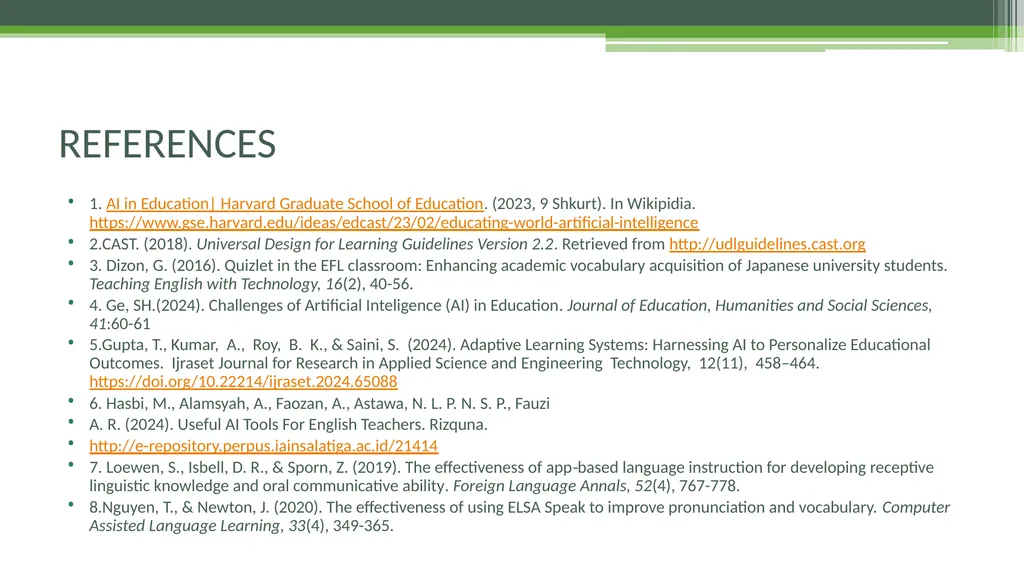
REFERENCES 1. AI in Education| Harvard Graduate School of Education. (2023, 9 Shkurt). In Wikipidia. https://www.gse.harvard.edu/ideas/edcast/23/02/educating-world-artificial-intelligence
2.CAST. (2018). Universal Design for Learning Guidelines Version 2.2. Retrieved from http://udlguidelines.cast.org
3. Dizon, G. (2016). Quizlet in the EFL classroom: Enhancing academic vocabulary acquisition of Japanese university students. Teaching English with Technology, 16(2), 40-56.
4. Ge, SH.(2024). Challenges of Artificial Inteligence (AI) in Education. Journal of Education, Humanities and Social Sciences, 41:60-61
5.Gupta, T., Kumar, A., Roy, B. K., & Saini, S. (2024). Adaptive Learning Systems: Harnessing AI to Personalize Educational Outcomes. Ijraset Journal for Research in Applied Science and Engineering Technology, 12(11), 458–464. https://doi.org/10.22214/ijraset.2024.65088
6. Hasbi, M., Alamsyah, A., Faozan, A., Astawa, N. L. P. N. S. P., Fauzi
A. R. (2024). Useful AI Tools For English Teachers. Rizquna.
http://e-repository.perpus.iainsalatiga.ac.id/21414
7. Loewen, S., Isbell, D. R., & Sporn, Z. (2019). The effectiveness of app‐based language instruction for developing receptive linguistic knowledge and oral communicative ability. Foreign Language Annals, 52(4), 767-778.
8.Nguyen, T., & Newton, J. (2020). The effectiveness of using ELSA Speak to improve pronunciation and vocabulary. Computer Assisted Language Learning, 33(4), 349-365.<br>
2.CAST. (2018). Universal Design for Learning Guidelines Version 2.2. Retrieved from http://udlguidelines.cast.org
3. Dizon, G. (2016). Quizlet in the EFL classroom: Enhancing academic vocabulary acquisition of Japanese university students. Teaching English with Technology, 16(2), 40-56.
4. Ge, SH.(2024). Challenges of Artificial Inteligence (AI) in Education. Journal of Education, Humanities and Social Sciences, 41:60-61
5.Gupta, T., Kumar, A., Roy, B. K., & Saini, S. (2024). Adaptive Learning Systems: Harnessing AI to Personalize Educational Outcomes. Ijraset Journal for Research in Applied Science and Engineering Technology, 12(11), 458–464. https://doi.org/10.22214/ijraset.2024.65088
6. Hasbi, M., Alamsyah, A., Faozan, A., Astawa, N. L. P. N. S. P., Fauzi
A. R. (2024). Useful AI Tools For English Teachers. Rizquna.
http://e-repository.perpus.iainsalatiga.ac.id/21414
7. Loewen, S., Isbell, D. R., & Sporn, Z. (2019). The effectiveness of app‐based language instruction for developing receptive linguistic knowledge and oral communicative ability. Foreign Language Annals, 52(4), 767-778.
8.Nguyen, T., & Newton, J. (2020). The effectiveness of using ELSA Speak to improve pronunciation and vocabulary. Computer Assisted Language Learning, 33(4), 349-365.<br>
13
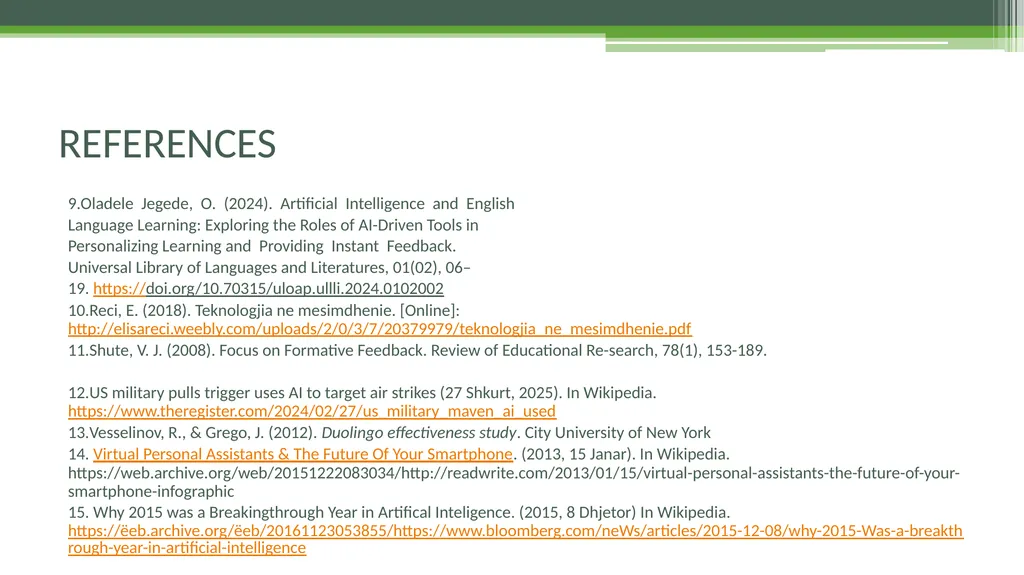
REFERENCES 9.Oladele Jegede, O. (2024). Artificial Intelligence and English
Language Learning: Exploring the Roles of AI-Driven Tools in
Personalizing Learning and Providing Instant Feedback.
Universal Library of Languages and Literatures, 01(02), 06–
19. https://doi.org/10.70315/uloap.ullli.2024.0102002
10.Reci, E. (2018). Teknologjia ne mesimdhenie. [Online]: http://elisareci.weebly.com/uploads/2/0/3/7/20379979/teknologjia_ne_mesimdhenie.pdf
11.Shute, V. J. (2008). Focus on Formative Feedback. Review of Educational Re-search, 78(1), 153-189.
12.US military pulls trigger uses AI to target air strikes (27 Shkurt, 2025). In Wikipedia. https://www.theregister.com/2024/02/27/us_military_maven_ai_used
13.Vesselinov, R., & Grego, J. (2012). Duolingo effectiveness study. City University of New York
14. Virtual Personal Assistants & The Future Of Your Smartphone. (2013, 15 Janar). In Wikipedia. https://web.archive.org/web/20151222083034/http://readwrite.com/2013/01/15/virtual-personal-assistants-the-future-of-your-smartphone-infographic
15. Why 2015 was a Breakingthrough Year in Artifical Inteligence. (2015, 8 Dhjetor) In Wikipedia. https://ëeb.archive.org/ëeb/20161123053855/https://www.bloomberg.com/neWs/articles/2015-12-08/why-2015-Was-a-breakthrough-year-in-artificial-intelligence<br>
Language Learning: Exploring the Roles of AI-Driven Tools in
Personalizing Learning and Providing Instant Feedback.
Universal Library of Languages and Literatures, 01(02), 06–
19. https://doi.org/10.70315/uloap.ullli.2024.0102002
10.Reci, E. (2018). Teknologjia ne mesimdhenie. [Online]: http://elisareci.weebly.com/uploads/2/0/3/7/20379979/teknologjia_ne_mesimdhenie.pdf
11.Shute, V. J. (2008). Focus on Formative Feedback. Review of Educational Re-search, 78(1), 153-189.
12.US military pulls trigger uses AI to target air strikes (27 Shkurt, 2025). In Wikipedia. https://www.theregister.com/2024/02/27/us_military_maven_ai_used
13.Vesselinov, R., & Grego, J. (2012). Duolingo effectiveness study. City University of New York
14. Virtual Personal Assistants & The Future Of Your Smartphone. (2013, 15 Janar). In Wikipedia. https://web.archive.org/web/20151222083034/http://readwrite.com/2013/01/15/virtual-personal-assistants-the-future-of-your-smartphone-infographic
15. Why 2015 was a Breakingthrough Year in Artifical Inteligence. (2015, 8 Dhjetor) In Wikipedia. https://ëeb.archive.org/ëeb/20161123053855/https://www.bloomberg.com/neWs/articles/2015-12-08/why-2015-Was-a-breakthrough-year-in-artificial-intelligence<br>
14
THANK YOU VERY MUCH<br>