
Resolving financial abuse legal issues Solicitor
CS
Published · 67 slides · 0 views

1 / 1











Description
Resolving financial abuse legal issues Solicitor Financial Abuse Service NSW Redfern Legal Centre Jasmine Opdam Outline Consumer credit law How to craft financial hardship requests Tips and tricks for negotiating with creditors and debt
Related Topics
Share
Embed code
Download this presentation From Below
"Resolving financial abuse legal issues Solicitor" is the property of its rightful owner. Permission is granted to download and print the materials on this website for personal, non-commercial use only, and to display it on your personal computer provided you do not modify the materials and that you retain all copyright notices contained in the materials. By downloading content from our website, you accept the terms of this agreement.
Presentation Transcript
01
Resolving financial abuse legal issues<br>
02
Solicitor
Financial Abuse Service NSW
Redfern Legal Centre Jasmine Opdam<br>
03
Outline Consumer credit law
How to craft financial hardship requests
Tips and tricks for negotiating with creditors and debt collectors
When to get specialist legal advice
Questions and further resources RESOURCES: www.rlc.org.au/training/resources/financial-abuse<br>
How to craft financial hardship requests
Tips and tricks for negotiating with creditors and debt collectors
When to get specialist legal advice
Questions and further resources RESOURCES: www.rlc.org.au/training/resources/financial-abuse<br>
04
1. Consumer credit law<br>
05
Test your knowledge True or False?
Financial institutions are legally required to consider requests for hardship assistance
If a creditor rejects a request for financial hardship assistance, there is nothing you can do about it
A creditor can remove a default listing from a customer’s credit report where the customer has experienced financial abuse, even if the listing is correct
If a creditor has already obtained default judgment against your client in court, there is nothing your client can do but pay the debt
If your client has received a statement of claim, it is too late to make a complaint to AFCA<br>
06
Test your knowledge True or False?
Financial institutions are legally required to consider requests for hardship assistance [TRUE]
If a creditor rejects a request for financial hardship assistance, there is nothing you can do about it [FALSE]
A creditor can remove a default listing from a customer’s credit report where the customer has experienced financial abuse, even if the listing is correct [TRUE]
If a creditor has already obtained default judgment against your client in court, there is nothing your client can do but pay the debt [FALSE]
If your client has received a statement of claim, it is too late to make a complaint to AFCA [FALSE]<br>
07
Consumer Credit Law The Credit Law is national legislation and has two main parts:
The National Consumer Credit Protection Act 2009 (NCCP)
The National Credit Code (at Schedule 1 of the NCCP) (NCC)
Seek legal advice if a credit contract was taken out prior to 1 July 2010 as different (state-based) laws may apply.
Unless otherwise stated, references in these slides are to sections of the NCCP.<br>
08
What does this apply to? Consumer loans predominantly for personal, domestic or household purposes, e.g.:
Seek legal advice if your client has a business loan, has signed a “business purposes declaration” or if there is any doubt whether the Credit Law applies. Car loans
Personal loans
Home loans
Consumer leases (e.g. rental contracts for goods)
Credit cards<br>
Seek legal advice if your client has a business loan, has signed a “business purposes declaration” or if there is any doubt whether the Credit Law applies. Car loans
Personal loans
Home loans
Consumer leases (e.g. rental contracts for goods)
Credit cards<br>
09
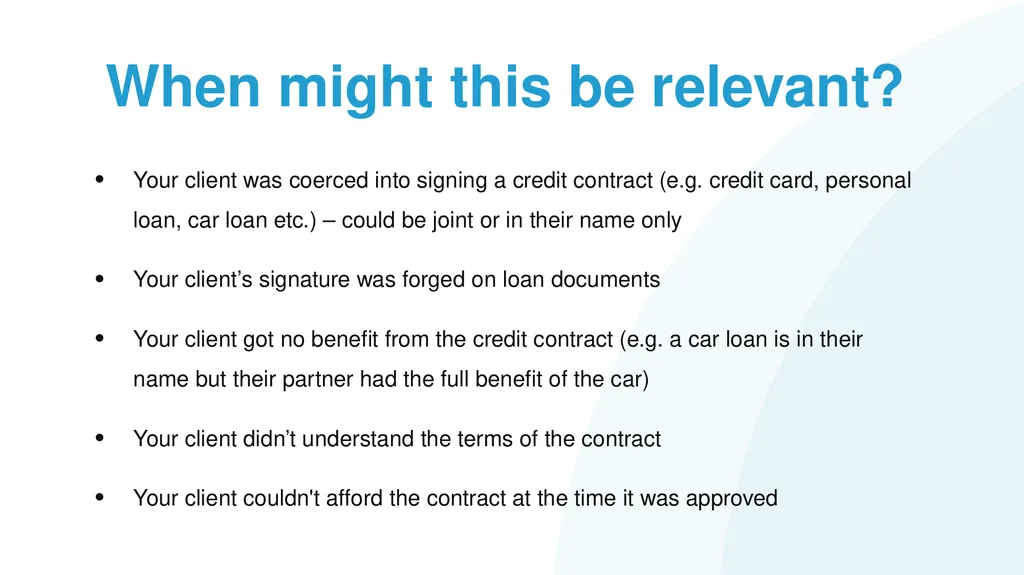
When might this be relevant? Your client was coerced into signing a credit contract (e.g. credit card, personal loan, car loan etc.) – could be joint or in their name only
Your client’s signature was forged on loan documents
Your client got no benefit from the credit contract (e.g. a car loan is in their name but their partner had the full benefit of the car)
Your client didn’t understand the terms of the contract
Your client couldn't afford the contract at the time it was approved<br>
10
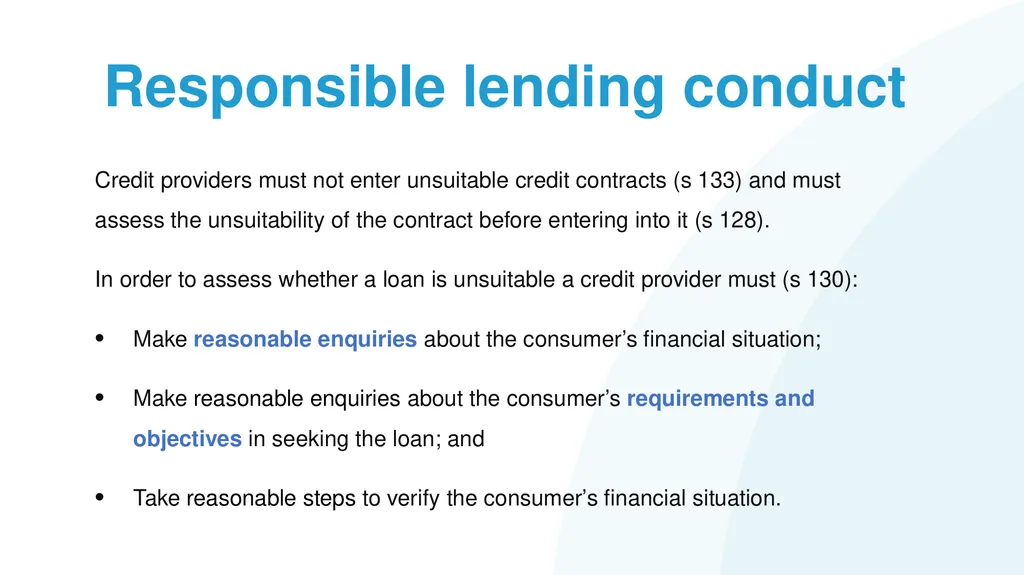
Responsible lending conduct Credit providers must not enter unsuitable credit contracts (s 133) and must assess the unsuitability of the contract before entering into it (s 128).
In order to assess whether a loan is unsuitable a credit provider must (s 130):
Make reasonable enquiries about the consumer’s financial situation;
Make reasonable enquiries about the consumer’s requirements and objectives in seeking the loan; and
Take reasonable steps to verify the consumer’s financial situation.<br>
11
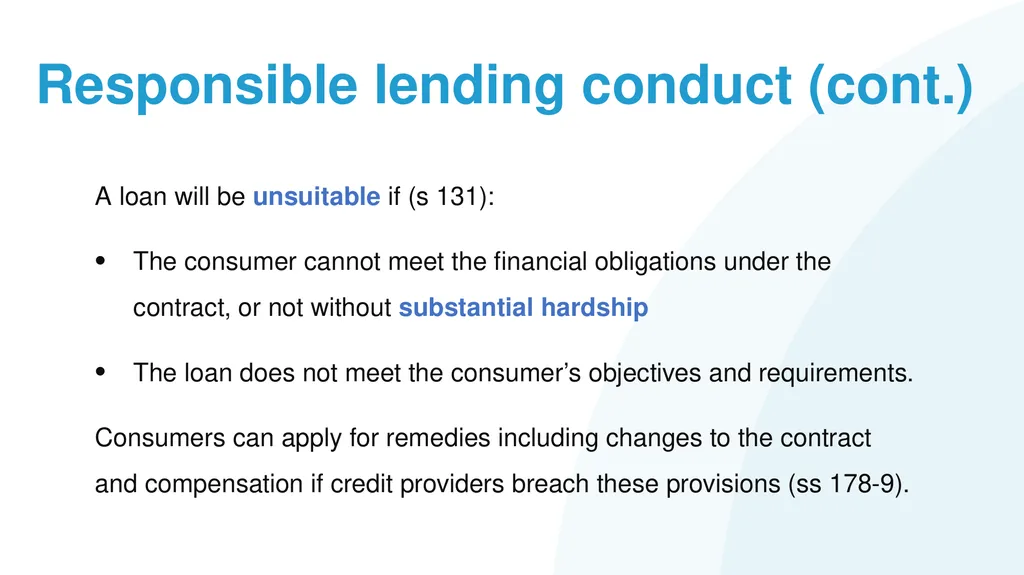
Responsible lending conduct (cont.) A loan will be unsuitable if (s 131):
The consumer cannot meet the financial obligations under the contract, or not without substantial hardship
The loan does not meet the consumer’s objectives and requirements.
Consumers can apply for remedies including changes to the contract and compensation if credit providers breach these provisions (ss 178-9).<br>
12
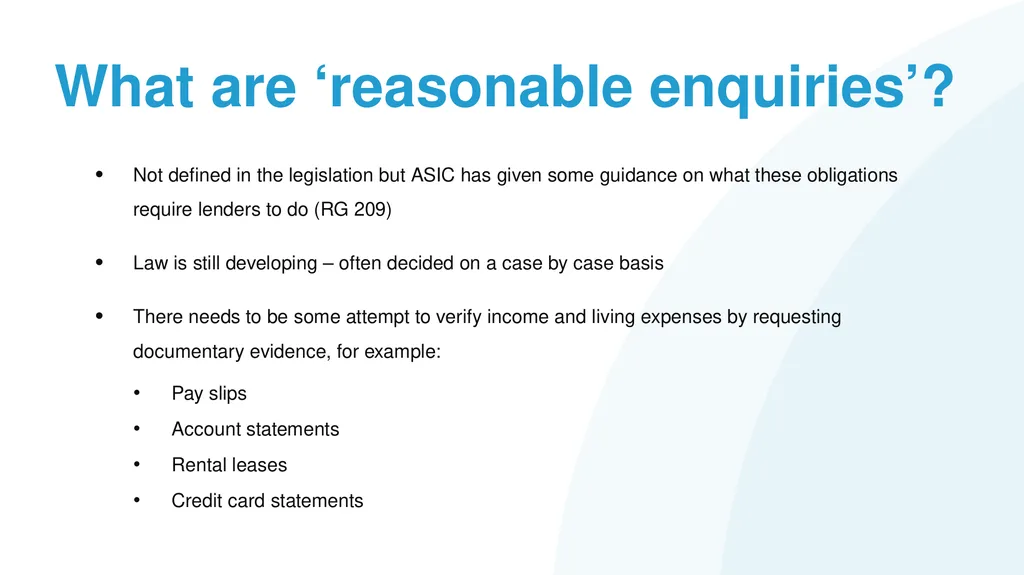
What are ‘reasonable enquiries’? Not defined in the legislation but ASIC has given some guidance on what these obligations require lenders to do (RG 209)
Law is still developing – often decided on a case by case basis
There needs to be some attempt to verify income and living expenses by requesting documentary evidence, for example:
Pay slips
Account statements
Rental leases
Credit card statements<br>
Law is still developing – often decided on a case by case basis
There needs to be some attempt to verify income and living expenses by requesting documentary evidence, for example:
Pay slips
Account statements
Rental leases
Credit card statements<br>
13
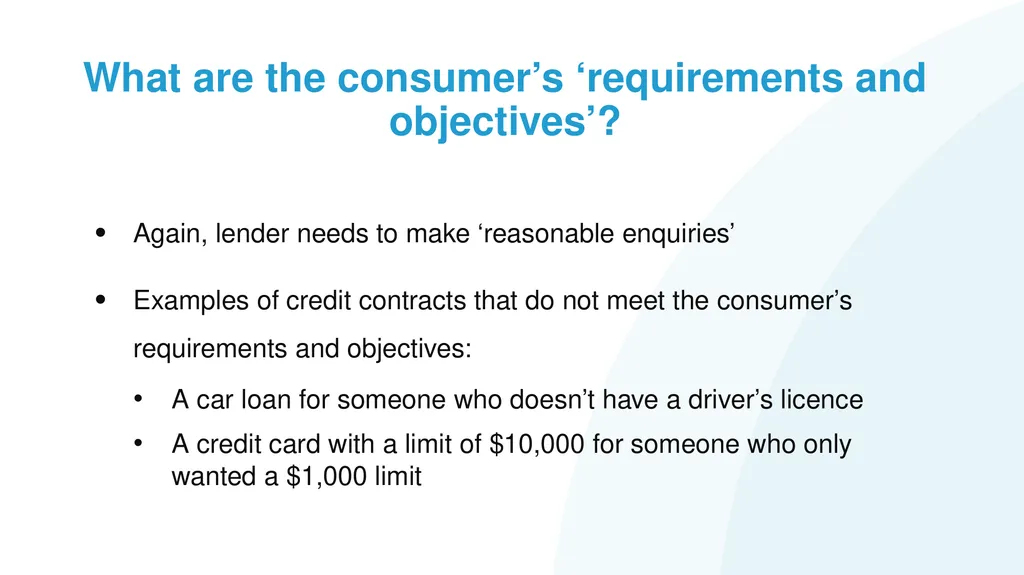
What are the consumer’s ‘requirements and objectives’? Again, lender needs to make ‘reasonable enquiries’
Examples of credit contracts that do not meet the consumer’s requirements and objectives:
A car loan for someone who doesn’t have a driver’s licence
A credit card with a limit of $10,000 for someone who only wanted a $1,000 limit<br>
Examples of credit contracts that do not meet the consumer’s requirements and objectives:
A car loan for someone who doesn’t have a driver’s licence
A credit card with a limit of $10,000 for someone who only wanted a $1,000 limit<br>
14
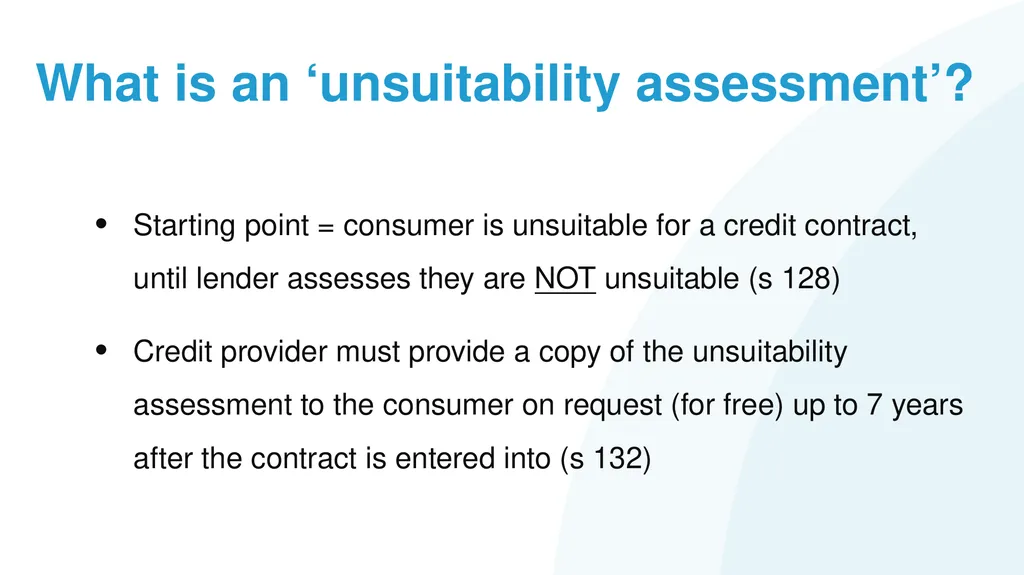
What is an ‘unsuitability assessment’? Starting point = consumer is unsuitable for a credit contract, until lender assesses they are NOT unsuitable (s 128)
Credit provider must provide a copy of the unsuitability assessment to the consumer on request (for free) up to 7 years after the contract is entered into (s 132)<br>
Credit provider must provide a copy of the unsuitability assessment to the consumer on request (for free) up to 7 years after the contract is entered into (s 132)<br>
15
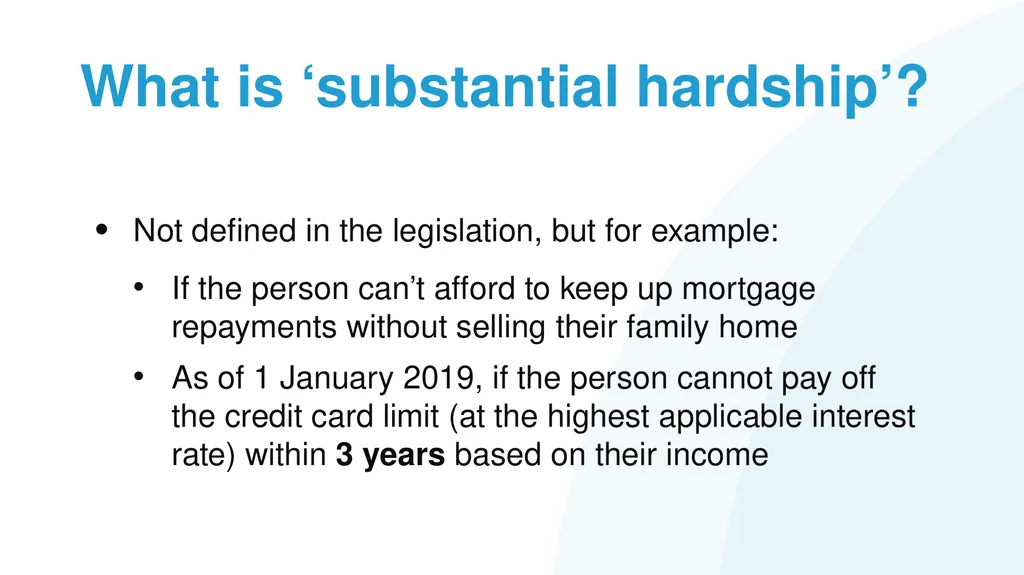
What is ‘substantial hardship’? Not defined in the legislation, but for example:
If the person can’t afford to keep up mortgage repayments without selling their family home
As of 1 January 2019, if the person cannot pay off the credit card limit (at the highest applicable interest rate) within 3 years based on their income<br>
If the person can’t afford to keep up mortgage repayments without selling their family home
As of 1 January 2019, if the person cannot pay off the credit card limit (at the highest applicable interest rate) within 3 years based on their income<br>
16
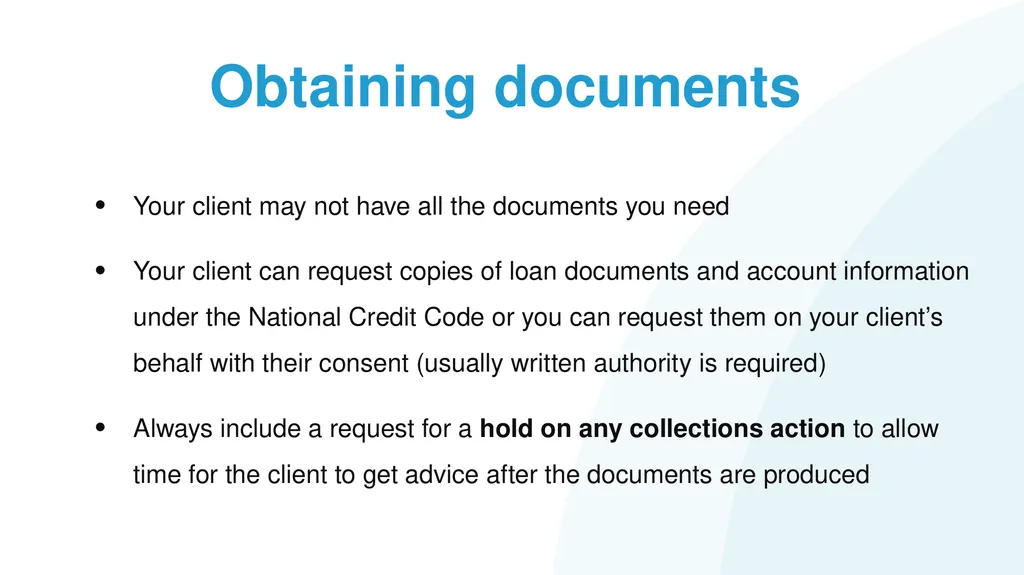
Obtaining documents Your client may not have all the documents you need
Your client can request copies of loan documents and account information under the National Credit Code or you can request them on your client’s behalf with their consent (usually written authority is required)
Always include a request for a hold on any collections action to allow time for the client to get advice after the documents are produced<br>
17
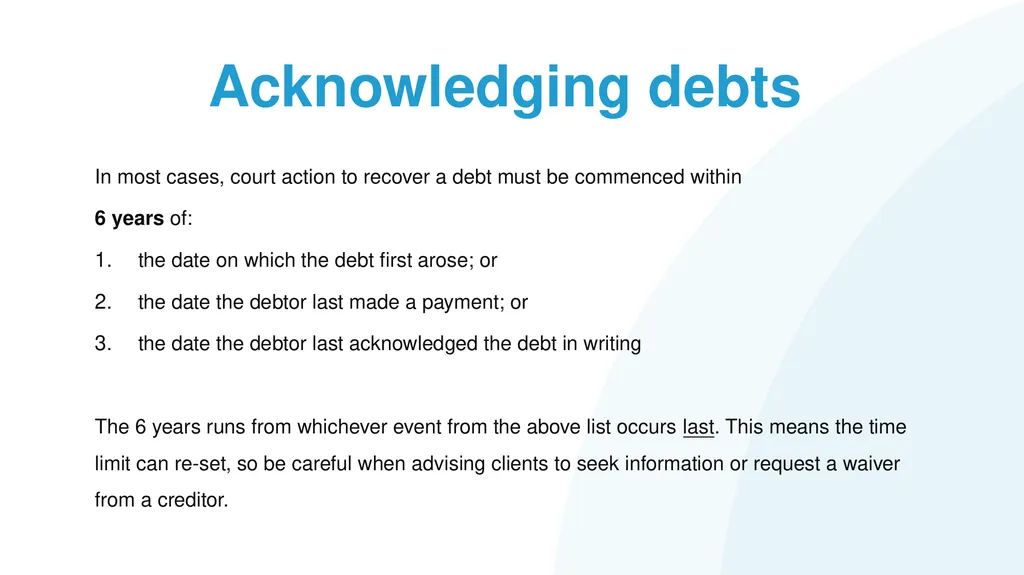
Acknowledging debts In most cases, court action to recover a debt must be commenced within
6 years of:
the date on which the debt first arose; or
the date the debtor last made a payment; or
the date the debtor last acknowledged the debt in writing
The 6 years runs from whichever event from the above list occurs last. This means the time limit can re-set, so be careful when advising clients to seek information or request a waiver from a creditor.<br>
18
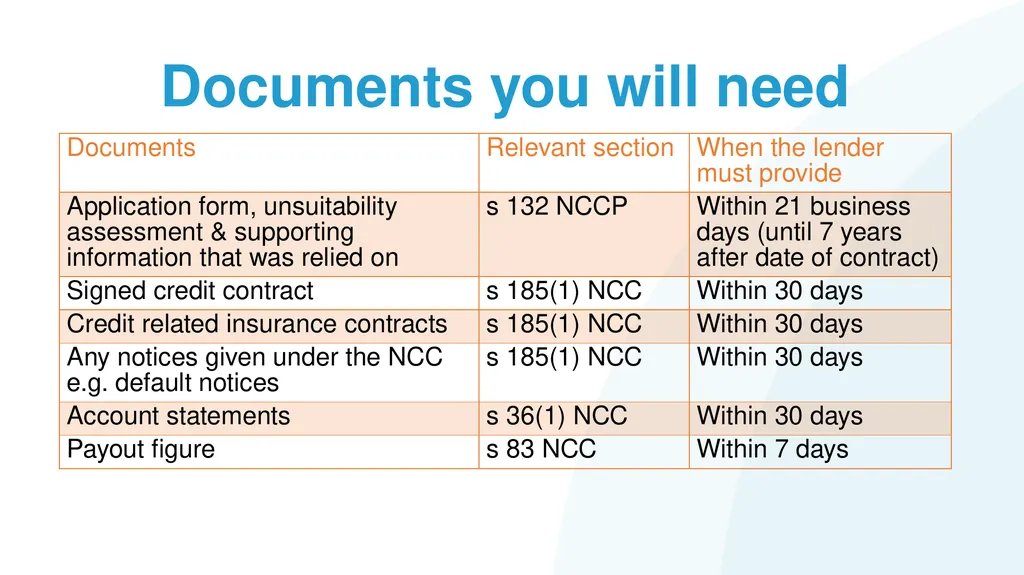
Documents you will need<br>
19
What to look for in the documents Income amount on application is higher than actual income
Client had no income or only Centrelink income at time of application
Other debts / liabilities are not listed or not accurate on application
Contact information doesn’t match your client e.g. partner’s email or phone number only<br>
Client had no income or only Centrelink income at time of application
Other debts / liabilities are not listed or not accurate on application
Contact information doesn’t match your client e.g. partner’s email or phone number only<br>
20
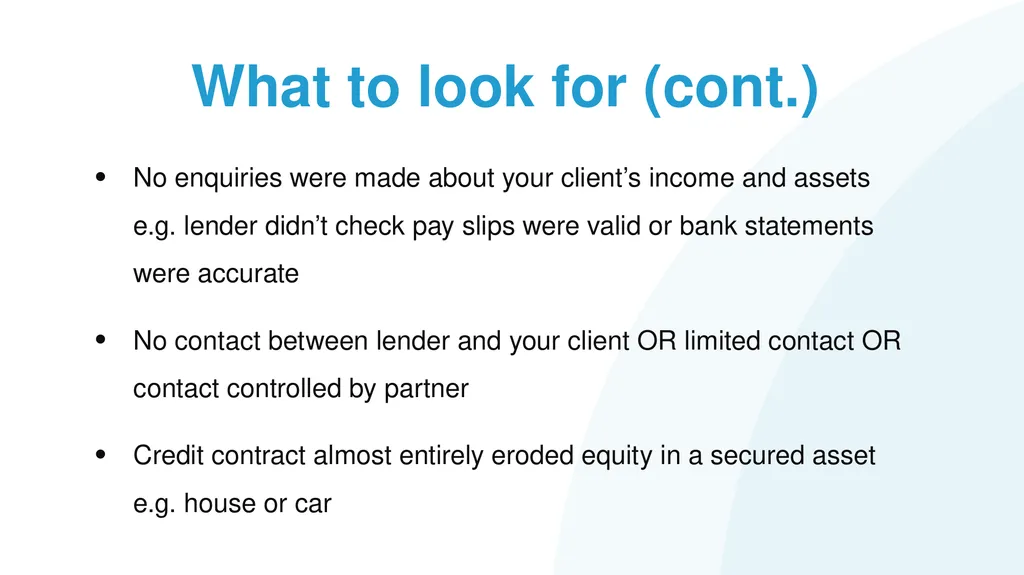
What to look for (cont.) No enquiries were made about your client’s income and assets e.g. lender didn’t check pay slips were valid or bank statements were accurate
No contact between lender and your client OR limited contact OR contact controlled by partner
Credit contract almost entirely eroded equity in a secured asset e.g. house or car<br>
No contact between lender and your client OR limited contact OR contact controlled by partner
Credit contract almost entirely eroded equity in a secured asset e.g. house or car<br>
21
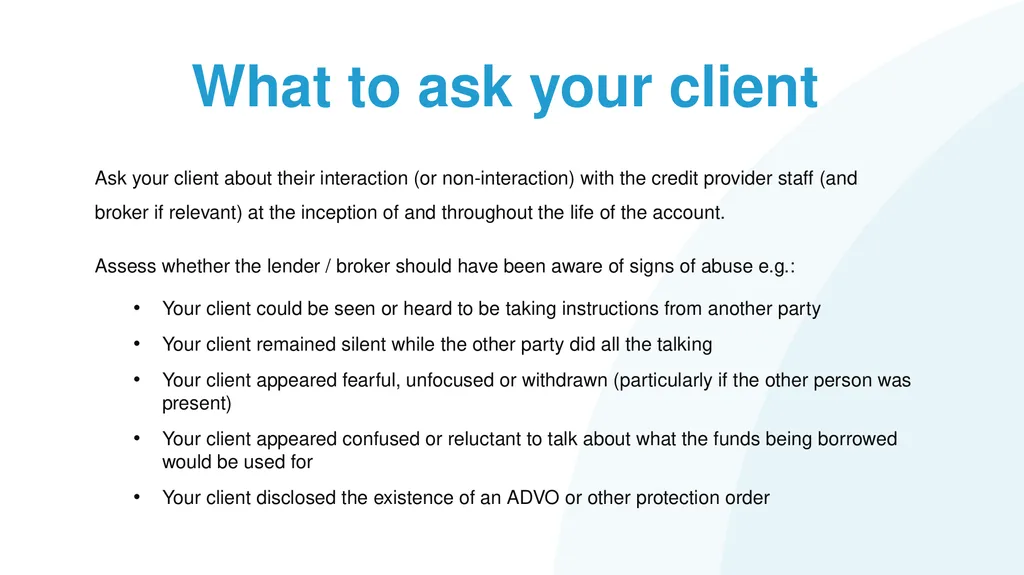
What to ask your client Ask your client about their interaction (or non-interaction) with the credit provider staff (and broker if relevant) at the inception of and throughout the life of the account.
Assess whether the lender / broker should have been aware of signs of abuse e.g.:
Your client could be seen or heard to be taking instructions from another party
Your client remained silent while the other party did all the talking
Your client appeared fearful, unfocused or withdrawn (particularly if the other person was present)
Your client appeared confused or reluctant to talk about what the funds being borrowed would be used for
Your client disclosed the existence of an ADVO or other protection order<br>
22
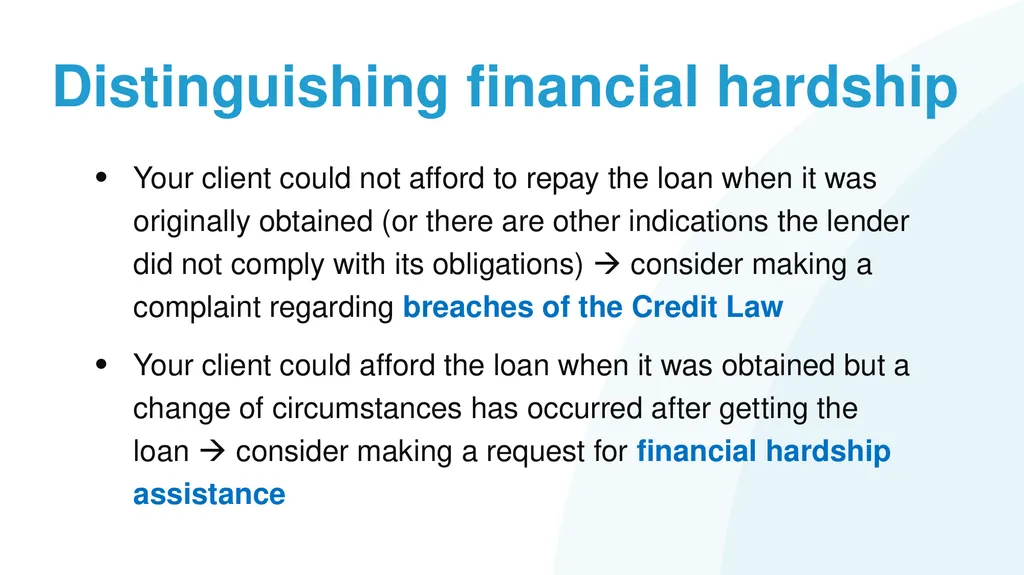
Distinguishing financial hardship Your client could not afford to repay the loan when it was originally obtained (or there are other indications the lender did not comply with its obligations) consider making a complaint regarding breaches of the Credit Law
Your client could afford the loan when it was obtained but a change of circumstances has occurred after getting the loan consider making a request for financial hardship assistance<br>
Your client could afford the loan when it was obtained but a change of circumstances has occurred after getting the loan consider making a request for financial hardship assistance<br>
23
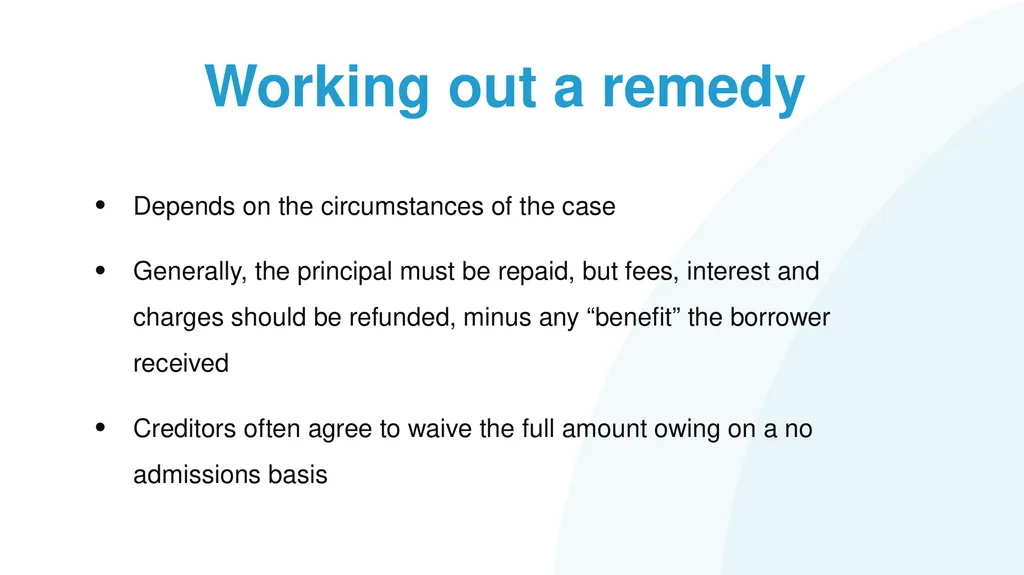
Working out a remedy Depends on the circumstances of the case
Generally, the principal must be repaid, but fees, interest and charges should be refunded, minus any “benefit” the borrower received
Creditors often agree to waive the full amount owing on a no admissions basis<br>
Generally, the principal must be repaid, but fees, interest and charges should be refunded, minus any “benefit” the borrower received
Creditors often agree to waive the full amount owing on a no admissions basis<br>
24
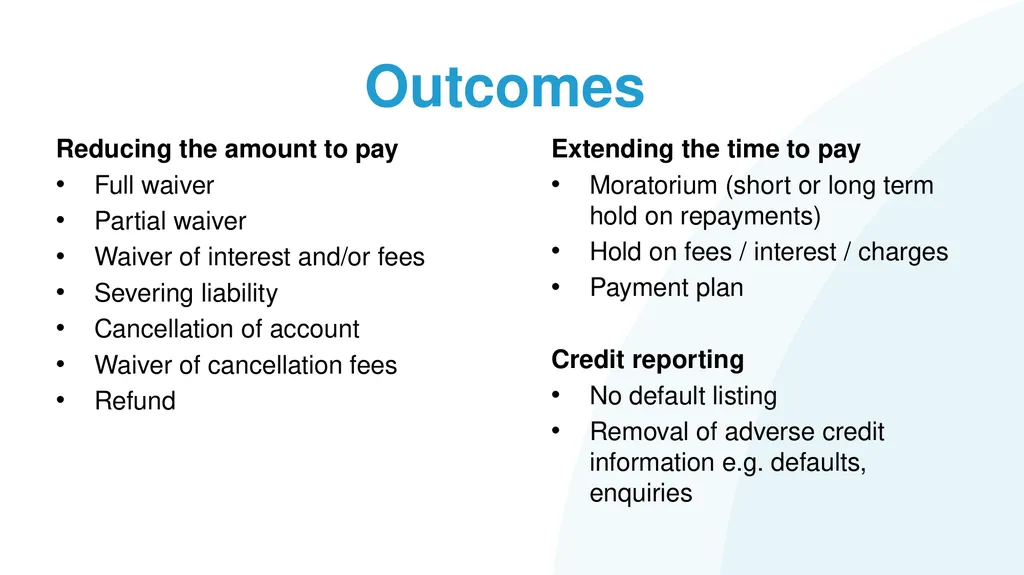
Outcomes Reducing the amount to pay
Full waiver
Partial waiver
Waiver of interest and/or fees
Severing liability
Cancellation of account
Waiver of cancellation fees
Refund Extending the time to pay
Moratorium (short or long term hold on repayments)
Hold on fees / interest / charges
Payment plan
Credit reporting
No default listing
Removal of adverse credit information e.g. defaults, enquiries<br>
25
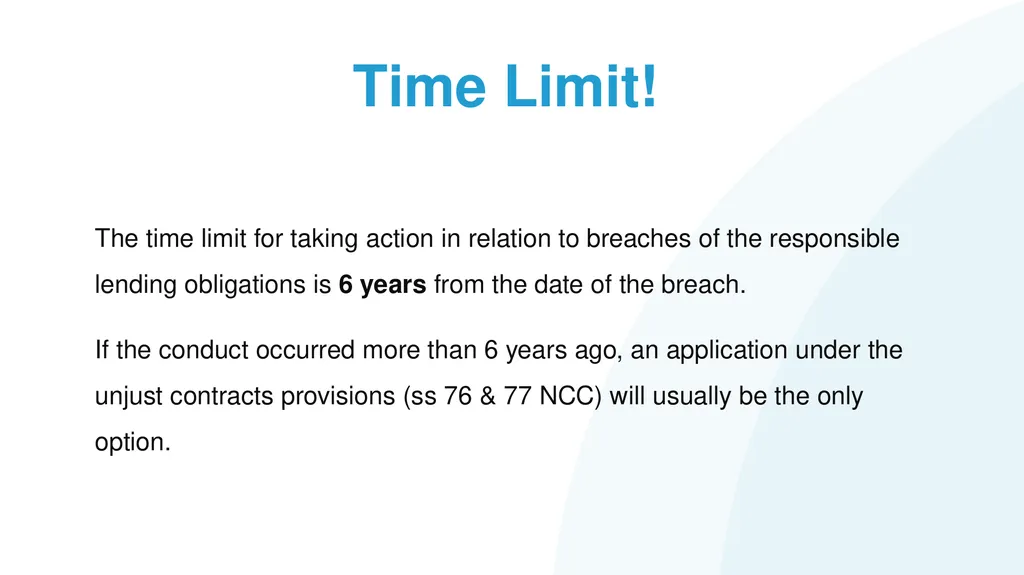
Time Limit! The time limit for taking action in relation to breaches of the responsible lending obligations is 6 years from the date of the breach.
If the conduct occurred more than 6 years ago, an application under the unjust contracts provisions (ss 76 & 77 NCC) will usually be the only option.<br>
If the conduct occurred more than 6 years ago, an application under the unjust contracts provisions (ss 76 & 77 NCC) will usually be the only option.<br>
26
Unjustness Defined as including “unconscionable, harsh or oppressive” (s 76(8) NCC).
A credit contract, mortgage or guarantee can be reopened if the court is satisfied that the contract is unjust:
Court may reopen unjust transactions (s 76 NCC)
Court may review unconscionable interest and other charges (s 78 NCC)<br>
A credit contract, mortgage or guarantee can be reopened if the court is satisfied that the contract is unjust:
Court may reopen unjust transactions (s 76 NCC)
Court may review unconscionable interest and other charges (s 78 NCC)<br>
27
Unjustness Continued “The public interest and all the circumstances of the case”.
Matters that may be relevant:
The consequences of compliance or non-compliance with the contract
The relative bargaining positions of the parties
Whether the contract was subject to negotiation
Whether the borrower was realistically able to reject or renegotiate any of the contract provisions
If the contract imposes conditions that are unreasonably difficult to comply with or not reasonably necessary to protect the legitimate interests of a party to the contract<br>
28
Unjustness Continued Whether the consumer (or their representative) was reasonably able to protect their own interests because of their age, physical or mental condition
The form of the contract and how it is expressed
Whether the consumer received independent legal advice or other expert advice
Whether the contract was explained to the consumer and whether they understood that explanation
Whether unfair tactics or pressure were used on the consumer
Whether the credit provider explained the consequences of the contract to the consumer<br>
29
Unjustness Continued Whether the credit provider knew or could have reasonably ascertained by reasonable inquiry at that time that the consumer could not repay the loan, or could not pay it without substantial hardship
Whether the terms of the transaction or the conduct of the credit provider is justified in light of the risks undertaken by the credit provider
Whether any part of a mortgage will void another section of the NCC
Whether in comparison with other similar loans the interest and fees are excessive
Any other relevant factor<br>
30
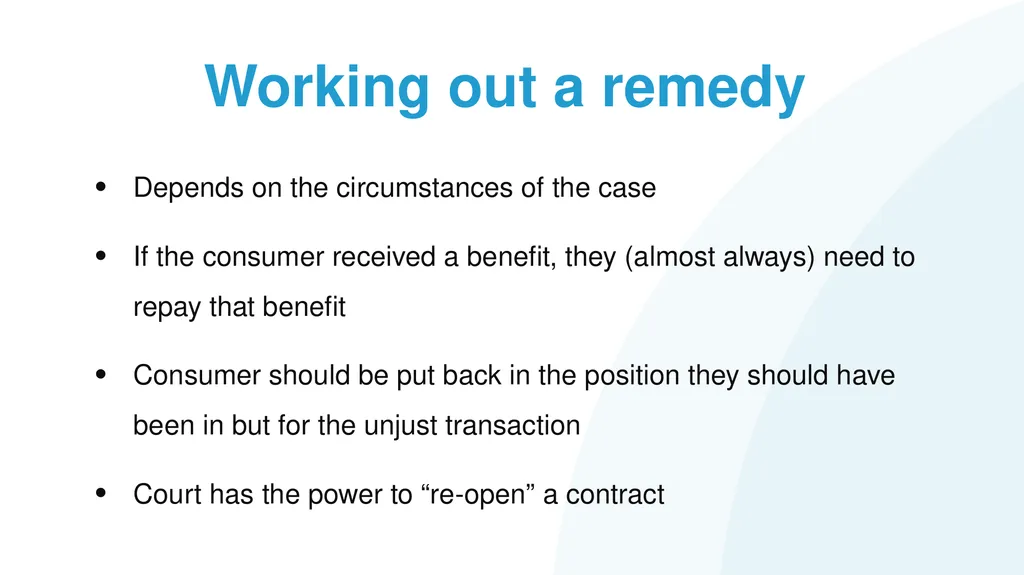
Working out a remedy Depends on the circumstances of the case
If the consumer received a benefit, they (almost always) need to repay that benefit
Consumer should be put back in the position they should have been in but for the unjust transaction
Court has the power to “re-open” a contract<br>
If the consumer received a benefit, they (almost always) need to repay that benefit
Consumer should be put back in the position they should have been in but for the unjust transaction
Court has the power to “re-open” a contract<br>
31
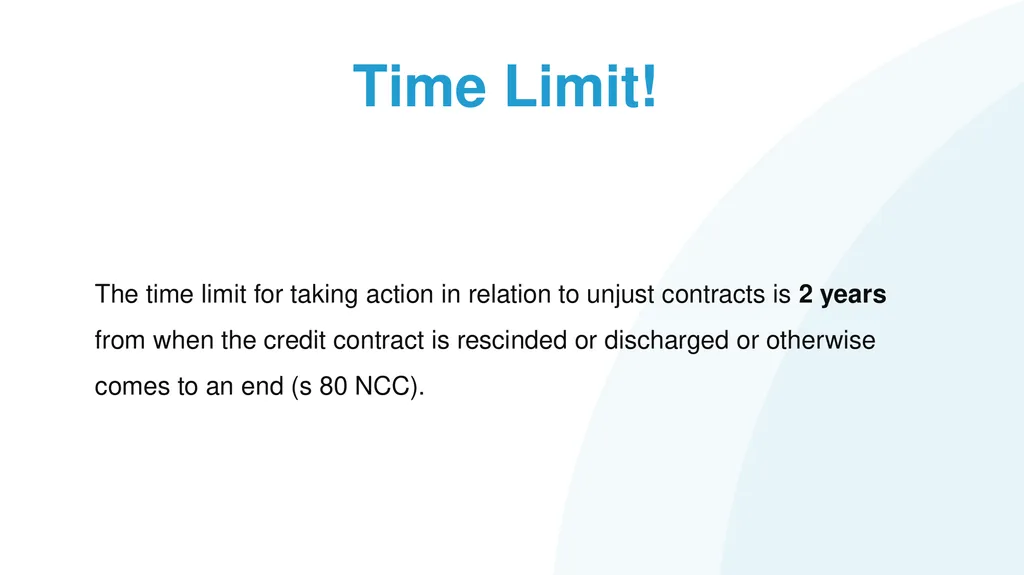
Time Limit! The time limit for taking action in relation to unjust contracts is 2 years from when the credit contract is rescinded or discharged or otherwise comes to an end (s 80 NCC).<br>
32
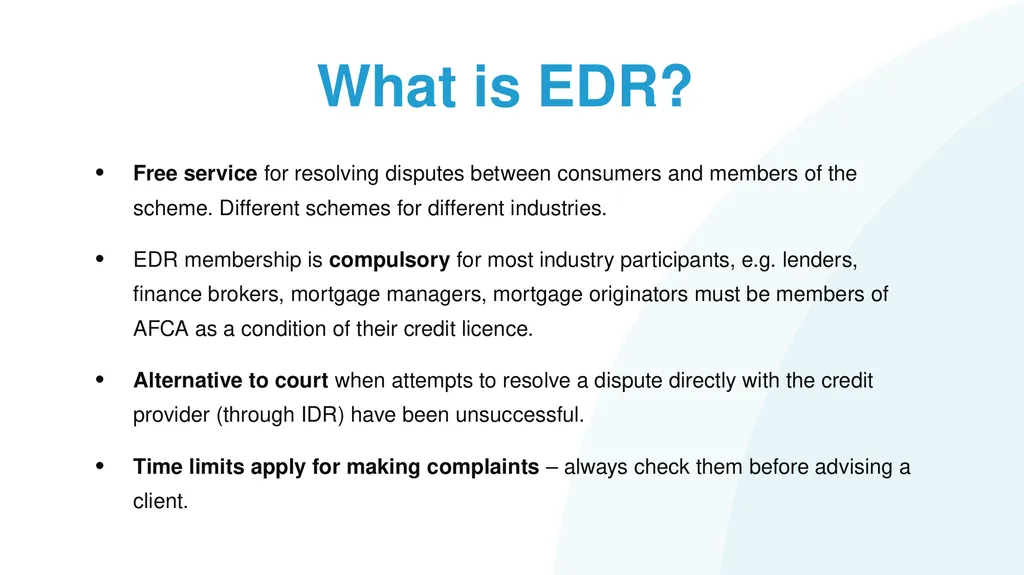
What is EDR? Free service for resolving disputes between consumers and members of the scheme. Different schemes for different industries.
EDR membership is compulsory for most industry participants, e.g. lenders, finance brokers, mortgage managers, mortgage originators must be members of AFCA as a condition of their credit licence.
Alternative to court when attempts to resolve a dispute directly with the credit provider (through IDR) have been unsuccessful.
Time limits apply for making complaints – always check them before advising a client.<br>
33
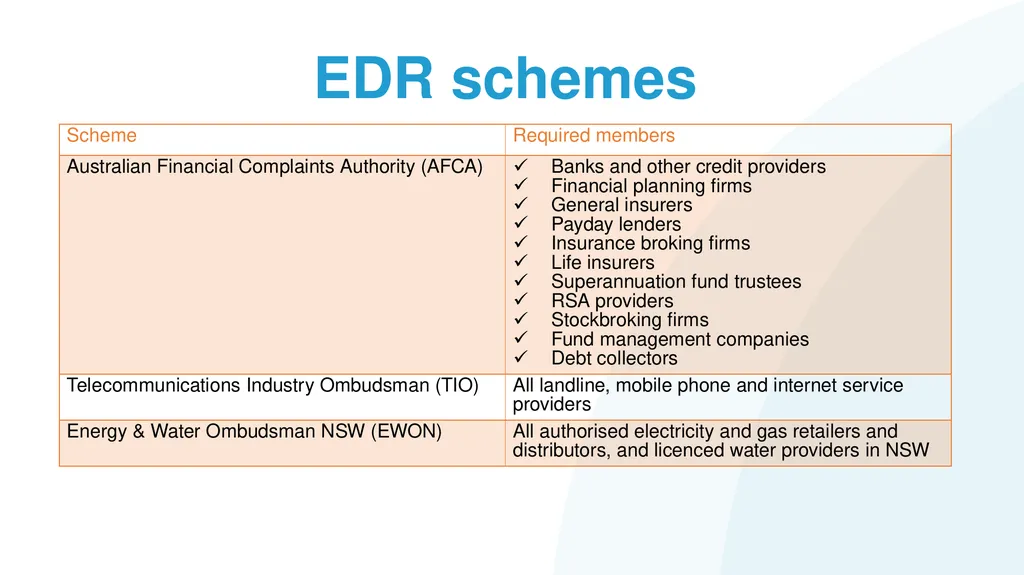
EDR schemes<br>
34
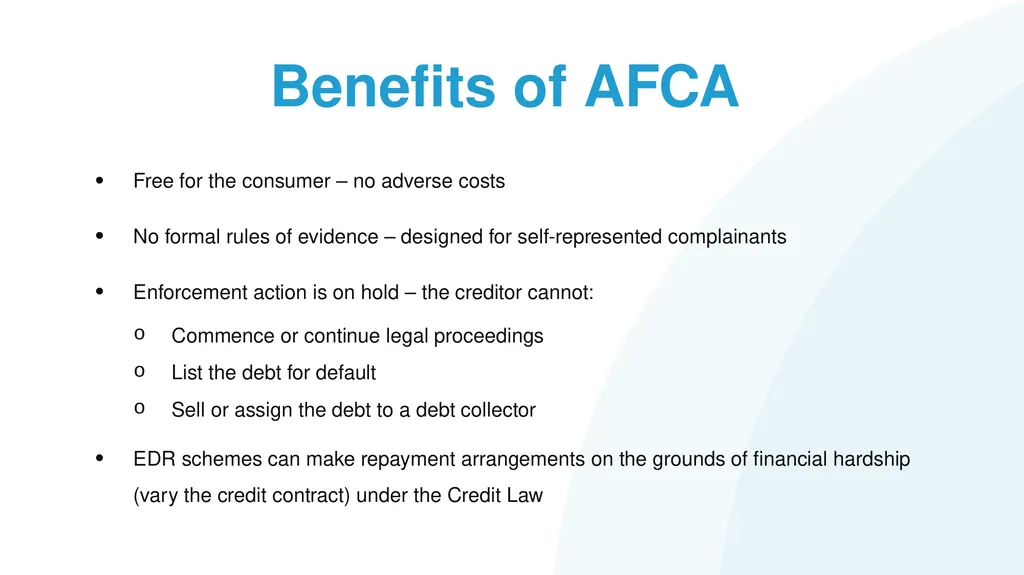
Benefits of AFCA Free for the consumer – no adverse costs
No formal rules of evidence – designed for self-represented complainants
Enforcement action is on hold – the creditor cannot:
Commence or continue legal proceedings
List the debt for default
Sell or assign the debt to a debt collector
EDR schemes can make repayment arrangements on the grounds of financial hardship (vary the credit contract) under the Credit Law<br>
35
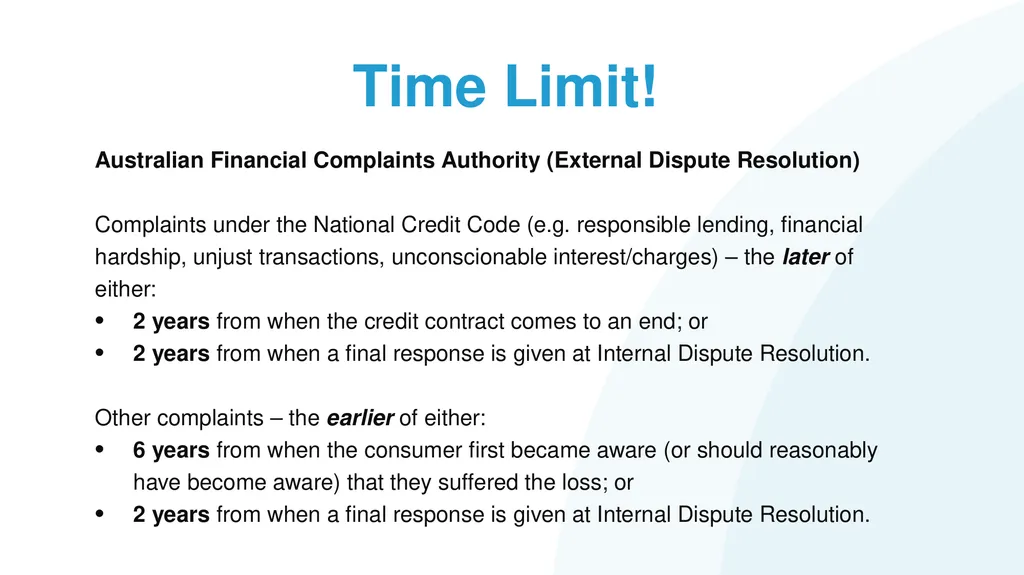
Time Limit! Australian Financial Complaints Authority (External Dispute Resolution)
Complaints under the National Credit Code (e.g. responsible lending, financial hardship, unjust transactions, unconscionable interest/charges) – the later of either:
2 years from when the credit contract comes to an end; or
2 years from when a final response is given at Internal Dispute Resolution.
Other complaints – the earlier of either:
6 years from when the consumer first became aware (or should reasonably have become aware) that they suffered the loss; or
2 years from when a final response is given at Internal Dispute Resolution.<br>
36
Legal resources Credit Law Toolkit
ASIC Regulatory Guide 209 Credit licensing: Responsible lending conduct
ABA Banking Code of Practice RESOURCES: www.rlc.org.au/training/resources/financial-abuse<br>
ASIC Regulatory Guide 209 Credit licensing: Responsible lending conduct
ABA Banking Code of Practice RESOURCES: www.rlc.org.au/training/resources/financial-abuse<br>
37
2. How to craft financial hardship requests<br>
38
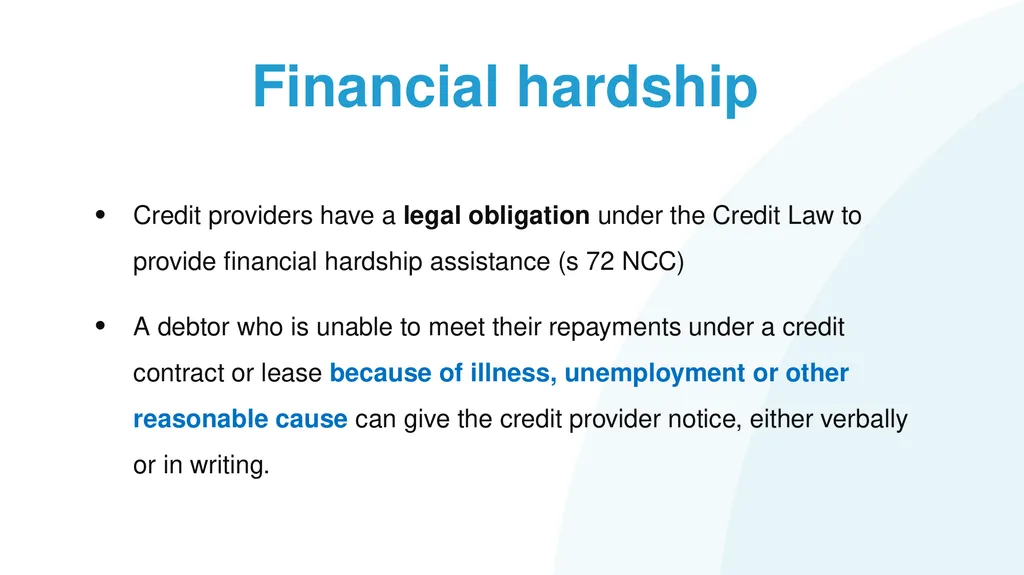
Financial hardship Credit providers have a legal obligation under the Credit Law to provide financial hardship assistance (s 72 NCC)
A debtor who is unable to meet their repayments under a credit contract or lease because of illness, unemployment or other reasonable cause can give the credit provider notice, either verbally or in writing.<br>
A debtor who is unable to meet their repayments under a credit contract or lease because of illness, unemployment or other reasonable cause can give the credit provider notice, either verbally or in writing.<br>
39
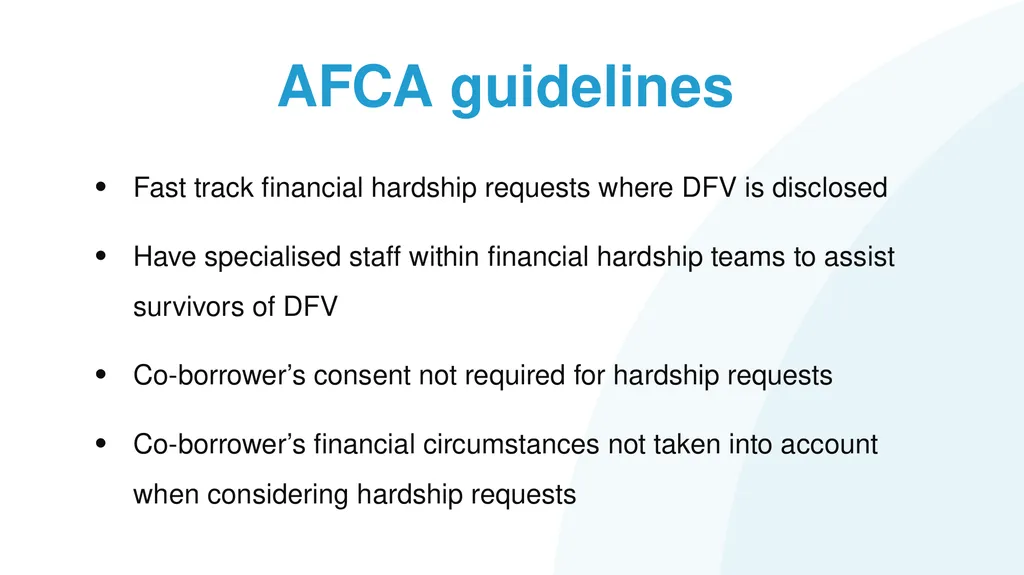
AFCA guidelines Fast track financial hardship requests where DFV is disclosed
Have specialised staff within financial hardship teams to assist survivors of DFV
Co-borrower’s consent not required for hardship requests
Co-borrower’s financial circumstances not taken into account when considering hardship requests<br>
Have specialised staff within financial hardship teams to assist survivors of DFV
Co-borrower’s consent not required for hardship requests
Co-borrower’s financial circumstances not taken into account when considering hardship requests<br>
40
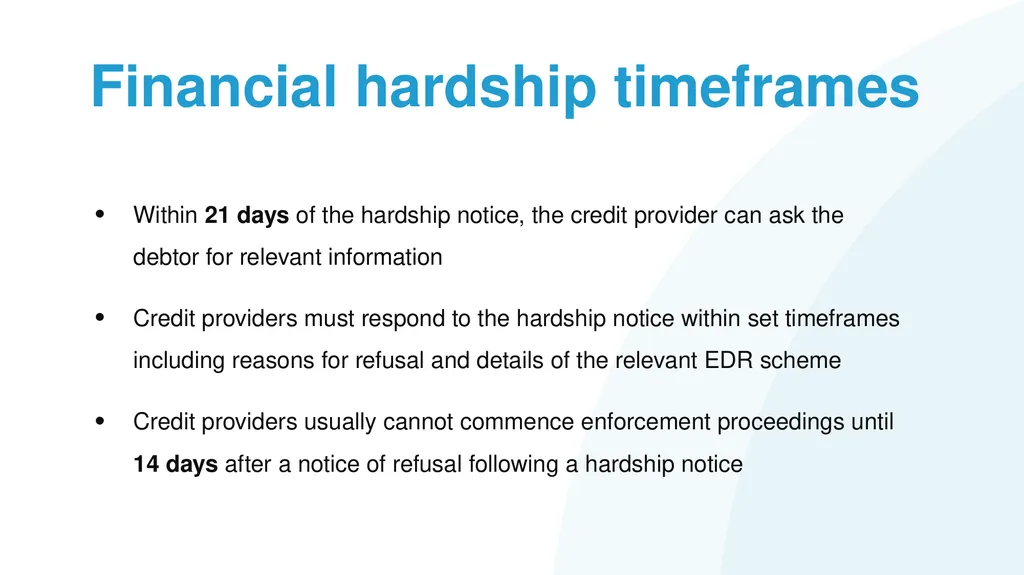
Financial hardship timeframes Within 21 days of the hardship notice, the credit provider can ask the debtor for relevant information
Credit providers must respond to the hardship notice within set timeframes including reasons for refusal and details of the relevant EDR scheme
Credit providers usually cannot commence enforcement proceedings until 14 days after a notice of refusal following a hardship notice<br>
Credit providers must respond to the hardship notice within set timeframes including reasons for refusal and details of the relevant EDR scheme
Credit providers usually cannot commence enforcement proceedings until 14 days after a notice of refusal following a hardship notice<br>
41
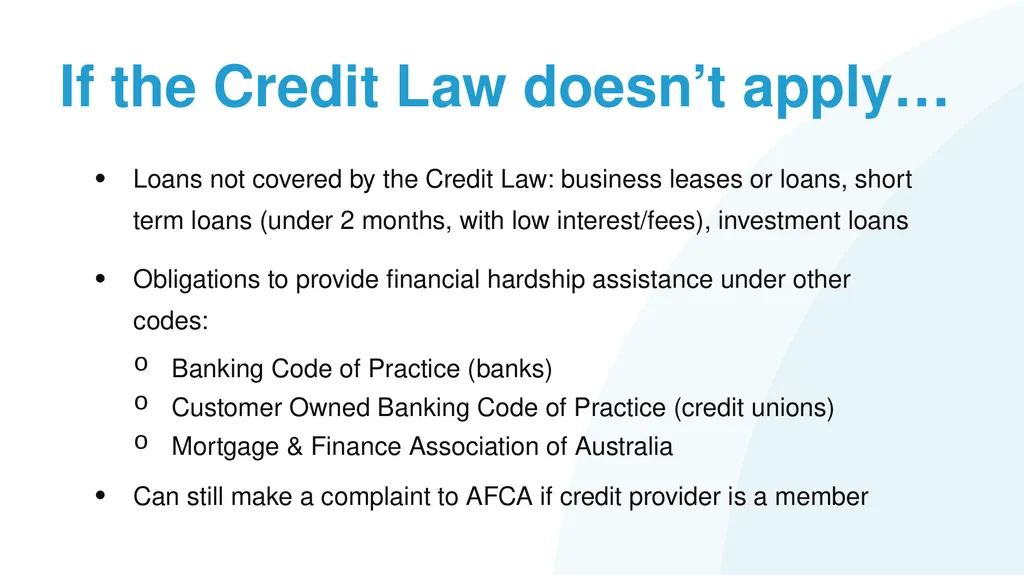
If the Credit Law doesn’t apply… Loans not covered by the Credit Law: business leases or loans, short term loans (under 2 months, with low interest/fees), investment loans
Obligations to provide financial hardship assistance under other codes:
Banking Code of Practice (banks)
Customer Owned Banking Code of Practice (credit unions)
Mortgage & Finance Association of Australia
Can still make a complaint to AFCA if credit provider is a member<br>
Obligations to provide financial hardship assistance under other codes:
Banking Code of Practice (banks)
Customer Owned Banking Code of Practice (credit unions)
Mortgage & Finance Association of Australia
Can still make a complaint to AFCA if credit provider is a member<br>
42
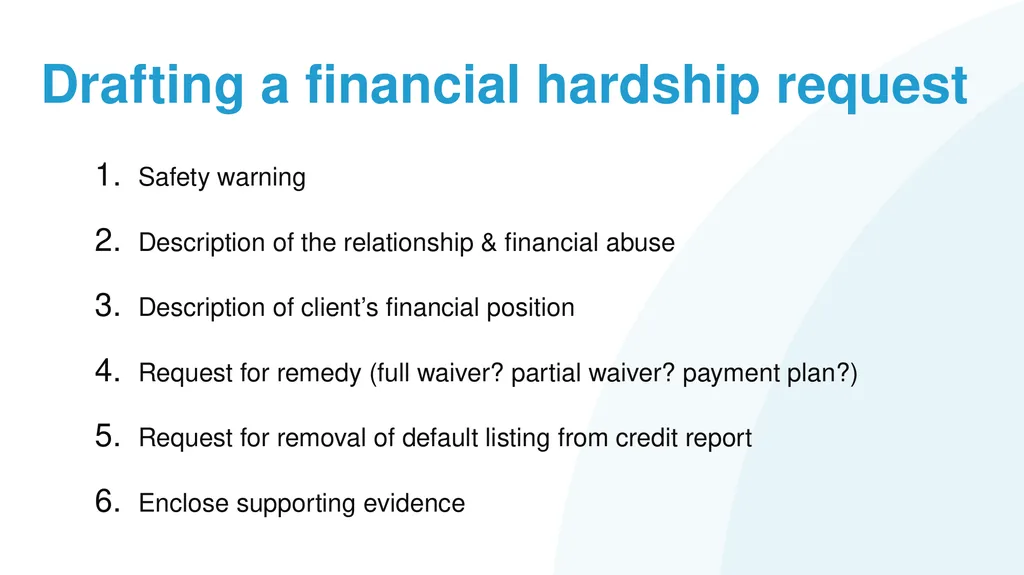
Drafting a financial hardship request Safety warning
Description of the relationship & financial abuse
Description of client’s financial position
Request for remedy (full waiver? partial waiver? payment plan?)
Request for removal of default listing from credit report
Enclose supporting evidence<br>
Description of the relationship & financial abuse
Description of client’s financial position
Request for remedy (full waiver? partial waiver? payment plan?)
Request for removal of default listing from credit report
Enclose supporting evidence<br>
43
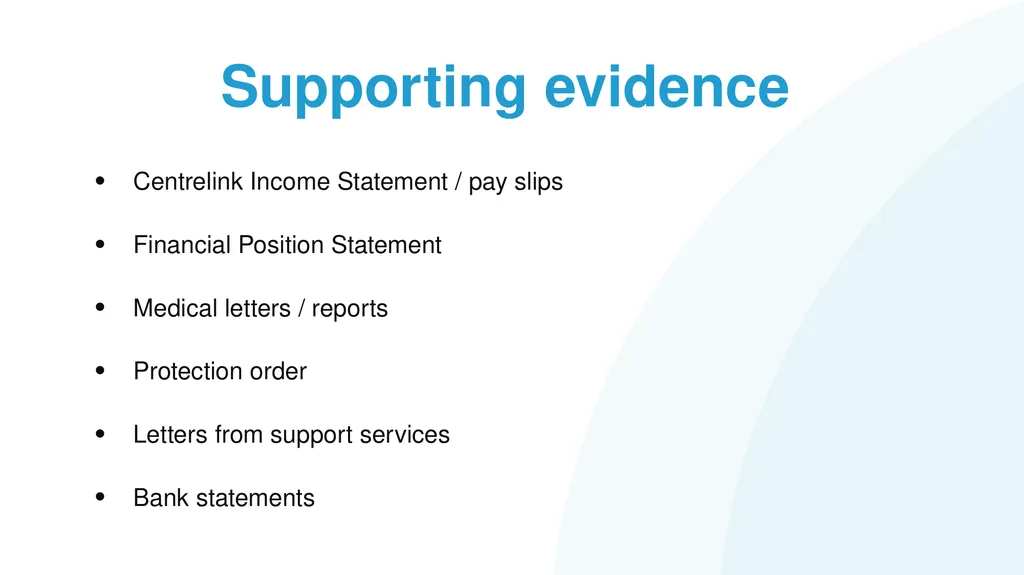
Supporting evidence Centrelink Income Statement / pay slips
Financial Position Statement
Medical letters / reports
Protection order
Letters from support services
Bank statements<br>
Financial Position Statement
Medical letters / reports
Protection order
Letters from support services
Bank statements<br>
44
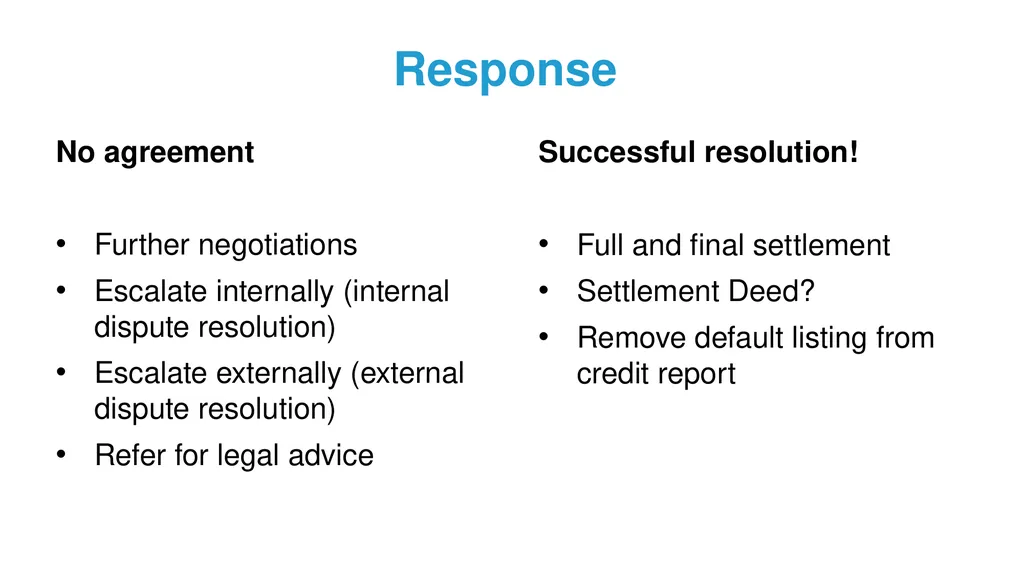
Response No agreement
Further negotiations
Escalate internally (internal dispute resolution)
Escalate externally (external dispute resolution)
Refer for legal advice Successful resolution!
Full and final settlement
Settlement Deed?
Remove default listing from credit report<br>
Further negotiations
Escalate internally (internal dispute resolution)
Escalate externally (external dispute resolution)
Refer for legal advice Successful resolution!
Full and final settlement
Settlement Deed?
Remove default listing from credit report<br>
45
3. Tips and tricks for negotiating with creditors and debt collectors<br>
46
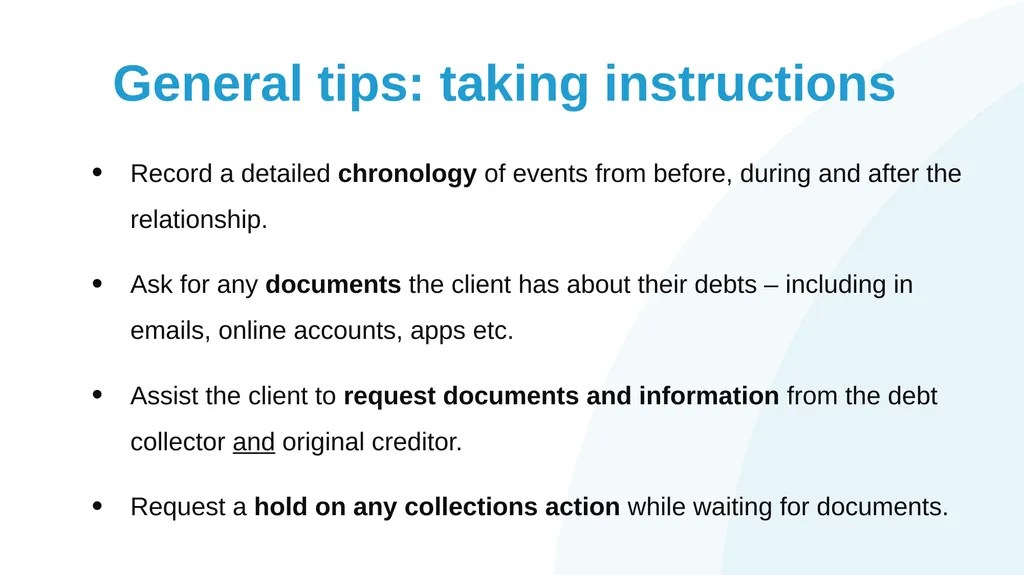
General tips: taking instructions Record a detailed chronology of events from before, during and after the relationship.
Ask for any documents the client has about their debts – including in emails, online accounts, apps etc.
Assist the client to request documents and information from the debt collector and original creditor.
Request a hold on any collections action while waiting for documents.<br>
Ask for any documents the client has about their debts – including in emails, online accounts, apps etc.
Assist the client to request documents and information from the debt collector and original creditor.
Request a hold on any collections action while waiting for documents.<br>
47
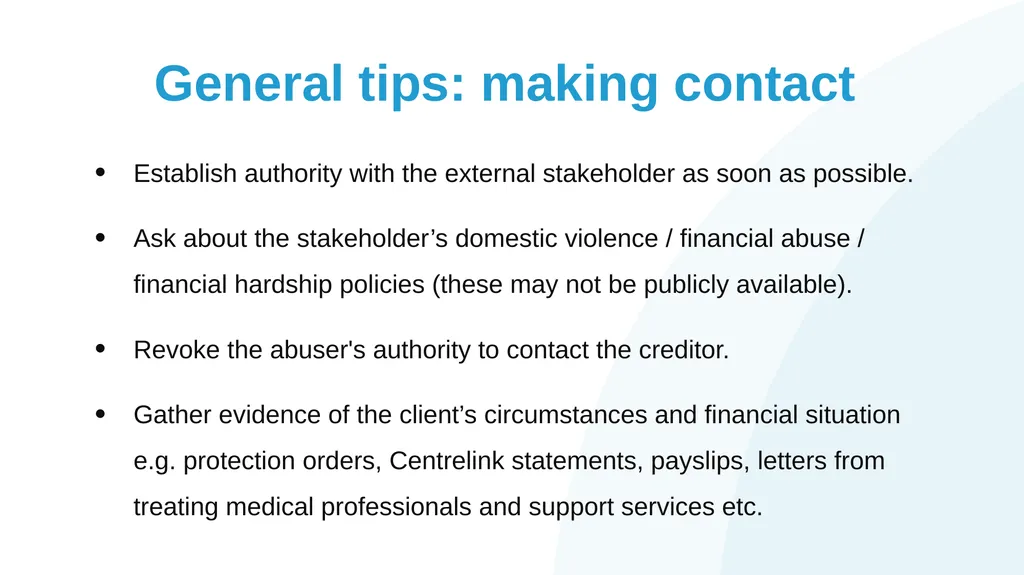
General tips: making contact Establish authority with the external stakeholder as soon as possible.
Ask about the stakeholder’s domestic violence / financial abuse / financial hardship policies (these may not be publicly available).
Revoke the abuser's authority to contact the creditor.
Gather evidence of the client’s circumstances and financial situation e.g. protection orders, Centrelink statements, payslips, letters from treating medical professionals and support services etc.<br>
48
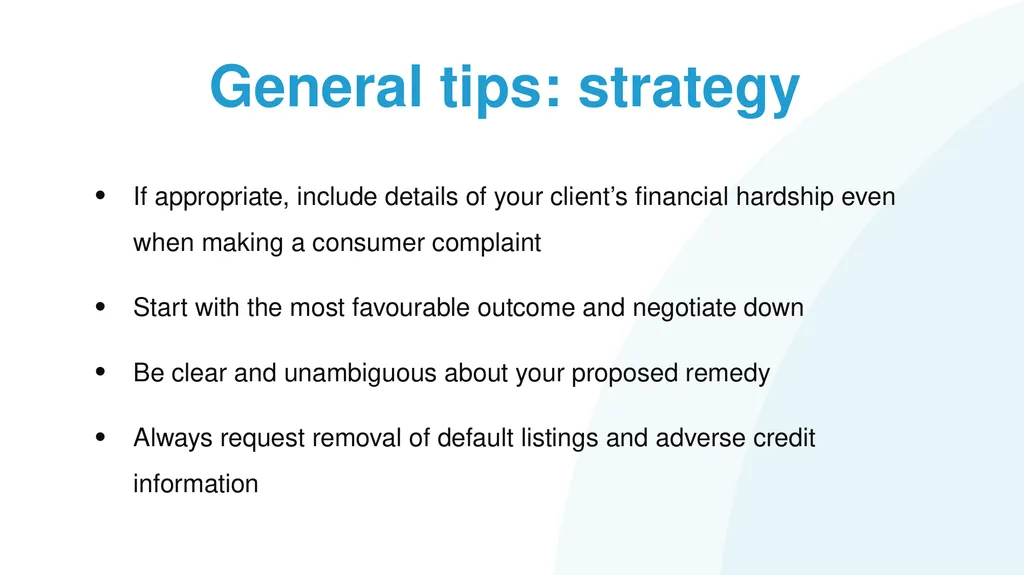
General tips: strategy If appropriate, include details of your client’s financial hardship even when making a consumer complaint
Start with the most favourable outcome and negotiate down
Be clear and unambiguous about your proposed remedy
Always request removal of default listings and adverse credit information<br>
Start with the most favourable outcome and negotiate down
Be clear and unambiguous about your proposed remedy
Always request removal of default listings and adverse credit information<br>
49
Negotiating with Financial Service Providers<br>
50
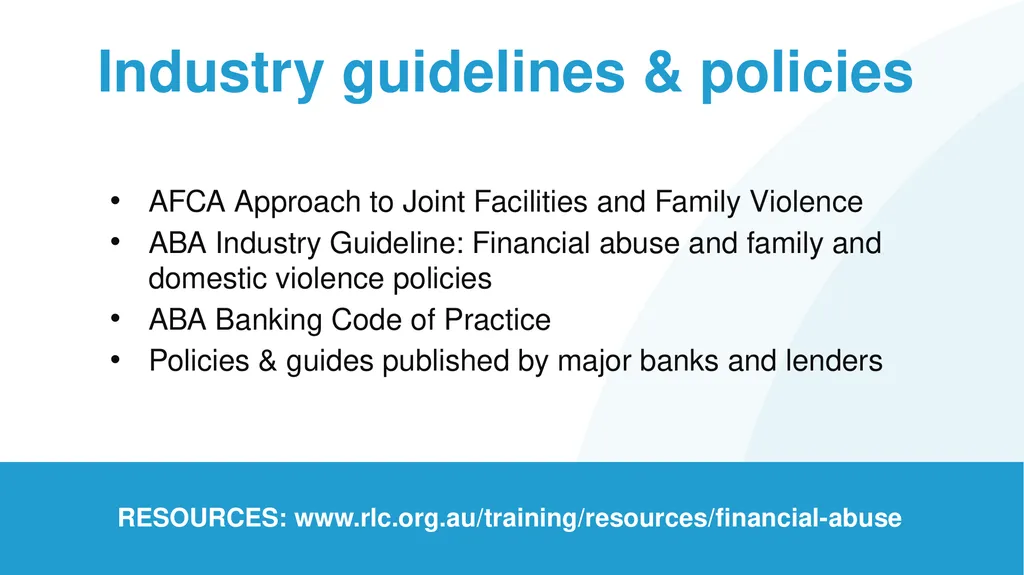
Industry guidelines & policies AFCA Approach to Joint Facilities and Family Violence
ABA Industry Guideline: Financial abuse and family and domestic violence policies
ABA Banking Code of Practice
Policies & guides published by major banks and lenders RESOURCES: www.rlc.org.au/training/resources/financial-abuse<br>
ABA Industry Guideline: Financial abuse and family and domestic violence policies
ABA Banking Code of Practice
Policies & guides published by major banks and lenders RESOURCES: www.rlc.org.au/training/resources/financial-abuse<br>
51
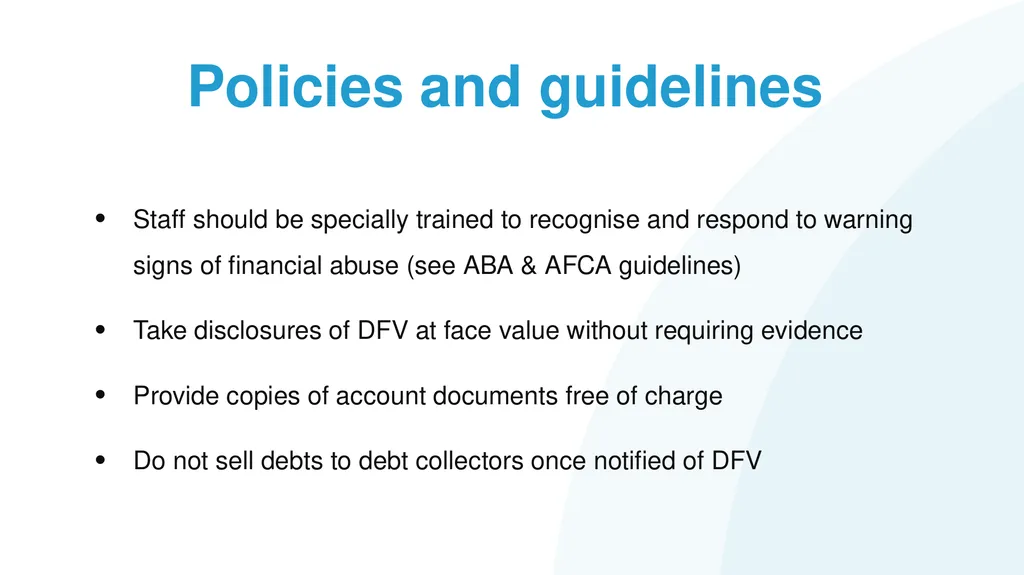
Policies and guidelines Staff should be specially trained to recognise and respond to warning signs of financial abuse (see ABA & AFCA guidelines)
Take disclosures of DFV at face value without requiring evidence
Provide copies of account documents free of charge
Do not sell debts to debt collectors once notified of DFV<br>
Take disclosures of DFV at face value without requiring evidence
Provide copies of account documents free of charge
Do not sell debts to debt collectors once notified of DFV<br>
52
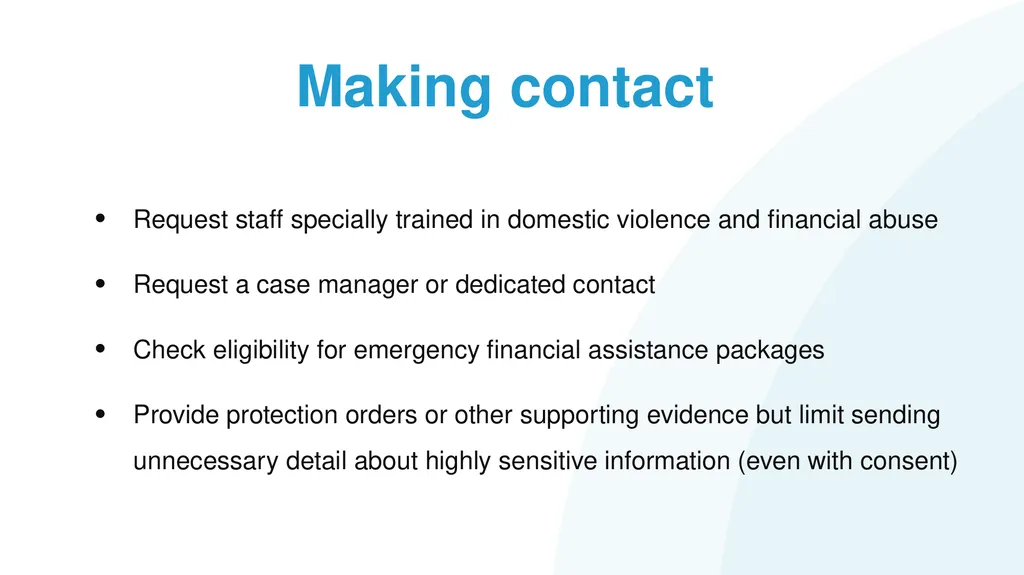
Making contact Request staff specially trained in domestic violence and financial abuse
Request a case manager or dedicated contact
Check eligibility for emergency financial assistance packages
Provide protection orders or other supporting evidence but limit sending unnecessary detail about highly sensitive information (even with consent)<br>
Request a case manager or dedicated contact
Check eligibility for emergency financial assistance packages
Provide protection orders or other supporting evidence but limit sending unnecessary detail about highly sensitive information (even with consent)<br>
53
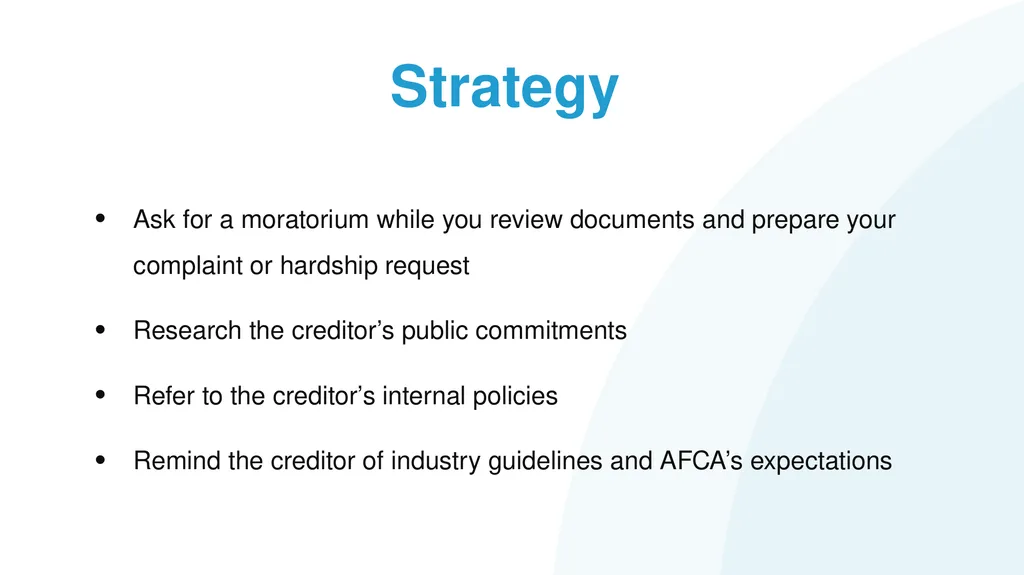
Strategy Ask for a moratorium while you review documents and prepare your complaint or hardship request
Research the creditor’s public commitments
Refer to the creditor’s internal policies
Remind the creditor of industry guidelines and AFCA’s expectations<br>
Research the creditor’s public commitments
Refer to the creditor’s internal policies
Remind the creditor of industry guidelines and AFCA’s expectations<br>
54
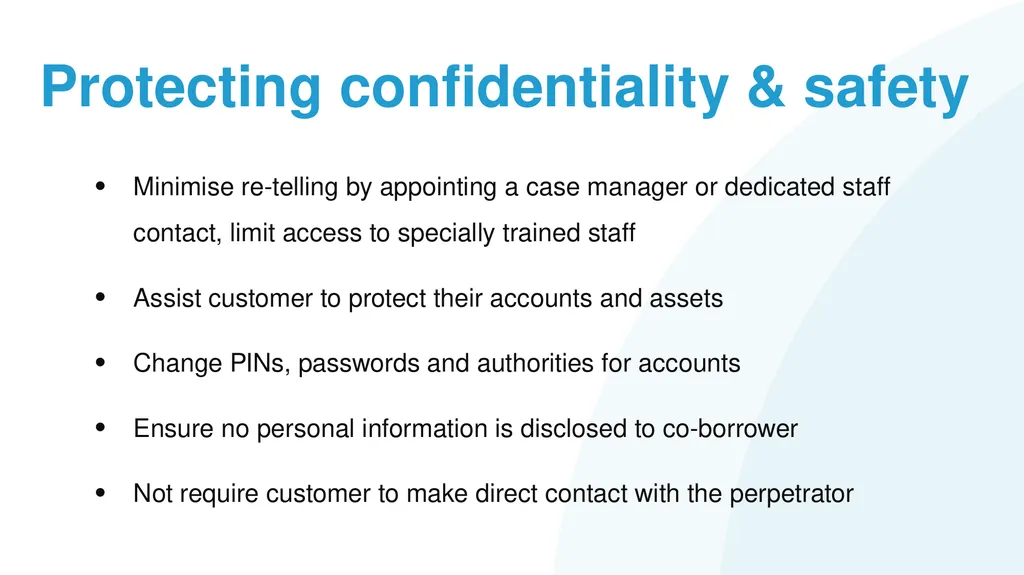
Protecting confidentiality & safety Minimise re-telling by appointing a case manager or dedicated staff contact, limit access to specially trained staff
Assist customer to protect their accounts and assets
Change PINs, passwords and authorities for accounts
Ensure no personal information is disclosed to co-borrower
Not require customer to make direct contact with the perpetrator<br>
Assist customer to protect their accounts and assets
Change PINs, passwords and authorities for accounts
Ensure no personal information is disclosed to co-borrower
Not require customer to make direct contact with the perpetrator<br>
55
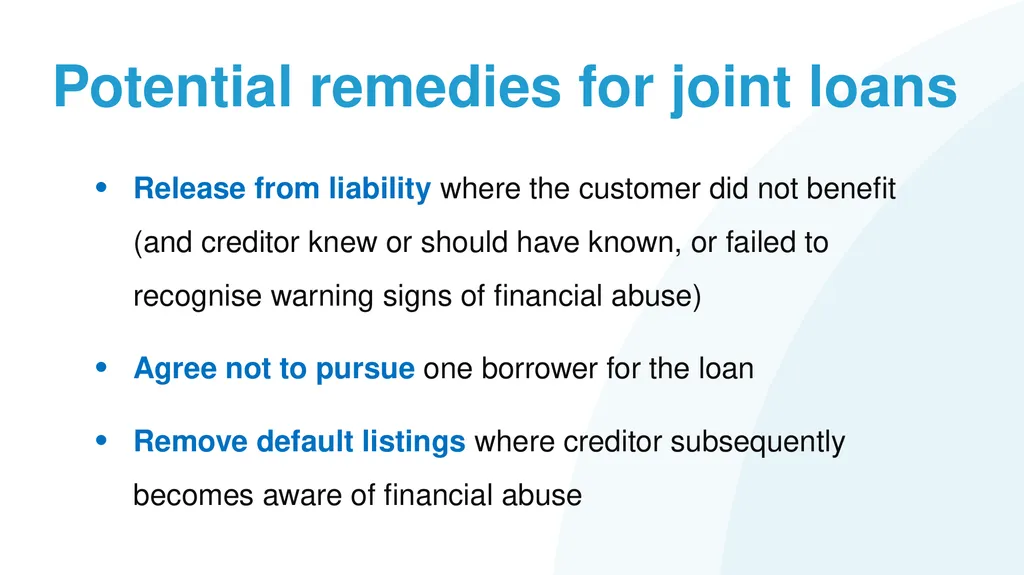
Potential remedies for joint loans Release from liability where the customer did not benefit (and creditor knew or should have known, or failed to recognise warning signs of financial abuse)
Agree not to pursue one borrower for the loan
Remove default listings where creditor subsequently becomes aware of financial abuse<br>
Agree not to pursue one borrower for the loan
Remove default listings where creditor subsequently becomes aware of financial abuse<br>
56
Negotiating with Debt Collectors<br>
57
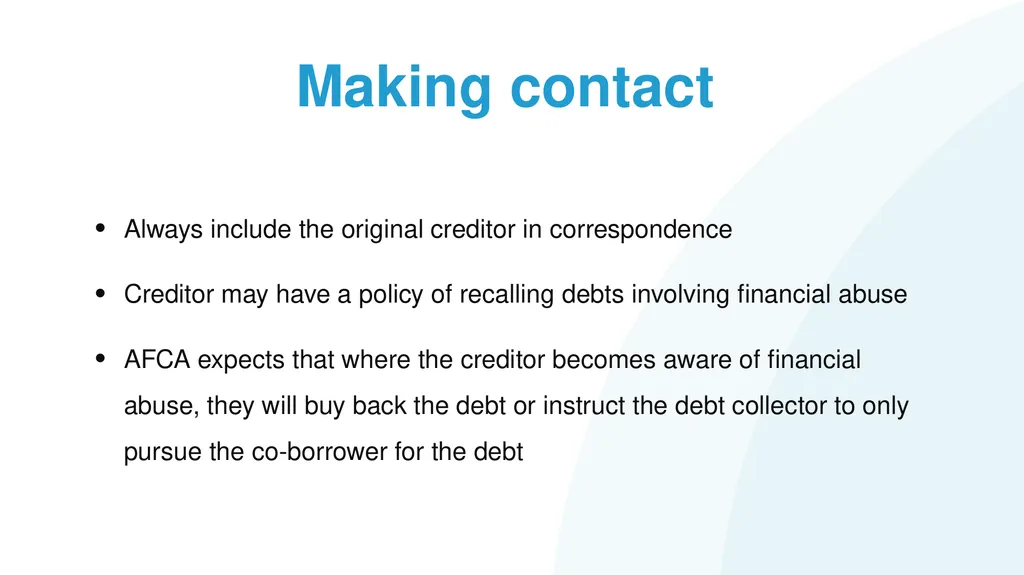
Making contact Always include the original creditor in correspondence
Creditor may have a policy of recalling debts involving financial abuse
AFCA expects that where the creditor becomes aware of financial abuse, they will buy back the debt or instruct the debt collector to only pursue the co-borrower for the debt<br>
Creditor may have a policy of recalling debts involving financial abuse
AFCA expects that where the creditor becomes aware of financial abuse, they will buy back the debt or instruct the debt collector to only pursue the co-borrower for the debt<br>
58
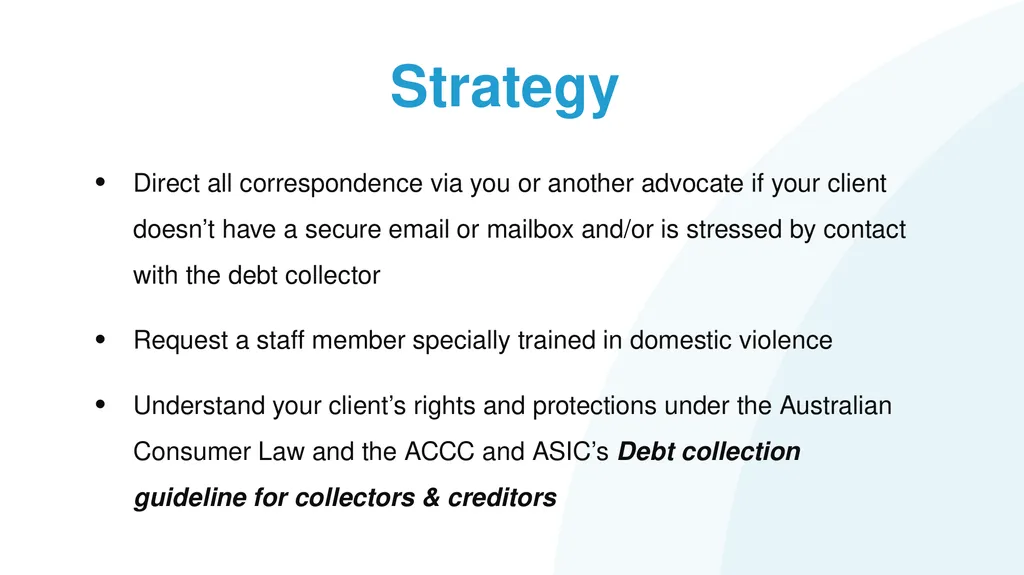
Strategy Direct all correspondence via you or another advocate if your client doesn’t have a secure email or mailbox and/or is stressed by contact with the debt collector
Request a staff member specially trained in domestic violence
Understand your client’s rights and protections under the Australian Consumer Law and the ACCC and ASIC’s Debt collection guideline for collectors & creditors<br>
Request a staff member specially trained in domestic violence
Understand your client’s rights and protections under the Australian Consumer Law and the ACCC and ASIC’s Debt collection guideline for collectors & creditors<br>
59
4. When to get specialist legal advice<br>
60
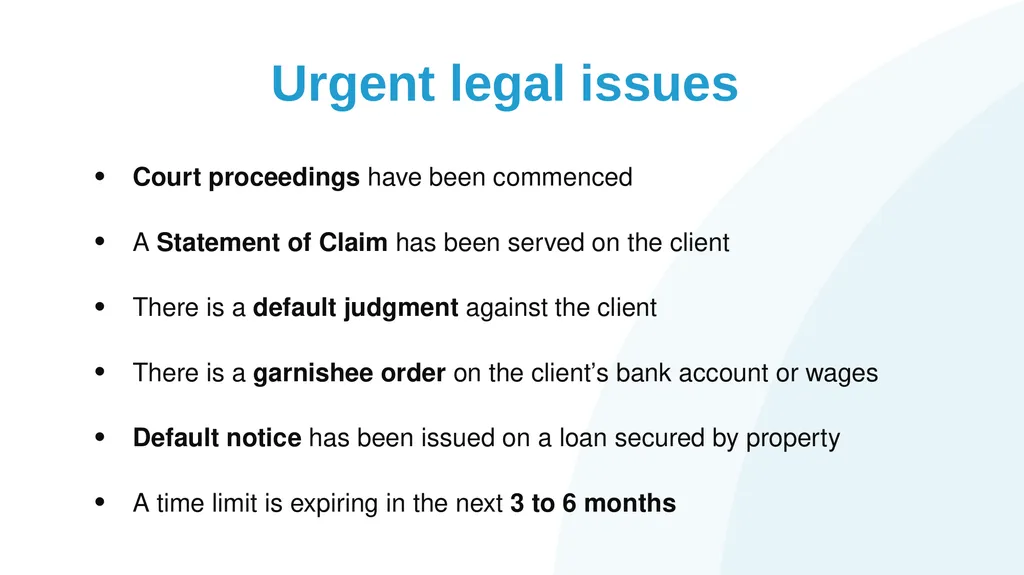
Urgent legal issues Court proceedings have been commenced
A Statement of Claim has been served on the client
There is a default judgment against the client
There is a garnishee order on the client’s bank account or wages
Default notice has been issued on a loan secured by property
A time limit is expiring in the next 3 to 6 months<br>
A Statement of Claim has been served on the client
There is a default judgment against the client
There is a garnishee order on the client’s bank account or wages
Default notice has been issued on a loan secured by property
A time limit is expiring in the next 3 to 6 months<br>
61
Specialist legal assistance Defend any legal proceedings currently on foot
Apply to set aside the default judgment
Apply for financial hardship assistance from creditor
Negotiate directly with creditor to repay the debt
If any breaches of Credit Law or fraud, lodge a consumer complaint (IDR) seeking a waiver or reduction of the debt
Lodge a complaint with an EDR scheme (e.g. AFCA)<br>
62
Where to get free legal advice Redfern Legal Centre’s Financial Abuse Service NSW offers free specialist advice and representation to people in NSW who have experienced financial abuse in an intimate partner relationship. Call us on 0481 730 344 or visit https://rlc.org.au/fals
Your client’s local community legal centre.
Legal Aid in your state or territory.<br>
Your client’s local community legal centre.
Legal Aid in your state or territory.<br>
63
“You make me feel that there is hope for a better quality of life at some point in future. Thank you all from the bottom of my heart”
“Thank you again for all your help, you have no idea how much of a relief this all is for me!”<br>
“Thank you again for all your help, you have no idea how much of a relief this all is for me!”<br>
64
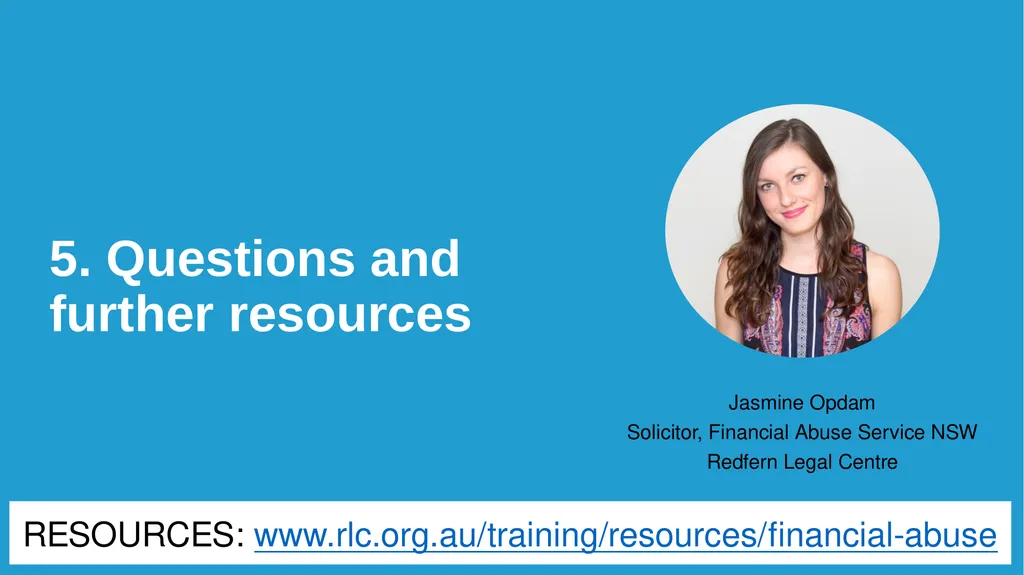
5. Questions and further resources Jasmine Opdam
Solicitor, Financial Abuse Service NSW
Redfern Legal Centre RESOURCES: www.rlc.org.au/training/resources/financial-abuse<br>
Solicitor, Financial Abuse Service NSW
Redfern Legal Centre RESOURCES: www.rlc.org.au/training/resources/financial-abuse<br>
65
Before You Go Your feedback helps us improve our training.
Please stay with us for another 60 seconds… Training: rlc.org.au/training
Enquiries: Nick Manning
education@rlc.org.au This workshop is a guide to the law in Australia. It is not a substitute for legal advice. If you have a legal problem, seek legal advice from a legal centre or Legal Aid.<br>
Please stay with us for another 60 seconds… Training: rlc.org.au/training
Enquiries: Nick Manning
education@rlc.org.au This workshop is a guide to the law in Australia. It is not a substitute for legal advice. If you have a legal problem, seek legal advice from a legal centre or Legal Aid.<br>