
Respiratory Medicine in General Practice Dr Andrew
DP
Published · 140 slides · 0 views

1 / 1










Description
Respiratory Medicine in General Practice Dr Andrew Thurston GP Focus on AKT RCGP Curriculum: Investigations: PEFR, Spirometry, Pulse Oximetry, Sputum Culture Indications for CXR, CT, MRI, Bronchoscopy Disease Scoring Tools e.g. CURB65
Related Topics
Share
Embed code
Download this presentation From Below
"Respiratory Medicine in General Practice Dr Andrew" is the property of its rightful owner. Permission is granted to download and print the materials on this website for personal, non-commercial use only, and to display it on your personal computer provided you do not modify the materials and that you retain all copyright notices contained in the materials. By downloading content from our website, you accept the terms of this agreement.
Presentation Transcript
01
Respiratory Medicine in General Practice Dr Andrew Thurston
GP<br>
GP<br>
02
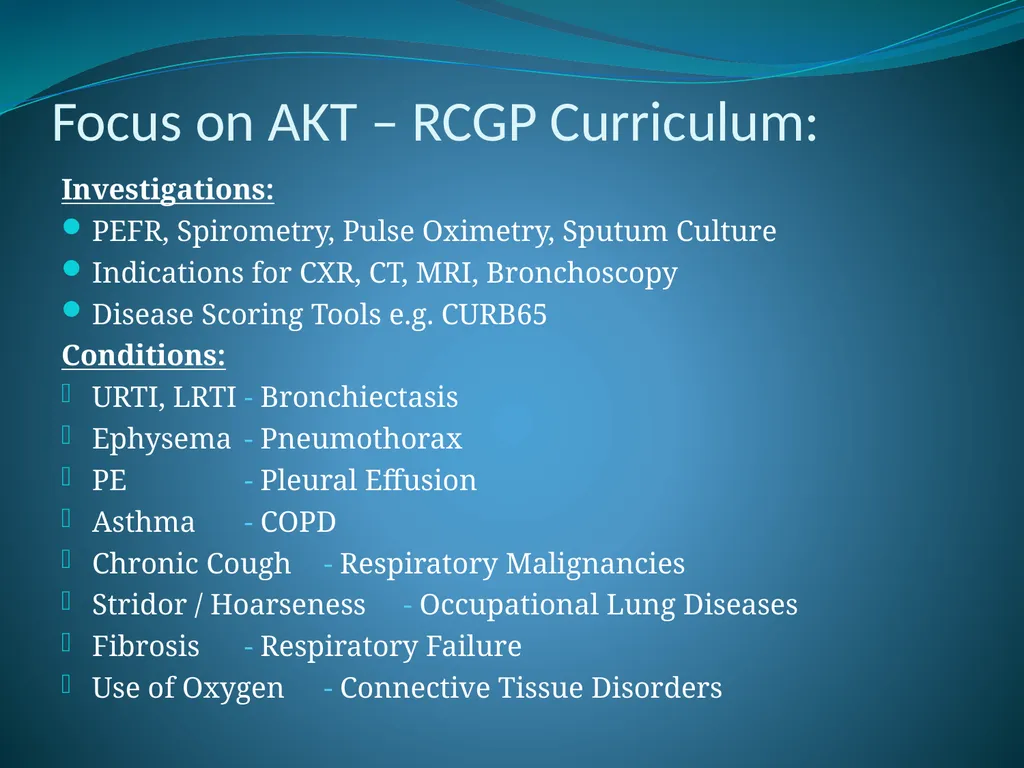
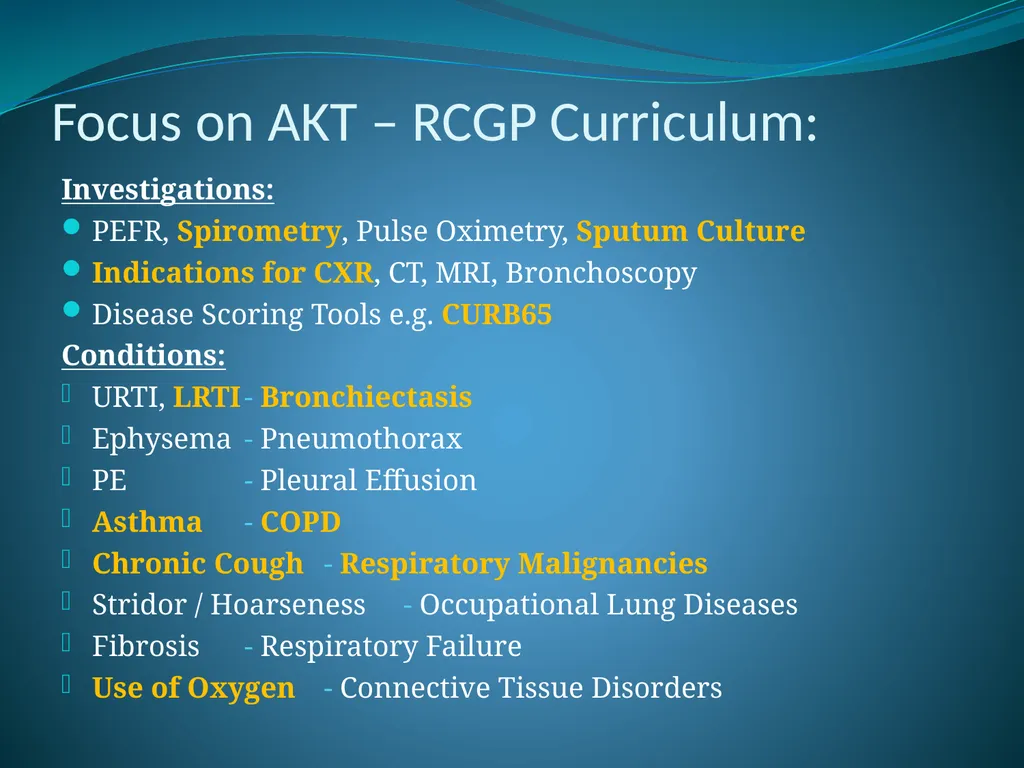
Focus on AKT – RCGP Curriculum: Investigations:
PEFR, Spirometry, Pulse Oximetry, Sputum Culture
Indications for CXR, CT, MRI, Bronchoscopy
Disease Scoring Tools e.g. CURB65
Conditions:
URTI, LRTI - Bronchiectasis
Ephysema - Pneumothorax
PE - Pleural Effusion
Asthma - COPD
Chronic Cough - Respiratory Malignancies
Stridor / Hoarseness - Occupational Lung Diseases
Fibrosis - Respiratory Failure
Use of Oxygen - Connective Tissue Disorders<br>
PEFR, Spirometry, Pulse Oximetry, Sputum Culture
Indications for CXR, CT, MRI, Bronchoscopy
Disease Scoring Tools e.g. CURB65
Conditions:
URTI, LRTI - Bronchiectasis
Ephysema - Pneumothorax
PE - Pleural Effusion
Asthma - COPD
Chronic Cough - Respiratory Malignancies
Stridor / Hoarseness - Occupational Lung Diseases
Fibrosis - Respiratory Failure
Use of Oxygen - Connective Tissue Disorders<br>
03
Focus on AKT – RCGP Curriculum: Investigations:
PEFR, Spirometry, Pulse Oximetry, Sputum Culture
Indications for CXR, CT, MRI, Bronchoscopy
Disease Scoring Tools e.g. CURB65
Conditions:
URTI, LRTI - Bronchiectasis
Ephysema - Pneumothorax
PE - Pleural Effusion
Asthma - COPD
Chronic Cough - Respiratory Malignancies
Stridor / Hoarseness - Occupational Lung Diseases
Fibrosis - Respiratory Failure
Use of Oxygen - Connective Tissue Disorders<br>
PEFR, Spirometry, Pulse Oximetry, Sputum Culture
Indications for CXR, CT, MRI, Bronchoscopy
Disease Scoring Tools e.g. CURB65
Conditions:
URTI, LRTI - Bronchiectasis
Ephysema - Pneumothorax
PE - Pleural Effusion
Asthma - COPD
Chronic Cough - Respiratory Malignancies
Stridor / Hoarseness - Occupational Lung Diseases
Fibrosis - Respiratory Failure
Use of Oxygen - Connective Tissue Disorders<br>
04
DISCLAIMER I wrote all the questions to fit with the topics
They were designed to be similar to AKT questions.
Please ask if anything isn’t clear or looks wrong.<br>
They were designed to be similar to AKT questions.
Please ask if anything isn’t clear or looks wrong.<br>
05
Question 1 A 56 year old woman presents with exertional breathlessness, worsening over 6 months. Spirometry shows:
FVC 1.98 (predicted 3.51)
FEV1 1.64 (predicted 2.82)
FEV1/FVC 83% (predicted 80%)
What is the most likely diagnosis?
Asthma
Bronchiectasis
COPD
Pulmonary Fibrosis
Extrinsic Allergic Alveolitis<br>
FVC 1.98 (predicted 3.51)
FEV1 1.64 (predicted 2.82)
FEV1/FVC 83% (predicted 80%)
What is the most likely diagnosis?
Asthma
Bronchiectasis
COPD
Pulmonary Fibrosis
Extrinsic Allergic Alveolitis<br>
06
Question 1 A 56 year old woman presents with exertional breathlessness, worsening over 6 months. Spirometry shows:
FVC 1.98 (predicted 3.51)
FEV1 1.64 (predicted 2.82)
FEV1/FVC 83% (predicted 80%)
What is the most likely diagnosis?
Asthma
Bronchiectasis
COPD
Pulmonary Fibrosis
Extrinsic Allergic Alveolitis<br>
FVC 1.98 (predicted 3.51)
FEV1 1.64 (predicted 2.82)
FEV1/FVC 83% (predicted 80%)
What is the most likely diagnosis?
Asthma
Bronchiectasis
COPD
Pulmonary Fibrosis
Extrinsic Allergic Alveolitis<br>
07
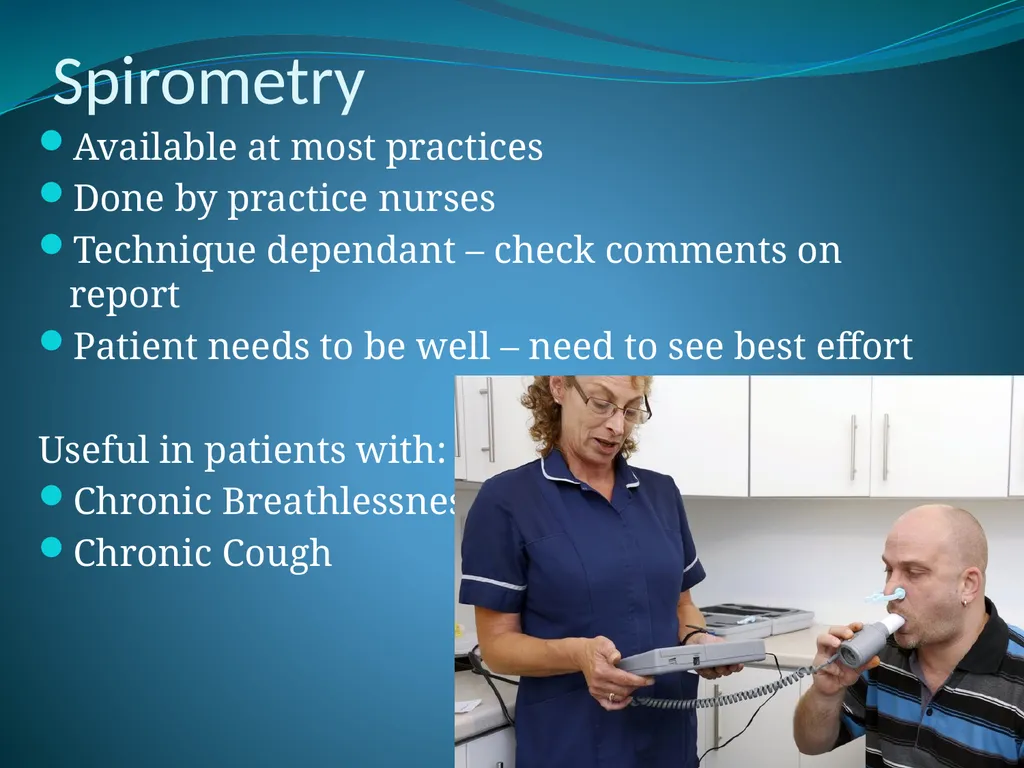
Spirometry Available at most practices
Done by practice nurses
Technique dependant – check comments on report
Patient needs to be well – need to see best effort
Useful in patients with:
Chronic Breathlessness
Chronic Cough<br>
Done by practice nurses
Technique dependant – check comments on report
Patient needs to be well – need to see best effort
Useful in patients with:
Chronic Breathlessness
Chronic Cough<br>
08
Requesting Spirometry in GP With or Without Reversibility?
If you think it could be asthma – ask for reversibility
Anything else – Post-Bronchodilator Spiro
Is the patient capable of performing the test?
Need to be able to follow instructions.
Is the patient well enough?
Wait 4 weeks after any chest infection<br>
If you think it could be asthma – ask for reversibility
Anything else – Post-Bronchodilator Spiro
Is the patient capable of performing the test?
Need to be able to follow instructions.
Is the patient well enough?
Wait 4 weeks after any chest infection<br>
09
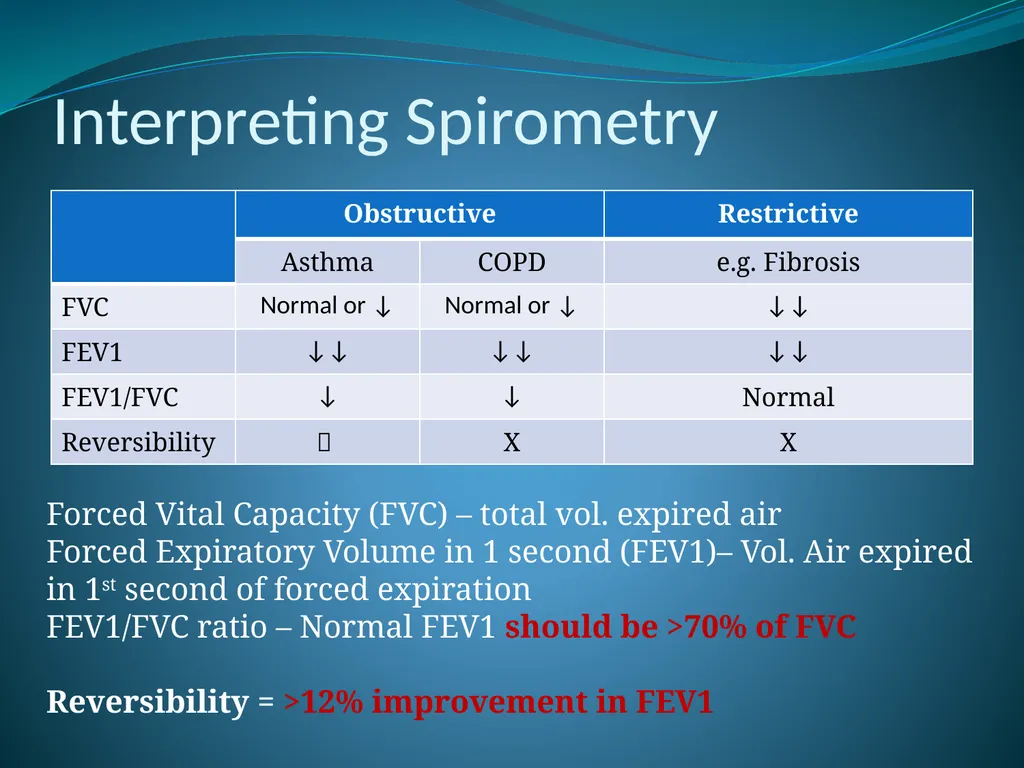
Interpreting Spirometry Forced Vital Capacity (FVC) – total vol. expired air
Forced Expiratory Volume in 1 second (FEV1)– Vol. Air expired in 1st second of forced expiration
FEV1/FVC ratio – Normal FEV1 should be >70% of FVC
Reversibility = >12% improvement in FEV1<br>
Forced Expiratory Volume in 1 second (FEV1)– Vol. Air expired in 1st second of forced expiration
FEV1/FVC ratio – Normal FEV1 should be >70% of FVC
Reversibility = >12% improvement in FEV1<br>
10
Interpreting Spirometry Example:
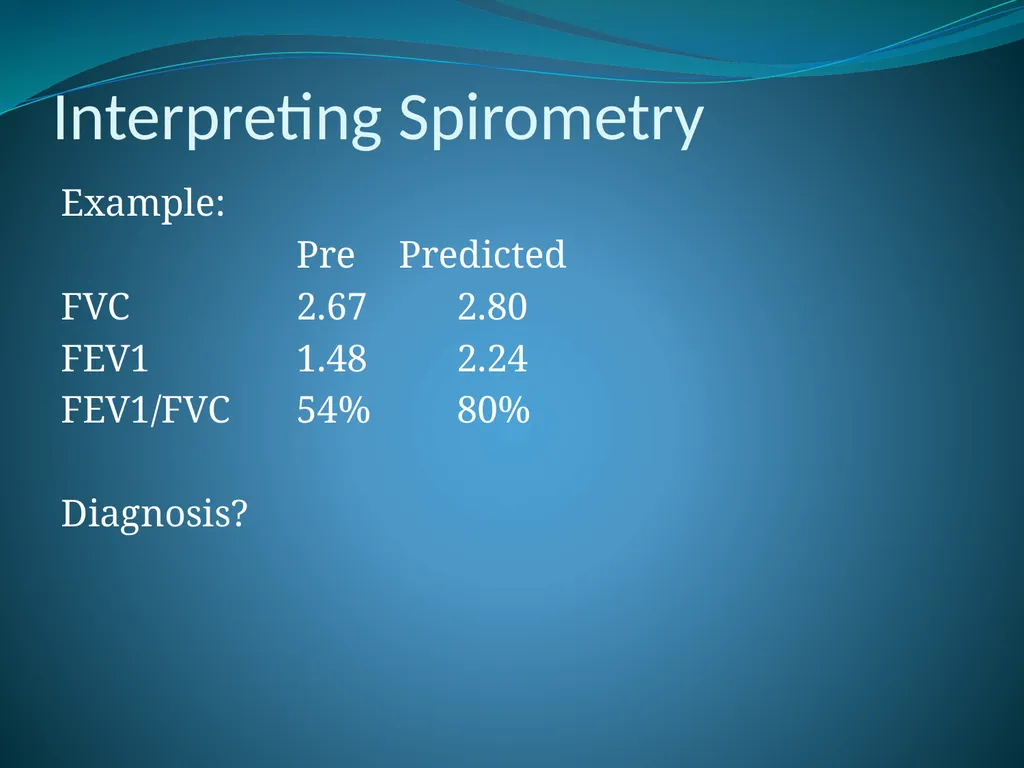
Pre Predicted
FVC 2.67 2.80
FEV1 1.48 2.24
FEV1/FVC 54% 80%
Diagnosis?<br>
Pre Predicted
FVC 2.67 2.80
FEV1 1.48 2.24
FEV1/FVC 54% 80%
Diagnosis?<br>
11
Interpreting Spirometry Example:
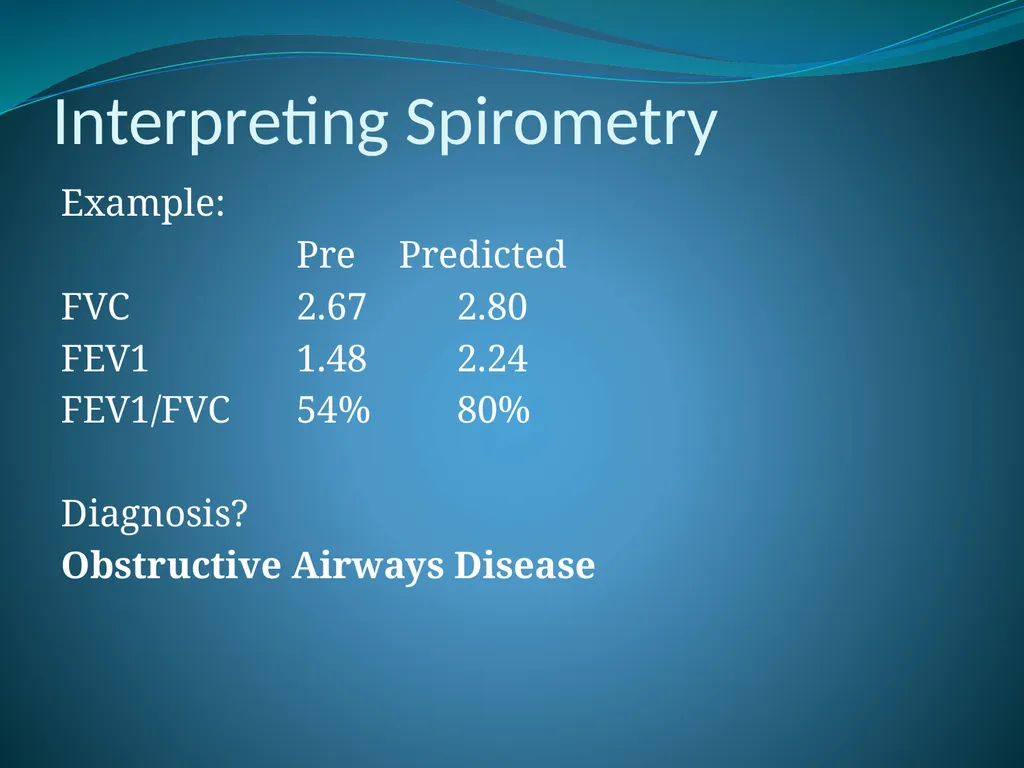
Pre Predicted
FVC 2.67 2.80
FEV1 1.48 2.24
FEV1/FVC 54% 80%
Diagnosis?
Obstructive Airways Disease<br>
Pre Predicted
FVC 2.67 2.80
FEV1 1.48 2.24
FEV1/FVC 54% 80%
Diagnosis?
Obstructive Airways Disease<br>
12
Interpreting Spirometry Example:
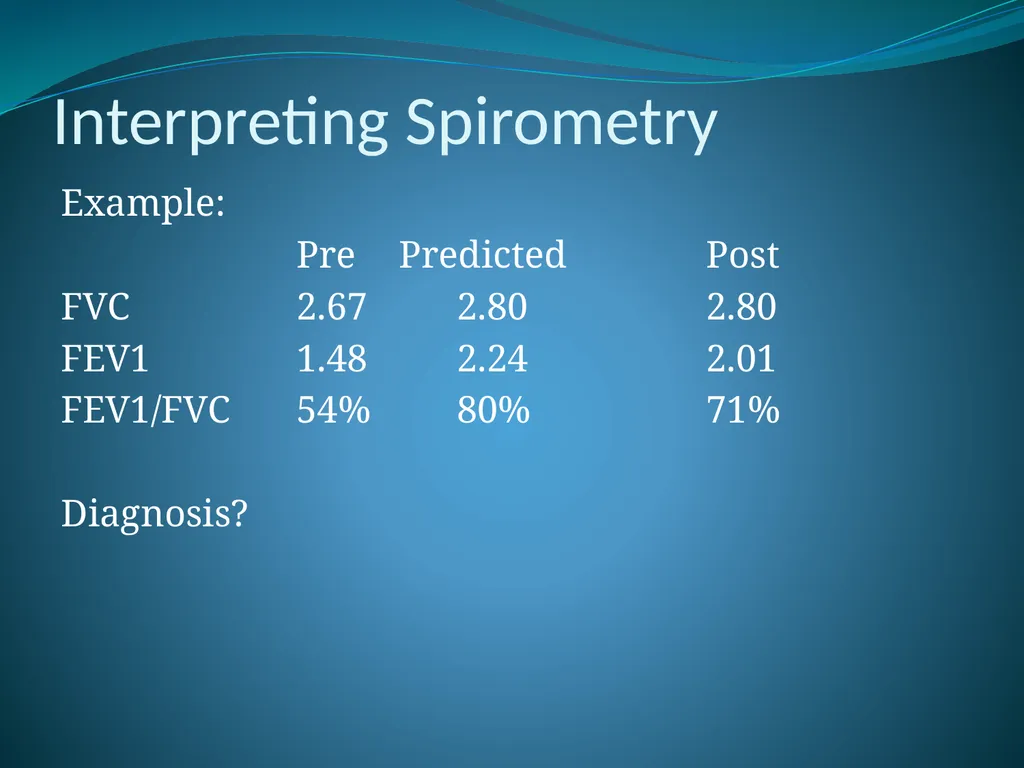
Pre Predicted Post
FVC 2.67 2.80 2.80
FEV1 1.48 2.24 2.01
FEV1/FVC 54% 80% 71%
Diagnosis?<br>
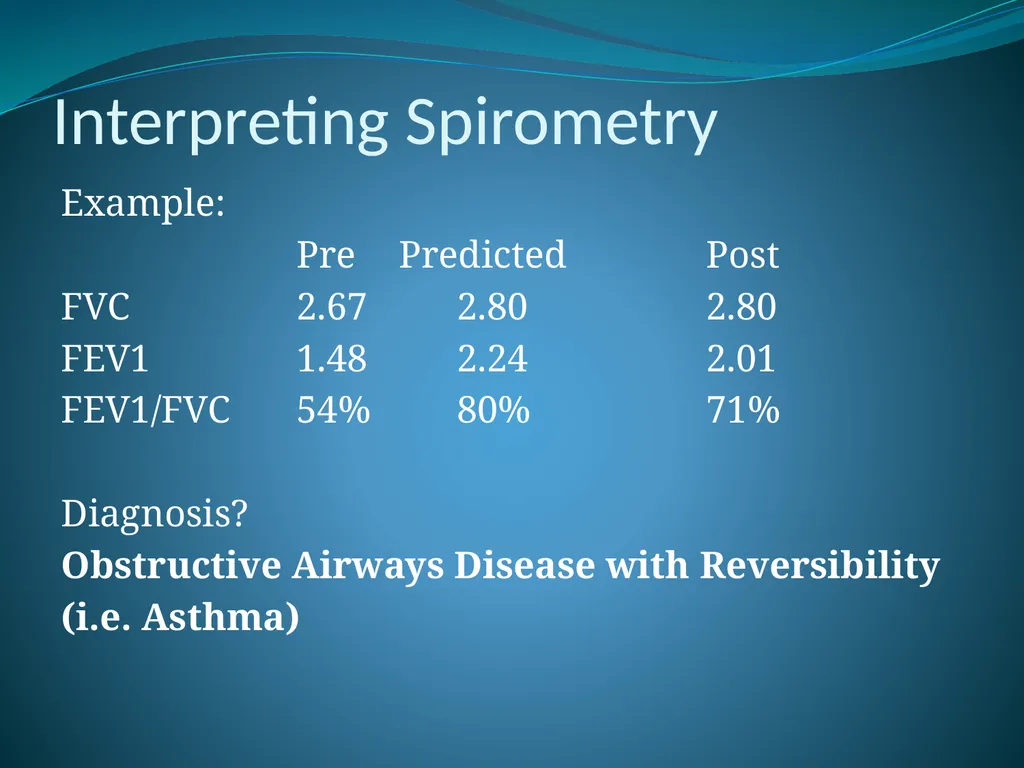
Pre Predicted Post
FVC 2.67 2.80 2.80
FEV1 1.48 2.24 2.01
FEV1/FVC 54% 80% 71%
Diagnosis?<br>
13
Interpreting Spirometry Example:
Pre Predicted Post
FVC 2.67 2.80 2.80
FEV1 1.48 2.24 2.01
FEV1/FVC 54% 80% 71%
Diagnosis?
Obstructive Airways Disease with Reversibility
(i.e. Asthma)<br>
Pre Predicted Post
FVC 2.67 2.80 2.80
FEV1 1.48 2.24 2.01
FEV1/FVC 54% 80% 71%
Diagnosis?
Obstructive Airways Disease with Reversibility
(i.e. Asthma)<br>
14
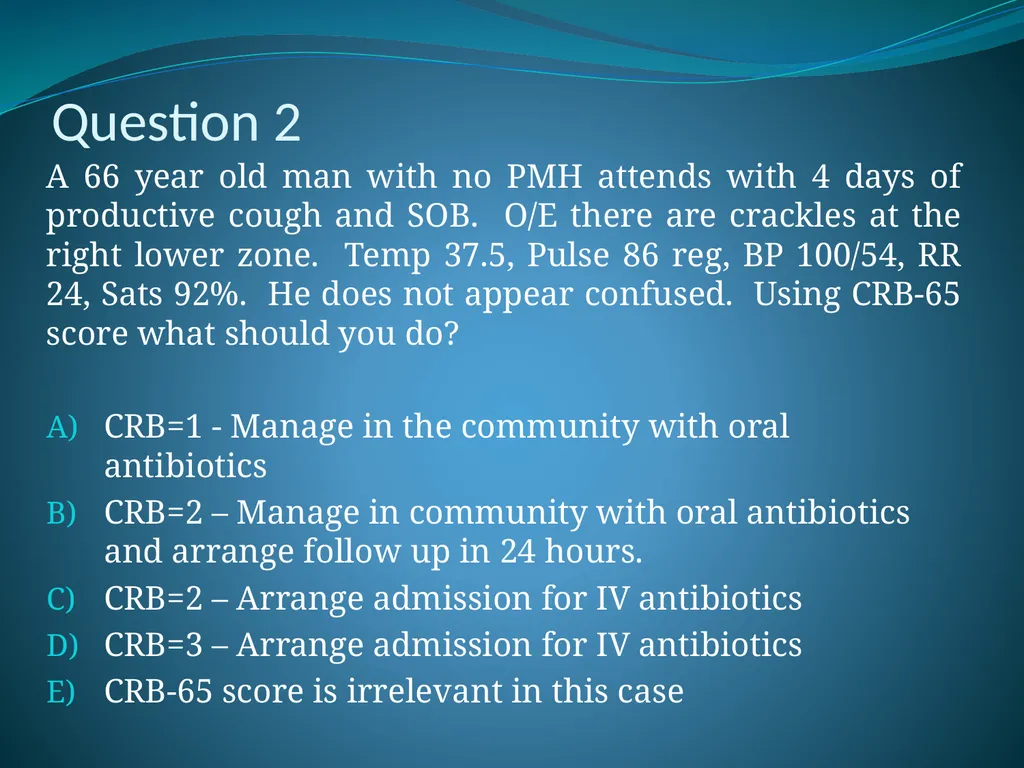
Question 2 A 66 year old man with no PMH attends with 4 days of productive cough and SOB. O/E there are crackles at the right lower zone. Temp 37.5, Pulse 86 reg, BP 100/54, RR 24, Sats 92%. He does not appear confused. Using CRB-65 score what should you do?
CRB=1 - Manage in the community with oral antibiotics
CRB=2 – Manage in community with oral antibiotics and arrange follow up in 24 hours.
CRB=2 – Arrange admission for IV antibiotics
CRB=3 – Arrange admission for IV antibiotics
CRB-65 score is irrelevant in this case<br>
CRB=1 - Manage in the community with oral antibiotics
CRB=2 – Manage in community with oral antibiotics and arrange follow up in 24 hours.
CRB=2 – Arrange admission for IV antibiotics
CRB=3 – Arrange admission for IV antibiotics
CRB-65 score is irrelevant in this case<br>
15
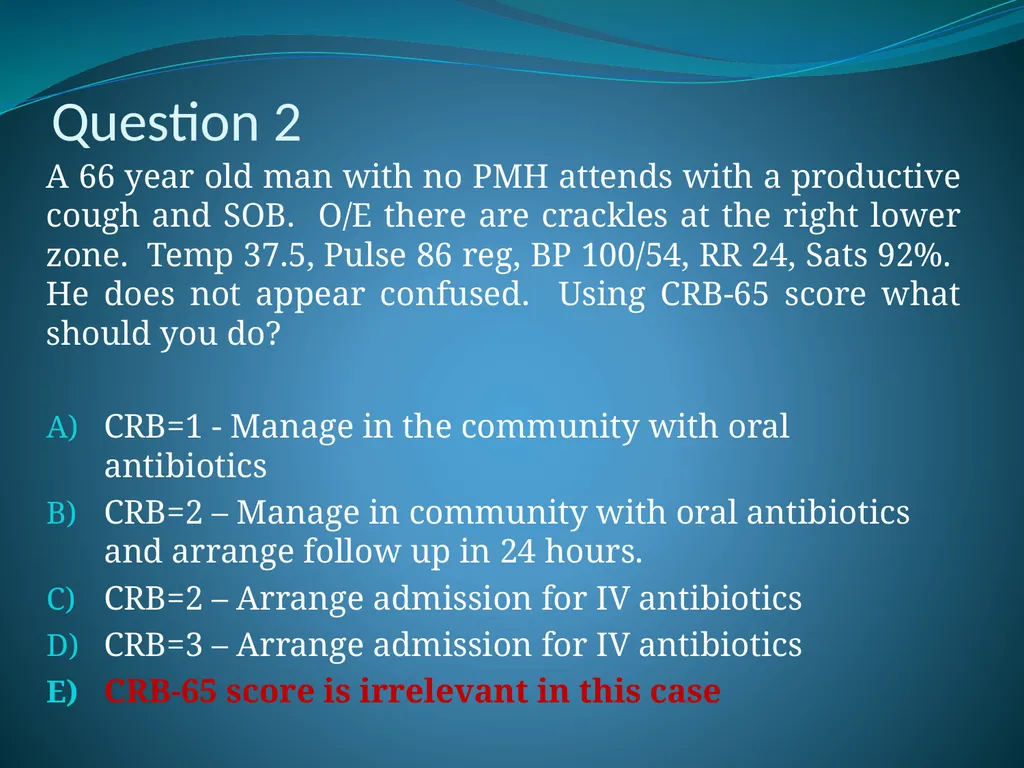
Question 2 A 66 year old man with no PMH attends with a productive cough and SOB. O/E there are crackles at the right lower zone. Temp 37.5, Pulse 86 reg, BP 100/54, RR 24, Sats 92%. He does not appear confused. Using CRB-65 score what should you do?
CRB=1 - Manage in the community with oral antibiotics
CRB=2 – Manage in community with oral antibiotics and arrange follow up in 24 hours.
CRB=2 – Arrange admission for IV antibiotics
CRB=3 – Arrange admission for IV antibiotics
CRB-65 score is irrelevant in this case<br>
CRB=1 - Manage in the community with oral antibiotics
CRB=2 – Manage in community with oral antibiotics and arrange follow up in 24 hours.
CRB=2 – Arrange admission for IV antibiotics
CRB=3 – Arrange admission for IV antibiotics
CRB-65 score is irrelevant in this case<br>
16
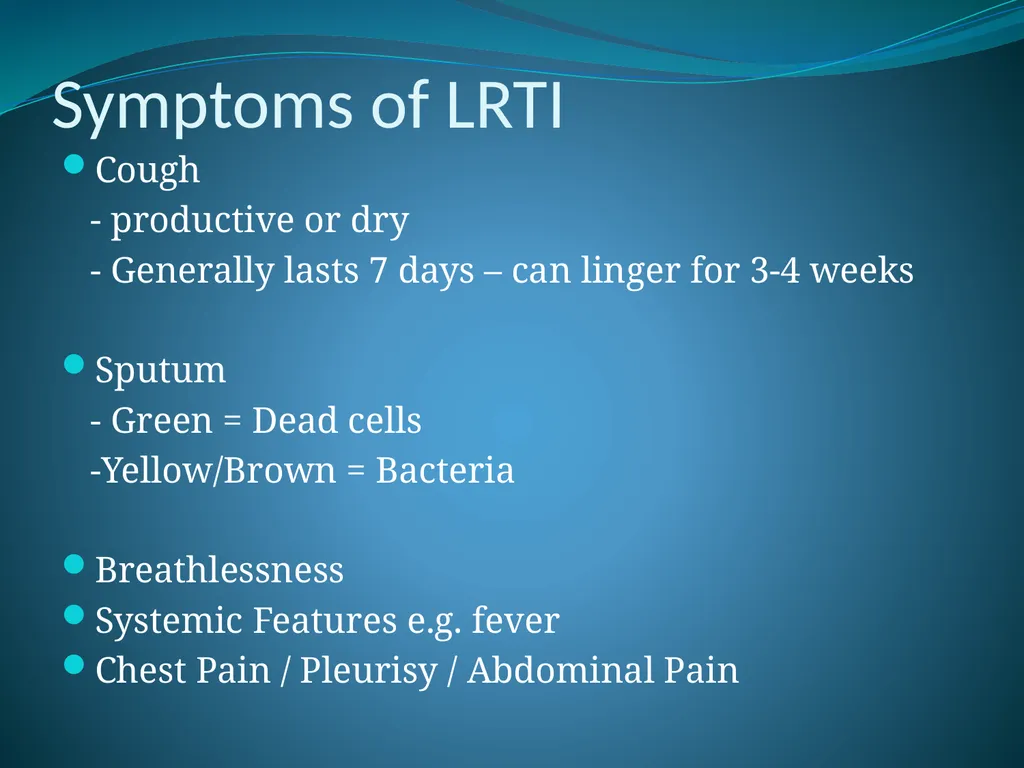
Symptoms of LRTI Cough
- productive or dry
- Generally lasts 7 days – can linger for 3-4 weeks
Sputum
- Green = Dead cells
-Yellow/Brown = Bacteria
Breathlessness
Systemic Features e.g. fever
Chest Pain / Pleurisy / Abdominal Pain<br>
- productive or dry
- Generally lasts 7 days – can linger for 3-4 weeks
Sputum
- Green = Dead cells
-Yellow/Brown = Bacteria
Breathlessness
Systemic Features e.g. fever
Chest Pain / Pleurisy / Abdominal Pain<br>
17
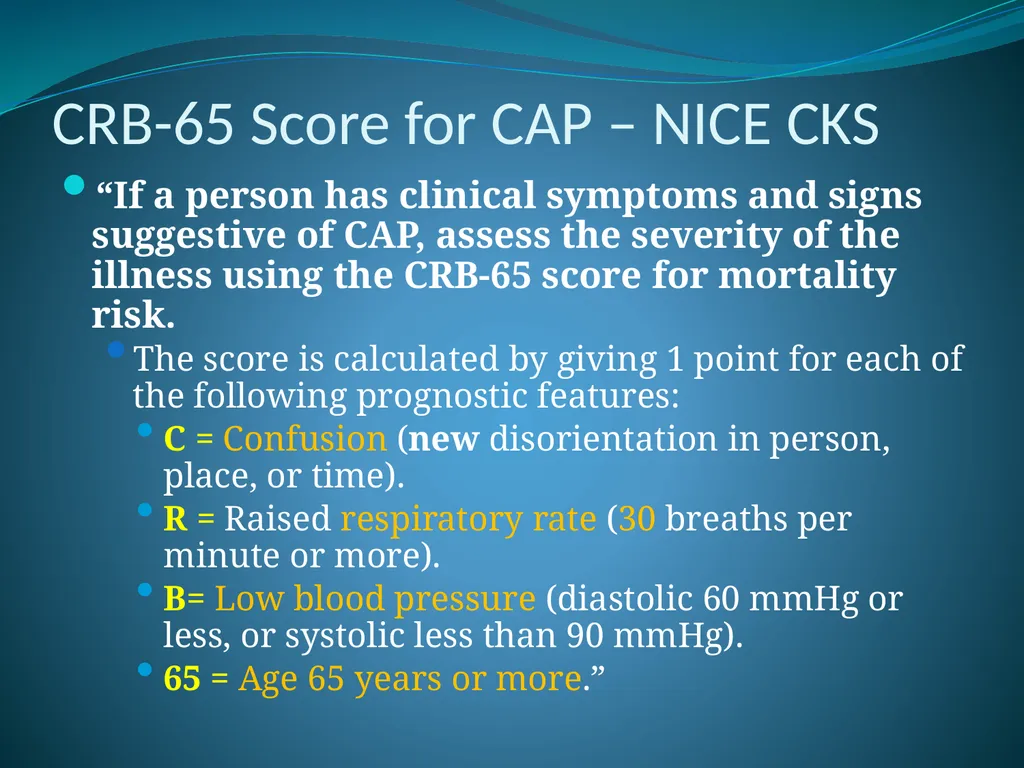
CRB-65 Score for CAP – NICE CKS “If a person has clinical symptoms and signs suggestive of CAP, assess the severity of the illness using the CRB-65 score for mortality risk.
The score is calculated by giving 1 point for each of the following prognostic features:
C = Confusion (new disorientation in person, place, or time).
R = Raised respiratory rate (30 breaths per minute or more).
B= Low blood pressure (diastolic 60 mmHg or less, or systolic less than 90 mmHg).
65 = Age 65 years or more.”<br>
The score is calculated by giving 1 point for each of the following prognostic features:
C = Confusion (new disorientation in person, place, or time).
R = Raised respiratory rate (30 breaths per minute or more).
B= Low blood pressure (diastolic 60 mmHg or less, or systolic less than 90 mmHg).
65 = Age 65 years or more.”<br>
18
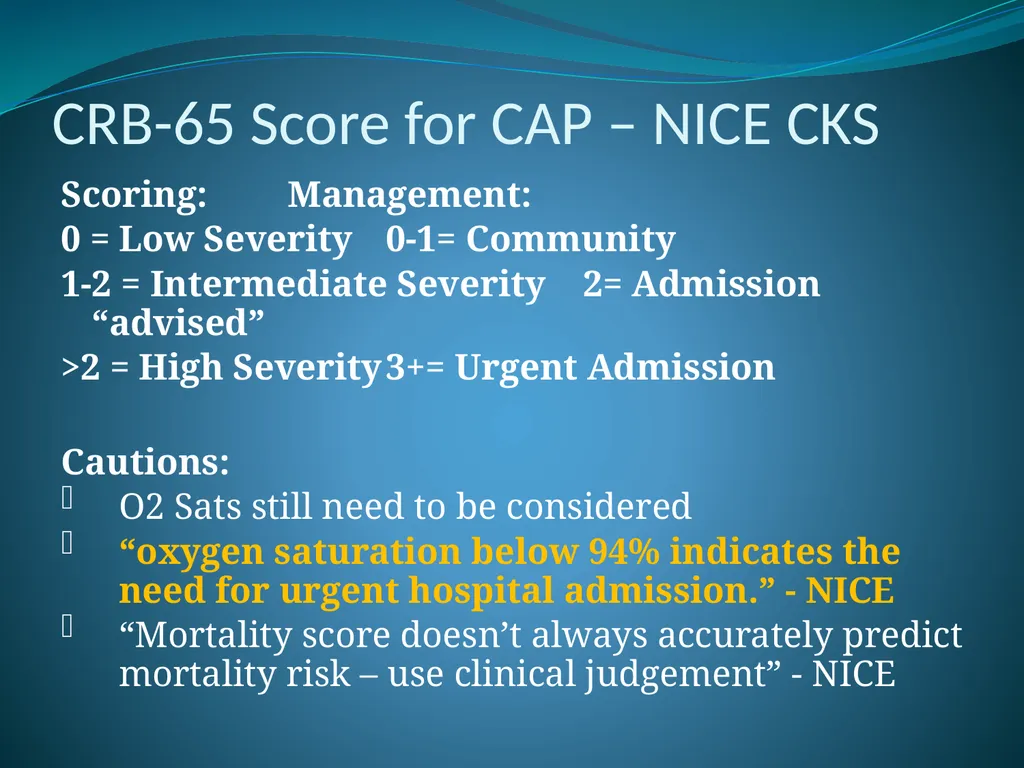
CRB-65 Score for CAP – NICE CKS Scoring: Management:
0 = Low Severity 0-1= Community
1-2 = Intermediate Severity 2= Admission “advised”
>2 = High Severity 3+= Urgent Admission
Cautions:
O2 Sats still need to be considered
“oxygen saturation below 94% indicates the need for urgent hospital admission.” - NICE
“Mortality score doesn’t always accurately predict mortality risk – use clinical judgement” - NICE<br>
0 = Low Severity 0-1= Community
1-2 = Intermediate Severity 2= Admission “advised”
>2 = High Severity 3+= Urgent Admission
Cautions:
O2 Sats still need to be considered
“oxygen saturation below 94% indicates the need for urgent hospital admission.” - NICE
“Mortality score doesn’t always accurately predict mortality risk – use clinical judgement” - NICE<br>
19
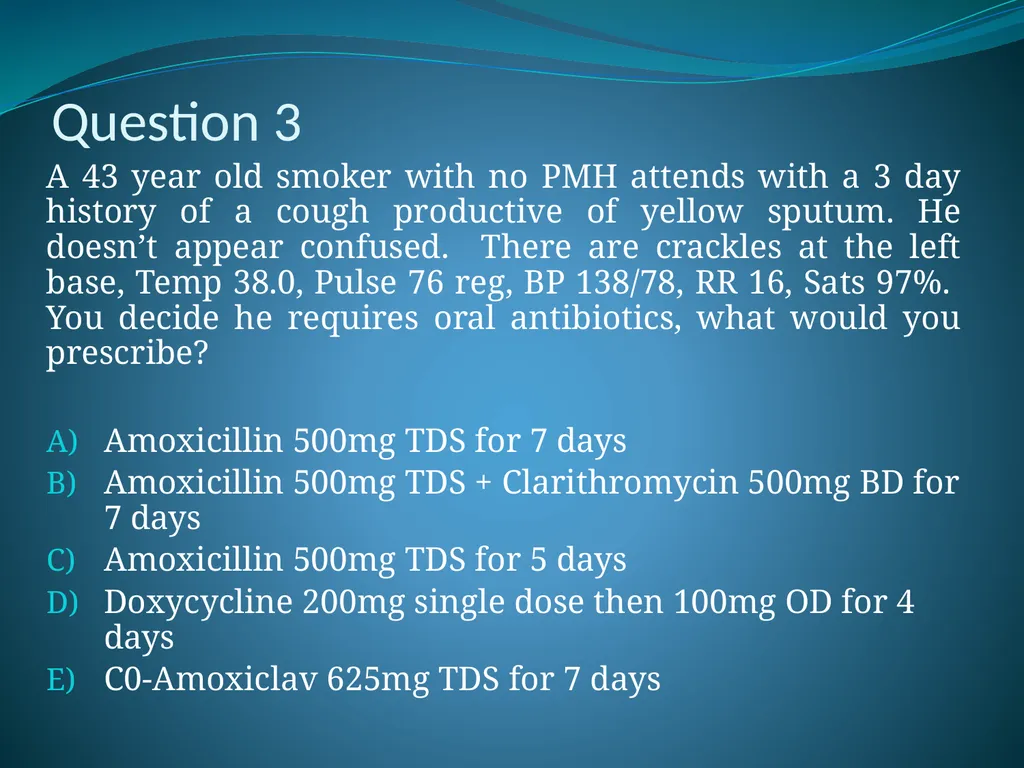
Question 3 A 43 year old smoker with no PMH attends with a 3 day history of a cough productive of yellow sputum. He doesn’t appear confused. There are crackles at the left base, Temp 38.0, Pulse 76 reg, BP 138/78, RR 16, Sats 97%. You decide he requires oral antibiotics, what would you prescribe?
Amoxicillin 500mg TDS for 7 days
Amoxicillin 500mg TDS + Clarithromycin 500mg BD for 7 days
Amoxicillin 500mg TDS for 5 days
Doxycycline 200mg single dose then 100mg OD for 4 days
C0-Amoxiclav 625mg TDS for 7 days<br>
Amoxicillin 500mg TDS for 7 days
Amoxicillin 500mg TDS + Clarithromycin 500mg BD for 7 days
Amoxicillin 500mg TDS for 5 days
Doxycycline 200mg single dose then 100mg OD for 4 days
C0-Amoxiclav 625mg TDS for 7 days<br>
20
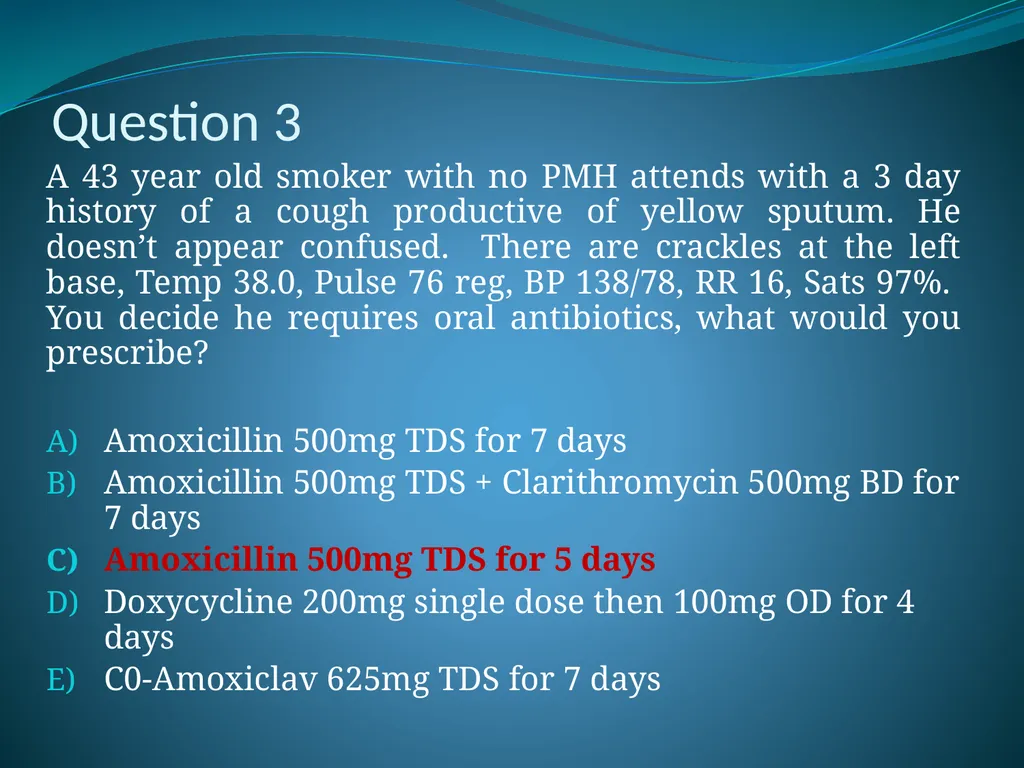
Question 3 A 43 year old smoker with no PMH attends with a 3 day history of a cough productive of yellow sputum. He doesn’t appear confused. There are crackles at the left base, Temp 38.0, Pulse 76 reg, BP 138/78, RR 16, Sats 97%. You decide he requires oral antibiotics, what would you prescribe?
Amoxicillin 500mg TDS for 7 days
Amoxicillin 500mg TDS + Clarithromycin 500mg BD for 7 days
Amoxicillin 500mg TDS for 5 days
Doxycycline 200mg single dose then 100mg OD for 4 days
C0-Amoxiclav 625mg TDS for 7 days<br>
Amoxicillin 500mg TDS for 7 days
Amoxicillin 500mg TDS + Clarithromycin 500mg BD for 7 days
Amoxicillin 500mg TDS for 5 days
Doxycycline 200mg single dose then 100mg OD for 4 days
C0-Amoxiclav 625mg TDS for 7 days<br>
21
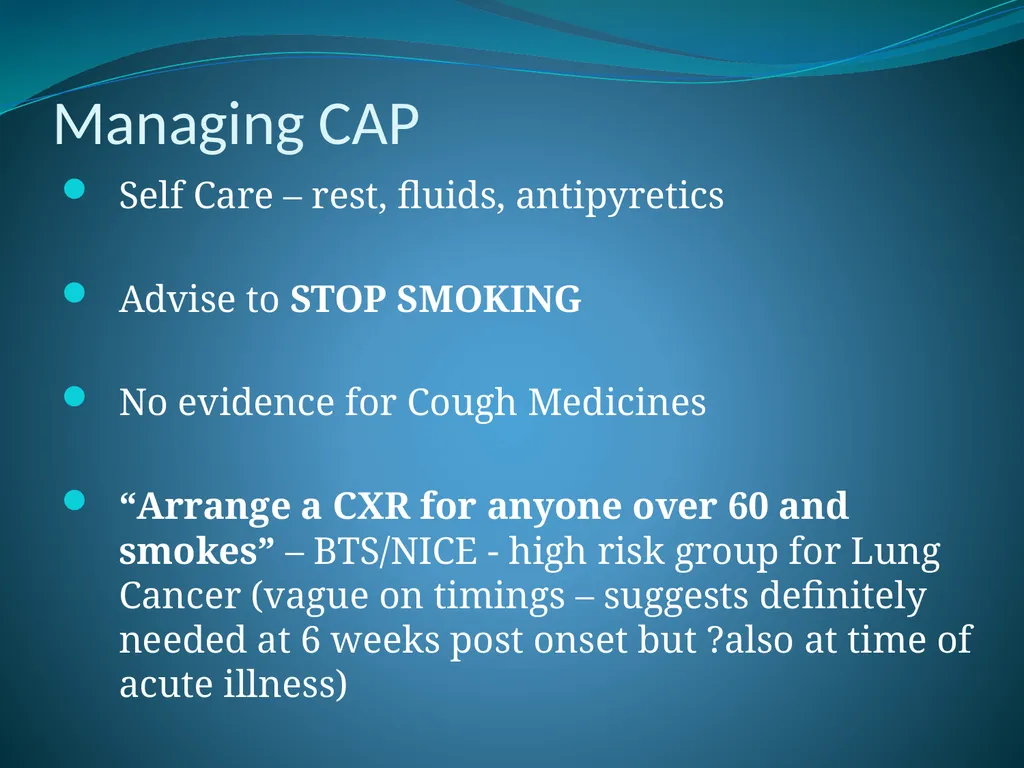
Managing CAP Self Care – rest, fluids, antipyretics
Advise to STOP SMOKING
No evidence for Cough Medicines
“Arrange a CXR for anyone over 60 and smokes” – BTS/NICE - high risk group for Lung Cancer (vague on timings – suggests definitely needed at 6 weeks post onset but ?also at time of acute illness)<br>
Advise to STOP SMOKING
No evidence for Cough Medicines
“Arrange a CXR for anyone over 60 and smokes” – BTS/NICE - high risk group for Lung Cancer (vague on timings – suggests definitely needed at 6 weeks post onset but ?also at time of acute illness)<br>
22
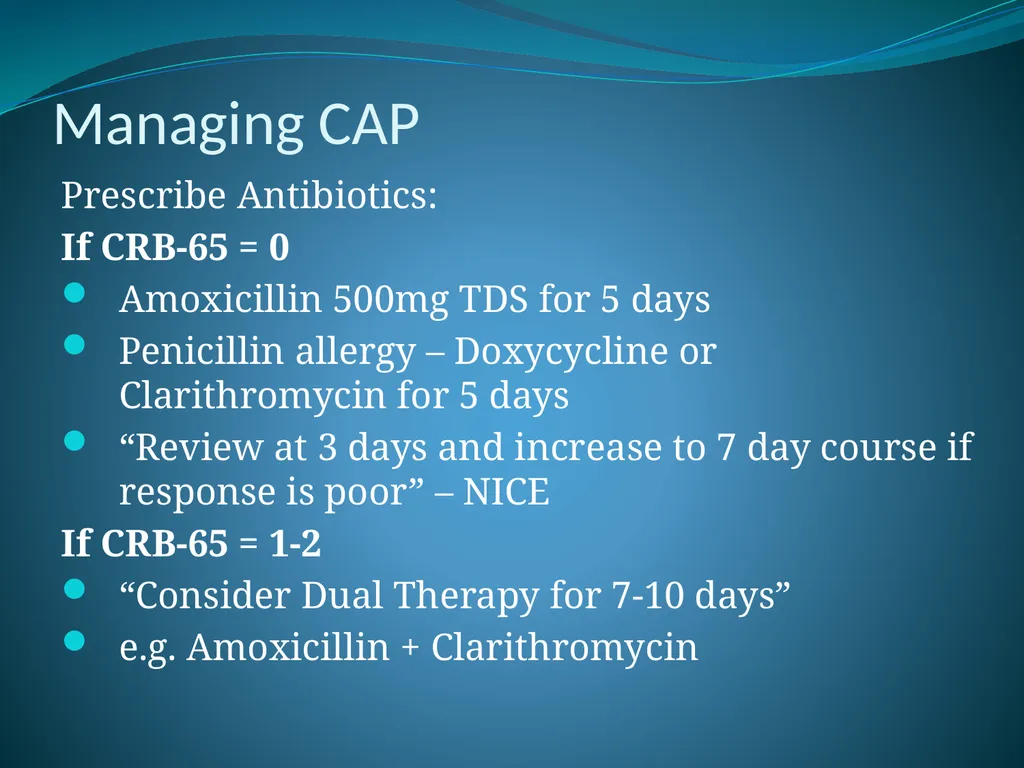
Managing CAP Prescribe Antibiotics:
If CRB-65 = 0
Amoxicillin 500mg TDS for 5 days
Penicillin allergy – Doxycycline or Clarithromycin for 5 days
“Review at 3 days and increase to 7 day course if response is poor” – NICE
If CRB-65 = 1-2
“Consider Dual Therapy for 7-10 days”
e.g. Amoxicillin + Clarithromycin<br>
If CRB-65 = 0
Amoxicillin 500mg TDS for 5 days
Penicillin allergy – Doxycycline or Clarithromycin for 5 days
“Review at 3 days and increase to 7 day course if response is poor” – NICE
If CRB-65 = 1-2
“Consider Dual Therapy for 7-10 days”
e.g. Amoxicillin + Clarithromycin<br>
23
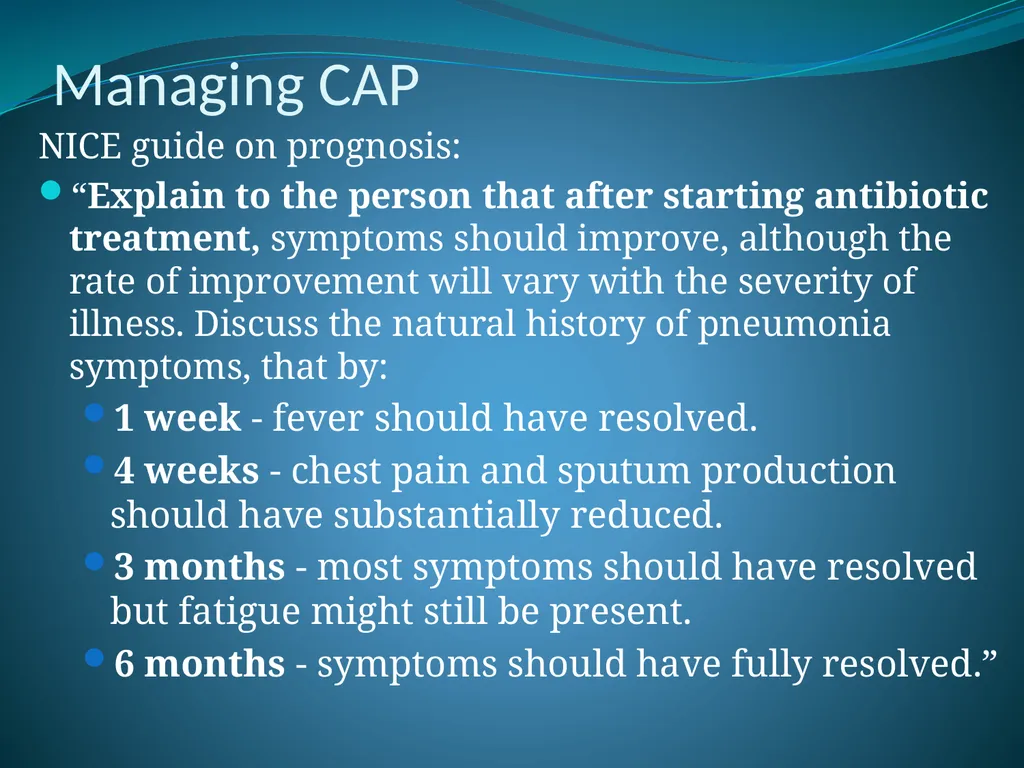
Managing CAP NICE guide on prognosis:
“Explain to the person that after starting antibiotic treatment, symptoms should improve, although the rate of improvement will vary with the severity of illness. Discuss the natural history of pneumonia symptoms, that by:
1 week - fever should have resolved.
4 weeks - chest pain and sputum production should have substantially reduced.
3 months - most symptoms should have resolved but fatigue might still be present.
6 months - symptoms should have fully resolved.”<br>
“Explain to the person that after starting antibiotic treatment, symptoms should improve, although the rate of improvement will vary with the severity of illness. Discuss the natural history of pneumonia symptoms, that by:
1 week - fever should have resolved.
4 weeks - chest pain and sputum production should have substantially reduced.
3 months - most symptoms should have resolved but fatigue might still be present.
6 months - symptoms should have fully resolved.”<br>
24
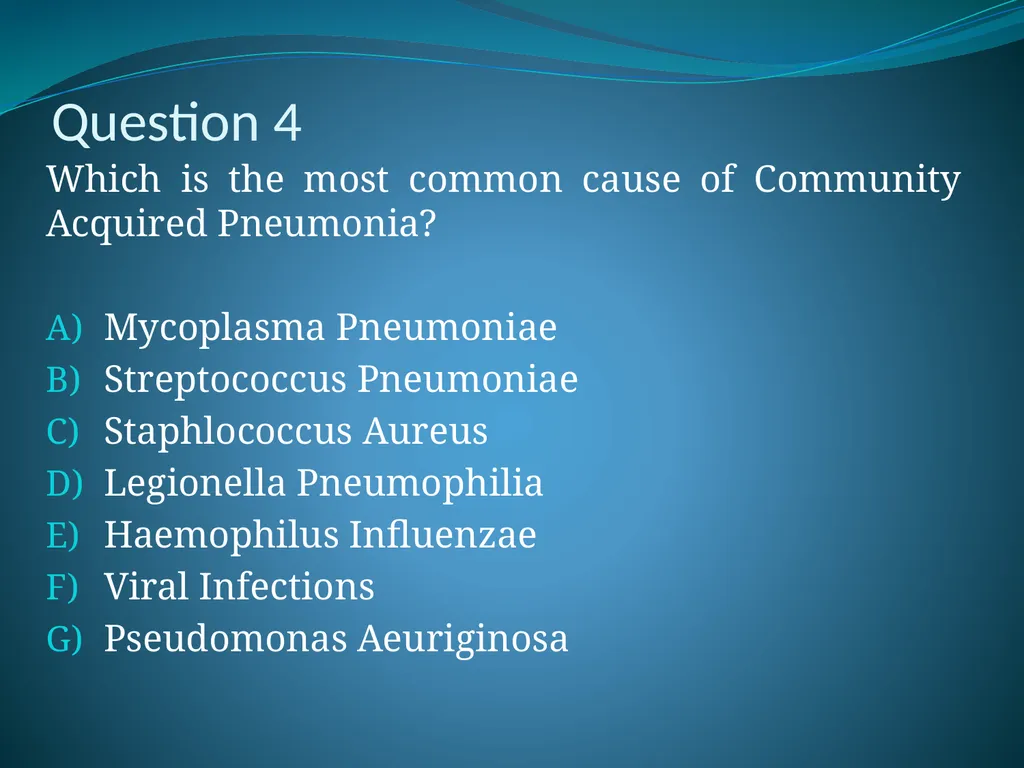
Question 4 Which is the most common cause of Community Acquired Pneumonia?
Mycoplasma Pneumoniae
Streptococcus Pneumoniae
Staphlococcus Aureus
Legionella Pneumophilia
Haemophilus Influenzae
Viral Infections
Pseudomonas Aeuriginosa<br>
Mycoplasma Pneumoniae
Streptococcus Pneumoniae
Staphlococcus Aureus
Legionella Pneumophilia
Haemophilus Influenzae
Viral Infections
Pseudomonas Aeuriginosa<br>
25
Question 4 Which is the most common cause of Community Acquired Pneumonia?
Mycoplasma Pneumoniae
Streptococcus Pneumoniae
Staphlococcus Aureus
Legionella Pneumophilia
Haemophilus Influenzae
Viral Infections
Pseudomonas Aeuriginosa<br>
Mycoplasma Pneumoniae
Streptococcus Pneumoniae
Staphlococcus Aureus
Legionella Pneumophilia
Haemophilus Influenzae
Viral Infections
Pseudomonas Aeuriginosa<br>
26
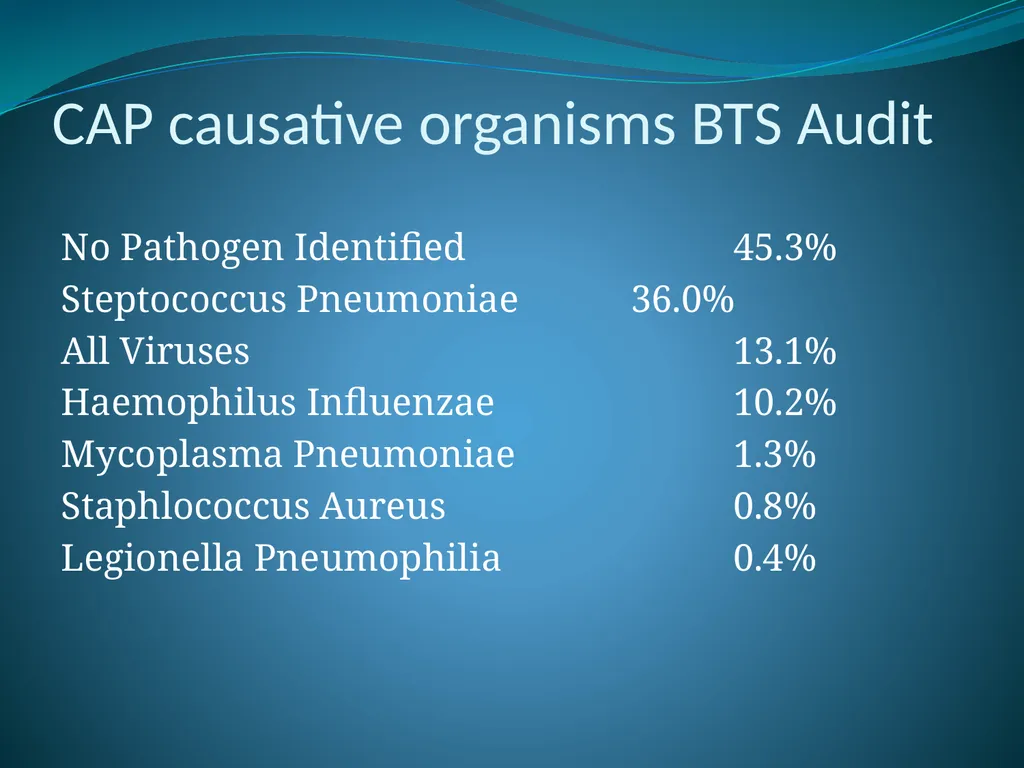
CAP causative organisms BTS Audit No Pathogen Identified 45.3%
Steptococcus Pneumoniae 36.0%
All Viruses 13.1%
Haemophilus Influenzae 10.2%
Mycoplasma Pneumoniae 1.3%
Staphlococcus Aureus 0.8%
Legionella Pneumophilia 0.4%<br>
Steptococcus Pneumoniae 36.0%
All Viruses 13.1%
Haemophilus Influenzae 10.2%
Mycoplasma Pneumoniae 1.3%
Staphlococcus Aureus 0.8%
Legionella Pneumophilia 0.4%<br>
27
Pseudomonas Aeruginosa You are going through your results and a sputum result comes through showing Pseudomonas.
What do else do you need to know?
Any chronic respiratory conditions?
Why was sputum sent?
How is the patient now?
Any previous Sputum results?
What should you do with this result?
If they’ve had it before and are well – Nothing
Never had it before – Treat - speak to Micro – should aim to eradicate before it colonises.
Had it before and unwell – Treat - speak to Micro<br>
What do else do you need to know?
Any chronic respiratory conditions?
Why was sputum sent?
How is the patient now?
Any previous Sputum results?
What should you do with this result?
If they’ve had it before and are well – Nothing
Never had it before – Treat - speak to Micro – should aim to eradicate before it colonises.
Had it before and unwell – Treat - speak to Micro<br>
28
Pseudomonas Aeruginosa Gram Negative Rods
Common in soil and standing water
Opportunistic infection in humans - chest, wounds, nails, otitis externa
Survivor – very hard to eradicate once it has infected
Leads to cycles of recurrent infection and “colonisation” especially in Bronchiectasis and CF
Contributes to deterioration in chronic respiratory diseases e.g. Early infection if CF is a bad prognostic indicator
Chronic infection is associated with worse lung function
Rust coloured sputum (apparently tastes metallic)
Makes nails and wounds green
Only oral antibiotic option is Ciprofloxacin – always speak to micro (or check Respiratory clinic letters) as may need IV
IV treatment = aminoglyosides e.g. Tobramycin, Gentamycin<br>
Common in soil and standing water
Opportunistic infection in humans - chest, wounds, nails, otitis externa
Survivor – very hard to eradicate once it has infected
Leads to cycles of recurrent infection and “colonisation” especially in Bronchiectasis and CF
Contributes to deterioration in chronic respiratory diseases e.g. Early infection if CF is a bad prognostic indicator
Chronic infection is associated with worse lung function
Rust coloured sputum (apparently tastes metallic)
Makes nails and wounds green
Only oral antibiotic option is Ciprofloxacin – always speak to micro (or check Respiratory clinic letters) as may need IV
IV treatment = aminoglyosides e.g. Tobramycin, Gentamycin<br>
29
Question 4 A 19 year old male student has just returned home for the holidays and now attends with a 5 week history of a persistent dry cough, sore throat, and a rash. He thinks a few other students in his halls have had the same thing. He denies foreign travel and doesn’t smoke. On examination his observations are all normal. His chest and throat are clear. Abdomen is SNT with no organomegaly. There is no lymphadenopathy. The rash is on the trunk and consists of raised target lesions. What is the most likely diagnosis?
Glandular Fever
Whooping Cough
Atypical Pneumonia
Tuberculosis
Post Infective Cough<br>
Glandular Fever
Whooping Cough
Atypical Pneumonia
Tuberculosis
Post Infective Cough<br>
30
Question 4 A 19 year old male student has just returned home for the holidays and now attends with a 5 week history of a persistent dry cough, sore throat, and a rash. He thinks a few other students in his halls have had the same thing. He denies foreign travel and doesn’t smoke. On examination his observations are all normal. His chest and throat are clear. Abdomen is SNT with no organomegaly. There is no lymphadenopathy. The rash is on the trunk and consists of raised target lesions. What is the most likely diagnosis?
Glandular Fever
Whooping Cough
Atypical Pneumonia
Tuberculosis
Post Infective Cough<br>
Glandular Fever
Whooping Cough
Atypical Pneumonia
Tuberculosis
Post Infective Cough<br>
31
Question 5 A 19 year old male student has just returned home for the holidays and now attends with a 5 week history of a persistent dry cough, sore throat, and a rash. He thinks a few other students in his halls have had the same thing. He denies foreign travel and doesn’t smoke. On examination his observations are all normal. His chest and throat are clear. Abdomen is SNT with no organomegaly. There is no lymphadenopathy. The rash is on the trunk and consists of raised target lesions. What is the most likely diagnosis?
Legionella Pneumophilia
Mycoplasma Pneumonia
Chlamydia Psittaci (Psittacosis)
Klebsiella
Coxiella Burnetii<br>
Legionella Pneumophilia
Mycoplasma Pneumonia
Chlamydia Psittaci (Psittacosis)
Klebsiella
Coxiella Burnetii<br>
32
Question 5 A 19 year old male student has just returned home for the holidays and now attends with a 5 week history of a persistent dry cough, sore throat, and a rash. He thinks a few other students in his halls have had the same thing. He denies foreign travel and doesn’t smoke. On examination his observations are all normal. His chest and throat are clear. Abdomen is SNT with no organomegaly. There is no lymphadenopathy. The rash is on the trunk and consists of raised target lesions. What is the most likely diagnosis?
Legionella Pneumophilia
Mycoplasma Pneumonia
Chlamydia Psittaci (Psittacosis)
Klebsiella
Coxiella Burnetii<br>
Legionella Pneumophilia
Mycoplasma Pneumonia
Chlamydia Psittaci (Psittacosis)
Klebsiella
Coxiella Burnetii<br>
33
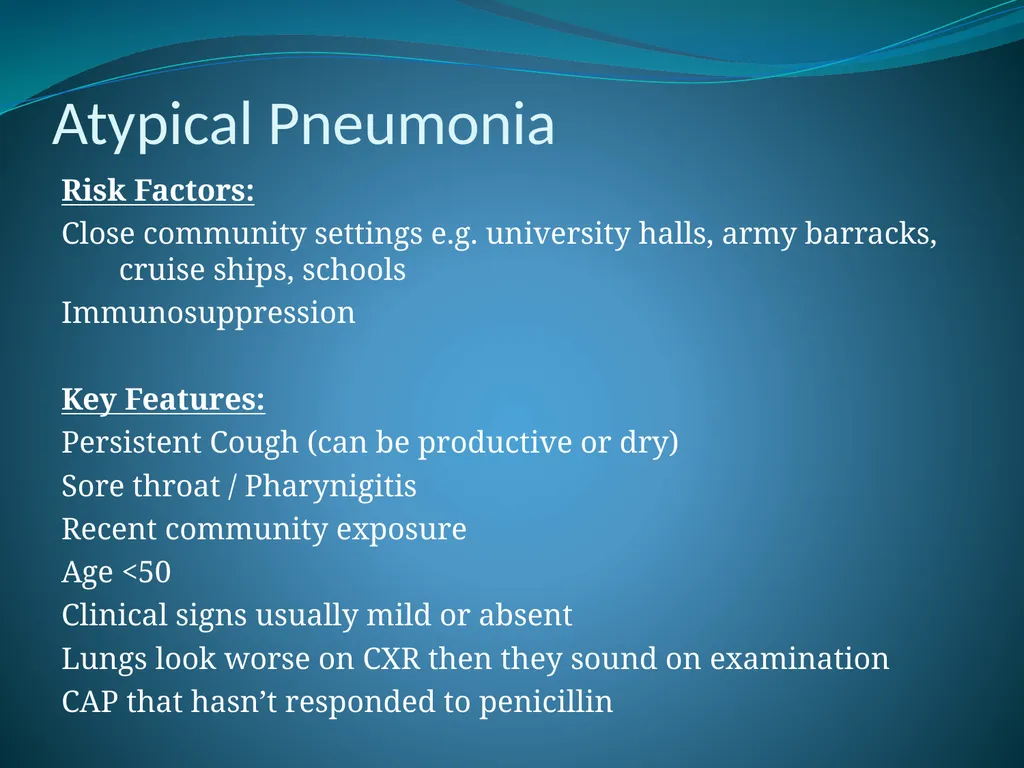
Atypical Pneumonia Risk Factors:
Close community settings e.g. university halls, army barracks, cruise ships, schools
Immunosuppression
Key Features:
Persistent Cough (can be productive or dry)
Sore throat / Pharynigitis
Recent community exposure
Age <50
Clinical signs usually mild or absent
Lungs look worse on CXR then they sound on examination
CAP that hasn’t responded to penicillin<br>
Close community settings e.g. university halls, army barracks, cruise ships, schools
Immunosuppression
Key Features:
Persistent Cough (can be productive or dry)
Sore throat / Pharynigitis
Recent community exposure
Age <50
Clinical signs usually mild or absent
Lungs look worse on CXR then they sound on examination
CAP that hasn’t responded to penicillin<br>
34
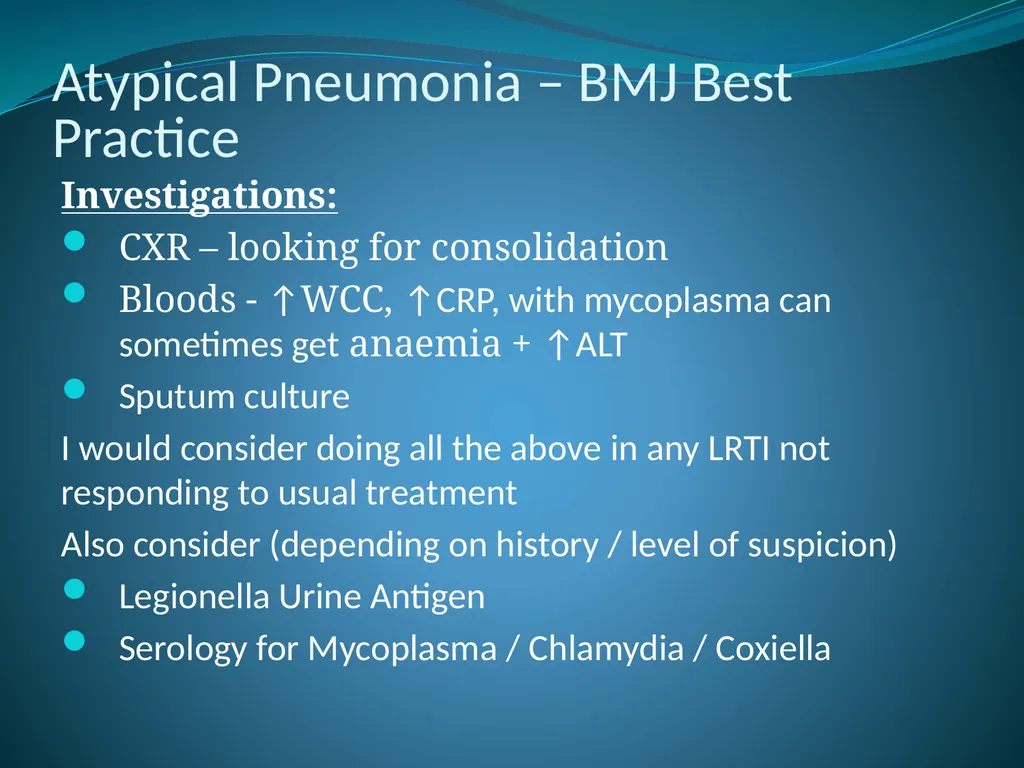
Atypical Pneumonia – BMJ Best Practice Investigations:
CXR – looking for consolidation
Bloods - ↑WCC, ↑CRP, with mycoplasma can sometimes get anaemia + ↑ALT
Sputum culture
I would consider doing all the above in any LRTI not responding to usual treatment
Also consider (depending on history / level of suspicion)
Legionella Urine Antigen
Serology for Mycoplasma / Chlamydia / Coxiella<br>
CXR – looking for consolidation
Bloods - ↑WCC, ↑CRP, with mycoplasma can sometimes get anaemia + ↑ALT
Sputum culture
I would consider doing all the above in any LRTI not responding to usual treatment
Also consider (depending on history / level of suspicion)
Legionella Urine Antigen
Serology for Mycoplasma / Chlamydia / Coxiella<br>
35
Atypical Pneumonia – BMJ Best Practice Managment:
1st line – Macrolide (Azithromycin / Clarithromycin)
Alt 1st line – Doxycycline
2nd line – Fluroquinolone (Levoflocacin / Moxyfloxacin)
I would think about consulting microbiology for advice<br>
1st line – Macrolide (Azithromycin / Clarithromycin)
Alt 1st line – Doxycycline
2nd line – Fluroquinolone (Levoflocacin / Moxyfloxacin)
I would think about consulting microbiology for advice<br>
36
Atypical Pneumonia Mycoplasma:
Community Outbreaks – approx every 4 years
Usually late summer / autumn
Most common in children and young adults
Can have associated headache
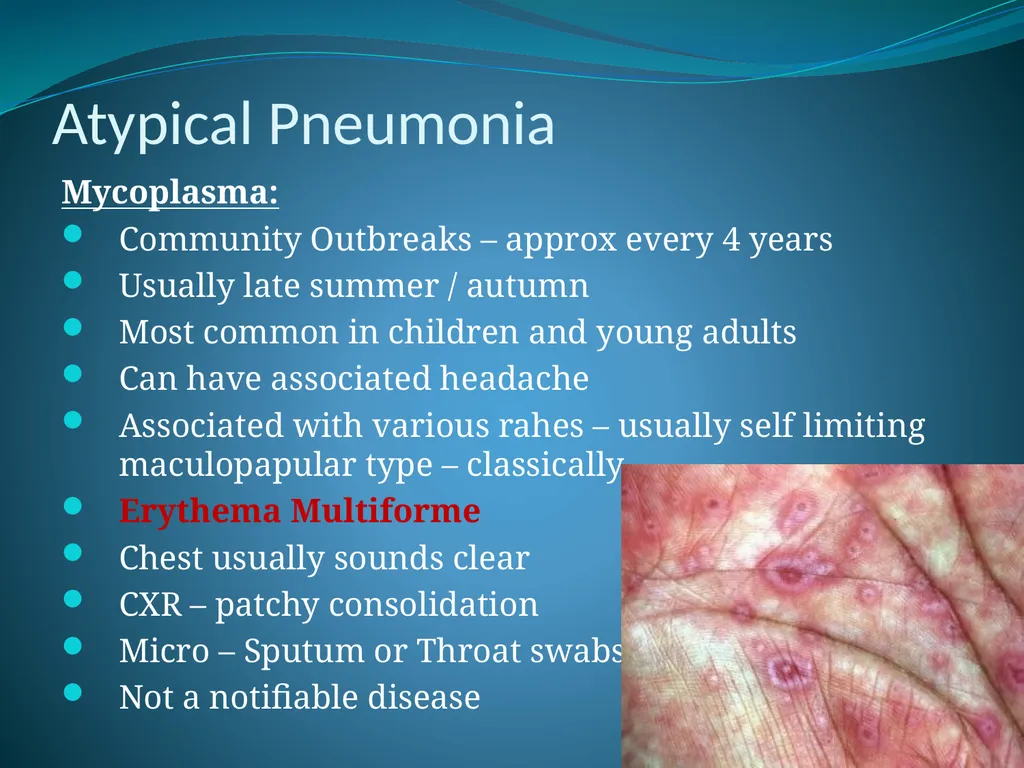
Associated with various rahes – usually self limiting maculopapular type – classically...
Erythema Multiforme
Chest usually sounds clear
CXR – patchy consolidation
Micro – Sputum or Throat swabs
Not a notifiable disease<br>
Community Outbreaks – approx every 4 years
Usually late summer / autumn
Most common in children and young adults
Can have associated headache
Associated with various rahes – usually self limiting maculopapular type – classically...
Erythema Multiforme
Chest usually sounds clear
CXR – patchy consolidation
Micro – Sputum or Throat swabs
Not a notifiable disease<br>
37
Atypical Pneumonia Legionella:
Standing water – e.g. Air conditioning, spa pools, showers/taps.
Caught from these sources rather then infected individuals. Outbreaks often in hotels, cruise ships, hospitals, nursing homes.
Can be associated with Diarrhoea
Legionella urine antigen – negative result doesn’t exclude
Sputum culture
Notifiable disease
Psitticosis:
Chlamydia Psittaci carried by birds
Suspect if exposure to commercial (poultry farmers) or pet birds (parrots / budgies)
Chlamydia swab of throat – sputum testing is risk to Lab staff<br>
Standing water – e.g. Air conditioning, spa pools, showers/taps.
Caught from these sources rather then infected individuals. Outbreaks often in hotels, cruise ships, hospitals, nursing homes.
Can be associated with Diarrhoea
Legionella urine antigen – negative result doesn’t exclude
Sputum culture
Notifiable disease
Psitticosis:
Chlamydia Psittaci carried by birds
Suspect if exposure to commercial (poultry farmers) or pet birds (parrots / budgies)
Chlamydia swab of throat – sputum testing is risk to Lab staff<br>
38
Atypical Pneumonia Coxiella Burnetti:
Associated with livestock: Farmers, Vets, Abattoir workers all at risk. Micro lab workers also at risk
Usually as outbreaks with other workers affected.
Usually self limiting flu-like illness but...
Can cause hepatitis – hepatomegaly (less common) and endocarditis (rarely).
Recommendation is to treat with antibiotics for 14 days in any symptomatic patient with clinical suspicion.
Serology testing is the usual diagnostic test
I would discuss with micro if ever suspecting<br>
Associated with livestock: Farmers, Vets, Abattoir workers all at risk. Micro lab workers also at risk
Usually as outbreaks with other workers affected.
Usually self limiting flu-like illness but...
Can cause hepatitis – hepatomegaly (less common) and endocarditis (rarely).
Recommendation is to treat with antibiotics for 14 days in any symptomatic patient with clinical suspicion.
Serology testing is the usual diagnostic test
I would discuss with micro if ever suspecting<br>
39
Question 6 A 30 year old woman, originally from Somalia, attends with a 3 week history of weight loss and malaise. In last week she has noticed a mild but productive cough. She had been back to Somalia 5 weeks ago to visit a relative in hospital.
Which test is most likely to be diagnostic:
Sputum Culture for Acid Fast Bacilli
Full blood count and CRP
Thick blood film
QuantiFERON
Chest Radiograph<br>
Which test is most likely to be diagnostic:
Sputum Culture for Acid Fast Bacilli
Full blood count and CRP
Thick blood film
QuantiFERON
Chest Radiograph<br>
40
Question 6 A 30 year old woman, originally from Somalia, attends with a 3 week history of weight loss and malaise. In last week she has noticed a mild but productive cough. She had been back to Somalia 5 weeks ago to visit a relative in hospital.
Which test is most likely to be diagnostic:
Sputum Culture for Acid Fast Bacilli
Full blood count and CRP
Thick blood film
QuantiFERON
Chest Radiograph<br>
Which test is most likely to be diagnostic:
Sputum Culture for Acid Fast Bacilli
Full blood count and CRP
Thick blood film
QuantiFERON
Chest Radiograph<br>
41
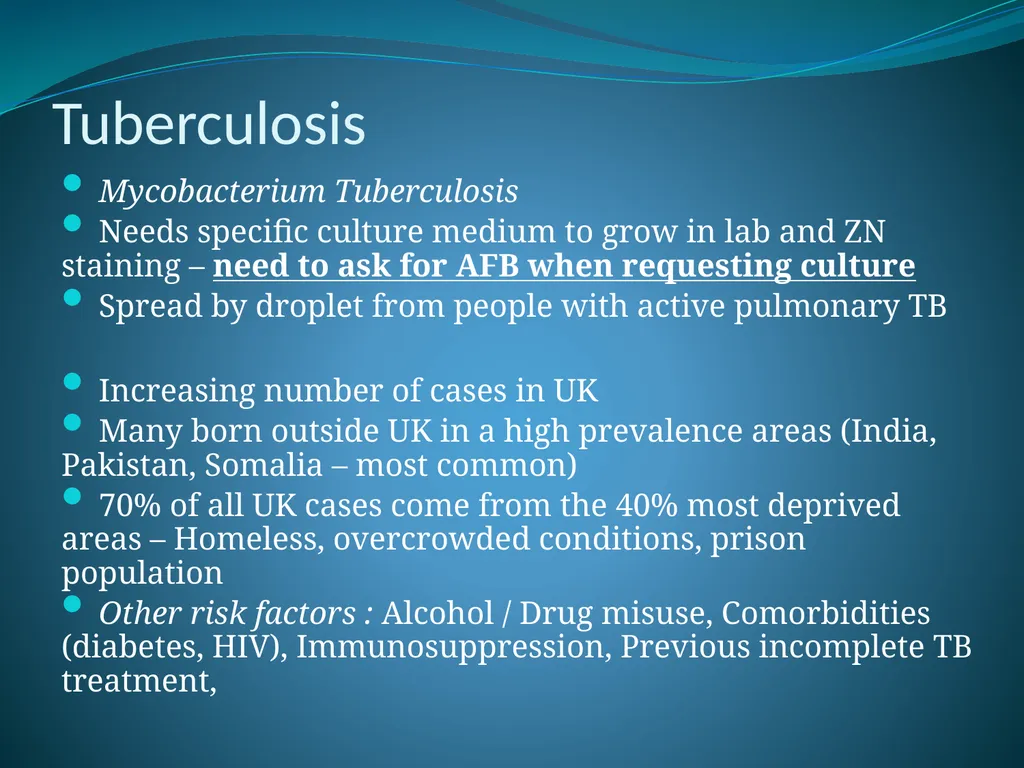
Tuberculosis Mycobacterium Tuberculosis
Needs specific culture medium to grow in lab and ZN staining – need to ask for AFB when requesting culture
Spread by droplet from people with active pulmonary TB
Increasing number of cases in UK
Many born outside UK in a high prevalence areas (India, Pakistan, Somalia – most common)
70% of all UK cases come from the 40% most deprived areas – Homeless, overcrowded conditions, prison population
Other risk factors : Alcohol / Drug misuse, Comorbidities (diabetes, HIV), Immunosuppression, Previous incomplete TB treatment,<br>
Needs specific culture medium to grow in lab and ZN staining – need to ask for AFB when requesting culture
Spread by droplet from people with active pulmonary TB
Increasing number of cases in UK
Many born outside UK in a high prevalence areas (India, Pakistan, Somalia – most common)
70% of all UK cases come from the 40% most deprived areas – Homeless, overcrowded conditions, prison population
Other risk factors : Alcohol / Drug misuse, Comorbidities (diabetes, HIV), Immunosuppression, Previous incomplete TB treatment,<br>
42
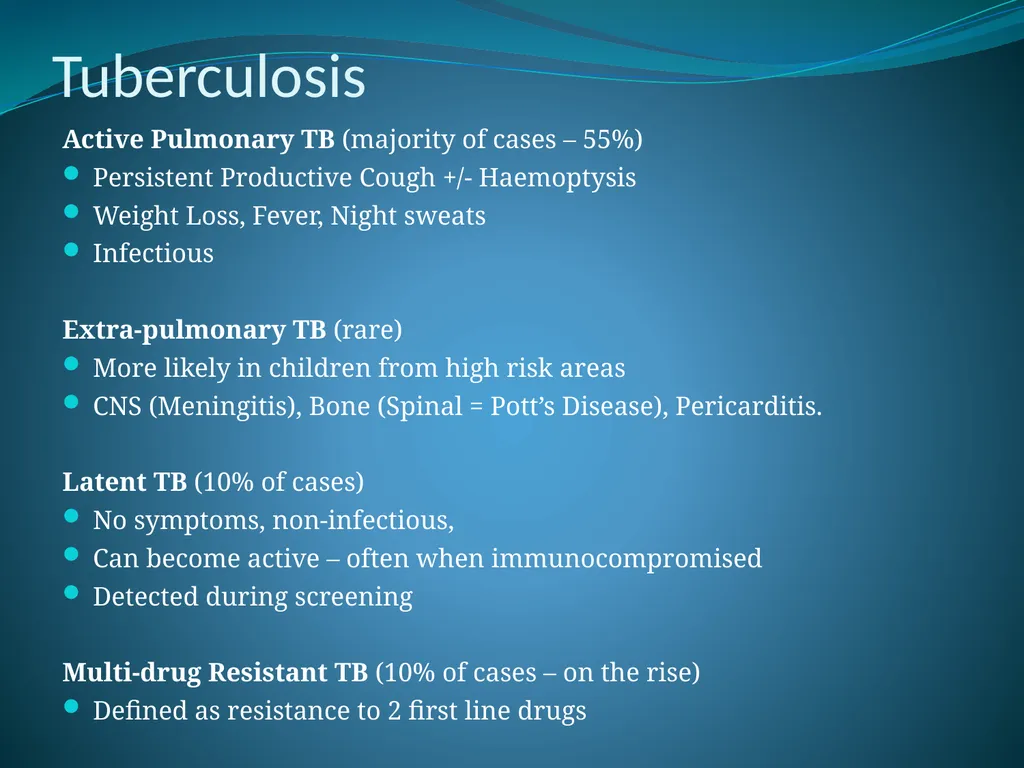
Tuberculosis Active Pulmonary TB (majority of cases – 55%)
Persistent Productive Cough +/- Haemoptysis
Weight Loss, Fever, Night sweats
Infectious
Extra-pulmonary TB (rare)
More likely in children from high risk areas
CNS (Meningitis), Bone (Spinal = Pott’s Disease), Pericarditis.
Latent TB (10% of cases)
No symptoms, non-infectious,
Can become active – often when immunocompromised
Detected during screening
Multi-drug Resistant TB (10% of cases – on the rise)
Defined as resistance to 2 first line drugs<br>
Persistent Productive Cough +/- Haemoptysis
Weight Loss, Fever, Night sweats
Infectious
Extra-pulmonary TB (rare)
More likely in children from high risk areas
CNS (Meningitis), Bone (Spinal = Pott’s Disease), Pericarditis.
Latent TB (10% of cases)
No symptoms, non-infectious,
Can become active – often when immunocompromised
Detected during screening
Multi-drug Resistant TB (10% of cases – on the rise)
Defined as resistance to 2 first line drugs<br>
43
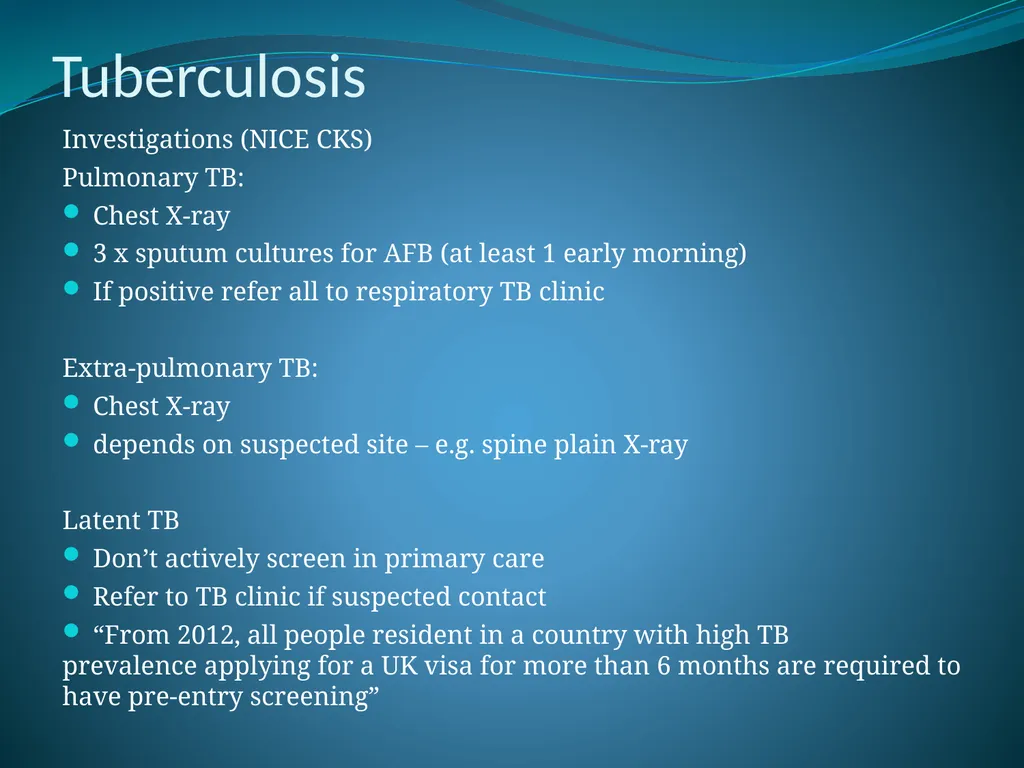
Tuberculosis Investigations (NICE CKS)
Pulmonary TB:
Chest X-ray
3 x sputum cultures for AFB (at least 1 early morning)
If positive refer all to respiratory TB clinic
Extra-pulmonary TB:
Chest X-ray
depends on suspected site – e.g. spine plain X-ray
Latent TB
Don’t actively screen in primary care
Refer to TB clinic if suspected contact
“From 2012, all people resident in a country with high TB prevalence applying for a UK visa for more than 6 months are required to have pre-entry screening”<br>
Pulmonary TB:
Chest X-ray
3 x sputum cultures for AFB (at least 1 early morning)
If positive refer all to respiratory TB clinic
Extra-pulmonary TB:
Chest X-ray
depends on suspected site – e.g. spine plain X-ray
Latent TB
Don’t actively screen in primary care
Refer to TB clinic if suspected contact
“From 2012, all people resident in a country with high TB prevalence applying for a UK visa for more than 6 months are required to have pre-entry screening”<br>
44
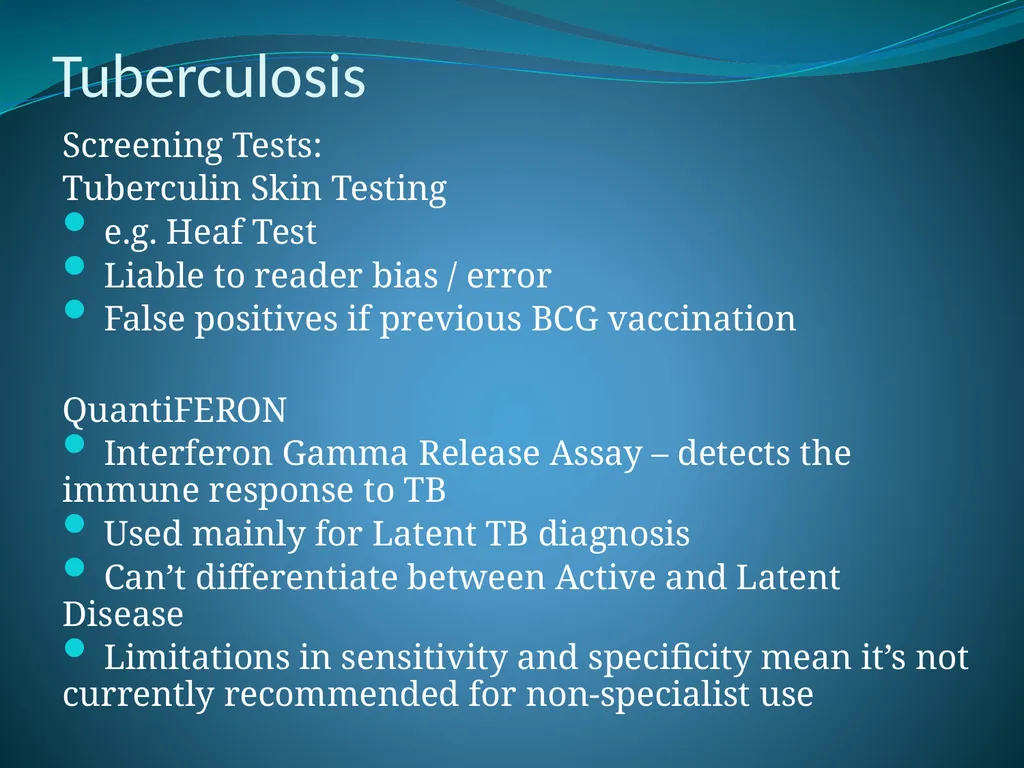
Tuberculosis Screening Tests:
Tuberculin Skin Testing
e.g. Heaf Test
Liable to reader bias / error
False positives if previous BCG vaccination
QuantiFERON
Interferon Gamma Release Assay – detects the immune response to TB
Used mainly for Latent TB diagnosis
Can’t differentiate between Active and Latent Disease
Limitations in sensitivity and specificity mean it’s not currently recommended for non-specialist use<br>
Tuberculin Skin Testing
e.g. Heaf Test
Liable to reader bias / error
False positives if previous BCG vaccination
QuantiFERON
Interferon Gamma Release Assay – detects the immune response to TB
Used mainly for Latent TB diagnosis
Can’t differentiate between Active and Latent Disease
Limitations in sensitivity and specificity mean it’s not currently recommended for non-specialist use<br>
45
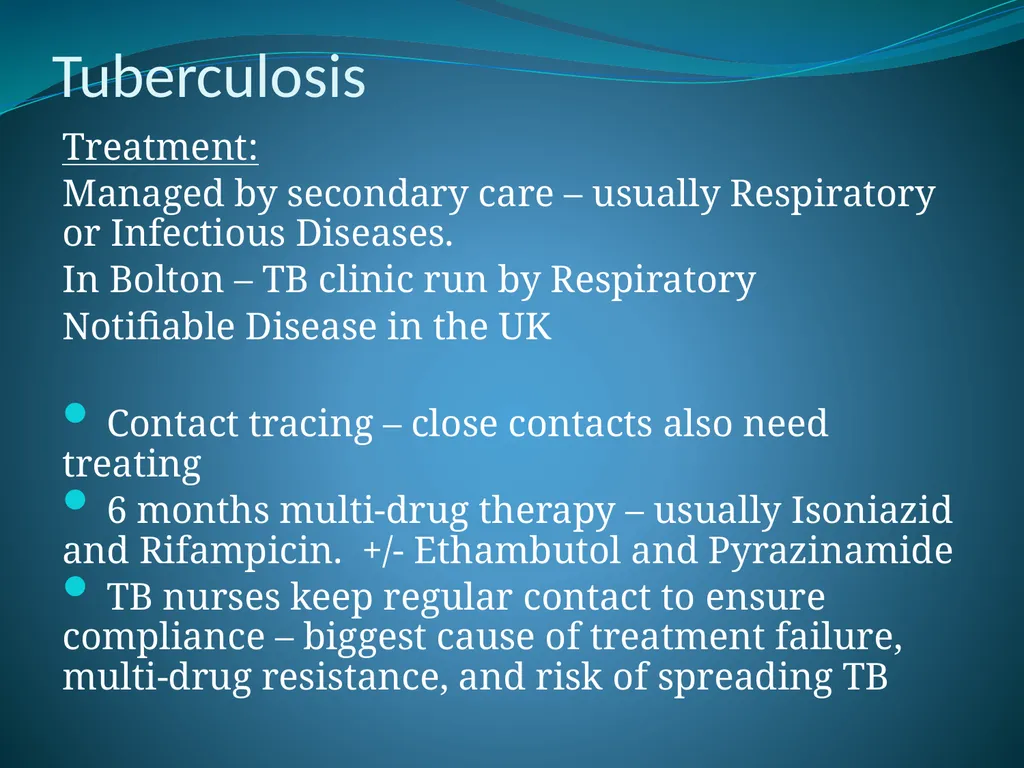
Tuberculosis Treatment:
Managed by secondary care – usually Respiratory or Infectious Diseases.
In Bolton – TB clinic run by Respiratory
Notifiable Disease in the UK
Contact tracing – close contacts also need treating
6 months multi-drug therapy – usually Isoniazid and Rifampicin. +/- Ethambutol and Pyrazinamide
TB nurses keep regular contact to ensure compliance – biggest cause of treatment failure, multi-drug resistance, and risk of spreading TB<br>
Managed by secondary care – usually Respiratory or Infectious Diseases.
In Bolton – TB clinic run by Respiratory
Notifiable Disease in the UK
Contact tracing – close contacts also need treating
6 months multi-drug therapy – usually Isoniazid and Rifampicin. +/- Ethambutol and Pyrazinamide
TB nurses keep regular contact to ensure compliance – biggest cause of treatment failure, multi-drug resistance, and risk of spreading TB<br>
46
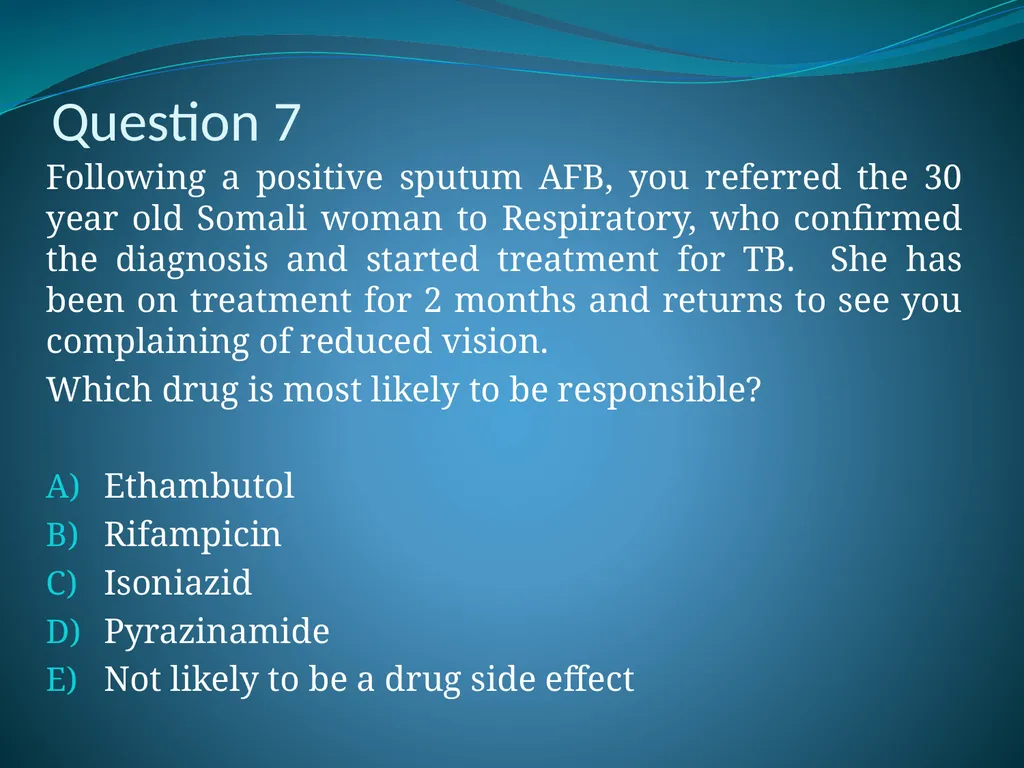
Question 7 Following a positive sputum AFB, you referred the 30 year old Somali woman to Respiratory, who confirmed the diagnosis and started treatment for TB. She has been on treatment for 2 months and returns to see you complaining of reduced vision.
Which drug is most likely to be responsible?
Ethambutol
Rifampicin
Isoniazid
Pyrazinamide
Not likely to be a drug side effect<br>
Which drug is most likely to be responsible?
Ethambutol
Rifampicin
Isoniazid
Pyrazinamide
Not likely to be a drug side effect<br>
47
Question 7 Following a positive sputum AFB, you referred the 30 year old Somali woman to Respiratory, who confirmed the diagnosis and started treatment for TB. She has been on treatment for 2 months and returns to see you complaining of reduced vision.
Which drug is most likely to be responsible?
Ethambutol
Rifampicin
Isoniazid
Pyrazinamide
Not likely to be a drug side effect<br>
Which drug is most likely to be responsible?
Ethambutol
Rifampicin
Isoniazid
Pyrazinamide
Not likely to be a drug side effect<br>
48
TB Drug Side Effects Ethambutol
Visual disturbance
Peripheral Neuropathy (common)
Hyperuricaemia (Gout flares)
Isoniazid
Peripheral Neuropathy (common)
Liver Failure (rare)
Pyrazinamide
Hyperuricaemia (Gout flares)
Rifampicin
Turns secretions orange – will stain soft contact lenses and clothing
Thrombocytopoenia
Nausea / Vomiting<br>
Visual disturbance
Peripheral Neuropathy (common)
Hyperuricaemia (Gout flares)
Isoniazid
Peripheral Neuropathy (common)
Liver Failure (rare)
Pyrazinamide
Hyperuricaemia (Gout flares)
Rifampicin
Turns secretions orange – will stain soft contact lenses and clothing
Thrombocytopoenia
Nausea / Vomiting<br>
49
TB Drug Side Effects Essentially:
If a patient on TB treatment presents with any of;
Peripheral Neuropathy
Visual Disturbance
Acute Gout Flare
Deranged LFTs
Suspect the TB drugs as a cause and advise the patient to inform their TB clinic urgently.
Don’t stop any TB treatment without consulting the specialist first<br>
If a patient on TB treatment presents with any of;
Peripheral Neuropathy
Visual Disturbance
Acute Gout Flare
Deranged LFTs
Suspect the TB drugs as a cause and advise the patient to inform their TB clinic urgently.
Don’t stop any TB treatment without consulting the specialist first<br>
50
Asthma – Key Features Symptoms:
- Wheeze - Chest Tightness
- Cough - Breathlessness
Quality of the Symptoms:
- Episodic
- Diurnal Variation (worse at night or early morning)
- Triggered by e.g. exercise, allergens. infection, cold air
Other Associations:
- Family History
- Atopic – Eczema, Allergic Rhinitis
- Occupation – Lab work, baking, animals, welding, paint spraying
- Drugs e.g. NSAIDs and Beta Blockers<br>
- Wheeze - Chest Tightness
- Cough - Breathlessness
Quality of the Symptoms:
- Episodic
- Diurnal Variation (worse at night or early morning)
- Triggered by e.g. exercise, allergens. infection, cold air
Other Associations:
- Family History
- Atopic – Eczema, Allergic Rhinitis
- Occupation – Lab work, baking, animals, welding, paint spraying
- Drugs e.g. NSAIDs and Beta Blockers<br>
51
Asthma – Why is it so complicated? There is no gold standard diagnostic test
Are GP’s over diagnosing asthma?
Overlap with other conditions e.g. COPD in adults, Viral Induced Wheeze in children
In the UK there are 2 sets of guidelines:
- BTS / SIGN Guidelines – updated 2019
- NICE Guidelines – published 2017<br>
Are GP’s over diagnosing asthma?
Overlap with other conditions e.g. COPD in adults, Viral Induced Wheeze in children
In the UK there are 2 sets of guidelines:
- BTS / SIGN Guidelines – updated 2019
- NICE Guidelines – published 2017<br>
52
Question 8 A 19 year old woman attends with SOB and wheeze on exertion as well as an early morning cough ongoing for the past year, but getting worse now that it’s winter. She has hayfever, was prone to wheeze as a child, and doesn’t smoke.
According to the NICE guidelines what diagnostic test should be done first?
Fractional Exhaled Nitric Oxide (FeNO)
Peak Flow Diary
Post Bronchodilator Spirometry
Pre and Post Bronchodilator Spirometry
No further tests needed – trial steroid inhaler<br>
According to the NICE guidelines what diagnostic test should be done first?
Fractional Exhaled Nitric Oxide (FeNO)
Peak Flow Diary
Post Bronchodilator Spirometry
Pre and Post Bronchodilator Spirometry
No further tests needed – trial steroid inhaler<br>
53
Question 8 A 19 year old woman attends with SOB and wheeze on exertion as well as an early morning cough ongoing for the past year, but getting worse now that it’s winter. She has hayfever, was prone to wheeze as a child, and doesn’t smoke.
According to the NICE guidelines what diagnostic test should be done first?
Fractional Exhaled Nitric Oxide (FeNO)
Peak Flow Diary
Post Bronchodilator Spirometry
Pre and Post Bronchodilator Spirometry
No further tests needed – trial steroid inhaler<br>
According to the NICE guidelines what diagnostic test should be done first?
Fractional Exhaled Nitric Oxide (FeNO)
Peak Flow Diary
Post Bronchodilator Spirometry
Pre and Post Bronchodilator Spirometry
No further tests needed – trial steroid inhaler<br>
54
What?! It’s an unfair question because NICE don’t even seem to know the answer
NICE published new Asthma Guidelines in November 2017
Biggest changes came in diagnosing asthma
Emphasised need for objective evidence rather then clinical diagnosis
Added FeNO to the list of objective tests approved and (seems to) suggests this as the first line investigation - “should be offered to all patients where available”
In reality there is still limited access to FeNO in Primary Care so it is rarely requested.
Also states that any child over 5 years old should have an objective test e.g. Spirometry<br>
NICE published new Asthma Guidelines in November 2017
Biggest changes came in diagnosing asthma
Emphasised need for objective evidence rather then clinical diagnosis
Added FeNO to the list of objective tests approved and (seems to) suggests this as the first line investigation - “should be offered to all patients where available”
In reality there is still limited access to FeNO in Primary Care so it is rarely requested.
Also states that any child over 5 years old should have an objective test e.g. Spirometry<br>
55
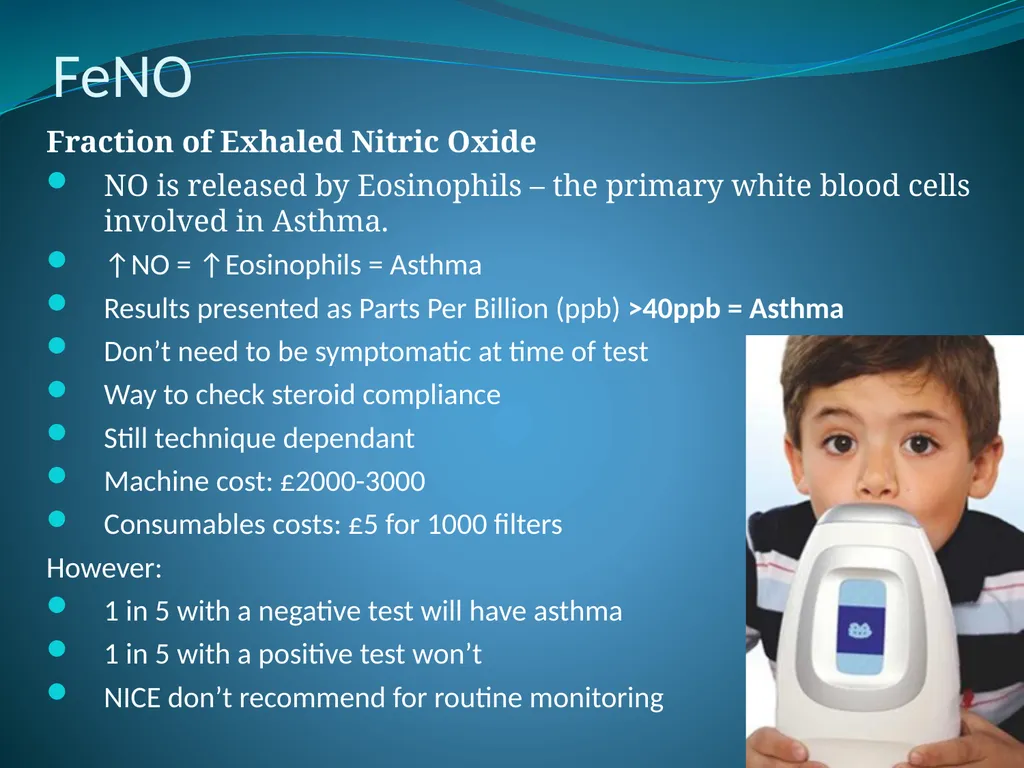
FeNO Fraction of Exhaled Nitric Oxide
NO is released by Eosinophils – the primary white blood cells involved in Asthma.
↑NO = ↑Eosinophils = Asthma
Results presented as Parts Per Billion (ppb) >40ppb = Asthma
Don’t need to be symptomatic at time of test
Way to check steroid compliance
Still technique dependant
Machine cost: £2000-3000
Consumables costs: £5 for 1000 filters
However:
1 in 5 with a negative test will have asthma
1 in 5 with a positive test won’t
NICE don’t recommend for routine monitoring<br>
NO is released by Eosinophils – the primary white blood cells involved in Asthma.
↑NO = ↑Eosinophils = Asthma
Results presented as Parts Per Billion (ppb) >40ppb = Asthma
Don’t need to be symptomatic at time of test
Way to check steroid compliance
Still technique dependant
Machine cost: £2000-3000
Consumables costs: £5 for 1000 filters
However:
1 in 5 with a negative test will have asthma
1 in 5 with a positive test won’t
NICE don’t recommend for routine monitoring<br>
56
Asthma Diagnostic Tests Spirometry
Patient has to be symptomatic at the time of test to give a positive result
Technique dependent – more difficult then FeNO
Looking for obstructive picture – FEV1:FVC <70%
Ask for reversibility - >12% improvement in FEV1 after bronchodilator PLUS an increase in volume of 200mL
PEFR Diary
Captures the diurnal variation
NICE recommends BD readings over 2-4 weeks
>20% variability suggests asthma
Relying on patient for good quality evidence<br>
Patient has to be symptomatic at the time of test to give a positive result
Technique dependent – more difficult then FeNO
Looking for obstructive picture – FEV1:FVC <70%
Ask for reversibility - >12% improvement in FEV1 after bronchodilator PLUS an increase in volume of 200mL
PEFR Diary
Captures the diurnal variation
NICE recommends BD readings over 2-4 weeks
>20% variability suggests asthma
Relying on patient for good quality evidence<br>
57
Asthma Diagnostic Tests Direct Bronchial Challenge
Aims to trigger asthma symptoms
Histamine or Methacholine
Only done in secondary care – generally when all other tests have been inconclusive but the clinical picture still suggests asthma.
Risks triggering severe symptoms<br>
Aims to trigger asthma symptoms
Histamine or Methacholine
Only done in secondary care – generally when all other tests have been inconclusive but the clinical picture still suggests asthma.
Risks triggering severe symptoms<br>
58
NICE Asthma Diagnosis Guideline In symptomatic adults (>17) diagnose asthma if:
FeNO >40ppb PLUS either: positive reversibility, positive PEFR diary, or positive bronchial challenge
or
FeNO 25-39ppb AND positive bronchial challenge
or
Positive Reversibility AND positive PEFR diary “irrespective of FeNO result”
“Suspect Asthma” if Obstructive Spirometry but negative reversibility PLUS either:
FeNO >40ppb
FeNO 25-39ppb AND positive PEFR Diary
Refer to Respiratory for a second opinion if:
Only 1 test comes back positive and others are negative<br>
FeNO >40ppb PLUS either: positive reversibility, positive PEFR diary, or positive bronchial challenge
or
FeNO 25-39ppb AND positive bronchial challenge
or
Positive Reversibility AND positive PEFR diary “irrespective of FeNO result”
“Suspect Asthma” if Obstructive Spirometry but negative reversibility PLUS either:
FeNO >40ppb
FeNO 25-39ppb AND positive PEFR Diary
Refer to Respiratory for a second opinion if:
Only 1 test comes back positive and others are negative<br>
59
NICE Asthma Diagnosis Guideline In symptomatic Children (>5) diagnose asthma if:
FeNO >35ppb AND positive PEFR diary
or
Obstructive Spirometry with Reversibility
“Suspect Asthma” if only 1 test is positive
Refer to Respiratory for a second opinion if:
All tests are inconclusive<br>
FeNO >35ppb AND positive PEFR diary
or
Obstructive Spirometry with Reversibility
“Suspect Asthma” if only 1 test is positive
Refer to Respiratory for a second opinion if:
All tests are inconclusive<br>
60
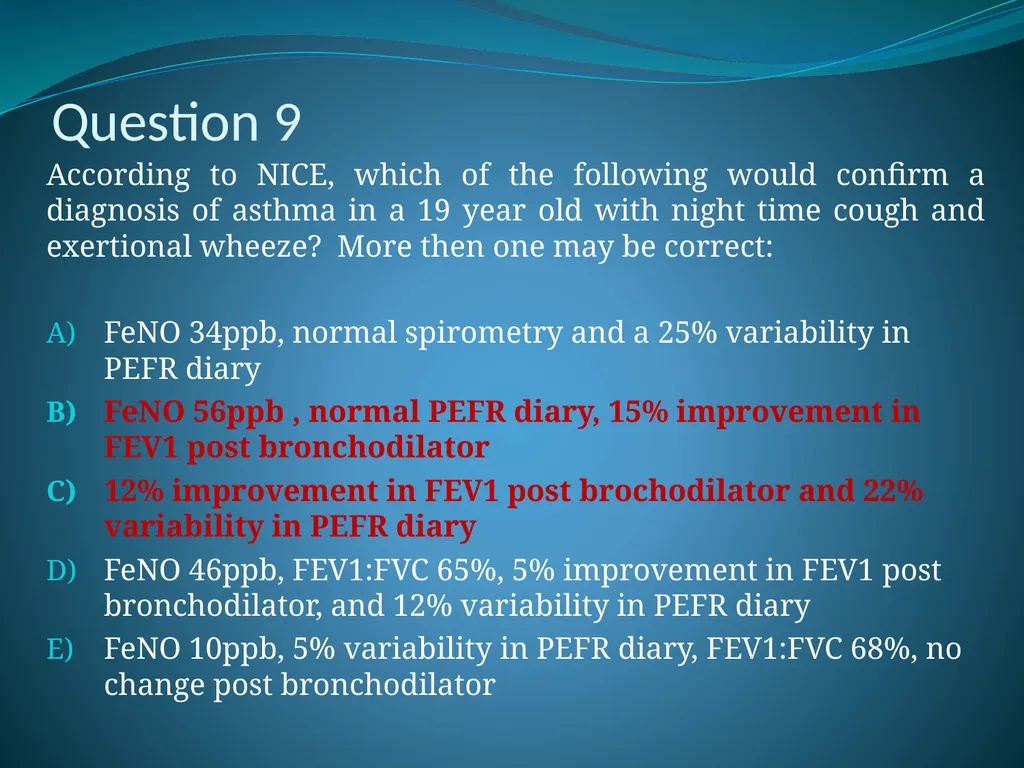
Question 9 According to NICE, which of the following would confirm a diagnosis of asthma in a 19 year old with night time cough and exertional wheeze? More then one may be correct:
FeNO 34ppb, normal spirometry and a 25% variability in PEFR diary
FeNO 56ppb , normal PEFR diary, 15% improvement in FEV1 post bronchodilator
12% improvement in FEV1 post brochodilator and 22% variability in PEFR diary
FeNO 46ppb, FEV1:FVC 65%, 5% improvement in FEV1 post bronchodilator, and 12% variability in PEFR diary
FeNO 10ppb, 5% variability in PEFR diary, FEV1:FVC 68%, no change post bronchodilator<br>
FeNO 34ppb, normal spirometry and a 25% variability in PEFR diary
FeNO 56ppb , normal PEFR diary, 15% improvement in FEV1 post bronchodilator
12% improvement in FEV1 post brochodilator and 22% variability in PEFR diary
FeNO 46ppb, FEV1:FVC 65%, 5% improvement in FEV1 post bronchodilator, and 12% variability in PEFR diary
FeNO 10ppb, 5% variability in PEFR diary, FEV1:FVC 68%, no change post bronchodilator<br>
61
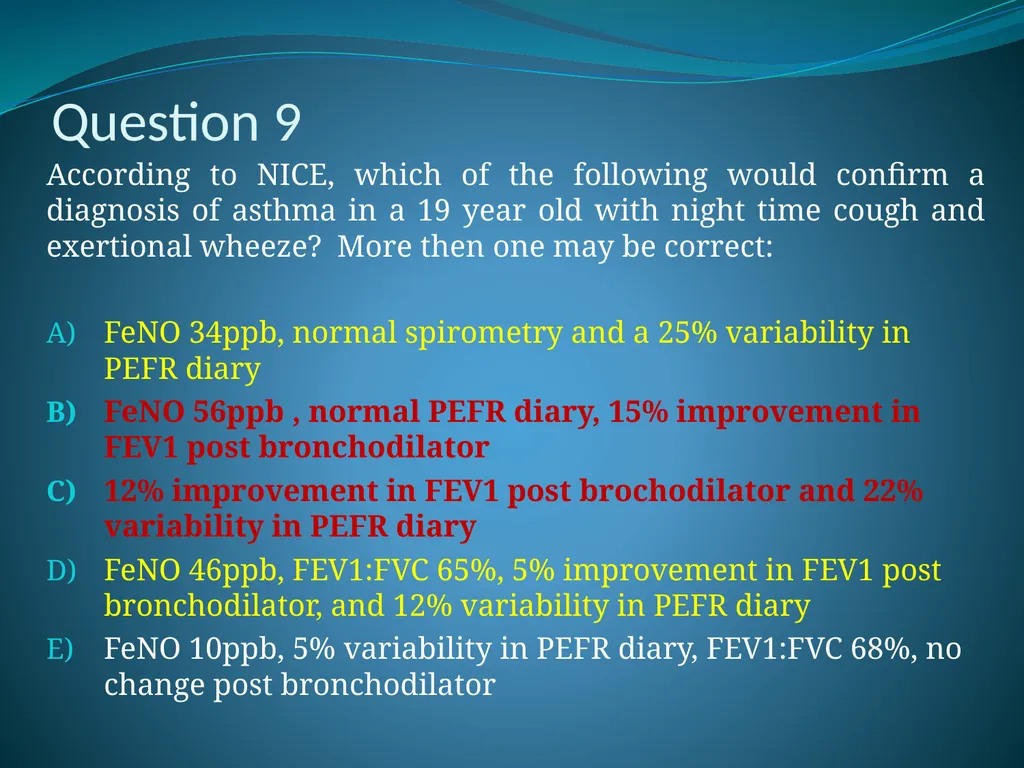
Question 9 According to NICE, which of the following would confirm a diagnosis of asthma in a 19 year old with night time cough and exertional wheeze? More then one may be correct:
FeNO 34ppb, normal spirometry and a 25% variability in PEFR diary
FeNO 56ppb , normal PEFR diary, 15% improvement in FEV1 post bronchodilator
12% improvement in FEV1 post brochodilator and 22% variability in PEFR diary
FeNO 46ppb, FEV1:FVC 65%, 5% improvement in FEV1 post bronchodilator, and 12% variability in PEFR diary
FeNO 10ppb, 5% variability in PEFR diary, FEV1:FVC 68%, no change post bronchodilator<br>
FeNO 34ppb, normal spirometry and a 25% variability in PEFR diary
FeNO 56ppb , normal PEFR diary, 15% improvement in FEV1 post bronchodilator
12% improvement in FEV1 post brochodilator and 22% variability in PEFR diary
FeNO 46ppb, FEV1:FVC 65%, 5% improvement in FEV1 post bronchodilator, and 12% variability in PEFR diary
FeNO 10ppb, 5% variability in PEFR diary, FEV1:FVC 68%, no change post bronchodilator<br>
62
Question 9 According to NICE, which of the following would confirm a diagnosis of asthma in a 19 year old with night time cough and exertional wheeze? More then one may be correct:
FeNO 34ppb, normal spirometry and a 25% variability in PEFR diary
FeNO 56ppb , normal PEFR diary, 15% improvement in FEV1 post bronchodilator
12% improvement in FEV1 post brochodilator and 22% variability in PEFR diary
FeNO 46ppb, FEV1:FVC 65%, 5% improvement in FEV1 post bronchodilator, and 12% variability in PEFR diary
FeNO 10ppb, 5% variability in PEFR diary, FEV1:FVC 68%, no change post bronchodilator<br>
FeNO 34ppb, normal spirometry and a 25% variability in PEFR diary
FeNO 56ppb , normal PEFR diary, 15% improvement in FEV1 post bronchodilator
12% improvement in FEV1 post brochodilator and 22% variability in PEFR diary
FeNO 46ppb, FEV1:FVC 65%, 5% improvement in FEV1 post bronchodilator, and 12% variability in PEFR diary
FeNO 10ppb, 5% variability in PEFR diary, FEV1:FVC 68%, no change post bronchodilator<br>
63
BTS/SIGN Asthma Diagnosis Guideline Published 2019
Response to treatment is key to confirming diagnosis
Based on clinical judgement does the patient have a High, Intermediate, or Low probability of their symptoms being Asthma:
High probability of Asthma
Code as “Suspected Asthma”
Start Treatment – if responds then Asthma diagnosis confirmed
Poor response – move to Intermediate
Intermediate probability of Asthma
Test for airway obstruction (e.g. PEFR diary, Spirometry) or eosinophil activity (i.e. FeNO)
If positive code as “Suspected Asthma” and start treatment
If responds then Asthma diagnosis confirmed
Poor Response – move to low probability
Low Probability of Asthma
Consider alternative diagnosis, or Specialist referral<br>
Response to treatment is key to confirming diagnosis
Based on clinical judgement does the patient have a High, Intermediate, or Low probability of their symptoms being Asthma:
High probability of Asthma
Code as “Suspected Asthma”
Start Treatment – if responds then Asthma diagnosis confirmed
Poor response – move to Intermediate
Intermediate probability of Asthma
Test for airway obstruction (e.g. PEFR diary, Spirometry) or eosinophil activity (i.e. FeNO)
If positive code as “Suspected Asthma” and start treatment
If responds then Asthma diagnosis confirmed
Poor Response – move to low probability
Low Probability of Asthma
Consider alternative diagnosis, or Specialist referral<br>
64
SIGN / BTS Asthma Diagnosis Guideline
2019<br>
65
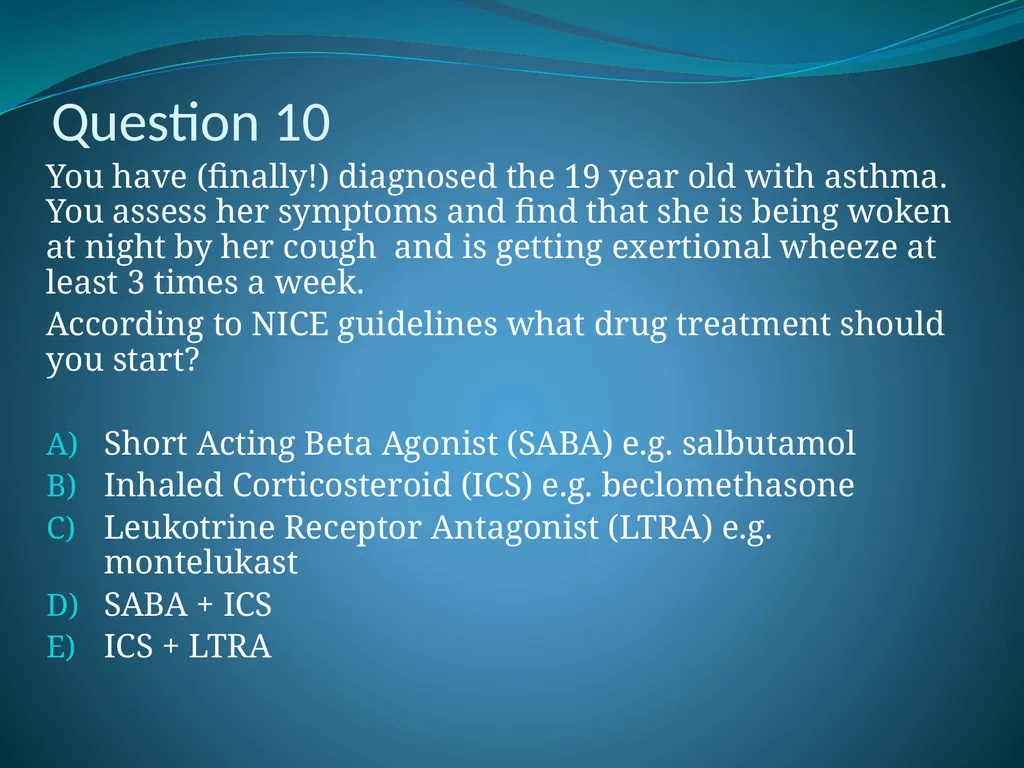
Question 10 You have (finally!) diagnosed the 19 year old with asthma. You assess her symptoms and find that she is being woken at night by her cough and is getting exertional wheeze at least 3 times a week.
According to NICE guidelines what drug treatment should you start?
Short Acting Beta Agonist (SABA) e.g. salbutamol
Inhaled Corticosteroid (ICS) e.g. beclomethasone
Leukotrine Receptor Antagonist (LTRA) e.g. montelukast
SABA + ICS
ICS + LTRA<br>
According to NICE guidelines what drug treatment should you start?
Short Acting Beta Agonist (SABA) e.g. salbutamol
Inhaled Corticosteroid (ICS) e.g. beclomethasone
Leukotrine Receptor Antagonist (LTRA) e.g. montelukast
SABA + ICS
ICS + LTRA<br>
66
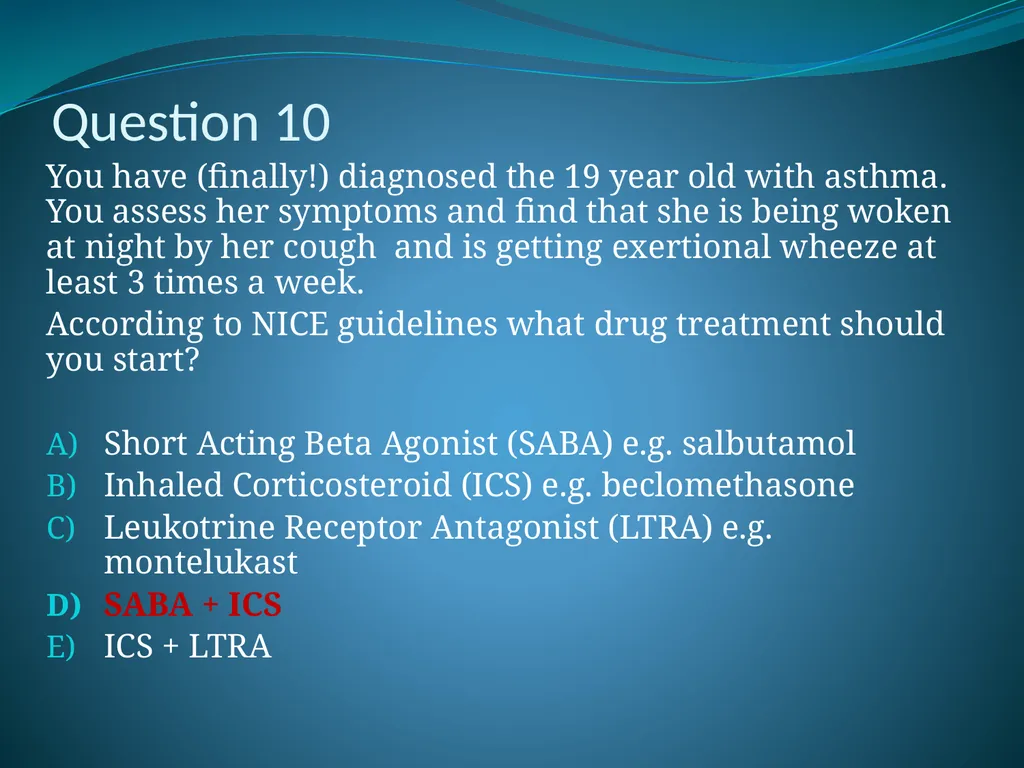
Question 10 You have (finally!) diagnosed the 19 year old with asthma. You assess her symptoms and find that she is being woken at night by her cough and is getting exertional wheeze at least 3 times a week.
According to NICE guidelines what drug treatment should you start?
Short Acting Beta Agonist (SABA) e.g. salbutamol
Inhaled Corticosteroid (ICS) e.g. beclomethasone
Leukotrine Receptor Antagonist (LTRA) e.g. montelukast
SABA + ICS
ICS + LTRA<br>
According to NICE guidelines what drug treatment should you start?
Short Acting Beta Agonist (SABA) e.g. salbutamol
Inhaled Corticosteroid (ICS) e.g. beclomethasone
Leukotrine Receptor Antagonist (LTRA) e.g. montelukast
SABA + ICS
ICS + LTRA<br>
67
NICE Asthma Treatment Guideline 1. Offer all patients a SABA (salbutamol)
2. Assess symptoms at diagnosis:
- If night time waking or asthma symptoms >3 times a week then offer ICS
- Otherwise treat with SABA alone (step up to ICS if uncontrolled)
3. Remain uncontrolled on ICS?
- Add LTRA (montelukast)
4. Still uncontrolled on ICS and LTRA?
- Either add LABA (e.g. salmeterol) or swap LTRA for LABA
- NICE advises “discuss with patient about whether to continue LTRA”
5. Still uncontrolled on ICS, LABA +/- LTRA?
- Consider MART (Maintenance and Reliever Therapy) regimen.
- stop SABA and use low dose ICS + LABA combination for both maintenance and reliever
6. Still uncontrolled on MART regimen +/- LTRA?
- Increase steroid dose (either as MART or fixed doses + SABA reliever)
7. Still uncontrolled?
- Consider specialist referral – may need oral steroids
Consider decreasing therapy once symptoms have been stable for 3 months<br>
2. Assess symptoms at diagnosis:
- If night time waking or asthma symptoms >3 times a week then offer ICS
- Otherwise treat with SABA alone (step up to ICS if uncontrolled)
3. Remain uncontrolled on ICS?
- Add LTRA (montelukast)
4. Still uncontrolled on ICS and LTRA?
- Either add LABA (e.g. salmeterol) or swap LTRA for LABA
- NICE advises “discuss with patient about whether to continue LTRA”
5. Still uncontrolled on ICS, LABA +/- LTRA?
- Consider MART (Maintenance and Reliever Therapy) regimen.
- stop SABA and use low dose ICS + LABA combination for both maintenance and reliever
6. Still uncontrolled on MART regimen +/- LTRA?
- Increase steroid dose (either as MART or fixed doses + SABA reliever)
7. Still uncontrolled?
- Consider specialist referral – may need oral steroids
Consider decreasing therapy once symptoms have been stable for 3 months<br>
68
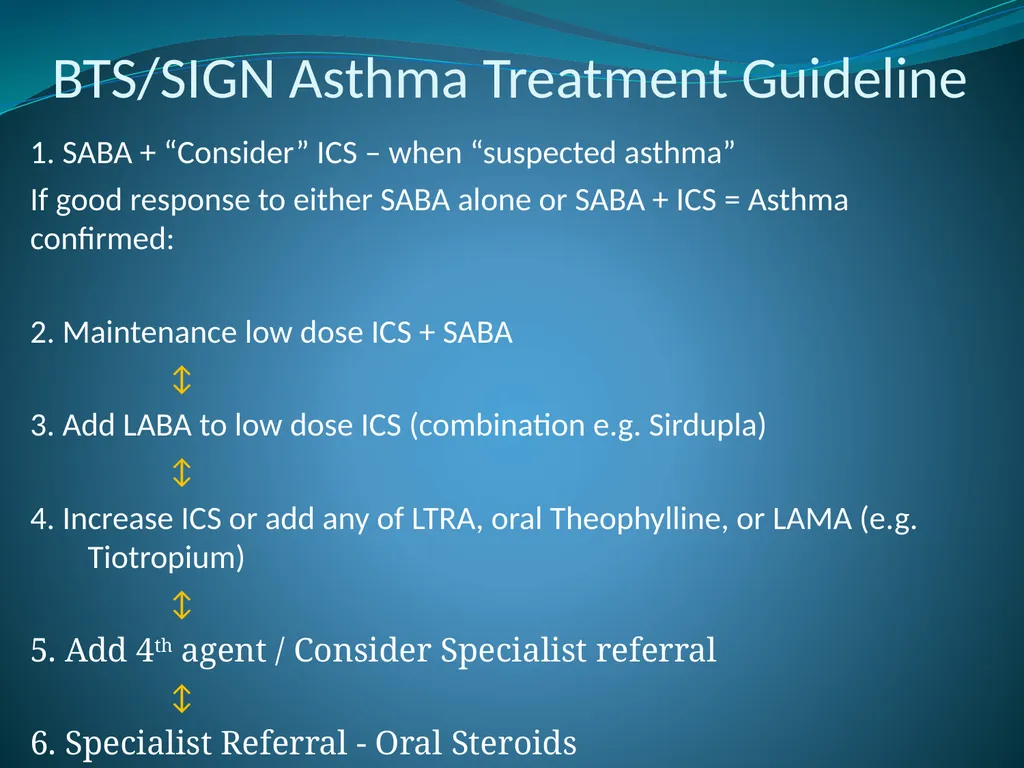
BTS/SIGN Asthma Treatment Guideline 1. SABA + “Consider” ICS – when “suspected asthma”
If good response to either SABA alone or SABA + ICS = Asthma confirmed:
2. Maintenance low dose ICS + SABA
↕
3. Add LABA to low dose ICS (combination e.g. Sirdupla)
↕
4. Increase ICS or add any of LTRA, oral Theophylline, or LAMA (e.g. Tiotropium)
↕
5. Add 4th agent / Consider Specialist referral
↕
6. Specialist Referral - Oral Steroids<br>
If good response to either SABA alone or SABA + ICS = Asthma confirmed:
2. Maintenance low dose ICS + SABA
↕
3. Add LABA to low dose ICS (combination e.g. Sirdupla)
↕
4. Increase ICS or add any of LTRA, oral Theophylline, or LAMA (e.g. Tiotropium)
↕
5. Add 4th agent / Consider Specialist referral
↕
6. Specialist Referral - Oral Steroids<br>
69
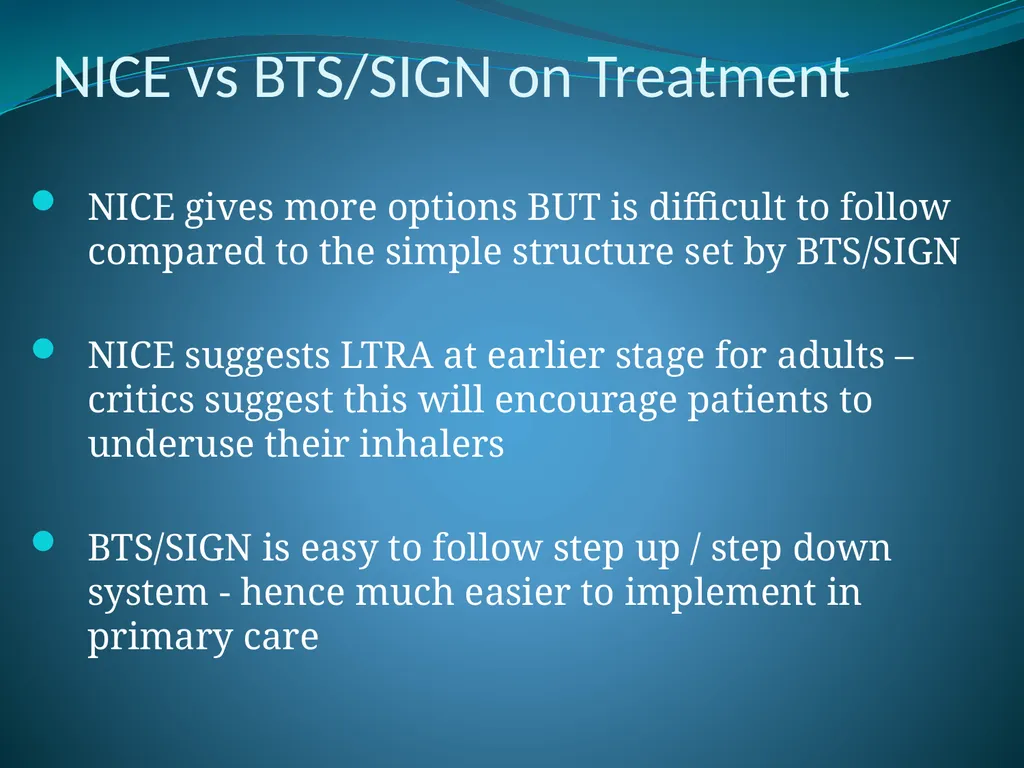
NICE vs BTS/SIGN on Treatment NICE gives more options BUT is difficult to follow compared to the simple structure set by BTS/SIGN
NICE suggests LTRA at earlier stage for adults – critics suggest this will encourage patients to underuse their inhalers
BTS/SIGN is easy to follow step up / step down system - hence much easier to implement in primary care<br>
NICE suggests LTRA at earlier stage for adults – critics suggest this will encourage patients to underuse their inhalers
BTS/SIGN is easy to follow step up / step down system - hence much easier to implement in primary care<br>
70
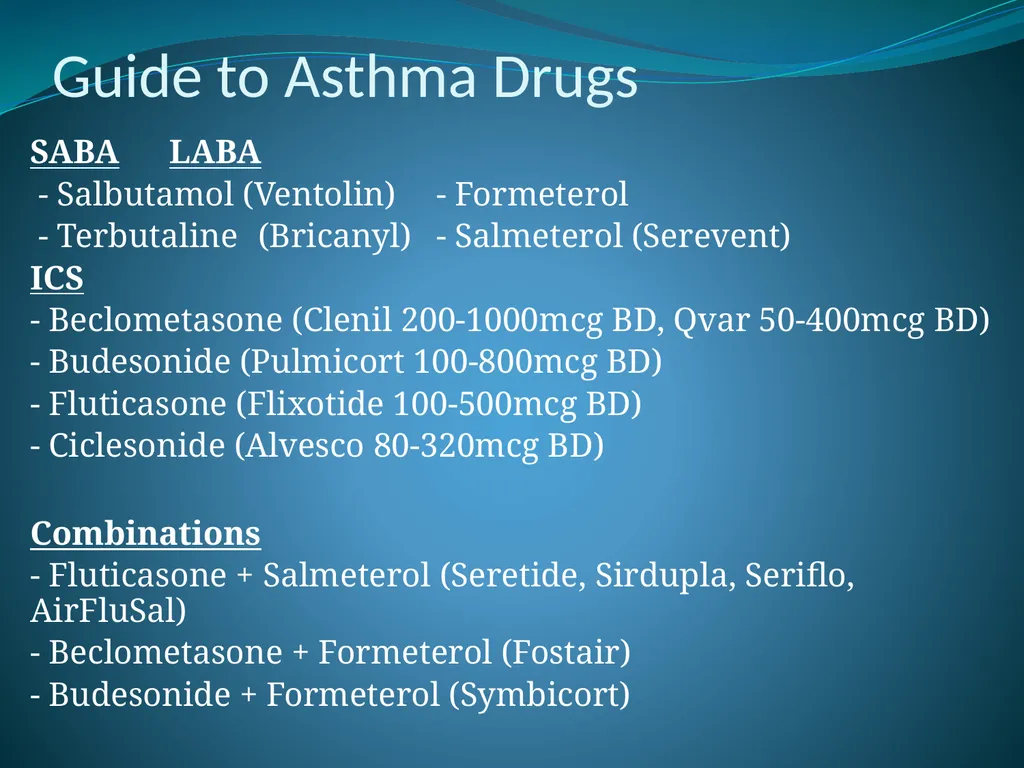
Guide to Asthma Drugs SABA LABA
- Salbutamol (Ventolin) - Formeterol
- Terbutaline (Bricanyl) - Salmeterol (Serevent)
ICS
- Beclometasone (Clenil 200-1000mcg BD, Qvar 50-400mcg BD)
- Budesonide (Pulmicort 100-800mcg BD)
- Fluticasone (Flixotide 100-500mcg BD)
- Ciclesonide (Alvesco 80-320mcg BD)
Combinations
- Fluticasone + Salmeterol (Seretide, Sirdupla, Seriflo, AirFluSal)
- Beclometasone + Formeterol (Fostair)
- Budesonide + Formeterol (Symbicort)<br>
- Salbutamol (Ventolin) - Formeterol
- Terbutaline (Bricanyl) - Salmeterol (Serevent)
ICS
- Beclometasone (Clenil 200-1000mcg BD, Qvar 50-400mcg BD)
- Budesonide (Pulmicort 100-800mcg BD)
- Fluticasone (Flixotide 100-500mcg BD)
- Ciclesonide (Alvesco 80-320mcg BD)
Combinations
- Fluticasone + Salmeterol (Seretide, Sirdupla, Seriflo, AirFluSal)
- Beclometasone + Formeterol (Fostair)
- Budesonide + Formeterol (Symbicort)<br>
71
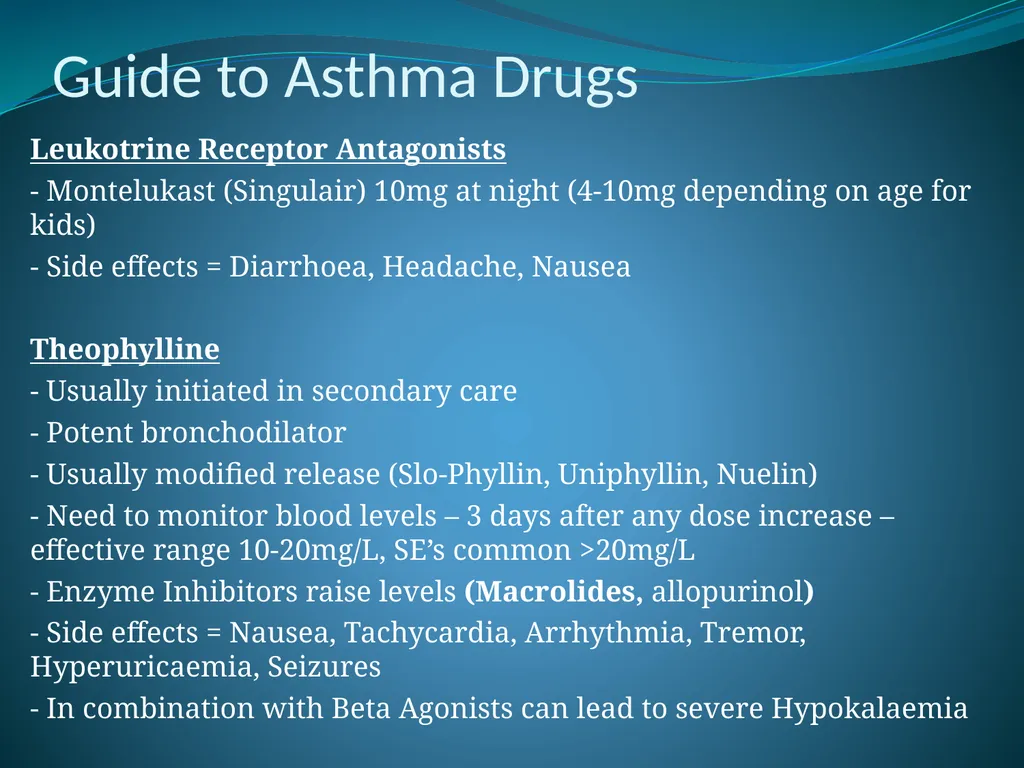
Guide to Asthma Drugs Leukotrine Receptor Antagonists
- Montelukast (Singulair) 10mg at night (4-10mg depending on age for kids)
- Side effects = Diarrhoea, Headache, Nausea
Theophylline
- Usually initiated in secondary care
- Potent bronchodilator
- Usually modified release (Slo-Phyllin, Uniphyllin, Nuelin)
- Need to monitor blood levels – 3 days after any dose increase – effective range 10-20mg/L, SE’s common >20mg/L
- Enzyme Inhibitors raise levels (Macrolides, allopurinol)
- Side effects = Nausea, Tachycardia, Arrhythmia, Tremor, Hyperuricaemia, Seizures
- In combination with Beta Agonists can lead to severe Hypokalaemia<br>
- Montelukast (Singulair) 10mg at night (4-10mg depending on age for kids)
- Side effects = Diarrhoea, Headache, Nausea
Theophylline
- Usually initiated in secondary care
- Potent bronchodilator
- Usually modified release (Slo-Phyllin, Uniphyllin, Nuelin)
- Need to monitor blood levels – 3 days after any dose increase – effective range 10-20mg/L, SE’s common >20mg/L
- Enzyme Inhibitors raise levels (Macrolides, allopurinol)
- Side effects = Nausea, Tachycardia, Arrhythmia, Tremor, Hyperuricaemia, Seizures
- In combination with Beta Agonists can lead to severe Hypokalaemia<br>
72
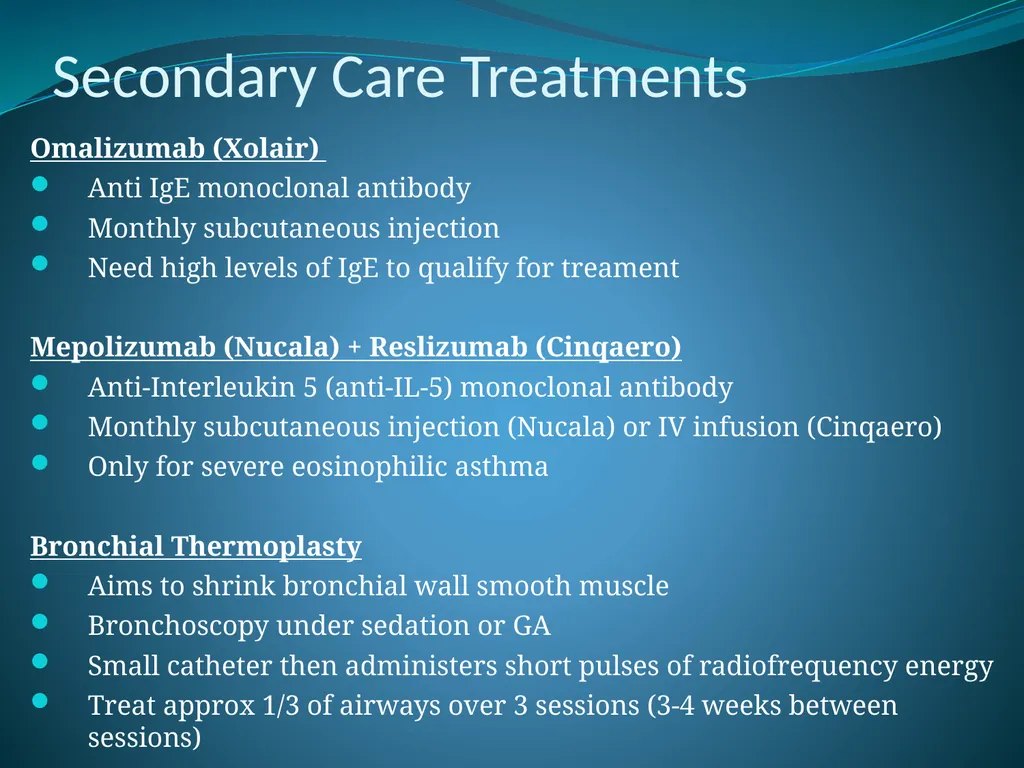
Secondary Care Treatments Omalizumab (Xolair)
Anti IgE monoclonal antibody
Monthly subcutaneous injection
Need high levels of IgE to qualify for treament
Mepolizumab (Nucala) + Reslizumab (Cinqaero)
Anti-Interleukin 5 (anti-IL-5) monoclonal antibody
Monthly subcutaneous injection (Nucala) or IV infusion (Cinqaero)
Only for severe eosinophilic asthma
Bronchial Thermoplasty
Aims to shrink bronchial wall smooth muscle
Bronchoscopy under sedation or GA
Small catheter then administers short pulses of radiofrequency energy
Treat approx 1/3 of airways over 3 sessions (3-4 weeks between sessions)<br>
Anti IgE monoclonal antibody
Monthly subcutaneous injection
Need high levels of IgE to qualify for treament
Mepolizumab (Nucala) + Reslizumab (Cinqaero)
Anti-Interleukin 5 (anti-IL-5) monoclonal antibody
Monthly subcutaneous injection (Nucala) or IV infusion (Cinqaero)
Only for severe eosinophilic asthma
Bronchial Thermoplasty
Aims to shrink bronchial wall smooth muscle
Bronchoscopy under sedation or GA
Small catheter then administers short pulses of radiofrequency energy
Treat approx 1/3 of airways over 3 sessions (3-4 weeks between sessions)<br>
73
New Asthma Diagnosis Which of these should you (or the practice nurse) arrange / offer your patient?
- Personalised Asthma Action Plan
- Teach Inhaler Technique and advise when to use
- Ensure they have a PEFR meter
- Provide advice on weight loss
- Provide advice on stopping smoking
- Advise they avoid known triggers
- Advise they avoid potential triggers e.g. NSAIDs
- Refer to Respiratory if Occupational Asthma is suspected
- Ensure childhood vaccinations were completed
- Yearly influenza vaccine
- Pneumococcal vaccination
- Assess for Anxiety / Depression
- Provide sources of information and support e.g. Asthma UK
- Annual Asthma review<br>
- Personalised Asthma Action Plan
- Teach Inhaler Technique and advise when to use
- Ensure they have a PEFR meter
- Provide advice on weight loss
- Provide advice on stopping smoking
- Advise they avoid known triggers
- Advise they avoid potential triggers e.g. NSAIDs
- Refer to Respiratory if Occupational Asthma is suspected
- Ensure childhood vaccinations were completed
- Yearly influenza vaccine
- Pneumococcal vaccination
- Assess for Anxiety / Depression
- Provide sources of information and support e.g. Asthma UK
- Annual Asthma review<br>
74
New Asthma Diagnosis Which of these should you (or the practice nurse) arrange / offer your patient?
- Personalised Asthma Action Plan
- Teach Inhaler Technique and advise when to use
- Ensure they have a PEFR meter
- Provide advice on weight loss
- Provide advice on stopping smoking
- Advise they avoid known triggers
- Advise they avoid potential triggers e.g. NSAIDs
- Refer to Respiratory if Occupational Asthma is suspected
- Ensure childhood vaccinations were completed
- Yearly influenza vaccine
- Pneumococcal vaccination
- Assess for Anxiety / Depression
- Provide sources of information and support e.g. Asthma UK
- Annual Asthma review All of these!<br>
- Personalised Asthma Action Plan
- Teach Inhaler Technique and advise when to use
- Ensure they have a PEFR meter
- Provide advice on weight loss
- Provide advice on stopping smoking
- Advise they avoid known triggers
- Advise they avoid potential triggers e.g. NSAIDs
- Refer to Respiratory if Occupational Asthma is suspected
- Ensure childhood vaccinations were completed
- Yearly influenza vaccine
- Pneumococcal vaccination
- Assess for Anxiety / Depression
- Provide sources of information and support e.g. Asthma UK
- Annual Asthma review All of these!<br>
75
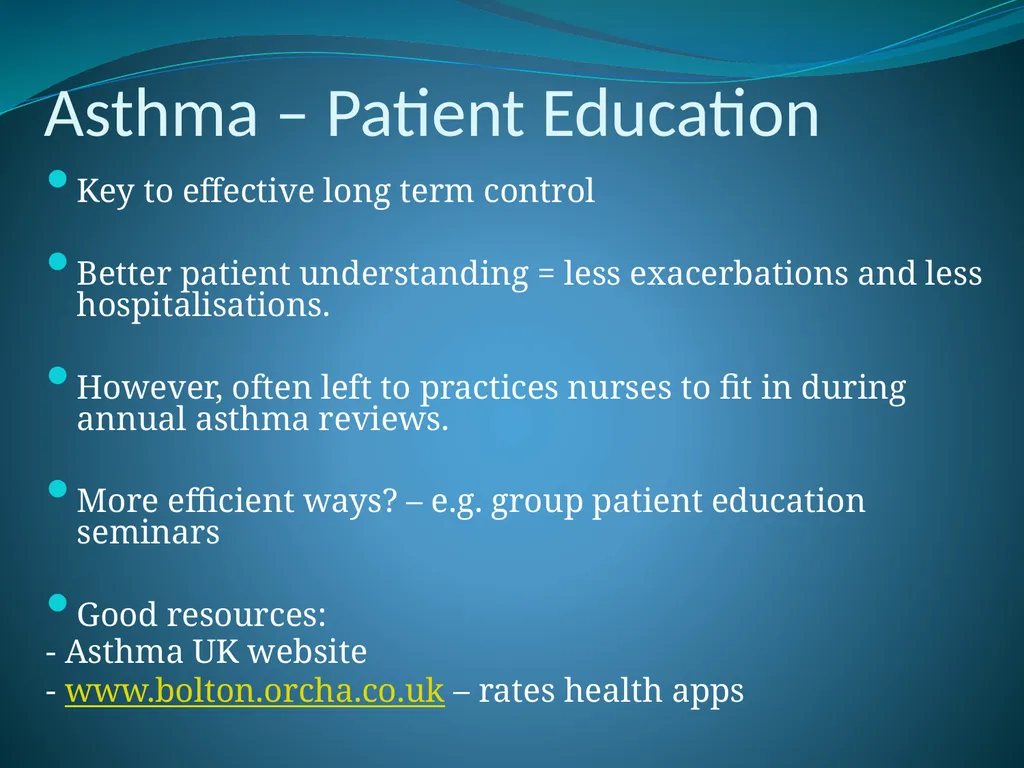
Asthma – Patient Education Key to effective long term control
Better patient understanding = less exacerbations and less hospitalisations.
However, often left to practices nurses to fit in during annual asthma reviews.
More efficient ways? – e.g. group patient education seminars
Good resources:
- Asthma UK website
- www.bolton.orcha.co.uk – rates health apps<br>
Better patient understanding = less exacerbations and less hospitalisations.
However, often left to practices nurses to fit in during annual asthma reviews.
More efficient ways? – e.g. group patient education seminars
Good resources:
- Asthma UK website
- www.bolton.orcha.co.uk – rates health apps<br>
76
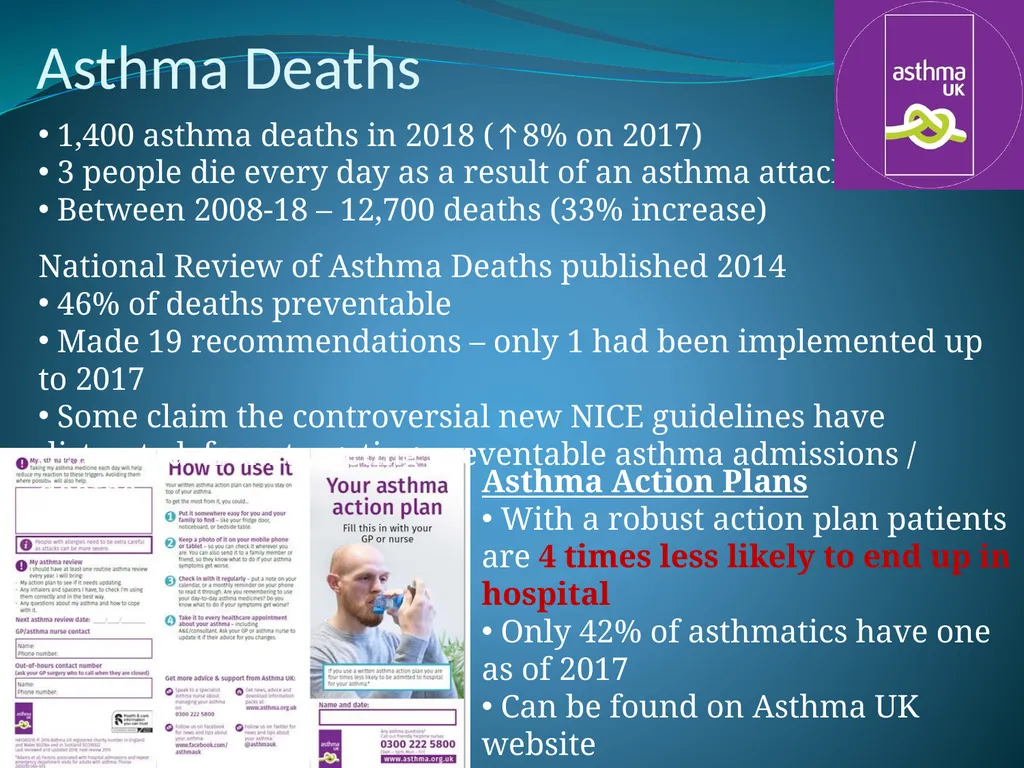
Asthma Deaths 1,400 asthma deaths in 2018 (↑8% on 2017)
3 people die every day as a result of an asthma attack
Between 2008-18 – 12,700 deaths (33% increase)
National Review of Asthma Deaths published 2014
46% of deaths preventable
Made 19 recommendations – only 1 had been implemented up to 2017
Some claim the controversial new NICE guidelines have distracted from targeting preventable asthma admissions / deaths Asthma Action Plans
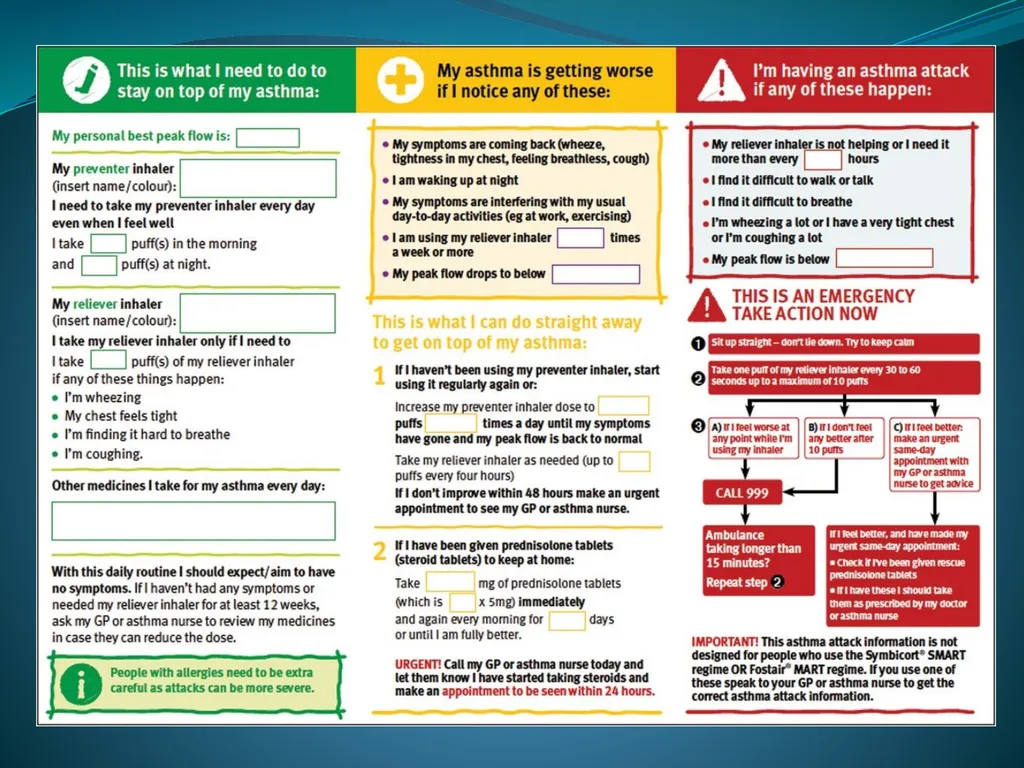
With a robust action plan patients are 4 times less likely to end up in hospital
Only 42% of asthmatics have one as of 2017
Can be found on Asthma UK website<br>
3 people die every day as a result of an asthma attack
Between 2008-18 – 12,700 deaths (33% increase)
National Review of Asthma Deaths published 2014
46% of deaths preventable
Made 19 recommendations – only 1 had been implemented up to 2017
Some claim the controversial new NICE guidelines have distracted from targeting preventable asthma admissions / deaths Asthma Action Plans
With a robust action plan patients are 4 times less likely to end up in hospital
Only 42% of asthmatics have one as of 2017
Can be found on Asthma UK website<br>
77
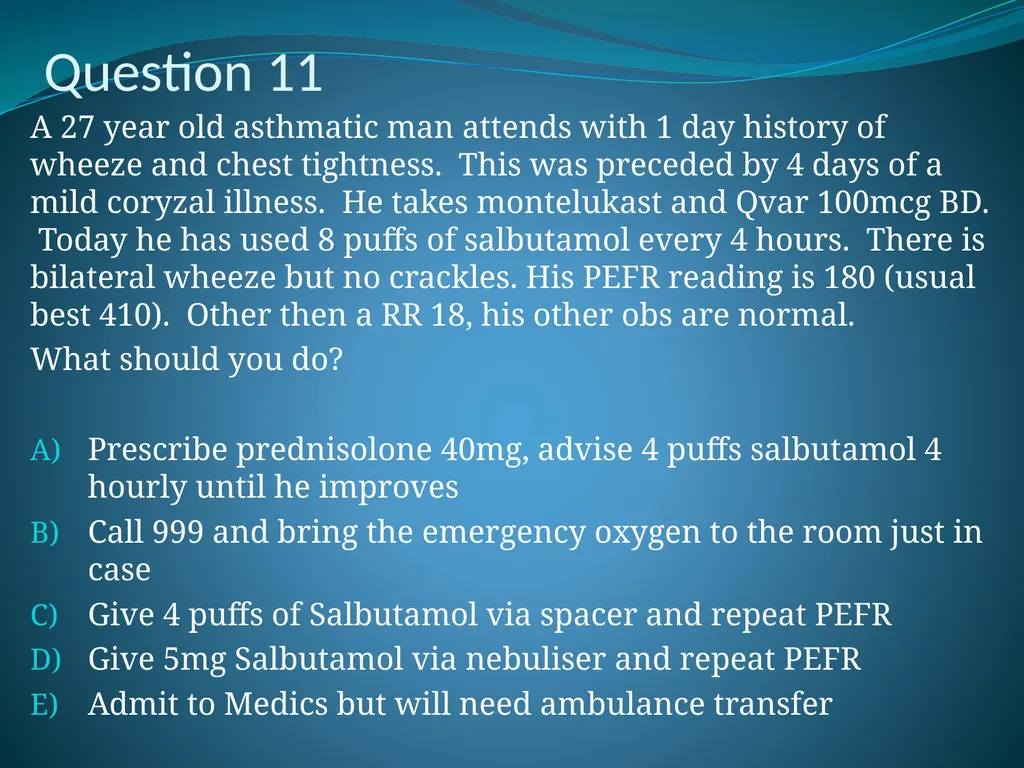
Question 11 A 27 year old asthmatic man attends with 1 day history of wheeze and chest tightness. This was preceded by 4 days of a mild coryzal illness. He takes montelukast and Qvar 100mcg BD. Today he has used 8 puffs of salbutamol every 4 hours. There is bilateral wheeze but no crackles. His PEFR reading is 180 (usual best 410). Other then a RR 18, his other obs are normal.
What should you do?
Prescribe prednisolone 40mg, advise 4 puffs salbutamol 4 hourly until he improves
Call 999 and bring the emergency oxygen to the room just in case
Give 4 puffs of Salbutamol via spacer and repeat PEFR
Give 5mg Salbutamol via nebuliser and repeat PEFR
Admit to Medics but will need ambulance transfer<br>
What should you do?
Prescribe prednisolone 40mg, advise 4 puffs salbutamol 4 hourly until he improves
Call 999 and bring the emergency oxygen to the room just in case
Give 4 puffs of Salbutamol via spacer and repeat PEFR
Give 5mg Salbutamol via nebuliser and repeat PEFR
Admit to Medics but will need ambulance transfer<br>
78
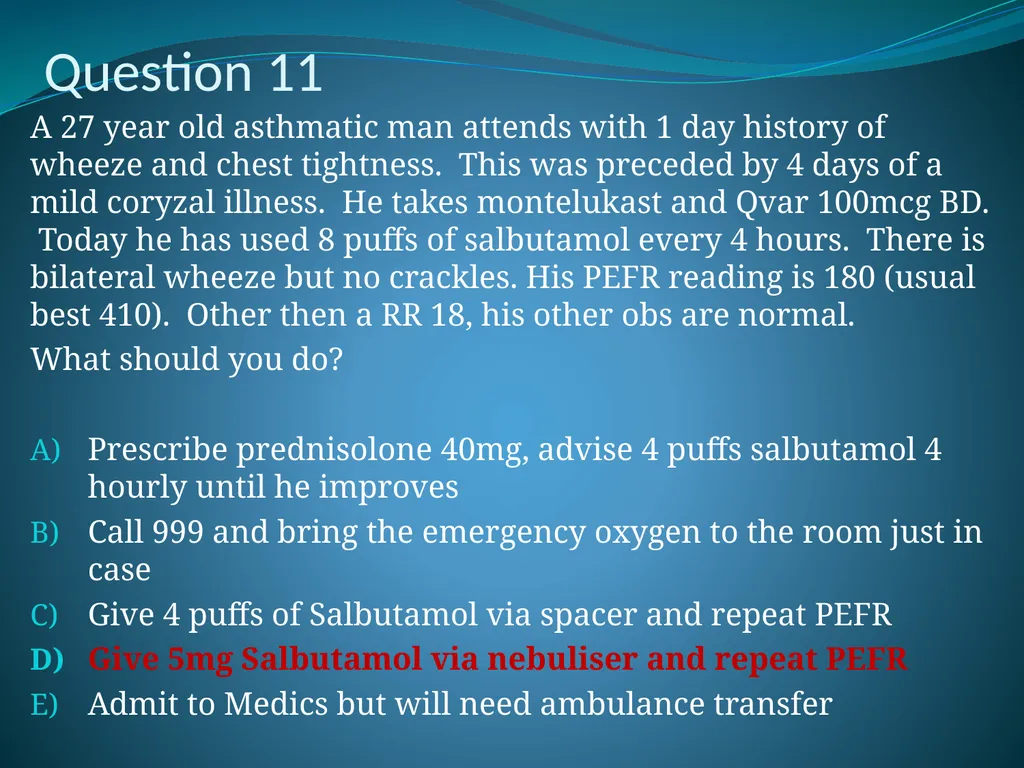
Question 11 A 27 year old asthmatic man attends with 1 day history of wheeze and chest tightness. This was preceded by 4 days of a mild coryzal illness. He takes montelukast and Qvar 100mcg BD. Today he has used 8 puffs of salbutamol every 4 hours. There is bilateral wheeze but no crackles. His PEFR reading is 180 (usual best 410). Other then a RR 18, his other obs are normal.
What should you do?
Prescribe prednisolone 40mg, advise 4 puffs salbutamol 4 hourly until he improves
Call 999 and bring the emergency oxygen to the room just in case
Give 4 puffs of Salbutamol via spacer and repeat PEFR
Give 5mg Salbutamol via nebuliser and repeat PEFR
Admit to Medics but will need ambulance transfer<br>
What should you do?
Prescribe prednisolone 40mg, advise 4 puffs salbutamol 4 hourly until he improves
Call 999 and bring the emergency oxygen to the room just in case
Give 4 puffs of Salbutamol via spacer and repeat PEFR
Give 5mg Salbutamol via nebuliser and repeat PEFR
Admit to Medics but will need ambulance transfer<br>
79
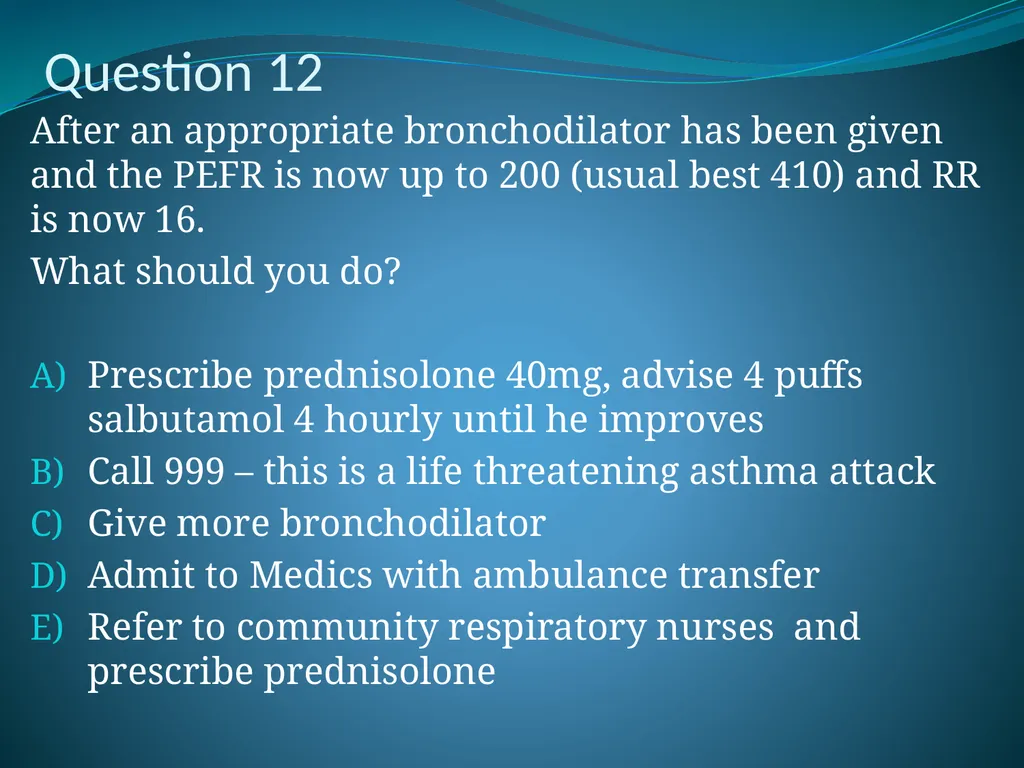
Question 12 After an appropriate bronchodilator has been given and the PEFR is now up to 200 (usual best 410) and RR is now 16.
What should you do?
Prescribe prednisolone 40mg, advise 4 puffs salbutamol 4 hourly until he improves
Call 999 – this is a life threatening asthma attack
Give more bronchodilator
Admit to Medics with ambulance transfer
Refer to community respiratory nurses and prescribe prednisolone<br>
What should you do?
Prescribe prednisolone 40mg, advise 4 puffs salbutamol 4 hourly until he improves
Call 999 – this is a life threatening asthma attack
Give more bronchodilator
Admit to Medics with ambulance transfer
Refer to community respiratory nurses and prescribe prednisolone<br>
80
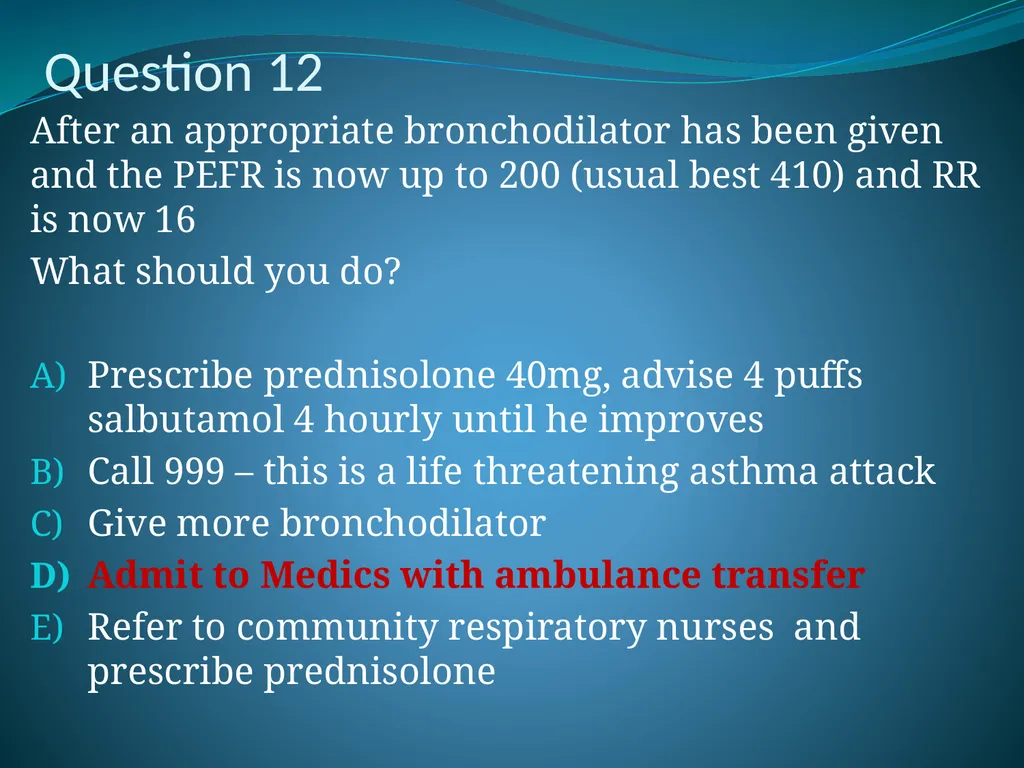
Question 12 After an appropriate bronchodilator has been given and the PEFR is now up to 200 (usual best 410) and RR is now 16
What should you do?
Prescribe prednisolone 40mg, advise 4 puffs salbutamol 4 hourly until he improves
Call 999 – this is a life threatening asthma attack
Give more bronchodilator
Admit to Medics with ambulance transfer
Refer to community respiratory nurses and prescribe prednisolone<br>
What should you do?
Prescribe prednisolone 40mg, advise 4 puffs salbutamol 4 hourly until he improves
Call 999 – this is a life threatening asthma attack
Give more bronchodilator
Admit to Medics with ambulance transfer
Refer to community respiratory nurses and prescribe prednisolone<br>
81
Acute Asthma Exacerbations Signs of severe asthma attack:
Drowsiness / Agitation
Signs of exhaustion: can’t complete sentences, cyanosis, accessory muscle use
For all patients:
Examine chest – wheeze, ?crackles, air entry,
Record RR, pulse, BP, and O2 Sats
Measure PEFR – best of 3, compare to usual best
Find out about previous admissions, ever been on ICU?<br>
Drowsiness / Agitation
Signs of exhaustion: can’t complete sentences, cyanosis, accessory muscle use
For all patients:
Examine chest – wheeze, ?crackles, air entry,
Record RR, pulse, BP, and O2 Sats
Measure PEFR – best of 3, compare to usual best
Find out about previous admissions, ever been on ICU?<br>
82
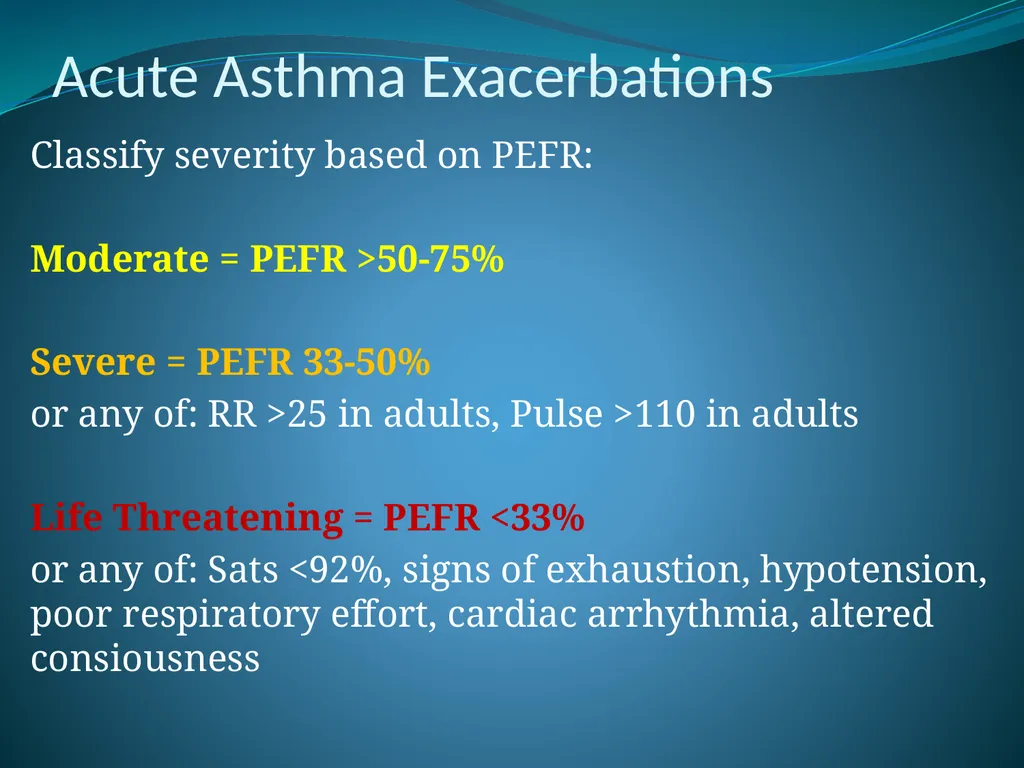
Acute Asthma Exacerbations Classify severity based on PEFR:
Moderate = PEFR >50-75%
Severe = PEFR 33-50%
or any of: RR >25 in adults, Pulse >110 in adults
Life Threatening = PEFR <33%
or any of: Sats <92%, signs of exhaustion, hypotension, poor respiratory effort, cardiac arrhythmia, altered consiousness<br>
Moderate = PEFR >50-75%
Severe = PEFR 33-50%
or any of: RR >25 in adults, Pulse >110 in adults
Life Threatening = PEFR <33%
or any of: Sats <92%, signs of exhaustion, hypotension, poor respiratory effort, cardiac arrhythmia, altered consiousness<br>
83
Acute Asthma Exacerbations Managing Moderate Exacerbations (PEFR >50-75%)
Short course of Salbutamol:
4 puffs followed by 2 puffs every 2 minutes up to max 10 puffs to achieve relief of symptoms. Initially can repeat after 10-20 minutes
In first 1-2 days can repeat every 4 hours and reduce to PRN when able – if needing <4 hourly then needs further review
Short course of oral steroids:
e.g. Prednisolone 40mg for 5 days. Don’t adjust ICS dose
Are Antibiotics needed? E.g. Amoxicillin
Advise they monitor PEFR + Safety net
Consider offering follow up to check response to treatment<br>
Short course of Salbutamol:
4 puffs followed by 2 puffs every 2 minutes up to max 10 puffs to achieve relief of symptoms. Initially can repeat after 10-20 minutes
In first 1-2 days can repeat every 4 hours and reduce to PRN when able – if needing <4 hourly then needs further review
Short course of oral steroids:
e.g. Prednisolone 40mg for 5 days. Don’t adjust ICS dose
Are Antibiotics needed? E.g. Amoxicillin
Advise they monitor PEFR + Safety net
Consider offering follow up to check response to treatment<br>
84
Acute Asthma Exacerbations Managing Severe Exacerbations (PEFR 33-50%)
Give appropriate bronchodilator immediately and reassess - 5mg Salbutamol Neb is better option
If PEFR now >50% and no other concerning features can treat as a moderate exacerbation in the community.
If no improvement – need to admit to hospital<br>
Give appropriate bronchodilator immediately and reassess - 5mg Salbutamol Neb is better option
If PEFR now >50% and no other concerning features can treat as a moderate exacerbation in the community.
If no improvement – need to admit to hospital<br>
85
Acute Asthma Exacerbations Managing Life Threatening Exacerbations (PEFR <33%)
Get help – emergency alarm, call 999
Give Oxygen – aim sats >94%
Give Salbutamol 5mg Neb (2.5mg if <5)– oxygen driven preferable. Repeat every 20-30 mins if needed
If no improvement give Ipratropium 500mcg Neb (if available, 250mcg if <12) – can only use every 4 hours
Monitor Obs and PEFR until ambulance arrives<br>
Get help – emergency alarm, call 999
Give Oxygen – aim sats >94%
Give Salbutamol 5mg Neb (2.5mg if <5)– oxygen driven preferable. Repeat every 20-30 mins if needed
If no improvement give Ipratropium 500mcg Neb (if available, 250mcg if <12) – can only use every 4 hours
Monitor Obs and PEFR until ambulance arrives<br>
86
Question 13 Annual seasonal Influenza vaccination is recommended to all over the age of 65, children aged 2-10 years and anyone aged 6 months to 65 years who fall into a “Clinical Risk Group”.
Which of the following diagnoses do not fit into a “Clinical Risk Group” and would not qualify for an NHS flu vaccination?
More then one answer may apply
Bronchiectasis
Stroke
Immunosuppression
Diabetes Mellitus
Epilepsy
CKD stage 3
Obesity (BMI>30)
Pregnant Women<br>
Which of the following diagnoses do not fit into a “Clinical Risk Group” and would not qualify for an NHS flu vaccination?
More then one answer may apply
Bronchiectasis
Stroke
Immunosuppression
Diabetes Mellitus
Epilepsy
CKD stage 3
Obesity (BMI>30)
Pregnant Women<br>
87
Question 13 Annual seasonal Influenza vaccination is recommended to all over the age of 65, children aged 2-9 years and anyone aged 6 months to 65 years who fall into a “Clinical Risk Group”.
Which of the following diagnoses do not fit into a “Clinical Risk Group and would not qualify for an NHS flu vaccination?
More then one answer may apply
Bronchiectasis
Stroke
Immunosuppression
Diabetes Mellitus
Epilepsy
CKD stage 3
Obesity (BMI>30)
Pregnant Women<br>
Which of the following diagnoses do not fit into a “Clinical Risk Group and would not qualify for an NHS flu vaccination?
More then one answer may apply
Bronchiectasis
Stroke
Immunosuppression
Diabetes Mellitus
Epilepsy
CKD stage 3
Obesity (BMI>30)
Pregnant Women<br>
88
Seasonal Influenza Vaccination Clinical Risk Groups:
Chronic Respiratory Disease
Chronic Heart Disease
Chronic Kidney Disease
Chronic Liver Disease
Chronic Neurological Disease – includes TIA but not Epilepsy
Diabetes Mellitus
Immunosuppression
Splenectomy
Pregnant Women – at any stage
Morbid Obesity BMI > 40 – “use clinical judgement”
Certain Healthy Individuals also qualify
Over 65 years of age
Children aged 2-3 (done via GP) and 4-9 (done via school)
People in long stay care facilities e.g. Residential Homes
Carer’s
Household contacts of immuno-compromised individuals
Healthcare and Social Workers involved in patient care – includes students
Hajj and Umrah Pilgrims – advised by Saudi Ministry of Health - ?on NHS<br>
Chronic Respiratory Disease
Chronic Heart Disease
Chronic Kidney Disease
Chronic Liver Disease
Chronic Neurological Disease – includes TIA but not Epilepsy
Diabetes Mellitus
Immunosuppression
Splenectomy
Pregnant Women – at any stage
Morbid Obesity BMI > 40 – “use clinical judgement”
Certain Healthy Individuals also qualify
Over 65 years of age
Children aged 2-3 (done via GP) and 4-9 (done via school)
People in long stay care facilities e.g. Residential Homes
Carer’s
Household contacts of immuno-compromised individuals
Healthcare and Social Workers involved in patient care – includes students
Hajj and Umrah Pilgrims – advised by Saudi Ministry of Health - ?on NHS<br>
89
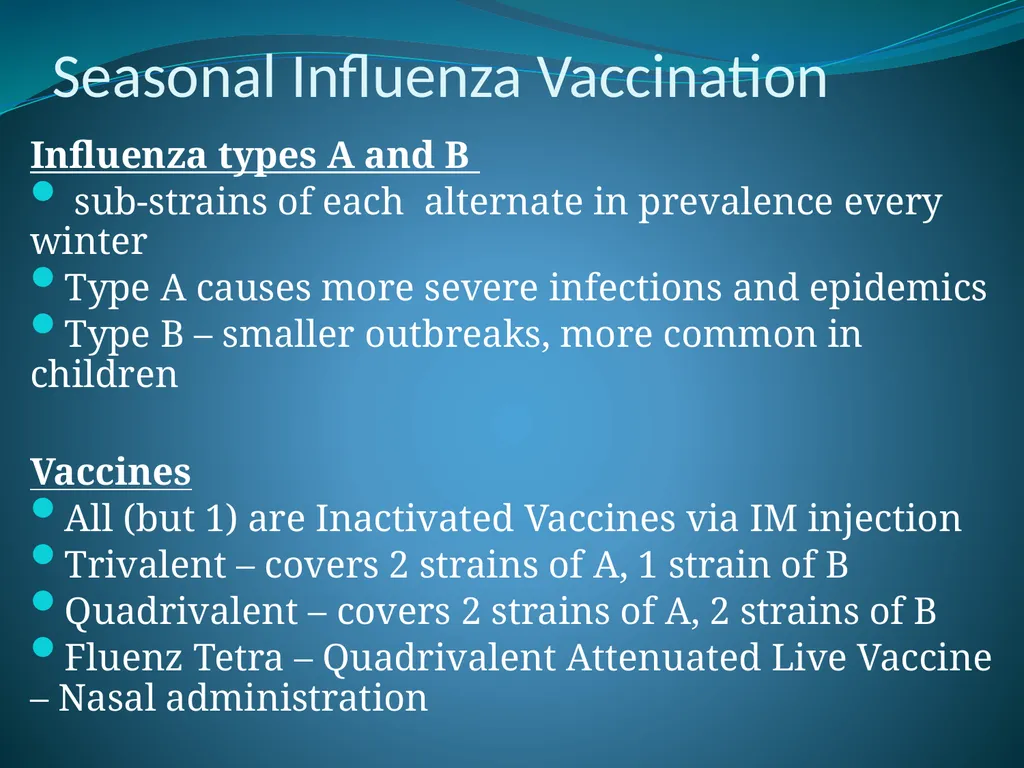
Seasonal Influenza Vaccination Influenza types A and B
sub-strains of each alternate in prevalence every winter
Type A causes more severe infections and epidemics
Type B – smaller outbreaks, more common in children
Vaccines
All (but 1) are Inactivated Vaccines via IM injection
Trivalent – covers 2 strains of A, 1 strain of B
Quadrivalent – covers 2 strains of A, 2 strains of B
Fluenz Tetra – Quadrivalent Attenuated Live Vaccine – Nasal administration<br>
sub-strains of each alternate in prevalence every winter
Type A causes more severe infections and epidemics
Type B – smaller outbreaks, more common in children
Vaccines
All (but 1) are Inactivated Vaccines via IM injection
Trivalent – covers 2 strains of A, 1 strain of B
Quadrivalent – covers 2 strains of A, 2 strains of B
Fluenz Tetra – Quadrivalent Attenuated Live Vaccine – Nasal administration<br>
90
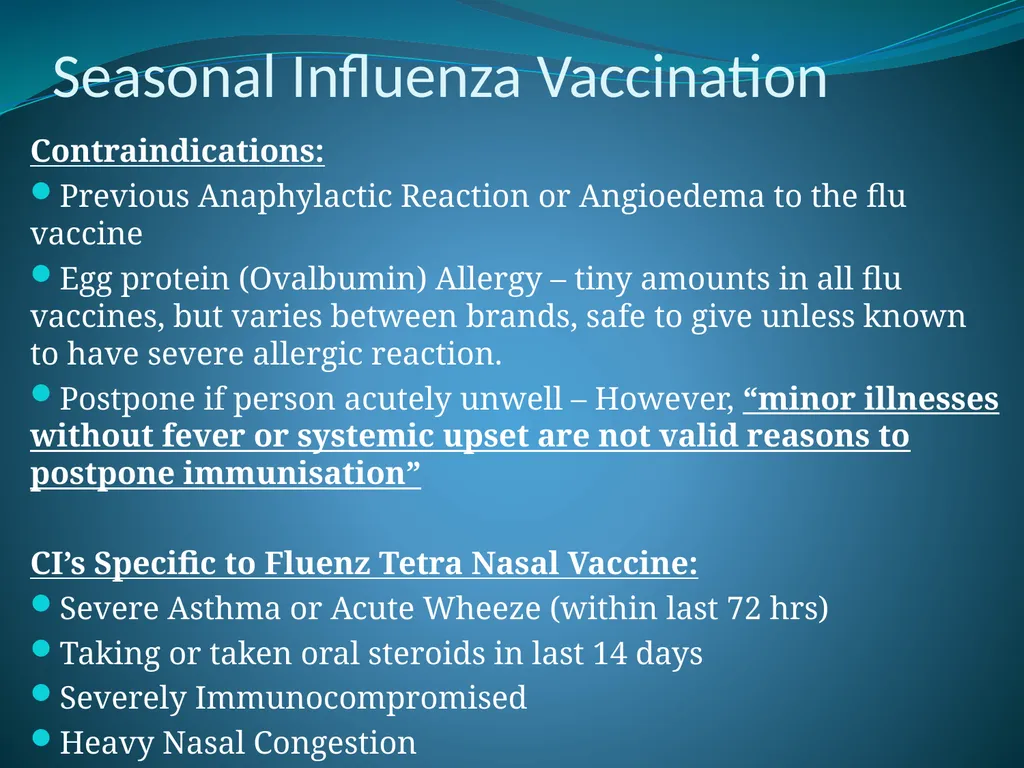
Seasonal Influenza Vaccination Contraindications:
Previous Anaphylactic Reaction or Angioedema to the flu vaccine
Egg protein (Ovalbumin) Allergy – tiny amounts in all flu vaccines, but varies between brands, safe to give unless known to have severe allergic reaction.
Postpone if person acutely unwell – However, “minor illnesses without fever or systemic upset are not valid reasons to postpone immunisation”
CI’s Specific to Fluenz Tetra Nasal Vaccine:
Severe Asthma or Acute Wheeze (within last 72 hrs)
Taking or taken oral steroids in last 14 days
Severely Immunocompromised
Heavy Nasal Congestion<br>
Previous Anaphylactic Reaction or Angioedema to the flu vaccine
Egg protein (Ovalbumin) Allergy – tiny amounts in all flu vaccines, but varies between brands, safe to give unless known to have severe allergic reaction.
Postpone if person acutely unwell – However, “minor illnesses without fever or systemic upset are not valid reasons to postpone immunisation”
CI’s Specific to Fluenz Tetra Nasal Vaccine:
Severe Asthma or Acute Wheeze (within last 72 hrs)
Taking or taken oral steroids in last 14 days
Severely Immunocompromised
Heavy Nasal Congestion<br>
91
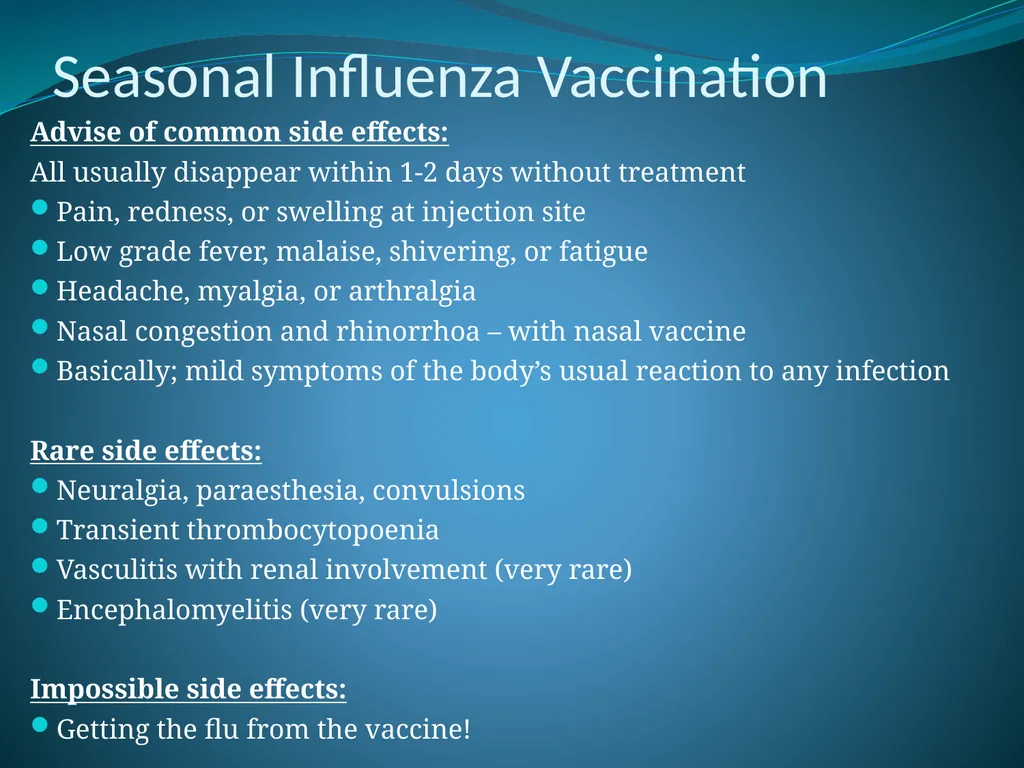
Seasonal Influenza Vaccination Advise of common side effects:
All usually disappear within 1-2 days without treatment
Pain, redness, or swelling at injection site
Low grade fever, malaise, shivering, or fatigue
Headache, myalgia, or arthralgia
Nasal congestion and rhinorrhoa – with nasal vaccine
Basically; mild symptoms of the body’s usual reaction to any infection
Rare side effects:
Neuralgia, paraesthesia, convulsions
Transient thrombocytopoenia
Vasculitis with renal involvement (very rare)
Encephalomyelitis (very rare)
Impossible side effects:
Getting the flu from the vaccine!<br>
All usually disappear within 1-2 days without treatment
Pain, redness, or swelling at injection site
Low grade fever, malaise, shivering, or fatigue
Headache, myalgia, or arthralgia
Nasal congestion and rhinorrhoa – with nasal vaccine
Basically; mild symptoms of the body’s usual reaction to any infection
Rare side effects:
Neuralgia, paraesthesia, convulsions
Transient thrombocytopoenia
Vasculitis with renal involvement (very rare)
Encephalomyelitis (very rare)
Impossible side effects:
Getting the flu from the vaccine!<br>
92
COPD – Key Features Symptoms:
- Wheeze - Chest Tightness
- Cough - Breathlessness
- Sputum - Recurrent chest infections
Quality of the Symptoms:
- Progressive – inevitable and incurable
- >35 years old
- No clear pattern of Variation (but can be worse at night)
- Poor response to bronchodilators
- Exacerbations triggered by e.g. Exercise, infection, cold air
Complications:
- Disability - Impaired Quality of Life
- Depression - Anxiety
- Cor Pulmonale - Secondary Polycythaemia
- Lung Cancer - Type 2 Respiratory Failure<br>
- Wheeze - Chest Tightness
- Cough - Breathlessness
- Sputum - Recurrent chest infections
Quality of the Symptoms:
- Progressive – inevitable and incurable
- >35 years old
- No clear pattern of Variation (but can be worse at night)
- Poor response to bronchodilators
- Exacerbations triggered by e.g. Exercise, infection, cold air
Complications:
- Disability - Impaired Quality of Life
- Depression - Anxiety
- Cor Pulmonale - Secondary Polycythaemia
- Lung Cancer - Type 2 Respiratory Failure<br>
93
Question 14 Which of the following is not a recognised risk factor for developing COPD?
More then one answer may apply
Occupational Exposure (e.g. Welder) in non-smokers
Occupational Exposure (e.g. Welder) in smokers
Homozygous alpha-1 antitrypsin deficiency
Heterozygous alpha-1 antitrypsin deficiency
Passive smoking
E-cigarettes
Obesity (BMI>30)
Air pollution<br>
More then one answer may apply
Occupational Exposure (e.g. Welder) in non-smokers
Occupational Exposure (e.g. Welder) in smokers
Homozygous alpha-1 antitrypsin deficiency
Heterozygous alpha-1 antitrypsin deficiency
Passive smoking
E-cigarettes
Obesity (BMI>30)
Air pollution<br>
94
Question 14 Which of the following is not a recognised risk factor for developing COPD?
More then one answer may apply
Occupational Exposure (e.g. Welder) in non-smokers
Occupational Exposure (e.g. Welder) in smokers
Homozygous alpha-1 antitrypsin deficiency
Heterozygous alpha-1 antitrypsin deficiency
Passive smoking
E-cigarettes (not yet anyway)
Obesity (BMI>30)
Air pollution<br>
More then one answer may apply
Occupational Exposure (e.g. Welder) in non-smokers
Occupational Exposure (e.g. Welder) in smokers
Homozygous alpha-1 antitrypsin deficiency
Heterozygous alpha-1 antitrypsin deficiency
Passive smoking
E-cigarettes (not yet anyway)
Obesity (BMI>30)
Air pollution<br>
95
Risk Factors for COPD SMOKING
But non-smokers can get COPD too:
Occupation exposures
Dust, noxious chemicals, welding fumes, particles of grains or silica, coal
20% COPD cases linked to occupational causes
Air Pollution
Particularly in developing countries that use wood or coal for household heating
Less of a factor in UK
However – vehicle pollution is linked to ↓lung function<br>
But non-smokers can get COPD too:
Occupation exposures
Dust, noxious chemicals, welding fumes, particles of grains or silica, coal
20% COPD cases linked to occupational causes
Air Pollution
Particularly in developing countries that use wood or coal for household heating
Less of a factor in UK
However – vehicle pollution is linked to ↓lung function<br>
96
Risk Factors for COPD Alpha-1 Antitrypsin Deficiency
Only confirmed genetic cause of COPD
WBC’s produce Trypsin enzyme to move between other cells and to break down bacteria or react to toxins e.g. Tobacco smoke
Antitrypsin stops trypsin damaging healthy lung tissue.
Genetics:
Autosomal Co-dominent – severity of disease depends on combination of genes inherited as both will be expressed
Simplified verion- Three forms of the A1A gene:
M = normal levels, Z = deficiency, S = mild deficiency
Homozygous A1AD (ZZ genotype)
Develop COPD under age of 45
Liver disease – (tends to be in most severe form and presents in childhood)
Heterozygous or mild homozygous A1AD (MZ, SZ, MS, SS genotypes)
rarely diagnosed but may explain why some people are more prone to COPD
Won’t necessarily develop COPD or any lung disease<br>
Only confirmed genetic cause of COPD
WBC’s produce Trypsin enzyme to move between other cells and to break down bacteria or react to toxins e.g. Tobacco smoke
Antitrypsin stops trypsin damaging healthy lung tissue.
Genetics:
Autosomal Co-dominent – severity of disease depends on combination of genes inherited as both will be expressed
Simplified verion- Three forms of the A1A gene:
M = normal levels, Z = deficiency, S = mild deficiency
Homozygous A1AD (ZZ genotype)
Develop COPD under age of 45
Liver disease – (tends to be in most severe form and presents in childhood)
Heterozygous or mild homozygous A1AD (MZ, SZ, MS, SS genotypes)
rarely diagnosed but may explain why some people are more prone to COPD
Won’t necessarily develop COPD or any lung disease<br>
97
E-cigarettes Big gaps in evidence
Big opportunity for misinformation to thrive
Big opportunity to make money in the confusion
Key points:
They are safe: In that they meet the minimum requirements of safety in order to be sold. But so does tobacco
Produce less carcinogenic substances then tobacco –therefore the RCP and NICE support their use in smoking cessation (but not as a “safe” alternative to smoking)
Liquid cartridge usually contain nicotine, propylene glycol, glycerol, water, and “flavourings” – No evidence on the long term effects of these (alone or in combination)
Battery powered heater produces the vapour – no evidence on environmental impact<br>
Big opportunity for misinformation to thrive
Big opportunity to make money in the confusion
Key points:
They are safe: In that they meet the minimum requirements of safety in order to be sold. But so does tobacco
Produce less carcinogenic substances then tobacco –therefore the RCP and NICE support their use in smoking cessation (but not as a “safe” alternative to smoking)
Liquid cartridge usually contain nicotine, propylene glycol, glycerol, water, and “flavourings” – No evidence on the long term effects of these (alone or in combination)
Battery powered heater produces the vapour – no evidence on environmental impact<br>
98
E-cigarettes – Deaths in USA Centre for Disease Control and Prevention (CDC) update:
As of Oct 2019 – 1,479 case of “lung injury” reported
79% of patients were under 35 years old
33 deaths confirmed related to e-cigarettes
Most of these patients reported use of THC containing products (either shop bought or off the street)
Advise against use of all e-cigarettes as exact cause not yet known
Flavoured liquids / devices are suspected to be a cause – lawmakers planning to temporarily remove from sale (possibly a move to encourage tighter regulation - FDA pretty relaxed so far)
UK / EU have tighter regulation – hence RCP/PHE still advise that e-cigarettes are safe and advocate their use in tobacco smoking cessation<br>
As of Oct 2019 – 1,479 case of “lung injury” reported
79% of patients were under 35 years old
33 deaths confirmed related to e-cigarettes
Most of these patients reported use of THC containing products (either shop bought or off the street)
Advise against use of all e-cigarettes as exact cause not yet known
Flavoured liquids / devices are suspected to be a cause – lawmakers planning to temporarily remove from sale (possibly a move to encourage tighter regulation - FDA pretty relaxed so far)
UK / EU have tighter regulation – hence RCP/PHE still advise that e-cigarettes are safe and advocate their use in tobacco smoking cessation<br>
99
Question 15 You are suspecting COPD in a 60 year old smoker with progressive exertional breathlessness over 6 months.
What tests should be performed in all cases according to NICE? More than one answer may be correct
Post Bronchodilator Spirometry
Chest X-ray
FeNO
PEFR
Pre and Post Bronchodilator Spirometry
ECG
Full Blood Count
Pulse Oximetry<br>
What tests should be performed in all cases according to NICE? More than one answer may be correct
Post Bronchodilator Spirometry
Chest X-ray
FeNO
PEFR
Pre and Post Bronchodilator Spirometry
ECG
Full Blood Count
Pulse Oximetry<br>
100
Question 15 You are suspecting COPD in a 60 year old smoker with progressive exertional breathlessness over 6 months.
What tests should be performed in all cases according to NICE? More than one answer may be correct
Post Bronchodilator Spirometry
Chest X-ray
FeNO
PEFR
Pre and Post Bronchodilator Spirometry
ECG
Full Blood Count
Pulse Oximetry<br>
What tests should be performed in all cases according to NICE? More than one answer may be correct
Post Bronchodilator Spirometry
Chest X-ray
FeNO
PEFR
Pre and Post Bronchodilator Spirometry
ECG
Full Blood Count
Pulse Oximetry<br>
101
Diagnosing COPD – NICE Guidelines Arrange the following for all people with suspected COPD:
Post Bronchodilator Spirometry
- FEV1:FVC <70% (<0.7) confirms diagnosis
- Reversibility testing not recommended
Chest X-ray
- Exclude differential diagnoses
Full Blood Count
- Pick up anaemia or secondary polycythaemia
Arrange the following additional investigations where appropriate:
Pulse Oximetry – What’s normal?
ECG + Echocardiogram – if signs of cor pulmonale
Sputum Culture – if purulent sputum is persistent feature<br>
Post Bronchodilator Spirometry
- FEV1:FVC <70% (<0.7) confirms diagnosis
- Reversibility testing not recommended
Chest X-ray
- Exclude differential diagnoses
Full Blood Count
- Pick up anaemia or secondary polycythaemia
Arrange the following additional investigations where appropriate:
Pulse Oximetry – What’s normal?
ECG + Echocardiogram – if signs of cor pulmonale
Sputum Culture – if purulent sputum is persistent feature<br>
102
COPD Severity Graded using the FEV1
Stage 1 – Mild FEV1 >80% predicted
Stage 2 – Moderate FEV1 50-79% predicted
Stage 3 – Severe FEV1 30-49% predicted
Stage 4 – Very Severe FEV1 <30% predicted<br>
Stage 1 – Mild FEV1 >80% predicted
Stage 2 – Moderate FEV1 50-79% predicted
Stage 3 – Severe FEV1 30-49% predicted
Stage 4 – Very Severe FEV1 <30% predicted<br>
103
COPD Severity MRC Dyspnoea Scale is also helpful (recommended by NICE)<br>
104
Question 16 You review a 65 year old COPD sufferer who is having persistent breathlessness despite using Terbutaline (SABA) PRN.
According to NICE guidance, which of the following could be added next?
LABA (e.g. Salmeterol)
ICS (e.g. Budesonide)
SAMA (e.g. Ipratropium)
LABA + ICS (e.g. Sirdupla)
LAMA (e.g. Tiotropium – Spiriva)
LAMA + LABA (e.g. Spiolto Respimat)
LTRA (e.g. Montelukast)
LABA + LAMA + ICS (e.g. Trelegy)<br>
According to NICE guidance, which of the following could be added next?
LABA (e.g. Salmeterol)
ICS (e.g. Budesonide)
SAMA (e.g. Ipratropium)
LABA + ICS (e.g. Sirdupla)
LAMA (e.g. Tiotropium – Spiriva)
LAMA + LABA (e.g. Spiolto Respimat)
LTRA (e.g. Montelukast)
LABA + LAMA + ICS (e.g. Trelegy)<br>
105
Question 16 You review a 65 year old COPD sufferer who is having persistent breathlessness despite using Terbutaline (SABA) PRN.
According to NICE guidance, which of the following could be added next?
LABA (e.g. Salmeterol)
ICS (e.g. Budesonide)
SAMA (e.g. Ipratropium)
LABA + ICS (e.g. Sirdupla)
LAMA (e.g. Tiotropium – Spiriva)
LAMA + LABA (e.g. Spiolto Respimat)
LTRA (e.g. Montelukast)
LABA + LAMA + ICS (e.g. Trelegy)<br>
According to NICE guidance, which of the following could be added next?
LABA (e.g. Salmeterol)
ICS (e.g. Budesonide)
SAMA (e.g. Ipratropium)
LABA + ICS (e.g. Sirdupla)
LAMA (e.g. Tiotropium – Spiriva)
LAMA + LABA (e.g. Spiolto Respimat)
LTRA (e.g. Montelukast)
LABA + LAMA + ICS (e.g. Trelegy)<br>
106
Managing COPD – NICE Guidelines<br>
107
Managing COPD – NICE Guidelines<br>
108
Managing COPD – NICE Guidelines 2018 What about LABA or LAMA alone?
Combination inhalers more effective
Should not be prescribing LABA or LAMA alone
When to step up treatment?
>2 exacerbations in last year
1 hospitalisation as a result of COPD exacerbation
Still symptomatic (use MRC scale to judge)
What to check before stepping up?
Smoking?
Inhaler technique - ?need different device<br>
Combination inhalers more effective
Should not be prescribing LABA or LAMA alone
When to step up treatment?
>2 exacerbations in last year
1 hospitalisation as a result of COPD exacerbation
Still symptomatic (use MRC scale to judge)
What to check before stepping up?
Smoking?
Inhaler technique - ?need different device<br>
109
Managing COPD Lifestyle Advice
Stop Smoking
Promote Exercise
Dietary Advice
Preventation + Screening
Immunisation – Seasonal Flu + Pneumococcal (single dose)
Screen for Depression + Anxiety
Screen for Heart Failure
Social, Physio, Occupational Therapy needs?
Pulmonary Rehabilitation
Consider for anyone suffering with breathlessness
https://www.youtube.com/watch?v=8x6Er-ifaXM<br>
Stop Smoking
Promote Exercise
Dietary Advice
Preventation + Screening
Immunisation – Seasonal Flu + Pneumococcal (single dose)
Screen for Depression + Anxiety
Screen for Heart Failure
Social, Physio, Occupational Therapy needs?
Pulmonary Rehabilitation
Consider for anyone suffering with breathlessness
https://www.youtube.com/watch?v=8x6Er-ifaXM<br>
110
Managing COPD – Other Therapies Mucolytics
Consider if chronic productive cough with difficulty expectorating
Carbocisteine
- 750mg TDS for 4 weeks
- if “successful” then continue but reduce to 750mg BD
- if no response – STOP
Macrolides e.g. Azithromycin
- Only initiated by Secondary Care
Nebulised Saline
- Only initiated by Secondary Care
- Minimal impact with normal (0.9%) saline
- Need Hypertonic for significant effect<br>
Consider if chronic productive cough with difficulty expectorating
Carbocisteine
- 750mg TDS for 4 weeks
- if “successful” then continue but reduce to 750mg BD
- if no response – STOP
Macrolides e.g. Azithromycin
- Only initiated by Secondary Care
Nebulised Saline
- Only initiated by Secondary Care
- Minimal impact with normal (0.9%) saline
- Need Hypertonic for significant effect<br>
111
Managing COPD – Other Therapies Theophylline
Consider when persistent bronchospasm (wheeze) despite max inhaled therapy.
E.g. Uniphyllin MR – starting dose 200mg BD
Need to monitor levels (target 10-20mg/L)
Toxicity can cause: Nausea, Tachycardia, Arrhytmia, Hypokalaemia, Irritability, Seizures<br>
Consider when persistent bronchospasm (wheeze) despite max inhaled therapy.
E.g. Uniphyllin MR – starting dose 200mg BD
Need to monitor levels (target 10-20mg/L)
Toxicity can cause: Nausea, Tachycardia, Arrhytmia, Hypokalaemia, Irritability, Seizures<br>
112
Managing COPD – Other Therapies Phosphodiesterase type-4 inhibitors
E.g. Roflumilast (only PDE4i licensed for severe COPD)
PDE4 breaks down anti-inflammatory enzymes and therefore promotes inflammation
In severe COPD – reduces exacerbations and improves FEV1
Only started by secondary care
Roflumilast 500mcg OD – 30 tablets cost £37
Side effects: Weight loss, insomnia, headache, GI upset
Interacts with Theophylline – don’t co-prescribe<br>
E.g. Roflumilast (only PDE4i licensed for severe COPD)
PDE4 breaks down anti-inflammatory enzymes and therefore promotes inflammation
In severe COPD – reduces exacerbations and improves FEV1
Only started by secondary care
Roflumilast 500mcg OD – 30 tablets cost £37
Side effects: Weight loss, insomnia, headache, GI upset
Interacts with Theophylline – don’t co-prescribe<br>
113
COPD – When to Refer (Bolton CCG) Diagnostic Uncertainty
Severe/Worsening COPD
Haemoptysis
Frequent respiratory infections
Suspected Cor Pulmonale
Symptoms don’t match Spirometry results
Age <40 or FH of A1AD
Assessment for Nebuliser / Home Oxygen Therapy<br>
Severe/Worsening COPD
Haemoptysis
Frequent respiratory infections
Suspected Cor Pulmonale
Symptoms don’t match Spirometry results
Age <40 or FH of A1AD
Assessment for Nebuliser / Home Oxygen Therapy<br>
114
Question 17 Which of the following is a benefit of Long Term Oxygen Therapy in COPD?
More then one answer may be correct
Improved sleep
Reduced anxiety
Reduced breathlessness
Improved mood
Improved life expectancy
Reduced cough
Reduced hospital admissions<br>
More then one answer may be correct
Improved sleep
Reduced anxiety
Reduced breathlessness
Improved mood
Improved life expectancy
Reduced cough
Reduced hospital admissions<br>
115
Question 17 Which of the following is a benefit of Long Term Oxygen Therapy in COPD?
More then one answer may be correct
Improved sleep
Reduced anxiety
Reduced breathlessness
Improved mood
Improved life expectancy
Reduced cough
Reduced hospital admissions<br>
More then one answer may be correct
Improved sleep
Reduced anxiety
Reduced breathlessness
Improved mood
Improved life expectancy
Reduced cough
Reduced hospital admissions<br>
116
COPD – Oxygen Therapy (BTS) Treatment for Chronic Hypoxaemia (PaO2 <7.3kPa)
Does not relieve breathlessness
Different types:
LTOT – Long Term Oxygen Therapy
- at least 15 hours a day. 0.5-2L flow rate
- increases life expectancy and improves sleep
- improves outcomes in Cor Pulmonale, Polcythaemia, and Pulmonary Hypertension
- Use in Hypercapnic patients does not increase mortality
- No impact on hospitalizations or mood/anxiety
Ambulatory Oxygen
- Portable, improves quality of life
- Rarely used if patient doesn’t qualify for LTOT<br>
Does not relieve breathlessness
Different types:
LTOT – Long Term Oxygen Therapy
- at least 15 hours a day. 0.5-2L flow rate
- increases life expectancy and improves sleep
- improves outcomes in Cor Pulmonale, Polcythaemia, and Pulmonary Hypertension
- Use in Hypercapnic patients does not increase mortality
- No impact on hospitalizations or mood/anxiety
Ambulatory Oxygen
- Portable, improves quality of life
- Rarely used if patient doesn’t qualify for LTOT<br>
117
COPD – Oxygen Therapy (BTS) When to refer for LTOT:
Baseline oxygen saturations <92% on air
Very Severe airflow obstruction – FEV1 <30%
Peripheral Oedema or Raised JVP (Cor Pulmonale)
Secondary Polycythaemia
Cyanosis
Refer to Respiratory Nurses – BART
When not to refer – if they still smoke!<br>
Baseline oxygen saturations <92% on air
Very Severe airflow obstruction – FEV1 <30%
Peripheral Oedema or Raised JVP (Cor Pulmonale)
Secondary Polycythaemia
Cyanosis
Refer to Respiratory Nurses – BART
When not to refer – if they still smoke!<br>
118
Oxygen Therapy (BTS) – other uses Short Burst Oxygen
- 10-20 minute bursts of high flow oxygen e.g. 12L
- Not recommended for use in exertional breathlessness by BTS
- But NICE say “consider for people not eligible for LTOT who have episodes of severe breathlessness not relieved by other treatments”
- used for symptomatic relief in Cluster Headache
Palliative Oxygen
- Considered for breathlessness in terminal disease
- Only of benefit in hypoxaemic breathless patients
- Even then studies show little benefit on reducing symptoms
Other options for Dyspnoea in Palliative Care:
- Opiates e.g. Low doses of morphine PRN
- Clonazepam drops
- Fan therapy and CBT are other options
- Refer to palliative care<br>
- 10-20 minute bursts of high flow oxygen e.g. 12L
- Not recommended for use in exertional breathlessness by BTS
- But NICE say “consider for people not eligible for LTOT who have episodes of severe breathlessness not relieved by other treatments”
- used for symptomatic relief in Cluster Headache
Palliative Oxygen
- Considered for breathlessness in terminal disease
- Only of benefit in hypoxaemic breathless patients
- Even then studies show little benefit on reducing symptoms
Other options for Dyspnoea in Palliative Care:
- Opiates e.g. Low doses of morphine PRN
- Clonazepam drops
- Fan therapy and CBT are other options
- Refer to palliative care<br>
119
Question 18 The receptionist asks you to urgently see a COPD patient with 2 days of breathlessness, who has become more SOB in the waiting room. They take Trelegy and are getting no relief from salbutamol. Their observations are: T 36.7, pulse 86 reg, BP 109/62, RR 28, O2 sats 86%. They look tired, are pursed lip breathing, and using accessory muscles. On auscultation there is wide spread wheeze and prolonged expiration.
What should you do first?
Give 10 puffs Salbutamol via spacer
Call 999
Give oxygen – target sats >94%
Give oxygen – target sats 88-92%
Give Salbutamol 5mg Neb<br>
What should you do first?
Give 10 puffs Salbutamol via spacer
Call 999
Give oxygen – target sats >94%
Give oxygen – target sats 88-92%
Give Salbutamol 5mg Neb<br>
120
Question 18 The receptionist asks you to urgently see a COPD patient with 2 days of breathlessness, who has become more SOB in the waiting room. They take Trelegy and are getting no relief from salbutamol. Their observations are: T 36.7, pulse 86 reg, BP 109/62, RR 28, O2 sats 86%. They look tired, are pursed lip breathing, and using accessory muscles. On auscultation there is wide spread wheeze and prolonged expiration.
What should you do first?
Give 10 puffs Salbutamol via spacer
Call 999
Give oxygen – target sats >94%
Give oxygen – target sats 88-92%
Give Salbutamol 5mg Neb<br>
What should you do first?
Give 10 puffs Salbutamol via spacer
Call 999
Give oxygen – target sats >94%
Give oxygen – target sats 88-92%
Give Salbutamol 5mg Neb<br>
121
Acute Exacerbations of COPD Signs of Severe Exacerbation
- O2 sats <90% - use of accessory muscles
- RR >25 - pursed lip breathing - Confusion
- Cyanosis - Peripheral oedema - ↓ ↓ET
Emergency Management
- Nebulised Salbutamol 5mg
- Oxygen – aim sats 88-92% (NICE)
- Most will need admission
- If stabilising can consider community management e.g. Admissions Avoidance Team
- Should there be a bigger push towards community management?<br>
- O2 sats <90% - use of accessory muscles
- RR >25 - pursed lip breathing - Confusion
- Cyanosis - Peripheral oedema - ↓ ↓ET
Emergency Management
- Nebulised Salbutamol 5mg
- Oxygen – aim sats 88-92% (NICE)
- Most will need admission
- If stabilising can consider community management e.g. Admissions Avoidance Team
- Should there be a bigger push towards community management?<br>
122
Acute Exacerbations of COPD Managing in Primary Care
Increase dose/freqency of SABA
e.g. 4 puffs 4 hourly – best via spacer
Oral Corticosteroids
Prednisolone 30mg OD for 7-14 days
Oral Antibiotics
Only if purulent sputum
1st line – Amoxicillin 500mg TDS for 5 days
Pen Allergy – Clarithromycin
2nd line – Doxycycline 200mg then 100mg OD 5 day course<br>
Increase dose/freqency of SABA
e.g. 4 puffs 4 hourly – best via spacer
Oral Corticosteroids
Prednisolone 30mg OD for 7-14 days
Oral Antibiotics
Only if purulent sputum
1st line – Amoxicillin 500mg TDS for 5 days
Pen Allergy – Clarithromycin
2nd line – Doxycycline 200mg then 100mg OD 5 day course<br>
123
Rescue Packs Don’t prescribe without educating:
How to recognise an exacerbation
- SOB, wheeze, cough, ↓ET, ↑sputum
Infective vs Non-infective?
- Purulent sputum (yellow/brown) - change in sputum
What to do before starting the rescue pack?
- increase SABA - Breathing exercises
When to start steroids?
- if the above measures aren’t helping
When to start antibiotics?
- only if purulent sputum
Important points:
Never put on repeat prescription
If had >3 courses of steroids in 12 months and >65 – will need bone protection<br>
How to recognise an exacerbation
- SOB, wheeze, cough, ↓ET, ↑sputum
Infective vs Non-infective?
- Purulent sputum (yellow/brown) - change in sputum
What to do before starting the rescue pack?
- increase SABA - Breathing exercises
When to start steroids?
- if the above measures aren’t helping
When to start antibiotics?
- only if purulent sputum
Important points:
Never put on repeat prescription
If had >3 courses of steroids in 12 months and >65 – will need bone protection<br>
124
Bronchiectasis What is it?
Chronic - Dilated, thick walled bronchi
Excess sputum and cilliary dysfunction
What causes it?
Any prolonged condition that damages the lungs
Affects up to 30% of COPD sufferers
Commonest cause is severe LRTI
Other causes: CF, aspiration, ABPA, Asthma, RA, Immune deficiency
When to suspect it?
Chronic excess sputum production – persistent cough
Unusual sputum results e.g. Pseudamonas
Prolonged LRTIs – requiring extended courses of antibiotics<br>
Chronic - Dilated, thick walled bronchi
Excess sputum and cilliary dysfunction
What causes it?
Any prolonged condition that damages the lungs
Affects up to 30% of COPD sufferers
Commonest cause is severe LRTI
Other causes: CF, aspiration, ABPA, Asthma, RA, Immune deficiency
When to suspect it?
Chronic excess sputum production – persistent cough
Unusual sputum results e.g. Pseudamonas
Prolonged LRTIs – requiring extended courses of antibiotics<br>
125
Bronchiectasis Diagnosis
Can only be confirmed by High Resolution CT
But do we need to refer everyone to respiratory?
- NICE says yes, especially if young
- All will need: CXR, Spirometry, and sputum cultures to exclude alternative causes first
But e.g.
- COPD patient with prolonged exacerbations – confirming the diagnosis won’t change much – can suspect bronchiectasis and manage by checking sputum and Rx longer courses of antibiotics
Worth remembering that up to 30% COPD sufferers may need 10-14 day courses of antibiotics and better to send sputum before treating<br>
Can only be confirmed by High Resolution CT
But do we need to refer everyone to respiratory?
- NICE says yes, especially if young
- All will need: CXR, Spirometry, and sputum cultures to exclude alternative causes first
But e.g.
- COPD patient with prolonged exacerbations – confirming the diagnosis won’t change much – can suspect bronchiectasis and manage by checking sputum and Rx longer courses of antibiotics
Worth remembering that up to 30% COPD sufferers may need 10-14 day courses of antibiotics and better to send sputum before treating<br>
126
Question 19 A 59 year old male smoker attends with a 3 week history of cough. He is frequently coughing up small amounts of blood. He denies breathlessness, chest pain, or sputum production. He has not had any fever or coryzal symptoms. He has not travelled abroad in the last 12 months and has never been exposed to TB. He has no PMH and is not on any medications. Chest examination and all observations are normal.
What should you do?
Admit to medics as suspected PE
Arrange an urgent chest x-ray
2 week wait referral to respiratory
Treat as suspected LRTI and arrange follow up in 1 week
Watch and wait (with safety netting advice)<br>
What should you do?
Admit to medics as suspected PE
Arrange an urgent chest x-ray
2 week wait referral to respiratory
Treat as suspected LRTI and arrange follow up in 1 week
Watch and wait (with safety netting advice)<br>
127
Question 19 A 59 year old male smoker attends with a 3 week history of cough. He is frequently coughing up small amounts of blood. He denies breathlessness, chest pain, or sputum production. He has not had any fever or coryzal symptoms. He has not travelled abroad in the last 12 months and has never been exposed to TB. He has no PMH and is not on any medications. Chest examination and all observations are normal.
What should you do?
Admit to medics as suspected PE
Arrange an urgent chest x-ray
2 week wait referral to respiratory
Treat as suspected LRTI and arrange follow up in 1 week
Watch and wait (with safety netting advice)<br>
What should you do?
Admit to medics as suspected PE
Arrange an urgent chest x-ray
2 week wait referral to respiratory
Treat as suspected LRTI and arrange follow up in 1 week
Watch and wait (with safety netting advice)<br>
128
Suspected Lung Cancer - NICE Refer people using a suspected cancer pathway referral (for an appointment within 2 weeks) for lung cancer if they:
Have chest X-ray findings that suggest lung cancer or
Are aged 40 and over with unexplained haemoptysis<br>
Have chest X-ray findings that suggest lung cancer or
Are aged 40 and over with unexplained haemoptysis<br>
129
Suspected Lung Cancer - NICE Offer urgent Chest X-ray to the following:
Anyone >40 with:
- Finger Clubbing - Persistent chest infection
- Chest signs suggestive of Lung Ca (bronchial BS, unilat ?effusion)
- Thrombocytosis - Supraclavicular lymphadenopathy
Anyone >40 with 2 of, or any smoking history with 1 of;
Unexplained:
- Cough - Fatigue
- Weight Loss - SOB
- Chest Pain - Appetite loss<br>
Anyone >40 with:
- Finger Clubbing - Persistent chest infection
- Chest signs suggestive of Lung Ca (bronchial BS, unilat ?effusion)
- Thrombocytosis - Supraclavicular lymphadenopathy
Anyone >40 with 2 of, or any smoking history with 1 of;
Unexplained:
- Cough - Fatigue
- Weight Loss - SOB
- Chest Pain - Appetite loss<br>
130
Question 20 A 53 year old woman attends with a persistent irritating dry cough for the last 5 weeks. It tends to be worse at night and she reports constantly having a dry throat. She has well controlled hypertension on 5mg Ramipril and has intermittent heart burn for which she occasionally takes OTC Ranitidine. She denies haemoptysis and has never smoked.
What would be the best initial management plan?
Stop the Ramipril and reassess in 2 weeks
Trial regular inhaled corticosteroid
2 week wait referral to respiratory
5 day course of Amoxicillin 500mg TDS
Start Omeprazole 20mg OD regularly and reassess in 1 month<br>
What would be the best initial management plan?
Stop the Ramipril and reassess in 2 weeks
Trial regular inhaled corticosteroid
2 week wait referral to respiratory
5 day course of Amoxicillin 500mg TDS
Start Omeprazole 20mg OD regularly and reassess in 1 month<br>
131
Question 20 A 53 year old woman attends with a persistent irritating dry cough for the last 5 weeks. It tends to be worse at night and she reports constantly having a dry throat. She has well controlled hypertension on 5mg Ramipril and has intermittent heart burn for which she occasionally takes OTC Ranitidine. She denies haemoptysis and has never smoked.
What would be the best initial management plan?
Stop the Ramipril and reassess in 2 weeks
Trial regular inhaled corticosteroid
2 week wait referral to respiratory
5 day course of Amoxicillin 500mg TDS
Start Omeprazole 20mg OD regularly and reassess in 1 month<br>
What would be the best initial management plan?
Stop the Ramipril and reassess in 2 weeks
Trial regular inhaled corticosteroid
2 week wait referral to respiratory
5 day course of Amoxicillin 500mg TDS
Start Omeprazole 20mg OD regularly and reassess in 1 month<br>
132
Cough NICE divides into: I tend to simplify to:
Acute = 0-3 weeks - Acute = 0-4 weeks
Subacute = 3-8 weeks - Persistant = >4 weeks
Chronic = >8 weeks
There is no effective treatment for cough – but can treat the causes
There are lots of potential causes of a persistent cough:
- Asthma - COPD - Post Infective
- Bronchiectasis - Lung Ca - Tuberculosis
- Pertussis - Pneumonia - Bronchitis
- GORD (silent) - ACEi - Post Nasal Drip
- Smoking related - ILD - Heart Failure
- Foreign Body Aspiration - Atypical Pneumonia<br>
Acute = 0-3 weeks - Acute = 0-4 weeks
Subacute = 3-8 weeks - Persistant = >4 weeks
Chronic = >8 weeks
There is no effective treatment for cough – but can treat the causes
There are lots of potential causes of a persistent cough:
- Asthma - COPD - Post Infective
- Bronchiectasis - Lung Ca - Tuberculosis
- Pertussis - Pneumonia - Bronchitis
- GORD (silent) - ACEi - Post Nasal Drip
- Smoking related - ILD - Heart Failure
- Foreign Body Aspiration - Atypical Pneumonia<br>
133
Cough NICE divides into: I tend to simplify to:
Acute = 0-3 weeks - Acute = 0-4 weeks
Subacute = 3-8 weeks - Persistant = >4 weeks
Chronic = >8 weeks
There is no effective treatment for cough – but can treat the causes
There are lots of potential causes of a persistent cough:
- Asthma - COPD - Post Infective
- Bronchiectasis - Lung Ca - Tuberculosis
- Pertussis - Pneumonia - Bronchitis
- GORD (silent) - ACEi - Post Nasal Drip
- Smoking related - ILD - Heart Failure
- Foreign Body Aspiration - Atypical Pneumonia<br>
Acute = 0-3 weeks - Acute = 0-4 weeks
Subacute = 3-8 weeks - Persistant = >4 weeks
Chronic = >8 weeks
There is no effective treatment for cough – but can treat the causes
There are lots of potential causes of a persistent cough:
- Asthma - COPD - Post Infective
- Bronchiectasis - Lung Ca - Tuberculosis
- Pertussis - Pneumonia - Bronchitis
- GORD (silent) - ACEi - Post Nasal Drip
- Smoking related - ILD - Heart Failure
- Foreign Body Aspiration - Atypical Pneumonia<br>
134
Persistent Cough - Assessment Good history is key:
Smoker? - think Lung Cancer or Smoking related
Dry or Productive?
Improving, worsening or stable?
Coughing bouts?
- think Pertussis (+/- inspiratory “whoop” or vomiting)
Any illness at onset
- think Infective (prolonged or post)
Associated symptoms
- Acid brash, heartburn? – think Reflux
- Blocked nose / rhinorrhoea? – think Post nasal drip
- Swallowing difficulty? – think Aspiration
- Cardiac History? – think Heart Failure
- Breathlessness? – think COPD / ILD / Heart Failure
Timing
- Diurnal variation? – think Asthma
- Seasonal? – think Allergic (asthma or rhinitis)<br>
Smoker? - think Lung Cancer or Smoking related
Dry or Productive?
Improving, worsening or stable?
Coughing bouts?
- think Pertussis (+/- inspiratory “whoop” or vomiting)
Any illness at onset
- think Infective (prolonged or post)
Associated symptoms
- Acid brash, heartburn? – think Reflux
- Blocked nose / rhinorrhoea? – think Post nasal drip
- Swallowing difficulty? – think Aspiration
- Cardiac History? – think Heart Failure
- Breathlessness? – think COPD / ILD / Heart Failure
Timing
- Diurnal variation? – think Asthma
- Seasonal? – think Allergic (asthma or rhinitis)<br>
135
Persistent Cough - Assessment Good history is key:
Triggers
- Laying on back / bending forward? – think Reflux
- Allergens – pets? dust? temperature?
Occupation
- Asbestos exposure? – think ILD / Mesothelioma
- Coal Miner? – think Pneumoconiosis
- Baker? – Occupational Asthma
Foreign Travel
- Cruise/Hotel – anyone else unwell? – think Legionella
- TB exposure?
Drugs
- ACEi – short or long term us
- Long term Nitrofurantoin – cause of Pulmonary Fibrosis
Red Flags:
- Haemoptysis -Weight loss<br>
Triggers
- Laying on back / bending forward? – think Reflux
- Allergens – pets? dust? temperature?
Occupation
- Asbestos exposure? – think ILD / Mesothelioma
- Coal Miner? – think Pneumoconiosis
- Baker? – Occupational Asthma
Foreign Travel
- Cruise/Hotel – anyone else unwell? – think Legionella
- TB exposure?
Drugs
- ACEi – short or long term us
- Long term Nitrofurantoin – cause of Pulmonary Fibrosis
Red Flags:
- Haemoptysis -Weight loss<br>
136
Persistent Cough - Assessment Investigations – my approach:
Chest X-ray
- Consider for any cough lasting >4 weeks
- Rule out Lung Ca, Pneumonia, ILD
Spirometry
- If any features of asthma
- If any exertional breathlessness suggestive of COPD/ILD
Sputum Culture
- If any sputum production<br>
Chest X-ray
- Consider for any cough lasting >4 weeks
- Rule out Lung Ca, Pneumonia, ILD
Spirometry
- If any features of asthma
- If any exertional breathlessness suggestive of COPD/ILD
Sputum Culture
- If any sputum production<br>
137
Persistent Cough - Assessment Normal CXR +/- Normal Spirometry:
Features of Reflux?
- Trial PPI for 1-2 months
- e.g. Omeprazole 20mg OD
Features of Post Nasal Drip / Allergic Rhinitis
- Trial steroid nasal spray for 3 months
- e.g. Mometasone 50mcg OD
- Other options – Ipratropium Nasal Spray (Rinatec)
On ACEi with no features of any other cause?
- Stop ACEi and review in 4 weeks<br>
Features of Reflux?
- Trial PPI for 1-2 months
- e.g. Omeprazole 20mg OD
Features of Post Nasal Drip / Allergic Rhinitis
- Trial steroid nasal spray for 3 months
- e.g. Mometasone 50mcg OD
- Other options – Ipratropium Nasal Spray (Rinatec)
On ACEi with no features of any other cause?
- Stop ACEi and review in 4 weeks<br>
138
“Treatments” for Cough Dextromethorphan
- Active ingredient in most cough mixtures
- Minimal evidence of efficacy – therefore NOT recommended by NICE
Sedating Antihistamines
- Another ingredient in OTC cough mixtures
- Effects probably due to sedation rather then any antitussive effect
Expectorants – claim to help clear secretions – no evidence they do this
Demulcent preparation – “soothing” properties – may sooth but still cough
Simple Linctus
- Main ingredient is Citric Acid – no evidence of efficacy – don’t prescribe
Codeine
- All opiates suppress cough – but not particularly well
- Lot of SE’s and risk of dependence
- Rarely prescribed but can try if e.g. Poor sleep due to coughing (short term)
Palliative Care
- Morphine can be useful in terminal Lung Cancer<br>
- Active ingredient in most cough mixtures
- Minimal evidence of efficacy – therefore NOT recommended by NICE
Sedating Antihistamines
- Another ingredient in OTC cough mixtures
- Effects probably due to sedation rather then any antitussive effect
Expectorants – claim to help clear secretions – no evidence they do this
Demulcent preparation – “soothing” properties – may sooth but still cough
Simple Linctus
- Main ingredient is Citric Acid – no evidence of efficacy – don’t prescribe
Codeine
- All opiates suppress cough – but not particularly well
- Lot of SE’s and risk of dependence
- Rarely prescribed but can try if e.g. Poor sleep due to coughing (short term)
Palliative Care
- Morphine can be useful in terminal Lung Cancer<br>