
Respiratory syncytial virus (RSV) immunisation for
EM
Published · 39 slides · 0 views

1 / 1







Description
Respiratory syncytial virus (RSV) immunisation for pregnant women for the protection of infants Acknowledgments to UK Health Security Agency (UKHSA) for use of their training slides Contents Key messages Respiratory syncytial virus (RSV);
Related Topics
Download this presentation From Below
"Respiratory syncytial virus (RSV) immunisation for" is the property of its rightful owner. Permission is granted to download and print the materials on this website for personal, non-commercial use only, and to display it on your personal computer provided you do not modify the materials and that you retain all copyright notices contained in the materials. By downloading content from our website, you accept the terms of this agreement.
Share
Embed code
Presentation Transcript
01
Respiratory syncytial virus (RSV)
immunisation for
pregnant women
for the protection of infants Acknowledgments to UK Health Security Agency (UKHSA) for use of their training slides<br>
02
Contents Key messages
Respiratory syncytial virus (RSV); symptoms, complications and epidemiology
RSV immunisation programme for pregnant women
Vaccine specific information
Additional resources<br>
Respiratory syncytial virus (RSV); symptoms, complications and epidemiology
RSV immunisation programme for pregnant women
Vaccine specific information
Additional resources<br>
03
Key messages Respiratory syncytial virus (RSV) is a major cause of respiratory illness in the population, accounting for approximately 33,500 hospitalisations annually in children aged under 5 years old
RSV can be particularly dangerous for infants and the elderly population, who are more likely to require intensive care admission
RSV results in 20 to 30 infant deaths per year in the United Kingdom (UK)<br>
RSV can be particularly dangerous for infants and the elderly population, who are more likely to require intensive care admission
RSV results in 20 to 30 infant deaths per year in the United Kingdom (UK)<br>
04
Key messages (continued) RSV vaccines have been developed, and they have now been rigorously tested for safety and efficacy
the Joint Committee for Immunisation and Vaccination (JCVI) recommend RSV vaccination in pregnant women from 28 weeks gestation for the protection of their infant
RSV vaccination should be offered throughout the year, and in each new pregnancy, to offer the best protection to the baby
the universal RSV vaccination programmes are projected to have substantial health benefits; saving lives and significantly reducing burden on the National Health Service (NHS) during the challenging winter months<br>
the Joint Committee for Immunisation and Vaccination (JCVI) recommend RSV vaccination in pregnant women from 28 weeks gestation for the protection of their infant
RSV vaccination should be offered throughout the year, and in each new pregnancy, to offer the best protection to the baby
the universal RSV vaccination programmes are projected to have substantial health benefits; saving lives and significantly reducing burden on the National Health Service (NHS) during the challenging winter months<br>
05
Respiratory syncytial virus (RSV) Respiratory syncytial virus (RSV) is a single-stranded RNA virus that is a common cause of respiratory tract infections
humans are the only known reservoir of RSV
RSV is highly infectious and is transmitted via respiratory droplets (coughing and sneezing), through close contact with an infected person, or contact with contaminated surfaces
the incubation period varies from 2 to 8 days (average 3 to 5 days)
the virus usually causes mild, cold-like symptoms, however it can cause very serious infection in the young (infants) and the elderly, who are at increased risk of acute lower respiratory tract infection
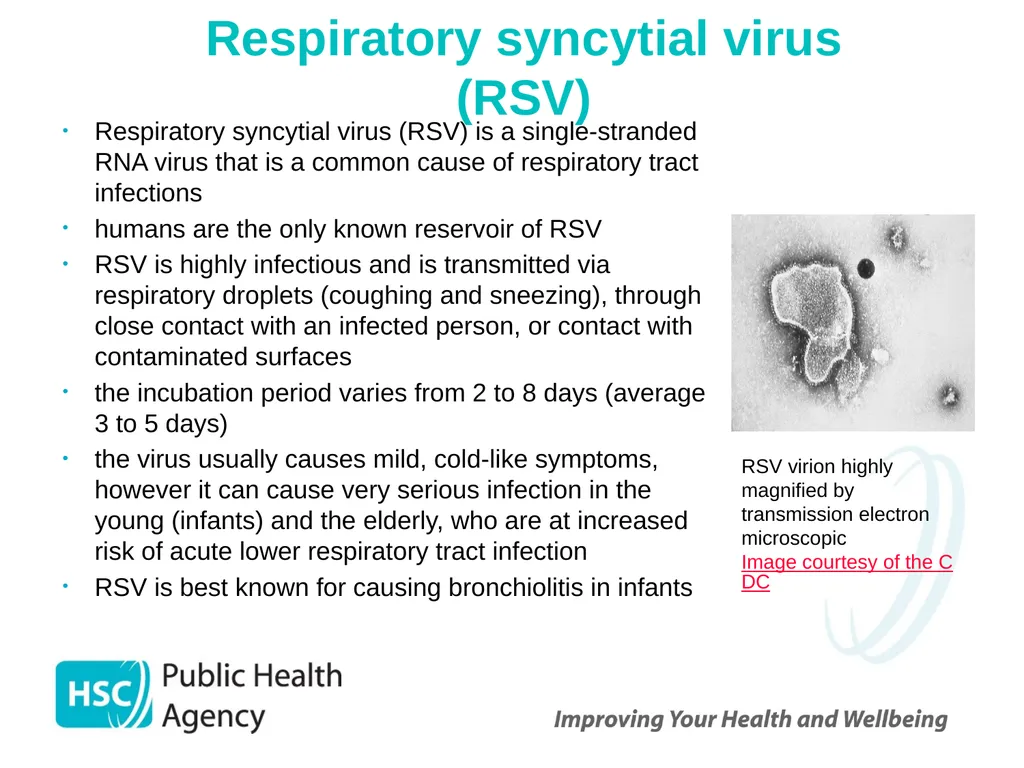
RSV is best known for causing bronchiolitis in infants RSV virion highly magnified by
transmission electron microscopic
Image courtesy of the CDC<br>
humans are the only known reservoir of RSV
RSV is highly infectious and is transmitted via respiratory droplets (coughing and sneezing), through close contact with an infected person, or contact with contaminated surfaces
the incubation period varies from 2 to 8 days (average 3 to 5 days)
the virus usually causes mild, cold-like symptoms, however it can cause very serious infection in the young (infants) and the elderly, who are at increased risk of acute lower respiratory tract infection
RSV is best known for causing bronchiolitis in infants RSV virion highly magnified by
transmission electron microscopic
Image courtesy of the CDC<br>
06
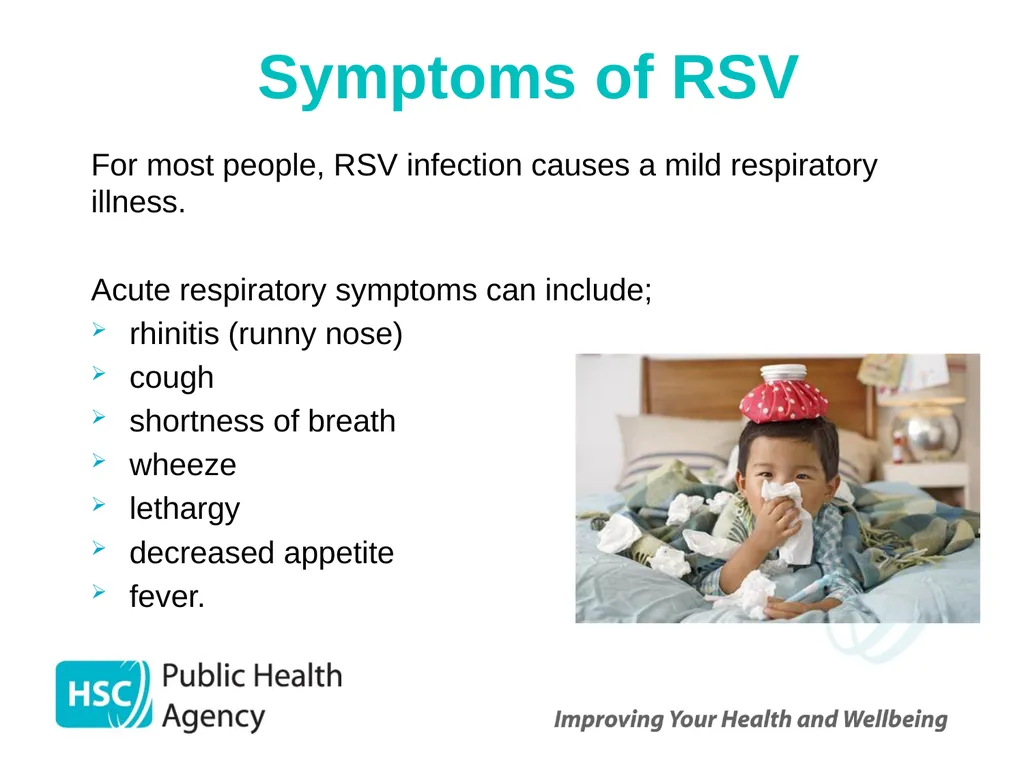
Symptoms of RSV For most people, RSV infection causes a mild respiratory illness.
Acute respiratory symptoms can include;
rhinitis (runny nose)
cough
shortness of breath
wheeze
lethargy
decreased appetite
fever.<br>
Acute respiratory symptoms can include;
rhinitis (runny nose)
cough
shortness of breath
wheeze
lethargy
decreased appetite
fever.<br>
07
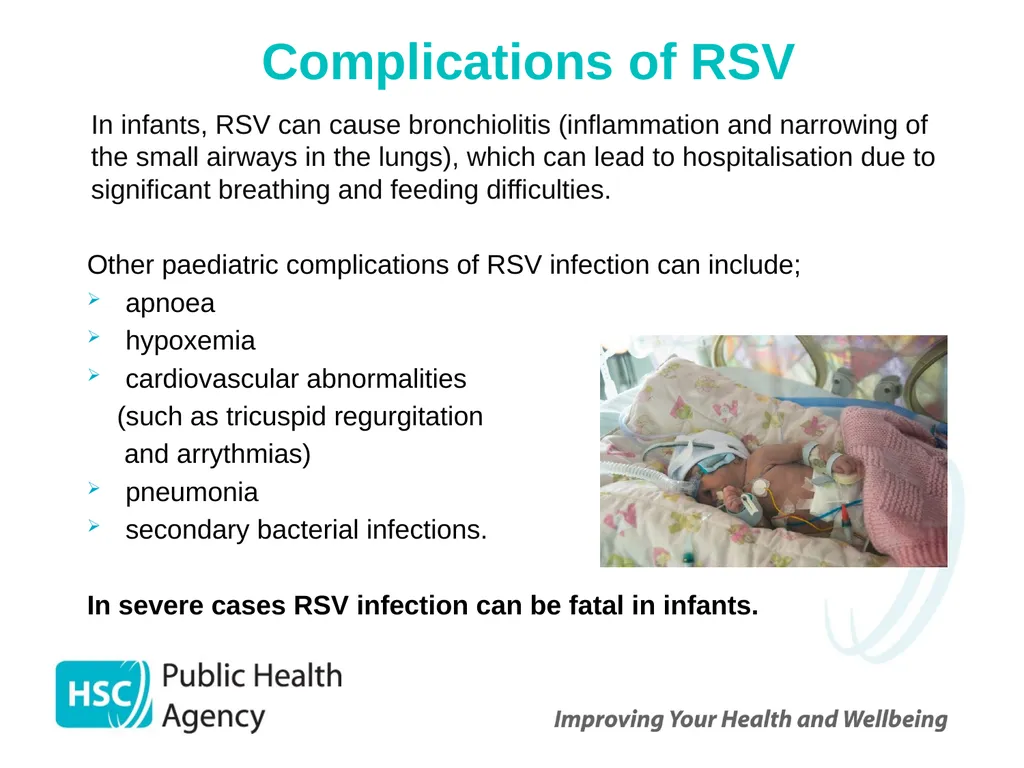
Complications of RSV In infants, RSV can cause bronchiolitis (inflammation and narrowing of the small airways in the lungs), which can lead to hospitalisation due to significant breathing and feeding difficulties.
Other paediatric complications of RSV infection can include;
apnoea
hypoxemia
cardiovascular abnormalities
(such as tricuspid regurgitation
and arrythmias)
pneumonia
secondary bacterial infections.
In severe cases RSV infection can be fatal in infants.<br>
Other paediatric complications of RSV infection can include;
apnoea
hypoxemia
cardiovascular abnormalities
(such as tricuspid regurgitation
and arrythmias)
pneumonia
secondary bacterial infections.
In severe cases RSV infection can be fatal in infants.<br>
08
Complications of RSV (continued) children most at risk of developing severe RSV infection are very young infants born prematurely who have predisposing conditions
however, most RSV hospital admissions occur in full-term babies without underlying clinical risk factors
children who have RSV bronchiolitis in early life may be at increased risk of developing asthma later in childhood (it may be that some children are more susceptible to both), and are at increased risk of recurrent wheezing
RSV in older children is associated with croup and otitis media (middle ear infection)
RSV lower respiratory tract infection can result in pneumonia in all age groups<br>
however, most RSV hospital admissions occur in full-term babies without underlying clinical risk factors
children who have RSV bronchiolitis in early life may be at increased risk of developing asthma later in childhood (it may be that some children are more susceptible to both), and are at increased risk of recurrent wheezing
RSV in older children is associated with croup and otitis media (middle ear infection)
RSV lower respiratory tract infection can result in pneumonia in all age groups<br>
09
High risk groups for RSV (children) infants (under 1 year of age) are at the greatest risk from RSV
while most RSV infections usually cause mild illness, infants aged less than 6 months are at the highest risk of complications, such as bronchiolitis and pneumonia, which may result in hospitalisation
children born prematurely, who have predisposing conditions such as; congenital heart disease, chronic lung disease, chromosomal abnormalities, neuromuscular disorders, large airway abnormalities, and immunodeficiency, particularly multimorbidity, are at increased risk of developing severe, and occasionally fatal disease<br>
while most RSV infections usually cause mild illness, infants aged less than 6 months are at the highest risk of complications, such as bronchiolitis and pneumonia, which may result in hospitalisation
children born prematurely, who have predisposing conditions such as; congenital heart disease, chronic lung disease, chromosomal abnormalities, neuromuscular disorders, large airway abnormalities, and immunodeficiency, particularly multimorbidity, are at increased risk of developing severe, and occasionally fatal disease<br>
10
RSV epidemiology RSV infection occurs throughout the year, however, activity is higher in winter, with a typical RSV season in the UK starting in October, peaking in December and declining by March
there is a significant burden of RSV illness in the UK population, with corresponding impacts on NHS services during the winter months
RSV accounts for approximately 33,500 hospitalisations annually in children aged under 5 years old, most commonly due to bronchiolitis
RSV is a leading cause of infant mortality globally, and results in 20 to 30 deaths per year in the UK
RSV infects up to 90% of children within the first 2 years of life and frequently re-infects older children and adults
previous infection with RSV results in only partial immunity to the virus, therefore individuals can be infected repeatedly throughout their life course<br>
there is a significant burden of RSV illness in the UK population, with corresponding impacts on NHS services during the winter months
RSV accounts for approximately 33,500 hospitalisations annually in children aged under 5 years old, most commonly due to bronchiolitis
RSV is a leading cause of infant mortality globally, and results in 20 to 30 deaths per year in the UK
RSV infects up to 90% of children within the first 2 years of life and frequently re-infects older children and adults
previous infection with RSV results in only partial immunity to the virus, therefore individuals can be infected repeatedly throughout their life course<br>
11
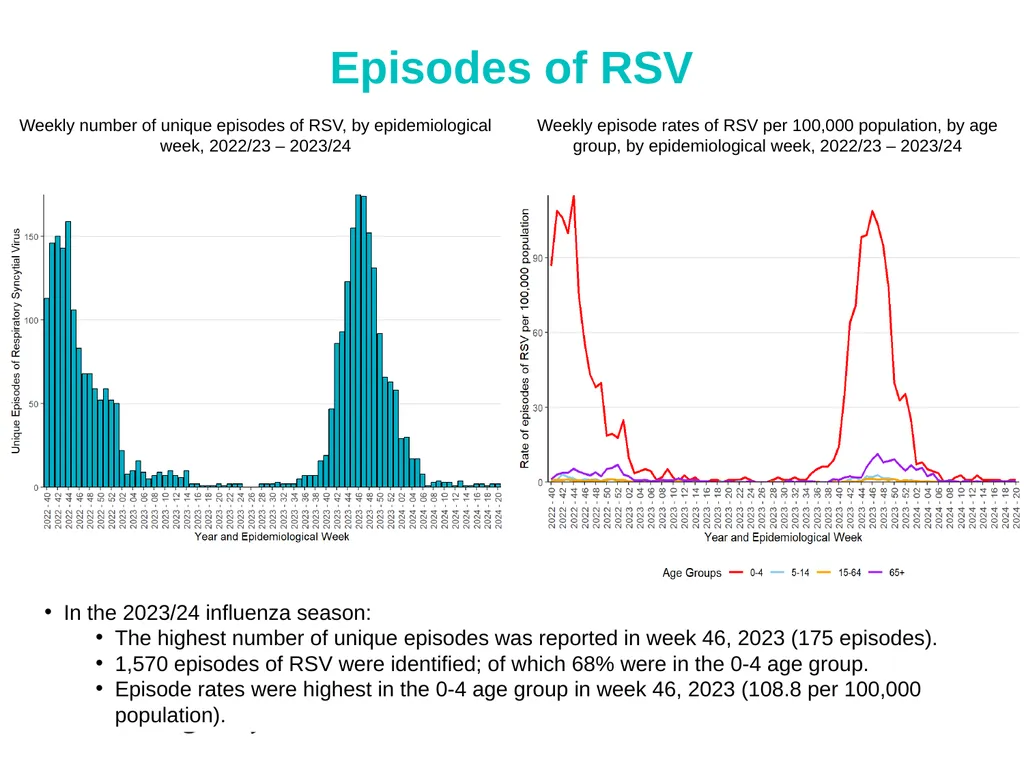
Episodes of RSV Weekly number of unique episodes of RSV, by epidemiological week, 2022/23 – 2023/24 Weekly episode rates of RSV per 100,000 population, by age group, by epidemiological week, 2022/23 – 2023/24 In the 2023/24 influenza season:
The highest number of unique episodes was reported in week 46, 2023 (175 episodes).
1,570 episodes of RSV were identified; of which 68% were in the 0-4 age group.
Episode rates were highest in the 0-4 age group in week 46, 2023 (108.8 per 100,000 population).<br>
The highest number of unique episodes was reported in week 46, 2023 (175 episodes).
1,570 episodes of RSV were identified; of which 68% were in the 0-4 age group.
Episode rates were highest in the 0-4 age group in week 46, 2023 (108.8 per 100,000 population).<br>
12
RSV immunisation
programme
for pregnant women<br>
13
RSV immunisation RSV infection can occur at any age, however the risks of severe illness and complications from RSV are increased in neonates, infants and older adults.
On 7th June 2023, JCVI recommended that a universal immunisation programme should be developed to protect both infants and older adults.
From 1 September 2024, the RSV vaccine should be offered to:
all pregnant women from 28 weeks’ gestation
adults turning 75 years old
adults aged 75 years up until their 80th birthday*
The RSV vaccine should be offered throughout the year as this is a year-round programme.<br>
On 7th June 2023, JCVI recommended that a universal immunisation programme should be developed to protect both infants and older adults.
From 1 September 2024, the RSV vaccine should be offered to:
all pregnant women from 28 weeks’ gestation
adults turning 75 years old
adults aged 75 years up until their 80th birthday*
The RSV vaccine should be offered throughout the year as this is a year-round programme.<br>
14
Aim of maternal RSV immunisation the aim of the RSV vaccination programme for pregnant women is to reduce the incidence and severity of RSV disease in infants
although RSV infection can occur at any age, babies under one year of age are at greatest risk of hospitalisation and other complications
most women will have been exposed to RSV infection in childhood and in adulthood, however, the antibodies acquired from natural infection will not provide sufficient protection for their unborn babies
immunisation with the RSV vaccine during pregnancy will temporarily boost maternal antibody levels, which will enable high levels of antibodies to transfer across the placenta to the fetus, resulting in passive protection for the infant against RSV infection in the first few months of life<br>
although RSV infection can occur at any age, babies under one year of age are at greatest risk of hospitalisation and other complications
most women will have been exposed to RSV infection in childhood and in adulthood, however, the antibodies acquired from natural infection will not provide sufficient protection for their unborn babies
immunisation with the RSV vaccine during pregnancy will temporarily boost maternal antibody levels, which will enable high levels of antibodies to transfer across the placenta to the fetus, resulting in passive protection for the infant against RSV infection in the first few months of life<br>
15
Timing of maternal vaccination RSV is a year-round immunisation programme, and all women should be offered an RSV vaccine in every pregnancy.
Vaccination should be offered from 28 weeks' gestation (ideally in week 28 or soon after), however, women may be offered vaccination up until birth*.<br>
Vaccination should be offered from 28 weeks' gestation (ideally in week 28 or soon after), however, women may be offered vaccination up until birth*.<br>
16
Abrysvo® RSV vaccine Abrysvo® is a recombinant (DNA), bivalent RSV vaccine, containing recombinant RSV prefusion F protein (pre-F) antigens developed from each of the respiratory syncytial virus subtypes, A and B
Abrysvo® is the only vaccine licensed for RSV vaccination of pregnant women and it is the only RSV vaccine currently available for use in Northern Ireland
Abrysvo® is an inactivated (or non-live) vaccine<br>
Abrysvo® is the only vaccine licensed for RSV vaccination of pregnant women and it is the only RSV vaccine currently available for use in Northern Ireland
Abrysvo® is an inactivated (or non-live) vaccine<br>
17
How the vaccine works to protect
the infant when a pregnant woman is given RSV vaccine, her immune system recognises the proteins (antigens) in the vaccine as being foreign and makes antibodies against them
these antibodies pass across the placenta and provide the baby with passive protection against RSV during their first few months of life
for the best protection, Abrysvo® is recommended for pregnant women at 28 weeks gestation, or as soon as possible after. This is to ensure enough time for the mother to make antibodies and for these to cross the placenta to help protect the baby, even if born prematurely
RSV vaccine can be offered to pregnant women up until birth, but this may not offer as high a level of passive protection to the baby<br>
these antibodies pass across the placenta and provide the baby with passive protection against RSV during their first few months of life
for the best protection, Abrysvo® is recommended for pregnant women at 28 weeks gestation, or as soon as possible after. This is to ensure enough time for the mother to make antibodies and for these to cross the placenta to help protect the baby, even if born prematurely
RSV vaccine can be offered to pregnant women up until birth, but this may not offer as high a level of passive protection to the baby<br>
18
Safety of RSV vaccination in pregnancy RSV containing vaccines are inactivated, i.e. they do not contain live organisms and cannot cause the disease against which they protect
there is no evidence of risk to pregnancy or the fetus with inactivated viral vaccines such as Abrysvo®
inactivated pertussis-containing, influenza and COVID-19 vaccines are routinely given to pregnant women with no adverse effects and with proven safety and efficacy
as of July 2024, Abrysvo® has been given to more than 100,000 pregnant women in the USA, where monitoring has shown a good safety record<br>
there is no evidence of risk to pregnancy or the fetus with inactivated viral vaccines such as Abrysvo®
inactivated pertussis-containing, influenza and COVID-19 vaccines are routinely given to pregnant women with no adverse effects and with proven safety and efficacy
as of July 2024, Abrysvo® has been given to more than 100,000 pregnant women in the USA, where monitoring has shown a good safety record<br>
19
Safety of RSV vaccination in pregnancy (continued) in the vaccine clinical trials, there were slightly more premature births in the vaccine group (2.1%) compared to the unvaccinated (placebo) group (1.9%) in the month following vaccination. This was observed in upper middle-income countries, from where the data are consistent with a chance difference and was not seen in high-income countries of Europe and North America.
the difference was not statistically significant and there was no temporal relationship between vaccination and premature birth
average birth weight and gestational age at birth were the same in infants of vaccinated and unvaccinated mothers
there are no safety concerns around congenital anomalies, which were less common in the vaccine group (5%) than the placebo group (6%)
The JCVI has advised that it is reassured that the safety data for Abrysvo® does not raise any significant concerns about use in a maternal vaccination programme, and the vaccine has been approved by the Medicines and Healthcare products Regulatory Agency (MHRA) and the European Medicines Agency (EMA) on the basis of safety, quality and effectiveness.
Abrysvo® has also been licensed for use in several European countries, the USA, Argentina, Australia, Canada and Japan.<br>
the difference was not statistically significant and there was no temporal relationship between vaccination and premature birth
average birth weight and gestational age at birth were the same in infants of vaccinated and unvaccinated mothers
there are no safety concerns around congenital anomalies, which were less common in the vaccine group (5%) than the placebo group (6%)
The JCVI has advised that it is reassured that the safety data for Abrysvo® does not raise any significant concerns about use in a maternal vaccination programme, and the vaccine has been approved by the Medicines and Healthcare products Regulatory Agency (MHRA) and the European Medicines Agency (EMA) on the basis of safety, quality and effectiveness.
Abrysvo® has also been licensed for use in several European countries, the USA, Argentina, Australia, Canada and Japan.<br>
20
Effectiveness of RSV vaccination in pregnancy in clinical trials, maternal (antenatal) RSV vaccination has been demonstrated to be efficacious against RSV lower respiratory tract infection (LRTI) in infants from birth through to six months of age
in the final analysis, vaccine efficacy (VE) against severe RSV LRTI was 82.4% at 90 days and 70.0% at 180 days
for maternal vaccination, while the major mechanism of infant protection is transplacental antibody transfer, some evidence suggests there may also be protective effects from antibody transfer in breast milk, and from indirect protection by reducing the risk of infection and/or degree of infectiousness in the mother and therefore chance of infecting the infant<br>
in the final analysis, vaccine efficacy (VE) against severe RSV LRTI was 82.4% at 90 days and 70.0% at 180 days
for maternal vaccination, while the major mechanism of infant protection is transplacental antibody transfer, some evidence suggests there may also be protective effects from antibody transfer in breast milk, and from indirect protection by reducing the risk of infection and/or degree of infectiousness in the mother and therefore chance of infecting the infant<br>
21
Selective monoclonal antibody immunisation programme
for high risk infants RSV monoclonal antibody immunisation for passive protection of high risk infants was first approved in European countries in 1999
it is not possible to vaccinate neonates to protect them against RSV during the early months of life, as the immature immune system is not able to make an adequate response. Therefore, infants can only be protected via passive immunisation programmes
the high cost and moderate effectiveness of RSV monoclonal antibody meant that cost-effectiveness was only demonstrated for very high-risk infants
the UK selective RSV monoclonal antibody passive immunisation programme has been delivered in secondary care by paediatric services since 2010, and this programme will continue alongside the universal infant protection programme (via maternal immunisation)
RSV vaccination should be offered to all pregnant women in week 28 of pregnancy, and in addition, high-risk infants and children who meet the eligibility criteria in the Green Book RSV chapter should be offered a monoclonal antibody immunisation<br>
it is not possible to vaccinate neonates to protect them against RSV during the early months of life, as the immature immune system is not able to make an adequate response. Therefore, infants can only be protected via passive immunisation programmes
the high cost and moderate effectiveness of RSV monoclonal antibody meant that cost-effectiveness was only demonstrated for very high-risk infants
the UK selective RSV monoclonal antibody passive immunisation programme has been delivered in secondary care by paediatric services since 2010, and this programme will continue alongside the universal infant protection programme (via maternal immunisation)
RSV vaccination should be offered to all pregnant women in week 28 of pregnancy, and in addition, high-risk infants and children who meet the eligibility criteria in the Green Book RSV chapter should be offered a monoclonal antibody immunisation<br>
22
Abrysvo® respiratory syncytial virus (RSV) vaccine<br>
23
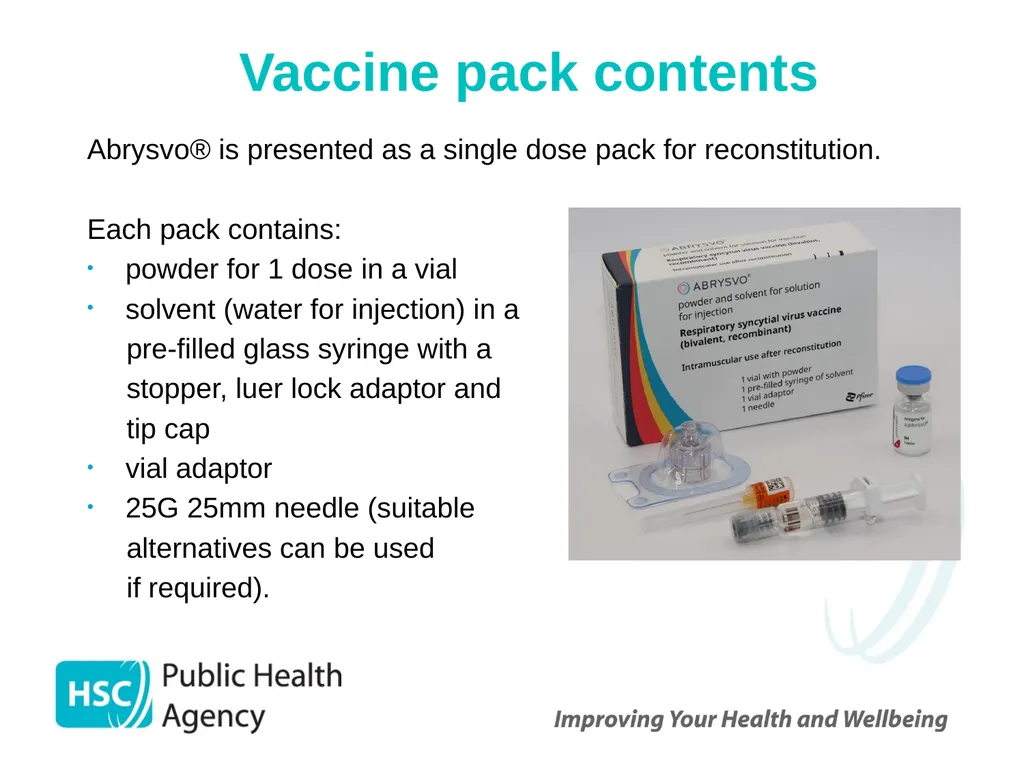
Vaccine pack contents Abrysvo® is presented as a single dose pack for reconstitution.
Each pack contains:
powder for 1 dose in a vial
solvent (water for injection) in a
pre-filled glass syringe with a
stopper, luer lock adaptor and
tip cap
vial adaptor
25G 25mm needle (suitable
alternatives can be used
if required).<br>
Each pack contains:
powder for 1 dose in a vial
solvent (water for injection) in a
pre-filled glass syringe with a
stopper, luer lock adaptor and
tip cap
vial adaptor
25G 25mm needle (suitable
alternatives can be used
if required).<br>
24
Contraindications and precautions Abrysvo® should not be given to anyone who has had a confirmed anaphylactic reaction to a previous dose of an RSV vaccine, or any of the excipients (ingredients) in the vaccine
for a full list of ingredients please refer to the Summary of Product Characteristics
minor illnesses without fever or systemic upset are not valid reasons to postpone immunisation
however, if an individual is acutely unwell, immunisation may be postponed until they have fully recovered. This is to avoid confusing the differential diagnosis of any acute illness by wrongly attributing any signs or symptoms to the adverse effects of the vaccine<br>
for a full list of ingredients please refer to the Summary of Product Characteristics
minor illnesses without fever or systemic upset are not valid reasons to postpone immunisation
however, if an individual is acutely unwell, immunisation may be postponed until they have fully recovered. This is to avoid confusing the differential diagnosis of any acute illness by wrongly attributing any signs or symptoms to the adverse effects of the vaccine<br>
25
Bleeding disorders and anticoagulation therapy women with bleeding disorders and women who receive medication to reduce bleeding, for example treatment for haemophilia, may be vaccinated intramuscularly if, in the opinion of a doctor familiar with the woman's bleeding risk, vaccines or similar small volume intramuscular (IM) injections can be administered with reasonable safety by this route. IM vaccination can be scheduled shortly after medication/treatment is administered
women on stable anticoagulation therapy, including women who are on warfarin* who are up-to-date with their scheduled INR testing and whose latest INR is below the upper level of the therapeutic range, and women who are on prophylactic anticoagulants, such as low molecular weight heparin, can receive IM vaccination
a fine needle (23 or 25 gauge) should be used for the vaccination, followed by firm pressure applied to the site without rubbing for at least 2 minutes. The woman should be informed about the risk of haematoma from the injection
further information can be found in the Green Book, chapter four<br>
women on stable anticoagulation therapy, including women who are on warfarin* who are up-to-date with their scheduled INR testing and whose latest INR is below the upper level of the therapeutic range, and women who are on prophylactic anticoagulants, such as low molecular weight heparin, can receive IM vaccination
a fine needle (23 or 25 gauge) should be used for the vaccination, followed by firm pressure applied to the site without rubbing for at least 2 minutes. The woman should be informed about the risk of haematoma from the injection
further information can be found in the Green Book, chapter four<br>
26
Women with current or previous RSV infection although it might be expected that a woman diagnosed with RSV infection during pregnancy would transfer some antibodies to her unborn baby, there is no assurance that the levels would be high enough to sufficiently protect the infant. As high levels of antibodies are made following vaccination, offering RSV vaccine in week 28 of pregnancy, or as soon as possible after that, should ensure that optimal antibody levels can be passed to the baby
vaccination of women who may be infected with, or incubating RSV infection can proceed, as vaccination is unlikely to have a detrimental effect on the illness
however, women currently experiencing symptoms of fever, or other systemic illness, should not attend for vaccination until they have recovered*<br>
vaccination of women who may be infected with, or incubating RSV infection can proceed, as vaccination is unlikely to have a detrimental effect on the illness
however, women currently experiencing symptoms of fever, or other systemic illness, should not attend for vaccination until they have recovered*<br>
27
Vaccine schedule and dose Abrysvo® should be administered from 28 weeks of pregnancy
women may still be vaccinated later in pregnancy, however, this may not offer as high a level of passive protection to the baby, therefore vaccination should ideally be offered in week 28 of pregnancy, or as soon as possible after
a single dose is 0.5 ml (the full volume of the reconstituted vaccine, drawn up by syringe)
Abrysvo ® should be administered immediately after reconstitution*, or within 4 hours if stored between 15°C and 30°C<br>
women may still be vaccinated later in pregnancy, however, this may not offer as high a level of passive protection to the baby, therefore vaccination should ideally be offered in week 28 of pregnancy, or as soon as possible after
a single dose is 0.5 ml (the full volume of the reconstituted vaccine, drawn up by syringe)
Abrysvo ® should be administered immediately after reconstitution*, or within 4 hours if stored between 15°C and 30°C<br>
28
Vaccine storage Abrysvo® should be stored in a vaccine fridge between +2°C and +8°C
the vaccine must not be frozen. Discard if the carton has been frozen
Abrysvo® should be stored in the original packaging to protect it from light
further information on vaccine storage and stability is available in the Summary of Product Characteristics (SPC) and the vaccine specific Patient Group Direction (PGD)<br>
the vaccine must not be frozen. Discard if the carton has been frozen
Abrysvo® should be stored in the original packaging to protect it from light
further information on vaccine storage and stability is available in the Summary of Product Characteristics (SPC) and the vaccine specific Patient Group Direction (PGD)<br>
29
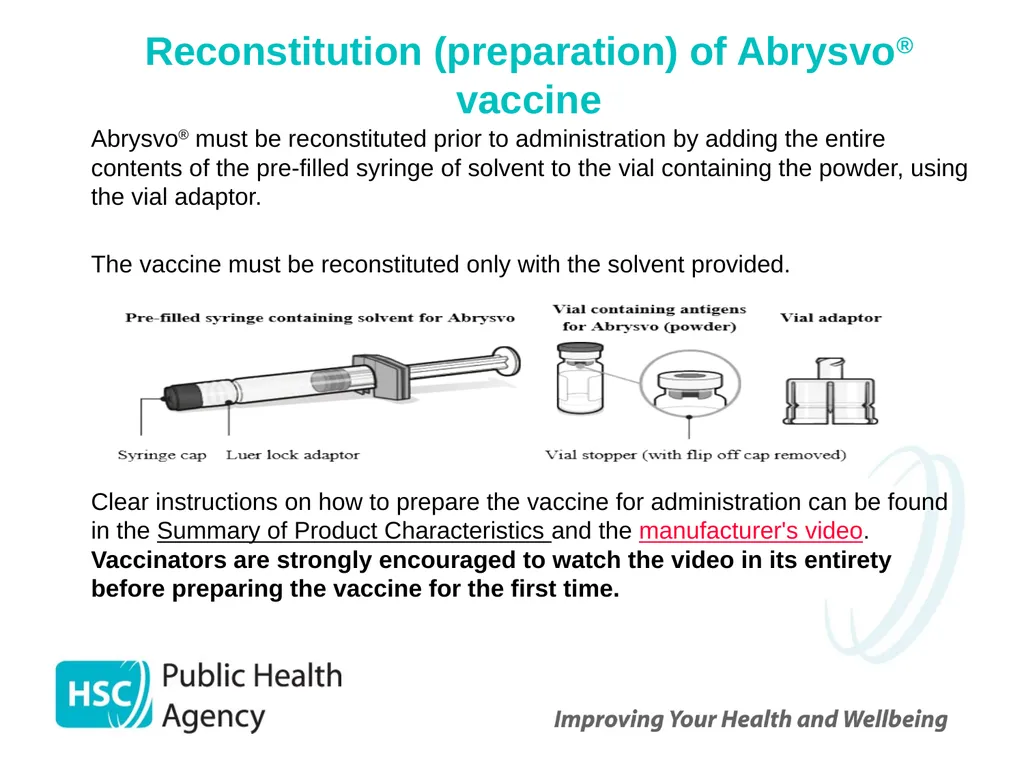
Reconstitution (preparation) of Abrysvo® vaccine Abrysvo® must be reconstituted prior to administration by adding the entire contents of the pre-filled syringe of solvent to the vial containing the powder, using the vial adaptor.
The vaccine must be reconstituted only with the solvent provided.
Clear instructions on how to prepare the vaccine for administration can be found in the Summary of Product Characteristics and the manufacturer's video. Vaccinators are strongly encouraged to watch the video in its entirety before preparing the vaccine for the first time.<br>
The vaccine must be reconstituted only with the solvent provided.
Clear instructions on how to prepare the vaccine for administration can be found in the Summary of Product Characteristics and the manufacturer's video. Vaccinators are strongly encouraged to watch the video in its entirety before preparing the vaccine for the first time.<br>
30
Preparing the Abrysvo® vaccine (1) Images from Abrysvo® vaccine SPC<br>
31
Preparing the Abrysvo® vaccine (2)<br>
32
Preparing the Abrysvo® vaccine (3)<br>
33
Preparing the Abrysvo® vaccine (4)<br>
34
Co-administration with anti-D immunoglobulin,
influenza and COVID-19 vaccine where possible, vaccines should be given once a pregnant woman becomes eligible. However, there may be times when a pregnant woman presents late for vaccination, or when pregnant women may become eligible for more than one vaccine at the same time, such as during influenza and COVID-19 seasonal vaccination campaigns
Abrysvo® (RSV vaccine) can be co-administered with inactivated influenza and COVID-19 vaccines during pregnancy
in addition, there are no safety or effectiveness concerns around co-administration of Abrysvo® and the live attenuated influenza vaccine (LAIV)
Abrysvo® can be administered at the same time as, or at any interval before or after, anti-D immunoglobulin. The administration of Abrysvo® should not be delayed due to the woman receiving anti-D immunoglobulin (or vice-versa)<br>
Abrysvo® (RSV vaccine) can be co-administered with inactivated influenza and COVID-19 vaccines during pregnancy
in addition, there are no safety or effectiveness concerns around co-administration of Abrysvo® and the live attenuated influenza vaccine (LAIV)
Abrysvo® can be administered at the same time as, or at any interval before or after, anti-D immunoglobulin. The administration of Abrysvo® should not be delayed due to the woman receiving anti-D immunoglobulin (or vice-versa)<br>
35
Co-administration of RSV and pertussis vaccines some evidence suggests that co-administration of RSV and pertussis containing vaccines may reduce the response made to pertussis components - the clinical significance of this is unclear and any impact on protection is likely to be small (the key pertussis toxoid component is least affected)
giving the vaccines separately at the routinely recommended times; from 16 - 20 weeks' gestation for pertussis (usually given around time of the fetal anomaly scan at 20 weeks), and 28 weeks' gestation for RSV, will avoid any potential attenuation (weakening) of antibody response to the pertussis containing vaccine
however, if a woman has not received a pertussis containing vaccine by the time she presents for an RSV vaccine, they can and should both be given at the same appointment to provide timely protection against both infections to the infant and to avoid the risk of the woman not returning for a later appointment<br>
giving the vaccines separately at the routinely recommended times; from 16 - 20 weeks' gestation for pertussis (usually given around time of the fetal anomaly scan at 20 weeks), and 28 weeks' gestation for RSV, will avoid any potential attenuation (weakening) of antibody response to the pertussis containing vaccine
however, if a woman has not received a pertussis containing vaccine by the time she presents for an RSV vaccine, they can and should both be given at the same appointment to provide timely protection against both infections to the infant and to avoid the risk of the woman not returning for a later appointment<br>
36
Breastfeeding and RSV vaccination there is no known risk associated with giving non-live vaccines whilst breastfeeding
infants born to women who have received Abrysvo® can be safely breastfed
there may also be protective effects from antibody transfer in breast milk following vaccination during pregnancy<br>
infants born to women who have received Abrysvo® can be safely breastfed
there may also be protective effects from antibody transfer in breast milk following vaccination during pregnancy<br>
37
Adverse reactions following vaccination Vaccines can cause side effects (also referred to as adverse reactions). Reactions occur because vaccines work by triggering an immune system response. Most side effects are mild and only last a few days.
Very common side effects following RSV vaccination include:
injection site pain (41%)
headache (31%)
myalgia (muscle pains and aches) (27%).
For pregnant women, the majority of local and systemic reactions are mild in severity and resolve within a few days of onset.<br>
Very common side effects following RSV vaccination include:
injection site pain (41%)
headache (31%)
myalgia (muscle pains and aches) (27%).
For pregnant women, the majority of local and systemic reactions are mild in severity and resolve within a few days of onset.<br>
38
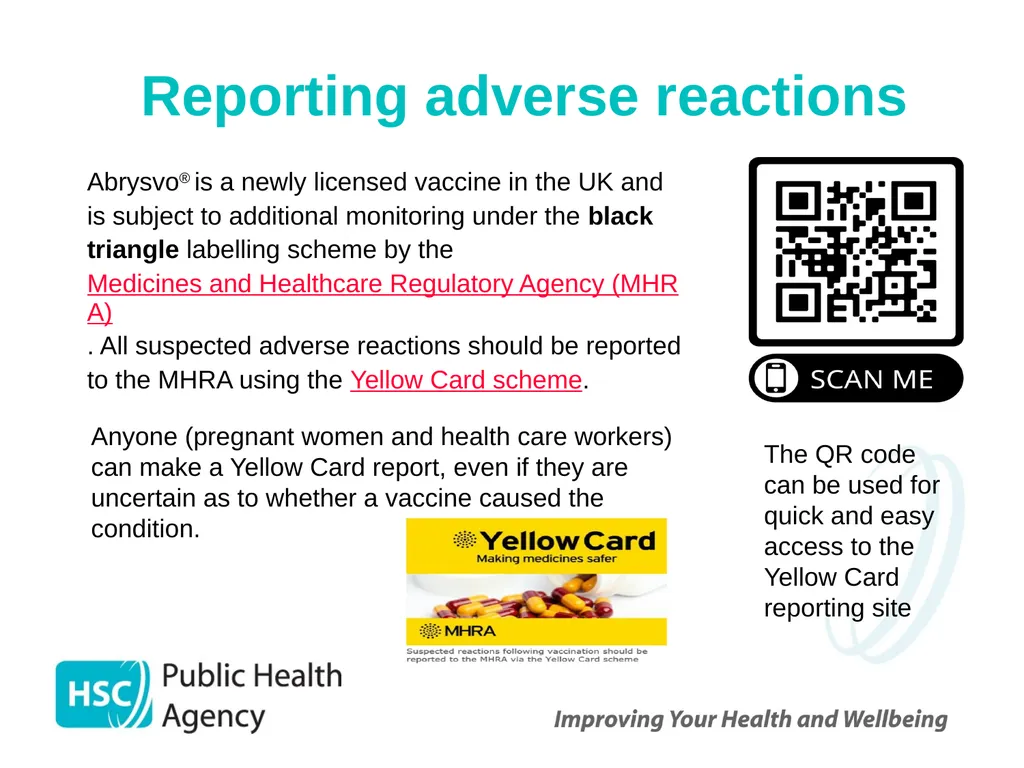
Reporting adverse reactions Abrysvo® is a newly licensed vaccine in the UK and is subject to additional monitoring under the black triangle labelling scheme by the Medicines and Healthcare Regulatory Agency (MHRA). All suspected adverse reactions should be reported to the MHRA using the Yellow Card scheme.
Anyone (pregnant women and health care workers) can make a Yellow Card report, even if they are uncertain as to whether a vaccine caused the condition. The QR code can be used for quick and easy access to the Yellow Card reporting site<br>
Anyone (pregnant women and health care workers) can make a Yellow Card report, even if they are uncertain as to whether a vaccine caused the condition. The QR code can be used for quick and easy access to the Yellow Card reporting site<br>
39
Further resources National RSV programme guidance Green Book on Immunisation chapter 27a Respiratory syncyntial virus (RSV) (publishing.service.gov.uk)
PHA Healthcare factsheet Health professional resources | HSC Public Health Agency (hscni.net)
E-learning Immunisation - elearning for healthcare (e-lfh.org.uk)
Abrysvo® (Pfizer) vaccine preparation instructional video
UKHSA RSV vaccination programme resources Respiratory syncytial virus (RSV) vaccination programme - GOV.UK (www.gov.uk)
Medicines and Healthcare products Regulatory Agency (MHRA): reporting adverse reactions
Royal College of Midwives (RCM) Midwives and Public Health (rcm.org.uk)<br>
PHA Healthcare factsheet Health professional resources | HSC Public Health Agency (hscni.net)
E-learning Immunisation - elearning for healthcare (e-lfh.org.uk)
Abrysvo® (Pfizer) vaccine preparation instructional video
UKHSA RSV vaccination programme resources Respiratory syncytial virus (RSV) vaccination programme - GOV.UK (www.gov.uk)
Medicines and Healthcare products Regulatory Agency (MHRA): reporting adverse reactions
Royal College of Midwives (RCM) Midwives and Public Health (rcm.org.uk)<br>