
Responses to submissions on Copyright Amendment
TA
Published · 50 slides · 0 views
1 / 1
Description
Responses to submissions on Copyright Amendment Bill 2nd advert in the section 79(1) process 1 The reservations 2 Purpose of second adverts: To seek public inputs on substantive amendments that flowed from the first adverts deliberation
Related Topics
Download this presentation From Below
"Responses to submissions on Copyright Amendment" is the property of its rightful owner. Permission is granted to download and print the materials on this website for personal, non-commercial use only, and to display it on your personal computer provided you do not modify the materials and that you retain all copyright notices contained in the materials. By downloading content from our website, you accept the terms of this agreement.
Share
Embed code
Presentation Transcript
01
Responses to submissions on Copyright Amendment Bill
2nd advert in the section 79(1) process 1<br>
2nd advert in the section 79(1) process 1<br>
02
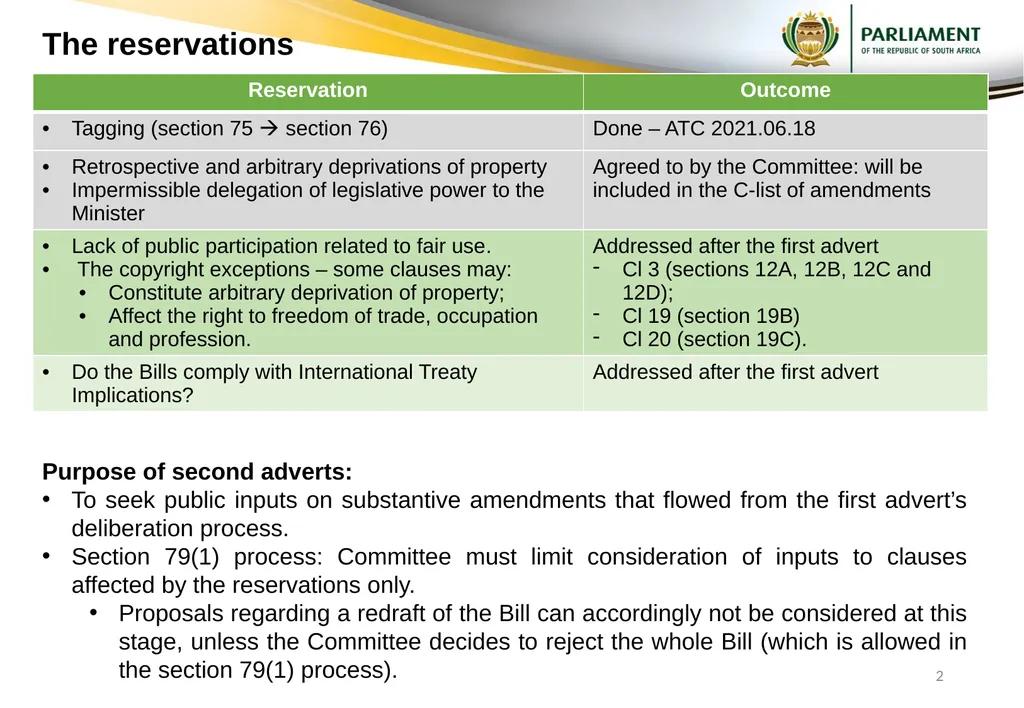
The reservations 2 Purpose of second adverts:
To seek public inputs on substantive amendments that flowed from the first advert’s deliberation process.
Section 79(1) process: Committee must limit consideration of inputs to clauses affected by the reservations only.
Proposals regarding a redraft of the Bill can accordingly not be considered at this stage, unless the Committee decides to reject the whole Bill (which is allowed in the section 79(1) process).<br>
To seek public inputs on substantive amendments that flowed from the first advert’s deliberation process.
Section 79(1) process: Committee must limit consideration of inputs to clauses affected by the reservations only.
Proposals regarding a redraft of the Bill can accordingly not be considered at this stage, unless the Committee decides to reject the whole Bill (which is allowed in the section 79(1) process).<br>
03
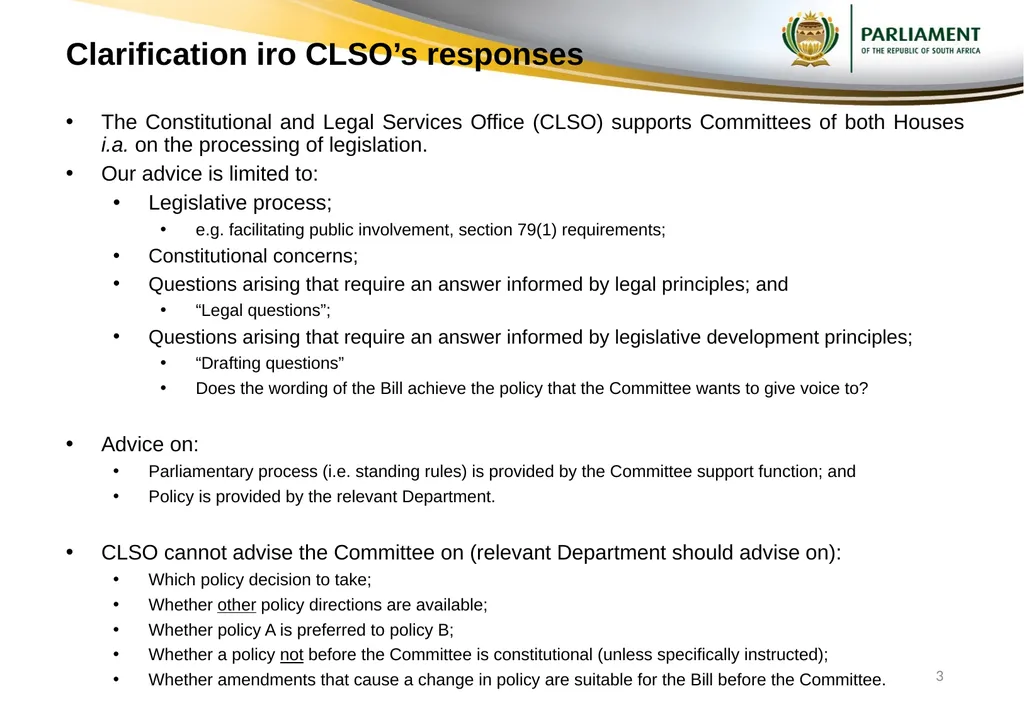
Clarification iro CLSO’s responses The Constitutional and Legal Services Office (CLSO) supports Committees of both Houses i.a. on the processing of legislation.
Our advice is limited to:
Legislative process;
e.g. facilitating public involvement, section 79(1) requirements;
Constitutional concerns;
Questions arising that require an answer informed by legal principles; and
“Legal questions”;
Questions arising that require an answer informed by legislative development principles;
“Drafting questions”
Does the wording of the Bill achieve the policy that the Committee wants to give voice to?
Advice on:
Parliamentary process (i.e. standing rules) is provided by the Committee support function; and
Policy is provided by the relevant Department.
CLSO cannot advise the Committee on (relevant Department should advise on):
Which policy decision to take;
Whether other policy directions are available;
Whether policy A is preferred to policy B;
Whether a policy not before the Committee is constitutional (unless specifically instructed);
Whether amendments that cause a change in policy are suitable for the Bill before the Committee. 3<br>
Our advice is limited to:
Legislative process;
e.g. facilitating public involvement, section 79(1) requirements;
Constitutional concerns;
Questions arising that require an answer informed by legal principles; and
“Legal questions”;
Questions arising that require an answer informed by legislative development principles;
“Drafting questions”
Does the wording of the Bill achieve the policy that the Committee wants to give voice to?
Advice on:
Parliamentary process (i.e. standing rules) is provided by the Committee support function; and
Policy is provided by the relevant Department.
CLSO cannot advise the Committee on (relevant Department should advise on):
Which policy decision to take;
Whether other policy directions are available;
Whether policy A is preferred to policy B;
Whether a policy not before the Committee is constitutional (unless specifically instructed);
Whether amendments that cause a change in policy are suitable for the Bill before the Committee. 3<br>
04
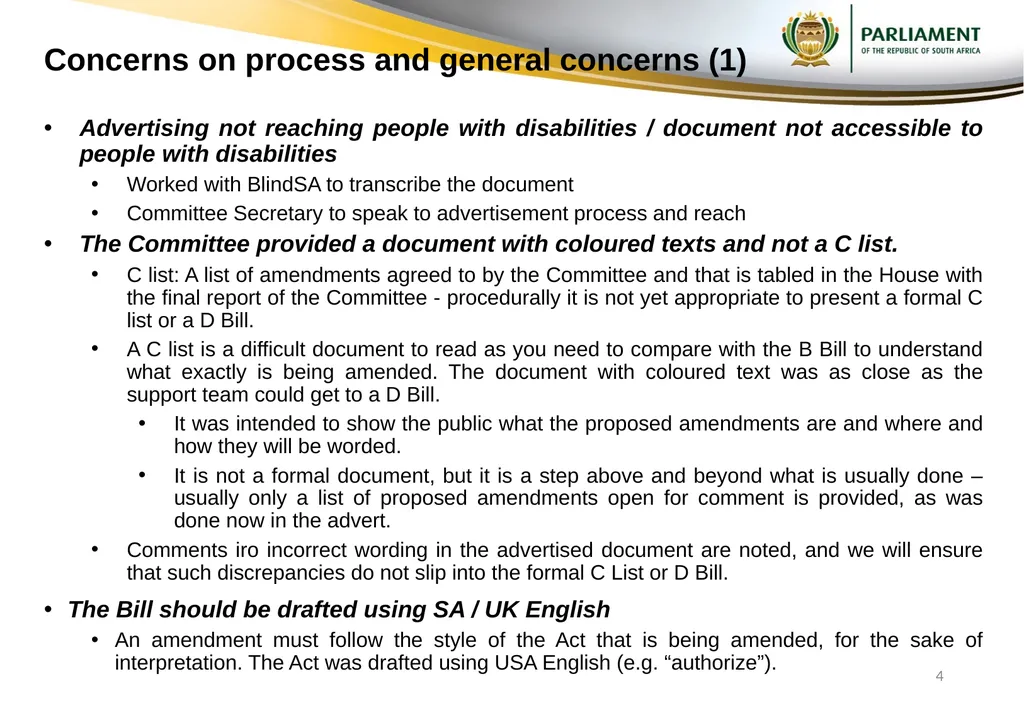
Concerns on process and general concerns (1) Advertising not reaching people with disabilities / document not accessible to people with disabilities
Worked with BlindSA to transcribe the document
Committee Secretary to speak to advertisement process and reach
The Committee provided a document with coloured texts and not a C list.
C list: A list of amendments agreed to by the Committee and that is tabled in the House with the final report of the Committee - procedurally it is not yet appropriate to present a formal C list or a D Bill.
A C list is a difficult document to read as you need to compare with the B Bill to understand what exactly is being amended. The document with coloured text was as close as the support team could get to a D Bill.
It was intended to show the public what the proposed amendments are and where and how they will be worded.
It is not a formal document, but it is a step above and beyond what is usually done – usually only a list of proposed amendments open for comment is provided, as was done now in the advert.
Comments iro incorrect wording in the advertised document are noted, and we will ensure that such discrepancies do not slip into the formal C List or D Bill.
The Bill should be drafted using SA / UK English
An amendment must follow the style of the Act that is being amended, for the sake of interpretation. The Act was drafted using USA English (e.g. “authorize”). 4<br>
Worked with BlindSA to transcribe the document
Committee Secretary to speak to advertisement process and reach
The Committee provided a document with coloured texts and not a C list.
C list: A list of amendments agreed to by the Committee and that is tabled in the House with the final report of the Committee - procedurally it is not yet appropriate to present a formal C list or a D Bill.
A C list is a difficult document to read as you need to compare with the B Bill to understand what exactly is being amended. The document with coloured text was as close as the support team could get to a D Bill.
It was intended to show the public what the proposed amendments are and where and how they will be worded.
It is not a formal document, but it is a step above and beyond what is usually done – usually only a list of proposed amendments open for comment is provided, as was done now in the advert.
Comments iro incorrect wording in the advertised document are noted, and we will ensure that such discrepancies do not slip into the formal C List or D Bill.
The Bill should be drafted using SA / UK English
An amendment must follow the style of the Act that is being amended, for the sake of interpretation. The Act was drafted using USA English (e.g. “authorize”). 4<br>
05
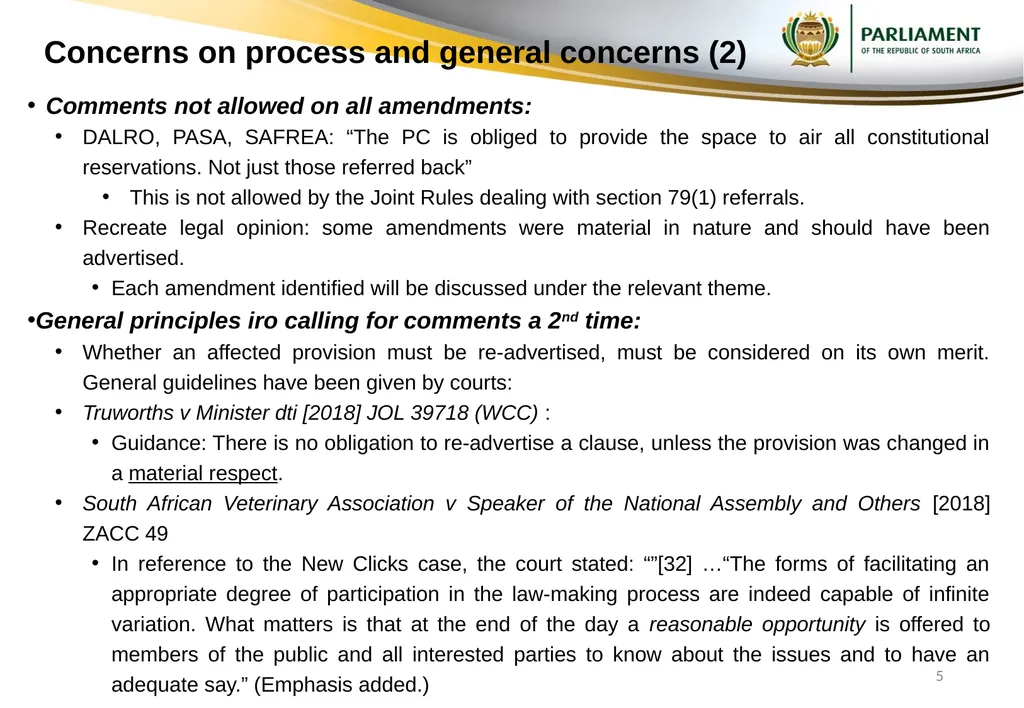
Concerns on process and general concerns (2) Comments not allowed on all amendments:
DALRO, PASA, SAFREA: “The PC is obliged to provide the space to air all constitutional reservations. Not just those referred back”
This is not allowed by the Joint Rules dealing with section 79(1) referrals.
Recreate legal opinion: some amendments were material in nature and should have been advertised.
Each amendment identified will be discussed under the relevant theme.
General principles iro calling for comments a 2nd time:
Whether an affected provision must be re-advertised, must be considered on its own merit. General guidelines have been given by courts:
Truworths v Minister dti [2018] JOL 39718 (WCC) :
Guidance: There is no obligation to re-advertise a clause, unless the provision was changed in a material respect.
South African Veterinary Association v Speaker of the National Assembly and Others [2018] ZACC 49
In reference to the New Clicks case, the court stated: “”[32] …“The forms of facilitating an appropriate degree of participation in the law-making process are indeed capable of infinite variation. What matters is that at the end of the day a reasonable opportunity is offered to members of the public and all interested parties to know about the issues and to have an adequate say.” (Emphasis added.) 5<br>
DALRO, PASA, SAFREA: “The PC is obliged to provide the space to air all constitutional reservations. Not just those referred back”
This is not allowed by the Joint Rules dealing with section 79(1) referrals.
Recreate legal opinion: some amendments were material in nature and should have been advertised.
Each amendment identified will be discussed under the relevant theme.
General principles iro calling for comments a 2nd time:
Whether an affected provision must be re-advertised, must be considered on its own merit. General guidelines have been given by courts:
Truworths v Minister dti [2018] JOL 39718 (WCC) :
Guidance: There is no obligation to re-advertise a clause, unless the provision was changed in a material respect.
South African Veterinary Association v Speaker of the National Assembly and Others [2018] ZACC 49
In reference to the New Clicks case, the court stated: “”[32] …“The forms of facilitating an appropriate degree of participation in the law-making process are indeed capable of infinite variation. What matters is that at the end of the day a reasonable opportunity is offered to members of the public and all interested parties to know about the issues and to have an adequate say.” (Emphasis added.) 5<br>
06
Specific amendments 6<br>
07
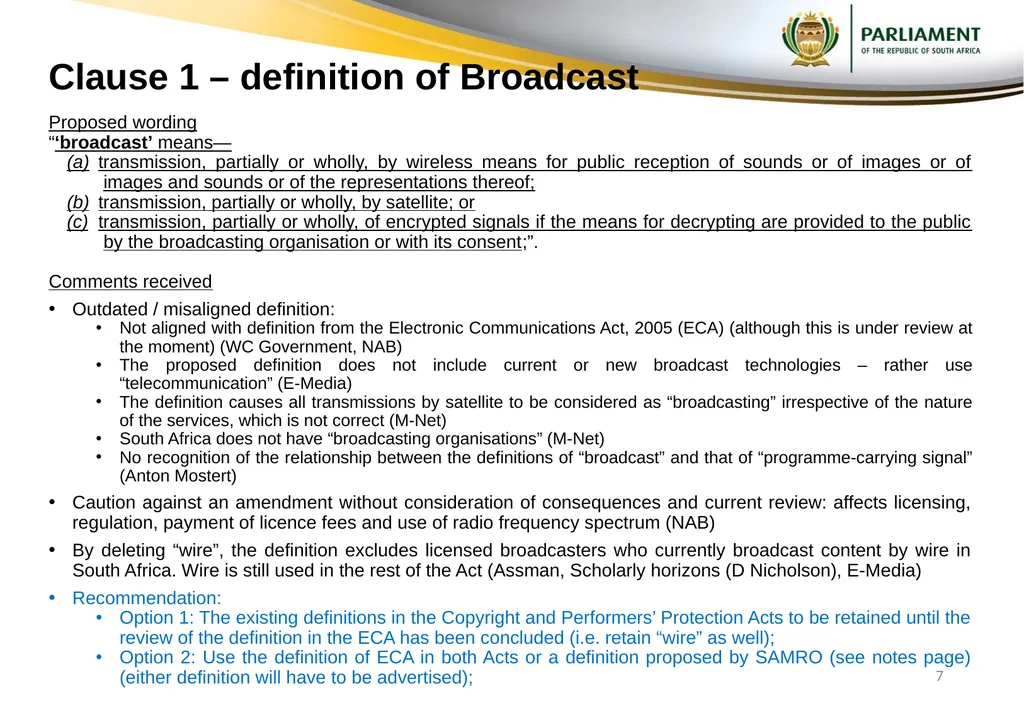
Clause 1 – definition of Broadcast Proposed wording
“‘broadcast’ means—
(a) transmission, partially or wholly, by wireless means for public reception of sounds or of images or of images and sounds or of the representations thereof;
(b) transmission, partially or wholly, by satellite; or
(c) transmission, partially or wholly, of encrypted signals if the means for decrypting are provided to the public by the broadcasting organisation or with its consent;”.
Comments received
Outdated / misaligned definition:
Not aligned with definition from the Electronic Communications Act, 2005 (ECA) (although this is under review at the moment) (WC Government, NAB)
The proposed definition does not include current or new broadcast technologies – rather use “telecommunication” (E-Media)
The definition causes all transmissions by satellite to be considered as “broadcasting” irrespective of the nature of the services, which is not correct (M-Net)
South Africa does not have “broadcasting organisations” (M-Net)
No recognition of the relationship between the definitions of “broadcast” and that of “programme-carrying signal” (Anton Mostert)
Caution against an amendment without consideration of consequences and current review: affects licensing, regulation, payment of licence fees and use of radio frequency spectrum (NAB)
By deleting “wire”, the definition excludes licensed broadcasters who currently broadcast content by wire in South Africa. Wire is still used in the rest of the Act (Assman, Scholarly horizons (D Nicholson), E-Media)
Recommendation:
Option 1: The existing definitions in the Copyright and Performers’ Protection Acts to be retained until the review of the definition in the ECA has been concluded (i.e. retain “wire” as well);
Option 2: Use the definition of ECA in both Acts or a definition proposed by SAMRO (see notes page) (either definition will have to be advertised); 7<br>
“‘broadcast’ means—
(a) transmission, partially or wholly, by wireless means for public reception of sounds or of images or of images and sounds or of the representations thereof;
(b) transmission, partially or wholly, by satellite; or
(c) transmission, partially or wholly, of encrypted signals if the means for decrypting are provided to the public by the broadcasting organisation or with its consent;”.
Comments received
Outdated / misaligned definition:
Not aligned with definition from the Electronic Communications Act, 2005 (ECA) (although this is under review at the moment) (WC Government, NAB)
The proposed definition does not include current or new broadcast technologies – rather use “telecommunication” (E-Media)
The definition causes all transmissions by satellite to be considered as “broadcasting” irrespective of the nature of the services, which is not correct (M-Net)
South Africa does not have “broadcasting organisations” (M-Net)
No recognition of the relationship between the definitions of “broadcast” and that of “programme-carrying signal” (Anton Mostert)
Caution against an amendment without consideration of consequences and current review: affects licensing, regulation, payment of licence fees and use of radio frequency spectrum (NAB)
By deleting “wire”, the definition excludes licensed broadcasters who currently broadcast content by wire in South Africa. Wire is still used in the rest of the Act (Assman, Scholarly horizons (D Nicholson), E-Media)
Recommendation:
Option 1: The existing definitions in the Copyright and Performers’ Protection Acts to be retained until the review of the definition in the ECA has been concluded (i.e. retain “wire” as well);
Option 2: Use the definition of ECA in both Acts or a definition proposed by SAMRO (see notes page) (either definition will have to be advertised); 7<br>
08
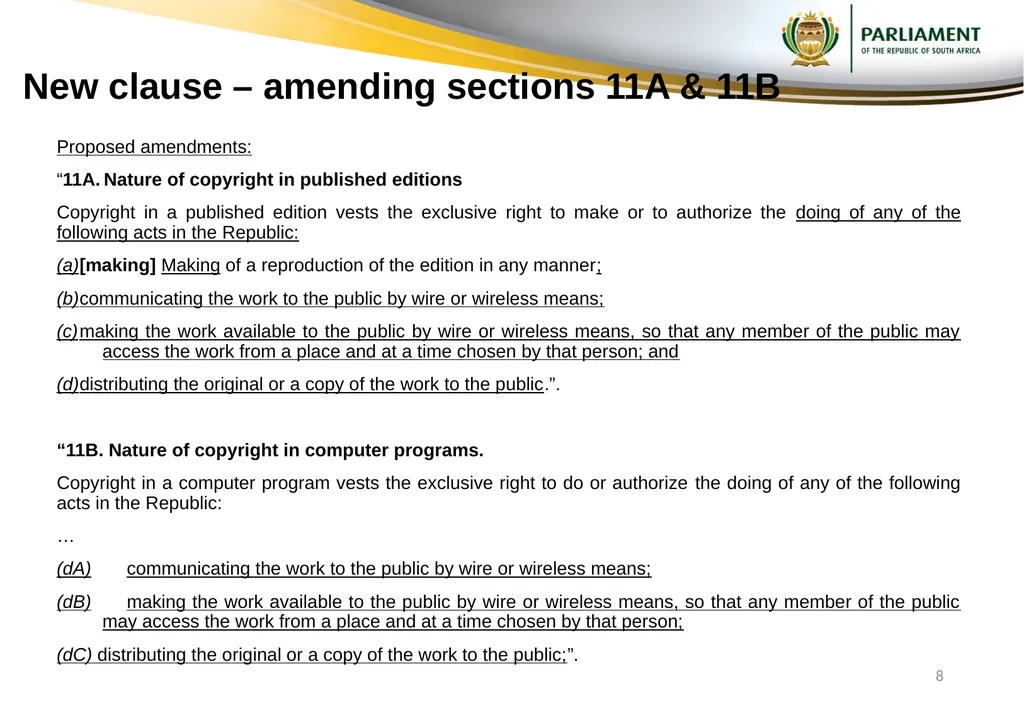
New clause – amending sections 11A & 11B Proposed amendments:
“11A. Nature of copyright in published editions
Copyright in a published edition vests the exclusive right to make or to authorize the doing of any of the following acts in the Republic:
(a) [making] Making of a reproduction of the edition in any manner;
(b) communicating the work to the public by wire or wireless means;
(c) making the work available to the public by wire or wireless means, so that any member of the public may access the work from a place and at a time chosen by that person; and
(d) distributing the original or a copy of the work to the public.”.
“11B. Nature of copyright in computer programs.
Copyright in a computer program vests the exclusive right to do or authorize the doing of any of the following acts in the Republic:
…
(dA) communicating the work to the public by wire or wireless means;
(dB) making the work available to the public by wire or wireless means, so that any member of the public may access the work from a place and at a time chosen by that person;
(dC) distributing the original or a copy of the work to the public;”. 8<br>
“11A. Nature of copyright in published editions
Copyright in a published edition vests the exclusive right to make or to authorize the doing of any of the following acts in the Republic:
(a) [making] Making of a reproduction of the edition in any manner;
(b) communicating the work to the public by wire or wireless means;
(c) making the work available to the public by wire or wireless means, so that any member of the public may access the work from a place and at a time chosen by that person; and
(d) distributing the original or a copy of the work to the public.”.
“11B. Nature of copyright in computer programs.
Copyright in a computer program vests the exclusive right to do or authorize the doing of any of the following acts in the Republic:
…
(dA) communicating the work to the public by wire or wireless means;
(dB) making the work available to the public by wire or wireless means, so that any member of the public may access the work from a place and at a time chosen by that person;
(dC) distributing the original or a copy of the work to the public;”. 8<br>
09
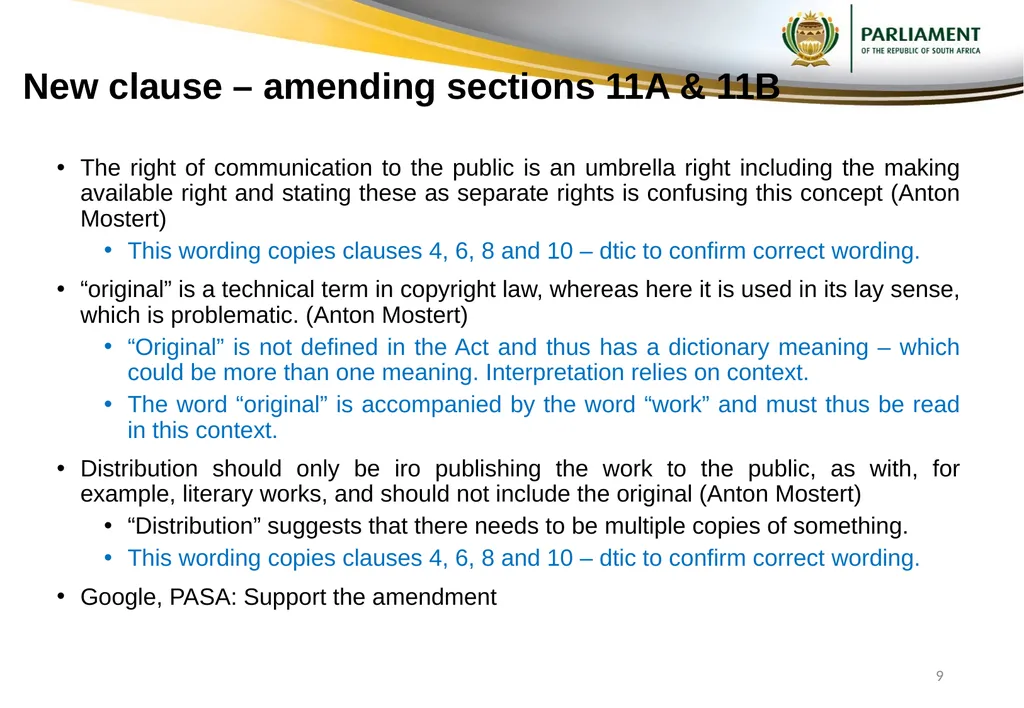
New clause – amending sections 11A & 11B The right of communication to the public is an umbrella right including the making available right and stating these as separate rights is confusing this concept (Anton Mostert)
This wording copies clauses 4, 6, 8 and 10 – dtic to confirm correct wording.
“original” is a technical term in copyright law, whereas here it is used in its lay sense, which is problematic. (Anton Mostert)
“Original” is not defined in the Act and thus has a dictionary meaning – which could be more than one meaning. Interpretation relies on context.
The word “original” is accompanied by the word “work” and must thus be read in this context.
Distribution should only be iro publishing the work to the public, as with, for example, literary works, and should not include the original (Anton Mostert)
“Distribution” suggests that there needs to be multiple copies of something.
This wording copies clauses 4, 6, 8 and 10 – dtic to confirm correct wording.
Google, PASA: Support the amendment 9<br>
This wording copies clauses 4, 6, 8 and 10 – dtic to confirm correct wording.
“original” is a technical term in copyright law, whereas here it is used in its lay sense, which is problematic. (Anton Mostert)
“Original” is not defined in the Act and thus has a dictionary meaning – which could be more than one meaning. Interpretation relies on context.
The word “original” is accompanied by the word “work” and must thus be read in this context.
Distribution should only be iro publishing the work to the public, as with, for example, literary works, and should not include the original (Anton Mostert)
“Distribution” suggests that there needs to be multiple copies of something.
This wording copies clauses 4, 6, 8 and 10 – dtic to confirm correct wording.
Google, PASA: Support the amendment 9<br>
10
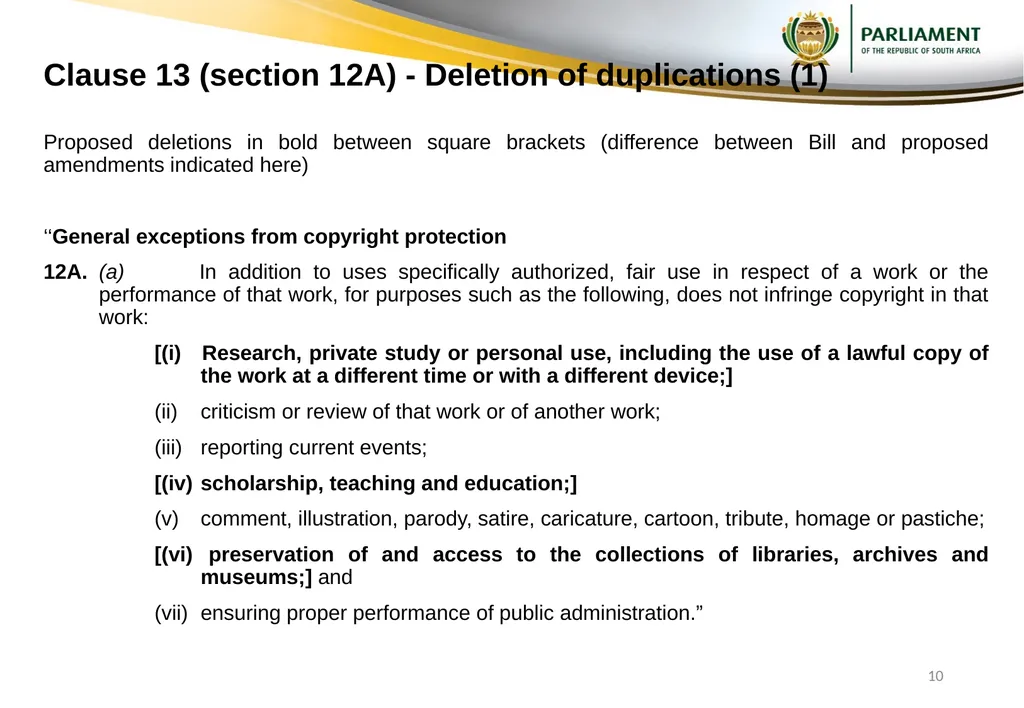
Clause 13 (section 12A) - Deletion of duplications (1) Proposed deletions in bold between square brackets (difference between Bill and proposed amendments indicated here)
‘‘General exceptions from copyright protection
12A. (a) In addition to uses specifically authorized, fair use in respect of a work or the performance of that work, for purposes such as the following, does not infringe copyright in that work:
[(i) Research, private study or personal use, including the use of a lawful copy of the work at a different time or with a different device;]
(ii) criticism or review of that work or of another work;
(iii) reporting current events;
[(iv) scholarship, teaching and education;]
(v) comment, illustration, parody, satire, caricature, cartoon, tribute, homage or pastiche;
[(vi) preservation of and access to the collections of libraries, archives and museums;] and
(vii) ensuring proper performance of public administration.” 10<br>
‘‘General exceptions from copyright protection
12A. (a) In addition to uses specifically authorized, fair use in respect of a work or the performance of that work, for purposes such as the following, does not infringe copyright in that work:
[(i) Research, private study or personal use, including the use of a lawful copy of the work at a different time or with a different device;]
(ii) criticism or review of that work or of another work;
(iii) reporting current events;
[(iv) scholarship, teaching and education;]
(v) comment, illustration, parody, satire, caricature, cartoon, tribute, homage or pastiche;
[(vi) preservation of and access to the collections of libraries, archives and museums;] and
(vii) ensuring proper performance of public administration.” 10<br>
11
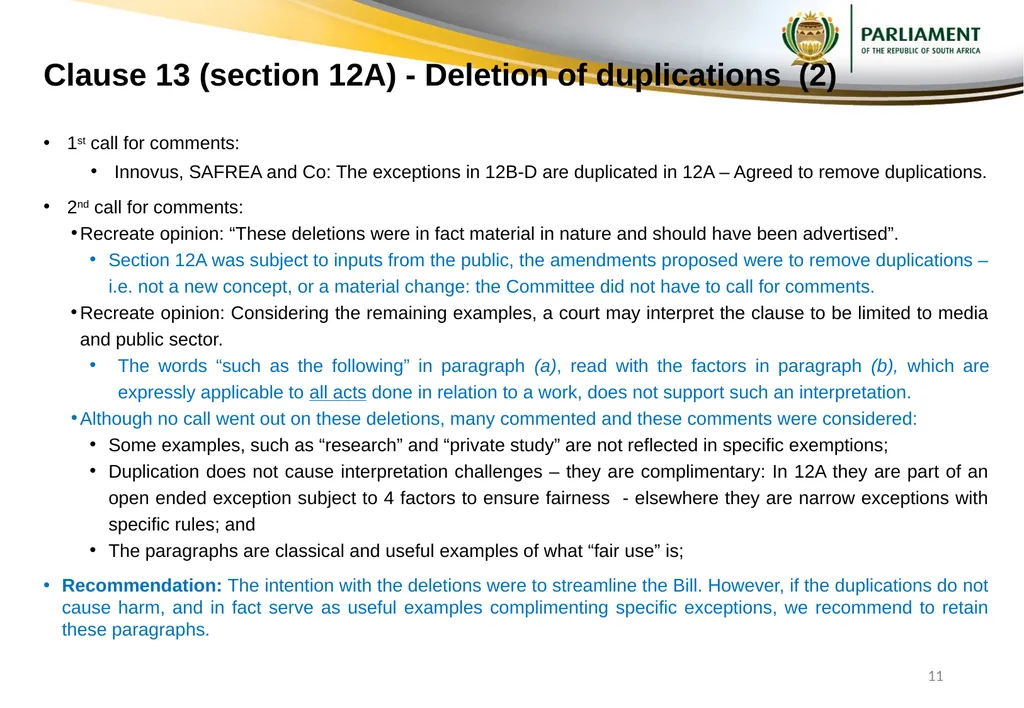
Clause 13 (section 12A) - Deletion of duplications (2) 1st call for comments:
Innovus, SAFREA and Co: The exceptions in 12B-D are duplicated in 12A – Agreed to remove duplications.
2nd call for comments:
Recreate opinion: “These deletions were in fact material in nature and should have been advertised”.
Section 12A was subject to inputs from the public, the amendments proposed were to remove duplications – i.e. not a new concept, or a material change: the Committee did not have to call for comments.
Recreate opinion: Considering the remaining examples, a court may interpret the clause to be limited to media and public sector.
The words “such as the following” in paragraph (a), read with the factors in paragraph (b), which are expressly applicable to all acts done in relation to a work, does not support such an interpretation.
Although no call went out on these deletions, many commented and these comments were considered:
Some examples, such as “research” and “private study” are not reflected in specific exemptions;
Duplication does not cause interpretation challenges – they are complimentary: In 12A they are part of an open ended exception subject to 4 factors to ensure fairness - elsewhere they are narrow exceptions with specific rules; and
The paragraphs are classical and useful examples of what “fair use” is;
Recommendation: The intention with the deletions were to streamline the Bill. However, if the duplications do not cause harm, and in fact serve as useful examples complimenting specific exceptions, we recommend to retain these paragraphs. 11<br>
Innovus, SAFREA and Co: The exceptions in 12B-D are duplicated in 12A – Agreed to remove duplications.
2nd call for comments:
Recreate opinion: “These deletions were in fact material in nature and should have been advertised”.
Section 12A was subject to inputs from the public, the amendments proposed were to remove duplications – i.e. not a new concept, or a material change: the Committee did not have to call for comments.
Recreate opinion: Considering the remaining examples, a court may interpret the clause to be limited to media and public sector.
The words “such as the following” in paragraph (a), read with the factors in paragraph (b), which are expressly applicable to all acts done in relation to a work, does not support such an interpretation.
Although no call went out on these deletions, many commented and these comments were considered:
Some examples, such as “research” and “private study” are not reflected in specific exemptions;
Duplication does not cause interpretation challenges – they are complimentary: In 12A they are part of an open ended exception subject to 4 factors to ensure fairness - elsewhere they are narrow exceptions with specific rules; and
The paragraphs are classical and useful examples of what “fair use” is;
Recommendation: The intention with the deletions were to streamline the Bill. However, if the duplications do not cause harm, and in fact serve as useful examples complimenting specific exceptions, we recommend to retain these paragraphs. 11<br>
12
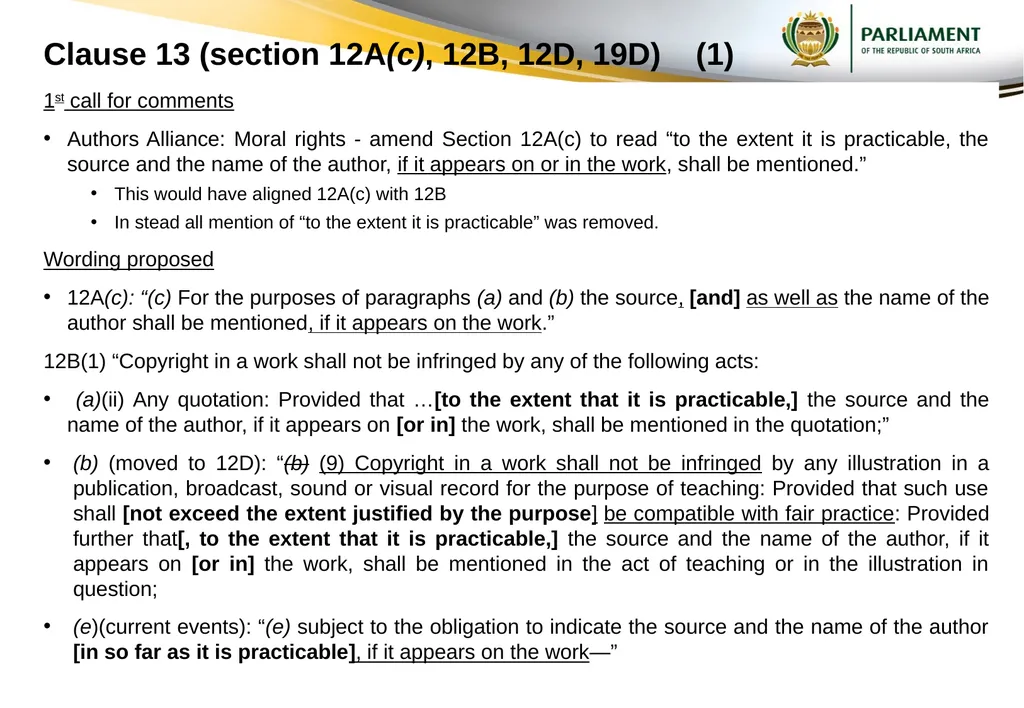
Clause 13 (section 12A(c), 12B, 12D, 19D) (1) 1st call for comments
Authors Alliance: Moral rights - amend Section 12A(c) to read “to the extent it is practicable, the source and the name of the author, if it appears on or in the work, shall be mentioned.”
This would have aligned 12A(c) with 12B
In stead all mention of “to the extent it is practicable” was removed.
Wording proposed
12A(c): “(c) For the purposes of paragraphs (a) and (b) the source, [and] as well as the name of the author shall be mentioned, if it appears on the work.”
12B(1) “Copyright in a work shall not be infringed by any of the following acts:
(a)(ii) Any quotation: Provided that …[to the extent that it is practicable,] the source and the name of the author, if it appears on [or in] the work, shall be mentioned in the quotation;”
(b) (moved to 12D): “(b) (9) Copyright in a work shall not be infringed by any illustration in a publication, broadcast, sound or visual record for the purpose of teaching: Provided that such use shall [not exceed the extent justified by the purpose] be compatible with fair practice: Provided further that[, to the extent that it is practicable,] the source and the name of the author, if it appears on [or in] the work, shall be mentioned in the act of teaching or in the illustration in question;
(e)(current events): “(e) subject to the obligation to indicate the source and the name of the author [in so far as it is practicable], if it appears on the work—” 12<br>
Authors Alliance: Moral rights - amend Section 12A(c) to read “to the extent it is practicable, the source and the name of the author, if it appears on or in the work, shall be mentioned.”
This would have aligned 12A(c) with 12B
In stead all mention of “to the extent it is practicable” was removed.
Wording proposed
12A(c): “(c) For the purposes of paragraphs (a) and (b) the source, [and] as well as the name of the author shall be mentioned, if it appears on the work.”
12B(1) “Copyright in a work shall not be infringed by any of the following acts:
(a)(ii) Any quotation: Provided that …[to the extent that it is practicable,] the source and the name of the author, if it appears on [or in] the work, shall be mentioned in the quotation;”
(b) (moved to 12D): “(b) (9) Copyright in a work shall not be infringed by any illustration in a publication, broadcast, sound or visual record for the purpose of teaching: Provided that such use shall [not exceed the extent justified by the purpose] be compatible with fair practice: Provided further that[, to the extent that it is practicable,] the source and the name of the author, if it appears on [or in] the work, shall be mentioned in the act of teaching or in the illustration in question;
(e)(current events): “(e) subject to the obligation to indicate the source and the name of the author [in so far as it is practicable], if it appears on the work—” 12<br>
13
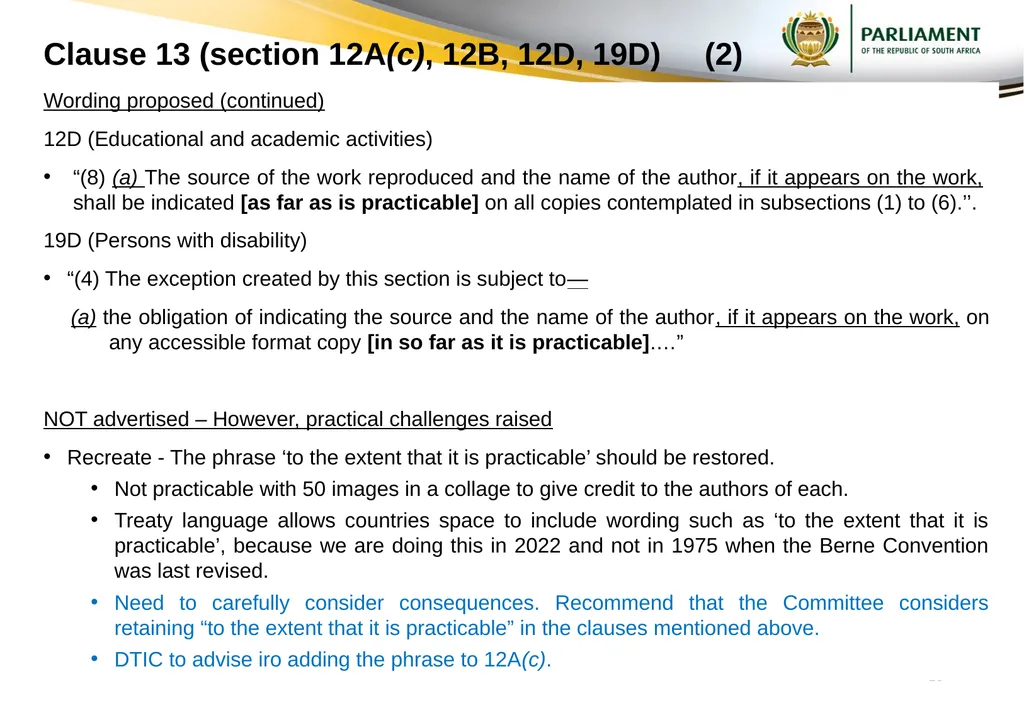
Clause 13 (section 12A(c), 12B, 12D, 19D) (2) Wording proposed (continued)
12D (Educational and academic activities)
“(8) (a) The source of the work reproduced and the name of the author, if it appears on the work, shall be indicated [as far as is practicable] on all copies contemplated in subsections (1) to (6).’’.
19D (Persons with disability)
“(4) The exception created by this section is subject to—
(a) the obligation of indicating the source and the name of the author, if it appears on the work, on any accessible format copy [in so far as it is practicable].…”
NOT advertised – However, practical challenges raised
Recreate - The phrase ‘to the extent that it is practicable’ should be restored.
Not practicable with 50 images in a collage to give credit to the authors of each.
Treaty language allows countries space to include wording such as ‘to the extent that it is practicable’, because we are doing this in 2022 and not in 1975 when the Berne Convention was last revised.
Need to carefully consider consequences. Recommend that the Committee considers retaining “to the extent that it is practicable” in the clauses mentioned above.
DTIC to advise iro adding the phrase to 12A(c). 13<br>
12D (Educational and academic activities)
“(8) (a) The source of the work reproduced and the name of the author, if it appears on the work, shall be indicated [as far as is practicable] on all copies contemplated in subsections (1) to (6).’’.
19D (Persons with disability)
“(4) The exception created by this section is subject to—
(a) the obligation of indicating the source and the name of the author, if it appears on the work, on any accessible format copy [in so far as it is practicable].…”
NOT advertised – However, practical challenges raised
Recreate - The phrase ‘to the extent that it is practicable’ should be restored.
Not practicable with 50 images in a collage to give credit to the authors of each.
Treaty language allows countries space to include wording such as ‘to the extent that it is practicable’, because we are doing this in 2022 and not in 1975 when the Berne Convention was last revised.
Need to carefully consider consequences. Recommend that the Committee considers retaining “to the extent that it is practicable” in the clauses mentioned above.
DTIC to advise iro adding the phrase to 12A(c). 13<br>
14
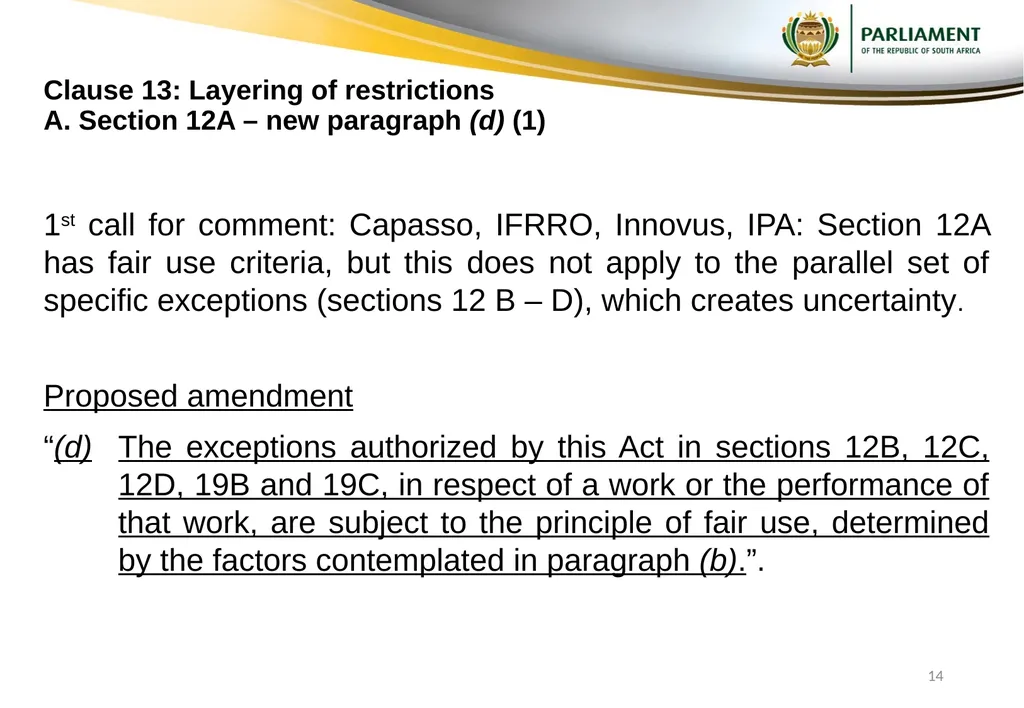
Clause 13: Layering of restrictions
A. Section 12A – new paragraph (d) (1) 1st call for comment: Capasso, IFRRO, Innovus, IPA: Section 12A has fair use criteria, but this does not apply to the parallel set of specific exceptions (sections 12 B – D), which creates uncertainty.
Proposed amendment
“(d) The exceptions authorized by this Act in sections 12B, 12C, 12D, 19B and 19C, in respect of a work or the performance of that work, are subject to the principle of fair use, determined by the factors contemplated in paragraph (b).”. 14<br>
Proposed amendment
“(d) The exceptions authorized by this Act in sections 12B, 12C, 12D, 19B and 19C, in respect of a work or the performance of that work, are subject to the principle of fair use, determined by the factors contemplated in paragraph (b).”. 14<br>
15
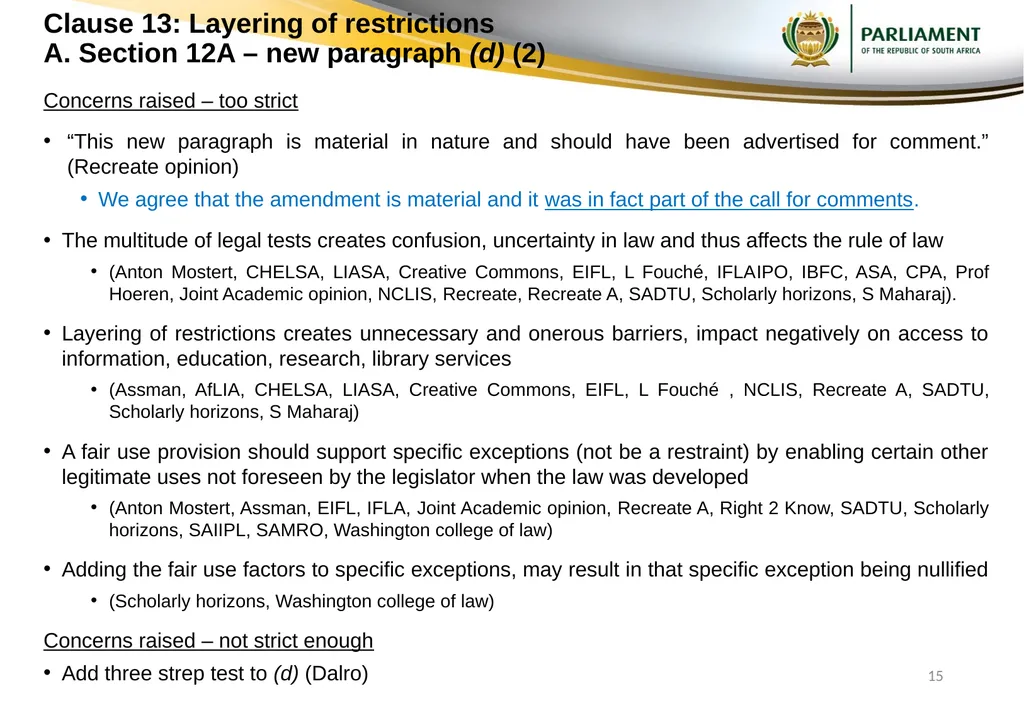
Clause 13: Layering of restrictions
A. Section 12A – new paragraph (d) (2) Concerns raised – too strict
“This new paragraph is material in nature and should have been advertised for comment.” (Recreate opinion)
We agree that the amendment is material and it was in fact part of the call for comments.
The multitude of legal tests creates confusion, uncertainty in law and thus affects the rule of law
(Anton Mostert, CHELSA, LIASA, Creative Commons, EIFL, L Fouché, IFLAIPO, IBFC, ASA, CPA, Prof Hoeren, Joint Academic opinion, NCLIS, Recreate, Recreate A, SADTU, Scholarly horizons, S Maharaj).
Layering of restrictions creates unnecessary and onerous barriers, impact negatively on access to information, education, research, library services
(Assman, AfLIA, CHELSA, LIASA, Creative Commons, EIFL, L Fouché , NCLIS, Recreate A, SADTU, Scholarly horizons, S Maharaj)
A fair use provision should support specific exceptions (not be a restraint) by enabling certain other legitimate uses not foreseen by the legislator when the law was developed
(Anton Mostert, Assman, EIFL, IFLA, Joint Academic opinion, Recreate A, Right 2 Know, SADTU, Scholarly horizons, SAIIPL, SAMRO, Washington college of law)
Adding the fair use factors to specific exceptions, may result in that specific exception being nullified
(Scholarly horizons, Washington college of law)
Concerns raised – not strict enough
Add three strep test to (d) (Dalro) 15<br>
“This new paragraph is material in nature and should have been advertised for comment.” (Recreate opinion)
We agree that the amendment is material and it was in fact part of the call for comments.
The multitude of legal tests creates confusion, uncertainty in law and thus affects the rule of law
(Anton Mostert, CHELSA, LIASA, Creative Commons, EIFL, L Fouché, IFLAIPO, IBFC, ASA, CPA, Prof Hoeren, Joint Academic opinion, NCLIS, Recreate, Recreate A, SADTU, Scholarly horizons, S Maharaj).
Layering of restrictions creates unnecessary and onerous barriers, impact negatively on access to information, education, research, library services
(Assman, AfLIA, CHELSA, LIASA, Creative Commons, EIFL, L Fouché , NCLIS, Recreate A, SADTU, Scholarly horizons, S Maharaj)
A fair use provision should support specific exceptions (not be a restraint) by enabling certain other legitimate uses not foreseen by the legislator when the law was developed
(Anton Mostert, Assman, EIFL, IFLA, Joint Academic opinion, Recreate A, Right 2 Know, SADTU, Scholarly horizons, SAIIPL, SAMRO, Washington college of law)
Adding the fair use factors to specific exceptions, may result in that specific exception being nullified
(Scholarly horizons, Washington college of law)
Concerns raised – not strict enough
Add three strep test to (d) (Dalro) 15<br>
16
Clause 13: Layering of restrictions
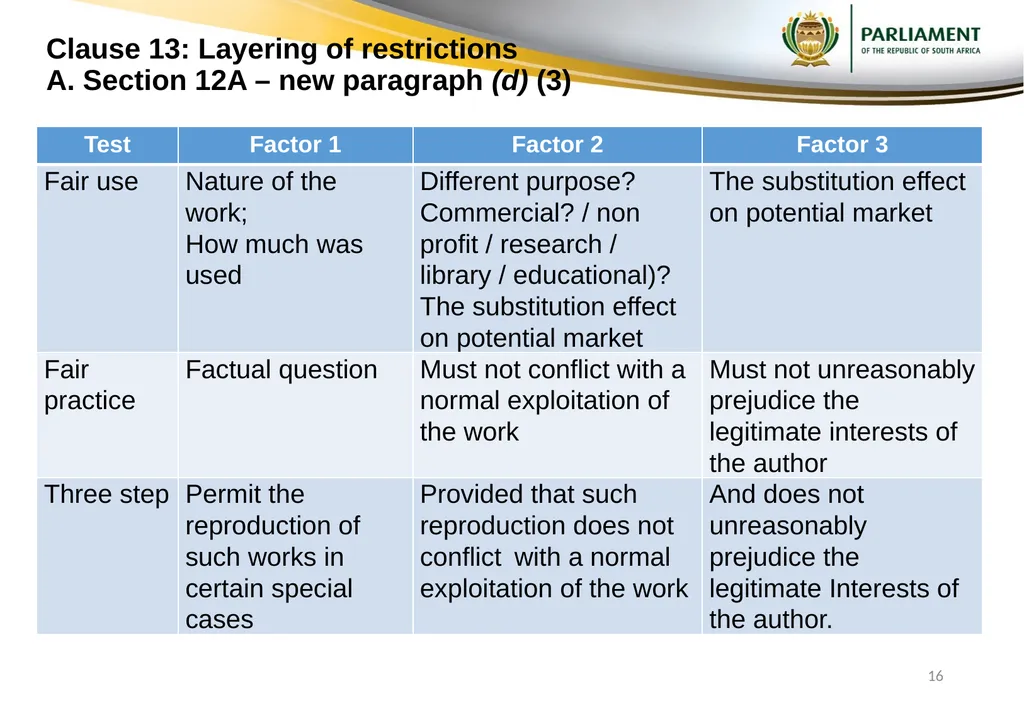
A. Section 12A – new paragraph (d) (3) 16<br>
17
Clause 13: Layering of restrictions
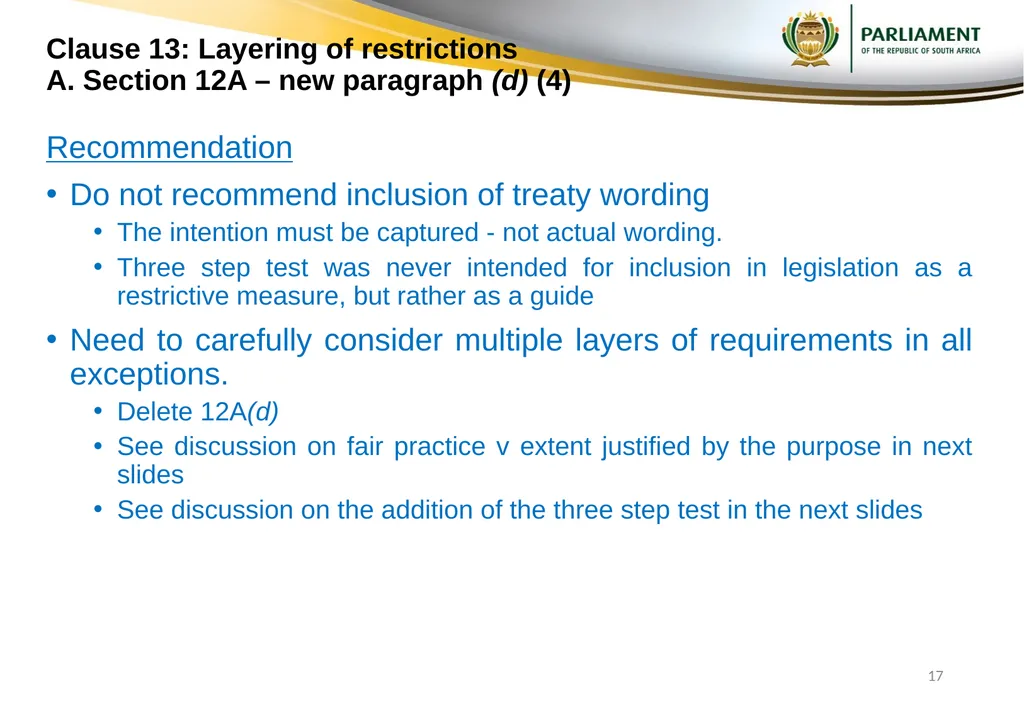
A. Section 12A – new paragraph (d) (4) Recommendation
Do not recommend inclusion of treaty wording
The intention must be captured - not actual wording.
Three step test was never intended for inclusion in legislation as a restrictive measure, but rather as a guide
Need to carefully consider multiple layers of requirements in all exceptions.
Delete 12A(d)
See discussion on fair practice v extent justified by the purpose in next slides
See discussion on the addition of the three step test in the next slides 17<br>
Do not recommend inclusion of treaty wording
The intention must be captured - not actual wording.
Three step test was never intended for inclusion in legislation as a restrictive measure, but rather as a guide
Need to carefully consider multiple layers of requirements in all exceptions.
Delete 12A(d)
See discussion on fair practice v extent justified by the purpose in next slides
See discussion on the addition of the three step test in the next slides 17<br>
18
Clause 13 : Layering of restrictions
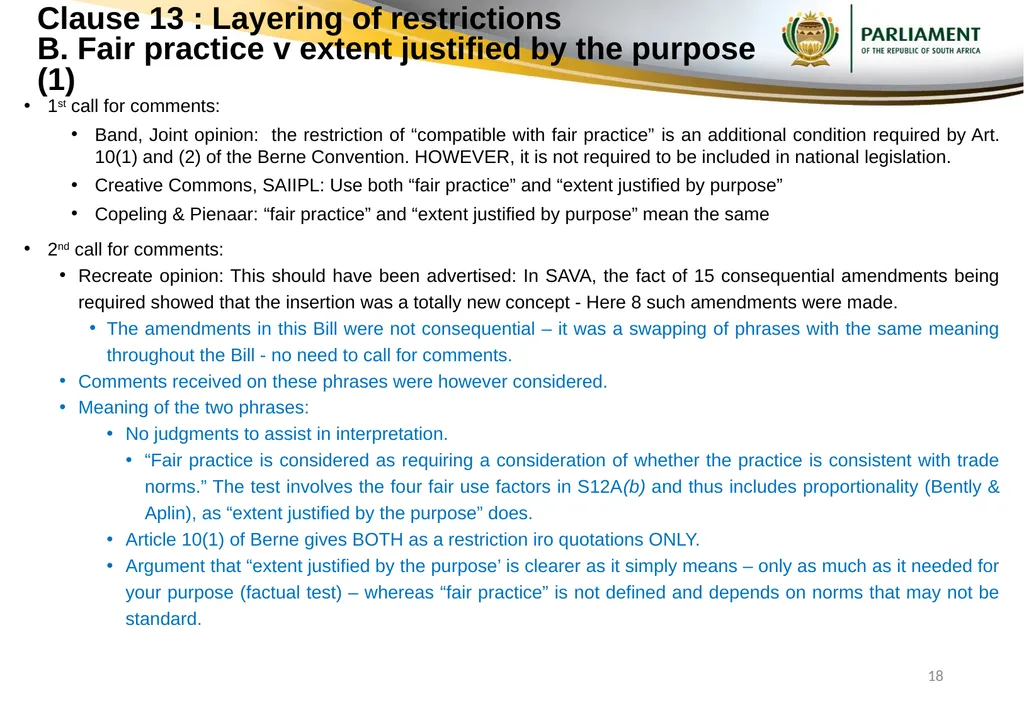
B. Fair practice v extent justified by the purpose (1) 1st call for comments:
Band, Joint opinion: the restriction of “compatible with fair practice” is an additional condition required by Art. 10(1) and (2) of the Berne Convention. HOWEVER, it is not required to be included in national legislation.
Creative Commons, SAIIPL: Use both “fair practice” and “extent justified by purpose”
Copeling & Pienaar: “fair practice” and “extent justified by purpose” mean the same
2nd call for comments:
Recreate opinion: This should have been advertised: In SAVA, the fact of 15 consequential amendments being required showed that the insertion was a totally new concept - Here 8 such amendments were made.
The amendments in this Bill were not consequential – it was a swapping of phrases with the same meaning throughout the Bill - no need to call for comments.
Comments received on these phrases were however considered.
Meaning of the two phrases:
No judgments to assist in interpretation.
“Fair practice is considered as requiring a consideration of whether the practice is consistent with trade norms.” The test involves the four fair use factors in S12A(b) and thus includes proportionality (Bently & Aplin), as “extent justified by the purpose” does.
Article 10(1) of Berne gives BOTH as a restriction iro quotations ONLY.
Argument that “extent justified by the purpose’ is clearer as it simply means – only as much as it needed for your purpose (factual test) – whereas “fair practice” is not defined and depends on norms that may not be standard. 18<br>
Band, Joint opinion: the restriction of “compatible with fair practice” is an additional condition required by Art. 10(1) and (2) of the Berne Convention. HOWEVER, it is not required to be included in national legislation.
Creative Commons, SAIIPL: Use both “fair practice” and “extent justified by purpose”
Copeling & Pienaar: “fair practice” and “extent justified by purpose” mean the same
2nd call for comments:
Recreate opinion: This should have been advertised: In SAVA, the fact of 15 consequential amendments being required showed that the insertion was a totally new concept - Here 8 such amendments were made.
The amendments in this Bill were not consequential – it was a swapping of phrases with the same meaning throughout the Bill - no need to call for comments.
Comments received on these phrases were however considered.
Meaning of the two phrases:
No judgments to assist in interpretation.
“Fair practice is considered as requiring a consideration of whether the practice is consistent with trade norms.” The test involves the four fair use factors in S12A(b) and thus includes proportionality (Bently & Aplin), as “extent justified by the purpose” does.
Article 10(1) of Berne gives BOTH as a restriction iro quotations ONLY.
Argument that “extent justified by the purpose’ is clearer as it simply means – only as much as it needed for your purpose (factual test) – whereas “fair practice” is not defined and depends on norms that may not be standard. 18<br>
19
Clause 13 : Layering of restrictions
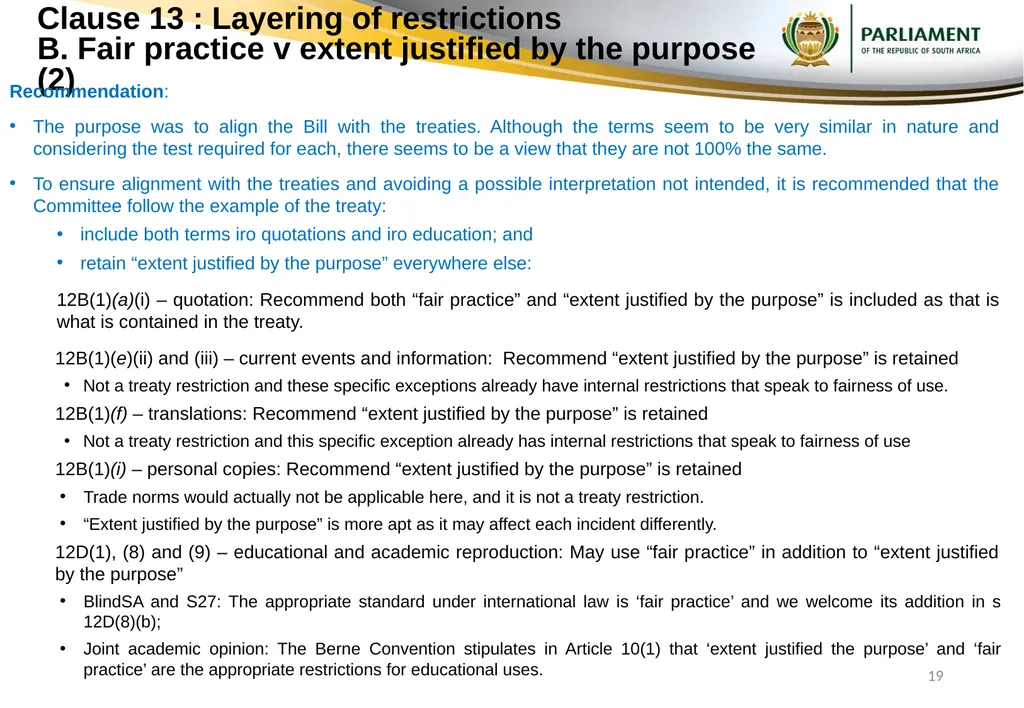
B. Fair practice v extent justified by the purpose (2) Recommendation:
The purpose was to align the Bill with the treaties. Although the terms seem to be very similar in nature and considering the test required for each, there seems to be a view that they are not 100% the same.
To ensure alignment with the treaties and avoiding a possible interpretation not intended, it is recommended that the Committee follow the example of the treaty:
include both terms iro quotations and iro education; and
retain “extent justified by the purpose” everywhere else:
12B(1)(a)(i) – quotation: Recommend both “fair practice” and “extent justified by the purpose” is included as that is what is contained in the treaty.
12B(1)(e)(ii) and (iii) – current events and information: Recommend “extent justified by the purpose” is retained
Not a treaty restriction and these specific exceptions already have internal restrictions that speak to fairness of use.
12B(1)(f) – translations: Recommend “extent justified by the purpose” is retained
Not a treaty restriction and this specific exception already has internal restrictions that speak to fairness of use
12B(1)(i) – personal copies: Recommend “extent justified by the purpose” is retained
Trade norms would actually not be applicable here, and it is not a treaty restriction.
“Extent justified by the purpose” is more apt as it may affect each incident differently.
12D(1), (8) and (9) – educational and academic reproduction: May use “fair practice” in addition to “extent justified by the purpose”
BlindSA and S27: The appropriate standard under international law is ‘fair practice’ and we welcome its addition in s 12D(8)(b);
Joint academic opinion: The Berne Convention stipulates in Article 10(1) that ‘extent justified the purpose’ and ‘fair practice’ are the appropriate restrictions for educational uses. 19<br>
The purpose was to align the Bill with the treaties. Although the terms seem to be very similar in nature and considering the test required for each, there seems to be a view that they are not 100% the same.
To ensure alignment with the treaties and avoiding a possible interpretation not intended, it is recommended that the Committee follow the example of the treaty:
include both terms iro quotations and iro education; and
retain “extent justified by the purpose” everywhere else:
12B(1)(a)(i) – quotation: Recommend both “fair practice” and “extent justified by the purpose” is included as that is what is contained in the treaty.
12B(1)(e)(ii) and (iii) – current events and information: Recommend “extent justified by the purpose” is retained
Not a treaty restriction and these specific exceptions already have internal restrictions that speak to fairness of use.
12B(1)(f) – translations: Recommend “extent justified by the purpose” is retained
Not a treaty restriction and this specific exception already has internal restrictions that speak to fairness of use
12B(1)(i) – personal copies: Recommend “extent justified by the purpose” is retained
Trade norms would actually not be applicable here, and it is not a treaty restriction.
“Extent justified by the purpose” is more apt as it may affect each incident differently.
12D(1), (8) and (9) – educational and academic reproduction: May use “fair practice” in addition to “extent justified by the purpose”
BlindSA and S27: The appropriate standard under international law is ‘fair practice’ and we welcome its addition in s 12D(8)(b);
Joint academic opinion: The Berne Convention stipulates in Article 10(1) that ‘extent justified the purpose’ and ‘fair practice’ are the appropriate restrictions for educational uses. 19<br>
20
Clause 13 : Layering of restrictions
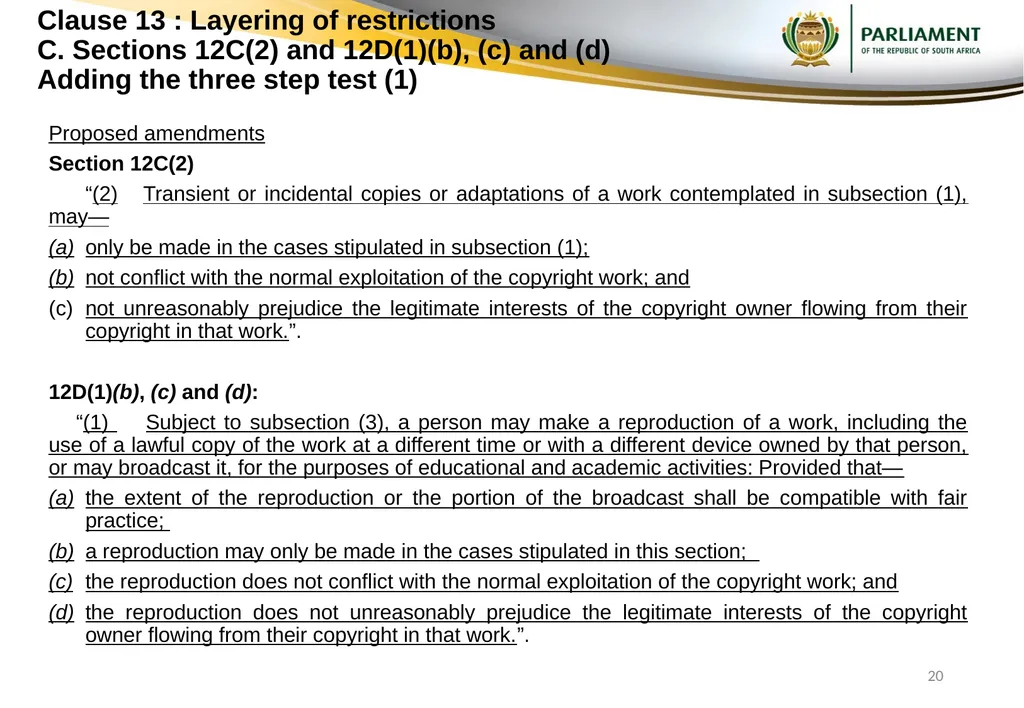
C. Sections 12C(2) and 12D(1)(b), (c) and (d)
Adding the three step test (1) Proposed amendments
Section 12C(2)
“(2) Transient or incidental copies or adaptations of a work contemplated in subsection (1), may—
(a) only be made in the cases stipulated in subsection (1);
(b) not conflict with the normal exploitation of the copyright work; and
not unreasonably prejudice the legitimate interests of the copyright owner flowing from their copyright in that work.”.
12D(1)(b), (c) and (d):
“(1) Subject to subsection (3), a person may make a reproduction of a work, including the use of a lawful copy of the work at a different time or with a different device owned by that person, or may broadcast it, for the purposes of educational and academic activities: Provided that—
(a) the extent of the reproduction or the portion of the broadcast shall be compatible with fair practice;
(b) a reproduction may only be made in the cases stipulated in this section;
(c) the reproduction does not conflict with the normal exploitation of the copyright work; and
(d) the reproduction does not unreasonably prejudice the legitimate interests of the copyright owner flowing from their copyright in that work.”. 20<br>
Section 12C(2)
“(2) Transient or incidental copies or adaptations of a work contemplated in subsection (1), may—
(a) only be made in the cases stipulated in subsection (1);
(b) not conflict with the normal exploitation of the copyright work; and
not unreasonably prejudice the legitimate interests of the copyright owner flowing from their copyright in that work.”.
12D(1)(b), (c) and (d):
“(1) Subject to subsection (3), a person may make a reproduction of a work, including the use of a lawful copy of the work at a different time or with a different device owned by that person, or may broadcast it, for the purposes of educational and academic activities: Provided that—
(a) the extent of the reproduction or the portion of the broadcast shall be compatible with fair practice;
(b) a reproduction may only be made in the cases stipulated in this section;
(c) the reproduction does not conflict with the normal exploitation of the copyright work; and
(d) the reproduction does not unreasonably prejudice the legitimate interests of the copyright owner flowing from their copyright in that work.”. 20<br>
21
Clause 13 : Layering of restrictions
C. Sections 12C(2) and 12D(1)(b), (c) and (d)
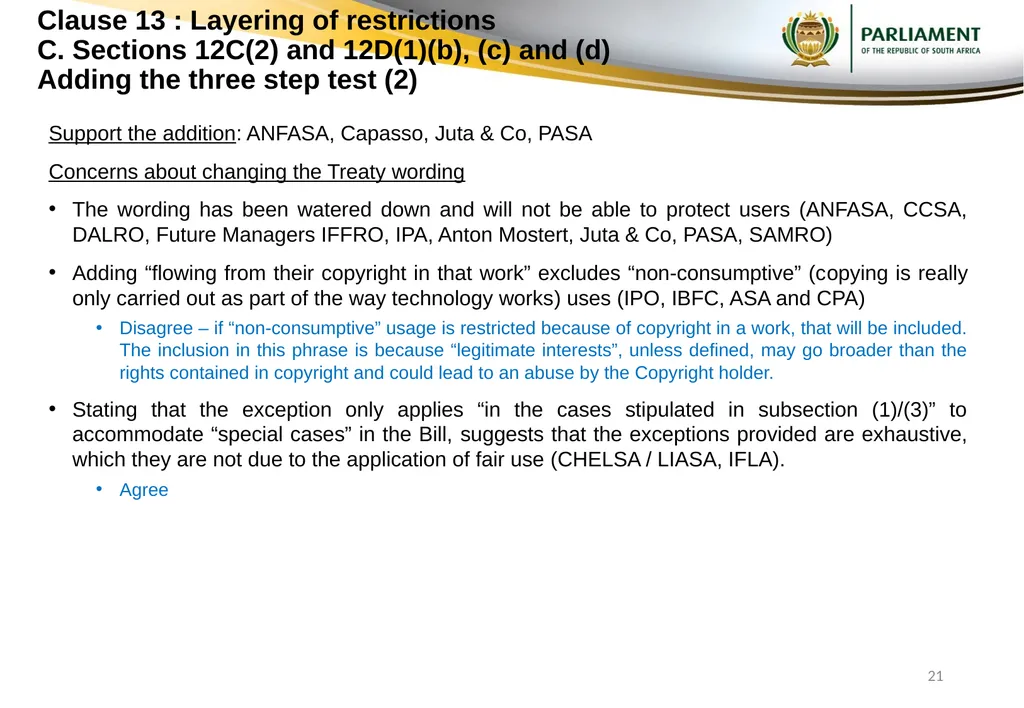
Adding the three step test (2) Support the addition: ANFASA, Capasso, Juta & Co, PASA
Concerns about changing the Treaty wording
The wording has been watered down and will not be able to protect users (ANFASA, CCSA, DALRO, Future Managers IFFRO, IPA, Anton Mostert, Juta & Co, PASA, SAMRO)
Adding “flowing from their copyright in that work” excludes “non-consumptive” (copying is really only carried out as part of the way technology works) uses (IPO, IBFC, ASA and CPA)
Disagree – if “non-consumptive” usage is restricted because of copyright in a work, that will be included. The inclusion in this phrase is because “legitimate interests”, unless defined, may go broader than the rights contained in copyright and could lead to an abuse by the Copyright holder.
Stating that the exception only applies “in the cases stipulated in subsection (1)/(3)” to accommodate “special cases” in the Bill, suggests that the exceptions provided are exhaustive, which they are not due to the application of fair use (CHELSA / LIASA, IFLA).
Agree 21<br>
Concerns about changing the Treaty wording
The wording has been watered down and will not be able to protect users (ANFASA, CCSA, DALRO, Future Managers IFFRO, IPA, Anton Mostert, Juta & Co, PASA, SAMRO)
Adding “flowing from their copyright in that work” excludes “non-consumptive” (copying is really only carried out as part of the way technology works) uses (IPO, IBFC, ASA and CPA)
Disagree – if “non-consumptive” usage is restricted because of copyright in a work, that will be included. The inclusion in this phrase is because “legitimate interests”, unless defined, may go broader than the rights contained in copyright and could lead to an abuse by the Copyright holder.
Stating that the exception only applies “in the cases stipulated in subsection (1)/(3)” to accommodate “special cases” in the Bill, suggests that the exceptions provided are exhaustive, which they are not due to the application of fair use (CHELSA / LIASA, IFLA).
Agree 21<br>
22
Clause 13 : Layering of restrictions
C. Sections 12C(2) and 12D(1)(b), (c) and (d)
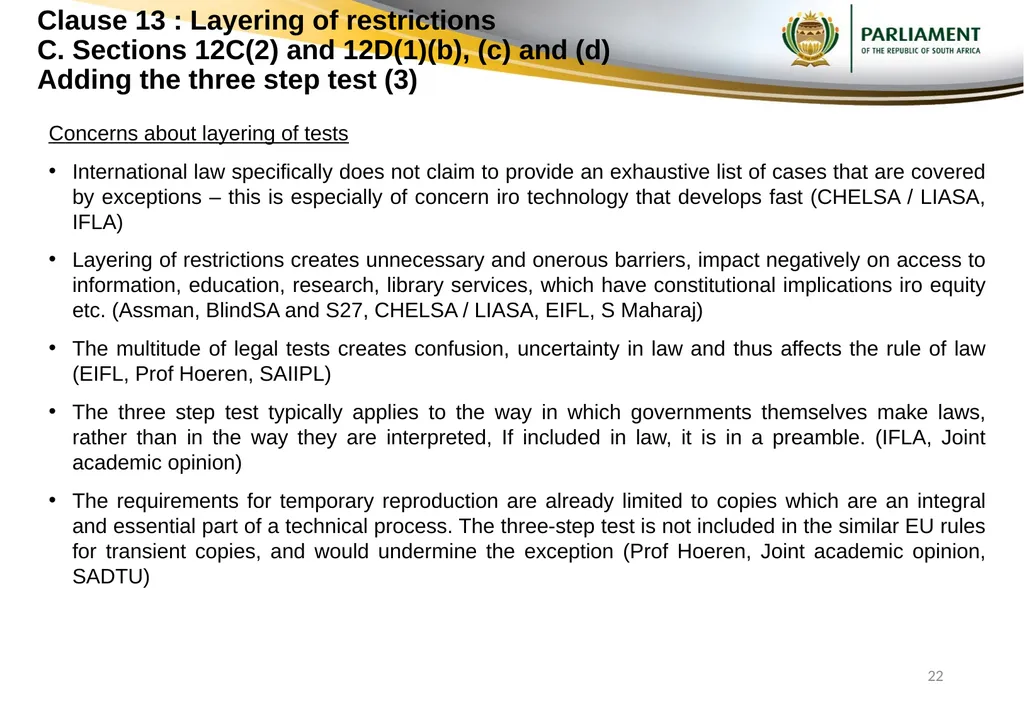
Adding the three step test (3) Concerns about layering of tests
International law specifically does not claim to provide an exhaustive list of cases that are covered by exceptions – this is especially of concern iro technology that develops fast (CHELSA / LIASA, IFLA)
Layering of restrictions creates unnecessary and onerous barriers, impact negatively on access to information, education, research, library services, which have constitutional implications iro equity etc. (Assman, BlindSA and S27, CHELSA / LIASA, EIFL, S Maharaj)
The multitude of legal tests creates confusion, uncertainty in law and thus affects the rule of law (EIFL, Prof Hoeren, SAIIPL)
The three step test typically applies to the way in which governments themselves make laws, rather than in the way they are interpreted, If included in law, it is in a preamble. (IFLA, Joint academic opinion)
The requirements for temporary reproduction are already limited to copies which are an integral and essential part of a technical process. The three-step test is not included in the similar EU rules for transient copies, and would undermine the exception (Prof Hoeren, Joint academic opinion, SADTU) 22<br>
International law specifically does not claim to provide an exhaustive list of cases that are covered by exceptions – this is especially of concern iro technology that develops fast (CHELSA / LIASA, IFLA)
Layering of restrictions creates unnecessary and onerous barriers, impact negatively on access to information, education, research, library services, which have constitutional implications iro equity etc. (Assman, BlindSA and S27, CHELSA / LIASA, EIFL, S Maharaj)
The multitude of legal tests creates confusion, uncertainty in law and thus affects the rule of law (EIFL, Prof Hoeren, SAIIPL)
The three step test typically applies to the way in which governments themselves make laws, rather than in the way they are interpreted, If included in law, it is in a preamble. (IFLA, Joint academic opinion)
The requirements for temporary reproduction are already limited to copies which are an integral and essential part of a technical process. The three-step test is not included in the similar EU rules for transient copies, and would undermine the exception (Prof Hoeren, Joint academic opinion, SADTU) 22<br>
23
Clause 13 : Layering of restrictions
C. Sections 12C(2) and 12D(1)(b), (c) and (d)
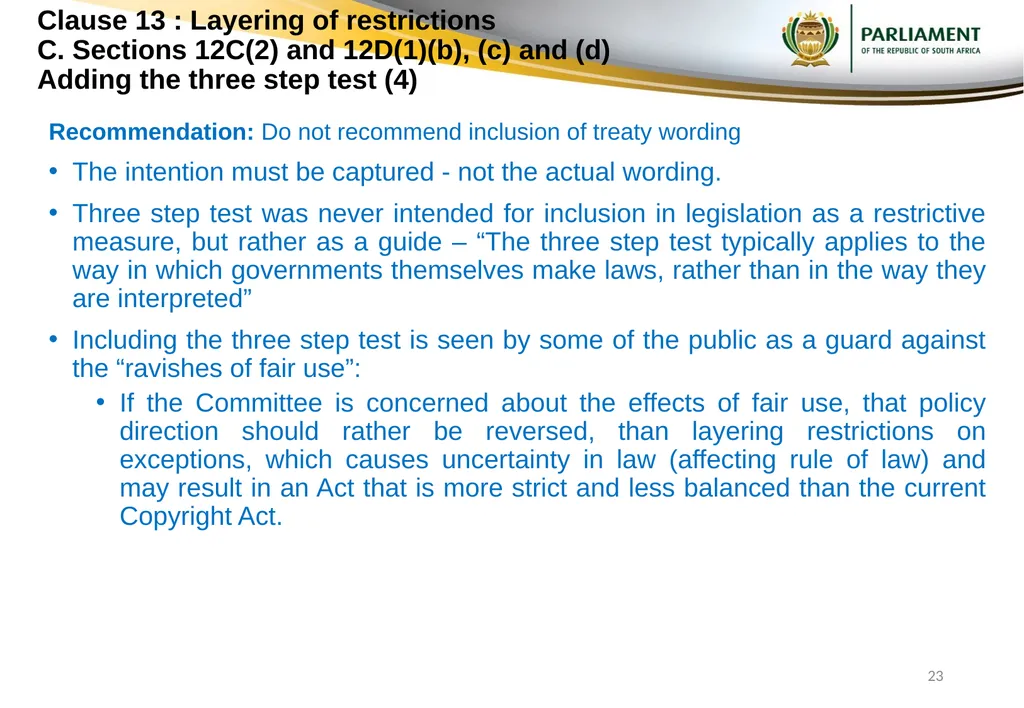
Adding the three step test (4) Recommendation: Do not recommend inclusion of treaty wording
The intention must be captured - not the actual wording.
Three step test was never intended for inclusion in legislation as a restrictive measure, but rather as a guide – “The three step test typically applies to the way in which governments themselves make laws, rather than in the way they are interpreted”
Including the three step test is seen by some of the public as a guard against the “ravishes of fair use”:
If the Committee is concerned about the effects of fair use, that policy direction should rather be reversed, than layering restrictions on exceptions, which causes uncertainty in law (affecting rule of law) and may result in an Act that is more strict and less balanced than the current Copyright Act. 23<br>
The intention must be captured - not the actual wording.
Three step test was never intended for inclusion in legislation as a restrictive measure, but rather as a guide – “The three step test typically applies to the way in which governments themselves make laws, rather than in the way they are interpreted”
Including the three step test is seen by some of the public as a guard against the “ravishes of fair use”:
If the Committee is concerned about the effects of fair use, that policy direction should rather be reversed, than layering restrictions on exceptions, which causes uncertainty in law (affecting rule of law) and may result in an Act that is more strict and less balanced than the current Copyright Act. 23<br>
24
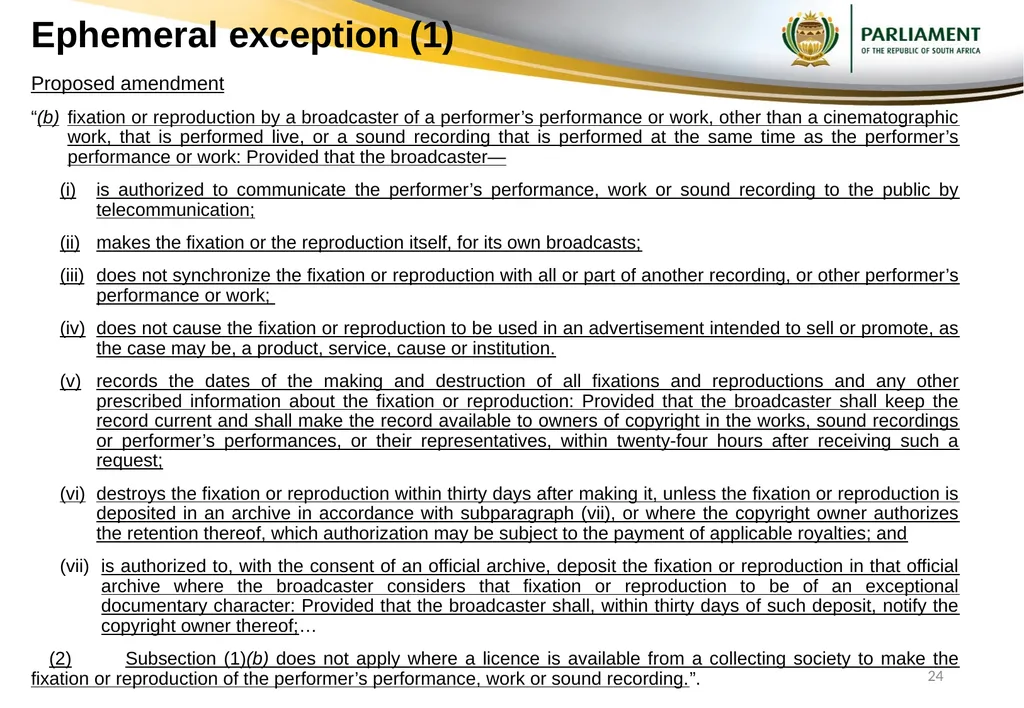
Ephemeral exception (1) Proposed amendment
“(b) fixation or reproduction by a broadcaster of a performer’s performance or work, other than a cinematographic work, that is performed live, or a sound recording that is performed at the same time as the performer’s performance or work: Provided that the broadcaster—
(i) is authorized to communicate the performer’s performance, work or sound recording to the public by telecommunication;
(ii) makes the fixation or the reproduction itself, for its own broadcasts;
(iii) does not synchronize the fixation or reproduction with all or part of another recording, or other performer’s performance or work;
(iv) does not cause the fixation or reproduction to be used in an advertisement intended to sell or promote, as the case may be, a product, service, cause or institution.
(v) records the dates of the making and destruction of all fixations and reproductions and any other prescribed information about the fixation or reproduction: Provided that the broadcaster shall keep the record current and shall make the record available to owners of copyright in the works, sound recordings or performer’s performances, or their representatives, within twenty-four hours after receiving such a request;
(vi) destroys the fixation or reproduction within thirty days after making it, unless the fixation or reproduction is deposited in an archive in accordance with subparagraph (vii), or where the copyright owner authorizes the retention thereof, which authorization may be subject to the payment of applicable royalties; and
is authorized to, with the consent of an official archive, deposit the fixation or reproduction in that official archive where the broadcaster considers that fixation or reproduction to be of an exceptional documentary character: Provided that the broadcaster shall, within thirty days of such deposit, notify the copyright owner thereof;…
(2) Subsection (1)(b) does not apply where a licence is available from a collecting society to make the fixation or reproduction of the performer’s performance, work or sound recording.”. 24<br>
“(b) fixation or reproduction by a broadcaster of a performer’s performance or work, other than a cinematographic work, that is performed live, or a sound recording that is performed at the same time as the performer’s performance or work: Provided that the broadcaster—
(i) is authorized to communicate the performer’s performance, work or sound recording to the public by telecommunication;
(ii) makes the fixation or the reproduction itself, for its own broadcasts;
(iii) does not synchronize the fixation or reproduction with all or part of another recording, or other performer’s performance or work;
(iv) does not cause the fixation or reproduction to be used in an advertisement intended to sell or promote, as the case may be, a product, service, cause or institution.
(v) records the dates of the making and destruction of all fixations and reproductions and any other prescribed information about the fixation or reproduction: Provided that the broadcaster shall keep the record current and shall make the record available to owners of copyright in the works, sound recordings or performer’s performances, or their representatives, within twenty-four hours after receiving such a request;
(vi) destroys the fixation or reproduction within thirty days after making it, unless the fixation or reproduction is deposited in an archive in accordance with subparagraph (vii), or where the copyright owner authorizes the retention thereof, which authorization may be subject to the payment of applicable royalties; and
is authorized to, with the consent of an official archive, deposit the fixation or reproduction in that official archive where the broadcaster considers that fixation or reproduction to be of an exceptional documentary character: Provided that the broadcaster shall, within thirty days of such deposit, notify the copyright owner thereof;…
(2) Subsection (1)(b) does not apply where a licence is available from a collecting society to make the fixation or reproduction of the performer’s performance, work or sound recording.”. 24<br>
25
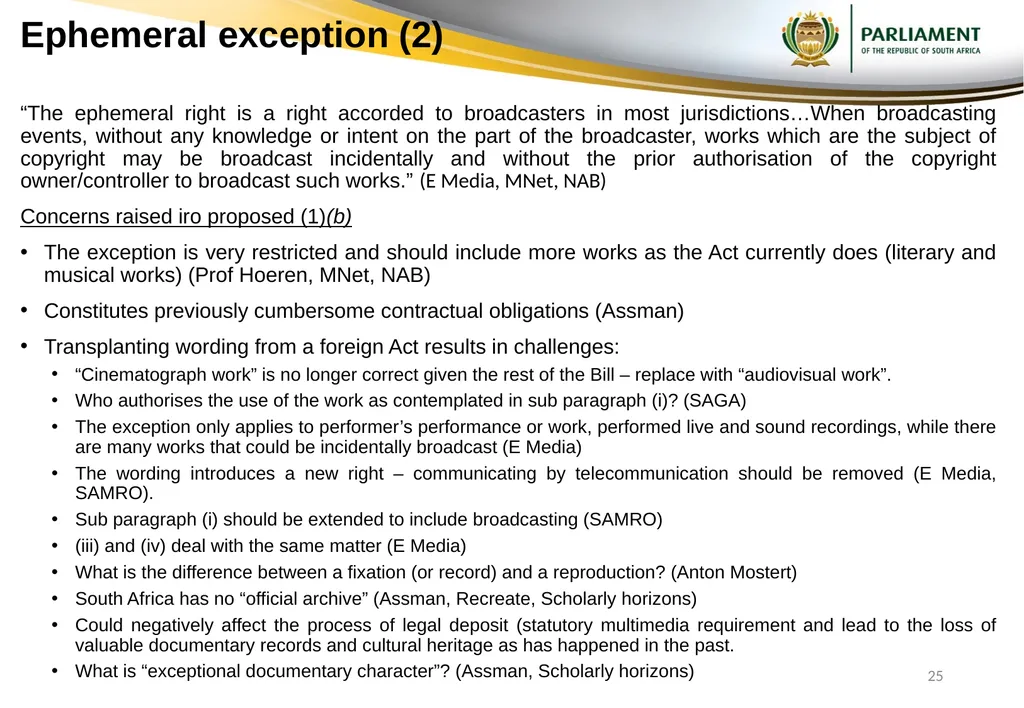
Ephemeral exception (2) “The ephemeral right is a right accorded to broadcasters in most jurisdictions…When broadcasting events, without any knowledge or intent on the part of the broadcaster, works which are the subject of copyright may be broadcast incidentally and without the prior authorisation of the copyright owner/controller to broadcast such works.” (E Media, MNet, NAB)
Concerns raised iro proposed (1)(b)
The exception is very restricted and should include more works as the Act currently does (literary and musical works) (Prof Hoeren, MNet, NAB)
Constitutes previously cumbersome contractual obligations (Assman)
Transplanting wording from a foreign Act results in challenges:
“Cinematograph work” is no longer correct given the rest of the Bill – replace with “audiovisual work”.
Who authorises the use of the work as contemplated in sub paragraph (i)? (SAGA)
The exception only applies to performer’s performance or work, performed live and sound recordings, while there are many works that could be incidentally broadcast (E Media)
The wording introduces a new right – communicating by telecommunication should be removed (E Media, SAMRO).
Sub paragraph (i) should be extended to include broadcasting (SAMRO)
(iii) and (iv) deal with the same matter (E Media)
What is the difference between a fixation (or record) and a reproduction? (Anton Mostert)
South Africa has no “official archive” (Assman, Recreate, Scholarly horizons)
Could negatively affect the process of legal deposit (statutory multimedia requirement and lead to the loss of valuable documentary records and cultural heritage as has happened in the past.
What is “exceptional documentary character”? (Assman, Scholarly horizons) 25<br>
Concerns raised iro proposed (1)(b)
The exception is very restricted and should include more works as the Act currently does (literary and musical works) (Prof Hoeren, MNet, NAB)
Constitutes previously cumbersome contractual obligations (Assman)
Transplanting wording from a foreign Act results in challenges:
“Cinematograph work” is no longer correct given the rest of the Bill – replace with “audiovisual work”.
Who authorises the use of the work as contemplated in sub paragraph (i)? (SAGA)
The exception only applies to performer’s performance or work, performed live and sound recordings, while there are many works that could be incidentally broadcast (E Media)
The wording introduces a new right – communicating by telecommunication should be removed (E Media, SAMRO).
Sub paragraph (i) should be extended to include broadcasting (SAMRO)
(iii) and (iv) deal with the same matter (E Media)
What is the difference between a fixation (or record) and a reproduction? (Anton Mostert)
South Africa has no “official archive” (Assman, Recreate, Scholarly horizons)
Could negatively affect the process of legal deposit (statutory multimedia requirement and lead to the loss of valuable documentary records and cultural heritage as has happened in the past.
What is “exceptional documentary character”? (Assman, Scholarly horizons) 25<br>
26
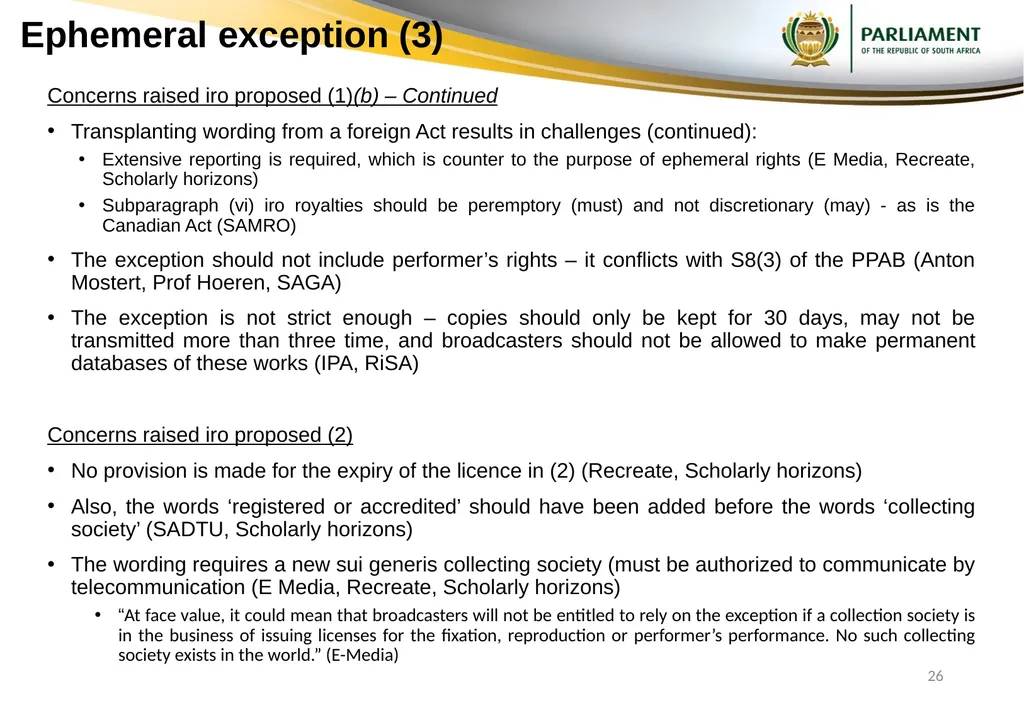
Ephemeral exception (3) Concerns raised iro proposed (1)(b) – Continued
Transplanting wording from a foreign Act results in challenges (continued):
Extensive reporting is required, which is counter to the purpose of ephemeral rights (E Media, Recreate, Scholarly horizons)
Subparagraph (vi) iro royalties should be peremptory (must) and not discretionary (may) - as is the Canadian Act (SAMRO)
The exception should not include performer’s rights – it conflicts with S8(3) of the PPAB (Anton Mostert, Prof Hoeren, SAGA)
The exception is not strict enough – copies should only be kept for 30 days, may not be transmitted more than three time, and broadcasters should not be allowed to make permanent databases of these works (IPA, RiSA)
Concerns raised iro proposed (2)
No provision is made for the expiry of the licence in (2) (Recreate, Scholarly horizons)
Also, the words ‘registered or accredited’ should have been added before the words ‘collecting society’ (SADTU, Scholarly horizons)
The wording requires a new sui generis collecting society (must be authorized to communicate by telecommunication (E Media, Recreate, Scholarly horizons)
“At face value, it could mean that broadcasters will not be entitled to rely on the exception if a collection society is in the business of issuing licenses for the fixation, reproduction or performer’s performance. No such collecting society exists in the world.” (E-Media) 26<br>
Transplanting wording from a foreign Act results in challenges (continued):
Extensive reporting is required, which is counter to the purpose of ephemeral rights (E Media, Recreate, Scholarly horizons)
Subparagraph (vi) iro royalties should be peremptory (must) and not discretionary (may) - as is the Canadian Act (SAMRO)
The exception should not include performer’s rights – it conflicts with S8(3) of the PPAB (Anton Mostert, Prof Hoeren, SAGA)
The exception is not strict enough – copies should only be kept for 30 days, may not be transmitted more than three time, and broadcasters should not be allowed to make permanent databases of these works (IPA, RiSA)
Concerns raised iro proposed (2)
No provision is made for the expiry of the licence in (2) (Recreate, Scholarly horizons)
Also, the words ‘registered or accredited’ should have been added before the words ‘collecting society’ (SADTU, Scholarly horizons)
The wording requires a new sui generis collecting society (must be authorized to communicate by telecommunication (E Media, Recreate, Scholarly horizons)
“At face value, it could mean that broadcasters will not be entitled to rely on the exception if a collection society is in the business of issuing licenses for the fixation, reproduction or performer’s performance. No such collecting society exists in the world.” (E-Media) 26<br>
27
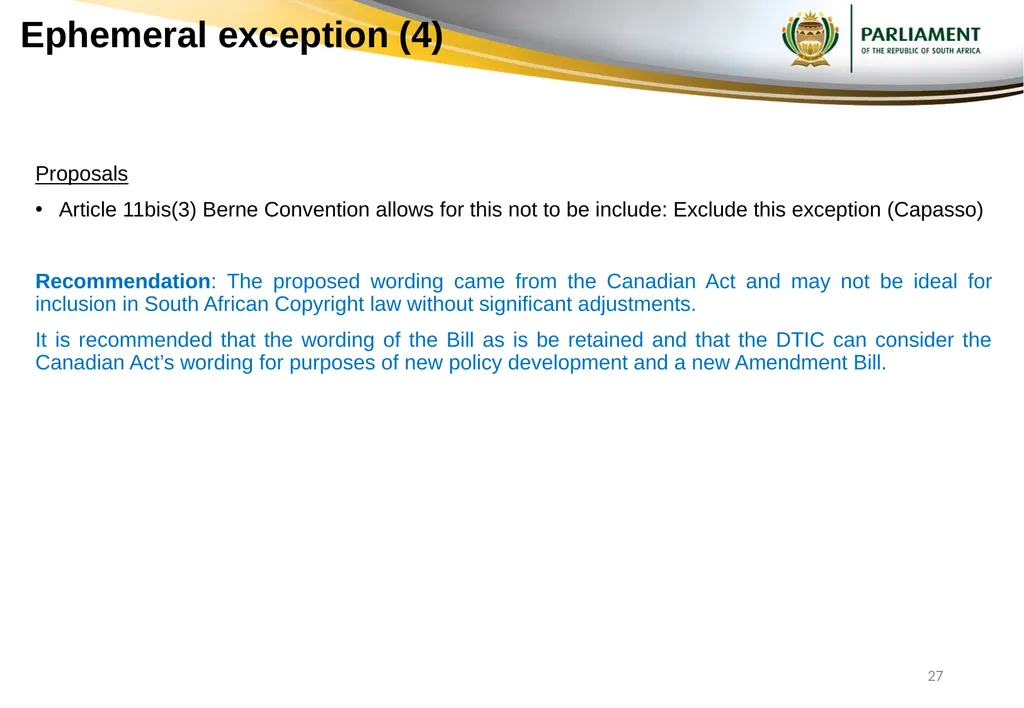
Ephemeral exception (4) Proposals
Article 11bis(3) Berne Convention allows for this not to be include: Exclude this exception (Capasso)
Recommendation: The proposed wording came from the Canadian Act and may not be ideal for inclusion in South African Copyright law without significant adjustments.
It is recommended that the wording of the Bill as is be retained and that the DTIC can consider the Canadian Act’s wording for purposes of new policy development and a new Amendment Bill. 27<br>
Article 11bis(3) Berne Convention allows for this not to be include: Exclude this exception (Capasso)
Recommendation: The proposed wording came from the Canadian Act and may not be ideal for inclusion in South African Copyright law without significant adjustments.
It is recommended that the wording of the Bill as is be retained and that the DTIC can consider the Canadian Act’s wording for purposes of new policy development and a new Amendment Bill. 27<br>
28
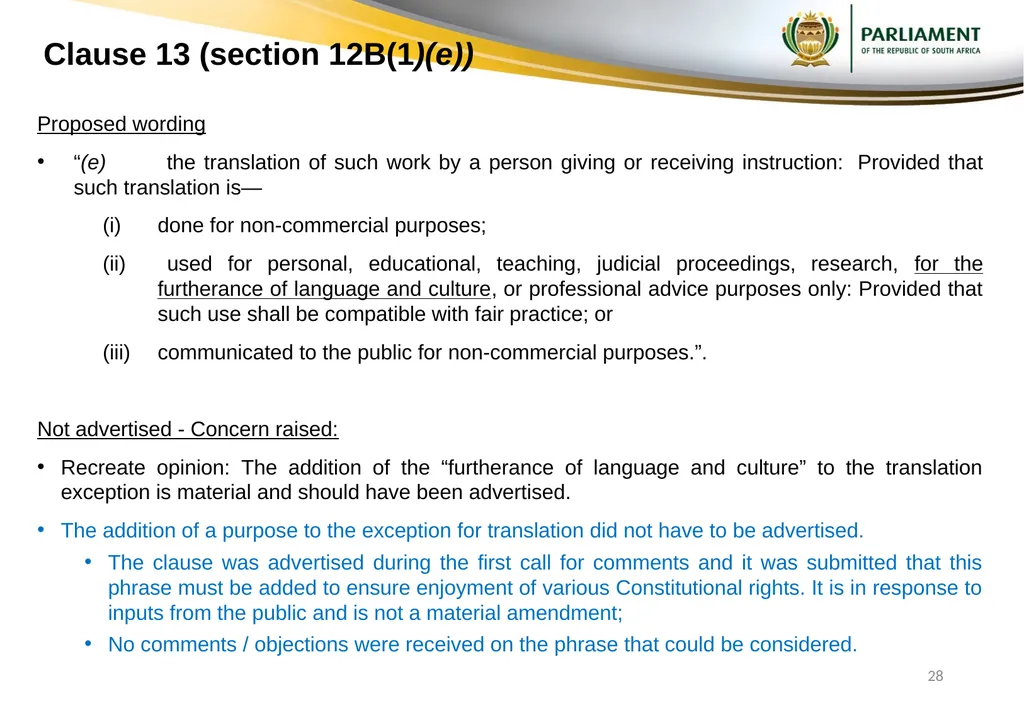
Clause 13 (section 12B(1)(e)) Proposed wording
“(e) the translation of such work by a person giving or receiving instruction: Provided that such translation is—
(i) done for non-commercial purposes;
(ii) used for personal, educational, teaching, judicial proceedings, research, for the furtherance of language and culture, or professional advice purposes only: Provided that such use shall be compatible with fair practice; or
(iii) communicated to the public for non-commercial purposes.”.
Not advertised - Concern raised:
Recreate opinion: The addition of the “furtherance of language and culture” to the translation exception is material and should have been advertised.
The addition of a purpose to the exception for translation did not have to be advertised.
The clause was advertised during the first call for comments and it was submitted that this phrase must be added to ensure enjoyment of various Constitutional rights. It is in response to inputs from the public and is not a material amendment;
No comments / objections were received on the phrase that could be considered. 28<br>
“(e) the translation of such work by a person giving or receiving instruction: Provided that such translation is—
(i) done for non-commercial purposes;
(ii) used for personal, educational, teaching, judicial proceedings, research, for the furtherance of language and culture, or professional advice purposes only: Provided that such use shall be compatible with fair practice; or
(iii) communicated to the public for non-commercial purposes.”.
Not advertised - Concern raised:
Recreate opinion: The addition of the “furtherance of language and culture” to the translation exception is material and should have been advertised.
The addition of a purpose to the exception for translation did not have to be advertised.
The clause was advertised during the first call for comments and it was submitted that this phrase must be added to ensure enjoyment of various Constitutional rights. It is in response to inputs from the public and is not a material amendment;
No comments / objections were received on the phrase that could be considered. 28<br>
29
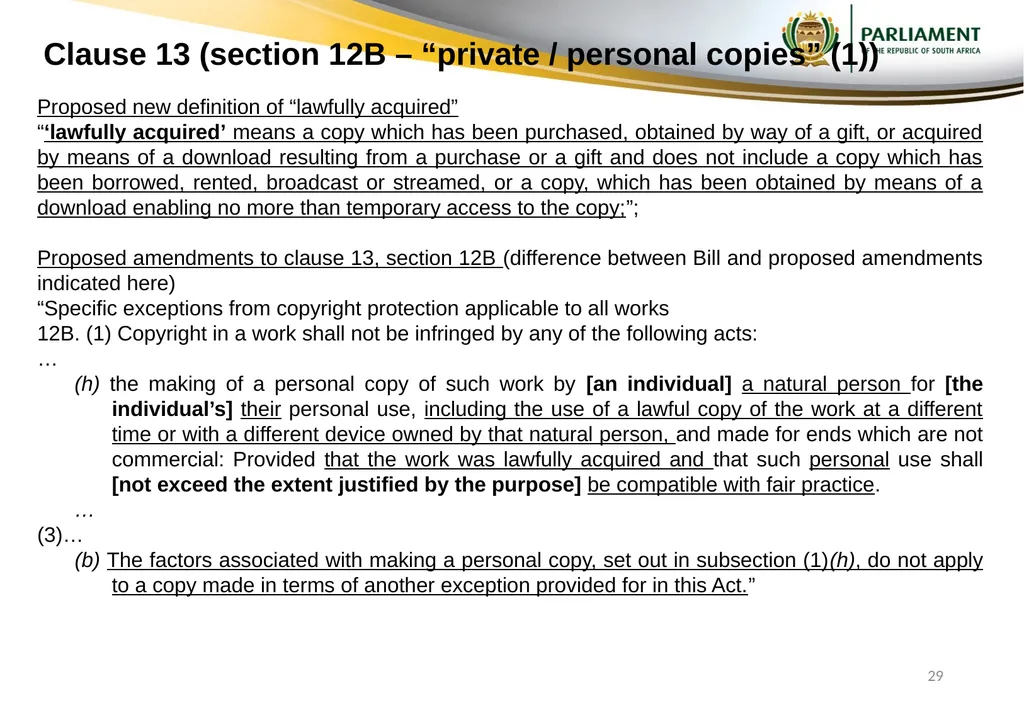
Clause 13 (section 12B – “private / personal copies” (1)) Proposed new definition of “lawfully acquired”
“‘lawfully acquired’ means a copy which has been purchased, obtained by way of a gift, or acquired by means of a download resulting from a purchase or a gift and does not include a copy which has been borrowed, rented, broadcast or streamed, or a copy, which has been obtained by means of a download enabling no more than temporary access to the copy;”;
Proposed amendments to clause 13, section 12B (difference between Bill and proposed amendments indicated here)
“Specific exceptions from copyright protection applicable to all works
12B. (1) Copyright in a work shall not be infringed by any of the following acts:
…
(h) the making of a personal copy of such work by [an individual] a natural person for [the individual’s] their personal use, including the use of a lawful copy of the work at a different time or with a different device owned by that natural person, and made for ends which are not commercial: Provided that the work was lawfully acquired and that such personal use shall [not exceed the extent justified by the purpose] be compatible with fair practice.
…
(3)…
(b) The factors associated with making a personal copy, set out in subsection (1)(h), do not apply to a copy made in terms of another exception provided for in this Act.” 29<br>
“‘lawfully acquired’ means a copy which has been purchased, obtained by way of a gift, or acquired by means of a download resulting from a purchase or a gift and does not include a copy which has been borrowed, rented, broadcast or streamed, or a copy, which has been obtained by means of a download enabling no more than temporary access to the copy;”;
Proposed amendments to clause 13, section 12B (difference between Bill and proposed amendments indicated here)
“Specific exceptions from copyright protection applicable to all works
12B. (1) Copyright in a work shall not be infringed by any of the following acts:
…
(h) the making of a personal copy of such work by [an individual] a natural person for [the individual’s] their personal use, including the use of a lawful copy of the work at a different time or with a different device owned by that natural person, and made for ends which are not commercial: Provided that the work was lawfully acquired and that such personal use shall [not exceed the extent justified by the purpose] be compatible with fair practice.
…
(3)…
(b) The factors associated with making a personal copy, set out in subsection (1)(h), do not apply to a copy made in terms of another exception provided for in this Act.” 29<br>
30
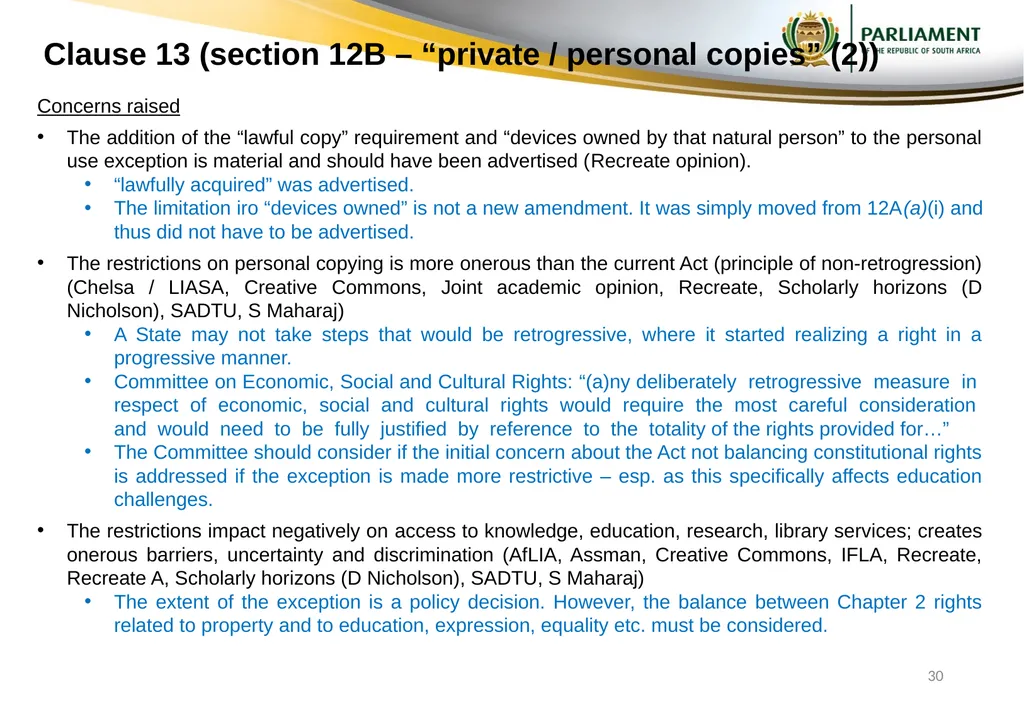
Clause 13 (section 12B – “private / personal copies” (2)) Concerns raised
The addition of the “lawful copy” requirement and “devices owned by that natural person” to the personal use exception is material and should have been advertised (Recreate opinion).
“lawfully acquired” was advertised.
The limitation iro “devices owned” is not a new amendment. It was simply moved from 12A(a)(i) and thus did not have to be advertised.
The restrictions on personal copying is more onerous than the current Act (principle of non-retrogression) (Chelsa / LIASA, Creative Commons, Joint academic opinion, Recreate, Scholarly horizons (D Nicholson), SADTU, S Maharaj)
A State may not take steps that would be retrogressive, where it started realizing a right in a progressive manner.
Committee on Economic, Social and Cultural Rights: “(a)ny deliberately retrogressive measure in respect of economic, social and cultural rights would require the most careful consideration and would need to be fully justified by reference to the totality of the rights provided for…”
The Committee should consider if the initial concern about the Act not balancing constitutional rights is addressed if the exception is made more restrictive – esp. as this specifically affects education challenges.
The restrictions impact negatively on access to knowledge, education, research, library services; creates onerous barriers, uncertainty and discrimination (AfLIA, Assman, Creative Commons, IFLA, Recreate, Recreate A, Scholarly horizons (D Nicholson), SADTU, S Maharaj)
The extent of the exception is a policy decision. However, the balance between Chapter 2 rights related to property and to education, expression, equality etc. must be considered. 30<br>
The addition of the “lawful copy” requirement and “devices owned by that natural person” to the personal use exception is material and should have been advertised (Recreate opinion).
“lawfully acquired” was advertised.
The limitation iro “devices owned” is not a new amendment. It was simply moved from 12A(a)(i) and thus did not have to be advertised.
The restrictions on personal copying is more onerous than the current Act (principle of non-retrogression) (Chelsa / LIASA, Creative Commons, Joint academic opinion, Recreate, Scholarly horizons (D Nicholson), SADTU, S Maharaj)
A State may not take steps that would be retrogressive, where it started realizing a right in a progressive manner.
Committee on Economic, Social and Cultural Rights: “(a)ny deliberately retrogressive measure in respect of economic, social and cultural rights would require the most careful consideration and would need to be fully justified by reference to the totality of the rights provided for…”
The Committee should consider if the initial concern about the Act not balancing constitutional rights is addressed if the exception is made more restrictive – esp. as this specifically affects education challenges.
The restrictions impact negatively on access to knowledge, education, research, library services; creates onerous barriers, uncertainty and discrimination (AfLIA, Assman, Creative Commons, IFLA, Recreate, Recreate A, Scholarly horizons (D Nicholson), SADTU, S Maharaj)
The extent of the exception is a policy decision. However, the balance between Chapter 2 rights related to property and to education, expression, equality etc. must be considered. 30<br>
31
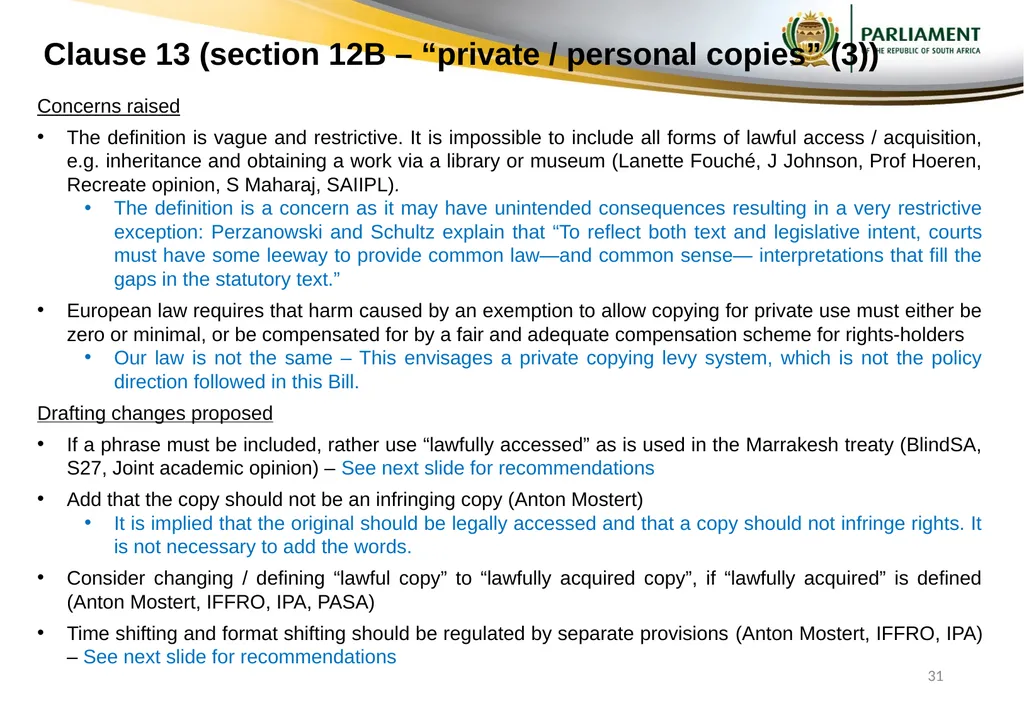
Clause 13 (section 12B – “private / personal copies” (3)) Concerns raised
The definition is vague and restrictive. It is impossible to include all forms of lawful access / acquisition, e.g. inheritance and obtaining a work via a library or museum (Lanette Fouché, J Johnson, Prof Hoeren, Recreate opinion, S Maharaj, SAIIPL).
The definition is a concern as it may have unintended consequences resulting in a very restrictive exception: Perzanowski and Schultz explain that “To reflect both text and legislative intent, courts must have some leeway to provide common law—and common sense— interpretations that fill the gaps in the statutory text.”
European law requires that harm caused by an exemption to allow copying for private use must either be zero or minimal, or be compensated for by a fair and adequate compensation scheme for rights-holders
Our law is not the same – This envisages a private copying levy system, which is not the policy direction followed in this Bill.
Drafting changes proposed
If a phrase must be included, rather use “lawfully accessed” as is used in the Marrakesh treaty (BlindSA, S27, Joint academic opinion) – See next slide for recommendations
Add that the copy should not be an infringing copy (Anton Mostert)
It is implied that the original should be legally accessed and that a copy should not infringe rights. It is not necessary to add the words.
Consider changing / defining “lawful copy” to “lawfully acquired copy”, if “lawfully acquired” is defined (Anton Mostert, IFFRO, IPA, PASA)
Time shifting and format shifting should be regulated by separate provisions (Anton Mostert, IFFRO, IPA) – See next slide for recommendations 31<br>
The definition is vague and restrictive. It is impossible to include all forms of lawful access / acquisition, e.g. inheritance and obtaining a work via a library or museum (Lanette Fouché, J Johnson, Prof Hoeren, Recreate opinion, S Maharaj, SAIIPL).
The definition is a concern as it may have unintended consequences resulting in a very restrictive exception: Perzanowski and Schultz explain that “To reflect both text and legislative intent, courts must have some leeway to provide common law—and common sense— interpretations that fill the gaps in the statutory text.”
European law requires that harm caused by an exemption to allow copying for private use must either be zero or minimal, or be compensated for by a fair and adequate compensation scheme for rights-holders
Our law is not the same – This envisages a private copying levy system, which is not the policy direction followed in this Bill.
Drafting changes proposed
If a phrase must be included, rather use “lawfully accessed” as is used in the Marrakesh treaty (BlindSA, S27, Joint academic opinion) – See next slide for recommendations
Add that the copy should not be an infringing copy (Anton Mostert)
It is implied that the original should be legally accessed and that a copy should not infringe rights. It is not necessary to add the words.
Consider changing / defining “lawful copy” to “lawfully acquired copy”, if “lawfully acquired” is defined (Anton Mostert, IFFRO, IPA, PASA)
Time shifting and format shifting should be regulated by separate provisions (Anton Mostert, IFFRO, IPA) – See next slide for recommendations 31<br>
32
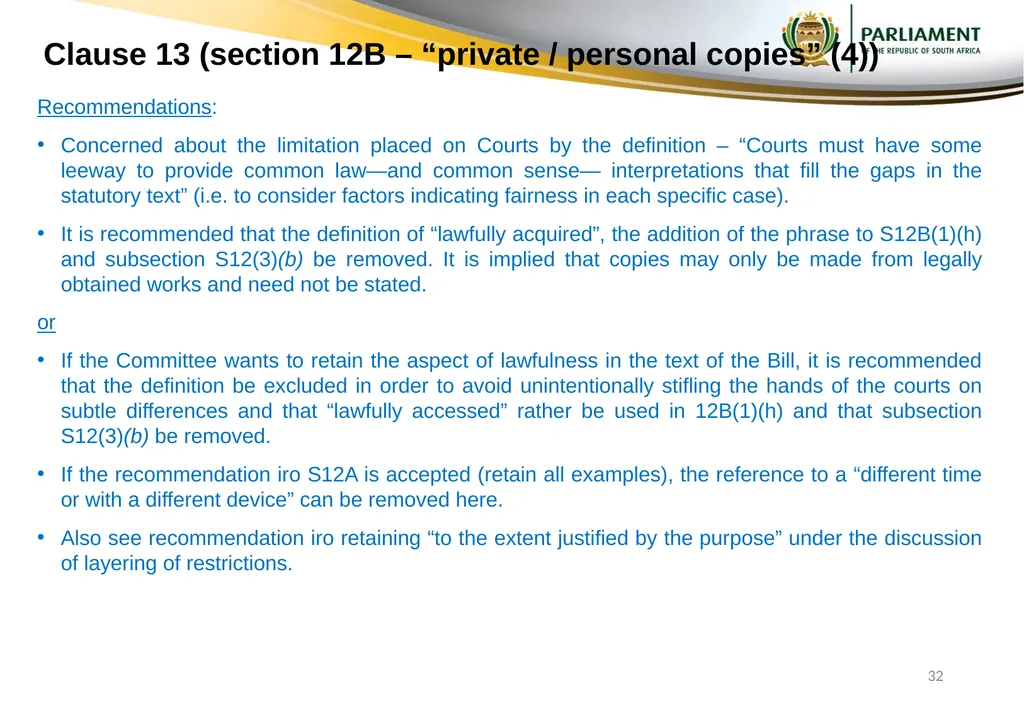
Clause 13 (section 12B – “private / personal copies” (4)) Recommendations:
Concerned about the limitation placed on Courts by the definition – “Courts must have some leeway to provide common law—and common sense— interpretations that fill the gaps in the statutory text” (i.e. to consider factors indicating fairness in each specific case).
It is recommended that the definition of “lawfully acquired”, the addition of the phrase to S12B(1)(h) and subsection S12(3)(b) be removed. It is implied that copies may only be made from legally obtained works and need not be stated.
or
If the Committee wants to retain the aspect of lawfulness in the text of the Bill, it is recommended that the definition be excluded in order to avoid unintentionally stifling the hands of the courts on subtle differences and that “lawfully accessed” rather be used in 12B(1)(h) and that subsection S12(3)(b) be removed.
If the recommendation iro S12A is accepted (retain all examples), the reference to a “different time or with a different device” can be removed here.
Also see recommendation iro retaining “to the extent justified by the purpose” under the discussion of layering of restrictions. 32<br>
Concerned about the limitation placed on Courts by the definition – “Courts must have some leeway to provide common law—and common sense— interpretations that fill the gaps in the statutory text” (i.e. to consider factors indicating fairness in each specific case).
It is recommended that the definition of “lawfully acquired”, the addition of the phrase to S12B(1)(h) and subsection S12(3)(b) be removed. It is implied that copies may only be made from legally obtained works and need not be stated.
or
If the Committee wants to retain the aspect of lawfulness in the text of the Bill, it is recommended that the definition be excluded in order to avoid unintentionally stifling the hands of the courts on subtle differences and that “lawfully accessed” rather be used in 12B(1)(h) and that subsection S12(3)(b) be removed.
If the recommendation iro S12A is accepted (retain all examples), the reference to a “different time or with a different device” can be removed here.
Also see recommendation iro retaining “to the extent justified by the purpose” under the discussion of layering of restrictions. 32<br>
33
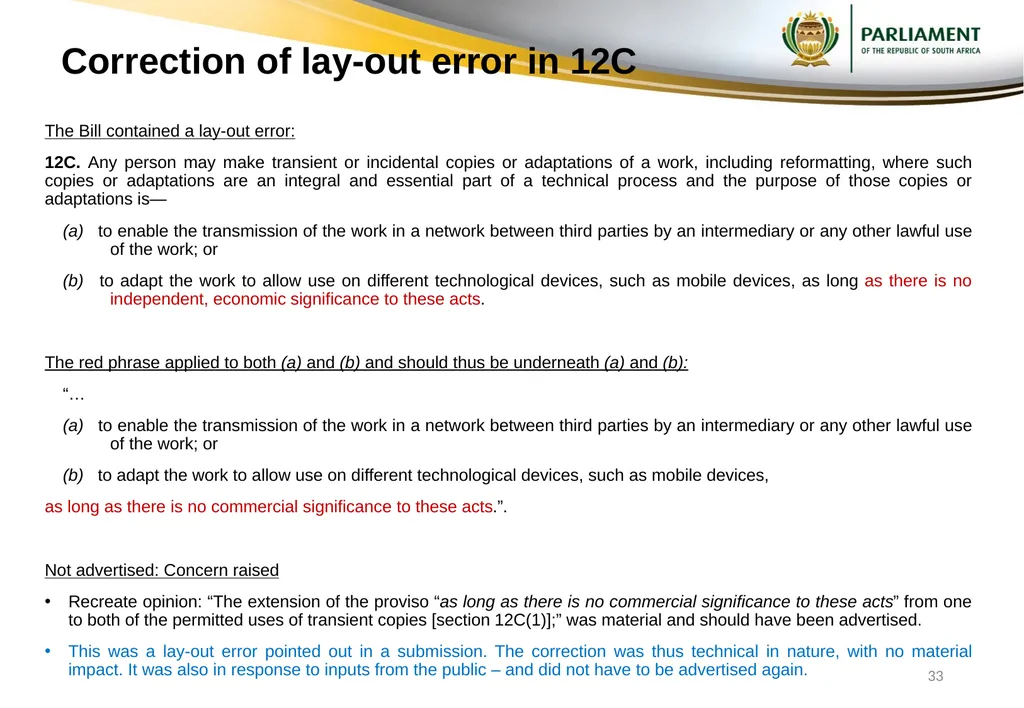
Correction of lay-out error in 12C The Bill contained a lay-out error:
12C. Any person may make transient or incidental copies or adaptations of a work, including reformatting, where such copies or adaptations are an integral and essential part of a technical process and the purpose of those copies or adaptations is—
(a) to enable the transmission of the work in a network between third parties by an intermediary or any other lawful use of the work; or
(b) to adapt the work to allow use on different technological devices, such as mobile devices, as long as there is no independent, economic significance to these acts.
The red phrase applied to both (a) and (b) and should thus be underneath (a) and (b):
“…
(a) to enable the transmission of the work in a network between third parties by an intermediary or any other lawful use of the work; or
(b) to adapt the work to allow use on different technological devices, such as mobile devices,
as long as there is no commercial significance to these acts.”.
Not advertised: Concern raised
Recreate opinion: “The extension of the proviso “as long as there is no commercial significance to these acts” from one to both of the permitted uses of transient copies [section 12C(1)];” was material and should have been advertised.
This was a lay-out error pointed out in a submission. The correction was thus technical in nature, with no material impact. It was also in response to inputs from the public – and did not have to be advertised again. 33<br>
12C. Any person may make transient or incidental copies or adaptations of a work, including reformatting, where such copies or adaptations are an integral and essential part of a technical process and the purpose of those copies or adaptations is—
(a) to enable the transmission of the work in a network between third parties by an intermediary or any other lawful use of the work; or
(b) to adapt the work to allow use on different technological devices, such as mobile devices, as long as there is no independent, economic significance to these acts.
The red phrase applied to both (a) and (b) and should thus be underneath (a) and (b):
“…
(a) to enable the transmission of the work in a network between third parties by an intermediary or any other lawful use of the work; or
(b) to adapt the work to allow use on different technological devices, such as mobile devices,
as long as there is no commercial significance to these acts.”.
Not advertised: Concern raised
Recreate opinion: “The extension of the proviso “as long as there is no commercial significance to these acts” from one to both of the permitted uses of transient copies [section 12C(1)];” was material and should have been advertised.
This was a lay-out error pointed out in a submission. The correction was thus technical in nature, with no material impact. It was also in response to inputs from the public – and did not have to be advertised again. 33<br>
34
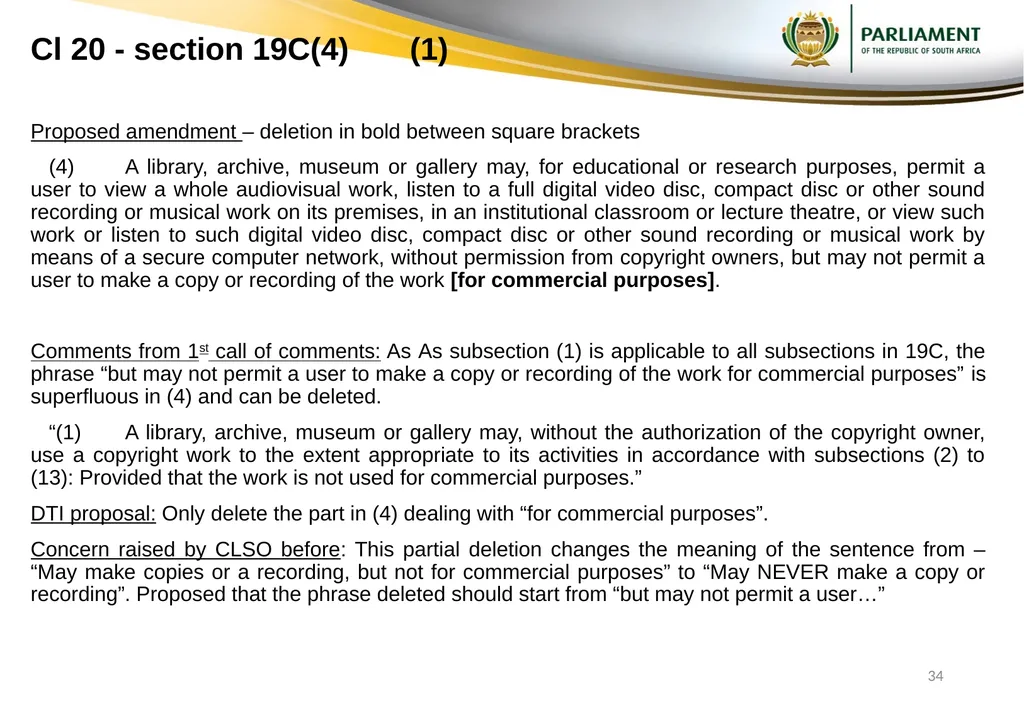
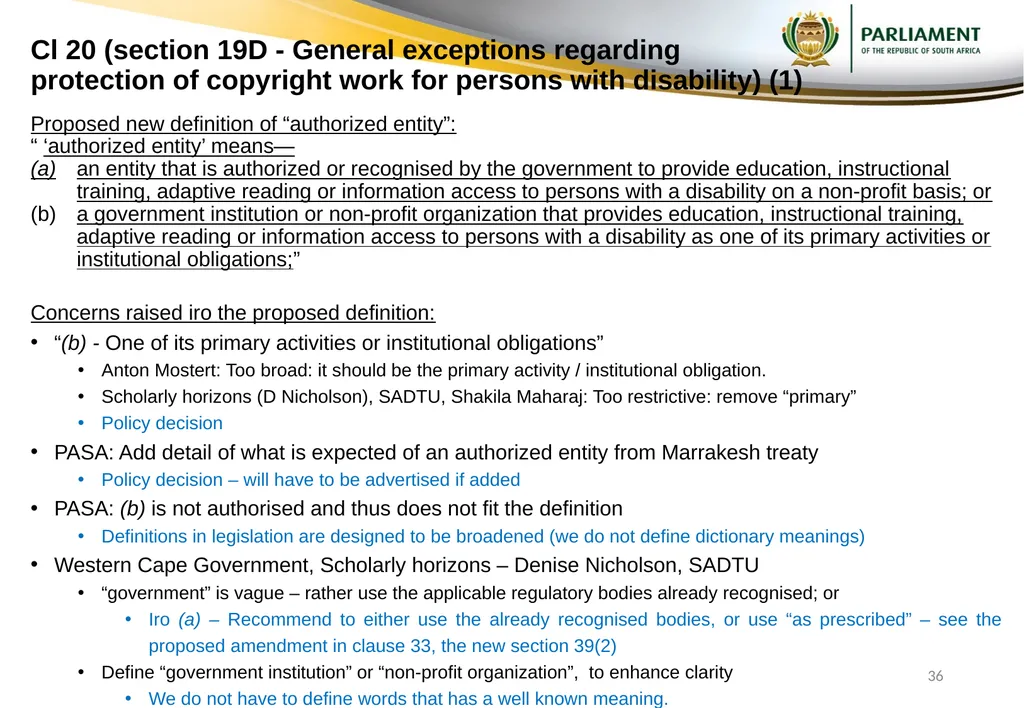
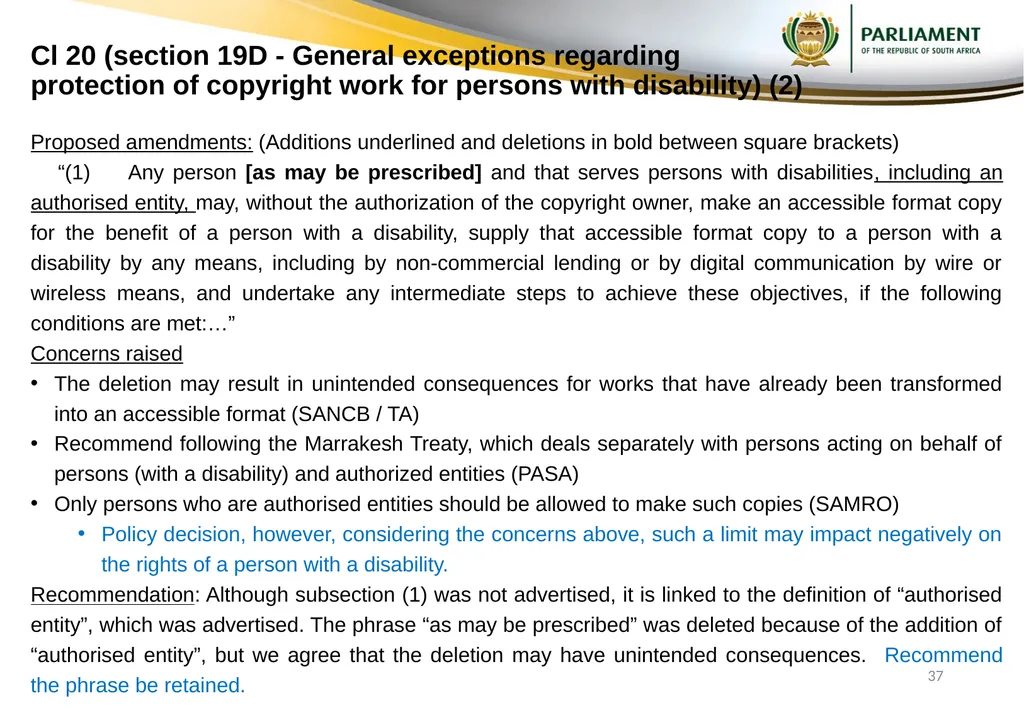
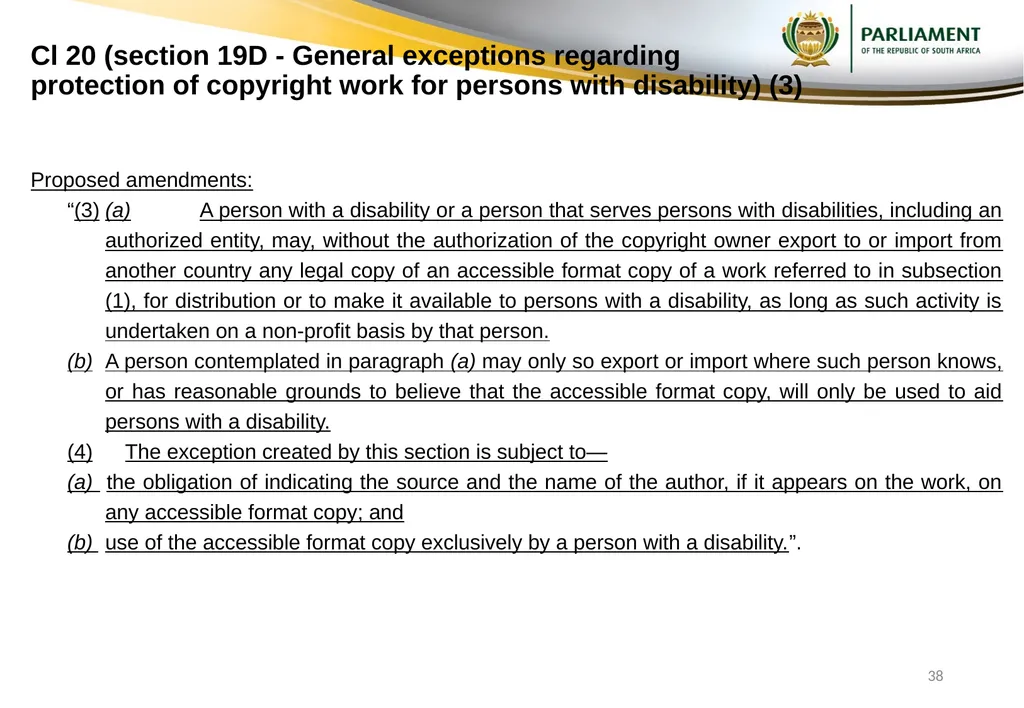
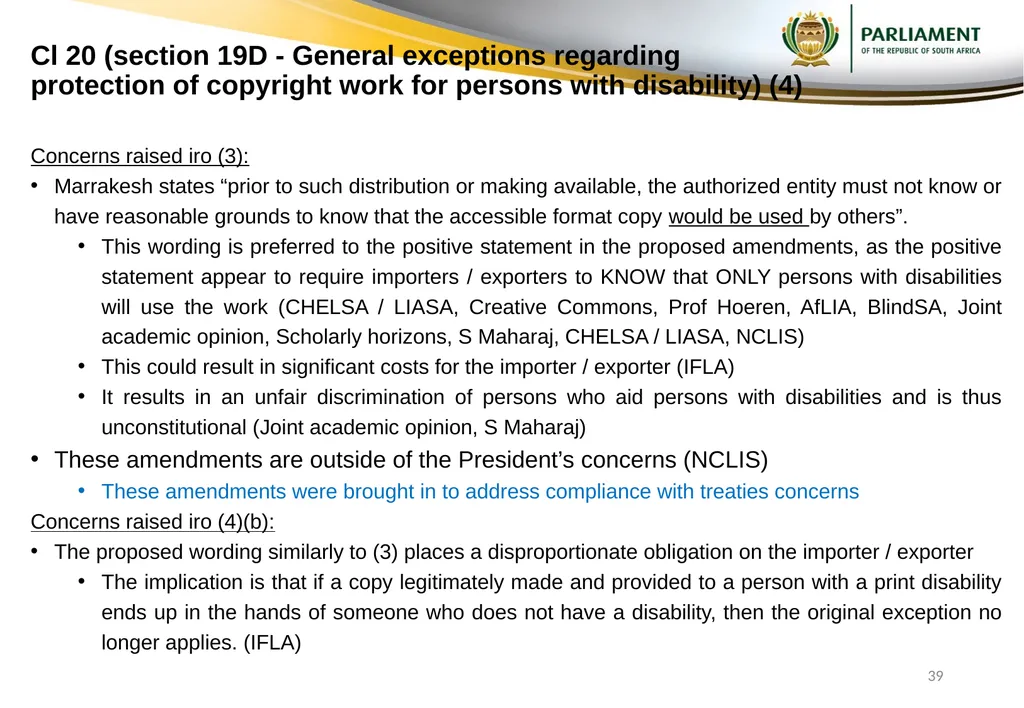
Cl 20 - section 19C(4) (1) Proposed amendment – deletion in bold between square brackets
(4) A library, archive, museum or gallery may, for educational or research purposes, permit a user to view a whole audiovisual work, listen to a full digital video disc, compact disc or other sound recording or musical work on its premises, in an institutional classroom or lecture theatre, or view such work or listen to such digital video disc, compact disc or other sound recording or musical work by means of a secure computer network, without permission from copyright owners, but may not permit a user to make a copy or recording of the work [for commercial purposes].
Comments from 1st call of comments: As As subsection (1) is applicable to all subsections in 19C, the phrase “but may not permit a user to make a copy or recording of the work for commercial purposes” is superfluous in (4) and can be deleted.
“(1) A library, archive, museum or gallery may, without the authorization of the copyright owner, use a copyright work to the extent appropriate to its activities in accordance with subsections (2) to (13): Provided that the work is not used for commercial purposes.”
DTI proposal: Only delete the part in (4) dealing with “for commercial purposes”.
Concern raised by CLSO before: This partial deletion changes the meaning of the sentence from – “May make copies or a recording, but not for commercial purposes” to “May NEVER make a copy or recording”. Proposed that the phrase deleted should start from “but may not permit a user…” 34<br>
(4) A library, archive, museum or gallery may, for educational or research purposes, permit a user to view a whole audiovisual work, listen to a full digital video disc, compact disc or other sound recording or musical work on its premises, in an institutional classroom or lecture theatre, or view such work or listen to such digital video disc, compact disc or other sound recording or musical work by means of a secure computer network, without permission from copyright owners, but may not permit a user to make a copy or recording of the work [for commercial purposes].
Comments from 1st call of comments: As As subsection (1) is applicable to all subsections in 19C, the phrase “but may not permit a user to make a copy or recording of the work for commercial purposes” is superfluous in (4) and can be deleted.
“(1) A library, archive, museum or gallery may, without the authorization of the copyright owner, use a copyright work to the extent appropriate to its activities in accordance with subsections (2) to (13): Provided that the work is not used for commercial purposes.”
DTI proposal: Only delete the part in (4) dealing with “for commercial purposes”.
Concern raised by CLSO before: This partial deletion changes the meaning of the sentence from – “May make copies or a recording, but not for commercial purposes” to “May NEVER make a copy or recording”. Proposed that the phrase deleted should start from “but may not permit a user…” 34<br>
35
Cl 20 - section 19C(4) (2) Concerns raised:
The limited deletion seriously affects libraries and their users, especially in a covid environment with remote teaching and given the recent UCT fire (Assman, CHELSA / LIASA, BlindSA / S27, Creative Commons, Right 2 Know)
It will e.g. hold back the use of library materials for research and data mining (IFLA, Right 2 Know)
It will prohibit libraries and archives using innovative technologies, e.g. streaming an audio visual work to a user’s device, which make technical copies of the work. (Joint Academic opinion)
The proposed deletion can create confusion in respect of copies permitted in the remainder of Section 19C. The prohibition on copying is unnecessary here as (4) is already limited to permitting “a user to view” (Joint Academic opinion)
The proposed limited deletion does not permit reproduction at all (e.g. not even for a school assignment), which arguably will deepen inequalities and is thus unconstitutional and also impractical, particularly in the covid environment and given the recent UCT fire. (CHELSA / LIASA, BlindSA / S27, EIFL, IFLA, SADTU, Scholarly horizons, S Maharaj)
Reverse the deletion, or at the very least provide for reproduction for educational and research purposes (at least for personal or private use), and to enable conversions into accessible formats for persons with disabilities. (Assman, CHELSA / LIASA, BlindSA / S27, Creative Commons, Right 2 Know, SADTU, S Maharaj)
This is not strict enough – add the three step test (Recommendation: this test is a guide only)
Recommendation: The whole phrase “…but may not permit a user to make a copy or recording of the work for commercial purposes” be removed, alternatively that “for commercial purposes” be retained. 35<br>
The limited deletion seriously affects libraries and their users, especially in a covid environment with remote teaching and given the recent UCT fire (Assman, CHELSA / LIASA, BlindSA / S27, Creative Commons, Right 2 Know)
It will e.g. hold back the use of library materials for research and data mining (IFLA, Right 2 Know)
It will prohibit libraries and archives using innovative technologies, e.g. streaming an audio visual work to a user’s device, which make technical copies of the work. (Joint Academic opinion)
The proposed deletion can create confusion in respect of copies permitted in the remainder of Section 19C. The prohibition on copying is unnecessary here as (4) is already limited to permitting “a user to view” (Joint Academic opinion)
The proposed limited deletion does not permit reproduction at all (e.g. not even for a school assignment), which arguably will deepen inequalities and is thus unconstitutional and also impractical, particularly in the covid environment and given the recent UCT fire. (CHELSA / LIASA, BlindSA / S27, EIFL, IFLA, SADTU, Scholarly horizons, S Maharaj)
Reverse the deletion, or at the very least provide for reproduction for educational and research purposes (at least for personal or private use), and to enable conversions into accessible formats for persons with disabilities. (Assman, CHELSA / LIASA, BlindSA / S27, Creative Commons, Right 2 Know, SADTU, S Maharaj)
This is not strict enough – add the three step test (Recommendation: this test is a guide only)
Recommendation: The whole phrase “…but may not permit a user to make a copy or recording of the work for commercial purposes” be removed, alternatively that “for commercial purposes” be retained. 35<br>
36
Cl 20 (section 19D - General exceptions regarding
protection of copyright work for persons with disability) (1) Proposed new definition of “authorized entity”:
“ ‘authorized entity’ means—
(a) an entity that is authorized or recognised by the government to provide education, instructional training, adaptive reading or information access to persons with a disability on a non-profit basis; or
a government institution or non-profit organization that provides education, instructional training, adaptive reading or information access to persons with a disability as one of its primary activities or institutional obligations;”
Concerns raised iro the proposed definition:
“(b) - One of its primary activities or institutional obligations”
Anton Mostert: Too broad: it should be the primary activity / institutional obligation.
Scholarly horizons (D Nicholson), SADTU, Shakila Maharaj: Too restrictive: remove “primary”
Policy decision
PASA: Add detail of what is expected of an authorized entity from Marrakesh treaty
Policy decision – will have to be advertised if added
PASA: (b) is not authorised and thus does not fit the definition
Definitions in legislation are designed to be broadened (we do not define dictionary meanings)
Western Cape Government, Scholarly horizons – Denise Nicholson, SADTU
“government” is vague – rather use the applicable regulatory bodies already recognised; or
Iro (a) – Recommend to either use the already recognised bodies, or use “as prescribed” – see the proposed amendment in clause 33, the new section 39(2)
Define “government institution” or “non-profit organization”, to enhance clarity
We do not have to define words that has a well known meaning. 36<br>
“ ‘authorized entity’ means—
(a) an entity that is authorized or recognised by the government to provide education, instructional training, adaptive reading or information access to persons with a disability on a non-profit basis; or
a government institution or non-profit organization that provides education, instructional training, adaptive reading or information access to persons with a disability as one of its primary activities or institutional obligations;”
Concerns raised iro the proposed definition:
“(b) - One of its primary activities or institutional obligations”
Anton Mostert: Too broad: it should be the primary activity / institutional obligation.
Scholarly horizons (D Nicholson), SADTU, Shakila Maharaj: Too restrictive: remove “primary”
Policy decision
PASA: Add detail of what is expected of an authorized entity from Marrakesh treaty
Policy decision – will have to be advertised if added
PASA: (b) is not authorised and thus does not fit the definition
Definitions in legislation are designed to be broadened (we do not define dictionary meanings)
Western Cape Government, Scholarly horizons – Denise Nicholson, SADTU
“government” is vague – rather use the applicable regulatory bodies already recognised; or
Iro (a) – Recommend to either use the already recognised bodies, or use “as prescribed” – see the proposed amendment in clause 33, the new section 39(2)
Define “government institution” or “non-profit organization”, to enhance clarity
We do not have to define words that has a well known meaning. 36<br>
37
Cl 20 (section 19D - General exceptions regarding
protection of copyright work for persons with disability) (2) Proposed amendments: (Additions underlined and deletions in bold between square brackets)
“(1) Any person [as may be prescribed] and that serves persons with disabilities, including an authorised entity, may, without the authorization of the copyright owner, make an accessible format copy for the benefit of a person with a disability, supply that accessible format copy to a person with a disability by any means, including by non-commercial lending or by digital communication by wire or wireless means, and undertake any intermediate steps to achieve these objectives, if the following conditions are met:…”
Concerns raised
The deletion may result in unintended consequences for works that have already been transformed into an accessible format (SANCB / TA)
Recommend following the Marrakesh Treaty, which deals separately with persons acting on behalf of persons (with a disability) and authorized entities (PASA)
Only persons who are authorised entities should be allowed to make such copies (SAMRO)
Policy decision, however, considering the concerns above, such a limit may impact negatively on the rights of a person with a disability.
Recommendation: Although subsection (1) was not advertised, it is linked to the definition of “authorised entity”, which was advertised. The phrase “as may be prescribed” was deleted because of the addition of “authorised entity”, but we agree that the deletion may have unintended consequences. Recommend the phrase be retained. 37<br>
“(1) Any person [as may be prescribed] and that serves persons with disabilities, including an authorised entity, may, without the authorization of the copyright owner, make an accessible format copy for the benefit of a person with a disability, supply that accessible format copy to a person with a disability by any means, including by non-commercial lending or by digital communication by wire or wireless means, and undertake any intermediate steps to achieve these objectives, if the following conditions are met:…”
Concerns raised
The deletion may result in unintended consequences for works that have already been transformed into an accessible format (SANCB / TA)
Recommend following the Marrakesh Treaty, which deals separately with persons acting on behalf of persons (with a disability) and authorized entities (PASA)
Only persons who are authorised entities should be allowed to make such copies (SAMRO)
Policy decision, however, considering the concerns above, such a limit may impact negatively on the rights of a person with a disability.
Recommendation: Although subsection (1) was not advertised, it is linked to the definition of “authorised entity”, which was advertised. The phrase “as may be prescribed” was deleted because of the addition of “authorised entity”, but we agree that the deletion may have unintended consequences. Recommend the phrase be retained. 37<br>
38
Cl 20 (section 19D - General exceptions regarding
protection of copyright work for persons with disability) (3) Proposed amendments:
“(3) (a) A person with a disability or a person that serves persons with disabilities, including an authorized entity, may, without the authorization of the copyright owner export to or import from another country any legal copy of an accessible format copy of a work referred to in subsection (1), for distribution or to make it available to persons with a disability, as long as such activity is undertaken on a non-profit basis by that person.
(b) A person contemplated in paragraph (a) may only so export or import where such person knows, or has reasonable grounds to believe that the accessible format copy, will only be used to aid persons with a disability.
(4) The exception created by this section is subject to—
(a) the obligation of indicating the source and the name of the author, if it appears on the work, on any accessible format copy; and
(b) use of the accessible format copy exclusively by a person with a disability.”. 38<br>
“(3) (a) A person with a disability or a person that serves persons with disabilities, including an authorized entity, may, without the authorization of the copyright owner export to or import from another country any legal copy of an accessible format copy of a work referred to in subsection (1), for distribution or to make it available to persons with a disability, as long as such activity is undertaken on a non-profit basis by that person.
(b) A person contemplated in paragraph (a) may only so export or import where such person knows, or has reasonable grounds to believe that the accessible format copy, will only be used to aid persons with a disability.
(4) The exception created by this section is subject to—
(a) the obligation of indicating the source and the name of the author, if it appears on the work, on any accessible format copy; and
(b) use of the accessible format copy exclusively by a person with a disability.”. 38<br>
39
Cl 20 (section 19D - General exceptions regarding
protection of copyright work for persons with disability) (4) Concerns raised iro (3):
Marrakesh states “prior to such distribution or making available, the authorized entity must not know or have reasonable grounds to know that the accessible format copy would be used by others”.
This wording is preferred to the positive statement in the proposed amendments, as the positive statement appear to require importers / exporters to KNOW that ONLY persons with disabilities will use the work (CHELSA / LIASA, Creative Commons, Prof Hoeren, AfLIA, BlindSA, Joint academic opinion, Scholarly horizons, S Maharaj, CHELSA / LIASA, NCLIS)
This could result in significant costs for the importer / exporter (IFLA)
It results in an unfair discrimination of persons who aid persons with disabilities and is thus unconstitutional (Joint academic opinion, S Maharaj)
These amendments are outside of the President’s concerns (NCLIS)
These amendments were brought in to address compliance with treaties concerns
Concerns raised iro (4)(b):
The proposed wording similarly to (3) places a disproportionate obligation on the importer / exporter
The implication is that if a copy legitimately made and provided to a person with a print disability ends up in the hands of someone who does not have a disability, then the original exception no longer applies. (IFLA) 39<br>
Marrakesh states “prior to such distribution or making available, the authorized entity must not know or have reasonable grounds to know that the accessible format copy would be used by others”.
This wording is preferred to the positive statement in the proposed amendments, as the positive statement appear to require importers / exporters to KNOW that ONLY persons with disabilities will use the work (CHELSA / LIASA, Creative Commons, Prof Hoeren, AfLIA, BlindSA, Joint academic opinion, Scholarly horizons, S Maharaj, CHELSA / LIASA, NCLIS)
This could result in significant costs for the importer / exporter (IFLA)
It results in an unfair discrimination of persons who aid persons with disabilities and is thus unconstitutional (Joint academic opinion, S Maharaj)
These amendments are outside of the President’s concerns (NCLIS)
These amendments were brought in to address compliance with treaties concerns
Concerns raised iro (4)(b):
The proposed wording similarly to (3) places a disproportionate obligation on the importer / exporter
The implication is that if a copy legitimately made and provided to a person with a print disability ends up in the hands of someone who does not have a disability, then the original exception no longer applies. (IFLA) 39<br>
40
Cl 20 (section 19D - General exceptions regarding
protection of copyright work for persons with disability) (5) Recommendation:
The treaty language is worded as a defence to something that seems to have happened already – legislation cannot be worded with an infringement deemed to have happened already. The Bill is setting up the requirements for import, not providing a defence: furthermore, there needs to be an obligation before there can be a breach that requires a defence. We can thus not use future and past tense in one sentence.
Proposed amendment to find a compromise – complying with legislative language but addressing the concern
19D(3)(b) A person contemplated in paragraph (a) may not export or import an accessible format copy where such person knows, or has reasonable grounds to believe that the accessible format copy will be used for purposes other than to aid persons with a disability.
If there is still discomfort, a clause stating a defence (in the wording of the treaty) may be added.
19D(4)(b) use of the accessible format copy exclusively to aid persons with a disability;
Or delete 19D(4)(b) as it is repeating the implied requirement in (3)(b). 40<br>
The treaty language is worded as a defence to something that seems to have happened already – legislation cannot be worded with an infringement deemed to have happened already. The Bill is setting up the requirements for import, not providing a defence: furthermore, there needs to be an obligation before there can be a breach that requires a defence. We can thus not use future and past tense in one sentence.
Proposed amendment to find a compromise – complying with legislative language but addressing the concern
19D(3)(b) A person contemplated in paragraph (a) may not export or import an accessible format copy where such person knows, or has reasonable grounds to believe that the accessible format copy will be used for purposes other than to aid persons with a disability.
If there is still discomfort, a clause stating a defence (in the wording of the treaty) may be added.
19D(4)(b) use of the accessible format copy exclusively to aid persons with a disability;
Or delete 19D(4)(b) as it is repeating the implied requirement in (3)(b). 40<br>
41
Clause 29: Technological protection measures (1) Proposed definitions (difference between Bill and proposed amendments indicated here):
“‘technological protection measure’--
[(a)] means any process, treatment, mechanism, technology, device, product, system or component that in the normal course of its operation [prevents or restricts] is designed to prevent or restrict the infringement of copyright in a work; [and
(b) does not include a process, treatment, mechanism, technology, device, system or component, to the extent that in the normal course of its operation, it controls any access to a work for non-infringing purposes;]”
“‘technological protection measure circumvention device or service’ means a device or service—
(a) primarily designed, produced or adapted for purposes of enabling or facilitating the circumvention of a technological protection measure;
(b) promoted, advertised or marketed for the purpose of circumvention of a technological protection measure; or
(c) with a limited commercially significant purpose or use other than to circumvent a technological protection measure;”; 41<br>
“‘technological protection measure’--
[(a)] means any process, treatment, mechanism, technology, device, product, system or component that in the normal course of its operation [prevents or restricts] is designed to prevent or restrict the infringement of copyright in a work; [and
(b) does not include a process, treatment, mechanism, technology, device, system or component, to the extent that in the normal course of its operation, it controls any access to a work for non-infringing purposes;]”
“‘technological protection measure circumvention device or service’ means a device or service—
(a) primarily designed, produced or adapted for purposes of enabling or facilitating the circumvention of a technological protection measure;
(b) promoted, advertised or marketed for the purpose of circumvention of a technological protection measure; or
(c) with a limited commercially significant purpose or use other than to circumvent a technological protection measure;”; 41<br>
42
Clause 29: Technological protection measures (2) Concerns raised – general
Goes beyond the section 79(1) remit (NCLIS)
The Committee decided to consider compliance with treaties and this fell under that consideration
Concerns raised – too restrictive
The definitions are based on the US regime defined in Sec 1201 of the 1998 Digital Millennium Copyright Act ("DMCA 1201") – this regime has significant defects (Dr C Doctorow) – see notes page for summaries of the submissions.
DMCA 1201 compromised 3 freedoms: to use the product as the consumer wants to; the freedom of the consumer to choose from whom to buy accessories, consumables, services and repairs; and the freedom of auditors to uncover and publicise defects in the products (“any disclosure could jeopardise the TPM”).
In South Africa, the imaginative reconfiguration of diverse components to adapt or repair a system to suit local needs and conditions will be prohibited: Foreign giants will decide what is and is not permissible in respect of the digital technologies that South Africans depend upon.
The proposed amendments erase the protections for non-infringing circumvention that were latent in the original text
The changes are not needed to comply with the treaties.
Par (c) of TPM circumvention device or Service endangers some of the most successful and popular free/open tools, which often have no "commercially significant purpose.”
The deletion of par (b) in the definition of TPM is not required by international law, affects technologies used for expression, and by people with disabilities (i.e. constitutional concerns) and would have harmful effects
(b) is allowed by WCT and WPPT and gives flexibility necessary for circumvention for lawful means -- e.g. to make a copy for classroom use or to quote in a documentary film. (Creative Commons, Joint Academic opinion, Recreate, Right2Know, S Maharaj)
The addition of par.s (b) and (c) in TPM circumvention device, affects technologies used for expression, and by people with disabilities (i.e. constitutional concerns) (Right2Know, PASA (iro (c)))
The TPM does not allow for appropriate channels for relief for person who would like access to protected works (MNet / NAB). 42<br>
Goes beyond the section 79(1) remit (NCLIS)
The Committee decided to consider compliance with treaties and this fell under that consideration
Concerns raised – too restrictive
The definitions are based on the US regime defined in Sec 1201 of the 1998 Digital Millennium Copyright Act ("DMCA 1201") – this regime has significant defects (Dr C Doctorow) – see notes page for summaries of the submissions.
DMCA 1201 compromised 3 freedoms: to use the product as the consumer wants to; the freedom of the consumer to choose from whom to buy accessories, consumables, services and repairs; and the freedom of auditors to uncover and publicise defects in the products (“any disclosure could jeopardise the TPM”).
In South Africa, the imaginative reconfiguration of diverse components to adapt or repair a system to suit local needs and conditions will be prohibited: Foreign giants will decide what is and is not permissible in respect of the digital technologies that South Africans depend upon.
The proposed amendments erase the protections for non-infringing circumvention that were latent in the original text
The changes are not needed to comply with the treaties.
Par (c) of TPM circumvention device or Service endangers some of the most successful and popular free/open tools, which often have no "commercially significant purpose.”
The deletion of par (b) in the definition of TPM is not required by international law, affects technologies used for expression, and by people with disabilities (i.e. constitutional concerns) and would have harmful effects
(b) is allowed by WCT and WPPT and gives flexibility necessary for circumvention for lawful means -- e.g. to make a copy for classroom use or to quote in a documentary film. (Creative Commons, Joint Academic opinion, Recreate, Right2Know, S Maharaj)
The addition of par.s (b) and (c) in TPM circumvention device, affects technologies used for expression, and by people with disabilities (i.e. constitutional concerns) (Right2Know, PASA (iro (c)))
The TPM does not allow for appropriate channels for relief for person who would like access to protected works (MNet / NAB). 42<br>
43
Clause 29: Technological protection measures (3) Concerns raised – not restrictive enough
These are still not providing “Adequate legal protection” as required by WCT and WPPT (CCSA, Dalro, IPO, IBFC, ASA, CPA, PASA)
The definitions still refer to technologies that prevent or restrict infringement, as opposed to technologies designed to have that effect or control access to copies of works – could allow abuse (IPA)
Whilst there might be a case to be made for exceptions and limitations with regard to "copy control" TPMs applied on individual copyright works, there is almost never a justified exception to circumvent "access control" TPMs (Mnet, NAB).
The existing CAB provisions do not provide sufficient protections for the TPM - allow for a high burden of proof on a very high and subjective standard, which will make it difficult to successfully prosecute persons (Mnet, NAB).
A ‘licence to hack’ through TPMs is tantamount to an invasion of property and unconstitutional if not reasonable and for full compensation and with attribution or credit
The property right is iro not being arbitrarily deprived of property - any deprivation for the reasons why TPM circumvention devices are allowed would comply with section 36 limitation of rights and would not be arbitrary.
Recommendation
Concerned about unintended consequences from these amendments – they could result in exceptions, which should be allowed for normal lawful activities, being prevented.
It is recommended that iro the:
Definition of TPM
Retain original wording, including retaining par (b); and
Adding “product” (also to paragraph (b) of definition of TPM).
Definition of TPM circumvention device:
Add “or service”
Paragraphs (b) and (c) to be removed 43<br>
These are still not providing “Adequate legal protection” as required by WCT and WPPT (CCSA, Dalro, IPO, IBFC, ASA, CPA, PASA)
The definitions still refer to technologies that prevent or restrict infringement, as opposed to technologies designed to have that effect or control access to copies of works – could allow abuse (IPA)
Whilst there might be a case to be made for exceptions and limitations with regard to "copy control" TPMs applied on individual copyright works, there is almost never a justified exception to circumvent "access control" TPMs (Mnet, NAB).
The existing CAB provisions do not provide sufficient protections for the TPM - allow for a high burden of proof on a very high and subjective standard, which will make it difficult to successfully prosecute persons (Mnet, NAB).
A ‘licence to hack’ through TPMs is tantamount to an invasion of property and unconstitutional if not reasonable and for full compensation and with attribution or credit
The property right is iro not being arbitrarily deprived of property - any deprivation for the reasons why TPM circumvention devices are allowed would comply with section 36 limitation of rights and would not be arbitrary.
Recommendation
Concerned about unintended consequences from these amendments – they could result in exceptions, which should be allowed for normal lawful activities, being prevented.
It is recommended that iro the:
Definition of TPM
Retain original wording, including retaining par (b); and
Adding “product” (also to paragraph (b) of definition of TPM).
Definition of TPM circumvention device:
Add “or service”
Paragraphs (b) and (c) to be removed 43<br>
44
Offences – Clause 27, Section 27 - general General concerns raised
The lowering of the mental state (mens rea) requirement for specific statutory offences in the Bill from “knows or has reason to know” (a subjective standard requiring intention (dolus)) to “knows or should reasonably have known” (an objective standard which encompasses mere negligence (culpa)) [sections 28O, 28P, 28S] should have been advertised (Recreate opinion):
These are consequential amendments because of the amendments to section 27 (offences), which was advertised. Comments on the amendments were thus considered.
Disagree with argument re subjective vs objective standard in opinion: Both phrases are linked to reasonableness (objective negligence tests) and are two sides of the same coin – “has reason to know” is very seldom used in legislation. The more known phrase – especially in respect of an offence - is “should reasonably have known”.
The new provisions for offences in relation to digital rights should be made by way of an amendment to Section 27(5) of the Act, and the existing terminology “for the purposes of trade” should be used, together with the element of “knowing to be infringement copies”, to define the offence. Section 27(5A) must then be withdrawn (SAIIPL)
DTIC to advise 44<br>
The lowering of the mental state (mens rea) requirement for specific statutory offences in the Bill from “knows or has reason to know” (a subjective standard requiring intention (dolus)) to “knows or should reasonably have known” (an objective standard which encompasses mere negligence (culpa)) [sections 28O, 28P, 28S] should have been advertised (Recreate opinion):
These are consequential amendments because of the amendments to section 27 (offences), which was advertised. Comments on the amendments were thus considered.
Disagree with argument re subjective vs objective standard in opinion: Both phrases are linked to reasonableness (objective negligence tests) and are two sides of the same coin – “has reason to know” is very seldom used in legislation. The more known phrase – especially in respect of an offence - is “should reasonably have known”.
The new provisions for offences in relation to digital rights should be made by way of an amendment to Section 27(5) of the Act, and the existing terminology “for the purposes of trade” should be used, together with the element of “knowing to be infringement copies”, to define the offence. Section 27(5A) must then be withdrawn (SAIIPL)
DTIC to advise 44<br>
45
Offences – Clause 27, Section 27(5A) (1) Proposed wording (proposed changes underlined)
“(5A) Any person who at a time when copyright subsists in a work, without the authority of the owner of the copyright and for commercial purposes—
(a) communicates the work to the public by wire or wireless means; or
(b) makes the work available to the public by wire or wireless means, so that any member of the public may access the work from a place and at a time chosen by that person,
which they know to be infringing copyright in the work, shall be guilty of an offence.
(Offence iro Clauses 4 (S6), 6 (S7), 8 (S8), 10 (S9), 11 (S9A) and new amendments iro SS11A and 11B) 45<br>
“(5A) Any person who at a time when copyright subsists in a work, without the authority of the owner of the copyright and for commercial purposes—
(a) communicates the work to the public by wire or wireless means; or
(b) makes the work available to the public by wire or wireless means, so that any member of the public may access the work from a place and at a time chosen by that person,
which they know to be infringing copyright in the work, shall be guilty of an offence.
(Offence iro Clauses 4 (S6), 6 (S7), 8 (S8), 10 (S9), 11 (S9A) and new amendments iro SS11A and 11B) 45<br>
46
Offences – Clause 27, Section 27(5A) (2) Concerns raised
The owner is not always the person who gives consent in practice – it might be on behalf of the owner, but as this is an offence clause, the drafting should be clear.
Recommend: (insertions underlined, deletions [bold]) - “Any person who at a time when copyright subsists in a work, without the necessary authority [of the owner] and for commercial purposes…”
Remove “and for commercial purposes” – it weakens the effectiveness of this provision (Capasso, E Media, FIAPF, SAMRO, IPO, IBFC, ASA and CPA). Policy decision, however, this clause deals with offences, which are serious breaches. Copyright infringement (a civil matter) may be a better fit for prevention of non-commercial uses.
Use terminology of the Act - “for the purposes of trade” (SAIIPL)
This phrase is used in section 23 of the Act, which deals with infringement. The Bill uses “commercial purposes”, but not in sections 6, 7, 8, or 9. However sections 8A, 9A and 22C uses “commercial purposes” iro sections 6, 7, 8, 9 and 9A .
It could be better to use the phrase currently used in the Act (“for the purposes of trade”) here, but if this is done, it is recommended that the sections where “commercial purposes” is used, are then also accordingly amended.
The conceptual confusion concerning the right of communication to the public, and the making available right is continued here – this should be corrected (Anton Mostert). DTIC to advise
Include the element of “knowing to be infringement copies”, to define the offence (SAIIPL). Recommend this inclusion.
Change “which they know” to “which such person knows, or should reasonably have known” to be consistent with proposed section 27(5B)(a). Recommend this amendment.
Paragraphs should be numbered (a) and (b) and not (eA) and (eB). Agree – this was a typing error. 46<br>
The owner is not always the person who gives consent in practice – it might be on behalf of the owner, but as this is an offence clause, the drafting should be clear.
Recommend: (insertions underlined, deletions [bold]) - “Any person who at a time when copyright subsists in a work, without the necessary authority [of the owner] and for commercial purposes…”
Remove “and for commercial purposes” – it weakens the effectiveness of this provision (Capasso, E Media, FIAPF, SAMRO, IPO, IBFC, ASA and CPA). Policy decision, however, this clause deals with offences, which are serious breaches. Copyright infringement (a civil matter) may be a better fit for prevention of non-commercial uses.
Use terminology of the Act - “for the purposes of trade” (SAIIPL)
This phrase is used in section 23 of the Act, which deals with infringement. The Bill uses “commercial purposes”, but not in sections 6, 7, 8, or 9. However sections 8A, 9A and 22C uses “commercial purposes” iro sections 6, 7, 8, 9 and 9A .
It could be better to use the phrase currently used in the Act (“for the purposes of trade”) here, but if this is done, it is recommended that the sections where “commercial purposes” is used, are then also accordingly amended.
The conceptual confusion concerning the right of communication to the public, and the making available right is continued here – this should be corrected (Anton Mostert). DTIC to advise
Include the element of “knowing to be infringement copies”, to define the offence (SAIIPL). Recommend this inclusion.
Change “which they know” to “which such person knows, or should reasonably have known” to be consistent with proposed section 27(5B)(a). Recommend this amendment.
Paragraphs should be numbered (a) and (b) and not (eA) and (eB). Agree – this was a typing error. 46<br>
47
Offences – Clause 27, Section 27(5B) (1) Proposed wording (proposed changes underlined)
(5B) Subject to section 28P, any person who, at the time when copyright subsists in a work that is protected by a technological protection measure applied by the author or owner of the copyright—
(a) makes, imports, sells, distributes, lets for hire, offers or exposes for sale or hire or advertises for sale or hire, a technological protection measure circumvention device or service if—
(i) such person knows, or should reasonably have known, that that device or service will or is likely to be used to infringe copyright in a work protected by an effective technological protection measure;
(ii) such person provides a service to another person to enable or assist such other person to circumvent an effective technological protection measure; or
(iii) such person knows, or should reasonably have known, that the service contemplated in subparagraph (ii) will or is likely to be used by another person to infringe copyright in a work protected by an effective technological protection measure;
(b) publishes information enabling or assisting any other person to circumvent an effective technological protection measure with the intention of inciting that other person to unlawfully circumvent an effective technological protection measure in the Republic; or
(c) circumvents such an effective technological protection measure when they are not authorized to do so,
shall be guilty of an offence. 47<br>
(5B) Subject to section 28P, any person who, at the time when copyright subsists in a work that is protected by a technological protection measure applied by the author or owner of the copyright—
(a) makes, imports, sells, distributes, lets for hire, offers or exposes for sale or hire or advertises for sale or hire, a technological protection measure circumvention device or service if—
(i) such person knows, or should reasonably have known, that that device or service will or is likely to be used to infringe copyright in a work protected by an effective technological protection measure;
(ii) such person provides a service to another person to enable or assist such other person to circumvent an effective technological protection measure; or
(iii) such person knows, or should reasonably have known, that the service contemplated in subparagraph (ii) will or is likely to be used by another person to infringe copyright in a work protected by an effective technological protection measure;
(b) publishes information enabling or assisting any other person to circumvent an effective technological protection measure with the intention of inciting that other person to unlawfully circumvent an effective technological protection measure in the Republic; or
(c) circumvents such an effective technological protection measure when they are not authorized to do so,
shall be guilty of an offence. 47<br>
48
Offences – Clause 27, Section 27(5B) (2) Concerns raised
The treaty provisions applicable to technological protection measures do not require criminalisation of circumvention, much less doing so based on a negligence standard - consider having only civil penalties for circumvention (Joint Academic opinion).
Policy decision: However consider that the amendment was to bring this in line with treaties, and if not required, the amendment could then be discarded.
Including “negligence” as part of the offence (“reasonably ought to have known”):
This expects someone to know at the time that the device or service is likely to be used to infringe copyright, without a warning to cease any offending activities (Google)
This will negatively affect the production of general-purpose tools that might incidentally also constitute circumvention devices, (e.g. debuggers, decompilers, and other essential tools for security audits) (Doctorow, Joint Academic opinion)
This expands the criminalisation of people using their own property, music, and books that they have bought and paid for but are prevented from using by software restrictions (Creative Commons).
Committee to decide if negligence should be a criminal office. Recommend that only intent is retained in S27 or that the amendments be discarded as a whole.
The wording of S28O, P and S can then also revert to “has reason to know” as it seems the public is more comfortable with that phrasing.
The bar for an infringement for circumvention of the dealing with devices is too high – no knowledge should be required. The mere offering of devices or services is enough (PASA, RiSA).
Strict liability may affect the rights of an accused person and is thus likely to be unconstitutional. 48<br>
The treaty provisions applicable to technological protection measures do not require criminalisation of circumvention, much less doing so based on a negligence standard - consider having only civil penalties for circumvention (Joint Academic opinion).
Policy decision: However consider that the amendment was to bring this in line with treaties, and if not required, the amendment could then be discarded.
Including “negligence” as part of the offence (“reasonably ought to have known”):
This expects someone to know at the time that the device or service is likely to be used to infringe copyright, without a warning to cease any offending activities (Google)
This will negatively affect the production of general-purpose tools that might incidentally also constitute circumvention devices, (e.g. debuggers, decompilers, and other essential tools for security audits) (Doctorow, Joint Academic opinion)
This expands the criminalisation of people using their own property, music, and books that they have bought and paid for but are prevented from using by software restrictions (Creative Commons).
Committee to decide if negligence should be a criminal office. Recommend that only intent is retained in S27 or that the amendments be discarded as a whole.
The wording of S28O, P and S can then also revert to “has reason to know” as it seems the public is more comfortable with that phrasing.
The bar for an infringement for circumvention of the dealing with devices is too high – no knowledge should be required. The mere offering of devices or services is enough (PASA, RiSA).
Strict liability may affect the rights of an accused person and is thus likely to be unconstitutional. 48<br>
49
Offences – Clause 27, Section 27(5C) Proposed wording (proposed changes underlined)
(5C) Subject to section 28S, any person who—
(a) in respect of any copy of a work, remove or modify any copyright management information; or
(b) make, import, sell, let for hire, offer or expose for sale, advertise for sale or hire or communicate to the public a work or a copy of a work, if the copyright management information in respect of that work or copy of that work, has been removed or modified without the authority of the copyright owner,
shall be guilty of an offence.
Concerns raised
Note that verbs in (5C)(a) and (b) should be in the singular form (PASA, Anton Mostert).
This will be corrected.
The conceptual confusion concerning the right of communication to the public, and the making available right is continued here – this should be corrected (Anton Mostert). DTIC to advise
Sub-section (5C)(b), must, like sub-section (5A), only constitute an offence where the infringing party knows that it is infringing copyright.
In this regard, broadcasters often receive content from third parties and may not have direct knowledge about whether they are infringing copyright or not.
To the extent that sub-section (5C)(b) imposes strict liability, this must be addressed - this may make this provision potentially liable to a constitutional challenge, as it results in strict liability. (Anton Mostert, E Media)
Recommend that this element be included in (5C) 49<br>
(5C) Subject to section 28S, any person who—
(a) in respect of any copy of a work, remove or modify any copyright management information; or
(b) make, import, sell, let for hire, offer or expose for sale, advertise for sale or hire or communicate to the public a work or a copy of a work, if the copyright management information in respect of that work or copy of that work, has been removed or modified without the authority of the copyright owner,
shall be guilty of an offence.
Concerns raised
Note that verbs in (5C)(a) and (b) should be in the singular form (PASA, Anton Mostert).
This will be corrected.
The conceptual confusion concerning the right of communication to the public, and the making available right is continued here – this should be corrected (Anton Mostert). DTIC to advise
Sub-section (5C)(b), must, like sub-section (5A), only constitute an offence where the infringing party knows that it is infringing copyright.
In this regard, broadcasters often receive content from third parties and may not have direct knowledge about whether they are infringing copyright or not.
To the extent that sub-section (5C)(b) imposes strict liability, this must be addressed - this may make this provision potentially liable to a constitutional challenge, as it results in strict liability. (Anton Mostert, E Media)
Recommend that this element be included in (5C) 49<br>
50
The end 50<br>